_____________________________________________
Formation of a Solid Solution Through Accumulative Roll Bonding (ARB) and Post-Heat
Treatment of Multilayered Cu/Zn/Al
M. Reihanian
1*, M.M. Mahdavian
2, L. Ghalandari
3, and A. Obeidavi
21Department of Materials Science and Engineering, Faculty of Engineering, Shahid Chamran University of Ahvaz, Iran
2 Department of Materials Science and Engineering, Ahvaz Branch, Islamic Azad University, Ahvaz, Iran 3
Department of Materials Science and Engineering, Shiraz Branch, Islamic Azad University, Shiraz, Iran
Abstract: In the present study, the capability of accumulative roll bonding (ARB) and subsequent heat-treatment to fabricate solid solution from a multilayered Cu/Zn/Al was investigated. Two post-heat treatment (one-step and two-step) routes were proposed. In the first, the ARB processed material was heated to 800 C for five and a half hours and allowed to cool slowly in a furnace (one-step route). In the second (two-step route), the composite was heated to 800 C for 3 hours and quenched in the cold water (0 ºC). The microstructures were characterized using a field emission scanning electron microscope (SEM) equipped with energy dispersive x-ray detector (EDX). The x-ray diffraction (XRD) pattern was used to identify the phases. Results indicated that even after imposing high ARB cycles (up to 14 cycles), the solid solution could not be formed. However, after the subsequent heat-treatment, Cu, Zn and Al distributed uniformly in the microstructure and a copper-based solid solution was formed.
Keywords: Accumulative roll bonding, heat treatment, multilayer, solid solution
1. Introduction
Accumulative roll bonding (ARB) is a kind of severe plastic deformation that can produce sheets with ultra-fine grained microstructure [1]. It consists of multiple cycles of stacking, cutting, rolling and deformation bonding. During the method, large value of plastic strain is imposed after several cycles, which results a considerable increase in strength of the material. Recently, ARB has also been employed, as a solid-state process, for producing both the particulate and multilayered metal matrix composites (MMCs). Alizadeh and Paydar [2] took pioneering steps to suggest the idea of producing particulate MMCs through repeated-roll bonding. The idea was then utilized to fabricate several particulate MMCs via ARB such as in [3-7]. Reihanian et al. [8, 9] showed that a uniform distribution of particles could be achieved after imposing a critical strain during ARB. Besides, Lee et al. [10] fabricated Fe/Ag and Ni/Ag multilayers by using a bonding and rolling method. Afterward, Min et al. [11] employed ARB as a solid state method to fabricate Al/Ni composite. In that case, a variety of bimetal multilayered systems such as Al/Mg [12], Al/Zn [13], Al/Ni [14], Al/Cu [15, 16], Cu/Ag [17], Cu/Ni [18], Al 2219/5086 [19] and Cu/Zn [20] were used to produce MMCs via ARB. A few attempts have been also made to fabricate MMCs consisting of three metallic constituents such as Al/Ni/Cu [21] and Cu/Zn/Al [22].
wt. %) in the form of sheets with a thickness of 0.9, 0.8, and 0.3 mm, respectively. All sheets were cut into 30 mm × 150 mm in size. Annealing of the elemental materials was conducted at 400 C for 60 min (for Al), at 150 C for 30 min (for Zn), and at 500 C for 60 min (for Cu). After surface preparation, Al and Zn strips were put between two Cu layers to form a sandwich of Cu (71 wt. %), Zn (25 wt. %) and Al (4 wt. %). The primary sandwich was fastened by copper wires on the four edges and cold rolled to a reduction in thickness of 57%. To investigate whether the ARB process has the capability of producing the solid solution through inter-diffusion across the layer interfaces, the sandwich was then conducted by the highest possible number of ARB cycles (up to 14 cycles) that could be achieved in the present investigation. The details of ARB process has been discussed in the previous work [22].
To investigate the possibility of solid solution formation after ARB, two post heat-treating routes were conducted after ARB. In the first, the ARB processed material was heated to 800 C for five and a half hours and allowed to cool slowly in a furnace (one-step route). In the second (two-step route), the composite was heated to 800 C for 3 hours and quenched in the cold water (0 ºC). Then, it was heated to 800 C for 3 hours and slowly cooled in the furnace. The heat treatment conditions were selected because during ARB and mechanical alloying, the material is undergone severe plastic deformation and the microstructure evolution is similar. Therefore, the temperature of heat treatment was selected based on a Cu/Zn/Al alloy that has been formed by mechanical alloying of the metal powders and subsequent sintering at high temperatures [24]. The holding time is chosen in a manner to allow diffusing atoms to have enough time for diffusion and formation of a solid solution. Heat-treating at the temperature of 800 C for 5 h has been previously used to eliminate the effect of the mechanical processing and homogenize the microstructure of the Cu-Zn alloy [25]. It is noticed that the effect of ARB cycle and heat treatment conditions on the solid solution formation is not the goal of the present study and needs to be investigated further in subsequent investigations.
The microstructure of the material was investigated by a field emission scanning electron microscope (FESEM) equipped with energy dispersive x-ray detector (EDX). X-ray diffraction (XRD) pattern was performed by a diffractometer, operating at 40 kV and 30 mA with Cu Kα radiation and a step time of 2 s.
3. Results and discussion
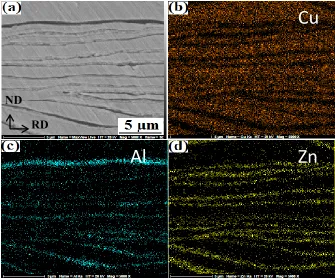
Fig. 1: SEM/line scan analysis of the Cu/Zn/Al multilayer after the first ARB cycle.
During ARB, the hard phase necks and fractures due to co-deformation of dissimilar metals and difference in flow properties that results in fragmentation of the layers. The fragmented layers become smaller and distribute uniformly as the ARB cycle is increased [12-15, 17, 18]. In previous studies [22], it was indicated that a uniform distribution of fragments could be achieved after imposing 14 ARB cycles into Cu/Zn/Al multilayer. Nonetheless, SEM/elemental maps at high magnifications (Fig.2) indicates that Cu, Zn and Al elements yet present as separate phases, representing that solid solution cannot be formed even after high ARB cycles.
Fig 2: SEM/elemental maps at high magnifications.
RD
ND
Cu
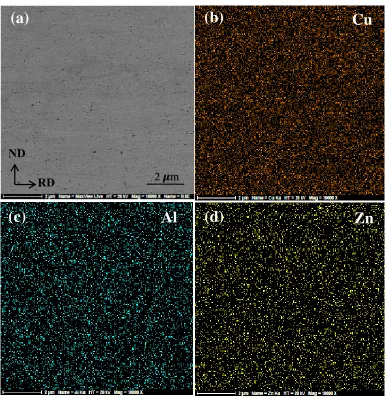
Fig 3: SEM/elemental mapping after 14 ARB cycles followed by the two-step heat-treatment route.
The XRD patterns after 14 ARB cycles with and without heat treatment are presented in Fig.4. After 14 ARB cycle with no heat treatment (Fig.4a), the pattern indicates reflections due to the elements Cu and Zn. Reflections of Al are not entirely apparent because its quantity is low compared with other elements.
(c)
Al
(d)
Zn
Fig 4: XRD patterns after 14 ARB cycles with and without heat treatment.
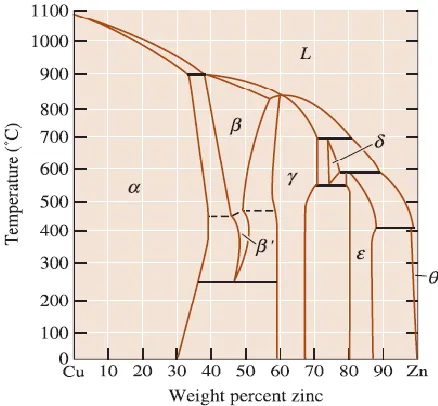
The patterns also indicate the reflection of CuZn5 intermetallic that is formed during ARB as a new phase at the interface between Cu and Zn. It is formed due to imposing of intense plastic deformation that results in an increase in the grain boundaries and dislocation density. This accelerates the elemental diffusion at interfaces and promotes the formation of non-equilibrium intermetallic. The formation of intermetallic phases is also reported during ARB of other multilayers [26-28]. Post-heat treatment causes the line intensity of high angle peaks decreases and Cu peaks shift to lower angle side (Fig.4b and Fig.4c). However, after the one-step heat treatment route, the reflection of Zn still exists while CuZn5 reflection disappears indicating its dissolution in the lattice. Considering the phase diagram of Cu-Zn (Fig.5) and composition of the alloy, CuZn5 is a non-equilibrium phase that is formed during ARB.
Fig. 5: phase diagram of Cu-Zn [29].
However, after the one-step heat treatment route, the reflection of Zn still exists while CuZn5 reflection disappears indicating its dissolution in the lattice. Considering the phase diagram of Cu-Zn (Fig.5) and composition of the alloy, CuZn5 is a non-equilibrium phase that is formed during ARB. Therefore, CuZn5 can be dissolved in the lattice when sufficient activation energy is provided by thermal energy during heat treatment. In contrast to one-step heat treatment, reflection of Zn is no longer detected after two-step heat treatment route. This confirms the conclusion drawn from the SEM/mapping (Fig.3) that Zn is dissolved within Cu lattice after the two-step heat treatment route.
Since the weight percent of Al is low compared to Cu and Zn, the phase diagram of Cu-Zn is investigated and presented in Fig.5. Regarding the composition of the alloy (71Cu-25Zn), a single solid solution must be formed at room temperature. The solubility of zinc in copper is limited and increases with increasing temperature. Consequently, if the alloy contains more than about 30% Zn, the excess zinc atoms combine with some of the copper atoms to form 𝜸 phase. This phase is a non-stoichiometric intermetallic compounds (CuZn compound) that has a range of compositions and is sometimes called intermediate solid solutions [29]. Two solid phases coexist at this region: a solid solution of copper saturated with about 30% Zn plus a CuZn compound.
4. Conclusions
A multilayered Cu/Zn/Al is processed via ARB and two post-heat treatment routes. The following results are obtained:
1-After 14 ARB cycles, a lamellar structure consisting of Cu, Zn and Al as separate phases is observed in the microstructure.
2- After two-step heat-treatment, the lamellar structure disappeared and all elements distribute in the microstructure uniformly.
3- XRD patterns confirm the SEM/mapping results and demonstrated that a copper-solid solution is formed after 14 ARB cycle followed by the two-step heat treatment.
Acknowledgement: The authors would like to thank Dr. Kh. Gheisari for his valuable discussions.
References
[1] Y. Saito, H. Utsunomiya, N. Tsuji, T. Sakai, Novel ultra-high straining process for bulk materials—development of the accumulative roll-bonding (ARB) process, Acta Materialia, 47 (1999) 579-583.
[2] M. Alizadeh, M.H. Paydar, Fabrication of Al/SiCP composite strips by repeated roll-bonding (RRB) process, Journal of Alloys and Compounds, 477 (2009) 811-816.
[3] A. Yazdani, E. Salahinejad, Evolution of reinforcement distribution in Al–B4C composites during accumulative roll bonding, Materials & Design, 32 (2011) 3137-3142.
[4] R. Jamaati, M.R. Toroghinejad, J. Dutkiewicz, J.A. Szpunar, Investigation of nanostructured Al/Al2O3 composite produced by accumulative roll bonding process, Materials & Design, 35 (2012) 37-42.
[5] M. Alizadeh, H.A. beni, M. Ghaffari, R. Amini, Properties of high specific strength Al–4wt.% Al2O3/B4C nano-composite produced by accumulative roll bonding process, Materials & Design, 50 (2013) 427-432.
[6] C.Y. Liu, Q. Wang, Y.Z. Jia, B. Zhang, R. Jing, M.Z. Ma, Q. Jing, R.P. Liu, Evaluation of mechanical properties of 1060-Al reinforced with WC particles via warm accumulative roll bonding process, Materials & Design, 43 (2013) 367-372.
[7] A. Ahmadi, M.R. Toroghinejad, A. Najafizadeh, Evaluation of microstructure and mechanical properties of Al/Al2O3/SiC hybrid composite fabricated by accumulative roll bonding process, Materials & Design, 53 (2014) 13-19.
[8] M. Reihanian, E. Bagherpour, M.H. Paydar, Particle distribution in metal matrix composites fabricated by accumulative roll bonding, Materials Science and Technology, 28 (2012) 103-108.
[9] M. Reihanian, E. Bagherpour, M.H. Paydar, On the achievement of uniform particle distribution in metal matrix composites fabricated by accumulative roll bonding, Materials Letters, 91 (2013) 59-62.
[10] J.-M. Lee, B.-R. Lee, S.-B. Kang, Control of layer continuity in metallic multilayers produced by deformation synthesis method, Materials Science and Engineering: A, 406 (2005) 95-101.
[11] G. Min, J.-M. Lee, S.-B. Kang, H.-W. Kim, Evolution of microstructure for multilayered Al/Ni composites by accumulative roll bonding process, Materials Letters, 60 (2006) 3255-3259.
[12] M.C. Chen, H.C. Hsieh, W. Wu, The evolution of microstructures and mechanical properties during accumulative roll bonding of Al/Mg composite, Journal of Alloys and Compounds, 416 (2006) 169-172.
63-processed by accumulative roll bonding, Materials Science and Engineering: A, 559 (2013) 759-764.
[19] S. Roy, B.R. Nataraj, S. Suwas, S. Kumar, K. Chattopadhyay, Accumulative roll bonding of aluminum alloys 2219/5086 laminates: Microstructural evolution and tensile properties, Materials & Design, 36 (2012) 529-539. [20] L. Ghalandari, M.M. Mahdavian, M. Reihanian, Microstructure evolution and mechanical properties of Cu/Zn multilayer processed by accumulative roll bonding (ARB), Materials Science and Engineering: A, 593 (2014) 145-152.
[21] A. Shabani, M.R. Toroghinejad, A. Shafyei, Fabrication of Al/Ni/Cu composite by accumulative roll bonding and electroplating processes and investigation of its microstructure and mechanical properties, Materials Science and Engineering: A, 558 (2012) 386-393.
[22] M.M. Mahdavian, L. Ghalandari, M. Reihanian, Accumulative roll bonding of multilayered Cu/Zn/Al: An evaluation of microstructure and mechanical properties, Materials Science and Engineering: A, 579 (2013) 99-107. [23] F. C. Lovey, V. Torra, Shape memory in Cu-based alloys: phenomenological behavior at the mesoscale level and interaction of martensitic transformation with structural defects in Cu-Zn-Al, Progress in Materials Science, 44 (1999) 189-289.
[24] A. V. Traleski, S. Vurobi Jr, O.M. Cintho, Processing of Cu-Al-Ni and Cu-Zn-Al alloys by mechanical alloying, Materials Science Forum, 727-728 (2012) 200-205.
[25] X.X. Wu, X.Y. San, Y.L. Gong, L.P. Chen, C.J. Li, X.K. Zhu, Studies on strength and ductility of Cu–Zn alloys by stress relaxation, Materials & Design, 47 (2013) 295-299.
[26] K. Wu, H. Chang, E. Maawad, W.M. Gan, H.G. Brokmeier, M.Y. Zheng, Microstructure and mechanical properties of the Mg/Al laminated composite fabricated by accumulative roll bonding (ARB), Materials Science and Engineering: A, 527 (2010) 3073-3078.
[27] A. Mozaffari, M. Hosseini, H.D. Manesh, Al/Ni metal intermetallic composite produced by accumulative roll bonding and reaction annealing, Journal of Alloys and Compounds, 509 (2011) 9938-9945.
[28] H. Chang, M.Y. Zheng, C. Xu, G.D. Fan, H.G. Brokmeier, K. Wu, Microstructure and mechanical properties of the Mg/Al multilayer fabricated by accumulative roll bonding (ARB) at ambient temperature, Materials Science and Engineering: A, 543 (2012) 249-256.
[29] D. Askeland, P. Fulay, Essentials of Materials Science & Engineering, second ed., Cengage Learning, USA, 2008.