Procedia Technology 6 ( 2012 ) 526 – 533
2212-0173 © 2012 The Authors. Published by Elsevier Ltd. Selection and/or peer-review under responsibility of the Department of Computer Science & Engineering, National Institute of Technology Rourkela
doi: 10.1016/j.protcy.2012.10.063
Block Encoding of Color Histogram for Content Based Image
Retrieval Applications
Shaila S G, Vadivel A*
Multimedia Information Retrieval Group, Department of Computer Applications, National Institute of Technoloogy Trichy India
{[email protected],[email protected]}
Abstract
In content-based image retrieval (CBIR) application, a large amount of floating-point data is processed. Among various low-level features, color is an important feature and represented in the form of histogram. It is essential that features required to be coded in such a way that the storage space requirement is low and processing speed is high. In this paper, we propose an encoding approach using Golomb-Rice coding, which effectively codes the floating point bin values of the color histogram. The floating point values are converted into integer values using preprocessing steps. The encoded histogram is finally represented in the form of sparse matrix and XOR based bitwise comparison is used as similarity measure to calculate the distance between the encoded and query histogram in the feature space. Based on the number of , the retrieved list is ranked and the relevant images are presented. This approach is tested in CBIR application and the precision of retrieval is encouraging compared to the original color histogram and the average bit length is very low besides having fast retrieval time.
© 2012 The Authors. Published by Elsevier Ltd.
Selection and/or peer-review under responsibility of the Department of Computer Science & Engineering, National Institute of Technology Rourkela
Keywords: floating point number; Golomb-Rice code; histogram encoding; Image retrieval
1. Introduction
In recent times, various real-time applications transfer large amount of numerical data and requires large space. It is essential that data has to be compressed to save disk space and to increase the processing speed. During compression, number of bits that need to be transferred and stored is reduced considerably. However, it is noticed that the compression/decompression overhead increases the communication latency and also
* A Vadivel. Tel.: +91-431-2503737; fax: +91-431-2500133. E-mail address: [email protected]
© 2012 The Authors. Published by Elsevier Ltd. Selection and/or peer-review under responsibility of the Department of Computer Science & Engineering, National Institute of Technology Rourkela Open access under CC BY-NC-ND license.
decreases the effective bandwidth. The data compression reduces the size of the given data to a smaller size. While the lossy compression scheme reproduces similar data, the replica of the original data is reproduced in lossless compression scheme. In recent times, floating point number compression has lot of real-time applications and there are two methods for processing the same. The first method, as pre-processing step, floating-point data is quantized into fixed-point data. However, this causes irreversible data loss which is considered as a main disadvantage as the main reason for using a floating-point representation is to avoid data loss. The second method uses general lossless methods such as gzip on the integer representation of the floating-point data. Multimedia applications use compression systems such as adaptive predictors and decorrelating transforms with quantizers for many blocks of the original data into low-entropy blocks of integers that are appropriate for entropy coding (Sayood et al., 1966). Typical entropy coders used in such applications are Run-Length, Huffman, arithmetic and variations of Golomb-Rice coders (Weinberger et al., 2000, Richardson et al., 2003). Due to the large variations in the statistics of blocks of integers to be encoded, designing the efficient entropy coders for such applications is found to be difficult. Among various entropy coders, Golomb-Rice (GR) coders have been used widely in modern compression systems because of its flexibility in changing the encoding tables by modifying a single integer parameter M ( Malvar et al., 1999) . The output code words can be easily computed for the corresponding input symbols so that explicit tables are not required. This approach makes GR coders quite attractive and computations are much faster than memory accesses.
Recently, multimedia information retrieval is fetching attention from both academia and industry. For multimedia retrieval applications, say image, the low level features are extracted for capturing the semantics. These extracted low level features are higher in dimension and requires large space to store them along with original image. It has been felt that it would be appropriate to reduce the size of the feature by employing suitable coding scheme in such a way that the decoding time is low. Further, even though there is loss in the data during coding, the precision of retrieval should not be affected. In this paper, we reduce the dimension of the color histogram which is a floating point number and Golomb-Rice Coding (Golomb et al., 1966) is used to encode values adaptively for achieving lower average bit length. During retrieval, the encoded values are decoded fast and higher precision of retrieval is obtained. The precision retrieval by both the normal histogram and encoded histogram is compared and is observed that there is no difference. Thus, the proposed coding approach for histogram is a suitable candidate for CBIR applications, where large number images and corresponding features are stored and retrieved.
The rest of the paper is organized as follows. In section 2, we review the related work. Section 3 explains the proposed approach in detail. Section 4 presents the experimental results and we conclude in the last section of the paper.
2. Literature Review
It is observed that most of the work on lossless compression of floating-point number focuses on audio, image, scientific measurement and simulation domains. Floating-point data that represent images focus on maximizing the compression ratio as the (de)compression speed is not so relevant. A compression method has been proposed for the double-precision output of a numerical solver for ordinary differential equations (Engelson et al., 2000). Integer delta and extrapolation algorithms are used to compress and decompress the data. However, this method is particularly beneficial with gradually changing data and may not be suitable for real-time applications. An efficient compression scheme for image data has been designed with an emphasis on 2D and 3D data (Lindstrom et al., 2006). The predictions of the data are done using the Lorenzo predictor and -static probability model (Schindler et al., 1998). A technique that combines differentiation and zero suppression is presented to compress floating-point data arising from experiments conducted at the Laser Interferometer Gravitation Wave Observatory (Klimenko
et al., 2001). It is observed that the compression ratio of this approach is same as GZIP but is significantly faster. However, its success is realized only with the nature of the LIGO data and thus values will change gradually. An algorithm has also been proposed for the lossless compression of audio data (Ghido et al., 2004). It transforms the floating-point values into integers and generates an additional binary stream for the lossless reconstruction of the original floating-point values. An extension to the JPEG2000 standard has recently been proposed that allow data to be encoded efficiently with bit-plane coding algorithms where the floating-point values are represented as big integers (Usevitch et al., 2003). The modification required in JPEG 2000 for achieving lossless floating-point compression is carried out by some adjustments in the wavelet transformation (Gamito et al., 2004). An arithmetic coder is used for single-precision floating-point fields that represent residual vectors between the actual and the predicted vertex positions in triangular meshes (Isenburg et al., 2004). In an extended precision algorithm, the Haar wavelet transform and Huffman coding is used to achieve lossless compression in 3D curvilinear grids (Chen et al., 2005). This approach performs differential coding and clustering to generate separate data residuals for the mantissa and exponent and Huffman coder and GZIP are used to encode the mantissa and exponent residuals. In Ratanaworabhan. et al. 2007 the lossless Floating Point Compression (FPC) algorithm used two context based value predictors for predicting the next value. The prediction and the true value are XORed and the result byte is compressed. However, FPC algorithm does not compress multidimensional datasets.Utilizing value predictors as data models for compression has previously been explored for program-execution-trace compression (Burtscher. et al., 2004). An algorithm has also been proposed to compresses sequences of IEEE double-precision floating-point values ( Ratanaworabhan. et al., 2006). It predicts each value in the sequence and XORs it with the true value. Since the sign, the exponent and the top mantissa bits occupy the most significant bit positions in the IEEE 754 standard, it is expected that the XOR result will have a substantial number of leading zeros. Thus, it can be encoded and compressed by a leading zero count that is followed by the remaining bits
.
In Chen. et al. 2009, a system is proposed to compress the histogram by run length coding of nonempty leaf nodes. The statistical analysis accurately models the underlying random process generating the histogram. However, compression of the query feature descriptors is also necessary for low-latency retrieval. A feature descriptor codec is presented in Chandrasekhar. et al., 2009 where each descriptor is transformed by a decorrelating transform, quantized and entropy-coded using Huffman coding or arithmetic coding. Another codec in Yeo. et al., 2008 generates a hash for each descriptor using random projections. The codecs are well suited for pair wise image matching. However, neither codec exploits the fact that, in tree-based retrieval, the tree histogram suffices for accurate classification. A lossy buffer compression / decompression technique is used and whatever the error introduced is kept under control (Rasmusson . et al., 2007). While the error grows relatively more, the method uses lossless compression approach. However, this algorithm has operated only on Low Dynamic Range (LDR) data. In Rasmusson . et al., 2009, a new color buffer compression algorithm is presented for coding floating-point buffers. It is considered that the approximate mode is error bounded and the amount of error introduced is accumulated and is controlled via few parameters. Hierarchical quad tree decomposition is performed and subsequently, hierarchical prediction as well as Golomb- Rice encoding are applied. However, this method is applicable for low-dynamic range color buffer. A method for compressing 16-bit floating-point color is presented and depth buffers in a unified manner has several limitations (Strom . et al., 2008). Scheme does not allow negative values and assumes the alpha channel is 1.0f. The work in Wennersten . et al. 2009, has addressed compression of the alpha channel using two separate compressors for color data which introduced complexity.
Based on the above discussion, it is observed that floating point number coding is useful in many real-time applications. None of the above method is found to be suitable for CBIR applications and also the encoding approach is found to be complex. In contrast, we propose a simple adaptive coding scheme for encoding histogram bin values. The encoding scheme along with the pre-processing steps has reduced the requirement of storage space considerably. The given histogram is segmented as blocks based on number of bins and for each
block, the encoding and decoding parameter is calculated. The precision of retrieval obtained using encoded histogram is similar to that of the original histogram.
3. Proposed Work
In this paper, we encode the bin values of the histogram using Golomb-Rice coding algorithm for achieving better average bit length and thus color histogram can be stored in lesser space. The RGB values from the image are converted in to HSV values. A suitable transformation function is used for converting the HSV value as floating point number (Vadivel . et al., 2008). Each bin value of the histogram is in the form of single-precision floating-point format of the IEEE 754 standard as shown in Fig. 1.
Fig 1: 32-bit IEEE floating-point representation
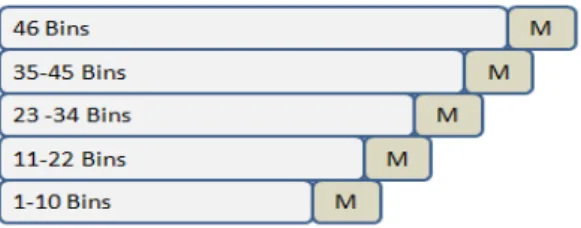
It is noticed from Fig. 2 that the histogram is combined as block and segmented along with the header value based on the number of bins. The header value contains the value M, from which the encoding and decoding offset is calculated. The bins containing 0 values of the histogram are removed and thus the dimension is reduced to certain extent. Further, the bin values having four zeros after the decimal point is also considered as zero values and thus neglected. The refined histogram is again segmented as blocks based on the dimension. Here, the reduced dimension histogram is depicted. The value of M for each block is calculated adaptively. It is known that Golomb-Rice Coding is suitable for integer values. Since, the histogram bin is normalized value, the floating point values are converted as integer without losing information. In this approach, we adaptively, find a multiplication factor (MULT-FACT) by counting number of zero values occurring after the decimal point. The entire bin value of the histogram is multiplied with MULT-FACT and represented as integer for using Golomb-Rice Coding effectively.
Fig. 2. The structural specification of the Histogram blocks
In Table.1 we present the MULT-FACT based on the number of zeros after the decimal point of the bin values wherein the MULT-FACT is adaptively decided for obtaining the integer value of the bin value. The parameter M is calculated for the histogram as given in Eq. (1). Here, W is fixed to 0.69 as given in Justin. et al. 2006 and n is the dimension of the feature. The bin values of the resultant histogram are in the form of integer N and are encoded. The quotient as well as remainder is calculated for each bin values using Eq.(2) and Eq.(3)
Table.1. MULTI_FACT values based on the number of zero after decimal point No. of zeros after decimal point MULTI_FACT
0.0 100 0.00 1000 0.000 10000 --- --- n i i
W
n
h
M
1 (1)Quotient
(
q
)
int
[
N
M
]
(2)Re
mainder
(
r
)
[
N
mod
M
]
(3) Based on the quotient and remainder values, code words are generated as per code format given in Eq.(4)Code
format
Quotient
Code
Re
mainder
Code
(4)If power of M is 2, then rice code has to be applied to the remainder and
log
2M
bits are needed for encoding. Alternatively, if M is not a power of 2, then Eq.(5) is used for encoding the remainder.
b
log
2M
(5) While coding, two important conditions are noted as given below.1. If , code r in plain binary, using b-1 bits
2. If , code the number in plain binary, using b bits.
The sample encoded histogram obtained is shown in Table.2 and is represented in the form of sparse matrix. The average bit length of the encoded histogram is calculated and is found that the average bit length of dimension reduced histogram is always low.
Table.2. Sample Encoded Histogram
Histogram Truncated histogram MULTI-FACT(MF) Final (MF)
Trunc*(MF) M Q Q-Encode R R-Encode Code
0.018434 0.0184 100 18 2 110 4 100 110100 0.004978 0.0049 1000 4 0 0 4 100 0100 0.004335 0.0043 1000 1000 4 7 0 0 4 100 0100 0.003987 0.0039 1000 3 0 0 3 011 0011 0.019956 0.0199 100 19 2 110 5 101 110101
During Retrieval, we calculate the similarity between the query and the database images in the encoded form and this increase the retrieval speed considerably. Both the query image and database images histograms are represented in the binary i.e. coded form. The bit wise XOR is performed for calculating the similarity value. In case, a histogram in the database is same as that of the query histogram, the XOR bit wise operation gives zero as output. In contrast, if any change in the bit values, 1 is given as output. Here, we use number of and for calculating the similarity. If more number of are obtained as output, the query and the database image is far in the feature space. Both of them are considered very close while number of is more. In Table 3, we present the output of histogram comparison, where both the query and database image are not same and accordingly, more number of are obtained as output. In this case, we have obtained 20 number and the
query image is far from the compared image in the feature space.
Table.3. Dissimilarity between query histogram with database histogram in the encoded form
Query Image Database XOR
1100 1101 0001 1000 1011 0011 0 0 0 0 0 0 0 11010 11010 1111001 0 1111001 100001111 101111 001110111 1111111101110 111101110111 0000100000001 1101010 1101010 0000000 101111 0000000 000010 = 20
Similarly, In Table 4, we show the encoded value of query and database histogram and observed that the XOR operation for both of them has given zero for every bit and number of as zero. Thus, the query image and the database image is same in the feature space.
Table.4. Exact match of the query histogram with database histogram in the encoded form
Query Image Database XOR
1100 1100 0000 1000 1000 0000 0 0 0 0 0 0 0 0 0 0 1111001 0000000 100001111 100001111 000000000 1111111101110 1111111101110 0000000000000 1101010 1101010 0000000 101111 101111 000000 4. Experimental Results
The effectiveness of the proposed encoded histogram is evaluated in an image retrieval system. In our experiments, we have used coral benchmark dataset with 10,000 images with 100 classes. We have selected some query images from the various classes for computing recall and precision. We have considered top 50 retrieval images and the average precision and recall for 10 different classes are shown in Fig.3(a)(b). Results are obtained for different values of recall from 0.1 to 1.0 in steps of 0.1 and the corresponding precision was calculated. For all the methods, histogram intersection is used as the distance metric. The higher the distance, the lower is the similarity between a query image and a target image. It is observed that for lower values of recall, the precision is getting higher, which is reaching around 94%. In Fig.3(a), it is noticed that the precision value is almost same even though the bin value are encoded in lossy mode. Similarly in Fig.3(b), the recall for various nearest neighbors is presented and the recall value is almost same as in the precise case. The recall vs. Precision is depicted in Fig.3(c) and for higher recall value, the precision is low as expected. The difference in precision for various recalls using coded and original histogram is almost zero. Further to consolidate the performance of the proposed approach, the F-measure is presented in Eq.(6).This is an Harmonic mean of recall and precision and is shown in Fig.3(d). In line with all the below results, the difference of F-Measure for various nearest neighbors is almost zero. This performance enhancement is due to the fact that the encoding procedure just assigns the code for minimizing the size of the histogram and the information is not lost. Thus, it
is noticed that the proposed approach performs well and retrieve same result set as that of the original histogram but consume less space in the memory.
(6)
(a) (b) (c) (d)
Fig.3. Performance Results of Retrieval (a) Average Precision; (b) Average Recall; (c) Precision vs. Recall; (d) F-Measure
It is observed from Fig.4(a) and Fig.4(b) that the result set of the normal and encoded histogram is similar. The difference in precision of retrieval for both these histogram is negligible. This is due to the fact that while encoding the bin values, the important colour information is very well retained and only unwanted bin value is truncated and considered for saving store space.
(a) (b)
Fig.4. The Retrieval Set (a) Sample Retrieval set using normal histogram; (b) Sample Retrieval set using encoded histogram
5. Conclusion and future work
This paper presents an encoding approach for histogram with floating-point number. Once the encoding is achieved, the encoded histogram is stored in the database. During the retrieval, the query histogram is decoded and based on the user query; retrieved set is ranked based on the similarity. To measure the performance of the proposed approach, we use precision, recall and F-Measure and found that the difference in precision of retrieval as well as F-score obtained using both the original and encoded histogram is almost negligible. Thus, the encoded histogram captures the semantic of the images effectively even though the bin values are coded after lossy pre-processing. In addition, the encoded histogram requires less memory and the processing is fast since the dimension is reduced. As future work, we will try to propose a suitable graph based similarity measure for ranking set.
Acknowledgements
This work is supported by research grant from the Department of Science and Technology, India, under Grant DST/TSG/ICT/2009/27 dated 3rd September 2010.
References
Sayood, K., 1996. Introduction to Data Compression: Morgan Kaufmann.
Weinberger, M.N., Seroussi, G., Sapiro, G., 2000. The LOCO-I lossless image compression algorithm: principles and standardization into JPEG-LS, IEEE Trans. Image Processing , 9, p. 1309.
P R R P PR F 1 1 2 2
Richardson, I. E. G., 2003. H.264 and MPEG-4 Video Compression, Video Coding for Next-Generation Multimedia, Wiley.
Malvar, H.S., 1999. Fast progressive wavelet coding , In Proc.of Data Compression Conf, Snowbird, UT, p. 336. Golomb, S.W., 1966. Run-length encoding, IEEE Transactions on Information Theory, IT-12, p.399.
Engelson, V., Fritzson, D., Fritzson, P., 2000. Lossless Compression of High-volume Numerical Data from Simulations , In Proc. of Data Compression Conf , p. 574.
Lindstrom, P., Isenburg, M., 2006. Fast and Efficient Compression of Floating-Point Data, IEEE Trans. on Visualization and Computer Graphics , 12, p. 5.
Schindler, M., 1998. A Fast Renormalisation for Arithmetic Coding , In Proc. of Data Compression Conference , p. 572. Klimenko, S., Mour, B., Shawhan, P., Sazonov, A., 2001.Data Compression Study with the E2 Data, LIGO-T010033-
00-E Technical Report , p. 1.
Ghido, F., 2004. An Efficient Algorithm for Lossless Compression of IEEE Float Audio , In Proc. of Data Compression Conference , p. 429.
Usevitch, B.E., 2003. JPEG2000 Extensions for Bit Plane Coding of Floating Point Data , In Proc. of Data Conference , p. 451.
Gamito, M.N., Dias, M.S., 2004. Lossless Coding of Floating Point Data with JPEG 2000, Applications of Digital Image Processing , p. 276.
Isenburg, M., Lindstrom, P., Snoeyink, J., 2004. Lossless Compression of Floating-Point Geometry, CAD2004, p. 495. Chen, D., Chiang, J.Y., Memon, N., 2005. Lossless compression of point-based 3D models, Pacific Graphics , p. 124. Martin, Burtscher., Paruj, Ratanaworabhan., 2007. High Throughput Compression of Double-Precision Floating-Point
Data , in Proceedings of the Data Compression Conference, IEEE Computer Society.
Burtscher, M., 2004. VPC3: A Fast and Effective Trace-Compression Algorithm , Joint International Conference on Measurement and Modelling of Computer Systems, p. 167.
Burtscher, M., Ganusov,I., Jackson, S.J., Ke,J., Ratanaworabhan, P., Sam, N.B., 2005. The VPC Trace-Compression Algorithms, IEEE Transactions on Computers , 54, p. 1329.
Burtscher, M., Jeeradit, M., 2003. Compressing Extended Program Traces Using Value Predictors , 12th International Conference on Parallel Architectures and Compilation Techniques , p. 159.
Paruj, Ratanaworabhan., Jian, Ke., Martin, Burtscher.,2006. Fast lossless compression of scientific floating-point data , In Proc. of the Data Compression Conference, IEEE Computer Society.
Chen, D., Tsai, S., Chandrasekha, V., Takac, .G., Singh, J.P., Girod, B., 2009. Tree histogram coding for mobile image Matching , IEEE Data Compression Conference.
Chandrasekhar, V., Takacs, G., Chen, D., Tsai, S.S., Singh, J., Girod, B., 2009. Transform coding of image feature descriptors, In SPIE Visual Communications and Image Processing .
Yeo, C., Ahammad, P., Ramchandran, K., 2008. Rate-efficient visual correspondences using random projections , in IEEE International Conference on Image Processing.
Jim, Rasmusson., Jon, Hasselgren., Tomas, Akenine, Moller., 2007 .Exact and Error-bounded Approximate Colour Buffer Compression and Decompression, in Graphics Hardware , p 41.
Jim, Rasmusson., Jacob, Strom., Tomas, Akenine, Moller., 2009 . Error-bounded Lossy Compression of Floating-Point Colour Buffers using Quadtree Decomposition, the Visual Computer: International Journal of Computer Graphics , 26(Issue 1), Springer-Verlag New York
Strom, J., Wennersten, P., Rasmusson, J., Hasselgren, J., Munkberg, J., Clarberg, P., Akenine, Moller., 2008. Floating- point buffer compression in a unified codec architecture , in Proceedings of the 23rd ACM SIGGRAPH/ EUROGRAPHICS symposium on Graphics hardware , p 75.
Wennersten, P., Strom, J., 2009. Table-based alpha compression, Computer Graphics Forum 28, 2 ,p 687.
Vadivel, A., Shamik, Sural., Majumdar, A.K., 2008. Robust Histogram Generation from the HSV Space based on Visual Colour Perception, International Journal of Signal and Imaging Systems Engineering, InderScience , 1(3/4), p 245.
Justin, Zobel., Alistair, Moffat., 2006. Inverted files for text search engines, ACM Computing Surveys (CSUR) 38, (Issue 2).