Dissemination of an Enterococcus Inc18-Like vanA Plasmid, Associated with 1
Vancomycin-Resistant Staphylococcus aureus 2
3
Wenming Zhu,1 Patrick R. Murray,2 W. Charles Huskins,3 John A. Jernigan,1 Lawrence 4
C. Mcdonald,1 Nancye C. Clark,1 Karen F. Anderson,1 Linda K. Mcdougal,1 Jeff C. 5
Hageman,1 Melissa Olsen-Rasmussen,4 Mike Frace,4 George J. Alangaden,5 Carol 6
Chenoweth,6 Marcus J. Zervos,7 Barbara Robinson-Dunn,8 Paul C. Schreckenberger,9 L. 7
Barth Reller,10 James T. Rudrik,11 Jean B. Patel1* 8
9
Division of Healthcare Quality Promotion1,Division of Scientific Resources4, Centers for Disease
10
Control and Prevention, MS-G08, 1600 Clifton Rd, Atlanta, GA;National Institutes of Health
11
Clinical Center, Bethesda, MD2; College of Medicine, Mayo Clinic, Rochester, MN3; Detroit
12
Medical Center, Detroit, MI5; University of Michigan, Ann Arbor, MI6; Henry Ford Hospital,
13
Detroit, MI7;William Beaumont Hospital, Royal Oak, MI8; Loyola University Medical Center,
14
Maywood, IL9; Duke University Medical Center, Durham, NC10; Michigan Department of
15
Community Health, Lansing, MI11,
16 17 18
Running title: Inc18 vanA plasmids in VRE 19
20 21
*Send Correspondence to: Dr. Jean B. Patel, Division of Healthcare Quality Promotion, 22
Centers for Disease Control and Prevention, 1600 Clifton Rd, MS-G08, Atlanta, GA 23
30333. Phone: (404) 639-0361, Fax: (404) 639-1381. Email: [email protected]. 24
25
The findings and conclusions in this report are those of the authors and do not necessarily 26
represent the official position of the Centers for Disease Control and Prevention or the 27
National Institutes of Health. 28
Copyright © 2010, American Society for Microbiology and/or the Listed Authors/Institutions. All Rights Reserved. Antimicrob. Agents Chemother. doi:10.1128/AAC.00185-10
Abstract 1
Of the 9 vancomycin-resistant Staphylococcus aureus (VRSA) cases reported to 2
date in the literature, 7 occurred in Michigan (MI). In 5 out of 7 of the Michigan VRSA 3
cases, an In18-like vanA plasmid was identified in the VRSA isolate and/or an associated 4
vancomycin-resistant Enterococcus (VRE) isolate from the same patient. This plasmid 5
may play a critical role in the emergence of VRSA and analysis of the geographical 6
distribution of VRE containing this plasmid may explain the observed prevalence of 7
VRSA in MI. A total of 1,641 VRE from three separate collections were tested for the 8
Inc18-like vanA plasmid by PCR for traA, repR, and vanA. All VRE from 2 MI 9
institutions (N= 386), and between 60 to 70 VRE (N=883) from 17 institutions in 13 10
other states were tested. Fifteen isolates (3.9%) from MI were positive for an Inc18-like 11
vanA plasmid (9 E. faecalis [12.5%], 3 E. faecium [1.0%], 2 E. avium, and 1 E.
12
raffinosus). Six isolates (0.6%) from outside of MI were positive (3 E. faecalis [2.7%]
13
and 3 E. faecium [0.4%]). Fourteen of the 15 plasmid-positive isolates from MI had the 14
same Tn1546 insertion site location as those of the VRSA-associated Inc18 plasmid 15
whereas 5 out of 6 plasmid-positive isolates from outside of MI differed in this 16
characteristic. The one exception was an E. faecium isolate with a pulsed-field gel 17
electrophoresis (PFGE) pattern that was indistinguishable from a plasmid-positive isolate 18
from MI. Most plasmid-positive E. faecalis demonstrated diverse patterns by PFGE, with 19
the exception of three pairs with indistinguishable patterns, suggesting the plasmid is 20
mobile. Although VRE with the VRSA-associated Inc18-like vanA plasmid were more 21
common in MI, they remain rare. Periodic surveillance of VRE for the plasmid may be 22
useful in predicting occurrence of VRSA. 23
Currently, vancomycin-resistant S. aureus (VRSA) infections are rare. Thus far, 1
nine cases have been documented in the United States (9, 20), and two have been 2
reported in other countries including Iran (1) and India (22, 27). Despite this rarity, 7 out 3
of the 9 U.S. VRSA cases occurred in the metropolitan Detroit, Michigan (MI) area. All 4
U.S. VRSA demonstrated either unique pulsed-field gel electrophoresis (PFGE) patterns 5
or unique plasmid restriction patterns (20, 33). This suggests that each VRSA isolate, 6
including the 7 from MI, acquired resistance independently and was not the result of 7
transmission of a common VRSA strain between patients. 8
VRSA are thought to occur by in-vivo transfer of a vanA plasmid from an 9
Enterococcus isolate to S. aureus isolate. For most of the VRSA cases, a
vancomycin-10
resistant Enterococcus (VRE) isolate was either co-isolated from the same body site as 11
the VRSA, or was found to colonize the patient at another body site such as the nares or 12
rectum (see Table 1 for a summary of VRE isolates from VRSA patients). There is 13
limited evidence that these VRE are the vanA donors. In previous studies (29, 30, 33), we 14
found that certain VRSA isolates carried vanA on a transposon and in some cases, a 15
plasmid was identified that was identical to the vanA plasmid or transposon in a VRE 16
isolate from the same patient. In VRSA cases 3, 4 and 5, the VRE and VRSA isolates 17
shared the same vanA plasmid. For all other VRSA cases, the VRSA isolates carried the 18
same Tn1546-like element as their associated VRE (10, 33). Hence, it was proposed that 19
the VRSA occurred by conjugative transfer of a vanA plasmid from VRE to S. aureus
20
(29, 33). 21
Inc18 incompatibility plasmids are a family of broad-host range conjugative 22
plasmids that occur naturally in Enterococcus and Streptococcus spp. The plasmids 23
pIP501 and pAMβ1 are two well-characterized examples in this group (15). These 1
plasmids carry multiple antimicrobial resistance genes, including genes that confer 2
resistance to macrolides, lincosamides, and the streptogramin B (MLS) group, and they 3
can be transferred to a wide variety of bacteria including streptococci (26), lactococci 4
(17), staphylococci (23), and enterococci (14). Specifically, Inc18-like vanA plasmids 5
were identified in VRE from 4 MI VRSA case-patients (cases 1, 4, 5, 6) and in VRSA 6
isolates from 3 patients (cases 4, 5, and 7) (10, 33). In all VRSA cases where an 7
Enterococcus spp. with an Inc18-like vanA plasmid was found, the isolate was E.
8
faecalis, but each isolate demonstrated a different PFGE pattern, indicating that there was
9
not a single enterococcus vanA donor in MI. These results suggest that Inc18-like vanA
10
plasmids may be more likely than other vanA plasmids to transfer from an Enterococcus
11
spp. to S. aureus. If VRE with Inc18-like vanA plasmids are more common in MI than in 12
other geographic areas, this may at least partially explain why VRSA have occurred 13
primarily in MI. In this study, we examined healthcare-associated VRE isolates from 14
institutions in various geographical locations within the United States for the presence of 15
an Inc18-like vanA plasmid, in order to determine the prevalence of Inc18-like vanA
16
plasmids in VRE and to examine the geographical distribution of these Inc18-positive 17
VRE. 18
MATERIALS AND METHODS 19
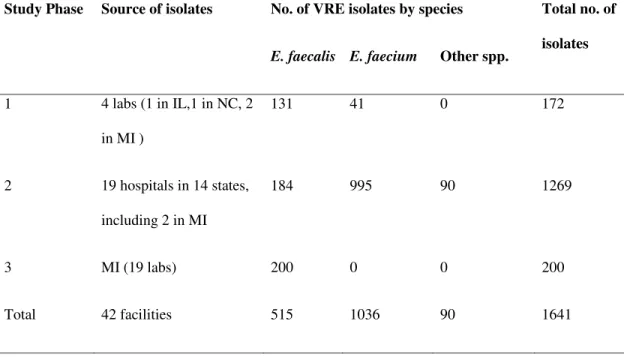
Bacterial isolate collection andspecies determination. The numbers and 20
sources of VRE clinical isolates examined in this study are listed in Table 2. This study 21
was conducted in three phases. 22
Phase 1 was a pilot study to evaluate whether VRE with Inc18-like vanA plasmids 1
were more common in metropolitan Detroit, MI than in two other areas; Chicago, IL and 2
Durham, NC. Isolates were requested from one healthcare institution in each of these 3
three areas including Detroit, Chicago, and Durham. Laboratories were asked to send 4
approximately 30 VRE isolates, including approximately 20 E. faecalis and 10 E.
5
faecium isolates that were recovered from either a clinical or surveillance culture during
6
January 2002 to May 2006. 7
Phase 2 was an investigation of the prevalence of Inc18-like vanA plasmids in 8
VRE isolates recovered from surveillance cultures collected in many different regions 9
within the United States. A total of 1269 VRE isolates were obtained from the “Strategies 10
to Reduce Transmission of Antimicrobial Resistant Bacteria in Intensive Care Units” 11
(STAR*ICU) Trial, a cluster-randomized trial of infection control strategies to reduce 12
transmission of methicillin-resistant S. aureus (MRSA) and VRE in ICUs that was 13
supported by the National Institute of Allergy and Infectious Diseases 14
(http://clinicaltrials.gov/show/NCT00342745). The Institutional Review Board (IRBs) at 15
all sites waived the requirement for informed consent and Health Insurance Portability 16
and Accountability Act (HIPAA ) authorization based on the criteria of the Federal Code 17
of Regulations, Title 45, Part 46.116 (d) and section 164.512 (i) of the HIPAA privacy 18
rule. As part of this study, admission and weekly stool or perianal swabs to screen for 19
colonization with VRE were collected from patients in 19 ICUs located in 14 states, 20
including 2 institutions in MI, between June 2005 and August 2006. Swabs were 21
processed for culture at the National Institutes of Health Clinical Center Microbiology 22
Laboratory. VRE isolates were confirmed to be vanA positive, but the isolates were not 23
identified to the species-level. For the current study, all VRE isolates from the two MI 1
institutions and between 50 to 70 randomly chosen VRE isolates from other institutions 2
were tested for the Inc18-like vanA plasmid. 3
Phase 3 was an analysis of vancomycin-resistant E. faecalis isolates from MI. The 4
MI Department of Community Health collected a large number of VRE from various 5
parts of the state between 1995 and 2002 as part of a surveillance program. In an effort to 6
enrich for isolates with the Inc18-like vanA plasmid, only E. faecalis isolates were tested 7
for the plasmid (N=200). 8
Species identification of VRE was confirmed at CDC by either PCR amplification 9
of species-specific ligase sequences (8), standard biochemical assays for Enterococcus
10
identification (25), or 16S rRNA gene sequence analysis (21). 11
Methods for detection and characterization of Inc18-like vanA plasmids. 12
PCR assays were performed for the detection of vanA and the two Inc18-like plasmid 13
specific genes traA and repR (8). Another PCR assay was developed to detect the Tn1546
14
insertion site in the Inc18-like vanA plasmid. Primer sequences were as follows: vanA F: 15
CATGAATAGAATAAAAGTTGC TGCAATA, vanA R: 16
CCCCTTTAACGCTAATACGATCAA; traA F: TAATCGCAA TGGCTTCTTATC, 17
traA R: TCTGCCCAATCTTTACGAAT; repR F: GCTTCATGA CGGCTTGTTA, repR
18
R: TTGGCTGCTTTGACAGATTTA; ddl F1 (E. faecalis): 19
ATCAAGTACAGTTAGTCT, ddlR1: ACGATTCAAAGCTAACTG; ddl F2 (E.
20
faecium) TAGAGACATTGAATATGCC, ddl R2: TCGAATGTGCTACAATC.
21
ORF18F: GGCAAATATAGTCAATTTTACTGAC and ORF19R: GACAAAACAGCT 22
TAGCTACAGC for Tn1546 left side junction, ORF27F: CAGATGTAATTACAAAT 1
ACTGTTGG and ORF28R: AAGTCCTGGAAGTTTAGGTGTTTT for Tn1546 right 2
side junction. 3
In phase 1, PCR for single genes was performed in a total volume of 50 µl 4
consisting of 1.6 mM of each dNTP (Applied Biosystems, Foster City, CA), 400 mM µl 5
of each primer, 1 x buffer, 1 mM MgCl2, 0.5 units of AmpliTaq Gold Enzyme (Applied 6
Biosystems), and 2 µl of DNA extract (equaling 100-500 ng). PCR reactions were carried 7
out in a GeneAmp PCR System 9700 (Applied Biosystems) with reaction cycles as 8
follows: an initial denaturation step of 2 min at 94°C, 30 cycles of 15s at 95°C, 30s at 9
55°C, 30s at 72°C; and a final elongation at 72°C for 7 min. In phase 2, a multiplex PCR 10
assay for traA, repR, and the ddl genes from E. faecalis and E. faecium was performed 11
using the Qiagen® Multiplex PCR Kit (Valencia, CA) according to the instruction of 12
manufacturer. PCR reactions were performed in a GeneAmp PCR System 9700 (Applied 13
Biosystems) with the following reaction cycles: an initial denaturation step of 2 min at 14
94°C, 30 cycles of 15s at 95°C, 90s at 55°C, 90s at 72°C; and a final elongation for 7 min 15
at 72°C. PCR products were visualized on a 1% agarose gel. In phase 3, a mutiplex PCR 16
assay for traA and repR was performed using the conditions described for the phase 2 17
multiplex assay. 18
The Tn1546vanA element arrangement was analyzed by RFLP as described by 19
Clark et al (4). 20
Susceptibility testing. Susceptibility to vancomycin and other antimicrobial 21
agents was determined by reference broth microdilution (BMD) using in-house prepared 22
panels with cation-adjusted Mueller-Hinton broth (BD Biosciences, Sparks, MD). 1
Susceptibility methods and interpretation were performed according to Clinical and 2
Laboratory Standards Institute (CLSI) guidelines (6). 3
Pulsed- field gel electrophoresis (PFGE). PFGE was performed by digesting 4
genomic DNA with SmaI restriction enzyme using standard procedures for enterococci 5
(28). TIFF images of PFGE gels were analyzed by BioNumerics software v5.1 (Applied 6
Maths, Austin, TX) using Dice coefficients plus UPGMA clustering. 7
Conjugation. Five milliliters of brain heart infusion (BHI) broth containing 25 8
µg/ml vancomycin or 25 µg/ml fusidic acid, respectively, was inoculated with traA-
9
positive donor isolates or the recipient E. faecalis JH2-2, and incubated overnight at 10
37°C. One hundred microliters of each culture were added to a new 5 ml BHI broth and 11
incubated for 5 hrs before being filtered through a Nalge 22 µM filter under vacuum. 12
The filter was then placed on a BHI agar plate and incubated for 18 hrs. The filter with 13
overlying colonies was then removed from the agar and placed in BHI broth. Serial 14
dilutions were prepared and plated on BHI selective plates containing 25 µg/ml each of 15
vancomycin and fusidic acid. 16
DNA sequencing and analysis. To understand the genetic organization of the 17
Inc18-like vanA plasmids from MI VRE, three plasmids from three VRSA associated 18
VRE were sequenced. Plasmids were sequenced on Applied Biosystem 3730XL 19
sequencers with the BigDye Terminator v3.1 cycle sequencing kit (Applied Biosystems 20
Inc). Plasmid sequencing was performed by primer walking with primers either 21
purchased from IDT (Integrated DNA Technologies, Inc, San Diego, California, USA) or 22
made at the CDC’s core facility. Reactions were cleaned with Agencourt Cleanseq beads 1
(Agencourt Bioscience Corporation Beverly, MA, USA). PhredPhrap and Consed 2
software (University of Washington, WA, USA) were used for basecalling read the 3
sequence data and assembly into contigs. DNA sequences were analyzed with Clone 4
Manager v9 (Scientific and Educational Software, NC, USA). 5
RESULTS 1
Completed sequence of plasmid pWZ909. The plasmids pWZ7140 (47,277 2
bp), pWZ909 (42,602 bp) and pWZ1668 (48,365 bp) from VRSA cases 1, 4, and 5 3
associated E. faecalis were sequenced and correspond to GenBank accession numbers 4
GQ484955, GQ484954, and GQ484956. In side-by-side comparison, we found that these 5
plasmids have the same genetic organization and sequences with few exceptions. The 6
three plasmids share 100% homology over 42 kb of sequence; however, compared to 7
pWZ909, pWZ7140 has a 4.7 kb insertion (putative transposase gene) and pWZ1668 has 8
two 5.4 kb and 0.6 kb insertions (putative transposase gene and IS456, respectively). 9
These plasmids also have genetic organization similar to Inc18 plasmids pIP501 and 10
pRE25 (Figure 1). The map of a representative plasmid, pWZ909 (from VRSA case 4), is 11
shown in Figure 1. This plasmid has 44 putative open reading frames and 16 are 100% 12
homologous to the conjugative transfer region of pIP501. The major difference between 13
pIP501 and pWZ909 is the insertion of a Tn1546vanA transposon in pWZ909 (Figure 14
1b). The DNA sequence of the transfer (tra) region, specifically traA, which encodes the 15
nickase, is conserved in the Inc18 plasmid family (16, 24). The traA gene and another 16
conserved gene repR (coding for an essential replication protein) were chosen as plasmid-17
specific genetic targets for a PCR assay to detect Inc18 plasmids. 18
The three sequenced plasmids demonstrate Tn1546 characteristics that were 19
common among all VRSA-associated VRE, and assays for these characteristics were 20
used for surveillance of the Inc18-like vanA plasmid in other VRE. One characteristic 21
was the Tn1546 insertion location; a PCR-assay was developed to detect the presence of 22
this same insertion location in other plasmids, and 4 of 5 MI VRSA-associated VRE were 23
positive by the assay (Table 1). The other common characteristic was a wild-type Tn1546
1
arrangement that was demonstrated in 4 of 5 MI VRSA-associated VRE by RFLP 2
analysis. 3
4
Inc18 vanA plasmids in VRE isolates from three geographical locations 5
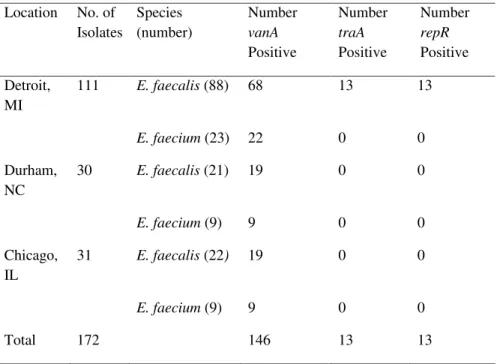
(phase 1). The phase 1 isolates consisted of 172 VRE: 88 E. faecalis and 23 E. faecium
6
isolates from three southeastern Michigan laboratories; 22 E. faecalis and 9 E. faecium
7
from one Chicago, IL lab; and 21 E. faecalis and 9 E. faecium from one Durham, NC lab 8
(see Table 3). All isolates were tested for vanA, traA, repR and Enterococcus specific 9
genes (ddl) by PCR amplification. If the isolates were positive for traA and repR, then 10
Tn1546 arrangement and insertion sites were analyzed by RFLP and PCR, respectively. 11
Thirteen VRE isolates from metropolitan Detroit (11.7%) were positive for three genes: 12
vanA, traA, and repR (Table 3). Another 77 VRE isolates were vanA positive but 13
negative for both traA and repR. Of the VRE isolates from outside of MI, none of 14
isolates were positive for all three genes vanA, traA and repR; although 56 of 61 were 15
positive for vanA. The 13 traA- and repR-positive isolates from MI had wild-type 16
Tn1546-like elements and the transposon was inserted at the same site as in pWZ909. All 17
of the isolates positive for an Inc18-like vanA plasmid from MI were E. faecalis; none 18
were E. faecium. Each isolate had a vancomycin minimum inhibitory concentration 19
(MIC) of at least 512 µg/ml. Conjugative experiments showed all of these isolates were 20
able to transfer the vanA-mediated vancomycin resistance to E. faecalis JH2-2, with traA
21
and repR being co-transferred with vanA (data not shown). This suggests that all three 22
genes were located on the same conjugative plasmid. The frequency of transfer for each 23
conjugation was approximately 10-5 to 10-7 per donor cell; there was no significant 1
difference in conjugation frequency observed among Inc18-like plasmid-carrying 2
isolates. 3
Expanded survey of Inc18 plasmids in VRE isolates (phase 2). A total of 4
1,269 VRE isolates from the STAR*ICU Trial were tested for the presence traA, repR, 5
and the Enterococcus ligase genes, using a mulitplex PCR assay. Isolates positive for 6
traA and repR were then tested for vanA and the Tn1546 arrangement and insertion site. 7
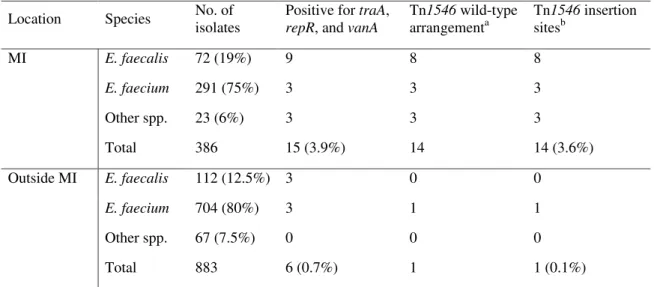
All VRE isolates from two MI healthcare facilities were tested (n = 386), including 291 8
E. faecium (75%), 72 E. faecalis (19%) and 23 VRE of other species (6%) (Table 4).
9
Fifteen isolates were positive for the Inc18-like vanA plasmid: 9 E. faecalis, 3 E. faecium, 10
2 E. avium, and 1 E. raffinosus. Of these, 14 isolates had plasmid Tn1546 characteristics
11
that were like those of pWZ909 (i.e., the same insertion site and arrangement). A total of 12
883 VRE isolates were tested from 17 healthcare facilities in 14 other states. These 13
consisted of 704 E. faecium (80%), 112 E. faecalis (12%), and 67 VRE of other species 14
(8%). Three E. faecalis isolates and 3 E. faecium isolates were positive for an Inc18-like 15
plasmid. One of these E. faecium isolates had Tn1546 characteristics like those of 16
pWZ909 (Table 4). Of the six Inc18-like plasmid-positive VRE isolates from outside of 17
Michigan, two were from Ohio, two were from Georgia, one was from Arizona, and one 18
was from Iowa. 19
All the plasmid-positive isolates had vancomycin MICs of at least 512 µg/ml. 20
Conjugative assays demonstrated that all of these plasmid-positive isolates were able to 21
transfer the vanA-mediated vancomycin resistance to E. faecalis JH2-2 via Inc18-like 22
plasmids. No significant difference in conjugation frequency was observed between the 1
six isolates and other Inc18-like plasmid positive isolates. 2
Inc18-like vanA plasmid distribution within Michigan (phase 3). To examine 3
the distribution of Inc18-like plasmids within Michigan, 200 isolates of E. faecalis from 4
the Michigan Department of Community Health Laboratory collection were tested with a 5
multiple PCR assay for traA and repR. Isolates positive for these genes were tested for 6
vanA, Tn1546 arrangements, and the Tn1546 insertion site. Out of these 200 E. faecalis
7
isolates, 11(5.5%) were positive for Inc18-like vanA plasmids: six from blood samples, 3 8
from wound samples, and 2 from urine samples. All of the plasmids had pWZ909-like 9
Tn1546 characteristics. All 11 of the isolates were from three healthcare institutes located 10
within a 30-mile radius of Detroit (Table 5). 11
PFGE patterns of VRE isolates with Inc18-like vanA plasmids. Typing by 12
PFGE indicated that the majority of these VRE isolates were unrelated (Fig. 2). 13
However, three pairs of E. faecalis isolates from the metropolitan Detroit area shared 14
PFGE patterns that were indistinguishable. Also, one E. faecium isolate containing the 15
Inc18-like vanA plasmid was identified outside of Michigan and had a PFGE pattern that 16
was indistinguishable from a MI E. faecium isolate carrying the same plasmid. 17
DISCUSSION 1
VRE with VRSA-associated Inc18-like vanA plasmids were more common in MI 2
than in other states. The best estimate of the prevalence of Inc18-like vanA plasmids in 3
VRE, from phase 2, was 3.9% of isolates in MI and 0.7% of isolates from outside of MI. 4
However, there are two limitations of this estimate: first, more VRE from the two MI 5
institutions were sampled than from the institutions in other states, and, second, isolates 6
from only 14 states were tested. It is thus possible that there are other geographic foci of 7
where VRE with this plasmid are more prevalent. It is important to note that, although the 8
plasmid was more common in MI, it was still rare in MI VRE. 9
The exact characteristics of an Inc18-like vanA plasmid that are important for its 10
transfer from Enterococcus spp. to S. aureus are unknown. It could be that not all Inc18-11
like vanA plasmids detected in this study are potential vanA donors to S. aureus. Because 12
we did not know which characteristics were important, we looked for similarities 13
between Inc18-like vanA plasmids and VRSA-associated plasmids (e.g., pWZ909) by 14
assaying for the Tn1546 insertion site and arrangement characteristic among Inc18-like 15
vanA plasmids from VRSA cases. Most of the plasmids detected in MI VRE shared these 16
characteristics, while most of the plasmids detected in VRE from outside MI did not. 17
Only one isolate from outside MI, an E. faecium isolate from Iowa that also had the same 18
PFGE pattern as an E. faecium isolate from MI, had pWZ909-like Tn1546 characteristics. 19
Data were not available to determine any possible epidemiologic link between the Iowa 20
patient and MI patients. 21
22
The diversity of PFGE patterns among plasmid-positive isolates suggests that 1
Inc18-like vanA plasmids are mobile. Among 21 analyzed MI E. faecalis isolates with 2
Inc18-like plasmids, we found only three pairs of isolates with PFGE patterns 3
indistinguishable from one another. These results suggest that the Inc18-like vanA 4
plasmid has disseminated among Enterococcus spp. by horizontal dissemination of the 5
plasmid rather than clonal spread of a single strain. This observation is consistent with 6
the reports byGarcia-Migura et al (12, 13), who reported Tn1546vanA elements on 7
Inc18-like plasmids in 45 of 150 different E. faecium isolates from farms (12). Their 8
findings suggested that dissemination of vancomycin resistanceby horizontal transfer 9
could play an important role within livestocksystems. The ability of these plasmids to be 10
transmitted between strains is also supported by our conjugation experiment results, 11
which showed that each of the plasmid-positive isolates tested was able to transfer 12
vancomycin resistance to E. faecalis JH2-2. 13
Considering that most VRE are E. faecium (3, 31), it was notable that, among 14
VRE isolates collected from MI institutions in the STAR*ICU study (phase 2), In18-like 15
vanA plasmid was found more commonly in E. faecalis isolates (12.5% ) than in E.
16
faecium isolates (0.6%). The issue does not seem to be that the plasmid is species limited;
17
besides finding the plasmid in E. faecalis and E. faecium, the plasmid was also identified 18
in two other species of enterococcus. We don’t know the reason why this plasmid was 19
more common in E. faecalis in MI. It could be that this is a relatively new vanA plasmid 20
and that there are more vanA-negative E. faecalis than vanA-negative E. faecium isolates 21
to serve as recipients. Although several reports have shown that pheromone-response 22
plasmids (including vanA and non-vanA plasmids) are more frequently found in E.
faecalis than in E. faecium and other Enterococcus species (5, 7, 11, 19, 32), Inc18-like 1
plasmids are pheromone-independent. We don’t know if the species carrying the plasmid 2
is important for vanA transfer from Enterococcus to S. aureus. One factor that may be 3
important for vanA transfer is biofilm formation, and E. faecalis are better than other 4
Enterococcus spp. at biofilm formation (18). Regardless, the increased prevalence of the
5
plasmid in E. faecalis is consistent with the identification of vancomycin-resistant E.
6
faecalis colonization or infection in 5 of the MI VRSA case-patients.
7
The findings in this study may be useful in predicting future VRSA occurrence. It 8
is possible that, if VRE with these plasmids increase in prevalence, the prevalence of 9
VRSA will also increase. Periodic surveillance for these vanA plasmids among VRE 10
isolates would be informative. Considering that VRSA are so rare, there are likely other 11
factors that are important for VRSA to occur. For example, there may be S. aureus and 12
environmental factors that facilitate plasmid transfer. Additional studies are needed to 13
identify those factors. However, regardless of exactly what factors are needed, our 14
findings provide additional public health rational for controlling the spread of VRE. In 15
additional to preserving treatment options for enterococcus infections, reducing the 16
spread of VRE may be an important means of preserving the activity of vancomycin for 17
the treatment of S. aureus infections, especially in areas where Inc18-like plasmids have 18
begun to emerge. 19
Figure legends 1
Fig. 1. Circular map of the Inc18-like vanA plasmid in E. faecalis isolate from VRSA 2
case 4 (a). Genes are shown as arrows; certain partial or non-functional genes are shown 3
as boxes. The putative conjugative transfer region is in gold color, the vancomycin 4
resistance genes are noted in light green and transposon genes are noted in dark blue. 5
Comparison of genetic organization of pWZ909 with that of Inc18 plasmids pRE25 and 6
pIP501 (b). The conjugative transfer region of the pWZ909 is very similar to that of 7
plasmids pRE25 from E. faecalis and pIP501 from Streptococcus agalactiae (24). 8
Fig. 2. PFGE analysis of SmaI-digested whole chromosomal DNA of E. faecalis (a) and 9
E. faecium (b) with Inc18-like vanA plasmid. The location and study phase where strains
10
were isolated from are labeled on the right side. The VRE1 and VRE4 are associated with 11
VRSA cases 1 and 4, respectively. 12
13
Acknowledgement 14
We thank Ainsley Nicholson for plasmid annotation and David Lonsway for technical 15
help. 16
18
Table 1. In18-like vanA plasmid characteristics of VRSA and associated VRE isolates from nine VRSA cases, United States
Case
No. State Isolate
Site of isolation Inc18-Like vanA plasmid Tn1546 arrangement a Tn1546 insertion site b Ref
VRSA Foot wound No Wild-type sequence - (29, 33) 1 MI
E. faecalis Foot wound Yes Wild-type sequence + (10)
VRSA Foot No Insertions & deletions - (4) 2 PA
E. faecium Contamination? N/A N/A
VRSA Urine No Insertions & deletions - (30) 3 NY
E. faecium Rectum No Insertions & deletions - Unpublished data
VRSA Wound/Toe Yes Wild-type sequence + (33) 4 MI
E. faecalis Rectal swab Yes Wild-type sequence + (33)
VRSA ABD wound Yes Wild-type sequence + (33) 5 MI
E.faecalis ABD wound Yes Wild-type sequence + (33)
VRSA Wound No Wild-type sequence - (33) 6 MI
19
VRSA Left elbow Yes N/A - (33)
7 MI
N/A N/A N/A N/A -
VRSA Foot No N/A - Unpublished data
8 MI
N/A N/A N/A N/A -
VRSA Foot No N/A - Unpublished data
9 MI
E. faecalis N/A N/A N/A NA
a The wild-type sequences of Tn1546 arrangement are identified as prototype (2).
b
Tn1546 insertion site test result was defined as positive “ +” if the junction sites were the same as those of plasmids pWZ909,
Table 2. Description of VRE isolates collected in this study
No. of VRE isolates by species Study Phase Source of isolates
E. faecalis E. faecium Other spp.
Total no. of isolates 1 4 labs (1 in IL,1 in NC, 2 in MI ) 131 41 0 172 2 19 hospitals in 14 states, including 2 in MI 184 995 90 1269 3 MI (19 labs) 200 0 0 200 Total 42 facilities 515 1036 90 1641
Table 3. VRE isolates with Inc18-like plasmids from three different locations (phase 1) Location No. of Isolates Species (number) Number vanA Positive Number traA Positive Number repR Positive Detroit, MI 111 E. faecalis (88) 68 13 13 E. faecium (23) 22 0 0 Durham, NC 30 E. faecalis (21) 19 0 0 E. faecium (9) 9 0 0 Chicago, IL 31 E. faecalis (22) 19 0 0 E. faecium (9) 9 0 0 Total 172 146 13 13
Table 4. Characteristics of Inc18-like plasmids in VRE isolates from the STAR*ICU trial (phase 2)
Location Species No. of isolates
Positive for traA,
repR, and vanA
Tn1546 wild-type arrangementa Tn1546 insertion sitesb MI E. faecalis 72 (19%) 9 8 8 E. faecium 291 (75%) 3 3 3 Other spp. 23 (6%) 3 3 3 Total 386 15 (3.9%) 14 14 (3.6%) Outside MI E. faecalis 112 (12.5%) 3 0 0 E. faecium 704 (80%) 3 1 1 Other spp. 67 (7.5%) 0 0 0 Total 883 6 (0.7%) 1 1 (0.1%) a
The wild-type arrangement of Tn1546 was considered to be the prototype (2). b
Tn1546 junction sites are the same as those of the plasmids pWZ909, pWZ7140 or pWZ1668.
Table 5. Distribution of E. faecalis with Inc18-like plasmids from the MI State Health Department surveillance, 1995-2002 (phase 3)
City distance from
Detroit (miles)
No. of isolates No. of plasmid-positive isolates
Geographic distribution (no. plasmid-positive/total no.)
< 30 160 11 (6.8%) Detroit (6/78)
2 cites in Oakland county (5/78)
2 cites in Wayne county (0/4)
>30 40 0 14 cites (0/40)
A B Fig. 1 pIP501 (31kb) pRE25 (50kb) pWZ909 (42.6kb) 1 3 5 7 9 11 13 15 1719 21 23 25 27 29 31 33 35 37 39 41 43 45 47 49 51 53 55 57 7 9 13 15 17 19 21 23 25 27 29 31 33 35 37 39 7 9 11 13 15 25 27 29 31 33 35 37 39
Transposase vanR vanH vanX vanZ
resolvase vanS vanA vanY
a 1 0 0 9 0 8 0 7 0 6 0 . . . . . . . . . . . . . . . . . . . . . . . 2 2 2 2 2 2 2 2 2 2 2 2 2 2 2 2 2 2 2 2 2 2 2 Study phase Location 1 1 2 1 1 1 1 1 1 1 - 1 1 2 2 2 2 - 1 1 2 2 2 MI, Institute A MI, Institute C MI, Institute C MI, Institute A MI, Institute A MI, Institute A MI, Institute D MI, Institute B MI, Institute A MI, Institute A MI, VRE1 MI, Institute C MI, Institute C MI, Institute A MI, Institute A MI, Institute D MI, Institute D MI, Institute A MI, Institute B MI, Institute A MI, VRE4 MI, Institute B MI, Institute C
b Fig. 2 1 0 0 9 0 8 0 7 0 6
0 Location Study phase
2 2 2 2 MI, Institute D MI, Institute D MI, Institute D IA,
REFERENCES
1. Aligholi, M., M. Emaneini, F. Jabalameli, S. Shahsavan, H. Dabiri, and H. Sedaght. 2008. Emergence of high-level vancomycin-resistant Staphylococcus aureus in the Imam Khomeini Hospital in Tehran. Med. Princ. Pract. 17:432-4.
2. Arthur, M., C. Molinas, F. Depardieu, and P. Courvalin. 1993. Characterization of Tn1546, a Tn3-related transposon conferring glycopeptide resistance by synthesis of depsipeptide peptidoglycan precursors in Enterococcus faecium BM4147. J. Bacteriol.
175:117-27.
3. Camins, B. C., M. M. Farley, J. J. Jernigan, S. M. Ray, J. P. Steinberg, and H. M. Blumberg. 2007. A population-based investigation of invasive vancomycin-resistant Enterococcus infection in metropolitan Atlanta, Georgia, and predictors of mortality. Infect. Control. Hosp. Epidemiol. 28:983-91.
4. Clark, N. C., L. M. Weigel, J. B. Patel, and F. C. Tenover. 2005. Comparison of Tn1546 -like elements in vancomycin-resistant Staphylococcus aureus isolates from Michigan and Pennsylvania. Antimicrob. Agents. Chemother. 49:470-2.
5. Clewell, D. B., F. Y. An, S. E. Flannagan, M. Antiporta, and G. M. Dunny. 2000. Enterococcal sex pheromone precursors are part of signal sequences for surface lipoproteins. Mol. Microbiol. 35:246-7.
6. Clinical and Laboratory Standards Institute. 2009. Performance standards for antimicrobial susceptibility testing. Wayne, PA: Clinical and Laboratory Standards Institute; 2009.
7. Dunny, G. M., B. L. Brown, and D. B. Clewell. 1978. Induced cell aggregation and mating
in Streptococcus faecalis: evidence for a bacterial sex pheromone. Proc. Natl. Acad. Sci.
U S A 75:3479-83.
8. Dutka-Malen, S., S. Evers, and P. Courvalin. 1995. Detection of glycopeptide resistance genotypes and identification to the species level of clinically relevant enterococci by PCR. J. Clin. Microbiol. 33:1434.
9. Finks, J., E. Wells, T. L. Dyke, N. Husain, L. Plizga, R. Heddurshetti, M. Wilkins, J. Rudrik, J. Hageman, J. Patel, and C. Miller. 2009. Vancomycin-resistant Staphylococcus aureus, Michigan, USA, 2007. Emerg. Infect. Dis. 15:943-5.
10. Flannagan, S. E., J. W. Chow, S. M. Donabedian, W. J. Brown, M. B. Perri, M. J. Zervos, Y. Ozawa, and D. B. Clewell. 2003. Plasmid content of a vancomycin-resistant
Enterococcus faecalis isolate from a patient also colonized by Staphylococcus aureus
with a VanA phenotype. Antimicrob. Agents. Chemother 47:3954-9.
11. Flannagan, S. E., and D. B. Clewell. 2002. Identification and characterization of genes encoding sex pheromone cAM373 activity in Enterococcus faecalis and Staphylococcus
aureus. Mol. Microbiol. 44:803-17.
12. Garcia-Migura, L., H. Hasman, C. Svendsen, and L. B. Jensen. 2008. Relevance of hot spots in the evolution and transmission of Tn1546 in glycopeptide-resistant
Enterococcus faecium (GREF) from broiler origin. J. Antimicrob. Chemother. 62:681-7.
13. Garcia-Migura, L., E. Liebana, and L. B. Jensen. 2007. Transposon characterization of vancomycin-resistant Enterococcus faecium (VREF) and dissemination of resistance associated with transferable plasmids. J. Antimicrob. Chemother. 60:263-8.
14. Gonzalez, C. F., and B. S. Kunka. 1983. Plasmid transfer in Pediococcus spp.: intergeneric and intrageneric transfer of pIP501. Appl. Environ. Microbiol. 46:81-9.
15. Grohmann, E., G. Muth, and M. Espinosa. 2003. Conjugative plasmid transfer in gram-positive bacteria. Microbiol. Mol. Biol. Rev. 67:277-301, table of contents.
16. Kurenbach, B., C. Bohn, J. Prabhu, M. Abudukerim, U. Szewzyk, and E. Grohmann.
2003. Intergeneric transfer of the Enterococcus faecalis plasmid pIP501 to Escherichia coli and Streptomyces lividans and sequence analysis of its tra region. Plasmid 50:86-93. 17. Langella, P., and A. Chopin. 1989. Conjugal transfer of plasmid pIP501 from Lactococcus
lactis to Lactobacillus delbruckii subsp. bulgaricus and Lactobacillus helveticus. FEMS
Microbiol. Lett. 51:149-52.
18. Mohamed, J. A., and D. B. Huang. 2007. Biofilm formation by enterococci. J. Med. Microbiol. 56:1581-8.
19. Paoletti, C., G. Foglia, M. S. Princivalli, G. Magi, E. Guaglianone, G. Donelli, C. Pruzzo, F. Biavasco, and B. Facinelli. 2007. Co-transfer of vanA and aggregation substance genes from Enterococcus faecalis isolates in intra- and interspecies matings. J. Antimicrob. Chemother. 59:1005-9.
20. Patel, J. B., W. C. Huskins, W. Zhu, J. A. Jernigan, Nancye. C. Clark, Karen F. Anderson, Linda K. McDougal, C. Chenoweth, G. J. Alangaden, and a. P. R. Murray. 2008. Dissemination of Enterncoccus Inc18-like vanA plasmid associated with vancomycin-resistant Staphylococcus aureus, abstr. K-568., Abstr. 48th Interesci.Conf. Antimicrob. Agents. Chenother., Washington.
21. Patel, R., K. E. Piper, M. S. Rouse, J. M. Steckelberg, J. R. Uhl, P. Kohner, M. K. Hopkins, F. R. Cockerill, 3rd, and B. C. Kline. 1998. Determination of 16S rRNA sequences of enterococci and application to species identification of nonmotile Enterococcus
gallinarum isolates. J. Clin. Microbiol. 36:3399-407.
22. Saha, B., A. K. Singh, A. Ghosh, and M. Bal. 2008. Identification and characterization of a vancomycin-resistant Staphylococcus aureus isolated from Kolkata (South Asia). J. Med. Microbiol. 57:72-9.
23. Schaberg, D. R., D. B. Clewell, and L. Glatzer. 1982. Conjugative transfer of R-plasmids from Streptococcus faecalis to Staphylococcus aureus. Antimicrob. Agents. Chemother.
22:204-7.
24. Schwarz, F. V., V. Perreten, and M. Teuber. 2001. Sequence of the 50-kb conjugative multiresistance plasmid pRE25 from Enterococcus faecalis RE25. Plasmid 46:170-87. 25. Teixeira L. M., M. G. Carvalho, and a. R. R. Facklam. 2007. Enterococcus, p.430-442. In
P. R. Murray, E. J. Baron, J. H. Horgensen, M. L. Landry and M. A. Pfaller (ed), Manual of Clinical Microbiology9th ed. ASM Press, Washington D.C.
26. Thompson, J. K., and M. A. Collins. 1988. Evidence for the conjugal transfer of the broad host range plasmid pIP501 into strains of Lactobacillus helveticus. J. Appl. Bacteriol. 65:309-19.
27. Tiwari, H. K., and M. R. Sen. 2006. Emergence of vancomycin resistant Staphylococcus
aureus (VRSA) from a tertiary care hospital from northern part of India. BMC. Infect. Dis.
6:156.
28. Turabelidze, D., M. Kotetishvili, A. Kreger, J. G. Morris, Jr., and A. Sulakvelidze. 2000. Improved pulsed-field gel electrophoresis for typing vancomycin-resistant enterococci. J. Clin. Microbiol. 38:4242-5.
29. Weigel, L. M., D. B. Clewell, S. R. Gill, N. C. Clark, L. K. McDougal, S. E. Flannagan, J. F. Kolonay, J. Shetty, G. E. Killgore, and F. C. Tenover. 2003. Genetic analysis of a high-level vancomycin-resistant isolate of Staphylococcus aureus. Science 302:1569-71. 30. Weigel, L. M., R. M. Donlan, D. H. Shin, B. Jensen, N. C. Clark, L. K. McDougal, W. Zhu,
Patel. 2007. High-level vancomycin-resistant Staphylococcus aureus isolates associated with a polymicrobial biofilm. Antimicrob. Agents. Chemother. 51:231-8.
31. Werner, G., T. M. Coque, A. M. Hammerum, R. Hope, W. Hryniewicz, A. Johnson, I. Klare, K. G. Kristinsson, R. Leclercq, C. H. Lester, M. Lillie, C. Novais, B. Olsson-Liljequist, L. V. Peixe, E. Sadowy, G. S. Simonsen, J. Top, J. Vuopio-Varkila, R. J. Willems, W. Witte, and N. Woodford. 2008. Emergence and spread of vancomycin resistance among enterococci in Europe. Euro. Surveill. 13.
32. Wirth, R. 1994. The sex pheromone system of Enterococcus faecalis. More than just a plasmid-collection mechanism? Eur. J. Biochem. 222:235-46.
33. Zhu, W., N. C. Clark, L. K. McDougal, J. Hageman, L. C. McDonald, and J. B. Patel. 2008. Vancomycin-resistant Staphylococcus aureus isolates associated with Inc18-like vanA plasmids in Michigan. Antimicrob. Agents. Chemother. 52:452-7.