Quality Function Deployment and Fuzzy TOPSIS Methods in
Decision Support System for Internet Service Provider
Selection
Novianto Dwi Prasongko, Bayu Surarso, Rahmat Gernowo
Master in Information System, Diponegoro University, IndonesiaMaster in Information System, Mathemathics Program , Diponegoro University, Indonesia Master in Information System, Physics Program, Diponegoro University, Indonesia
[email protected], [email protected], [email protected]
Abstract. Internet Service Provider (ISP) is a company or business organization that provides
access to intenet and services related for individual consumer or companies. There are many ISP in Indonesia recently, and they have almost the same product to offered. This problem makes internet service provider selection become a major issue. Decision support system can be used to recommend the best ISP company based on need. The aim of this research is to used Quality Function Deployment with Fuzzy TOPSIS sequentially to select the best ISP company as needed, and implemented in decision support system for internet service provider selection. Quality Function Deployment and Fuzzy TOPSIS methods used to evaluate, and then recommend the ISP company by ranked. Quality Function Deployment method used to find out customers requirements about internet network, the weighting of the criteria and the assessment of each ISP company. Fuzzy TOPSIS used to rank ISP company. These two methods produce consistent ratings when sensitivity analysis is performed for fuzzy and crisp value. These two methods make decision support system result can be trusted.
Introduction
Internet Service Provider (ISP) is a company or business organization that provides access to intenet and services related for individual consumer or companies [9]. In the past, ISPs were run by telephone companies. Nowadays, ISPs can be started by anyone who has sufficient money and expertise in the internet. There are so many ISP companies in Indonesia these days, and they are offering almost the same facilities and price. As a result, ISP selection become an important issue to handle [2].
Internet is one of information source that very helpful. To be specifically, we talk about the useful of internet in the college. Internet is using for administration process (such as registration, fill our study plan, to see study result), online study, download or upload journal research. Based on this case, ISP selection will be a problem because we have to choose the best ISP company that can support the college’s needs [12].
Decision support system is one of the system that can be used to choose the best ISP. Decision support system usually used for
supplier selection. In progress, we can use the model in supplier selection for service industry. The major difference between supplier selection and service industry selection is in the object that they sale. In the service industry, they sale a service and it means no inventory costs associated with service purchasing [1].
Supplier selection become an important issue because it can affecting the production cost. It is mean also affecting the price of the product. Supplier selection is a multi criteria problem that consist of qualitative and quantitative criteria [11].
Fuzzy TOPSIS is one of the methods that can be used in supplier selection. Fuzzy TOPSIS will recommend the best supplier according to weight of the criterias and supplier assessment. Fuzzy TOPSIS is suitable for supplier selection with changes of alternatives, changes of criteria, adding new alternatives and new criterias because of its consistency in ranking result [7].
Quality Function Deployment (QFD) is a tool that can help company to develop their product to fulfill customer expectations [6]. In the process, QFD can be used for decision
and Its Application (5th ISNPINSA)
support system. QFD used to listen what is the owners, suppliers, and customers wants. The data that we get from QFD processed to recommend the best supplier or we can combine QFD with another method to rank the supplier [13].
Internet Service Provider selection research had been doing in Iran to choose and evaluate ISP companies to used in three different cities. This research focus on choosing the criterias that can be used to measure the performance of ISPs and which technique should be selected if both of qualitative and quantitative criteria will be consider in ISP management process. QFD is utilized to rank the ISPs according to the qualitatitive criterias, then a quantitative model is adopted to consider quantitative metrics. This two models compose to choose the best ISP and succeeded. In the other hand, there is shifting in ISP’s rank when sensitivity analysis is perform for fuzzy and crisp value input for this two models [2].
Based on the last research about ISP selection using QFD method, we developed a QFD model with Fuzzy TOPSIS method to rank. We assume that Fuzzy TOPSIS method will produce consistent rank when sensitivity analysis is perform. Fuzzy TOPSIS has been choosed because of its enormous chance of success when TOPSIS method combined with intuitionistic fuzzy set to used in multi-criteria decision-making problem. Intuitionistic fuzzy sets are suitable way to deal with uncertainty, when decision maker’s opinions are vague [3]. The excellence of Fuzzy TOPSIS is in its rank consistency that produce, eventhough new alternatives and criterias been added [7]. The consistency of fuzzy TOPSIS method will help QFD method’s model to recommend the best ISP that more consistent in rank for fuzzy and crisp value. The difference of this research from the last research is in Fuzzy TOPSIS method to produce consistent rank when sensitivity analysis is perform, and we add new variabel to evaluate ISP companies.
Triangular Fuzzy Number
In this paper we used triangular fuzzy
number to heard the voice of customer and to assess ISP companies. Triangular Fuzzy Number (TFN) is one of the most popular
fuzzy number shapes to used, because they are intuitive and easy to use. Triangular Fuzzy Number (TFN) is represented with three points as follows: Ã=(l, m, u) which can be drawn in Fig. 1 [2].
Figure 1 Triangular Fuzzy Number a) l to m is increasing function b) m to u is decreasing function c) l ≤ m ≤ u for x < l ; x < u for l ≤ x ≤ m for m < x < u
Quality Function Deployment
(QFD)
QFD is a planning tool used to fulfill customer expectation. It is used for product design, engineering, production and product evaluation. QFD consists of requirement planning matrix called House of Quality (HoQ). HoQ is the first step to investigate customer requirement. The structure of HoQ can be described as a framework of a house, as shown in Fig. 2 [4]. HoQ process consists of six elements [9]: 1. Customer Requirements (WHATs)
The HoQ process begins with the collection of customer needs for the product or service concerned. WHATs can be described as criterias of needs. 2. Competitive Assessment
The weight assigned by decision makers for WHATs should be aggregated. Aggregated weight (wi), is calculated
using Eq. 1.
𝑤𝑖 =
(𝑟
1 × 𝑤𝑖)
+(𝑟
2 × 𝑤𝑖2)
+ ⋯ +(𝑟
𝑁 × 𝑤𝑖𝑁)
(1)
where I is the number of WHATs (i = 1, 2, …, I) and N is the number of decision makers (n = 1, 2, …, N).
3. Technical Descriptors (HOWs)
HOWs also known as voice of the organization. They are used to determine how well the company satisfies customer requirements (WHATs).
The relationship matrix indicates how much each HOWs affects each WHATs. In this paper, linguistic variables that transform into Triangular fuzzy numbers are used to denote the relationship between WHATs and HOWs. Aggregated weight (aij) is calculated by the Eq. 2. 𝑎𝑖𝑗 =
(𝑟
1 × 𝑎𝑖𝑗1)
+(𝑟
2 × 𝑎𝑖𝑗2)
+ ⋯ +(𝑟
𝑁 × 𝑎𝑖𝑗𝑁)
(2)
5. Correlation Mattrix
It presents the interdependencies among HOWs to capture the trade offs between various engineering parameters.
6. Prioritized Technical Descriptors
We complete the HoQ by calculating the weights of the HoQs (ff), averaging the
aggregated weight fro WHATs (wi), with
the aggregated weight between WHATs and HOWs (aij) according to the Eq. 3. 𝑓𝑓=1
𝑖 ×
[(𝑤
1 × 𝑎𝑖𝑗)
+ ⋯ +(𝑤
𝑗 × 𝑎𝑖𝑗)]
(3)
Figure 2 House of Quality (Chan dan Wu, 2002)
Fuzzy TOPSIS
Fuzzy TOPSIS method used to solve multicriteria decision making under uncertainty. Linguistic variables are used by decision makers to assess the weights of the criteria and the ratings of the alternatives, Dr
(r = 1, …,k). 𝑊̃𝑟
𝑗describes the weights of of the jth criterion, Cj (j = 1, …, m), given by the
rth decision maker. 𝑥̃𝑗𝑟describes the rating of the ith alternative, Ai (i = 1, …, n), with
respect to criterion j, given by the rth decision maker. Fuzzy TOPSIS method comprises the following steps [7]:
1. Aggregate the weights (𝑤̃j) of criterion
(Cj) and obtain the aggregate fuzzy
ratings (𝑥̃ij) of alternatives (Ai) given by k
decision makers, as expressed in Eqs. 4 and 5. 𝑤̃j= 1 𝑘[𝑤̃𝑗 1 + 𝑤̃ 𝑗2 + … + 𝑤̃𝑗𝑘]; j = 1, 2, …, n (4) 𝑥̃ij= 1 𝑘[𝑥̃𝑖𝑗 1 + 𝑥̃ 𝑖𝑗𝑟 + … + 𝑥̃𝑖𝑗𝑘] (5) i = 1, 2, …, m ; j = 1, 2, …, n
2. Construct the fuzzy decision matrix of the altenatives (𝐷̃) and the criteria (𝑊̃ ),
according to Eqs. 6 and 7.
C1 C2 Cj Cn 𝐷̃ = 𝐴1 𝐴2 ⋮ 𝐴𝑚 [ 𝑥̃11 𝑥̃12 𝑥̃1𝑗 𝑥̃1𝑛 𝑥̃21 ⋮ 𝑥̃22 ⋮ 𝑥̃𝑚1 𝑥̃𝑚2 𝑥̃2𝑗 ⋮ 𝑥̃2𝑛 ⋮ 𝑥̃𝑚𝑗 𝑥̃𝑚𝑛 ] (6) 𝑊̃ = [𝑤̃1 + 𝑤̃2 + … + 𝑤̃n] (7) i = 1, 2, …, m ; j = 1, 2, …, n
3. Normalize the fuzzy decision matrix, denoted by 𝑅̃, according to Eqs. 8 and 9. 𝑅̃ = [𝑟̃ij]mx n, i = 1, 2,.. , m ; j = 1, 2, .. , n (8)
This formula can be calculated as details:
𝑟̃ij = (𝑙𝑖𝑗 𝑢𝑗∗ , 𝑚𝑖𝑗 𝑢𝑗∗ , 𝑢𝑖𝑗 𝑢𝑗∗), 𝑢𝑗 ∗ = maxi𝑢 𝑖𝑗 (9)
4. Compute the weighted normalized decision matrix (𝑉̃), by Eq. 10.
𝑉̃ = [𝑣̃ij]m x n , i = 1, 2,.. , m ; j = 1, 2, , n (10)
where 𝑣̃ij is given by Eq. 11.
𝑣̃ij = 𝑥̃ij X 𝑤̃j, i=1, 2,.. ,m; j=1, 2,.. , n (11)
5. Define the Fuzzy Positive Ideal Solution (FPIS, A+) and the Fuzzy Negative Ideal
Solution (FNIS, A-), according to Eqs. 12
and 13. A+ = {𝑣 1+ , 𝑣𝑗+ , …, 𝑣𝑚+ } (12) A−= {𝑣 1− , 𝑣𝑗− , …, 𝑣𝑚− } (13) where, 𝑣1+ = (1, 1, 1) dan 𝑣1− = (0, 0, 0)
6. Calculate the distance of each alternative from FPIS (𝑑𝑖+ ) and FNIS (𝑑𝑖− ) according to Eqs. 14 and 15.
𝑑𝑖+ = ∑𝑛𝑗=1𝑑𝑣(𝑣̃𝑖𝑗 , 𝑣𝑗+ ) (14)
𝑑𝑖− = ∑𝑛𝑗=1𝑑𝑣(𝑣̃𝑖𝑗 , 𝑣𝑗− ) (15) where d (… , …) represent the distance between two fuzzy number according to the vertex method. For triangular fuzzy numbers, this is expressed as in Eq. 16.
d(𝑥̃, 𝑧̃) = √1
3[(𝑙𝑥 - 𝑙𝑧)
2 + (mx – mz)2 + (ux –
uz)2] (16)
7. Calculate the closeness coefficient (CCi)
according to Eq. 17.
CCi= 𝑑𝑖
−
𝑑𝑖++ 𝑑𝑖− (17)
Define the ranking of the alternatives according to the closeness coefficient (CCi),
in decreasing order. The best alternative is closest to the FPIS and farthest to the FNIS.
and Its Application (5th ISNPINSA)
Solution Metodhology
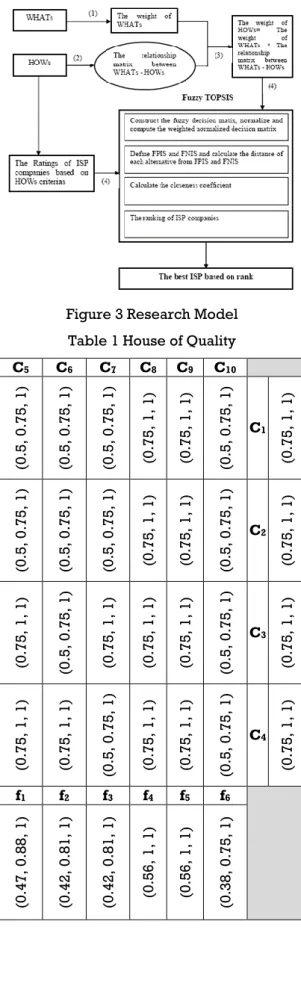
The Research Model and ResultIn this paper, we proposed the research model as drawn in Fig. 3. The QFD method used to bulid HoQ of the criterias of a good internet network and to assessed ISP companies. Fuzzy TOPSIS method used to analysed the HoQ and then define the ranking of the ISP companies according to steps in Fuzzy TOPSIS method.
Customer survey is carried to find out the customer needs and opinions about internet network. This research makes the college become the object, and students, lecturers and the college staffs become the customers. The result of this survey is analysed and become WHATs in HoQ, there are accessibility (C1), speed (C2), network stability (C3), and security (C4).. Decision maker, in this case is Head of Information System office, is asked to give weight to WHATs.. Next, decision maker is interviewed to build HOWs according to customer needs and opinions. Then, the relationship matrix between WHATs and HOWs is build and give weight by the decision maker. Next, decision maker assessed the ISP companies, in this case there are six ISP companies, based on HOWs criterias. All the weights and assessments is in linguistic variables and transform into triangular fuzzy number. The result of the survey and the interview is used to bulid HoQ for QFD method, as shown in table 1.
The HoQ is used in fuzzy TOPSIS method to rank the ISP companies. The first step in fuzzy TOPSIS is construct the fuzzy decision matrix based on the ISP companies assessment, as shown in table 3, and normalized it according Eq. (9). Compute the weighted normalized decision matrix according to Eq. (10). Define FPIS, according Eq. (12) and FNIS, according Eq. (13). Calculate each of ISP company from FPIS according to Eq. (14) and FNIS according to Eq. (15). The last step is calculate the closeness coefficient of each ISP company according to Eq. (17). The rank of ISP companies shown in table 2.
Figure 3 Research Model Table 1 House of Quality C5 C6 C7 C8 C9 C10 (0. 5, 0 .75, 1) (0. 5, 0 .75, 1) (0. 5, 0 .75, 1) (0. 75, 1, 1) (0. 75, 1, 1) (0. 5, 0 .75, 1) C1 (0. 75, 1, 1) (0. 5, 0 .75, 1) (0. 5, 0 .75, 1) (0. 5, 0 .75, 1) (0. 75, 1, 1) (0. 75, 1, 1) (0. 5, 0 .75, 1) C2 (0. 75, 1, 1) (0. 75, 1, 1) (0. 5, 0 .75, 1) (0. 75, 1, 1) (0. 75, 1, 1) (0. 75, 1, 1) (0. 5, 0 .75, 1) C3 (0. 75, 1, 1) (0. 75, 1, 1) (0. 75, 1, 1) (0. 5, 0 .75, 1) (0. 75, 1, 1) (0. 75, 1, 1) (0. 5, 0 .75, 1) C4 (0. 75, 1, 1) f1 f2 f3 f4 f5 f6 (0. 47, 0 .88, 1) (0. 42, 0 .81, 1) (0. 42, 0 .81, 1) (0. 56, 1, 1) (0. 56, 1, 1) (0. 38, 0 .75, 1)
Table 2 Closeness Coefficient and ISP Companies Rank
No ISP Company CC Rank
1 Lintasarta 0.5115 5 2 ICON+ 0.5348 2 3 Astinet 0.5348 2 4 Cepatnet 0.4830 6 5 Desnet 0.5401 1 6 Adau 0.5313 4
Sensitivity Analysis
Sensitivity analysis is doing to check the consistency of the ISP rank based on the model proposed. The fuzzy value change into crisp value and processed with QFD method only, then compare the ISP rank of crisp value with fuzzy value to check the consistency of the rank. There are shifting in ISP rank as shown in table 3. The crisp value also processed using the model proposed, QFD and Fuzzy TOPSIS methods to check the consistency of the rank. The result is no shifting in the ISP rank as shown in table 4. It is mean QFD and Fuzzy TOPSIS methods produce consistency in the ISP rank result.
Table 3 ISP Companies Rank Comparison in QFD Method with QFD and Fuzzy TOPSIS
Methods
No
QFD Method QFD and Fuzzy TOPSIS Methods
ISP
Fuzzy Crisp Fuzzy Crisp
Sc or e Ran k Sc or e Ran k Sc or e Ran k Sc or e Ran k 1 Lintasarta 0.4896 5 0.4938 5 0.5115 5 0.5174 5 2 ICON+ 0.8955 2 0.8889 3 0.5348 2 0.6427 2 3 Astinet 0.8955 2 0.8889 3 0.5348 2 0.6427 2 4 Cepatnet 0 6 0 6 0.4830 6 0.3643 6 5 Desnet 1 1 1 1 0.5401 1 0.6729 1 6 Adau 0.8508 4 0.9259 2 0.5313 4 0.6357 4
Conclusion
In this paper we have proposed a model for decision support system by using QFD method to assess the ISP companies and Fuzzy TOPSIS method to rank the ISP companies. The model produce consistency in rank result if sensitivity analysis perform.
References
[1] Aissaoui, N., Haouari, M., dan Hassini, E., 2007, Supplier Selection and Order Lot Sizing Modeling: A Review, Computers and Operations Research 34 (12), 3516– 3540.
[2] Amin, S.H., dan Razmi, J., 2009, An Integrated Fuzzy Model for Supplier Management: A Case Study of ISP Selection and Evaluation, Expert Systems with Applications 36, 8639–8648. [3] Boran, F.E, Genc, S., Kurt, M., dan Akay,
D., 2009, A Multi-Criteria Intuitionistic Fuzzy Group Decision Making for Supplier Selection with TOPSIS Method, Expert Systems with Applications 36, 11363–11368.
[4] Chan, L.K., dan Wu, M.L., 2002, Quality Function Deployment: A Literature Review, European Journal of Operational Research 143, 463-497.
[5] Chen, C.T., 2000, Extensions of The TOPSIS for Group Decision-Making under Fuzzy Environment, Fuzzy Sets Syst 114, 1–9.
[6] Dursun, M., dan Karsak, E.E., 2013, A QFD-Based Fuzzy MCDM Approach for Supplier Selection, Applied Mathematical Modelling 37, 5864–5875.
and Its Application (5th ISNPINSA)
[7] Lima Junior, F.R., Osiro, L., dan Carpinetti, L.C.R., 2014, A Comparison Between Fuzzy AHP and Fuzzy TOPSIS Methods to Supplier Selection, Applied Soft Computing 21, 194–209.
[8] Liu, C.H., dan Wu, H.H., 2008, A Fuzzy Group Decision-Making Method in The Relationship Between Customer Requirements and Technical Measures of Quality Function Deployment, The International Journal of Industrial Engineering: Theory, Applications and Practice 15 (2), 211-219.
[9] Rao, S.S., 2000, Internet Service Providers in India, Work Study 49 (5), 178–186.
[10] Rouhani, S., Mehdi, G., Mostafa, J., 2012, Evaluation Model of Business Intelligence for Enterprise System Using
Fuzzy TOPSIS, Expert Systems with Applications 39, 3764-3771.
[11] Rouyendegh, B.D., dan Saputro, T.E., 2014, Supplier Selection Using Integrated Fuzzy TOPSIS and MCGP: A Case Study, Procedia - Social and Behavioral Sciences 116, 3957 – 3970. [12] Santoso, H., 2012, Strategi Memilih
Internet Service Provider Terbaik untuk Perguruan Tinggi (Studi Kasus: STIMIK Atma Luhur), Seminar Nasional Aplikasi Teknologi Informasi.
[13] Scott, J., Ho, W., Dey, P.K., dan Talluri, S., 2015, A Decision Support System for Supplier Selection and Order Allocation in Stochastic, Multi-Stakeholder and Multi-Criteria Environments, Int. J. Production Economics 166, 226–237