Pacific University
CommonKnowledge
School of Physician Assistant Studies Theses, Dissertations and Capstone Projects
Summer 8-8-2015
Serum cholesterol: A Superior Prognostic Marker
of Sepsis Mortality in the ICU Compared to
Procalcitonin or C-reactive Protein
Whitney Thomas
Pacific University
Follow this and additional works at:http://commons.pacificu.edu/pa Part of theMedicine and Health Sciences Commons
This Capstone Project is brought to you for free and open access by the Theses, Dissertations and Capstone Projects at CommonKnowledge. It has been accepted for inclusion in School of Physician Assistant Studies by an authorized administrator of CommonKnowledge. For more information, please [email protected].
Recommended Citation
Thomas, Whitney, "Serum cholesterol: A Superior Prognostic Marker of Sepsis Mortality in the ICU Compared to Procalcitonin or C-reactive Protein" (2015).School of Physician Assistant Studies.Paper 528.
Serum cholesterol: A Superior Prognostic Marker of Sepsis Mortality in
the ICU Compared to Procalcitonin or C-reactive Protein
Abstract
Background:
Sepsis is the fourth most common admitting diagnosis to the ICU and the second leading cause of death. Despite aggressive management, sepsis continues to have a high mortality rate as high as 48.8% and costs an estimated $366 million annually. The need for an early prognostic marker to identify those at highest risk for mortality in order to optimize therapeutics is critical. Procalcitonin (PCT) and C-reactive protein (CRP) are the current standard markers in the ICU setting; however, each test carries significant limitations. Cholesterol may be a useful prognostic marker of sepsis given that lipid metabolism is significantly altered by systemic inflammation. These changes have been noted to occur within hours of an inflammatory state and are negatively correlated to clinical outcome. Few studies have evaluated the efficacy of serum cholesterol compared to PCT and CRP to identify those at high risk for mortality in the ICU. Can total cholesterol be a superior prognostic marker of mortality in patients admitted to the ICU for sepsis compared to the current gold standard of PCT or CRP?
Methods:
An exhaustive search was conducted using MEDLINE-Ovid, Web of Science, and CINAHL using the following keywords: cholesterol, procalcitonin or C-reactive protein, and sepsis. Relevant articles were assessed for quality using the Grading of Recommendations, Assessment, Development and Evaluation (GRADE). A search on the National Institute of Health (NIH) clinical trials inquiry site indicates that there are no current trials in any phase evaluating serum cholesterol as a prognostic marker in ICU septic patients. Results:
Two studies met eligibility criteria and were included in this systematic review. A prospective observational trial with 106 participants demonstrated a statistically significant superiority of total cholesterol as a prognostic marker for septic ICU patients with infection only compared to PCT and CRP. A second prospective observational trial with 96 participants demonstrated no superior benefit of total cholesterol levels when compared to CRP but total cholesterol had statistically significant utility in predicting mortality separately.
Conclusion:
Total cholesterol may be a useful and superior prognostic marker of mortality for patients admitted to the ICU with sepsis secondary to infection compared to its CRP and PCT counterparts. Serum cholesterol could provide ICU clinicians a more sensitive screening tool for identifying those patients at highest risk for morbidity and mortality irrespective of other underlying comorbidities, whereas CRP may be more useful for monitoring response to therapy. Cholesterol pathophysiology may also yield insight on experimental therapy including the use of statin medications in septic patients in the ICU.
Degree Type
Capstone Project
Degree Name
Master of Science in Physician Assistant Studies
First Advisor
Mary Von, DHEd, MS, PA-C
Second Advisor
Annjanette Sommers, MS, PA-C
Keywords
Sepsis, procalcitonin, C-reactive protein, mortality, ICU
Subject Categories
Medicine and Health Sciences
Rights
Terms of use for work posted in CommonKnowledge.
Copyright and terms of use
If you have downloaded this document directly from the web or from CommonKnowledge, see the “Rights” section on the previous page for the terms of use.
If you have received this document through an interlibrary loan/document delivery service, the following terms of use apply:
Copyright in this work is held by the author(s). You may download or print any portion of this document for personal use only, or for any use that is allowed by fair use (Title 17, §107 U.S.C.). Except for personal or fair use, you or your borrowing library may not reproduce, remix, republish, post, transmit, or
distribute this document, or any portion thereof, without the permission of the copyright owner. [Note: If this document is licensed under a Creative Commons license (see “Rights” on the previous page) which allows broader usage rights, your use is governed by the terms of that license.]
Inquiries regarding further use of these materials should be addressed to: CommonKnowledge Rights, Pacific University Library, 2043 College Way, Forest Grove, OR 97116, (503) 352-7209. Email inquiries may be directed to:. [email protected]
NOTICE TO READERS
This work is not a peer-reviewed publication. The Master’s Candidate author of this work has made every effort to provide accurate information and to rely on authoritative sources in the completion of this work. However, neither the author nor the faculty advisor(s) warrants the completeness, accuracy or usefulness of the information provided in this work. This work should not be considered authoritative or comprehensive in and of itself and the author and advisor(s) disclaim all responsibility for the results obtained from use of the information contained in this work. Knowledge and practice change constantly, and readers are advised to confirm the information found in this work with other more current and/or comprehensive sources.
The student author attests that this work is completely his/her original authorship and that no material in this work has been plagiarized, fabricated or incorrectly attributed.
Serum cholesterol: A Superior Prognostic Marker of
Sepsis Mortality in the ICU Compared to Procalcitonin or
C-reactive Protein
Whitney Thomas
A Clinical Graduate Project Submitted to the Faculty of the School of Physician Assistant Studies
Pacific University Hillsboro, OR
For the Masters of Science Degree, August 8, 2015 Faculty Advisor: Mary Von, DHEd, MS, PA-C
Biography
[Redacted for privacy]Abstract
Background:Sepsis is the fourth most common admitting diagnosis to the ICU and the second leading cause of death. Despite aggressive management, sepsis continues to have a high mortality rate as high as 48.8% and costs an estimated $366 million annually. The need for an early prognostic marker to identify those at highest risk for mortality in order to optimize therapeutics is critical.
Procalcitonin (PCT) and C-reactive protein (CRP) are the current standard markers in the ICU setting; however, each test carries significant limitations. Cholesterol may be a useful prognostic marker of sepsis given that lipid metabolism is significantly altered by systemic inflammation. These changes have been noted to occur within hours of an inflammatory state and are
negatively correlated to clinical outcome. Few studies have evaluated the efficacy of serum cholesterol compared to PCT and CRP to identify those at high risk for mortality in the ICU. Can total cholesterol be a superior prognostic marker of mortality in patients admitted to the ICU for sepsis compared to the current gold standard of PCT or CRP?
Methods:
An exhaustive search was conducted using MEDLINE-Ovid, Web of Science, and CINAHL using the following keywords: cholesterol, procalcitonin or C-reactive protein, and sepsis. Relevant articles were assessed for quality using the Grading of Recommendations, Assessment, Development and Evaluation (GRADE). A search on the National Institute of Health (NIH) clinical trials inquiry site indicates that there are no current trials in any phase evaluating serum cholesterol as a prognostic marker in ICU septic patients.
Results:
Two studies met eligibility criteria and were included in this systematic review. A prospective observational trial with 106 participants demonstrated a statistically significant superiority of total cholesterol as a prognostic marker for septic ICU patients with infection only compared to PCT and CRP. A second prospective observational trial with 96 participants demonstrated no superior benefit of total cholesterol levels when compared to CRP but total cholesterol had statistically significant utility in predicting mortality separately.
Conclusion:
Total cholesterol may be a useful and superior prognostic marker of mortality for patients admitted to the ICU with sepsis secondary to infection compared to its CRP and PCT
counterparts. Serum cholesterol could provide ICU clinicians a more sensitive screening tool for identifying those patients at highest risk for morbidity and mortality irrespective of other
underlying comorbidities, whereas CRP may be more useful for monitoring response to therapy. Cholesterol pathophysiology may also yield insight on experimental therapy including the use of statin medications in septic patients in the ICU.
Acknowledgements
[Redacted for privacy]Table of Contents
Biography ... 2 Abstract ... 3 Acknowledgements ... 4 Table of Contents ... 5 List of Tables ... 6 List of Figures ... 6 List of Abbreviations ... 6Serum cholesterol: A Superior Prognostic Marker of Infection and Sepsis Mortality in the ICU Compared to Procalcitonin or C-reactive Protein ... 7
BACKGROUND ... 7 METHODS ... 9 RESULTS ... 9 DISCUSSION ... 13 CONCLUSION ... 17 References ... 18
Table I. ACCP/SCCM Definition of Sepsis ... 21
Table II. False-positive and false-negative results of PCT assay ... 22
Table III. Characteristics of Reviewed Studies (GRADE) ... 23
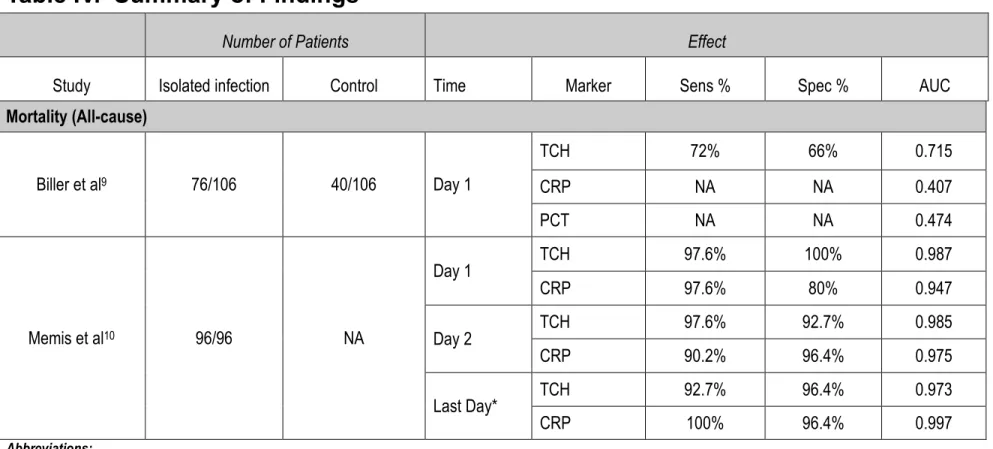
Table IV. Summary of Findings ... 24
Figure 1A. Cholesterol serum levels of survivors and nonsurvivors in patients with infection; 1B. Mortality in relation to quartiles of cholesterol levels. ... 25
List of Tables
Table I: ACCP/SCCM definition of sepsis
Table II: False-positive and false-negative results of PCT assay Table III: Characteristics of Reviewed Studies (GRADE)
Table IV: Summary of Findings
List of Figures
Figure I: 1A. Cholesterol serum levels of survivors and nonsurvivors in patients with infection; 1B. Mortality in relation to quartiles of cholesterol levels.
List of Abbreviations
PCT Procalcitonin
CRP C-Reactive protein
HDL-C High density lipoprotein – cholesterol
TCH Total cholesterol
APACHE II Acute Physiology and Chronic Health Evaluation II
GRADE Grading of Recommendations, Assessment, Development and
Evaluation
NIH National Institute of Health
ROS Receiver operating characteristic
AUC Area under the curve
LOS Length of stay
ACCP/SCCM American College of Chest Physicians/Society of Critical Care
Serum cholesterol: A Superior Prognostic Marker of
Sepsis Mortality in the ICU Compared to Procalcitonin or
C-reactive Protein
BACKGROUND
It is estimated that 5 million patients are admitted to the ICU in the United States annually.1 Sepsis, defined by the ACCP/SCCM Consensus Conference as the systemic
inflammatory response to infection2 (Table I), is the fourth most common admitting diagnosis to the ICU and is the second leading cause of mortality in the ICU after multiorgan failure.1 Despite
advances in aggressive management, a diagnosis of sepsis continues to have a high mortality rate, which increases with sepsis severity from 20.8% in patients with sepsis and as high as 48.8% in patients with septic shock.3 Sepsis also carries a high incidence of hospital
readmissions and consequently represents a significant portion of the healthcare budget. In a recent study4 evaluating 43 452 severe sepsis survivors by Goodwin et al, 26% of those patients
were readmitted within 30 days of their discharge and 48% of survivors by 180 days, with associated costs estimated at $366 million and $1.1 billion, respectively. Up to 10% of the sepsis survivors were deceased within 180 days of discharge,4 suggesting that sepsis is associated with
long-term morbidity and mortality.
Currently there are few reliable therapeutic strategies for the management of sepsis including empiric antibiotic therapy, aggressive volume repletion, and tight insulin control. Given that the reversibility of severe sepsis is poor, the need for an early prognostic marker to identify those at highest risk for mortality in order to optimize therapeutic options is critical in order to reduce the ICU mortality secondary to sepsis.5 Procalcitonin (PCT), a prohormone of the
hormone calcitonin, which is produced in the setting of microbial infection inflammatory mediators, and C-reactive protein (CRP), a calcium dependent ligand-binding protein
synthesized in the liver in response to the cytokine cascade, both known acute phase proteins and early inflammatory markers, are the current gold standard in early diagnosis and prognosis of patients with sepsis in the ICU setting; however, both present with limitations in their use.6 CRP is a nonspecific prognostic marker that is elevated in other infectious or inflammatory disorders, including obesity, diabetes mellitus, systemic lupus, chronic fatigue, depression, cigarette smoking. Moreover, CRP may also be falsely elevated in patients on steroids.6 Evidence has
demonstrated that PCT to be a useful tool in deciphering infectious vs noninfectious etiologies of inflammation5 but PCT has also had significant limitations in its utility for sepsis prognosis including a variable cutoff range that is dependent on the clinical setting and comorbidities such COPD and immunosuppression. PCT also has a high rate of false-positive and false-negative results (Table II).6
Recent evidence7 suggests that serum cholesterol may be a useful prognostic marker of
sepsis given that cholesterol metabolism has been shown to be markedly influenced by a state of widespread inflammation secondary to bacteremia. Additional studies5 have demonstrated that
patients diagnosed with severe sepsis in the ICU have a measured decrease in circulating levels of lipoproteins and an increase in triglycerides independent of comorbidities. These changes have been noted to occur early (within hours) in the inflammatory cascade associated with sepsis. A reduction in serum cholesterol was also negatively correlated to clinical outcome and length of stay, which carries additional mortality risk.8
Few studies, however, have evaluated the efficacy of serum cholesterol compared to the current gold standards, which have significant limitations in diagnosing sepsis early and
accurately identify those at high risk for mortality in the ICU setting. Can total cholesterol be a superior prognostic marker of mortality in patients admitted to the ICU for sepsis compared to the current gold standard of procalcitonin or C-reactive protein?
METHODS
An exhaustive search of available medical literature was conducted using MEDLINE-Ovid, Web of Science, and CINAHL using the following keywords: cholesterol, procalcitonin or C-reactive protein, and sepsis. Studies were included if the primary data evaluated the prognosis of adult patients admitted to the ICU for sepsis using cholesterol levels compared to one or both PCT or CRP. All studies evaluated must have been published in English and data collected using human trials only. Articles were excluded if trials were conducted on surgical ICU patients or if the primary data collected was on statin efficacy. Relevant articles were assessed for quality using the Grading of Recommendations, Assessment, Development and Evaluation (GRADE).19
A search on the National Institute of Health (NIH) clinical trials inquiry site indicates that there are no current trials in any phase evaluating serum cholesterol as a prognostic marker in ICU septic patients.
RESULTS
The initial result of the search yielded 36 potential articles. A total of 2 articles9,10 met eligibility criteria after screening relevant articles for primary data and human studies published in English. Both relevant articles were prospective observational studies published after 2007 (Table III and IV).
Cholesterol rather than procalcitonin or C-reactive protein predicts mortality in patients with infection (Biller et al)
In this prospective observational study,9 the authors compared the prognostic effect of
serum total cholesterol levels to PCT and CRP in predicting mortality in adult patients admitted to the ICU with severe sepsis secondary to infectious etiologies only. The study included patients admitted to the ICU at the University Hospital Grohadern in Munich, Germany. Seventy-six patients admitted consecutively to the ICU for sepsis secondary to infection between 2007 and 2011 fulfilling sepsis criteria of the ACCP/SCCM Consensus Conference2 were included in the
study. Infection was defined according to the Center for Disease Control criteria with bacterial proof and either an elevated CRP upon admission, signs of infection, including fever, shaking chills, and local signs, or radiological evidence. A control group of 40 patients admitted to the ICU with systemic inflammatory response syndrome (SIRS), a systemic inflammatory condition without evidence of infection, were also included in the study as controls. A one time blood draw was done immediately upon admission to the ICU to measure total cholesterol, PCT, and CRP.9
The primary outcome was mortality, which was investigated for the entire length of stay in the ICU per patient. Additional data collected upon hospital admission included the etiologies of infection and sepsis severity using the ACCP/SCCM criteria.2 In-house mortality and
underlying comorbid disorders were also considered during data analysis. Infectious etiologies of sepsis included pneumonia (most common), peritonitis, wound infection, bacteremia, urinary tract infection, and pancreatitis. Gram-negative infections predominated and aerobic infections were more common than anaerobic bacterial infections.9
Data analysis demonstrated that total cholesterol levels were significantly lower in nonsurviving patients in comparison with surviving patients (P = 0.006, 69mg/dL [range 37-88mg/dL] vs 96mg/dL [range 71-132mg/dL) whereas PCT and CRP levels demonstrated no
significant difference between the two groups. ROC analysis showed an AUC of 0.715 for total cholesterol levels and survival, with AUCs of 0.407 and 0.474 for PCT and CRP, respectively. Of the patients with sepsis and a total cholesterol level of 50mg/dL or less, 82% of the patients did not survive whereas patients with a cholesterol level of 100mg/dL or greater had a mortality rate of only 21%. A total cholesterol level of 80mg/dL was associated with a sensitivity of 72% and a specificity of 66%. There was no significant difference between survivors and
nonsurvivors in the control group for all prognostic markers,9 suggesting that cholesterol may be
most valuable in patients with sepsis secondary to infection rather than noninfectious etiologies of SIRS.
The authors suggest that a decrease in total cholesterol (hypocholesterolemia), which is consistent with previous research, has prognostic significance in patients with sepsis whereas PCT and CRP failed to demonstrate superior predictive value of mortality in this patient
population. It is recommended that on admission total cholesterol levels may identify patients at high risk for mortality with sepsis, enabling more optimal clinical management of these patients to prevent death.9
High C-reactive protein and low cholesterol levels are prognostic markers of survival in severe sepsis (Memis et al)
This prospective observational study10 evaluated the predictive potential of total
cholesterol in patients admitted to the Trakya University Hospital ICU in Turkey with sepsis in comparison with CRP only. Included were 96 patients admitted to the ICU for bacteriologically documented infections and at least two of the severe sepsis parameters defined by the
ACCP/SCCM Consensus Conference.2 Patients were excluded if they were admitted for
immunosuppressed patients, or diagnosed with a lethal condition that would result in death within 24 hours of admission. All patients were noted to receive standard of care resuscitation management and broad-spectrum antibiotic therapy, which included an aminoglycoside and a fourth generation cephalosporin or ciprofloxacin. Antibiotic management was altered in response to culture sensitivities accordingly. Total cholesterol and CRP levels were drawn within the first 24 hours of admission, day 2, and on the day of discharge from the ICU or upon death. The primary outcome was mortality, which was observed for 27 months following admission to the ICU. Clinical status and sepsis severity were monitored with the APACHE II score daily.10
Early data analysis indicated that nonsurvivors tended to be older in age and had higher CRP and APACHE II scores on admission compared to their survivor counterparts. In order to account for confounding factors of age on cholesterol levels, a covariance test was used to
remove the confounding effect. It was then demonstrated that nonsurvivors did have significantly lower cholesterol levels compared to survivors on Day 1, 2, and the last day (P <0.001, P < 0.001, P = 0.001, respectively). ROC analysis for Day 1 indicated that total cholesterol and survival had an AUC of 0.987 on admission with a sensitivity and specificity of 97.6% and 100%, respectively, whereas CRP with survival had an AUC of 0.947 with a sensitivity and specificity of 97.6% and 80%, respectively. There was no statistically significant difference between CRP and total cholesterol levels.10
The authors conclude that monitoring for hypocholesterolemia may be an equally effective prognostic marker of mortality risk as compared to CRP but may be superior if in addition to scoring systems that take into consideration severity of illness and age such as the APACHE II assessment. This combination of resources would then allow clinicians in the ICU
setting to earlier identify those patients that require careful monitoring and more aggressive therapies for sepsis and sepsis complications.10
DISCUSSION
Sepsis and septic shock have long remained one of the most common yet most
challenging admission diagnoses in the ICU, with significant risk for morbidity and mortality despite current aggressive management and high healthcare costs.3 Recent focus has been directed at identifying a prognostic marker to identify those patients that are at highest risk of mortality in the ICU secondary to sepsis. PCT and CRP, the most avidly studied prognostic markers, have demonstrated promise; however, significant limitations have been identified including lack of sensitivity and specificity as well as risk of false results with other
comorbidities.7 Although recognized for its diagnostic utility, CRP may be best utilized as a measure of response to therapy and the severity of inflammation rather than a prognostic marker given its relatively short half-life (approximately 19 hours).10 Prognostic potential of PCT is
unlikely during the early phase of systemic inflammation; however, without larger studies, the true effect compared to total cholesterol is unknown.9
Hudgins et al,11 in a study evaluating the systemic inflammatory response in both septic patients and healthy volunteers injected with a low dose of endotoxin, found that there is a major disruption in the normal metabolism of lipids, including lower levels of circulating HDL-C and the loss of one of the most abundant HDL apolipoproteins, Apo-A1. Low levels of Apo-A1 have been demonstrated throughout the literature to be significantly lower in nonsurviving septic patients compared to survivors.12 Changes in plasma lipids have been demonstrated to occur very early in systemic inflammation, with evidence that HDL-C decreases within hours of systemic
cytokine stimulation,8 suggesting that plasma lipids, specifically HDL-C and Apo-A1 levels,
may have significant promise as a sensitive prognostic markers of mortality in patients admitted to the ICU with sepsis. Although both prospective studies9,10 demonstrate high specificity,
Windler et al13 suggest that the convenience of total cholesterol is its nonspecificity for any
particular disease, which make low serum cholesterol a potential universal marker of mortality for a spectrum of diagnoses in the ICU. Unlike CRP and PCT, which can be altered with other underlying diseases, low cholesterol levels have been reported in a large population study as useful prognostic marker irrespective of comorbidities at time of admission.13 Reductions in
cholesterol, which do occur frequently in a hospital setting, were unlikely to decrease below 100mg/dL, whereas nonsurviving patients often had cholesterol levels as low as 40mg/dL.13 Serum cholesterol levels below 100mg/dL, which are only found in abetalipoproteinemia
disorders, are rare and would be unlikely to alter the significance of hypocholesteremia in severe disease, including sepsis.13
Although the exact mechanism in HDL-C and Apo-A1 reduction is relatively unknown, it is theorized that cholesterol’s role in the innate immune system may be to blame, rendering the host more susceptible to subsequent injury secondary to inflammation. Several studies have indicated that cholesterol has protective immunomodulatory effects in the presence of gram-negative sepsis,7 HDL-C and Apo-A1 in particular, being implicated as key players in the innate
immune cascade in response to infection by binding and subsequently neutralizing
lipopolysaccharide (LPS) endotoxins as well as lipoteichoic acid.14 These formed complexes result in consumption of HDL-C with high production of endotoxin, as seen in sepsis, resulting in a decline in circulating HDL-C and subsequently the immunomodulating effect that HDL-C has in response to infection.12 This is consistent with Biller et al,9 which demonstrated that a
reduction in cholesterol has value as a prognostic marker in patients with infection but not in patients with systemic inflammation without infection. This supports the hypothesis that HDL lipoproteins, comprising more than 90% of circulating cholesterol, have a prognostic role in infection.9 It is also theorized that a subsequent massive production in proinflammatory
cytokines secondary to infection may suppress the production of necessary apolipoproteins by the liver, which leaves tissue more vulnerable to endotoxin-mediated harm.12 It is also possible
that the reduction in HDL-C and Apo-A1 may be independent of the innate immune system role of cholesterol and rather a result of altered secondary to endogenous tissue lipid metabolism inhibition or increased hepatic triglyceride production (“lipemia of sepsis”).15 Low levels of
HDL-C have also been associated with low levels of stress-induced glucocorticoid production, which is a key innate response in combating the clinical manifestations of systemic inflammation as well as altered leukocyte recruitment.16
While the studies9,10 demonstrated that total cholesterol may have significant utility as a
superior prognostic marker of mortality in ICU septic patients, they both are limited in regards to evidence quality being observational studies and small sample sizes with inadequate control groups. Although the data in the Biller et al9 study demonstrated convincing evidence that total
cholesterol is a superior prognostic marker compared to the current gold standards, the lack of precision in comparing 37 nonsurvivors to 29 surviving patients demotes the quality of the evidence significantly on the basis of sample size. Their evaluation of hypocholesteremia severity with mortality rate is promising, however, and is consistent with previous studies that suggest a correlation to the severity of hypocholesterolemia and mortality (Figure I). In their study, 82% of patients with a serum total cholesterol level less than 50mg/dl during their ICU stay did not survive in comparison to their counterparts with cholesterol levels greater than
100mg/dL, who had a mortality rate of 21%. Windler et al13 indicated in a study comprising of
61 463 hospitalized septic participants that patients with serum cholesterol levels of 100mg/dL or less had an increased mortality rate of 29.7% from 3.6% in patients with normal cholesterol levels. Every patient with a serum cholesterol level less than 40mg/dL during their hospital stay did not survive.13
Likewise, Memis et al10 failed to provide precision given that their study was limited to
96 patients admitted to the ICU with documented infection and sepsis without a control group for comparison. However, of significance in this study, serum cholesterol levels and CRP were monitored over time (within 24 hours of admission, day 2, and day of discharge or death) with evidence that total cholesterol levels and CRP had significant prognostic ability throughout a patient’s hospital stay (P < 0.001),10 suggesting that total cholesterol levels may have utility
beyond that of admission.
In addition, neither Biller et al9 or Memis et al10 considered additional significant
prognostic endpoints, including hospital length of stay (LOS) and the number of ventilator days. In a study evaluating inflammatory markers in their prognostic utility for adverse outcomes in blunt trauma and sepsis, it was found that total cholesterol within the first week of admission are inversely related to the number of days on a ventilator and the hospital LOS,17 suggesting that
serum cholesterol has additional significant prognosis utility beyond mortality. Although previous studies18 have demonstrated that pre-existing dyslipidemia disorders, including those
requiring lipid-lowering therapy, do not confound serum cholesterol results in septic patients in the ICU, it is a serious variable to consider in evaluating the serum lipid response during systemic inflammation.
CONCLUSION
Emerging evidence suggests that serum total cholesterol may be a useful and superior prognostic marker of mortality for patients admitted to the ICU with sepsis secondary to
infection compared to its CRP and PCT counterparts. With larger, more comprehensive studies, it is likely that evidence will indicate that serum cholesterol levels will provide ICU clinicians a more sensitive screening tool for identifying those patients at highest risk for morbidity and mortality irrespective to other underlying comorbidities, whereas CRP may be more useful for monitoring response to therapy. Monitoring serum cholesterol levels on hospital admission could provide a very novel, inexpensive tool that has the potential to start early and aggressive therapy in patients most at risk for death, thus decreasing the mortality rate secondary to sepsis.
Understanding the pathophysiology of lipid metabolism in the event of systemic inflammation also opens the door to additional experimental therapy including the use of statin medications in septic patients.
References
1. US Department of Health and Human Services, Health Resources and Services
Administration Report to Congress. The Critical Care Workforce: A Study of the Supply and Demand for Critical Care Physicians. May 2006. Available at
http://bhpr.hrsa.gov/healthworkforce/reports/studycriticalcarephys.pdf. Accessed May 20, 2015
2. American College of Chest Physicians/Society of Critical Care Medicine Consensus
Conference: Definitions for sepsis and organ failure and guidelines for the use of innovative therapies in sepsis. Crit Care Med. 1992;20:864-874.
3. Goncalves-Pereira J, Pereira JM, Ribeiro O, Baptista JP, Froes F, Paiva JA. Impact of infection on admission and of the process of care on mortality of patients admitted to the Intensive Care Unit: the INFAUCI study. Clin Microbiol Infect. 2014;20:1308-1315. 4. Goodwin AJ, Rice DA, Simpson KN, Ford DW. Frequency, cost, and risk factors of readmissions among severe sepsis survivors. Crit Care Med. 2015;43:738-746.
5. Herzum I, Renz H. Inflammatory markers in SIRS, sepsis and septic shock. Curr Med Chem. 2008;15:581-587.
6. Sankar V, Webster NR. Clinical application of sepsis biomarkers. J Anesth. 2013;27:269-283.
7. Murch O, Collin M, Hinds CJ, Thiemermann C. Lipoproteins in inflammation and sepsis. I. Basic science. Intensive Care Med. 2007;33:13-24.
8. Wendel M, Paul R, Heller AR. Lipoproteins in inflammation and sepsis. II. Clinical aspects.
Intensive Care Med. 2007;33:25-35.
9. Biller K, Fae P, Germann R, Drexel H, Walli AK, Fraunberger P. Cholesterol rather than procalcitonin or C-reactive protein predicts mortality in patients with infection. Shock. 2014;42:129-132.
10. Memis D, Gursoy O, Tasdogan M, et al. High C-reactive protein and low cholesterol levels are prognostic markers of survival in severe sepsis. J Clin Anesth. 2007;19:186-191. 11. Hudgins LC, Parker TS, Levine DM, et al. A single intravenous dose of endotoxin rapidly alters serum lipoproteins and lipid transfer proteins in normal volunteers. J Lipid Res. 2003;44:1489-1498.
12. Chien JY, Jerng JS, Yu CJ, Yang PC. Low serum level of high-density lipoprotein
cholesterol is a poor prognostic factor for severe sepsis. Crit Care Med. 2005;33:1688-1693. 13. Windler E, Ewers-Grabow U, Thiery J, Walli A, Seidel D, Greten H. The prognostic value of hypocholesterolemia in hospitalized patients. Clin Investig. 1994;72:939-943.
14. Ulevitch RJ, Johnston AR. The modification of biophysical and endotoxic properties of bacterial lipopolysaccharides by serum. J Clin Invest. 1978;62:1313-1324.
15. Ilias I, Vassiliadi DA, Theodorakopoulou M, et al. Adipose tissue lipolysis and circulating lipids in acute and subacute critical illness: effects of shock and treatment. J Crit Care. 2014;29:1130.e5-1130.e9.
16. Lekkou A, Mouzaki A, Siagris D, Ravani I, Gogos CA. Serum lipid profile, cytokine production, and clinical outcome in patients with severe sepsis. J Crit Care. 2014;29:723-727.
17. Dunham CM, Frankenfield D, Belzberg H, Wiles CE 3rd, Cushing B, Grant Z.
Inflammatory markers: superior predictors of adverse outcome in blunt trauma patients?.
Crit Care Med. 1994;22:667-672
18. Luthold S, Berneis K, Bady P, Muller B. Effects of infectious disease on plasma lipids and their diagnostic significance in critical illness. Eur J Clin Invest. 2007;37:573-579.
19. GRADE working group. GRADE website. http://gradeworkinggroup.org/. Accessed August 11, 2012.
Table III. Characteristics of Reviewed Studies (GRADE)
Quality AssessmentDowngrade Criteria
Studies Design Limitations Indirectness Imprecision Inconsistency Publication bias Quality
Mortality (All-Cause)
Biller et al9 Prospective
Observational No serious limitations indirectness No serious Limited sample size inconsistencies No serious No bias likely Very low Memis et al10 Prospective
Observational No serious limitations indirectness No serious
Limited sample size without control
group
No serious
Table IV. Summary of Findings
Number of Patients Effect
Study Isolated infection Control Time Marker Sens % Spec % AUC
Mortality (All-cause) Biller et al9 76/106 40/106 Day 1 TCH 72% 66% 0.715 CRP NA NA 0.407 PCT NA NA 0.474 Memis et al10 96/96 NA Day 1 TCH 97.6% 100% 0.987 CRP 97.6% 80% 0.947 Day 2 TCH 97.6% 92.7% 0.985 CRP 90.2% 96.4% 0.975 Last Day* TCH 92.7% 96.4% 0.973 CRP 100% 96.4% 0.997 Abbreviations: TCH: Total cholesterol CRP: C-reactive protein PCT: Procalcitonin AUC: Area under the curve