Robust Scene Recognition
Li Shimiao
NATIONAL UNIVERSITY OF SINGAPORE
2009
Ordinal Depth from SFM and Its Application in
Robust Scene Recognition
Li Shimiao
(B.Eng. Dalian University of Technology)
A THESIS SUBMITTED
FOR THE DEGREE OF DOCTOR OF PHILOSOPHY
DEPT. ELECTRICAL AND COMPUTER ENGINEERING
NATIONAL UNIVERSITY OF SINGAPORE
2009
First of all I would like to express my sincere gratitude to my thesis super-visor, Professor Cheong Loong Fah for his valuable advices, constant support and encouragement through out the years.
I would also like to thank Mr. Teo Ching Lik for our good collaboration. I am grateful to Professor Tan Chew Lim for his understanding and support during the last one year.
Thanks to all my colleagues in Vision and Image Processing Lab for their sharing of ideas, help and friendship. Many thanks to Mr. Francis Hoon, our lab technician, for providing me with all the technical facilities during the years.
Finally, my special thanks to my parents and Dat, for their encouragement, support, love and sacrifices in making this thesis possible.
Abstract
Ordinal Depth from SFM and Its Application in Robust Scene Recognition
Li Shimiao
Under the purposive vision paradigm, visual data sensing, space representation and visual processing are task driven. Visual information in this paradigm can be weak or qualitative as long as it successfully subserves some vision task, but it should be easy and robust to recover.
In this thesis, we propose the qualitative structure information - ordinal depth as a computationally robust way to represent 3D geometry obtained from motion cues and in particular, advocate it as an informative and powerful component in the task of robust scene recognition.
The first part of this thesis analyzes the computational property of ordinal depth when being recovered from the motion cues and proposes an active camera control method - the biomimeticTBL motion as a strategy to robustly recover ordinal depth. This strategy is inspired by the behavior of insects from the order hymenoptera (bees and wasps). Specifically, we investigate the resolution of the ordinal depth extracted via motion cues when facing errors in 3D motion estimates. It is found that although metric depth estimates are inaccurate, ordinal depth can still be discerned reliably if the physical depth difference is beyond a certain discrimination threshold. Findings in this part of our work suggest that accurate knowledge of qualitative 3D structure can be ensured in a relatively small local image neighborhood and that resolution of ordinal depth decreases as the visual angle between points increases. Findings
also advocate camera lateral motion as a robust way to recovery ordinal depth. The second part of this thesis proposes a scene recognition strategy that integrates the appearance-based local SURF features and the geometry-based
3D ordinal constraint to recognize different views of a scene, possibly under different illumination and subject to various dynamic changes common in nat-ural scenes.
Ordinal depth information provides the crucial 3D information when deal-ing with outdoor scenes with large depth relief, and helps to distdeal-inguish am-biguous scenes with repeated local image features. In our investigation, geo-metrical ordinal relations of landmark feature points in each of the three di-mensions are found to complement each other under different types of camera movements and with different types of scene structures. Based on these in-sights, we propose the3D ordinal space representation and put forth a scheme to measure similarities among two scenes represented in this way. This leads us to a novel scene recognition algorithm which combines appearance information and geometrical information together.
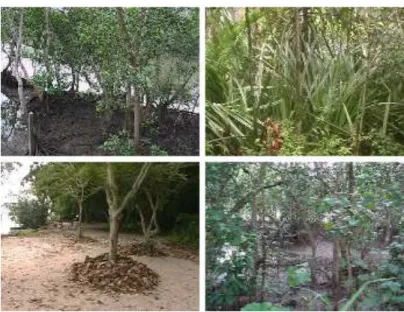
We carried out extensive scene recognition testing over four sets of scene databases, consisting mainly of outdoor natural images with significant view-point changes, illumination changes and moderate changes in scene content over time. The results show that our scene recognition strategy outperforms other algorithms that are based purely on visual appearance or exploit global or semi-local geometrical transformations such as epipolar constraint or affine constraint.
Table of Contents
Acknowledgments i
Abstract ii
List of Tables ix
List of Figures xii
1 Introduction 1
1.1 What is This Thesis About? . . . 1
1.2 Space Representation and Computational Limitation of Shape from X . . . 4
1.3 What Can Human Visual System Tell Us? . . . 5
1.4 Purposive Paradigm, Active Vision and Qualitative Vision . . 6
1.5 Ordinal Depth . . . 8
1.6 Turn-Back-and-Look(TBL) Motion . . . 8
1.7 Scene Recognition . . . 9
1.8 Contribution of the Thesis . . . 10
1.9 Thesis Organization . . . 14
2 Resolving Ordinal Depth in SFM 16
2.1 Overview . . . 16
2.2 Related Works . . . 19
2.2.1 The Structure from Motion (SFM) Problem . . . 19
2.2.2 Error Analysis of 3D Motion Estimation in SFM . . . . 20
2.2.3 Analysis of 3D Structure Distortion in SFM . . . 21
2.2.4 Ordinal Depth Information: Psychophysical Insights . . 23
2.3 Depth from Motion and its Distortion : A General Model . . . 24
2.4 Estimation of Ordinal Depth Relation . . . 27
2.4.1 Ordinal Depth Estimator . . . 27
2.4.2 Valid Ordinal Depth (VOD) Condition and VOD In-equality . . . 28
2.5 Resolving Ordinal Depth under Weak-perspective Projection . 30 2.5.1 Depth Recovery and Its Distortion under Orthographic or Weak-perspective Projection . . . 30
2.5.2 VOD Inequality under Weak-perspective Projection . . 32
2.5.3 Ordinal Depth Resolution and Discrimination Thresh-old(DT) . . . 33
2.5.4 VOD Function and VOD Region . . . 33
2.5.5 Ordinal Depth Resolution and Visual Angle . . . 34
2.5.6 VOD Reliability . . . 36
2.6 Resolving Ordinal Depth under Perspective Projection . . . . 38
2.6.1 The Pure Lateral Motion Case . . . 39
2.6.2 Adding Forward Motion: The Influence of FOE . . . . 41
2.7 Discussion . . . 43
TABLE OF CONTENTS vi
2.7.2 Psychophysical and Biological Implication . . . 44
2.8 Summary . . . 45
3 Robust Acquisition of Ordinal Depth using Turn-Back-and-Look (TBL) Motion 47 3.1 Background . . . 47
3.1.1 Turn-Back-and-Look (TBL) Behavior and Zig-Zag Flight 47 3.1.2 Why TBL Motion Is Performed? . . . 49
3.1.3 Active Camera Control and TBL Motion . . . 49
3.2 Recovery of Ordinal Depth using TBL Motion . . . 51
3.2.1 Camera TBL motion . . . 51
3.2.2 Gross Ego-motion Estimation and Ordinal Depth Recovery 52 3.3 Dealing With Negative Depth Value . . . 54
3.4 Experimental Results . . . 55
3.5 Summary . . . 56
4 Robust Scene Recognition Using 3D Ordinal Constraint 58 4.1 Background . . . 58
4.1.1 2D vs 3D Scene Recognition . . . 60
4.1.2 Revisiting 3D Representation . . . 64
4.1.3 Organization of this Chapter . . . 65
4.2 3D Ordinal Space Representation . . . 65
4.3 Robustness of Ordinal Depth Recovery . . . 67
4.4 Stability of Pairwise Ordinal Relations under Viewpoint Change 68 4.4.1 Changes to Pairwise Ordinal Depth Relations . . . 68
4.4.2 Changes to Pairwise Ordinal x and y Relations . . . . 72
4.5 Geometrical Similarity between Two 3D Ordinal Spaces . . . . 77
4.5.1 Kendall’s τ and Rank Correlation Coefficient . . . 77
4.5.2 Weighting of Individual Pairs . . . 82
4.6 Robust Scene Recognition . . . 85
4.6.1 Salient Point Selection . . . 86
4.6.2 Encoding the Appearance and Geometry of the Salient Points . . . 89
4.6.3 Measuring Scene Similarity and Recognition Decision . 91 4.7 Summary . . . 93
5 Robust Scene Recognition: the Experiment 95 5.1 Experimental Setup . . . 95 5.1.1 Database IND . . . 96 5.1.2 Database UBIN . . . 97 5.1.3 Database NS . . . 101 5.1.4 Database SBWR . . . 101 5.2 Experimental Results . . . 103
5.2.1 Recognition Performance and Comparison . . . 103
5.2.2 Component Evaluation and Discussions . . . 104
5.3 Summary . . . 115
6 Future Work and Conclusion 118 6.1 Future Work Directions . . . 118
6.1.1 Space Representation: Further Studies . . . 118
6.1.2 Scene Recognition and SLAM . . . 119
6.1.3 Ordinal Distance Information for 3D Object Classification119 6.2 Conclusion . . . 124
TABLE OF CONTENTS viii
A Acronyms 127
B Author’s Publications 128
2.1 DT values for different visual angles under different translation-to-rotation ratioh. Z = 100m and pe= 5%. . . 44
4.1 Invariant properties of ordinal relations in x, y, and Z dimen-sions to different types of camera movements and in different types of scenes. It can be seen that different dimensions com-plement each other. . . 76
5.1 Description of the four databases used in the experiments . . . 96 5.2 Rank correlation coefficient in the x, y, and Z dimensions for
two types of scenes. 1 and 2: locally planar or largely fronto-parallel scenes. 3 and 4: in-depth scenes. . . 109
LIST OF TABLES x
5.3 The comparison between local appearance matching and overall geometrical consistency: positive test example 1. The top left image pair represents the correspondences between the test and its correct reference scene; the middle left image pair represents the correspondences between the test and the best of the re-maining reference scenes (wrong reference scene); the top right pair and middle right pair represent the correspondences left af-ter pruning by the epipolar constraint (RANSAC is used); the bottom table shows the detailed values of Nmatch
Ntot , τ3D, G, and
Nmatch
Ntot after pruning by the epipolar constraint (RANSAC). . . 110
5.4 The comparison between local appearance matching and overall geometrical consistency: positive test example 2. The top left image pair represents the correspondences between the test and its correct reference scene; the middle left image pair represents the correspondences between the test and the best of the re-maining reference scenes (wrong reference scene); the top right pair and middle right pair represent the correspondences left af-ter pruning by the epipolar constraint (RANSAC is used); the bottom table shows the detailed values of Nmatch
Ntot , τ3D, G, and
Nmatch
5.5 The comparison between local appearance matching and overall geometrical consistency: positive test example 3. The top left image pair represents the correspondences between the test and its correct reference scene; the middle left image pair represents the correspondences between the test and the best of the re-maining reference scenes (wrong reference scene); the top right pair and middle right pair represent the correspondences left af-ter pruning by the epipolar constraint (RANSAC is used); the bottom table shows the detailed values of Nmatch
Ntot , τ3D, G, and
Nmatch
Ntot after pruning by the epipolar constraint (RANSAC). . . 112
5.6 Some negative test examples which have high Nmatch
Ntot value with
some reference scenes. The correspondences and the actual val-ues of Nmatch
Ntot , τ3D, G between the test and the reference scene
List of Figures
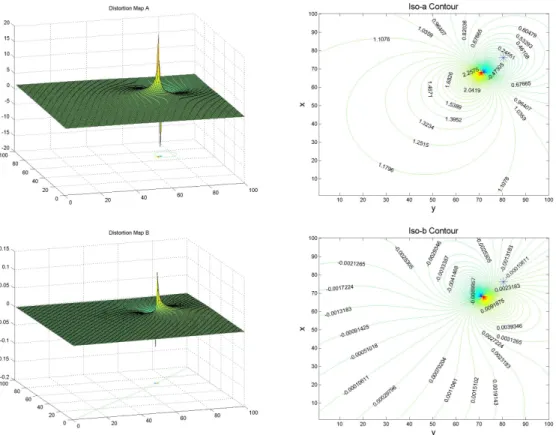
2.1 Realization of the distortion maps A,B under perspective pro-jection, iso-a contour, iso-b contour are shown. Motion param-eters are: focus of expansion (FOE) (x0, y0) = (26,30.5),
rota-tion velocity α = 0.005, β = 0.004, γ = 0.0002. Error in FOE estimates: (x0e, y0e) = (8,9), error in rotation: αe = 0.001,
βe = 0.001, γe = 0.00005. Focal length: 50 pixels, FOV= 90◦,
epipolar reconstruction scheme was adopted (n = ˆd
kˆdk), blue ∗
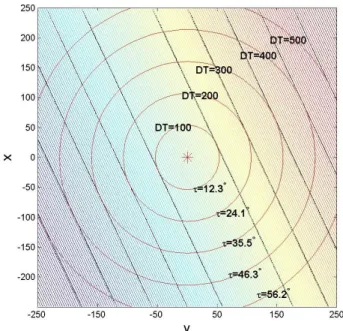
indicates the true FOE, red ∗ indicates the estimated FOE. . 27 2.2 Realization of VOD region of p0 = (0,0)T (p0 is denoted
by the red asterisk) for different DT under weak-perspective projection. VOD region is bounded by black lines. The big red circles show the width of the region bands. τ is the vi-sual angle between points on the circle and p0. The
rain-bow at the background shows the change of distortion factor
b. . Motion parameters and errors: T = (0.81,0.2,0.15)T,
Ω = (0.008,0.009,0.0001), Z = 35000, δ = −4.2857e −006,
φe = 28.6◦,δe = 1.0e−006, γe = 1.0e−006, p˙n = 0, f = 250. 35
2.3 Top: VOD Reliability of image points w.r.t. the image center for DT = 100 atZ = 35000. Bottom: VOD Reliability of image points w.r.t. the image center for different DT at Z = 35000
as visual angle(◦)between the point pair changes. (U, V, W) = (0.001,0.002,0.001), (α, β, γ) = (0.004,0.002,0.003). . . 37 2.4 Realization of VOD region of p0 = (0,0)T (denoted by red
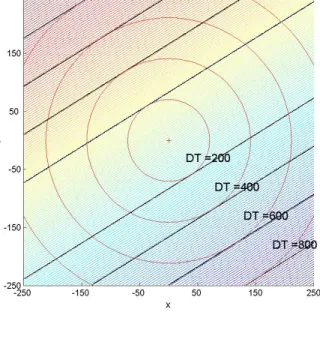
cross) for different DT under perspective projection and pure lateral motion. Top: second order flow ignored. Bottom: second-order flow considered. The VOD region is bounded by black lines. The background rainbow shows the change of distortion factor b. Motion parameters and errors are: T = (18,22,0)T,
Te = (15.3,24.5,0)T, (translation direction estimation error is
−7.3◦), Ωe = (0.00002,0.00002,0.00005), Z = 20000, p˙n = 0,
f = 250. . . 40
2.5 Realization of VOD region of p0 = (0,0)T (denoted by red
cross) for different DT under perspective projection with for-ward translation added to the motion configuration shown in Figure 2.4. Top: µ = 15◦. Bottom: µ = 25◦. µe = 0 in
both cases. Only first-order optical flow is considered for the illustration. . . 42
3.1 The Zig-Zag flight of a wasp directed towards a target (large circle) as seen from above [112]. Notice the significant transla-tional motion that is almost perpendicular to the target at each arc formed. The complete path is shown on the right. . . 48 3.2 Simple camera TBL motion . . . 52
LIST OF FIGURES xiv
3.3 Recovered ordinal depth of feature points in indoor and outdoor scenes, depicted using the rainbow color coding scheme (red stands for near depth; violet for far depth). Gross 3D motion estimates ( ˆφ,α,ˆ β,ˆ γ,ˆ fˆ) are shown under each image. . . 57
4.1 SIFT matching in the natural environment. Top: SIFT matches between two different views of a scene. Bottom: SIFT matches between images of two different scenes. The same matching threshold is used for both examples. . . 61 4.2 Examples of scenes with large depth discontinuities on which
2D-geometry-enhanced approach may fail and 3D method is required. . . 63 4.3 Landmark rank (based on thex-coordinate) remains unchanged
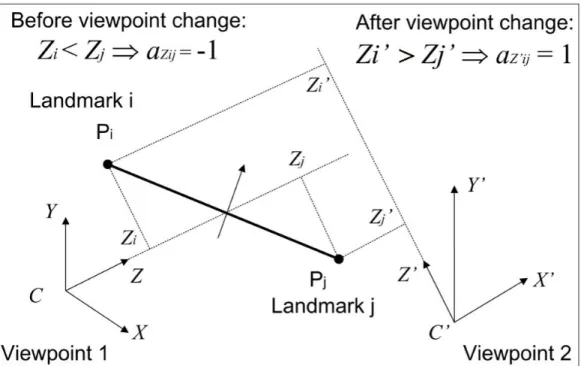
under small viewpoint change. . . 67 4.4 Pairwise ordinal depth relation varies as optical axis direction
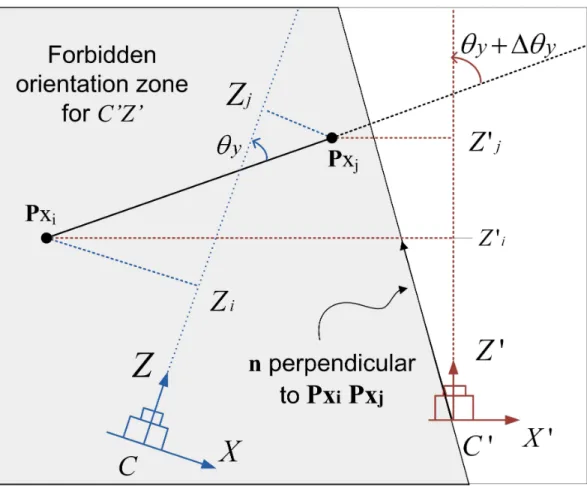
changes. . . 69 4.5 Pairwise ordinal depth relation under camera rotation around
the Y-axis. The figure is the projection of the scene in Figure 4.4 onto the XCZ plane. Forbidden orientation zone for C0Z0
is indicated by the shaded region that passes through C0. For feature pair that are almost fronto-parallel, likePi andPj when
viewed from C, small camera rotation around the Y axis may cause the line of sight C0Z0 at the new viewpoint to cross into the forbidden zone. . . 70
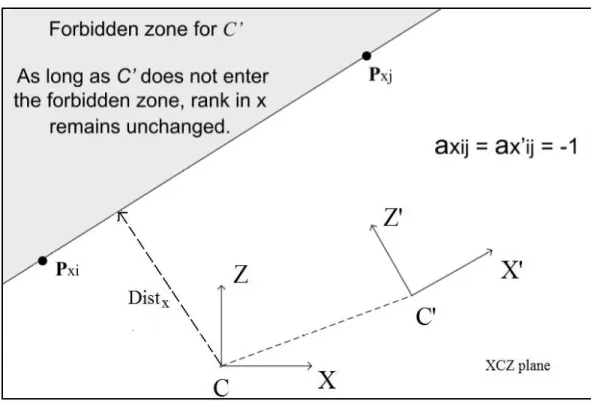
4.6 Pairwisexrelation under camera translation in theXCZ plane is preserved as long as C0 does not enter the forbidden zone, which is the half space indicated by the shaded region. DistX is
the shortest camera translation that will bring about the cross-ing of this half space. . . 72 4.7 The range image of a forest scene from the Brown range
im-age database. Intensity represents distance values, with distant object looking brighter. . . 80 4.8 Computing RCC on the Brown range data (forest scene):
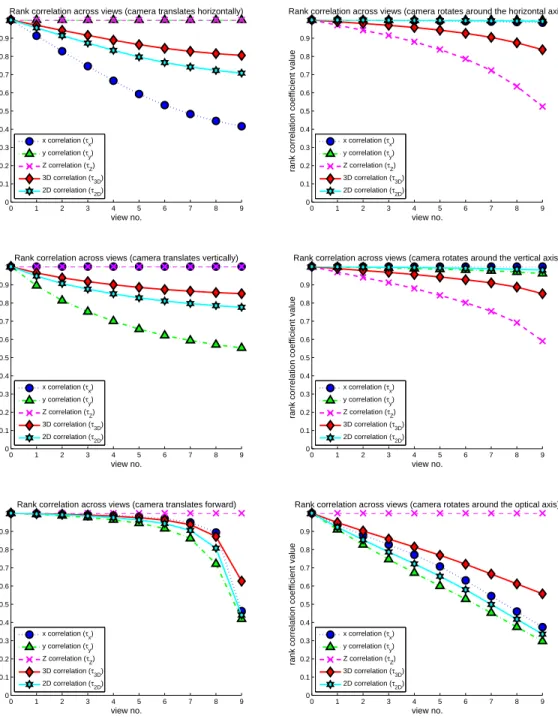
differ-ent RCCs across the views are shown when the camera under-goes different types of movements. The top, middle and bottom left figures correspond to translations in theX,Y, and theZ di-rection respectively, whereas the top, middle and bottom right figures correspond to rotations around theX, Y, and theZ di-rection respectively. The horizontal axis in each plot represents the various view positions (view 0-9) as the camera moves away from the original position. . . 81 4.9 Grayscale(top row) and saturation(bottom row) for the same
scene taken under different illumination conditions. . . 87 4.10 An example outdoor scene with its sky-ground segmentation
(top right), detected skyline (bottom left) and the resulting saliency map (bottom right). . . 88 4.11 Steps that describe the various stages of extracting the salient
ROIs using various image morphological operations. The initial saliency map is extracted based on a down-sampled image. The final salient ROIs are boxed in white and highlighted in green. 90
LIST OF FIGURES xvi
4.12 Ordinal depths extracted from gross depth estimates under TBL motion, depicted using the rainbow color coding scheme (red
stands for near depth; violet for far depth). . . 92
5.1 Reference scenes in the IND database. . . 97
5.2 Reference scenes in the UBIN database. . . 98
5.3 Reference scenes in the NS database. . . 99
5.4 Various challenging positive test scenes and reference scenes from the four databases. . . 100
5.5 Reference scenes in the SBWR database. . . 102
5.6 Comparison of the proposed SRS(SURF + 3D ordinal con-straint), the SURF only method, the SURF + Epipolar Con-straint (RANSAC) method, and the SURF + affine conCon-straint method. . . 105
5.7 Successfully recognized positive test scenes (right image in each subfigure) and their respective reference matches (left image in each subfigure), despite substantial viewpoint changes, natural dynamic scene changes or illumination changes. . . 106
5.8 More successfully recognized positive test scenes (right image in each subfigure) and their respective reference matches (left image in each subfigure), despite substantial viewpoint changes, natural dynamic scene changes or illumination changes. . . 107
5.9 Component evaluation: comparing the 3D weighted scheme, the 2D weighted scheme, and the 3D unweighted scheme over the four databases. . . 108
5.10 Separation of the positive test set and the negative test set in IND and NS databases (respectively the four rows). Left column: histogram of the SURF matching percentage (P =
Nmatch
Ntot ) for both the positive and the negative test set. Right
column: histogram of the global scene correlation coeffecient (G) for both the positive and the negative test set. For positive test scene, P and G are the values between the test scene and its correct reference scene; for negative test scene, P and G are the biggest values obtained when the test scene is compared with all the reference scenes. . . 114 5.11 Separation of the positive test set and the negative test set in
UBIN and SBWR databases (respectively the four rows). Left column: histogram of the SURF matching percentage (P =
Nmatch
Ntot ) for both the positive and the negative test set. Right
column: histogram of the global scene correlation coeffecient (G) for both the positive and the negative test set. For positive test scene, P and G are the values between the test scene and its correct reference scene; for negative test scene, P and G are the biggest values obtained when the test scene is compared with all the reference scenes. . . 115
6.1 Images of models of tables and planes . . . 121 6.2 Sampling with different number of vertices. . . 121 6.3 Rank proximity matrices of table models, computed from 343
LIST OF FIGURES xviii
6.4 Rank proximity matrices of plane models, computed from 343 sampled vertices. . . 123 6.5 Rank proximity matrices with different number of sampled
ver-tices. Upper row: table class, lower row: plane class. Sample number increases from left to right (as shown in Figure 6.2). . 124
Introduction
1.1
What is This Thesis About?
3D reconstruction has been a key problem since the emergence of the com-puter vision field. Marr and Poggio founded the theory of computational vision [65, 66, 64]. According to this theory, 3D representation of the physi-cal world can be built through three description levels from 2D images [64]. This was applied to the shape from X problems, which aim to reconstruct full 3D structure from its projections on 2D images using various visual cues such as texture, shading, stereo, motion etc. It is believed by the Marr school that reconstructing an internal representation of the physical world is a pre-requisite for carrying out any vision tasks [32]. However, despite the many ensuing efforts on 3D reconstruction since the 1980s, it was found that the shape from X(SFX) problems are ill-posed or very difficult to solve compu-tationally [115, 29]. Accurate and robust 3D reconstruction from 2D images seems to be infeasible in practice. Even low-level or mid-level representation is
1.1. What is This Thesis About? 2
very difficult to construct accurately. Thus Marr’s paradigm does not lead to many successful robotic vision applications such as recognition and navigation. Probably due to the difficulty of 3D reconstruction, researchers have been seeking alternative approaches to fulfil vision tasks without geometrical recon-struction. In image based object recognition task, 2D local feature descriptors, which encode the local visual appearance information, have been the main-stay since the late 1990s and have been proven to be successful, especially with the recent development of locally invariant descriptors [62, 9]. In spite of the success, the visual appearance information encoded by the descriptors may change significantly when camera has large viewpoint change or when the lighting condition changes. This limits the power of these 2D local descriptor methods. To overcome the limitation, the visual appearance information is often combined with geometrical constraints so as to enhance the discriminat-ing power of the local feature descriptors [6, 18, 34, 73, 91, 88]. 2D geometrical constraints [6,18,34,73,91], due to the assumption on the scene structure they are based on, are always restricted to certain types of objects or scenes. There-fore, 3D geometrical information is again required in robust recognition tasks. However, to combine 3D geometrical information with 2D visual appearance information, we again face the difficulties encountered in the 3D reconstruction problem.
Contrasting Marr’s paradigm of general-purpose reconstruction is the pur-posive vision paradigm [3, 98]. Its main tenet is that if we consider the specific vision task we are dealing with, e.g. the recognition task, the situation can be simplified [86]. Instead of seeking a solution for full 3D reconstruction following Marr’s paradigm, we may look for some weak or qualitative 3D geo-metrical information useful for the recognition task and at the same time, can
be recovered in an easy and robust way from some visual cues.
This thesis aims at finding such robust and useful geometrical information for vision tasks. We aim to answer the following questions.
• Although the reconstructed 3D structure may in general be inaccurate due to the computational difficulties in shape from X, can we still ex-tract some valid and useful geometrical information from the inaccurate structures?
• How to acquire such geometrical information in a simple and robust way?
• How to use such geometrical information in practical vision tasks? Specifically, in this thesis, we propose the qualitative structure information -ordinal depth1 as a computationally robust way to represent 3D geometry in shape/structure from motion problem and advocate it as a powerful component in the robust scene recognition task.
The first part of this thesis answers the question "How to recover ", specif-ically, we analyze ordinal depth’s computational properties when being recov-ered from the motion cues. Based on these properties, we propose a simple way called TBL motion, which is inspired from the behavior of biological insects, to recover ordinal depth robustly. The second part answers the question "How to use". The invariance properties of ordinal depth w.r.t. camera viewpoint change are analyzed. Based on these insights, we propose the3D ordinal space representation. Finally, we design a strategy to exploit the 3D ordinal space
1By ordinal depth, we mean the order of the distances of points in the physical world to
1.2. Space Representation and Computational Limitation of Shape from X 4
representation successfully in the robust scene recognition task, especially in the outdoor natural scene environment.
The remainder of this chapter is organized as follows. In Section 1.2 to Section 1.7, we give brief accounts to the various background topics relevant to this thesis. Section 1.8 presents a summary of the key contributions of the thesis. Finally, Section 1.9 presents the organization of the thesis.
1.2
Space Representation and Computational
Lim-itation of Shape from X
Marr’s paradigm aims at recovering metric representation of the space. How-ever, techniques of shape from X for this purpose suffer from noise in image measurements and errors in the computation stages. Taking the structure from motion problem for example, small noise in image velocity measurements can lead the algorithm to very different solutions. In spite of the many algorithms proposed for structure from motion, we still lack methods robust to noise in image velocities, and errors in motion estimates or calibration parameters. Er-ror analysis of this problem shows that there are inherent ambiguities in the motion estimation and calibration stage which may cause severe 3D structure distortions [29, 21, 119]. Similar problems exist in shape recovery from other visual cues [31, 67].
In a vision system, the geometrical information conveyed in a 3D space representation2 is usually computed by some 3D reconstruction technique.
2By space representation, we mean the way geometrical information of the physical world
However, due to the ill-conditioned and noise sensitive nature of shape from X, the robustness of this computation should be given a careful evaluation, especially for vision tasks requiring robust performance.
In this thesis, we present a comprehensive analysis on the computational robustness of structure from motion algorithms to recover the ordinal depth information. The insights obtained from this analysis serve as guidelines for ordinal depth to be exploited in the robust scene recognition task.
1.3
What Can Human Visual System Tell Us?
To find a proper space representation suitable for a wide range of vision tasks, researchers in cognition and psychophysics have been referring to one of the most powerful vision systems present in nature - the human vision system. Many studies were carried out exploring the properties of space representation in human visual system. It is believed by most researchers that the represen-tation is anything but Euclidean [106, 50, 38]. This may indicate that human perception of space is metrically imprecise.
Studies have also been carried out on how humans measure distances in space. Some psychophysical experiments were designed to test observers’ judgement on interval and ordinal depth measurements [100, 107, 76, 28]. Re-sults show that human are good at judging the weaker measurements such as the ordinal measurement. It was suggested that human vision might only perceive ordinal distance information from sparse points in the space, and as the number of points increases, metric information could be recovered from dense ordinal measurements using methods like multi-dimensional scaling [28]. Therefore, it seems that qualitative geometry information might be a key step
1.4. Purposive Paradigm, Active Vision and Qualitative Vision 6
towards finding a proper space representation.
Studies also show that human visual attention changes as subjects are asked to perform different vision tasks [120, 117]. This shows that the visual data acquisition process is purposively and actively controlled, rather than being a passively general process. It implies that vision might be a task-driven process and thus, geometrical information recovered by SFX could also vary with different tasks.
Inspired by the above findings from human visual system, this thesis focuses on understanding the qualitative geometry information, that is, the computa-tional properties and practical application of ordinal depth. We also propose a bio-inspired strategy for active acquisition of such geometrical information.
1.4
Purposive Paradigm, Active Vision and
Qual-itative Vision
The fundamental difference between Marr’s reconstruction paradigm and the purposive paradigm [3, 103] lies in the way they see the final goal of vision. According to the panel discussion in [13], from the view of the reconstruction paradigm, the goal of vision is:
• “The description of three dimensional world in terms of the surfaces and objects present and their physical properties and spatial relationships.”
while from the view of the purposive paradigm, the goal of vision is:
• “The development of fast visual abilities which are tied to specific behav-iors and which access the scene directly without intervening representa-tions.”
In traditional reconstruction paradigm, reconstruction is a task-independent process and is therefore general-purpose. On the other hand, the purposive paradigm is task-driven. In the purposive paradigm, data acquisition, space representation, and the 3D geometry information needed all become task-oriented.
Data acquisition often becomes an active process in the purposive paradigm. For example, the eye (or camera) movement can be actively controlled depend-ing on the information the agent needs for performdepend-ing the current task and the status of current scene interpretation. Such data acquisition strategy is known as theactive vision paradigm [4, 3, 8].
In another aspect, space representation and 3D reconstruction in the pur-posive paradigm are used to subserve specific task performing. Only geometry information needed for the robust performance of the current task is to be represented and constructed. Such geometry information can be imprecise or even qualitative in nature; this is in contrast to metric 3D reconstruction in the reconstruction paradigm. If only the qualitative description of the physical world is needed for some specific task, the system is said to subscribe to the
qualitative vision paradigm [5, 36]. Qualitative information exhibits greater invariance to the various factors in vision system such as viewpoint or illu-mination changes, and noise in data acquisition. It is hoped that qualitative vision, if proven to be adequate for some specific task, would have more robust performance than the traditional quantitative system.
In this thesis, we develop a recognition system for individual scene iden-tification. Our system subscribes to the active vision and qualitative vision paradigms. We use controlled camera movement though not requiring precise camera motion to robustly recover the qualitative ordinal depth information.
1.5. Ordinal Depth 8
Using ordinal depth, we develop the 3D ordinal space representation which only encodes the ordinal spatial information and couple it successfully to the task of scene recognition.
1.5
Ordinal Depth
Being the simplest qualitative description of the third dimension of the physical world, ordinal depth measures the order of the distances of 3D points to the observer along the viewing direction. Due to its qualitative nature, ordinal depth information is robust to noise and errors in shape from X [23]. It was proposed as one of the qualitative structures that can be used in active vision [36]. However firstly, the computational capability of shape from X algorithms to judge ordinal depth under different resolutions of depth variation has not been well analyzed. Secondly, the power of the ordinal depth information has not been well demonstrated in practical vision tasks.
Ordinal depth is the focus of this thesis. In this thesis, we will gain more understanding towards this qualitative geometry information, specifically, its computational properties and practical application. This thesis put ordinal depth into the proposed3D ordinal space representation and show how ordinal depth complements spatial information in the other two dimensions under different types of camera viewpoint changes.
1.6
Turn-Back-and-Look(TBL) Motion
In this thesis, we adopt an active data acquisition scheme which can acquire the ordinal depths in a simple and robust manner. For this purpose, we
pro-pose the use of motion cues, motion being an omnipresent cue for a mobile agent navigating in the environment. As is well-known, structure from motion analysis is sensitive to noise [29]. However, Cheong and Xiang [23] showed that for a certain kind of generic motions, the recovered depths preserve their depth relief, despite the gross egomotion estimates. Such motion consisting of a lateral translation plus a rotation is referred to as a lateral motion. The analysis and experiments in this thesis will further advocate lateral motion as a robust way to recover ordinal depth.
The ecological relevance of lateral motion is underlined by the prevalence of lateral motion used by different animals in nature to appreciate distances [112]. In the case of bees and wasps, this type of motion is known as zig-zag flights in Turn-Back-and-Look (TBL) behavior. In this thesis, we call such flight the Turn-Back-and-Look (TBL) motion. It was believed [24, 122] that TBL is important for the bees to recognize these scenes on their return trip. In our proposed scheme, camera performs a roughly controlled TBL motion to actively recover the ordinal depths.
1.7
Scene Recognition
Scene recognition is to recognize a specific location that has been previously visited. This is in contrast to the problem of scene classification or scene cat-egorization (e.g. [81]) which recognizes scene class. Knowing where I am is important to visual navigation [7, 16, 27, 45, 57, 85, 92, 97, 110, 116], for instance, in relation to the SLAM loop closing problem, or to various emerging applica-tions stemming from large scale image databases of the world [40, 90]. In the domain of biomimetic navigation, it also forms an integral component of what
1.8. Contribution of the Thesis 10
is known as the place recognition-triggered response [110] — the biological agent has a set of places in memory that is linked with a learnt set of actions that it must take once it recognizes that it has returned to the same place again. Compared to object recognition, robust scene recognition (especially outdoor natural scene recognition) requires algorithms that are able to deal with large viewpoint change, illumination change, and natural dynamic change of the scene itself.
This thesis tackles indoor and outdoor scene recognition problem and shows that the proposed 3D ordinal space representation is a robust geometry de-scriptor adequate for this vision task. We have also built up indoor and out-door databases, which contain extensive sets of scenes with complex changing effects between reference scene and test scene.
1.8
Contribution of the Thesis
The major contributions of this thesis are summarized as follows:
Computational properties of ordinal depth in structure from motion: We investigate the resolution of the ordinal depth extracted via motion cues in the perceived visual space, which is distorted from the physical space due to errors in the motion estimates. It is found that although metric depth estimates are inaccurate, ordinal depth can still be dis-cerned reliably if physical metric depth difference is beyond a certain discrimination threshold. Moreover, the resolution level of discernible ordinal depth decreases as the image distance or visual angle between the point pairs increases. Ordinal depth resolution also decreases as points receding from the camera or as the speed of the motion
com-ponent carrying depth information decreases. Ordinal depth resolution also decreases as image region approaching the focus of expansion (FOE), which indicates the resolution can be high under camera lateral motion and provides theoretical support for using TBL motion to extract ordinal depth. Findings in this part of work suggest that accurate knowledge of qualitative 3D structure is ensured in a relatively small local image neighborhood. By fleshing out the computational properties of the qual-itative visual space perception under estimation uncertainty, we hope to inspire future computational and psychophysical ventures into the study of visual space representation.
Scene recognition strategy: We put forth a scene recognition algorithm that is able to deal with both indoor and outdoor environments. In the current state of the art, outdoor natural environments without any man-made structures are deemed to be very challenging. Such scenes remain largely untouched by robotics and vision researchers due to the lack of distinguishable landmarks. Our scene recognition strategy is tested on four databases, consisting of one set for indoor environment and three for outdoor natural environments without man-made structures. As far as we are aware, they constitute the most extensive sets of outdoor scenes for specific scene recognition, covering a spatial extent much more ex-tensive than those typically encountered in SLAM experiments, and con-taining much more complex illumination changes and viewpoint effects than those found in typical object recognition database. These changes will degrade the performance in methods using 2D local feature match-ing, even when enhanced with the epipolar or affine constraint [61], as
1.8. Contribution of the Thesis 12
we show in the experiment. Nevertheless, our proposed algorithm ex-hibits good performance on all the four databases, demonstrating its accuracy and generality. While the visual appearance aspect of SLAM loop-closing [45, 57, 85, 97] has common grounds with the work described here, given the large spatial extent encountered in our work, internal maps and vehicle estimates are apt to be in gross errors and hence not useful.
TBL motion for active ordinal depth acquisition: By using TBL mo-tion scheme, ordinal depths can be obtained robustly in an active way, solely from a gross estimate of the motion parameters. It is thus stripped of the excess baggage of strict egomotion recovery, much faster, and more relevant for biological organisms in rapid motions without am-ple computational resources. TBL motion scheme also raises interesting questions about the actual role of TBL in insects during navigation. Some authors [56] have proposed the use of TBL to extract landmarks only, whereas others [56,99] suggested distance learning from such flights. However, in the latter works, either no computational details are forth-coming or restrictive conditions are required of the insect flights (e.g. translation only, in which case the recovery of relative depths is trivial). These works have overlooked the robustly obtainable ordinal depths, even in the presence of camera rotational perturbance.
3D ordinal space representation: We propose the use of weak 3D ge-ometrical constraint based on an 3D ordinal representation of space. This constraint is combined with local feature descriptor for robust scene recognition. Compared to some recent works that exploit global
rigid-ity for 3D object recognition [15, 88] and scene recognition [57, 92, 97], we exploit the qualitative geometrical information for scene recognition. Computing 3D rigid transformation (or tensors among multiple views) is difficult because, as discussed previously, image appearance changes substantially under different illumination and different viewpoint espe-cially in outdoor natural scenes, as well as due to the non-static nature of natural scenery over time, making local feature matching unreliable. Instead, we propose the 3D ordinal constraint which uses correlation to verify the geometrical consistency between the test scene and refer-ence scene, thus avoid the difficulty of computing transformation with numbers of outliers. Our weak geometrical characterization is similar in spirit to those works in 3D object problem [46, 52, 89], because both have to deal with variability in appearance. However, our task of specific scene recognition requires a much more powerful geometrical constraint than the qualitative constraints typically used in these works. For scene categorization and classification, [54, 96] exploit the 2D geometrical con-figuration of the image sub-regions characterized by their image feature statistics. Our proposed method not only adopt the 3D geometrical in-formation, but we are also able to offer a robustness analysis of the 3D ordinal geometrical consistency with respect to viewpoint change and errors in the 3D reconstruction stage.
Invariance properties of ordinal depth w.r.t. viewpoint changes: The use of ordinal depths for vision tasks have been proposed by [36, 44, 114]. However, its invariance property with respect to viewpoint change have not been investigated. We carry out such analysis and show clearly that
1.9. Thesis Organization 14
3D ordinal measurements provide complementary information to those provided by 2D ordinal measurements in the image dimension, and are especially important for certain types of scenes and viewpoint changes. The analysis also furnishes a scheme which weighs the different pairwise ordinal relationships appropriately, depending on various factors such as image separation and separation in depth, so that they can be combined in a more optimal way.
1.9
Thesis Organization
The remainder of this thesis is organized as follows.
Chapter 2 gives an analytic analysis of the resolution of ordinal depth re-covered from motion cues when facing errors in 3D motion estimates. Detailed analysis is carried out under orthographic/weak-perspective camera and per-spective camera. In particular, lateral motion and forward motion cases are discussed.
In Chapter 3, an active camera control method - TBL motion is proposed for fast and robust acquisition of ordinal depth. A simple yet effective algo-rithm is designed and tested.
Chapter 4 presents a strategy to use ordinal depth in performing scene recognition task. Firstly, we propose the3D ordinal space representation. Sec-ondly, invariance properties of geometrical entities in this space w.r.t. camera viewpoint changes are analyzed; a similarity measure based on these prop-erties is developed. Thirdly, we develop a scene recognition scheme which successfully combines the geometrical information in 3D ordinal space with the appearance information encoded by SURF feature descriptors.
Chapter 5 gives extensive experimental testing results on the proposed scene recognition strategy. These testings are carried out on databases of in-door and outin-door natural scenes, with various changing effects. The proposed method is compared with methods based on global and semi-local transfor-mations. Evaluation of various components of the proposed system is also provided.
Chapter 6 gives some brief proposals of future work directions and the conclusion of this thesis.
Chapter 2
Resolving Ordinal Depth in SFM
2.1
Overview
The shape/structure from motion (SFM) problem, which is to recover 3D structure from motion cues in 2D images, has attracted many concerns in the last two decades from researchers in the computer vision community and many other disciplines. Despite the large amount of algorithms proposed, the estimation of motion and structure is beset by the noise sensitivity problem. This has led to many error analyses trying to understand the behavior of the SFM algorithms in the presence of noise [2] [115] [29] [79]. These works have shown that some motion ambiguities are inherent and errors in the motion estimates are inevitable.
Since motion errors are inevitable, it is important to understand how the errors and noise may affect the recovered 3D structure information. A few works investigating this problem can be found in the literature [101] [21] [23]. It was shown that errors in motion estimates may cause severe systematic
distortion in the estimated depth and metrically accurate depth estimate is difficult to obtain [21].
However, despite the above works , there is still little understanding about the nature of the distorted perceived visual space. Are there any systematic laws governing the uncertainty of the recovered structure? Specifically, al-though the estimated metric depth might differ significantly from the physical value, can we still extract some valid and useful information of depth from these inaccurate estimates? Moreover, instead of recovering the depth of individ-ual points, robustly recovering some information about the relative positions among points might be of more importance. Such information extracted may be of a less precise form, such as ordinal or interval depth measurement [100]. It may be qualitative rather than quantitative. It could be more robustly achieved than metric depth estimates and might suffice for many vision tasks such as navigation and recognition. Exploring such geometry information and its possible applications is important for developing vision systems that sub-scribe to the purposive vision paradigm [3].
In the computer vision literature, a qualitative description of depth is given in [5,36]. Qualitative depth representation such as ordinal depth map has been adopted for visual motion segmentation and independent motion detection tasks [36, 60, 77, 78]. In the area of visual psychophysics, some psychophys-ical experiments were designed to test observers’ judgement on interval and ordinal depth relations [107,76,51]. However, in spite of these works, the com-putational property of shape from X algorithms to resolve qualitative depth information from inaccurate metric depth estimates is as yet unknown. Such an understanding might provide us with better insight about the nature of the perceived visual space and shed light on a proper space representation whereby
2.1. Overview 18
structure information could be obtained robustly and applied to vision tasks. In this chapter, we aim to investigate the resolution of the ordinal depth extracted via motion cues in the perceived visual space, which is distorted from the physical space due to errors in the motion estimates. Based on a general model describing how recovered depth is distorted by errors in the motion estimates, we derive a sufficient condition under which ordinal depth can be estimated validly. Then the condition is explored under orthographic/weak-perspective and orthographic/weak-perspective projection. Image regions that have valid ordinal depth estimates up to certain levels of resolution are delineated. By studying the geometry and statistics of these regions, we found that although metric depth estimates are inaccurate, ordinal depth can still be discerned reliably if the physical metric depth difference is beyond a certain discrimination thresh-old. Moreover, the resolution level of discernible ordinal depth decreases as the image distance or visual angle between the point pairs increases. Or-dinal depth resolution also decreases as points recede from the camera (as average depth increases) or as the speed of the motion component carrying depth information decreases. These findings suggest that accurate knowledge of qualitative 3D structure is ensured in a relatively small local image neigh-borhood, which might account for biological foveated vision. By fleshing out the computational properties of on the qualitative visual space perception un-der estimation uncertainty, we hope to inspire future computational and psy-chophysical ventures into the study of visual space representations and their practical applications in vision systems. The findings in this chapter will be used as guidelines in developing ordinal depth recovery strategy and applying ordinal depth information in the scene recognition task in later chapters.
give a review of the relevant works. Section 2.3 describes depth recovery via motion and the associated distortion model. Section 2.4 presents the ordi-nal depth estimator and conditions for its validity (valid ordiordi-nal depth(VOD) condition). Section 2.5 investigates VOD condition under orthographic/weak-perspective projection and presents analytical results and delineated how var-ious factors affect the resolution of discernible ordinal depth. Section 2.6 in-vestigates VOD condition under perspective projection. Section 2.7 discusses possible implications. Section 2.8 presents a summary.
2.2
Related Works
2.2.1
The Structure from Motion (SFM) Problem
In computer vision, structure from motion(SFM) refers to the process of recov-ering 3D structure of object/scene from analyzing the image projection of the 3D relative motion between object/scene and the camera. Following Marr’s reconstruction paradigm and shape from X studies, SFM became one of the central problems in computer vision since the early 1980s and has attracted much attention in the ensuing decades. The problem is normally divided into three subproblems: 1. the measurement of 2D displacement in the image; 2. the recovery of the 3D relative motion; 3. the reconstruction of the 3D structure. These three subproblems are usually solved in sequence. SFM algo-rithms can be categorized into two different approaches according to the two different ways of measuring the image displacement. The differential approach measures the 2D image velocities (optical flow), while the discrete approach measures the feature correspondences between the views. The discrete
ap-2.2. Related Works 20
proach for SFM is also known as theshape from stereo problem. Our analysis in this chapter adopts the differential approach.
Early studies in SFM focused on proving that a unique solution exists. Algorithms were proposed for both the differential case [59, 113, 1, 42] and the discrete case [58,111]. Most of these algorithms are based on the epipolar con-straint, which relates 2D image displacement to 3D motion parameters based on the rigidity assumption, eliminating the unknown 3D structure from the computation. These early algorithms using the epipolar constraint have closed-form solution and can be solved linearly. Thus these algorithms are simple and easy to implement. Other methods include the factorization approach [109], the pattern recognition approach [35] etc. Reviews for SFM algorithms can be found in [68, 33, 79].
However, in practice, SFM algorithms face two problems: ambiguity and noise sensitivity. Firstly, ambiguity problem refers to the fact that for some special scene or motion configuration, more than one solution may exist, e.g. the camera is viewing a planar scene [2, 67, 101]. Secondly, because measuring 2D displacements from image intensities is an ill-conditioned problem, noise is inevitable in this process. These noisy measurements are taken as input in the 3D motion estimation stage. Error analysis of SFM studies the effects of such noise on the final 3D motion estimates and the recovered 3D structure.
2.2.2
Error Analysis of 3D Motion Estimation in SFM
To design robust practical SFM algorithms, error analysis of SFM has been carried out to understand the behavior of the algorithms with noisy input [42, 115,68,29,37,80,119]. One major approach is to express the errors in 3D motion
estimates as bias or variance through statistical analysis [121,115,29]. Another approach is to characterize the topology of the cost function being minimized in solving SFM. [37,80,119]. Error analysis of 3D motion estimation has led to new optimization criteria and numerical methods in SFM [115, 48, 29, 123, 63]. Many of these works share common results regarding the noise sensitivity properties in 3D motion estimation. We briefly summarize these results below: 1. Translation-rotation confounding: When the field of view is small or depth variation in the scene is not sufficient, a rotation about an axis parallel to the image plane may easily be confounded with a lateral translation perpendicular to the axis.
2. Bias towards the viewing direction: The estimated translation tend to be biased towards the viewing direction if the cost function is not normalized properly.
3. Bas-relief valley: The plane defined by the true translation and the viewing direction can be estimated reliably by most algorithms. How-ever, analysis on the topology of error surface found that there is a valley lying trough the image centroid and the true focus of expansion (FOE: the intersection of the translation vector with the image plane). The estimated FOE is likely to fall into this valley, especially for scenes with small depth variation. This is related to the well known bas-relief ambi-guity in 3D structure reconstruction.
2.2.3
Analysis of 3D Structure Distortion in SFM
Error analysis in SFM show that small perturbations in the image measure-ment input may lead to erroneous solutions in 3D motion estimation.
There-2.2. Related Works 22
fore, understanding the effects of errors in 3D motion estimates on 3D structure reconstruction is important.
The most well-known 3D structure distortion in SFM is the bas-relief am-biguity [50, 51, 101]. It refers to the confusion between the relative depth of objects and the amount of camera rotation(in orthographic cameras) or trans-lation (in perspective camera). Bas-relief ambiguity causes shape distortion on the 3D structure with a bas-relief effect. Early studies on bas-relief ambiguity were carried out under orthographic cameras. It was later shown by Szeliski and Kang [101] that bas-relief ambiguity is significant even with many images under perspective projection. Besides, bas-relief ambiguity is also observed in shape from shading problem [12]. However, in spite of the shape distortion, it is worth noting that recovered depth is monotonically invariant to the true depth under bas-relief ambiguity.
To obtain further understanding towards how the perceived 3D structure is distorted by errors in motion estimates, Cheong developed the iso-distortion framework [21], which is a tool to systematically characterize the depth distor-tion. The framework was used to explain various phenomena in psychophysi-cal vision, develop new strategy of independent motion detection, and analyze the robustness of shape recovery in SFM [20, 118]. Based on the iso-distortion framework, Cheong and Xiang [23] analyzed depth distortion under generic motions in both calibrated and uncalibrated cases. It was found that depth information is difficult to recover under forward motion case; while for lateral motion, although depth is difficult to recover, ordinal depth information is obtainable.
2.2.4
Ordinal Depth Information: Psychophysical Insights
Due to the distortion, perceived 3D structure is far from being accurate met-rically. However, we may still extract some reliable qualitative information from this inaccurate quantitative structure. On the other hand, it has been suggested that some vision tasks can be performed on the basis of some qual-itative structure information such as ordinal or topological relations among objects; thus explicit knowledge of Euclidean metric structure may not be re-quired. To build real vision systems based on ordinal geometrical information, it is important to understand the role of such information in perceiving 3D space and performing vision tasks.
In Norman and Todd’s study [76], psychophysical experiments were carried out to test human’s judgement of relative depths of small probe dots using stereo cue. Discriminations of ordinal depth were found to be more precise than discriminations of depth intervals. Moreover, performance was higher when observers evaluated the depth relationships between nearby points in the projected images, and lower when the points were more widely separated. These findings indicate that the human visual system is good at measuring qualitative information (ordinal information), and that accurate knowledge of 3D structure is limited to small local neighborhood. In [107, 75], shading and texture cues were used. It was shown that relative depth judgments on smoothly curved surfaces were influenced by a monotonic depth change. This result suggests that our visual knowledge of smoothly curved surfaces can be defined in terms of local, nonmetric order relations. All the above works demonstrate the importance of ordinal depth information in human visual perception.
2.3. Depth from Motion and its Distortion : A General Model 24
In [28], Cutting compared among human’s judgement of ordinal depth us-ing nine different visual cues. Cuttus-ing suggested that the perceived spaces are really ordinal. However, as denser ordinal measurements are obtained, these spaces converge to a metric space. He further suggested that such convergence could possibly be realized using multidimensional scaling techniques. This hy-pothesis places ordinal geometrical information right in the center of 3D space perception.
2.3
Depth from Motion and its Distortion : A
General Model
We introduce in this section a novel distortion model, which relates recovered depth to errors in 3D motion estimates. Compared to the iso-distortion frame-work [21] [23], the model proposed in this section is more general and can be adapted to other camera models besides the perspective model used in the iso-distortion framework.
In this chapter, we denote the estimated parameters with the hat symbolˆ
and errors in the estimated parameters with the subscripte. The error of any estimated parameter l is defined as le =l−ˆl. p⊥ is the vector perpendicular
to vector p.
Generally, 2D image velocitiesp˙ = ( ˙px,p˙y)T due to 3D rigid motion
(trans-lation T = (U, V, W)T and rotation Ω= (α, β, γ)T) between the camera and the scene under any camera projection model can be written as
˙
wheredis the direction in which image velocity carries the depth information; we call this direction the epipolar direction since it is the direction of epipolar line in the differential case. g(Z) is a monotonic function of depth Z(Z >0)
andp˙indepis the component in image velocity independent of depth. Then the
depth information of a scene point can be recovered up to a scale factor as
g( ˆZ) = ˜˙ p−ˆ˙pindep·n ˆ d·n (2.2)
where p˜˙ =p˙ +p˙n is the measured image velocity. p˙n is the noise term in the
optical flow measurement which is random and its distribution is up to the image formation process and the optical flow computation process. n is a unit vector which specifies a direction. n’s value depends on the approach we use to recover depth. For example, the epipolar reconstruction approach usesn=db;
while reconstruction from normal flow uses local image gradient direction as
n. Concrete forms of Equation (2.1) and (2.2) under weak-perspective and perspective camera projection models will be given in Section 2.5 and Section 2.6 respectively.
Due to errors in the motion estimates and noise in the optical flow measure-ments, actual estimate of depth information g( ˆZ)( ˆZ >0) would be erroneous and can be readily shown to be related to the true g(Z) as
gZb
=ag(Z) +b+c (2.3)
where a, b and c are the distortion factors:
a= d·n b d·n = 1 + de·n b d·n, b = ˙ pindep e·n ˆ d·n , c= ˙ pn·n ˆ d·n (2.4)
2.3. Depth from Motion and its Distortion : A General Model 26
de and p˙indep e are both functions of the image coordinates and motion errors.
The latter can be regarded as random variables whose distribution functions rely on the motion estimation process and motion-scene configurations. a , b
and c are undefined when dˆ =0.
Equation (2.3) shows how the errors in the motion estimates and noise in the image measurements may distort the actual recovered depth. The error in the estimates of the epipolar direction de causes a multiplicative distortion in
g( ˆZ), while error in the estimates of the depth independent componentp˙indep e
and noise in the optical flow measurement p˙n result in additive distortions.
Note that a, b and c are functions of image coordinates. We denote them as ai,j, bi,j, ci,j, where i, j are the indices of image pixels. Let matrices A =
[ai,j], B = [bi,j], C = [ci,j]. We call A, B and C the distortion maps, whose
entries are random variables. In each depth recovery process from motion cues, there exist certain realizations of the distortion mapsA,B and C. Figure 2.1 illustrates realizations of the distortion maps A and B given specific motion configurations and errors in the image velocities under perspective projection. The depth distortion model described above can be applied into any cam-era projection model, such as orthographic, weak-perspective, perspective and catadioptric cameras. Under perspective projection, the distortion factors a,
b and c in the model are related to the distortion factor D in [21] [23] by
Figure 2.1: Realization of the distortion maps A, B under perspective pro-jection, iso-a contour, iso-b contour are shown. Motion parameters are: focus of expansion (FOE) (x0, y0) = (26,30.5), rotation velocity α = 0.005, β =
0.004, γ = 0.0002. Error in FOE estimates: (x0e, y0e) = (8,9), error in
ro-tation: αe = 0.001, βe = 0.001, γe = 0.00005. Focal length: 50 pixels,
FOV= 90◦, epipolar reconstruction scheme was adopted (n = kˆdˆ
dk), blue ∗
indicates the true FOE, red ∗ indicates the estimated FOE.
2.4
Estimation of Ordinal Depth Relation
2.4.1
Ordinal Depth Estimator
Suppose Z0 and Z1 are the depths of two scene points P0 and P1, whose
im-age points are p0 and p1. We denote g(Z0) as g0, g(Z1) as g1. The function
sgn(g0 −g1), i.e. the sign of (g0 −g1), reveals the ordinal depth
2.4. Estimation of Ordinal Depth Relation 28
Z(Z > 0). For example, given g(Z) = Z1 which is the case under perspective projection, we have sgn(g0−g1) = 1 Z0 < Z1 sgn(g0−g1) = −1 Z0 > Z1 (2.5)
2.4.2
Valid Ordinal Depth (VOD) Condition and VOD
Inequality
From Equation (2.3) we only have gˆ0 and gˆ1 at our disposal. Unfortunately,
sgn(ˆg0−gˆ1)may not reveal the correct ordinal relation information, because
gZˆ may not be a monotonic function of Z due to the distortion. We now derive the general condition under which sgn(ˆg0−gˆ1)is a valid estimator for
ordinal depth relation.
sgn(ˆg0−gˆ1) is a valid estimator for ordinal depth relation if and only if
sgn(ˆg0−gˆ1)sgn(g0−g1)>0 (2.6)
Referring to (2.3), the above is the same as
((a0g0−a1g1) + (b0−b1) + (c0−c1)) (g0−g1)>0 (2.7)
where(a0, b0, c0)and(a1, b1, c1)are realizations of the distortion factors
associ-ated with pointsp0andp1. Equation (2.6) or (2.7) is a sufficient and necessary
condition for sgn(ˆg0−gˆ1) to be a valid estimator for ordinal depth. We call
it the Valid Ordinal Depth (VOD) Condition. It reveals how the distortion factors may affect the judgement of the ordinal depth relation.
To obtain more insight into the condition, we define g = g0+g1
2 , a =
a0+a1
2 ,
4a=a0−a1, 4b =b0−b1, 4c=c0−c1,4g =g0−g1. Then it is clear that
a0g0−a1g1 =a4g+4ag. The VOD Condition (2.7) becomes
(a4g+ (4ag+4b+4c))4g >0 (2.8) Generally, given a > 0, it can be shown that a sufficient condition (but not necessary) for (2.8) to be satisfied is
|4g|> 4ag+4b+4c a (2.9)
We call (2.9) the VOD Inequality. It is a sufficient condition for sgn(ˆg0−ˆg1)
to be a valid ordinal depth relation estimator given a > 0. If a < 0, depth order between the two points is ensured to be estimated reversely by the VOD Inequality.
Equations (2.8) and (2.9) show that when the average of depth function g, depth function difference4g, and the difference of the distortion factors of the two points4a,4b, and4csatisfy certain conditions defined by the inequality, ordinal depth can be validly discerned up to a certain resolution even in the presence of motion errors and image measurement noise. To understand the VOD Condition and VOD Inequality better, we will look into specific projec-tion models, reconstrucprojec-tion schemes, and moprojec-tion configuraprojec-tions in Secprojec-tion 2.5 and Section 2.6 to see how various factors may affect the judgement of ordinal depth.
2.5. Resolving Ordinal Depth under Weak-perspective Projection 30
2.5
Resolving Ordinal Depth under Weak-perspective
Projection
We begin our investigation with the orthographic/weak-perspective cameras, which are good approximations of the perspective camera model under small FOV (small FOV is usually the case which gives rise to some typical errors in 3D motion estimates). An orthographic/weak-perspective camera belongs to the affine camera model [95, 41]. Equations associated with these models are relatively simple and easy to handle. The concepts introduced however can be applied to the perspective camera model in the next section.
2.5.1
Depth Recovery and Its Distortion under
Ortho-graphic or Weak-perspective Projection
Motion field equations under orthographic and weak-perspective cameras can be written as follows [22]:
˙
px =−sZβ −sU +γy+δx, p˙y =sZα−sV −γx+δy (2.10)
where δ = 1sdsdt is the relative changing rate of the scaling factor s (s = 1 for orthographic camera; s= f
Z for weak-perspective camera, where f is the focal
length andZ is the average depth of scene points). Here we haved= (−β, α)T,
g(Z) = sZ. Like under perspective projection, depth can only be recovered up to a scale factor. The magnitude of frontal rotation is unsolvable. We set
kdˆk = 1, which means we will recover depth information up to a scale factor
It is known that in the 2-frame motion estimation process under affine camera, translation parallel to the image plane can only be estimated in the direction perpendicular to the epipolar direction [22], thus p˙indep can only be
partially estimated. Depth can be recovered as a scaled and offset version of
ˆ Z. g0 ˆ Z =ksZˆ+Zc = ˜˙ p−pˆ˙indep−known·n ˆ d·n (2.11)
where pˆ˙indep−known = γyˆ + ˆδx,−γxˆ + ˆδy
T
and Zc = (
−sU,−sV)T·n ˆ
d·n which is
unknown. Depth distortion due to motion errors and noise can be written as
g0 ˆ Z =ksZˆ+Zc =a(ksZ) +Zc+b+c (2.12) wherea= dˆ·n d·n,b = ˙ pindep−known e·n ˆ d·n ,p˙indep−known e= (γey+δex,−γex+δey) T , c = ˙ pn·n ˆ d·n .
In the following discussion in this section, we assume the unit vector n in Equation (2.2) is the same for every feature point; thusZc is a constant. This
allows relative depth between any two points to be recovered up to a scale factor. The scaled relative depth between points p0 and p1 can be recovered
as
g( ˆZ0)−g( ˆZ1) = ks4Zˆ =g0( ˆZ0)−g0( ˆZ1) =a(ks4Z) +4b+4c (2.13)
where4Zˆ = ˆZ0 − Zˆ1 and 4Z = Z0 − Z1, a = a0 = a1, 4b = b0 − b1,
4c=c0−c1.
Specifically, if the epipolar reconstruction scheme (n = kˆdˆ
dk) is adopted,
we have a = cosφe (φ = tan−1 βα and φe is the angle between d and dˆ),
b= γep⊥+δep
2.5. Resolving Ordinal Depth under Weak-perspective Projection 32
a 180◦ ambiguity in the model and thus a may be negative. If a < 0, all the relative depths will be recovered reversely, and the whole scene structure will be recovered up to a mirror transformation.
2.5.2
VOD Inequality under Weak-perspective
Projec-tion
Here we will consider the VOD Inequality (2.9) under orthographic/weak-perspective projection. We adopt the epipolar reconstruction scheme where
n = dˆ (the derivation can be modified using other reconstruction schemes). We then have 4a = 0, 4b = γe4p⊥+δe4p
·dˆ, 4c = 4p˙n· ˆd where
4p = p0 −p1, 4p˙n = ˙pn0 −p˙n1. We write 4p = r(sinθ,cosθ), where r
indicates the image distance between p0 and p1. After some manipulation,
the VOD Inequality under orthographic/weak-perspective cameras takes the form r |4Z| < ksε (2.14) where ε = cosφe γecos(φb−θ)+δesin(φb−θ)+4p˙0n , where 4p˙0n = 4p˙n·dˆ r . ε = ∞ in the
error-free and noise-free ideal case, which implies that VOD inequality is sat-isfied in the entire image plane. Equation (2.14) shows that for two points, if the ratio between the image distancer and depth variation|4Z|is less than a certain value ksεdefined by a particular realization of motion errors and noise in the optical flow measurements, the SFM system can still get a valid ordinal depth relation judgement even in the presence of errors and noise.
2.5.3
Ordinal Depth Resolution and Discrimination
Thresh-old(DT)
Equation (2.14) can be written as :
|4Z|> DT, DT = r
ksε (2.15)
Equation (2.15) indicates that when depth variation is larger than a discrim-ination threshold(DT), ordinal depth relation can be judged correctly by the SFM system. DT is an indication of the ordinal depth resolution. It gives us the smallest depth differencee that ensures ordinal depth can be resolved correctly by VOD Inequality. The bigger DT is, the poorer the ordinal depth resolution.
It is noted that DT is a function of r – the distance between p0 and p1 in
the image. Generally, for a certain realization of errors in the motion estimates and noise in the image velocity, DT increases as r increases. This means that ordinal depth resolution decreases as image distance increases. Equation (2.15) further shows that ordinal depth resolution decreases as motion errors (ε) increase and as the magnitude of the motion component carrying depth information(frontal rotation here) k decreases.
2.5.4
VOD Function and VOD Region
To have an intuitive understanding of Equation (2.15), we defineVOD function
and VOD region as follows:
- VOD function: Given certain realization of errors in the motion es-timates and noise in the optical flow measurements, for an image point