Effective Classroom Practice:
A mixed-method study of
influences and outcomes
A Research Paper
Alison Kington, Elaine Regan,
Pam Sammons &
ISBN 978-1-906235-09-3
Alison Kington, Elaine Regan, Pam Sammons & Christopher Day 2012 First Edition published 2012
All rights reserved. No part of this publication may be reproduced, stored in a retrieval system, transmitted or utilized in any form or by any means, electronic, mechanical, photocopying, recording or otherwise, without permission in writing from the Publishers. The Nottingham Jubilee Press
School of Education University of Nottingham Dearing Building
Abstract: This brief paper reports findings from a two-year research project, funded by the ESRC, which identified, described and analyzed variation in effective primary and secondary school teachers’ classroom practice. The study also explored these practices in relation to different school contexts and teachers’ professional life phases in order to draw out relevant implications for policy and practice.
Keywords: effective classroom practice; effectiveness; teachers; pupils; mixed method.
Introduction
This research paper reports some key findings from the Effective Classroom Practice (ECP) project, a two-year research study that sought to identify key factors that contribute to the variations in teachers’ sustained effective teaching (Day et al., 2008). The study was funded by the Economic and Social Research Council (ESRC). The main aims of the research were to identify, describe, analyse and explain the variation in effective primary and secondary school teachers’ classroom practice; to explore the effective classroom practice of teachers across different school contexts, professional life phases and ages and to draw out implications from the findings for policy, schools and teacher development.
The study identified the ways in which these effective teachers combine classroom strategies and teaching practices, as well as highlighted the ways in which they utilized relationships with pupils, colleagues and school leaders in order to strength their overall presence in the school and classroom. The findings presented in this digest address the following four key questions:
1) What do teachers say about what makes them effective? 2) What do effective teachers do in their lessons?
3) What are the main influences on teachers’ effectiveness? 4) What do pupils say about their teacher?
The teachers and schools
The study itself involved 45 primary teachers and 36 secondary teachers from schools in England. In addition, the headteachers (n=38) of these schools and pupils (n=approx 3000) of the participant teachers were also involved in order to gain different perspectives on
2
effective classroom practice. We were keen to work with teachers who were already recognized as ‘effective’ based on a combination of value-added analyses of pupil attainment data across three years (for more on this see Kington et al., 2012). The teachers selected were at different stages of their professional life, taught different age groups (Yrs 2, 6 and 9), and worked in diverse socio-economic contexts.
Research design
A key aspect of what we wanted to investigate were the associations between teachers’ own perceptions of effective practice and their practice as we observed it (Kington et al., 2008c; Kington et al., 2011). Data were collected twice during the school yeari . Findings reported in
this research digest are based on:
Teacher questionnaire survey
The responses of 81 teachers to a self-completion questionnaire used to a) identify key characteristics (or attributes) of each teacher involved in the study in terms of their age, years in teaching, school phase, roles and responsibilities, etc. and b) establish, in conjunction with the results of a literature reviewii , key factors thought to impact
upon and influence teachers’ classroom practice.
Classroom observation
Observations of classroom practice using a) fieldnotes written during the lesson and b) two existing, thoroughly trialled structured observation schedules - the International System for Teacher Observation and Feedback (ISTOF) schedule (Teddlie et al, 2006) is based on ratings of teachers’ practice according to the frequency of different observed behaviours, and the Quality of Teaching (QoT) schedule (van de Grift, 2004) is a value based instrument using researcher judgments of the balance of strengths and weaknesses of different features of classroom practice.
Semi-structured interviews with teachers
Responses of teachers during semi-structured interviews - a pre-observation interview explored issues such as planning, differentiation and inclusion, classroom management, teaching skills, assessment, and role as classroom teacher, and a post-observation instrument allowed the in-depth probing of issues relating to the observed teaching session and its purposes, as well as exploring data strands such as teacher effectiveness, leadership issues, teacher identity, professional life phase and teacher efficacy.
Repertory grid interviews with teachers
Constructs elicited via a repertory grid interview with teachers.
Pupil questionnaire survey and focus group interviews
Questionnaire responses from approximately 3000 pupils and focus group interview data from approx 500 pupils from the participating teachers’ classes or teaching groups.
Using a combination of qualitative and quantitative methods of data collection and analysis, the research found key differences in the effectiveness of teachers in the sample, which led to the identification of a group of highly effective teachers. The identification of these teachers as highly effective was based on a combination of factors:
i) value-added data collected over three years or more which showed pupil progress as above expectation; ii) social, affective and behavioural data collected via a
pupil questionnaire survey that indicated a positive attitude to school, lesson, and the teacher; and, iii) judgment ratings based on the ISTOF and QoT
observation schedules that were predominantly strong. Nearly one quarter of primary (n=11) and half of secondary teachers (n=18) in the study were classified as highly effective. Based on this classification, this following section presents the main differences between the two groups of teachers in the sample, referred to as effective and highly effective teachers, and highlights the key characteristics of effective practice identified via a number of data sources.
Key messages
What do effective teachers say about what makes them effective?
i) The effective teachers have high expectations of pupils
All primary and secondary teachers reported having high expectations which were clear, consistent and understood by pupils. They also emphasised the value of establishing rules and boundaries at the outset. Some teachers commented that they based their expectations around targets or learning objectives which provided a consistent way to demonstrate their aspirations for the class (Brown et al., 2008b).
4
The importance of differentiating expectations according pupils’ abilities was also mentioned.
The highly effective teachers focus on expectations that are individualised, consistent, sequential and differentiated, giving pupils more control over their learning.
ii) The effective teachers have a flexible and adaptable approach to their teaching
Nearly half of the primary teachers and a third of secondary teachers said that flexibility was vital and that often plans could change throughout a lesson depending on the needs or interests of the class. All teachers commented on their confidence in deviating from a strict plan in order to respond appropriately to broader learning needs as they arose. Around a third of primary and a quarter of secondary teachers commented upon how having the freedom to emphasize creativity in lessons was a factor in pupil engagement. Primary teachers spoke more than secondary teachers about learning from mistakes and being reflective about their practice.
The highly effective teachers say that they are able to balance creativity, task centred progress and fun with the maintenance of discipline more consistently.
iii) The effective teachers prioritise building /sustaining positive relationships with pupils
The promotion of positive teacher-pupil relationships was a common feature discussed by the effective teachers, and most of the teachers in the sample were sensitive to group and individual personal and learning needs. The promotion of positive pupil-pupil relationships was discussed more widely by primary teachers. Teachers often used humour as a tool to make the subject or topic more relevant to pupils’ daily lives. Engendering trust and maintaining respect were also important factors. Teachers highlighted the need for teacher-pupil relationships to be based on fairness and consistency, and offered in a supportive and caring way. Primary teachers were more likely to mention the importance of letting the pupils get to know them as a person (Brown et al., 2008a), whereas secondary teachers were more inclined to retain a more distanced position (Kington et al., 2008a). Primary teachers also said that it was important to encourage pupils to build relationships with each other.
The highly effective teachers say that they give more time to developing individual relationships with pupils, and focus upon building self-esteem, engendering trust and maintaining respect.
iv) The effective teachers use positive reinforcement to support learning
Many teachers identified praise and feedback both as means of building relationships with pupils and in support of learning targets or objectives, assessment for learning and other forms of informal assessment (Kington et al., 2008b). Teachers talked about the importance of responding to and acknowledging that some children needed more public praise whilst others preferred feedback to be more private. The development of oral and written dialogue with pupils about their learning was mentioned by around one third of primary teachers.
The highly effective teachers say they use praise extensively to promote positive relationships, develop rapport, and establish boundaries. They offer opportunities to reflect, self-evaluate, engage in dialogue about learning, and recognise their own improvements giving pupils additional confidence in influencing their own learning. v) The effective teachers develop their practice through continuing professional development (CPD)
Both primary and secondary teachers commented on how CPD, a good knowledge of their subject and a genuine interest in learning all aided their practice. Primary teachers were more likely to seek improvement of their ICT skills in order to aid their effectiveness in the classroom. The highly effective teachers say that they seek a variety of professional development in both their subject and other areas of the curriculum.
6
What do effective teachers do in their lessons?
i) The effective teachers display a number of underlying core characteristics
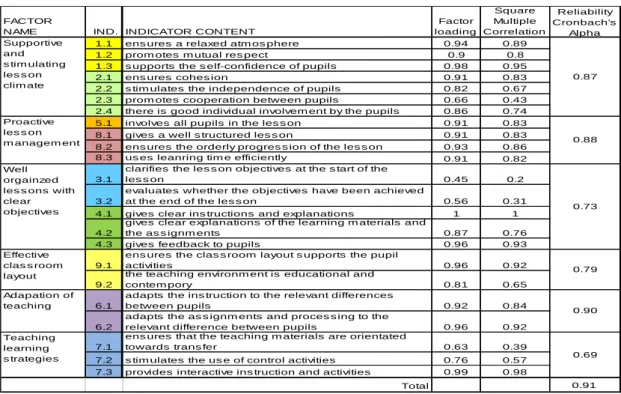
Analysis of the observation schedules indicated that our sample of effective teachers scored very highly in terms of: supportive lesson climate; proactive lesson management; well organized lesson with clear objectives; environmental and teacher support; clear and coherent lessons; student engagement; positive classroom management; purposive learning; and quality questioning and feedback for students (see figure i).
Figure i: Underlying dimensions of effective classroom practice identified by factor analysis
1.1 ens ures a relaxed atm os phere 0.94 0.89
1.2 prom otes m utual res pect 0.9 0.8
1.3 s upports the s elf-confidence of pupils 0.98 0.95
2.1 ens ures cohes ion 0.91 0.83
2.2 s tim ulates the independence of pupils 0.82 0.67 2.3 prom otes cooperation between pupils 0.66 0.43 2.4 there is good individual involvem ent by the pupils 0.86 0.74 5.1 involves all pupils in the les s on 0.91 0.83 8.1 gives a well s tructured les s on 0.91 0.83 8.2 ens ures the orderly progres s ion of the les s on 0.93 0.86 8.3 us es leanring tim e efficiently 0.91 0.82 3.1
clarifies the les s on objectives at the s tart of the
les s on 0.45 0.2
3.2
evaluates whether the objectives have been achieved
at the end of the les s on 0.56 0.31
4.1 gives clear ins tructions and explanations 1 1 4.2
gives clear explanations of the learning m aterials and
the as s ignm ents 0.87 0.76
4.3 gives feedback to pupils 0.96 0.93
9.1
ens ures the clas s room layout s upports the pupil
activities 0.96 0.92
9.2
the teaching environm ent is educational and
contem pory 0.81 0.65
6.1
adapts the ins truction to the relevant differences
between pupils 0.92 0.84
6.2
adapts the as s ignm ents and proces s ing to the
relevant difference between pupils 0.96 0.92 7.1
ens ures that the teaching m aterials are orientated
towards trans fer 0.63 0.39
7.2 s tim ulates the us e of control activities 0.76 0.57 7.3 provides interactive ins truction and activities 0.99 0.98
Total 0.91 0.69 0.90 0.79 Adapation of teaching Teaching learning s trategies Well orgainzed les s ons with clear objectives Effective clas s room layout 0.73 0.88 Factor loading Square Multiple Correlation Reliability Cronbach's Alpha 0.87 FACTOR
NAME IND. INDICATOR CONTENT Supportive and s tim ulating les s on clim ate Proactive les s on m anagem ent
Observation results provide some support for the view that there is an overall or generic concept of teacher effectiveness (which suggests that an effective teacher would tend to be effective in all ‘core’ aspects of teaching practices). However, they also provide some support for a differentiated concept of teacher effectiveness. This suggests that teachers would show both strengths and weaknesses in different aspects of their teaching practices and might vary in their effectiveness over time, in different lessons and for different pupil groups). The generic categories derived from the quantitative observation data are, inevitably, broad descriptions, whereas the qualitative analyses reveal
that there is considerable variation in the ways in which these are enacted (for further details, see Sammons & Ko, 2008).
The highly effective teachers show strengths in different aspects of their teaching practices and are able to adapt these to maintain effectiveness over time.
ii) The effective teachers create well-disciplined, positive learning climates for pupils
Clear academic and behavioural expectations were observed, especially in the primary classrooms and this resulted in a high level of pupil engagement. All teachers sought to encourage positive learning, emphasizing the importance of creating an open and trusting environment where pupils could feel happy, calm and relaxed. Around a third of teachers were also observed promoting lessons that were pupil led or interactive and demonstrating that a vital part of teaching was ensuring pupils were motivated. Primary teachers used bright informative displays and kept a tidy, organized environment in an attempt to set the right atmosphere where pupils could feel safe and secure. Secondary teachers gave these aspects less emphasis.
The highly effective teachers create a positive climate for learning by challenging pupils’ ideas, inspiring them, bringing more innovation into their practice and differentiating amongst pupils according to abilities and interests where appropriate. Pupils have more control over their learning and opportunities for success.
iii) The effective teachers cater for a variety of pupil needs
About a third of the teachers overall ensured that lessons contained elements which catered for different learning styles. Teachers catered for pupils needs by scaffolding tasks and questions, and combining a number of learning styles where appropriate, including verbal, visual, aural and kinaesthetic styles. Primary teachers were more likely to use differentiation than secondary teachers, but this was usually due to the setting of subject groups.
8
The highly effective teachers give individual and personalised support to pupils in order to address their needs, leading them to be motivated to engage in learning and ensure inclusion. In these lessons pupils appeared to feel more valued and part of the class community.
iv) The effective teachers use a variety of organizational techniques The majority of lessons were interactive with extensive use of groupwork, assessment for learning (primary) and assessment of learning (secondary). Teachers used a variety of organizational techniques. The most popular was the use of a starter activity and a plenary. Three quarters of teachers planned plenaries. Teachers informed pupils of the learning objectives in three-quarters of the lessons observed but under half of these returned to address these at the end of the lesson. Lessons were clearly sequenced, segmented and purposively paced, with well-managed transitions between tasks. There was extensive use of questioning in order to check for and extend understanding. Primary teachers also prompted and probed students more often. All teachers used scaffolding techniques during their lessons, but secondary teachers were more likely to link back explicitly to previous work.
The highly effective teachers include a starter activity and plenary as part of their lessons. The plenary is used to provide greater opportunity for review of learning goals and the use of intellectually challenging, interactive, whole-class teaching. They also use a variety of resources to raise aspirations and inspire wider participation of pupils.
What are the main influences on teachers’ effectiveness?
i) The effective teachers highlight the importance of an open and inclusive school culture
Teachers highlighted the importance of the open culture in their school and how this created a calm or friendly environment which was seen as conducive to effectiveness. Many teachers said how a hard-working culture and a culture of good behaviour had a positive impact on their work. Other issues cited by the teachers included the community context of the school, attitudes of parents, and opportunities for professional development offered by the school. Primary teachers were more likely to cite a consistent and open approach to expectations and behaviour across the school as impacting upon their practice.
The highly effective teachers are involved in the decision-making processes in the school, especially those related to teaching and learning, behaviour policies, and strategies to increase parental involvement.
ii) The effective teachers welcome a supportive management style While a small minority of teachers did not feel particularly supported by the school leadership, most made positive comments. These included the supportive or caring nature of line managers and the Senior Leadership Team, the encouragement given to engage in professional development, and the chance to improve their practice through feedback from observations. The importance of the school leadership giving teachers the freedom to be creative was mentioned by primary and secondary teachers. It appears there is a link between a more effective school context, support, and effective practice.
The highly effective teachers are encouraged by input from the management team and more frequently involved in peer observations.
iii) The effective teachers have a high level of motivation and commitment
The effective teachers talked about having a high level of motivation and commitment and enjoying the challenges and high standards expected from the job (Kington et al., 2008b). Succession planning and professional development all impacted on motivation and although some talked about stress and time pressures, many felt that the holidays gave them time to recharge. Over half of all teachers said that their motivation went through peaks and troughs throughout the year. Negative influences on motivation were tiredness, pressure from external demands, managing different roles within the school and pay issues (secondary only). Primary teachers mentioned a rise in motivation as a result of time for planning, preparation and assessment, and having more support in the classroom.
10
The highly effective teachers maintain a high level of motivation and commitment by seeking new challenges, seizing opportunities to be involved in a variety of activity in the school, and developing and sustaining positive relationships with colleagues.
iv) The effective teachers balance their work and personal lives The majority of teachers in our sample felt that their work and life were quite well balanced, although this fluctuated throughout the year (Kington et al., 2008b). Feelings of well-being were enhanced by freedom to make decisions in the classroom, opportunities for development, and feeling a commitment to the community surrounding the school.
The highly effective teachers are able to adopt strategies in order to help them manage workload and keep life in balance.
What do pupils say about their teachers?
i) The effective teachers engender positive pupil attitudes to school and learning
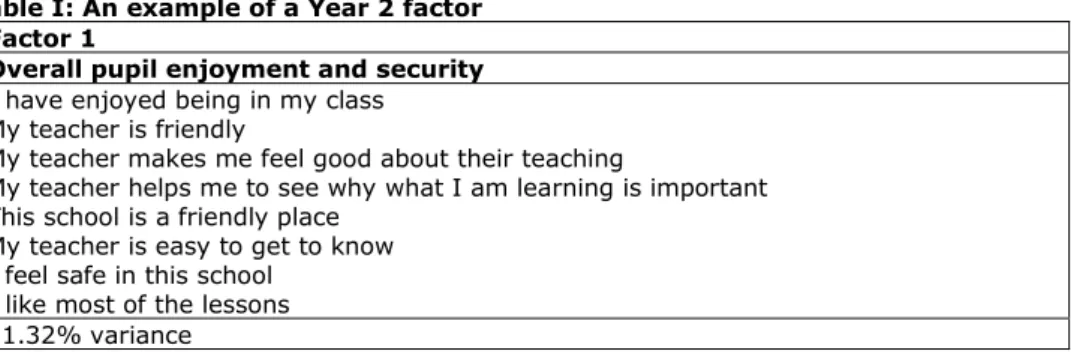
According to questionnaire survey findings, the views of pupils involved in the study were positive (Robertson et al., 2007). Year 2 pupils’ attitudes related to pupil enjoyment and feelings of security in school, as well as positive support and reassurance from their teacher (see table I). Pupils in Year 6 were also influenced by positive teacher support and reassurance, but also reported developing strong attachments to school.
Table I: An example of a Year 2 factor Factor 1
Overall pupil enjoyment and security
I have enjoyed being in my class My teacher is friendly
My teacher makes me feel good about their teaching
My teacher helps me to see why what I am learning is important This school is a friendly place
My teacher is easy to get to know I feel safe in this school
I like most of the lessons 21.32% variance
The Year 9 pupils mentioned ‘pupil enjoyment and security’, ‘teacher interest in pupils’, and ‘teacher approachability and organization’ as key factors.
Conclusions
Although many aspects of effective classroom practice were utilised by both effective and highly effective teachers, the highly effective teachers were found to use and combine a greater range of teaching and learning strategies in addressing the areas discussed above in consistently positive and more reflective, complex and contextually-responsive ways (Day et al., 2008). The mixed method approach enabled the study to go beyond generalised and acontextual lists of qualities, strategies and skills. Rather, it collected and integrated datasets for individual teachers through the creation of individual teacher profiles and indicated that, whilst there are core classroom competencies in terms of organization and management, pedagogical content knowledge, pedagogical skills, and interpersonal qualities, they are enacted differently by teachers in different phases and year groups.
References
Brown, E., Day, C., Regan, E., Kington, A., Gunraj, J. & Sammons, P. (2008a). Findings from Primary Teachers’ Interview Data, ECP Working Paper (No.6), July 2008.
Brown, E., Kington, A. & Day, C. (2008b). What Do Effective Teachers Look Like? How Do Effective Teachers See Themselves? Findings from Interview Data – Combined Report, Report submitted to the Economic and Social Research Council, August 2008.
Day, C., Sammons, P., Kington, A., Regan, E., Brown, E., Gunraj, J. & Robertson, D. (2008). Effective Classroom Practice: A mixed method study of influences and outcomes, End of Award Report submitted to the Economic and Social Research Council, August 2008.
Kington, A., Brown, E., Day, C., Regan, E., Gunraj, J. & Sammons, P. (2008a). Findings from Secondary Teachers’ Interview Data, ECP Working Paper (No.9), July 2008.
Kington, A., Reed, N., Regan, E., Sammons, P., Day, C. & Gunraj, J. (2008b). Initial Findings from the Repertory Grid Interview Data, ECP Working Paper (No.3), January 2008.
Kington, A., Sammons, P. & Day, C. (2008c). The Use of Mixed Method Design in the Research of Effective Classroom Practice, ECP Working Paper (No.2), January 2008.
Kington, A., Day, C., Sammons, P., Regan, E., Brown, E. & Gunraj, J. (2012). What Makes Teachers Effective?: Profiles of innovative classroom practice, In C. Day (Ed.), The Routledge International Handbook of Teacher and School Development, London, Routledge.
12
Kington, A., Sammons, P., Day, C. & Regan, E. (2011). ‘Stories and Statistics: Describing a mixed method study of effective classroom practice’. Journal of Mixed Methods Research. 5 (2), 103-125.
Robertson, R., Sammons, P., Kington, A., Day, C., Regan, E & Gunraj, J. (2007). Analysing Pupil Attitudes to Teaching and Learning, ECP Working Paper (No.1), October 2007.
Sammons, P. & Ko, J. (2008). Using Systematic Classroom Observation Schedules to Investigate Effective Teaching: Overview of quantitative findings. Report submitted to the Economic and Social Research Council, August 2008.
Teddlie, C., Creemers, B., Kyriakides, L., Muijs, D. and Yu, F. (2006). The International System for Teacher Observation and Feedback: Evolution of an international study of teacher effectiveness constructs, Educational Research and Evaluation, 12 (6), 561-582.
Tolley, H., Day, C., Sammons, P., Kington, A., Regan, E. & Gunraj, J. (2008). A Review of the Literature relating to Teacher Effectiveness and Effective Classroom Practice, Working Paper: ECP / 05, July 2008. van de Grift, W., Matthews, P., Tabak, l., and de Rijcke, F. (2004) Comparative research into the inspection of teaching in England and the Netherlands, A contribution to the Ofsted Impact Project and the publication Improvement through Inspection, HMI 2251, London, Ofsted.
Acknowledgements
We would like to acknowledge the valuable contributions of the teachers, pupils and headteachers involved in this research who gave their time in order to advance our knowledge of what makes teachers effective. The team would also like to thank the contributions made to the research by Eleanor Brown, Judith Gunraj, James Ko, Daniel Robertson and Joanne Towle, and the Economic and Social Research Council (ESRC) for their support of this study.
i The team developed a Code of Conduct, which adhered to ethical guidelines developed
by the British Educational Research Association. All instruments were piloted by the team before commencing data collection. Participation, consent, confidentiality and anonymity were discussed with headteachers and teachers, and assurances of the right to withdraw from the study at any point during the research, without the need to give a reason for this given. In the case of data collection with pupils, the consent of both the parent(s) and the child was sought. As with the teachers, permission was also obtained from pupils to digitally record interviews, and confidentiality of information was stressed. Headteachers were informed that they would not have access to data (or data
interpretation) regarding individual teachers, and that pupil survey data would only be given (on request) to class teachers, aggregated to the class level. In accordance with the principle of anonymity, unique identification codes were used for all research participants in order to protect their identities and ensure ‘non-traceability’. Finally, teacher profiles were constructed (based on all data collected) and shown to the individual teachers during the final round of interviews as a means of validating (or not validating) researcher interpretation of results.
ii The purpose of this research digest is not to present a review of the literature in this
area. For a review of relevant literature, see Tolley, H., Day, C., Sammons, P., Kington, A., Regan, E. & Gunraj, J. (2008).