1876-6102 © 2015 The Authors. Published by Elsevier Ltd. This is an open access article under the CC BY-NC-ND license (http://creativecommons.org/licenses/by-nc-nd/4.0/).
Peer-review under responsibility of the CENTRO CONGRESSI INTERNAZIONALE SRL doi: 10.1016/j.egypro.2015.11.135
Energy Procedia 78 ( 2015 ) 170 – 175
ScienceDirect
6th International Building Physics Conference, IBPC 2015
Drying evaluation using infrared thermography
Eva Barreira
a,*, Ricardo M. S. F. Almeida
b,a aCONSTRUCT-LFC, University of Porto, Faculty of Engineering, Civil Engineering Department, Rua Dr. Roberto Frias, 4200-465 Porto, Portugal
bDepartment of Civil Engineering, Polytechnic Institute of Viseu, Campus Politécnico, 3504-510 Viseu, Portugal
Abstract
The effect of moisture in buildings is normally related with damage, which may occur due to the presence of moisture itself or due to its evaporation. The drying process plays an important role in the available moisture, both inside the material or at its surface, so its evaluation is of great importance. Infrared thermography (IRT) is a non-contact and non-destructive testing technology that can be applied to determine the surface temperature of an object. It is commonly used as a diagnostic tool, enabling studies related to the thermal behaviour of building elements as well as to identify anomalies and degraded areas. Although less common, IRT is also used to assess moisture in building components.
In this work it was analyzed the applicability of IRT to assess the drying process of exterior walls after a long-term rainy weather. The test campaign started when the rain period stopped and a period of sunny days began. To assess the drying process, besides infrared camera, it was also used a moisture detector to evaluate qualitatively the walls’ moisture content. Measurements were carried out during six consecutive days without rain, at 10:00, 12:00, 14:00, 16:00 and 18:00. Two walls were assessed: one facing southeast, exposed to direct solar radiation, and one facing northeast, with no incident solar radiation.
Moisture detector results show that the walls dry out along the test campaign, being the drying process more intense in the wall facing southeast. That is mainly related to the fact that the wall was exposed to direct solar radiation during a longer period, which enabled the drying process to be fastened. The results obtained with both methods were combined and the opportunities and limitations of IRT to assess the drying process in outdoor conditions were discussed.
© 2015 The Authors. Published by Elsevier Ltd.
Peer-review under responsibility of the CENTRO CONGRESSI INTERNAZIONALE SRL.
Keywords: Infrared thermography; drying evaluation; surface temperature; dynamic measurement
* Corresponding author. Tel.: +351-225 081 940; fax: +351-225 081 940. E-mail address: [email protected]
© 2015 The Authors. Published by Elsevier Ltd. This is an open access article under the CC BY-NC-ND license (http://creativecommons.org/licenses/by-nc-nd/4.0/).
1.Introduction
The problem of moisture in buildings has always aroused great interest, since moisture is one of the main causes
of buildings’ pathology. Damage may occur due to the presence of moisture itself or due to its evaporation.
Therefore, the drying process plays an important role in the available moisture and its evaluation is of great importance. Moisture and the drying process may cause degradation of building materials and components, compromising their performance concerning durability, mechanical resistance, waterproofness and appearance. It can also cause unhealthy conditions for users, resulting from biological growth and degradation of materials and building components.
Moisture content is traditionally assessed using destructive procedures, which require collecting a wall sample to be weighed in the laboratory. However, moisture content can also be assessed using non-destructive techniques using moisture detectors. These techniques may not be as accurate as the destructive procedures, however, they are very easy to use and they deliver results in real time.
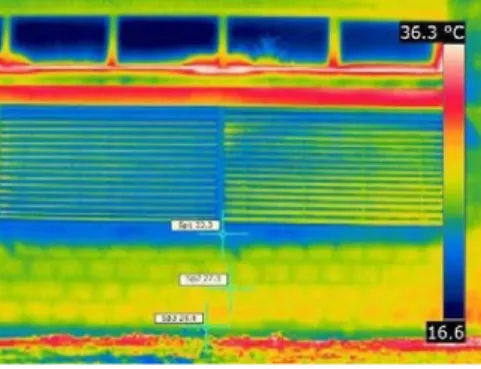
Infrared thermography (IRT) is a non-contact and non-destructive testing technology that determines the surface temperature of an object expressed as a thermal image, where each color corresponds to a certain range of temperatures (Fig. 1). Two approaches can be used to obtain the surface temperature distributions using infrared cameras: the passive approach and the active approach. The thermal images can be analyzed qualitatively or quantitatively [1]. IRT enables to assess the thermal behaviour of building elements and allows identifying anomalies and degraded areas [2-8]. Although less common, IRT is also used to assess moisture in building components [9-11] as changes in moisture content can be related with changes in surface temperature due to: evaporative cooling at the moist area, reduced thermal resistance and increased heat storage capacity of the moist material. However, only indoor conditions were tested in these researches. When one intends to assess IRT potential in outdoor conditions, several additional constraints appear.
Fig. 1. Example of thermogram (building façade).
In this work, the passive approaches were used in the thermographic measurements to assess the walls drying process. The physical phenomenon underlying these measurements is the effect of evaporative cooling. Simultaneously, a moisture detector was also used to evaluate qualitatively the walls moisture content evolution. The results obtained with both methods were combined and the opportunities and limitations of IRT to assess the drying process in outdoor conditions were discussed.
2.Set up of the experimental campaign
To assess the applicability of IRT to evaluate the drying process of walls after a long-term rainy weather, a test campaign was carried out. It started when the rain period stopped and a period of sunny days began during March 2014. Two different devices were used: infrared camera (FLIR ThermaCAM E300 – Fig. 2a) and moisture detector (Tramex MRH III – Fig. 2b). Before the measurements were carried out, calibrations procedures were performed according to the operation manual of each device. Measurements were carried out during six consecutive days
without rain, at 10:00, 12:00, 14:00, 16:00 and 18:00. The position of the camera and the measured points on the walls using the moisture detector were always the same. Two walls were assessed: one facing southeast, exposed to direct solar radiation as no nearby obstacles exist, and one facing northeast, with no incident solar radiation. The southeast facing wall was in shadow during the readings at 10:00, due to the position of the sun in the horizon, and at 18:00 the measurements were made at nightfall.
a b
Fig. 2. Devices: a) infrared camera; b) moisture detector.
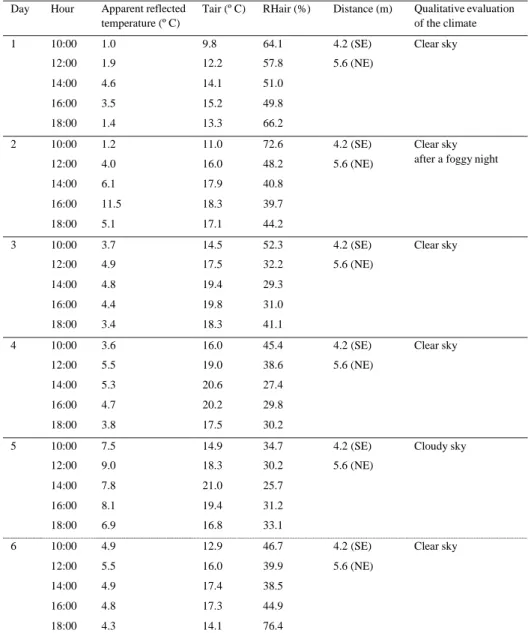
Emissivity was set to 0.9. This value may not correspond to the real emissivity value of the surfaces under study, however, as the qualitative approach was used, an estimated value of emissivity was considered acceptable. Correction parameters were introduced before the IRT measurements began (Table 1). Weather data (temperature and relative humidity) were measured by a weather station located near the walls under study.
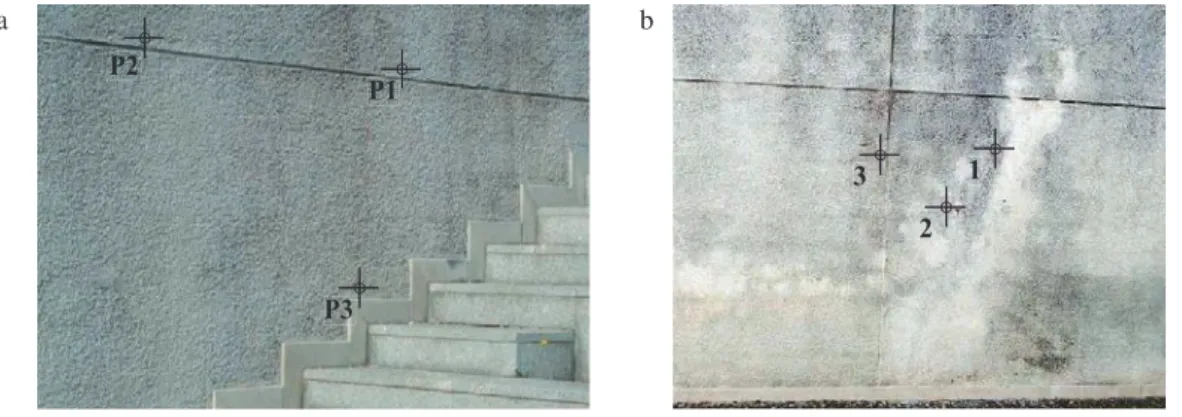
Moisture readings on the walls were made considering three different points on each wall (Fig. 3). The moisture detector operates on the principle that the electrical impedance of a material varies in proportion to its moisture content. The reading displayed by the equipment is a relative scale, varying from 0 to 99, which indicates the greater or lesser signal (lower values indicates lesser signal that corresponds to lower moisture content).
a b
Fig. 3. Walls under study with measuring points: a) facing southeast; b) facing northeast.
3.Results
Figs. 4 and 5 show the results obtained with the moisture detector. From day 2, readings on P1 and P2 on southeast facing wall had null values, which mean that the wall was superficially dry. As expected P3 had higher moisture content as it was near the ground, where larger amount of water was accumulated. However, at the end of day 6, it was also completely dry. The high drying ability of the wall is probably related to its direct exposure to solar radiation during a long period of the day. On the other hand, as expected, measurements on wall facing
northeast presented higher values of moisture content because there was no incident solar radiation on the wall. Special attention should be paid to the increase of moisture from day 1 to day 2, which may be related to the foggy night that increased surface moisture. Moreover, southeast façade is more exposed to the wind, which may help fastening the drying process.
Table 1. Correction parameters for IRT measurements and qualitative evaluation of the climate.
Day Hour Apparent reflected
temperature (º C)
Tair (º C) RHair (%) Distance (m) Qualitative evaluation
of the climate
1 10:00 1.0 9.8 64.1 4.2 (SE) Clear sky
12:00 1.9 12.2 57.8 5.6 (NE)
14:00 4.6 14.1 51.0
16:00 3.5 15.2 49.8
18:00 1.4 13.3 66.2
2 10:00 1.2 11.0 72.6 4.2 (SE) Clear sky
12:00 4.0 16.0 48.2 5.6 (NE) after a foggy night
14:00 6.1 17.9 40.8
16:00 11.5 18.3 39.7
18:00 5.1 17.1 44.2
3 10:00 3.7 14.5 52.3 4.2 (SE) Clear sky
12:00 4.9 17.5 32.2 5.6 (NE)
14:00 4.8 19.4 29.3
16:00 4.4 19.8 31.0
18:00 3.4 18.3 41.1
4 10:00 3.6 16.0 45.4 4.2 (SE) Clear sky
12:00 5.5 19.0 38.6 5.6 (NE)
14:00 5.3 20.6 27.4
16:00 4.7 20.2 29.8
18:00 3.8 17.5 30.2
5 10:00 7.5 14.9 34.7 4.2 (SE) Cloudy sky
12:00 9.0 18.3 30.2 5.6 (NE)
14:00 7.8 21.0 25.7
16:00 8.1 19.4 31.2
18:00 6.9 16.8 33.1
6 10:00 4.9 12.9 46.7 4.2 (SE) Clear sky
12:00 5.5 16.0 39.9 5.6 (NE)
14:00 4.9 17.4 38.5
16:00 4.8 17.3 44.9
18:00 4.3 14.1 76.4
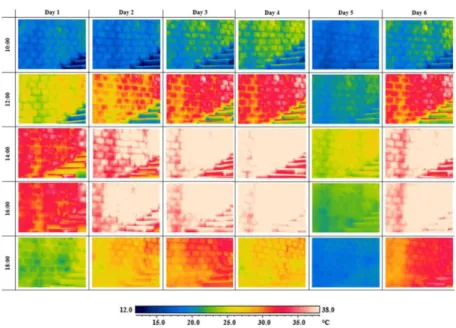
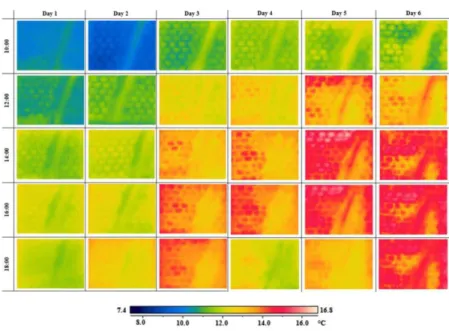
The thermal images collected during this test campaign are shown in Fig. 6 for wall facing southeast and in Fig. 7 for wall facing northeast. They are not very conclusive regarding the drying process, mainly due to the thermal patterns resulting from dirt at the surface and different thermal conductivity of inner layers. Darker colors on thermal images on day 5 are related with the cloudy day that decreased air temperature and consequently surface temperature. Results revealed that tackling the drying process through IRT is not straightforward, although a tendency for higher surface temperatures throughout the analysis can be identified. Yet, air temperature is also
increasing, which highlights the difficulty of isolating the effect of evaporative cooling. Also the influence of the wind in the thermal images is difficult to assess. Nevertheless, some encouraging results can be pointed such as the thermal images at 10:00 in northeast wall in day 1 and day 2 that show a reduction on the surface temperature, in line with the results obtained with the moisture detector, despite the increasing air temperature.
Fig. 4. Moisture detector readings: wall facing southeast.
Fig. 5. Moisture detector readings: wall facing northeast.
Fig. 7. Thermal images: wall facing northeast.
4.Conclusions
The use of IRT for drying evaluation was tested through an experimental campaign which also included the measurement of the moisture content. The opportunities and limitations of the technique were discussed and the following conclusion can pointed:
x Wall facing southeast had dried out faster mainly due to the direct exposure to solar radiation and higher exposure to the wind. After day 2 moisture detector readings are approximately zero. Yet, differences could be observed in the point nearer to the ground as moisture tends to accumulate in the base of the wall;
x Thermal images are not very conclusive regarding the drying process as thermal patterns resulting from dirt at the surface and different thermal conductivity of inner layers may mask the drying process identification and difficulties in isolating the effect of solar radiation, wind and air temperature prejudice the interpretation;
x Nevertheless, some encouraging results were obtained as a reduction on the surface temperature are in line with the results obtained with the moisture detector in scenarios where outdoor conditions had less impact.
References
[1] Maldague X. Nondestructive Evaluation of Materials by Infrared Thermography. Springer-Verlag; 1993. [2] Chew M. Assessing building façades using infra-red thermography. Structural Survey 16[2]; 1998. p. 81-86. [3] Hart J. A practical guide for infra-red thermography for building surveys. Watford: BRE; 2001
[4] Balaras C., Argiriou A. Infrared thermography for building diagnostics. Energy and Buildings 34[2]; 2002. p. 171-183.
[5] Ocaña S., Guerrero I., Requena I. Thermographic survey of two rural buildings in Spain. Energy and Buildings 36[6]; 2004. p. 515-523. [6] Avdelidis N., Moropoulou A. Applications of infrared thermography for the investigation of historic structures. Journal of Cultural Heritage
5[1]; 2004. p. 119-127.
[7] Asdrubali F., Baldinelli G., Bianchi F. A quantitative methodology to evaluate thermal bridges in buildings. Applied Energy 97; 2012. p. 365- 373.
[8] de Freitas SS., de Freitas VP., Barreira E. Detection of façade plaster detachments using infrared thermography – A nondestructive technique.
Construction and Building Materials 70; 2014. p. 80-87.
[9] Rosina E., Ludwig N. Optimal thermographic procedures for moisture analysis in building materials, Proceedings of society of photographic instrumentation engineers (SPIE) 3827; 1999. p. 22-33.
[10] Barreira E., Freitas VP. Evaluation of building materials using infrared thermography. Construction and Building Materials 21[1]; 2007. p. 218-224.