UCC Library and UCC researchers have made this item openly available.
Please
let us know
how this has helped you. Thanks!
Title Computer-aided detection of pulmonary nodules: a comparative study using the public LIDC/IDRI database
Author(s) Jacobs, Colin; van Rikxoort, Eva M.; Murphy, Keelin; Prokop, Mathias; Schaefer-Prokop, Cornelia M.; van Ginneken, Bram
Publication date 2015-10-06
Original citation Jacobs, C., van Rikxoort, E. M., Murphy, K., Prokop, M., Schaefer-Prokop, C. M. and van Ginneken, B. (2016) 'Computer-aided detection of pulmonary nodules: a comparative study using the public LIDC/IDRI database', European Radiology, 26(7), pp. 2139-2147. doi:
10.1007/s00330-015-4030-7 Type of publication Article (peer-reviewed) Link to publisher's
version http://dx.doi.org/10.1007/s00330-015-4030-7Access to the full text of the published version may require a subscription.
Rights © 2915, The Author(s). This article is distributed under the terms of the Creative Commons Attribution-NonCommercial 4.0
International License (http://creativecommons.org/licenses/by-nc/4.0/), which permits any noncommercial use, distribution, and reproduction in any medium, provided you give appropriate credit to the original author(s) and the source, provide a link to the Creative Commons license, and indicate if changes were made. http://creativecommons.org/licenses/by-nc/4.0/
Item downloaded
from http://hdl.handle.net/10468/9248
Downloaded on 2020-06-06T01:46:32Z
COMPUTER APPLICATIONS
Computer-aided detection of pulmonary nodules: a comparative
study using the public LIDC/IDRI database
Colin Jacobs1 &Eva M. van Rikxoort1,2&Keelin Murphy4&Mathias Prokop1&
Cornelia M. Schaefer-Prokop1,3&Bram van Ginneken1,2
Received: 12 June 2015 / Revised: 20 July 2015 / Accepted: 14 September 2015 / Published online: 6 October 2015
#The Author(s) 2015. This article is published with open access at Springerlink.com
Abstract
ObjectivesTo benchmark the performance of state-of-the-art computer-aided detection (CAD) of pulmonary nodules using the largest publicly available annotated CT database (LIDC/IDRI), and to show that CAD finds lesions not identi-fied by the LIDC’s four-fold double reading process.
Methods The LIDC/IDRI database contains 888 thoracic CT scans with a section thickness of 2.5 mm or lower. We report performance of two commercial and one academic CAD sys-tem. The influence of presence of contrast, section thickness, and reconstruction kernel on CAD performance was assessed. Four radiologists independently analyzed the false positive CAD marks of the best CAD system.
ResultsThe updated commercial CAD system showed the best performance with a sensitivity of 82 % at an average of 3.1 false positive detections per scan. Forty-five false positive CAD marks were scored as nodules by all four radiologists in our study.
Conclusions On the largest publicly available reference data-base for lung nodule detection in chest CT, the updated com-mercial CAD system locates the vast majority of pulmonary nodules at a low false positive rate. Potential for CAD is sub-stantiated by the fact that it identifies pulmonary nodules that
were not marked during the extensive four-fold LIDC anno-tation process.
Key Points
•CAD systems should be validated on public, heterogeneous databases.
• The LIDC/IDRI database is an excellent database for benchmarking nodule CAD.
•CAD can identify the majority of pulmonary nodules at a low false positive rate.
•CAD can identify nodules missed by an extensive two-stage annotation process.
Keywords Computer-assisted diagnosis . Image interpretation, computer-assisted . Lung cancer . Solitary pulmonary nodule . Lung
Abbreviations
CAD Computer-aided detection CT Computed tomography
LIDC Lung image database consortium IDRI Image database resource initiative
Introduction
The last two decades have shown substantial research into computer-aided detection (CAD) of pulmonary nodules in thoracic computed tomography (CT) scans [1,2]. Although many academic and several commercial CAD algorithms have been developed, CAD for lung nodules is still not com-monly used in daily clinical practice. Possible explanations for this are a lack of reimbursement, technical impediments to integration into PACS systems, but also low sensitivity and high false positive rates. The recent positive results of the
* Colin Jacobs
1 Diagnostic Image Analysis Group, Department of Radiology and
Nuclear Medicine, Radboud University Medical Center, Geert Grooteplein 10, 6525 GA, Nijmegen, The Netherlands
2
Fraunhofer MEVIS, Bremen, Germany
3
Department of Radiology, Meander Medical Center, Amersfoort, The Netherlands
4 Irish Centre for Fetal and Neonatal Translational Research,
NLST lung cancer screening trial [3] and the subsequent de-velopments towards implementation of lung cancer screening in the United States [4,5] have renewed the interest into CAD for pulmonary nodules. If lung cancer screening will be im-plemented on a large scale, the burden on radiologists will be substantial and CAD could play an important role in reducing reading time and thereby improving cost-effectiveness [6,7]. Following the general demand for open and reproducible science, public databases have been established to facilitate objective measures of CAD performance, and to move CAD development to a next level [8–10]. In 2011, the complete LIDC/IDRI (Lung Image Database Consortium / Image Da-tabase Resource Initiative) daDa-tabase was released [10]. This dataset provides by far the largest public resource to assess the performance of algorithms for the detection of pulmonary nodules in thoracic CT scans. A large effort has gone into the collection of annotations on these cases, but CAD was not used to assist the readers [10].
In this paper, we apply two commercial and one state-of-the-art academic nodule detection systems on the LIDC/IDRI database with the aim to set a first benchmark performance on the full database. To our knowledge, this is the first paper, which reports the performance of CAD systems on the full LIDC/IDRI database. We performed an extensive analysis of the performance of the applied CAD systems and make our evaluation publicly available so that other CAD developers can compare with this benchmark. Furthermore, we hypothe-size that CAD can find lesions, which were not detected in the extensive LIDC annotation process consisting of a blinded and unblinded review by four radiologists. To investigate the latter, we evaluated the false positives of the best CAD system using a similar reading protocol as had been used in LIDC.
Materials and methods
Data
This study used the LIDC/IDRI data set [10], consisting of 1, 018 helical thoracic CT scans collected retrospectively from seven academic centres. Nine cases with inconsistent slice spacing or missing slices were excluded. In addition, 121 CT scans, which had a section thickness of 3 mm and higher, were excluded since thick section data is not optimal for CAD analysis. This resulted in 888 CT cases available for evalua-tion. In Tables1,2, and3, the characteristics of the input data are shown.
LIDC/IDRI image annotation
The LIDC/IDRI employed a two-phase image annotation pro-cess [10]. In the first phase (the blind phase), four radiologists independently reviewed all cases. In the second phase (the
unblinded phase), all annotations of the other three radiolo-gists were made available and each radiologist independently reviewed their marks along with the anonymized marks of their colleagues. Findings were annotated and categorized into
nodule≥3 mm, nodule<3 mm, or non-nodule. Non-nodule
marks were used to indicate abnormalities in the scan, which were not considered a nodule. Using this two-phase process, the LIDC investigators aimed to identify as completely as possible all lung nodules, without forcing consensus among the readers. More details about the annotation process can be found in [10]. An XML file with the annotations is publicly available for every case.
Nodule selection and purpose
In this study, we included all annotations available in the XML files for the 888 scans. The focus of this study was on the Table 1 Manufacturer and scanner model distribution of the 888 CT scans in our dataset
Manufacturer Model name Number
GE MEDICAL SYSTEMS LightSpeed16 197
GE MEDICAL SYSTEMS LightSpeed Ultra 162
GE MEDICAL SYSTEMS LightSpeed QX/i 97
GE MEDICAL SYSTEMS LightSpeed Pro 16 79
GE MEDICAL SYSTEMS LightSpeed VCT 61
GE MEDICAL SYSTEMS LightSpeed Plus 56
GE MEDICAL SYSTEMS LightSpeed Power 10
Philips Brilliance 16P 54 Philips Brilliance 64 49 Philips Brilliance 40 9 Philips Brilliance16 5 SIEMENS Sensation 16 95 SIEMENS Sensation 64 5 SIEMENS Definition 3 SIEMENS Emotion 6 1 TOSHIBA Aquilion 5 Total 888 Table 2 Section thickness distribution of the 888 CT scans in our dataset
Section thickness Number
0.6 7 0.75 30 0.9 2 1 58 1.25 343 1.5 5 2 123 2.5 320 Total 888 2140 Eur Radiol (2016) 26:2139–2147
nodule≥3 mmgroup. As a result of the LIDC/IDRI image annotation process, eachnodule≥3 mm had been annotated by one, two, three, or four radiologists. In total, the data set of this study included 777 locations, which were marked as
nodule≥3 mmby all four radiologists. The 777nodule≥3 mm
annotations marked by all four radiologists can be categorized by size as follows: 22 nodules <4 mm, 228 nodules 4–6 mm, 199 nodules 6–8 mm, and 328 nodules >8 mm. The number of nodules per scan ranged between 1 and 8.
The purpose of this study was twofold. First, we aimed to assess the performance of three state-of-the-art nodule CAD
systems. Secondly, we performed an observer experiment to investigate whether CAD can find additional lesions, missed during the extensive LIDC annotation process.
CAD systems
Three CAD systems were used: a commercial CAD sys-tem Visia (MeVis Medical Solutions AG, Bremen, Ger-many), a commercial prototype CAD system Herakles
(MeVis Medical Solutions AG, Bremen, Germany), and an academic nodule CAD system ISICAD (Utrecht Med-ical Center, Utrecht, the Netherlands) [11]. ISICAD was the leading academic CAD system in the ANODE09 nodule detection challenge [9]. For all three CAD sys-tems, a list of candidate marks per CT scan was obtain-ed. Each CAD candidate is described by a 3D location. Additionally, Herakles and ISICAD also provide a CAD score per CAD candidate. The CAD score is the output of the internal classification scheme of the CAD system and is a measure of the likelihood that a candidate is a pulmonary nodule. An internal threshold on the CAD scores determines which candidates are active CAD marks and, hence, will be shown to the user, and which candidates are not shown. Since different thresholds can be applied on the CAD score, a CAD system can have multiple operating points. A low threshold generates more CAD marks, thereby typically increasing sensitiv-ity at the cost of more false positive detections. A high threshold will generate less false positives but may re-duce the sensitivity of a CAD system. For all three CAD systems, one fixed operating point is internally set which we will refer to as the system operating point.
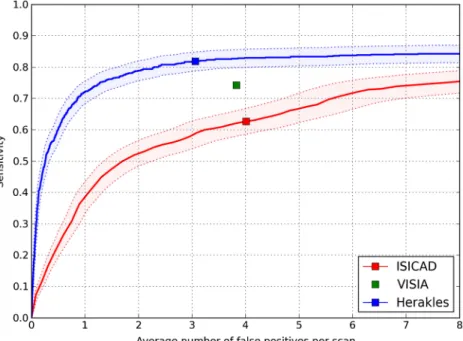
Fig. 1 FROC curves for all three CAD systems on the full database of 888 CT scans containing 777 nodules for which all four radiologists classified it as
nodule≥3 mm. The points on the curves indicate the system operating points of the three CAD systems. ForVisia,no continuous FROC curve but only a single operating point can be provided since the CAD scores of the CAD marks are not available. Shaded areas around the curve indicate 95 % confidence intervals
Table 3 Distribution of the reconstruction kernels used for the 888 CT scans in our dataset
Manufacturer and reconstruction kernel Type Number GE MEDICAL SYSTEMS - BONE Enhancing 220 GE MEDICAL SYSTEMS - LUNG Overenhancing 70 GE MEDICAL SYSTEMS - STANDARD Standard 372
Philips - B Standard 21 Philips - C Enhancing 7 Philips - D Overenhancing 45 SIEMENS - B20s Soft 1 SIEMENS - B30f Standard 102 SIEMENS - B31f Standard 1 SIEMENS - B45f Enhancing 30 SIEMENS - B50f Enhancing 2 SIEMENS - B70f Overenhancing 12 TOSHIBA - FC03 Standard 2 TOSHIBA - FC10 Soft 3 Total 888
Evaluation
The performance of the CAD systems was analyzed on the set of 777 nodules annotated by 4/4 radiologists as a
nodule≥3 mm.We employed free-response operating charac-teristic (FROC) analysis [12] where detection sensitivity is plotted against the average number of false positive detections per scan. Confidence intervals were estimated using bootstrapping with 5,000 iterations [13]. If a CAD system marked locations which were annotated by three or fewer radiologists asnodule≥3 mm, asnodule<3 mm, and as non-nodules, these CAD marks were counted as false positives. ForVisia, no CAD scores were available for the CAD candi-dates. Consequently, only one operating point and not a full FROC curve could be generated forVisia.
To gain more insight into which type of nodules were missed by CAD, we looked at the characteristics, as scored by the LIDC readers, for all nodule≥3 mm findings, of the false negatives. We defined subsolid nodules as nodules for which the majority of the radiologists gave a texture score smaller than 5 (1=ground-glass/non-solid, 3=part-solid, 5=solid). Subtle nodules were defined as nodules for which the majority of the radiologists gave a subtlety score smaller or equal than 3 (1=extremely subtle, 5=obvious).
To assess the robustness of the CAD algorithms, we also evaluated the CAD results on different subsets of the data. The LIDC-IDRI data set is a heterogeneous set of CT scans and CAD algorithms that could conceivably exhibit a different performance on different types of data. We analyzed the fol-lowing factors: (1) presence of contrast material, i.e.,
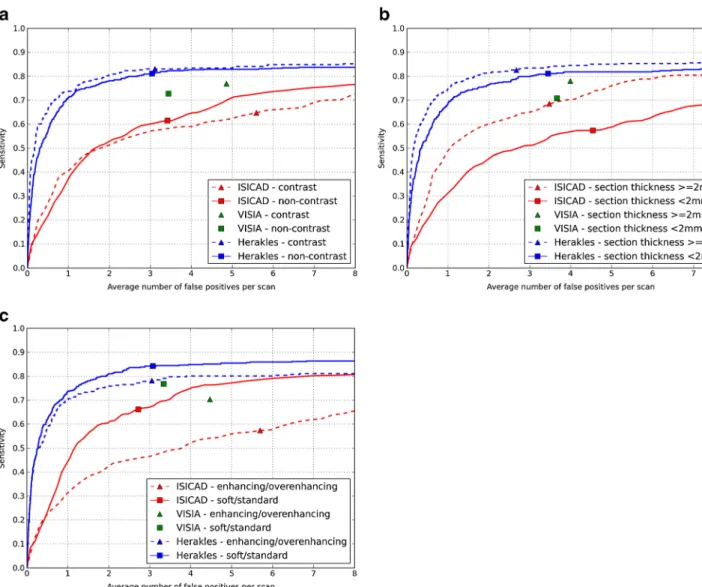
non-Fig. 2 FROC curves for all three CAD systems on (a) contrast scans (n=242) versus non-contrast scans (n=646), (b) scans with a section thick-ness <2 mm (n=445) versus scans with a section thickness ≥2 mm (n=443), and (c) scans with a soft or standard reconstruction kernel (n=502) versus scans with an enhancing or overenhancing reconstruction
kernel (n=386). The reference set of nodules consists of nodules for which all four radiologists classified it asnodule≥3 mm. The points on the curves indicate the system operating points of the three systems. For
Visia,no continuous FROC curve but only a single operating point can be provided since the CAD scores of the CAD marks are not available
contrast versus contrast enhanced scans, (2) section thickness, i.e., cases with section thickness <2 mm versus section thick-ness≥2 mm, and (3) reconstruction kernel, i.e., soft/standard versus enhancing/overenhancing kernels.
Observer study
In order to evaluate whether CAD can find lesions missed during the extensive annotation process of the LIDC/IDRI database, we considered the CAD marks of the best CAD algorithm , which were counted as false positives at its system operating point. Two conditions were differentiat-ed: the location of the CAD mark had in fact been marked in the LIDC annotation process, but not by all four readers as nodule≥3 mm as warranted for being counted as a true positive. The second condition comprised those CAD marks that had no corresponding LIDC marks at all. The CAD marks corresponding to the first condition can be subdivided according to the LIDC readings. The latter CAD marks were independently inspected by four chest radiologist s, since these a re potent ially nodules overlooked by all four LIDC readers. Thus, we mimic the original LIDC annotation process as though CAD had been included as another independent reader in the first phase of the image annotation process. CAD marks were categorized as nodule≥3 mm, nodule<3 mm, non-nodules, or false positive. Electronic measurement tools were available to measure size. To reduce the workload for the radiologists, a research scientist (5 years experi-ence in nodule CAD research) first removed the marks which were obviously not a nodule. CAD marks which were marked as nodule>3 mm by all four radiologists in
our study were independently evaluated by an experi-enced radiologist that scored subtlety, location, type, and attachment to other structures. Subtlety was scored on a five-point scale (1=extremely subtle, 5=obvious).
Results
Comparative CAD performance
The performance of the three CAD systems is depicted in Fig. 1. From the FROC curves it is evident that Herakles
performed best. The system performances were significantly different (p<0.001). At its system operating point,Herakles
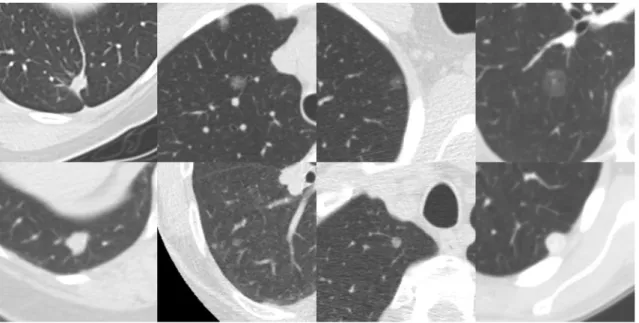
reached a sensitivity of 82 % at an average of 3.1 false posi-tives per scan for nodules all four LIDC readers had agreed on. We evaluated the characteristics of the 141 false negative nodules. 42 (30 %) false negatives were subsolid nodules. The size distribution of the missed nodules was as follows: five nodules <4 mm, 53 nodules 4–6 mm, 31 nodules 6–8 mm, and 52 nodules >8 mm. Thus, a large portion of the missed nod-ules were smaller than 6 mm, but still a substantial number of missed nodules, 52 (37 %), were larger than 8 mm. Finally, we found that 33 (23 %) of the missed nodules were subtle. Fig-ure3shows eight randomly chosen missed nodules.
The performance of the three CAD systems on the different subsets is depicted in Fig.2. This figure shows that the per-formance of ISICADand Visia was influenced by different data sources.ISICAD shows the largest performance differ-ence between soft/standard versus enhancing/overenhancing reconstruction kernels.Heraklesshowed the most stable and
Fig. 3 Eight randomly chosen examples of false negatives ofHerakles. Each image shows a transverse field of view of 60 x 60 mm in which the nodule is centred. Note that many missed nodules are subsolid
robust performance for all different data sources and consis-tently outperformed the other two CAD systems.
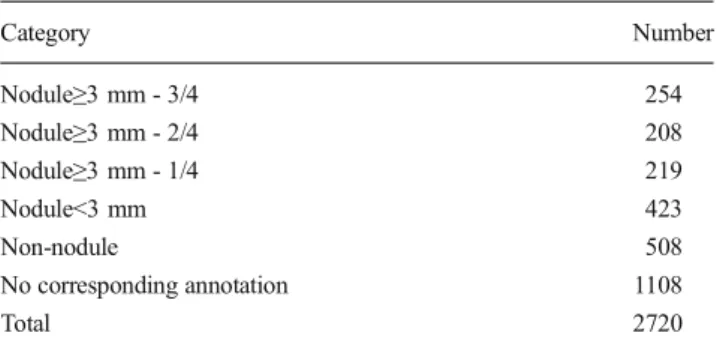
We categorized the CAD marks ofHerakles,which were counted as false positives at its system operating point. In total, there were 2,720 false positive CAD marks in the 888 cases (Table4). The majority of the CAD marks, 1,612 out of 2,720 (59 %), had at least one corresponding mark from the LIDC readers. These CAD marks can be further categorized into marks on annotations marked asnodule≥3 mmby three out of four radiologists, two out of four radiologists, one out of four radiologists; and annotations marked asnodule<3 mmby at least one radiologist (and, hence, nonodule≥3 mm annota-tions); and finally annotations marked asnon-nodule by at least one out of four radiologists (and, hence, nonodule≥3 mm
ornodule<3 mmannotations). Table4shows how the CAD marks were further split out into these categories. The remain-ing 1,108 false positive CAD marks had no correspondremain-ing mark from the LIDC readers.
Observer study results
In our observer experiment, we focused on these 1,108 false positive CAD marks ofHerakles,which had no correspond-ing mark from any of the LIDC readers. These are locations, which were potentially overlooked by all four LIDC readers. After CAD marks, which were obviously not a nodule had been removed by the research scientist, 269 CAD marks were left for analysis by the four radiologists. Common sources of false positive detections removed by the research scientist included fissure thickening at the chest wall, vessel bifurca-tions and (micro-)atelectasis. Table5depicts how each of the observers scored these 269 CAD marks. In total, 45 CAD marks were considered to be anodule≥3 mmby all four radi-ologists; 177 CAD marks were considered to be a
nodule≥3 mmby at least one of the radiologists. The size distribution of the 45 CAD marks was as follows: nine nod-ules <4 mm, 27 nodnod-ules 4-6 mm, seven nodnod-ules 6-8 mm, and two nodules >8 mm. Subtlety was scored lower or equal than 3 for 32 (71 %) nodules. Location was scored as central for 11 nodules, peripheral for 11 nodules, and in-between for 23 nodules. Nodule type was scored as follows: 32 solid, 2 ground-glass, 1 part-solid, and 10 calcified. Vascular, pleural or fissural attachment was found for 18 (40 %) nodules. Fig-ure4shows eight randomly chosen examples of CAD marks, which were considered anodule≥3 mmby all four radiologists and were scored as solid. In addition, 169 marks were consid-ered anodule≥3 mmor anodule<3 mmby all four radiolo-gists; 250 marks were considered a nodule≥3 mm or a
nodule<3 mmby at least one of the radiologists. Thus, follow-ing the reference of the 4-reader agreement and addfollow-ing these 45 CAD marks to the set of nodules, the updated performance ofHeraklesat its system operating point would reach a sen-sitivity of 83 % at an average of 3.0 false positive detections
per scan. In this FROC analysis, CAD marks on locations marked as nodule≥3 mmby three out of four radiologists, two out of four radiologist, one out of four radiologists, or as
nodule<3 mmby at least one radiologist were counted as false positives. Evidently, one could argue whether CAD marks on these locations should be counted as false positives or not. If CAD marks on these locations were not to be counted as false positives but ignored in the FROC analysis, a performance of 83 % sensitivity at an average of only 1.0 false positives per scan would be reached.
Discussion
Though clear definitions are available for what represents a pulmonary nodule (Fleischner Glossary [14]), the literature lists a number of publications demonstrating the lack of ob-server agreement of what indeed represents a pulmonary nod-ule [15–17]. Not surprisingly this effect is larger for small Table 4 Overview of the categories in which the false positives of
Heraklesat the system operating point can be divided. In this analysis, we first check for correspondingnodule≥3 mmannotations,then we check for correspondingnodule<3 mmannotations, and finally we check for correspondingnon-noduleannotations. This means that in the top row where three out of four radiologists annotated the location as
nodule≥3 mm, the fourth radiologist may have marked the location as
nodule<3 mm, non-nodule, or did not mark it at all. In the
nodule<3 mmcategory, all false positives whose location was marked asnodule<3 mmby at least one radiologist were placed (and, hence, no radiologist marked it asnodule≥3 mm). The non-nodule category contains all false positives whose location was marked asnon-noduleby at least one radiologist (and, hence, no radiologist marked the location as
nodule≥3 mmornodule<3 mm). False positives for which no correspond-ing annotation was found were assigned to the last category
Category Number Nodule≥3 mm - 3/4 254 Nodule≥3 mm - 2/4 208 Nodule≥3 mm - 1/4 219 Nodule<3 mm 423 Non-nodule 508 No corresponding annotation 1108 Total 2720
Table 5 Results of the observer experiment. The distribution of the scores of all observers is tabulated
Type Observer 1 Observer 2 Observer 3 Observer 4
Nodule≥3 mm 119 97 84 153 Nodule<3 mm 125 141 136 50 Non-nodule 20 20 46 41 False positive 5 11 3 25 Total 269 269 269 269 2144 Eur Radiol (2016) 26:2139–2147
lesions [15]. This lack of an absolute standard of truth makes benchmarking of CAD systems very difficult. Therefore, we decided to use the largest publicly available database of CT annotated pulmonary nodules. An elaborate double reading process involving four radiologists had been undertaken to define various levels of evidence for the presence of nodules to avoid the need for a consensus statement. In our study we used the extensive annotation information of the LIDC/IDRI database to benchmark the performance of state-of-the-art nodule CAD systems. To our knowledge, this is the first study that uses the full LIDC database and secondly accepts the fact that there is no absolute standard of truth for the presence of pulmonary nodules in the absence of pathological correlation. Our study showed substantial performance differences be-tween the three CAD systems, with the commercial prototype
Heraklesdemonstrating the best performance. At its system operating point,Heraklesdetected 82 % of allnodule≥3 mm
findings marked by all four LIDC readers at an average of 3.1 false positives per scan. If marks on the other LIDC annota-tions were ignored in the analysis, a sensitivity of 83 % at an average of only 1.0 false positives was reached.
The best CAD system still misses a subset of the nodules (18 % of the 777 nodules). We observed that a substantial part of the missed nodules (30 %) were subsolid nodules, which are more rare and have a markedly different internal character than solid nodules. Therefore, integrating a dedicated subsolid nodule detection scheme [18] in a complete CAD solution for pulmonary nodules may prove helpful to improve overall CAD performance.
BothVisiaand ISICAD showed substantial performance differences on different subsets of the data, butHerakles
achieved a more robust performance. The performance of
ISICAD dropped substantially on data with enhancing or overenhancing reconstruction kernels. This may be attributed to the fact thatISICADwas developed and trained exclusively with data from the Dutch-Belgian NELSON lung cancer screening trial, which consists of homogeneous thin-slice data reconstructed with a soft/standard reconstruction kernel [19]. This indicates that althoughISICAD was the leading CAD system for the data used in the ANODE challenge [9], which consisted only of data obtained from the NELSON trial, its performance drops when applied to data of other sources. Therefore, the heterogeneity of a reference database is an im-portant aspect for a reliable CAD evaluation and an advantage of the LIDC/IDRI database.
Although a blinded and unblinded review of all images had been performed by the LIDC investigators, we showed that CAD can find lesions missed by the original LIDC readers. We found 45 nodules, which were accepted as anodule≥3 mm
by all four radiologists involved in our observer study. Previ-ous studies have already shown that CAD can find lesions missed by multiple readers [18, 20]. One possible reason why the LIDC readers missed nodules may be that the LIDC readers only inspected transverse sections [10]. Characteristic features of the 45 nodules not included in the LIDC/IDRI database but seen by CAD were subtle conspicuity, small size (<6 mm), and attachment to pleura or vasculature.
Since an extensive evaluation on a large reference database is essential to move CAD to the next level, we have published our results on a public website (http://luna.grand-challenge. org/) which allows other CAD researchers to upload results of their CAD systems for which the same FROC curves as presented in Figs.1and2will be computed and published on the website. The annotation files of the reference standard and Fig. 4 Eight randomly chosen examples of solid nodule annotations
marked asnodule≥3 mmby all four readers in our observer experiment. These nodules were not annotated by any of the original LIDC readers.
Each image shows a transverse field of view of 60 x 60 mm in which the nodule is centred
the extra annotations by the human readers in our observer study are available for download. By making the extra annotations available to other researchers, this study contributes to an improved reference standard for the LIDC/ IDRI database, and we hope future CAD studies will use the improved reference standard.
We primarily evaluated the performance of CAD on nod-ules for which all four radiologists agreed that it was a
nodule≥3 mm. Previous publications have also focused on the nodules detected by three, two, or one out of four radiol-ogists [21,22]. For using CAD in a screening setting, a high sensitivity even at the expense of specificity is desirable to find all potential cancerous nodules. High false positive rates, on the other hand, increase the workload to radiologists and potentially increase unnecessary follow-up. We, therefore, re-port the sensitivity using the highest level of evidence (four out of four readers) and considered the lower levels of agree-ment for quantifying the false positive rates. For future CAD reference databases, a large database of CT images in-cluding follow-up CT and histopathological correlation would be helpful to remove subjectivity from the refer-ence standard, and to verify whether CAD detects the clinically relevant nodules.
In conclusion, we found that, on the largest publicly avail-able database of annotated chest CT scans for lung nodule detection,Herakles detects the vast majority of pulmonary nodules at a low false positive rate. The results show that the new prototype outperforms the other two CAD systems and is robust to different acquisition factors, such as presence of contrast, section thickness, and reconstruction kernel. Our ob-server experiment showed thatHerakles was able show to pulmonary nodules that had been missed by the extensive LIDC annotation process. Given the growing interest and need for CAD in the context of screening, it can be expected that new CAD algorithms will be presented in the near future. Our results are publicly available and other CAD researchers may compare the performance of their CAD algorithm to the results reported here, utilizing the LIDC/IDRI database for benchmarking of available CAD systems.
Acknowledgements The authors acknowledge the National Cancer In-stitute and the Foundation for the National InIn-stitutes of Health, and their critical role in the creation of the free publicly available LIDC/IDRI Database used in this study.
The scientific guarantor of this publication is Bram van Ginneken. The authors of this manuscript declare relationships with the following com-panies: MeVis Medical Solutions AG, Bremen, Germany
This study has received funding by a research grant from MeVis Med-ical Solutions AG, Bremen, Germany and by a research grant from the Netherlands Organisation for Scientific Research (NWO), project number 639.023.207. No complex statistical methods were necessary for this paper. Institutional Review Board approval was obtained. Written in-formed consent was waived by the Institutional Review Board.
Not applicable since no animals were involved in this study. Some study subjects or cohorts have been previously reported in previous
studies involving the LIDC/IDRI database. The following publication describes the complete LIDC/IDRI database:
Armato SG, McLennan G, Bidaut L, et al. (2011) The Lung Image Database Consortium (LIDC) and Image Database Resource Initiative (IDRI): a completed reference database of lung nodules on CT scans. Med Phys 38: 915–931
Methodology: retrospective, experimental, multicenter study. Open AccessThis article is distributed under the terms of the Creative Commons Attribution-NonCommercial 4.0 International License (http:// creativecommons.org/licenses/by-nc/4.0/), which permits any noncom-mercial use, distribution, and reproduction in any medium, provided you give appropriate credit to the original author(s) and the source, pro-vide a link to the Creative Commons license, and indicate if changes were made.
References
1. Li Q (2007) Recent progress in computer-aided diagnosis of lung nodules on thin-section CT. Comput Med Imaging Graph 31:248– 257
2. Lee SLA, Kouzani AZ, Hu EJ (2012) Automated detection of lung nodules in computed tomography images: a review. Mach Vis Appl 23:151–163
3. Aberle DR, Adams AM, Berg CD, Black WC, Clapp JD, Fagerstrom RM et al (2011) Reduced lung-cancer mortality with low-dose computed tomographic screening. N Engl J Med 365: 395–409
4. de Koning HJ, Meza R, Plevritis SK, Ten Haaf K, Munshi VN, Jeon J et al (2014) Benefits and harms of computed tomography lung cancer screening strategies: a comparative modeling study for the U.S. Preventive Services Task Force. Ann Intern Med 160:311–320 5. Black WC, Gareen IF, Soneji SS, Sicks JD, Keeler EB, Aberle DR et al (2014) Cost-effectiveness of CT screening in the National Lung Screening Trial. N Engl J Med 371:1793–1802
6. Aberle DR, Henschke CI, McLoud TC, Boiselle PM (2012) Expert opinion: barriers to CT screening for lung cancer. J Thorac Imaging 27:208
7. Prokop M (2014) Lung cancer screening: the radiologist's perspec-tive. Semin Respir Crit Care Med 35:91–98
8. Armato SG, McLennan G, McNitt-Gray MF, Meyer CR, Yankelevitz D, Aberle DR et al (2004) Lung image database con-sortium: developing a resource for the medical imaging research community. Radiology 232:739–748
9. van Ginneken B, Armato SG, de Hoop B, van de Vorst S, Duindam T, Niemeijer M et al (2010) Comparing and combining algorithms for computer-aided detection of pulmonary nodules in computed tomography scans: the ANODE09 study. Med Image Anal 14: 707–722
10. Armato SG, McLennan G, Bidaut L, McNitt-Gray MF, Meyer CR, Reeves AP et al (2011) The Lung Image Database Consortium (LIDC) and Image Database Resource Initiative (IDRI): a complet-ed reference database of lung nodules on CT scans. Mcomplet-ed Phys 38: 915–931
11. Murphy K, van Ginneken B, Schilham AMR, de Hoop BJ, Gietema HA, Prokop M (2009) A large scale evaluation of automatic pul-monary nodule detection in chest ct using local image features and k-nearest-neighbour classification. Med Image Anal 13:757–770 12. Chakraborty DP, Berbaum KS (2004) Observer studies involving
detection and localization: modeling, analysis, and validation. Med Phys 31:2313–2330
13. Efron B (1979) Bootstrap methods: another look at the jackknife. Ann Stat 7:1–29
14. Hansell DM, Bankier AA, MacMahon H, McLoud TC, Müller NL, Remy J (2008) Fleischner society: glossary of terms for thoracic imaging. Radiology 246:697–722
15. Armato SG, Roberts RY, Kocherginsky M, Aberle DR, Kazerooni EA, Macmahon H et al (2009) Assessment of radiologist perfor-mance in the detection of lung nodules: dependence on the defini-tion ofBtruth^. Acad Radiol 16:28–38
16. Armato SG, McNitt-Gray MF, Reeves AP, Meyer CR, McLennan G, Aberle DR et al (2007) The Lung Image Database Consortium (LIDC): an evaluation of radiologist variability in the identification of lung nodules on CT scans. Acad Radiol 14:1409–1421 17. Rubin GD, Lyo JK, Paik DS, Sherbondy AJ, Chow LC, Leung AN
et al (2005) Pulmonary nodules on multi-detector row CT scans: performance comparison of radiologists and computer-aided detec-tion. Radiology 234:274–283
18. Jacobs C, van Rikxoort EM, Twellmann T, Scholten ET, de Jong PA, Kuhnigk JM et al (2014) Automatic detection of subsolid
pulmonary nodules in thoracic computed tomography images. Med Image Anal 18:374–384
19. van Klaveren RJ, Oudkerk M, Prokop M, Scholten ET, Nackaerts K et al (2009) Management of lung nodules de-tected by volume CT scanning. N Engl J Med 361:2221– 2222
20. Drew T, Vo ML, Olwal A, Jacobson F, Seltzer SE, Wolfe JM (2013) Scanners and drillers: characterizing expert visual search through volumetric images. J Vis 13:1–13
21. Camarlinghi N (2013) Automatic detection of lung nodules in computed tomography images: training and validation of algorithms using public research databases. Eur Phys J Plus 128:1–21
22. Tan M, Deklerck R, Cornelis J, Jansen B (2013) Phased searching with NEAT in a time-scaled framework: experiments on a computer-aided detection system for lung nodules. Artif Intell Med 59:157–167