Generation Logic of an Automated
Journalist
Master of Science Thesis University of Turku
Department of Future Technologies Software Engineering
2019 Kyösti Puro
The originality of this thesis has been checked in accordance with the University of Turku quality assurance system using the Turnitin OriginalityCheck service.
KYÖSTI PURO: Tool for Journalists to Edit the Text Generation Logic of an Automated Journalist
Master of Science Thesis, 79 p., 10 app. p. Software Engineering
May 2019
Automated journalism means writing fact-based articles based on structured data using algorithms or software. The advantages of automated journalism are scalability, speed and lower costs. The limitations of it are fluency, quality of writing and limited perception. In this thesis, the different implementation methods of automated journalism were com-pared. These implementation methods were templates, decision trees, fact ranking method and different machine learning solutions. It was found out that no implementation method was strictly better than others but all had distinct advantages and disadvantages. When selecting an implementation method these factors should be taken into account and weighed.
Finnish national broadcasting company Yle’s automated journalist Voitto-robot was dis-cussed. Voitto’s implementation is based on templates and decision trees.
While Voitto’s text generation is easily modifiable and transparent due to its implemen-tation method, this was only available to programmers. The decision trees were imple-mented directly in the code which made them hard to understand and the template files were too complex to be easily edited. In this thesis, a proof-of-concept web application was made to allow journalists and other content creators the possibility to edit the tem-plates and decision trees of Voitto independently.
The created software was analysed and it was found that it helped journalists understand the text generation and modify it as they wanted. Even in its proof-of-concept state, it was good enough to be used to automate election reporting for the Finnish parliamentary election of 2019.
1 Introduction 1 1.1 Terminology . . . 3 2 Automated Journalism 5 2.1 Limitations . . . 6 2.2 Use Cases . . . 7 2.3 Advantages . . . 8 2.4 Six Requirements . . . 10 2.4.1 Transparency . . . 10 2.4.2 Accuracy . . . 11
2.4.3 Modifiability and Transferability . . . 11
2.4.4 Fluency of Output . . . 12
2.4.5 Data Availability . . . 12
2.4.6 Topicality of News . . . 12
2.4.7 Discussions . . . 12
3 Implementing Automated Journalism 15 3.1 Content Selection . . . 15
3.1.1 Decision Tree . . . 15
3.1.2 Fact Ranking Method . . . 16
3.2 Surface realisation . . . 17
3.3 End-to-End Solutions . . . 19 3.3.1 Machine Learning . . . 19 3.4 Comparisons . . . 20 3.4.1 Decision Tree . . . 21 3.4.2 Fact Ranking . . . 22 3.4.3 Templates . . . 23 3.4.4 Machine Learning . . . 23 3.5 Automated Comparisons . . . 24 3.6 Discussions . . . 26
3.7 Selecting an Implementation Method . . . 27
3.8 The Common Challenges . . . 28
4 Case Voitto-Robot 31 4.1 Acknowledgements . . . 31 4.2 Articles . . . 31 4.3 Implementation . . . 33 4.4 Decision Trees . . . 34 4.5 Attributes . . . 34 4.6 Variations . . . 35 4.7 Template Files . . . 36 4.8 Text Rendering . . . 37
4.9 The Six Requirements . . . 38
5 Software to Edit the Texts of Voitto 41 5.1 Introduction . . . 41
5.2 The Problem . . . 41
5.5 Existing Solutions . . . 45
5.5.1 Wordsmith and Arria Studio . . . 45
5.5.2 Yseop Compose and Quill . . . 46
5.5.3 Data2Text Studio . . . 46
5.5.4 Conclusions . . . 46
5.6 Objectives . . . 47
5.7 Limiting the Scope . . . 49
5.8 The Six Requirements . . . 51
5.9 The Solution . . . 51
5.9.1 The Front Page . . . 52
5.9.2 Template Editor . . . 52
5.9.3 Decision Tree Editor . . . 53
5.9.4 Automated Texts Page . . . 54
5.9.5 Settings Page . . . 54
5.9.6 Example Text Page . . . 55
5.10 Additional Features . . . 55
5.11 The Creation Process . . . 57
5.12 Changes to Voitto . . . 59
5.12.1 Moving Logic to Resource Files . . . 59
5.12.2 Resource File Deployment . . . 60
5.12.3 Combining the Attribute Lists . . . 61
5.12.4 Moving Values to the Tool . . . 62
5.13 Technical Aspects . . . 62
6 Analysis and Results 65 6.1 Simple UX Analysis . . . 65
6.4 Problems . . . 71 6.5 Further Improvements . . . 74 6.6 Other Possible Use Cases . . . 75
7 Conclusions 77
References 80
Appendices
A Decision tree A-1
A.1 Graph . . . A-2 A.2 Scala Code . . . A-3 A.3 EDN Resource File . . . A-4
B Article Written by Voitto B-1
B.1 Randomly Selected Article Written by Voitto . . . B-1
C Text Template Used by Voitto C-1
C.1 Template File Used by Voitto . . . C-1
Automated journalism (or algorithmic journalism or robot journalism) means writing co-herent and fluent articles based on data using software or algorithms [1]. Automated journalists read structured data, analyse it to find newsworthy facts, and then write an ar-ticle based on the facts. They write the entire arar-ticles autonomously from data gathering to publishing [1]. Automated journalism can be used to write fact-based articles about subjects that can be meaningfully represented with data and good quality data exists [1].
Automated journalism can help with the growing demand for content and reduced re-sources of newsrooms [2]. The advantages of automated journalism are that it is scalable, fast and cheap and can have fewer errors than articles written by human journalists [1]. In some studies, readers have even deemed articles written by automated journalists as more credible than human-written articles. [1][3]. However, it is not likely that automated jour-nalism will ever replace human journalists, as the automated journalists cannot innovate, they can only write about specific subjects and they always have a limited perception on the subjects [1]. It is more likely human and automated journalists will work together in the future [1][4].
While automated journalism is not yet in widespread use, [5] some of the largest news-rooms in the world such as Associated Press already use automated journalism [1]. There are still issues with automated journalism systems. The readability of automatically cre-ated articles is worse than human written equivalents [1]. Articles written automatically are generally less liked and are of worse quality than human written equivalents [3].
In the second chapter, we will go through the basics of automated journalism. This will include the advantages and limitations and different use cases of automated journal-ism. We will also discuss the requirements that are put on automated journalists for them to be held to the same standards as human journalists.
There are multiple different ways to implement automated journalism. These range from manually writing rules and text templates to machine learning solutions. In the third chapter of this thesis, we will go through the different implementation methods and compare them. The objective is to find the advantages and disadvantages of each method and to find out if different solutions work better for different use cases.
The first research question this thesis will try to answer is: What different ways are there to implement automated journalism?
In the fourth chapter, we will showcase Finland’s national public broadcasting com-pany Yle’s automated journalist known as “Voitto”. Voitto writes articles about sports matches and elections and creates graphics to be used by human journalists. Voitto is an in-house solution that does not use any existing automated journalism software. In this thesis, Voitto’s text generation method is presented and analysed.
In the fifth chapter, we will try to create a tool that makes it possible for journalists to edit the text generation logic of Voitto. Currently, the texts are designed by journalists and then implemented by programmers. Journalists cannot independently add texts and they have a hard time understanding the text selection logic. The journalists are also unable to edit the rule-based logic of Voitto. These problems will be solved by creating a tool that can be used to edit the texts and the logic. There already are some existing pieces of software that try to help implement automated journalism. These preexisting tools are also explored to find if any of them solve the problem at hand.
In the sixth chapter, the software is analysed to see how usable it is and to see whether it solves the problem. The analysis is done from both a user experience perspective and by conducting interviews with journalists that used the tool.
The second research question that this thesis will try to answer is: Is it possible to create a tool for journalists to edit an automated journalist’s text generation logic?
1.1
Terminology
Decision treeis a special case of a tree data structure. In a decision tree, everybranch node(a node that has a child or children, aka internal node, parent node) contains a value, that can be used to select one of its branches. For example, in a binary decision tree, every branching node has two branches. Each branching node contains a boolean value (true or false / yes or no). If the branching node’s value is true, it selects one branch, otherwise, it selects the other. Binary decision trees can be walked from the root node by checking the values of the branching nodes and selecting the corresponding branches, eventually reaching a leaf node. This is very similar to the use of a flowchart.
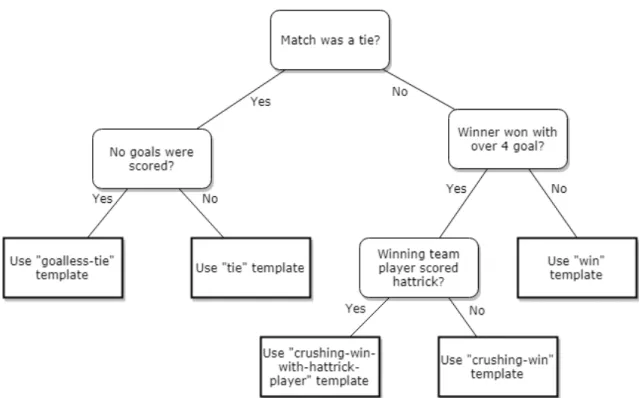
A simple if-else if-else structure, where all outcomes return a value, is a decision tree. The branching nodes are the conditions of “if” and “else if” statements. A simple decision tree, displayed as a graph, can be seen in Appendix A.1. A corresponding else if-else code fragment written in the Scala programming language (or the Java programming language, implementations are identical in this case) can be seen in Appendix A.2.
Machine learning means computer systems that can learn to perform a task without being given direct instructions. Instead, they are given teaching data which contains input data and corresponding desired outcomes. The system tries to infer how to do things based on the data. Different machine learning systems have different algorithms used for learning, making them more suitable for specific tasks.
Template is used in this thesis to refer only to text templates. Simply put, text tem-plates are text strings that have gaps where values are later placed. For example, a text template might have a gap where a name, time or place is put according to data. These gaps are referred to asattributes. A custom “mustache” template language will be used
in this thesis’ example templates i.e. attributes in templates are surrounded with double brackets. Take the following template as an example:
{{firstGoalPlayer}} scored the first goal
In this template{{firstGoalPlayer}} is an attribute which will be replaced with the actual name of the player that scored the first goal.
Content creator (or content producer) is used as a term for anyone who designs and/or implements the text generation logic or templates of an automated journalist. This person might be a programmer, designer or a journalist or anyone who designs the texts.
Deploymentin this thesis will refer to moving the application to a remote environment where it will run. We will also refer to two different environments, where the software can be deployed: test and production. These are generally on remote servers or in cloud services. Users will only ever see the results created by the production environment. The test environment is used to test the software before it is deployed to the production environment.
Personification means creating content from the same topic differently according to the reader’s preferences. In the context of automated journalism, this can mean, for ex-ample, translating the article to a different language or changing the tone of the article, depending on the reader.
Version controlmeans managing changes done to files, especially the source code of a piece of software. It stores the history of changes done and allows examining the history and returning back to old versions.
Automated journalism means using an algorithm or software to generate articles based on structured data [2][1]. Automated journalists analyse the structured data to find newswor-thy facts from it and then write articles based on the facts. Automated journalism does not require human interaction after the automated journalist has been implemented [1]. The algorithm or software goes through the entire article writing process from data gathering and analysing to writing and publishing the article [1].
For example, an automated journalist might write reports about football matches. The data this kind of automated journalist gathers might include info on how the game pro-gressed, who scored goals and when, and other statistics such as the number of offsides, corners and fouls. The automated journalist will then analyse this data and try to find the newsworthy facts of it. Newsworthy facts might be how the game progressed and high-lighting important players, based on the player stats in the data. This analysis answers the question “What is said” in the article [6].
The previously selected newsworthy facts are then turned into fluent text and the ar-ticle is formed. This part of the process answers the question “How are they said” in the article [6]. The automated journalist will finally publish the finished article.
The articles written by an automated journalist do not need to be used as-is, they can also be used as a base where journalists add more information [1]. Automated journalism will most likely not replace all journalists, but perhaps allow them to focus on in-depth analysis and other work that is hard or nearly impossible for automated journalists [1]. In
future, automated and regular journalists will likely work together [1][4]. For example, the Los Angeles Times’ Quakebot only writes drafts that are then checked and published by humans [1]. This saves time while being less error-prone, which is important due to the delicate subject matter (reporting about earthquakes).
Automated journalism has already seen a fair share of use [1][2]. Some of the largest news agencies use automated journalism. For example, Associated Press (AP) uses it for financial reports and sports reporting in smaller leagues [1]. Other major users of automated journalism include Forbes, New Yorker and Los Angeles Times [2]. These newsrooms have stated that their reason for using automated journalism is the reduced resources and growing demand [2].
However, it cannot be said that automated journalism is widely adopted [5]. Compa-nies that provide automated journalism solutions have reported that they have few cus-tomers [1]. Automated journalism is considered to still be “experimental” or in an “early-market expansion phase” [5]. According to Andreas Graefe, this might quickly change [1]. This is due to there being more and more high-quality data available and newsrooms being pressured by consumers into creating more content cheaply.
2.1
Limitations
The major limiting factor for what automated journalism can be used for is the necessity of data [1]. As the whole purpose of automated journalism is to write articles based on data, there are many requirements on the data. The data has to accurately describe the topic and it has to be of good quality [1], otherwise, the news will not be accurate. The data should also be timely, or the news will be late and be less newsworthy. The data also needs to be machine-readable [1].
What the data contains depends on the use case. Generally speaking, it should contain everything required to make newsworthy articles about the subject [2]. The data should
support writing interesting articles based solely on it. The data available puts boundaries on the possibilities available to the automated journalist: it is not possible to write about things not in the data. Therefore the design of the automated journalist needs to start with going through what data is available and what is not [2].
Another limitation is that reports written by an automated journalist have to be repet-itive i.e. multiple articles written from the same subject [1]. There is no advantage to an automated journalist if it does not write multiple articles. Otherwise, it is most likely faster and cheaper to write the articles by hand. This means that automated journalism has to be about a subject that requires continuous reporting.
The repetition can also come in the form of personification [2]. Personification re-quires writing an article multiple times for different readers, where automated journalism can help. Personification in journalism can mean that the article is, for example, written in multiple languages or more focused e.g. an election report for each municipality instead of writing a single report about the entire election.
Unlike human journalists, automated journalists have to predict what to write about. They cannot react to it [7]. This is due to the fact that the automated journalist has to be implemented beforehand. Therefore the subject matter has to be somewhat predictable.
2.2
Use Cases
There are many different use cases for automated journalism. Most common automated journalism use cases are weather, financial and sports news [2]. In financial and weather news the entire news can be derived from the data. In sports, it is relatively easy to collect data from the match and turn the data into articles, even though there are aspects of sports that cannot be represented with data (we will return to this later on in this thesis). Another common use case is election reporting, as elections results can be easily represented with data. All of these examples are also repetitive: Weather reports are written continuously,
financial reports are often yearly, half-yearly or quarterly, there are many sports matches and elections happen every few years. Because sports and elections are common use cases, they will be used as examples throughout this thesis.
There are also some less common use cases. For example, the Los Angeles Times uses automated journalism for murder and earthquake reporting [1]. In both of these use cases, the limitations of automated journalism are not a problem: there are (unfortunately) multiple homicides and earthquakes in Los Angeles so the reports are repeated. Also, there was data available from L.A. County coroner’s office and U.S. Geological Survey’s Earthquake Notification Service respectively which made the automated reports possible [1].
2.3
Advantages
There are many advantages of automated journalism. Most of these advantages are similar to other automation tasks: scalability, costs reduction, speed and precision.
Scalability is an obvious advantage of automated journalism. If there is an automated journalist that can write an article about a subject, it can be used for writing other articles about the same subject, if they use the same data. For example, creating an automated journalist that handles a single sports match or a single election can handle other simi-lar matches or elections as well. Automation allows writing articles that were previously impossible to cover due to limited resources [1]. Also, it is much easier to manage if mul-tiple articles must be made at the same time because efforts don’t have to be coordinated. Automated journalists can also handle larger sets of data than what is possible for human journalists [2].
Automated journalism is generally faster as the automated journalist does not have to type or stop to think. Articles written by an automated journalist can be published almost as soon as data is available [1]. Reporting the news quickly is important as it ensures that
the article maintains newsworthiness. An example where speed is of the essence is the previously mentioned Los Angeles Times Quakebot which reports about earthquakes in the Los Angeles area [1].
Automated journalists can also be more precise. Automated journalists do not make simple mistakes or neglect important facts unless they are implemented incorrectly [1]. They do not misspell things and they do not tire [1]. However, there still are mistakes made by automated journalists. They can often happen due to unforeseen consequences. For example, stock being split was reported as the stock losing value [1]. When designing the text generation of an automated journalist, predicting possible anomalies should be done thoroughly, even though it might be difficult [7].
Automated journalism can also help with the personification of news [2]. The scalabil-ity of automated journalism also lends itself to personification: making articles according to certain needs or interests requires writing a lot more articles. An example of such a use case is “Vaalibotti Valtteri” by Leppänen et al. [2]. Vaalibotti Valtteri wrote election news about Finnish municipal elections of 2017. The articles could be modified to be about a single party in a single municipality. [2]. If this would be done with human journalists it would require writing thousands of articles which is not feasible. The articles can also be written in multiple languages [1][2]. Vaalibotti was able to write the same article in Finnish, Swedish and English. In the extreme case, personification can mean that articles are written for one person [1]. Automated journalists could also focus on different aspects of the article or change the tone according to the reader’s preferences [1].
In addition to personifying articles to certain needs, automated journalism can also provide “news on demand” [1][2] meaning that news is created automatically according to user input. Vaalibotti Valtteri is an example of this also: the reader can select a party and a municipality and the article written will focus on the selected municipality and party [2].
as being more objective, this might not be the case [1]. Automated journalists always use the same algorithms so they should not have a bias, but the people implementing them might have a bias, which could have transferred. The data also has to be unbiased for the article to be unbiased. However, data suggests that people perceive automated journalists as being more credible [1][3]. Also if articles are personified according to the reader’s preferences, then they cannot also be unbiased [1]. An automated journalist can be unbiased, but it is not always the case and cannot be taken for granted [1].
Automated journalism could allow human journalists to write more interesting arti-cles, as simple and repetitive articles can be automated. This allows human journalists to focus on articles the automated journalists cannot write, such as analytical pieces. [1]
2.4
Six Requirements
Leppänen et al. listed 6 requirements that automated journalists should adhere to [2]. Automated journalists need to follow the same standards as human journalists. Human journalists are expected to write truthfully and accurately, their text must be fluent and their subject newsworthy. Any automated journalist that fulfils these six requirements should uphold the same standards. The requirements are presented in the following sec-tion.
While these requirements might not be comprehensive, they provide a good baseline for comparisons. Therefore they will be used in this thesis to compare different imple-mentation methods of automated journalism and to plan and evaluate the practical part of this thesis.
2.4.1
Transparency
Transparency means that the process of creating a text from the data is clear and open. For example, it should be clear why the automated journalist decided to mention specific
aspects of the data. This is comparable to human journalists being open about the way an article was written, e.g. mentioning the use of reliable sources.
This requirement can sometimes be achieved by having the source code of the auto-mated journalist be open-source. However, that can be uncommon due to the fact that commercial solutions may lose their competitive advantage if they reveal their source code. Some times being open-source does not help due to the implementation method being a "black box" i.e. the inner workings of it cannot be directly observed.
2.4.2
Accuracy
Accuracy means that the text should be truthful to the data it was made from. This is not in any way different from human journalists.
While not specifically mentioned in the report by Leppänen et al. we would also add that not saying something important is also indicative of poor accuracy [2]. This is similar to human journalists omitting important info, even if it is more likely not purposeful when it comes to automated journalism. Omitting facts can happen accidentally more often as the automated journalism system has to predict what to write about as was discussed earlier.
2.4.3
Modifiability and Transferability
Automated journalists should be easily transferable from one subject to another, just like human journalists can write about many subjects. This makes them much more generally usable. If the automated journalist is easily modifiable it will also be more easily transfer-able. Designing the system to be modular generally helps adhere to this requirement as it allows modifying only some modules when switching to a new context.
2.4.4
Fluency of Output
Automated journalists are expected to write fluent text just like human journalists. Flu-ency means that texts written by a computer should not read like they were written by a computer, but instead, they should be as easy to read as human-written articles.
2.4.5
Data Availability
The workings of automated journalists rely completely on data. Therefore the data used by the automated journalist must be newsworthy and of good quality. Otherwise, the automated journalist is unable to write accurate and interesting enough articles. This is comparable to a journalist having to have enough info on a subject before writing an article.
2.4.6
Topicality of News
Just like regular journalists’, the automated journalists’ texts should be topical. As an au-tomated journalist is not as suitable for long-form articles or complex analysis, topicality is often achieved via personification, localization or just timeliness. This means that the automated journalist either writes articles meant specifically for certain readers or they write about events that just happened.
2.4.7
Discussions
We think that splitting modifiability and transferability into two different requirements should be considered. A system can be easily modifiable without being easily transferable and vice versa.
For example, a text generation system based on a decision tree can be modified by adding new branches or editing existing ones. However, changing from one subject to another will probably require the design and implementation of a completely new decision
tree. The modular design will help as you only have to change the module that converts data into values used in the tree and the tree itself, but it might still be plenty of work.
The difference between modifiability and transferability can also be perceived the other way around: An easily transferable system might not always be easily modifiable. As an example: A perfect machine learning system might be able to turn any data into a coherent article with minimal work, but it might not be at all modifiable as machine learning is often a “black box” meaning that its inner workings cannot be inspected or modified directly.
Because of these reasons modifiability and transferability will often be discussed sep-arately in this thesis. Although as stated previously modifiability often helps with trans-ferability so there are also reasons why these requirements are grouped together.
While it was not stated in by Leppänen et al. we would add that fluency also requires for different articles by the same automated journalist to be sufficiently different from each other [2]. For human journalists, this is pretty much given, even though articles from the same subject will have similarities. However, for automated journalists, different articles being samey is much more likely because all the articles are created with exactly the same process. While the text itself might be fluent when reading a single article, when reading multiple articles it might become too obvious that the text was written by an automated journalist.
This issue came up in studies conducted by Melin et al. where humans read articles that were based on the same data written by humans and automated journalists [3]. At first, readers had a hard time determining which articles were written by humans and which were written by a robot. After reading a few articles by both sources, readers got better at recognizing the writer. This would hint that automatically written articles bear more similarities with each other than human-written ones. This type of fluency may not be required in cases where automated journalism is used for one-time article personification (e.g. different election result articles for each municipality) as people will
probably not read multiple articles.
While in the paper these requirements were introduced as equals, we think that some are more important than others. We think accuracy is the most important of all of the requirements as the point of articles is to tell what happened. An inaccurate automated journalist can be very problematic. We think transferability is very case dependent. If the goal is to use an automated journalist for a single use case, this requirement is not as important as others. The importance of different requirements depends on the use case. This will be discussed more when different implementation methods are analysed and compared.
In this chapter, we will introduce and compare the different ways to implement automated journalism. Automated article generation is divided into two separate problems: “What is said?” (content selection) and “How is it said?” (surface realisation) [6]. There are also solutions where a single end-to-end process handles both tasks i.e. they handle the text generation as a single process from start to finish.
Due to the fact that most automated journalists deployed in practice are implemented by private companies using closed-source products, there is little information on the im-plementation methods used [2]. Therefore there might be other imim-plementation methods not described here. However, most implementations seem to be template and rule-based [2].
3.1
Content Selection
Content selection means trying to find the most important facts to mention in the article. Basically, it means finding the most newsworthy aspects of the data.
3.1.1
Decision Tree
The decision tree data structure introduced in Section 1.1 can be used to select the texts the automated journalist outputs. The data used by the automated journalist is refined into boolean values. These boolean values are placed into the branch nodes of a decision tree
and texts are placed into the leaf nodes. When an article is created, the tree’s value is determined by calculating the boolean values from the data and then determining the leaf node that should be selected. The creation of the tree is most often done manually [8].
A decision tree is a rule-based system as the branches are rules which determine which template to select. There are most likely other hard-coded, rule-based systems for text selection which are closed-source, as most solutions appear to be rule-based [2]. Unfor-tunately, there is little info on them, but if the rules are made manually they most likely have the same advantages and disadvantages as the decision tree model.
The decision tree is often designed and implemented by programmers, journalists or even data analysts working together [1]. The design of the decision tree decides the newsworthiness of different aspects of the data [8]. The nodes at the top of the tree determine what is the most important thing to take away from the data. The decision tree can also be extracted automatically with machine learning [9].
3.1.2
Fact Ranking Method
The fact ranking method means finding significant, comparable (numerical) facts from the data and comparing them to find outliers (e.g. facts that are furthest from average). These facts are then selected and an article is written based on them. [2]
This type of system was used in the Vaalibotti Valtteri automated journalism project. Possible facts were, for example, the number of votes a party or a member received, the change of votes compared to last election etc. A newsworthy fact could be getting the most votes, losing the most votes compared to previous election etc. The facts can also be used to create other facts. For example, in elections, the number of votes can be used to rank the parties to create a new fact about rankings e.g. party ranked first or second. [2]
3.2
Surface realisation
Surface realisation means changing the data into readable text. After selecting what needs to be said, the selected facts have to be changed into fluent text. Aside from end-to-end solutions, templates are the only way used to turn data into text that we are aware of.
3.2.1
Templates
The text templates introduced in Section 1.1 are often used to represent data as text [2]. Templates can range from simple to complex [2]. Simple templates can form just a frag-ment of a sentence while complex templates can be multiple sentences long. Simple templates are generally more universal and portable, but they might be less vibrant than templates that only fit specific cases [2]. For example, simple templates were used in Vaalibotti Valtteri. Having more general templates also means that fewer templates are needed, which makes translations easier. The entire article can be a single template [8]. In fact, most newsrooms use such templates, which are hard to transfer and require rewriting everything when changing domain or language [2]. All in all using templates can be a bit of a balancing act between portability and fluency [2].
Even seemingly minor things can make templates less reusable even in a relatively similar context. For example, using the term “score a goal” in a team ball sport (such as football) means that the same template cannot be used in basketball.
Templates can also be extracted automatically using machine learning [9]. Machine learning systems can read articles and then extract sentences and figure out the attributes in said sentences, creating new templates.
Improving Templates
Templates don’t have to be used as-is; they can be processed before they are added to the article. These processes can make the template-based text more natural and fluent. [2]
If the templates are simple, one-sentence templates, they can be combined automat-ically with conjunctions [2]. This makes the text more natural as it is not just a list of simple one-clause sentences. In Vaalibotti this type of system was used. However, it did create some strange and even factually inaccurate sentences. An example by Leppanen et. al.: “Aggregating ’X got most votes’, and ’X got 5 seats in the previous elections’ into ’X got most votes and 5 seats in the previous elections’ changes the meaning of the first text snippet” Nevertheless, this kind of system can be used to combine sentences, as the problems found in Vaalibotti are just bugs that need to be ironed out [2].
In the Vaalibotti project, a piece of software called a “Recurring expression generator” was used with templates to make the text more natural. The software would recognize that a certain attribute value (such as a person’s name) was mentioned multiple times and change the following mentions accordingly. For example, if a specific election candidate was mentioned many times, the first time would use their full name, but the second time it would refer to them by last name alone or say “he”/”she” in place of saying their full name multiple times. [2]
Templates can have synonyms written into the template [9]. This means that the tem-plate can have multiple options in place of a word. The selection of specific synonym can be random, or it can take the data into account. For example in the template
{{winningTeam}} won {{losingTeam}}
the word "won" can be replaced according to data, e.g. if the winning team won with many goals, it can say
{{winningTeam}} crushed {{losingTeam}}
Exact synonyms can also be selected randomly to improve the fluency by adding variation to the articles.
3.3
End-to-End Solutions
End-to-end solution means that a single software takes the data and outputs natural lan-guage, without there being a way to divide the process into two parts [6]. The most prominent example of these are different machine learning systems.
3.3.1
Machine Learning
Machine learning systems can be used to implement an automated journalist. These types of systems are fed a huge amount of teaching data. The teaching data includes the struc-tured data, from which to write the articles, and also articles that are written based on the same data [6].
The requirement to have enough teaching material is an issue in the machine learning systems [6]. There needs to be a plethora of articles and data related to those articles. For example, Wiseman et al. introduced a set of over 4000 basketball articles with scores and other match data [6]. The data contained player stats such as points scored, rebounds and assists, and team stats such as points scored and previous games won and lost.
Wiseman et al. also used the data to compare many different machine learning im-plementations. The different machine learning systems had different features that would improve the outcome by changing the learning process. The machine learning implemen-tations all had features where they would copy words from the data directly for improved accuracy. These words would generally be names of players and teams, and scores. There were two different copying mechanisms: Joint Copying and Conditional Copying. These differed in the way the machine learning determined whether or not to copy a word or to generate a new word. [6]
A reconstruction based technique was also used to improve the results. This means that during training the machine learning system reconstructs the database from the out-put text. The reconstructed database is compared to the inout-put data and scored. If the
reconstructed database is similar to the input database, the score is better. Total varia-tion distance (TVD) penalizavaria-tion can be added to the reconstrucvaria-tion loss. This means that there is a penalization if different reconstructed databases are too different from each other. [6]
Some of these techniques were combined and the tested combinations were:
• Joint Copy
• Joint Copy + Reconstruction
• Joint Copy + Reconstruction + TVD • Conditional Copy
Of these models, the Conditional Copy model and Joint Copy with Reconstruction and TVD performed best. However, even the best models had noticeable issues with accuracy with only approximately 71% of records being correct. [6]
Nie et al. were able to improve upon these with a machine learning system called Operation guided Attention-based sequence-to-sequence network (OpAtt). They used the same teaching data as Wiseman et al. so the results are comparable. OpAtt adds additional processing to the input data before text generation. It also uses copying models to achieve better results. OpAtt was able to improve both the correctness and the fluency of the output. It had approximately 81% of records correct on the same dataset, which is an improvement but still quite far from solving the accuracy issues of machine learning. [10]
3.4
Comparisons
In this chapter, we will use the previously introduced seven requirements of automated journalists to compare the different implementation methods. Modifiability is separated from transferability for this comparison for reasons discussed in Section 2.4.7. While data
availability and topicality of news are not really related to the implementation method used [2], the other five requirements can be used to compare different implementation methods.
Unfortunately, not much research is done comparing different implementation meth-ods. While the subject of different implementation methods has been researched there is little research comparing them. An automatic system has been implemented for compar-ing automated journalists which will be discussed later. Though, it has not been used to do a wide analysis yet.
For a lot of these different implementations, the accuracy and fluency depend on the humans that create the actual content. For the sake of argument, we will compare the best possible result, but also take the human element into account. We will leave the consideration on whether the systems are open-source or not out of this comparison and only compare the transparency of the actual systems themselves.
3.4.1
Decision Tree
Decision trees have poor transferability, as they are based on a manually created set of rules which determine what is newsworthy and what is not. While some parts can be reused if the change of topic is to another similar topic (e.g. from one sport to another, from one election to another), if the domain is changed altogether, the decision tree has to be created from the beginning [2]. Creating the new decision tree does not only require redesigning the tree but also implementing all the boolean variables used in it. Therefore it is expensive to transfer from one subject to another using decision trees.
As the decision tree needs to be manually implemented, they have perfect modifia-bility. The accuracy of decision trees depends on the implementation. If not reporting something newsworthy is considered poor accuracy, decision trees often have at least some problems with accuracy, as it is often expensive to create rules for everything. Also, there are probably inaccuracies due to the fact that the tree was manually implemented,
so there are likely to be some mistakes. Fluency depends on the templates used with the decision tree. Decision trees have good transparency as it is easy to see why a specific template was selected.
3.4.2
Fact Ranking
Fact ranking has better transferability then decision trees as there are generally fewer facts to be ranked than decision tree decisions. However, some work is still required to move from one subject to another, as the different facts being read from the data need to be implemented. The modifiability of the fact ranking method is slightly worse than the modifiability of decision trees, as one cannot directly state that one fact is more newswor-thy than another [2]. It is possible to edit the importance of different facts, just not to such a fine-grained level.
The accuracy should be good as it is easier to have all the facts in the article and it is less likely that there are bugs as not all decision need to be programmed manually. The transparency is quite good, but it is not as good as a decision tree’s [2] as decision trees are easy to read. On the other hand, if there are multiple automated journalists, this might flip the scales, as the human journalists do not have to consider different decision trees for different journalists [2]. Fluency depends greatly on the templates used with the fact ranking method.
Unfortunately, fact ranking method does not work in all use cases [2]. It does not work for storylike articles where one thing leads to another, such as a sports match. It is more suited to articles where it is more important to point out the outliers. Election news is a good use case as the story often is who got the most votes, who gained and who lost the most. Not being able to be used in all articles is the biggest detriment of this method. Nevertheless, of the common automated journalism use cases, fact ranking method fits weather, election and financial news.
3.4.3
Templates
The transferability of templates depends on the templates. Simple templates that just state a single fact are more transferable while specific templates are not as transferable. This due to the fact that fewer simple templates are needed to write an article and therefore fewer templates need to be rewritten when changing domain or language. The fluency of templates also depends on how complex they are. More complex templates can have more flavour, at the cost of transferability [2][8].
Templates have excellent modifiability, as they are manually written and can be edited. They also have good transparency as they clearly state what is said. The accuracy of tem-plates depends on the part that implements “what is said”. As temtem-plates are implemented manually they can have accuracy issues due to human errors.
The texts generated by Vaalibotti Valtteri were analysed with humans readers. The words “Repetition” and “Listing-like” were respectively the second and the fifth most common negative words used. The implementation based on repeating simple templates may have caused these issues. It would appear that the problems of template-based so-lutions only crop up when reading multiple articles. The readers were better at figuring out which texts were written by humans and which were written by an algorithm, after reading multiple articles. [3]
3.4.4
Machine Learning
Machine learning should have good transferability as the same machine learning system can be used in different use cases, it just has to be taught with different data. Modifiability is quite poor as it is not possible to directly edit the system. It can only be changed by editing the parameters of the teaching process. The fluency of machine learning systems is good, as they learn from articles written by human journalists. The accuracy of ma-chine learning systems is relatively bad. The transparency of mama-chine learning systems is minimal, as they are a "black box" [2]. It is difficult or even impossible to say why a
machine learning system decided to use a certain phrase or mention a specific fact from the data.
It is difficult to find enough teaching data for machine learning systems [6]. In a perfect scenario, the articles in the teaching data would have no info that is not in the data, otherwise, there are facts in the article that are not supported by the data [6]. This might affect the quality of the machine learning system. However, it is difficult to find a large number of articles that are written based solely on structured data with no additional info.
3.5
Automated Comparisons
Wiseman et al. created an automated system for comparing different text generation meth-ods and especially comparing different ways machine learning can be used to implement automated journalism [6]. The test used two data sets: one with data from over 4 000 basketball matches and statistic heavy articles written from the same matches and another with over 10 000 basketball matches and matching articles that are less formal [6].
For figuring out how well the different systems performed, an automatic system was created. Human evaluation was argued against, as it was stated by Wiseman et al. that “we believe that current text generations are sufficiently bad in sufficiently obvious ways that automatic metrics can still be of use in evaluation”[6]. Instead, they used an automatic system which used metrics known as Bilingual Evaluation Understudy (BLEU), Content Selection (CS), Relation Generation (RG) and Content Ordering (CO). The systems ex-tract facts from both a generated article and from an article written by a human journalist about the same match. [6]
BLEU is a metric that is designed for testing machine translations [11]. It compares human written translations to machine translations and the closer they are the better the BLEU score is. While BLEU is designed for comparing human and machine translations,
it can also be used to compare human written and machine written articles [6].
BLEU mostly checks how fluent and adequate the translation is [11]. However, Wise-man et al. noted that BLEU does not really take into account “What is said” i.e. it does not check that the report mentions the most important aspects of the data [6]. Content Selection amends this as it checks what facts are mentioned in the generated article and compares those to the facts mentioned in the corresponding article written by a human journalist [6]. Relation Generation checks that the facts are correct by comparing the facts in the generated article to the data the article was based on [6]. Content Ordering checks that the order in which the facts were mentioned in the generated article is similar to the order of facts in the human-written equivalent [6].
The test was conducted on multiple different machine learning models and a template-based solution. The outcome of the experiment was that while the template-template-based solution had a lower BLEU score (less fluent) and was slightly worse at selecting the correct facts, it performed better on all other metrics. [6]
However, the template-based reference implementation is extremely basic: it only states the results and then lists the six biggest scoring players one by one with exactly the same wording and finally a sentence about both team’s next match [6]. Not surprisingly, the text is not very natural and scores low points in fluency. It should be tested with a more complex based system with natural language templates. The template-based system did not appear to have any kind of template selection system, but always used a single template, which might reduce its Content Selection score.
The automated comparison of article automation methods could also be used to test a decision tree-based system vs. a fact ranking system. For example, a decision tree system and fact ranking based system could both be used in an election data case and compared against each other. The work needed and the costs to get each of them working could also be compared. It must be noted that other article generation methods might not be sufficiently bad enough for the comparison methods used by Wiseman et al. to work.
These tests are outside of the scope of this thesis as they would require implementing multiple automated journalists using different methods.
3.6
Discussions
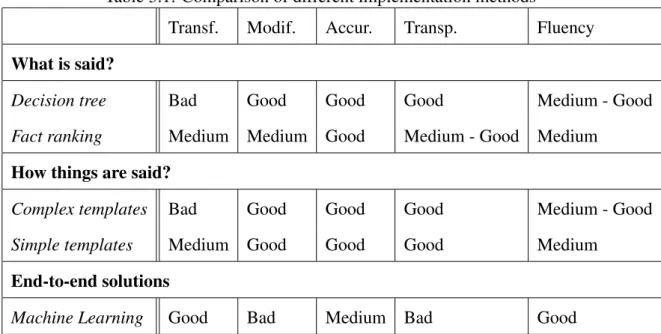
None of the implementations of automated journalism compared is strictly better than others. Machine learning is very fluent, but has issues in accuracy and requires teaching data. Text selection with a fact ranking method is quite fluent and transferable but doesn’t fit a story-like article structure where events happen in order. In Table 3.1 there is a sum-mary of different implementation methods. While it is very difficult to state objectively how good or bad different aspects of the systems are, the table works as a guideline for comparing the systems to each other.
Some criticise machine learning systems as being inferior and not viable compared to template-based systems due to their "black-boxness" and poorer accuracy [8]. However there is constant research into better machine learning systems [6][10] that improve upon the accuracy, so this might change eventually.
It is difficult to state how fluent and accurate decision trees and templates are. It is possible to edit and polish template files and decision trees to perfection. In theory, it could be possible to replicate a machine learning-based text generator with decision trees and templates, although this would be extremely expensive. Improving decision trees and templates also has diminishing returns: Each new branch in the decision tree has less value as the addition is relatively smaller. Each completely new segment added to an article also has less value as it is a smaller relative increase to the entire text of the article. Adding new branches to the decision tree makes the logic more and more complex, which makes it harder to grasp and less transparent. Adding templates generally requires a lot of manual work. The goal of this thesis’ practical work is to make editing templates and decision trees much easier, to reduce these problems.
Table 3.1: Comparison of different implementation methods
Transf. Modif. Accur. Transp. Fluency What is said?
Decision tree Bad Good Good Good Medium - Good Fact ranking Medium Medium Good Medium - Good Medium
How things are said?
Complex templates Bad Good Good Good Medium - Good Simple templates Medium Good Good Good Medium
End-to-end solutions
Machine Learning Good Bad Medium Bad Good
It is harder to translate machine learning-based automated journalists than template-based solutions as they would require data from sports matches and articles from the same matches in all languages for which translations are desired. For template-based solutions, it is always possible to add new languages by just translating the templates, although that does require manual work.
While strides are being made to create better and better machine learning systems[6][10], it is difficult to say if machine learning systems can replace all other implementation meth-ods. As was stated previously, the biggest hurdle of the machine learning solutions is the teaching data. There seems to be only a handful of data sets used in research (a total of six that we know of [6][10]) in English, which is one of the most spoken and written languages. For smaller languages, it might not be feasible to find enough articles and matching data to create viable machine learning solutions based on them.
3.7
Selecting an Implementation Method
If there is plenty of teaching material available and being in complete control of the au-tomated journalist is not vital, machine learning is probably the way to go. Especially if
there is a requirement for different unrelated use cases as the transferability is better. If the automated article is more about finding the outliers in the data, the fact ranking method with templates is probably the way to go. These types of use cases could be election or financial news. This approach gives more control as it is clear how things are said, but deciding what is said is perhaps harder to grasp and balance. It might be more difficult to give an explicit ranking on how newsworthy some aspects are as the fact ranking method just find outliers.
If the article has a story-like approach, or there is an explicit ranking of newswor-thiness (i.e. some aspects are always more important to mention than others) a decision tree-based approach is most likely the best implementation method. These types of use cases are, for example, sports matches. This approach gives the tightest control of the outcome as it has clear rules on what is said and how is it said.
Also as stated previously, decision trees and complex templates are not transferable, if they are fluent and have good accuracy (accurate as in everything newsworthy is written) [2]. Therefore they might not be the best solution if the goal is to create multiple different automated journalists that write about different subjects.
When selecting a suitable implementation method for a use case one should consider all the requirements for an automated journalist and weight them according to the use case. For example, if only one automated journalist is desired, transferability is not too important. After the requirements are weighed it should be easier to see what implemen-tation fits the use case best.
3.8
The Common Challenges
There are many ways to implement automated journalism and all of them have their own challenges. However, some challenges persist over different implementation methods and use cases.
It is difficult to create implementations that are truly portable [2]. While some parts of text generation are reusable, none of the different implementation methods really supports changing the subject matter without requiring plenty of work. While simple templates and a fact ranking text selection can be quite portable, it doesn’t really support all kinds of article types and still requires some work when changing domain. Machine learning systems can be portable, but they require an abundance of data and matching articles to be able to learn how to write articles based on the data.
While automated journalists can look for correlation in data and find interesting rela-tionships, they cannot provide any real analysis. They are unable to ascertain why these relationships exist [1]. In other words, the automated journalists can tell what happened, but they have a hard time telling why it happened [1].
Earlier in this thesis, we asserted that not saying something important is also indicative of poor accuracy. It would seem that most of the previously explored implementations will miss very rarely occurring events. Human journalists can react to unexpected events while automated journalists have to predict them as the automation has to be implemented beforehand [7].
For example, if multiple hat tricks were scored in a football match, most implemen-tations would miss it. A machine learning system probably would not have seen enough matches with multiple hat tricks to be able to generate text about it. A decision tree-based system would not necessarily have a rule for it, as it happens extremely rarely. A fact ranking system might pick it up, but then it would require one ranked fact to be the num-ber of hat tricks and it may not know to underline how important this is. As stated by Andreas Graefe “– contribution is limited to providing answers to prewritten questions by analyzing given data.“ i.e. algorithms lack ingenuity and cannot innovate [1]. Therefore algorithms have limited perception and cannot come up with anything new, unlike human journalists [1].
problem that could probably be easily fixed with human and automated journalists work-ing together. While an automated journalist might miss the rare occurrence it should be obvious to the human reporter and they could update the automatically generated article with the additional info. This again speaks for the advantage of having both human and automated journalists working hand in hand. The automated journalist can write about the scores and all other data-based text and the human journalist can add everything important outside of that.
When compared to the way humans write articles, it is difficult to write as lively articles from data alone [7]. For example, if a human journalist watches a football match, they might see an incredible goal and highlight that in their article. It is quite difficult to accurately portray this information with just data as these are not hard, numerical facts but are up to debate. Simply put it is hard to put emotion into data. While this is not a problem in all use cases, it is definitely an issue in sports journalism, which is one of the most common automated journalism use cases. The data also lacks a human element which interests readers [7]. This again is a problem that has been solved with a human journalist adding a "human touch" to the automated articles [1].
In addition, the amount of data that can be used is usually limited while human jour-nalists might have all kinds of important info that can be used in the article [7]. For example, human journalists might know something about players’ history of injuries or personal life. While these facts are not vital to writing the article, they do give it some spice. It would be impossible to give all the data to the automated journalist, even though it would help with writing more human-like content. In Thurman et al. a journalist noted that in sports the events that happen at the pitch might be less interesting than other events surrounding the game that are not in the data [7]. For example, in a football match be-tween West Ham United and Manchester United in 2016, there was a riot before the match which delayed it, and after 112 years it was the last time West Ham played at Upton Park Stadium [7]. This info would most likely be missed by all automated journalists.
Voitto is a virtual robot that is created by the Finnish national broadcasting company Yle. It is a sort of hypernym for multiple different projects. All of these projects have to do with automation, personification or assisting journalists or users. Automated journalism is one of the first things Voitto started with. Since then the Voitto-name has been used in automatic goal clip generation from football and using machine learning to recommend articles to readers. In this thesis, we will only focus on the automated journalism aspect of Voitto as the other aspects are unrelated to this thesis.
4.1
Acknowledgements
We have worked in the Voitto robot project for over a year. Most of this chapter is based on personal experience and discussions with other members of the project team. Most implementation details can be verified from the documentation and the source code of Voitto available in GitHub1. Some of the features presented in this chapter are in newer versions of Voitto and therefore cannot be found in the open-source repository.
4.2
Articles
Voitto has mostly focused on sports articles to this point. Only non-sport articles Voitto has written were about elections in Finland. In these elections, Voitto wrote about the
results of all municipalities in Finland. The sports Voitto writes articles about are ice hockey, football and floorball.
In addition to writing articles about single matches, Voitto also writes automatically updating sports guides that contain the latest results, upcoming matches, league table and top player’s stats. These guides also have links to the individual articles written by Voitto. Also during the FIFA World Cup of 2018 Voitto published preview articles 30 minutes before matches started. These preview articles contained a short intro about which players to follow and who was predicted to win. More importantly, they had embedded live streams of the match. On days with multiple matches, Voitto also writes aggregates that go through all matches played on that day.
The goal of Voitto is to write articles that would be too expensive or time-consuming to write by regular journalists. For example, writing election articles for all of the ap-proximately 300 municipalities of Finland is not feasible. Also writing articles from all the major European football leagues is quite a lot of work: A single season for all se-ries’ combined sums up to over a thousand articles which is not quite feasible for human writers, but is manageable for an automated journalist.
Voitto also generates images from the data in most articles. For example, Voitto cre-ates bar charts from the match’s stats and a visual list of events that happened in the match. These images are used in Voitto’s articles but human journalists are also encouraged to add these graphics to their own articles. This thesis will only focus on the text generation side of Voitto’s articles. Appendix B.1 is an article written by Voitto, which also contains the images.
The articles written by Voitto are also somewhat targeted to gain better topicality. Because Voitto writes many articles their visibility has been limited on the main Yle sports news site. This means that they don’t show up on the front page or the list of the latest news, otherwise the articles would flood the lists. However, the articles can be read from Yle’s mobile application “Uutisvahti”. Uutisvahti allows the user to subscribe to
index terms and the app will send out a notification when an article is published with that index term. Therefore users can affect which articles by Voitto they will read. Index terms can be team and player names, and the user will get a notification when that team or player has played a match.
Voitto has also written articles in Swedish, with the name Victoria.
4.3
Implementation
The implementation of texts in Voitto uses the previously featured decision trees and templates but with some twists to accommodate Finnish language and to make the texts more lively. Voitto is implemented in the Scala programming language but its resource files use the Extensible Data Notation (EDN) data format.
The articles written by Voitto are divided into multiple smaller sections based on con-text. This division varies by article subject. In ice hockey reports, the texts are divided per period. The football reports are based on different highlights of the match. For example, a player scoring multiple goals or the match having many yellow and red cards. Each of these sections has its own decision tree and templates. Not all of these texts are required to select a template if no template in the decision tree fits. For example, if no player scored multiple goals, a decision tree that selects a template about star players will not select a template. However, some texts, such as the title, are always required.
Before text selection, the data received by Voitto is derived into easier to use values. For example, the number of goals scored by both teams (e.g. 2 and 5) is derived into goal difference (e.g. 3) and the outcome of the match (e.g. “2-5”). For text generation purposes these values can be divided into two categories: boolean values (true/false) and attributes. Boolean values are used in decision tree decisions and attributes are used to fill templates.
4.4
Decision Trees
The decision trees of Voitto is relatively basic. They are a collection of simple if-else if-else structures written in the Scala programming language. The values in the nodes of the decision trees are the aforementioned boolean values derived from the data. These structures are used to select the right template. A simplified example of a decision tree can be seen in Appendix A.2. TheloadTemplatefunction loads the selected template from a resource file.
4.5
Attributes
The attributes in Voitto’s templates use a similar custom Mustache template language that has been used in examples in this thesis, i.e. attributes are surrounded with double brackets.
There are many different kinds of attributes in Voitto’s templates. There are plain text strings, series names, numbers, “helpers”, player and team names and lists of names. “Helpers” are specific words that can be used to spice up the text according to data. For example, instead of repeating team names, a helper can be used to say “the home team” or “the away team” instead, depending on the data. Take the following template for example:
{{{homeOrAwayTeam}} scored the first goal.}
The attribute {{homeOrAwayTeam}} will either have the value “Home team” or “Away team”, depending on which team actually scored the first goal. While these helpers could be replaced with having different templates for either case, it would require having many very similar templates and more complex text selection logic.
The template attributes of Voitto have info on which inflection to use. Adding inflec-tions to attributes is absolutely necessary for Finnish, otherwise, the text is syntactically broken or it will sound very robotic. All the available inflections for names and helpers
are listed in separate resource files. The resource files are long lists of player and team names that have a specific set of available inflections. The resource files are used be-cause no reliable way was found to do inflections on the fly. First 10 numbers also have written inflections but for larger numbers, the numbers are used as-is with inflections in the end, e.g. "20:ssä ottelussa" ("in 20 matches"). All attributes except plain texts have inflections. Attributes are marked in template files with a colon after attribute name e.g.
{{winner:genitive}}would be the name of the winner in genitive form.
Attributes can also have other options. For example, player name attributes can have options to only use the last name without the first name. These options are mostly short-cuts that reduce the amount of code that needs to be written. For example, the program-mer does not have to create a separate attribute for each player’s full name and last name. The options can also be, for example, player or team stats or the name of the opposing team. Attributes with options can also have inflections. Options are noted with a dot. For example {{player.totalGoals}}would be a player’s total number of goals and
{{player.totalGoals:genitive}}would be the same but in genitive form. Attributes also can be forced to be capitalized so that they can be used as the first word in a sentence. Capitalization is also noted with a colon, but it is at the end of the attribute string. It can also be used with options and inflections e.g.
{{player.totalGoals:genitive:capitalize}}
would be the number of goals scored by a player, capitalized and in genitive form.
4.6
Variations
Each of Voitto’s templates contains a list of variations that say the same thing but using different words and turns of phrases. Each language has its own list of variations. The point of variations is to make the articles not sound samey even if the same templates are selected. The variations might use different attributes to make them less similar. If
there were no variations, reading multiple articles from the same subject would make the articles sound more robotic and predictable.
Variations are selected with weighted randomness. This means that all variations have attached weights that can be changed to determine how likely it is for that specific vari-ation to be selected. This is used to lower the chance of a certain text from appearing if it starts to seem repetitive. For example, if a certain turn of phrase is used in multiple templates and starts to become grating, the weights can be lowered on all variations that use this phrase.
Variations try to achieve the same goal as the previously discussed synonyms in tem-plates. As the variations are always picked at random, they cannot have different tones, as they would not be supported by data. Instead, different tones are achieved by having different templates. For example, a crushing win will use a different template from a close win.
4.7
Template Files
While some automated journalists have quite universal/simple templates [2], the templates of Voitto are quite specific/complex. While this hurts the reusability of the templates, it does make the text more lively as it opens up the possibility of using exact terms and turns of phrase. A simplified example of a template file used by Voitto can be seen in Appendix C.1.
While Voitto’s templates are quite basic there are some special features. Voitto’s tem-plate files have a loose hierarchy. There are some common temtem-plate files that fit many sports. These are at least somewhat independent from the sport and the decision tree that uses them. An example of a common template is the “crushing-win” titles template; the winner won with a sizeable margin. The same text is applied to floorball, ice hockey and football titles. However, the decision tree logic is different for all these sports. While
in football 3 goal difference is enough to select this template, in ice hockey 4 goals are needed and in floorball, a more sophisticated calculation is used. There are also quite a few templates that are used in both ice hockey and floorball as the sports are quite similar. Common templates have some advantages which are similar to not having copy-paste code. If there are mistakes or typos in the text, the fix doesn’t need to be implemented into multiple places. It also provides transferability to similar domains, as some texts don’t need to be written again. Adding variations to these common templates helps all sports that use these templates. All in all, common templates give some of the advantages of having more general templates without the disadvantages, such as reduced fluency.
Decision trees can use templates from multiple template files. For example, football titles use a template file for common titles and another file for football-specific titles. There is no checking that the different template files don’t have same names for templates and there are no overriding rules. This is an issue that we will return to in the practical part of this thesis.
4.8
Text Rendering
After the template is selected with a decision tree, all of its variations are rendered. This means that the attributes that the template contains are fetched from the values, inflected and then placed in the templates.
Sometimes there are variations that cannot be rendered. For example, there is a player name that does not have inflections in the resource files or an attribute is unavailable (most often caused by a bug). If a variation cannot be rendered then that variation is not used and another variat