CRANFIELD UNIVERSITY
KAMRAN RAZMDOOST
THE EFFECT OF KNOWLEDGE MISCALIBRATION ON THE
DIMENSIONS OF CONSUMER VALUE
SCHOOL OF MANAGEMENT
PhD Thesis
PhD in Management
Academic Year: 2014 - 2015
Supervisors: Dr Radu Dimitriu, Professor Simon Knox
March 2015
CRANFIELD UNIVERSITY
SCHOOL OF MANAGEMENT
PhD Thesis
PhD in Management
Academic Year 2014 - 2015
KAMRAN RAZMDOOST
The Effect of Knowledge Miscalibration on the Dimensions of Consumer
Value
Supervisors: Dr Radu Dimitriu, Professor Simon Knox
March 2015
© Cranfield University 2015. All rights reserved. No part of this
publication may be reproduced without the written permission of the
ABSTRACT
Consumer value is an important determinant of consumers’ post-use behaviour, for example satisfaction, repeat purchase and word of mouth. The existing research mainly looks at the factors associated with the product and service providers to improve consumer value. Few studies on the role of the consumer in shaping consumer value have found consumer knowledge to be an important element in shaping consumer value. Adopting critical realism, this PhD expands this area of knowledge by investigating knowledge miscalibration (i.e., the inaccuracy in subjective knowledge) as a significant antecedent of consumer value.
Most of the time, consumers’ perceptions of what they think they know (i.e., subjective knowledge) has been shown to be different from what they actually know (i.e., objective knowledge). Thus, subjective knowledge is usually inaccurate. This inaccuracy in subjective knowledge relative to objective knowledge is called knowledge miscalibration. Although the effect of knowledge miscalibration on consumers’ purchasing decisions has been investigated in the consumer behaviour literature, its role in the use stage of consumption has received much less attention. The aim of this research is to examine the effect of knowledge miscalibration on product or service use, and more specifically on the value consumers derive from actually using products or services (i.e., value-in-use).
In this research a critical realism paradigm is pursued, implying that reality exists in the three domains of the empirical, the actual and the real. The research starts with observing regularity in the empirical domain (i.e., consumer value) followed by imagining the causal power in the actual and the real domains (i.e., knowledge miscalibration), shaping the research question. A retroductive strategy is followed, firstly by proposing the effect of knowledge miscalibration on consumer value and secondly by conceptually and empirically testing this relationship.
This research conceptualises that knowledge miscalibration influences consumer value dimensions, described as efficiency, excellence, play and aesthetics. It is suggested that underconfidence (i.e., knowledge miscalibration where subjective knowledge is deflated) and overconfidence (i.e., knowledge miscalibration where subjective
knowledge is inflated) influence consumer value dimensions differently as they generate different consequences in use. Therefore, a conceptual model is developed that describes the effect of knowledge miscalibration (i.e., overconfidence and underconfidence) on the dimensions of consumer value.
The empirical part of the research is designed by conducting a covariance-based study and an experimental investigation in order to gain both internal and external validity. The covariance-based investigation is conducted in the context of amazon.com online shopping. Knowledge miscalibration and consumer value dimensions are measured in this study. This study supports the negative effect of underconfidence on efficiency, excellence, play and aesthetics and the negative effect of overconfidence on play.
The experimental investigation is designed in the context of prezi.com, an online dynamic presentation creation website that enables its users to move between slides, words and images during their presentations. In this study, overconfidence and underconfidence are manipulated and their effects on the dimensions of consumer value are examined. The findings of this study show that underconfidence negatively influences efficiency, excellence and aesthetics, while overconfidence negatively impacts excellence, play and aesthetics.
Overall, this PhD concludes that knowledge miscalibration negatively influences the dimensions of consumer value, with the exception of overconfidence impacting efficiency. The contradictory results of the covariance-based study observed in the experimental study can be explained through its inability to account for reciprocal relationships (i.e., where consumer value dimensions also impact knowledge miscalibration) and the existence of a third variable affecting both independent and dependent variables. Furthermore, the context of the experimental study (employing a new consumption task) is proposed to be the main reason for the lack of support for the effect of underconfidence on play.
Keywords:
Overconfidence, Underconfidence, Value-in-use, Knowledge calibration, Subjective knowledge, Customer value
ACKNOWLEDGEMENTS
I would like to express the deepest appreciation to my core supervisor Dr Radu Dimitriu for his assistance, guidance and immense support throughout the entire PhD. I am extremely grateful for his continuing encouragement and earnest care. He made the highly complex nature of this journey understandable and possible for me.
I wish to extend my thanks to my second supervisor Professor Simon Knox and my review panel members Dr Emma Macdonald and Dr Stan Maklan for their support and guidance throughout the PhD. Their precious insights and constructive comments have greatly contributed to my work.
Many academics and practitioners have helped me with their valued advice, guidance and support. I especially thank Professor Marek Szwejczewski, Professor Donna Ladkin, Professor Paul Baines, Dr Javier Marcus, Professor Lynette Ryals, Professor Stephen Vargo, Professor Morris Holbrook, Dr Stephanie Feiereisen, Dr Sara Leroi-Werelds, Chris Lawer, Nardine Mowbray, Melanie Schwarzer, Chris Connick and David Oliveira.
I would also like to give special thanks to my PhD colleagues Dr Paolo Antonetti, Emanuel Said, Morgan Chambers, Yiarayong Klangboonkrong, Dr Helen Bruce, Dr Alessandro Giudici, Dr Guy Champniss, Allan Richard, Claus Springborg, Angela Bond, Shelly Chapman, Martin Douglas, Bjorn Madsen, Christina Palmer and Dr Payam Zargarzadeh, for their encouragement, guidance, help, company and solidarity. Last but not least, I thank my wife Leila for being there for me when I was struggling and for supporting me during this PhD. This journey would not have been possible without her continuous encouragement and unlimited support. Finally, I would like to dedicate this work to my wonderful mother, Soraya, for her unconditional love, support and sacrifices.
I would like to gratefully acknowledge the financial support provided for this PhD by Cranfield School of Management.
GLOSSARY OF TERMS
Consumer value: “An interactive, relativistic preference experience” (Holbrook, 1996, p. 138).
Flow: An optimal state of mind where there is a deep engagement with a consumption task (Csikszentmihalyi, 1990).
Knowledge miscalibration: Inaccuracy in subjective knowledge (relative to objective knowledge).
Objective knowledge: Actual consumer knowledge about a product or service.
Overconfidence: Knowledge miscalibration where subjective knowledge is inflated (relative to objective knowledge).
Self-efficacy: The self-assessment of the performance of consuming a product or service.
Subjective knowledge: The self-assessment of consumer knowledge about a product or service.
Underconfidence: Knowledge miscalibration where subjective knowledge is deflated (relative to objective knowledge).
Use: A mental, physical or virtual use or possession of resources (Grönroos and Voima, 2013).
TABLE OF CONTENTS
ABSTRACT ... i
ACKNOWLEDGEMENTS ... iii
GLOSSARY OF TERMS ... iv
LIST OF FIGURES ... vii
LIST OF TABLES ... viii
1 INTRODUCTION ... 1
1.1 CONSUMER VALUE ... 1
1.2 CONSUMER KNOWLEDGE ... 2
1.3 KNOWLEDGE MISCALIBRATION ... 4
1.4 AIM AND RESEARCH QUESTION ... 6
1.5 POSITIONING THE FIELD OF ENQUIRY ... 7
1.6 METHOD ... 9 1.7 CONTRIBUTIONS ... 10 1.8 REPORT STRUCTURE ... 12 2 LITERATURE REVIEW ... 14 2.1 INTRODUCTION ... 14 2.2 SERVICE-DOMINANT LOGIC ... 15 2.3 CONSUMER KNOWLEDGE ... 18 2.3.1 Objective Knowledge ... 19 2.3.2 Subjective Knowledge ... 21
2.3.2.1 Antecedents of Subjective Knowledge ... 22
2.3.2.2 Self-efficacy ... 26
2.4 KNOWLEDGE MISCALIBRATION ... 28
2.4.1 Consequences of Knowledge Miscalibration ... 32
2.5 CONSUMER VALUE ... 36
2.5.1 Dimensionality of Consumer Value ... 39
2.5.1.1 Efficiency and Excellence Value ... 44
2.5.1.2 Play Value ... 45
2.5.1.3 Aesthetic Value ... 47
2.5.2 Online Consumer Value ... 48
2.6 SUMMARY ... 51 3 RESEARCH PHILOSOPHY ... 52 3.1 PHILOSOPHICAL IMPLICATIONS ... 52 3.2 ONTOLOGICAL ASSUMPTION ... 55 3.3 EPISTEMOLOGICAL ASSUMPTION ... 57 3.4 RESEARCH STRATEGY ... 57 4 CONCEPTUAL MODEL ... 60 4.1 INTRODUCTION ... 60
4.2 KNOWLEDGE MISCALIBRATION AND CONSUMER VALUE ... 61
4.2.1 Knowledge Miscalibration and Efficiency ... 61
4.2.2 Knowledge Miscalibration and Excellence ... 62
4.2.3 Knowledge Miscalibration and Play ... 63
4.2.4 Knowledge Miscalibration and Aesthetics ... 64
5.1 EMPIRICAL INVESTIGATION ... 65
5.2 EMPIRICAL INVESTIGATION DESIGN ... 68
5.2.1 Context ... 68
5.2.2 Measurement and Manipulation ... 70
5.2.2.1 Knowledge miscalibration, overconfidence and underconfidence – Study 1 .. 70
5.2.2.2 The manipulation of knowledge calibration – Study 2 ... 72
5.2.2.3 Consumer value – Study 1 and 2 ... 75
5.2.2.4 Manipulation check – Study 2 ... 78
5.2.3 Procedure ... 78 5.2.3.1 Study 1 Procedure ... 78 5.2.3.2 Study 2 Procedure ... 79 5.2.4 Data analysis ... 83 5.2.5 Sample size ... 84 5.2.6 Control variables ... 85 5.3 VALIDITY CONSIDERATIONS ... 86 5.4 SUMMARY ... 87 6 FINDINGS ... 89
6.1 STUDY 1: COVARIANCE-BASED STUDY ... 89
6.1.1 Study 1: Pilot Study ... 89
6.1.1.1 Study 1: Pilot Study Data Analysis ... 89
6.1.1.2 Study 1: Pilot Study Conclusion ... 92
6.1.2 Study 1: Main Study ... 93
6.2 STUDY 2: EXPERIMENTAL STUDY ... 100
6.2.1 Study 2: Pilot Study ... 100
6.2.1.1 Study 2: Pilot study data analysis ... 101
6.2.2 Study 2: Main Study ... 103
6.3 SUMMARY ... 111
7 DISCUSSION AND CONCLUSION ... 112
7.1 GENERAL DISCUSSION ... 112 7.2 THEORETICAL CONTRIBUTIONS ... 118 7.3 MANAGARIAL IMPLICATIONS ... 121 7.4 LIMITATIONS ... 124 7.5 FURTHER RESEARCH ... 125 7.6 CONCLUSION ... 127 REFERENCES ... 129
APPENDIX A: STUDY 1 – QUALTRICS OVERVIEW ... 153
LIST OF FIGURES
Figure 1: Mapping the Field ... 14
Figure 2: Consumer Operand and Operant Resources (Arnold et al., 2006) ... 17
Figure 3: Antecedents of Subjective Knowledge and Knowledge Miscalibration ... 32
Figure 4: Customer Value Hierarchical Model (Woodruff and Gardial, 1996, p. 142) ... 38
Figure 5: A Typology of Consumer Value (Holbrook, 1996, p. 139) ... 41
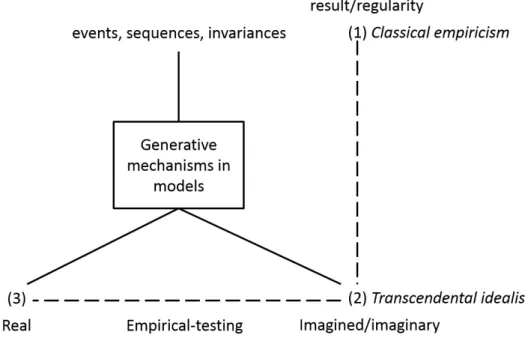
Figure 6: The Logic of Scientific Discovery (Bhaskar, 1998, p. 50) ... 55
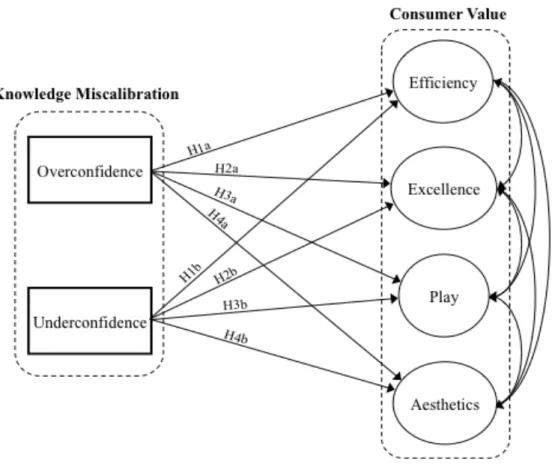
Figure 7: Conceptual Model of the Effect of Knowledge Miscalibration on Consumer Value .. 60
Figure 8: Example of Objective and Subjective Knowledge Measurement Format ... 72
Figure 9: Example of Enhanced Calibration Feedback for an Overconfident Participant ... 74
Figure 10: Example of Enhanced Calibration Feedback for an Underconfident Participant ... 74
Figure 11: Study 2 Experiment Setting ... 80
Figure 12: The Process of Experimental Investigation ... 81
Figure 13: Sample of the Presentation Given to the Participants ... 82
Figure 14: Example of the Presentation Created by a Participant ... 83
Figure 15: Study 1, Pilot Study SEM Model for CFA (Adapted from Mathwick et al., 2001) .. 90
Figure 16: Study 1, SEM Model for CFA ... 95
Figure 17: Study 1, SEM Model for Path Analysis ... 98
Figure 18: Study 2, SEM Model for CFA ... 105
Figure 19: Study 2, SEM Model for Path Analysis ... 108
LIST OF TABLES
Table 1: Aspects of Self-assessment and the Consequent Type of Miscalibration ... 8
Table 2: Existing Studies on Miscalibration ... 8
Table 3: Foundational Premises of the Service-Dominant Logic (Adapted from Vargo and Lusch, 2008) ... 16
Table 4: The Consequences of Knowledge Miscalibration ... 35
Table 5: The Structure of the Research Empirical Investigations ... 67
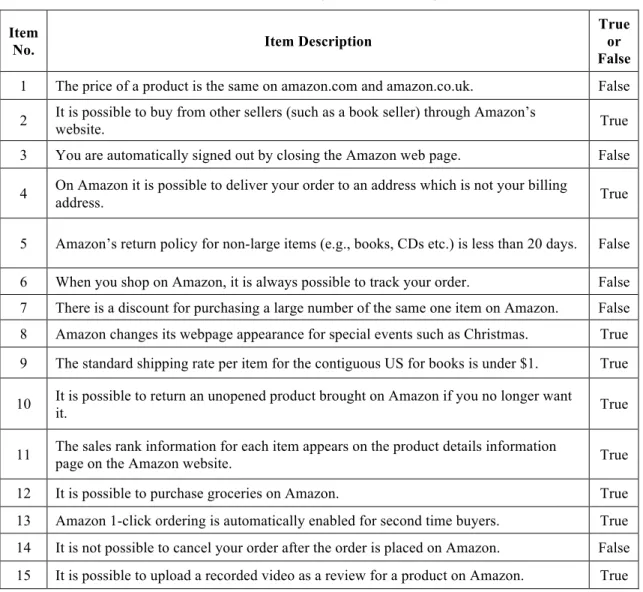
Table 6: Amazon.com Objective Knowledge Items ... 71
Table 7: Prezi.com Objective Knowledge Items ... 73
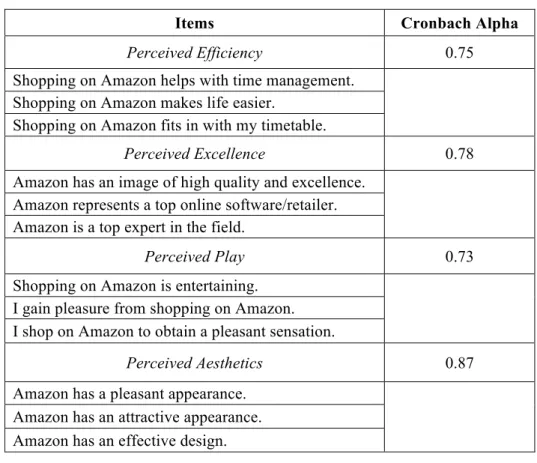
Table 8: Consumer Value Scales ... 76
Table 9: Study 1, The Consumer Value Scale Used in the Study ... 77
Table 10: Study 2, The Consumer Value Scale Used in the Study ... 77
Table 11: Study 1, Pilot Study CFA Regression and Standard Regression Weights ... 91
Table 12: Study 1, Pilot Study CFA Covariances and Correlations ... 92
Table 13: Study 1, Pilot Study Validity Criteria ... 92
Table 14: Study 1, Respondents’ Descriptive Statistics ... 93
Table 15: Study 1, Gender Descriptive Statistics ... 94
Table 16: Study 1, Respondents’ Highest Level of Education Descriptive Statistics ... 94
Table 17: Study 1, Consumer Value Items Descriptive Statistics ... 96
Table 18: Study 1, CFA Regression and Standard Regression Weights ... 96
Table 19: Study 1, CFA Covariances and Correlations ... 97
Table 20: Study 1, Validity Criteria for Overconfident Group ... 97
Table 21: Study 1, Validity Criteria for Underconfident Group ... 97
Table 22: Study 1, Consumer Knowledge Descriptive Statistics ... 98
Table 23: Study 1, Overconfident Group Regression and Standard Regression Weights ... 99
Table 24: Study 1, Underconfident Group Regression and Standard Regression Weights ... 99
Table 25: Summary of Path Analysis ... 100
Table 26: Study 2, Pilot Study Manipulation Check Descriptive Statistics for Overconfident Group ... 101
Table 27: Study 2, Pilot Study Independent Samples Test Results for Overconfident Group .. 102
Table 28: Study 2, Pilot Study Manipulation Check Descriptive Statistics for Underconfident Group ... 102
Table 29: Study 2, Pilot Study Independent Samples Test Results for Underconfident Group 102 Table 30: Study 2, Gender Descriptive Statistics ... 103
Table 31: Study 2, Respondents’ Highest Level of Education Descriptive Statistics ... 103
Table 32: Study 2, Respondents’ Descriptive Statistics ... 104
Table 33: Study 2, Consumer Value Items Descriptive Statistics ... 106
Table 34: Study 2, CFA Covariances and Correlations ... 106
Table 35: Study 2, CFA Regression and Standard Regression Weights ... 107
Table 36: Study 2, Validity Criteria for Overconfident Group ... 107
Table 37: Study 2, Validity Criteria for Underconfident Group ... 107
Table 38: Study 2, Consumer Knowledge Descriptive Statistics ... 108
Table 39: Study 2, Overconfident Group Regression and Standard Regression Weights ... 109
Table 41: Summary of Path Analysis ... 110
Table 42: Summary of MANCOVA Results ... 111
Table 43: Summary of Hypothesis Tests in Study 1 and Study 2 ... 111
Table 44: Summary of Hypothesis Investigation ... 112
1
INTRODUCTION
1.1
CONSUMER VALUE
Academics have explained value as an important factor in business operations. Woodruff (1997) suggests that consumer value (or customer value in a broad sense) is the primary source of competitive advantage, while Porter (1985) defines businesses as value creating entities. Practitioners also verify the crucial role of value in business operations. For example, in the latest American Marketing Association’s definition of marketing in 2013, marketing aims to create, communicate and deliver offerings that have value for stakeholders (American Marketing Association, 2013).
Although there is agreement on the importance of value, the way it is defined varies across academic disciplines and paradigms. In particular, the focus on exchange (i.e., the focus on the exchange of resources vs. the focus on the exchange of the application of resources) identifies the way value is defined. Traditionally, value was viewed as attached to the resources exchanged (e.g., Porter, 1985; Christopher, 2005); in this view, value is added to the resources through internal chains of processes (Porter, 1985) or chains of businesses (Christopher, 2005), for example, in the case of a Smartphone, the value is added to the actual Smartphone product through supply, manufacturing, marketing and delivery activities.
However, the service-dominant logic of marketing embeds value in the application of resources rather than in resources per se (Vargo and Lusch, 2008). In fact, in the service-dominant logic service as the application of resources for the benefit of another party is the unit of exchange and value is always determined by the beneficiary (Vargo and Lusch, 2008). Therefore, consumers integrate their own resources (e.g., knowledge and skills) and exchanged resources (e.g., products) to create value (Vargo and Lusch, 2004). In the case of using software for instance, consumers apply their software knowledge and use the features of the software to solve their problems, creating value when they actually use the software. Although this view highlights the role of consumer resources in the value creation process, there are only a few studies that offer empirical evidence for it (e.g., Barrutia and Gilsanz, 2012; van Beuningen, de Ruyter and
Wetzels, 2011). This PhD follows the service-dominant logic view of exchange to shed light on the effect of consumer resources on consumer value.
In the service-dominant logic value refers to value-in-use, signifying that value is perceived by the consumer in a specific use situation (Woodruff and Flint, 2006) through “an interactive, relativistic preference experience” (Holbrook, 1996, p. 138). Use is the mental, physical or virtual use or possession of resources (Grönroos and Voima, 2013). Consumer value is an outcome of consumers’ evaluations and performances in the use of a product or a service (Woodruff, 1997); it reflects rational (e.g., price and quality; Zeithaml, 1988) and non-rational (e.g., emotion; Holbrook and Batra, 1987) aspects in use. In fact, consumer value is a multidimensional phenomenon, dealing with different aspects of use such as efficiency, excellence, play and aesthetics (Holbrook, 1999), which are investigated in this PhD. In addition, consumer value is a strong predictor of consumers’ post-use intentions (Chen and Dubinsky, 2003; Lam, Shankar, Erramilli and Murthy, 2004; Liu and Jang, 2009; Overby and Lee, 2006). Therefore, it is crucial for businesses to understand factors determining consumer value, in particular those residing with the consumer (i.e., consumer resources).
1.2
CONSUMER KNOWLEDGE
Arnould, Price and Malshe(2006) classify consumer resources into economic, physical, social and cultural resources. Economic resources are material objects, such as goods and money, or physical spaces, such as a garden or a house. Physical resources are those related to the mental and physical capabilities of a consumer, such as sensorimotor (i.e., pertaining to responses caused by sensory stimuli) endowment, energy and emotion. Social resources are social relationship networks around the consumer, which can be demographic groups, such as families, ethnic groups and emerging groups, for example brand communities or consumer tribes. Finally, cultural resources are specialised knowledge and skills required to achieve specific goals.
Among the different types of consumer resources discussed in the framework established by Arnould et al. (2006), consumer knowledge (i.e., a cultural resource) is strongly established in consumer behaviour literature. Consumer knowledge has been selected for this research as it is an important construct in shaping consumer behaviour,
including consumer decision-making (Bettman and Park, 1980; Beattie, 1982; Moorman, Diehl, Brinberg and Kidwell, 2004), information search (Brucks, 1985), evaluation and judgement (Cordell, 1997; Hong and Strenthal, 2010; Rao and Monroe, 1988; Sujan, 1985), information processing (Alba and Hutchinson, 1987; Cowley and Mitchell, 2003; Srull, 1983) and product involvement (Park and Moon, 2003). Therefore, instead of looking at all types of consumer resources, this research will focus on the specific resource of consumer knowledge.
Consumers’ knowledge of products and services has always been an important factor in buyer-seller relationships. For instance, the ancient marketplaces of Athens were sectioned in such a way that consumers could easily find the products they required; these market sections, named after the product sold there, matched consumers’ knowledge of the location of the products or services that they intended to buy (Trentmann, 2012). Indeed, the ancient marketplaces in Athens had a product categorisation similar to the consumers’ categorisation of the products in their long-term memory.
Consumer knowledge has played a crucial role in company-consumer relationships since the industrial revolution, with the emergence of a wide variety of complex products. One of the main challenges for manufacturers has been to increase consumers’ knowledge of their products and services so as to ensure more people consume their products or services (Weaver, 1935). Furthermore, consumers with a better knowledge of products and services have benefited from the rational use of those products and services (Kyrk, 1930). For instance, when the telephone was invented and commercialised in the late 19th century, on the one hand companies needed to educate consumers on how to use the telephone in order to sell their products, and on the other hand consumers needed to learn how to use the telephone to exploit its potential benefits.
Empirical studies have shown that consumer knowledge influences different aspects of consumer behaviour. For instance, Staelin (1978) illustrates that increasing consumer knowledge about safety principles reduces the number of consumption related injuries. Alternatively, Brucks (1985) reveals that consumer knowledge positively influences information search and information acquisition for consumers. A general conclusion
from Hutchinson and Eisenstein (2008) is that consumer knowledge increases the potential benefits consumers receive from using a product or service. Barrutia and Gilsanz (2012) have also found a positive relationship between consumer knowledge and consumer value.
Consumer knowledge can be divided into objective and subjective knowledge (Alba and Hutchinson, 2000; Brucks, 1985); objective knowledge is the product or service information retrievable from the long-term memory that can be validated for accuracy, whereas subjective knowledge is consumers’ self-assessment of the validity of the product or service information they retain in memory (Brucks, 1985; Carlson, Vincent, Hardesty and Bearden, 2009; Park, Mothersbaugh and Feick, 1994). For example, a consumer’s knowledge about the return policy of an online shopping website is her objective knowledge, whereas her perception of the validity of this knowledge is her subjective knowledge. The consumer may recall that the return policy is 14 days, reflecting her objective knowledge. This can be true or false, demonstrating the consumer’s level of objective knowledge. The consumer also has a perception about the validity of her objective knowledge. For instance, she might think that her knowledge about the 14 day return policy is 80% correct, reflecting the level of subjective knowledge. An individual’s subjective knowledge is frequently inaccurate, which means that in many situations the individual does not know how much she knows (Alba and Hutchinson, 2000; Lichtenstein and Fischhoff, 1977). This phenomenon is referred to as knowledge miscalibration.
1.3
KNOWLEDGE MISCALIBRATION
Knowledge calibration is the agreement between subjective and objective knowledge about a product or service that a consumer can apply to a consumption task (Alba and Hutchinson, 2000), and knowledge miscalibration represents its reverse. The agreement between subjective and objective knowledge reflects the accuracy of subjective knowledge, and therefore knowledge miscalibration refers to the inaccuracy in subjective knowledge. Knowledge miscalibration can take one of two forms: overconfidence or underconfidence. A consumer is overconfident when her subjective knowledge is inflated (Alba and Hutchinson, 2000) and underconfident when her
subjective knowledge is deflated. In fact, some consumers have product or service knowledge (i.e., objective knowledge) that they are not aware of (i.e., deflated subjective knowledge or underconfidence), while others have less knowledge about a product or service (i.e., objective knowledge) than they think they have (i.e., inflated subjective knowledge or overconfidence).
Individuals may incur costs (i.e., economic and non-economic) as a consequence of overconfidence and underconfidence. They might lose the opportunity to take advantage of applying knowledge (i.e., which they are not aware of) in a task or they might pursue the wrong path (Dunning, Heath and Suls, 2004); for instance, an underconfident individual may not apply for a good college or university based on an inaccurate assessment of her knowledge (Dunning et al., 2004), or an overconfident individual might purchase a high-end digital camera that she thinks is matched with her own knowledge of camera use where in fact it is not (Burson, 2007).
To date, investigations of overconfidence and underconfidence have focused on purchase decisions. These studies have shown that lower levels of knowledge miscalibration result in better purchase decisions (Alba and Hutchinson, 2000; Burson, 2007; Kidwell, Hardesty and Childers, 2008). However, knowledge miscalibration can continue to impact the use of products and services, in addition to consumers’ purchasing decisions. In fact, consumers appraise the possible means needed to achieve a certain goal (Bagozzi and Dholakia, 1999). Bagozzi (1992) defines the self-assessment of consumers’ resources (e.g., subjective knowledge) as one of the primary means-appraisal processes. Indeed, in their daily product or service consumptions people take action based on their impression of their own skill, knowledge and ability to actually use products and services. Therefore, the inaccuracy in subjective knowledge (i.e., knowledge miscalibration) can play a crucial role in the use stage of consumption. However, it is less clear how overconfidence and underconfidence affect the use stage of consumption, and the related perceived value of products or services. For instance, in the case of the overconfident consumer with the high-definition camera, the question is: how does her knowledge miscalibration impact the value she attributes to the use of the camera? Alternatively, imagine another consumer who believes she knows little about the Amazon website, while she actually knows how to use Amazon very well; the
question here is how this consumer’s underconfidence influences the value she attributes to the use of the Amazon shopping website. To answer these questions, the goal of this PhD research is to understand the role of knowledge miscalibration in the value consumers derive from the use stage of consumption.
1.4
AIM AND RESEARCH QUESTION
The goal of positivist deductive research is to provide conceptual and empirical support for a hypothesised theory (Blaikie, 2007). However, a positivist paradigm does not explain how these hypothesised theories are developed. They can be developed through induction reasoning which is based on, at a minimum, a single observable event (Mantere and Ketokivi, 2013); for example, the researcher observes that a knowledgeable consumer perceives value positively and hypothesises the effect of consumer knowledge on consumer value. Hypothesis development could also be the outcome of deductive reasoning based on existing theories (Mantere and Ketokivi, 2013). For instance, the researcher hypothesises the effect of consumer knowledge on consumer value in online contexts, based on established theories that consumer knowledge affects consumer value in offline contexts and based on the fact that consumers behave similarly in offline and online contexts. However, these paradigms limit the theory development to existing theories and observable events. Critical realism helps this PhD to look beyond observed events and existing theories. In a critical realism paradigm, a causal mechanism, which is not observable with the event, is imagined first and its validity is investigated in the later stages of the research (Bhaskar, 1998). Applying a retroductive research strategy based on critical realism (Bhaskar, 1998), this research hypothesises and validates that knowledge miscalibration affects consumer value.
Knowledge miscalibration has not yet been conceptually or empirically observed as a causal mechanism of consumer value. Therefore, the value of this PhD is to imagine knowledge miscalibration as a causal mechanism of consumer value (i.e., beyond the existing understanding and observation of causal mechanisms) and to validate this proposition conceptually and empirically. Therefore, the question this research poses is:
• What is the effect of knowledge miscalibration on consumer value?
In fact, critical realism informs the entire research process from defining the research question to investigating its validity. According to Bhaskar (1998) and as debated later in this thesis, the second part of this PhD which seeks to validate the effect of knowledge miscalibration on consumer value conceptually and empirically is in line with a deductive objectivism paradigm.
1.5
POSITIONING THE FIELD OF ENQUIRY
Self-assessment of performance (i.e., self-efficacy; Bandura, 1977) and self-assessment of knowledge (i.e., subjective knowledge; Park et al., 1994) have been investigated in both psychology and consumer behaviour. The effect of self-efficacy and subjective knowledge on people’s performance has also been studied in educational psychology (e.g., Bandura, 1977; Eccles and Wigfield, 1995; Gist, Schwoerer and Rosen, 1989) as well as human-machine interaction literature (e.g., Kuo, Chu, Hsu and Hsieh, 2004; Oulasvirta, Wahlström and Ericsson, 2011). These studies have been followed in the marketing and consumer behaviour literature by investigations into the effect of self-efficacy on consumers’ evaluations of the economic worth of a product or service (e.g., McKee, Simmers and Licata, 2006; van Beuningen et al., 2011; van Beuningen, de Ruyter, Wetzels and Streukens, 2009).
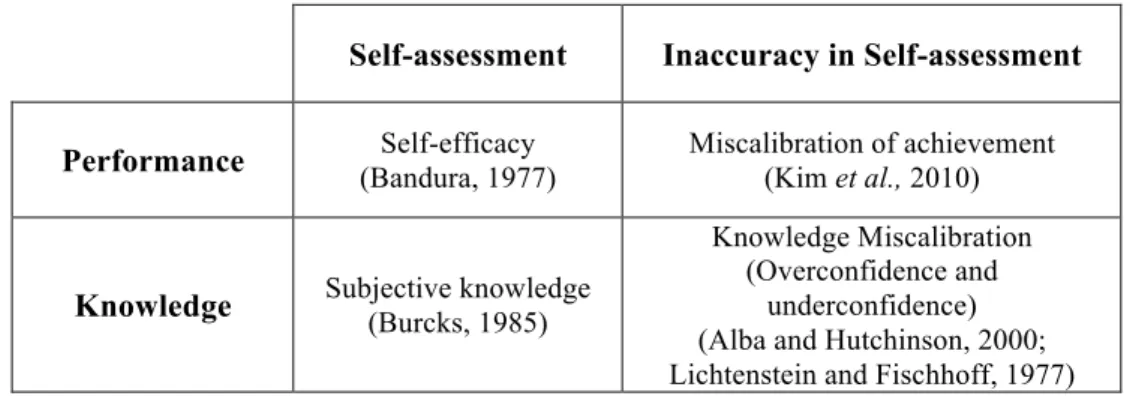
However, these works are not concerned with inaccuracy in self-assessment (i.e., miscalibration). In educational psychology, Kim, Chiu and Zou (2010) and Winne and Jamieson-Noel (2002) identify that it is the inaccuracy in self-efficacy that determines performance rather than self-efficacy per se. Consumer behaviour literature has also started exploring the consequences of knowledge miscalibration in the use of products and services (Pillai and Hofacker, 2007). Nonetheless, the relationship between knowledge miscalibration and consumer value dimensions resulting from use has neither been clearly conceptualised nor empirically investigated. Table 1 shows the two aspects of self-assessment (i.e., self-assessment of performance and self-assessment of knowledge) and the relevant studies focusing on inaccuracy in self-perceptions.
Table 1: Aspects of Self-assessment and the Consequent Type of Miscalibration
Self-assessment Inaccuracy in Self-assessment Performance (Bandura, 1977) Self-efficacy Miscalibration of achievement (Kim et al., 2010)
Knowledge Subjective knowledge (Burcks, 1985)
Knowledge Miscalibration (Overconfidence and
underconfidence) (Alba and Hutchinson, 2000; Lichtenstein and Fischhoff, 1977)
Table 2: Existing Studies on Miscalibration
Concept Performance Decision Consumer Value
Miscalibration of Performance Kim et al., 2010; Winne and Jamieson-Noel, 2002 Burson, 2007; Pearson and Liu-Thompkin, 2012 Research Opportunity Knowledge Miscalibration Research Opportunity Alba and Hutchinson, 2000; Kidwell et al., 2008 Research Opportunity
Table 2 shows a categorisation of the research conducted on miscalibration from different points of view. Studies on miscalibration of performance have focused on inaccuracy in the self-efficacy rather than subjective knowledge (i.e., the interest of this research), for example in consumer behaviour Burson (2007) introduces skill matching as a process in which a consumer chooses a skill-based product (i.e., those products that can be ranked by skill levels such as sport-related goods and technological products), aligning it with her skill rank (i.e., based on performance). The findings show that consumers relatively underestimate their skills when they face more challenging tasks and choose skill-based products based on their own assessment of their product skill level, which may not be accurate. Pearson and Liu-Thompkins (2012) also show that consumers underestimate their performance in using direct-to-consumer genetic tests. They indicate that miscalibration of performance (i.e., the inaccuracy in self-efficacy) negatively determines consumers’ attitude and purchase intention. In response to these
negative consequences, the authors suggest immediate educational interventions and show that these interventions reduce the miscalibration of performance.
Similar to the miscalibration of performance, there are few studies in the area of knowledge miscalibration in consumer behaviour literature. For example, Alba and Hutchinson (2000) conceptualise knowledge miscalibration and theorise their fundamental components. Moreover, Kidwell et al. (2008) indicate that in addition to knowledge miscalibration, emotional miscalibration influences consumer decision-making quality. Emotional miscalibration refers to the extent of disagreement between objective emotional ability (i.e., emotional intelligence) and subjective emotional ability; objective emotional ability is the ability to interpret emotional information in a consumption experience and subjective emotional ability is the subjective assessment of the consumer's objective emotional ability. Based on these definitions, Kidwell et al.
(2008) reveal that emotionally miscalibrated consumers make low quality decisions in healthy food selections.
However, these studies follow the goods-dominant logic of marketing as they try to explain the reasons for exchange decisions rather than actual value creation in use. Pillai and Hofacker (2007) suggest that knowledge miscalibration has consequences in use such as a lack of experience of flow and an experience of frustration. However, the effect of knowledge miscalibration on consumer value has not been investigated. In other words, although the effect of knowledge miscalibration on people’s decision-making (i.e., purchasing decision in the consumption context) has been investigated in psychology and marketing literature, its role in decision behaviour (i.e., post-purchase behaviour in the consumption context) needs further investigation. Therefore, this research advances knowledge by conceptualising and investigating the relationship between knowledge miscalibration and consumer value.
1.6
METHOD
Following a critical realism paradigm (Bhaskar, 1998), this research begins with the imagination of knowledge miscalibration as a causal mechanism of consumer value. This PhD also aims to provide conceptual and empirical support for the effect of knowledge miscalibration on consumer value. First, in Chapter 4, the relationships
between different types of knowledge miscalibration (i.e., overconfidence and underconfidence) on the one hand and dimensions of consumer value on the other are conceptualised.
Second, these relationships are empirically investigated. The empirical investigation includes a covariance based study (i.e., Study 1) and an experimental study (i.e., Study 2). Study 1 follows the consumer behaviour paradigm of investigating knowledge miscalibration through a subjective probability paradigm (i.e., a method to measure knowledge miscalibration level; Alba and Hutchinson, 2000), which is a covariance-based method. This study is performed to investigate the existence of the relationship and to provide a basis for comparison with Study 2, which is an experimental method. Study 2 manipulates knowledge miscalibration (i.e., both overconfidence and underconfidence) through enhanced calibration feedback (i.e., feedback about objective knowledge, subjective knowledge and knowledge miscalibration; Sieck and Arkes, 2005). A pilot study is performed during each study in order to validate the data collection instruments.
The empirical studies are performed in the online contexts of amazon.com (i.e., Study 1) and prezi.com (i.e., Study 2). Online consumer behaviour has been investigated in marketing literature through concepts such as technology acceptance models (e.g., Koufaris, 2002; Morgan-Thomas and Veloutsou, 2013), online customer experience (e.g., Novak, Hoffman and Yung, 2000; Rose, Clark, Samouel and Hair, 2012) and online consumer value (e.g., Methwick, Malhotra and Rigdon, 2001; Overby and Lee, 2006), which are all relevant to the concept of consumer value. Furthermore, both consumer knowledge and consumer value are important elements of consumer behaviour in online settings (Barrutia and Gilsanz, 2012). Therefore, focusing on online contexts fit the purpose of this research and provides a platform to contribute to online consumer behaviour literature.
1.7
CONTRIBUTIONS
This PhD has a number of potential contributions. Firstly, it extends the knowledge miscalibration literature (e.g., Alba and Hutchinson, 2000; Hansen and Thomsen, 2013; Kidwell et al., 2008) by looking at the consequences it has beyond purchase
decision-making and in use situations. Secondly, while the extant studies have tended to look at knowledge miscalibration holistically without distinguishing between overconfidence and underconfidence (Gershoff and Johar, 2006; Hansen and Thomsen, 2013; Kidwell
et al., 2008; Pillai and Kumar, 2012), this PhD argues that underconfidence and overconfidence should be treated separately as they trigger different consumption behaviours (Moore and Healy, 2008; Pillai and Hofacker, 2007). Thirdly, unlike previous consumer behaviour studies that have only measured knowledge miscalibration (e.g., Gershoff and Johar, 2006; Kidwell et al., 2008; Pillai and Hofacker, 2007; Pillai and Kumar, 2012), in this research it is both manipulated (through an experimental study) and measured (in an initial covariance-based study). Fourthly, the PhD adds to the area of knowledge looking at antecedents of consumer value (e.g., Lähteenmäki and Nätti, 2013; Lemke, Clark and Wilson, 2011; Macdonald, Wilson, Martinez and Toosi, 2011; van Beuningen et al., 2011; Barrutia and Gilsanz, 2012) by introducing knowledge miscalibration as a further determinant of consumer value. Fifthly, as the research investigates different dimensions of consumer value, in particular efficiency, excellence, play and aesthetics, it contributes to studies looking into these dimensions (e.g., Maenpaa, Kale, Kuusela and Mesiranta, 2008; Munnukka and Jarvi, 2012; Mathwick and Rigdon, 2004; Sonderegger, Sauer and Eichenberger, 2014). Finally, this PhD contributes to online consumer behaviour literature, particularly through the advancement of technology acceptance models (e.g., Ha, Yoon and Choi, 2007; Morgan-Thomas and Veloutsou, 2013), as well as online consumer value and customer experience literature (e.g., Kim, Suh and Lee, 2013; van Noort, Voorveld and van Reijmersdal, 2012; Yang, Lu, Gupta and Cao, 2012).
This research has a number of potential practical implications. First, it demonstrates an opportunity for value creation by influencing consumers’ self-assessment of knowledge, for example companies may be able to improve consumer value by altering knowledge miscalibration levels. Second, it provides an advanced element for evaluating consumers in terms of marketing practices such as segmentation, promotion and product development, for instance different market segments with varied levels of knowledge miscalibration may need different product features and promotional materials. Finally, it reveals a hidden factor in value creation which could have wrongly been used to improve some aspects of the business-consumer relationship, for example businesses
may influence their consumers’ knowledge miscalibration level through their communication strategies without being aware of their negative consequences in use.
1.8
REPORT STRUCTURE
In order to provide readers with a clear understanding of the logic behind this PhD dissertation, its structure is briefly described as follows:
Chapter 1. Introduction - the current chapter identifies the research question and the importance of the topic addressed by this PhD. In this chapter the field of enquiry is positioned, the research method is briefly explained, and potential contributions in theory and practice are identified.
Chapter 2. Literature Review - this chapter defines and describes the service-dominant logic of marketing, the concepts of consumer knowledge, knowledge miscalibration and consumer value, and their sub-dimensions. In particular, the consequences of knowledge miscalibration are discussed in this chapter to provide a basis for further conceptualisation.
Chapter 3. Research Philosophy - this chapter explains the philosophical implications of the research and the research strategy implemented. The philosophical paradigm of the research is explained in this chapter, followed by the research strategy.
Chapter 4. Conceptual Model - this chapter describes and documents the hypothesised relationships between knowledge miscalibration and the consumer value dimensions, leading to the conceptual model being advanced. In particular, the effects of overconfidence and underconfidence on efficiency, excellence, play and aesthetics are conceptualised.
Chapter 5. Methodology - this chapter explains the empirical research method used to further investigate the validity of the conceptual model. The rational for empirical investigation and detailed considerations of the method is explained in this chapter. In particular, two empirical studies, including a covariance-based and an experimental investigation, are described.
Chapter 6. Findings - this chapter presents the data collection and analysis conducted to investigate the conceptual model developed in Chapter 4. The findings of the two studies (i.e., firstly a covariance-based study, and secondly an experimental study) are also presented in this chapter.
Chapter 7. Discussion and Conclusion - the final chapter discusses the findings of the current PhD and describes the contribution of the research towards the existing literature, its implications for practice, the research limitations, and recommendations for future research.
2
LITERATURE REVIEW
2.1
INTRODUCTION
This chapter outlines the study areas that inform this research and defines the relevant concepts. As the research is informed by the service-dominant logic of marketing, the literature on the service-dominant logic is reviewed and its relation to this research is stated before the relevant concepts are explained. Next, the concepts of knowledge miscalibration and consumer value, their sub-dimensions and the related constructs are defined and described. Figure 1 illustrates the main fields of study for this research. It looks at the relationships between knowledge miscalibration and consumer value dimensions. Knowledge miscalibration is part of the consumer knowledge literature. Furthermore, as knowledge miscalibration is an inaccuracy in subjective knowledge, the concepts of subjective knowledge and self-efficacy are also relevant to this research. Therefore, in the following sections, the service-dominant logic and the concepts of consumer knowledge, subjective knowledge, self-efficacy, knowledge miscalibration, and consumer value are defined and explained.
2.2
SERVICE-DOMINANT LOGIC
Bastiat (1860) criticised political economists who linked value to tangible objects, suggesting that efforts are transmitted in an exchange rather than goods and value is embedded in the use of material objects. However, he was ignored by fellow economists who claimed that his idea was not an economic theory (Schumpeter, 1954). The marketing discipline also followed the traditional economic theory of exchange, focusing on goods.
The pre-1980s was the ‘crawling out’ period for service marketing emerging as a marketing sub-discipline (Fisk, Brawn and Bitner, 1993). However, marketing researchers approached service and service related phenomena using the goods-dominant logic view of marketing where services were perceived as anything not being goods (Vargo, Lusch and Morgan, 2006). Thereafter, a divergence was observed from the goods-dominant logic towards the view mentioned by Bastiat (1860) in order to describe services, service delivery and service consumption. For example, Prahalad and Ramaswamy (2004) argued that value is co-produced by parties (i.e., buyer and seller) rather than produced separately. This divergence initiated the idea of the emergence of a new dominant logic by Vargo and Lusch (2004) called the service-dominant logic. In the service-dominant logic, parties integrate their resources and other resources available in the environment or offered by other social units for exchange in order to create value for their benefit; operant, intangible resources are the basis of exchange rather than operand, tangible resources. In this logic it is argued that applied, specialised skills and knowledge are the focus of any economic exchange. Therefore, individuals apply their own skills and knowledge to provide a service and exchange this service with others for another service that they need. In this process, goods may be transmitted as a mechanism in order to provide services for parties (Vargo and Lusch, 2006). Indeed, in the service-dominant logic, a service is not defined as an alternative product form. Rather, it is labelled as “the application of specialised competences (Operant resources-knowledge and skills), through deeds, processes, and performances for the benefit of another entity or the entity itself” (Vargo and Lusch, 2006, 43).
Vargo and Lusch (2004) presented eight foundational premises for the service-dominant logic. In response to critiques and suggestions from other researchers, they refined these (Vargo and Lusch, 2008) into ten foundational premises (FP) which are the heart of the service-dominant logic. Table 3 is a summary of these foundational premises.
Table 3: Foundational Premises of the Service-Dominant Logic (Adapted from Vargo and Lusch, 2008)
Premise
Number Foundational Premise of the Service-Dominant Logic
FP1 Service is the fundamental basis of exchange.
FP2 Indirect exchange masks the fundamental basis of exchange. FP3 Goods are a distribution mechanism for service provision.
FP4 Operant resources are the fundamental source of competitive advantage. FP5 All economies are service economies.
FP6 The customer is always a co-creator of value.
FP7 The enterprise cannot deliver value, but can only offer value propositions. FP8 A service-centred view is inherently customer oriented and relational. FP9 All social and economic actors are resource integrators.
FP10 Value is always uniquely and phenomenologically determined by the beneficiary.
Traditionally, value was perceived as being embedded in product and companies created value through embedding it in their outputs (e.g., Beckman, 1957; Porter, 1980). However, as is evident in FP6, FP7 and FP10 of the service-dominant logic, value can only be proposed by a company and is co-created by the consumer. Therefore, value is determined by the consumer on the basis of value-in-use (Vargo and Lusch, 2008), where use is a mental, physical or virtual use or possession of resources (Grönroos and Voima, 2013). The service-dominant logic explores the need for improvements not only in the firm's value propositions but also in the way consumers integrate their resources. For instance, there is a need for firms to help consumers to allocate their resources (e.g., budget and effort) in the best way (Wilkie and Moore, 2006).
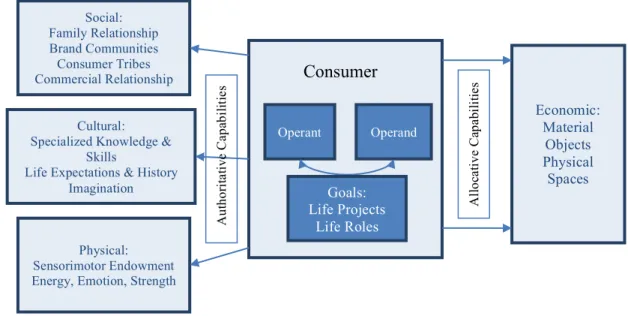
Arnould et al. (2006) introduce a cultural resource-based theory of the consumer. They explain that consumers apply their operand and operant resources for their life projects based on the different roles they play in life to achieve their life goals. In this description, while operand resources are tangible economic resources, such as income and goods, operant resources are the consumer’s competencies, which are virtual resources. Arnould et al. (2006) also describe operand resources as resources over which the consumer has allocative capabilities to perform life projects; these resources can be material objects such as goods and money or physical spaces that the consumer has control over, such as a garden or a house. On the other hand, the configuration of consumers’ operant resources shapes the use of their operand resources as well as a company’s operand and operant resources. These operant resources are categorised into social, cultural and physical resources. In this classification, physical resources are those related to the mental and physical capabilities of a consumer, such as sensorimotor (i.e., pertaining to motor responses caused by sensory stimuli) endowment, energy and emotion. Furthermore, social resources are social relationship networks around the consumer which can be demographic groups such as families, ethnic groups and emerging groups, for example brand communities or consumer tribes. Finally, cultural resources are specialised cultural capital, skills and goals. Therefore, any specialised knowledge and skills are cultural resources (Figure 2).
Figure 2: Consumer Operand and Operant Resources (Arnold et al., 2006) Economic: Material Objects Physical Spaces Social: Family Relationship Brand Communities Consumer Tribes Commercial Relationship Cultural: Specialized Knowledge &
Skills
Life Expectations & History Imagination
Physical: Sensorimotor Endowment Energy, Emotion, Strength
Al lo ca ti ve C ap ab il it ie s Au th or it at iv e C ap ab il it ie s Consumer Operant Operand Goals: Life Projects Life Roles
The service-dominant logic focuses on operant resources and describes them as fundamental sources of competitive advantage (Vargo and Lusch, 2004). Similarly, Arnould et al. (2006) claim that the type, quantity and quality of consumer operant resources affect the role of the consumer, company and the value sought by the consumer from an experience. Indeed, marketers propose a package of operant resources including images, symbols and myths to consumers in order to inspire their imagination of consumption. However, consumers derive more or less value from the value proposition based on their ability to integrate resources as well as the imagined value perceived from the value proposition. As explained in Chapter 1, this research aims to shed light on the relationship between consumer resources and value creation by investigating the effect of consumer knowledge miscalibration on consumer value. These concepts are reviewed in the following sections.
2.3
CONSUMER KNOWLEDGE
Consumer knowledge has been an important consideration in buyer-seller relationships. The importance of consumer knowledge was highlighted in the early 19th century (e.g., Kelley, 1899; Kelley, 1908), when scholars encouraged organisations to focus on consumer knowledge (e.g., Kitson, 1923; Schlink and Brady, 1928) and consumer education (e.g., Kyrk, 1930; Koos, 1934; Palmer and Schlink, 1934; Weaver, 1935) to improve the product and service consumption experience. Consumer knowledge was operationalised (e.g., Due, 1955; Oxenfeldt, 1950) and its role in product and service consumption started being investigated (e.g., Alba and Hutchinson, 1987; Bettman and Park, 1980; Goldman, 1977; Primeaux, 1970;).
Consumer knowledge has traditionally been viewed as a unidimensional phenomenon representing product familiarity (e.g., Park and Lessig, 1981) or prior knowledge (e.g., Bettman and Park, 1980). These studies are concerned with the amount of information about or experience consumers gain from a product (Alba and Hutchinson, 1987). However, different ways of operationalising consumer knowledge such as the number of product purchases (e.g., Bettman and Park, 1980), objective tests (e.g., Brucks, 1985) and subjective measures (e.g., Johnson and Russo, 1984) have suggested that consumer knowledge is a multidimensional construct. Alba and Hutchinson (1987) propose
familiarity and expertise as two components of consumer knowledge, where familiarity is the frequency of product-related experience and expertise is the ability to perform consumption tasks successfully. However, familiarity appears to be an antecedent of what consumer knowledge actually is. For example, Alba and Hutchinson (1987) theorise that repeated task experiences increases the amount of cognitive resources available for the task, leading to improved task performance. Indeed, the categorisation of consumer knowledge into familiarity and expertise explains the process of consumer knowledge formation and its behavioural consequences.
Focusing on consumer knowledge itself, researchers have divided it into objective and subjective knowledge (Alba and Hutchinson, 2000; Brucks, 1985). Objective knowledge is the product or service information retrievable from long-term memory that can be validated for accuracy; subjective knowledge is consumers’ self-assessment of the validity of the product or service information they retain in memory (Brucks, 1985; Carlson et al., 2009; Park et al., 1994). In other words, objective knowledge reflects actual knowledge about a product, and subjective knowledge represents the consumer’s perception of her knowledge about the product (Alba and Hutchinson, 2000; Brucks, 1985). These two dimensions of knowledge are explained in the following sections to create a better understanding of consumer knowledge.
2.3.1 Objective Knowledge
Objective knowledge has a positive impact on the way consumers perform consumption tasks. Brucks (1985) shows that objective knowledge improves information search activities by reducing the number of inappropriate searches for irrelevant information. Sujan (1985) have also found that consumers with strong objective knowledge have efficient product evaluation strategies as they rapidly process product information they understand and engage in analytical processes about new product information. However, Cowley and Mitchell (2003) indicate that knowledgeable consumers may not always be efficient in learning. For example, they show that, when provided with use situation (i.e., the reason and context in which a product or service is going to be used), low-knowledge consumers focus on information which is relevant to that use situation, while high-knowledge consumers learn about other use situations as well (i.e., those
which are irrelevant to that use situation). Although Cowley and Mitchell (2003) show that objective knowledge does not create information processing efficiency at the encoding (i.e., learning) stage, finding that objective knowledge provides consumers with a wider range of information with an appropriate structure during the retrieval stage (i.e., when the information is used).
Objective knowledge can also define how consumers evaluate a product or service. Hong and Sternthal (2010) investigate the interaction between objective knowledge, information processing mode (i.e., progressive vs. assessment) and the level of construal (i.e., high vs. low). They show that consumers with a high level of objective knowledge evaluate a product more favourably when they process information progressively (i.e., they evaluate features one by one and eliminate the worst performer at each stage until the best product is selected) than through assessment (i.e., evaluate all features together and select the best product). They have also shown that consumers with a high level of objective knowledge evaluate a product more favourably when they receive high construal information (i.e., abstract information about the features of a product) compared to low construal information (i.e., concrete information about the performance of a product). Lee and Lee (2011) also illustrate that consumers with a low level of objective knowledge evaluate advertisements favourably when they include information about competitors, whereas consumers with a high level of objective knowledge show no difference in their evaluations in such circumstances. Overall, objective knowledge leads to evaluations that are well articulated, consistent and stable over time (de Bont and Schoormans, 1995; Roy and Cornwell, 2004).
Objective knowledge is measured by an impartial third party or through an objective test (Cordell, 1997). These methods however may not be able to reflect the actual level of objective knowledge. Indeed, while objective tests and third party evaluations remove subjective biases, they are also associated with other biases (Brucks, 1985). For example, objective tests may only gauge a portion of consumers’ objective knowledge. Despite this, objective tests are the most reliable ways to measure objective knowledge (Alba and Hutchinson, 2000).
Overall, studies on objective knowledge imply that the amount of consumption-related information stored in consumers’ long-term memory predicts their capability and
motivation for searching, processing and evaluating relevant information. However, sometimes consumers with a low level of objective knowledge behave similarly to those with a high level of objective knowledge. Rao and Monroe (1988) illustrate that objective knowledge has a U-shaped effect on using price as an indicator of quality; in fact, consumers with little knowledge about a product use its price to evaluate the quality more than those with moderate knowledge. Interestingly, highly knowledgeable consumers also use price as a quality indicator. Bruwer and Buller (2012) have found similar effects when consumers use country-of-origin as a quality cue, which could be due to the fact that consumers with a high level of objective knowledge have an extensive experience with the product and have shaped a strong quality-price association in their memory (Herr, 1989). However, this effect may reflect the impact of subjective knowledge (i.e., a strong belief in knowledge about quality-price association) rather than objective knowledge, and this is shown by Rao and Monroe (1988) to be due to the association between objective and subjective knowledge. In the next section, subjective knowledge as the next dimension of consumer knowledge is defined and its role in consumer behaviour is explained.
2.3.2 Subjective Knowledge
Subjective knowledge is also an important consideration in consumer behaviour. Park and Lessig (1981) show that subjective knowledge is associated with interest in a product and leads to purchase decision-making because of the reduced evaluation time. Andaleeb and Basu (1994) also demonstrate that consumers with a low level of subjective knowledge associate perceived fairness with perceived quality more strongly for technically complex products and services than for simple products and services. This is due to the fact that consumers with low subjective knowledge consider fairness as an important factor in covering their lack of knowledge in a transaction. Alternatively, Moorman et al. (2004) illustrate that subjective knowledge increases search activities in high quality categories, leading to better quality decisions (e.g., better choices of nutrition). In addition, it has been shown that subjective knowledge improves the overall perception of value (Barrutia and Gilsanz, 2012) and the perception of a salesperson’s motivation to help (DeCarlo, Laczniak and Leigh, 2013).
Subjective knowledge is gauged through a self-assessment test reflecting a consumer’s self-assessment of knowledge (Cordell, 1997). The existing scales of subjective knowledge include a single item scale involving overall knowledge (e.g., Cordell, 1997), a multiple item scale about overall knowledge (Koufaris, 2002), and a multiple item scale about different components of knowledge (e.g., Flynn and Goldsmith, 1999). The latter method is combined with scales measuring objective knowledge that are referred to as subjective probability measures, showing a high level of accuracy (Alba and Hutchinson, 2000). The subjective probability paradigm will be explained in the methodology chapter as a research method for measuring subjective and objective knowledge in this research.
2.3.2.1 Antecedents of Subjective Knowledge
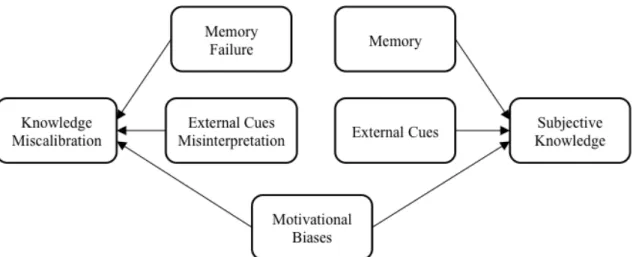
Subjective knowledge is determined by three main factors: memory, external cues and motivational biases. Firstly, subjective knowledge depends on how well a consumer is able to remember the evidence for assessing the accuracy of objective knowledge. For instance, when we judge our knowledge about the calories in milk, we recall the last time we looked at the nutritional label of the milk as evidence for the accuracy of our knowledge. If we accurately remember the moment, we think our knowledge about the amount of calories in milk is true. Park et al. (1994) indicate that consumers with consumption-related information (e.g., information about consumption processes or information search processes) have better access to their memory and therefore a higher subjective knowledge than those with product-related information (e.g., product features). In other words, consumers with higher consumption-related information can easily remember the evidence for validity of their objective knowledge. For example, considering the objective knowledge to be the colour of the writing of a pen, a consumer who uses the pen has more evidence about the colour (e.g., she can remember the colour of the written text) than someone who only memorises the colour.
Other researchers have identified a number of factors influencing subjective knowledge that can be explained by their impact on memory. For instance, Brucks (1985) identifies the number of product or service use occasions as an antecedent of subjective knowledge, showing that consumers who use a product or service on a number of occasions have a high level of subjective knowledge. The reason for this finding is that
the frequency of product or service use intensifies the memory of the learning processes through which product or service related information is stored in the long-term memory. Therefore, the frequency of use increases the chance of remembering the evidence for the accuracy of knowledge. For example, a consumer who uses a pen every day is very confident about her knowledge of the colour of the writing of the pen as she has a lot of information to validate her knowledge of the colour.
In another example, personal relevance (i.e., the importance of the context of information to the person) is identified as having an effect on subjective knowledge (Radecki and Jaccard, 1995). Consumers with more interest in price comparisons have a higher subjective knowledge regarding a product’s price (Mägi and Julander, 2005). Similarly, Park and Moon (2003) indicate that subjective knowledge is correlated with consumer involvement (i.e., a consumer’s perceived relevance of a product). In these studies, as the context is important, the person puts in a great deal of information acquisition effort, and it is therefore more likely that she will easily remember the validity of her knowledge. For example, a consumer who likes one of her pens is more likely to have more information regarding the colour of the pen.
Secondly, subjective knowledge is shaped based on external cues. In order to evaluate the validity of their knowledge people use external cues (e.g., other people's level of knowledge), particularly when they do not have enough evidence in their memory. Radecki and Jaccard (1995) document the impact of ‘frame of reference’, which refers to one’s perception of others’ knowledge on subjective knowledge. They show that if a consumer thinks many people know a lot about a product, her subjective knowledge will be reduced. Furthermore, Carlson, Bearden and Hardesty (2007) indicate that consumers use their evaluation of their best friend’s knowledge to shape their subjective knowledge. In another example, Serra and Dunlosky (2005) reveal that people use difficulty in recalling information as a cue to shape their subjective knowledge; they illustrate that those who spend more time recalling a fact have lower subjective knowledge.
In particular, when these external cues carry no information about objective knowledge, they lead to inaccurate subjective knowledge. Consistent with Serra and Dunlosky (2005), Frankenberger and Albaum (1997) show that consumers use the level of task
difficulty to evaluate their own knowledge. They also show that as task difficulty contains no information about objective knowledge, it leads to inaccurate subjective knowledge. The effect of task difficulty on subjective knowledge can be explained through the concept of fluency; fluency is the ease with which information is brought to mind or new information is processed (Schwarz, 2004). Furthermore, Burrati and Allwood (2012) find that fluency affects subjective knowledge in such a way that consumers who easily retrieve information from their memory have high subjective knowledge. It can be concluded that in difficult tasks consumers experience less fluency in retrieving information, leading to low subjective knowledge.
Thirdly, subjective knowledge is directed by motivational biases. In fact, people are motivated to give themselves a higher or lower assessment to achieve their personal needs. For instance, someone might diminish her self-assessment to reduce the expectations of others, or might increase it to enhance her personality. As motivational biases are one of the sources of knowledge miscalibration, they are explained in the next section along with other determinants of knowledge miscalibration.
Radecki and Jaccard (1995) indicate that objective knowledge is a predictor of subjective knowledge. A possible explanation is that the correlation between objective and subjective knowledge observed in several studies (please see Carlson et al., (2009) for a review of literature) results from the fact that often the actual information and the evidence for the validity of information are identical. For instance, a consumer’s objective knowledge of the colour of the writing of a pen can be based on the text written by the pen, which can also be used as evidence to shape subjective knowledge. As explained above, subjective knowledge is built on evidence that may not be the source of objective knowledge. Therefore, although both objective and subjective knowledge reflect the level of consumer knowledge, they can have different effects on the same consumption outcome. For instance, subjective knowledge has a stronger effect than objective knowledge on perceived decision outcomes such as confusion in decision-making and perceived quality of decision-making (Raju, Lonial, and Mangold, 1995). The amount of information searching is directly correlated with subjective knowledge, whereas it has an inverted U-shaped relationship with objective knowledge (Raju et al., 1995). Indeed, consumers with moderate objective knowledge are more
engaged with products and search for more information than those with low objective knowledge. However, consumers with high objective knowledge are more selective about the information they need and search for less information than those with moderate objective knowledge. This is not the case for subjective knowledge, which is not based on actual knowledge; those with high subjective knowledge are motivated to further search for information, and are not necessarily selective about the information they need as they