Pathogenicity and selective constraint in
the non-coding genome
Patrick J. Short St. Edmund’s College Submitted: September, 2018 Supervisor: Dr. Matthew Hurles
This dissertation is submitted in accordance with the requirements of the University of Cambridge for the degree of Doctor of Philosophy.
Acknowledgements
I would like to thank all of the members of the Hurles team and the DDD project for four wonderful years of research and for being such great scientists and friends. To Jeremy, Sebastian, and Jeff especially, thank you for all of your mentorship.
To my supervisor Matt, I am incredibly thankful to have a supervisor that is both a rigorous, visionary scientist, and such a down-to-earth person. Thank you so much for all of your support.
To the Wellcome Trust and the Mathematical Genomics and Medicine PhD programme, thank you for providing the structure and financial support to make all of this work possible. To my parents, Jack and Denice, my brother John, and my fiancée Timarie, thank you so much for supporting me, even as I moved ‘across the pond’ to pursue this dream. I consider myself so lucky to have a family like you.
Preface
This dissertation is the result of my own work and includes nothing which is the outcome of work done in collaboration except as declared in the Preface and specified in the text.
It is not substantially the same as any that I have submitted, or, is being concurrently submitted for a degree or diploma or other qualification at the University of Cambridge or any other University or similar institution except as declared in the Preface and specified in the text. I further state that no substantial part of my dissertation has already been
submitted, or, is being concurrently submitted for any such degree, diploma or other qualification at the University of Cambridge or any other University or similar institution except as declared in the Preface and specified in the text
Table of Contents
CHAPTER 1:INTRODUCTION ... 1
SECTION 1.1:THE FUNCTION OF NON-CODING DNA IN THE HUMAN GENOME ... 1
SECTION 1.1.1.FUNCTIONAL ROLES OF NON-CODING ELEMENTS IN THE HUMAN GENOME ... 1
SECTION 1.1.2.CHARACTERISING NON-CODING ELEMENTS IN THE HUMAN GENOME ... 3
SECTION 1.2:THE ROLE OF NON-CODING VARIATION IN MENDELIAN DISEASE ... 9
SECTION 1.2.1.THE CONTRIBUTION OF PROTEIN-CODING VARIATION TO MENDELIAN DISEASE ... 9
SECTION 1.2.2.REGULATORY VARIATION IN MENDELIAN PHENOTYPES ... 11
SECTION 1.2.3THE ROLE OF REGULATORY VARIATION IN CANCER AND NEURODEVELOPMENTAL DISORDERS 13 CHAPTER 2: DE NOVO MUTATIONS IN REGULATORY ELEMENTS CONTRIBUTE TO SEVERE NEURODEVELOPMENTAL DISORDERS... 21
INTRODUCTION ... 21
METHODS ... 25
SEQUENCING IN THE DDDCOHORT ... 25
ALIGNMENT,VARIANT CALLING, AND QUALITY CONTROL ... 25
RESULTS SECTION 2.1:ASSESSING THE ROLE OF DE NOVO MUTATIONS IN REGULATORY ELEMENTS IN SEVERE DD ... 33
RESULTS SECTION 2.1.1.MODELLING THE GERMLINE MUTATION RATE IN THE NON-CODING GENOME 33 RESULTS SECTION 2.1.2.FETAL BRAIN ACTIVE ULTRA-CONSERVED NON-CODING ELEMENTS ARE ENRICHED FOR MUTATIONS IN EXOME-NEGATIVE PROBANDS WITH NEURODEVELOPMENTAL PHENOTYPES ... 37
RESULTS SECTION 2.1.3.RECURRENTLY MUTATED REGULATORY ELEMENTS ... 46
RESULTS SECTION 2.2:EXTRAPOLATING RESULTS FROM TARGETED REGULATORY ELEMENTS TO GENOME-WIDE ESTIMATES ... 49
RESULTS SECTION 2.2.1.ESTIMATE OF PROPORTION OF PROBANDS CARRYING A PATHOGENIC MUTATION IN A REGULATORY ELEMENT GENOME-WIDE. ... 49
RESULTS SECTION 2.2.2.POWER CALCULATIONS AND ESTIMATION OF FRACTION OF BASES CONTRIBUTING TO SEVERE DD WHEN MUTATED ... 50
DISCUSSION ... 53
CHAPTER 3:MUTATION RATE AND SELECTIVE CONSTRAINT IN THE NON-CODING GENOME ... 59
INTRODUCTION ... 59
HETEROGENEITY IN THE HUMAN GERMLINE MUTATION RATE ... 59
MEASURING SELECTIVE CONSTRAINT IN THE HUMAN GENOME ... 61
METHODS ... 63
RESULTS SECTION 3.1:MODELLING THE HUMAN GERMLINE MUTATION RATE ... 69
RESULTS SECTION 3.1.1.IMPROVED MODELLING OF THE HUMAN GERMLINE MUTATION RATE... 69
RESULTS SECTION 3.1.2.GENOMIC FEATURES ASSOCIATED WITH HYPERMUTABILITY ... 74
RESULTS SECTION 3.2:MEASURING SELECTIVE CONSTRAINT IN REGULATORY ELEMENTS GENOME-WIDE .... 79
RESULTS SECTION 3.2.1.PATTERNS OF PURIFYING SELECTION IN NON-CODING ELEMENTS GENOME-WIDE . 79 RESULTS SECTION 3.2.2.NUCLEOTIDE-LEVEL CONSERVATION SCORES ARE MORE INFORMATIVE OF SELECTIVE CONSTRAINT THAN LOCUS-LEVEL SCORES ... 87
RESULTS SECTION 3.2.3.DOMINANCE AND SELECTION IN THE NON-CODING GENOME ... 93
CHAPTER 4:FUNCTIONAL CHARACTERISATION OF MUTATIONS IN ULTRA-CONSERVED ELEMENTS ASSOCIATED
WITH SEVERE DEVELOPMENTAL DISORDERS ... 103
INTRODUCTION ... 103
METHODS FOR ASSESSING ENHANCER ACTIVITY USING REPORTER CONSTRUCTS ... 103
MASSIVELY PARALLEL REPORTER ASSAYS METHODS AND APPLICATIONS ... 104
METHODS ... 107
RESULTS SECTION 4.1:ASSESSING DISEASE-ASSOCIATED ENHANCER ACTIVITY USING MASSIVELY PARALLEL REPORTER ASSAYS... 114
RESULTS SECTION 4.1.2.IMPACT OF SNVS AND INDELS ON ULTRA-CONSERVED ELEMENT FUNCTION ... 125
RESULTS SECTION 4.1.3.ASSESSING THE IMPACT OF PATIENT MUTATIONS USING MPRAS ... 127
RESULTS SECTION 4.2:ASSESSING DISEASE-ASSOCIATED ENHANCER ACTIVITY USING MOUSE TRANSGENESIS ASSAYS ... 129
RESULTS SECTION 4.2.1.MOUSE TRANSGENESIS ASSAYS TO IDENTIFY PUTATIVE DEVELOPMENTAL ENHANCERS ... 129
DISCUSSION ... 132
CHAPTER 5:DISCUSSION... 137
Abbreviations
3C – Chromosome Conformation Capture ASD – autism spectrum disorder
ASE – allele specific expression BWA – Burrows-Wheeler Aligner
CADD – combined annotation dependent depletion CDTS – context dependent tolerance score
CNEs – conserved non-coding elements CNN – convolutional neural network CNVs – copy number variations CRISPRa – CRISPR activation CRISPRi – CRISPR inactivation
DDD – Deciphering Developmental Disorders DD – Developmental Disorders
DHS – DNase I hypersensitive site DNA – deoxy ribonucleic acid DNM – de novo mutation DSB – double strand break
ENCODE – Encyclopedia of DNA Elements eQTL – expression quantitative trait loci ESCs – embryonic stem cells
ExAC – exome aggregation consortium FDR – false discovery rate
GAM - Genome Architecture Mapping GATK – Genome Analysis Toolkit GFP – green fluorescent protein
gnomAD – genome aggregation database HARs – human accelerated regions HGEs – human gained enhancers Indels – insertions/deletions
iPSCs – induced pluripotent stem cells LCLs – Lymphoblastoid Cell Lines lncRNAs – long non-coding RNAs
MAPS – mutability adjusted proportion of singletons MAVEs – multiplexed assays of variant effect
MPRAs – massively parallel reporter assays NHEJ – non-homologous end-joining NHS – National Health Services
PAH – pulmonary arterial hypertension
pLI – probability of loss-of-function intolerance REP – Roadmap Epigenome Project
RFR – random forest regression RNA – ribonucleic acid
SHH – Sonic Hedgehog
SNV – single nucleotide variant SVM – support vector machine TBP - TATA-box binding protein TCGA – The Cancer Genome Atlas TFBS – transcription factor binding site TFs – Transcription Factors
TSS – Transcription Start Site
UMIs – unique molecular identifiers UTR – untranslated region
VEP – Variant Effect Predictor VFS – variant frequency spectrum VUS – variant of unknown significance WGS – whole genome sequencing
Chapter 1: Introduction
Section 1.1: The function of non-coding DNA in the human genome Section 1.1.1. Functional roles of non-coding elements in the human genome
The vast majority of DNA sequence in the human genome does not code for protein1. Non-coding DNA can serve many functional roles including transcriptional
activation, repression, and three-dimensional genome organisation. Based on comparative evolutionary analyses, between 3% to 15% of the non-coding genome is predicted to be under purifying selection2-4, while protein-coding sequence comprises less than 2% of the genome1. Thus, the amount of functional non-coding sequence likely outnumbers functional coding sequence, yet the function of most non-coding sequence is poorly understood.
The regulation of gene expression in time and space is an essential part of organismal development. The ‘core promoter’ includes a transcription start site (TSS), a binding site for RNA polymerase II, and binding sites for more general transcription factors5. The proximal promoter is less rigidly defined and includes regulatory sequence to the 5’ end of the transcribed strand which may harbour tissue-specific transcription factors (TFs). For many genes, particularly those with complex tissue-specific regulation, enhancers play an important role in regulating transcription6,7. Enhancers contain numerous transcription factor binding sites (TFBS), which can be identified by distinctive sequence patterns called motifs. These sequence patterns are often very flexible, maintaining binding efficiency despite changes to the underlying sequence. Furthermore, enhancers and TFBS show a high degree of evolutionary turnover8,9. Villar et. al identified putative regulatory regions in the liver of twenty different mammals and showed that nearly half of all enhancers show rapid lineage specific evolution9. While some principles of the enhancer ‘grammar’ have emerged, including cooperation and antagonism between different TFs10, the nucleotide-level logic in most enhancers are poorly understood. Enhancers can be proximal (tens of kilobases from the TSS) as well as distal (in some cases, more than one million bases from the TSS).
While distal enhancers may be hundreds of kilobases from the genes they regulate in genomic space, they often colocalise in physical space. Topologically associated domains (TADs) are large genomic segments (median size 880kb) that interact more frequently than
expected under a model of random interactions11. The prevailing model by which looping is thought to occur is by loop extrusion by the cohesin complex, until the complex encounters a ‘boundary element’ containing the transcription factor CTCF12. TAD boundaries have been shown to be highly conserved across different cell types and tissues11. Interactions between regulatory elements and genes are far more likely occur within a TAD than between TADs, although there are examples of interactions between enhancers and promoters in different TADs13. While physical looping has been proposed as the primary mechanism for long-range enhancer-promoter interactions (Figure 1A), there is evidence that looping may not occur in all cases14. In particular, other mechanisms have been proposed including induced phase-separation, chromatin decompaction, and subsequent diffusion of transcription factors (Figure 1B)14,15. Via looping or diffusion, general transcription factors and tissue specific transcription factors complex with RNA polymerase II to promote transcription16. While general principles of gene regulation are beginning to emerge, there is still no broad consensus around a unified model of gene regulation in all cases.
Figure 1 Schematic of transcriptional activation via enhancer looping and diffusion facilitated by chromatin decompaction and phase separation (a) Looping brings enhancers into physical proximity of the gene promoter. (b) Phase transition and chromatin decompaction allows rapid 1D diffusion of transcription factors to the target promoter.
Many genes encoding transcription factors are only transcribed in a subset of cells, tissues, or developmental time-points. As a result, enhancers and promoters harbouring binding sites for these TFs can drive tissue-specific transcriptional patterns. For example, the GLI3 gene is expressed primarily in the developing brain and limb. Antagonistic interactions between GLI3 and Sonic Hedgehog (SHH) in the developing limb results in SHH expression in the Zone of Polarising activity, but nowhere else in the developing limb bud. Together, interactions between GLI3 and SHH impact the expression of more than 1,000 downstream
genes in the developing limb17. Detailed annotations of enhancer activity across mouse development suggest that the majority of enhancers are expressed during temporally-restricted windows, which were associated with different stages of organogenesis18.
Multiple enhancers can act in a particular tissue or time-point in a coordinated manner. For example, the Wap gene is upregulated more than 1,000 fold in the mouse mammary gland19 by the coordinated interaction of three different enhancers. A series of experiments deleting or perturbing individual enhancers and pairs of enhancers in the locus showed that all three were necessary to achieve the 1,000-fold upregulation. Clusters of coordinated enhancers, bound by the mediator complex, with non-additive contributions to gene expression have been termed super-enhancers20. However, the appropriateness and utility of this new category has been disputed, and it is not clear whether super-enhancers are simply collections of ‘normal’ enhancers with acting with varying degrees of strength or represent a novel functional category where constituent enhancers display synergistic properties21.
Enhancers can also exhibit functional redundancy22. Osterwalder et. al created ten mouse lines with homozygous deletions of individual enhancers shown to regulate genes critical for normal limb development. Single deletions showed no discernible limb
malformations. However, combinatorial deletion of multiple enhancers in a single locus did result in limb malformations. For example, deletion of mm1179 and hs1586, two enhancers shown to regulate GLI3 expression, results in a duplication of the first digit23.
Section 1.1.2. Characterising non-coding elements in the human genome
In light of the evidence for an important functional role for non-coding elements in the human genome, there have been a number of efforts to annotate non-coding function. These efforts have introduced novel methods to annotate non-coding function and
collaborative efforts have been formed to apply new and established methods to a diverse range of organisms, tissues, and time points.
The earliest large-scale annotations of putative functional non-coding DNA leveraged DNA sequence from different mammalian and vertebrate species to identify non-coding sequence with low levels of sequence divergence24. Early work on ultra-conserved
non-coding elements (defined as having >97% sequence identity between human, mouse, and rat) showed that a large fraction of these elements were likely acting as enhancers24-27. These enhancers were enriched near genes previously known to be involved in
development, suggesting that their evolutionary conservation was due to a highly conserved role in gene expression during development27. Beyond the most highly ultra-conserved elements, which comprised a very small fraction of the genome, multi-species alignments indicated that 3-15% of the genome was conserved2-4. As only 1-2% of genome encodes protein-coding, large-scale efforts are underway to annotate non-coding functional elements genome-wide.
The Encyclopedia of DNA Elements (ENCODE) project launched in 2007 to systematically map functional elements across the human genome using a variety of different biochemical methods28,29. Nucleosome occupancy and epigenetic modification of the histone proteins comprising the core of the nucleosome have a profound impact on the accessibility of a segment of DNA. DNase-seq identifies regions of DNA that are sensitive to cleavage by DNase I30. These regions are often denoted as ‘open’ as they are fully or
partially free of nucleosomes. More recently, ATAC-seq has emerged as the method of choice for identifying open chromatin due to its low requirement for input material compared to DNase-seq, and comparative speed and ease of use31.
In addition to nucleosome occupancy, epigenetic modifications to histone proteins can shed light on the underlying function of a piece of DNA. Promoter regions and
transcription start sites are often marked by trimethylation of K4 (H3K4me3)32 and the bodies of transcribed genes by trimethylation of histone H3 at lysine 36 (H3K36me3)33. Like promoters, active enhancers can be identified by distinctive chromatin signatures, including open chromatin, monomethylation of histone H3 at lysine 4 (H3K4me1) and acetylation of histone H3 at lysine 27 (H3K27ac)34. H3K27ac by p300/CBP has been shown to destabilise nucleosomes, promoting accessibility by transcriptional machinery and TFs. In contrast, repressed or inactive chromatin is marked by trimethylation at histone H3 lysine 27 (H3K27me3) or trimethylation at histone H3 lysine 9 (H3K9me3)35,36. These marks are assayed using a technique called chromatin immunoprecipitation followed by high
throughput sequencing (ChIP-seq)37-39. In the ChIP-seq method, DNA is first cross-linked to preserve any DNA-protein interactions. An antibody to the protein of interest in then used to extract the short DNA fragments bound to the protein. These short fragments are
sequenced and mapped back to the reference genome, providing indication of where the protein was bound37-39.
While there are many other potential histone modifications, six core marks (H3K27ac, H3K4me1, H3K4me3, H3K36me3, H3K27me3, H3K9me3) have been shown to sufficient to define a number of different ‘chromatin states’. Assaying these modifications has been the focus of large-scale efforts such as the ENCODE project29 and the Roadmap Epigenome Project40 to annotate non-coding function across different tissues and
developmental time-points. A number of methods have been developed to integrate data from open chromatin assays and histone modifications to define the chromatin state. One of the most widely used methods, chromHMM, integrates aligned reads from each input feature and uses a hidden markov model to partition the genome into predicted chromatin states41. The simplest model has 15-states, which include active states such as strong and weak transcription, active/weak/poised promoters, and active/weak/poised enhancers as well as inactive or repressed states such as heterochromatin, or polycomb repression.
Beyond histone modifications, ChIP-seq can be used to identify DNA-binding events for any protein for which an antibody is available. To date, the ENCODE project has assayed more than 167 human transcription factors in 127 different tissue/cell types. These data sets have been used to identify canonical and non-canonical transcription factor binding motifs42. Due to the difficulties associated with testing thousands of transcription factors across hundreds of different spatial and temporal contexts, machine learning techniques have been developed to detect TF-binding motifs in the absence of direct measurement by ChIP-seq43.
Regulatory elements can also be identified using variation in gene expression or chromatin features resulting from natural genetic variation in a population. Associations between genetic variation and gene expression, termed expression quantitative trait loci 44-46 (eQTLs), were first established using Lymphoblastoid Cell Lines (LCLs) and have expanded substantially to include a wide range of cell types and tissues47-49. Analysis of the underlying genetic architecture of eQTLs suggests that a large fraction of associations fall within open chromatin peaks and directly impact transcription factor binding50. The majority of SNPs implicated in genome-wide association studies of common and complex disease risk fall outside coding regions, and there is a substantial overlap between these risk-associated loci
and eQTLs in disease-relevant cell types, suggesting gene mis-regulation as a primary contribution to common and complex disease49.
As discussed in section 1.1, genomic elements that are far apart in sequence space may interact by forming loops in three-dimensional space. The spatial organisation of chromatin can be detected by a number of different methods. The most widely used
techniques are innovations around the chromosome conformation capture (3C) technique51. The original 3C technique, which used PCR to check for interaction between known
fragments, has been modified to produce genome-wide interaction maps (Hi-C52), and detailed interaction maps centred on promoters or other elements of interest (Capture-C 53-55). Hi-C has been used to define TADs in a number of different tissues and cell types11. However, Hi-C and Capture-C can also reveal more fine-grained regulatory interactions within TADs, including promoter-promoter and enhancer-promoter interactions. While Hi-C and Capture-C have proved valuable tools for linking enhancers to putative target genes, the sheer complexity of potential tissues, cell types, and time points to assay, combined with the incomplete sensitivity of the tools means that gene target prediction remains a challenge.
Other methods for interrogating three-dimensional organisation that are not based on ligation have recently emerged. Genome architecture mapping (GAM) assays three-dimensional organisation by freezing the cells of interest, cryosectioning the frozen cells, and isolating nuclei using laser capture microdissection. The DNA in each of these thin slices is sequenced and the frequency of interaction is quantified based on the proportion of cellular slices in which two genomic segments are sequenced together13. This method has the advantage of improved detection of interactions between three different segments – in ligation based methods where only two interacting segments can be identified at a time, two separate pair-wise interactions cannot be easily disambiguated from a single three-way interaction. Furthermore, GAM requires a small amount of cellular material and makes use of laser microdissection, which enables this method to be used on rare cell types or directly on patient tissue13.
The applications of open chromatin assays, ChIP-seq, and 3C techniques in the ENCODE and Roadmap Epigenome Projects have produced fundamental insights into human biology, but have focused primarily on natural variation present in human tissues, cell lines, induced pluripotent stem cells (iPSCs) and iPSC-derived tissues29,40. Improvements
in oligo synthesis and genome-editing technologies have given rise to new high-throughput methods for generating programmed variation in the underlying DNA sequence.
Reporter assays have been long been used to test putative promoters and enhancers for their ability to drive gene expression56. Reporter assays use a bacterial plasmid with a putative regulatory element upstream of a reporter gene, often GFP or luciferase. These plasmids can then be transfected into a cell type of interest and the output of the reporter gene quantified, either by measuring fluorescence intensity or by quantitative PCR. The original reporter assays, designed to test a small number of putative regulatory elements, have been adapted to allow testing of tens of thousands of elements at once. For example, massively parallel reporter assays (MPRAs) can quantify the regulatory activity of tens of thousands of enhancers in a single experiment57,58. MPRAs work by adding a DNA barcode to each putative regulatory element. The reporter gene is then inserted between the
enhancer element and the barcode, resulting in the barcode being transcribed on the 3’ end of the reporter gene. These barcodes can be quantified with RNA-sequencing and regulatory elements driving stronger reporter gene expression will have a greater number of barcodes relative to the amount of input DNA. Different MPRA variations have emerged including STARR-seq, which places the regulatory element downstream of the reporter gene, allowing a direct readout of the element rather than a linked barcode.
Saturation mutagenesis experiments using this technology have recovered known disease-associated variants, for example in the TERT promoter (unpublished work from Nadav Ahituv) and to test for causal variants in eQTL studies from a large number of SNPs in linkage disequilibrium59. Beyond testing variations in wild-type sequence, these assays can be used to understand the ‘grammar’ of non-coding elements at a more fundamental level, by building functional sequences from scratch, and systematically altering or destroying synthetic sequences10,57,60. These assays have a number of drawbacks – in particular, the enhancer or promoter is being tested outside of its native context, either in an episome or integrated into the genome by a lentivirus. Furthermore, not all tissues or cellular models are amenable to transfection. Greater detail on the rapid evolution of the experimental techniques and applications of MPRA to interrogate enhancer and promoter function is included in the Introduction to Chapter 4.
enzyme Cas9. Gasperini et. al use pairs of programmed guide-RNAs to delete thousands of kilo-base sized genomic regions61. Their first application of the method was applied to a housekeeping gene, HPRT1, which has little distal regulatory sequence, but in principal this method has the potential to test the impacts on cellular fitness or gene expression from deletion of coding or non-coding sequence.
Cas9 cutting can be paired with a repair template, allowing more precise edits such as single base pair changes via homology directed repair (HDR). However, the double-strand break (DSB) induced by the CRISPR enzyme most often resolves by non-homologous end-joining (NHEJ) usually resulting in small deletions at the cut site. Recent work by Findlay et. al has shown that performing the edits in a cell-line with LIG4, an important gene in the NHEJ pathway, knocked out results in lowered efficiency in NHEJ and a greater proportion of DSBs proceeding via HDR. Findlay et. al created more than 96.5% of all possible SNVs in two exons of the BRCA1 gene, paving the way for CRISPR-based alternatives to the massively parallel reporter assays discussed above62.
Cellular models may not reveal the full spatial and temporal complexity of enhancer activity on an organismal level. Mouse transgenesis assays use a GFP reporter construct driven by the putative enhancer of interest to test for tissue-specific enhancer activity. To date, more than 2,800 putative enhancers have been tested and results made available through the VISTA browser63, with more than 1,500 testing consistently positive in at least one tissue. Beyond transgenesis assays, mouse knockouts can reveal the function of
evolutionarily conserved enhancers in vivo. ARX is an essential neuronal transcription factor in the human and mouse brain with at least two enhancers (hs119 and hs121) that control expression in the ventral forebrain. These enhancers are ultraconserved, exhibiting >97% identity between human and mouse.24 Homozygous deletion of either hs119 or hs121 show subtle phenotypic changes including subtle changes in body weight and density of
cholinergic neurons. However, deletion of both ultraconserved enhancers shows a dramatic reduction in both body weight and cholinergic neurons64.
Taken together, these technologies provide a detailed overview of the functional non-coding sequence across the genome for hundreds of different cellular contexts and time-points. An overview of each of these techniques is described in Table 1 which includes the type of elements/interactions tested, the approximate throughput (number of genomic elements tested in a typical experiment). Projects such as ENCODE29, The Roadmap
Epigenome Project40, and FANTOM65 have focused on building an atlas of reference epigenomes and functional non-coding elements in primarily healthy tissues and cellular contexts. As the role of non-coding elements in common and Mendelian disease becomes increasingly apparent, these technologies can be applied to understand the mechanism of gene mis-regulation in these diseases.
Name of technique Element/interaction assayed Number of elements tested in a typical experiment
DNase-seq Open chromatin Genome-wide
ATAC-seq Open chromatin Genome-wide
ChIP-seq
Protein-occupancy (commonly histone marks, or transcription
factors) Genome-wide
Hi-C/Capture-C Three-dimensional interaction between DNA elements Genome-wide
Reporter Assays
Ability of putative regulatory
element to drive gene expression 100s of loci
Mouse Transgenesis Assays
Ability of putative regulatory element to drive gene
expression, with tissue specificity. 10s of loci Massively Parallel Reporter
Assays (MPRAs)
Activity of putative enhancer/promoter to drive gene
expression >10,000 loci CRISPR-inactivation Assessing the impact repressing a genomic element >10,000 loci
CRISPR-editing
Assessing the impact of deletion/alteration of a genomic
element. >10,000 loci
Table 1 Overview of established and emerging techniques in non-coding genome annotation.
Section 1.2: The role of non-coding variation in Mendelian disease
Section 1.2.1. The contribution of protein-coding variation to Mendelian disease
The overwhelming majority of established genetic causes of Mendelian disease are caused by protein-altering single-nucleotide variation, small insertions/deletions (indels), or larger copy number variations (CNVs). Clinical microarrays and gene panels have been used extensively to test for diagnostic protein-altering variation in Mendelian disease, particularly
whole exome sequencing, which allows for targeted sequencing of protein-coding regions, has proven to deliver a higher diagnostic yield66,67. Across a broad category of Mendelian disorders, diagnostic yield is approximately 25-30%, but the actual diagnostic yield differs substantially between different disease groups68. For example, RASopathies, a collection of disorders resulting from mutations in the RAS-MAP kinase pathway, have diagnostic rates of over 60% whereas developmental disorders, which suffer from the issue of phenotypic similarity across a wide range of potential causal genes, have a diagnostic yield of 25-30% 68-70.
Study design can also influence diagnostic yield. For example, sequencing of parent-offspring trios has been shown to greatly improve the diagnostic yield compared to
sequencing the proband-only71,72. In the past few years, hundreds of novel Mendelian disease genes have been identified using exome sequencing, improving the diagnostic yield even further73. In the case of severe developmental disorders, Wright et. al estimate that implementing parent–offspring whole-exome sequencing as a first-line diagnostic test would diagnose approximately 50% of patients74.
McRae et. al estimated that 42% of undiagnosed severe developmental disorder cases harboured damaging de novo mutations in protein-coding genes70. Of this estimated 42%, ~25% could be robustly linked to a known or novel developmental disorder gene while the remaining ~17% were found in genes not yet robustly linked to developmental
disorders. Beyond the contribution from de novo mutations in genes with a monoallelic disease mechanism, Martin et. al estimated the contribution of protein-altering variation in biallelic genes to be only 4% in British-European cases, and up to 20% in British-Pakistani75.
Figure 2 Diagnoses in the DDD project broken down by variant class. De novo mutations in protein-coding genes make up the largest fraction of diagnoses (25%), and analyses suggest that a substantial fraction of the missing diagnoses (~17%) will come from genes not yet robustly associated to DD. As of this writing, ~45% of the DDD cases likely lack a highly penetrant protein-coding variant contributing to their disorder.
Beyond developmental disorders, other severe Mendelian diseases have a high rate of unsolved cases, despite large-scale exome sequencing projects. In pulmonary arterial hypertension (PAH) heterozygous mutations in the coding sequence BMPR2 are found in an estimated 80% of familial cases and 20% of sporadic cases76. However, sporadic cases greatly outnumber familial cases; in a study of 1,048 individuals affected with PAH, 5.5% reported a family history77. Mutations in BMPR2 and other recently reported novel genes were found in just 23.5% of cases77. Thus, a substantial fraction of individuals remain without a cause in the protein-coding regions, even in large and well-powered studies of Mendelian Diseases (Figure 2). These results have motivated the search for causal variation outside of protein-coding genes.
Section 1.2.2. Regulatory variation in Mendelian phenotypes
The importance of the non-coding genome in complex disease is well established - the vast majority of disease-associated single nucleotide polymorphisms (SNPs) lie in intergenic or intronic regions78,79. Fine-mapping studies have shown that in most cases
associations with a non-coding SNP cannot simply be accounted for by linkage with a coding variant on the same haplotype. Analysis of forty coding SNPs associated with Type-II
Diabetes showed that a large fraction of associations (13/40) are actually ‘false leads’ that are likely driven by a nearby non-coding SNP80. In Mendelian disorders, the role of
enhancers or other non-coding elements is less clear. There have been a number of regulatory elements linked to Mendelian disorders through targeted re-sequencing and pedigree analyses. Lettice et. al identified a set of single nucleotide variants in evolutionarily conserved sites in a regulatory element located 1Mb from the target gene, Shh, responsible for polydactyl81. Inherited single nucleotide variants as well as whole-element deletions in SOX10 enhancers have also been shown to reduce SOX10 expression, contributing to isolated Hirschprung disease82. Weedon et. al describe a set of six different recessive variants in an enhancer located 25kb from PFT1A that disrupt transcription factor binding sites for FOXA2 and PDX1, abolishing enhancer activity and causing pancreatic agenesis83. A single nucleotide variant in an ultraconserved element regulating the expression of PAX6, a critical gene in eye development, has also been shown to cause Aniridia. Other examples of point mutations and small insertions/deletion in non-coding elements that have been causally linked to human disease are described in a review by Mathelier et. al84.
In addition to point-mutations and small insertions/deletions, larger-scale copy-number variations and rearrangements of regulatory sequence have been shown to cause Mendelian disorders. Loss of function can be caused by deletion of an enhancer, as in the SOX10 case described above resulting in isolated Hirschsprung disease82, as well as in Pierre-Robin syndrome85,86 , a condition marked by malformations of the cranial skeleton. Genomic rearrangements or disruptions of topologically associated domains (for example, by deletion of a CTCF binding site) can cause enhancers to regulate a gene they do not normally
regulate. This phenomenon is termed ‘enhancer adoption’ and has been implicated in brachydactyl type A287 (a shortening of the digits) as well as sex-reversal due to a gonad-specific gain of function of SOX988. A number of studies in which copy number variation and rearrangements of non-coding cis-regulatory elements contribute to Mendelian disorders by disrupting or altering gene regulation are reviewed by Malte Spielmann and Stefan Mundlos89.
Nearly all of these well-established examples of regulatory causes of Mendelian disease share the common characteristic of being non-syndromic. In each of the cases, a
single organ or organ system is affected, reflecting the tissue-specificity of the enhancer element whose function is being perturbed. It is unclear whether this is a common
characteristic of Mendelian disease caused by variants in regulatory regions, or a by-product of ascertainment based on recognisable phenotypes. Furthermore, unlike loss-of-function mutations in protein-coding genes that may only impact the amount of functional protein produced, mutations in regulatory elements have the potential to cause more complex mis-regulation. Thus, the impact of variation in regulatory elements may not be directly
comparable to changes in the protein-coding sequence.
Section 1.2.3 The role of regulatory variation in cancer and neurodevelopmental disorders
There have been reports of recurrent somatic mutations in regulatory regions in several cancer types using whole genome sequence data from The Cancer Genome Atlas (TCGA)90,91. These studies included nearly 500 whole genome sequences of tumours and matched normal tissue and primarily identified mutations in promoter sequences as well as 3’ UTRs and 5’ UTRs. The strongest signal, in the TERT promoter, comprises mutations that show substantial overexpression of a luciferase reporter as well as RNA levels of the TERT transcripts in the cancerous tissue90,91. Further work using a combination of whole genome sequencing and chromatin immunoprecipitation sequencing (ChIP-exo) highlighted
disruption of CTCF and cohesin binding sites in colorectal cancer which contribute to genomic stability and establishment/maintenance of TAD boundaries92.
Expanding these analyses to nearly 1,000 tumour whole genomes with matching transcriptomes, Zhang et. al recapitulated the variants resulting in overexpression in the TERT promoter and discover novel regulatory elements regulating the expression of
DAAM1, MTG2, and HYI93. Their approach leverages the matched transcriptomes to identify ‘somatic eQTLs’ linking regulatory elements to putative target genes. This is a promising new approach for disorders where RNA transcript levels can be measured in the relevant tissue, or where accurate cellular models can be derived, for example, by reprogramming induced pluripotent stem cells (iPSCs).
There is substantial evidence for protein-coding DNMs contributing to autism spectrum disorder (ASD), albeit at a lower contribution than in severe developmental
disorders94. Thus, there has been a similar motivation to assess the contribution of DNMs in the non-coding genome to ASD. For example, Turner et. al reported a nominally significant enrichment for de novo mutations in autism cases compared to unaffected siblings in 3’ UTRs, promoters, and conserved transcription factor binding sites95 using data from whole genome sequenced trios. However, independent analysis of the same cohort from Werling et. al find no significant enrichment and show that without appropriate correction for
multiple statistical tests, plausible associations can be observed in both cases and controls96. Thus, the contribution of variation in the non-coding genome to developmental disorders and other rare disorders is not clear. The Deciphering Developmental Disorders study has nearly an order of magnitude more cases than the ASD studies discussed above, and included approximately 4 megabases of regulatory sequence in the exome capture. This study design may afford greater power to test for DNM burden, albeit in a more limited set of non-coding annotations. This study will be covered in detail in Chapter 2. The dramatic increase in the number of whole genome sequenced individuals affords an opportunity to identify non-coding elements under purifying selection across the genome in a disease-agnostic manner. Analyses based on more than 25,000 deep whole genomes using
population genetics methods to identify selectively constrained non-coding elements will be covered in detail in Chapter 3. Finally, methods for assaying the function of non-coding elements and the impact of genetic variation in these elements can be used to delineate benign from damaging variation in these non-coding elements and to understand their function. Chapter 4 includes results from a series of MPRA experiments and mouse transgenesis assays including non-coding mutations identified in developmental disorder cases.
1 International Human Genome Sequencing, C. Finishing the euchromatic sequence of the human genome. Nature 431, 931-945, doi:10.1038/nature03001 (2004).
2 Lindblad-Toh, K. et al. A high-resolution map of human evolutionary constraint using 29 mammals. Nature 478, 476-482, doi:10.1038/nature10530 (2011).
3 Ponting, C. P. & Hardison, R. C. What fraction of the human genome is functional? Genome Res 21, 1769-1776, doi:10.1101/gr.116814.110 (2011).
4 Lunter, G., Ponting, C. P. & Hein, J. Genome-wide identification of human functional DNA using a neutral indel model. PLoS Comput Biol 2, e5,
doi:10.1371/journal.pcbi.0020005 (2006).
5 Smale, S. T. & Kadonaga, J. T. The RNA Polymerase II Core Promoter. Annual Review of Biochemistry 72, 449-479, doi:10.1146/annurev.biochem.72.121801.161520 (2003).
6 Shlyueva, D., Stampfel, G. & Stark, A. Transcriptional enhancers: from properties to genome-wide predictions. Nat Rev Genet 15, 272-286, doi:10.1038/nrg3682 (2014). 7 Banerji, R., Schaffner. Expression of a Beta-Globin Gene is Enhanced by REmote SV40
DNA Sequences. Cell (1981).
8 Meader, S., Ponting, C. P. & Lunter, G. Massive turnover of functional sequence in human and other mammalian genomes. Genome Res 20, 1335-1343,
doi:10.1101/gr.108795.110 (2010).
9 Villar, D. et al. Enhancer evolution across 20 mammalian species. Cell 160, 554-566, doi:10.1016/j.cell.2015.01.006 (2015).
10 Smith, R. P. et al. Massively parallel decoding of mammalian regulatory sequences supports a flexible organizational model. Nature Genetics 45, 1021-1028,
doi:10.1038/ng.2713 (2013).
11 Dixon, J. R. et al. Topological domains in mammalian genomes identified by analysis of chromatin interactions. Nature 485, 376-380, doi:10.1038/nature11082 (2012). 12 Ganji, M. et al. Real-time imaging of DNA loop extrusion by condensin. Science 360,
102-105, doi:10.1126/science.aar7831 (2018).
13 Beagrie, R. A. et al. Complex multi-enhancer contacts captured by genome architecture mapping. Nature 543, 519-524, doi:10.1038/nature21411 (2017). 14 Benabdallah, N. S. & Bickmore, W. A. Regulatory Domains and Their Mechanisms.
Cold Spring Harb Symp Quant Biol 80, 45-51, doi:10.1101/sqb.2015.80.027268 (2015).
15 Benabdallah, N. S. et al. PARP mediated chromatin unfolding is coupled to long-range enhancer activation. bioRxiv, doi:10.1101/155325 (2017).
16 Hardison, R. C. & Taylor, J. Genomic approaches towards finding cis-regulatory modules in animals. Nat Rev Genet 13, 469-483, doi:10.1038/nrg3242 (2012). 17 Tickle, C. & Towers, M. Sonic Hedgehog Signaling in Limb Development. Front Cell
Dev Biol 5, 14, doi:10.3389/fcell.2017.00014 (2017).
18 Nord, A. S. et al. Rapid and pervasive changes in genome-wide enhancer usage during mammalian development. Cell 155, 1521-1531,
doi:10.1016/j.cell.2013.11.033 (2013).
19 Shin, H. Y. et al. Hierarchy within the mammary STAT5-driven Wap super-enhancer. Nature Genetics, 1-10, doi:10.1038/ng.3606 (2016).
20 Hnisz, D. et al. Super-enhancers in the control of cell identity and disease. Cell 155, 934-947, doi:10.1016/j.cell.2013.09.053 (2013).
21 Hay, D. et al. Genetic dissection of the alpha-globin super-enhancer in vivo. Nature Genetics 48, 895-903, doi:10.1038/ng.3605 (2016).
22 Frankel, N. et al. Phenotypic robustness conferred by apparently redundant transcriptional enhancers. Nature 466, 490-493, doi:10.1038/nature09158 (2010). 23 Osterwalder, M. et al. Enhancer redundancy provides phenotypic robustness in
mammalian development. Nature 554, 239-243, doi:10.1038/nature25461 (2018). 24 Bejerano, G. et al. Ultraconserved elements in the human genome. Science 304,
1321-1325, doi:10.1126/science.1098119 (2004).
25 Kleinjan, D. A. & Van Heyningen, V. Long-Range Control of Gene Expression: Emerging Mechanisms and Disruption in Disease. Am. J. Hum. Genet 76, 8-32, doi:10.1086/426833 (2005).
26 Siepel, A. et al. Evolutionarily conserved elements in vertebrate, insect, worm, and yeast genomes. Genome Research 15, 1034-1050, doi:10.1101/gr.3715005 (2005).
27 Sandelin, A. et al. Arrays of ultraconserved non-coding regions span the loci of key developmental genes in vertebrate genomes. BMC Genomics 5, 99,
doi:10.1186/1471-2164-5-99 (2004).
28 Birney, E. et al. Identification and analysis of functional elements in 1% of the human genome by the ENCODE pilot project. Nature 447, 799-816,
doi:10.1038/nature05874 (2007).
29 Consortium, E. P. An integrated encyclopedia of DNA elements in the human genome. Nature 489, 57-74, doi:10.1038/nature11247 (2012).
30 Crawford, G. E. et al. Genome-wide mapping of DNase hypersensitive sites using massively parallel signature sequencing (MPSS). Genome Res 16, 123-131, doi:10.1101/gr.4074106 (2006).
31 Buenrostro, J. D., Giresi, P. G., Zaba, L. C., Chang, H. Y. & Greenleaf, W. J.
Transposition of native chromatin for fast and sensitive epigenomic profiling of open chromatin, DNA-binding proteins and nucleosome position. Nature Methods 10, 1213-1218, doi:10.1038/nmeth.2688 (2013).
32 Liu, C. L. et al. Single-nucleosome mapping of histone modifications in S-cerevisiae. Plos Biol 3, 1753-1769, doi:10.1371/journal.pbio.0030328 (2005).
33 Bannister, A. J. et al. Spatial distribution of di- and tri-methyl lysine 36 of histone H3 at active genes. J Biol Chem 280, 17732-17736, doi:10.1074/jbc.M500796200 (2005). 34 Creygthon, C., Welstead, Kooistra, Carey, Steine, Hanna, Lodato, Frampton, Sharp,
Boyer, Young, Jaenisch. Histone H3K27ac separates active from poised enhancers and predicts developmental state. PNAS (2010).
35 Young, M. D. et al. ChIP-seq analysis reveals distinct H3K27me3 profiles that correlate with transcriptional activity. Nucleic Acids Res 39, 7415-7427, doi:10.1093/nar/gkr416 (2011).
36 Schuettengruber, B., Chourrout, D., Vervoort, M., Leblanc, B. & Cavalli, G. Genome regulation by polycomb and trithorax proteins. Cell 128, 735-745,
doi:10.1016/j.cell.2007.02.009 (2007).
37 Barski, A. et al. High-resolution profiling of histone methylations in the human genome. Cell 129, 823-837, doi:10.1016/j.cell.2007.05.009 (2007).
38 Johnson, D. S., Mortazavi, A., Myers, R. M. & Wold, B. Genome-wide mapping of in vivo protein-DNA interactions. Science 316, 1497-1502,
doi:10.1126/science.1141319 (2007).
39 Landt, S. G. et al. ChIP-seq guidelines and practices of the ENCODE and modENCODE consortia. Genome Research 22, 1813-1831, doi:10.1101/gr.136184.111 (2012). 40 Consortium, R. E. et al. Integrative analysis of 111 reference human epigenomes.
Nature 518, 317-330, doi:10.1038/nature14248 (2015).
41 Ernst, J. & Kellis, M. Discovery and characterization of chromatin states for systematic annotation of the human genome. Nature Biotechnology 28, 817-825, doi:10.1038/nbt.1662 (2010).
42 Kheradpour, P. & Kellis, M. Systematic discovery and characterization of regulatory motifs in ENCODE TF binding experiments. Nucleic Acids Res 42, 2976-2987,
doi:10.1093/nar/gkt1249 (2014).
43 Zhou, J. & Troyanskaya, O. G. Predicting effects of noncoding variants with deep learning-based sequence model. Nature Methods 12, doi:10.1038/nmeth.3547 (2015).
44 Dixon, A. L. et al. A genome-wide association study of global gene expression. Nat Genet 39, 1202-1207, doi:10.1038/ng2109 (2007).
45 Stranger, B. E. et al. Population genomics of human gene expression. Nat Genet 39, 1217-1224, doi:10.1038/ng2142 (2007).
46 Morley, M. et al. Genetic analysis of genome-wide variation in human gene expression. Nature 430, 743-747, doi:10.1038/nature02797 (2004).
47 Consortium, G. T. et al. Genetic effects on gene expression across human tissues. Nature 550, 204-213, doi:10.1038/nature24277 (2017).
48 Consortium, G. T. The Genotype-Tissue Expression (GTEx) project. Nat Genet 45, 580-585, doi:10.1038/ng.2653 (2013).
49 Grundberg, E. et al. Mapping cis- and trans-regulatory effects across multiple tissues in twins. Nat Genet 44, 1084-1089, doi:10.1038/ng.2394 (2012).
50 Gaffney, D. J. et al. Dissecting the regulatory architecture of gene expression QTLs. Genome Biol 13, R7, doi:10.1186/gb-2012-13-1-r7 (2012).
51 Dekker, R., Dekker, Kleckner. Capturing Chromosome Conformation. Science (2002). 52 Lieberman-Aiden, E. et al. Comprehensive mapping of long-range interactions
reveals folding principles of the human genome. Science 326, 289-293, doi:10.1126/science.1181369 (2009).
53 Jager, R. et al. Capture Hi-C identifies the chromatin interactome of colorectal cancer risk loci. Nat Commun 6, 6178, doi:10.1038/ncomms7178 (2015).
54 Davies, J. O. et al. Multiplexed analysis of chromosome conformation at vastly improved sensitivity. Nat Methods 13, 74-80, doi:10.1038/nmeth.3664 (2016). 55 Hughes, J. R. et al. Analysis of hundreds of cis-regulatory landscapes at high
resolution in a single, high-throughput experiment. Nat Genet 46, 205-212, doi:10.1038/ng.2871 (2014).
56 Dewet, J. R., Wood, K. V., Deluca, M., Helinski, D. R. & Subramani, S. Firefly
Luciferase Gene - Structure and Expression in Mammalian-Cells. Mol Cell Biol 7, 725-737, doi:Doi 10.1128/Mcb.7.2.725 (1987).
57 Melnikov, A. et al. Systematic dissection and optimization of inducible enhancers in human cells using a massively parallel reporter assay. Nature Biotechnology 30, 271-277, doi:10.1038/nbt.2137 (2012).
58 Patwardhan, R. P. et al. High-resolution analysis of DNA regulatory elements by synthetic saturation mutagenesis. Nature Biotechnology 27, 1173-1175,
doi:10.1038/nbt.1589 (2009).
59 Tewhey, R. et al. Direct Identification of Hundreds of Expression- Modulating
Variants using a Multiplexed Reporter Resource Direct Identification of Hundreds of Expression-Modulating Variants using a Multiplexed Reporter Assay. Cell 165, 1519-1529, doi:10.1016/j.cell.2016.04.027 (2016).
60 Kheradpour, P. et al. Systematic dissection of regulatory motifs in 2000 predicted human enhancers using a massively parallel reporter assay. Genome Research, 800-811, doi:10.1101/gr.144899.112 (2013).
61 Gasperini, M. et al. CRISPR/Cas9-Mediated Scanning for Regulatory Elements Required for HPRT1 Expression via Thousands of Large, Programmed Genomic Deletions. Am J Hum Genet 101, 192-205, doi:10.1016/j.ajhg.2017.06.010 (2017). 62 Findlay, G. M. et al. Accurate functional classification of thousands of BRCA1
63 Visel, A., Minovitsky, S., Dubchak, I. & Pennacchio, L. A. VISTA Enhancer Browser - A database of tissue-specific human enhancers. Nucleic Acids Research 35, 88-92, doi:10.1093/nar/gkl822 (2007).
64 Dickel, D. E. et al. Ultraconserved Enhancers Are Required for Normal Development. Cell 172, 491, doi:10.1016/j.cell.2017.12.017 (2018).
65 Andersson, R. et al. An atlas of active enhancers across human cell types and tissues. Nature 507, doi:10.1038/nature12787 (2014).
66 Ng, S. B. et al. Targeted capture and massively parallel sequencing of 12 human exomes. Nature 461, 272-U153, doi:10.1038/nature08250 (2009).
67 Yang, Y. et al. Clinical whole-exome sequencing for the diagnosis of mendelian disorders. N Engl J Med 369, 1502-1511, doi:10.1056/NEJMoa1306555 (2013). 68 Rehm, H. L. Evolving health care through personal genomics. Nat Rev Genet 18,
259-267, doi:10.1038/nrg.2016.162 (2017).
69 Cizmarova, M. et al. New Mutations Associated with Rasopathies in a Central
European Population and Genotype-Phenotype Correlations. Ann Hum Genet 80, 50-62, doi:10.1111/ahg.12140 (2016).
70 Mcrae, J. F. et al. Prevalence and architecture of de novo mutations in
developmental disorders. Nature 542, 433-438, doi:10.1038/nature21062 (2017). 71 Retterer, K. et al. Clinical application of whole-exome sequencing across clinical
indications. Genet Med 18, 696-704, doi:10.1038/gim.2015.148 (2016).
72 Lee, H. et al. Clinical Exome Sequencing for Genetic Identification of Rare Mendelian Disorders. Journal of the American Medical Association 312, 1880-1887,
doi:10.1001/jama.2014.14604 (2014).
73 Chong, Jessica X. et al. The Genetic Basis of Mendelian Phenotypes: Discoveries, Challenges, and Opportunities. The American Journal of Human Genetics 97, 199-215, doi:10.1016/j.ajhg.2015.06.009 (2015).
74 Wright, C. F. et al. Making new genetic diagnoses with old data: iterative reanalysis and reporting from genome-wide data in 1,133 families with developmental disorders. Genet Med, doi:10.1038/gim.2017.246 (2018).
75 Martin, H. C. et al. Quantifying the contribution of recessive coding variation to developmental disorders. bioRxiv, doi:10.1101/201533 (2017).
76 Lane, K. B. et al. Heterozygous germline mutations in BMPR2, encoding a TGF-beta receptor, cause familial primary pulmonary hypertension. Nature Genetics 26, 81-84 (2000).
77 Graf, S. et al. Identification of rare sequence variation underlying heritable pulmonary arterial hypertension. Nature Communications 9, doi:ARTN 1416 10.1038/s41467-018-03672-4 (2018).
78 Hindorff, L. a. et al. Potential etiologic and functional implications of genome-wide association loci for human diseases and traits. Proceedings of the National Academy of Sciences of the United States of America 106, 9362-9367,
doi:10.1073/pnas.0903103106 (2009).
79 Maurano, M. T. et al. Systematic Localization of Common Disease-Associated Variation in Regulatory DNA. Science 337, 1190-1195, doi:10.1126/science.1222794 (2012).
80 Mahajan, A. et al. Refining the accuracy of validated target identification through coding variant fine-mapping in type 2 diabetes. Nat Genet 50, 559-571,
81 Lettice, L. A. et al. A long-range Shh enhancer regulates expression in the developing limb and fin and is associated with preaxial polydactyly. Human Molecular Genetics
12, 1725-1735, doi:10.1093/hmg/ddg180 (2003).
82 Lecerf, L. et al. An impairment of long distance SOX10 regulatory elements underlies isolated Hirschsprung disease. Hum Mutat 35, 303-307, doi:10.1002/humu.22499 (2014).
83 Weedon, M. N. et al. Recessive mutations in a distal PTF1A enhancer cause isolated pancreatic agenesis. Nature Genetics 46, 61-64, doi:10.1038/ng.2826 (2014). 84 Mathelier, A., Shi, W. & Wasserman, W. W. Identification of altered cis-regulatory
elements in human disease. Trends in Genetics 31, 67-76, doi:10.1016/j.tig.2014.12.003 (2015).
85 Gordon, C. T. et al. Long-range regulation at the SOX9 locus in development and disease. J Med Genet 46, 649-656, doi:10.1136/jmg.2009.068361 (2009).
86 Gordon, C. T. et al. Identification of Novel Craniofacial Regulatory Domains Located far Upstream of SOX9 and Disrupted in Pierre Robin Sequence. Hum Mutat 35, 1011-1020, doi:10.1002/humu.22606 (2014).
87 Dathe, K. et al. Duplications Involving a Conserved Regulatory Element Downstream of BMP2 Are Associated with Brachydactyly Type A2. Am J Hum Genet 84, 483-492, doi:10.1016/j.ajhg.2009.03.001 (2009).
88 Amiel, J., Benko, S., Gordon, C. T. & Lyonnet, S. Disruption of long-distance highly conserved noncoding elements in neurocristopathies. Ann N Y Acad Sci 1214, 34-46, doi:10.1111/j.1749-6632.2010.05878.x (2010).
89 Spielmann, M. & Mundlos, S. Looking beyond the genes: the role of non-coding variants in human disease. Human Molecular Genetics 25, 157-165,
doi:10.1093/hmg/ddw205 (2016).
90 Melton, C., Reuter, J. a., Spacek, D. V. & Snyder, M. Recurrent somatic mutations in regulatory regions of human cancer genomes. Nature Genetics, doi:10.1038/ng.3332 (2015).
91 Weinhold, N., Jacobsen, A., Schultz, N., Sander, C. & Lee, W. Genome-wide analysis of noncoding regulatory mutations in cancer. Nature Genetics 46, 1160-1165, doi:10.1038/ng.3101 (2014).
92 Katainen, R. et al. CTCF/cohesin-binding sites are frequently mutated in cancer. Nature Genetics, 818-821, doi:10.1038/ng.3335 (2015).
93 Zhang, W. et al. A global transcriptional network connecting noncoding mutations to changes in tumor gene expression. Nature Genetics 50, 613-+, doi:10.1038/s41588-018-0091-2 (2018).
94 Iossifov, I. et al. The contribution of de novo coding mutations to autism spectrum disorder. Nature 13, 216-221, doi:10.15154/1149697 (2014).
95 Turner, Tychele N. et al. Genome Sequencing of Autism-Affected Families Reveals Disruption of Putative Noncoding Regulatory DNA. The American Journal of Human Genetics 98, 58-74, doi:10.1016/j.ajhg.2015.11.023 (2016).
96 Werling, D. M. et al. An analytical framework for whole-genome sequence association studies and its implications for autism spectrum disorder. Nature Genetics 50, doi:10.1038/s41588-018-0107-y (2018).
Chapter 2: De novo mutations in regulatory elements contribute to severe neurodevelopmental disorders
Introduction
The Deciphering Developmental Disorders Study
The Deciphering Developmental Disorders (DDD) study is a collaboration between the National Health Services (NHS) Regional Genetics Centres in the United Kingdom and Ireland and the Wellcome Trust Sanger Institute which has enrolled nearly 14,000 patients with severe developmental disorders (DD)1. Patients enrolled in the DDD study do not have a molecular diagnosis for their disorder after testing by clinical microarray, single-gene tests, or gene panels by a senior clinical geneticist in the NHS. The sheer number of genes implicated in DD (2,045 as of this writing
https://decipher.sanger.ac.uk/ddd#ddgenes), and the often-overlapping phenotypes from different genes (for example, intellectual disability or developmental delay) have made diagnosing this class of rare disorders very challenging. The rate of molecular diagnosis for these disorders has been estimated to be between 20% and 60% dependent on a number of factors, including the specificity of the clinical presentation and the technology used to detect mutations, underscoring the need for greater understanding in the underlying genetic architecture and improvements in diagnosis2.
Successful molecular diagnosis may provide opportunities for treatment. A number of metabolic disorders, provided they are correctly diagnosed, are amenable to treatment by vitamin or mineral supplementation. In Duchenne Muscular
Dystrophy, exon-skipping therapies have been used in clinical trials to restore the open-reading frame of the DMD gene. Approaches such as these may be amenable to other developmental disorders, and successful diagnosis is a critical first step to understanding the mechanisms underlying these disorders, and conducting clinical trials. Furthermore, knowing the likely genetic cause of the disorder is essential for counselling families considering having more children. For example, the recurrence risk for a family whose child carries a de novo mutation (DNM) in a dominant
developmental disorder gene is far lower than for a family where the child has inherited a rare and damaging genetic variant from each parent in a recessive developmental disorder gene.
The DDD study has performed exome sequencing on approximately 14,000 affected individuals. Nearly 10,000 of the affected individuals were recruited as full trios (mother, father, and child). The trio study design allows for detection of both rare recessive variants and de novo mutations, which are more challenging to detect from singleton affected patients. A subset of patients were also tested using array CGH, which allows for detection of large copy number variations (CNVs). The affected individuals and parents enrolled in the study have undergone systematic phenotyping using the Human Phenotype Ontology3 as well as growth parameters including height, weight, and head circumference, and developmental milestones.
Large copy-number variations, rare genetic variants, and de novo mutations disrupting protein-coding genes have been identified as likely causal in nearly one-third of patients. The majority of these diagnosis are from de novo mutations in protein-coding genes. In the first 4,000 DD trios analysed, 25% of patients carried a likely causal de novo mutation in a known developmental disorder gene, and an additional 17% were predicted to carry pathogenic mutations in genes not yet robustly associated to developmental disorder4. However, after accounting for pathogenic de novo mutations and inherited variants, the majority of the individuals in the DDD study remain undiagnosed. For this reason, I sought to explore the contribution of de novo mutations outside of the protein-coding sequence.
Assaying non-coding sequence in the Deciphering Developmental Disorders Study The majority of disease-associated common SNPs lie in intergenic or intronic regions, albeit with low effect sizes. In severe Mendelian disorders, rare sequence and structural variants in relatively few regulatory elements have been causally linked to Mendelian disorders5-7 (reviewed in Chapter 1, and Mathelier et. al, 2015, Zhang and Lupski, 2015, and Spielmann and Mundlos, 2016). These pathogenic regulatory variants can act by loss-of-function8-11 or gain-of-function12,13 and most act dominantly, with a few exceptions14. These regulatory elements can lie far from
conserved regulatory element located 1Mb from its target gene, SHH, can cause polydactyly12. As a consequence, it can be challenging to identify the gene whose regulation is being perturbed by an associated regulatory variant15-17. Moreover, the contribution of highly penetrant mutations in regulatory elements to genetically heterogeneous rare diseases, such as neurodevelopmental disorders, has not been firmly established.
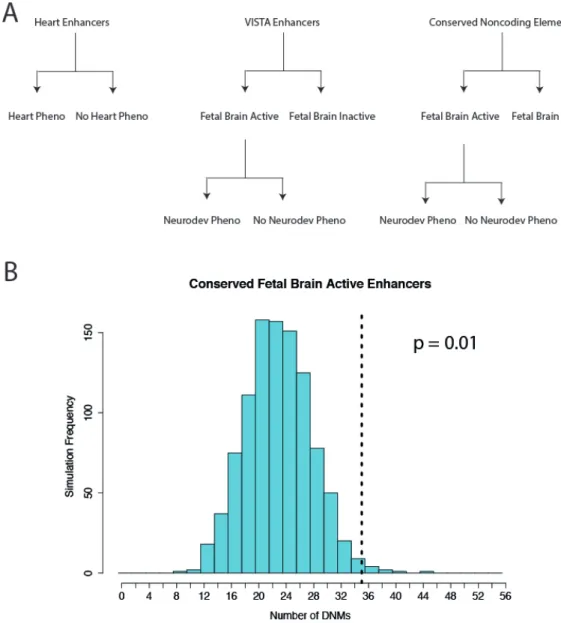
To assess the contribution of variation outside the coding regions to severe DD, more than 6,000 putative regulatory elements were included in the exome capture. These elements were derived from three major categories: 4,307 highly evolutionarily conserved non-coding elements18, 595 experimentally-validated enhancers19, and 1,237 putative heart enhancers20, together covering 4.2Mb of sequence (see Methods).
Variant effect prediction in the non-coding genome
A number of computational tools have been developed that combine
evolutionary conservation, chromatin modifications in different tissues, transcription factor binding sites, and other genomic features to predict the impact of variation genome-wide. Combined Annotation Dependent Depletion uses a support vector machine (SVM) to predict pathogenicity of coding and non-coding variation and has proved to be a powerful tool in the coding regions, particularly for improved
stratification of missense variation21. FATHMM-MKL also uses an SVM to predict the pathogenicity of variation genome-wide, but instead of combining all features into one model, constructs a kernel for each different feature group (Histone
modifications, TF binding sites, Open Chromatin, evolutionary conservation, GC content, amongst others)22.
In contrast to CADD and FATHMM-MKL, which attempt to model
pathogenicity genome-wide, Genomiser addresses the more precise use-case of variant prioritisation in Mendelian disease23. Genomiser relies on a set of 453 non-coding variants previously associated with Mendelian disorders, collected through literature review and in some cases, computational prediction. Genomiser employs a similar set of features to CADD and FATHMM-MKL, including evolutionary
conservation, histone modifications, and open chromatin data and uses a Random Forest model to make pathogenicity predictions.
Other methods have been developed to predict disruptions to TFBS, and integrate these disruptions with evolutionary conservation data to infer
pathogenicity. One such method, DeepSEA uses a convolutional neural network (CNN) to predict TF binding intensity based on sequence context alone, using peak intensity from the ENCODE project to train the model24. While this method has been shown to outperform motif-based predictions of TF-binding, neural networks and other machine learning models that predict on sequence data alone are more challenging to interpret than models with structured feature sets.
CADD, Fathmm-MKL, Genomiser, and other non-coding variant effect predictors have purported to improve variant effect prediction for non-coding variation, but the utility of these scores has not been robustly verified in the non-coding genome to the same degree as tools such as Variant Effect Predictor25 (VEP), SIFT26, PolyPhen27, or CADD21 which are used in interpretation of coding variation. This difference is in large part due to the paucity of disease associated regulatory variation to verify the models. In the case of Genomiser, which was trained using curated disease variants, testing on an independent set of disease-linked variants will not be possible until more variants independent of the training set have been reported. Furthermore, effect sizes in the non-coding genome may be smaller in general, as suggested by the greater burden of non-coding variation in common disease, making the detection of damaging variation more difficult.
An alternative approach to validate the utility of these models is to use selective constraint, which can be inferred from the allele frequency of variation in modern humans. Sites under negative selection will on average harbour fewer variants, and variants at lower allele frequencies, than sites evolving neutrally28-30 This approach has been successfully applied in the coding regions of the genome— CADD, SIFT, and PolyPhen scores show a strong correlation with pathogenicity predictions and inferred strength of purifying selection30. In this chapter, the mutability adjusted proportion of singletons (MAPS30) method is used to assess the relationship between non-coding variant effect predictors and selective constraint as
effect prediction and selective constraint in the non-coding genome is explored in greater detail in Chapter 3 using whole genome-sequence data from >28,000 individuals.
Methods
Recruitment in the Deciphering Developmental Disorders (DDD) project At the time of this analysis, 7,930 trios (mother, father, affected child) were
recruited through NHS Clinical Genetics Centres in the U.K. and Ireland and had been sequenced. The families gave informed consent for participation and the study has research ethics approval (10/H0305/83, granted by the Cambridge South Research Ethics Committee and GEN/284/12, granted by the Republic of Ireland Research Ethics Committee). DECIPHER was used to collect and store clinical data including family history, growth measurements, developmental milestones, and structured phenotypic descriptions (using the Human Phenotype Ontology3). Saliva was
collected from all family members, and blood was collected from affected probands and DNA was extracted for sequencing.
Sequencing in the DDD Cohort
Genomic DNA was extracted from patient saliva and sheared into 150bp fragments. Libraries were created following standard Illumina paired-end protocols in the Wellcome Trust Sanger Institute sequencing facility. SureSelect RNA baits were used to do the exome pulldown. Enriched libraries were sequenced on Illumina HiSeq at the Wellcome Trust Sanger Institute using 75-base paired-end sequencing.
Alignment, Variant Calling, and Quality Control
Mapping of short-read sequences was carried out using the Burrows-Wheeler Aligner31 (BWA; version 0.59) algorithm with the GRCh37 1000 Genomes Project phase 2 reference. The Genome Analysis Toolkit32 (GATK; version 3.1.1) and
SAMtools33 (version 0.1.19) were used for sample-level BAM improvement. Ensembl Variant Effect Predictor (VEP25) based on Ensembl gene build 76 was used to
consequence was selected. I identified a trinucleotide specific error mode (GTN->GGN) that introduced false positives which was corrected by strict strand filtering (FS < 20). I determined the number of variants called per individual, and excluded unaffected parents with variant counts on the extremes of the distribution (top 1% and bottom 1%). Across the 7,080 unaffected parents that passed quality control filters, I identified 1,520,250 unique variants in the targeted non-coding elements and coding regions.
De novo mutation calling
De novo mutations were called as described in McRae et al, 2017, excluding SNVs and indels with posterior probability <0.00781 as annotated by DeNovoGear34.
Defining targeted non-coding elements
The placental mammal 28-way phastCons score35 was used to select the top 4,432 conserved non-coding elements with no overlap with RefSeq genes (downloaded from UCSC on August 4th, 2010). Using the VISTA enhancer browser19, all 622 putative enhancers with evidence of in vivo activity in developing mouse embryos were downloaded on August 3rd, 2010. At the time the capture was designed, the observation had been made that heart enhancers are depleted among ultra-conserved elements20. As heart defects are the largest group of non-CNS
abnormalities in the DDD cohort ultra-conserved elements were supplemented with an early annotation of heart enhancers. These putative heart enhancers were kindly provided by Axel Visel based on ChIP-seq of p300 in human fetal heart described in May et. al, 2012 in GRCh36 coordinates, mapped over to GRCh3736. Collectively, these elements cover approximately 4.6 megabases of total sequence. First, elements were filtered to exclude any targeted sequences with less than 10x
coverage across the DDD data set. Second, any elements previously annotated to be non-coding, but classified as protein-coding in Gencode v1937 were removed. Finally, any elements less than 50bp in length were excluded. After filtering, 4,307
conserved elements, 595 enhancer elements and 1,237 putative heart enhancers remain.