Saïd Business School
Research Papers
Saïd Business School RP 2017-09
The Saïd Business School’s working paper series aims to provide early access to high-quality and rigorous academic research. Oxford Saïd’s working papers reflect a commitment to excellence, and an interdisciplinary scope that is appropriate to a business school embedded in one of the world’s major research universities.
Destination-Based Cash Flow Taxation
Alan Auerbach
University of California, Berkeley
Michael P. Devereux
Saïd Business School & Centre for Business Taxation, University of Oxford
Michael Keen
International Monetary Fund
John Vella
Centre for Business Taxation, University of Oxford
February 2017
Destination-Based Cash Flow
Taxation
WP 17/01
The paper is circulated for discussion purposes only, contents should be considered preliminary and are not to be quoted or reproduced without the author’s permission.
February 2017
Alan Auerbach
University of California, Berkeley Michael P. Devereux
Oxford University Centre for Business Taxation Michael Keen
International Monetary Fund John Vella
Oxford University Centre for Business Taxation
1
Destination-Based Cash Flow Taxation
Alan Auerbach
University of California, Berkeley
Michael P. Devereux
Oxford University Centre for Business Taxation
Michael Keen
International Monetary Fund
John Vella
Oxford University Centre for Business Taxation
2
TABLE OF CONTENTS
PREFACE...4
EXECUTIVE SUMMARY...6
I. INTRODUCTION ...9
II. THE DBCFT IN OUTLINE ... 11
1. Cash flow taxation ... 11
2. Destination basis... 15
3. Equivalence between DBCFT and VAT with matching reduction in wage taxes... 18
4. Border Adjustments ... 19
III. EVALUATING THE DBCFT... 24
1. Universal adoption... 24
a. Economic efficiency... 24
Location of investment... 24
Scale of investment ... 28
Form of financing... 28
b. Robustness to avoidance and evasion ... 28
c. Ease of Administration ... 32 d. Fairness... 33 Incidence of the DBCFT... 33 Inter-nation equity ... 36 Developing countries... 38 e. Stability... 40 2. Unilateral adoption... 40 a. Economic efficiency... 41
b. Robustness to avoidance and evasion ... 42
c. Ease of Administration ... 44
d. Fairness... 44
e. Stability... 45
IV. TAXING FINANCIAL FLOWS ... 47
1. The choice between an R base and an R+F base ... 47
2. Transactions between taxable entities ... 48
3. Transactions with individuals and tax-exempt entities ... 54
4. International Considerations ... 57
Unilateral Adoption ... 62
V. IMPLEMENTATION ... 66
1. Two Economically Equivalent Reforms ... 66
2. Practical Issues... 68
a. Scope ... 69
b. R versus F flows under an R base, and debt v equity under an R+F base... 72
c. Losses... 73 Domestic... 73 International... 76 Financial institutions... 78 d. Destination ... 80 e. Collection... 82
f. Tax Treaties and the WTO... 84
g. Transitional issues ... 85
h. Other issues in comparing the two approaches ... 86
3. Final Thoughts... 88
REFERENCES ... 89
APPENDIX ... 93
PREFACE
This paper sets out a possible approach to the international taxation of corporate profit: a destination-based cash flow tax (DBCFT). This option is one of a number that have been considered over the last three years by a group of economists and lawyers, chaired by Michael Devereux. The other current members of the group are Alan Auerbach, Michael Keen, Paul Oosterhuis, Wolfgang Schön and John Vella.
The group’s intention is to produce a book which provides an extensive discussion of alternative ways in which jurisdictions might tax a share of the profit of multinational companies, including the existing system and well-known alternatives such as formulary apportionment. The book will analyse in detail two reform proposals, a DBCFT and a “residual profit allocation”, which is based more closely on the existing framework for taxing multinational profit. Members of the group presented both of these ideas in public conferences at Oxford University in June 2016, and at the Tax Policy Center in Washington DC in July 2016, as well as at other events in Europe and the USA.
In June 2016, the Ways and Means Committee of the US House of Representatives published a Blueprint document “A Better Way for Tax Reform”,1 which proposes a
version of a DBCFT. In the light of the public interest in this idea, the group has decided to publish this paper in advance of completing the book; in effect it is a draft of one chapter of the book. The intention of publishing this now is to help inform the public debate about the properties of a DBCFT, and to highlight and discuss issues that would arise in its implementation.
The paper shows that the DBCFT is equivalent in economic terms to a reform that introduces a broad-based, uniform rate VAT (or achieves the same effect through an existing VAT), and reduces taxes on payroll by the same proportion. Each of these two options has advantages and disadvantages in terms of implementation, which are set out and discussed in the paper.
The authors of this paper would like to thank several people who have contributed to their thinking about the DBCFT and other options, especially group members Paul Oosterhuis and Wolfgang Schön. We are also grateful to have received helpful 1https://waysandmeans.house.gov/taxreform/
comments from, among others: Rosanne Altshuler, Jennifer Blouin, Stephen Bond, Ian Brimicombe, Alex Cobham, Rita de la Feria, Steve Edge, Judith Freedman, Malcolm Gammie, Michael Graetz, Rachel Griffith, Itai Grinberg, Valeska Gronert, Michelle Hanlon, Chris Heady, Jim Hines, Vanessa Houlder, John Kay, Ed Kleinbard, Ben Lockwood, Mark Mazur, Peter Merrill, Will Morris, Paul Morton, Tom Neubig, John Samuels, John Sherman, Joel Slemrod, Eric Toder, Al Warren, David Weisbach and staff at the International Monetary Fund. The contents of this paper are the sole responsibility of the four named authors. Views expressed here should not be attributed to the IMF, its staff, Executive Board or its Management.
Devereux and Vella are grateful to the Nuffield Foundation for financial support. For correspondence, please email [email protected].
EXECUTIVE SUMMARY
This paper presents, analyses, and further develops the idea of a destination-based cash-flow tax (DBCFT). Its purpose is expositional: to describe the DBCFT, how it might work, what its effects would be and some of the challenges that its implementation would face.
The DBCFT has two basic components.
The “cash flow” element gives immediate relief to all expenditure, including capital expenditure, and taxes revenues as they accrue.
The “destination-based” element introduces border adjustments of the same form as under the value added tax (VAT): exports are untaxed, while imports are taxed. This is equivalent in its economic impact to introducing a broad-based, uniform rate Value Added Tax (VAT) - or achieving the same effect through an existing VAT - and making a corresponding reduction in taxes on wages and salaries.
The paper evaluates the DBCFT against five criteria: economic efficiency, robustness to avoidance and evasion, ease of administration, fairness and stability. And it does so both for the case of universal adoption by all countries and the more plausible case of unilateral adoption.
In contrast with existing systems of taxing corporate profit, especially in an international environment, the DBCFT and VAT-based equivalent have significant attractions:
A central motivation for the DBCFT is to improve economic efficiency by taxing business income in a relatively immobile location – that is, the location of final purchasers of goods and services (the “destination”). The DBCFT should not distort either the scale or the location of business investment and eliminates the tax bias towards debt finance by assuring neutral treatment of debt and equity as sources of finance.
Taxing business income in the place of destination also has the considerable advantage that the DBCFT is also robust against avoidance through inter-company
transactions. Common means of tax avoidance – including the use of inter-company debt, locating intangible property in low-tax jurisdictions and mispricing inter-company transactions - would not be successful in reducing tax liabilities under a DBCFT.
Here however the distinction between universal and unilateral adoption is important. With adoption by only a subset of countries, those not adopting are likely to find their profit shifting problems to be intensified: companies operating in high tax countries, for instance, which may seek to artificially over-price their imports, will face no countervailing tax when sourcing them by exporting from related companies in DBCFT countries.
By the same token, the DBCFT provides long term stability since countries would broadly have an incentive to adopt it – either to gain a competitive advantage over countries with a conventional origin-based tax, or to avoid a competitive disadvantage relative to countries that had already implemented a DBCFT. It would also be resistant to tax competition in tax rates.
In terms of its distributional impact, given the equivalence between a DBCFT and a VAT combined with a labour tax cut, the incidence of the tax would be on domestic residents financing consumption other than from wages, including from profit subject to the DBCFT. In that respect, the DBCFT would be more progressive than a single rate VAT, and possibly more so than existing corporate taxes (the burden of which may fall largely on labour). If desired, it would be possible to maintain a tax on the return to capital at the personal level, though the paper does not elaborate on this.
Fairness between countries is harder to assess, but – combined with taxes on natural resources – some very preliminary evidence suggests that few countries would be likely to see a reduction in their tax base as a result of border adjustment in itself. The paper looks closely at the application of DBCFT treatment to the financial sector, which is a familiar problem under the VAT but has been little considered under the DBCFT. It compares two alternative approaches, based on the Meade Committee’s ‘R-base’ (taxing only “real” flows) and its ‘R+F’ base (taxing “real and financial”) flows. There are shown to be equivalent for transactions between taxed entities. Administrative considerations suggest applying the R base to most companies, but also
taxing financial flows between financial companies and tax exempt entities and individuals
The DBCFT raises a number of significant implementation issues - both administrative and legal - and requires substantial changes, both conceptually and in application, from current practice in corporate taxation. Neither of its two principal design features, a cash flow tax base and taxation on a destination basis, are commonplace amongst existing corporation taxes. Issues related to losses, familiar under the VAT, would be amplified. The paper sets out this and other core implementation issues, and how they might be addressed. It also compares the implementation of a DBCFT with the economically equivalent VAT-based approach, setting out the advantages and disadvantages of each.
One critical legal issue is that many have argued that the basic DBCFT, with an integrated relief for labour costs, is inconsistent with WTO rules. However, this is not true of the economically equivalent VAT-based approach, either on the usual invoice-credit basis, or on a subtraction method. It is also possible that the DBCFT would be considered to be within the ambit of bilateral income tax treaties, in which case it would clearly be inconsistent with several of the typical provisions of such treaties. For any country, replacing a conventional corporate income tax by a DBCFT, or VAT-based equivalent, would be a major undertaking. This paper considers core issues of design and implementation, but the assessment of any proposal must evaluate its details, including in relation to possible accompanying measures. Deviations from the design principles set out in the paper could alter significantly the analysis it provides and the conclusions that it reaches. For any proposal, careful, country-specific assessment of design, implementation and probable effects, including those for other countries, will be essential.
I. INTRODUCTION
This paper presents, analyses, and further develops the idea of a destination-based cash-flow tax (DBCFT).2
The DBCFT has several highly attractive properties: it does not distort the scale and location of investment, assures neutral treatment of debt and equity as sources of finance, is robust against avoidance through inter-company transactions, and provides long term stability due to its incentive compatibility and its resistance to tax competition amongst states. The DBCFT thus addresses many of the ailments afflicting current tax systems in both purely domestic and international settings.
On the other hand, the DBCFT raises a number of significant implementation issues -both administrative and legal - and requires substantial changes, -both conceptually and in application, from current practice in corporate taxation. Neither of its two principal design features, a cash flow tax base and taxation on a destination basis, are commonplace amongst existing corporation taxes.3
The purpose of this paper is expositional: to describe the DBCFT, how it might work, what its effects would be and some of the challenges its implementation would face. To this end, the paper starts by outlining how a DBCFT would work, and elaborating on its key elements, including the nature and role of border tax adjustments. We show too that a tax reform with equivalent economic effects would be to introduce a broad-based, uniform rate Value Added Tax (VAT) - or achieve the same effect by raising the rate of an existing VAT - and making a corresponding reduction in taxes on wages and salaries. Section 2 then evaluates the DBCFT on the basis of five criteria: economic efficiency, robustness to avoidance and evasion, ease of administration, fairness and stability. In doing so we deal in turn with two cases: that in which all countries adopt a DBCFT (or VAT-based equivalent) and that in which adoption is unilateral. Section 3 then considers the treatment of financial flows, from both conceptual and practical perspectives. This is as an important issue that has not 2For earlier discussions of the DBCFT, see Bond and Devereux (2002), President’s Advisory Panel on Federal Tax Reform (2005), Devereux and Birch Sorensen (2006), European Economic Advisory Group (2007), Auerbach, Devereux and Simpson (2010), Auerbach (2010), Devereux (2012) and Auerbach and Devereux (2015). See also Avi-Yonah and Clausing (2016) and Cui (2016).
3The only national-level cash flow tax of which we are aware is the Mexican IETU, which operated (as a minimum tax) between 2007 and 2014, apparently without major technical difficulty.
previously been considered in detail. Finally, Section 4 takes up a range of implementation issues, though the paper does not attempt a full treatment of all the issues that are likely to arise in practice (many of which are likely to be country-specific).
II. THE DBCFT IN OUTLINE
The DBCFT has two distinct attributes: a cash-flow tax base and a destination basis. A destination basis could be applied to a variety of tax bases, and arguments for cash-flow taxation originally arose in a purely domestic setting. But there are advantages to combining the destination basis and the cash-flow tax base. This section recalls the features of a cash flow tax operating in a single economy, explains what destination-basing would mean and what a DBCFT would look like, and shows its economic equivalence to the combination of a VAT and a reduction of taxes on labour by the same amount.
1. Cash flow taxation
Cash flow taxation in a single economy has been studied at length.4 As its name implies, a cash flow tax applies to net receipts arising in the business. Receipts are included in the tax base when payment is received and expenses are recognized when payment is paid.5 The tax base in any given period is the former less the latter. The
most significant difference in the timing of the inclusion of receipts and expenses in the base, compared to most existing corporate tax systems, is that under cash flow taxation even capital assets that are typically depreciated over time are immediately expensed (i.e. deducted in full upon purchase). There is therefore no need for complex depreciation rules that are typically found under current systems, and no need to differentiate between different types of assets. This also introduces a significant difference between the cash-flow tax base and measures of profit in financial statements.
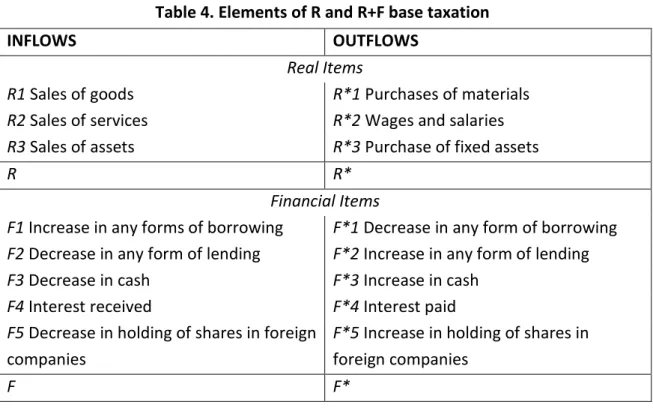
In the terminology of the Meade Committee (1978), a cash-flow tax could be levied on a company on an R (real) base or an R+F (real plus financial) base. Under the R base, transactions involving financial assets and liabilities are ignored – so, for example, interest receipts would not be taxed and interest expenses would not be deductible. 4 The idea of the cash flow tax dates back to Brown (1948), and has since been the subject of an extensive literature that began with Kaldor (1955), Andrews (1974), US Treasury (1977), Meade (1978) and Graetz (1979). Readers familiar with properties of cash flow taxation in a closed economy can easily skip this subsection.
5More precisely, the tax would naturally be based on an accruals basis so that, for example, receipts are recorded when the obligation to pay is incurred, rather than when cash is actually received. The accruals basis would also apply to purchases, including of capital assets. Similar arrangements are common, of course, under the VAT.
The R base is thus limited to the difference between real inflows (from the sale of products, services and real assets) and real outflows (from the purchase of materials, products, services – including labour – and real assets). By contrast, under the R+F base, all cash inflows, including borrowing and the receipt of interest, would be taxable; all cash outflows, including lending, repaying borrowing and interest payments would be subtracted in calculating the tax base. That is, the tax would apply to all net financial inflows related to borrowing, including principal amounts, as well as to net real inflows.6The choice between an R and an R+F base is discussed in detail below.
The properties of the cash flow tax, conceived of as operating in a single economy, are well-known and so treated only briefly here. The starting point for understanding them is the usual assumption that an investor seeks to maximize the net present value (NPV) profit of an investment, measured as the sum of all discounted cash flows associated with it. The discounting effectively adjusts for interest that might otherwise have been earned during the intervening period. For instance, in the example below, assuming a discount rate of 10%, a cash flow of 110 in one year’s time has a present value of 100. Since the discounting approach adjusts for a required rate of return on an investment, the NPV is a measure of the economic rent of an investment. In principle, it is worth undertaking any project with a NPV greater than zero; and it is not worth undertaking any project with a NPV less than zero. Any tax that falls only on economic rent (and has a rate between zero and 100%) has the property that the post-tax NPV of an investment has the same sign as the pre-tax NPV. In this case, any investment worth undertaking in the absence of tax remains worth undertaking in the presence of tax, and vice versa. Hence the investment decision is independent of a tax on economic rent.
The example in Box 1 shows that a cash flow tax can indeed be thought of as a tax on the NPV, or economic rent, of an investment. Intuitively, cash flow taxation is neutral because, in effect, the government contributes a proportion of all costs of the business (through giving tax relief for all costs when they are incurred), and takes the same proportion of all receipts. In effect, the government becomes a shareholder in the business. Like other cases in which the ownership of shares in a business changes, this in itself has no effect on the profitability of the business, or on marginal 6The Meade committee discussed a third form: the ‘S’ base cash flow tax, levied on net distributions to shareholders. As a consequence of the identity between a firm’s sources and uses of funds, an S-base tax is precisely equivalent to an R+F-based one, at least in a domestic context.
investment and financial decisions. By taxing all cash flows at the same rate, the government captures that same proportion of economic rent.7
Box 1. Neutrality of cash flow taxation in a single economy setting
Consider a two-period investment, with a cost of 100 in period 1, an interest rate of 10%, and a tax rate of 20%. Under a cash flow tax, there is a negative tax liability in period 1 of -20. In period 2 the investment makes a return. For an investment that just breaks even, the total value of the investment in period 2 must be 110: this represents a rate of return of 10%, equal to the discount rate. The total return of 110 generates a tax liability in period 2 of 22. In NPV terms, the NPV pre-tax and post-tax are both zero. That is, the economic rent before and after tax are both zero. The tax also has a NPV of zero; that is consistent with the tax only falling on economic rent.
Illustration of properties of a cash flow tax on investment incentives
Pre-tax cash flows Cash flow tax Net cash flows
Period 1 outflows 100 -20 80
Marginal investment
Period 2 inflows 110 22 88
NPV, at 10% discount rate 0 0 0
Rate of return earned 10% - 10%
With economic rent
Period 2 inflows 132 26.4 105.6
NPV, at 10% discount rate 20 4 16
Rate of return earned 32% - 32%
In the lower part of the table, we assume instead that the investment generates a return of 32%, that is, it is worth 132 in period 2. Combined with the initial outlay of 100, that represents a net present value of 20.8Tax due in period 2 is 26.4, implying that the NPV of
the tax is 4. That leaves a post-NPV of 16. Since both the pre-tax and post-tax NPVs are positive, the investment is attractive to the investor irrespective of the tax. Note also, that the NPV of the tax is equal to 20% of the pre-tax NPV of the investment; so the tax is effectively a tax on the economic rent of the investment. That is why it does not affect the investment decision. This also implies that the post-tax rate of return (a return of 105.6 on a net investment of 80) is also 32% - the same as the pre-tax rate of return.
7Complications may arise in practice. For example, this simple characterisation assumes a symmetric tax system, in which the government collects tax when cash flows are positive, but effectively makes a tax rebate when cash flows are negative. The appropriate treatment of losses is discussed below in a number of different settings.
8The net present value of a cash flow arising in the next period is calculated by dividing the value of the cash flow by 1 plus the interest rate, expressed as a decimal. Thus, in this case, the NPV of 132 is 132/1.1=120.
The neutrality of cash flow taxation applies also to financial decision-making. Existing taxes on corporate profit generally treat debt and equity asymmetrically: the return on debt is generally deductible from the corporate tax base, whilst the return to equity is not. This favourable treatment of debt distorts the choice of financing between debt and equity financing, leading to leverage ratios that are higher than they would otherwise be.9This is a significant concern: socially excessive levels of debt, especially in the financial sector, are widely seen as having played a central role in triggering and deepening the financial crisis of 2008.
By contrast, cash flow taxes, either with an R or an R+F base, do not distort the choice between debt and equity. This is easily seen in the case of an R base, since all financial flows are simply ignored, be they associated with debt or equity. But the same applies to the R+F base. We return to this issue in more detail below.
However, there are caveats to this analysis. One is that cash flow taxes lose their neutrality if the tax rate is expected to change over time: a falling rate will encourage investment, for instance, since the cost is deducted at a higher rate than it is later taxed. Second, even cash flow taxes may distort the choice between mutually exclusive projects which face different tax rates; the classic case in which this is a factor is in location choices between countries, as we discuss below, but this could also occur in a purely domestic context. Third, the analysis is based on the assumption that a business will aim to maximize its value, summarized by the NPV. This may not necessarily be the case. One possibility, for example, is that managers with a short term horizon will seek to maximize current profit as recorded in financial statements; this is more likely, of course, if managers’ own remuneration depends on current financial earnings. In some cases, this may not be consistent with maximizing the NPV of the business. At various points in the discussion below of the precise design of the DBCFT, we consider this possibility.
It should be noted too that cash flow taxation is not the only way to achieve neutrality in business taxation. The same economic effects can in principle be achieved by giving relief for the cost of depreciation of assets, instead of an immediate write-off, and in addition giving relief for the cost of finance. In the case of debt finance, this cost is 9For a survey on the impact of the tax incentive to use debt, see Graham (2003). More recent evidence is provided by, amongst others, Devereux, Maffini and Xing (2016), Doidge and Dyck (2015), Heider and Ljungqvist (2015) and Keen and de Mooij (2015).
normally the interest payments that the business must make on its borrowing. For equity finance, it is an opportunity cost, reflecting the return that the shareholder has foregone on some alternative asset of equivalent risk. These financial costs can be seen as reflecting a minimum rate of return that the providers of finance require on their investments in the business. Naturally, then, giving relief for these costs implies that only economic rent – that is, profit over and above the minimum required rate of return – is subject to tax.
Comparing this approach to cash flow treatment, relief for the opportunity cost of finance can also be seen as compensating for the lack of immediate expensing in the system. Giving relief only for the depreciation of capital assets in effect defers tax relief on capital expenditure relative to a cash flow tax. Relief for the opportunity cost of capital compensates for this deferral. In fact, as the IFS Capital Taxes Group (1991) showed, it is possible for a tax to fall on economic rent with any schedule of depreciation allowances, as long as relief for the opportunity cost of capital is based on the difference between the initial cost of the asset and its tax-depreciated value. The IFS Capital Taxes Group proposed an “Allowance for Corporate Equity” (ACE) based on this principle, which would be a relief in addition to relief for the cost of interest payments.10
The approach using an ACE has the advantage of being more similar to existing corporation taxes, in that it simply adds one additional relief and leaves features like interest deductibility and capital allowances unaffected. It has the disadvantage of adding some complexity relative to the cash flow tax, since it requires the specification of a rate at which the allowance is applied, although this has been applied in practice in the context of ACE reliefs introduced in several countries,11and also in resource taxes.
2. Destination basis
The international setting introduces the second dimension of the DBCFT, relating to how a country determines the component of a corporation’s tax base falling within its 10The equivalence of expensing and a rate of return allowance was first shown by Boadway and Bruce (1984). Kleinbard (2007) proposes a related form of cost of capital allowance. Bond and Devereux (1995, 2003) analyse the properties of various such rate of return allowances in the presence of risk.
11For example, in Austria, Belgium, Brazil, Croatia, and Italy. Experience with the ACE is reviewed in de Mooij (2011); see also Zangari (2014) and IMF (2016a).
particular jurisdiction. A DBCFT would be based on sales of goods and services in the country less expenses incurred in the country: so receipts from exports are not included in taxable revenues and imports are taxed.12 This ‘border adjustment’ is
essentially the same treatment as is common under VAT; we explore differences from and similarities with VAT below. In a sense, the DBCFT would tax inflows and outflows asymmetrically – since income from sales are subject to tax in the place of the sale (the “destination” country), while expenses, including for labour, receive tax relief where they are incurred (the “origin” country). It thus combines both destination and origin elements. We stick, however, with the established terminology, with the term “destination” – taken from the literature on VAT—highlighting the role of border adjustment on payments and receipts.
A simple example makes the workings of the DBCFT clear (Table 1). Suppose a company produces goods in country A, employing labour at a cost of 60 and with costs of 40 on other domestic purchases. It sells goods to domestic consumers in A for 150, and also has exports goods to country B of 150. It therefore has a total profit, in cash flow terms, of 200.
Table 1. Illustration of application of the DBCFT
Country A Country B Total
Tax rate 20% 30% Labour costs 60 0 60 Other costs 40 0 40 Sales 150 150 300 DBCFT tax base 50 150 200 DBCFT charge 10 45 55
VAT tax base 110 150 260
VAT charge 22 45 67
Relief for labour costs
-12 0 -12
VAT + relief for labour costs
10 45 55
12More precisely (and as discussed later): imports by businesses liable to a DBCFT could either be taxed, with a deduction then available, or untaxed but not deductible; imports by final consumers would simply be taxed.
The DBCFT tax base in country A is calculated as domestic sales of 150 less domestic cost of 100: a total of 50. The DBCFT tax base in B is simply the value of the imports into B: 150. If the tax rate in A is 20% and that in B is 30%, then the firm’s tax liabilities are 10 in A and 45 in B.
The relevant “destination” for the calculation of tax, it should be emphasized, is the location of the immediate purchaser, not (necessarily) that of the final consumer. For example, if a US manufacturer sells steel to a French automobile producer which uses the steel to produce automobiles sold back to the United States, US application of the destination-based tax would not tax the sale of steel but would tax the automobile imports.
It is, however, the location of the final consumer upon which the impact of the DBCFT ultimately turns. Sales to other businesses effectively attract no tax under the DBCFT, either (if the sale is domestic) because they generate a deduction for the purchaser or (if exported) because they are untaxed. Thus the DBCFT, as will be seen more clearly below, is built on the intuition that taxing companies on the basis of something that is relatively immobile - which, by and large, we take consumers to be - limits the scope for the gaming that has caused such difficulties within the current international tax framework.
It should be noted too that other forms of rent tax, other than cash flow taxes, could also be destination-based. One could also implement border adjustments under an ACE, for example, though this would raise additional considerations. For instance, it will be seen below that one advantage of the cash flow approach to destination-basing is that tax frequently nets out to zero. An example is the taxation of an import of capital assets used by business, where under a cash flow tax, the tax on the import nets out with the tax relief for the cost of the input. In effect this means that the import can be ignored except to the extent that enforcement requires that they are not passed off as domestic purchases, which would receive relief on the grounds that tax had already been paid on the purchase from the domestic supplier. This is not true under the ACE, where the capital asset would initially receive only a depreciation allowance.
3. Equivalence between the DBCFT and a VAT with matching reduction in wage taxes
Before turning to an evaluation of the DBCFT, it is useful to compare the DBCFT with a VAT. In the example in Table 1 above, under the usual invoice–credit method, at a tax rate of 20%, the company would remit VAT on the value of the domestic sale (30) net of the VAT already paid on the non-labour input (8).13The total VAT payment by the
company in A would thus be 22. The VAT due in B, where there are only sales,14would be the same as the DBCFT charge, 45.
The only difference in principle between the DBCFT and a VAT is in the treatment of labour costs. In B, where no wage costs are incurred, the liability is the same under the DBCFT as under the VAT. In A, the difference in the DBCFT base and the VAT base is the 60 of labour costs incurred in A. The DBCFT is intended to tax profit, and so gives relief for labour costs. The VAT is intended to tax value added; this is equivalent to the sum of profit and the amount paid to labour, and so VAT does not give relief for labour costs. It follows that introducing a VAT (or increasing its rate) – having in mind here an idealized VAT, levied at a single rate on a broad base15- and reducing labour
income taxes at the same rate would have equivalent economic effects to those of the DBCFT. This is shown in the last two lines of the table: giving relief for labour costs in A reduces the tax in A by 12, and the combination of the VAT and relief for labour costs yields the same tax base as the DBCFT.
Below we discuss in some detail the two options of (a) implementing a DBCFT as a reform to corporation tax, and (b) an economically equivalent reform of introducing a VAT (or applying an increased rate to the generality of transactions under an existing VAT) combined with a matching reduction in taxes on wages and salaries.
13The standard invoice-credit method of collecting VAT keeps track of VAT on every transaction. A VAT registered business remits tax on its sales less the VAT it has paid on its inputs. A subtraction-method VAT is more akin to a corporation tax - and the DBCFT - with annual accounting of the sales less non-labour costs made by the company. In the simple case in which there is a single VAT rate, these approaches result in the same tax base.
14Importation of the 150 from the entity in country A would be subject to VAT, but a credit of exactly the same amount would be available against the VAT due on sales.
4. Border Adjustments16
A key element for understanding both the incentive effects of a DBCFT and the incidence of a DBCFT is the role played by border tax adjustment (BTA). By this is meant that exports would not be subject to the tax, but imports would be. The impact of BTA has been extensively studied in the literature on VAT, in analysing the effects of shifting from an origin-based system (export taxed, imports untaxed) to a destination-based system (exports untaxed, imports taxed); we draw on that literature here.
The adoption of border adjustments would appear initially to make a country more competitive in international trade. But any such effect is at most a temporary one. To see this, consider first the case in which there is a single common currency, or a fixed exchange rate. Then consider a border adjustment by one country only; for the moment we consider only the impact of this border adjustment, abstracting from the other elements of the DBCFT. 17,18 Moving from an origin-based tax that included
exports in the tax base, the border adjustment would make exports cheaper on the world market; this would create a stimulus to exports. By contrast, the domestic cost of imports would increase with the tax on imports; this would discourage imports. With a fixed exchange rate, and sticky wages, both effects would induce a stimulus to domestic activity. This corresponds to the well-known effect of such border adjustments having the same impact as a currency devaluation – that is, in making exports cheaper to non-domestic consumers, and imports more expensive for domestic consumers.19 In the short run, this would generate a stimulus to domestic production relative to foreign production.
Over the longer run, however, we would expect prices to adjust. Expansion of domestic production would lead to an increase in the demand for labour. This would 16See Auerbach and Holtz-Eakin (2016) for an elaboration of, and examples illustrating, the arguments in this subsection.
17As discussed below, alternatively consider the case of a switch from an origin-based cash flow tax to a destination-based cash flow tax; this would give the same effect, reducing the tax on exports, and increasing the tax on imports.
18The analysis here is in the context of the border adjustment taking place in a single country. If it happened in several countries at once, then the effects identified would be replicated in each country. The extent of price and/or exchange rate adjustments would depend on relative tax rates in the countries undertaking the reform.
in turn push up the wage rate, and in consequence, push up the price of domestically produced goods and services. The effect of this rise in prices and wages would be to begin to raise again the price of exports on the world market, and to raise the price of domestically-produced goods relative to imports. When domestic prices and wages had risen far enough, the initial real equilibrium will be re-established.20 In this long
run, there would be no overall impact on trade, due to the price adjustments.
If instead the country had a flexible exchange rate, the same real long-run effect would occur naturally – and much more quickly, quite possibly indeed immediately (with some effect in advance if the change is pre-announced) - through an appreciation of the exchange rate, which would raise the (domestic currency) price of exports in the world market and reduce the price of imports. This would not require adjustment to the nominal price level in the domestic country.21 In effect, the initial fiscal devaluation would immediately be offset by an appreciation of the currency – i.e. a revaluation; these two effects would cancel out, leaving trade unaffected.
The nature of the adjustment — as between changes in domestic prices and wages, in the nominal exchange rate, and in the level of activity — will thus depend in practice on which of these can adjust more rapidly. There is, it may be helpful to note, an important difference here between the adoption of a DBCFT and the adoption of a VAT. Under the latter, consumer prices rise relative to wages, an effect that cannot be accomplished simply by a change in the nominal exchange rate; with wages sticky, the expectation is that the effect will come largely through an increase in consumer prices. The DBCFT, however, leaves that relative price unchanged, and so can be transmitted through the exchange rate.
The precise conditions under which - as a consequence of adjustment in the exchange rate and/or domestic prices - the shift from an origin to a destination basis will have no impact on the real equilibrium have been extensively studied in the VAT
20See Auerbach and Devereux (2015).
21It is important to distinguish these effects of the DBCFT from its effects on thelevelsof wages, prices and exchange rates, even though the concepts are related. The impact on the general price level is a macroeconomic phenomenon related to monetary policy, exchange rate policy, the nature of bargaining in the labour market, and domestic price-setting behaviour, and in itself tells us relatively little about the effects of the tax.
literature.22And, since wages are deductible in both cases, these results apply directly
to the comparison between a destination - and origin - based cash flow tax.
The conditions required for such an equivalence between a destination- and origin-based cash flow tax, it should be stressed, are demanding. One necessary condition is that a uniform tax rate applies to all sectors: without this, adjusting only the exchange rate or simply rescaling process by some common factor cannot re-establish the pre-reform pattern of relative prices. Equivalence is unlikely to hold, for instance, if there is a large untaxed sector, or significant variation in business tax rates across sectors, or in respect of real-world VATs for which rate differentiation is commonly extensive.23The wider political economy of taxation clearly plays a role here. Nor does the result hold with imperfect competition.24 There is, however, little work on the
quantitative extent to which plausible violations of uniformity are likely to cause departures from equivalence.
It should be noted too that whilst in the simplest models it is immaterial whether it is domestic prices or the nominal exchange rate that adjusts, this does matter for precisely who is affected by BTA. Nominal exchange rate changes will have balance sheet effects for non-residents with assets or liabilities (or contracts) denominated in the currency of the DBCFT-adopter for example, which is some cases would be significant; domestic prices changes do not. The incidence of the DBCFT is discussed more fully below.
Account also needs to be taken on the impact of Border Tax Adjustment (BTA) on revenue.25 For countries running a trade deficit – imports exceeding exports – the shift to a destination basis will increase tax revenue. If trade is balanced in the long run, however, and the tax rate is expected to remain unchanged, the revenue impact in present value is zero, except to the extent of net imbalances prior to enactment. If consumers are sufficiently forward-looking to recognize this, there will then be no real impact from this revenue effect. More generally (and plausibly), however, there may 22 A comprehensive analysis is provided by Lockwood (2001), synthesizing a number of earlier contributions, including de Meza et al (1994) and Lockwood (1993).
23Feldstein and Krugman (1990) stress and explore the trade implications of departures from uniformity of the VAT.
24 The implications of imperfect competition for the comparison between origin and destination principles for indirect taxation are considered in Keen and Lahiri (1998).
25Assuming other conditions for equivalence to be met, this revenue impact is essentially an income effect across national borders, and does not affect the economic efficiency of the outcome reached.
be an impact. Governments that are credit-constrained, for example, will not be indifferent to the timing of their tax revenues; and consumers may not be – though its nature is imponderable, depending, for instance, on the use made of the revenue and on consumers’ preferences.
All these (and other) qualifications mean that the adjustment to the introduction of a DBCFT in practice may well not be as simple – even in the long run, and leaving aside potentially significant short-run effects – as some combination of a rescaling of domestic prices and appreciation of the nominal exchange rate. To the extent that this raises revenue, for instance, the impact will depend on what use is made of that additional revenue, on how interest rates react and on how consumers respond. It is important too to bear in mind that the discussion above has considered the introduction of a DBCFT in isolation, not in replacement of an existing corporate (or other) tax. That would of course bring additional considerations. For instance, moving to cash flow tax from a traditional corporate tax would be expected to ease disincentives to investment, creating a source of efficiency gain itself. Macro simulation methods can potentially provide more nuanced assessments of practical reform proposals, though of course subject to their own limitations. The key point, however, is that the considerations raised by the basics of BTA are likely to be of first order importance in assessing the impact of practical reforms.
One might hope to be able to draw on past experiences to gauge the likely impact of destination-basis taxation. But there is, unfortunately, very little empirical evidence on the effects of BTA (or of significant tax changes more generally) on exchange rates – largely because these are rarely fundamental enough, relative to all the other factors that buffet exchange rates, to create reasonable prospect of being found in the data. There are, however, signs of effects along the lines just described in the work of de Mooij and Keen (2013) on ‘fiscal devaluations.’ These are tax changes that combine an increase in VAT and a reduction in the employers’ social contributions26 on labour –
which, recalling the discussion in Section I.3, is much the same thing as an increase in the rate of a DBCFT. This was advocated by some as a way to stimulate activity in the Eurozone, mimicking the effects of the devaluation that was unavailable to them, until offset by upward movements of prices and wages as described above. Looking at 30 OECD countries between 1965 and 2009, what emerges is that there is indeed a 26The reason for focusing on the employers’ contribution is that wage stickiness is most likely to apply to the wage net of those contributions, so that a cut translates immediately into reduced employment costs.
marked short-term boost to net exports within the Eurozone countries and period. Outside the Eurozone, however, there is no effect – suggesting that adjustment to what resembles close to a DBCFT comes very quickly when the exchange rate is allowed to react. Where the exchange rate is fixed, recent evidence that increases in the standard rate of VAT are fully passed on to consumers fairly quickly – in about 6 months27— suggest that it is rigidity in nominal wages that is most likely to account for extended adjustment periods.
There are two other respects, not addressed in these analyses, in which origin and destination taxation fundamentally differ. First, as set out below, a DBCFT should not affect the location of investment projects, whereas an origin-based cash flow tax generally would. Second, origin taxation, but not destination taxation, is vulnerable to transfer pricing abuse, since the prices charged on cross-border intermediate transactions affect overall tax liability.28 Under origin taxation, the seller charges tax
at the rate of the exporting country but the buyer then takes a deduction at the tax rate of the importing country; if the rate charged on sales exceeds that on purchase, there is an incentive in transactions between related parties to set an artificially low price, and conversely if it is less. Under destination taxation, in contrast, neither country charges tax on such sales. And so, as will be amplified later, BTA removes a wide range of avoidance possibilities.29
27Benedek and others (2016).
28The point is stressed by Auerbach and Devereux (2015) in the context of cash flow taxation; see also Genser and Schulze (1997) in the VAT context.
29This is a major reason to prefer a DBCT over an origin-based cash flow tax even when the conditions of the standard equivalence results are met.
III.
EVALUATING THE DBCFT
We evaluate the properties of the DBCFT in two settings. The first is that in which the DBCFT is adopted by all countries, although – importantly – not necessarily at the same rate. The second is that in which it is adopted by just one. Our main discussion relates to the former case. Considering the properties of the DBCFT if introduced in a single country, or small group of countries, is critical, however, for the issue of whether individual countries might find it in their own interest to adopt the DBCFT, or whether it could only be introduced by significant agreement between countries. This issue is also important for its stability; for example, is there an incentive for an individual country to introduce the DBCFT if other countries have already adopted it; or are countries that have already adopted it likely to undermine it through competition?
The evaluation is by five criteria: economic efficiency, robustness to avoidance and evasion, ease of administration, fairness and stability. The first four of these are common criteria for evaluating taxes. By stability we mean that there is an incentive for a country to adopt a system, whether or not other countries adopt it, and that there would also be no incentive for a country to compete with others by changing the basic system or by cutting the tax rate, each of which could impose costs on other countries and thereby undermine the overall international system. In a subsequent section we address issues of implementation in more detail, here we focus on economic principles.
1. Universal adoption
a. Economic efficiency
In principle, the DBCFT has remarkable properties in terms of economic efficiency. In particular, it should not distort the scale or location of investment, nor forms of financing choices. We discuss each in turn.
Location of investment
Whilst taxes on economic rent should not distort marginal investment decisions in a domestic setting, once we move to an international setting such taxes can distort
decisions on the location of investment if imposed on an origin basis – that is, broadly where the economic activity, or production defined very widely, takes place. This decision would be distorted, for example, if the states operating a tax on economic rents on an origin basis offer different tax rates. Faced with the decision where to locate their investment, the difference in tax rates may be so large as to induce companies to locate in the location which is less advantageous from a non-tax perspective. More generally, a difference in average tax rates on different mutually exclusive options may induce distortions, even if the tax base is economic rent.30 That distortion does not arise, however, if taxes on economic rent are levied on a destination basis. To see this, we have to consider the tax levied on the income generated from sales and the tax relief available for expenses. A key reason for choosing a destination basis is that consumers are relatively immobile; they are unlikely, except in some specific circumstances, to move in response to a higher rate of DBCFT. But it might be thought that there would be an advantage to locating expenses in a country with a high tax rate. By doing so firms would deduct expenses from profits which would otherwise be taxed at a high rate of tax (or, if in loss positions, they would receive relief at this high rate of tax). This is true – but the effect is negated by the impact of the border adjustments described above.
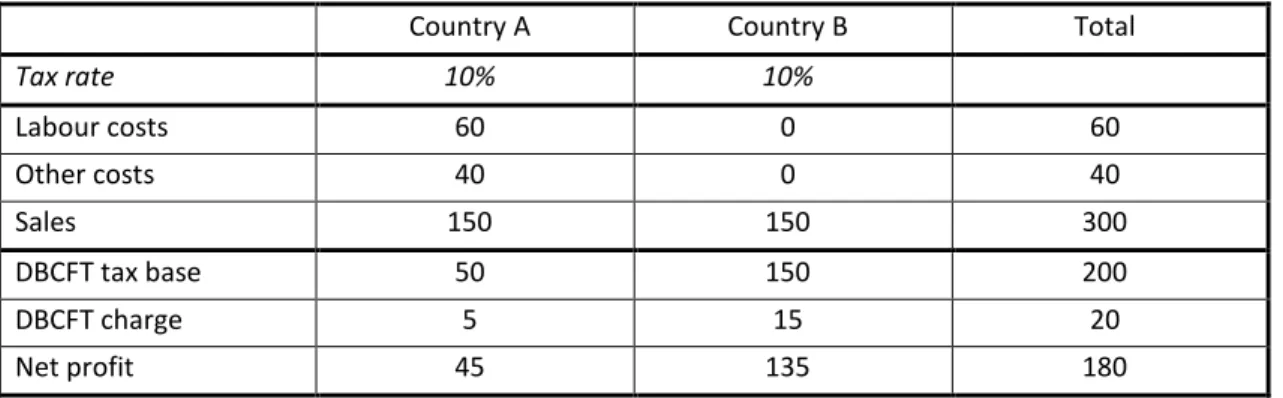
To see this, consider the example in Table 2. In Panel A, sales and costs in the two countries are as in Table 1, with the exchange rate between the two countries taken to be one-for-one. Initially, the two countries levy their DBCFTs at the same rate, 10 percent, which leaves the firm with after-tax profits of 180. From the point of view of the firm, the situation is just as if it operated in a single economy with a single DBCFT of 10 percent. This means, in particular, and just as discussed there, that the firm’s investment (and financing) decisions are wholly unaffected by the presence of the two taxes.
Suppose now that country B raises the rate of its DBCFT to 25 percent. If nothing else changes, this, as seen in Panel B, increases the firms’ total tax charge by 22.5 (15 percent of the base of 150 in country B), leaving it after-tax profits of 157.5.
30This assumes that the rent at issue is not specific to a particular location. See Devereux and Griffith (1998) for empirical evidence on the role of effective average tax rates on location decisions, and Auerbach and Devereux (2015) for a theoretical analysis.
Table 2. Investment Neutrality of the DBCFT with universal adoption
Panel A
Country A Country B Total
Tax rate 10% 10% Labour costs 60 0 60 Other costs 40 0 40 Sales 150 150 300 DBCFT tax base 50 150 200 DBCFT charge 5 15 20 Net profit 45 135 180 Panel B
Country A Country B Total
Tax rate 10% 25% Labour costs 60 0 60 Other costs 40 0 40 Sales 150 150 300 DBCFT tax base 50 150 200 DBCFT charge 5 37.5 42.5 Net profit 45 112.5 157.5 Panel C
Country A Country B Total
Tax rate 10% 25% Labour costs 0 60 60 Other costs 0 40 40 Sales 150 150 300 DBCFT tax base 150 50 200 DBCFT charge 15 12.5 27.5 Net profit 135 37.5 172.5 Panel D
Country A Country B Total
Tax rate 10% 25% Labour costs 0 72 72 Other costs 0 48 48 Sales 150 180 330 DBCFT tax base 150 60 210 DBCFT charge 15 15 30 Net profit 135 45 180
Panel E
Country A Country B Total
Tax rate 10% 25% Labour costs 60 0 60 Other costs 40 0 40 Sales 150 180 330 DBCFT tax base 50 180 230 DBCFT charge 5 45 50 Net profit 45 135 180
But, still assuming no other changes, the increased tax rate in B gives the firm an incentive to shift its production there from A to B, since that higher tax rate means a larger deduction for costs. As shown in Panel C, shifting production in this way reduces the firm's total tax liability, and so increases its after-tax profit, by 15 (the difference in tax rates, 15 percent, multiplied by production costs of 100).
If the tax rate change applied only to this firm, which was just one among many, that would be the end of the story. But if it applies to the generality of businesses, things will change, along the lines discussed in Section I.4 above. As the demand of residents of B for imports from A falls (and the demand of residents of A for exports from B rises) upward pressure emerges—as described above—on the value of B's currency31 (or on wages and prices in B, if A and B have a fixed exchange rate). This has the effect, shown in Panel D, of increasing the value of profits earned in B expressed in A’s currency, and rising by a factor (of 1.2 in this example)32that reflects the difference in tax rates. Profits in B, expressed in A’s currency, rise to 60, which, after tax at 25 percent, exactly restores after-tax profits to the level they had before the tax change and when all production was in A. Moreover, as shown in Panel E, the rise in B’s prices also eliminates the firm’s incentive to shift production to B, as maintaining production in A also results in after tax profits of 180, rather than the 157.5 shown in Panel C.
31One can also think of the incipient capital inflow into B described in the previous paragraph and the incipient net export surplus of B described here as implying an excess demand for B’s currency in the foreign exchange market that is eliminated by a nominal appreciation of B’s currency.
32Denoting the tax rate in countryiby , the adjustment required is(1 − )/(1 − ), which in this example is(1 − 0.1)/(1 − 0.25) = 1.2.Note that this adjustment does not depend on the firm’s costs, sales or any other characteristics—and hence offsets the tax change for all firms. What is required for neutrality, however, is that the same rate apply to all firms in either country.
The idea that prices and/or the exchange rate will adjust so as to exactly neutralize differences in rates of DBCFT across countries, it should be stressed, is not fanciful or arbitrary. The point, as is clear from the earlier discussion of BTA, is that if the initial situation is an equilibrium – firms and consumers all content with whatever it is they are doing – then so is that in which prices and/or the exchange rate have adjusted as described. Indeed unless there are some other equilibria, the adjustment must be of exactly this form.
If the exchange rate is fixed or managed, however, or if wages or prices are sticky, this adjustment may not come about instantaneously. Without the equilibrating appreciation of B’s current or increase in prices and wages, B’s exports will be cheap abroad and its imports expensive at home. Its net exports, and the level of activity, will therefore tend to rise. As the pressures on wages and prices this creates build up, however, the effect would be expected to be temporary.
Scale of investment
That the level of investment is also undistorted when all countries apply a DBCFT, at whatever rate, follows from the arguments just given. We have just seen that the presence of a DBCFT in country B, at whatever rate, left the firm’s after-tax profit exactly as it was when it faced a 10 percent DBCFT everywhere. But when it faces such a tax, then, by the general property of cash flow taxation shown in Box 1, its investment decision is entirely undistorted.
Form of financing
Under an R-based cash flow tax, whether origin- or destination-based, financial flows simply do not enter the tax calculation and so are evidently left undistorted. The same is true under an R+F base, given price and/or exchange rates of the kind analysed above.
b. Robustness to avoidance and evasion
No tax system is perfectly robust to avoidance and evasion. However, when adopted universally the DBCFT closes the most significant avoidance channels found under existing tax systems: it simply does away, in particular, with many of the problems
currently besetting the taxation of multinationals, cutting through the swathe of issues taken on in the G20-OECD project on Base Erosion and Profit Shifting (BEPS). When adopted in all countries, the DBCFT eliminates the shifting of profits to low-tax countries through the three most important current channels: lending from a low-tax country to a high-tax country, locating intangible assets that earn a royalty or license payment in a low tax country, and manipulating transfer prices.
The most straightforward of these to explain is debt shifting. Under an R-based cash flow tax, there is no tax relief for interest payments and there is no tax on interest received. So the debt-shifting channel simply would not exist. Lending among affiliates of a multinational located in different countries would simply have no tax consequences. As we set out below, this channel would not exist under the R+F base either.
Profit shifting through the manipulation of intra-group prices is also precluded by the DBCFT. To see this, consider the effect of a sale of a good by company A to another member of the same multinational group, company B, with the two companies located in different countries. Under current arrangements, A pays tax on the sale of the good to B, but B receives tax relief on the purchase of the good as an input into its own activity. If A’s country has a higher tax rate, then there is an incentive to understate the true price of the good; B’s tax relief on the purchase of the good will then exceed the tax levied on A’s sale. If A’s country has a lower tax rate, then the incentive is reversed; overall tax is lowered if the price is overstated.
But under a DBCFT, A faces no domestic tax on its export. B does face a tax on its import,33but as an input into whatever activity B is undertaking the cost of the good
will also be deducted from B’s tax base. These two effects exactly cancel out, making the value of the import irrelevant for tax purposes.
An alternative approach to implementing this treatment of imports, as discussed in Auerbach (2010) and further below, would be simply to exclude imports by taxable businesses from the tax base altogether – so that for them there is neither a tax on 33There is a need to define what is an import. The key issue here is that all goods sold domestically should be subject to the tax. Broadly, in this case, an “import” would be a good or service sold by an entity not subject to the domestic DBCFT (and also not a domestic entity excluded from it by virtue of size, as we discuss below in the context of the scope of the tax).
imports,34 nor a deduction for the cost of the imported good. In this case, the
transaction between A and B is entirely free of tax. Under this alternative approach, it is particularly easy to see how the destination basis eliminates certain tax avoidance opportunities based on mispricing of within-group cross-border transactions. Because cross-border transactions would simply no longer affect the tax base for either of the parties to the transaction, a company cannot influence its domestic tax liability by misstating revenues or expenses associated with cross-border transactions.
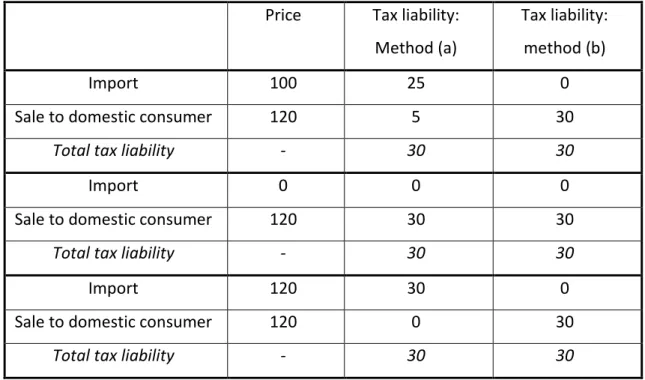
Table 3 illustrates this key point that – given universal adoption of a DBCFT, albeit at different rates in different countries - understating or overstating intra-group prices makes no difference to the overall tax liability under the DBCFT. The company imports the good from an affiliate in the same multinational group, and then sells it to a domestic third party – for example, a final consumer or an unrelated party - for a price of 120. Both countries operate a DBCFT, and so there is no tax on the export in the exporting country. The tax in the importing country - assumed to be at 25% - can be thought of in two ways, as described above. In column (a) the import is taxed, and the cost of the import set against the tax charge on the sale to the final consumer. In column (b), the import is ignored for both purposes.
Suppose that the price at which the good is imported is 100. Then under method (a), there is a tax charge on the import of 25. In addition, there is a tax charge on the profit of the importing company at 25% of sales less imports - a tax liability of 5. Total tax is therefore 30. Under method (b), the import is simply ignored, and there is a tax charge on the total value of the sale to the domestic consumer, which also generates a total tax liability of 30. This shows the irrelevance of the import price of the import for the total tax charge. Even if the price were set to zero, or 120, the total tax charge would remain 30.
The netting out of business-to-business transactions also makes the DBCFT robust to avoidance strategies used in the context of formulary apportionment systems which are based on the destination of sales.35 Under a formulary apportionment system, a
highly profitable company could sell its products in a fully arms-length transaction to a much less profitable retail company in a low-tax jurisdiction. As a result, only the low rate of tax would be applied to the company’s high profits. The retail company could 34Imports by final consumers would remain taxable.
35By this is meant a system under which the consolidated profits of a multinational are allocated for taxation across jurisdictions according to the share of each in its total sales.
sell on the goods into a high tax jurisdiction and face tax at a higher rate, but this would only apply to its relatively low profit. The overall tax liability may then be considerably lower than if the original company had sold directly into the high tax jurisdiction. This would not happen under a DBCFT. In that case, the full value of imports into the final country of destination would be subject to tax in that country.
Table 3. DBCFT liabilities in importing country, with different prices for imports
Price Tax liability: Method (a)
Tax liability: method (b)
Import 100 25 0
Sale to domestic consumer 120 5 30
Total tax liability - 30 30
Import 0 0 0
Sale to domestic consumer 120 30 30
Total tax liability - 30 30
Import 120 30 0
Sale to domestic consumer 120 0 30
Total tax liability - 30 30
A third common strategy for profit shifting under the existing system is to place highly valuable intangibles in low tax jurisdictions. Other companies within the multinational group that are located in high tax countries may then pay royalties or license fees to the company that owned the intangible asset in return for their use. These payments receive tax relief at the high rate of tax and are liable to tax on the receipt at the low rate of tax. Again, this would not happen under a DBCFT.
The reason is the same as that given above. The purchase or sale of the right to make use of the intangible asset would naturally be treated in the same way as the purchase or sale of a good. This is, then, an import into a destination country, and as such, would be liable to tax in that country. If A (located in a high tax jurisdiction) acquires a license from B (located in a tax haven) to use its IP, this would give rise to a
tax liability in the high tax jurisdiction. But the tax paid on that import would be deductible as a cost for A. Just as above, these two elements would exactly balance out. An alternative arrangement, as with other imports by taxed businesses, would be simply to disregard the import and the payment for it. In any case, since there are no real tax consequences of the transaction, the incentive to locate intangible assets in a low tax country would disappear under the DBCFT.
Finally, note that the DBCFT puts considerably less pressure on the notion of corporate residence than does the existing system, though at the cost of introducing a different notion of nexus than exists in current tax treaties. The tax base is essentially domestic sales less domestic expenses. There is no requirement for corporate residence to identify either sales or expenses. Sales are taxed in the country of the consumer, irrespective of corporate residence. And expenses are allowed in the country in which they are incurred, also irrespective of corporate residence.
The DBCFT is not perfectly robust to avoidance and evasion. Indeed, certain forms of evasion commonly found in the VAT sphere, such as fraudulently disguising domestic sales as exports, can be expected. However, if adopted in all countries the DBCFT is robust to the most significant and widespread avoidance mechanisms including locating intangible assets in tax havens, transfer pricing abuse and shifting profit through the use of debt. Their elimination is a major strength of the DBCFT.
c. Ease of Administration
We examine issues of implementation in detail in Section IV below. Here we simply outline the main specific features that differentiate the DBCFT – since the DBCFT eliminates the need for swathes of complex legislation which burdens the current tax system and increases compliance costs on taxpayers and revenue authorities alike. Under the R-based cash flow tax, since debt and equity are treated in a neutral fashion, there is also no need for complex rules that police the border between the two. Further, due to the immediate expensing of all asset purchases under a cash-flow tax no rules are required to distinguish between assets that are expensed and those that are capitalized. It follows that there is also no need for complex depreciation schedules or to keep track of individual assets and their bases.
The destination basis also brings extensive simplifying benefits. It eliminates the need for some of the most significant, yet complex and lengthy, extant anti-avoidance rules. These include including exit taxes, transfer pricing, Controlled Foreign Company, thin capitalisation and anti-inversion rules. These rules require constant updating to meet new planning strategies and their application is notoriously costly and burdensome. Their elimination thus provides significant benefits of simplification to both governments and businesses.
On the other hand, the DBCFT does raise some significant administrative challenges which are new to corporation taxes, but well known in VAT. One is the need to distinguish between real and financial flows; this is addressed in Section III. Others include the challenges posed by negative liabilities and the need to levy a tax in the place of sale, a particularly difficult problem for services and digital products; these are addressed in Section IV.
d. Fairness
What ultimately matters for the fairness of any tax system, of course, is how it affects people; and corporations are not, in other than a legal sense, people. But how we tax corporations does have implications for the fairness with which the tax burden is shared, both within and across countries. This section looks at the DBCFT in this light, and at the particular question of the suitability, or not, of the DBCFT for developing countries.
Incidence of the DBCFT
The effective incidence of the DBCFT – who bears the burden of this tax – can be most easily understood by recalling from Section I.3 that the DBCFT is equivalent to a VAT plus a matching deduction for wages and salaries. The incidence of the DBCFT will thus be the same as that of a tax on domestic consumption net of a subsidy, at the same rate, to domestic wages or, equivalently, a tax on domestic consumption financed by resources other than wage and salary income. These resources will have three components.
First, in transition they will include returns to previous investments. Second, on an ongoing basis and in present value terms, rents: the return on investments in excess of
that needed to cover the normal return to capital. But the precise identity of who bears this element of the tax depends on the nature of the exchange rate or price adjustment, discussed earlier.
Third, in the context of a country with a fixed exchange rate, introducing a DBCFT would tend to push up prices and wages. So the tax would be borne by any domestic consumption financed from income or resources other than wages and salaries, including domestic residents holding shares in companies subject to the DBCFT. This could also include individuals (typically the more elderly) consuming from their wealth, earning a minimum wage or in receipt of government transfer payments, such as pensions. Neutralizing some of the possible adverse distributional effects may require indexing such payments, and any minimum wage, to consumer prices.
But by contrast, in a country with a flexible exchange rate, nominal domestic prices would be unaffected; their value would change relative to world prices through an appreciation of the exchange rate. In this case, we would expect only domestic residents owning firms subject to the DBCFT and those holding assets denominated in the foreign currency to bear any tax burden;36 those consuming from wage income
would again be unaffected. Note, though, that there are other valuation effects of adopting the DBCFT (rather than simply raising the tax rate under the DBCFT, as in Table 2) that must be taken into account. In particular, a move to immediate expensing of domestic investment lowers the value of existing capital relative to new capital, and a shift away from taxing foreign source income may raise the value of offshore assets. A tax on consumption not financed by labour earnings would be expected to fall on the affected consumers, except to the extent that these consumers respond to the imposition of the tax. In general, these consumers may seek to avoid a tax on their consumption from non-labour income by changing their behaviour.37 For the DBCFT, however, some of the channels of response normally associated with corporate taxation would be absent. In particular, because the cash-flow tax base excludes the normal return to saving, there would be no incentive to save less;38 and, because of
36Non-residents holding assets denominated in the currency of the DBCFT country, on the other hand, would receive a benefit. And of course changes in the exchange rates may have other effects through contracts or pricing specified in its currency.
37If their demand for consumption goods is inelastic, then standard incidence analysis would conclude that these consumers bear the entire tax burden.