REMOTE POLICY ENFORCEMENT
USING JAVA VIRTUAL MACHINE
C
ONTENTS
1 INTRODUCTION 1 1.1 Trust Model . . . 2 1.2 Our Approach . . . 3 1.3 Thesis Contribution . . . 4 1.4 Structure of Dissertation . . . 52 BACKGROUND AND RELATED WORK 7 2.1 Security Policies . . . 7
2.1.1 Access Control . . . 8
2.1.2 Usage Control . . . 10
2.2 Information Flow Control . . . 13
2.2.1 Information Flow Problem . . . 13
2.2.2 Managing Information Flow . . . 16
2.2.3 Covert Channel and Noninterference . . . 20
2.3 Java Security . . . 22
2.4 Trusted Computing . . . 25
2.4.1 Trusted Platform Module . . . 25
2.5 Summary . . . 28
3 TRISHUL 31 3.1 Architecture . . . 31
3.1.1 Design . . . 32
3.1.2 Handling Implicit Flows . . . 34
3.2 The Policy Enforcement Engine . . . 36
3.2.1 Actions . . . 38
3.2.2 Abstract actions . . . 38
3.2.3 Taint Labels & Patterns . . . 40
3.2.5 Policy Engine Tree . . . 44
3.2.6 Policy Engine Security . . . 45
3.3 Implementation . . . 46
3.3.1 Java Architecture . . . 47
3.3.2 Taint Propagation . . . 49
3.3.3 Implicit Flows . . . 51
3.3.4 Manual Taint Propagation . . . 58
3.3.5 Exception Handling . . . 60
3.3.6 Just-in-Time Mode . . . 63
3.3.7 Trishul-P . . . 70
3.3.8 Platform Integrity . . . 72
3.4 Example Applications . . . 73
3.4.1 Protecting system password file . . . 73
3.4.2 Multi-Level Security Systems . . . 75
3.5 Performance . . . 77
3.5.1 Taint Propagation Overhead . . . 78
3.5.2 Load-time Overhead . . . 79
3.5.3 Policy Engine Overhead . . . 80
3.5.4 Optimisations . . . 81
3.6 Related Work . . . 83
3.7 Conclusion . . . 89
4 APPLICATION: DIGITAL RIGHTS MANAGEMENT 91 4.1 Introduction . . . 91
4.2 Modelling DRM . . . 95
4.2.1 The UCONABCModel . . . 95
4.3 Trishul-UCON Architecture . . . 97 4.4 Enforcing DRM Policies . . . 102 4.4.1 Pay-per-use . . . 104 4.4.2 Use N times . . . 106 4.4.3 Metered payment . . . 107 4.5 Performance . . . 109
4.6 Trusted System Considerations . . . 111
4.7 Related Work . . . 113
CONTENTS V
5 APPLICATION: WEB SERVICES 117
5.1 Web Services . . . 118 5.2 Scenario Overview . . . 122 5.2.1 Policy Classes . . . 122 5.2.2 Threat Model . . . 123 5.3 Trishul-WS . . . 124 5.3.1 System Architecture . . . 124 5.3.2 Properties . . . 126 5.3.3 Functional Requirements . . . 127 5.3.4 Platform Security . . . 128 5.3.5 Implementation . . . 130
5.3.6 Advertising Enforceable Policies . . . 132
5.4 Related Work . . . 132
5.5 Conclusion . . . 134
6 SUMMARY AND CONCLUSIONS 137 6.1 Summary . . . 137
6.2 Conclusions . . . 139
6.3 Future Work . . . 140
BIBLIOGRAPHY 143
L
IST OF
F
IGURES
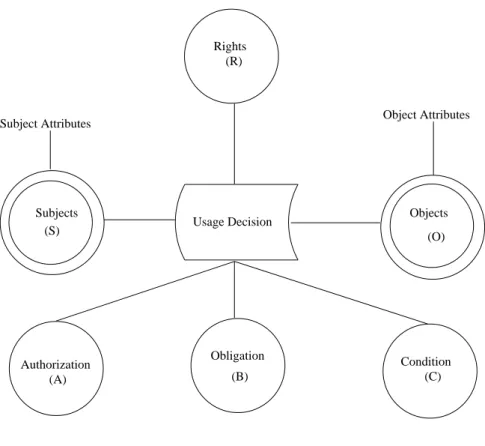
2.1 Components of the UCONABCmodel. . . 13
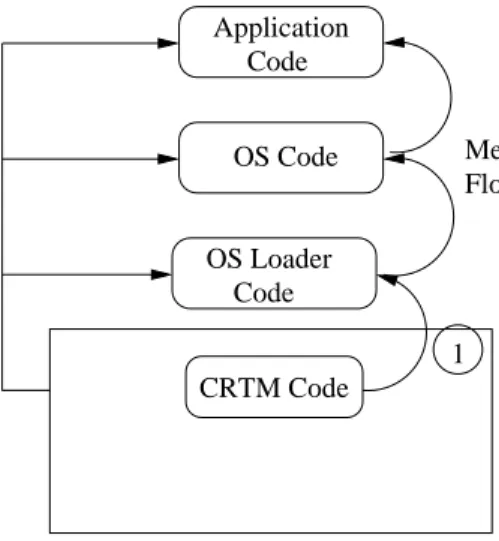
2.2 Extending trust from trusted (root of trust) hardware to the higher level of application code using induction of digest measurement. . . 27
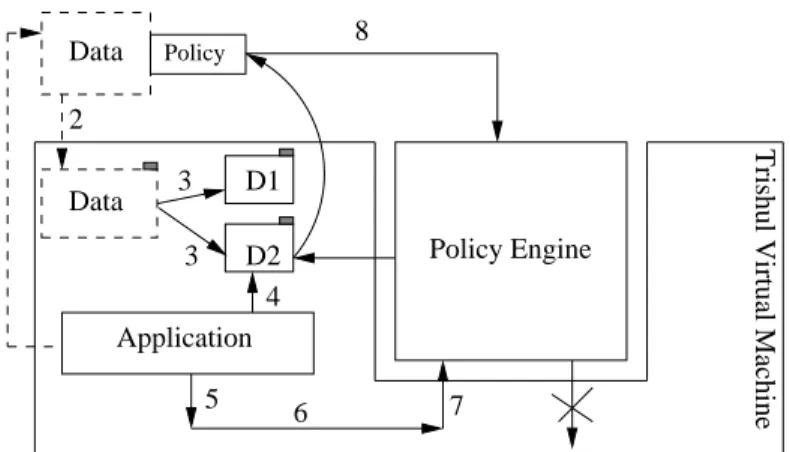
3.1 Trishul Architecture. . . 33
3.2 Internal layout of a JVM. . . 49
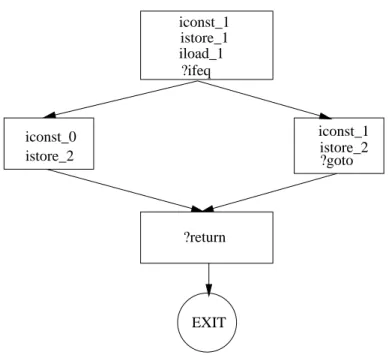
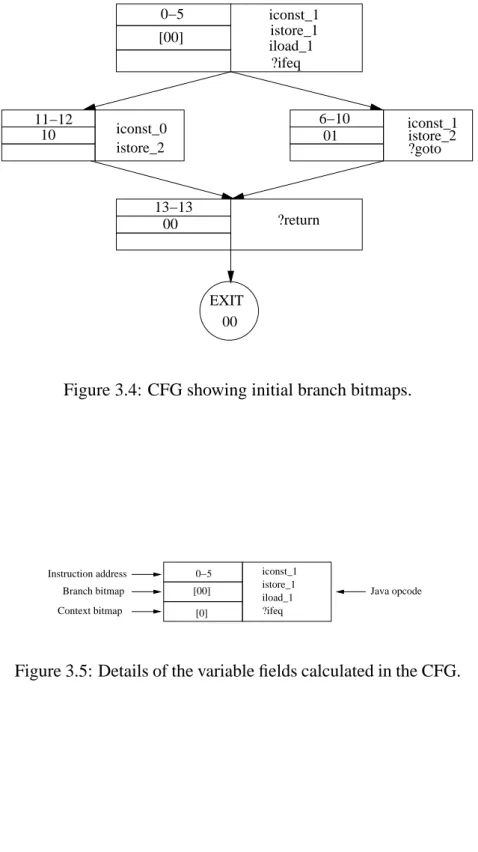
3.3 Control-flow graph created from Listing 3.11. . . 53
3.4 CFG showing initial branch bitmaps. . . 54
3.5 Details of the variable fields calculated in the CFG. . . 54
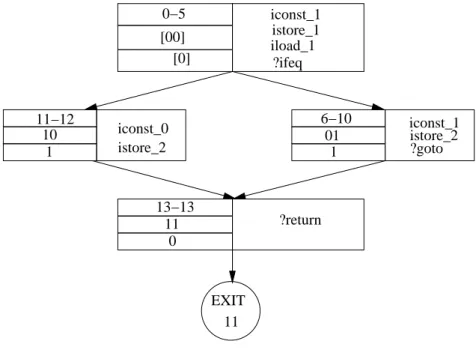
3.6 CFG showing final branch bitmaps and context bitmaps. . 55
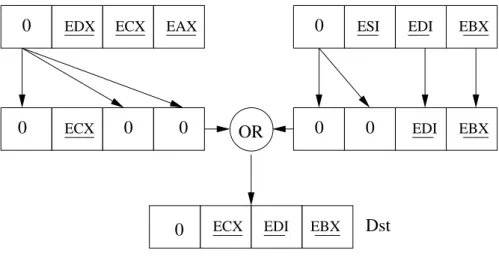
3.7 Moving taint of ECX (ECX) to taint of ESI (ESI) using SSE registers in 3 operations. . . 65
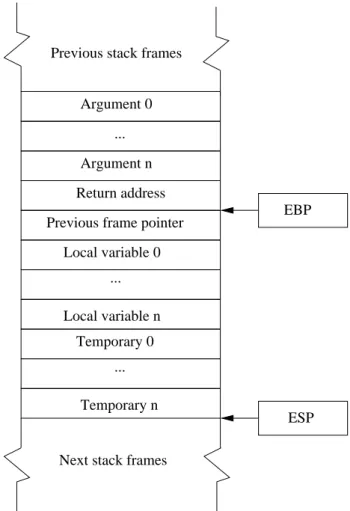
3.8 Kaffe stack frame. . . 66
3.9 Trishul’s stack frame holding taints, denoted by underlined names. . . 67
4.1 Stakeholders involved in a typical DRM setup. . . 92
4.2 Components of the UCONABCmodel. . . 96
4.3 A schematic representation of (a) T-UCON intercepting application methods calls and (b) various components of the Trishul-UCON architecture. . . 98
4.4 Working of the Obligation Module of T-UCON. . . 103
4.5 Implementing pay-per-use policy using T-UCON. . . 105
4.6 Implementing the ‘play N times’ policy using T-UCON. . 108
4.7 Implementing metered payment policy using T-UCON. . . 109
5.1 The use of SOAP messages between web service entities. . 119
5.3 Example scenario providing motivation for the policy en-forcement architecture. . . 122 5.4 The architecture of Trishul-WS designed to develop policy
enforcement in web services framework. . . 125 5.5 Steps involved in the platform attestation process. . . 129
L
IST OF
T
ABLES
2.1 An access control matrix with two subjects (users) and three objects (files). . . 8 3.1 Reasoning of how the concept of branch context taint is
used to capture the indirect flow present in Listing 3.1. . . 35 3.2 Reasoning of how the concept of branch context taint is
used to capture the implicit flow present in Listing 3.2. . . 36 3.3 Performance of prime number generator when run in Kaffe
and Trishul JVMs. . . 78 3.4 Time taken read and print a 10Mb file when run in Kaffe
and Trishul JVMs. . . 79 3.5 Runtime overhead due to load-time analysis of an
applica-tion printing a specific date. . . 79 3.6 Memory overhead due to load-time analysis. . . 79 3.7 Runtime overhead due to Policy engine. . . 80 4.1 Performance comparison of T-UCON prototype in
pay-per-view microbenchmark. . . 110 4.2 Performance comparison of T-UCON prototype in
pay-per-view application run. . . 110 5.1 Performance comparison of normal web service
process-ing time and that usprocess-ing the T-WS policy enforcement ar-chitecture for policy in Listing 5.2. . . 132
C
HAPTER
1
Introduction
As the reach and power of the Internet and networked systems widen, and thanks to the emergence of paradigm shifting technologies and delivery models like Web Services (WS) and Software as a Service (SaaS), ever larger numbers of users are sending huge amounts of private data to remote systems that they do not have any control over. On the other side of the same technology-coin, commercial digital content distributors are using the wide reach of the Internet to help disseminate digital content like music, videos and software to individual client machines, be it generic desktop machines or consumer appliances like multimedia players.
In general, these data and content providers have a strong interest in protecting their data from being misused. They would like their data to be used as specified by them, accessible only to explicitly allowed external parties and even after said access has been granted, allowing only specific actions to be performed on the data.
These access and usage specifications are usually expressed in the form of policies which can then be bundled with the data that they govern and sent over to the remote machines.
Several previous works have focused on how to express the restrictions that the policies define at the level of specification languages, while oth-ers have considered the problem from a more theoretical angle by formally defining models and classes of the policies that can be enforced based on various assumptions and capabilities of the system. Fewer works have, however, investigated the actual system level requirements involved in en-forcing these policies on the remote machines. This is the angle from which we approach the problem in this dissertation.
PROBLEM STATEMENT
The broad problem statement that the work reported in this dissertation addresses can be expressed as follows:
Given a data object that the user wishes to submit to an remote host and a policy that defines access and usage restrictions on the data object, design and implement an architecture that enables the enforcement of these policies at the remote host.
While the development of a fully functional policy enforcement frame-work would involve several complementary areas of research including the policy expression language, policy modelling, formal analysis and the sys-tem architecture development, it is only the last of these research areas that form the subject of this dissertation. Where possible, existing works in the other areas are leveraged to fill in the gaps in the rest of the framework.
1.1. TRUST MODEL
In order to clarify and understand the requirements of the system that needs to be implemented at the remote host and the measure of trust that the data provider must place on the remote party, a judicious threat model that captures the interest of the various parties involved is necessary.
While the specifics of the threat model would vary with the different application scenarios’ environment, like the open or closed nature of the remote host environment, certain characteristics of the threat model can still be generalised for most policy enforcement scenarios.
The data that are submitted to the remote host is assumed to be of high value to the data provider, like financial, personal or similar. Hence the data provider is trusted to compose the right access and usage policies. At the same time, the data provider is assumed not to have any direct control over the working of the remote host.
The entity in charge of the remote host (user or administrator) is as-sumed to have its own interest at heart when dealing with the data provider and it is assumed to be untrusted from the data provider’s point of view. It has varying degree of control over the run-time environment of the remote host. On open systems like a typical desktop or a server, the entity has almost full control over the hardware and the software that power the host. However, in the case of closed application devices like mobile phones or
SEC. 1.2 OURAPPROACH 3
multimedia players like iPod, the entity has limited control over the ma-chine’s hardware and the software. In general, the remote host is assumed to be capable of running any application locally and these applications are not trusted to adhere to the policies defined by the data provider.
The remote host is assumed to run a middleware, developed as part of this dissertation work, that enable the enforcement of the policies. This middleware, the operating system and all the hardware below it is assumed to be trusted to behave as expected. In order for the remote host to obtain the policy-attached data, it needs to prove to the provider that it is running this stack of trusted hardware and software layers. However, as mentioned before, the application is assumed to be untrusted in nature.
Thus a “Trust but verify" mantra sums up the trust relationship of the provider with the remote host. This ability of the data providers to verify the environment of the remote system, termed attestation in literature, is a strong assumption and requirement, which though discussed in detail later on, is not the primary focus of this work.
1.2. OUR APPROACH
The policy enforcement problem, as defined here, can be approached from various angles and using various levels of abstraction. Some of the earlier works and systems consider enforcing policies for specific applica-tions or classes of applicaapplica-tions [Jobs, 2007; Microsoft Corporation, 2009]. In these works the logic required to make enforcement decisions are built into the application code itself. Others, on the other hand, take a much lower level approach and consider the problem at the level of operating system, exploring intricacies at the level of operating system processes, describing which process can communicate with which other processes or access specific input or output channels [Zeldovich, 2007].
Based on the level at which policy enforcement is performed, the classes of policies that can be interpreted (and hence enforced) also varies. Oper-ating system level enforcement limits the enforcement classes to those that are readily describable at the process and system call level, while those at the level of specific applications confine themselves to those applications and their semantics alone.
In this dissertation, we consider the policy enforcement problem from a data-centric view point, assuming that the policy is attached to the data
that are operated on by the applications. Our work approaches the prob-lem at the middleware level, with the intention of exploiting the features of the higher and lower level solutions. This approach allows the architec-ture to enforce data-specific, and not application specific, policies across multiple applications while at the same time not running the risk of losing application-semantic level information that would be valuable in enforcing a wider variety of policy classes. In particular we consider the enforcement of policies for applications run in the Java Virtual Machine (JVM) [Gosling et al., 1996] environment. The rationale for this choice and details of the design of such an architecture are discussed in detail further on in this dis-sertation.
One of the key concepts that we leverage in our architecture is that of Information Flow Control (IFC), which deals with restrictions placed on how information can be transferred from one entity to another. While IFC as a research topic can be investigated from various angles, our work considers it from the perspective of the application’s programming lan-guage semantics. Works in the area of IFC can be divided into two broad approaches–compile time and run time. In compile time systems, the in-formation flow constraints are checked and verified at the time of com-pilation. Run-time systems, on the other hand, perform these checks dy-namically during the execution of the application. While each approach has its pros and cons, our architecture uses a hybrid approach, using the run-time mechanism enhanced with static control flow analysis, due to two main considerations: the ability of the enhanced run-time system to work without having access to the actual source code of the application and the larger classes of policies that can be enforced using this hybrid run-time approach.
1.3. THESIS CONTRIBUTION
In this dissertation we present the design, implementation and applica-tion of a Java Virtual Machine based policy enforcement architecture. The contributions of this work are as follows:
• We examine in detail the previous work done in the problem space of policy enforcement and highlight the gaps our work aims to fill. • We present the design and implementation of a JVM based
informa-SEC. 1.4 STRUCTURE OFDISSERTATION 5
tion flow control based middleware architecture aimed at enforcing policies associated with data objects.
• The middleware developed is used to implement an application inde-pendent Digital Rights Management (DRM) system using a widely studied usage control model as its basis.
• The JVM framework is also used to design a Web Service architec-ture capable of enforcing usage policies associated with the submit-ted data, as specified by the data provider.
1.4. STRUCTURE OF DISSERTATION
The rest of the dissertation is organised as follows.
Chapter 2 introduces the concept of access and usage control and infor-mation flows and outlines the existing research work in these areas within the problem space of this dissertation. We highlight the limitations of the current state of the art and explain the need for the work that this disserta-tion undertakes.
In Chapter 3 we present the design and implementation of the JVM based information flow control system, named Trishul, that forms the core of the dissertation. We explain in details the various design and implemen-tation choices made during the course of the work and how they influence the performance of the achieved system, which is investigated in detail us-ing microbenchmark performance measurements reported in the chapter.
In chapters 4 and 5, we present the applications of the Trishul frame-work in building policy enforcement systems in various application scenar-ios:
• In Chapter 4 we present the implementation of a Digital Rights Man-agement (DRM) system using the theoretical concepts proposed in a widely researched usage control model, UCONABC, and the Trishul
framework.
• In Chapter 5 we show how Trishul can also be used to implement a policy enforcement architecture for Web Services, the core compo-nents of the Service Oriented Architecture paradigm.
Finally, we conclude the dissertation in Chapter 6. There we review the contributions of the dissertation work, the lessons learnt and point out directions for future work.
C
HAPTER
2
Background and related work
In this chapter we discuss the background work related to the area of se-curity policy enforcement. We start with an introduction of basic access control and usage control policies as they form the core of any policy enforcement system. We then introduce the concept of information flow control. Information flow control plays an integral part in the systems we consider in this dissertation as a form of very fine grained abstract access control policies. We look at various types of systems that enforce these flow-based policies and discuss their key differences. A discussion on the security of Java architecture and that of trusted computing systems is also presented in this chapter.
2.1. SECURITY POLICIES
In this dissertation, a broad definition of a security policy as proposed in [Bishop, 2002] is used:
A security policy is a statement that partitions the states of the system into a set of authorised, or secure, states and a set of unauthorised, or insecure, states.
This definition allows for categorisation of security policies into three: confidentiality policies which deal with (read) access to restricted tion, integrity policies which deal with who can alter restricted informa-tion and how it can be transformed and availability policies which specify which entities can have access to specific system resources [Bishop, 2002]. In this work, we concentrate on the enforcement of confidentiality and
availability policies and integrity policies are not discussed further on in this dissertation. Interested readers are referred to [Bishop, 2002] for a systematic analysis of this category of policies.
2.1.1. Access Control
Access control policies, a form of availability policies, define which sub-jects can gain access to a restricted object, usually files, processes or ma-chine resources like disk, network and CPU.
An access control matrix model, proposed by Lampson [Lampson, 1971] and later refined by Denning and Graham [Graham and Denning, 1971], provides the simplest framework for such a policy. The framework describes the rights R of domains over resources using a matrix represen-tation A, an example of which is shown in Table 2.1. The protected entities (files in this case) are termed objects O while subjects S denote the set of active players in the system like users and processes. Each element a[s,o]
∈A denotes the rights exerted by the subject on the object. object→
subject↓ file 1 file 2 process 1 user 1 read, write read, execute execute
user 2 read write
-Table 2.1: An access control matrix with two subjects (users) and three objects (files).
Access control policies can be divided into two broad categories. In discretionary access control (DAC) [US DoD, 1985], individual users are given control over specifying who can access a particular resource they own. On the other hand, in mandatory access control (MAC) [US DoD, 1985], the system specifies access control restrictions associated with an object and the individual user is not allowed to change the settings. Mod-ern operating systems in general enforce DAC, using a set of rules which describe conditions under which the access is allowed. When the access constraints are specified in terms of the identity of the subject, these kind of policies are know as identity based access control (IBAC) policies.
Originator controlled access control (ORCON) [Bishop, 2002] is a hy-brid form of the DAC and MAC systems proposed to model scenarios
SEC. 2.1 SECURITYPOLICIES 9
where the originator of the objects retain control over them even after they have left the originator. In ORCON, implemented as a decentralised access control system, the originator1of an object controls who can access it. In such a model, the owner of the object cannot override the originator’s set-tings on the access control restrictions on the object. Thus if the originator has specified that subjectS1cannot read a particular file, the owner cannot
overrule this and provideS1with the read rights.
Often, the role played by the subject in an organisation–more than the identity of the subject–defines the access control rights he or she enjoys. For example, a company policy could be defined that the CEO of the com-pany should have access rights to reports marked ‘top-secret’, while the manager of a group should have access to only reports marked ‘secret.’ Instead of associating the read right to the top-secret to a specific subject whose identity might change, the right is associated with the role of the CEO and the subject is then assigned this role. In this way, a change in the role can be reflected by simply changing the access matrix instead of hav-ing to re-assign the role to all the subjects. Such a model in which the role (a set of job functions) of the subject defines the access rights to restricted objects is termed role-based access control (RBAC). RBAC can be consid-ered as a form of MAC model with DAC providing further restrictions on the allowed actions.
Bell-LaPadula [Bell and LaPadula, 1975] is a hybrid MAC-DAC ac-cess control policy model aimed at enforcing a confidentiality policy in a military-like environment for subjects, which constitute active components in the system, and objects, which form the passive entities. In this model, a set of security clearances is associated with the subjects and security clas-sifications with the objects. The “need to know” principle is captured using the concept of categories for each security classification. Objects can be placed in several of these categories and subjects are given access to power set of the category set. Each security clearance/security classification and security category form a security level.
Let us denote L(S) = ls as the security clearance setting the
linear-ing orderlinear-ing property of the classification, that is, for all of subject S and L(O) =loas the security classification of object and security classifications
has the property li,i=0,1, ...k−1,li<li+1.
The Bell-LaPadula security model is described using two properties: 1Note that originator need not be the owner of an object.
• The Simple Security Property states that a subject at a given security level may read an object at the same or lower security level and if it has discretionary read access to the object. This property is often described as the “no read-up.”
• The *-Property states that a subject at a given security level cannot write to any object at a lower security level. This is often described as the “no write-down" property.
“Unclassified,” “Confidential,” “Secret" and “Top Secret” is one exam-ple of one such classification. Consider the examexam-ple of subjectS1 with a
clearance of “Top Secret” and S2 with clearance “Secret” and objectsO1
with security classification “Top Secret” andO2 with classification
“Con-fidential.” As per the simple security principle, S1 can read both O1 and O2whileS2can read onlyO2. *-property places the restriction thatS1can
write intoO1but notO2whileS2cannot write intoO1orO2.
However, there are occasions where a subject at a high clearance has to communicate with a subject with a lower clearance. The Bell-LaPadula restrictions prevent this from happening. Instead, in order to allow such a communication, the concept of maximum security level and current se-curity level are introduced in the model. A subject is given a maximum security level clearance to which it can raise itself to but at the same time is able to lower his current security level to a lower value than this maximum in order to communicate with another subject at that lower security level. Of course, with the current security level, the associated access privilege will be reduced.
Over the years, several other access control models have been proposed and studied, including Biba [Biba, 1977], LOMAC [Fraser, 2000], System Z [Mclean, 1987] etc. These are not discussed here for reasons of brevity.
2.1.2. Usage Control
Since its introduction in early military systems, the use of authorisation has been a means to limit access to resources. However, researchers have been coming to the realisation that the traditional classic models are falling short of serving the needs of the modern distributed computing environment and associated work-flow management.
Once a subject has been given access to the object, one may still wish to control the way in which the object is used by the subject. Classically, this
SEC. 2.1 SECURITYPOLICIES 11
had to do with the time allocated to the access of the object. For example, a subject which has been granted access to use the network should not be allowed to hog the resource in such a way that no other subjects can gain access to it. In recent years, the use of usage control has expanded to encompass issues like privacy and intellectual property protection. For example, a subject who has been granted access to a piece of data should still be restricted on what operations can be performed on the data. For example, a policy could state that playing an MP3 file could be allowed but not more than three times.
One of the more recent and coherent theoretical modelling of the vari-ous aspects of usage control is that of UCONABCmodel.
UCONABCModel
The core aspect of the UCONABCmodel proposed by Park and Sandhu [Park
and Sandhu, 2004] deals with the decision-making aspects of the subjects’ usage of the objects. Subjects and objects are endowed with attributes that capture the properties and/or capabilities of these components. One of the main innovative aspects of the UCONABCmodel is its concept of mutable
attributes of the subjects and objects. While earlier models considered only immutable attributes that can only be modified by the manual intervention of an administrator, like the clearance of the subject or the classification of the object, in this model subject and object attributes can be modified as a result of the exercise of a right by the subject. This allows the frame-work to model modern applications like DRM, where the subject attributes capture variables like credit balance and object attributes the variables like cost per-use.
Subjects can be either provider subjects, consumer subjects or identifiee subjects. Provider subjects are the provider of the objects and hold some limited rights on it while the consumer subjects are the ones that exercise most usage rights on the objects. The identifiee subjects are those entities that are identified by the object, for example patients in medical records.
The subjects exercise privileges termed rights. However, unlike the traditional predefined access matrix based rights, the rights in UCONABC
model are approved/provided in real-time when the access is attempted after evaluating various constraint conditions. This is similar to the task-based authorisation [Thomas and Sandhu, 1998] model, which was pro-posed as an extension to the traditional model in which authorisation
deci-sion is made during the completion of the task. In it, the rights are created and consumed just-in-time and the exercise of a consumable right can in turn enable other rights for different subjects and objects.
In UCONABC, the decision to allow the exertion of the rights by the
subject on the object are based on—Authorisation (A), oBligation (B) and Conditions (C).
Authorisation evaluates the rights requested, the subject and the ob-ject attributes and provides decision on whether to allow it or not. These authorisation checks could be performed before the rights are granted (pre-authorisation or preA) or while the rights are being exercised, at periodic intervals (ongoing-authorisation or onA). Obligations [Park and Sandhu, 2002], an aspect not considered in most traditional access control models, specify the mandatory requirements that the subjects have to perform be-fore access is provided (preB) or during the exercise of the rights (onB). For example, accepting the End User License Agreement is an obligation, specifically a preB. Conditions capture the system and environment states that influence the decision to allow a right. Unlike authorisation and obli-gation evaluations, condition evaluations do not lead to the update of the subject or object attributes. The associated condition variables are also not mutable.
The primary components of the framework and their relationships with each other are illustrated in Fig. 2.1.
Denoting the mutability of the attributes by 0 for immutable, 1 for pre-updates, 2 for ongoing and 3 for post-pre-updates, the core UCONABCmodels
can be represented as preA0, preA1 and preA3, onA0, onA1, onA2, onA3,
preB0, preB1, preB2, preB3, preC0and onC0.
UCONABC model has been used in modelling various scenarios like
resource sharing in collaborative computing systems [Zhang et al., 2008a] and data control in remote platforms [Berthold et al., 2007a]. Work has also been done in expanding the scope of the model. Katt et al. [Katt et al., 2008] has extended the original UCONABCmodel by adding the notion of
post-obligations using a continuity-enhanced usage control enforcement model and adding continuous usage sessions.
SEC. 2.2 INFORMATION FLOW CONTROL 13 Authorization (A) Obligation (B) Condition (C) Rights (R)
Usage Decision Objects
(O) Subjects
(S)
Subject Attributes Object Attributes
Figure 2.1: Components of the UCONABCmodel.
2.2. INFORMATION FLOW CONTROL
When a security policy is associated with a data object, it becomes im-perative to trace the flow of the data within the system as it is used by various applications and that the access to this data object by these appli-cations be mediated as per the policy restrictions. The field of work related to information flow control studies this requirement and a brief discussion on it is presented here.
2.2.1. Information Flow Problem
In the context of this dissertation, the definition of information flow closely follows that in [Haldar, 2006]:
Information is said to flow from an entityA to another entity Bif A
An entity is any subject in the system model, for example two processes running in the system.
Denning formally defined a control flow model FM [Denning, 1976] as FM=hN,P,SC,⊕,→i
N denotes a set of storage objects that receive and store data. P is a set of processes that move information around in the system. SC is defined as a set of security classes that each object in N is bound to. This security class also includes L, the lower bound of the security classes which is attached to objects in N by default.⊕is the binary operator that defines the security class of the result of a binary operation performed on any pair of operand classes. In most cases it is equvalent to an OR operation. →denotes the legal can-flow of information from one security class of object to another. Without losing generality and specifically in the context of this dissertation, the objects that form N can be considered as program variables, and in certain instances, as seen later on, blocks of program code.
Many programs perform their computation using one or more variables as operands and store the resulting values into another variable. For ex-ample, in the pseudo-code y=x, when the value of x is transferred to y, information is said to flow from object (variable) x to object (variable) y and the flow can denoted as x⇒y [Denning, 1976].
Flows due to codes like y=x are termed explicit flows, more accurately explicit direct flows after the convention in [Guernic et al., 2006], because the flow takes place due to the explicit transfer of a value from x to y. On the other hand, consider the code shown in Listing 2.1. Even though there is no direct transfer of value from x to y, once the code is executed, y would have obtained the value of x. Listing 2.2 shows another example of a convoluted information flow causing code fragment. At the end of the execution of this code fragment, boolean variable b ends up having the same value as boolean a. In traditional literature these two examples are grouped together as examples of implicit flows but to differentiate the level of complexity needed to trace information flow in them, we follow the convention in [Guernic et al., 2006] and terming the information flow exhibited in Listing 2.1 as explicit indirect flow and that in Listing 2.2 as implicit indirect flow. Thus x⇒y is an explicit indirect flow and a⇒b is an implicit indirect flow.
SEC. 2.2 INFORMATION FLOW CONTROL 15 1 b o o l e a n x 2 b o o l e a n y 3 i f ( x == t r u e ) 4 y = t r u e 5 e l s e 6 y = f a l s e
Listing 2.1: Explicit indirect flow
1 b o o l e a n b = f a l s e 2 b o o l e a n c = f a l s e 3 i f ( ! a ) 4 c = t r u e 5 i f ( ! c ) 6 b = t r u e
Listing 2.2: Implicit indirect flow
Fenton [Fenton, 1974a] proposed a mechanism to handle implicit in-formation flow by adding a new security class for the program counter pc. Whenever a control branch occurs, pc is set to the⊕of the class of objects that form the arguments of the branch decision. Within the branch block, pc is added to every control flow. Thus in the example illustrated in List-ing 2.1, when the i f statement is executed, pc is set to x and y is set to L⊕pc = x. Thus the implicit information flow from x to y is captured by the security label y and the process x→p→y.
However, the proposed solution does not capture the trickier implicit indirect flow shown in Listing 2.2. When a is true, the first i f fails so c remains L. The next i f succeeds and b = pc = c = L. Thus, at the end of the run, b attains the value of a, but b6=a. The same is true when a is f alse. The underlying problem is that even though the first branch is not taken, the very fact that it is not followed contains information, which is then leaked using the next i f .
A trivial (and ineffective) approach to this problem is to ignore it, as done by Beres and Dalton [Beres and Dalton, 2003]. Fenton [Fenton, 1973] and Gat and Saal [Gat and Saal, 1976] proposed a solution which works by restoring the value and class of objects changed within the branch struc-ture, back to the value and security class it had before entering the branch. This however would not work in practice since existing application codes routinely use similar control structures without paying any consideration to information flow leaks.
Aries [Brown and King, 2004] takes a more drastic approach wherein a write to an object within a branch structure is disallowed if its security class is less than or equal to the security class of the program counter, pc. Thus, in the previous example if a is f alse, when the program tries to write to c, the compile time system prevents it from doing so, since c’s security class L<=pc (= a). This approach works only if the security classes have an explicit notion of high and low. Furthermore, pc may not be known during compile time.
Denning [Denning, 1975] proposes a more secure approach whereby the compiler inserts an extra instruction at the end of the i f(!a){c=true}
code block to update c to pc (= a). Thus, irrespective of whether the branch was followed or not, the class of object acted upon within the branch is updated to reflect the information flow.
2.2.2. Managing Information Flow
In general, two different approaches have been explored with the aim of providing information flow control—static and dynamic, each associated with compile-time and run-time systems.
In the compile-time approach, applications are written in specially de-signed programming languages in which special annotations are used to attach security labels and constraints to the objects in the program. At compile time, the compiler uses these extra labels to ensure the security of the flow control model. These compile-time checks can thus be viewed as an augmentation of type checking.
We say that x can flow to y, denoted by x→y, iff information in x is allowed to flow into y [Denning, 1976]. In the context of information flow, the necessary and sufficient condition for a system to be considered secure is that, for all (x, y), x⇒y is allowed iff x→y [Denning and Denning, 1977]. When information flow occurs between more than two objects, the compiler has to verify that each of the flows is allowed. For example, in the code segment z=x+y, it is clear that information flows from both x and y to z. A compiler would, in theory, need to verify x→z and y→z. In general, if b= f(a1,a2....an), each ai→b has to be verified. However
for the sake of simplicity, the compiler computes A=a1⊕a2...anand then
verifies A→b.
Compile-time information flow analysis was used by Denning [Denning, 1976; Denning and Denning, 1977] as a mechanism to add a certification mechanism into the compiler analysis phase in order to prove the security of the system. In JFlow [Myers, 1999], an example of a modern compile-time system, the Java [Gosling et al., 1996] programming language is ex-tended in order to let the programmer specify security labels to the objects. At compile time, a special compiler uses the labels to verify the informa-tion security model of the system. Once this has been verified, the code is translated to normal Java code and a normal Java compiler transforms it into bytecode.
SEC. 2.2 INFORMATION FLOW CONTROL 17
Run-time solutions take a different approach by using the labels as an extra property of the object and tracking their propagation as the objects are involved in computation. Instead of verifying x⊕y→z at compile time, the system propagates the security class of the information source into the information receiving object. Thus, the assignment z=x⊕y oc-curs. These assignments however only track the flow of information as it moves through the system. The actual enforcement of security policies is carried out by another part of the system, termed the “Policy Engine.” It intercepts all information flows from program objects (such as variables) to output channels, and allows the flow to proceed only if they are not disal-lowed by the relevant policies. Examples of such output channels are files, shared memories, network writes, etc. Whenever an object x tries to write information into an output channel O, the policy engine checks whether x→O is allowed by the specified policy and if not, the flow is disallowed, by aborting the program or silently returning the failure return value for that execution.
Pure run-time enforcement systems are, however, unable to distinguish implicit information flows and hence control them since by definition these flows exploit execution branches that have not been executed in a particular run, which hence have not been under the scrutiny of the pure run-time system. In order to enforce information flow policies on systems that have implicit flows in it, the policy engine also has to consider the program as a whole and perform a non-realtime analysis of all execution branches in the program.
Fenton’s Data Mark Machine [Fenton, 1974a] was one of the earli-est systems that proposed the use of run-time information flow control to enforce policies. However the machine was an abstract concept and no implementation was attempted. The security mechanism proposed by Gat and Saal [Gat and Saal, 1976] works in a similar fashion. The system however relies heavily on specialised hardware architecture to trace infor-mation flow. The RIFLE architecture [Vachharajani et al., 2004] is a more recent system that implements run-time information flow security with the aim of providing policy decision choice to the end user. They use a combi-nation of program binary translation and a hardware architecture modified specifically to aid information flow tracking. Again, the use of the modified hardware architecture prevents it from being used on a normal machine.
Beres and Dalton [Beres and Dalton, 2003] use the DynamoRIO [MIT, 2009] dynamic instruction stream modification framework to dynamically
rewrite machine code in order to support dynamic label binding. Taint-Bochs [Chow et al., 2004] uses a similar idea to track flow of information within a system but with the aim of tracking how ‘tainted’ data flows in the system. With a similar objective in mind Haldar et al. [Haldar et al., 2005a] use bytecode instrumentation to track tainted data received from the network. They also attempt to extend this idea by using bytecode in-strumentation to perform mandatory access control on Java objects, in or-der to enforce security policies [Haldar et al., 2005b]. However, the level of granularity that is considered (objects) is too coarse-grained to be use-ful in many applications. For instance, they provide as an example a class method that tries to leak a secret file into a public file [Haldar et al., 2005b]. This is prevented by tagging the whole class instance as ‘secret’ as soon as the secret file is read and denying access to public channels once this tag has been set. The coarse nature of this tagging however prevents the class method from accessing any public channels even if the operation it wishes to perform is not on the data read from the secret file.
Recent years have seen considerable interest in research of the compile-time approach towards information flow [Myers, 1999; Sabelfeld and My-ers, 2003]. One of the reasons for favouring the compile-time approach is that all such systems are deemed to be secure even before execution of the program. The belief was that these systems leak only at most one bit of information per program execution and hence are inherently more se-cure than run time systems [Myers, 1999]. However, it has been shown by Vachharajani et al. [Vachharajani et al., 2004] that termination channel attacks, usually considered the Achilles’ heel of run-time systems, can be engineered to leak the same amount of information in compile-time sys-tems as in run-time ones.
One of the most important distinguishing points of the two approaches is the kinds of policies that can be enforced by them. Compile-time sys-tems suffer from the important limitation that the policies are bound to the code in a static manner. There is no easy way to handle scenarios where the policies are not purely information flow based and where different policies need to be attached to different runs of the application using different input data. These system perform policy-code binding early in the lifecycle, pre-venting their use in application scenarios where the policy is bound, not to the application but instead, to the data. An example application where such limitations occur is that of an email system in which each incoming email has its own specific policy, none of which are constant within the same
SEC. 2.2 INFORMATION FLOW CONTROL 19
or across different application runs or known at compile-time. Compile-time systems are also limited by the fact that these systems cannot enforce policies that depend on the dynamic run-time properties of the system and the user. For example, a policy that states “This application should not be allowed to send more than 1 MB of data across the network in one day” cannot be verified at compile time, since the enforcement requires the maintenance of a state that tracks the network usage of the application at run-time. While some sophisticated compile-time systems address this indirectly by checking that the application itself contains the logic to per-form this enforcement check, such a mechanism cannot be per-formalised for a generic class of policies.
Compile-time systems are in general more efficient than run-time sys-tems in that the verification is done only once, at compile time. At run-time, these systems can thus confine themselves to checking the proof of the verification. However, run-time systems perform flow control on each run of the code, slowing the system. The gain in speed enjoyed by compile-time systems however is in exchange for the limitation on the kind of policies that can be enforced. These include policies that depend on the dynamic run-time properties of the system and the user. Similarly, compile-time systems cannot ensure the enforcement of system-wide obli-gations [Park and Sandhu, 2002] that may be stated in the usage policy, unless they can be expressed at compile-time in a static, immutable man-ner.
Compile-time systems are written in special languages; hence most ex-isting applications, written in C, C++, or Java, will have to be rewritten in these languages before they can be verified. Yet another shortcoming is that the verification process is performed by the programmer and the user has to trust the programmer. Although proof carrying codes [Necula, 1997] can be used to enhance the trust, practical use of the concept has not reached a critical mass.
Inline reference monitors (IRMs) [Erlingsson, 2004] use a hybrid ref-erence monitor with post-compile-time (but not strictly run-time) code rewriting approach to the problem of high-level policy enforcement. How-ever, McLean [McLean, 1990] has proved that information flow policies equivalent to noninterference are not properties and Schneider [Schneider, 2000] has shown that execution monitors (IRMs being a form of execu-tion monitors) are only capable of enforcing properties. Informaexecu-tion flow, not being a safety property is not enforceable by the use of reference
mon-itors [Schneider, 2000]. This limitation can be intuitively understood as follows—monitors see executions as a series of executed actions, however in order to enforce strong information flow constraints as discussed ear-lier, the enforcement system must also be aware of actions which were not evaluated by a given execution, something that monitors are not capable of.
What this means at the enforcement level is that because they are un-able to trace information flow within the system, in order to enforce a fine grained policy like ‘do not allow data accessed from /secret to be sent over the network,’ IRMs have to resort to enforcing a coarser policy like ‘do not allow data accessed from anywhere within the local file system to be sent over the network.’ Hence, while IRMs are able to enforce a policy like ‘do not allow transmitting on network once data has been read from /secret,’ because they are unable to trace information flow within the system, they cannot enforce a finer policy like ‘do not allow data accessed from local file system to be sent over the network.’ In the former, all access to net-work resources will have to be denied, irrespective of the origin of the data that are being attempted to be sent, as long as the local file system has been accessed before the network usage. In the latter, network access will be denied only if the data that are attempted to be transferred is actually read from the local file system.
This conservative approach to dealing with the enforcement of infor-mation control policies is by itself a property of compile-time enforcement system, due to its inability to use the information available at runtime.
2.2.3. Covert Channel and Noninterference
Covert channels are a form of hidden communication channels that use the bandwidth of a legitimate channel to leak information about various aspects of the system. A simple example of such a channel is that of a process that opens and closes a file, leading to a lock / unlock being placed on the file, in a timed pattern. This lock on the file can be observed by another process in the system, which may not, in the first place, be allowed to communicate with the first process. However, the former process could represent the in-formation it wants to leak (basically a string of bits) as the timed pattern, allowing the latter to gain knowledge about the information. The Trusted Computer Security Evaluation Criteria [US DoD, 1985] defines two gen-eral forms of covert channels—storage channels where communication is
SEC. 2.3 INFORMATION FLOW CONTROL 21
established by the act of storing or modifying objects, and timing channels in which relative timing of events is used to convey information.
Covert channel attacks are known to be hard to eliminate by the very nature of the attacks. Since the channel from which the covert channel ‘steals’ the bandwidth to leak the information is almost always a legitimate channel and since the subjects have legitimate need and proper authori-sation to access this channel, the use of this channel is hard to control, especially given that the timing pattern could be adhoc and dynamic in nature.
The use of covert channels points to an alternative way of looking at information flow security—in the form of interference at the system level. Viewed this way all channels, and not just those which are explicitly de-signed to conduct information between subjects, need to be controlled for controlling information flow within a secure system.
Goguen and Meseguer define their notion of noninterference [Goguen and Meseguer, 1982] as follows:
“commands in A, issued by users in G, are noninterfering with users in G’ provided that any sequence of commands to the system, given by any users, produces the same effect for users in G’ as the corresponding sequence with all commands in A by users in G deleted”
Though modelling security policies as noninterference assertions and system security as a set of state transitions fulfils strong security require-ments, the sweeping nature of the model makes it difficult to design and implement actual generic systems that satisfy the model at the system level. Hence, in this dissertation, noninterference aspects of security are not con-sidered at the overall system level. Similarly, covert channels are also not considered in this dissertation due to this inherent difficulty in building covert-channel-free as a practical system and its limited usage in the broad scope of policy enforcement. Furthermore there is a large body of existing work that investigates various aspects of this problem [Shaffer et al., 2008; Cabuk et al., 2004].
However, information flow control at the code semantic level as dis-cussed before can itself be modelled as a noninterference system. A nar-rower definition of noninterference stated as follows is however used in these contexts. A process, P is said to be noninterfering if the values of its public (or low) outputs do not depend on the values of its secret (or high) inputs. The system presented in this dissertation can be used to enforce/im-plement such a noninterference policy.
2.3. JAVA SECURITY
Since its early days of the 1990s, Java technology has seen wide accep-tance in the whole spectrum of computer systems, from backend servers to embedded devices. This was due mainly to the “write once, run anywhere" cross-platform nature of Java applications as well as to the rich program-ming language available to application developers. Built-in mechanisms like type-safe reference casting, automatic garbage collection and struc-tured memory access make the language inherently more secure than other commonly used languages. Java Virtual Machine’s (JVM) features like the class loader architecture and class file verifier further enhance the security of the execution environment.
The Java security manager is assigned the responsibility of managing the access control restrictions of the code running inside the JVM to re-sources external to the JVM. The Java API asks the security manager for permission to perform potentially unsafe actions by invoking the checkPer-missionmethod. Only if allowed by the manager will the API go ahead with the execution. If the permission is denied, a security exception is thrown.
The early implementation used the concept of sandboxing to create two levels of security environment. This was refined later on (JDK 1.2 and above) to provide more levels of security environments whose security permission could be specified with a finer granularity [Gong et al., 2003]. Cryptographic signatures are used to bind the application code to the origin of the code and policies are defined based on the principals (origin) of the code.
For example, consider an application trying to read the /etc/passwd file. The Java API would create ajava.io.FilePermissionobject and pass the strings ‘/etc/passwd’ and ‘read’ to the object’s constructor. It then passes thisPermissionobject to thecheckPermission()method of thejava.security. AccessController object. The AccessController uses the information con-tained in the protection domains objects (which encapsulates the permis-sions granted to the code source in the policy file) of classes whose methods are present in the call stack (using stack inspection [Wallach and Felten, 1998]) to determine whether the action is to be allowed or not.
In Java 2 the use of-Djava.security.managerinitiates a concrete Securi-tyManagerclass and allows the system administrator to specify the access policy (used by the security manager to make it decisions) via a policy file.
SEC. 2.3 JAVASECURITY 23
Policy File
The Java policy file is used to grant permission(s) to class files loaded into the JVM. Each class file is associated with a code source which indicates where the code came from. This allows application developers to vouch for codes they develop using digital certificates and code-signing methods and users to grant permissions based on their trust on these developers.
1 g r a n t signedBy ` `VU-CA" {
2 p e r m i s s i o n j a v a . i o . F i l e P e r m i s s i o n 3 ` `/ e t c / passwd " , ` `read " ; 4 }
Listing 2.3:Policyobject example.
Listing 2.3 shows a sample policy file which grants specific permission to codes signed by ‘VU-CA.’ A permission object has three parts—type, name and optional action. The permission class’s name indicates the type, for examplejava.io.FilePermission. The name is obtained from the Permis-sionobject, /etc/passwd being the example used above. The action property of thePermission object specifies the action requested, for example read. One or more suchPermissionobjects is associated with aCodeSourceand forms aPolicyobject. The policy file consists of several such objects.
The current security manager design, even with all the above-mentioned features, still has limitations. Consider an application that wantsread ac-cess to the /etc/passwd file of an UNIX/Linux system. Such an access is normal, since information present in the file is used to perform routine housekeeping operations. However, there is no reason to send the informa-tion obtained from the file outside the system via the network connecinforma-tion. An application that tries to do so would, for example, be trying to harvest system user information in order to perform an efficient brute force pass-word attack. What is needed is a policy that allows an application to read the content of the password file but prevents it from sending that infor-mation out on the network. Current policy architecture does not support this level of control. In order for it to enforce a similar functionality, the Security Manager would have to prevent all writes to the network, thus preventing all network communication capability of the code.
Furthermore a more fundamental issue with the stack based approach to JVM security has recently been identified. When an application attempts
to access a restricted resource, the JVM performs a walk over the execu-tion stack to verify that all callers currently in the stack have been granted permission to access that resource [Wallach and Felten, 1998] using the checkPermission primitive, in order to prevent the Confused Deputy At-tacks [Hardy, 1988]. However it has been shown [Pistoia et al., 2007] that the stack-based access control approach is not secure as it allows untrusted code to influence the execution of trusted code that accesses restricted re-sources. Consider as example the code fragment in Listing 2.4.
1 p u b l i c c l a s s T r u s t e d { 2 p u b l i c s t a t i c main v o i d ( S t r i n g [ ] args ) t h r o w s E x c e p t i o n { 3 H e l p e r h = new H e l p e r ( ) ; 4 S t r i n g fname = h . name ( ) ; 5 F i l e O u t p u t S t r e a m f = new F i l e O u t p u t S t r e a m ( fname ) ; 6 } } 7 p u b l i c c l a s s H e l p e r { 8 p u b l i c S t r i n g name ( ) { 9 r e t u r n ` `/ home / user / s e c r e t . t x t " ; 10 } }
Listing 2.4: ClassTrustedcode fragment.
Assume that the classTrustedis provided by a trusted party and is al-lowed to perform a security sensitive operation like creating a FileOutput-Stream. However, unknown to the user, the class is using an untrusted Helperclass to supply the name of theFileOutputStream,fname.
When the JVM performs a stack walk, it sees the following callers on the stack—security.checkPermission,FileOutputStream.<init>(File, boolean), FileOutputStream.<init>(String) and Trusted.main. Since all these callers have permission as strong asFilePermission “/home/user/secret.txt", “write", checkPermission will pass. However this allows the class Helper, an un-trusted code, to influence the execution. Sinceh.namewas not in the stack when the stack walk was performed, this influence was not captured.
In addition to all this, the current Security Manager architecture is only capable of enforcing basic credential based access control policies and not usage control policies. In addition the notion of obligations as a set of directives that has to be carried out before or after the access/usage is al-lowed is neither conceptually expressible nor enforceable by the current Java Security Manager implementation.
SEC. 2.4 TRUSTEDCOMPUTING 25
2.4. TRUSTED COMPUTING
Trusted computing aims to provide open commodity systems with cer-tain desirable properties usually associated with high-assurance closed sys-tems. Cryptographic co-processors [Smith et al., 1998] work as secure tamper resistant processing units used to perform processing of sensitive operations, including tamper-proof execution of programs and protection of secrets. However, due to the high degree of secure functionalities it im-plements, these processors are very expensive and cannot be cost-effective for use in large-scale deployment of cheap commodity systems.
One of the fundamental problems that these trusted platforms try to ad-dress is allowing external parties to measure and evaluate the security of the platform. Software based solutions that aim at providing such function-alities can be easily circumvented by basing the attack at a lower level of the computer architecture than which the solutions work at.
2.4.1. Trusted Platform Module
The Trusted Platform Module (TPM) specifications [Trusted Computing Group, 2006], defined by the Trusted Computing Group (TCG) [Trusted Computing Group, 2009], provide a mechanism to implement a cheap trusted computing architecture. The TPM, implemented as a chip that is attached to the motherboard of the machine, is aimed at providing a hard-ware root of trust for, among other functionalities, implementing a founda-tion for verifying the software processes running on the system.
The chip implements several cryptographic operations, such as random number generation, asymmetric and symmetric key encryption and decryp-tion, signing, secure hashing, etc. The architecture uses a combination of hardware and software features to provide a high-assurance environment. For this, each TPM has several cryptographic keys either built in or gener-ated within the chip.
The Storage Root Key (SRK) always resides in the nonvolatile memory of the TPM and its asymmetric private part never leaves the TPM. When the TPM generates a new key, it is encrypted by its parent key and SRK forms the root of this tree, forming the Root of Trust for Storage. Endorse-ment Key (EK) is used to uniquely identify the TPM. Each TPM manufac-turer provides a certificate to the EK attesting the compliance of the TPM to the specifications. The TPM produces Attestation Identity Keys (AIKs)
that are linked to the platform using certificates from the EK. The private AIK never leaves the TPM unless it has been encrypted by the SRK. A Privacy Certificate Authority uses the certificate issued by the EK and the manufacturer’s certificate of EK to attest the authenticity of the AIKs.
Remote Attestation
A crucial functionality provided by the TPM is that of remote attestation that allows for the platform to attest its state in response to a challenge from an external party. The state of the system is captured in the form of a log of events, maintained by an integrity measurement architecture (IMA) like that of IBM IMA [Sailer et al., 2004]. It is the responsibility of the IMA to produce measurements as requested by the external parties, as follows.
The TPM contains a number of Platform Configuration Registers (PCRs) that hold the SHA-1 cryptographic hash of the event. Each measurement is extended into one of the PCRs by hashing the result of the concatena-tion of the PCR’s current value and the new measurement value: PCRi =
SHA-1(PCRi + m). Thus the PCR value reflects the digest of all the
mea-surements taken so far as well as the order in which they are taken. The latest version of the TPMs have at least 24 PCRs. In order to capture the complete boot sequence of a platform, each step of the boot process is cap-tured as a hash in the PCR. This starts when the system is booted. At this point the TPM take control, hashes the BIOS and stores the value in the PCR. It then hands control to the BIOS, which in turn computes the hash of the operating system and extends the PCR with the measured value and transfers control to the OS. Taking this process further, the IMA captures details of the various binaries that are being executed by the operating sys-tem and stores the hash in the PCR. This process is shown in Figure 2.2, where CRTM stands for Core Root of Trust for Measurement, which forms the part of the platform whose integrity is trusted.
When an external party contacts the platform with an attestation quest, the TPM uses its AIK’s private key to sign the content of the re-quested PCR and sends it to the challenging party. The verifier authenti-cates the public AIK by validating the AIK’s certificate chain provided by the Privacy Certification Authority. It then reads the value of the PCR and decides to trust the integrity of the platform by comparing it against a list of know ‘safe’ values. In turn, the challenging party must have in place a policy on how to classify the reported fingerprint values if they turn out to
SEC. 2.4 TRUSTEDCOMPUTING 27 CRTM Code OS Code OS Loader Code Application Code Execution Flow Measurement Flow 1
Figure 2.2: Extending trust from trusted (root of trust) hard-ware to the higher level of application code using induction of digest measurement.
be unknown or untrusted fingerprints.
Sealed Storage
The TPM also provides the functionality of sealed storage by which data can be encrypted using a key whose private part never leaves the TPM. In addition, the sealing process can be bound to a particular state of the platform as specified by the value contained in a specific PCR(s) of the TPM. Later the TPM performs the decryption operation only if the PCR(s) contain the same value as it did when the sealing was performed, thus ensuring that the decryption happens only if the system is in the same state as when it was performing the decryption.
Dynamic PCRs
TPM specification v1.2 [Trusted Computing Group, 2006] extends the na-ture of PCRs by introducing dynamic PCRs. In this version, unlike PCRs 1-16 which are reset only when the system reboots, PCRs 17-23 can be reset to zero dynamically on the receipt of a hardware command from the CPU. On system reboot these PCRs are reset to the value of -1 to distin-guish static and dynamic resets of these PCRs.
The dynamic sets of the PCR work as follows: AMD’s Secure Virtual Machine (SVM) extensions allow for the late launch of a Virtual Machine Monitor (VMM) with built-in protection against software-based attacks. In order to launch the VMM, the kernel code residing in protection ring 0 of the CPU invokes the SKINIT instruction2with a physical memory address as the only argument. The first two words in the memory at this location, termed the Secure Loader Block (SLB), are the SLB’s length and entry point (max of 64KB). In order to protect the SLB launch from software at-tacks, the CPU disables direct memory access to memory pages composing the SLB and also disables interrupts to prevent codes that were executing earlier from regaining control. The processor then enters the 32-bit pro-tected mode and jumps to the entry point specified.
In order to support attestation of the proper invocation of the SLB, as a part of the SKINIT instruction the processor resets the dynamic PCRs values (PCR 17-23) to zero and then sends the content of the (max 64KB) SLB at the entry point to the TPM. The TPM in turn computes the hash of the content and extends the value into PCR 17. Future TPM attestation can then include the value stored in PCR 17, attesting to the invocation of the SKINIT instruction and the (hash based) identity of the SLB code.
Though the SVM technology’s use of SLBs and dynamic PCRs was meant for use in the secure late launch of VMMs, the Flicker project by McCune et al. [McCune et al., 2008] has extended the SKINIT technology for the execution of other security sensitive application codes in a secure and isolated environment with support for multiple session runs using the TPM sealing functionality. They have demonstrated its use in applications like SSH password authentication, distributed computing applications and certificate authority application.
We make use of these TPM functionalities to provide attestation assur-ance for our system.
2.5. SUMMARY
In this chapter, we looked at background work related to various as-pects of security policies, information flows and Java security. However, 2Intel has a similar GETSEC[SENTER] instruction for its Trusted eXecution Technol-ogy extension
SEC. 2.5 SUMMARY 29
as evident from the discussion in this chapter, current systems have various failings and are not engineered towards enforcing comprehensive sets of policies and there is a need for a JVM based dynamic run-time time policy enforcement architecture with information flow tracing capability.
In the next chapter we present the design and implementation of such a system, which forms the core of this dissertation.
It is to be noted that this chapter only provides a basic overview of the various aspects of security we are interested in. We go into more detailed analysis of the various related works and associated issues in the chapters that follow this.
C
HAPTER
3
Trishul
For a system to be able to enforce policies attached to data, it needs to be able to trace the data as they are used within the system and then verify that such usages are allowed by the policy. Therefore one of the important aspects of a data-oriented policy enforcement system is the information flow tracing system.
In this section we present the design and implementation of Trishul, a Java Virtual Machine (JVM) based IFC system. Java was chosen to imple-ment Trishul on because of its wide use as a mature platform-independent technology. Furthermore, the interpreted nature of the code execution within the JVM allows Trishul to interpose itself between the Java appli-cation and the lower level system on which it is being executed, the details of which are discussed in this chapter.
The source code of Trishul has been released under the GPL license and can be obtained from the project’s homepage [Nair, 2009].
3.1. ARCHITECTURE
In this section we provide an introduction to Trishul’s architecture and discuss various associated design issues. Discussion of implementation specific issues are left for later parts of the chapter.
3.1.1. Design
Trishul is designed to be an information flow based policy enforcement ar-chitecture aimed at providing an application independent platform for en-forcing policies. Hence, instead of handcrafting it as a specialised system to solve a specific application’s requirements, Trishul is designed in such a way as to be generic and extensible to suit various applications’ needs. With this in mind it is engineered to implement the following features
• dynamic runtime information flow tracing mechanism that is capable of introducing and propagating taint labels
• Java method call interpositioning mechanism that allows for exami-nation of all aspects of the method call
• pluggable modular policy engine that controls various aspects of the information flow tracing mechanism and makes decision on whether to allow the method call to proceed or not
In addition to this we also provide a Java-like language to allow the policy engine developers to write the engines modules for the various ap-plication scenarios that Trishul can be used in.
Figure 3.1 illustrates Trishul’s architecture and its basic working. It consists of two parts: the core Trishul JVM system and the pluggable pol-icy engine module. The core JVM implements information flow tracing as explained later in this chapter and provides the policy engine the hooks needed to specify the method calls made by the untrusted application that it is interested in examining. These hooks allow the policy engine to load appropriate policy enforcement logic into the Trishul system based on the policy associated with the data being used by the application and later, based on the operation being performed on the data by the application, to decide whether to allow the application’s function call.
The system works as follows. When a Java application is started, the application is loaded and executed in the JVM as usual. A policy engine is also loaded into the JVM, based either on the application being run or via a command-line argument to the JVM. When the application performs certain actions which introduces data into the JVM that the policy engine is interested in, for example reading from a local file (step 1 in Figure 3.1) or receiving data over a network socket, the JVM intercepts the call and attaches a taint label to the data (step 2). The information flow tracing
SEC. 3.1 ARCHITECTURE 33 Policy Engine D2 3 1 8 3 Data D1 Application 5 6 Data 2 4 7
Trishul Virtual Machine
Operating System Policy
Figure 3.1: Trishul Architecture.
functionality of Trishul ensures that, irrespective of what the application does or where the data are moved in the JVM (step 3), the label remains associated with the data. When the application tries to act on the data (step 4), for example send it over a socket connection (step 5), Trishul interposes (step 6) and transfers the control to the policy enforcement engine (step 7). The engine checks with the respective data’s usage policy (step 8) and decides whether or not to allow the application to proceed. For example, if