University of Massachusetts - Amherst
ScholarWorks@UMass Amherst
Computer Science Department Faculty Publication
Series
Computer Science
2007
On Unstructured File Sharing Networks
Honggang Zhang
University of Massachusetts Amherst
Follow this and additional works at:
http://scholarworks.umass.edu/cs_faculty_pubs
Part of the
Computer Sciences Commons
This Article is brought to you for free and open access by the Computer Science at ScholarWorks@UMass Amherst. It has been accepted for inclusion in Computer Science Department Faculty Publication Series by an authorized administrator of ScholarWorks@UMass Amherst. For more information, please [email protected].
Zhang, Honggang, "On Unstructured File Sharing Networks" (2007).Computer Science Department Faculty Publication Series.Paper 107.
On Unstructured File Sharing Networks
Honggang Zhang∗, Giovanni Neglia†, Don Towsley∗, Giuseppe Lo Presti§∗Computer Science Dept. †D.I.E.E.T. §IT Dept.
University of Massachusetts Amherst Universit`a degli Studi di Palermo, Italy C.E.R.N., Switzerland
{honggang, towsley}@cs.umass.edu [email protected] [email protected]
UMass Amherst Computer Science Department Technical Report 2006-40
First version: August 1, 2006 This version: August 22, 2006
Abstract
We study the interaction among users of unstructured file sharing applications, who compete for available network resources (link bandwidth or capacity) by opening multiple connections on multiple paths so as to accelerate data transfer. We model this interaction with an unstructured file sharing game. Users are players and their strategies are the numbers of sessions on available paths. We consider a general bandwidth sharing framework proposed by Kelly [1] and Mo and Walrand [2], with TCP as a special case. Furthermore, we incorporate the Tit-for-Tat strategy (adopted by BitTorrent [3] networks) into the unstructured file sharing game to model the competition in which a connection can be set up only when both users find this connection beneficial. We refer to this as an overlay formation game. We prove the existence of Nash equilibrium in several variants of both games, and quantify the losses of efficiency of Nash equilibria. We find that the loss of efficiency due to selfish behavior is still unbounded even when the Tit-for-Tat strategy is believed to prevent selfish behavior.
I. INTRODUCTION
Recently peer-to-peer applications (e.g., BitTorrent [3], Kazaa, eDonkey, and Gnutella [4]) have become very popular. They can be major contributors of the Internet traffic. For example, Sprint’s IP Monitoring Project [5] shows that in April 2003, 20−40% of total bytes corresponded to peer-to-peer traffic on one backbone link. CacheLogic [6] estimates that peer-to-peer generated 60% of all US Internet traffic at the end of2004.
We refer to the networks for these peer-to-peer applications as unstructured file sharing overlay networks. These networks are overlay networks since users forward or relay traffic for each other. These networks are also
unstructured because there are no well-defined network topologies, and users are not under the control of some
central entity. For comparison, Resilient Overlay Network [7] is a structured overlay network. Given the increasingly large share of Internet traffic from unstructured file sharing networks, it is important to understand the behavior and performance of such networks, and such a fundamental understanding will certainly help ISPs and aid in the design of future Internet architecture.
In this paper, we investigate the strategic behavior of self-interested peers/users of such unstructured file sharing overlay networks. Our work differs from previous works on peer-to-peer applications, whose focus are on file searching and replication [8], and topology discovery [9]. Specifically, our investigations are from two different angles.
First, we study the interaction among users of unstructured file sharing applications, who compete for available network resources (link bandwidth or capacity) by opening multiple connections or sessions on multiple paths so as to accelerate data transfer. We introduce an unstructured file sharing game to model this interaction. In this game, users are players and their strategies are the numbers of sessions on available paths. The data rate allocated to connections are determined by the network. The mechanism of rate allocation considered by us is a general bandwidth sharing framework proposed by Kelly [1] with TCP networks as special cases [10][2]. Our focus is on TCP networks in which all connections/sessions are TCP connections. The unstructured file sharing game generalizes the TCP connection game introduced in [11] where the competition for a single bottleneck link capacity is investigated.
Second, we incorporate the Tit-for-Tat strategy into the unstructured file sharing game. This strategy is widely known and built into BitTorrent [3] networks. With this strategy, peers set up a connection between themselves only when they both find it beneficial. We model this interaction scenario as an overlay formation game. In order to make our model tractable, we restrict users to open either zero or one connection to another peer.
In both games, users are interested in maximizing their benefits, a combination of some utility function and the cost associated with maintaining data transfer sessions. We assume that utility functions are increasing and concave functions of the data throughput in bits per second. Throughput is defined as the successful packet delivery rate. The cost incurred to users includes memory cost and CPU cost. As in [11], we consider a cost that is proportional to the total number of connections opened by a user. We also consider another type of cost which is proportional to a user’s packet sending rate.
We are interested in the following questions. First, does there exist a stable network state (i.e., Nash equilibrium (NE) [12]) in both games? If so, what is the system performance at a NE? Specifically, we are interested in the loss of efficiency of a NE and the price of anarchy [13] of NE(s). The loss of efficiency of a NE is defined as the ratio of the optimal system performance over the system performance at the NE, and the worst loss of efficiency is referred to as the price of anarchy [13]. These metrics capture how bad the competition can be among self-interested TCP users. Here we focus on pure strategy NE.
We make the following contributions.
First, we give a formal formulation of unstructured file sharing game, and show by examples that multiple NEs exist on general network topologies. We then focus on parallel link networks and star networks, which are used to model peer-to-peer applications (similar topologies were also studied in [14][15]). We prove the existence of
NE of unstructured file sharing games on both networks, and find that, if users are not resource constrained, the efficiency loss of NEs can be unbounded (i.e., price of anarchy is arbitrarily large). Fortunately, if there are resource constraints for users, the efficiency loss is upper bounded. We also demonstrate the stability of NE in best-response dynamics in several variants of the game.
Second, we model the Tit-for-Tat strategy in unstructured file sharing networks by an overlay formation game. We show analytically the existence of equilibrium overlay networks and that the loss of efficiency can be arbitrarily large. Tit-for-Tat is believed to prevent selfish behavior. However, our results show that the loss of efficiency due to selfish behavior can still be unbounded.
The rest of this paper is organized as follows. Related work is presented in Section II. The problem formulation for unstructured file sharing game is given in Section III. In Sections IV and V, we focus on unstructured file sharing game on a parallel link network and star network. We address the overlay formation game in Section VI. Conclusions are given in Section VII.
II. RELATEDWORK
Johari et al [16] study a congestion game where users of a congested resource anticipate the effect of their actions on the price of the resource. In [16] users compete for each link independently from other links in the network. But this independence characteristic is not true for our model, because if a user opens a connection on a path, then all links of this path must carry this connection. [17] and [11] study the interactions among selfish TCP users competing for a single bottleneck link. The unstructured file sharing game in this paper can be thought of as a generalized version of the game in [11].
[18][19] propose multi-path congestion controllers by which users can coordinate the data transfer sessions on several different paths to improve data throughput. A multi-path congestion controller chooses rates at which to send data on all of the paths available to it. In our models, all sessions controlled by a single user are independent congestion controllers. [14] studies how Tit-for-Tat affects selfish peers who are able to set their uploading bandwidth. Our work differs from [14] in that we assume that a user can benefit by changing the number of connections to open. The analytical framework for our overlay formation game is in [20].
III. UNSTRUCTUREDFILESHARINGGAME
A. Formulations
Consider a network consisting of J links, numbered 1, ..., J. Link j has a capacity given by Cj > 0; we let
C= (C1, C2, ..., CJ) denote the vector of capacities. A set of users{1, ..., R} share this network. We assume that
there exists a set of paths through the network, numbered1, ..., P. By an abuse of notation, we will useJ, N, P to also denote the sets of links, users, and paths, respectively. Each pathp∈P uses a subset of the set of links J; if
linkj is used by pathp, we will denote this by writingj∈p. Each user r∈Rhas a collection of paths available through the network; if path p serves user r, we will denote this by writingp∈r.
Each user can open a number of concurrent connections nrp on each path p withp∈r. This defines a strategy
vector for user r as nr = (nrp) with p∈P and p∈r. Then a composite strategy vector of all users is given by
n = (n1, ...,nR). For a given n, a certain rate allocation mechanism allocates a traffic rate yp to each connection
on path p. We will discuss rate allocation mechanisms in the following section. For now, we simply state that,
∀p∈P,yp is a function of n. We use vectory= (yp, p∈P) to represent a rate allocation on all paths.
The total date rate or throughputGr obtained by a userr is:Gr(nr) =
P
p∈rnrpyp, where nrp is the number of
connections opened by user r on pathp. Asyp (∀p∈P) is a function of n, the throughput of user r is a function
of the number of connections of all users, namely, Gr = f(n). Any feasible rate allocation y must satisfy the
capacity constraint: Pr∈RPp:j∈pnrpyp≤Cj, j ∈J.
We assume that userrreceives a utilityUr(Gr)when obtaining throughputGr. We assume thatUris a continuous,
concave, and non-decreasing function of Gr, with domain Gr≥0. A userr has some costΦr(nr) associated with
opened connections. We assume that this cost is proportional to the total number of connections opened by this user on all its available paths:Φr(nr) =β
P
p∈rnrp.Note thatβ∈[0,1], and it is interpreted as the aggressiveness
coefficient. Smallerβ corresponds to more powerful computation resources. This type of cost is also considered in [11]. In general, we can assume that Φr is a continuous, convex, and non-decreasing function of nr. The payoff
or benefit of a user r is a linear combination of utilityUr and costΦr, defined as:
Br(nr) =Ur(nr)−Φr(nr). (1)
B. Rate Allocation Mechanism
We assume that the network allocates data rates to connections based on the α-bandwidth allocation scheme [10][1][2]: maximizey P pwpnαp(ypnp) (1−α) 1−α (2) subject to Pr∈RPp:j∈pnrpyp≤Cj, j∈J (3) np= P r:p∈rnrp∀p∈P. (4)
where wp is the weight of pathp.np is the number of connections or sessions on pathp. Different values ofα give
different rate allocations. For example, as α → ∞, this allocation mechanism corresponds to Max-Min fairness. Rate allocation in a TCP network is well approximated with α = 2 and wp = 1/(RT Tp)2. Here, RT Tp is the
Round Trip Time (RTT) of path p.
In a single link case and where all paths have the same RTT, thisα-bandwidth allocation is simplified to a simple
an equal share of the bandwidth of the link, namely,
y=C/n. (5)
Thus if a user r hasnr flows, then its throughputGr is:
Gr(nr) = Cnr/ P w∈Rnw, if nr>0 0, otherwise (6)
Remarks. Note that this simple rate allocation mechanism cannot be extended to a network setting. Specifically, after we calculate the rate allocated to each user on each link according to (5), we cannot simply say that the allocated rate on a path can be given by yrp=minj∈pyrj,∀r∈R.An illustrative example is given in Appendix I.
Note that the authors of [16] can use this rate allocation mechanism because in their case, users compete for each link independently from other links. However, in our case, links can not be treated independently, as all links of a path must carry the connections opened on this path. As shown in the following section, this requirement makes the throughput of a user neither a concave nor convex in the numbers of connections opened by this user. Thus, it is difficult to apply the existing game-theoretic results (which requires concavity of utility functions) to the unstructured file sharing game on general network topology. Thus, in this paper we focus on two specific networks: parallel links and a star.
C. Unstructured File Sharing Game
Based on the previous formulations, we now introduce an unstructured file sharing game. In this game, each user r tries to maximize its aggregate benefitBr by adjustingnr, its number of connections on its available paths.
Namely, a user r tries to solve the following optimization problem: maxnr Br(nr,y ∗(n r)) (7) s.t. nrp ∈[0, n max rp ], ∀rp ∈Pr (8) y∗ =argmax y X p wpnαp (ypnp)(1−α) 1−α (9) s.t. X r∈R X p:j∈p nrpyp ≤Cj, j ∈J np= X r:p∈r nrp,∀p∈P
The decision variables of user r is given by vector nr. The set of available paths of user r is represented by Pr.
(9) indicates that the throughput of each connection on a path is the solution of the optimization problem defined in (2). If α = 2 and wp = 1/(RT Tp)2 and the network is a single bottleneck link, this game becomes the TCP
For a general network, we cannot obtain an explicit form of function Br(nr) because there is no closed form
solution for the rate allocation problem (9). However, as shown later, we can obtain an explicit form ofBr(nr)for
some specific networks such as grid network, parallel link, and star network.
In fact, (7) is a Bi-level Programming problem which in general is NP-hard [21]. In this paper, we do not try to obtain a general solution for (7) for each user. Instead, we focus on some special network topologies for which there exist analytically tractable and closed form solutions to (9), and for these networks, we investigate the existence of Nash equilibrium.
Let n∗r represent the solution to userr’s optimization problem defined above. Formally, we have:
n∗r =argmaxnrBr(n).
A Nash equilibrium (NE) is defined as a composite strategy profile or a vector of connections of all users, and no user can gain by unilaterally deviating from it. We denote a Nash equilibrium by: n∗ = (n1∗,n2∗, ...,nR∗).
The NE of this game represents the stable network state of the interaction among all users. The network performance at a NE is described by the loss of efficiency, defined as:
Lef f =Bmax/Bne (10)
where Bne is the total benefit of all users when the network is at a NE, andBmax is the maximum benefit. The
worst efficiency loss is also known as the price of anarchy [13].
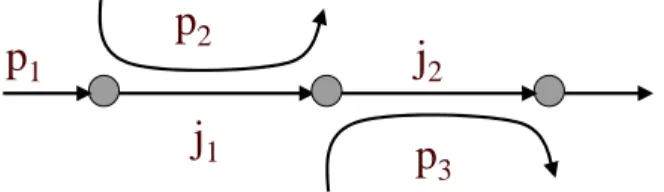
Remarks. It is not necessarily true that the throughput Gr(nr) is an increasing function ofnr. For example, in the
network shown in Figure 1, user r has three paths:p1, p2 andp3. p1 contains two linksj1 andj2 with capacity C. p2 contains link j1 andp2 contains link j2. According to the simple rate allocation mechanism introduced before, if nr= (0,1,1), then Gr(nr) = 2C. However, if user r increases its number of connections on path p1 from zero to one, then Gr(nr) = 3C/2. Thus, Gr(nr) is a decreasing function of np1.
p
1p
2p
3j
1j
2Fig. 1. A case where the throughput of userris not increasing innr.
One interesting special case is that a user can only choose either zero or one connection on a given available path. That is, (8) can be described as nrp ∈ {0,1},∀rp ∈ Pr. In this case, each user only has finite number of
strategies. This variant of the game is a finite game. According to [22], this game admits a mixed strategy NE. This NE is related to randomly choosing of connections to other peers in BitTorrent applications [3]. This is an interesting future research topic.
(a) A E D B C (b)
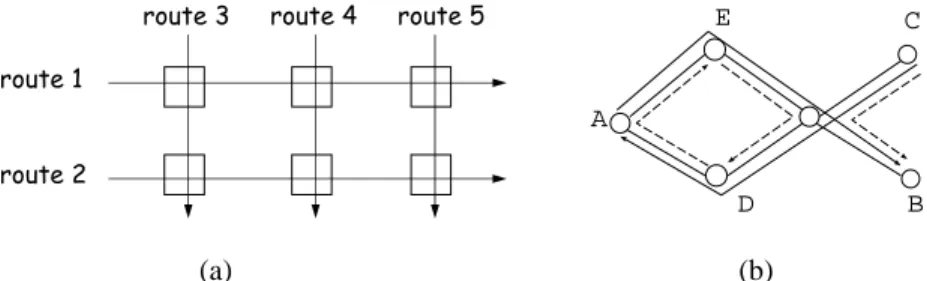
Fig. 2. (a) is a grid network where squares represent links. (b) is an instance of (a).A→E→B andC→D→Acorrespond to route 1 and 2 in (a). D→A→E, E→F →D, C→F→B correspond to routes3,4,5.
D. Existence of Multiple Nash Equilibria in Grid Network
In this section, we use a simple example to illustrate the unstructured file sharing game and possible NEs. The network topology in this example is a so called grid network introduced in [10], shown in Figure 2.(a). A possible instance of this grid network is called “fish” network, shown in Figure 2.(b).
A closed form rate allocation based on the α-bandwidth sharing mechanism for such a grid network is given in [10]. Specifically, if there are K horizontal routes and L vertical routes, then the total throughput on horizontal path pis given by npyp= ( PK k=1RT T1 kn α k)1/α (PKk=1 1 RT Tkn α k)1/α+ ( PL l=1 RT T1 ln α l)1/α (11) where np denotes the number of flows on horizontal path p. yp is the throughput of a single flow on path p.
In the following, we discuss two variants of the game by considering two users playing the game on the grid network. User 1 uses route1and user2 uses route2. Suppose α= 2 in (11), which corresponds to TCP. Suppose that all vertical and horizontal routes have RTT of 50ms, and there are 10 background flows on all vertical routes. Benefit includes throughput only. When both users are only concerned with total throughput and have no resource limitations, we have identified the following case where there is a unique NE, at which both players open their maximal allowable number of connections.
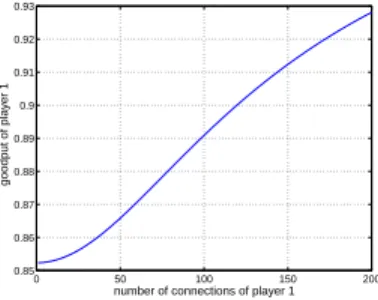
There are two users. User1 uses the upper horizontal route and user2 uses the lower horizontal route. Suppose that user 2 opens 100 connections. In Figure 3, we plot the throughput of user 1 as a function of its number of connections on its single available path. We find that the throughput of user 1 is neither a concave nor convex function of its number of connections on its single available path. This suggests that the current results on the existence of Nash equilibrium cannot be applied here because these results require the concavity of the utility function [12][23].
However, note that the throughput of user1 is an increasing function of n1, which can be verified by checking its first-order derivative. Similarly, we can also show that user 2’s throughput is also an increasing function of its number of connections. Therefore, if both users play the unstructured file sharing game, there is a unique NE. Furthermore, at the NE both players opens their maximal allowable number of connections.
0 50 100 150 200 0.85 0.86 0.87 0.88 0.89 0.9 0.91 0.92 0.93
number of connections of player 1
goodput of player 1
Fig. 3. Total data rateGof user 1as a function of the number of connections on its path, when user 2 has 100 connections.
Benefit includes both throughput and cost. In this variant of the game, not only is thatBr neither a concave nor
a convex function of its number of connections nr, butBr is not always increasing in nr.
For example, supposeβ = 0.0005in the cost function Φ(nr). We plot in Figures 4 and 5 the benefit B of user
1 as a function of its number of connections on its single available route, given that the number of connections of user 2is50 and100respectively. Note that, depending on the number of connections opened by user2, the benefit of user 1 can be either an increasing or a decreasing function ofn1.
0 50 100 150 200 0.74 0.76 0.78 0.8 0.82 0.84
number of connections of player 1
benefit of player 1
Fig. 4. Benefit of user1as a function of the num-ber of connections when user2has50connection.
0 50 100 150 200
0.83 0.84 0.85 0.86
number of connections of player 1
benefit of player 1
Fig. 5. Benefit of user1as a function of the num-ber of connections when user2has100connection.
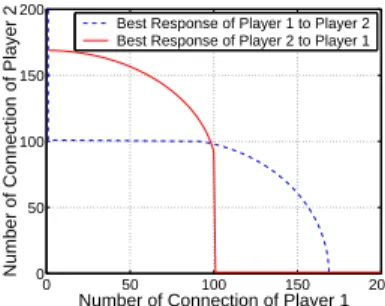
We define the best response n∗r of player r as the solution of r’s optimization problem given fixed strategies of all other players n−r. In Figure 6, we plot the best response curves of both players. Note that there are three
intersecting points. An intersecting point is a NE because at that point, each user’s response is the best response to the other user’s strategy. Thus, there are three NE in this game. For comparison, in the single link TCP connection game [11], there is only one unique NE when the cost is proportional to the number of connections.
It is also interesting to note that these two players do not share any common link (Figure 2), so, their interaction arises because they share links with other common sessions.
This simple example indicates that the interaction among multiple users on a general network topology can be much more complex than the single link TCP connection game. The existence and uniqueness of Nash equilibrium can depend on network topologies and the utility functions adopted by users.
0 50 100 150 200 0 50 100 150 200
Number of Connection of Player 1
Number of Connection of Player 2
Best Response of Player 1 to Player 2 Best Response of Player 2 to Player 1
Fig. 6. Best response curves of both player 1 and player 2.
to model peer-to-peer networks.
IV. PARALLELLINKNETWORK
In this section, we investigate an unstructured file sharing game on a parallel-link network where all users share a common source and a common destination node interconnected by a number of parallel links. Parallel-link networks can be used as simple models for unstructured file sharing. For example, in eDonkey networks [4], a peer can download a file from multiple other peers providing this file. There are possibly many peers simultaneously downloading the same file, and they can be thought of as associated with a common destination node. Each of the file-providing peers can be thought of as a “link” or “path” connecting the common destination node with a common super virtual file-providing source node. Those downloading peers compete for these parallel links/paths for bandwidth. This scenario can be approximated by a parallel link network.
In this section, we first show the existence of stable network states (NEs) on a parallel-link network. We then present the results on the efficiency loss of NE and the stability of NE in the best-response dynamics.
A. Nash equilibrium
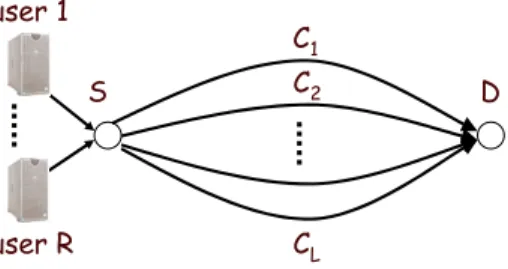
Suppose that there areL links and R users. By an abuse of notation, we will useL and R to denote the set of links and the set of users respectively. An example of a parallel link network is shown in Figure 7. The throughput
Grj obtained by userron linkjis given by the simple rate allocation mechanism introduced in the previous section:
Grj(nrj) =Cjnrj/RT Trj/(
PR
k=1nkj/RT Tkj), whereRT Trj is the Round Trip Time of userr on link/pathj,Cj
is the capacity of linkj, andnrj is the number of connections of userr on linkj. The strategy of userr is a vector
of the number of connections on its available paths or links:nr= (nr1, ..., nrL) andnrj ∈(0, nmaxr ],∀j∈L.nmaxr
is the maximum allowable number of connections for userr. Note that this game is a continuous kernel game [12] as we assume that a user’s strategy is a real-valued vector.
In this section, we only consider the case where Ur(nr) =Gr(nr). The benefit or payoff obtained by user r is:
Fig. 7. A parallel-link network topology.
We consider two scenarios: an unconstrained game and a constrained game. In an unconstrained game, there is no upper limit on the total number of connections a user can open. In a constrained game, each user must choose a certain total number of connections1. We have shown the existence of a unique NE in both constrained and unconstrained games.
B. Unconstrained Game
In an unconstrained game, users essentially play an independent game on each distinct path/link. Since a NE exists and is unique on a single link game [11], we know that a NE also exists and is unique on this parallel link network. This is summarized in the following theorem.
Theorem 1: There exists a unique interior-point NE in an unstructured file sharing game on a parallel link
network.
Social Benefit at Nash equilibrium. As shown in [11], a single bottleneck link TCP connection game admits a symmetric NE when users have the same Round Trip Times (RTT) and their benefit function includes throughput and a cost proportional to the number of connections. This result can be extended to our uncontrained game. That is, when all users have the same RTTs, the unique NE is symmetric, in the sense that all users have the same number of connections at the NE.
Solving the optimization problem for a user r, we can get the vector of connections of userr at the symmetric NE as:
n∗rj = (R−1)Cj/(R2β).
Then, user r’s benefit at the NE is
Br∗= L X j=1 Cj/R− L X j=1 (R−1)Cj/R2.
Therefore, the total social benefit of the NE is
Bne= L X j=1 Cj/R. 1
Note that Bne is not related to the cost of users. It is simply a function of the total network capacity and the
number of users. As the number of users increases, the total social benefit of the NE goes to zero.
Reaction functions. The reaction function of a user r is defined as the best response of userr as a function (if it exists) of the total number of connections of all other users. A response of userr isnr= (nr1, nr2, ..., nrL). Since
in an unconstrained game users essentially play an independent game on each individual link, we can solve for a user’s best response on each link separately. Specifically, for any link j, we have
¯ nrj =argmaxnrj∈(0,∞)Brj( R X k6=r nkj). (12)
For convenience, let n−rj denote
PR
k6=rnkj. It is easy to show that
¯
nrj =f(n−rj) =−n−rj +
q
Cjn−rj/β. (13)
¯
nrj is a continuous function of n−rj. We note that in order to guarantee that the best response of user r is an
interior point of its strategy space, we must have
¯
nrj >0 or n−rj < Cj/β. (14)
As shown in Section III-D, we can use reaction functions to identify NEs by checking the intersecting point(s) of the reaction function (best response) curves of all players. We can also use reaction functions to investigate the best-response dynamics of the game playing process, as discussed later.
Stability of NE in Best-response Dynamics. Suppose that users interact with each other using best-response in a discrete time process, a so called best-response dynamics [12][11]. This process proceeds in discrete time steps or rounds, and only one randomly chosen user makes a move at each round. Whenever a user makes a move, it calculates its best response to other users’ numbers of connections which are determined in previous steps. That is, the user who makes a move solves its optimization problem to maximize its benefit. If all users’ strategies converge to or stabilize at some point ns as time goes to infinity, then ns is a NE, and it is globally stable. Regarding an
unstructured file sharing game on a parallel link network, we have the following stability result.
Theorem 2: The unique NE is globally stable in the two-player version of the unstructured file sharing game on
parallel link network when both players use best-response to play the game.
Proof: We want to show that the best response of a user is a concave function of the other player’s number
of connections. In the unconstrained game, users actually play independent games on different links. For a given user r, the best response function or reaction function on link j is given by (13), and re-stated as follows:
¯
nr,j =−n−r,j+
q
where n−r,j is the number of connections of all other users. It can be shown that
∂2n¯r,j/∂n2−r,j = (−1/4)
q
Cj/β·n−−3r,j/2 ≤0.
Thus, the reaction function of user r is a concave function of number of connections of other users. Then, from [24], we know that in a two-player version of the game, Nash equilibrium is globally stable.
Efficiency loss of Nash equilibrium
First note that the maximal system benefit is the solution of a straightforward optimization problem. The system benefit can be represented as:
B = R X r=1 Br = R X r=1 L X j=1 Grj −β R X r=1 L X j=1 nrj. (15)
We find that the maximal value of B is
Bmax =
L
X
j=1
Cj−βNmin. (16)
Consider a homogeneous network where all links have the same capacity. Then we have Bmax =LC−βL, as
we need at least one connection for each link in order to get the bandwidth of each link. The efficiency loss of a NE is given by
Lef f = Bmax
Bne
= LC−βL
LC/R . (17)
This result essentially suggests that the efficiency loss of the unique NE is bounded. However, if L, C are fixed, and let R→ ∞, then Lef f → ∞. This suggests that the system performance at NE can degrade arbitrarily if the
number of users becomes large. Socially Responsible Users
Note that we can think of users as data senders in the game discussed above. Let the packet loss rate associated with each link/path j bepj. Suppose that the packet sending rate of a TCP connection of userr on path/linkj is
Trj. The throughput of this connection is given by Grj =Trj(1−pj). Not all packets coming to bottleneck link
j are delivered. The network resources before link j are partially wasted because that they carry data at a higher rate than the actual delivery rate of link j. Therefore we can think of this extra traffic as a cost to the network and that is proportional to the packet sending rate Trj. A user is considered as socially responsible if his/her benefit
function includes this cost term. That is, we have Br(nr) = Grj −γ
PL
i=1nrjTrj, where γ ∈ (0,1). Based on [11], we can show that there exists a pure strategy unique NE because users actually play a game on each link independently from other links. It also follows that the loss of efficiency of the NE is bounded as the unique NE is an interior point in the strategy space. Note that the definition of loss of efficiency in unstructured file sharing game is different from that of the single bottleneck link TCP connection game. The latter is defined as the ratio of total sending rate from all users at NE over the minimum total sending rate. The latter is the efficiency loss from network’s point of view, whereas the former is from user’s point of view.
C. Constrained Game
Consider another model where the total number of connections that are allowed to open by a user is fixed. Formally, for any user r, we have PLj xrj =nr, where nr is the required total number of connections.
We refer to this game as a constrained game. As summarized in the following theorem, this game admits a unique symmetric Nash equilibrium.
Please see Appendix II for the proof of this theorem.
Theorem 3: There exists a unique interior-point symmetric Nash equilibrium in a constrained unstructured file
sharing game in parallel-link network.
Remarks. It can be true that there are asymmetric NE. For example, suppose that there are two users and two links with the same capacity, and each user is constrained to use two and only two connections. Then one NE is that user 1 opens its two connections on link 1 and user 2 opens its two connections on link 2, or a NE could be that user 1 opens its two connections on link 2, and user 2 opens its two connections on link 1.
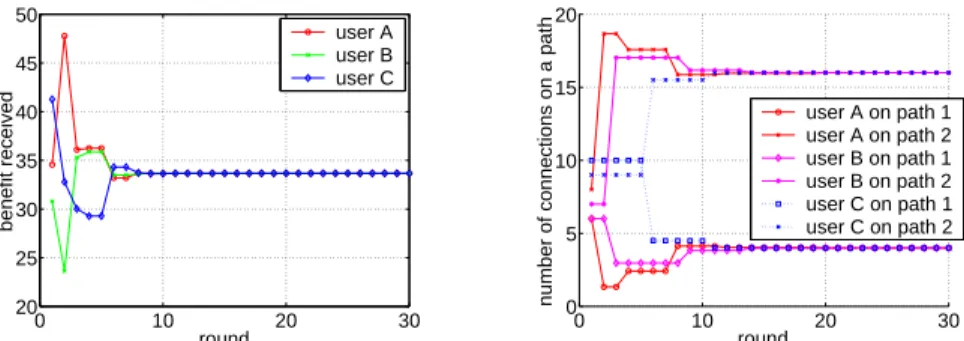
An Illustrative Example for the existence and stability of NE. We use a simple example to illustrate the Nash equilibrium proved in Theorem 3 . There are three users: A, B, and C. There are two paths (or two links) in a parallel link topology. Suppose that the capacity of link 1 is C1 = 25Mbps and the capacity of link 2 is
C2 = 100Mbps. Suppose that each user has to open20 connections. As proved in Theorem 3, at Nash equilibrium,
each user will open 4 and16 connections on link 1 and 2 respectively, because n∗1/n2∗ =C1/C2 = 1/4. That is, at Nash equilibrium we have, n∗A=n∗B =n∗C= (4,16).
Suppose users interact with each other using best-response dynamics [12][11]. If all users’ strategies converge to or stabilize at some points as time goes by, then the stablized numbers of connections are the Nash equilibrium strategies for all users. As shown in Figure 8, the best-response dynamics indeed converges to a stable point which corresponds to the Nash equilibrium obtained from the previous analysis.
0 10 20 30 20 25 30 35 40 45 50 round benefit received user A user B user C 0 10 20 30 0 5 10 15 20 round
number of connections on a path
user A on path 1 user A on path 2 user B on path 1 user B on path 2 user C on path 1 user C on path 2
Fig. 8. An example of the best-response dynamics on two parallel links. This dynamic process converges to Nash equilibrium. The left figure shows the benefit of three users. The right figure shows the numbers of connections.
Loss of Efficiency. Given the constraint that the total number of connections of user r should be equal to nr, the
maximal value of (15) is given by Bmax =
PL
j=1Cj−β
PR
F A C E H B G D I
Fig. 9. An example of star network.
A
B
C D
Fig. 10. A three node topology.
same as the system performance at Nash equilibrium. Then, the Nash equilibrium has no efficiency loss, that is,
Lef f = 1.
V. STARNETWORK
In this section, we use a star network to approximately model a peer-to-peer file sharing overlay network, and investigate the unstructured file sharing game on such a star network. Figure 9 presents one such example.
In the star network, we assume that a user has two asymmetric access links to the Internet: one downstream link and one upstream link. This assumption is supported in a measurement study in [25], where it is found that most users in current peer-to-peer networks use cable modem or ADSL to get connected to the Internet. Usually the downstream link has higher capacity than the upstream link [25].
A userr uses its downstream link to get data from other peers. The downstream link of userr is a “private” link in the sense that this link is only used by userr itself. On the other hand, the upstream link of userr is shared by all other peers or users who are downloading files from user r. We can think of the upstream link of user r as a “public” link from the point of view of user r.
In addition, similar to [14][15], we assume that in a peer-to-peer file sharing network, bottlenecks can occur at access links, not in the core Internet. This assumption is a reasonable approximation of the current peer-to-peer file sharing networks such as Gnutella and BitTorrent, where usually the data throughput is limited by the “last mile” (cable or ADSL or modem) of a connection. Thus, in the star network shown in Figure 9, the Internet cloud can be represented simply as a central node.
In the following, we first prove the existence of NE in unstructured file sharing game on a star network. We then use examples to illustrate the best response dynamics of this game playing process, and finally we present our results on the loss of efficiency of NE.
A. Nash Equilibrium
Recall that the benefit of userr is given by (1). In the following, we first present a lemma (Lemma 1) and later use it to prove that a utility function2 Ur(Gr(nr)) is a non-decreasing, continuous, and concave function of user
r’s number of connections nr = (nr1, ..., nrPr), where Pr represents the set of available paths of user r and the
number of paths as well. Since we assume that cost Φr(nr) is an increasing and convex function of nr, it then
follows that the benefit Br is a non-decreasing, continuous, and concave function ofnr.
Lemma 1 is introduced for the simple network in Figure 10, where a user r has two paths (A→ C → D and
B → C → D) to transfer data to destination node D. Both paths share a common link CD. Suppose that the number of connections userr opens on pathA→C →Disnp1, and on pathB →C→D isnp2. Then we have
nr= (np1, np2).
We assume that linkCDis a private link of userr, i.e., no other users use this link. This private link corresponds to the downstream link of user r in a star network. On the other hand, linksAC andBC are shared by userr and other users. AC andBC correspond to two public links of user r in a star network.
Recall that throughputGr obtained by userr is a function ofnr. Lemma 1 shows thatGr is a concave function
of nr.
Lemma 1: ThroughputGr of userr in Figure 10 is a concave function ofnr= (np1, np2). Proof: The strategy vector of user r isnr= (np1, np2). Let z= npn1p+1nC−1r1 +npn2+p2nC−2r2. Then, the throughput obtained by user r is
G(np1, np2) = C3 , ifz≥C3 z , ifz≤C3 (18) First, we note that this function is continuous and increasing. Second, this function has two parts, with each part being a concave function. Now we want to show that this function is a concave function of nr everywhere in its
domain.
Take any two points n1 and n2. Without loss of generality, we assume that n1 satisfies z ≤ C3 and that n2 satisfies z≥C3, as shown in Figure 11. We would like to show that
G(δn1+ (1−δ)n2)≥δG(n1) + (1−δ)G(n2), δ∈[0,1].
If we connect pointsn1 andn2 with a line, then this line intersects with the boundary of regionz≥C3 at point
n0. Then we have,
G(δn1+ (1−δ)n2) ≥ G(δn1+ (1−δ)n0) (19)
≥ δG(n1) + (1−δ)G(n0) (20)
= δG(n1) + (1−δ)G(n2) (21)
2U
Fig. 11. The domain of Gr, the throughput of user r, can be divided into two regions. One region isz ≥C3, and the other region is
z≤C3.
(19) is true because thatG(x) is an increasing function ofx, andδn1+ (1−δ)n2 ≥δn1+ (1−δ)n0. (20) is true because function G is a concave function in region z≤C3. (21) is true because function G is a continuous function.
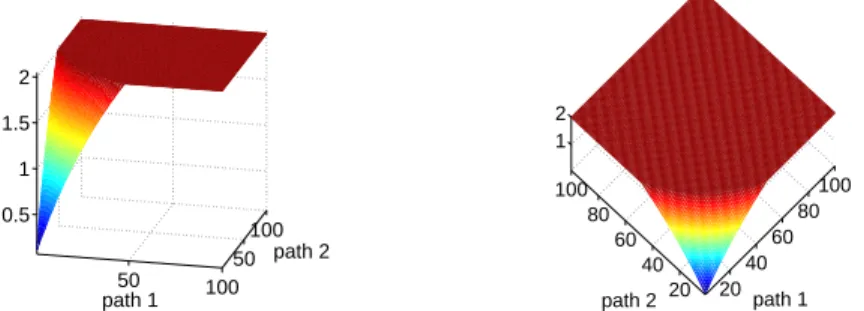
An illustrative example. In Figure 10, suppose we choose 6bps as capacities for links A →C and B → C and
2bps for link C → D. User r wants to open some number of connections on paths A → C → D (path 1) and
B → C → D (path 2) to transfer data from A and B to destination node D. The numbers of connections or sessions from other users on linksAC andBC are100. We vary the numbers of connections from userr on path1 and2, and then compute the throughput received by userr. As shown in Figure 12, we see that userr’s throughput is indeed a concave function.
50 100 50 100 0.5 1 1.5 2 path 2 path 1 20 40 60 80 100 20 40 60 80 100 1 2 path 1 path 2
Fig. 12. ThroughputGr of userras a function of the number of connections on both paths. The left figure is a side view. The right figure
is a top view.
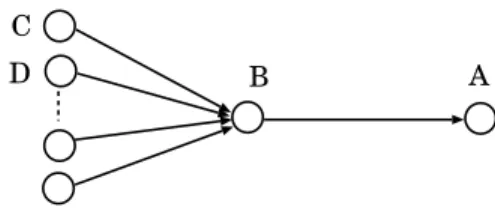
Consider the network in Figure 13, a generalized version of the network in Figure 10. In Figure 13, there areM (multiple) paths along which user r can get data from the sender. All paths share a common link BA. A strategy vector of user r isnr= (nr1, nr2, ..., nrM) withM ≥2. We can extend the result in Lemma 1 to show that a user
r’s throughput is also a concave function of nr. This is summarized in Lemma 2.
B A C
D
Fig. 13. A network where a user has multiple paths (or peers) to get data.
of user r is a concave function of its strategy vectornr = (nr1, nr2, ..., nrM).
Based on Lemma 2, we can show in the following theorem the existence of NE on a star network. One example of such star network is shown in Figure 9.
Theorem 4: There exists a Nash equilibrium of unstructured overlay game on a star network (shown in Figure
9).
Proof: According to Lemma 2, each user r’s total throughput is a concave function of the vector of number of connections nr. Then it is easy to show that userr’s benefit or payoff functionBr is a concave function ofnr.
In addition, Br is continuous in n. Thus we have a multi-player concave game. Based on the result in [23], we
conclude that Nash equilibrium exists in this game.
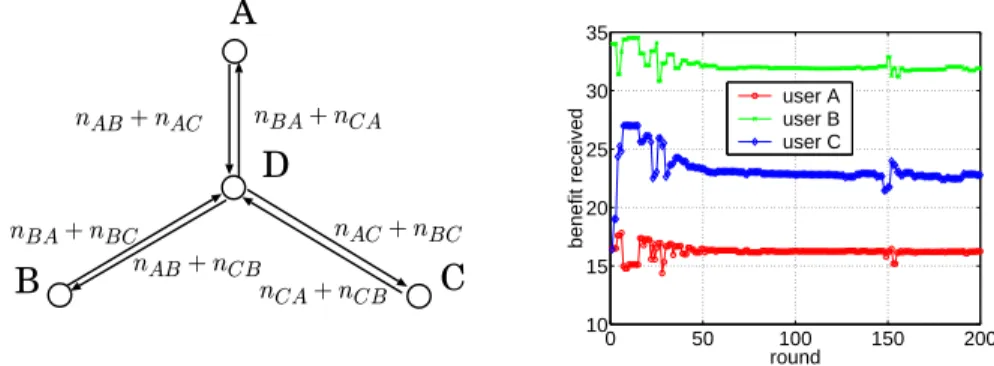
An illustrative example. We use a simple star network shown in Figure 14 to illustrate the existence of NE proved in Theorem 4. On this star network, there are6 linksAD, DA, BD, DB, CD, andDC. The capacities of all links are CAD = 10, CDA = 20, CBD = 30, CDB = 40, CCD = 50, and CDC = 60. There are three users associated
with nodes A, B and C respectively. For convenience, we refer to the user at node A as user A. Note that each user has two download paths with each path consisting of two links. For example, userA has two download paths
B → D→ A andC →D→A. For any given download path, one link is shared with other users, and the other link is a private link. For example, for user A, pathB →D→Ahas two links: BD andDA. Link BD is a link shared with user C. Link DA is a private link of user A, which is shared by both of its paths B →D→ A and
C →D→A.
UserA’s strategy is a vector of number of connections on two available paths, i.e.,nA= (nBA, nCA). Similarly,
strategies of user B andC are:nB= (nAB, nCB) andnC = (nAC, nBC).
Consider the unstructured file sharing game played by usersA, B, andC. Each user tries to maximize its benefit
Br (r=A, B, C). We use best response dynamics to demonstrate the existence of a NE in this game. At the first
step, each user opens a random number of connections on two available paths. In the following steps, only one player is randomly chosen to compute its best response at each step. As shown in Figure 14, the best response dynamics converges to a NE, which can be verified by checking the optimality of benefits of all three users.
A B C D "!$# % &')(+*&,( 0 50 100 150 200 10 15 20 25 30 35 round benefit received user A user B user C
Fig. 14. The left figure shows a simple star topology with three users A, B, and C. The right figure shows the best response dynamics. All three users’ benefits converge to the Nash equilibrium.
B. Loss of Efficiency
Consider the case where all downstream links have higher capacity than upstream links and users are homo-geneous. We can show that in this case, the loss of efficiency of any NE in the game is bounded. However, if users are aggressive in the sense that their benefit functions do not contain cost terms, then a unique NE is a point where all users open their maximum allowable number of connections. Clearly, the loss of efficiency of the NE is unbounded if users can open arbitrarily large numbers of connections. In order to show these results, we need to do a simple transformation as described below.
In the star topology shown in Figure 9, if all users’ private downstream links have much higher capacities than the upstream links of those other peers, then this game can be thought of a variant of the game on a parallel link network. For example, we can transform the simple star network in the left sub-figure of Figure 14 into Figure 15. Center nodeDin Figure 14 is decomposed into six interconnected virtual nodesDAd, DAu, DBd, DBu, DCd, DCu.
Links between these six virtual nodes have infinite capacity. Node A is decomposed into nodes Adown and Aup.
Link DAdAdown represents the downstream link of nodeA. LinkAupDAu represents the upstream link of nodeA.
Other links have similar interpretations.
Adown DAd DAu Aup Bdown DBd D Bu Bup Cdown DCd DCu Cup
Fig. 15. Transformation of star network into equivalent parallel link network.
Based on the transformation illustrated in Figure 15, the result for the loss of efficiency at NE on a parallel link network can be applied to a star network. That is, the loss of efficiency at NE of the unstructured file sharing game
can be arbitrarily large if the number of users becomes large in this special case.
We also consider another special case where users are aggressive in the sense that users do not have cost constraint and only care about their throughputs [11]. That is, user’s benefit function is represented as: Br(nr) =Gr(nr).In this special case, there exist a unique Nash equilibrium where all users open their maximum allowable number of connections, and the price of anarchy can be unbounded when users can open arbitrary large number of connections. Network Resource Utilization. Suppose that all downstream links have higher capacities than upstream links. Then the capacities of all upstream links will be fully utilized at the NE. This is a good situation in terms of the network resource utilization because the total throughput can be supported by the network is just the aggregate capacity of these upstream links. Note that this is not always true for general network topologies, which is demonstrated in an example in Appendix III. A similar example is given in [26].
VI. OVERLAYFORMATIONGAME
In this section, we introduce an overlay formation game to study the Tit-for-Tat strategy adopted by BitTorrent (BT) [3], one of the most popular peer-to-peer applications.
As before, we assume that the physical network is a star network where each peer is attached to a physical node, and the center node models the Internet, and peers connect to the center node via access links. However, unlike the last section, here we assume that bottlenecks only occur at upstream access links. As before, we assume that peers always have demands that can be satisfied by each other, and that connections are always allowed.
A connection between a pair of peers can be thought of as a virtual link. Through setting up connections between themselves, peers form an overlay network, in which each node represents a unique peer, and virtual links are connections between peers. A peer i can get a share of the upload bandwidth (BW) of peer j through the connection (or virtual link) between iandj. In the mean time, other peers may want to get some share of peer j’s upload BW by setting up connections with j. The upload BW of j is equally shared among all connections with other peers. Note that a peer may want to get BW shares of all other peers’ upload BW and want to maximize its received total BW. If all peers behave this way, we have a game among peers, and any stable point of this game is an overlay network consisting of a set of virtual links among peer nodes. We call this game an overlay formation
game.
We can think of the overlay formation game as a variant of an unstructured file sharing game with two major unique characteristics: 1) two peers set up a connection between themselves only when they both find it beneficial; 2) there can only be zero or one connection between a pair of peers. The first characteristic captures the reciprocation feature of the so called Tit-for-Tat strategy in BitTorrent (BT) protocol [3]. According to Tit-for-Tat strategy each peer uploads to the nu peers (the default value is 4) from which it can download at the highest rate, i.e., its best
The Tit-for-Tat strategy is generally considered robust. To the best of our knowledge, the only analytical support for this belief is in [14]. The authors of [14] study how Tit-for-Tat can affect selfish peers who are able to set their upload bandwidth in a BT network. Under several assumptions, they show that there is a good NE at which each peer uploads at the maximum rate. Note that in [14], for a given peer, the total number of other peers to set up a connection with is fixed. However, we observe that BT clients can change the number of connections to open in order to gain advantage or to improve their performance. We illustrate this observation in the following example. An Illustrative Example. Consider 10 peers divided into two groups. Five peers have physical upload bandwidth
C1 = 3 and the other five have bandwidth C2 = 2. Suppose that the default number of connections is nu = 3.
According to [14], peers would use all their upload bandwidth and would create the overlay shown in Figure 16, where big circles and small circle respectively represent high-bandwidth and low bandwidth peers. Note that the peers do not receive the same download rate, even if they belong to the same group. Four high-bandwidth peers receive a download rate of 3 (= 3C1/3), while the peer connecting the two groups (peer S in the figure) receives only 8/3 (= 2C1/3 +C2/3). Similarly four low-bandwidth peers receive rates of 2, while the other receives 7/3. According to [14] the formed overlay network is stable in the sense that no peer wants to change a link (or reduces its uploading rate).
Let us now remove the constraint on the number of connections. For example, peer S decides to increase its number of connections to 5. If all other peers keepnu = 3, the new equilibrium is presented in Figure 17. Note
that peer S improves its performance, because its download rate increases from 8/3 to 10/3 (= 5C2/3).
S
Fig. 16. Regular Graph.
S
Fig. 17. Peers can change numbers of connections.
This example shows that peers can benefit by changing their numbers of connections. This is formally supported by a result in Section VI-B.1 regarding a homogeneous network where all peers have the same capacity. In the rest of this section, we first formally introduce the overlay formation game in which peers act selfishly as player S. We then study the network equilibria arising in this game and quantify the loss of efficiency using the analytical framework of network formation games [20].
A. Model of Overlay Formation Game
We formally introduce the overlay formation game in this section. Assumptions are detailed in the previous section. We refer to peers as players and to connections as links. As before, let R = {1,2,· · · , R} denote the set of players. The strategy of a player i is the set of intended connections player i wants to establish, which is
denoted by si ={si,j|j∈R\{i}}, wheresi,j = 1 means that playeriintends to create a link (open a connection)
with player j andsi,j = 0 means that player idoes not intend to create such a link. With the Tit-for-Tat strategy,
both players have to agree in order to create a link, hence a link between players i and j is formed if and only if si,j = sj,i = 1. A strategy profile s = {s1, s2,· · · , sR} therefore induces a network g(s) = {gi,j, i, j ∈ R},
where gi,j = 1 denotes the existence of link(i, j) andgi,j = 0 denotes the absence of link(i, j). Given a network
g, we use g+gi,j or g−gi,j to denote the network obtained by adding or severing the link (i, j). We also let
Ni(g) ={j∈R:j6=i, gi,j = 1}be the set of playeri’s neighbors in graphg, and let ni(g) =|Ni(g)|. A network
is symmetric if ni(g) =n,∀i∈R, i.e. all players have the same number of connections, also known as a regular
graph.
The payoff or benefit of player i is given by its download rate minus the cost of opening connections: Bi =
Gi−Φi(ni) =
P
j∈Ni(g)Cj/nj−Φi(ni).As before, we assume that Φi is a convex function ofni. The marginal
benefit for player ito open a new connection with player j is:
bi(ni(g), nj(g)) = Bi(g+gi,j)−Bi(g)
= Cj
nj(g) + 1−Φi(ni(g) + 1) + Φi(ni(g)).
A connection between two players can be set up only when both of them find this connection beneficial. This coordination requirement makes the concept of Nash equilibrium (NE) partially inadequate. To address this issue, the idea of NE has been supplemented with the requirement of pairwise stability [27], described below.
Definition 1: A network g is a pairwise equilibrium network (PEN) if the following conditions hold: 1) there is a NE strategy profile which supports g; 2) for gi,j = 0, Bi(g+gi,j)> Bi(g)⇒Bj(g+gi,j)< Bj(g).
B. Equilibria in Homogeneous Networks
In this section we consider homogeneous networks in which all peers have the same upload capacity and payoff function.
1) Overlay Network Characterization: Based on the previous assumptions, our game is the local spillovers game
with strategic substitutes properties studied in [28]. Some of the following results (Theorems 5, 6 and 8) can be derived from [28]. Please see Appendix IV for details.
Theorem 5: If the number of players is even, a symmetric PEN always exists. Specifically, if b(0,0)≤ 0, the empty network is a PEN; ifb(r−2, r−2)≥0, the complete network is a PEN; ifb(k, k)≤0≤b(k−1, k−1), the regular graph with degree k is a PEN. When the previous inequalities are strict, the degree of the PEN is unique. Remarks. First, note that for a set of R players or nodes, ifR is even, we can expect a PEN to be a symmetric or regular graph of any possible degree from 0 toR−1; this is not true when the number of players is odd. Second, this theorem states that the degree of a PEN can be determined by considering only the marginal benefit b(k, k)
for a pair of nodes with the same number of connections k, and in particular this degree is the smallest value k that makes b(k, k) negative. Third, the symmetric network at equilibrium is not necessarily connected. Figure 18 shows two possible equilibria with r= 8 players and degreek= 2. Finally, even when a symmetric network can arise from player interaction according to Theorem 5, the degree of the network is in general different from the default value used in current BitTorrent implementation (nu = 4). This means that the symmetric network created
by compliant peers in BitTorrent networks is not in general a PEN for our overlay formation game.
Fig. 18. Different Pairwise Symmetric Equilibria.
Besides symmetric PENs discussed in the above, we have the following theorem addressing asymmetric PENs.
Theorem 6: There can be at most one player or node not connected to any other players in a PEN and the rest
of the network is a symmetric network of a unique degree. In asymmetric networks with a single component, if two players with the same number of connections k(i.e. two nodes with the same degreek) are connected to each other, then any two players with fewer number of links than k (or two nodes with lower degrees thank) must be mutually connected.
Remarks. First, this property rules out two or more isolated players and interlinked stars with two or more central players, but does allow a star to arise in equilibrium3. Note that for file sharing purposes, an overlay with a star topology is very inefficient: the operation falls back to the server-client paradigm with the center of the star acting as the server. Second, in some cases symmetric and asymmetric networks can be pairwise equilibria for a given set of link capacities and cost functions (see [28] for examples).
The following theorem (not derived from [28]) shows some other restrictions as regards asymmetric networks when the marginal benefit for playerito open a connection with playerjonly depends on the number of connections of players i and j (as in our case). This new result rules out also star topologies. Please see Appendix V for a detailed proof.
Theorem 7: In a scenario where a unique degree -h- is possible for the symmetric PENs, there can be at mosth 3
An interlinked star network has a maximally connected group and a minimally connected group of players. In addition, the maximally connected players are connected to all players while the minimally connected group has links only with the players in the maximally connected set.
players with degree smaller than h. Sayl the number of players with degree smaller than h, there can be at most
(h−l)l players with degree bigger than h, each of them with degree at mosth+l. If the cost function is linear then there are no players with degree bigger than h.
Remark. Note that the degree of symmetric PENs h depends only on the cost function Φ()and the capacity C, and is independent from the number of players R. Hence the distance between a PEN and a symmetric PEN is bounded and becomes less significant as the number of players R increases. Formally:
lim R→∞ 1 RE ( R X i=1 |ni(gP EN)−h| ) = 0.
Similarly the average payoff per player in a PEN converges to that of a symmetric PEN.
The following result shows that players having more connections gain higher payoffs than other players, sup-porting the example introduced at the beginning of this section.
Theorem 8: Letgbe a pairwise equilibrium network in whichni(g)< nj(g). If∀u∈Ni(g),∃v∈Nj(g)s.t.nu=
nv, then Bi(g)< Bj(g).
Note that if playeri’s neighborhood is included in player j’s neighborhood (Ni ⊂Nj), the condition, “∀u∈Ni(g), ∃v∈Nj(g),s.t. nu =nv”, is satisfied.
2) Loss of Efficiency of Symmetric Equilibria: In our game, given the number of players, the number of possible
overlays players can create is finite. Hence there is one network gopt with the highest total payoff
P
i∈RBi(gopt).
We define the efficiency loss of a PEN g as the ratio of the highest total payoff over the total payoff of the PEN:
Lef f(r, C,Φ) = P i∈RBi(gopt) P i∈RBi(g) .
We note that Lef f depends in general on the number of players, and the upload capacities and cost functions of
those players. The following theorem states that Lef f is unbounded even for the class of linear connection cost
functions (Φ(n) =αn). Therefore, the price of anarchy (the worst efficiency loss of all NEs) is infinite4. Please see Appendix VI for a detailed proof.
Theorem 9: For the class of linear connection cost functions, the loss of efficiency is unbounded. In particular,
given an even number of players and an upload capacity C, ∀M ∈R,∃α∗ ∈R+ s.t. Lef f(r, C,Φ∗)> M, where
Φ∗(n) =α∗n.
C. Dynamic Models
We investigate in this section how peers can dynamically reach a PEN. Here we consider linear costs (Φ(ni) =
αni). We consider the following dynamic discrete-time process. Starting from an empty network, at each time a
player pair (i,j) is randomly chosen. Link (i, j) is created (or kept) if both players find it beneficial. An existing 4This is different from what happens for selfish routing, where the price of anarchy is finite, and independent from the network topology
link is removed if at least one of the two players of that link does not find it useful. We are going to show that this dynamic process always reaches a PEN.
Let us introduce some terminology according to [20]. A networkg0 is adjacent to a networkg ifg0 =g+gi,j or
g0 =g−g
i,j for some pair(i, j). A networkg0 defeats another networkgif eitherg0 =g−gi,j andBi(g0)> Bi(g),
or ifg0 =g+gi,j with Bi(g0)≥Bi(g)andBj(g0)≥Bj(g)with at least one inequality holding strictly. A network
game exhibits no indifference if for any two adjacent networks, one defeats the other.
According to this terminology in the dynamic process we described above, the current network is altered if and only if the addition or deletion of a link would defeat the current network. The process leads to an improving
path, i.e. a sequence of networks g1, g2, ..., gK where each network gk is defeated by the subsequent (adjacent)
network gk+1. There are two kind of improving paths: those exhibiting cycles (which have infinite length) and those terminating with a PEN (called stable state). The following lemma (a theorem in [30]) characterizes when there are no cycles and pairwise stable networks exist.
Lemma 3: GivenGthe set of all the possible networksg, if there exists a real valued functionw:G→Rsuch that “g0 defeatsg” if and only if “w(g0)> w(g) and g0 and g are adjacent”, then there are no cycles. Conversely, if the network game exhibits no indifference, then there are no cycles only if there exists a function w :G→ R such that “g0 defeats g” if and only if “w(g0)> w(g) andg0 andg are adjacent”.
Based on this lemma, we have the following result.
Theorem 10: If the connection cost function is a linear functionΦ(n) =αn, the dynamic process introduced at the beginning of Section VI-C always reaches a PEN.
Sketch of the proof. If h∈ {0,1,· · · , R−1} is the degree of a symmetric equilibrium according to Theorem 5 and b(h, h)<0 forh=6 R−1, the following function w:G→R:
w(g) =− R X i=1 f(ni), where f(ni) = h−ni if h≥ni R(ni−h) otherwise
satisfies the relation in Lemma 3 for our overlay formation game, hence the dynamic process always reaches a PEN. If h6=R−1 and b(h, h) = 0, then in a PEN there can be also nodes with degree h+ 1 (as well as nodes with degrees 0,1,· · · , h), in this case the following function can be considered:
f(ni) = h−ni if h≥ni R(ni−(h+ 1)) otherwise The details of the proof are in Appendix VIII.
Simulations. We present some simulation results. We considered a number of players ranging from 100 to 10000 and α = 0.245, for which the degree of a symmetric PEN is 4. For each setting we simulated 5000 runs of the above dynamic process. Each run terminates with a PEN. We denote the average degree for this PEN over all players as davg. 101 102 103 104 2 2.5 3 3.5 4 4.5 5 number of users
average node degree minimum average
Fig. 19. Average node degree.
101 102 103 104
100 102 104
number of users
total benefit of all users
minimum average optimum
Fig. 20. Total benefit.
Figure 19 shows the minimum and the mean ofdavg over all the runs. We see that asR increases both the mean
and the minimum converge to4. This result confirms Theorem 7: asR increases the PENs converge to a symmetric one.
In Figure 20, the mean and the minimum of the total benefit are compared with the highest total benefit, which can be directly evaluated from the results in Appendix VII. This figure shows also the convergence of the payoffs of all PENs to the payoff of the symmetric PEN when R increases.
101 102 103 104 100 101 102 103 104 number of users
number of iterations per user
minimum average
Fig. 21. Number of iterations per peer.
In addition, we present the number of iterations per peer in Figure 21. We observe that the average number of iterations to reach a PEN is of the order of R2 and hence the number of iteration per peer is of the order of R. Let us consider this number of iterations in the context of BitTorrent (BT) [3]. Each peer in a BT network tries to replace an existing connection with a new, better connection every 10 seconds. All peers do such replacement simultaneously, unlike the sequential replacement in our simulations. SoR2iterations in our simulations corresponds to10R seconds in a BT network. For a population of100peers, the time needed to reach a PEN is of the order of