In the following report, Hanover Research presents best practices and models for achieving
vertical alignment—alignment of strategic planning priorities at the institutional, college,
departmental, and programmatic levels—in higher education. The first section of the
report reviews literature on the topic and best practices for vertical alignment in strategic
planning, and the second section profiles institutions that have implemented vertical
integration into their strategic planning processes.
Strategic Planning
Vertical Integration
T
ABLE OF
C
ONTENTS
Executive Summary and Key Findings ... 3
INTRODUCTION ... 3
KEY FINDINGS ... 3
Section I: Models and Best Practices for Vertical Integration ... 5
CHALLENGES THAT RESULT FROM LACK OF STRATEGIC PLANNING COORDINATION ... 5
VERTICAL AND HORIZONTAL ALIGNMENT ... 6
PRACTICAL CONSIDERATIONS FOR VERTICAL ALIGNMENT ... 8
Executing the Strategic Plan and Integrating Budgets ... 9
Strategic Planning Evaluations and Leading Change ... 10
Section II: Institutional Profiles ... 13
KANSAS STATE UNIVERSITY ... 13
UNIVERSITY OF DAYTON ... 16
KENT STATE UNIVERSITY ... 18
CALIFORNIA STATE UNIVERSITY‐CHICO ... 19
Appendix ... 21
E
XECUTIVE
S
UMMARY AND
K
EY
F
INDINGS
I
NTRODUCTIONIn this report, Hanover Research reviews the literature on best practices and models for
vertical alignment during strategic planning within a higher education institution. This
report also provides examples of how four institutions have vertically integrated strategic
priorities. The report comprises two sections:
Section I outlines the challenges that result from lack of coordination amongdifferent units within an institution during strategic planning, defines vertical and
horizontal alignment, and presents practical considerations for implementing
vertical alignment in strategic planning.
Section II includes profiles of strategic planning strategies at four institutions thathave applied some form of vertical integration to their planning processes.
An appendix to this report provides examples of templates, checklists, and rubrics used for
vertical integration planning and implementation at some of the institutions profiled in this
report.
K
EYF
INDINGS
The strategic planning process should establish clear linkages between institution‐wide goals and those of academic schools and departments. The Society for College
and University Planning (SCUP) defines this process as “vertical alignment,” a method
for “aligning and leveraging strategies, actions, and responsibilities at institutional,
college, departmental, and programmatic levels.”1 Vertical alignment can help unify
goals and initiatives across an institution and expedite the execution of key strategies
more consistently.
Establishing a plan for vertical alignment can help institutions address severalcommon strategic planning challenges by unifying and streamlining the planning
process. For example, communication and coordinated planning across multiple
organizational levels within an institution can help reconcile the divergent goals of a
unit and the broader institution. A plan can also help to prevent planning, assessment,
and budgeting cycles from conflicting with vertical alignment.
When developing a vertically aligned strategic plan, the institution‐wide plan shouldbe a living document that integrates feedback from each organizational level within
the institution. Each academic unit or program’s plan is tied to the goals of a higher
level plan in the institution, so the planning process should also allow lower level units
1
Norris, D., and N. Poulton. “A Guide to Planning for Change.” Society for College and University Planning, 2010. p. 27. http://www2.cortland.edu/dotAsset/90d13b15‐af02‐4732‐a13f‐0b2c5f81b958.pdf
to suggest revisions when the boundaries of a higher level plan appear too restrictive
or unnecessary. A university cannot achieve its goals if the academic units below it
cannot execute their own strategic plans.
Commonly, lower level units can select one or more of the institutional goals orthemes they believe are most relevant to their own strategic goals. In their planning
documents, lower level units should explicitly state how each strategic goal or
objective relates to major institutional themes. Templates, rubrics, and other
instructional documents are useful tools to guide lower level units through this
process. For example, Kansas State University provides specific templates and
checklists to academic departments or colleges and major units to guide unit
administrators through developing their own strategic plans.
Synchronizing the annual operating plan and budget planning cycles annually andover the long term will help institutions execute strategic actions more efficiently.
SCUP recommends that institutions consider state and federal fiscal cycles (where
applicable), academic planning cycles, and human resources calendars, and how these
will affect the timing for implementing strategic actions.
Lead administrators should propose a clear timeline for the alignment process andprovide forums for feedback from stakeholders. Both Kansas State University and
California State University‐Chico, for example, have held retreats for strategic planning
administrators to discuss progress and challenges across organizational units at
different levels within the institution. They also elicited feedback from a broader set of
stakeholders, including faculty, staff, students, and alumni. This approach can build a
sense of ownership in the planning process at multiple levels, while still ensuring that
different levels of the institution are moving toward a common goal.
S
ECTION
I:
M
ODELS AND
B
EST
P
RACTICES FOR
V
ERTICAL
I
NTEGRATION
Internal coordination throughout the strategic planning process is integral at all
organizational levels to effect holistic change. From academic departments and programs,
to colleges and schools, to the entire institution, each organizational level’s vision and
initiatives should be aligned for an institution to progress toward achieving its strategic
goals. As Dr. William Swart, professor and administrator at Eastern Carolina University and
strategic planning expert, explains:
If a university has a strategic plan but its academic units (colleges and departments)
do not have corresponding tactical plans, then it will be impossible for it to achieve
its vision (except by sheer luck and coincidence). If an academic unit has a tactical
plan, but the university does not have a strategic plan, then there will be no
coordination, and units are likely to be moving in different and contradictory
directions. Thus, any university that takes on a strategic planning effort must carry it throughout all of its organizational levels.2
However, alignment or “vertical integration” of strategic planning throughout an institution
means more than just developing planning documents at multiple organizational levels in
the institution. Planning should involve “intentional correlation” between the institution’s
goals and those of academic schools and departments.3 This coordination should extend
through both strategic planning and outcomes assessments, so that both department‐level
and institution‐level plans and assessment results inform the decision‐making process for
future initiatives.4
C
HALLENGES THATR
ESULT FROML
ACK OFS
TRATEGICP
LANNINGC
OORDINATIONNearly every higher education institution in the United States has a strategic planning
process and a budgeting process that guides institutional practice at some level. However,
the implementation and effectiveness of these processes varies widely. Lack of coordination
can lead to a range of roadblocks for an institution’s planning initiatives, outcomes
assessments, and budgeting cycles. As strategic planning and vertical integration are
concepts that grew out of business applications, it is not surprising that business faculty and
administrators within higher education have often been at the forefront of strategic
planning initiatives in colleges and universities. In 2004, Roller, Bovee, and Green, a group of
higher education business education administrators, identified three areas where
2
Swart, W. Leadership for Academic Units, 2010. p. 107.
http://books.google.com/books?id=Uf7GrptiwUIC&dq=vertical+alignment+for+university+strategic+planning&so urce=gbs_navlinks_s
3
Roller, R., S. Bovee, and J. Green. “Integrating Strategic Planning, Budgeting, and Outcomes Assessment in Christian Business Education.” Christian Business Faculty Association Conference, 2004. pp. 5‐6.
http://www.cbfa.org/Roller‐Bovee‐Green.pdf 4
universities commonly face challenges in strategic planning, budgeting, and outcomes
assessment:5
Differences between institutional level and department, division, and/or schoollevel;
Incongruences between departmental and institutional level goals; and
Conflicting planning, assessment, and budgeting cycles.
Challenges as a result of differences between the institution and the departments,
divisions, or schools may arise from different perspectives or access to information across
organizational levels. For example, a unit within an institution may view its competitive
placement among peers differently than the institution sees its position as a whole, and this
may influence the content of planning documents differently.6 For this reason, a certain
level of flexibility is needed within the strategic planning framework to allow academic units
to evaluate what is most important to them and to choose their own goals within the
university‐wide framework. This can help to establish a “feeling of ownership” in the
planning process, while still enabling all stakeholders to move toward a common goal.7
Divergent goals between a unit and the broader institution are another common challenge
to strategic planning and budgeting. Within an academic school or department, leaders are
likely to develop plans that will benefit their own unit, although these may be “in conflict or
not synchronized with organizational goals.”8 Institutions that consciously align their
strategic planning at all levels are less likely to encounter this issue.9
Finally, conflicting planning, assessment and budgeting cycles can hinder an institution’s
progress in achieving the goals set out in a strategic plan. If the results of a program
assessment are not available until after the budget proposal has already been approved,
this can make it difficult to link an established priority to the proper resources needed to
affect the change. For these reasons, vertically aligning strategic planning objectives and
integrating assessment and budget cycles are key for optimizing the effectiveness of
planning at all institutional levels.
V
ERTICAL ANDH
ORIZONTALA
LIGNMENTThere are many approaches that universities have applied when re‐evaluating their unit or
division strategic plan for alignment with the broader university goals. However, any
approach falls into one of two directional planning processes: top‐down or bottom‐up. As
the Society for College and University Planning (SCUP) highlights, institutions often try to
5
Bulleted points taken verbatim, with minor alterations to improve readability, from: Ibid., pp. 4‐6. 6
Ibid., pp. 4‐5. 7
Lerner, A. “A Strategic Planning Primer for Higher Education.” College of Business Administration and Economics, California State University, July 1999. p. 12. http://www.nu.edu.sa/userfiles/awadm/m31.pdf
8
Roller, Bovee, and Green, Op. cit., p. 5. 9
maintain “a virtuous balance between top‐down and bottom‐up thinking and planning.”10 In
a bottom‐up approach, an institution’s strategic plan is based on a combination of the
strategic planning goals in each department. Conversely, in a top‐down approach, each
department aligns its mission, goals, and objectives to those of the overarching institutional
strategic plan.11 SCUP notes that planning processes are “highly situational,” but some
processes can be managed centrally (top‐down) while others will be better served through
consensus‐building with decentralized participation (bottom‐up).12
Figure 1.1 Vertical and Horizontal Alignment for Planning, Accreditation, Continuous
Improvement, and Performance
Source: SCUP13
Moreover, planning can be coordinated vertically and horizontally. SCUP defines vertical
alignment as “aligning and leveraging strategies, actions, and responsibilities at institutional,
10
Norris and Poulton, Op. cit., p. 26. 11
Roller, Bovee, and Green, Op. cit., p. 31. 12
Norris and Poulton, Op. cit., p. 26. 13
college, departmental, and programmatic levels.”14 Vertical alignment can help unify goals
and initiatives across an institution, and when budget cycles are also aligned, it can expedite
the execution of key strategies more consistently. Horizontal alignment is defined as “the
alignment of strategic planning, capital planning, accreditation and program review,
continuous improvement, and performance management.”15 Figure 1.1 presents the
relationship of processes and feedback that affect vertical and horizontal alignment within
an institution.
P
RACTICALC
ONSIDERATIONS FORV
ERTICALA
LIGNMENTThere are three levels for strategic planning to consider when implementing a vertical
integration plan, as shown below in Figure 1.2. The strategic level of planning consists of
establishing high‐level institutional goals and establishing an implementation plan, while the
operational level involves smaller planning at the division‐ and department‐level of an
institution. Tactical planning, the third level of institutional planning, consists of developing
the policies and procedures that will ensure “effective management, planning, budgeting,
and assessing,” especially at the department level.16
Figure 1.2: Levels of Institutional Planning
STRATEGIC LEVEL OPERATIONAL LEVEL TACTICAL LEVEL
Institutional objectives and
goals
Implementation plan
Divisional‐level plans Departmental‐level plans
Policies Procedures Source: SCUP17
Dr. Swart’s book, Leadership for Academic Units, highlights several basic and practical
considerations for achieving institutional alignment.18 At the institutional level, the strategic
planning document – based on the mission, vision, and values of the university – establishes
boundaries by which all other units will develop their own planning elements (missions,
tactical initiatives, and tactical objectives).19 The academic division’s operational planning
should be based on a draft of the university’s plan, and each department’s plan should be
based on the draft document for its managing academic unit.
At all levels, these documents are still considered to be in “draft” form because vertical
alignment requires an “interactive sequence in which each successive level down in the
organization has the opportunities to negotiate the modification of the higher level plan” if
its boundaries seem too restrictive or unnecessary.20 This multi‐level feedback exchange is
suggested in the SCUP model presented in Figure 1.1 but not fully illustrated as a multi‐ 14 Ibid., p. 27. 15 Ibid., p. 31. 16
Hinton, K. “A Practical Guide to Strategic Planning in Higher Education.” Society for College and University Planning, 2012. pp. 28‐29. http://www.keene.edu/ksc/assets/files/19900/scpguideonplanning.pdf
17
Ibid., p. 28. 18
Swart, Op. cit., p. xi. 19
Ibid., pp. 106‐109. 20
directional process rather than strictly a top‐to‐bottom approach. At each level, the
strategic plan is a part of a feedback loop of nesting tactical plans, whereby the university
cannot achieve its goals if the academic units below it cannot execute their own strategic
plans.
Figure 1.3 presents a flowchart of feedback between the university, division, college, and
department level plans for a “robust” strategic planning process.21
Figure 1.3: Developing Organizationally Aligned Tactical Plans
Source: Swart22
E
XECUTING THES
TRATEGICP
LAN ANDI
NTEGRATINGB
UDGETSSCUP emphasizes that in addition to this feedback loop between different organizational
levels, tactical planning and execution are a vital part of implementing a strategic plan.23
Over the past decade, institutional planning has shifted from having a primary emphasis on
planning (90% of effort) over execution (10%), to a process that gives more weight to the
execution of an institutional plan (60% of effort) over the planning process (40%).24
One of the key elements for executing the strategic plan is integrating the annual operating
plan and budget planning processes. Strategic planning should guide the institution in how it
will allocate resources to achieve its goals, and SCUP emphasizes that “it is critical that the 21 Ibid. 22 Ibid. 23
Norris and Poulton, Op. cit., p. 33. 24
budget cycle and the planning cycle be aligned, not only on the annual basis, but over the
long term.”25 This can be difficult because budget cycles must be aligned with state or
federal fiscal cycles, academic planning cycles run by the academic calendar year, and
human resources calendars, which often operate on a January‐to‐December calendar. All of
these calendar cycles should be considered when integrating strategic planning and
budgeting processes.26
Budget and planning cycles should be aligned not only at the institutional level but also at
the academic unit level. Some of the top sources of frustration for academic unit
administrators are related to funding resources, such as “adequate staffing, funding, faculty
compensation, and research support; reasonable program reinvestment; appropriate
technology reinvestment; and influence on budgeting processes.”27 Roller, Bovee, and
Green suggest that an effectively integrated strategic plan and budget process will fulfill the
all of the elements presented in Figure 1.4 below.
Figure 1.4: Elements of an Effective Departmental and Institutional
Planning and Budgeting Process
Fully identify the cost of proposed action plans; Be supported by data from the planning process;
Be informed by clear departmental strategic priorities and rationale; Be informed by full disclosure of relevant institutional priorities,
constraints, and data; and
Generate results that are assessed and inform future planning efforts.
Source: Roller, Bovee, and Green28
Roller, Bovee, and Green also recommend embedding estimated costs into an academic
unit’s operational “action plan” alongside each objective so that this information can easily
be integrated into the budget planning process. It also “enables requests for additional
funding to be supported by the results of assessment and environmental scanning processes
and the resulting strategic priorities of the unit and institution.”29
S
TRATEGICP
LANNINGE
VALUATIONS ANDL
EADINGC
HANGESCUP identifies four main review points in the annual and long‐term planning cycle where
institutions have an opportunity to examine whether goals are being smoothly
implemented. During the annual cycle, the planning committee should meet at the beginning and the midpoint of the planning year. The first meeting allows the committee to
review progress in the previous year and recalibrate or confirm goals for the coming year.
The midpoint review serves to confirm that the institution is on track with its annual goals at
25
Hinton, Op. cit., p. 15. 26
Ibid., pp. 15‐16. 27
Roller, Bovee, and Green, Op. cit., p. 18. 28
Figure contents taken verbatim from: Ibid. 29
a point where corrections can still have a positive impact on the remaining time left in the
year.30 The third and fourth review points take place near the end of the multi‐year planning
cycle. These points provide an opportunity to document achievements over the life of the
plan and to reflect on how the planning process can be improved.31
For colleges, schools, or other academic units within a university, Roller, Bovee, and Green
suggest a number of ways that unit administrators can effect change in the strategic
planning process. Figure 1.5 lists actionable recommendations for academic unit leaders.
Figure 1.5: Leading Organizational Change as an Academic Unit Administrator
Lead school‐level planning and assessment efforts;
Meaningfully involve faculty and staff in the strategic management
process;
Ensure that the school’s strategic plan is appropriately informed by
operational and student learning assessment results and
environmental scanning;
Clearly define a relevant mission and goals for the school that support
the institutional mission and goals;
Clarify the strategic priorities of the school and ensure that these
priorities are in alignment with those of the institution; Communicate the school’s strategic priorities and budgeting
implications to the administration (in the context of presenting the
strategic plan for review and approval);
Implement school‐level performance evaluations that are tied to
strategic goals and priorities; and
Ensure that annual operating and capital budget requests flow from
and are supported by the strategic plan.
Source: Roller, Bovee, and Green32
SCUP also suggests a number of practices that “leading‐edge” institutions have used to help
track progress, increase communication, and execute planning strategies for vertical and
horizontal alignment, presented in Figure 1.6 on the following page.33 A major component
of these vertical and horizontal alignment practices is improving the transparency and
availability of planning documents by creating online repositories that can be easily
updated and tracked over time.
30
Hinton, Op. cit., p. 20. 31
Ibid., pp. 20‐21. 32
Bulleted points presented at the Christian Business Faculty Association Annual Conference in 2004 and taken verbatim from: Roller, Bovee, and Green, Op. cit., p. 34.
33
Figure 1.6: Vertical and Horizontal Alignment Strategies
VERTICAL ALIGNMENT STRATEGIES HORIZONTAL ALIGNMENT STRATEGIES
Maintain online records of products from strategic thinking or planning processes, including mission, values, and vision statements, the results of a SWOT analysis, and records of strategies and strategic decisions. Maintain online records of institutional‐level results of strategic planning, including strategies, goals (with targets), actions, responsibilities (individuals or groups responsible for specific actions), and measures/metrics that show progress. Maintain online records that reflect how institutional‐level strategies cascade to the college, departmental, and programmatic levels through processes of operational and budgetary planning. Maintain online records of the expeditionary execution of strategies, allowing for progressive refinement and recalibration of strategies as conditions change and analytics yield fresh insights. Maintain a changing online record of strategies, goals (targets), actions, responsibilities, and measures that cascade from institutional to college to departmental to programmatic levels. The “responsibilities”
record creates a sort of community of practice
for those responsible for the execution of
actions derived from strategies.
Maintain a changing online record of capital plans, linked to the evolving strategic plan and strategies, that can be refined and revised
annually. Use templates and rubrics that reflect the “look” of particular regional and programmatic accreditations and to conduct online accreditation activities. By definition,
these approaches are linked to strategic
planning, a key accreditation requirement.
Manage continuous improvement activities in the same manner as accreditation and program review and link these activities to
strategies and/or “get‐well” recommendations
resulting from accreditation reviews.
Ensure that performance measurement and management are integral parts of all these horizontally aligned processes. At each stage
and process, measurement is contextualized to
strategies, actions, and/or external
recommendations.
Source: SCUP34
34
S
ECTION
II:
I
NSTITUTIONAL
P
ROFILES
In this section, Hanover presents examples of vertically integrated strategic planning
strategies implemented by U.S. higher education institutions. When available, each profile
includes information about the transition to a vertically integrated planning process, and an
appendix to this report includes illustrative examples of planning templates referenced in
these profiles.
K
ANSASS
TATEU
NIVERSITYIn February 2010, the president and provost of Kansas State University (Kansas State)
announced the K‐State 2025 Visionary Plan (“K‐State 2025”), an initiative aimed at
propelling the University into the top 50 public research universities by 2025. The initial
strategic planning process was “the culmination of an 18‐month process that involved more
than 500 students, faculty, staff, alumni, and friends” of the University.35 The resulting plan
included seven “theme areas” with eight “common elements” consistent throughout each
theme, as well as eight “key university metrics” to evaluate and benchmark progress over
time. These theme areas, common elements, and key metrics are presented in Figure 2.1.
Figure 2.1: Core Components of K‐State 2025
THEME AREAS COMMON ELEMENTS KEY METRICS
1. Research, Scholarly and Creative Activities, and Discovery (RSCAD) 2. Undergraduate Educational Experience 3. Graduate Scholarly Experience 4. Engagement, Extension, Outreach, and Service 5. Faculty and Staff 6. Facilities and Infrastructure 7. Athletics Diversity International Sustainability Communications and Marketing External Constituents Culture Funding Technology
Total Research and
Development Expenditures Total Endowment
Number of National Academy
Members
Number of Faculty Awards Number of Doctorates Awarded Freshman‐to‐Sophomore
Retention Ratio
Six‐Year Graduation Rate Percentage of Undergraduates
Involved in Formalized Research
Experience Source: Kansas State University36
As a second phase to the institutional strategic planning effort, in September 2011 the
University president announced plans to align the college, major unit, and departmental
planning processes with the new K‐State 2025 strategic plan.37 Figure 2.2 presents the
35
“Message from the President and Provost.” 2025 Visionary Plan, Kansas State University. http://www.k‐ state.edu/2025/plan/
36
“K‐State 2025: A Visionary Plan for Kansas State University.” Kansas State University. http://www.k‐ state.edu/2025/plan/2025‐visionary‐plan.pdf
37
“Aligning College/Major Unit/Departmental Planning.” 2025 Visionary Plan, Kansas State University. http://www.k‐ state.edu/2025/initiatives/college‐planning/
timeline of steps toward achieving vertical alignment of strategic plans throughout the
University.
Figure 2.2: Strategic Alignment Timeline
Source: Kansas State University38
To assist academic units in the vertical integration process, Kansas State developed a set of
templates and guidance resources for the units to use throughout the planning process. The
planning resources provided to the academic units included:39
Strategic Action Planning and Alignment Guidance and Instructions (College, MajorUnit, and Department levels);40
Strategic Action Plan and Alignment Template for College/Major Unit;41
Strategic Action Plan and Alignment Template for Departments;42
Strategic Action Planning Alignment Checklist (Department level only);43 and
Strategic Action Planning and Alignment Response Chart (College, Major Unit, andDepartment levels).44 38 Ibid. 39 Ibid. 40
“College/Major Unit/Departmental Strategic Action Planning and Alignment Guidance and Instructions.” Kansas State University, November 3, 2014. http://www.k‐state.edu/2025/documents/2014.11.03‐Strategic‐Action‐ Planning‐and‐Alignment‐Guidance‐and‐Instructions.pdf
41
“Strategic Action Plan and Alignment Template for College/Major Unit.” Kansas State University, October 2014. http://www.k‐state.edu/2025/documents/K‐State‐2025‐Strategic‐Direction‐Action‐Plan‐and‐Alignment‐ Template‐Oct‐2014.docx
42
“Strategic Action Plan and Alignment Template for Departments.” Kansas State University, July 3, 2013. http://www.k‐state.edu/2025/documents/K‐State‐2025‐Dept‐Strategic‐Action‐Plan‐Template‐7‐3‐13.docx 43
“Strategic Action Planning Alignment Checklist.” Kansas State University, January 25, 2013. http://www.k‐ state.edu/2025/documents/K‐State‐2025‐University‐Alignment‐Checklist‐1‐25‐13.docx
44
“Strategic Action Planning and Alignment Response Chart.” Kansas State University, October 14, 2014. http://www.k‐state.edu/2025/documents/K‐State‐2025‐Alignment‐Response‐Chart‐Oct‐2014.pdf
September 2011 Complete visionary plan May 2012 Draft initial college/ major unit alignment plans June‐August 2012 Review inital plans September‐ November 2012 Develop additional University metrics September‐ December 2012 Complete college and major units plans January 2013‐ May 2014 Develop departmental alignment plans
The “Strategic Action Planning and Alignment Guidance and Instructions” include an array of
basic information about the planning initiative, including points of contact during the
planning and review process, a timeline overview, the submission process, and detailed
instructions for colleges, major units, and departments on how to complete their plans.45
This document also outlines the “guiding principles” for the planning process at the
academic unit level, presented in Figure 2.3 below.
Figure 2.3: Guiding Principles for Planning
[The plan must] work for your unit – Be sure your plan reflects your strengths and your vision of
where you are going by 2025.
College/Major Unit/Departmental plans should align with and support the K‐State 2025 University
Visionary Plan, where appropriate.
Goal setting should be comprehensive in scope: o Involve faculty, staff, students, and alumni; o Be inclusive of all levels;
o Include quantitative measures for outcomes; and o Use web tools to aid collaboration.
Planning will translate into operational plans that will relate to budget, staffing, and evaluation.
Source: Kansas State University46
Other templates and checklists used by Kansas State University are available in the appendix
to this report. The templates and associated alignment checklist assist colleges, major units,
and departments with defining their own goals, linking these to higher level goals in the
institution, and articulating desired outcomes in the short‐term, intermediate‐term, and
long‐term. The templates also ask each unit to evaluate its existing resources, needed
resources to achieve its goals, and plan for acquiring the resources needed to achieve its
goals. This process helps link strategic planning to budget and human resources planning.
The college and major unit plans were submitted in May of 2012, and they were reviewed
and compared across colleges. These proposed college plans were refined several times “to
address gaps and strengthen quantitative measures.” Departmental plans were developed
later after the college‐level planning document revisions were complete. The revision
process included several retreats for deans and other key planning contacts from each unit
to discuss changes and refine guidance documents for future use, as well as individual unit
“progress checks” as the documents neared completion. Additionally, the institution used
the initial college and major unit plans to add metrics for evaluating progress toward
thematic goals across the institution because “metrics should be strategic and meaningful
for [academic] units as well as the university.”47
45
“College/Major Unit/Departmental Strategic Action Planning and Alignment Guidance and Instructions,” Op. cit. 46
Table contents taken verbatim, with some modifications to improve readability, from: Ibid., p. 1. 47
“2025 Planning Contacts Meeting.” Kansas State University, November 8, 2012. http://www.k‐ state.edu/2025/documents/2025‐Planning‐Contacts‐Meeting‐November‐8‐2012.ppsx
U
NIVERSITY OFD
AYTONThe University of Dayton most recently developed a strategic planning document in 2006
that defined five “common goals” for the University moving forward. Key points and tactics
to achieve change support each goal. The University chose Education, Scholarship, Identity,
Engagement, and Stewardship as the overarching goals for the institution.48 Vertical
alignment of academic units and departments through comprehensive strategic planning
was not a part of the overall goal for the University of Dayton. However, some academic
units, such as the School of Education and Allied Professions, have developed their own
strategic plans in alignment to the institutionally‐defined goals.49
Although each academic unit was not required to conduct a vertical alignment process, each
one is obligated to develop an “assessment plan” that is consistent with the University of
Dayton’s overall assessment plan. These plans are similar to a strategic plan but are more
concentrated on assessing student learning outcomes and linking them to the institution’s
strategic plan. In contrast, vertical alignment links broader departmental strategic planning
goals with the institution’s goals. Therefore, these assessment plans provide a lesser degree
of vertical alignment within an institution.
The overarching objectives for the University of Dayton’s learning outcomes are:
Scholarship;
Faith Traditions;
Diversity;
Community;
Practical Wisdom;
Critical Evaluation of Our Times; and
Vocation.
Figure 2.4 on the following page presents the required elements for each unit’s assessment
plan. In 2008, the institution shifted its assessment requirements to a “less is more
philosophy” that allowed academic units to focus more deeply on a smaller number of
outcomes during each review cycle.50 The Finance and Administrative Services unit, which
manages the University assessment process, hosts sample assessment plans on its website
as further guidance to units developing their own reports.51
48
“Strategic Plan Introduction.” University of Dayton Strategic Plan.
https://www.udayton.edu/strategicplan/strategic_plan_introduction.htm 49
“School of Education and Allied Professions: Strategic Plan.” University of Dayton, March 16, 2012. https://www.udayton.edu/education/_resources/documents/dean_office/Strategic_Plan.pdf 50
“Assessment Plans of Individual Units.” Finance and Administrative Services, University of Dayton. https://www.udayton.edu/finadmin/ir/assessment/unit_plans.php
51
“Assessment Best Practices.” Finance and Administrative Services, University of Dayton. https://www.udayton.edu/finadmin/ir/assessment/best_practice.php
Figure 2.4: Essential Elements for Unit Assessment Plans
Definition of the unit
Mission and goals of the unit mapped to
broader university goals/mission/strategic plan
Outcomes mapped to university‐wide learning
outcomes as listed in the University
Assessment Plan (Units are not expected to
cover all of the university‐wide learning
outcomes but must map their outcomes to at
least one of the university‐wide learning
outcomes.)
Accreditation requirements, if applicable; Assessment schedule ‐ when each of the
outcomes will be assessed
Definition of "players" ‐ those responsible for
assessment (individuals, committee, etc.) Areas in which units will collaborate on
assessment programs ‐ joint efforts, if
applicable (for example, general education and
library literacy, or graduate programs and
corresponding undergraduate programs)
Description of the process involved ‐ what gets
done by whom ‐ define responsibilities
How assessment will be documented, including
the assessment plan, revisions to the plan,
measurement results, and actions taken as a
result of assessment
How assessment results will be used
How assessment results will be communicated
to constituents ‐ internal and external
audiences (both external to the unit within UD
and external to UD, such as accrediting bodies,
employers, and prospective students) Measurements to be used, having sufficient
sensitivity to identify specific gaps in student
learning ‐ include multiple measures, multiple
sources, direct and indirect measures
Constraints, if any, of communicating results to
external audiences
How information will be reported to the
University Assessment Committee How results will be tracked over time Source: University of Dayton52
At the University of Dayton, each department within the College of Arts & Sciences develops
an assessment plan. Other academic units within the college, such as the School of Business
Administration, the School of Law, and the Libraries division, develop their own assessment
plans. Every assessment plan must include the following core components: the
departmental mission, learning outcomes and measures, assessment responsibilities, and
assessment schedule.53
Vertical integration of institutional goals is required for the section on learning outcomes
and measures, where each unit must clearly show how its outcomes correlate to institution‐
wide goals. However, units can focus on one or two learning outcomes during each annual
review cycle to evaluate their plan to meet each goal in‐depth, rather than superficially
evaluating all seven institutional measures. Figure A.4 in the appendix to this report
provides an example of how the Geology Department at the University of Dayton aligned
department learning outcomes and metrics to the University‐wide objective of “Practical
Wisdom.”
52
Figure contents taken verbatim from: “Assessment Plans of Individual Units,” Op. cit. 53
See for example: “Geology Department Assessment Plan.” University of Dayton.
K
ENTS
TATEU
NIVERSITYThe University Strategic Plan at Kent State University (Kent State) takes a different approach
to vertical alignment compared to the institutions discussed earlier in this section. The
University outlines six strategic goals within its strategic plan, each with a number of key
themes and tactical objectives. These goals include: 54
1. Ensuring Student Success
2. Enhance Academic Excellence and Innovation
3. Expanding Breakthrough Research and Creative Endeavors
4. Engaging with the World Beyond Our Campuses
5. Securing our Financial Future
6. Developing and Recognizing Our People
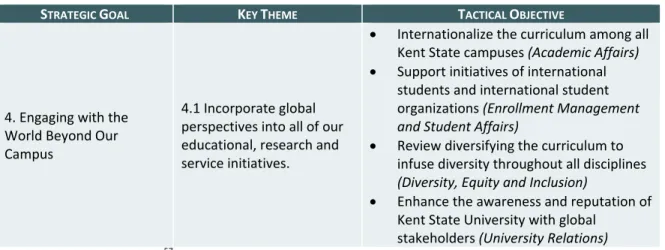
The Kent State strategic plan also assigns tactical objectives within key themes to a specific
organizational unit within the University. This process clearly maps institutional strategic
goals to particular organizational units.55 While this centralized process takes some of the
onus off of organizational units in steering the development of their own strategic plan at a
high level, these units are still responsible for creating their own themes, projects, and tasks
within the assigned tactical objectives and the metrics that will be used to evaluate their
progress.56 Figure 2.5 below presents an example of a strategic goal, supporting key theme,
affiliated tactical objectives, and assigned units responsible for that objective.
Figure 2.5: Excerpt from Kent State University Strategic Plan
STRATEGIC GOAL KEY THEME TACTICAL OBJECTIVE
4. Engaging with the
World Beyond Our
Campus
4.1 Incorporate global
perspectives into all of our
educational, research and
service initiatives.
Internationalize the curriculum among all
Kent State campuses (Academic Affairs)
Support initiatives of international
students and international student
organizations (Enrollment Management
and Student Affairs)
Review diversifying the curriculum to
infuse diversity throughout all disciplines (Diversity, Equity and Inclusion)
Enhance the awareness and reputation of
Kent State University with global
stakeholders (University Relations) Source: Kent State University57
54
Bulleted points taken verbatim from: “University Strategic Plan.” Kent State University. http://www2.kent.edu/excellenceagenda/index.cfm
55 Ibid. 56
See for example: “Division of Human Resources Strategic Plan for a Culture of Excellence: 2012‐2017.” Kent State University. http://www2.kent.edu/hr/upload/hr‐strategic‐plan‐2013.pdf
57
“Strategic Planning Document.” Kent State University, p. 10.
Apart from the University’s strategic plan, at a minimum other organizational units in the
University have a “Strategy Map” that outlines the vertical alignment of University strategic
goals and key themes with the strategic plans and key themes of the unit. The Strategy Map
also outlines the metrics that will be used to evaluate progress in each major area.58
Some units have a full strategic plan in addition to the Strategy Map. For example, the
Division of Human Resources has a nine‐page strategic plan that includes information on
how the department’s mission aligns with institutional goals, strategic directions for the unit
with associated key themes and projects (similar to the structuring of the University
strategic plan), and the Strategy Map.59 Others, such as the Division of Academic Affairs and
the Division of University Relations, only have a Strategy Map (See Figure A.5 in the
appendix).60
C
ALIFORNIAS
TATEU
NIVERSITY‐C
HICOAt California State University‐Chico (CSU‐Chico), the Division of Academic Affairs has
undertaken an initiative to create strategic alignment from the CSU system‐wide strategic
plan down through the accomplishment reports for individual faculty and staff. This effort
demonstrates the cascading alignment that institutions can pursue from the highest level of
strategic planning to connect goals with individual staff actions. Error! Reference source not
found. on the following page presents the Academic Affairs alignment plan developed as a
part of The Academic Plan.61
According to the provost and vice president for academic affairs, the Academic Plan 2007‐
2012 “provides an initial roadmap for our journey to excellence in instruction, research,
creative activity, and public service. In it, we identify five Academic Affairs goals and
associated strategies by which we support the University's strategic priorities.”62 Prior to
this process, the unit’s plan had strategic goals that related to the overall mission of
University, but the relationship between individual goals for the unit was not clearly
mapped to specific University goals. Academic Affairs is currently undergoing a review of its
Academic Plan through the “Creating New Possibilities” initiative to ensure this alignment.
58
See for example: “EMSA Divisional Strategy Map.” Kent State University, July 20, 2010. http://www2.kent.edu/emsa/about/upload/emsa‐divisional‐strategy‐map.pdf 59
“Division of Human Resources Strategic Plan for a Culture of Excellence: 2012‐2017,” Op. cit. 60
[1] “Academic Affairs Strategy Map.” Kent State University, January 27, 2010.
http://cmsprod.uis.kent.edu/about/administration/provost/upload/Academic‐Affairs‐Strategy‐Map.pdf [2] “University Relations Strategy Map.” Kent State University.
http://www2.kent.edu/about/administration/ur/upload/University‐Relations‐strategic‐map.pdf 61
“Achieving Strategic Alignment: From CSU Strategic Plan to Individual Faculty/Staff Member.” CSU Chico. http://www.csuchico.edu/vpaa/wasc/docs/EERDocs/Theme4/CSUAASPCascade5‐08v.1.0.pdf
62
“Strategic Planning Within Academic Affairs.” Provost and Vice President for Academic Affairs, CSU Chico, 2014. http://www.csuchico.edu/vpaa/planning/planning/planning‐in‐aa.shtml
The “Creating New Possibilities” project began in fall 2013
with Phase I, which consisted of “possibility” conversations
with University stakeholders.63 Discussions were data‐
driven, with multiple parties independently analyzing 61
datasets to produce themes for improvement in the
Academic Plan.64 Phase II commenced in spring 2014 with a
number of mini‐retreats and consultation sessions to
interpret the findings of the Phase I data analysis.65 The
following six themes emerged from this analysis:66
Theme 1: Student Lifelong Success
Theme 2: Excellence in Teaching and Learning
Theme 3: Building Community
Theme 4: Faculty Renewal
Theme 5: Staff Renewal
Theme 6: Organizational Process ImprovementThe Academic Affairs planning in currently in Phase III, with
designated committee members assigned to develop
“action groups” organized around the six themes identified.
The committees were asked to develop short‐term, intermediate, and long‐term actions
that will help the University to achieve the goals of each theme.67 During this process,
groups work with an Evaluation Rubric document that requires each theme and proposed
action to be directly linked to at least one strategic priority from the University‐wide plan.68
In addition, the committee must identify the following criteria: Key Performance Indicators,
Organizational Impact Level, Organizational Implementation Level, Resource Predictability,
Timeframe for Implementation, Resource Intensity One Time versus Ongoing, Scope of
Impact, and Intensity of Impact. A template of the rubric is presented in Figure A.6 in the
appendix to this report. 63
“Phase I: Fall 2013.” Creating Our Future Together, CSU Chico, 2014. http://www.csuchico.edu/futurepossibilities/phases/phase1.shtml 64
Data were analyzed by the Academic Plan Committee (APC), the Associated Students, and the Academic Senate in collaboration with the President’s Cabinet members, the Staff Council, the Council of Academic Deans (CAD), the Council of Chairs, and the CSU, Chico California Faculty Association (CFA). “Final Report on the Possibility Conversations.” CSU Chico, March 28, 2014. p. 1.
http://www.csuchico.edu/futurepossibilities/documents/apc_report_phase1_final_draft.pdf 65
“Phase II: Spring 2014.” Creating Our Future Together, CSU Chico, 2014. http://www.csuchico.edu/futurepossibilities/phases/phase2.shtml 66
“Creating New Possibilities.” Creating Our Future Together, CSU Chico. http://www.csuchico.edu/futurepossibilities/index.shtml
67
“Phase III: Action Conversations, Fall 2014.” Creating Our Future Together, CSU Chico, 2014. http://www.csuchico.edu/futurepossibilities/phases/phase3.shtml
68
“APC Evaluation Rubric.” CSU Chico, October 2014.
http://www.csuchico.edu/futurepossibilities/documents/apc_evaluation_rubric.pdf CSU Strategic Plan CSU Chico Strategic Plan Academic Affairs Plan Academic Affairs College/Unit Plan Department Plan Program Plan Faculty/Staff Accomplishment Report
Figure 2.6: Achieving Strategic
Alignment in Academic Affairs
A
PPENDIX
Figure A.1: Strategic Action Plan and Alignment Template for College/Major Unit,
Kansas State University
Source: Kansas State University69
69
“Strategic Action Plan and Alignment Template for College/Major Unit.” Kansas State University, October 2014. http://www.k‐state.edu/2025/documents/K‐State‐2025‐Strategic‐Direction‐Action‐Plan‐and‐Alignment‐ Template‐Oct‐2014.docx
Figure A.2: Strategic Action Plan and Alignment Template for Departments,
Kansas State University
Source: Kansas State University70
70
“Strategic Action Plan and Alignment Template for Departments.” Kansas State University, July 3, 2013. http://www.k‐state.edu/2025/documents/K‐State‐2025‐Dept‐Strategic‐Action‐Plan‐Template‐7‐3‐13.docx
Figure A.3: Strategic Action Plan and Alignment Checklist (Departmental level only),
Source: Kansas State University71
71
“Strategic Action Planning Alignment Checklist.” Kansas State University, January 25, 2013. http://www.k‐ state.edu/2025/documents/K‐State‐2025‐University‐Alignment‐Checklist‐1‐25‐13.docx
Figure A.4: University of Dayton Geology Department Assessment Plan
for “Practical Wisdom” University‐wide Objective
UNIVERSITY‐WIDE OBJECTIVE: PRACTICAL WISDOM
All undergraduates will develop and demonstrate practical wisdom in addressing real human problems
and deep human needs, drawing upon advanced knowledge, values, and skills in their chosen profession
or major course of study. Starting with a conception of human flourishing, students will be able to define
and diagnose symptoms, relationships, and problems clearly and intelligently, construct and evaluate
possible solutions, thoughtfully select and implement solutions, and critically reflect on the process in
light of actual consequences.
PERTINENT GEOLOGY DEPARTMENT OUTCOMES
Students will demonstrate a firm grasp of the basic principles of Geology as developed in the
introductory sequence of Physical Geology, Historical Geology, and Mineralogy.
All graduates will demonstrate a familiarity with the fundamentals of geological field investigation. Graduates will be adequately prepared for employment in the geologic and/or environmental arenas.
Graduates will demonstrate an understanding of the relationship between science, culture, and
society.
Environmental Geology majors will display interdisciplinary knowledge that is significant for success
in their field
MEASURES TO BE UTILIZED
All students will pass a “Second Year Review” of basic knowledge in Geology. The average score on
the first time taking the exam will exceed 80%.
All physically able graduates will complete at least 15 days of intensive training in the fundamentals
of field investigation, through course work in Field Geology and/or Environmental Instrumentation
Laboratory, independent study and/or thesis work, and class field trips. In conjunction with this work
they will demonstrate skills such as detailed note‐taking and interpretation of observed field
relationships, mapping of rock types or landforms at a variety of scales, detailed observation and
description of earth materials (including measurement and descriptions of stratigraphic sections), and
field‐based sampling procedures and subsequent processing and analysis of samples in the
laboratory.
At least 75% of graduating students will complete an internship, summer research experience,
summer job, student teaching (for dual degree students), or volunteer experience in an earth science‐
related field.
On the Annual Survey of Exiting Students, over 75% of graduates will “AGREE” or “STRONGLY AGREE”
with the statement, “As an undergraduate in the Geology Department of the University of Dayton I
believe I am adequately prepared for a career in geology and/or environmental geology.”
On a Post‐graduate Survey of alumni to be administered three years after graduation, at least 75% of
alumni will AGREE or STRONGLY AGREE with the statement, “I believe that my undergraduate
experience at the University of Dayton adequately prepared me to pursue a career in earth and
environmental sciences or related fields.”
Source: University of Dayton72
72
Figure contents taken verbatim from: “Geology Department Assessment Plan.” University of Dayton, September 2011. pp. 2‐3. https://www.udayton.edu/finadmin/ir/assessment/docs/Assessment_Plan_Geology_2010‐11.pdf
Figure A.5: Academic Affairs Strategy Map for Kent State University
Source: University of Dayton73
73
“Academic Affairs Strategy Map.” Kent State University, January 27, 2010.
Figure A.6: CSU Chico Academic Affairs Planning Evaluation Rubric
Source: CSU Chico74
74
“APC Evaluation Rubric.” CSU Chico, October 2014.
P
ROJECT
E
VALUATION
F
ORM
Hanover Research is committed to providing a work product that meets or exceeds partner
expectations. In keeping with that goal, we would like to hear your opinions regarding our
reports. Feedback is critically important and serves as the strongest mechanism by which we
tailor our research to your organization. When you have had a chance to evaluate this
report, please take a moment to fill out the following questionnaire. http://www.hanoverresearch.com/evaluation/index.php
C
AVEAT
The publisher and authors have used their best efforts in preparing this brief. The publisher
and authors make no representations or warranties with respect to the accuracy or
completeness of the contents of this brief and specifically disclaim any implied warranties of
fitness for a particular purpose. There are no warranties which extend beyond the
descriptions contained in this paragraph. No warranty may be created or extended by
representatives of Hanover Research or its marketing materials. The accuracy and
completeness of the information provided herein and the opinions stated herein are not
guaranteed or warranted to produce any particular results, and the advice and strategies
contained herein may not be suitable for every partner. Neither the publisher nor the
authors shall be liable for any loss of profit or any other commercial damages, including but
not limited to special, incidental, consequential, or other damages. Moreover, Hanover
Research is not engaged in rendering legal, accounting, or other professional services.
Partners requiring such services are advised to consult an appropriate professional.
4401 Wilson Boulevard, Suite 400 Arlington, VA 22203 P 202.559.0500 F866.808.6585 www.hanoverresearch.com