Published in the International Journal of Operations & Production Management, Vol 21 (3), 2001 pp275-301
CUSTOMER SUPPORT AND NEW PRODUCT DEVELOPMENT—AN EXPLORATORY STUDY
Keith Goffin and Colin New
Cranfield School of Management, Cranfield, Bedford MK43 0AL, England, UK
Tel: 0044 (0)1234-751122; Fax: 0044 (0)1234-751806 email: [email protected]
BIOGRAPHICAL DETAILS
Keith R.H. Goffin is Professor of Innovation Management at Cranfield School of Management in the UK. He studied Physics at Durham University, graduating in 1977 with first class honours. Subsequently he obtained a MSc in Medical Physics from Aberdeen University in Scotland, specialising in developing software for the analysis of heart function. For fourteen years he worked in the electronics industry: as an engineer on new product development; managing customer support groups; and as a marketing manager. Parallel to his working responsibilities he studied for a Ph.D. at Cranfield School of Management, graduating in 1993. His research on customer support has practical applications that have been put to use at a number of companies. In 1995, Keith joined the teaching faculty of Cranfield, where he teaches operations management on MBA and executive programmes. His research interests are all focused on innovation, including product support for high-tech products and innovation rates in different industrial sectors. He has published widely, including articles in the International Journal of Physical Distribution & Logistics Management, International Journal of Operations & Production Management, and theJournal of Product Innovation Management.
Colin New was Professor of Manufacturing Strategy and Deputy Director of Cranfield School of Management until he took early retirement in 1999. He started his industrial career with Rolls-Royce Aero Engines in Derby, where he was involved in advanced production planning and control systems. He subsequently completed the Masters programme at London Business School with Distinction and then stayed on to teach at LBS for seven years before moving to Cranfield in 1978. He was appointed Deputy Director of the School with special responsibility for graduate programmes in June 1989. His research areas include manufacturing strategy; manufacturing planning and control; and distribution systems management and he developed the Best Factory Awards survey of manufacturing performance, which is now running in Germany, Italy and the UK. Colin is the author of three books and a large number of papers and articles on manufacturing strategy. On a number of occasions, Colin acted as a special advisor to the UK Government on the competitiveness of manufacturing industry. He has also acted as a consultant to many manufacturing companies across Europe and the United States. He is currently writing two books and several major research reports.
Final Draft of Paper (Accepted for publication by the International Journal of Operations & Production Management)
CUSTOMER SUPPORT AND NEW PRODUCT DEVELOPMENT—AN EXPLORATORY STUDY
Keith Goffin and Colin New
Cranfield School of Management, Cranfield, Bedford MK43 0AL, England, UK
Tel: 0044 (0)1234-751122; Fax: 0044 (0)1234-751806 email: [email protected]
ABSTRACT
Customer support is an essential element in the successful marketing of many
products—from domestic appliances to high-tech computer networks. Many aspects
of support are strongly influenced by a product’s design and so customer support
requirements should be evaluated during new product development. However,
researchers have largely ignored the relationship between new product development
and customer support. The current study addressed this gap by using case studies and
a workshop, both conducted with leading companies, to identify how customer
support is typically evaluated at the design stage and to determine the importance of
this aspect of new product development. The results have implications for managers
responsible for product innovation—they show the need to allocate adequate resources
to integrating customer support requirements into new product development.
KEYWORDS
Customer support; new product development; design for supportability
INTRODUCTION
End-users of many types of product, ranging from computer systems to domestic
appliances, require customer support at some time—assistance to help them gain
maximum value from their purchases. Typical forms of support include installation,
user training. In fact customer support entails all activities “to ensure that a product is
available for trouble-free use to consumers over its useful life span” (Loomba, 1998).
Customer support, which is also referred to as product support, after-sales service, technical support, or simply service, is important for manufacturers because it:
Is essential for achieving customer satisfaction and good long term relationships— as identified by a number of researchers (Armistead and Clark, 1992; Athaideet al, 1996; Cespedes, 1995; Christopher et al, 1991; Davidow, 1986; Lele and Sheth,
1987; Teresko, 1994).
Can provide a competitive advantage (Armistead and Clark, 1992; Davidow, 1986; Goffin, 1998; Hull and Cox, 1994). This is true in most high-tech industries
(Goffin, 1994; Lawless, and Fisher, 1990; Meldrum, 1995) but also in some
low-tech sectors (Moriarty and Kosnik, 1989). As product differentiation becomes
harder in many markets, companies are increasingly looking to customer support as
a potential source of competitive advantage (Loomba, 1998). A number of
examples of how companies have won market share through good support can be
found in the trade press [see for example (Goffin, 1994)].
Plays a role in increasing the success rate of new products (Cooper and Kleinschmidt, 1993);
Needs to be fully evaluated during new product development (NPD), as good product design can make customer support more efficient and cost-effective
(Armistead and Clark, 1992; Berg and Loeb, 1990; Cespedes, 1995; Goffin, 1998).
Although there is ample anecdotal evidence that customer support is an essential
requirements and NPD is not adequately understood. Therefore, exploratory research
was conducted which had two main objectives:
To investigate the role of after-sales support in five different sectors—covering both simple and complex products
To investigate how different companies evaluate customer support requirements during new product development
The results show that customer support is highly important in a range of markets with
vastly different products—from domestic appliances, to passenger aircraft.
Additionally, the research shows the need to address support requirements at the
design stage. The results have implications for all managers responsible for NPD, in
any industry where support plays a significant role.
CUSTOMER SUPPORT
The Importance of Customer Support
As already explained, good customer support is a prerequisite for achieving customer
satisfaction; it can increase the success rate of new products and directly contribute to
competitive advantage. In addition, it can be a major source of revenue for
manufacturers (Berg and Loeb, 1990; Hull and Cox, 1994; Knecht, et al 1993). In fact,
the total worldwide market for high-tech support is estimated at $400 billion
(Blumberg, 1992) and the importance of support revenues to manufacturing
companies in a range of industries has been identified (Knecht, et al 1993). Over the
working lifetime of a product, the support revenues from a customer may be far higher
than the initial product revenue (ibid). Despite the importance of customer support as
a source of both revenue and profit, it is an area that has often only received scant
management attention given to customer support, it has also failed to attract the
attention of management researchers (Hull and Cox, 1994). This is in stark contrast to
the amount of previous research on what is termedcustomer service.
Customer Support in Context
It is important to see understand how the topic of customer support relates to the
extensive literature on customer service. Customer service—the way in which a customer is handled before, during and after the sales transaction (of either a tangible
product or a service)—has been researched from both the operations management and
marketing perspectives. Many papers and books have been published on this area,
describing for example the differences between the marketing of services and products
(e.g. Payne, 1993). Another highly researched area is the perceived quality of the
service received by the customer, including the many studies using the well-known
“Gap Model” (Zeithaml and Bitner, 1996). The streams of research into customer
service are well established. In contrast, customer support—a specific type of
customer service offered by manufacturers—has not been as highly researched.
However, customer support is now “being recognised as an important research
priority” (Loomba, 1996).
The majority of what has been written about customer support has been
published for practitioners. Examples are journals, such as AFSM International—The
Professional Journal, (the publication of a professional association for customer support
managers), and books (e.g. Wellemin, 1984; Patton, 1984; Laub and Khandphur, 1996). An extensive review of the practitioner literature identified seven elements of support (Goffin, 1999).
The Elements of Customer Support
The seven key elements of customer support are:
Installation.For many products, the first element of product support following the sale is installation. For complex products, or where safety issues are involved,
personnel from the manufacturing company, or their representatives usually
perform this.
User Training. The complexity of some types of equipment means that manufacturers must provide good training for users. For example, the successful
implementation of new manufacturing equipment often depends on extensive
training (Athaide et al, 1996). Many products include functions, which help users learn to use them more efficiently; these can range from simple Helpfunctions, to full computer training packages.
Documentation. Most products require some form of documentation. Typical forms of documentation cover equipment operation, installation, maintenance and repair.
Good documentation can reduce support costs (Miskie, 1989).
Maintenance and Repair. Historically, this has always been an important element of customer support. Maintenance, is necessary to clean, refurbish or replace parts
of equipment which otherwise would be liable to fail. If equipment fails, fast and
efficient repair is essential in many markets because “down-time costs run typically
at anywhere from 100 to 10,000 times the price of spare parts or service” (Knecht
et al, 1993). Manufacturers need to have effective logistics for the management of
On-Line Support. Telephone advice on products is important in many industries. Product experts give on-line consulting to customers to help them use products
more efficiently or, sometimes to trace the cause of faults.
Warranty. Manufacturers’ warranties reduce the financial risk of owning products. Over the working lifetime of a product, support costs can be high and so many
manufacturers offer customers the possibility to purchaseextended warranty.
Upgrades. Customers may be offered the opportunity to enhance the performance of existing products. For example, computer upgrades increase the working
lifetimes of products.
Over the last fifteen years there has been a change in the relative importance of
different elements of customer support. In the past, when many products had high
failure rates, the most important aspect of support was fast and reliable repair (Lele
and Karmarker, 1983). New technologies have now typically led to more reliable
products. However, increased product complexity (which is often software-based)
means that the importance of user training and on-line support has increased (Goffin,
1998).
Previous Publications and Research
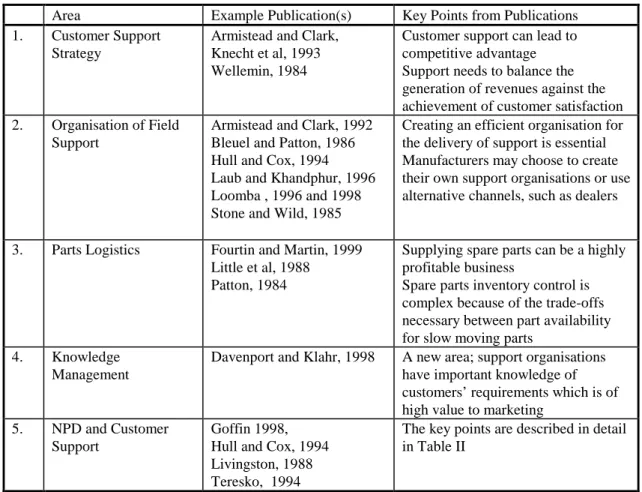
Table I shows that there are five aspects of the management of customer support on
which papers and books have been published. Customer support strategy consist of
writings on how support contributes both to the competitive advantage of companies,
the achievement of customer satisfaction and the generation of revenues—there is
there has been increasing recognition of the strategic importance of customer support
to manufacturers (Knechtet al, 1993).
Insert Table 1
A key aspect of support is the management of the field support organisation—
including the engineers who install and maintain equipment. Much has been written
for practitioners on how to approach this and there has been some academic research
into best practices (e.g. Hull and Cox, 1994). Just as the management of engineers is
important, so is the logistics of spare parts. Inventory levels for spare parts are
difficult to control and, for example, research has shown that the approaches used for
stock control in manufacturing situations do not apply to spare parts (Fourtin and
Martin, 1999).
Two emerging areas should also be mentioned. Customer support
organisations have extensive knowledge of customers’ requirements and this
information is now being recognised as invaluable for marketing. However, little has
been published on this area yet. Similarly, the relationship between new product
development and customer support has been discussed by a number of authors but is
not well understood.
Customer Support and NPD
Support revenues may be a significant source of income for manufacturers but for
customers the cost of maintaining equipment over its working lifetime—referred to as
cost-of-ownership (Taylor, 1995)—can be prohibitive. Therefore, customers in many sectors are demanding more economical and effective customer support (Loomba,
support is product design (Lele, 1986). However, the need to consider customer
support during NPD has been largely ignored by both companies and researchers
(Goffin, 1998).
A number of authors have recognised the importance of support requirements
being considered at the design stage (e.g. Cespedes, 1995; Armistead and Clark, 1992;
Berg and Loeb, 1990; Goffin, 1998). Product design influences both the amount of
support necessary and the means by which it can be delivered (Garvin, 1988; Sleeter,
1991). For example, decisions taken at the design stage affect product reliability and
consequently how often products require maintenance and repair (Lele, 1986).
Similarly, a modular approach to product design can reduce repair costs (Hedge and
Kubat, 1989), as can good diagnostics (Armistead and Clark, 1992; Karmarker and
Kubat, 1987). However, beyond repair and maintenance, product design also
influences the amount of user training which is necessary and the ease of upgrading
products. Appropriate product design can therefore significantly reduce
cost-of-ownership (Blanchard, 1991). For example, Microsoft’s Windows 95 product was “specifically designed to reduce total cost of ownership through increased ease of use,
functionality and support” (Taylor, 1995). Products that have been consciously
designed for easy customer support have a strong differentiating factor in the market
(Swink, et al 1996).
It is important to not only consider customer support requirements early in
NPD but also to make a comprehensive evaluation. The early evaluation ofallaspects of product support at the design stage has been termed Design for Supportability
(DFS-II) by Goffin (1998). To achieve this, it has been recognised that engineers with
Cox, 1994), as “by participating in the development stage, the after-sales group can
add substantial value by making the equipment more ‘maintenance-friendly’” (Knecht
et al, 1993). However, a survey showed that customer support personnel were only
“occasionally involved in new product work” (Page, 1993). In addition, research has
shown that many companies do not consider product support until relatively late in the
development cycle (Goffin, 1990). Low involvement of customer support personnel in
NPD can lead to products that are difficult to repair and which have excessive
warranty and service costs (Anthoney and McKay, 1992).
Design for Supportability Practices
Although the need to evaluate support requirements is recognised, information on how
this should be done is sparse—only four articles discuss this aspect of NPD in detail
(see Table II).
Insert Table II
Livingston describes how Rank-Xerox recognised that low cost-of-ownership is
important to customers and that it can be minimised by reducing the cost of every
aspect of support (Livingston, 1988). This recognition led to the adoption of a range of
supportability goals including ease-of-use, ease-of-cleaning, easier maintenance
procedures, and ease-of-repair. Rank-Xerox found that it was necessary to have a clear
process for setting design priorities, as different functional departments may have
opposing objectives. For example, manufacturing’s objective may be to reduce
assembly costs. This can lead to a product that is easy to manufacture but hard for
engineers to repair at customer sites. A limitation of Livingston’s article is that
Teresko (1994) discusses serviceability (ease of product maintenance and repair) and product design, suggesting that “a new design idea is surfacing in the
market battle for product supremacy: serviceability”. A computer-aided design (CAD)
tool is described which calculates field disassembly and re-assembly times and
identifies service costs (Parker, 1993; Teresko, 1994). This package is based on earlier
software used to ensure that products are easy to manufacture. The apparent limitation
of the software is that it focuses on maintenance and repairs and ignores other
important elements of customer support, such as user training, documentation, etc.
Hull and Cox (1994) conducted case study research at six leading electronics
manufacturers. They focused mainly on field support organisations but also identified
the importance of customer support engineers giving inputs to the NPD process. For
example at National Cash Register (NCR), an information processing company,
“maintainability and serviceability of products are a prime consideration in the design
and manufacturing processes”. Similar approaches were found at International
Business Machines (IBM); Hewlett-Packard; General Electric (GE); and Amdahl (data
processing systems). At American Telephone and Telegraph (AT&T) “products are
designed for serviceability and [good] after-sales support is acknowledged as a
prerequisite for product sales”. Although they clearly identified that leading
electronics companies consider support at the design stage by involving service
engineers, Hull and Cox gave no information on how support is evaluated during
NPD.
Previous research on hospital equipment (Goffin, 1998), identified three main
points. Firstly, support requirements are typically not considered early enough during
product features during NPD and so a clear understanding of the cost of support over
the working lifetime of a product is required. Thirdly, it is important to provide
quantitative design goals to R&D, related to each of the key support requirements. The
main limitation of this research is that it only describes the approach taken at one
company in detail.
The need for evaluating customer support during NPD is clear but previous
research had the limitations, which were discussed. Therefore, the following research
questions were identified:
1) What are the key elements of customer support in different industries? How are
these related to the characteristics of typical products?
2) Is customer support important for both simple and complex products?
3) How do companies evaluate support requirements during new product
development?
Overall, the investigation of NPD formed part of a wider study of customer support,
which has been described previously (Goffin, 1999).
METHODLOGY Research Design
As shown by the literature review, there has been only limited previous investigation
of how customer support issues are evaluated during NPD. Therefore, the research
was exploratory in nature and a suitable approach was required.
A postal survey of the issues was considered but rejected. Postal surveys have
a number of limitations, including the possible ambiguity of questions, the lack of
control over who actually answers the questionnaire and potentially low response rates
support and their emerging nature, the possibility of ambiguous answers was
considered to be high. Similarly, response rates for surveys in the field of customer
support have previously been low (Goffin, 1998). Therefore, a case study approach
was selected as an appropriate way to address the problems of non-response and
ambiguous answers. However, in choosing case study methodology, the researchers
recognised that the design needed to be carefully constructed to ensure sufficient
rigour.
There are many issues to consider in achieving high-quality case study design
but the main ones are construct validity and internal validity (Yin, 1994; Easton, 1995;
Miles and Huberman, 1994). Construct validity refers to establishing suitable
operational measures for the concepts being studied (Mason and Bramble, 1989). This
was largely achieved by basing the questionnaire used for data collection on the work
of previous researchers and sufficient piloting. Consequently, operational measures
such as the percentage of revenues from customer support were identified from
previous research. Internal validity refers to the reliability of a study and whether the
variables chosen for investigation are sufficient to explain the topic under
investigation (Dane, 1990). In order to maximise internal validity, multiple sources of
data were used. For example, triangulation was used with informants’ views being
checked against company documentation where possible. Lincoln and Guba (1985)
have identified observer bias as being a potentially real threat to reliable interpretation.
To counter observer bias, “member checks”—feedback from informants—were used
as the key method for establishing the credibility of an interpretation (Wallendorf and
Belk, 1989). To achieve a rigorous case study design, the research was designed in
Preliminary contacts. Leading companies in different industries were identified and contacted by letter. Their agreement to participate in the research was obtained
and the manager responsible for customer support identified. At this point
telephone calls were made to the customer support managers at each company to:
explain the research aims; obtain a preliminary understanding of the role of
customer support; set a date for a visit; and to identify the most suitable informants.
Case study visits.One-day visits were made to the companies to conduct semi-structured interviews with the customer support manager and other informants,
such as marketing and quality managers. During these visits the researcher also had
the opportunity to inspect documentation and to view the company’s products.
Data analysis and post-visit contacts.After each visit, preliminary analysis and data reduction was conducted and, following the completion of all five visits,
cross-case analysis was performed. There was also a high degree of involvement of
the companies during this stage, in checking case descriptions and discussing the
results with the researcher.
Workshop with participating companies.The final stage of the research was a one-day workshop held with managers from the participating companies. This gave
participating managers the opportunity to discuss the results of the cross-case
analysis and best practices with managers from different sectors. At this workshop,
the researchers obtained extensive feedback from managers.
Exploratory Sample
From the onset of the research it was clear that a single case study would not be
sufficient. In exploratory studies single case are only appropriate if they are unique,
exploratory sample for the research. As the computer industry had been investigated
previously (see Table II), it was decided to extend knowledge by focusing on sectors,
which had not been studied before. Therefore, telecommunications, the car industry,
vending machines, aircraft and domestic appliances were chosen—a purposive choice
of industries. The choice was driven by the need to cover a variety of case study
contexts. Therefore both a deliberately wide range of sectors (including both
consumer and business-to-business products) and technologies (from electronics to
mechanical devices) were included.
Once the industries had been chosen, “leading” companies were identified—
companies having a significant market share in their industry. All of the sample
companies have operations in Europe. As a motivation to participate in the research,
companies were promised an informal “benchmarking report”, contrasting their
approach evaluating customer support during NPD to that of other companies. This
offer was well received and only one company declined to co-operate with the
research (forcing the selection of another company). In addition, participating
companies were also told they would be invited to a workshop where the results of the
research would be presented and discussed with the other companies.
Structure of Case Study Visits
The main data collection was performed during visits to the companies. These were
made over a period of seven months in 1997-98. During each visit, semi-structured
interviews were held with a range of informants. Holding on-site interviews at
companies with personnel from various departments—typically customer support,
picture of the role of customer support within the company to be obtained. Multiple
informants also allowed data triangulation—an important approach to ensuring data
reliability in manager-reported research (Miles and Huberman, 1994).
The interviews at each company were based on a questionnaire designed to
collect information on each of the following areas:
What are the characteristics of the company’s typical products?
What is the role of customer support in the company’s market?
What are the key elements of the customer support they offer to their customers?
How are customer support requirements evaluated during new product development?
- At what stage of NPD are requirements considered?
- Which departments are responsible for evaluating support?
- Are design goals set for support requirements?
Every interview was recorded (and later transcribed) and at the same time detailed
notes were taken. Interview transcripts were prepared and footnotes added to explain
any specific terms used by the respondents. Marginal notes were used to identify both
key issues and areas where further clarification was required (this was obtained in the
post-visit telephone calls). In addition to direct discussions, a number of telephone
interviews were held with personnel who were not available during the on-site visits
but interviewees had recommended the researcher to contact.
Where possible, a range of company documentation was inspected during the
Company brochures and annual reports (for background information)
Product brochures (to understand product features and to see whether customer support was used as a marketing tool)
Financial statements (to investigate support revenues)
Organisation charts (to see where customer support fitted in the structure of the company)
Most importantly, documentation of how the evaluation of customer support fits into new product development.
Companies were willing to give the researcher copies of most of these documents but,
in the case of financial statements and (sometimes) organisation charts, they only
allowed inspection. After each visit a detailed case file was prepared containing the
transcripts, interview notes and copies of documents.
Questionnaire Design
The 11-page questionnaire was based on the instruments developed by researchers
who have previously investigated customer support; primarily the work of Goffin,
(1990), Hull and Cox (1994); Knecht et al (1993); and Loomba (1996). Questions
were incorporated on the importance of support; its key elements; product
characteristics; and customer support and NPD. Due to the emergent nature of some of
the issues involved, many of the questions were open-ended. [A copy of the
questionnaire is available on request from the authors.]
Data Analysis
Case analysis was conducted in four main stages, which follows the recommendations
Each case was reviewed separately and the data analysed to give a complete picture of the company’s approach to evaluating support at the design stage. The same data
analysis framework was used for each case. To check the internal validity of the
data, triangulation was used; between different respondents and between
respondents’ comments and copies of company documentation.
Data reduction was performed and 2-3 page case descriptions were written on each company. A number of main headings were used for data presentation including
Product Characteristics; Key Elements of Customer Support; The Importance of Customer Support; and Customer Support and NPD. The descriptions were then submitted to informants for two reasons. Firstly, informants checked that the case
descriptions did not contain obvious clues to their company’s identity or
information that was likely to compromise their business. Secondly, informants
checked the detail given in the case description—and a number of small corrections
were made.
Following this, cross-case comparisons were made, to determine where similarities and differences existed and to identify a number of “best practices” (Yin, 1994).
As the results of the cross-case analysis were presented to participating companies during the workshop mentioned above, this allowed the conclusions to be discussed
with the informants. The transcript of the recording of the workshop was also
useful in this stage of the analysis.
RESULTS: FIVE CASE STUDIES
As the companies were promised anonymity, they will be referred to as TelecommA,
given in Table III, including company backgrounds, the informants interviewed and
the key findings. In order to concentrate on the main results of the study, only short
descriptions of each of the companies will be given (further within-case background
information can be found in Goffin, 1999). This paper focuses on the cross-case
analysis of the key elements of support and the way support is evaluated during NPD.
Insert Table III
Company and Product Overviews
TelecommA is a small company of 150 employees but they are the European leaders
in the field of telecommunications systems. They design, integrate and support
complex systems used in logistics applications, such as radio contact and control of
fleets of vehicles. Systems consist of a central computer linked to devices such as
PCs, sensors and radio equipment, with specialised software monitoring and
controlling the resulting network. Each system sold has a unique configuration and
costs are typically in the region of $1M. Customers—normally logistics companies
and organisations—typically use their systems for up to 20 years and they are
increasingly demanding more cost-effective support from TelecommA. Currently
customer support, which is provided by the R&D group from the factory, only
generates 4% of revenues but at margins, which are higher than those from product
sales.
AutoB is a major international manufacturer of passenger cars, which has
thousands of employees in its various organisations worldwide. They design,
manufacture and market cars and their products are produced in very high volumes.
produced by AutoB costs $15,000 and has a 10-12 year working lifetime, during
which it will have a number of owners. Although customer support only accounts for
15% of AutoB’s revenues, they acknowledge that it has a strong influence over
whether customers make repeat purchases—the importance of customer support in the
automotive market has also been recognised by researchers (e.g. Goffin, 1999).
VendorC designs, manufactures, sells and supports complex vending machines
and are the market leader. They employ several thousand people in their development,
manufacturing and service organisations worldwide. Vending companies buy large
numbers of machines to provide self-service sales of a wide range of goods, some of
high value. Modern vending machines—often referred to asvending terminals—are a complex mix of mechanical, electronic, security and display technologies and a top
range model can cost in the region of $15,000. The machines have a working lifetime
of about 10 years during which regular maintenance is required. Customer support is
essential to VendorC, as correctly functioning equipment prevents loss of sales for
vending companies. In addition, VendorC make over a third of their revenues form
customer support activities and top management has focused significant resources on
this area since recognising that good support can “dramatically improve...
[customers’] business performance” [VendorC—Quality Manager].
AeroD designs, manufactures, sells and supports small passenger aircraft—
termed regional aircraft in the industry. They have several thousand employees, including significant numbers in development and production. Regional aircraft is a
very competitive industry and margins are often low because the cost of materials and
vendor components can exceed 65% of sales price. Aircraft typically cost between
working lifetime of at least 20 years and support consequently accounts for 20% of
company revenues. Since “the in-service performance of aircraft, in terms of flight
safety and reliability, is paramount” [AeroD—Engineering Manager], customer
support is a key part of the business.
DomesticE, which is based in continental Europe, designs, manufactures, sells
and maintains “white goods”—domestic appliances, such as washing machines. They
have several thousand employees and operate in a highly competitive, price-sensitive
market—shown by the fact that despite having a strong brand, DomesticE have not
been able to increase their prices for the last ten years. Modern washing machines are
a mix of mechanical, electro-mechanical and, increasingly, electronic components and
a typical model will cost in the region of $300. Machines have a working lifetime of
about 10 years in normal usage. Strategically, support is “a major strength and a
competitive advantage” and a key source of profit for DomesticE. The company
strongly promotes its customer support in all its sales and marketing activities— “our
extensive After-Sales Service ensures each product produces a market-leading
performance from day one onwards” (extract from a promotional brochure).
Key Elements of Customer Support
From the trade literature, seven elements of customer support were identified. The
case study research showed that not all of the seven elements are of importance to
every company and identified an eighth element which applies to some companies—
Table III gives the key elements for each of the companies.
The simplest products studied were the appliances of DomesticE, for which
four elements of customer support are key. Installation is simple and a not particularly
machine, or independently arranges for it to be carried out by a local tradesman.
However, simple and effective documentation is important because users seldom have
much technical knowledge. DomesticE have recognised this and try to produce user
documentation covering installation, operation and simple fault-finding which is
deliberately written in a style that is accessible to typical users. Washing machines
used to need preventive maintenance, for example replacement of the brushes on
electric motors. However, maintenance has now been “engineered out of products by
designing them for the whole life cycle” [DomesticE—Process Manager] and service engineers are not required unless a product fails. Quick response in the event of
breakdowns is essential in this market and DomesticE have their own,
long-established and extensive service organisation, assisted by call centres which try to
solve problems over the telephone. Product warranty is important to DomesticE—one
year is the industry norm but they differentiate themselves by offering the customer
better terms.
In strong contrast to domestic appliances, the most complex products in the
sample were aircraft and every element of customer support was both relevant and
important for the manufacturer AeroD. This company delivers aircraft to their
customers and conduct training of airline personnel, which is one of the most
time-consuming aspects of support—both induction and refresher courses for airlines’
pilots and maintenance engineers are run on a regular basis. As might be expected in a
highly regulated industry, high quality documentation is essential and, in some cases,
this must be approved. Key documentation includes theflight manual, which contains all the information that the pilot needs to operate the aircraft safely; and maintenance
maintenance is required—something under 3 maintenance hours per flying hour is
typical in the industry. AeroD sells spare parts to airlines for repair and maintenance
purposes and they have a large call centre to give advice on maintenance issues.
Warranty cover is comprehensive and generally specified for each major component
of the aircraft. For example, engine and structural warranty are separately specified, in
cycles (e.g. the number of take-offs and landings) or flying hours. Upgrading aircraft
is also a significant business for AeroD. A key aspect of AeroD’s strategy is their
engineering support—advice to airlines on how best to manage their aircraft—which goes beyond the scope of support provided by response centres. Engineering support
is provided without charge to major customers and helps increase aircraft reliability
and prevent flight cancellations (which can lead to a major loss of revenues for
airlines). “We [the manufacturer] can offer to examine the customer’s operation and
provide advice on how he can get the best from the product. This can be technical,
operational or commercial advice” [AeroD—Customer Service Manager].
In terms of complexity, the products of the three other sample companies lie in
different positions between the extremes, with cars and vending machines both being
more complex than domestic appliances but simpler than telecommunications systems
and aircraft. In the automotive industry product support is generally referred to as
service and the four main elements are maintenance and repair including parts;
documentation (workshop and owner manuals); the training of mechanics from
recognised dealerships; and warranty. Due to their mechanical parts, cars require a
significant amount of maintenance and repair and this increases cost-of-ownership.
normally 12 months, although competitive pressure is changing this to 3 years in some
countries.
VendorC manage all aspects of installation, from site surveying, to wiring and
fitting. Training of the staff of vending companies who are responsible for first-line
maintenance and replenishing machines plays a key role. Terminals have full technical
documentation for maintenance purposes and some of this is being made available
over the Internet. Timely maintenance and repair is very important as equipment
downtime leads to lost sales. Consequently VendorC has invested heavily in
establishing an effective support organisation. Warranties are 90 days—standard in
this industry. In addition, VendorC sell upgrades on “used terminals to extend
equipment lifetime” [VendorC brochure]. VendorC have the capability to offer full
goods management to their customers—ensuring that machines are working and are replenished in a timely fashion. This new service is now an important source of
revenue for VendorC and arose from customer feedback obtained by the field service
function.
TelecommA’s systems are complex and require extensive support, although
the company has not focused on developing this side of the business. R&D engineers
install systems and this typically takes 9 days. Systems are designed for ease of use but
users still require training—typically one day following installation (TelecommA
“spend very little time on training, we do try to pass that on to the customer”
[TelecommA—Development Manager]). Hardware is very reliable and failure rates
are typically only 1%. However, due to the complexity of networks, software
problems may occur and require investigation. System documentation is produced by
documentation for their own use in first-line maintenance. All systems are sold with a
12 months hardware warranty and 3 months software warranty, which is standard in
this industry. Upgrades, which enhance system capability, are a significant business
for TelecommA and systems typically have a major upgrade every 2 years.
Across the sample of companies studied, it can be seen that different products
have different key elements of customer support. Generally, more complex products
require more aspects of customer support. It is the evaluation of the relevant aspects of
customer support at the design stage that potentially can make support easier and more
cost-effective.
New Product Development and Customer Support
Although customer support plays an important role for all of the companies, there was
a wide variation in the approaches taken to integrating it into NPD. A key issue that
emerged from the research was how “comprehensive” the evaluation of customer
support requirements at the design stage is. For example, are all relevant elements
considered early in the design cycle and are suitable design goals set for each of them?
In this section of the analysis, the case results will be presented starting with the
simplest approach to evaluating customer support during NPD.
The least comprehensive approach to the evaluation of customer support needs
at the design stage was at TelecommA—as might be expected at a small company. For
them, NPD involves taking a “core” computer system and integrating it with other
devices to match specific customer needs and developing suitable software. The
design of a system typically takes 6 months. Support issues are considered from the
maintain and support as possible. There’s no formal documentation [on customer
support requirements]” [Quality Manager]. TelecommA have noproduct support plan
[a document that summarises the key issues of customer support for a particular
product, which is common in the computer industry]. Many of TelecommA’s R&D
engineers have had experience of supporting previous systems in the field and are
aware of customer support issues. However, no formal product design goals are set on
any issues related to supportability. Consequently, there are currently no goals at
TelecommA to reduce installation times, simplify training or minimise upgrade times
and therefore reduce costs on new products.
DomesticE’s product life cycles are normally 12 years but models “undergo a
constant evolution of cosmetic and other design improvements over the life cycle”
[NPD Process Manager]. New appliances are developed typically over 30 months by a
cross-functional team including R&D, marketing, manufacturing, and suppliers.
Product requirements are comprehensively documented at the design stage and a
number of formal tools, such as Quality Function Development (QFD) and Design for
Assembly (DFA), are used to help guide design decisions. Representatives from the
service organisation have always been invited to give their inputs on new designs and
prototypes. However, DomesticE are concerned that this has not worked efficiently—
“we still need to get more service involvement and to have them take a more active
part in the formal review process” [DomesticE—Process Manager]. Due to the
number of mechanical components they contain, washing machines are susceptible to
failure and the average failure rate is 25% for a machine in its first year of usage.
Consequently, the analysis of customer support issues at the design stage focuses on
are set at the design stage. However, no model of total lifetime service costs is
currently used. DomesticE now face a number of challenges including the need to
improve product reliability and ensuring that new, more complex products are easier
to use.
Although their products are complex, AeroD do not set as many
support-related design goals as, for example AutoB or VendorC. During development, the
AeroD project team takes into account the requirements of a range of users making up
what is called the Advisory Group; this includes pilots, cabin personnel, airlines’ financial representatives and maintenance engineers. Accounting for the requirements
of these different parties is not simple and the design group has to make decisions on
the best solution to complex and sometimes opposing requirements. “One of the
concerns is to make the aircraft cheaper to maintain” [AeroD—Design Manager] and
a Maintenance Steering Group is used to identify the key requirements of maintenance personnel. They determine “some top level goals, like maintenance hours
per flying hour” [AeroD—Design Manager] but not all aspects of support are
currently evaluated in detail or have associated quantitative design goals. “I think its
fair to say that many of these types of issues [design for easy maintenance] were again
down to the experience of the team who were working on the job and the guidance of
the more senior managers” [AeroD—Customer Service Manager]. With the high level
of bought-in components, AeroD also have the issue that some aspects of maintenance
are strongly influenced by their suppliers. Support has always been considered during
NPD by the experienced design team but AeroD are now trying to improve this
evaluation by determining a more comprehensive range of maintenance-related design
Since three years, AutoB has had a specific organisation of 30 people with the
responsibility for ensuring that customer support issues are adequately considered
during NPD. Their charter “is to participate early and pro-actively in the new model
development process and to represent customer services division in design decisions”.
[AutoB—Advanced Service Manager]. This is important because cost-of-ownership is
a key factor in business-to-business sales, as fleet managers are acutely aware of
vehicle running costs (comparisons of these are often published in trade journals). As
a consequence, AutoB conducts a detailed analysis of the way every new product will
be serviced. The product design goals which are set include cost-of-ownership; serviceability; and maintenance. In addition, a check is made of whether new cars solveprior model concernsand addressdamageabilityissues adequately. The latter is an assessment of how the cost of repairing the inevitable damage that will occur in
common accidents can be minimised. The results of the analyses are summarised in a
document called the Cost of Ownership/Serviceability/Damageability Plan, which assesses the five issues mentioned, for each and every major component in a car (an
example copy of this plan was given to the researchers). As a consequence, design
goals are set for both AutoB’s development teams and suppliers. To convince the
various departments involved in NPD to give suitable priority to service-related
issues, a financial model is also used. This can “demonstrate the wisdom of reducing
cost-of-ownership and look at the effect of poor repair capability on customer
satisfaction... trying to put a dollar figure on it” [AutoB—Advanced Service
Manager]. For the future, AutoB say they need to reduce cost-of-ownership further
Of the five companies studied, VendorC make the most comprehensive
evaluation of customer support at the design stage. Their NPD team is
cross-functional and includes R&D, product management, manufacturing, suppliers and
product support specialists. Their work is co-ordinated by a seven stagePhase Review
plan, which specifies the key responsibilities of each department at each stage of NPD.
Over the last five years, a strong focus on product support by management has led to
the consideration of service issues being “pushed further back into the design”,
through the direct involvement of customer support specialists [VendorC—Field
Service Engineer]. Consequently, the preparation of a Product & Solutions Services Planningdocument which summarises these issues is now an integral part of NPD. At the design stage product support specialists analyse the RASUI of products—the
reliability; availability; serviceability; usability; and installability. For each of these five categories a detailed analysis is performed, and clear design goals are set. The
Quality Department has the overall responsibility of ensuring that RASUI goals are met. In order to meet their challenging maintenance goals, VendorC have adopted a
variety of approaches. These include modular design, for quick replacement of faulty
or worn components, is standard practice and “diagnostic capability is designed into
each individual element of terminals” [VendorC—Quality Assurance Engineer].
Several of the benefits to customers of theRASUI evaluation are clearly identified in product brochures. The performance of their installed base of vending machines is
very closely monitored by VendorC’s elaborate internet-based system, which collates
data on all aspects of field service. Product reliability (e.g. downtime by product; by
location; by cause; etc.) and service engineer efficiency (installation times; percentage
organisation. Comprehensive data have been found crucial for early recognition of
product problems and in setting design goals for new products.
DISCUSSION
The cases cover five very different markets but it can be seen that customer support
plays an important role in each of them—managers identified that good product
support plays a key role in both creating a competitive advantage and, in most cases,
generating significant revenues. However, the cross-case analysis identified some key
differences in:
The elements of customer support which are important for particular types of products and
How comprehensively companies evaluate customer support requirements at the design stage.
The nature and reliability of equipment obviously has a large influence over
the key elements of product support. In the two companies where products have a
large number of mechanical components, products require higher levels of
maintenance. In the telecommunications industry hardware maintenance is less of an
issue but in all five markets customers expect reliable products and quick response in
the event of failure. Equipment retrofits or upgrades are an important element of
customer support in three industries: telecommunications, vending machines and
aircraft. Currently they are not important in the car industry but it remains to be seen
whether this will change as more electronics systems are used in cars (a technology
that lends itself to comparatively easy upgrades). Both VendorC and AeroD offer their
respectively. These services are more complex than the normal advice offered by call
centres and appear to give a competitive advantage to the respective manufacturers.
Further investigation is, however, required on the link between these new types of
customer support and competitive advantage.
The degree with which customer support issues are evaluated at the design
stage varied across the five companies. TelecommA, probably because of its small
size, has the least formal approach. Although R&D engineers are used as a resource
for field service and therefore often have first-hand knowledge of the problems, it
appears that TelecommA could benefit from a more structured approach. For example,
they have not set design goals to reduce installation times (and costs) from current
levels. DomesticE and AeroD evaluate support at the design stage but do not use a full
range of quantitative goals and both companies are not satisfied with the degree to
which support requirements are input to their NPD programmes. They feel that too
much still depends on whether R&D engineers have the experience to know how to
design products which are easy to support. In contrast, both AutoB and VendorC make
a comprehensive evaluation of every aspect of support and set design goals related to
each of them. In addition, the supportability of previous generations of products is
used as a benchmark—both companies want the customer support of each new
product to be more efficient. VendorC’s RASUI evaluation and tracking of a wide
range of field service data appears to be useful mechanisms for ensuring that the needs
of customer support are fully integrated into NPD. The strong support of top
management the customer support function at VendorC is also acknowledged as being
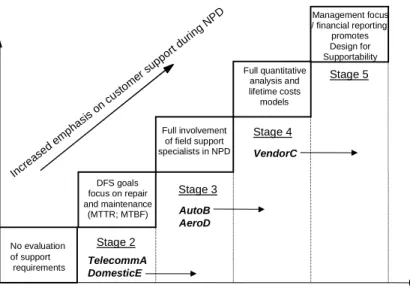
From both the literature and the current study, the concept emerged of a
comprehensive evaluation of customer support requirements at the design stage. The case companies appeared to have reached different levels of sophistication in this area.
Although strict historical data on when the companies enhanced their approaches were
not collected, discussions with informants indicated that this had taken some time—
for example AutoB had assigned a specific group to the task for the last three years
but still saw room for improvement. Reviewing the data on each of the case
companies allowed a conceptual model, Figure 1, to be drawn. This illustrates the
degree to which the companies evaluate support and how, over time, increased
emphasis is put on this area.
Insert Figure 1
Initially, customer support requirements may not be recognised as important.
Companies at Stage 1 do not recognise the potential of support business. And
consequently do not evaluate it at the design stage. Poor product design means higher
repair costs and can lead to dissatisfied customers. At Stage 2, companies consider
reliability and repair times at the design stage and typically set quantitative goals for
product reliability time-between-failures, MTBF) and ease-of-repair
(mean-time-to-repair, MTTR). However, broader aspects of support are not considered at the
design stage. Further progression leads to Stage 3, where companies involve panels of
field engineers in NPD reviews. It is essential to evaluate all aspects of support at the
design stage i.e. installation times; fault diagnosis times; field access times; repair
times/costs, user training times; upgrade times; etc. Integrating this effectively into the
4. At Stage 4 companies set quantitative goals at the design stage for all relevant
aspects of support and use lifetime cost models. These goals push development
engineers to develop designs that are easier and cheaper to support than previous
products. Finally, leading companies may reach Stage 5, which is characterised by all
of the issues considered at Stage 4 with two important additions. Firstly, financial
reporting mechanisms are used to ensure that return on DFS investment is clearly
visible to management. Secondly, the companies that reach Stage 5 have management
teams that fully recognise the importance of support to their businesses and
consequently devote sufficient focus and resources to this area. The position of each
of the sample companies on Figure 1 was initially determined by reviewing their
approach to evaluating customer support during NPD (as described in the text and
summarised in Table III) and then verifying this with the companies directly.
The workshop, which was run with participating companies, enabled a
verification of where the companies were positioned on the model. For example,
VendorC confirmed that that they had an advanced approach. “I think we are at Stage
4… we [customer support specialists] are fully allocated to the teams… the
quantitative analysis of cost… we basically do that but we are certainly [not] yet at 5”
[consensus between the VendorC Quality Manager and Support Specialist]. VendorC
are currently trying to further improve their design for Supportability practices, as
indicated by the arrow moving to Stage 5 on Figure1. For AutoB, they are also
improving “but not enough for me to convincingly say we are at Stage 4 [yet]”
[AutoB—Product Support Specialist]. Overall, Figure 1 was found at the workshop to
be an effective tool for discussions on the progress companies have made towards
needs further empirical verification. (This should include an estimation of the time
required for companies to move between the various stages.)
STUDY LIMITATIONS AND FUTURE RESEARCH
The research described in this paper has limitations, which must be acknowledged— both in terms of the scope of the issues studied and the methodology used.
The number of aspects of customer support and NPD investigated was limited. For example, informants perceived advantages in designing products for easy and efficient support but these advantages were not quantified in any way. Informants presumed that Design for Supportability would make new products easier to support and consequently reduce cost-of-ownership and in several cases had anecdotal evidence. However, this point needs further investigation and can be formulated into the following proposition:
Proposition 1: Products, which are developed after a comprehensive evaluation of customer support requirements has been made, will be easier and cheaper to support than comparable products where this is not the case.
Although a detailed evaluation of support requirements at the design stage may improve the supportability of products, small organisations such as TelecommA may not necessarily need to implement a formal planning process. This would, of course, need to be considered in any research designed to check Proposition 1.
With the small sample of the current study, external validity is an issue. For example, results from the five companies indicate that more complex products require more elements of support. However, these results are inconclusive. More investigation is required of the following proposition:
Proposition 2: Manufacturers of more complex products must provide more elements of customer support than are required for simpler products.
One of the key methodological limitations is that much of the data collected
was “manager reported”, although triangulation was used where possible. Researchers
researchers are present at key design meetings and actually observe the process of
evaluation and implementation of customer support requirements are needed.
For researchers active in the area of new product development, there are a
number of other areas, which require further investigation. Research is necessary to
identify whether the case companies manage customer support at the design stage in a
way that is typical for their industry or whether, in addition to having large market
shares, the sample can be considered as being “best-in-class” in this area. To establish
this, a wide survey of companies’ practices is required, ideally covering several
industries. The case on VendorC clearly demonstrates the competitive advantage that
can be obtained from well-planned support and functionality in products, which
supports incremental services. This requires further investigation—are a high
percentage of manufacturing companies using support to gain a competitive
advantage?
CONCLUSIONS
The contribution of this research is that it provided the first empirical evidence on
how support is evaluated during NPD in different industries. It showed that leading
companies invest significant resources to ensure that products are easy and
economical to support. Previous research (Goffin, 1990) showed that many companies
do not evaluate customer support until well into the NPD cycle. The current results
show that the sample companies do not make this mistake—they all evaluate support
at the design stage, albeit to varying degrees of sophistication.
The research has important implications for all managers involved with new
product development and, in particular top management who can exercise the greatest
Closely involving customer support experts in NPD.
Performing a comprehensive evaluation of support needs at the design stage and setting suitable design goals.
Using data management systems to monitor all aspects of field support.
Having top management that recognises the importance of customer support at.
Using customer support to gain a competitive advantage and increase revenues. It has clearly been shown that customer support must be given a high enough priority
during NPD. If they are not already doing so, manufacturing companies need to focus
enough time and resources on this area. Overall, the evaluation of customer support
REFERENCES
1) Anthoney, M.T. and McKay, J. (1992) “Balancing the Product Development Process: Achieving Product and Cycle-Time Excellence in High-Technology Industries”,Journal
of Product Innovation Management, Vol. 9, No. 2, pp140-147.
2) Armistead, C.G. and Clark, G. (1992),Customer Service and Support,Pitman, London. 3) Athaide, G.A., Meyers, P.W. and Wilemon, D.L. (1996) “Seller-Buyer Interactions During
the Commercialization of Technological Process Innovations”,Journal of Product
Innovation Management, Vol. 13, No. 5, pp406-421.
4) Berg, J. and Loeb, J. (1990) “The Role of Field Service in New Product Development and Introduction”,AFSM International—The Professional Journal, Vol. 14, No. 9, pp25-30. 5) Blanchard, B.S. (1991) “The Impact of Integrated Logistic Support on the Total
Cost-Effectiveness of a System”,International Journal of Physical Distribution & Logistics
Management, Vol. 21, No. 5, pp23-26.
6) Bleuel, W.H. and Patton, J.D. (1986)Service Management: Principles and Practices.
Instrument Society of America, North Carolina, 2ndEdition.
7) Blumberg, D.F. (1992) “A Strategic “Inside” evaluation of the European Service Market Opportunity in the 1990s”,AFSM International—The Professional Journal, Vol. 16, No. 10, pp33-44.
8) Cespedes, F.V. (1995),Concurrent Marketing,Harvard Business School Press, Boston, pp243-266.
9) Christopher, M., Payne, A. and Ballantyne, D. (1991),Relationship Marketing,
Butterworth-Heinemann, Oxford.
10) Cooper, R.G. and Kleinschmidt, E.J. (1993) “Major New Products: What Distinguishes the Winners in the Chemical Industry”,Journal of Product Innovation Management,Vol. 10, No. 2, pp90-111.
11) Dane, F.C. (1990)Research Methods.Brookes/Cole, Pacific Groove California. 12) Davenport, T.H. and Klahr, P. (1998) “Managing Customer Support Knowledge”,
Californian Management Review,Vol. 40, No. 3, Spring, pp195-208.
13) Davidow, W.H. (1986),Marketing High Technology: An Insider’s View. The Free Press, New York..
14) Easton, G. (1995) “Case Research as a Methodology for Industrial Networks: A Realist Approach”.Proceedings of IMP 11thInternational Conference,Manchester, pp369-388. 15) Fortuin, L. and Martin, H. (1999) “Control of Service Parts”,International Journal of
Operations and Production Management,Vol. 19, No. 9, pp950-971.
16) Garvin, D.A. (1988),Managing Quality,The Free Press, New York.
17) Goffin, K. (1990) “Design for Support: Results of a UK Survey”,AFSM International—
The Professional Journal, Vol. 14, No. 10, pp24-29.
18) Goffin, K. (1994) “Gaining a Competitive Advantage from Support: Five Case Studies”,
European Services Industry, Vol. 1, No. 4 , pp1, 5-7.
19) Goffin, K. (1998) “Customer Support and New Product Development—An Exploratory Study”,Journal of Product Innovation Management, Vol. 15, No.1, pp42-56.
20) Goffin, K. (1999) “Customer Support: A Cross-Industry Study of Distribution Channels and Strategies”.International Journal of Physical Distribution & Logistics Management,
Vol. 29, No. 6, pp374-397.
21) Hedge, G.G. and Kubat, P. (1989) “Diagnostics design: A Product Support Strategy”,
European Journal of Operational Research, Vol. 38, pp35-43.
22) Hull, D.L. and Cox, J.F. (1994) “The Field Service Function in the Electronics Industry: Providing a Link between Customers and Production/ Marketing”,International Journal
of Production Economics, Vol. 37, No. 1, pp115-126.
23) Karmarkar, U.S. and Kubat, P. (1987) “Modular Product Design and Product Support”,
European Journal of Operational Research, Vol. 29, No. 1, pp74-82.
25) Laub, L. and Khandphur, K. (1996)Delivering World-Class Technical Support.Wiley, Chichester UK.
26) Lawless, M.W. and Fisher, R.J. (1990) “Sources of Durable Competitive Advantage in New Products”,Journal of Product Innovation Management,Vol. 7, No. 1, pp35-44. 27) Lele, M.M. (1986) “How Service Needs Influence Product Strategy”,Sloan Management
Review, Vol. 28, No. 1, pp63-70.
28) Lele, M.M. and Karmarkar, U.S. (1983), “Good Product Support is Smart Marketing”,
Harvard Business Review, Vol. 61, No. 6, November-December, pp124-132.
29) Lele, M.M. and Sheth, J.N. (1987),The Customer is Key,Wiley, New York.
30) Little, D., Mosquera, J. and Wild, A.M.A. (1988), “Logistics for Service Support in the Computer Industry”,Focus on Physical Distribution & Logistics Management,Vol. 7, No. 2, March, pp30-35.
31) Lincoln, Y.S. and Guba, E. (1985)Naturalistic Enquiry.Sage, Beverly Hills. 32) Livingston, I. (1988) “Design for Service”,Proceedings of the First International
Conference on After-Sales Success, London 29-30thNovember 1988, pp45-71 (ISBN
1-85423-0289).
33) Loomba, A.P.S. (1996) “Linkages between Product Distribution and Service Support Functions”,International Journal of Physical Distribution & Logistics Management, Vol. 26, No. 4, pp4-22.
34) Loomba, A.P.S. (1998) “Product Distribution and Service Support Strategy Linkages: An Empirical Investigation”,International Journal of Physical Distribution & Logistics
Management, Vol. 28, No. 2, pp143-161.
35) Mason, E.J. and Bramble, W.J. (1989)Understanding and Conducting Research.
McGraw-Hill, New York, 2ndEdition.
36) Meldrum, M. J. (1995) “Marketing High-Tech Products: The Emerging Themes”,
European Journal of Marketing,Vol. 29, No. 10, pp45-58.
37) Miles, M.B. and Huberman, A.M. (1994)Qualitative Data Analysis: An Expanded
Sourcebook.Sage Publications, London, 2ndEdition.
38) Miskie, R. (1989), “Documentation: Not a “Necessary Evil” but a Valuable Resource”,
Network World, Vol. 6, No. 8, February 27, p35.
39) Moriarty, R.T. and Kosnik, T.J. (1989) “High-tech Marketing: Concepts, Continuity, and Change”,Sloan Management Review,Vol. 30, No. 4, pp7-17.
40) Moser, C.A. and Kalton, G. (1971)Survey Methods in Social Investigation.Gower, Aldershot UK, 2ndEdition.
41) Page, A.L. (1993) “Assessing New Product development Practices and Performance: Establishing Crucial Norms”,Journal of Product Innovation Management, Vol. 10, No. 4, pp273-290.
42) Parker, K. (1993) “Being Green Doesn’t Have to Hurt”,Manufacturing Systems,Vol. 11, No. 10, pp31-36.
43) Patton, J.D. (1984)Service Parts Management.Instrument Society of America. 44) Payne, A. (1993)The Essence of Services Marketing.Prentice Hall, New York. 45) Sleeter, M. (1991) “How Product Usability Impacts the Service Organization”,AFSM
International—The Professional Journal, Vol. 16, No. 2, pp59-61.
46) Stone, M. amd Wild, A.Field Service Management. Gower, Aldershot, UK. 47) Swink, M.L., Sandvig, J.C. and Mabert, V.A. (1996) “Customizing Concurrent
Engineering Processes: Five Case Studies”,Journal of Product Innovation Management,
Vol. 13, No. 3, pp229-244.
48) Taylor, P. (1995), “New Moves to Reduce Cost of Ownership”,Financial Times Review, Wednesday June 7, pp1-2.
49) Teresko, J. (1994), “Service Now a Design Element”,Industry Week,Vol. 243, No. 3, pp51-52.