Borderline Personality Disorder in Clinical Practice
Carolyn Zittel Conklin, Ph.D.
Drew Westen, Ph.D.
Objective: Most studies of borderline personality disorder have drawn patients from among hospital inpatients or outpa-tients. The aims of this study were to ex-amine the nature of borderline personal-ity disorder patients in everyday clinical practice and to use data from a sample of borderline personality disorder patients seen in the community to refine the bor-derline construct.
Method: A random national sample of 117 experienced psychiatrists and psy-chologists from the membership registers of the American Psychiatric Association and American Psychological Association provided data on a randomly selected pa-tient with borderline personality disorder (N=90) or dysthymic disorder (N=27) from their practice. The clinicians provided data on axis I comorbidity, axis II comorbidity, and adaptive functioning, as well as a per-sonality description of the patient using the Shedler-Westen Assessment Procedure-200 (SWAP-200) Q-sort, an instrument designed for assessment and taxonomic purposes. Analyses compared borderline personality
disorder and dysthymic disorder groups on variables of interest and aggregated SWAP-200 items across all borderline personality disorder patients to create a composite portrait of borderline personality disorder as seen in the community.
Results: The borderline personality dis-order sample strongly resembled previ-ously studied borderline personality dis-order samples with regard to comorbidity and adaptive functioning. However, the SWAP-200 painted a portrait of borderline personality disorder patients as having more distress and emotion dysregulation, compared to the DSM-IV description. Conclusions: Borderline personality dis-order patients in research samples are highly similar to those seen in a cross-sec-tion of clinical practice. However, several studies have now replicated a portrait of borderline personality disorder symp-toms that places greater weight than the DSM-IV description on the intense psycho-logical pain of these patients and suggests candidate diagnostic criteria for DSM-V.
(Am J Psychiatry 2005; 162:867–875)
S
ince the first research using a standardized interview for borderline personality disorder patients two decades ago (1), an immense body of research has emerged on the nature and etiology of borderline personality disorder. Most studies have drawn subjects from groups of outpa-tients or inpaoutpa-tients, usually associated with academic training departments (e.g., references 2–19). To what ex-tent these patients, who are likely to have symptoms on the more disturbed end of the borderline spectrum, re-semble the range of borderline personality disorder pa-tients seen in everyday practice is largely unknown.The aims of the current study were twofold. The first was to describe the nature of borderline pathology seen in clinical practice. We compared data from prior studies with data from a random national sample of borderline personality disorder patients treated in the community on three sets of criteria: axis I comorbidity, axis II comorbid-ity, and adaptive functioning. Gunderson’s review (20) in-dicated that the axis I disorders most frequently found in borderline personality disorder patient samples are dys-thymic disorder, major depression, substance abuse, post-traumatic stress disorder, and eating disorders and that at
least one-half of borderline personality disorder patients have major depressive disorder, dysthymia, or both. Al-though borderline personality disorder has been found to have high rates of comorbidity with virtually all axis II dis-orders, the highest diagnostic overlap appears to be with histrionic and avoidant personality disorders (20, 21). With regard to adaptive functioning, research findings have associated borderline personality disorder with self-injurious behavior such as skin cutting and burning and with psychiatric hospitalizations, suicidality, difficulty maintaining relationships, and difficulty maintaining ap-propriate employment. We thus expected to see similar patterns of findings in a community clinical sample if the descriptions of borderline personality disorder generated from hospital inpatients and outpatients generalize.
The second aim was to describe the personality charac-teristics of borderline personality disorder patients by us-ing a large, relatively comprehensive item set and to refine the borderline construct empirically by using a broad sample of borderline personality disorder patients seen in the community. In a prior study (22, 23), a large random national sample of experienced clinicians described a
personality disorder patient by using the Shedler-Westen Assessment Procedure-200 (SWAP-200) (22), a clinician-report personality pathology Q-sort instrument that in-cludes items reflecting the roughly 80 DSM-IV criteria for all current axis II diagnoses as well as 120 additional items that provide candidate criteria for refining current diag-noses (i.e., potential alternative diagnostic criteria). Of 530 clinician-participants, 43 described a patient with border-line personality disorder. Among the items most charac-teristic of the borderline personality disorder patients in this sample were several that mirrored DSM-IV criteria. Other items, however, appeared to be more characteristic of the average borderline personality disorder patient than several of the DSM-IV criteria, notably items describing intense and poorly modulated affect and profound dys-phoric affect. The data suggested that intense dysdys-phoric affect is a core, rather than co-occurring, feature of bor-derline personality disorder. Similar findings emerged in a prior study that used the SWAP-167, the progenitor to the SWAP-200 (24). The results of these studies were in keep-ing with Gunderson’s findkeep-ing that chronic major depres-sion and chronic feelings of helplessness, hopelessness, worthlessness, guilt, loneliness, and emptiness appear to be central to the disorder (20).
In the present study, we asked a random national sample of experienced clinicians to provide data on phenome-nology, comorbidity, and adaptive functioning in a ran-domly selected patient with DSM-IV-diagnosed borderline personality disorder, and we used data from the SWAP-200 Q-sort to develop an empirical portrait of the personality functioning of the average patient with borderline person-ality disorder. Given that the instrument includes items as-sessing all current axis II criteria, if personality descriptors that were not among the DSM-IV diagnostic criteria ap-peared to be more diagnostic than the current criteria in a sample specifically selected for meeting those criteria, and if these descriptors replicated those found to be more de-scriptive of borderline personality disorder patients in prior research, these findings would suggest the need for refining the borderline construct to mirror more closely the nature of patients seen in the community.
Method
The present investigation relied on practice network methods to address taxonomic and other basic science questions. Else-where we addressed in detail the rationale for this clinician-report method, including its advantages and limitations (see references 22, 25–30). In brief, clinicians are experienced observers who ob-serve patients longitudinally and in depth. Although unstructured
clinical judgments have been shown to have poor reliability and validity, a host of recent studies suggested that clinicians can pro-vide highly reliable and valid data when they quantify their judg-ments using psychometric instrujudg-ments and that their data predict data from independent interviews (27, 31–33). In multiple studies, clinicians’ theoretical orientation has predicted little variance when clinicians were asked to describe a specific patient rather than their beliefs about or theories of psychopathology (see, e.g., references 24, 34).
Participants and Procedures
Participants were 117 clinicians who constituted a random na-tional sample of experienced psychiatrists and psychologists from the membership registers of the American Psychiatric Asso-ciation and the American Psychological AssoAsso-ciation. Initial letters to clinicians described the study, presented them with the DSM-IV diagnostic criteria for borderline personality disorder and dys-thymic disorder (which was selected as a comparison condition), and asked them to complete a postcard indicating whether they had at least one borderline personality disorder or dysthymic dis-order patient in their practice who met the inclusion and exclu-sion criteria. Based on their postcard responses, we assigned the clinicians to describe either a borderline personality disorder pa-tient (N=90) or a dysthymic disorder papa-tient (N=27), again pre-senting them with the DSM-IV diagnostic criteria for borderline personality disorder and/or dysthymic disorder to ensure close attention to the diagnostic criteria. To ensure random selection of patients, we asked the clinicians who reported having more than one appropriate patient to consult their calendars and select the patient they saw most recently who met the study criteria. For the dysthymic disorder group, we asked clinicians to describe a cur-rent patient who met the DSM-IV criteria for dysthymic disorder and who had no diagnosable DSM-IV personality disorder and no more than three DSM-IV diagnostic criteria for borderline per-sonality disorder. For patients in both groups, we asked clinicians to select a female patient (to avoid the confounding factor of gen-der and to maximize power, because 75%–80% of patients who re-ceive a diagnosis of borderline personality disorder are female [20, DSM-IV]) between ages 18 and 55 years (to avoid the con-founding factors associated with adolescent and late-life person-ality disorder diagnosis) whom they had seen for a minimum of eight sessions and a maximum of 2 years (to guarantee that they knew the patient well while minimizing the likelihood of substan-tial personality change in treatment) and who did not have a psy-chotic disorder. We asked clinicians to select a current psycho-therapy patient to maximize the likelihood of their being able to provide detailed personality assessments. (We selected a com-parison group of patients with dysthymic disorder because pa-tients with depression have been the most common comparison group in studies of personality disorders, and patients with dys-thymic disorder have enduring, moderate depression that is also common in patients with borderline personality disorder.) To maximize participation, we gave clinicians the option to partici-pate by pen and paper or on our interactive web site (http://www. psychsystems.net). Consistent with the literature on computerized versus paper administration of questionnaires (35), we found no systematic differences between responses with the two methods.
Before analyzing the data, we excluded data on patients who were extreme outliers in age or length in treatment beyond the pa-rameters we requested, data on patients who did not meet the di-agnostic criteria for the borderline personality disorder or dysthy-mic disorder groups, and data suggesting extreme carelessness in responding (e.g., multiple pages not completed). To maximize power, however, we retained patients who exceeded within rea-sonable bounds the maximum limit for age (two patients whose ages were in the range of 55–61 years) and time in treatment (six patients whose time in treatment ranged from 25 to 48 months). Further, because several dysthymic disorder patients were one criterion short of the diagnostic criteria for the disorder or met the criteria for multiple personality disorders, we were faced with decisions about the “purity” of the dysthymic disorder sample. We ultimately chose to retain patients who had chronic depres-sion if they were within one criterion of the dysthymic disorder diagnosis and to retain dysthymic disorder patients who met the DSM-IV criteria for a non-borderline-personality-disorder diag-nosis (mostly avoidant and schizoid personality disorders) to maximize the number of subjects and the generalizability of the
sample. The decision to include non-borderline-personality-dis-order patients actually rendered findings more conservative and increased external validity, given the high rates of comorbidity (60%) for dysthymic disorder and personality disorders in prior research (36, 37). (In fact, we reran all analyses without the eight patients who did not meet the criteria, and significance values improved in three cases and decreased from 0.01 to 0.05 in one. However, to preserve consistency with other reports of data from this sample, we chose to avoid excluding these subjects for some analyses but not for others.)
Measures
Clinicians completed the following measures, presented in the following order. (We included other instruments for other studies but do not describe them here.)
Clinical Data Form. The Clinical Data Form was used to assess a range of variables relevant to demographics, diagnosis, adaptive functioning, developmental history, and family history of psycho-pathology. This measure was developed over several years and used in a number of studies (see reference 38). The sections of the Clinical Data Form that were relevant to this study ask clinicians to provide basic demographic data on themselves and the pa-tient, as well as information pertaining to the patient’s diagnosis and adaptive functioning. Prior research found such ratings to correlate strongly with ratings made by independent interviewers (28, 33, 39).
SWAP-200. The SWAP-200 is a 200-item Q-sort designed to as-sess personality and personality pathology (e.g., references 22, 24, 27, 38). (A Q-sort is a set of statements printed on separate index cards, in this case, statements about personality and personality dysfunction.) An experienced clinical observer sorts the cards into eight piles, thereby assigning each of the 200 descriptive items a numerical score ranging from 0 (for items least descrip-tive of the patient) to 7 (items most descripdescrip-tive of the patient). Items for the SWAP-200 were derived from a number of sources, including DSM-III-R and DSM-IV axis II criteria, clinical literature on personality disorders, research on personality disorders, re-search on normal personality traits and psychological health, pilot interviews, and the feedback of more than 1,000 clinicians. Development of the item set was an iterative process that fol-lowed standard psychometric methods, such as eliminating re-dundant items, items with minimal variance, and so forth. The Q-sort items provide a standardized clinical language that allows for clinicians’ assessments to be quantified, compared with those of other clinicians, and analyzed statistically.
Research thus far has supported the validity and reliability of the SWAP-200 in predicting numerous external criteria, such as suicide attempts and history of psychiatric hospitalizations, adaptive functioning assessed by measures such as the Global As-sessment of Functioning Scale (GAF) from the DSM-IV, diagnoses based on interviews, and developmental and family history vari-ables (e.g., references 25, 27, 34). The SWAP-200 has been used for taxonomic purposes in multiple studies (e.g., for empirically de-riving personality diagnoses from large samples of adult and ado-lescent patients [references 27, 40]).
Axis I checklist. Clinicians completed a present/absent check-list of the most common axis I DSM-IV diagnoses in borderline personality disorder reported in the literature, including major depressive disorder, dysthymic disorder, bipolar disorder, gener-alized anxiety disorder, panic disorder, anorexia nervosa (restrict-ing type), anorexia nervosa (b(restrict-inge-eat(restrict-ing/purg(restrict-ing type), bulimia nervosa (purging type), bulimia nervosa (nonpurging type), alco-hol abuse/dependence, prescription drug abuse/dependence, and illicit drug abuse/dependence. For a subset of disorders in which we were particularly interested (dissociative disorders,
posttraumatic stress disorder, and dysthymic disorder), we asked clinicians to make present/absent distinctions on each DSM cri-terion for each disorder, which allowed us to apply DSM-IV algo-rithms to identify patients who met the diagnostic criteria.
Axis II checklist. Clinicians completed a checklist containing the criteria for the DSM-IV personality disorders, randomly or-dered, so that we could assess axis II pathology both dimension-ally (number of symptoms endorsed) and categoricdimension-ally (applying DSM-IV cutoffs), again without relying on clinicians’ global diag-noses. Similar methods have been employed by other research-ers, such as Blais and Norman (41).
Data Analysis
The aims of the study were 1) to examine the nature of border-line personality disorder patients in everyday clinical practice and their resemblance to borderline personality disorder patients seen in research studies and 2) to see if we could identify candi-date diagnostic criteria for a revision of DSM-IV. Thus, after con-ducting diagnostic validity checks, we examined their similarity to borderline personality disorder patients prototypically de-scribed in research accounts in terms of axis I and axis II comor-bidity and adaptive functioning. We hypothesized that the bor-derline personality disorder group, compared to the dysthymic disorder group, would demonstrate lower levels of various indices of adaptive functioning in chi-square analyses for categorical variables and t tests for dimensional variables. We report Pear-son’s r as an effect size estimate throughout. (For interpretations of r as a measure of effect size, see references 42, 43.) To create a composite personality portrait of borderline personality disorder in everyday practice and to see if we could identify candidate cri-teria for the disorder that might be more identifying than the DSM-IV criteria, we aggregated SWAP-200 item scores across all borderline personality disorder patients.
Results
DemographicsOf the 117 clinician-participants, 19% (N=22) were psy-chiatrists and 81% (N=95) were psychologists (the latter re-sponded at a much higher rate to the initial solicitation); 42% (N=49) were female. The majority worked at least part time in private practice (88%, N=103), although many worked in other settings as well, with 18% (N=21) working in a clinic; 26% (N=30) in outpatient, inpatient, or partial hospital settings; 8% (N=9) in a forensic setting; and 16% (N=19) in other settings. Clinicians were diverse in theoret-ical orientation, with 21% (N=24) describing their psycho-therapeutic orientation as cognitive behavioral or behav-ioral, 44% (N=52) as psychodynamic or psychoanalytic, 32% (N=37) as eclectic, and 3% (N=4) as other.
Patients were an average age of 38 years (SD=10.14). The sample was predominantly Caucasian (88%, N=103); about 5% (N=6) were Hispanic, and the remainder were African American, Asian, or another ethnicity. Patients were primar-ily working class (33%, N=39) and middle class (47%, N=55), with educational attainment ranging from high school de-gree (15%, N=18) to having some graduate education (26%, N=30). Patients had been in treatment for an average of 12 months (SD=7.8), so the clinicians knew them well.
Validity Check
As a validity check, we conducted two t tests to compare borderline personality disorder and dysthymic disorder pa-tients on two measures of borderline personality disorder. Using the clinicians’ 7-point ratings of the extent to which patients matched the borderline personality disorder con-struct, we found that clinicians rated borderline personality disorder patients significantly higher than dysthymic disor-der patients (t=27.72, df=29.15, p<0.001, r=0.97). The same pattern emerged when we instead used SWAP-200 border-line personality disorder scale scores as the criterion vari-able (t=12.26, df=115, p<0.001, r=0.75) (17).
Borderline Personality Disorder as Seen in Everyday Practice
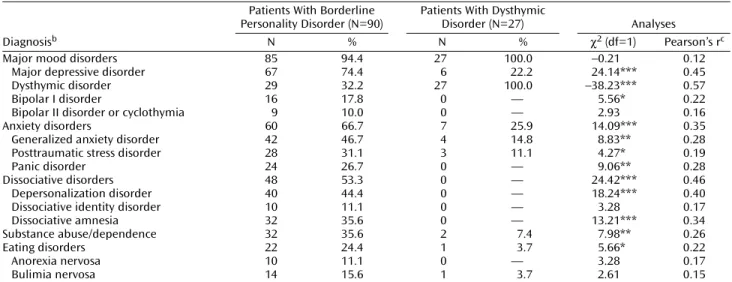
Comorbidity. Table 1 reports the frequency of comorbid axis I conditions in the two groups. The borderline person-ality disorder group distinguished itself both by the sheer number of comorbid diagnoses on average and by the spe-cific diagnoses that have commonly been reported in
re-views of studies of borderline personality disorder pa-tients (20, 21).
We assessed axis II comorbidity by applying DSM-IV al-gorithms to the axis II symptom checklist data. As Table 2 shows, comorbidity was substantial, with the pattern once again strongly resembling that reported in prior studies (20, 21). (We do not report axis II comorbidity data for the dysthymic disorder patients because we requested that the clinicians provide data for dysthymia disorder patients without personality disorder diagnoses.)
Adaptive functioning. As Table 3 and Table 4 show, bor-derline personality disorder patients functioned signifi-cantly more poorly than dysthymic disorder patients on multiple indices of adaptive functioning. For example, on a 7-point rating of chronic level of personality functioning based loosely on Kernberg’s model of levels of functioning (44) (using four anchors: “psychotic,” “personality disor-der,” “substantial problems,” and “high-functioning”), cli-nicians rated the dysthymic disorder patients more than 2 points (and three standard deviations) higher than the borderline personality disorder patients. The one excep-tion was the number of confidants, a measure of social support, which makes sense in light of the association of borderline personality disorder with the personality trait of extroversion (45).
Most (70%, N=63) of the borderline personality disorder patients had attempted suicide. Attempters on average had made 3.89 attempts (SD=6.72), with the severity of the most dangerous attempt rated on average as “moderate, requiring medical attention.” Most (63%, N=57) of the bor-derline personality disorder patients had at least one psy-chiatric hospital admission, and those who had a history
TABLE 1. Axis I Diagnoses in Patients With Borderline Personality Disorder and Dysthymic Disorder From the Practices of a Random National Sample of 117 Cliniciansa
Patients With Borderline Personality Disorder (N=90)
Patients With Dysthymic
Disorder (N=27) Analyses
Diagnosisb N % N % χ2 (df=1) Pearson’s rc
Major mood disorders 85 94.4 27 100.0 –0.21 0.12
Major depressive disorder 67 74.4 6 22.2 24.14*** 0.45
Dysthymic disorder 29 32.2 27 100.0 –38.23*** 0.57
Bipolar I disorder 16 17.8 0 — 5.56* 0.22
Bipolar II disorder or cyclothymia 9 10.0 0 — 2.93 0.16
Anxiety disorders 60 66.7 7 25.9 14.09*** 0.35
Generalized anxiety disorder 42 46.7 4 14.8 8.83** 0.28
Posttraumatic stress disorder 28 31.1 3 11.1 4.27* 0.19
Panic disorder 24 26.7 0 — 9.06** 0.28
Dissociative disorders 48 53.3 0 — 24.42*** 0.46
Depersonalization disorder 40 44.4 0 — 18.24*** 0.40
Dissociative identity disorder 10 11.1 0 — 3.28 0.17
Dissociative amnesia 32 35.6 0 — 13.21*** 0.34
Substance abuse/dependence 32 35.6 2 7.4 7.98** 0.26
Eating disorders 22 24.4 1 3.7 5.66* 0.22
Anorexia nervosa 10 11.1 0 — 3.28 0.17
Bulimia nervosa 14 15.6 1 3.7 2.61 0.15
aData were provided by experienced psychiatrists (N=22) and psychologists (N=95) identified from the membership registers of the American
Psychiatric Association and the American Psychological Association. Each clinician randomly selected one patient with borderline personality disorder or dysthymic disorder from his or her practice.
bOnly comorbid diagnoses with at least 5% prevalence in one or both groups are included.
cEffect size estimate (see references 42, 43 for interpretations of r as a measure of effect size).
*p<0.05. **p<0.01. ***p<0.001.
TABLE 2. Comorbid Axis II Diagnoses in Patients With Borderline Personality Disorder (N=90)
Personality Disorder Diagnosis Number of Patients %
Paranoid 33 36.7 Schizoid 22 24.4 Schizotypal 14 15.6 Antisocial 25 27.8 Histrionic 23 25.6 Narcissistic 18 20.0 Avoidant 48 53.3 Dependent 29 32.2 Obsessive-compulsive 14 15.6
of hospitalization had an average of 3.67 admissions (SD= 3.92). More than one-half of the borderline personality disorder patients (52%, N=47) had self-injured. Of the 47 borderline personality disorder patients who self-injured, 81% (N=38) cut, 23% (N=11) burned, and 13% (N=6) se-verely scratched or tore their skin; an additional 26% (N= 12) had repeated accidents.
Patients with borderline personality disorder showed generally poor relational functioning across several mea-sures. Of particular interest, 41% (N=37) had been in abu-sive relationships in adulthood, with the majority in the role of victim (60%, N=22), a substantial minority in the roles of both victim and perpetrator (38%, N=14), and only one ex-clusively in the role of perpetrator. Nearly one-third (32%, N=29) had been the victim of rape or sexual assault in adult-hood (see reference 46), and, for borderline personality dis-order patients who reported any such incident, rape or sex-ual assault occurred on average 2.75 times (SD=3.66).
Identifying Candidate Diagnostic Criteria
To construct a composite personality portrait of border-line personality disorder in clinical practice, we aggregated scores for each of the 200 items of the SWAP-200 across all 90 borderline personality disorder patients by taking the mean across subjects and then arraying the items in de-scending order of magnitude (i.e., beginning with the items most characteristic of the borderline personality disorder patients). Table 5 lists the items with the highest average rankings. (Items ranked significantly higher for borderline
personality disorder patients than for dysthymic disorder patients are starred in Table 5.)
Most DSM-IV diagnostic criteria for borderline per-sonality disorder were represented among the SWAP-200 items with the highest average rankings. However, several SWAP-200 items with the highest average rankings were not reflected in the DSM-IV criteria. Table 6 presents the non-DSM-IV items that were rank-ordered among the top 20 items, all of which also ranked within the 20 most de-scriptive items in the largest prior sample to date in which this method was used (23), suggesting that the findings are robust and not attributable to particular characteristics of the present sample. In general, these items captured neg-ative affect, emotion dysregulation, and poor self-esteem or self-loathing. Perhaps most striking, the two items most descriptive of borderline personality disorder patients in both samples were “Tends to feel unhappy, depressed, or despondent” and “Emotions tend to spiral out of control.”
Discussion
Primary FindingsVirtually all research on patients with borderline per-sonality disorder has studied samples from hospital in-patient units or outin-patient clinics. This study compared borderline personality disorder patients with dysthymic disorder patients treated in the community to see whether the phenomena observed in prior samples characterize borderline personality disorder patients as treated in the
TABLE 3. Adaptive Functioning of Patients With Borderline Personality Disorder and Dysthymic Disorder Patients With Borderline
Personality Disorder (N=90)
Patients With Dysthymic
Disorder (N=27) Analyses
Variable N % N % χ2 (df=1) Pearson’s ra
Lost job in past 5 years 46 51.1 2 7.4 17.47*** 0.39
History of suicide attempts 63 70.0 6 22.2 19.60*** 0.41
History of self-injury 47 52.2 1 3.7 20.21*** 0.42
Psychiatric hospitalization 57 63.3 5 18.5 16.75*** 0.38
Rape or sexual assault 29 32.2 2 7.4 6.57** 0.24
Abusive romantic relationship 37 41.1 5 18.5 4.77* 0.20
aEffect size estimate (see references 42, 43 for interpretations of r as a measure of effect size).
*p<0.05. **p<0.01. ***p<0.001.
TABLE 4. Clinicians’ Ratings of Adaptive Functioning in Patients With Borderline Personality Disorder and Dysthymic Disorder
Patients With Borderline Personality Disorder
Patients With
Dysthymic Disorder Analyses
Variable N Mean SD N Mean SD ta df Pearson’s rb
Global Assessment of Functioning Scale 90 47.64 9.68 27 57.33 12.62 –4.24** 115 0.37 Personality functioning 90 3.27 0.82 27 5.74 0.76 –13.98** 115 0.79 Quality of relationships 90 2.73 1.06 27 4.30 0.99 –6.83** 115 0.54 Number of confidants 90 1.90 3.24 27 2.70 1.81 –1.23 115 0.11 Employment stability 89 3.07 1.32 27 5.11 1.50 –6.82** 115 0.54
Current physical health 90 4.87 1.52 27 5.96 1.16 –3.99** 55.52 0.31
How often ill 90 3.16 1.49 27 2.15 1.43 3.11* 115 0.28
aEqual variances were assumed except where Levine test showed them to be unequal at p<0.05. All degrees of freedom with decimal values
are for comparisons for which unequal variance was assumed.
bEffect size estimate (see references 42, 43 for interpretations of r as a measure of effect size).
community or whether samples of borderline personality disorder patients from hospitals and university clinics provide an overly pathological portrait of the disorder. The results point to two primary conclusions.
First, the data from prior studies, which could be ex-pected to oversample the more severe end of the border-line spectrum, nevertheless generalized well to the pa-tients seen by randomly selected clinicians across a wide variety of settings. In terms of axis I comorbidity, the bor-derline personality disorder sample in our study was very similar to other borderline personality disorder samples reviewed by Gunderson (20), with a profile of high emo-tional distress (in the form of mood and anxiety disorders,
including posttraumatic stress disorder) and problematic ways of managing it (e.g., dissociative disorders, sub-stance abuse, eating disorders). The findings were also consistent with Gunderson’s review of research on axis II comorbidity in borderline personality disorder (20, 21, 47), in which 90%–97% of borderline personality disorder patients were found to meet the criteria for other DSM personality disorder diagnoses. In our sample, the axis II checklist identified substantial rates of comorbidity for ev-ery axis II personality disorder, with particularly high fre-quencies of avoidant, paranoid, and dependent personal-ity disorders. The slightly higher rates of avoidant and dependent personality disorder diagnoses in this sample may reflect the possibility that the community treatment-seeking sample is more withdrawn and dysphoric than the more acute hospital or university clinic samples or may re-flect changes in borderline personality disorder criteria between DSM-III-R and DSM-IV.
With respect to adaptive functioning, like the borderline personality disorder patients studied in prior investiga-tions, the borderline personality disorder patients treated in everyday practice showed substantial deficits. More than two-thirds had attempted suicide, more than one-half had self-injured (mostly by cutting), and almost two-thirds had been hospitalized at least once. Clinicians
re-TABLE 5. Mean Rankings for Shedler-Westen Assessment Procedure-200 Items That Best Describe Patients With Borderline Personality Disorder
Itema RankingMean b
Tends to feel unhappy, depressed, or despondent. 5.28
Emotions tend to spiral out of control, leading to
extremes of anxiety, sadness, rage, excitement, etc.*** 5.09
Tends to fear she/he will be rejected or abandoned by
those who are emotionally significant. 4.87
Is unable to soothe or comfort self when distressed; requires involvement of another person to help
regulate affect.*** 4.59
Tends to be anxious. 4.13
Tends to be angry or hostile (whether consciously or
unconsciously).** 4.03
Tends to feel she/he is inadequate, inferior, or a failure. 4.00
Emotions tend to change rapidly and unpredictably.*** 3.99
Tends to feel misunderstood, mistreated, or victimized.* 3.87
Tends to become irrational when strong emotions are stirred up; may show a noticeable decline from
customary level of functioning.*** 3.84
Lacks a stable image of who she/he is or would like to become (e.g., attitudes, values, goals, and feelings
about self may be unstable and changing).** 3.76
Tends to be overly needy or dependent; requires
excessive reassurance or approval. 3.70
Tends to act impulsively, without regard for
consequences.*** 3.69
Is simultaneously needy of, and rejecting toward, others (e.g., craves intimacy and caring but tends to reject it
when offered).*** 3.64
Tends to express intense and inappropriate anger, out of
proportion to the situation at hand.*** 3.61
Tends to feel empty or bored. 3.58
Tends to “catastrophize”; is prone to see problems as
disastrous, insolvable, etc.* 3.56
Tends to feel helpless, powerless, or at the mercy of
forces outside his/her control. 3.49
Interpersonal relationships tend to be unstable, chaotic,
and rapidly changing.*** 3.48
Tends to feel like an outcast or outsider; feels as if she/
he does not truly belong. 3.37
Tends to become attached quickly or intensely; develops feelings, expectations, etc., that are not warranted
by the history or context of the relationship.*** 3.32
aItems are listed in descending order of diagnostic importance; p
values refer to t test comparisons between mean rankings for bor-derline personality disorder (N=90) and dysthymic disorder (N=27) groups, with all mean rankings higher for the borderline personal-ity disorder group.
bRange=0, least descriptive of patient, to 7, most descriptive of
pa-tient.
*p<0.05. **p<0.01. ***p<0.001.
TABLE 6. Ra nk O rd er o f Shed ler -Wes ten As ses sm ent Procedure-200 Items Not Captured by DSM-IV Borderline Personality Disorder Criteria in Current (N=90) and Previ-ous (N=42) Samples of Borderline Personality Disorder Patients Itema Current Sample Rank Order Previous Sample Rank Orderb
Tends to feel unhappy, depressed,
or despondent. 1 2
Emotions tend to spiral out of control, leading to extremes of anxiety, sadness,
rage, excitement, etc. 2 1
Is unable to soothe or comfort self when distressed; requires involvement of another
person to help regulate affect. 4 5
Tends to be anxious. 5 8
Tends to feel she/he is inadequate, inferior,
or a failure. 7 3
Tends to feel misunderstood, mistreated,
or victimized. 9 11
Tends to become irrational when strong emotions are stirred up; may show a noticeable decline from customary level
of functioning. 10 12
Tends to be overly needy or dependent;
requires excessive reassurance or approval. 12 10
Tends to “catastrophize”; is prone to see
problems as disastrous, insolvable, etc. 17 14
Tends to feel helpless, powerless, or at the
mercy of forces outside his/her control. 18 6
Tends to feel like an outcast or outsider;
feels as if she/he does not truly belong. 20 17
aItems are rank-ordered (from 1 to 200) according to their mean
item rankings (from 0 to 7) in the current sample (see Table 5) and are listed in descending order of diagnostic importance.
ported that borderline personality disorder patients had lower quality of relationships and unstable work histories, with more than one-half having lost a job in the past 5 years because of interpersonal problems.
Of particular interest are findings on physical health and abusive experiences in adulthood, as these areas of func-tioning have not received as much empirical attention as other aspects of adaptation. Borderline personality disor-der patients appeared to have frequent or chronic minor illnesses, leading to missed appointments, days off from work, visits to the doctor, or subjective distress. Forty per-cent of the borderline personality disorder patients in this sample also had been in abusive relationships in adult-hood, with virtually all being victimized (whether or not they also at times perpetrated violence). Nearly one-third of the borderline personality disorder patients had been the victim of rape or other serious sexual assault in adult-hood, with such experiences typically occurring multiple times. A recent study by Zanarini et al. (46) produced simi-lar results.
Second, the data provide a portrait of the average pa-tient with DSM-IV-diagnosed borderline personality dis-order seen in clinical practice, and this portrait converges with the DSM-IV description in multiple respects but di-verges in others. Of the 200 items in the SWAP-200, several designed to reflect DSM-IV diagnostic criteria appeared empirically among the 20 items that were most descriptive of patients who receive a borderline personality disorder diagnosis. These items describe rejection/abandonment fears, unstable relationships, unstable identity, impulsiv-ity, labile emotions, feelings of emptiness or boredom, and intense anger. On the other hand, several DSM-IV criteria were not ranked highly among the SWAP-200 descriptors of actual borderline personality disorder patients, and other items not included in DSM-IV received higher rank-ings on average than many current criteria.
Among the DSM-IV criteria that did not receive high av-erage rankings were items describing the tendency to see people as “all good” or “all bad” (either because empiri-cally these concepts are not as central to the diagnosis or because splitting them into two items may have decreased the ranking of both) and items describing specific forms of impulsivity, such as alcohol abuse and promiscuous sex. The hybrid criterion added to DSM-IV regarding transient psychotic symptoms and dissociative episodes did not rank highly. However, a related item that ranked tenth in the borderline personality disorder sample better appears to capture an aspect of the construct originally intended by Gunderson (21) and should be considered as a replace-ment criterion for DSM-V: “tends to become irrational when strong emotions are stirred up; may show a notice-able decline from customary level of functioning.” Al-though clinicians reported significant self-injury and sui-cidality (on the Clinical Data Form), SWAP-200 items for these phenomena did not rank as highly as other items. These differences may reflect a sampling difference
be-tween prior studies and the present investigation or may reflect the differential salience of particular high-risk be-haviors when reported to an interviewer on a single occa-sion, typically when the patient is most symptomatic and presents at a hospital or clinic for treatment, versus when the behavior is contextualized within a longitudinal por-trait of the patient over time.
Several other SWAP-200 items emerged as more descrip-tive than some of the current borderline personality disor-der criteria, despite the fact that we used DSM-IV criteria to define the patient sample. Perhaps most important was a set of items reflecting chronic (rather than transient) as-pects of emotional experience, namely the tendency “to feel unhappy, depressed, despondent” (the item with the highest ranking of all the items in the SWAP-200 composite borderline personality disorder profile) and to feel anxious. These data suggest that DSM-IV may understate the pain and dysphoria borderline personality disorder patients feel. They also support the view that negative affect is a central trait in borderline personality disorder as currently defined (48, 49).
Another set of items that may not receive adequate rep-resentation among the criteria for borderline personality disorder in DSM-IV describes the related trait of emotion dysregulation (on the difference between negative affect and emotion dysregulation, see references 28, 34, 40). These items describe a person whose emotions tend to spiral out of control; who can become irrational when strong emotions are stirred; who tends to “catastrophize,” seeing problems as disastrous and insolvable; and who has difficulty self-soothing and hence may become overly dependent on others to help regulate emotion. These de-scriptions of emotion dysregulation appear clinically richer and more specific than the DSM-IV description of “affective instability due to a marked reactivity of mood.” All of these items distinguished borderline personality dis-order patients from dysthymic disdis-order patients, who share the trait of negative affect, and occurred at a simi-larly high rate in previous efforts to develop an empirical prototype of borderline personality disorder (22).
Limitations and Potential Objections
The data from this study, like the data from a number of studies from our laboratory (e.g., references 22, 25, 27, 29), point to the potential utility of practice research network methods in research on personality disorders. The conver-gence of multiple informants would clearly be ideal (al-though most studies of psychopathology rely on a single observer—the patient—by means of either self-report or structured interviews); however, data from experienced clinical observers who interact with the patient over time and hence can provide a longitudinal portrait provide a complementary standpoint to that typically seen in psy-chiatric research.
Another set of limitations concerns the makeup of the current sample. Psychologists were disproportionately
represented in the sample, relative to psychiatrists (80% and 20%, respectively), and the overall response rate was relatively low, compared to our previous studies. Although we cannot be sure that some unknown bias was not intro-duced by clinicians’ decisions to participate or not partic-ipate, the data provided by psychologists and by psychia-trists did not show any pattern of differences in this or any of our prior studies using this method, despite substan-tially different response rates, and our findings converged with those of research from medical centers that used completely different sampling methods. The similarities in these findings suggest that such biases are not likely sub-stantial. Limiting the study to patients in psychotherapy also introduced the possibility that we were oversampling higher-functioning borderline personality disorder pa-tients. However, the data suggested otherwise: The major-ity of the borderline personalmajor-ity disorder patients in the study reported histories of psychiatric hospitalizations, suicide attempts, and self-injurious behavior, and their av-erage GAF score (mean=47.64, SD=9.68) indicated serious impairment. Finally, male and non-Caucasian borderline personality disorder patients are understudied groups, and broader sampling, including oversampling to maximize representativeness of the population, would strengthen fu-ture investigations.
Received Jan. 13, 2003; revision received Feb. 17, 2004; accepted May 19, 2004. From Cambridge Hospital/Harvard Medical School; and the Departments of Psychology and Psychiatry and Behavioral Sciences, Emory University. Address correspondence and reprint re-quests to Dr. Zittel Conklin, The Cambridge Hospital, Macht Building, 1493 Cambridge St., Cambridge, MA 02139; [email protected] (e-mail); or Dr. Westen, Departments of Psychology and Psy-chiatry and Behavioral Sciences, Emory University, 532 North Kilgo Circle, Atlanta, GA 30322; [email protected] (e-mail).
Preparation of this manuscript was supported in part by NIMH grants MH-62377 and MH-62378 to Dr. Westen and by a grant from the Fund for Psychoanalytic Research of the American Psychoana-lytic Association to Dr. Zittel Conklin. Presented in part at the 2nd An-nual Meeting of the National Institute of Mental Health and Border-line Personality Disorder Research Foundation, Minneapolis, May 30–June 1, 2002.
The authors thank the 117 clinicians who donated up to 4 hours of their time to participate in the study.
References
1. Gunderson JG, Kolb JE, Austin V: The Diagnostic Interview for Borderline Patients. Am J Psychiatry 1981; 138:896–903 2. Clarkin JF, Hull JW, Hurt SW: Factor structure of borderline
per-sonality disorder criteria. J Personal Disord 1993; 7:137–143 3. Golomb A, Ludolph P, Westen D, Block MJ, Maurer P, Wiss FC:
Maternal empathy, family chaos, and the etiology of border-line personality disorder. J Am Psychoanal Assoc 1994; 42:525– 548
4. McGlashan TH: The Chestnut Lodge follow-up study, III: long-term outcome of borderline personalities. Arch Gen Psychiatry 1986; 43:20–30
5. McGlashan TH: The longitudinal profile of borderline personal-ity disorder: contributions from the Chestnut Lodge follow-up study, in Handbook of Borderline Disorders. Edited by Silver D, Rosenbluth M. Madison, Conn, International Universities Press, 1992, pp 55–83
6. Morey LC, Zanarini MC: Borderline personality: traits and disor-der. J Abnorm Psychol 2000; 109:733–737
7. Nigg JT, Lohr NE, Westen D, Gold LJ, Silk KR: Malevolent object representations in borderline personality disorder and major depression. J Abnorm Psychol 1992; 101:61–67
8. Ogata SN, Silk KR, Goodrich S, Lohr NE, Westen D, Hill EM: Childhood sexual and physical abuse in adult patients with borderline personality disorder. Am J Psychiatry 1990; 147: 1008–1013
9. Sabo AN, Gunderson JG, Najavits LM, Chauncey D, Kisiel C: Changes in self-destructiveness of borderline patients in psy-chotherapy: a prospective follow-up. J Nerv Ment Dis 1995; 183:370–376
10. Shachnow J, Clarkin J, DiPalma CS, Thurston F, Hull J, Shearin E: Biparental psychopathology and borderline personality disor-der. Psychiatry 1997; 60:171–181
11. Silk K, Nigg J, Westen D, Lohr N: Severity of childhood sexual abuse, borderline symptoms, and familial environment, in The Role of Sexual Abuse in the Etiology of Borderline Personality Disorder. Edited by Zanarini M. Washington, DC, American Psy-chiatric Press, 1997, pp 131–163
12. Silk KR, Lee S, Hill EM, Lohr NE: Borderline personality disorder symptoms and severity of sexual abuse. Am J Psychiatry 1995; 152:1059–1064
13. Stone MH: Long-term outcome in personality disorders. Br J Psychiatry 1993; 162:299–313
14. Stone MH, Hurt SW, Stone DK: The PI 500: long-term follow-up of borderline inpatients meeting DSM-III criteria, I: global out-come. J Personal Disord 1987; 1:291–298
15. Westen D, Lohr N, Silk KR, Gold L, Kerber K: Object relations and social cognition in borderlines, major depressives, and normals: a Thematic Apperception Test analysis. Psychol As-sess 1990; 2:355–364
16. Westen D, Ludolph P, Block MJ, Wixom J, Wiss FC: Developmen-tal history and object relations in psychiatrically disturbed ad-olescent girls. Am J Psychiatry 1990; 147:1061–1068
17. Westen D, Ludolph P, Misle B, Ruffins S, Block J: Physical and sexual abuse in adolescent girls with borderline personality disorder. Am J Orthopsychiatry 1990; 60:55–66
18. Young DW, Gunderson JG: Family images of borderline adoles-cents. Psychiatry 1995; 58:164–172
19. Zanarini MC, Frankenburg FR, Khera GS, Bleichmar J: Treat-ment histories of borderline inpatients. Compr Psychiatry 2001; 42:144–150
20. Gunderson JG: Borderline Personality Disorder: A Clinical Guide. Washington, DC, American Psychiatric Publishing, 2001 21. Gunderson JG, Zanarini MC, Kisiel C: Borderline personality dis-order, in The DSM-IV Personality Disorders. Edited by Livesley WJ. New York, Guilford, 1995, pp 141–157
22. Westen D, Shedler J: Revising and assessing axis II, part II: to-ward an empirically based and clinically useful classification of personality disorders. Am J Psychiatry 1999; 156:273–285 23. Shedler J, Westen D: Refining personality disorder diagnosis:
in-tegrating science and practice. Am J Psychiatry 2004; 161: 1350–1365
24. Shedler J, Westen D: Refining the measurement of axis II: a Q-sort procedure for assessing personality pathology. Assessment 1998; 5:333–353
25. Westen D, Harnden-Fischer J: Personality profiles in eating dis-orders: rethinking the distinction between axis I and axis II. Am J Psychiatry 2001; 158:547–562
26. Morey LC: Personality disorders in DSM-III and DSM-III-R: con-vergence, coverage, and internal consistency. Am J Psychiatry 1988; 145:573–577
27. Westen D, Shedler J: Revising and assessing axis II, part I: devel-oping a clinically and empirically valid assessment method. Am J Psychiatry 1999; 156:258–272
28. Westen D, Muderrisoglu S, Fowler C, Shedler J, Koren D: Affect regulation and affective experience: individual differences, group differences, and measurement using a Q-sort proce-dure. J Consult Clin Psychol 1997; 65:429–439
29. Wilkinson-Ryan T, Westen D: Identity disturbance in borderline personality disorder: an empirical investigation. Am J Psychia-try 2000; 157:528–541
30. Westen D, Weinberger J: When clinical description becomes statistical prediction. Am Psychol 2004; 59:595–613
31. Dutra L, Campbell L, Westen D: Quantifying clinical judgment in the assessment of adolescent psychopathology: reliability, validity, and factor structure of the Child Behavior Checklist for clinician report. J Clin Psychol 2004; 60:65–85
32. Russ E, Heim A, Westen D: Parental bonding and personality pathology assessed by clinician report. J Personal Disord 2003; 17:522–536
33. Westen D, Muderrisoglu S: Reliability and validity of personality disorder assessment using a systematic clinical interview: eval-uating an alternative to structured interviews. J Personal Dis-ord 2003; 17:350–368
34. Shedler J, Westen D: Dimensions of personality pathology: an alternative to the five-factor model. Am J Psychiatry 2004; 161: 1743–1754
35. Butcher J, Perry J, Atlis M: Validity and utility of computer-based test interpretation. Psychol Assess 2000; 12:6–18 36. Pepper CM, Klein DN, Anderson RL, Riso LP, Ouimette PC,
Lizardi H: DSM-III-R axis II comorbidity in dysthymia and major depression. Am J Psychiatry 1995; 152:239–247
37. Riso LP, Klein DN, Ferro T, Kasch KL, Pepper CM, Schwartz JE, Aronson TA: Understanding the comorbidity between early-on-set dysthymia and cluster B personality disorders: a family study. Am J Psychiatry 1996; 153:900–906
38. Westen D, Shedler J: A prototype matching approach to person-ality disorders: toward DSM-V. J Personal Disord 2000; 14:109– 126
39. Hilsenroth MJ, Ackerman SJ, Blagys MD, Baumann BD, Baity MR, Smith SR, Price JL, Smith CL, Heindselman TL, Mount MK,
Holdwick DJ Jr: Reliability and validity of DSM-IV axis V. Am J Psychiatry 2000; 157:1858–1863
40. Westen D, Shedler J, Durrett C, Glass S, Martens A: Personality diagnoses in adolescence: DSM-IV axis II diagnoses and an em-pirically derived alternative. Am J Psychiatry 2003; 160:952– 966
41. Blais M, Norman D: A psychometric evaluation of the DSM-IV personality disorder criteria. J Personal Disord 1997; 11:168– 176
42. Meyer GJ, Finn SE, Eyde LD, Kay GG, Moreland KL, Dies RR, Eis-man EJ, Kubiszyn TW, Read GM: Psychological testing and psy-chological assessment: a review of evidence and issues. Am Psychol 2001; 56:128–165
43. Rosenthal R: Meta-Analytic Procedures for Social Research. Newbury Park, Calif, Sage Publications, 1991
44. Kernberg O: Borderline Conditions and Pathological Narcis-sism. Northvale, NJ, Jason Aronson, 1975
45. Widiger T, Frances A: Toward a dimensional model for the per-sonality disorders, in Perper-sonality Disorders and the Five-Factor Model of Personality. Edited by Costa P, Widiger T. Washington, DC, American Psychological Association, 1994, pp 19–39 46. Zanarini M, Parachini E, Frankenburg F, Holman J, Hennen J,
Reich D, Silk K: Sexual relationship difficulties among border-line patients and axis II comparison subjects. J Nerv Ment Dis 2003; 191:479–482
47. Gunderson JG, Zanarini MC, Kisiel C: Borderline personality dis-order: a review of data on DSM-III-R descriptions. J Personal Disord 1991; 5:340–352
48. Widiger TA, Costa PT, McCrae RR: A proposal for axis II: diagnos-ing personality disorders usdiagnos-ing the five-factor model, in Per-sonality Disorders and the Five-Factor Model of PerPer-sonality, 2nd ed. Edited by Costa PT, Widiger TA. Washington, DC, Amer-ican Psychological Association, 2002, pp 431–456
49. Trull TJ: Structural relations between borderline personality disorder features and putative etiological correlates. J Abnorm Psychol 2001; 110:471–481