A SHARED COGNITIVE USER TASK FRAMEWORK FOR
ELEARNING STORYBOARD
NOR'AIN BINTI MOHD YUSOFF
FACULTY OF COMPUTER SCIENCE AND
INFORMATION TECHNOLOGY
UNIVERSITY OF MALAYA
KUALA LUMPUR
A SHARED COGNITIVE USER TASK FRAMEWORK
FOR ELEARNING STORYBOARD
NOR'AIN BINTI MOHD YUSOFF
THESIS SUBMITTED IN FULFILMENT OF THE
REQUIREMENTS FOR THE DEGREE OF DOCTOR OF
PHILOSOPHY
FACULTY OF COMPUTER SCIENCE AND
INFORMATION TECHNOLOGY
UNIVERSITY OF MALAYA
KUALA LUMPUR
iii
UNIVERSITI MALAYA
ORIGINAL LITERARY WORK DECLARATION
Name of Candidate:NOR‘AIN BINTI MOHD YUSOFF (I.C No: 740811-05-5384) Registration/Matric No: WHA040020
Name of Degree: Doctor of Philosophy
Title of Thesis: A shared cognitive user task framework for eLearning storyboard
Field of Study: Human-computer Interaction
I do solemnly and sincerely declare that: i. I am the sole author/writer of this Work; ii. This Work is original;
iii. Any use of any work in which copyright exists was done by way of fair dealing and for permitted purposes and any excerpt or extract from, or reference to or reproduction of any copyright work has been disclosed expressly and sufficiently and the title of the Work and its authorship have been acknowledged in this Work;
iv. I do not have any actual knowledge nor do I ought reasonably to know that the making of this work constitutes an infringement of any copyright work; v. I hereby assign all and every rights in the copyright to this Work to the
University of Malaya (―UM‖), who henceforth shall be owner of the copyright in this Work and that any reproduction or use in any form or by any means whatsoever is prohibited without the written consent of UM having been first had and obtained;
vi. I am fully aware that if in the course of making this Work I have infringed any copyright whether intentionally or otherwise, I may be subject to legal action or any other action as may be determined by UM.
Candidate‘s Signature Date: 19th March 2015
Subscribed and solemnly declared before,
Witness‘s Signature Date: 19th March 2015
Name: Professor Dr Siti Salwah Salim Designation: Professor
iv
ABSTRACT
This thesis presents a framework which is aimed to achieve shared mental model (SMM) needed between instructional designers and subject-matter experts called as the eSCOUT (eLearning Storyboard for Shared Cognitive User Task). The eSCOUT is built to facilitate shared input, shared process and shared output. The shared input refers to the data process that derived from the knowledge and needs of instructional designer and subject-matter expert. The shared process refers to storyboard design process methodology which is designed to support agility and consists of three cognitive user task processes: pre-processing, processing and post-processing. Several types of shared visualizations techniques are proposed to support shared cognitive user task in these processing phases. At the pre-processing stage, collaborative mapping is used to support shared structural design of the storyboard requirement while at the processing stage; collaborative whiteboard is used to support shared storyboard design specifications. At the post-processing stage, both collaborative discussion and collaborative annotation are used to support shared reviews of the storyboard design. Finally, the shared output is the shared cognitive user task information generated in a form of shared data visualization. To implement the framework of the eSCOUT, a web-based system prototype is developed. Experimental study on shared mental model is carried out among users of real instructional design practices. Using paired groups of instructional designers and subject-matter experts, the result shows that effectiveness of the agile storyboarding process is perceived as 64.3% compare to efficiency capabilities of the process which is 50%. All the tools available (i.e. collaborative mapping, collaborative whiteboard, collaborative discussion and collaborative annotation) are perceived as different from what the users have experienced in other storyboard system. The findings also showed that both collaborative map and collaborative whiteboard are flexible in terms of sharing
v
the data and performing eLearning tasks as well as easy to learn the functionalities. Our evaluation study demonstrates high achievement of similarity and accuracy of the shared data visualization, in turn leading to the development of task mental model. Consequently, it also shows effectiveness and efficiency of the agility support in the storyboarding design process as well as high usability scores of the shared visualizations techniques.
vi
ABSTRAK
Tesis ini membentangkan rangka kerja yang bertujuan untuk mencapai perkongsian mental model yang diperlukan antara pereka pengajaran dan pakar isikandungan yang dipanggil sebagai eSCOUT (Papan Cerita e-Pembelajaran untuk Perkongsian Pengguna Tugas Kognitif). eSCOUT dibina untuk memudahkan perkongsian input, proses dan output. Perkongsian input merujuk kepada proses data yang diperolehi daripada pengetahuan dan keperluan pereka pengajaran dan pakar isikandungan. Perkongsian proses merujuk kepada proses reka bentuk metodologi di dalam papan cerita yang direka untuk menyokong ketangkasan. Ia terdiri daripada tiga proses pengguna tugas kognitif iaitu pra-pemprosesan, pemprosesan dan pasca-pemprosesan. Beberapa jenis teknik perkongsian visualisasi dicadangkan untuk menyokong perkongsian pengguna tugas kognitif dalam fasa pemprosesan. Di peringkat pra-pemprosesan, pemetaan kolaboratif digunakan untuk menyokong perkongsian reka bentuk struktur yang diperlukan untuk papan cerita dan pada peringkat pemprosesan; papan tulis kolaboratif digunakan untuk menyokong perkongsian spesifikasi reka bentuk papan cerita. Manakala, di peringkat pasca-pemprosesan, kedua-dua perbincangan kerjasama dan anotasi kolaboratif digunakan untuk menyokong perkongsian ulasan untuk reka bentuk papan cerita. Akhirnya, perkongsian output adalah maklumat pengguna tugas kognitif yang dihasilkan dalam bentuk perkongsian visualisasi data. Bagi merealisasikan perlaksanaan rangka kerja eSCOUT, sistem prototaip berasaskan web dibangunkan. Kajian eksperimen perkongsian mental model telah dijalankan di kalangan pengguna sebenar didalam hal reka bentuk. Kajian penilaian ke atas pereka pengajaran dan pakar isikandungan yang disatukan sebagai satu pasukan reka bentuk menunjukkan bahawa, keberkesanan proses papan cerita yang tangkas memperlihatkan pencapaian 64.3% berbanding dengan keupayaan kecekapan proses iaitu 50%. Semua alat-alat yang
vii
dicadangkan (iaitu pemetaan kolaboratif, papan tulis kolaboratif, perbincangan kerjasama dan anotasi kolaboratif) dilihat sebagai pengalaman berbeza daripada apa yang terdapat didalam sistem papan cerita lain. Selain daripada itu, kajian juga menunjukkan bahawa kedua-dua pemetaan kolaboratif dan papan tulis kolaboratif adalah fleksibel dari segi perkongsian data, serta mudah digunakan untuk menjalankan tugas dan fungsi dalam e-Pembelajaran. Hasil kajian ini menunjukkan bahawa wujud persamaan dan ketepatan perkongsian data visualisasi yang tinggi, seterusnya membawa kepada pembangunan tugas mental model. Di samping itu, keputusan juga menunjukkan keberkesanan dan kecekapan yang di berikan apabila menggunakan ketangkasan proses reka bentuk di dalam lakaran papan cerita dan juga skor kebolehgunaan yang tinggi yang diperolehi daripada teknik perkongsian visualisasi yang telah dicadangkan.
viii
In the Name of Allah, the Most Gracious, Most Merciful. By time.
Indeed, mankind is in loss, Except for those who have believed
and done righteous deeds and advised each other to truth and advised each other to patience.
(The Quran, Surah 103: 1-3) * * * * * * * * * * * * * * * * * * * * * * * * *
As a true believer, this humble work is granted and made permissible from His blessings.
ix
ACKNOWLEDGEMENTS
My deep appreciation, sincere and heartfelt gratitude are dedicated to:
The Dean of the Faculty of Computing and Informatics, Multimedia University, Cyberjaya, Associate Professor Dr. Ho Chin Kuan for his gracious support and motivation with my career and study.
My supervisor, Professor Dr. Siti Salwah Salim for her inspiration, patience, persistence and perseverance in coaching me towards the journey of research.
The following research grants which my supervisor and I received from:
1. Multimedia University Research Funding: Project ID - IP20110707004 for funding the investigation study,
2. Multimedia University Research Funding: Project ID - IP20120511020 for funding the experimental study, and
3. Exploratory Research Funding Scheme (ERGS), Ministry of Higher Education, Malaysia: Project ID - EP20120612006 for funding the eSCOUT frameworkl development and evaluation work
My colleagues at the Faculty of Computing and Informatics, Multimedia University, Cyberjaya, for their support and encouragement on my research work.
My research mates at the Human-computer Interaction lab who have brought in an enjoyable companionships and made my time such a great experience on knowledge and expertise.
My beloved parents Haji Mohd Yusoff and Hajjah Maznah, as well as parents-in-law, Haji Ahmad and Hajjah Faridah for their unconditional loves and concerns, especially during my moments of ups and downs.
Lastly but by no means the least, to both of my dear precious sweethearts; my darling husband Ariff and lovely baby Anas, you kept my spirit alive, always. Without your encouragement and understanding, it would have been impossible for me to complete this research. Yes sweetie... finally mommy has finished her PhD, which from this special moment, I am looking forward to devote and enjoy the time that I owe you, insyaAllah.
x
TABLE OF CONTENTS
Abstract ... iv Abstrak ... vi Acknowledgements ... ix Table of Contents ... xList of Figures ... xviii
List of Tables... xxiii
List of Symbols and Abbreviations ... xxvi
List of Appendices ... xxvii
List of Publications ... xxviii
CHAPTER 1 INTRODUCTION ... 1
1.1 Background of Study ... 1
1.2 Research Problem ... 2
1.2.1 Little Emphasis to Support ID and SME Interaction ... 3
1.2.2 Limited SME‘s Role in eLearning Content Design ... 4
1.2.3 Limited Choice of Storyboard Tools ... 4
1.2.4 Little Work in Collaborative and Distributed Design ... 5
1.3 Research Motivation ... 7
1.3.1 Shared Mental Model Research in Human-Computer Interaction .. 7
1.3.2 Shared Cognitive User Task Support for ID and SME ... 8
1.3.3 Solidifying Instructional Design Process ... 9
1.3.4 Trends Towards Internally Developed eLearning Courseware .... 10
1.4 Problem Statement ... 11
xi
1.6 Research Questions ... 12
1.7 Scope and Limitations ... 14
1.8 Research Methodology ... 15
CHAPTER 2 INSTRUCTIONAL DESIGNER AND SUBJECT-MATTER EXPERT INTERACTION ... 18
2.1 Online Course Development Team ... 18
2.2 Instructional Designer ... 19
2.3 Subject-Matter Expert ... 22
2.4 Instructional Designer vs. Subject-matter Expert ... 23
2.5 ID and SME Roles in the Community of Practice ... 25
2.5.1 Method for Content Production Process ... 25
2.5.2 Method for Learning Object Development Process ... 26
2.5.3 Method for Multimedia Learning Object Design... 27
2.5.4 Discussion ... 28
2.6 Shared Mental Model in ID and SME ... 29
2.6.1 Shared Knowledge and Ideas ... 29
2.6.2 Shared Decision Making and Agile Process ... 30
2.6.3 Discussion ... 31
2.7 Collaboration in Distributed Instructional Design ... 32
2.8 Designer Centeredness Support ... 34
xii
CHAPTER 3 ELEARNING STORYBOARD ... 37
3.1 Defining Storyboard ... 37
3.2 Significance of Storyboard in Different Industries ... 38
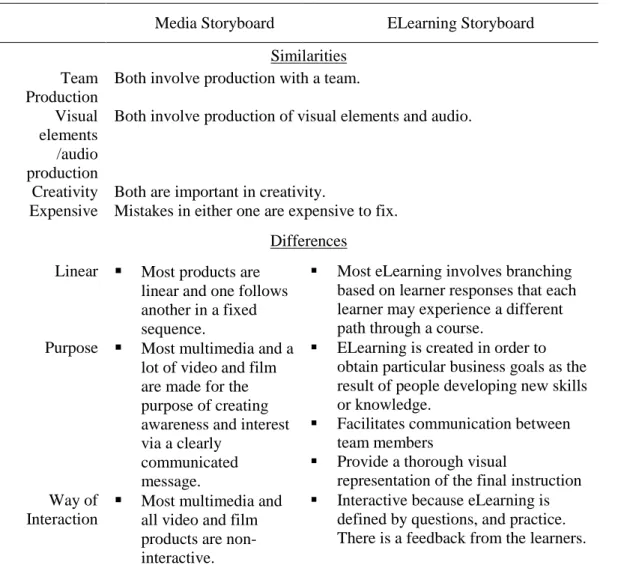
3.3 Media vs. eLearning Storyboard ... 39
3.4 Architecture of eLearning Storyboard ... 40
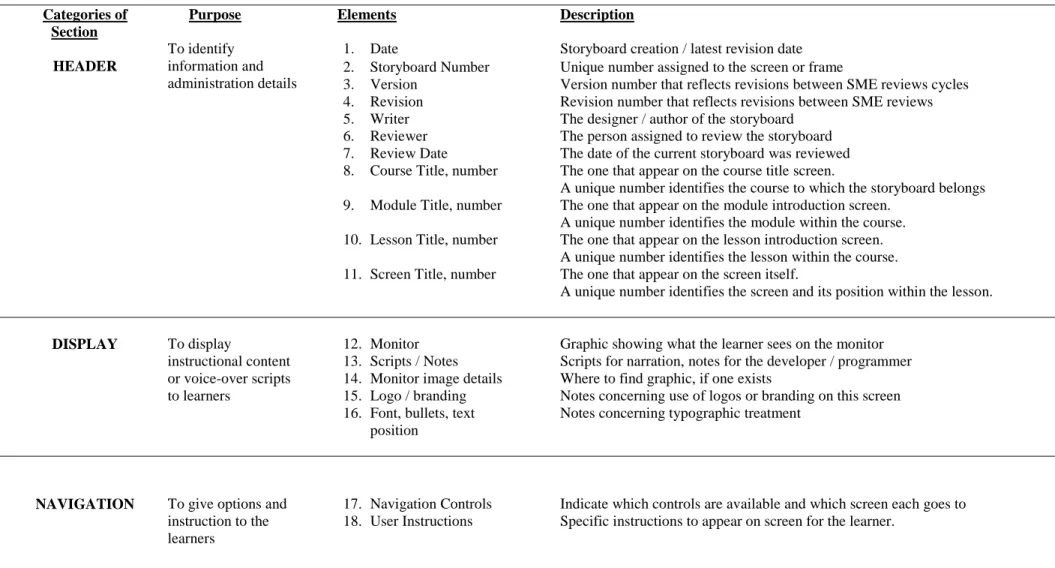
3.5 Design Process in eLearning Storyboard ... 44
3.6 Roles of eLearning Storyboard ... 47
3.6.1 An Instructional Design Tool ... 48
3.6.2 A Communication Tool ... 49
3.6.3 Discussion ... 50
3.7 Storyboard Tools, Concepts and Framework ... 50
3.7.1 Domain Independent Tools ... 51
3.7.2 Domain Dependent Tools ... 56
3.7.3 Conceptual Models and Frameworks ... 60
3.7.4 Analysis of Storyboard Tools, Concepts and Framework ... 65
3.7.5 Discussion ... 66
3.8 Summary ... 68
CHAPTER 4 SHARED MENTAL MODEL AND VISUALIZATION ... 71
4.1 Team Cognitive Research in Human-Computer Interaction ... 71
4.2 Theoretical Concept of Shared Mental Model ... 72
4.2.1 Properties of Shared Mental Model ... 72
4.2.2 Importance of Shared Mental Model ... 73
4.2.3 Types of Shared Mental Model ... 74
4.2.4 Aspects of Shared Mental Model ... 77
xiii
4.3 Evaluation in Shared Mental Model ... 80
4.3.1 Shared Mental Model Measurement ... 80
4.3.2 Cognitive Task Analysis ... 82
4.3.3 Discussion ... 84
4.4 Significance of Shared Visualization ... 84
4.4.1 Role of Artifact for Visualization ... 86
4.4.2 Shared Visualization for Shared Mental Model ... 87
4.4.3 User Interaction in Shared Visualization ... 88
4.4.4 Distributed Design in Shared Visualization ... 88
4.4.5 Discussion ... 89
4.5 A Systematic Reviews of Shared Visualization ... 91
4.5.1 Related Works ... 91
4.5.2 Research Design ... 92
4.5.3 Result and Analysis ... 97
4.5.4 Research Question 1 ... 98 4.5.5 Research Question 2 ... 101 4.5.6 Research Question 3 ... 111 4.5.7 Research Question 4 ... 120 4.5.8 Discussion ... 124 4.6 Summary ... 131
xiv
CHAPTER 5 EMPIRICAL STUDIES IN ELEARNING STORYBOARD ... 134
5.1 Empirical Study 1: Investigation on Cognitive Task Difficulties ... 135
5.1.1 Research Methodology... 135
5.1.2 Research Procedures and Design ... 142
5.1.3 Data Results and Findings ... 148
5.1.4 Discussion ... 154
5.1.5 Recommendations ... 157
5.2 Empirical Study 2: Experimentation on Artifact and Visualization ... 165
5.2.1 Related Works ... 165
5.2.2 Research Methodology... 166
5.2.3 Research Procedures and Design ... 170
5.2.4 Coding and Analysis ... 173
5.2.5 Experimental Results ... 173
5.2.6 Post-Experimental Results ... 177
5.2.7 Discussion ... 180
5.2.8 Recommendation... 183
xv
CHAPTER 6 FRAMEWORK DEVELOPMENT ... 188
6.1 Introduction to Framework Development ... 188
6.2 Initial Framework Development ... 188
6.2.1 Structure of eSCOUT ... 190 6.2.2 Contents of eSCOUT ... 190 6.2.3 A Scenario ... 196 6.3 Framework Evaluation ... 198 6.3.1 Purpose of Study ... 198 6.3.2 Participants ... 199
6.3.3 Research Procedures and Design ... 201
6.3.4 Framework Evaluation Results ... 209
6.3.5 Discussion ... 244
6.4 Revised Framework Development ... 248
xvi
CHAPTER 7 SYSTEM PROTOTYPE DEVELOPMENT AND EVALUATION 253
7.1 System Prototyping Development ... 253
7.1.1 Software Development Requirements... 253
7.1.2 Software Development Architecture ... 254
7.1.3 The eSCOUT Tools ... 263
7.1.4 User Interface of the eSCOUT System ... 264
7.2 System Prototyping Evaluation ... 277
7.2.1 Participants ... 277
7.2.2 Purpose of Study ... 278
7.2.3 Three Phases of Evaluation ... 279
7.3 Evaluation Study 1: Cognitive Walkthrough ... 281
7.3.1 Evaluation Procedure and Design ... 282
7.3.2 Data Results and Finding ... 285
7.3.3 Discussion ... 288
7.1 Evaluation Study 2: Usability Evaluation ... 289
7.1.1 Evaluation Procedures and Design... 289
7.1.2 Data Results and Finding ... 290
7.1.3 Discussion ... 294
7.2 Evaluation Study 3: Shared Mental Model Measurement ... 295
7.2.1 Evaluation Procedures and Design... 295
7.2.2 Data Results and Finding ... 298
7.2.3 Discussion ... 301
xvii
CHAPTER 8 CONCLUSION ... 304
8.1 Introduction ... 304
8.2 Research Objectives Revisited ... 304
8.3 Research Contributions ... 305
8.4 Limitations of Study ... 308
8.5 Recommendations for Future Work ... 309
8.6 Summary ... 310
REFERENCES ... 311
LIST OF APPENDICES ... 327
APPENDIX A ... 328
Collection papers on systematic review (2000-2013, N=15) APPENDIX B ... 330
The ACTA Toolkit Methods APPENDIX C ... 336
The five virtual windows design APPENDIX D ... 341
A template of email invitation to the pre-recruited academic expert APPENDIX E ... 342
Questionnaire items for academic experts APPENDIX F ... 345
A template of email invitation to practitioners APPENDIX G ... 346
Questionnaire items for practitioners APPENDIX H ... 349
Participating academicians‘ profiles APPENDIX I ... 352
Participating practitioners‘ profiles APPENDIX J ... 356
Qualitative feedback from the experts APPENDIX K ... 370 Full version of system prototype evaluation scripts
xviii
LIST OF FIGURES
Figure 1.1: The scope of research ... 14
Figure 1.2: Research flow and its corresponding research methods ... 17
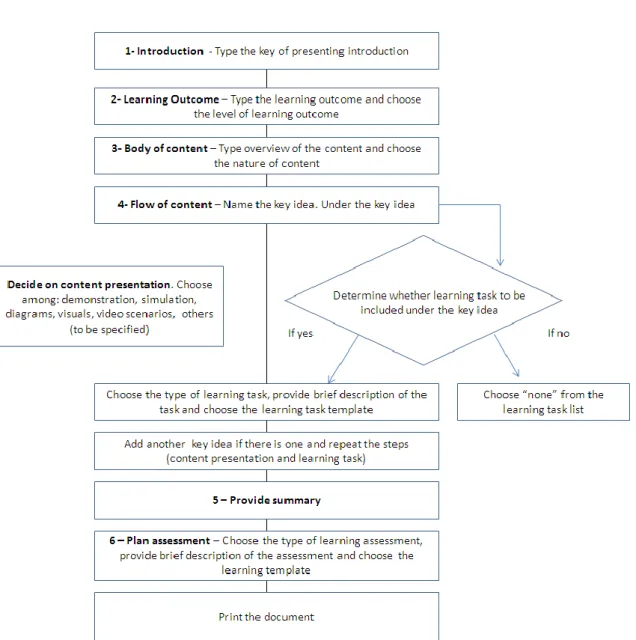
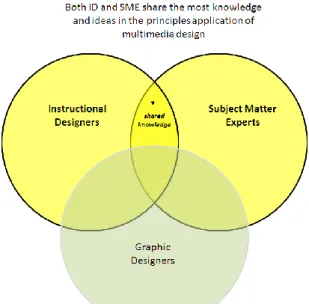
Figure 2.1: Razak and Palanisamy (2010)‘s flow chart for content analysis document . 27 Figure 2.2: Razak (2013)‘s SMM of multimedia design experts showing ID and SME share the most knowledge and ideas in designing instructional media ... 30
Figure 2.3: Achievement of research questions and connection from chapter 2 to chapter 3 ... 36
Figure 3.1: Van der Lelie, (2006)‘s five phases of design process in storyboard for product design ... 44
Figure 3.2: Brandon (2004)‘s steps of eLearning storyboard creation ... 48
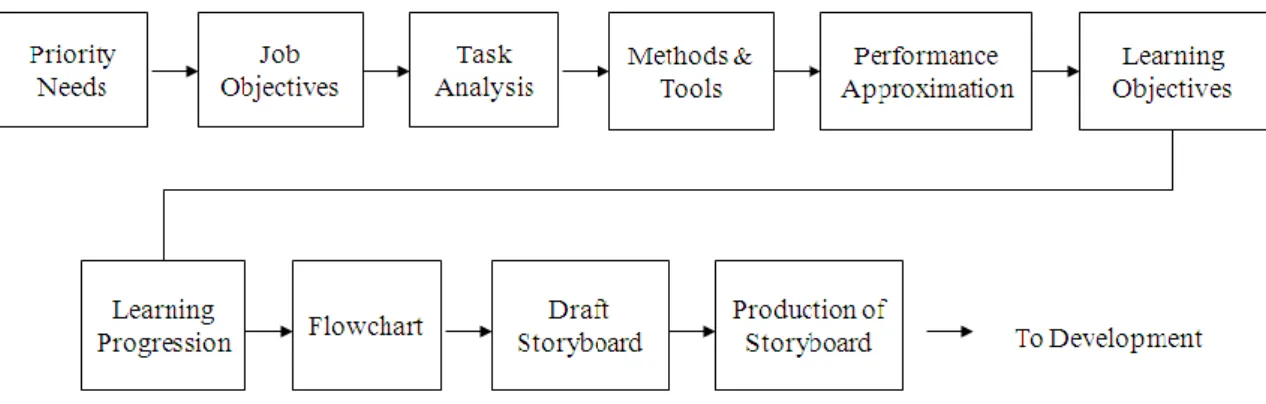
Figure 3.3: Storyboard tools, conceptual models and framework ... 66
Figure 3.4: Achievement of research questions and connection from chapter 2, 3 to chapter 4 ... 70
Figure 4.1: Badke-Schaub, et al. (2007, pp.10)‘s framework on SMM development in design teams ... 78
Figure 4.2: The emergence process of an external cognitive artifact ... 86
Figure 4.3: The relationship between the four research questions ... 93
Figure 4.4: Flow of searching and extraction strategy ... 96
Figure 4.5: Classification of inspected publications according to type of research ... 98
Figure 4.6: The trend in engaged research in SCC and SSA by 3-year intervals ... 99
Figure 4.7: Trends in research on distributed and co-located environments ... 100
Figure 4.8: Identified strategies and techniques to design shared visualization-based systems ... 126
Figure 4.9: Socially shared cognitive systems: strategies and techniques ... 126
xix
Figure 4.11: Achievement of research questions and connection from the three literature
chapters to chapter 5... 133
Figure 5.1: ACTA session with expert instructional designers in a multimedia studio 141 Figure 5.2: Levels of techniques in Applied Cognitive Task Analysis method... 142
Figure 5.3: Design process in eLearning storyboard ... 145
Figure 5.4: Standard template for storyboard ... 146
Figure 5.5: The Task Diagram: In this technique, cognitive task skills required in eLearning storyboard have been differentiated from the non-cognitive task skills. ... 148
Figure 5.6: Guidelines for developing eLearning storyboard for effective ID-SME interaction ... 164
Figure 5.7: Three sets of storyboarding artefacts representing the subject-matter of (a) statistics, (b) logo design and (c) IT management ... 169
Figure 5.8: A storyboarding process which consists of ID and SME working in four different sessions ... 172
Figure 5.9: Result and timing when no shared view is presented ... 173
Figure 5.10: Result and timing when a shared view is presented ... 175
Figure 5.11: Result and timing when multiple shared views are presented ... 175
Figure 5.12: Result and timing when multiple shared and annotation views are presented ... 176
Figure 5.13: Externalizing cognitive artifact representation of SCOs‘ structuring ... 178
Figure 5.14: Representation and presentation of shared multiple views of SCOs ... 179
Figure 5.15: Agile storyboarding design process and cognitive data process of SMM in eLearning storyboard ... 184
Figure 5.16: Achievement of research questions and connection from three literature review chapters, empirical study chapter to chapter 6 ... 187
Figure 6.1: Mapping thesis chapters information with the framework development ... 189
Figure 6.2: Structure of the eSCOUT ... 190
xx
Figure 6.4: Initial framework development of the eSCOUT ... 195
Figure 6.5: Steps towards virtual windows design for the framework evaluation ... 202
Figure 6.6: The agile storyboarding design process and virtual windows designs ... 202
Figure 6.7: Triangulation result of the appropriateness and support of the four storyboard processing phases based on mean of sample means, which are compared between the ID and SME ... 219
Figure 6.8: Degree of appropriateness and support of the four storyboard processing phases based on mean ... 220
Figure 6.9: Triangulation result of appropriateness, importance, clarity and understandability of the seven eSCOUT shared visualization strategies and techniques based on mean of sample means, which are compared between the ID and SME. ... 234
Figure 6.10: Revised framework development of the eSCOUT ... 249
Figure 6.11: Achievement of research questions and connection from chapter 6 to chapter 7 ... 252
Figure 7.1: Architecture of the eSCOUT ... 254
Figure 7.2: Use case diagram ... 255
Figure 7.3: Activity diagram ... 256
Figure 7.4: Sequence diagram – ID manages a project ... 257
Figure 7.5: Sequence diagram – ID shares a storyboard ... 258
Figure 7.6: Sequence diagram - SME manages a course ... 259
Figure 7.7: Sequence diagram: SME manages a lesson ... 260
Figure 7.8: Sequence diagram – SME manages storyboard mapping and storyboard design ... 261
Figure 7.9: Sequence diagram: reviewer reviews storyboard ... 262
Figure 7.10: The eSCOUT general and specific tools ... 263
Figure 7.11: User interface begins from a) Log-in b) ID profile c) SME profiles d) Project list e) Register new project and f) Course list ... 265
xxi
Figure 7.13: Collaborative concept mapping tool interfaces – a) Mapping storyboard
manager b) ―Data Structure and Algorithm‖ course and lessons ... 267
Figure 7.14: Collaborative concept mapping tool interfaces – a) Storyboard map created for ―Human-computer Interaction‖ subject b) Inviting other users to edit structural design c) Sharing structural design task d) History view and edit previous versions of structural design e) Publishing structural design ... 268
Figure 7.15: Collaborative Whiteboard Tool Interface ... 269
Figure 7.16: Collaborative whiteboard interfaces - a) Select course b) Select lesson c) Select SCO or create new SCO ... 270
Figure 7.17: Collaborative whiteboard interfaces – a) Select SCO title b) Rename SCO title ... 271
Figure 7.18: Collaborative whiteboard interfaces – a) Display storyboard information/feature b) Edit storyboard feature ... 272
Figure 7.19: Collaborative whiteboard interfaces – a) My generated storyboard b) Shared storyboard artefacts ... 273
Figure 7.20: Collaborative whiteboard interface - Share storyboard with other users . 273 Figure 7.21: Collaborative annotation tool interface ... 274
Figure 7.22: Collaborative discussion tool interface... 275
Figure 7.23: a) Storyboard manager b) Export storyboard packages c) Log-out interfaces ... 276
Figure 7.24: Flow of evaluation study ... 279
Figure 7.25: Briefing the Agile Storyboarding Process ... 282
Figure 7.26: Main tasks evaluation in Cognitive Walkthrough ... 283
Figure 7.27: A graph representing the percentage of positive against negative questions for the agile storyboarding process ... 287
Figure 7.28: Usability evaluation results for the eSCOUT general tools ... 291
Figure 7.29: Usability evaluation results for the eSCOUT specific tools ... 293
Figure 7.30: A graphical representing the TMM development using the four (4) visualization techniques ... 299
xxii
Figure 7.31: Similarity and accuracy of the tools ... 301 Figure 7.32: Achievement of research questions in chapter 7 ... 303
xxiii
LIST OF TABLES
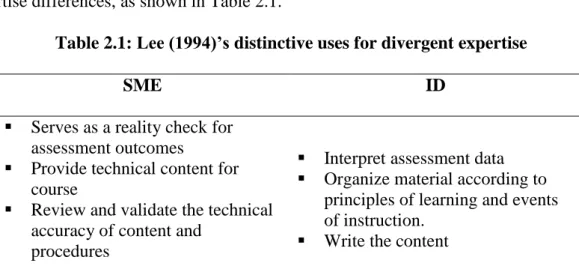
Table 2.1: Lee (1994)‘s distinctive uses for divergent expertise ... 24 Table 3.1: Similarities and differences between media and eLearning storyboard ... 40 Table 3.2: Brandon (2004)'s storyboard organization ... 42 Table 3.3: Summary of systems/tools on domain independent tools and their implementation technologies ... 55 Table 3.4: Summary of domain-dependent tools and their implementation technologies ... 59 Table 3.5: Summary of conceptual models and frameworks and their implementation technologies... 64 Table 4.1: Mathieu, et al. (2000)‘s major domains and Cannon-Bowers, et al. (1993)‘s types of SMMs ... 76 Table 4.2: Analogy of shared cognitive process in SMM and CoVis ... 90 Table 4.3: Initial search results for seven databases using the search string ... 95 Table 4.4: Types of visualization strategy, systems and their strategic descriptions (continued….) ... 108
Table 4.5: Types of visualization techniques, systems and their technique implementation ... 117 Table 4.6: Summary of technological implementation in mobile-based and web-based systems ... 123 Table 4.7: Social, task and cognitive supports in shared visualization ... 125 Table 4.8: Summary of strategies, techniques and technologies ... 129 Table 5.1: Instructional designers‘ profile ... 137
Table 5.2: Questions asked in Knowledge Audit technique ... 143 Table 5.3: Questions asked in Task Simulations technique ... 144 Table 5.4: The process of storyboard, purposes and projected forms ... 145 Table 5.5: The Knowledge Audit table ... 150
xxiv
Table 5.6: The Simulation Interview table ... 151 Table 5.7: The Cognitive Demand table ... 153 Table 5.8: Subject-matter experts‘ profile ... 167 Table 5.9 - The average time spent in the four storyboarding processes ... 176 Table 6.1: Structure of the framework evaluation questionnaires ... 207 Table 6.2: Demographic characteristics of experts (N=27) ... 210 Table 6.3: Academicians‘ expertise information (N=13) ... 211 Table 6.4: Practitioners‘ expertise information (N=14) ... 211 Table 6.5: Experts‘ means and standard deviations of appropriateness and support of the pre-processing phase. ... 213 Table 6.6: Experts‘ means and standard deviations of appropriateness and support of the processing phase... 214 Table 6.7: Experts‘ means and standard deviations of appropriateness and support of the post-processing phase... 216 Table 6.8: Experts‘ means and standard deviations of appropriateness and support of the re-design phase ... 217 Table 6.9: Experts‘ means and standard deviations of appropriateness, importance, clarity and understandability of the collaborative concept mapping in the pre-processing phase ... 221 Table 6.10: Experts‘ means and standard deviations of appropriateness, importance, clarity and understandability of the shared board in the processing phase ... 223 Table 6.11: Experts‘ means and standard deviations of appropriateness, importance, clarity and understandability of the shared user-generated storyboard in the processing phase ... 225 Table 6.12: Experts‘ means and standard deviations of appropriateness, importance, clarity and understandability of the shared storyboard artefact viewer in the processing phase ... 226 Table 6.13: Experts‘ means and standard deviations of appropriateness, importance, clarity and understandability of the shared narrative abstraction in the processing phase ... 228
xxv
Table 6.14: Experts‘ means and standard deviations of appropriateness, importance, clarity and understandability of the collaborative discussion board in the post-processing phase ... 229 Table 6.15: Experts‘ means and standard deviations of appropriateness, importance, clarity and understandability of the collaborative annotation in the post-processing phase ... 231 Table 6.16: Experts‘ means and standard deviations of overall structural and functionality design of the eSCOUT as well as the overall shared visualization strategies and techniques ... 235 Table 7.1: Profile of participants in evaluation study ... 277 Table 7.2: Three types of evaluation in the eSCOUT system prototype ... 280
xxvi
LIST OF SYMBOLS AND ABBREVIATIONS
ACTA : Applied Cognitive Task Analysis TechniqueAPI : Application Programming Interface CoP : Community of Practice
CoVis : Collaborative Visualization CTA : Cognitive Task Analysis
eSCOUT : eLearning Storyboard for Shared Cognitive User Task HCI : Human-computer Interaction
ID : Instructional Designer IPO : Input-Process-Output
ISI : Institute for Scientific Information KM : Knowledge Management
MMU : Multimedia University Malaysia MPU : Multimedia Production Unit
PUTQ : Purdue Usability Testing Questionnaire SCO : Sharable Content Objects
SCORM : Sharable Content Object Reference Model SDK : Software Development Kit
SME : Subject-Matter Expert TMM : Task Mental Model
xxvii
LIST OF APPENDICES
Appendix A: Collection papers on systematic review (2000-2013, N=15) Appendix B: The ACTA Toolkit Methods
Appendix C: The five virtual windows design
Appendix D: A template of email invitation to the pre-recruited academic expert Appendix E: Questionnaire items for academic experts
Appendix F: A template of email invitation to practitioners Appendix G: Questionnaire items for practitioners
Appendix H: Participating academicians‘ profiles Appendix I: Participating practitioners‘ profiles Appendix J: Qualitative feedback from the experts
xxviii
LIST OF PUBLICATIONS
Referred Journals
1. Nor'ain Mohd Yusoff & Siti Salwah Salim. (2012). Investigating cognitive task difficulties and expert skills in eLearning storyboards using a cognitive task analysis technique. Computers & Education, 58(1), 652-665. Elsevier Science. doi: 10.1016/j.compedu.2011.09.009.
2. Nor'ain Mohd Yusoff & Siti Salwah Salim. (2015). A Systematic Review of Shared Visualisation to Achieve Common Ground. Journal of Visual Languages and Computing, 28, 83-99. (Open Access). Elsevier Science. doi: 10.1016/j.jvlc.2014.12.003
3. Nor'ain Mohd Yusoff & Siti Salwah Salim. (2015). Visualisation strategy and techniques for agile storyboarding: driven strategies towards shared mental models. Computers & Education – In preparation
4. Nor'ain Mohd Yusoff & Siti Salwah Salim. (2015). eSCOUT: a shared visualization-based system of eLearning storyboarding supporting task mental models for design communication. Computers & Education – In preparation
5. Nor'ain Mohd Yusoff & Siti Salwah Salim. (2015). eLearning storyboard framework for shared cognitive user task: a dual expertise evaluation. IEEE Transaction in Learning Technologies – In preparation
6. Nor'ain Mohd Yusoff & Siti Salwah Salim. (2015). Classification in domain independent and dependent storyboard systems. New Review of Hypermedia and Multimedia – In preparation
7. Nor'ain Mohd Yusoff & Siti Salwah Salim. (2015). Issues in instructional designers and subject-matter interaction using eLearning storyboards. Educational Technology & Society – In preparation
8. Nor'ain Mohd Yusoff & Siti Salwah Salim. (2015). Agility support for eLearning storyboard design process. Learning and Instruction – In preparation
9. Nor'ain Mohd Yusoff & Siti Salwah Salim. (2015). A shifting paradigm of shared mental model for human-computer interaction. International Journal of Human-computers Studies – In preparation
Lecture Notes in Computer Science
10. Nor‘ain Mohd Yusoff & Siti Salwah Salim. (2014). A review of storyboard tools, concepts and frameworks. In Panayiotis Zaphiris & Andri Ioannou (Eds.), Learning and Collaboration Technologies. Designing and Developing Novel Learning Experiences (Vol. 8523, pp. 73-82): Springer International Publishing.
xxix
Conference Proceedings
11. Nor'ain Mohd Yusoff & Siti Salwah Salim (2014). Social-based versus shared situation awareness-based approaches to the understanding of team cognitive research in HCI. Proceedings of the 3rd International Conference on User Science and Engineering 2014 (iUSER2014). Shah Alam, Selangor, Malaysia (pp.281-286): ISBN: 978-1-4799-5813-9/14
Poster Presentation
12. Nor'ain Mohd Yusoff & Siti Salwah Salim (2014). Shared mental model in human-computer interaction. National Symposium on HCI (SymHCI) 2014. 8th Dec 2014. International Islamic University, Kuala Lumpur Malaysia.
--- Notes:
1
CHAPTER 1
INTRODUCTION
This chapter provides the background of study, research problem and motivation which lead to the problem statement, research objectives and research questions. The scope and limitation of the research as well as the research methodology are also being emphasized.
1.1 Background of Study
The National Higher Education Strategic Plan is a strategic direction program towards long term objectives to empower higher education in Malaysia. To realize the educational transformation, the Ministry of Higher Education has identified 22 critical agenda projects which can be developed to achieve the need of urgency. ELearning policy is one of the critical agenda projects that refer to the initiative which provide a quality eLearning framework that fits the concept of 1Malaysia and New Economic Model. This policy is in line with the critical fields of eLearning presented by the National Information Technology Council and the needs of Economic Transformation Program in which more than 60% of the Entry Point Projects is using information and communication technology (PEMANDU: Performance Management & Delivery Unit, 2013).
One of the objectives in the eLearning critical projects is to provide appropriate infrastructure and user friendly eLearning avenue. Developing eLearning infrastructure is important as it provides online communication and interaction for the process of eLearning development. Such technologies are used by eLearning designers and developers for specific purposes, including design instructions and content development. To date, many instructional design tools and technologies are developed to support different stages of eLearning design development.
2
One of the stages is storyboarding process. Storyboarding process has some issues which are highly interdisciplinary which involve high participation from instructional designers and subject-matter experts. At this stage, design decision that requires communication within the instructional design team is crucial because the design generation affects the later production development of eLearning. Therefore, any corrections due to the shortcomings of a poor design development can be difficult to compensate. In addition to the demands for fast and efficient eLearning courseware available, eLearning companies and higher institutions have to stay competitive in a global market. It indicates that not only the resources and softwares are geographically distributed, but also the knowledge and expertise in the instructional design team. Experiencing this shifting of paradigm, the storyboarding process for eLearning design needs to adopt more pragmatic approach through the support of information technology. As such, providing suitable techniques and strategies for the storyboarding process to assist the instructional design team in distributed design environment is very important, where it becomes a promising area for further research.
1.2 Research Problem
Current eLearning development that occur in the instructional design strategies, tools, and technologies, require higher education institutions to be adaptive as well as responsive to the change and innovation. Therefore, exposure to new knowledge and skills need to be updated and provided to academic faculties in order to keep abreast with the demand of eLearning education. In order to achieve quality eLearning course production, instructional designer (ID) and subject-matter expert (SME) need to use one of the most common visual communication strategies which are called the eLearning storyboards.
This section discusses research problems in the scope that support ID-SME interaction in instructional design. In this section, research problems refer to research gaps that
3
include issues or concerns studied by researchers (Brewer & Hunter, 2006; McLaughlin, 2013).
Looking at these spectrums, the urge for conducting this research is motivated by the following problems in research:
1.2.1 Little Emphasis to Support ID and SME Interaction
Based on preliminary studies, many literatures have reported their works in examining the design team as a whole, who includes ID, programmers, graphic designers, etc. Despite having noted as the two most critical roles in eLearning design team as well as denoted as the key players, the research about ID and SME interaction in particular is relatively very few.
The need of performance support for academicians as a part of instructional design team had also been addressed by Jury (2007). According to Jury (2007), elearning in corporation and academic environments are much different in terms of business drivers, audiences, performance outcomes, and functional requirements. In academic environment, course instructor, professor, or course designer are considered as the SMEs where they work together with the IDs as one team. Unlike the SMEs in academe, corporate eLearning designers may be members of the instructional design team but are usually not the SMEs. They are often considered as clients who provide the needs and contents to the IDs who work under their project funding. Parsons (2008) revealed that one of the greatest challenges in Malaysian higher education environment is educator‘s motivation and acceptance as well as their lack of time to involve in implementing the eLearning. In this thesis, the result shows special attention should be given to the educators in receiving adequate support from the ―instructional designers, computer graphic artist, the relevant softwares... etc.‖(Parsons 2008, p.89). Another relevant study has been further investigated by Umar and Su-Lyn (2011). In their study on Malaysian instructional design practitioners, Umar & Su Lyn (2011) found that more
4
effort should be conducted to support ID practitioners in the process of decision making. The study has found that by encouraging ID involvement in the decision phase, the importance of awareness concerning the relevancy and significance of the instructional design practice can be created.
Based on these studies, research should be conducted to support for SMEs motivation in implementing eLearning by finding ways to reduce their time constraint. On the other hand, research is also needed to find ways to assist ID in making decision making. It shows that much more research is needed to support educators (i.e. the SMEs) as well as the IDs to proliferate the future of instructional design practices in Malaysia.
1.2.2 Limited SME’s Role in eLearning Content Design
While many initiatives have been done to assist ID with their work, there is a room for further research to bridge and promote the collaboration between ID and SME. A recent study by Razak and Palanisamy (2010) suggested that there is a need for ―the creation of a platform to promote the collaboration between SMEs and IDs in developing content for multimedia learning objects, where the SMEs provide inputs on the content analysis and questions for learning activities while the IDs design presentations such as simulation, demonstration, and learning activities with feedback‖ (p. 1911). Future research could include the role of SME in content design and development of multimedia learning objects where interaction between ID and SME can be optimized during content design leading to storyboard development. By initiating and allowing SMEs to participate in elearning content design, it can lead towards flexible ways to represent their own design content (Griffiths & Blat, 2005).
1.2.3 Limited Choice of Storyboard Tools
The availability in computer-based ID tools intended to support the designer during the actual conceptualization and front-end instructional design is very limited. This type of family which is referred by Andrews (2001) as the pre-production/design tools has
5
received very little attention among the tool developers. It leaves the instructional designers with limited choices to support pre-production instructional work that could be used to automate the needs assessment, learner analysis, objectives, learning architectures, and other design events at the front-end (Merriënboer & Martens, 2002). The next generation of more pre-production design tools such as the storyboard system should be garnered by system developers. In addition to the trend where more and more organizations are looking to novice developers and SMEs as course designers, the storyboard tools to support automated instructional design at the pre-production work is much needed in instructional design practices.
1.2.4 Little Work in Collaborative and Distributed Design
Despite of overwhelming interest in collaborative learning which is dedicated for student collaboration, the aspect of faculty or academic collaboration (i.e. SMEs) has been overlooked (Wang, Dannenhoffer, Davidson & Spector, 2005). Wang, et al., (2005) suggested that collaborative efforts by the academic members supported in distributed work environments should be increased. This is because much of the work is taking place in the context of distance and distributed environments where it requires considerable time, effort, and expertise for an academic member to collaborate with the IDs.
One of the challenges to design for computer-based learning environment is to recognize the importance of participatory and collaborative modes of designing. According to Häkkinen (2002), designing environments for learning is dependent upon descriptive knowledge which is derived from task analysis, problem solving and tested by teams of experts in complex domain. Zhang, Shaw, and Strobel (2006) have also noticed several limitation and capabilities to support instructional design for online delivery in content management systems. It is found that despite of many efforts conducted to automate design tasks for individual users, little attention has been paid to
6
support the instructional design processes in collaborative and distributed ways. Based on this finding, Zhang, et al. (2006) suggested a computer supporting collaborative design that can support the construction of shared understanding and shared objects as well as able to support cooperation in articulating design process.
Picciano & Dziuban (2007) argue that blended learning approach which integrates communication technologies; people, locations and pedagogies are not only the useful approach to make decisions in achieving quality of learning environments. Further approach to support decision making should be initiated in a collaborative and distributed instructional design environment, who involve a group of faculty i.e. the SMEs along with instructional designers. By encourage more people shared in the process and disseminated the techniques for teaching, learning and evaluation, total faculty control of quality will be removed. Even though, the development time and initial costs can be longer, the quality control is shared and the eLearning courseware can be used by all SMEs teaching that subject.
This section discusses four research problems involving little emphasis in supporting ID and SME interaction in academe and work in distributed instructional design environment. Research problems are also found in pertaining to the limited effort in supporting the role of SME in eLearning design content and limited choice of storyboard tool to support front-end instructional design.
7
1.3 Research Motivation
Looking at these research problems, the urge for conducting this research is motivated by the following issues:
1.3.1 Shared Mental Model Research in Human-Computer Interaction
One type of cognitive architecture in domain of team work and collaboration that has received substantial research attention in Human-computer Interaction (HCI) is Shared Mental Model (SMM). SMM is derived from the root of mental model construct from the discipline of cognitive psychology (DeChurch & Mesmer-Magnus, 2010). SMM refers to ―knowledge structure held by members of a team that enables them to form accurate explanations and expectations for the task, and in turn, to coordinate their actions and adapt their behavior to demands of the task and other team members‖ (Cannon-Bowers, et al., 1993 p.228). One way to support SMM is by using technological visualization approach called as collaborative visualization (CoVis). In CoVis, a shared use of any forms of visual representations is required to enable any cognitive activities collaboration.
With regards to this research, aspects of shared knowledge have been identified in the design principles of multimedia between ID and SME (Razak, 2013). It shows the SMM is found between ID and SME, particularly in soliciting the agreed knowledge when designing multimedia instruction. The shared task knowledge required in eLearning storyboard which contains of task procedures, task strategies and task component relationships are crucial to the ID and SME in order to attain SMM of the task (Mathieu, Heffner, Goodwin, Salas, & Cannon-Bowers, 2000). Ultimately, attaining SMM in this task work domain may lead ID and SME towards achieving their work goals and performance requirements (Mohammed, Ferzandi, & Hamilton, 2010). SMM in HCI has been used to introduce the space of theoretical and empirical choices of the literature within the framework design and development (Payne, 2003).
8
According to Payne (2003), even though the research interest in SMM has become overwhelming in HCI, more emphasis on empirical and conceptual work pertaining to the team cognition and computer interaction are required. In response to this need, the aspects of SMM of the task in eLearning storyboard can be explored based on user study. Besides, there is also a need to investigate how shared visualization can be used in eLearning storyboarding process to support the SMM of ID and SME.
1.3.2 Shared Cognitive User Task Support for ID and SME
The role of cognitive task analysis is important in instructional design. According to Nekvinda (2011), task-based information is needed to be captured and completely analyzed to enable designers in utilizing strategic and tactical scaffolding techniques when presenting support instructional design content (p.138). A cognitive task is a group of unobservable, mental related activities which is directed toward a goal (Klein & Militello, 1998). Task that depends on cognitive aspects of expertise, such as decision making and problem solving is primarily valuable in order to perform effective and efficient task effectively (Crandall, Klein, & Hoffman, 2006).
With regards to this research, ID and SME need to put much effort on sharing cognitive task activities such as deciding on the storyboard content, organizing the structure for storyboard design, recalling the analysis requirements before storyboarding, and evaluating the storyboard design production. Moreover, working in a distributed instructional design project, having different domain knowledge, skills and expertise becomes additional barrier to achieve common ground in this distance communication. Difficulties in these tasks can hinder the development of SMM between them and later impeding the effective and efficiency process of storyboarding. Because of this, they suffer a substantial amount of time and effort to coordinate the tasks and activities in designing and developing an eLearning storyboard. The shared cognitive user task of eLearning storyboard, in particular the ID and SME is much needed because cognitive
9
task that is shared among team could lead to better task performance, in terms of the accuracy, efficiency, quality of output, volume, timeliness (Cannon-Bowers & Salas, 2001).
1.3.3 Solidifying Instructional Design Process
An ID performs distinguishing and critical competencies which includes the ability to deal and communicate within the team (Liang, 2000). One of the biggest challenges confronting ID is to guide the SME through the design process (Gibby, Quiros, Demps, & Liu, 2002). Gibby et al. (2002) found that SME frequently needs assistance from ID practitioners in producing the ―steps and tasks that a designer takes to get to the end product‖ (p.205). It includes helping SME is by making the right design decision based on the project needs, such as decision about informational and media presentation. Iterative or agility process in making decision in designing instruction for both experts i.e. the ID and non-experts i.e. SME in instructional design is important (Jonassen, 2008). Due to the complexity of and ill-structured problem solving in instructional design process, the primary thinking process that ID and SME needs to employ is decision making that occurs in cycles. Due to the needs of agile in instructional design, a framework of an agile instructional development (AIDev) has been developed to support efficiency and foster pedagogical excellence (Bratt, 2011). Although this framework is targeted to scaffold new research by situating agile instructional development in a pedagogical context, the limitation of these strategies was derived from data gathered from learners and not the eLearning designers (Bratt, 2013). As such, this framework may not be effective or suitable to apply for eLearning design teams. Recommendations for future research should gather data requirements from eLearning designers such as IDs or SMEs to identify the strategies for an appropriate agile process which can support decision making between them.
10 1.3.4 Trends Towards Internally Developed eLearning Courseware
A study conducted by Mercer Management Consulting found that distributed learning today has maintained the traditional focus on training (Ismail, 2001). This means that there has been no effort to expand the vision to a broader use and possibilities afforded by eLearning. They further found that innovative enterprises now have moved beyond training to focus more on the eLearning context. One of the emerging trends that arise from these usage patterns is that internally developed eLearning courseware is becoming more important than off-the-shelf courseware.
In Malaysia, this way of eLearning initiatives has become one of the important focuses of the organization. For examples, the virtual University of Tun Abdul Razak (UNITAR) established its own content development department in 1996 to support the development for internally digital content. Multimedia University Malaysia (MMU) developed an in-house learning management system in 2000, now called as Multimedia Production Unit (MPU). The establishment of MPU is dedicated to take care of its internet-based programs and forming a team of ID to be the bridge between the SMEs and the information technology experts. Similarly, Open University Malaysia (OUM) has established a Center for Instructional Design and Technology in 2001 to enable the development of its own digital and print-based contents (Raja Maznah, 2004). These higher educational institutions have made an aggressive movement in putting their efforts to customize their own an internally developed content. Based on the trends of eLearning which have been discussed, it is important to investigate ways that can facilitate and support the instructional design work of ID and SME in achieving their own internally developed eLearning courseware.
This section discusses four issues involving the need for more SMM research in HCI, shared cognitive user task support for ID and SME, solidifying the instructional design process and trends towards internally developed eLearning courseware in academe.
11
These problems and issues have brought the concern that further research needs to be done to support ID and SME to collaborate in distributed instructional design environment, in particular to solidify instructional design process in creating internally developed eLearning courseware. Furthermore, there is also a great need to assist ID and SME in aspects of SMM of the task in eLearning storyboard using supporting strategies in HCI.
1.4 Problem Statement
From the research problem above, it is not known how the shared cognitive user task of ID and SME as design team in a distributed instructional design environment can be supported using shared visualization techniques. Moreover, it is also not known how the decision making at front-end instructional design can be supported in an agile process of eLearning storyboard.
Pursuing to the problem statement, this research tries to grasp the so-called shared visualisation techniques in HCI and how these techniques can be applied to support shared cognitive user task between ID and SME using the proposed eLearning storyboard framework called as the eSCOUT (eLearning Storyboard for Shared
Cognitive User Task).
1.5 Research Objectives
The main objective of this research is to support shared cognitive user task between ID and SME using a proposed eLearning storyboard framework. In achieving the main objective, there are some specific objectives that need to be fulfilled, which are:
Objective 1: To identify the requirements of shared cognitive user task between ID and SME in eLearning storyboard.
Objective 2: To formulate a framework that can support the shared cognitive user task between ID and SME in eLearning storyboard.
12
Objective 3: To develop a system prototype that can demonstrate a logical view of the formulated eSCOUT framework.
Objective 4: To evaluate the aspects of shared cognitive user tasks using the system prototype.
1.6 Research Questions
Corresponding to the four research objectives, research questions are designed and each question is answered in the chapters as follows:
OBJECTIVE 1: To identify the requirements of shared cognitive user task between ID and SME in eLearning storyboard.
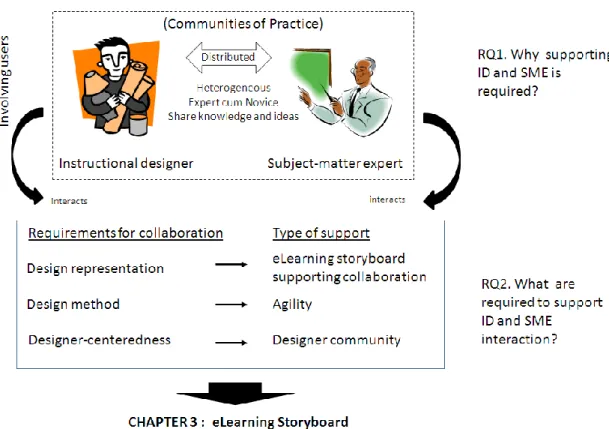
Chapter 2 – Instructional designer and Subject-matter Interaction RQ 1. Why supporting ID and SME interaction is required? RQ 2. What are required to support ID and SME interaction? Chapter 3 – eLearning Storyboard
RQ 3. What is needed in eLearning storyboard to support ID and SME interaction?
Chapter 4– SMM and Shared Visualization
RQ 4. How to support SMM for ID and SME interaction? Chapter 5 – Empirical Studies in eLearning Storyboard
RQ 5. What are the aspects of cognitive task difficulties in eLearning storyboard?
RQ 6. How to solve the cognitive task difficulties?
RQ 7. How the shared visualizations can be used to support shared cognitive user task of ID and SME?
RQ 8. How agility can be driven in the eLearning storyboarding process to support shared cognitive user task of ID and SME?
13
OBJECTIVE 2: To develop a framework that can support the shared cognitive user task between ID and SME in eLearning storyboard.
Chapter 6– Framework Development
RQ 9. What are the basis, structure and contents of the eSCOUT?
RQ 10. How the shared cognitive use task can be supported in eLearning storyboard?
RQ 11. How is the eSCOUT framework evaluated?
RQ 12. How is the result of evaluation lead to revised eSCOUT development?
OBJECTIVE 3: To develop a system prototype that can demonstrate a logical view of the formulated framework.
Chapter 7 – System Prototyping Development and Evaluation RQ 13. How is the eSCOUT prototype system developed?
RQ 14. How is the revised eSCOUT framework being mapped into the system prototype?
RQ 15. How is the walking interface in the system prototype being described using a scenario?
OBJECTIVE 4: To evaluate the similarity and accuracy of shared data visualization which is derived shared cognitive user tasks.
Chapter 7 – System Prototyping Development and Evaluation
RQ 16. What are the criteria used to evaluate the system prototype? RQ 17. How is the system prototype evaluation being conducted? RQ 18. How the result of the evaluation implicates the study?
14
1.7 Scope and Limitations
This research concentrates on investigating specific problems involving ID and SME interaction using eLearning storyboard in communicating the eLearning design content. The proposed eSCOUT framework is applicable to similar problems faced by ID and SME in other countries. However, to evaluate the eSCOUT framework, participating IDs and SMEs from the area of Kelang Valley, Kuala Lumpur, Malaysia are invited for testing and evaluation. As shown in Figure 1.1, this study focuses on two domains from automated instructional design and HCI.
Figure 1.1: The scope of research
This study concentrates on the aspects of eLearning storyboard as one of the pre-production tools to support the key players in automated instructional design, i.e. the ID and SME (Andrews, 2001). In addition, the aspects of SMM and system technologies that provide knowledge values to the HCI research are concerned (Payne, 2003). The SMM in this study refers to the SMM of the ID and SME while shared visualization is chosen as the technique for system design.
15
It is important to emphasize that this research does not aim to offer collaborative design for learners or students, nor it is meant to achieve eLearning quality and standard. As we have mentioned in the research objective earlier, we aim to support shared cognitive user task using the proposed eLearning storyboard framework, involves participation of the key players in eLearning design team, i.e. the ID and SME. Thus, this research is aimed to assist the eLearning designers to collaborate and communicate, which can only be achieved when their SMM are developed.
1.8 Research Methodology
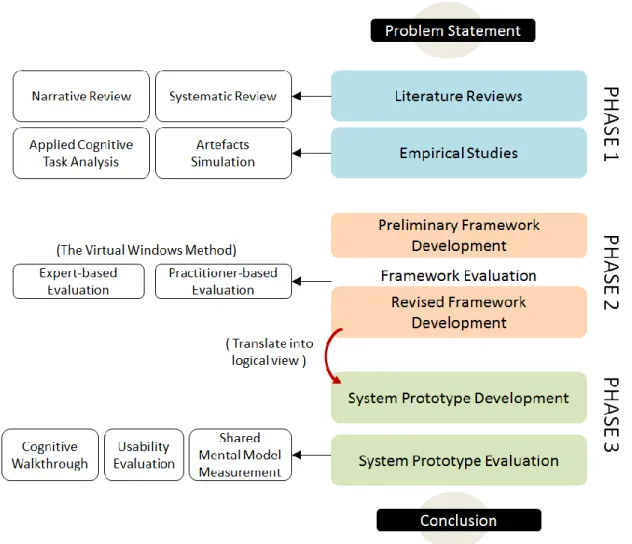
The research work is divided into three phases of study; Phase 1 is the literature reviews work, Phase 2 is framework development and Phase 3 is system prototyping development.
This research starts with conducting literature review to understand the concepts and issues pertaining to the scope of study. Using both narrative and systematic approaches in reviewing the literatures, three chapters of reviews are presented. First chapter represents the issues and challenges of ID and SME in instructional design study. Second chapter describes the importance to support ID and SME in eLearning storyboard as well as limitation in the existing storyboard tools, conceptual model and framework. It also includes the needed requirements to support ID and SME in eLearning storyboard. The third chapter reviews systematically available shared visualization strategies and techniques used to support SMM.
From the three reviews, two empirical investigations are conducted. The first study explores the aspects of cognitive task difficulties in eLearning storyboard using a specific cognitive task analysis technique called as Applied Cognitive Task Analysis (L. G. Militello & R. J. B. Hutton, 2000). In the second study, artefacts simulation of physical storyboards are used to examine shared visualization techniques as well as the
16
drive of agility in supporting shared cognitive user task of ID and SME in eLearning storyboard.
The information from the literatures and investigation studies is collected and analyzed to which is important for the initial framework development of the eSCOUT. Using a specific method for early design development called as the Virtual Windows Method (Lauesen, 2007), the initial framework is evaluated by groups of academic experts and industrial practitioners. Consequently, the feedback from these groups is gathered and used for the enhancement of the revised eSCOUT framework.
The revised eSCOUT framework is translated into a logical form of system prototype. Specific criteria are used to evaluate the aspects of shared cognitive user tasks using the system prototype. This system prototype is evaluated using three ways of testing; cognitive walkthrough, usability evaluation and SMM measurement.
In this thesis, each research methodology is presented in the respective chapter to provide a reading flow in such an order that their logic is as easy for a reader to understand as possible. For example, chapter 5, 6 and 7 are presented in the order starting with introductory, research methodology, research procedures and design, data results and findings, discussion, recommendation as well as conclusion. The research flow and its corresponding research methods are summarized in Figure 1.2.
17
18
CHAPTER 2
INSTRUCTIONAL DESIGNER AND
SUBJECT-MATTER EXPERT INTERACTION
This chapter describes two key players in instructional design; the ID and SME and issues surrounding the support for their interaction support. It consists of two parts. The first part reviews the ID and SME in online course development team and distinctions between them. The second part reviews four issues pertaining to their interaction support, which includes their roles in community of practices in instructional design, SMM, online course collaboration in distributed design and designer centeredness. Summary of the review is discussed.
2.1 Online Course Development Team
Online course development is a complex process which requires a high calibre online course of instruction. In order to produce quality course production, highly organized and concerted efforts are needed from many players.
An online course development team or the instructional design team comprises at least five key roles; subject-matter experts, graphic designer, web developer, programmer and instructional designer. According to Piskurich (2003), these people are grouped into two kinds of role; the core group and the transition group. Piskurich et al. (2000) emphasized that these two groups complement to each in such a way that the core group works need to work closely with the transition group to ascertain that the course production is founded on solid course design principles as well as smoothly integrated with the capabilities of the web environment.
The core group is the people who are responsible to design the basic principles of instruction and learning that follow the instructional design process. These people are normally members in eLearning development unit and who manage the project such as instructional designers, graphic designers and web developers. The transition group
19
refers to those who involve extensively in the eLearning course development to provide information. They could be the clients who sponsored the eLearning projects, academic faculty members or subject-matter experts. Piskurich (2003) identifies two key players from each core and transition group who are significant to represent the participation of their roles; i.e. instructional designers (ID) and the subject-matter experts (SME). These key players need to utilize number of communication strategies in order to achieve the acceptance and participation as Community of Practices in instructional design, which is coined by Keppell (2004) as ―legitimate participation‖.
In instructional design literature, the important of interaction between ID and SME in instructional design project had been given a great emphasis. Before this matter could be described, questions such as who is an ID, what does an ID do - should firstly be understood. Similarly, the same questions should be asked for defining SME. This explanation is presented in the next section.
2.2 Instructional Designer
Instructional design is defined as the ―systematic and reflective process of translating principles of learning and instruction into plans for instructional materials, activities, information resources, and evaluation‖ (Smith & Ragan, 2005 p.4). Therefore, an ID can be simply understood as a person who is responsible for designing the basic principles of instruction and learning that follow the instructional design process. They serve positions such as eLearning Manager, Information Manager, or Head Department of eLearning Unit (Keengwe, Kidd, & Kyei-Blankson, 2009).
According to Caplan & Graham (2008, p.258), an ID need to perform five common processes in instructional design which is constitute in a famous ADDIE model (which refers to Analysis, Design, Development, Implementation and Evaluation). IDs use this model as a guide and systematic framework to build effective online course. These processes are described briefly as follows: