ISSN 1549-3636
© 2011 Science Publications
Corresponding Author: A. Balamurugan,Department of Information Technology,
V.L.B. Janakiammal College of Engineering and Technology, Coimbatore, Tamilnadu, India 1545
Coverage Eligibility Rule based Coverage Maintenance
Protocol for Energy Conservation in Wireless Sensor Networks
1
A. Balamurugan and
2T. Purushothaman
1
Department of Information Technology,
V.L.B. Janakiammal College of Engineering and Technology,
Coimbatore, Tamilnadu, India
2
Department of CSE/IT,
Government College of Technology, Coimbatore, Tamilnadu, India
Abstract: Problem statement: Wireless Sensor Networks (WSNs) comprise of small nodes with
sensing, computation and wireless communication capabilities. Nodes in a sensor network are severely constrained by energy and computing power. Continuous working of sensor nodes leads to quick depletion of battery power and reduces the overall lifetime. To prolong the lifetime of the sensor nodes, efficient routing protocol that could also optimize the energy consumption while maintaining coverage and connectivity is required. Approach: The Coverage Maintenance Protocol (CMP) uses Coverage Eligibility Rule (CER) to find the eligibility of sensor nodes to sleep. After turning off the eligible nodes found out by CER, the network coverage degree was maintained by the remaining active nodes. If these active nodes continuously work, they consumemore energy and decreasethe lifetime. The CMP protocol helps to balance the energy consumed by active nodes,scheduling the work state of active nodes into sleeping, active and listening states. Each node in the sleeping state will not consume energy and remains idle for delay time Td. Results: This maintained the network coverage and increased the lifetime of sensor nodes. Conclusion: The simulation results indicated that the proposed Coverage Maintenance Protocol (CMP) can significantly conserve energy increase the lifetime of sensor networks while maintaining the given coverage.
Key Words: Wireless sensor networks, Coverage Eligibility Rule (CER), Wireless Sensor Networks
(WSNs), Coverage Maintenance Protocol (CMP), Quality of Service (QoS), Coverage Eligibility Rule (CER), Geographical Adaptive Fidelity (GAF), Coverage Control Protocol (CCP)
INTRODUCTION
Wireless Sensor Networks are a trend of the past few yearsand they involve deploying a large number of small nodes. The nodes then sense environmental changes and report them to other nodes over flexible network architecture. They transmit time series of the sensed phenomenon to central nodes where computations are performed and data are fused. The monitored data is to be forwarded to destination without any loss in data. The transmitted data is then presented to the system by the gateway connection. In dense networks, energy-efficient scheduling is a key factor to extend the functionality and lifetime of the network. In most applications, each sensor node is usually powered by a battery and expected to work for long period without recharging. A fundamental
problem is to minimize the number of nodes that remain active, while still achieving acceptable quality of service for applications. In particular, maintaining sufficient sensing coverage and network connectivity with the active nodes are critical requirements in sensor networks.
Different applications require different degrees of sensing coverage. While some applications may only require that every location in a region be monitored by one node, other applications require significantly higher degrees of coverage. In general, coverage degree can be considered as a measure of Quality Of Service (QoS) of a wireless sensor network. The higher the coverage degree is, the better the field is monitored (Azlina et al., 2009; Bulut and Korpeoglu. 2011; Gui and Mohapatra, 2004; Huang and Tseng, 2003).
Sensing is only one responsibility of a sensor network. To operate successfully a sensor network must also provide satisfactory connectivity so that nodes can communicate for data fusion and reporting to base stations. The connectivity of a graph is the minimum number of nodes that must be removed in order to partition the graph into more than one connected component. The active nodes of a sensor network define a graph with links between nodes that can communicate. If this graph is K-connected, then for any possible K-1 active nodes which fail the sensor network will remain connected (Khelifa et al., 2009) Connectivity affects the robustness and achievable throughput of communication in a sensor network. Most sensor networks must remain connected, i.e., the active nodes should not be partitioned in any configured schedule of node duty cycles. However, single connectivity is not sufficient for many sensor networks because a single failure could disconnect the network. At a minimum, redundant potential connectivity through the inactive nodes can allow a sensor network to heal after a fault that reduces its connectivity, by activating particular inactive nodes. Alternatively, transient communication disruption can be avoided by maintaining greater connectivity among active nodes. Greater connectivity may also be necessary to maintain good throughput by avoiding communication bottlenecks.
In WSNs, random deployment may cause asymmetric node density in the field. In some sub areas of the field, the sensing areas of neighboring nodes might overlap with each other, which results in coverage redundancy. This redundancy can be exploited to design energy-efficient coverage control protocols (Bulu and Korpeoglu. 2011; Gui and Mohapatra, 2004; Huang and Tseng, 2003; Tian and Georganas 2002; Ye et al., 2003; Zhang and Hou, 2005; Notani, 2008; Khelifa et al., 2003; Gupta and Dave, 2009; Yuheng et al., 2009). In a k-covered field, a node is said to be redundant if each point within its sensing area is already k-covered by other active nodes (Wang et al., 2003). The basic concept of the coverage control protocols is to turn off the redundant nodes. Since the coverage degree is maintained by the other active nodes, unnecessary power consumption of eligible nodes is saved to a significant extent. An off-duty eligibility rule to identify eligible nodes is critical to the accuracy and efficiency of coverage control protocols. The two protocols in literature, the Ottawa protocol (Xing et al., 2005) and CCP protocol (Khelifa et al., 2003; Xing et al., 2005) adopt either unnecessary or insufficient rules and as a result, redundancy still exists in the Ottawa protocol and blind points might exist with the CCP protocol.
Achieving energy conservation by scheduling nodes to sleep is not a new concept; none of the existing protocols satisfy the complete set of requirements in sensor networks. The main contributions of this study are as follows. First Coverage Eligibility Rule (CER) is presented to find the eligibility of sensor nodes to sleep. After turning off the eligible nodes found out by CER, the network coverage degree is maintained by the remaining active nodes. If these active nodes continuously work, they consume more energy and decrease the lifetime. Second the scheduling protocol CMP is presented to balances the energy consumed by neighbouring nodes thereby improves life time of network.
Related work: Number of solutions have been
proposed for conserving energy in wireless sensor Networks. Following are the brief overview and their limitations of the existing works of various sleep management approaches. In this approach, only a small number of nodes remain active to maintain continuous service of a network and all other nodes are scheduled to sleep.
Many energy-efficient protocols have been proposed to ensure a desired node density by exploiting deployment redundancy. Xu et al. (2001), a Geographical Adaptive Fidelity (GAF) algorithm is proposed to reduce overall energy consumption, while maintaining network connectivity. A probing based density control algorithm called PEAS is proposed in (Ye et al., 2003) to ensure prolonged network lifetime and sensing coverage. Some functional nodes in PEAS continue working until they drain down the battery energy or fail physically, which might reduce network connectivity. In order to balance energy consumption among the network, the ALUL protocol is presented in (Gui and Mohapatra, 2004). However none of the aforementioned works derive complete conditions for redundant nodes for coverage. In fact, their main purpose is to maintain network connectivity, which in most cases does not guarantee coverage.
Barati et al. (2008) and (Cardei et al., 2005), proposes coverage control algorithms to extend network lifetime for target tracking sensor networks. The algorithms aim to divide the sensor nodes into a maximum number of disjoint sets, each of which can completely cover all the targets. By activating these sets successively, unnecessary energy can be saved to a maximum extent. The authors prove that determining sum maximum sets is an NP-complete problem. Two heuristic algorithms are presented to address this problem. However the major limitation of the centralized algorithms is that heavy communication overhead is introduced due to much information exchange, especially in a mobile and multi-hop sensor network.
1547 Optimal Geographical Density Control (OGDC) in (Zhang and Hou, 2005) A Localized protocol provides coverage control while maintaining network connectivity. OGDC first computes the position where each active node should locate if a full coverage is achieved. Then OGDC selects the nodes closest to these positions as active node and change all the other nodes into sleep to conserve energy. This optimal approach by OGDC is built under an assumption that the network density is high enough that a node can be found at any desirable position. In this all nodes in the boundary positions are ignored. It cannot adapt to the changes in sensor network and hence coverage degree is not achieved.
The main approach in Ottawa protocol (Tian and Georganas, 2002) is to derive off-duty eligibility rules for redundant nodes and then schedule the work status of these eligible nodes. The Ottawa protocol uses a sector to approximately calculate node i’s sensing area covered by node j as illustrated in Fig 1. The sector corresponds to the angle of θ and is bounded by radius iPj,1, iPj,2 and arc i← j. In the eligibility rule of Ottawa protocol, node i is said to be eligible for turning off if the sum of the angles created by all of its neighboring nodes are larger than 2π. However, this rule only takes the neighbors within a node’s sensing area into account, bypassing the nodes outside the sensing area but still contributing to coverage sponsorship. In the scenario shown in Fig 1, the eligible node i is considered ineligible by the Ottawa protocol since nodes q and s are ignored. Therefore, as a sufficient but unnecessary condition, the Ottawa protocol can result in redundancy after turning off only a subset of eligible nodes. However, Ottawa protocol support only 1-coverage and can not meet the requirements of some applications such as target localization or tracking which requires at least 3-coverage (Langendoen and Reijers, 2003).
Optimal Coverage Preserving protocol in (Balamurugan et al., 2010) to provide more coverage control but support only 1-coverage. In Coverage Control Protocol (CCP) (Barati et al., 2008) and
(Cardei et al., 2005), A coverage-configurable off-duty rule is adopted to determine node eligibility. The CCP rule considers a node to be eligible if all the intersection points inside its sensing area are k-covered.
An intersection point is defined as the intersection point of the sensing circles of two nodes or that of the sensing circle of one node with the boundary of the field. The CCP protocol outperforms the Ottawa protocol in coverage efficiency.
Fig. 1: Unnecessary condition of of Ottawa
However, in the CCP rule, the rule does not test the intersection points on a node’s sensing circle. As shown in Fig. 2, the CCP considers node i eligible mistakenly based on the assumption that all the inner intersection (i.e., Pm,t) is covered by node j.
Therefore, the CCP rule is a necessary but insufficient condition for an eligible node and blind points might be incurred.
Below are the summary of above said existing works: • GAF maintain network connectivity but do not
guarantee sensing coverage
• PEAS ensure prolonged lifetime and sensing coverage but reduced connectivity
• OGDC ignores boundary positions; hence coverage degree is not activated
• Ottawa protocol does not support a configurable coverage degree
• Blind points might exist with the CCP
Therefore, complete condition to identify an eligible mode to sleep while maintaining coverage and connectivity is required. This study addresses the above problem and describes CER based CMP for energy conservation in WSN.
Problem description: The sensor node resources are
limited due to the high density, multiple nodes may generate and transmit redundant data causing unnecessary energy consumption and hence a significant reduction in network lifetime .Therefore the fundamental issue in WSN is the redundancy. Consider there are k sensors in a field A. Node i (i∈S) is said to be a redundant node if and only if each point within its sensing area is at least k-covered by other active nodes. Turning off redundant nodes can save unnecessary power consumption. Hence, a redundant node is also called an off-duty eligible node. One solution to determine a redundant node is to find out all sub regions divided by the sensing circles of all neighbouring nodes and check if each sub-region is k sensors covered or not.
Fig. 2: Insufficient condition of CCP
The energy-efficient coverage problem is described as follows. Given a field A (L×L), a set of sensors S, a sensing radius r and a requested coverage degree k, an coverage eligibility rule for a node i is used to determine whether it is a redundant node. It is found that such an eligibility rule be a sufficient and necessary condition for an eligible node and can be executed at a low computational complexity. Moreover, for all the eligible nodes identified by CER, a sleep scheduling protocol CMP is used to balance energy consumption among all the nodes in the network. Thus improves the lifetime of network without affecting network performance.
The rest of this study is organised as follows. In Materials and Methods, the concept of AODV routing protocol is described and the proposed Coverage Eligibility Rule based. Coverage Maintanence Protocol is completely discussed. In Results the performance analysis are discussed. Finally, the study ends with a conclusion.
MATERIALS AND METHODS
Routing protocol: In order to select the most suitable
routing mechanism for a sensor application, all routing protocols have to be classified according to a well-defined taxonomy.The protocols has been classified according to network structure and protocol operation (Notani, 2008) Routing in WSNs is generally divided in two ways: according to the network structure as flat-based, hierarchy-basedand location-based routingand according to the protocol operation as multipath-based, query-basedand negotiation-based, QoS-based, or coherent-based. The dynamic topologies with scheduling consume less energy with less number of on-duty nodes (Barati et al., 2008) and (Cardei et al., 2005).
In location-based routing protocol, nodes are addressed and used for routing based on their location in their network. This helps in formation of routes and improves efficiency, as only those nodes need to be considered that are on the route to the base station from
the point of detection. In case of location-based protocols (Yuheng et al., 2009), a k-covered field, a node is said to be redundant if each point within its sensing area is already k-covered by other active nodes. The main mechanism of the coverage maintenance protocols is to turn off the redundant nodes, which are also called eligible nodes to sleep. Since the other on-duty nodes maintain the coverage degree, unnecessary power consumption of eligible nodes is saved to a significant extent. An off-duty eligibility rule to identify eligible nodes is critical to the accuracy and efficiency of coverage maintenance protocols. A localized protocol is more suitable to large and dynamic network topology that is expected to be quite frequent in mobile and ubiquitous scenarios.
AODV: Ad Hoc on-Demand Distance Vector Routing
Protocol (AODV) is a routing protocol designed for wireless networks. AODV builds routes using a route request / route reply query cycle. When a source node desires a route to a destination for which it does not already have a route, it broadcasts a route request (RREQ) packet across the network. Nodes receiving this packet update their information for the source node and set up backwards pointers to the source node in the route tables. In addition to the source node's IP address, current sequence number and broadcast ID, the RREQ also contains the most recent sequence number for the destination of which the source node is aware. A node receiving the RREQ may send a route reply (RREP) if it is either the destination or if it has a route to the destination with corresponding sequence number greater than or equal to that contained in the RREQ. If this is the case, it unicasts a RREP back to the source. Otherwise, it rebroadcasts the RREQ. The complete routing algorithm is described in (Notani 2008).
One of the disadvantages of this protocol is that intermediate nodes can lead to inconsistent routes if the source sequence number is very old and the intermediate nodes have a higher but not the latest destination sequence number, thereby having stale entries. Also multiple RouteReply packets in response to a single RouteRequest packet can lead to heavy control overhead. Another disadvantage of AODV is that the periodic beaconing leads to unnecessary bandwidth consumption.
Hence, to avoid the above issues discussed in AODV, Coverage maintenance Protocol is presented which reduces the communication overhead and maintains the coverage degree with few numbers of active nodes. It sends beacon messages and quit messages to attain active and sleep states respectively. Thus CMP significantly conserve energy increase the lifetime of sensor networks while maintaining the given coverage.
1549 Fig. 3: An example of coverage eligibility
Coverage Eligibility Rule (CER): Each node executes
a coverage eligibility rule to determine whether it is necessary to become active. Given a requested coverage degree, a node i is ineligible if every location within its coverage range is already K-covered by other active nodes. Fig. 3 shows an example of coverage eligibility. A nodes covering the shaded circles in Fig. 3 are active, the node with the bold sensing circle is ineligible for Ks=1 but eligible for Ks>1. The main part of the CER is to determine the perimeter coverage degree of the arc segment of each neighboring node within a node’s sensing area. CER runs at node i is as follows:
• For a node j (j∈N(i)), let d(i, j) be the distance between node i and j. Then, calculate the length of the segment of node j covered by node i. the arc i← j
can be measured by its central angle
• For node j’s each neighboring node m, calculate node j’s arc segment covered by node m
• Add all the points generated by last step to an angle list AL and then sort AL in an ascending order. Meanwhile, mark each point as a left or right boundary of each covered arc segment
• Calculate the perimeter coverage degree of the start point of arc i← j, denoted as Kt. Then, scan the arc segment by visiting each point in the sorted AL: whenever a start point is visited, Kt is increased by one; whenever an end point is visited, Kt is decreased by one. Finally, the perimeter coverage degree of arc i← j should be the minimal value of Kt during the scanning process
• For each node j (j∈N(i)), check the perimeter coverage degree of its arc segment within node i’s sensing area by running the above steps. If there exists a node whose arc segment covered bynode i is less than k-perimeter-covered, node i considers itself ineligible. If no such a node is found, node i determines it is eligible
Coverage Maintenance Protocol (CMP): After
turning off the eligible nodes to sleep by CER, the network coverage degree can be maintained by the remaining active nodes. However, if these active nodes continuously work, they may soon run out of
battery energy. A Coverage Maintenance Protocol (CMP) is used to balance energy consumption among the neighboring nodes while maintaining the requested coverage degree. In CMP, a node can work at one of three states: Sleeping, Active and Listening. The operation of each node is divided into rounds. Each round takes the same period of time (TR) and consists of two steps.
Step 1: At the beginning of each round, all nodes are in active state. To obtain the information of neighboring nodes, each node broadcasts a Beacon Message (BM) which contains node ID and its current location. Then, each node enters Listening state to collect the BMs from its neighbors. Finally, a neighbor list is maintained at each node. Since nodes may have some mobility, it is necessary for each node to update its neighbor list in each round.
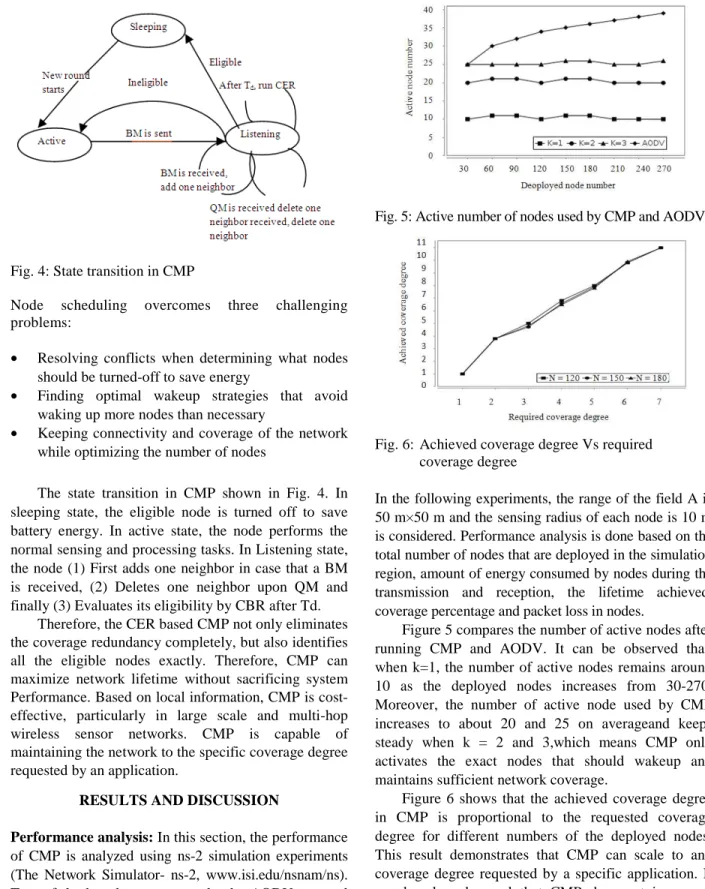
Step 2: After obtaining the neighbor information, each node evaluates its eligibility by CER. However, blind points may occur due to some neighboring nodes’ dependency on each other. CMP uses the back-off scheme to avoid blind points. In this scheme, each node runs CER after a random delay timer Td. The node with the shortest Td evaluates its eligibility earliest. If a node considers itself eligible by CER, it broadcasts a Quit Message (QM) to declare that it enters Sleeping state. The neighboring nodes with longer Td receive the QM and remove the sleeping node from their neighbor lists. Thus, a node with a longer Td will evaluate its eligibility without taking the sleeping nodes into account. Furthermore, by the back-off scheme, the candidate nodes that dependent on each other compete to be eligible by rounds in a random fashion, which evenly spreads the energy consumption around all nodes. After running CMP, only a minimal number of nodes remain active to maintain the desired coverage degree and all the eligible nodes are turned off to conserve energy.
The CMP ensures two solutions to provide scheduling and quality coverage. The CMP rule considers a node to be eligible if all the intersection points inside its sensing area are k-covered. An intersection point is defined as the intersection point of the sensing circles of two nodes or that of the sensing circle of one node with the boundary of the field. CMP makes use of all the nodes within twice the sensing range.
Fig. 4: State transition in CMP
Node scheduling overcomes three challenging problems:
• Resolving conflicts when determining what nodes should be turned-off to save energy
• Finding optimal wakeup strategies that avoid waking up more nodes than necessary
• Keeping connectivity and coverage of the network while optimizing the number of nodes
The state transition in CMP shown in Fig. 4. In sleeping state, the eligible node is turned off to save battery energy. In active state, the node performs the normal sensing and processing tasks. In Listening state, the node (1) First adds one neighbor in case that a BM is received, (2) Deletes one neighbor upon QM and finally (3) Evaluates its eligibility by CBR after Td.
Therefore, the CER based CMP not only eliminates the coverage redundancy completely, but also identifies all the eligible nodes exactly. Therefore, CMP can maximize network lifetime without sacrificing system Performance. Based on local information, CMP is cost-effective, particularly in large scale and multi-hop wireless sensor networks. CMP is capable of maintaining the network to the specific coverage degree requested by an application.
RESULTS AND DISCUSSION
Performance analysis: In this section, the performance
of CMP is analyzed using ns-2 simulation experiments (The Network Simulator- ns-2, www.isi.edu/nsnam/ns). Two of the best known protocols, the AODV protocol and the CMP protocol, are consider for comparison.
Fig. 5: Active number of nodes used by CMP and AODV
Fig. 6: Achieved coverage degree Vs required coverage degree
In the following experiments, the range of the field A is 50 m×50 m and the sensing radius of each node is 10 m is considered. Performance analysis is done based on the total number of nodes that are deployed in the simulation region, amount of energy consumed by nodes during the transmission and reception, the lifetime achieved, coverage percentage and packet loss in nodes.
Figure 5 compares the number of active nodes after running CMP and AODV. It can be observed that, when k=1, the number of active nodes remains around 10 as the deployed nodes increases from 30-270. Moreover, the number of active node used by CMP increases to about 20 and 25 on averageand keeps steady when k = 2 and 3,which means CMP only activates the exact nodes that should wakeup and maintains sufficient network coverage.
Figure 6 shows that the achieved coverage degree in CMP is proportional to the requested coverage degree for different numbers of the deployed nodes. This result demonstrates that CMP can scale to any coverage degree requested by a specific application. It can be also observed that CMP does not incur any coverage redundancy to the network.
1551 Figure 7 shows the coverage percentage of two protocols. It can be found that CMP can maintain the network coverage with fewer active nodes than AODV, which means CMP, is a more energy-efficient coverage control protocol.
The amount of energy consumed by the node can be estimated depending upon its active period and transmission of packets. Figure 8 shows comparison of energy consumed between AODV and CMP.
Figure 9 shows the network lifetime by two protocols when varying number of nodes. It is found that the sensor network lifetime will be almost be linear in the number of nodes which can be deployed in monitoring area. Even though CMP requires an excess time to avoid blind points its lifetime is slightly longer when compared to lifetime of AODV. Throughput is the total number of packets received per unit time.
The total number of packet received by CMP is more when compared with the total number of packets received by AODV at a particular time. The throughput of CMP provides 0.5 times more than the number of packets received per unit time by AODV. This is because CMP identifies the exact nodes and makes the node to receive packets in an efficient way. This is attained due to less packet loss during message transfer. The Fig. 10 shows the throughput performance of CMP and AODV.
Fig. 7: Coverage percentage Vs time
Fig. 8: Energy consumed
Figure 11 shows the packet delivery ratio of two protocols over varying number of nodes deployed in the region of interest. When no. of node increases, CMP can deliver more packets, i.e. 100% delivery ratio is achieved.
From the above analysis, it is been found that coverage maintenance protocol completely eliminates the coverage redundancy but also identifies all the eligible nodes exactly, thus improves the coverage efficiency. It is also found that energy consumption is minimized by a significant amount which facilitates prolonged lifetime.
Fig. 9: Network lifetime
Fig. 10: Throughput graph
CONCLUSION
This study explores the problem of energy conservation while maintaining both desired coverage and connectivity in wireless sensor networks. A coverage eligibility rule (CER), is used to determine redundant nodes. CER provides a sufficient and necessary condition of off-duty eligible nodes to sleep. A Coverage Maintenance Protocol is presented to schedule the work states of on-duty eligible nodes. The CMP is more self-adaptive and energy-efficient in a large scale and multi-hop sensor networks. CMP supports configurable coverage degree to meet various application requirements. Moreover, the minimum coverage degree keeps equal to the requested coverage degree. CMP has the equivalent efficiency in maintaining network coverage and it only activates the exact nodes that should wakeup. CMP eliminates the exact nodes to maintain network coverage and as a result, the energy of redundant nodes is significantly conserved. Simulation results indicate that CMP can maintain the network coverage efficiently and accurately. Thus, CMP can significantly extend the network lifetime without affecting network performance.
REFERENCES
Azlina, N., A.B. Aziz, K.A.B. Aziz and W.Z.W. Ismail, 2009. Coverage strategies for wireless sensor networks. World Acad. Sci. Eng. Technol., 50: 145-150.
Balamurugan, A., T. Purushothaman and S. UmaMaheswari, 2010. Efficient coverage and connectivity with minimized power consumption in wireless sensor networks. Int. J. Comput. Network Security (IJCNS), 2: 214-214.
Barati, A., A. Movaghar, H. Barati and A.A. Mazreah 2008. decreasing overhead and power consuming in ad-hoc networks by proposal a novel routing algorithm. J. Comput. Sci., 4: 427-433. DOI: 10.3844 / jcssp.2008.427.436
Bulut, E. and I. Korpeoglu, 2011. Sleep scheduling with expected common coverage in wireless sensor networks. Wireless Netw, 17: 19-40. DOI: 10.1007/S11276-010-0262-2
Cardei, M., M.T. Thai, Y. Li and W. Wu, 2005. Energy-efficient target coverage in wireless sensor networks. Proceeding of the 24th annual joint conference of the ieee computer and communications societies, March 13-17, IEEE Xplore Press, USA, pp: 1976-1984. DOI: 10.1109/INFCOM.2005.1498475
Gui, C. and P. Mohapatra, 2004. Scalable multicasting in mobile ad hoc networks. Proceedings of the 23rd Annual Joint Conference of the IEEE Computer and Communication Societies, Mar. 7-11, IEEE Xplore Press, Hong Kong, pp: 2119-2129. 10.1109/INFCOM.2004.1354619
Gupta, S. and M. Dave, 2009. Distributed real time architecture for data placement in wireless sensor networks, J. Comp. Sci., 5: 1060-1067. DOI: 10.3844/jcssp.2009.1060.1067
Huang, C.F. and Y.C. Tseng, 2003. The Coverage Problem in a Wireless Sensor Network. Proceedings of the 2nd ACM international conference on Wireless sensor networks and applications, (WSNA '03), ACM New York, USA, pp: 115-121. DOI: 10.1145/941350.941367 Khelifa, B., H. Haffaf, M. Madjid and D.L. Jones,
2009. Monitoring connectivity in wireless sensor networks. Int. J. Future Generation Comm. Network., 2: 1-10.
Langendoen, K. and N. Reijers, 2003. Distributed localization in wireless sensor networks. A quantitative comparison. Comput. Networks., 43: 499-518. DOI: 10.1016/S1389-1286(03)00356-6 Notani, S.A, 2008. Performance simulation of multihop
routing algorithms for ad-hoc wireless sensor networks using TOSSIM. Adv. Commun.
Technol., 1: 508-513. DOI:
10.1109/ICACT.2008.4493813.
Tian, D. and N.D. Georganas, 2002. A coverage-preserving node scheduling scheme for large wireless sensor networks. Proceedings of the 1st ACM international workshop on Wireless sensor networks and applications, (WSNA '02), ACM
New York, USA, pp: 32-41.
DOI: 10.1145/570738.570744
Wang, X., G. Xing, Y. Zhang, C. Lu and R. Pless, et al., 2003. Integrated coverage and connectivity configuration in wireless sensor networks. Washington University.
Xing, G., X. Wang and Y. Zhang, C. Lu and R. Pless, et al., 2005. Integrated coverage and connectivity configuration for energy conservation in sensor networks. ACM Trans. Sensor Netw., 1: 36-72. DOI: 10.1145/1077391.1077394
Xu, Y., J. Heidemann and D. Estrin, 2001. Geography-informed energy conservation for ad hoc routing. Proceedings of the 7th annual international conference on Mobile computing and networking, (MobiCom '01), ACM New York, USA, pp: 70-84. DOI: 10.1145/381677.381685
1553 Ye, F., G. Zhong, J. Cheng, S. Lu and L. Zhang, 2003.
PEAS A robust energy conserving protocol for long-lived sensor networks. Proceedings of 23rd International Conference on Distributed Computing Systems, May 19-22, IEEE Xplore
Press, USA, pp: 28-37.
10.1109/ICDCS.2003.1203449
Yuheng, L., J. Pu, S. Zhang, Y. Liu and Z. Xiong, 2009. A localized coverage preserving protocol for wireless sensor networks. Sensors, 9: 281-302. DOI: 10.3390/S90100281
Zhang, H. and J.C. Hou, 2005. Maintaining sensing coverage and connectivity in large sensor networks. Ad-Hoc Sensor Wirel, Netw., 1: 89-124.