
Deposited in DRO:
15 October 2019Version of attached le:
Published VersionPeer-review status of attached le:
Peer-reviewedCitation for published item:
Bothmann, Enrico and Chahal, Gurpreet Singh and Hoche, Stefan and Krause, Johannes and Krauss, Frank and Kuttimalai, Silvan and Liebschner, Sebastian and Napoletano, Davide and Schonherr, Marek and Schulz, Holger and Schumann, Steen and Siegert, Frank (2019) 'Event generation with Sherpa 2.2.', SciPost phys., 7 . 034.
Further information on publisher's website:
https://doi.org/10.21468/SciPostPhys.7.3.034Publisher's copyright statement:
Copyright E. Bothmann et al. This work is licensed under the Creative Commons Attribution 4.0 International License. Published by the SciPost Foundation.
Additional information:
Use policy
The full-text may be used and/or reproduced, and given to third parties in any format or medium, without prior permission or charge, for personal research or study, educational, or not-for-prot purposes provided that:
• a full bibliographic reference is made to the original source
• alinkis made to the metadata record in DRO
• the full-text is not changed in any way
The full-text must not be sold in any format or medium without the formal permission of the copyright holders. Please consult thefull DRO policyfor further details.
Durham University Library, Stockton Road, Durham DH1 3LY, United Kingdom Tel : +44 (0)191 334 3042 | Fax : +44 (0)191 334 2971
Event generation with Sherpa 2.2
Enrico Bothmann1, Gurpreet Singh Chahal2, Stefan Höche3, Johannes Krause4, Frank Krauss2, Silvan Kuttimalai5, Sebastian Liebschner4, Davide Napoletano6,
Marek Schönherr2, Holger Schulz7, Steffen Schumann1? and Frank Siegert4
1Institut für Theoretische Physik, Georg-August-Universität Göttingen,
D-37077 Göttingen, Germany
2Institute for Particle Physics Phenomenology, Durham University, Durham DH1 3LE, UK
3Fermi National Accelerator Laboratory, Batavia, IL, 60510-0500, USA
4Institut für Kern- und Teilchenphysik, TU Dresden, D-01062 Dresden, Germany
5SLAC National Accelerator Laboratory, Menlo Park, CA 94025, USA
6IPhT, CEA Saclay, CNRS, Université Paris-Saclay, F-91191 Gif-sur-Yvette cedex, France
7Department of Physics, University of Cincinnati, Cincinnati, OH 45219, USA
Abstract
SHERPAis a general-purpose Monte Carlo event generator for the simulation of particle
collisions in high-energy collider experiments. We summarise essential features and improvements of the SHERPA2.2 release series, which is heavily used for event generation in the analysis and interpretation of LHC Run 1 and Run 2 data. We highlight a decade of developments towards ever higher precision in the simulation of particle-collision events.
Copyright E. Bothmannet al.
This work is licensed under the Creative Commons
Attribution 4.0 International License. Published by the SciPost Foundation.
Received 26-05-2019 Accepted 10-09-2019
Published 18-09-2019 Check forupdates
doi:10.21468/SciPostPhys.7.3.034
Contents
1 Introduction 2
2 Highlighting SHERPAComponents 4
2.1 Hard-Scattering Matrix Elements 4
2.2 Parton Showers 9
2.3 Matching and Merging 11
2.4 Internal Reweighting 14
2.5 Initial State Radiation and PDFs 15
2.6 Higher-Order QED and EW Corrections to Decays 16
2.7 Underlying Event and Beam Remnants 17
2.8 Hadronisation 19
2.9 Hadron Decays 21
2.10 Tuning non-perturbative model parameters 22
3.1 Z(→``)production in association with jets 24
3.2 W(→`ν)production in association with jets 25
3.3 g g→hproduction in association with jets 26
3.4 t¯t production in association with jets 27
3.5 Single-top quark production 28
3.6 Diboson production in association with jets 28
3.7 Vγproduction in association with jets 30
3.8 Diphoton production in association with jets 31
3.9 Physics beyond the Standard Model 32
3.10 Hadronisation, Underlying Events and Hadron Decays 33
4 Conclusions 36
A Default-tune non-perturbative model parameters 37
References 39
1
Introduction
Monte Carlo event generators are indispensable tools for the design, realisation, analysis and interpretation of high-energy scattering experiments. In particular, general-purpose genera-tors such as PYTHIA[1], HERWIG[2]and SHERPA[3]are necessary to address detailed aspects
of the final states produced in individual scattering events[4]. Typical experimental use cases comprise for example the calibration of object-reconstruction algorithms, the evaluation of de-tector acceptances, selection efficiencies, or the extrapolation of fiducial cross sections to the full phase space.
Furthermore, over the past decade, Monte Carlo event generators have been established as a tool for precision predictions of scattering cross sections, differential distributions and event topologies. Through the consistent inclusion of higher-order perturbative corrections, in particular in QCD, but also in QED and in the electroweak sector, they nowadays repre-sent state-of-the-art theory calculations that make precision analyses and data interpretation possible. Based on a high level of automation they allow for both the realistic simulation of Standard Model production processes and the description of almost arbitrary New Physics sig-nals. Monte Carlo event generators form a vital cornerstone of collider-based particle physics, from searches for new phenomena to actual Standard Model measurements.
The SHERPA event generator framework, introduced about fifteen years ago [3,5], is a
general-purpose simulation tool for particle collisions at high-energy colliders. It contains implementations of all components needed for a factorised and probabilistic description of scattering events at hadron-hadron, lepton-hadron and lepton-lepton colliders.
This paper summarises the current abilities and components of SHERPA, reflecting the legacy
of the SHERPA2.2 series that was and is being used extensively for the analysis of LHCRun 1
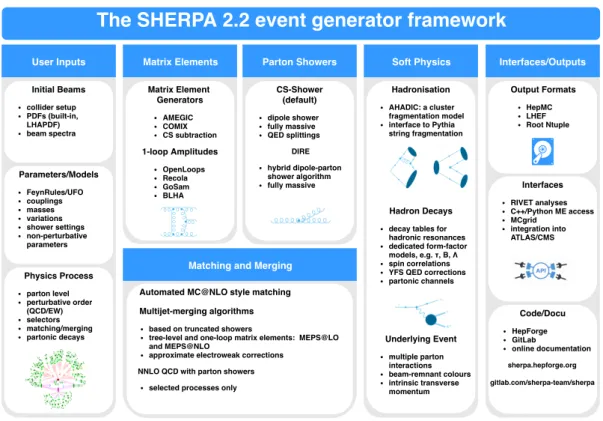
and Run 2 data. A pictorial overview of the SHERPAframework is given in Fig.1. A generator
setup and the corresponding event generation is defined through a text file that contains all non-default settings needed to define the process of interest and to steer the event evolution. The latter includes the setup of the initial beams, the physics model as well as parameters
to consider. SHERPA features two built-in tree-level matrix element generators, AMEGIC [6]
User Inputs Matrix Elements Parton Showers Soft Physics
The SHERPA 2.2 event generator framework
Initial Beams collider setup PDFs (built-in, LHAPDF) beam spectra Physics Process parton level perturbative order (QCD/EW) selectors matching/merging partonic decays Parameters/Models FeynRules/UFO couplings masses variations shower settings non-perturbative parameters
Matching and Merging
Output Formats HepMC LHEF Root Ntuple Interfaces RIVET analyses C++/Python ME access MCgrid integration into ATLAS/CMS Code/Docu HepForge GitLab online documentation sherpa.hepforge.org gitlab.com/sherpa-team/sherpa CS-Shower (default) dipole shower fully massive QED splittings DIRE hybrid dipole-parton shower algorithm fully massive Matrix Element Generators AMEGIC COMIX CS subtraction 1-loop Amplitudes OpenLoops Recola GoSam BLHA
Automated MC@NLO style matching Multijet-merging algorithms
based on truncated showers
tree-level and one-loop matrix elements: MEPS@LO and MEPS@NLO
approximate electroweak corrections NNLO QCD with parton showers
selected processes only
Hadronisation AHADIC: a cluster fragmentation model interface to Pythia string fragmentation Hadron Decays
decay tables for hadronic resonances dedicated form-factor models, e.g. τ, B, Λ spin correlations YFS QED corrections partonic channels Underlying Event multiple parton interactions beam-remnant colours intrinsic transverse momentum Interfaces/Outputs
Figure 1: Overview of the SHERPA2.2 event generator framework.
Model and beyond, and for the decay of heavy resonances such asW,Z, or Higgs bosons or top
quarks. Both include automated methods for efficient phase-space integration and algorithms for the subtraction of infrared divergences in calculations at next-to-leading order (NLO) in
QCD [9–11] and the electroweak theory [12]. For the evaluation of virtual corrections at
NLO accuracy SHERPArelies on interfaces to dedicated one-loop providers,e.g. BLACKHAT[13], OPENLOOPS [14]and RECOLA[15,16]. The default parton-showering algorithm of the SHERPA
2.2 series is the CSSHOWER[17], based on Catani–Seymour dipole factorisation[9,10,18]. As
of version 2.2.0 SHERPAalso features an independent second shower implementation, DIRE[19–
21]. For the matching of NLO QCD matrix elements with parton showers SHERPAimplements
the MC@NLO method[22,23]. For NNLO QCD calculations the UN2LOPS method [24,25]
is used. The merging of multi-jet production processes at leading order [26–28] and
next-to-leading order[29,30]is based on truncated parton showers. Multiple parton interactions
are implemented via the Sjöstrand–van-Zijl model [31]. The hadronisation of partons into
hadrons is modelled by a cluster fragmentation model [32]. Alternatively, in particular for
uncertainty estimations, an interface to the Lund fragmentation model[33]of PYTHIA[34]is
available. SHERPAprovides a large library for the simulation of τ-lepton and hadron decays,
including many form-factor models. Furthermore, a module for the simulation of QED final-state radiation in particle decays[35], which is accurate to first order inαfor many channels is built-in. To account for spin correlations in production and subsequent decay processes
the algorithm described in[36] is implemented. Events generated with SHERPA can be cast
into various output formats for further processing, with the HEPMC [37] format being the
most commonly used. In the specific case of parton-level events, at the leading and next-to-leading order in QCD, additional output formats are supported. They include Les Houches Event Files[38], NTUPLEfiles for NLO QCD events[39] and cross-section interpolation grids produced via MCGRID[40,41]in the APPLGRID[42]and FASTNLO[43,44]formats. To analyse
events on-the-fly a runtime interface to the RIVETpackage[45]can be used conveniently.
The SHERPA Monte Carlo is publicly available from its HEPFORGE project page
sherpa.hepforge.org
. The actual code development and bug-tracking facilities are hosted ongitlab.com/sherpa-team/sherpa
. The current release version is SHERPA2.2.8.The paper is organised as follows. Sec.2will focus mainly on highlighting and summarising
the specific physics implementations and realisations in SHERPA, referring to more in-depth
original literature where appropriate. This section also includes a brief discussion on aspects
related to the tuning of non-perturbative model parameters in SHERPA. In Sec.3we present
selected results obtained with recent versions of SHERPAthat shall illustrate typical use cases and highlight specific aspects of the simulation. We present our conclusions and an outlook in Sec.4.
Please note, for more detailed and pedagogical reviews of general Monte Carlo event gener-ation techniques and their practical implementgener-ations we refer interested readers to[4,46,47].
2
Highlighting S
HERPAComponents
In the following we will briefly describe the central components of the SHERPAframework.
We focus on the physics models and features available, providing references to the original literature for more detailed theoretical derivations and discussions.
The SHERPAframework is written in C++in a highly modular structure, reflecting the
fac-torised ansatz to calculate the evolution of scattering events. The SHERPAcore module is
re-sponsible for steering the event generation process. It initialises the required physics modules and iterates the steps of the simulation. The setup of each generator run, including the
speci-fication of model parameters and all switches, is read from a simple ASCIIfile, called
Run.dat
per default. Parameters of a specific simulation aspect are collated in blocks following a simple bracket syntax: (block_name){ Parameter1 Value1; Parameter2 Value2; ... }(block_name)
Examples of blocks are
(run)
, where general settings are kept, while the specification ofthe hard scattering process to be considered is compiled in
(processes)
. Settings relatedto cuts on the hard scattering final state are given in
(selectors)
. Specific run parameterswill be highlighted along with the presentation of the physics models in this section and the
examples in Sec.3. We organise the discussion beginning with methods for the hard-process
generation in Sec.2.1, followed by parton showers and the methods for matching and merging
them with higher-order matrix elements in Secs. 2.2and 2.3, respectively. We present the
evaluation of perturbative uncertainties based on a reweighting method in Sec.2.4. This is
followed by a brief discussion of available beam spectra and distribution functions in Sec.2.5.
Section2.6is devoted to the discussion of higher-order QED and electroweak corrections in
the decays of unstable particles. Sec.2.7presents our treatment of beam remnants and the
underlying event, while Sec.2.8describes the SHERPAcluster hadronisation model. We close
by presenting our methods forτ-lepton and hadron decays in Sec.2.9.
2.1
Hard-Scattering Matrix Elements
The simulation of individual events starts from a partonic hard-scattering configuration, with momenta distributed according to the corresponding squared QFT transition matrix element.
Sampling those partonic events allows one to determine the total production rate and dif-ferential distributions of the final-state objects to a given perturbative fixed-order accuracy,
e.g. at tree-level or at next-to-leading order in the strong or electroweak coupling. Given the
plethora of processes that users might want to study – both within the Standard Model and various theories for New Physics – a high level of automation is mandatory for the construction and evaluation of matrix elements.
In SHERPAa large variety of fixed-order calculations are available, ranging from the explicit
implementation of some simple 2→2 squared amplitudes at leading order (LO) and next-to
leading order (NLO), over automated matrix-element generators (MEGs) for tree-level pro-cesses with large multiplicities of external particles, to interfaces to external matrix-element implementations at tree- and one-loop level. The respective MEG to be used in a simulation run is specified via:
(run){ ...
ME_SIGNAL_GENERATOR Internal Amegic Comix BlackHat OpenLoops Recola ...; ...
}(run)
(processes){ ...
Loop_Generator Internal BlackHat OpenLoops Recola ...; RS_ME_Generator Amegic Comix;
...
}(processes)
ME_SIGNAL_GENERATOR
defines the global choice for the matrix-element provider(s) to beused throughout the run. When specifying several values they are consecutively asked to
pro-vide the requested matrix element. By specifying
Loop_Generator
and/orRS_ME_Generator
the generators for the loop amplitudes and the subtracted real-emission terms may be chosen separately.
Built-in Matrix Element Generators SHERPAincludes two fully automated MEGs, AMEGIC[6]
and COMIX[7], for the calculation of fixed-order total and differential cross sections and decay widths for multi-particle production and decay processes at tree level. Both MEGs are capa-ble of simulating complicated final states as chains of subsequent decays in the narrow-width approximation, including a proper treatment of all effects due to spin and colour correlations. COMIXallows for external particles with spin-0, 1/2, and 1, while AMEGICalso supports external
spin-2 particles[48]. In both MEGs Majorana fermions are treated using the formalism
pre-sented in[49]. Squared amplitudes in both AMEGICand COMIXcan be projected on arbitrary
orders in the contributing couplings. This permits, among others, the computation of pure QCD contributions to the cross section or to exclusively select interference terms, seee.g.[51]. To give an example, the definition of the tree-level partonic processes for hadronic electron-positron-pair production in association with two final-state partons reads:
(processes){
% use light-jet container 93
Process 93 93 -> 11 -11 93 93;
% constrain orders in strong (1st) and ew (2nd) coupling
Order (2,2); End process; }(processes)
Note, particles are referred to using their PDG Monte Carlo number [52]. In addition, SHERPApermits the utilisation of both predefined and user-specific particle containers. In the
above example, the predefined container
93
comprises all massless QCD partons,i.e. gluonsand massless quarks. The coupling orders are counted at the squared matrix element level. The factorisation and renormalisation scales used in the evaluation of the hard process can be specified through (run){ ... SCALES <scale-setter>{<fac-scale-definition>}{<ren-scale-definition>}; ... }(run)
Possible scale setters for fixed-order calculations include
VAR
andFASTJET
. The firstal-lows the use of simple user-defined functions of the final-state momenta, the latter invokes jet finding via FASTJET[53]. In both cases particle/jet momenta are accessible through
p[<i>]
,where
i=0,1
labels the initial-state momenta and final-state particles orpT-ordered jets usei>1
. Examples to set both the factorisation and the renormalisation scales to either theinvari-ant mass of the two jets or their scalar sum read:
% VAR scale setter
SCALES VAR{Abs2(p[4]+p[5])}{Abs2(p[4]+p[5])};
% FASTJET scale setter
SCALES FASTJET[A:antikt,PT:30.,R:0.4,M:0]{H_T2}{H_T2};
To regularise the phase space, cuts on the final-state leptons and partons need to be applied. A possible event selection may read (again using the FASTJETpackage for jet finding):
(selector){
% window cut on di-lepton invariant mass
Mass 11 -11 80. 100.;
% transverse momentum cut pT>15 GeV on leptons
PT 11 15. E_CMS;
PT -11 15. E_CMS;
% require at least 2 anti-kt jets with R=0.4 and pT>30 GeV
FastjetFinder antikt 2 30. 0 0.4; }(selector)
AMEGICeffectively performs a colour decomposition of the full amplitude, leading to gauge-invariant subsets of amplitudes for each colour structure. These terms are each composed of
Feynman diagrams expressed as helicity building blocks based on[54]. In this amplitude
con-struction process, common sub-amplitudes are identified and algebraically factored out[56],
thereby dramatically reducing evaluation times later on. The resulting expressions are
writ-ten out as C++source code, compiled and linked into dynamic libraries. During the
event-generation phase, these libraries are automatically located and loaded to the main code.
COMIXimplements the colour-dressed Berends–Giele recursive relations[57], a tree-level
equivalent of the Dyson–Schwinger equations [58], to construct off-shell currents that are
fused into amplitudes. Information about the valid current and vertex assignments in the process is written to disk in the form of text files such that subsequent runs of the generator
requesting the same process can commence faster. COMIX uses the colour-flow
representa-tion[61]and colour sampling to compute cross sections including QCD particles. This explicit
computation of colour-ordered amplitudes turns out to be advantageous in the context of matrix-element parton-shower matching and merging.
BSM Simulations An interface to FEYNRULES[63–65],i.e.the UFOmodel definition files[66],
allows the user to consider a wide range of models. In AMEGIC, however, only vertices with
up to four external particles are supported, imposing some limits on its abilities, while in
COMIXthis number is limited only by computing power, allowing calculations in more
compli-cated theories. With the physics-model information encoded in the standard UFOformat[66],
SHERPAcreates and links complete C++source code necessary to compute arbitrary scattering
processes, employing an automatic generator for Lorentz[8]and colour[67]structures which
represent the elementary vertices of the theory. The generators AMEGICand COMIXhave been
extensively benchmarked, internally and against other codes, for example in the SM[56]and
the MSSM[68]1.
Phase-Space Integration SHERPAuses various methods to efficiently integrate multi-particle
phase spaces, implemented in its PHASIC module. These can be classified as
importance-sampling techniques, where phase-space points are generated using suitable approximations for the desired target distribution, that is given by the squared matrix element. For this pur-pose a set of phase-space maps (called channels) is automatically constructed by the MEGs ac-cording to the propagator and vertex structures of contributing Feynman diagrams or current topologies. The full set of contributing integration channels is combined into a multi-channel integrator that features an automatic optimisation of the individual channel weights[69].
In AMEGICthis leads to the construction of typically one channel per diagram[6]. Within
COMIX, the method is recast into a recursive algorithm, reducing the factorial growth in the
number of channels to an exponential one[7]. Both AMEGICand COMIXfurther optimise the
integration over propagator masses and polar angles in decays, using a re-mapping of random numbers base on VEGAS[70,71]for each channel.
Resonance Decays Intermediate unstable resonances, as they frequently appear in exten-sions of the Standard Model, can produce high-multiplicity final states through cascade decays. In SHERPAthere are two ways of treating such effects. The first is to select solelys-channel
di-agrams/current topologies of the requested intermediate resonances, thereby automatically
taking into account finite-width and spcorrelation effects while possibly violating gauge in-variance of the overall amplitude. An example for the production and decay of top quarks in electron-positron annihilation reads
(processes){
% enforce intermediate top-quarks
Process 11 -11 -> 6[a] -6[b];
% decays t -> bW
Decay 6[a] -> 5 24[c]; Decay -6[b] -> -5 -24[d];
% decays W+ -> mu+ nu, W- -> qqb’
Decay 24[c] -> -13 14; Decay -24[d] -> 94 94; End process;
}(processes)
Alternatively, employing a strict narrow–width-type factorisation of production and decay, resonances can be produced as external particles and then decayed through separate decay matrix elements. By default, a posteriori the decay kinematics is adjusted to a Breit–Wigner distribution using the resonance’s width. Spin correlations are retained through the algorithm worked out in[36,72–74]. For the latter case, SHERPAautomatically constructs the decay tables
1 We would like to note that since version S
HERPA-2.0 the realisation[48] of the ADD model of large extra dimensions is no longer supported.
and computes the partial widths and branching ratios at tree level. It is possible for users to overwrite any of the automatically generated branching ratios, and to enable or disable any subset of decay channels. This can be useful, for example, to include NLO K-factors or to better match known (and measured) branching ratios. The setup corresponding to top-quark production and decay from above in the factorised approach reads:
(run){
% enable hard decays
HARD_DECAYS On;
% enforce decay W+ -> mu+ nu
HDH_STATUS[24,-13,14] 2;
% switch off decays W- -> l- nu
HDH_STATUS[-24,-12,11] 0; HDH_STATUS[-24,-14,13] 0; }(run)
(processes){
% produce final-state tops, decay through hard decay module
Process 11 -11 -> 6 -6; End process;
}(processes)
NLO Calculations and One-Loop Providers The inclusion of NLO QCD corrections to a given scattering process has become a de-facto standard in today’s event generators, including their matching to parton showers. As both virtual and real-emission corrections are separately
infrared divergent, a cancellation procedure is required. In SHERPA this has been realised
for the first time through the automation of the Catani–Seymour dipole subtraction formal-ism[9,10]in [11]. Renormalised QCD virtual corrections are obtained either through dedi-cated interfaces from programs and libraries like BLACKHAT[13,75–77], MADGRAPH [78,79],
OPENLOOPS [14] and RECOLA [80], or through the generic Binoth Les-Houches Accord
inter-face[81,82]from codes like GOSAM[83,84] or NJET[85]. An example process declaration
including the evaluation of NLO QCD corrections in a fixed-order computation reads:
(processes){
Process 93 93 -> 11 -11 93 93;
% use asterisk wild card for strong coupling
Order (*,2);
% evaluate NLO QCD corrections in fixed order scheme
NLO_QCD_Mode Fixed_Order;
% include Born (B), Virtual (V), Integrated Subtraction (I), Real (R) and Subtraction terms (S)
NLO_QCD_Part BVIRS;
Loop_Generator <One-Loop Provider>; End process;
}(processes)
Examples of NLO QCD calculations performed with SHERPAinclude:
• vector-boson production with up to five jets at NLO QCD[86,87],
• Higgs-boson production in association with up to three jets, taking into account
finite-mass corrections[88],
• diphoton plus up to three jets production[90,91], • up to five-jet production at the LHC[92–94].
The generalisation of the subtraction formalism to electroweak corrections has been
imple-mented in[12]and renormalised electroweak one-loop corrections can at present be obtained
from GOSAM, OPENLOOPSand RECOLA. They are, however, not yet available in SHERPA-2.2.
Pro-cesses that have already been evaluated at full EW one-loop order with a development version of SHERPAinclude:
• three-jet production at the LHC[95], • four-lepton production[16,96,97], • t¯thproduction[16],
• W (Z) production with up to three (two) jets[16,98], • γγW andγγZ production[99],
• andγγj production[100].
NNLO QCD Calculations For a few phenomenologically highly relevant processes SHERPA
allows for the evaluation at NNLO QCD precision, using theqT-slicing method based on the
ideas of[101,102]. QCD NNLO cross sections can be computed in SHERPAfor neutral and
charged current Drell–Yan processes[25,103]and for Higgs-boson production [24].2 Note,
the NNLO facilities are not distributed with the public code releases, but can be obtained in
the form of plugins from
http://www.slac.stanford.edu/~shoeche/pub/nnlo/
.External Matrix Elements SHERPAprovides a generic interface to external amplitude gen-erators, that can be used in particular to compute cross sections for loop-induced processes,
likee.g. g g →W+W− or g g →H H. For matrix elements provided by OPENLOOPS [14], the
interface is fully automated and can be used as a blueprint to access other external MEGs as well.
For the phase-space integration of externally provided matrix elements, a set of process-specific
phase-space generators is available in SHERPA. If they need to be extended, a phase-space
generator for a process with similar characteristics can be generated with AMEGICand then
used as a plug-in. Alternatively, phase space can be sampled uniformly, using the SHERPA
implementation of the RAMBOalgorithm[105].
2.2
Parton Showers
QCD parton showers form an indispensable part of any multi-purpose event generator. They account for the successive emission of QCD or QED quanta off the initial- and final-state partons of the hard process. In doing so, showers relate a few-parton hard-scattering configuration at
momentum scaleQ2hard to a set of partons with typical inter-parton separation scales down to
Q20≈1 GeV2. This solves the evolution of arbitrary hard-scattering processes from high to low scales, where ultimately a non-perturbative hadronisation process sets in, transforming the final-state partons into primary hadrons.
Formally, parton showers provide approximate numerical solutions for the all-orders re-summation of large kinematical logarithms. A statement on the logarithmic accuracy for an
2A development version of S
HERPAhas also been used to compute NNLO cross sections for di-boson production at hadron colliders[104].
arbitrary observable evaluated with a shower algorithm cannot easily be made. However, in re-cent years investigations on the correspondence of parton showers to resummation approaches have been fruitful, see for instance[106–108].
Furthermore, the need to match parton showers to higher-order matrix elements, in partic-ular multi-leg tree-level or one-loop matrix elements, has served as a development paradigm. This raises issues about matching the exact singularity and colour structure of QCD matrix elements, preserving their fixed-order accuracy, without compromising on the resummation property of the parton shower. This has for instance led to the formulation of shower algo-rithms based on NLO QCD infrared subtraction schemes.
SHERPAcomprises two different parton showers, based on different construction paradigms, and implementing different ways to fill the phase space for multiple emissions of secondary particles.
CSSHOWER The default shower of the SHERPA-2 series is based on Catani–Seymour dipole
factorisation[9,10], first proposed in[18]. The technique was implemented in SHERPA[17]
and at the same time in[109], building on a set of generic operators for particle emission off
a dipole in unintegrated and spin-averaged form in the large-Nc limit. Each dipole contains
a splitting parton and a colour-connected spectator parton. The shower evolves through se-quential splittings of such dipoles. In the SHERPAimplementation, all QCD splittings within the
Standard Model and the MSSM, as well as the emission and splittings of photons are
incor-porated, evolving QCD and QED quanta on an equal footing[110]. Note that the CSSHOWER
fully supports finite-mass effects. This is important in particular for the production and evolu-tion ofb-quarks[17,110], thus allowing for systematic studies ofb-quark associated/initiated
processes in the four- and the five-flavour scheme[111,112]. With this, the CSSHOWER, in
essence, implements a fully-differential general-mass variable flavour-number scheme (GM-VFNS), generating massive quark thresholds through momentum conservation. Furthermore,
general electroweak splittings are implemented in CSSHOWER[113]. However, as the chirality
of fermions can currently only be treated in an approximated form, these splittings are disabled by default.
In the dipole picture of the CSSHOWER, soft-gluon emissions are mapped onto two dipoles,
which consist of the same partons, but with the roles of spectator and emitter interchanged. The splittings are ordered by their associated transverse momenta. For final-state splitters, this is the transverse momentum between the two daughters, whereas for initial-state splitters the transverse momentum is taken with respect to the emitting beam particle. In contrast
to the original formulation [17], where the kinematics of the Catani–Seymour formalism is
used, in the current default configuration recoil from the emission is either compensated by the spectator if the emitter is a final-state parton, or otherwise distributed equally among all
final-state particles. This modified recoil scheme was first proposed in[114] and refined to
include massive partons in[110]. It is crucial to obtain reliable predictions for Deep Inelastic Scattering (DIS) processes[110,115].
The above choices were made with the matching and merging of the shower with hard matrix elements in mind (these techniques are described in Sec.2.3). Building the splitting kernels on top of the subtraction formalism used to calculate NLO matrix elements allows one to write the
MC@NLOformalism in the most simple form. Using the transverse momentum as the ordering
variable removes the need to veto splittings with scales that are larger than the scale set by the hard process. And finally, local energy-momentum conservation enables the translation of a multi-leg matrix element into a history of parton-shower emissions, which is needed for attaching showers to multi-parton amplitudes[28].
DIRE The second parton shower implemented in SHERPAis DIRE [19], it presents a hybrid
between the colour-dipole picture[116]and standard collinear parton evolution. Similar to
the CSSHOWER, it is based on Catani–Seymour dipole subtraction[9,10], but uses the inverse of the soft eikonal as evolution variable. The soft-enhanced part of the splitting functions is defined by a partial fraction of the soft eikonal of the colour dipole[9], giving the correct soft-anomalous dimension at one-loop order. The collinear remainder of the splitting kernels is determined by the constraint that they reproduce the known collinear anomalous dimensions, while respecting flavour and momentum sum rules.
The resulting splitting functions can be negative, leading to negative emission probabilities
which necessitate the weighted Sudakov veto algorithm, introduced in[110,117,118]. The
negative prefactor is then moved to an analytic event weight. In the same way, DIREcan also
deal with negative values of PDFs without resorting to an unphysical emission cut-off. The event-weight variance imposed by this approach is typically small.
DIRE uses the same recoil strategy as CSSHOWER, and as for CSSHOWER, massive partons are
supported, with the additional construction principle that the evolution variable of DIREis still
mapped to the soft-enhanced term of the full matrix element. A unique feature of DIRE is
that it has also been implemented in PYTHIA[1], allowing extensive cross validation between
the two generators thus enabling stringent consistency checks of event samples produced for experimental analyses.
Within the framework of DIRE, it has been shown that triple-collinear and double-soft NLO
corrections to the splitting functions can consistently be included in a parton shower[20,119]. A complete treatment of higher-order corrections will be available in a future version of SHERPA.
2.3
Matching and Merging
Having discussed the methods used for calculating hard-scattering matrix elements and parton showering raises the question how to combine these two complementary approaches, while
preserving their respective strengths. Consider a well-defined inclusiven-jet type observable.
A tree-level calculation atO(αns)will typically provide the lowest-order prediction. Subsequent emissions from a parton shower provide a (leading) logarithmic approximation for the higher
jet rates, preserving the leading-ordern-jet rate. In contrast, an exact NLO QCD calculation,
i.e. including the virtual and real corrections, yields an NLO accurate prediction for then-jet cross section, while the(n+1)-jet rate is approximated to leading order.
Matching matrix elements and parton showers resolves the double-counting of the NLO
corrections in the matrix-element calculation with the first parton-shower emission. Multijet
merging, on the other hand, allows for the combination of final states of increasing
matrix-element parton multiplicity, evolved by a parton shower, into an inclusive description. This enables prediction for higher jet rates at NLO or LO accuracy, depending on the order of the underlying matrix-element calculation, up to a certain maximum matrix-element parton multiplicity. Yet higher jet numbers are accounted for by the parton shower off the highest-multiplicity matrix element.
Multijet merging, first introduced in[26,27], has been one of the cornerstones of SHERPA
since its inception. Promoting the idea underlying multijet merging to the inclusion of higher-order matrix elements builds on the exact matching of these matrix elements to the subsequent parton showering, delivering precise simulations in their own right. In this section we describe
the methods for matching and merging in SHERPA, including the incorporation of NNLO QCD
corrections for a few processes and means to account for approximate NLO electroweak con-tributions relevant in particular in high–momentum-transfer regions.
Matching of NLO Matrix Elements and Parton Showers For the matching of next-to lead-ing order matrix elements, SHERPAuses a variant of the MC@NLOmethod[22]. Its basic idea
is the realisation that parton showers organise their radiation pattern, and in particular the first emission, by identifying and factorising the singular soft and collinear limits of the emis-sion matrix elements. In parton showers the notion of a resolution parameter in the emisemis-sion phase space of the secondary quanta regularises the singularities, leading to the appearance of logarithms in the cut-off parameter. In NLO calculations, however, these singular terms must be identified and subtracted from the real-emission matrix elements. This enables the decom-position of the parton-level calculation into two parts with well-defined, finite cross sections: an infrared-subtracted real-emission contribution, where the subtraction is identified as the first parton-shower emission off an underlying Born configuration, and a part consisting of the original Born-level calculation supplemented with the virtual correction and the integrated infrared subtraction terms, both of which share the same Born kinematics. Parton showers are attached to both parts, with starting conditions reflecting the respective kinematics. In SHERPA, this idea has been recast in a form that maximises the benefit of using identical kernels for in-frared subtraction and parton showering[23].
In the past decade, the MC@NLO matching in SHERPAhas been continuously developed and
refined. Specific aspects and applications have been discussed in a series of dedicated publica-tions, including pure jet production at the LHC[120], the hadronic production of electroweak
gauge bosons and up to three jets[121], t¯t b¯bproduction[122],s- andt-channel single-top
production[123]or Higgs-boson pair production[124]. The MC@NLOapproach is nowadays
routinely used in Standard Model simulations with SHERPA. Furthermore, it forms the basis
for all merging approaches involving NLO QCD matrix elements. To give an example, the
process definition of an MC@NLOmatched simulation of Drell–Yan lepton-pair production in
association with two jets reads:
(run){ ... SHOWER_GENERATOR CSS ... }(run) (processes){ Process 93 93 -> 11 -11 93 93; Order (*,2);
% evaluate NLO QCD corrections in MC@NLO scheme
NLO_QCD_Mode MC@NLO; Loop_Generator Recola; End process;
}(processes)
Note, selector definitions similar to the ones stated in Sec.2.1apply here as well.
NNLO Matrix Elements and Parton Showers: First Steps Using the UN2LOPSmethod pro-posed in [24], and relying on qT-slicing [101,102] to regulate the additional infrared sin-gularities, it is possible to also include NNLO-correct matrix elements for the production of
colour-singlets at hadron colliders into a parton shower framework. In SHERPAthis has been
achieved for two processes, Drell–Yan and Higgs-boson production[24,25], thereby providing
an important alternative to the MINLO-based implementations of[125,126]. More recently,
the application to hadronic final state production in Deep Inelastic Scattering[127]has been
discussed. However, here the projection-to-Born method [128], rather than the qT-slicing
technique has been used to regulate the additional infrared singularities appearing at NNLO.
Note, the NNLO+PS facilities are not distributed with the public code releases. The Drell–Yan
Multijet Merging at LO and NLO The multijet-merging approach uses the notion of jets –
usually defined through akT-type measure – to classify emissions as either jet production or
jet evolution, and to additively combine towers of exact matrix elements with increasing jet multiplicities into one inclusive sample. Denoting the separation scale of both regimes asQcut,
emissions withQ ≥ Qcut get accounted for by exact matrix elements, while radiation with
Q<Qcutis described by the parton shower instead. In turn, hard jet-emission configurations will follow the fixed-order matrix-element kinematics, while the inner-jet evolution and the production of additional softer jets is in the realm of the parton shower’s emission kernels. The resummation of emission-scale hierarchies is provided by the parton shower in both regimes. The classification into two disjoint, complementary regimes avoids the explicit double-counting of emissions, while the logarithmic accuracy of the parton shower is recovered by both the matrix elements and the parton shower’s emission kernels having the same infrared
limits (at leadingNc) and using the parton shower’s resummation in both regions. Originally
these ideas have been proposed for the combination of tree-level matrix elements in[26,27], and have been implemented, in variations, in all event generators[28,29,129–136]. A dedi-cated comparison can, for example, be found in[131].
The SHERPAmerging algorithm for tree-level matrix elements, called MEPS@LO, has been
detailed in[28]. It relies on a truncated parton shower,i.e. the shower explicitly generating the Sudakov form factor for lines between reconstructed matrix–element-type emissions. Broadly speaking the algorithm proceeds as follows:
• initial cross sections for the multijet matrix elements to be considered are evaluated,
• according to the total cross section a specific jet multiplicity is picked, then a flavour
channel and an event kinematics are generated,
• for the given flavour assignment and kinematics a clustering algorithm is applied that
inverts the parton shower algorithm until a unique core process and subsequent emission scales in the full matrix-element configuration are identified,
• a scale choice is made for the strong-coupling factors, comprising the respective
contri-butions for both the identified core process and the individual emission scales, identical to those used in the parton shower,
• the truncated parton shower starts from the core configuration, reconstructing the
iden-tified matrix-element emissions when the shower evolution parameter crosses their pre-determined scales, and the event is vetoed when the parton shower produces an emission
above the resolution scaleQcut, implementing the Sudakov factor of the parton-shower
resummation in the matrix-element region.
This procedure allows one to add event configurations exclusive in the emission scale down
toQcut into an inclusive sample, thereby cancelling the dependence on the separation
param-eter to the logarithmic accuracy of the parton shower. Note, the sample of highest matrix-element multiplicity has to be exclusive down to the lowest matrix-matrix-element emission scale only,i.e. QMElast≥Qcut.
The well-established LO approach has been promoted to include matrix elements at NLO accuracy in QCD, called MEPS@NLO, and implemented in SHERPAin [30,137,138]. It
com-bines MC@NLOmatched samples of increasing jet multiplicities, separated by the resolution
parameterQcut into an inclusive sample. In general, the approach follows the outline above,
only the usual care with overlapping descriptions through NLO matrix elements and parton showers is taken, and any overlaps are carefully removed to fully maintain the respective ac-curacies throughout. Other formulations and approximations thereof have been presented in[139–142].
NLO EW Corrections in Matching and Merging In [143,144], an approach to incorpo-rate approximate electroweak and subleading mixed QCD-EW corrections into the above
de-scribed MEPS@NLOQCD method was introduced, dubbed MEPS@NLOQCD+EWapprox. There,
the Born-like input cross section into the MC@NLOmatched samples of the multijet-merged
calculation are supplemented with exact NLO EW renormalised virtual corrections as well as approximated NLO EW real-emission corrections integrated over their real-emission phase space. This approximation is tailored to reproduce the exact NLO EW corrections in regions with large momentum transfers where they are dominated by virtual weak-boson exchanges and renormalisation corrections. The integrated-out real-photon emission part of the elec-troweak correction, which are of prime importance for leptonic final states, are recovered in
a full event simulation by including a soft-photon resummation,cf.Sec.2.6. Subleading
tree-level contributions may be added where relevant.
The MEPS@NLOapproach defines the current standard in simulating QCD-associated
Stan-dard Model production processes with SHERPA. Examples of validation and application of the
method include:
• V+jets production with up to two jets described at NLO QCD and approximate NLO
EW[143],
• h+jets production with up to three jets described at NLO QCD and 5 jets at LO[145,146], • four-lepton production[147],
• triple vector boson production[138],
• Higgs production in association with a gauge boson[138],
• application to loop-induced production processes[147,148],
• and top-quark pair production in association with up to three jets[149].
In Sec.3we illustrate results for a variety of processes based on the matching and merging
of matrix-element elements and parton showers and compare them with actual data from the LHC.
We close this section with an example for the process setup of Drell–Yan production in associ-ation with QCD jets, based on NLO QCD matrix elements for up to two jets:
(processes){
% process definition: Drell-Yan + 0,1,2 jets @ NLO QCD
Process 93 93 -> 11 -11 93{2}; Order (*,2);
% merging scale parameter corresponding to Qcut=30 GeV
CKKW sqr(30/E_CMS); NLO_QCD_Mode MC@NLO; RS_ME_Generator Comix; Loop_Generator OpenLoops;
% include approx. EW corr. and first subleading tree-level
Associated_Contributions EW|LO1; End process;
}(processes)
2.4
Internal Reweighting
The advancements of state-of-the-art QCD calculations as described in this publication led to a considerable growth in computational cost per event, a limiting factor in current and future
applications of event generators. One place where this cost can be addressed relatively easily is in studies targeting theory uncertainties for QCD input parameter and scale choices. Tradition-ally, this involved re-running the whole event-generation chain with different PDFs, values for the strong couplingαs, or with varied choices for the renormalisation and factorisation scales
µR,F. Nowadays this is achieved by appropriately reweighting the default prediction,
signifi-cantly reducing the computational costs. Furthermore, SHERPAallows for a reweighting of the
nominal NLO QCD calculation to include the associated approximate NLO EW corrections and subleading tree-level contributions.
Implementation The parameter-reweighting techniques available in SHERPAhave been de-scribed in[150]. Like in other generators, cf.[151,152], they are calculatedon-the-fly and cover scale variations, different PDF choices and modified values for coupling constants. They can furthermore include the effects these choices have on the parton shower, without rerunning it. The shower-emission reweighting uses the generalised Sudakov Veto Algorithm presented
in [110]. Relative weights that emerge from different choices of these inputs are provided
either in the HEPMC event output[37]or directly passed through the internal interface to the
RIVETanalysis framework[45]. Especially when the events are stored on disk, this also reduces the necessary disk space by potentially large factors, replacing full events for each variation by single numbers.
Reweighting in SHERPAcan be applied to fixed-order calculations, both at LO and NLO
using the NTUPLEdecomposition[39]. When applied to matched or merged calculations, both
the CSSHOWERand DIREparton showers are supported. A lower bound on the parton-shower
evolution scale can be set to omit the reweighting of very soft emissions. This allows for a trade-off between speed and accuracy.
An extensive example that invokes 7-point scale variations, variations over several PDF sets (including all their error replica/eigenvector PDFs, and sets with variedαS(mZ)), and adding electroweak corrections as separate variations, is given by the following snippet:
(run){
% pairs of factors multiplying default squared scales muR,muF
SCALE_VARIATIONS 0.25,0.25 0.25,1. 1.,0.25 1.,1. 1.,4. 4.,1. 4.,4.;
% event variation for given (error) sets of PDFs
PDF_VARIATIONS CT14nlo[all] MMHT2014nlo68cl[all] NNPDF30_nlo_as_0118[all] \
NNPDF30_nlo_as_0115 NNPDF30_nlo_as0121;
% reweight nominal QCD to QCD+EW and QCD+EW+subLO
ASSOCIATED_CONTRIBUTIONS_VARIATIONS EW EW|LO1;
% enable consistent variations of parton-shower splittings
CSS_REWEIGHT 1;
% reweight the alpha_s that multiplies the splitting probability
REWEIGHT_SPLITTING_ALPHAS_SCALES 1;
% reweight the PDF ratios for initial-state splittings
REWEIGHT_SPLITTING_PDF_SCALES 1; }(run)
Note that although the production will be considerably faster compared to producing separate event samples for each variation, the inclusion of hundreds of variations (as in the example above) can still slow down the production significantly, especially when enabling the parton-shower reweighting.
2.5
Initial State Radiation and PDFs
As a multi-purpose generator, SHERPAcan be used to simulate collisions for various different
the proper modelling of beam spectra and (partonic) substructures.
Beam Particles SHERPA allows for a two-step definition of particles entering a hard
inter-action:
BEAM
particles are specified, which may be subjected to a spectrum, modifying theirenergy, or, possibly get converted to other particles, that are refered to as
BUNCH
. For the latter,two examples are available in SHERPA, namely
• Laser Backscattering, where initial beam leptons are “converted” into bunch photons
through Compton scattering[153–155]; and
• equivalent photons in the Weizsäcker–Williams approximation, where the beam particles
act as quasi classical sources of collinear photon fluxes[156–158].
By default initial beams are considered monochromatic and will directly enter the second stage, where their potential substructure is resolved.
Encoding Partonic Structure: Available PDFs The emerging beam particles, that initiate the hard scattering, may feature a partonic structure, described by a parton distribution func-tion (PDF). This in particular applies to protons, photons, or leptons, whose constituents then form the initial states of the matrix-element calculations described in Sec.2.1.
For these beam particles SHERPAprovides built-in PDFs that are shipped with the code, namely
• various proton PDFs, in particular the default set NNPDF 3.0 NNLO[159],
• the GRV leading-order photon PDF set[160,161],
• and an analytic QED lepton structure function in different approximations[162–165]. In addition, SHERPAcan be built with an interface to the LHAPDFlibrary[166,167], allowing the user ample choice in particular of proton PDFs, including their respective error and variational sets.
An example beam setting, assuming proton-proton collisions atps=13 TeV using the MMHT
2014 NLO PDF set[168]via LHAPDFreads:
(run){
BEAM_1 2212; BEAM_ENERGY_1 6500.; BEAM_2 2212; BEAM_ENERGY_2 6500.; PDF_LIBRARY LHAPDFSherpa;
PDF_SET MMHT2014nlo68cl;
% use the PDF implementation of running aS
USE_PDF_ALPHAS 1; }(run)
In setups which include PDFs, SHERPAautomatically uses a consistent value ofαSand order
of its running throughout the event generation. When using LHAPDF, it is optionally possible
to use the actual implementation of the running within the given PDF library.
2.6
Higher-Order QED and EW Corrections to Decays
Higher-order QED and electroweak corrections can be computed in SHERPA using the
soft-photon resummation of Yennie, Frautschi and Suura (YFS)[169], which exploits the universal
structure of soft real and virtual photon emissions to construct an all-order approximation while all mass effects are retained. The implementation in SHERPA[35,170]focusses on higher-order corrections to particle decays, both for elementary particle decays (e.g. W±, Z,h,τ±) as well as for hadron decays.
Implementation The soft-photon resummed higher-order QED corrections in SHERPAare ap-plied to decay processes that involve colourless particles only, while those that involve coloured particles – quarks and gluons – are subjected to a regular parton shower. By default, exact
first-order QED corrections are applied to Z→``, W→`ν,h→``andτ→`ν`ντand some
hadron decays[35,103,146,171]. In all other cases, the eikonal approximation underlying the all-orders resummation is corrected in the hard collinear emission regime through subtracted Catani–Seymour dipole splitting functions[35].
Treatment of Resonances To meaningfully dress the complex final state of a hard scattering process with QED radiation it is mandatory to preserve its internal resonance structures. In SHERPAthis is achieved through universal resonance identification described in[96]. It identi-fies all possible resonances by first scanning the final state of a scattering process for possible recombinations into resonant states present in the employed physics model. Then, all possible combinations are ordered by the difference of invariant mass of the decay products and the mass of the resonance, scaled by its width: ∆=|minvkin−mres|/Γres. Resonances are identified
in ascending order of∆, and configurations with ∆ > ∆res are classified as a non-resonant
production of the respective final state, where the arbitrary parameter∆resis set to 10 by
de-fault. The kinematics of the radiation off the thus identified resonant decay is subject to the condition that the invariant mass of the system is maintained. Non-resonantly produced final states are corrected for QED effects using the universal YFS exponential coupled with universal collinear-emission correction factors.
The main switches steering the YFS corrections are given by
(run){
% apply QED corrections to hard scattering - On/Off
ME_QED On;
% threshold \Delta_res to differentiate resonant and non-resonant regions
ME_QED_CLUSTERING_THRESHOLD 10.;
% general YFS switch: 0 - Off, 1 - soft photons only, 2 - soft and hard photons
YFS_MODE 2;
% apply exact first order QED matrix element corrections: 0 - Off, 1 - On
YFS_USE_ME 1; }(run)
2.7
Underlying Event and Beam Remnants
The inner structure and finite size of incident hadrons in collisions,e.g. at the LHC, allow for
effects beyond the hard process and secondary radiation. These are collectively called the un-derlying event (UE). In particular, partons inside the hadron may have some non-perturbative transverse momentum, and the break-up of the hadrons will produce further colour charges that will have an impact on the hadronisation of the partons. Furthermore, and maybe most prominently, it is possible to have more than one parton–parton interaction per hadron–hadron scatter. Such multiple parton interactions (MPIs) alter the overall particle yield in collisions, and they influence observables such as jet rates and jet shapes. The parameters introduced in the models addressing the underlying event are subject to tuning and need to be determined by comparing generator predictions to actual collider data, cf. Sec.2.10.
Modelling Multiple Parton Interactions The first model successfully simulating MPIs as the
dominant effect in the UE was proposed by Sjöstrand and van der Zijl in[31], and it is also
observation that their cross section exceeds the total hadronic cross section even for moderate
transverse momenta above∼2–5 GeV. This is interpreted as having more than one parton–
parton scatter per hadronic collision. The scatters are ordered by their transverse momentum, acting as an “evolution parameter” for the UE, which dresses the primary interaction with secondary scatters, through an expression similar to the Sudakov form factor in the parton shower: Pno(p⊥,min) =exp − 1 ξσND Z p2⊥,min dp2⊥ d ˆσ dp⊥2 , (1)
whereσND is the non-diffractive hadron–hadron cross section. Furthermore, ˆσdenotes the
parton-level 2→2 scattering cross section, including parton distribution functions, where the
potential singular structure of the differential cross section, introduced by thet-channel singu-larity in the scattering amplitude at small momentum transfers and the divergent behaviour of the strong coupling at small scales, is tamed by supplementing the transverse momentum with a regulatorpT,0,i.e. pT2→pT2+pT,02 . The evolution terminates when the transverse momentum of the secondary scatters falls below a cut-off valuep⊥,min, usually of the order of a few GeV.
ξis a dimensionless parameter, allowing to rescale the non-diffractive cross section.
In their paper, Sjöstrand and van der Zijl also extended their model to describe Minimum Bias events; this, however, is not realised in SHERPA.
Implementation The Sjöstrand–van-der-Zijl model[31]has been implemented in SHERPAby precalculating and tabulating the partonic 2→2 scattering cross sections, using the results for the Sudakov-like factor driving the evolution of the MPIs in the transverse-momentum scale. These tables are either calculated and stored or read in during the initialisation phase of the
run. SHERPA uses all partonic channels in MPIs, including processes with photons in the
fi-nal state, and it supplements the scatters with a parton shower that starts at the transverse
momentum of the scatter. The SHERPAimplementation also features an impact-parameter
de-pendence, given by the matter-density profileρ(r)of the incident hadrons. Available options
are a simple Gaussian, an exponential, and, the default, a double Gaussian profile supporting
a more compact matter core of radiusr2, containing the fraction fmat of the hadronic matter,
surrounded by a larger sphere of radiusr1:
ρ(r)∝(1−fmat) 1 r13exp −r 2 r12 + fmat 1 r23exp −r 2 r22 . (2)
The corresponding profile parameters fmat, r1 and r2, as well as the cut-off scale p⊥,min, the
regulatorpT,0andξare subject of tuning to reference data. The SHERPAmodule for the
un-derlying event is called AMISIC.
Intrinsic Transverse Momentum Partons inside hadrons are assigned a transverse momen-tumkTof the order of up to a fewΛQCD. This is most visible for the case of Drell–Yan produc-tion of lepton pairs at small transverse momenta. There is a finite probability of the parton shower ending with no emissions down to its cut-off scale of about 1 GeV, which would lead to a visible peak at zero combined transverse momentum of the lepton pair. Instead the
in-trinsickTwashes out this unwanted and unphysical feature, and marginally shifts the overall
distribution. In SHERPA, the intrinsic kT of partons in a beam hadron is chosen flavour- and
x-independently according to a Gaussian distribution, parametrised by a mean value and a
width: P(k⊥)∝exp −(k⊥− 〈k⊥〉) 2 σ2 . (3)
It is applied to all partons stemming from the hadron break-up: the initiators of the parton shower at the cut-off scale for both the signal process and the MPIs as well as for all other partons that are added to guarantee flavour sum rules.
Beam Remnants One subtlety in the modelling of the MPIs is the treatment of flavours and colours. For the former, flavour sum rules must be respected, which may necessitate to add extra quarks during the breakup of the hadron in the collision. Similarly, starting from a colour-neutral hadron it is clear that the colours of the partons must compensate each other, which
offers some freedom in the colour assignments. In SHERPAthis freedom is used to assign the
colours such that the total length of the colour connections in momentum space, parametrised through the Lund measure[31,172], is minimal.
For collisions that are not initiated by hadrons, the treatment of beam remnants is significantly less involved; in the case of initial-state radiation off leptons or similarly simple configurations, the beam remnant will be collinear to the incident beam but with reduced energy.
2.8
Hadronisation
There are currently two successful approaches included in event generators to describe the transition from the quanta of perturbative QCD, the quarks and gluons, to the observable hadrons, namely the Lund string model[33,173]used in PYTHIA[1,34]and cluster
fragmen-tation models[174], such as the ones implemented in HERWIG[175]and SHERPA[32].
Underlying Principles In both models, the parton configurations coming from the parton showers, underlying event and beam remnants are cast into the form of colour-connected
singlets, which will decay non-perturbatively. These decays proceed by “popping” flavour/
anti-flavour pairs and inserting them into the singlet structure, which in turn decays into more singlets with reduced masses. The only flavours being allowed to be produced in this way are the lightu,d, andsquarks and, possibly, diquarks made from them. The latter are hypothetical bound states of two quarks or two anti-quarks, forming a colour sextet or anti-sextet, which in the large-Nclimit is re-interpreted as a colour anti-triplet or triplet. The diquarks also carry the baryonic quantum numbers – in this picture baryons are bound states of a quark and a diquark.
The Lund string and the cluster fragmentation models differ in the logic in which the non-perturbative flavour production proceeds. In the string model the singlets form coloured lines (strings) of the typeq g g. . .g g¯q, which decay from their ends into a hadron and a “shorter” string. The flavour necessary to form the hadron is compensated by the anti-flavour of the new string end. In contrast, in the cluster model, gluons decay non-perturbatively to form
colour-neutral quark/anti-quark or quark/diquark clusters. The clusters are interpreted as massive
hadron resonances and undergo binary decays, until clusters are formed that are light enough to be hadrons.
Cluster Fragmentation in AHADIC In SHERPA, the cluster model is implemented in the
mod-ule AHADIC. It starts with non-perturbative gluon decays at the end of the perturbative phase
which result in the production of quark/anti-quark and of diquark/anti-diquark pairs. In what follows the term “quark” is used such that it also includes diquarks. Their selection is driven by the phase space available for them, defined by their constituent masses, and by further flavour-specific suppression weights.
The splitting kinematics is realised in a dipole frame, where the gluons remain massless and the necessary recoil is provided by the spectator object. The splitting kinematics of the
gluon decays is defined by two parametersy andz, with distributions given by P(y) ∝ yηexp − yˆs−(1−yy)m2spect−4m2min 4p2⊥,0 , (4) P(z) ∝ z2+ (1−z)2, (5)
where ˆsis the mass of the splitter–spectator system,mspectis the mass of the spectator,mminis a minimal mass of the resultant quark–anti-quark system, given by their constitutent masses. The parametersηandp2⊥,0are subject to tuning, cf. Sec.2.10.
They-dependent term in the exponential denotes the invariant mass squared of the quark–
anti-quark system,m2qq, which defines the allowed mass range of their flavours,
m2qq≡ yˆs− y
1−ym
2
spect. (6)
In a centre-of-mass system, where the original gluon and spectator have momenta pA and
pB oriented along the positive and negative z-axis, the momenta of the two quarks and the
spectator after splitting are then given by
pqµ = (1−z) (1−β)·pµA + z y·pµB + ~k⊥,
pqµ¯ = z(1−β)·pµA + (1−z)y·pµB − ~k⊥,
pspectµ = β·pµA + (1− y)·pµB,
(7)
where the terms involving β = m
2 spect ˆ
s(1−y) ensure that the spectator is on-shell. The transverse
momentum~k⊥ is distributed isotropically in the transverse plane. Its absolute value is given
by
k2⊥=z(1−z)m2qq−m2q. (8)
After the gluon decays, AHADICproceeds with the formation of colour-neutral clusters, by
combining colour-connected quarks and anti-quarks. Depending on their mass, these clusters either decay into hadrons or into further clusters. For both types of decays, flavour pairs have to be created again, using the same suppression weights as for gluon splittings.
For cluster decays into two clusters, a similar kinematics is built, with a new, non-perturbatively “popped” quark–anti-quark pair. Its mass is given by
m2qq=x yˆs, (9)
where x and y are the momentum fraction taken away from the splitter and the spectator
partons within the decaying cluster, respectively. Their distributions are again given by P(x) =xηxP(m2 qq) and P(y) =yηyP(m 2 qq), (10) where P(m2qq)∝exp −m 2 qq−4m 2 min 4p⊥2,0 . (11)
The exponentsηx,y are determined depending on whether the quark associated to it is leading,
i.e.has been produced perturbatively, or not, and whether it is the “splitter” or the “spectator”, cf. Sec.2.10.
To fix the kinematics of the new quark pair, again an additional energy-splitting variable
z is uniformly selected, such that the four-vectors of splitter, spectator, and new quarks are
given by pµq = z x·pµA + (1−z)y·p µ B + k µ ⊥, pµ¯q = (1−z)x·pµA + z y·pµB − kµ⊥, pµspect = α(1−x)·pµA + (1−β)(1−y)·pµB, pµsplit = (1−α)(1−x)·pµA + β(1−y)·pµB, (12)
whereαandβ are determined by the on-shell constraints of splitter and spectator, p2=m2,
and the squared transverse momentum is given by Eq. (8).
Clusters that are too light will decay into two hadrons; this is determined by comparing
the cluster mass Mc with a critical mass Mcrit determined by a combination of the masses of
the lightest and heaviest hadron pairs,M−andM+ that could emerge in the cluster decay,
Mcrit=M−(1−κ) +M+κ, (13)
with an off-set parameter κ. If the cluster made of quarks q1q¯2 is lighter than Mc it will
decay into two hadrons; the relative probabilities of an individual decay channelC →h1h2
is determined by a product of the “popping” probability of the necessary additionalq¯q pair,
Pq, the flavour component of the wave function of the two hadrons,|ψ1,2|2, their meson or
baryon multiplet weights,Pmulti, the decay phase-space weight, and a mass-dependent factor
with parameterχ, P(C→h1h2) =Pq|ψ1(q1¯q)|2|ψ2(q¯q2)|2Pmulti q (M2 c −m 2 1−m22)2−4m21m22× ×8πMc2 (m1+m2)2 M2 c χ . (14)
Default values for the hadronisation parameters used to model gluon splittings, quark–
anti-quark pair creation and cluster decays in SHERPAare compiled in App.A.
Interface to Lund String Fragmentation In addition to its native cluster model
implemen-tation, SHERPAalso provides a link to the Lund string fragmentation model implemented in
PYTHIA6.4[34]. The parameters of this model can be directly set through the run cards steer-ing SHERPA.
2.9
Hadron Decays
Primary hadrons formed during the hadronisation stage are often unstable and will decay
further into secondary hadrons. The same is also true for theτlepton, which is unstable and
predominantly decays into hadrons. Since decay products are often unstable themselves, a cascade of decays emerges.
Organisation of Decay Chains Hadron decays and their cascades in SHERPAare handled by
its HADRONSmodule in a recursive approach, based on individual 1→ n decays, first
simu-lated assuming the incident hadron is on-shell. Spin correlations across the propagator of the
decaying particle can be taken into account by the algorithm introduced in[36]. Off-shell
kinematics is imposed a posteriori with a relativistic Breit–Wigner distribution, through the
application of a reverse Rambo algorithm[105]which shifts the momenta to their new mass
shells while preserving momentum conservation in the decay cascade. Since decaying parti-cles have a finite lifetime they will travel in space before they decay and the resulting vertex offset is included in the simulation.
Decay Widths and Kinematics Due to the plethora of observed hadron decay channels and the limited theoretical framework to predict them precisely, the decay tables are based on
measured branching ratios[176]. For some particles the branching ratios of observed decays
do not add up to unity. In such cases, the branching ratios are rescaled within


![Figure 10: Result for the diphoton transverse-momentum distribution at the L HC , in comparison to data taken from [ 188 ].](https://thumb-us.123doks.com/thumbv2/123dok_us/799362.2601028/33.892.129.434.140.492/figure-result-diphoton-transverse-momentum-distribution-comparison-taken.webp)

![Figure 15: Results for the differen- differen-tial jet shape ρ(r) in dependence on the jet transverse momentum within |η| < 2.8 in comparison to A TLAS data [ 195 ]](https://thumb-us.123doks.com/thumbv2/123dok_us/799362.2601028/36.892.466.763.140.485/figure-results-differen-differen-dependence-transverse-momentum-comparison.webp)
![Figure 17: Results for semilep- semilep-tonic B 0 decays based on differ-ent form-factor models in compari-son to data from the B A B AR experi-ment [ 197 ]](https://thumb-us.123doks.com/thumbv2/123dok_us/799362.2601028/37.892.463.761.149.424/figure-results-semilep-semilep-decays-differ-factor-compari.webp)
