PROBLEMS
Ran Cheng
A thesis submitted for the degree of Doctor of
Philosophy
Declaration
I, Ran Cheng, hereby declare that both this thesis and the work reported in it are entirely outcome of my own original research. Wherever contributions of others are involved, they are always clearly indicated with due references to the literature.
Abstract
Large optimization problems that involve either a large number of decision variables or many objectives pose great challenges to nature inspired optimization algorithms. On the one hand, nature inspired optimization algorithms suffer from the curse of dimensionality in the decision space. With an exponentially increased volume of the decision space as well as the complexity of the search landscape, it is challenging for nature inspired optimization algorithms to perform efficient search within limited execution time, in particular when the decision variables are non-separable due to the interactions between them. On the other hand, nature inspired optimization algorithms suffer from the curse of dimensionality in the objective space. In high-dimensional objective space, due to the sparse distribution of the candidate solutions, efficient population diversity management and convergence pressure preservation become particularly important.
In this thesis, we present several pieces of work to address the above challenges. Firstly, we present two variants of the particle swarm optimization algorithm to tackle single-objective large problems. By enhancing the swarm diversity, the two algorithms are capable of handling problems with as large as 5000 decision variables. Secondly, we present an inverse model based evolutionary algorithm to tackle multi-objective large problems. By building inverse models that map candidate solutions from the objective space to the decision space, the algorithm is able to enhance the computational efficiency in the optimization of bi- or three-objective problems with a large number of decision variables. Thirdly, we present a reference vector guided evolutionary algorithm to tackle optimization problems with many objectives. By decomposing the high-dimensional objective space into subspaces using a set of reference vectors, the algorithm is able to handle problems with as many as 10 objectives. Finally, we present a benchmark test suite which can be used to assess the performance of nature inspired optimization algorithms on problems with both a large number of decision variables and many objectives.
The performance of all proposed algorithms have been verified on widely used benchmark problems in comparison with some other state-of-the-art algorithms. Moreover, the proposed reference vector guided evolutionary algorithm has been successfully applied to the optimization of a seven-objective hybrid electric vehicle controller model designed at the Honda Research Institute Europe.
Acknowledgements
First of all, I would like to express my sincerest gratitude to Prof. Yaochu Jin for his consistent help and support on both my study and life during the past three years. His guidance has led me towards excellence; his encouragement has helped me through darkness; his great patience, strong motivation and immense knowledge have left me deep impressions. I am more than lucky to have had him as my mentor, advisor and supervisor.
Besides, my sincere thanks also goes to Prof. Bernhard Sendhoff, Dr. Markus Olhofer, Dr. Tobias Rodemann, Dr. Lars Graening and Mr Kaname Narukawa, who are from the sponsor for my PhD study, the Honda Research Institute Europe (HRI-EU). They have helped me a lot with my research work during my visits at HRI-EU, and provided me access to their research facilities. Without their precious support, it would not have been possible to conduct my research work.
Many thanks go to the most important collaborator during my PhD study, Prof. Xingyi Zhang, who provided a lot of valuable suggestions on my research work during his visit at our department. In addition, there are also other people who have helped me with my research, namely, Dr. Aimin Zhou, Prof. Ke Tang, Prof. Xiaodong Li and Dr. Ke Li. I would say many thanks to all of them.
Specially, I would like to thank my wife, Yuanzhe Shao, who has been taking care of me during the past three years to support my PhD study. Without her, my life would not have been full of love and care. Most importantly, she has given me the most invaluable gift in my life – our little daughter, Shiyun Cheng.
Finally, I would like to thank the examiners of my PhD viva, Dr. Norman Poh from the Uni-versity of Surrey and Prof. Peter Fleming from the UniUni-versity of Sheffield, for their constructive and valuable comments on my thesis.
Contents
1 Introduction 23 1.1 Challenges . . . 26 1.2 Main Contributions . . . 27 1.3 Structure of Thesis . . . 28 1.4 List of Publications . . . 29 2 Background 31 2.1 Problem Definition . . . 312.2 Particle Swarm Optimization . . . 33
2.3 Multi-objective Evolutionary Algorithms (MOEAs) . . . 35
2.3.1 MOEAs for Solving MOPs . . . 36
2.3.2 MOEAs for Solving MaOPs . . . 37
2.4 Benchmark Test Problems . . . 41
2.4.1 Benchmark Test Problems for Large-Scale Optimization . . . 41
2.4.2 Benchmark Test Problems for Multi- and Many-objective Optimization . 42 3 Competitive and Social Learning Particle Swarm Optimization 45 3.1 Introduction . . . 45
3.2 Competitive Swarm Optimizer . . . 47
3.2.1 Random Competition for Pairwise Learning . . . 47
3.2.2 Analysis of Search Dynamics . . . 51
3.2.3 Experimental Comparisons . . . 52 5
3.3 Social Learning Particle Swarm Optimization Algorithm . . . 67
3.3.1 Swarm Sorting for Social Learning . . . 68
3.3.2 Dimension-dependent Adaptive Parameter Control . . . 71
3.3.3 Convergence Proof . . . 75
3.3.4 Experimental Comparisons . . . 77
3.4 Summary . . . 87
4 Inverse Model Based Evolutionary Multi-objective Optimization 89 4.1 Introduction . . . 89
4.2 Decomposition of Multivariate Inverse Models . . . 92
4.3 Gaussian Process Based Inverse Modelling . . . 96
4.3.1 Partition of the combined population . . . 97
4.3.2 Inverse modeling . . . 99 4.3.3 Reproduction . . . 104 4.4 Experimental Comparisons . . . 104 4.4.1 Test Problems . . . 105 4.4.2 Performance Indicators . . . 106 4.4.3 MOEAs in Comparison . . . 106 4.4.4 Parameter Settings . . . 107
4.4.5 Performance on Modified ZDT and DTLZ Test Instances . . . 107
4.4.6 Performance on the WFG Test Instances . . . 113
4.4.7 Computational Efficiency . . . 118
4.5 A posteriori Sampling . . . 119
4.6 Limitations and potential remedies . . . 120
4.7 Summary . . . 121
5 Reference Vector Guided Evolutionary Many-objective Optimization 123 5.1 Introduction . . . 123
5.2 Reference Vector Guided Evolutionary Algorithm . . . 124
5.2.2 Offspring Creation . . . 125
5.2.3 Reference Vector Guided Selection . . . 125
5.2.4 Reference Vector Adaptation . . . 130
5.2.5 Computational Complexity of the Proposed RVEA . . . 133
5.3 Experimental Comparisons . . . 134 5.3.1 Test Problems . . . 135 5.3.2 Performance Indicator . . . 135 5.3.3 Parameter Settings . . . 136 5.3.4 Performance on DTLZ1 to DTLZ4, SDTLZ1 and SDTLZ3 . . . 138 5.3.5 Performance on WFG1 to WFG6 . . . 144 5.4 Preference Articulation . . . 146
5.5 Handling Irregular Pareto Fronts . . . 149
5.6 Optimization of HEV Controller . . . 152
5.7 Summary . . . 158
6 Benchmark Test Suite of Multi- and Many-objective Optimization Problems with a Large Number of Decision Variables 161 6.1 Introduction . . . 161
6.2 Design Principles . . . 162
6.3 Problem Characteristics . . . 163
6.3.1 Variable Linkages on PSs . . . 164
6.3.2 Non-uniform Grouping of Decision Variables . . . 164
6.3.3 Different Correlations between Variable Groups and Objective Functions . 165 6.3.4 Mixed Separability . . . 166
6.4 The Proposed Test Problems . . . 167
6.4.1 Definitions of the Linkage FunctionL . . . 167
6.4.2 Definitions of the Shape Functions hi . . . 168
6.4.3 Definitions of the Basic Landscape Functions ¯gi . . . 169
6.4.4 Instances of the Correlation MatrixC . . . 170
6.5 Experimental Comparisons . . . 173 6.5.1 MOEAs in Comparison . . . 174 6.5.2 Performance Indicators . . . 175 6.5.3 Parameter Settings . . . 176 6.5.4 Statistical Results . . . 177 6.6 Summary . . . 184
7 Summary and Future Work 185 7.1 Summary . . . 185
7.2 Future Work . . . 187
Appendices 215
A Definitions of Test Functions 217
B Performance Indicators for MOEAs 219
C Generation of Uniform Reference Vectors 221
D Hybrid Electric Vehicle Controller Model 223
Acronyms
ALC-PSO aging theory inspired PSO
BBPSO bare bone PSO
BS battery stress
CC cooperative coevolution
CCPSO2 cooperative coevolutionary PSO 2
CEC congress on evolutionary computation
CLPSO comprehensive learning PSO
CMA-ES covariance matrix adaptation evolution strategy
CPSO cooperative multi-swarm PSO
CSO competitive swarm optimizer
DE differential evolution
DMS-PSO dynamic multi-swarm PSO
DMS-L-PSO DMS-PSO enhanced with a local search operator
DTLZ Deb, Thiele, Laumanns and Zitzler test suite for MOO and MaOO
EA evolutionary algorithm
EDA estimation of distribution algorithm
EM electric motor
EPUS-PSO PSO variant which adjusts the swarm size according to the search results
FC fuel consumption
GA genetic algorithm
GPSO global version PSO
GrEA grid based evolutionary algorithm
G-MOEA guided MOEA
HEV hybrid electric vehicle
HSO hypervolume by slicing objectives
HV hypervolume indicator
IBEA a binary indicator based EA
ICE internal combustion engine
IGD inverted generational distance
IM-MOEA inverse model based MOEA
IRM-MEDA improved version of RM-MEDA
ISPO intelligent single particle optimization
KKT Karush-Kuhn-Tucker
KnEA knee point driven EA
LPSO the local version PSO
L-SOP sing-objective optimization problem with a large number of decision variables
L-MOP multi-objective optimization problem with a large number of decision variables
L-MaOP many-objective optimization problem with a large number of decision variables
LSMOP test suite of L-MOPs and L-MaOPs
MaOP many-objective optimization problem
MLCC multilevel cooperative coevolution
MOEA multi-objective evolutionary algorithm
MOEA/D MOEA based on decomposition
MOEA/DD MOEA based on dominance and decomposition
MOEA/D-DE MOEA/D with differential evolution
MOEA/D-M2M MOEA/D based on objective space division
MOO multi-objective optimization
MOP multi-objective optimization problem
MVU maximum variance unfolding
NSGA-II elitist non-dominated sorting genetic algorithm II
NSGA-III elitist non-dominated sorting genetic algorithm III
OPC operation changes
PAE partitioning around medoids
PBI penalty-based boundary intersection
PCA principal component analysis
PCA-NSGA-II NSGA-II with PCA for objective reduction
PCSEA Pareto corner search EA
PF Pareto front
PS Pareto set
RM-MEDA a regularity model based multi-objective EDA
RVEA a reference vector guided MOEA
SAEA surrogate-assisted evolutionary algorithm
SBX simulated binary crossover
SDE shift-based density estimation
SL-PSO social learning PSO
SMS-EMOA s-metric selection evolutionary multi-objective algorithm
SOC battery state of charge
SOO single-objective optimization
SOP single-objective optimization problem
SPEA strength Pareto EA 2
UO urban operation
WFG walking fish group
ZDT Zitzler, Deb and Thiele test suite for bi-objective optimization
ϵ-MOEA ϵdominance based MOEA
List of Figures
1.1 This figure illustrates the classification of large optimization problems involved
in this thesis. Generally, the problems can have either a large number of decision variables or many objectives, which can be further categorized into four classes: single-objective problems with a large number of decision variables (L-SOPs), multi-objective optimization problems with a large number of decision variables (L-MOPs), many-objective optimization problems (MaOPs), and many-objective
optimization problem with a large number of decision variables (L-MaOPs). . . . 25
3.1 The basic idea of CSO. During each generation, particles are pairwise randomly
selected from the current swarm for competitions. After each competition, the loser, whose fitness value is worse, will be updated by learning from the winner,
while the winner is directly passed to the swarm of the next generation. . . 47
3.2 Statistical results of optimization errors obtained CSO on 2 non-separable
func-tions f2, f3 and 2 separable functions f1, f6 of 500 dimensions with different
swarm sizes m varying from 25 to 300. . . 54
3.3 Fitting curves describing the relationship between the social factor ϕand swarm
size m that lead to the best search performance using the logarithmic linear
regression analysis. . . 57
3.4 The convergence profiles of CSO, CCPSO2 and MLCC on 500-Df1 and f5 . . . 60
3.5 The swarm diversity profiles during 500,000 Fitness Evaluations (FEs) of CSO
with neighborhood control (denoted as CSO-n) and the original CSO on 500-D
functions on a separable function f1 and a non-separable functionf3 respectively. 65
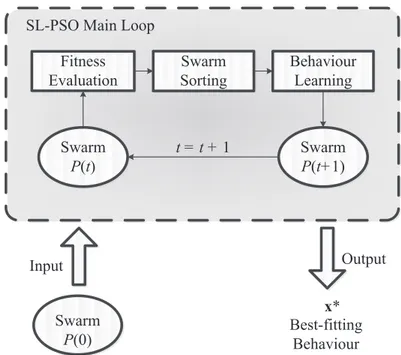
3.6 Main components of SL-PSO. . . 68
3.7 Swarm sorting and behavior learning in SL-PSO. At first, the swarm is sorted
according to the fitness values; then each particle (except for the best one) learns
from its demonstrators which have better fitness values. . . 69
3.8 The learning probability curves for different search dimensionality varying from
n≤100 to n= 2000. Here, a fixed swarm size m= 100 is used and the swarm is
already sorted according to behavior fitness values. . . 72
3.9 The convergence profiles. . . 80
3.10 The averaged computational time. . . 81
4.1 A schematic illustration of the basic idea of the proposed IM-MOEA. In the
figure, Xp and Yp are a set of the decision and objective vectors, respectively,
denoting the current parent population. f is the vector of objective functions.
To generate offspring, a set of new objective vectors Yo are sampled from the
probability distribution of the parents in the objective space (P(Yp)). Yo is then
mapped back to the decision space using the conditional probability distribution
P(Xp|Yp) approximated by the estimated inverse model, resulting in a set of
decision variables Xo. Xo and Yo together form the offspring population. . . 92
4.2 Decomposition of the m-input-and-n-output multivariate conditional
probabili-ty distribution (probabilistic inverse model) into m ×n univariate conditional
probability distribution. . . 93
4.3 An example to show the independent sampling on each objective of a bi-objective
MOP. . . 94
4.4 The framework of the proposed IM-MOEA. . . 96
4.5 An illustration of how to associate a candidate solution with a reference vector.
4.6 An illustration of the random grouping method. In each model groupj, a number
of L decision variables are randomly grouped with the j-th objective to build L
GP models. xrj,i denotes thei-th decision variable in the j-th model group. In
this way, a number of m model groups are generated with L GP models inside
each of them. . . 100
4.7 An example of a Gaussian process. The training target is to regress the inverse
mapping from objectivefj to decision variablexigiven the training dataTj,i. The
curve in the middle of the figure consists of the mean valuesµj,i of the predictions
on the test input points uniformly distributed within [fjmin−0.5ξ,fjmax+ 0.5ξ],
refer to (4.15), and the dashed area covers the length of ±σj,i around the mean
value curveµj,i, which reflects the uncertainty of the prediction on each test input
point. . . 103
4.8 The non-dominated solutions with the best IGD values obtained by each
algo-rithm among 20 runs in the objective space on F6. . . 108
4.9 The non-dominated solutions with the best IGD values obtained by each
algo-rithm among 20 runs in the objective space on F9. . . 110
4.10 Averaged convergence profiles of the IGD values for the five algorithms on F6. . 112
4.11 Averaged convergence profiles of the IGD values for the five algorithms on F9. . 112
4.12 The non-dominated solutions with the best HV values obtained by each algorithm among 20 runs in the objective space on 104-D WFG5. . . 116 4.13 The non-dominated solutions with the best HV values obtained by each algorithm
among 20 runs in the objective space on 104-D WFG6. . . 117 4.14 Runtimes of IM-MOEA and RM-MEDA averaged over 20 runs on F1 and F4 with
different numbers of decision variables. The maximum fitness evaluation number is 100,000 for each single run. . . 118
4.15 An example of a posteriori sampling on F4. The dashed circles mark the
inter-ested regions on the PF. . . 120
5.1 The Pareto optimal solutions (solid dots) specified by different reference vectors
(dashed arrows) on different PF (solid lines). . . 131
5.2 The parallel coordinates of non-dominated front obtained by each algorithm on
10-objective DTLZ1 in the run associated with the median HV value. . . 140
5.3 The parallel coordinates of non-dominated front obtained by each algorithm on
10-objective DTLZ4 in the run associated with the median HV value. . . 141
5.4 The non-dominated solutions obtained by each algorithm on 3-objective SDTLZ1
in the run associated with the median HV value. . . 142
5.5 A visualized illustration of the transformation procedure to generate reference
vectors inside a region specified by a central vector vc and a radius r. In this
example, 10 uniformly distributed reference vectors are generated inside a region
in a bi-objective space specified by vc= (
√ 2 2 , √ 2 2 ) and r= 0.5. . . 146
5.6 The preferred Pareto optimal solutions approximated by RVEA on DTLZ1 and
DTLZ2 with reference vectors articulated with different preferences. . . 147
5.7 The Pareto optimal solutions approximated by RVEA* and RVEA in the run
associated with the median HV values. . . 149
5.8 In an HEV, a conventional internal combustion engine (ICE), powered by fuel,
charges a battery that drives an electric motor (EM) to propel the vehicle. Before the start of the trip the battery can also be charged from the electricity grid. During braking, the EM can also act as a generator to re-charge the battery using kinetic energy. The amount of torque generated by the EM is defined by the driver (or in this case the driving cycle). The HEV controller uses current
speed V(t) and battery state-of-charge SOC(t) as inputs and determines the
operation of the ICE, only. . . 154
5.9 The box plots showing the statistical results of the HV values obtained by RVEA,
NSGA-III and MOEA/D-PBI via 20 independent optimizations of the
5.10 The parallel coordinate plot showing the solutions obtained by RVEA in the final population in a run associated with median HV value. The bold dash line is the baseline solution manually tuned by an engineer. . . 156
6.1 The separable correlations between the variable groups and the objective functions.170
6.2 The overlapped correlations between the variable groups and the objective
func-tions. . . 171
6.3 The full correlations between the variable groups and the objective functions. . 172
6.4 The non-dominated front obtained by each algorithm on 2-objective LSMOP1 (a,
b, c), LSMOP3 (d, e, f), LSMOP5 (g, h, i) and LSMOP7 (j, k, l) in the run
associated with the best IGD value. . . 180
6.5 The parallel coordinates of non-dominated front obtained by each algorithm on
10-objective LSMOP1 (a, b, c), LSMOP3 (d, e, f), LSMOP5 (g, h, i), LSMOP7 (i, j, l) in the run associated with the best HV value. . . 181 C.1 An illustration of how to generate the uniformly distributed reference vectors in a
three-objective space. In this case, 10 uniformly distributed reference points are first generated on a hyperplane, and then they are mapped to a hypersphere to generate the 10 reference vectors. . . 221
List of Tables
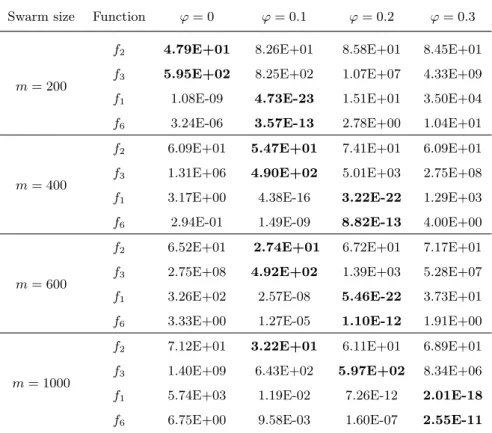
3.1 Statistical results of mean optimization errors obtained by CSO on 2 non-separable
functionsf2,f3and 2 separable functionsf1,f6of 500 dimensions with the swarm
sizem varying from 200 to 1000 and φfrom 0 to 0.3. . . 55
3.2 The best combinations of the swarm size m and the social factor φ in the
opti-mization of 500-D f1,f2,f3 and f6. . . 57
3.3 Parameter settings for the seven functions of 100-D, 500-D and 1000-D. . . 58
3.4 The statistical results (first line) and the t values (second line) of optimization
errors on 100-D test functions. . . 58
3.5 The statistical results (first line) and the t values (second line) of optimization
errors on 500-D test functions. . . 59
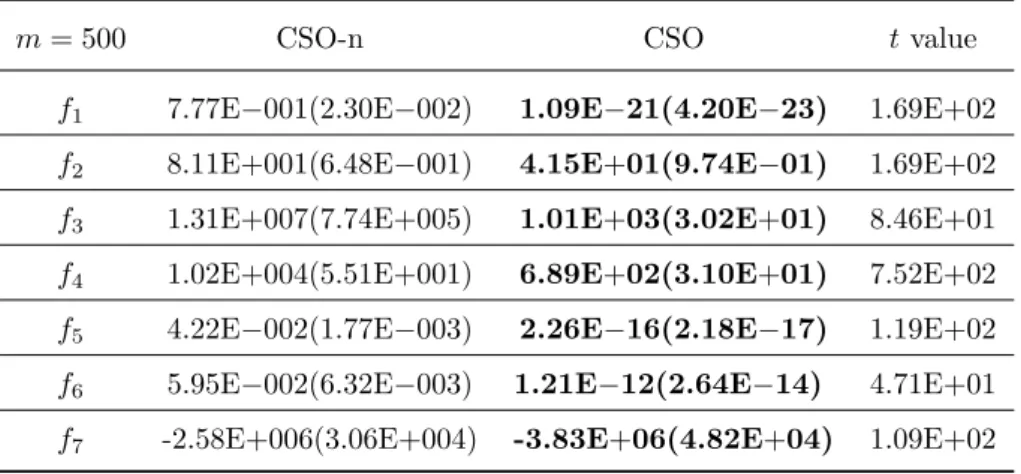
3.6 The statistical results (first line) and the t values (second line) of optimization
errors on 1000-D test functions. . . 59
3.7 Parameter settings of CSO on 2000-D and 5000-D functions. . . 61
3.8 Statistical results of the optimization errors obtained by CSO on 2000-D and
5000-D functions. . . 62
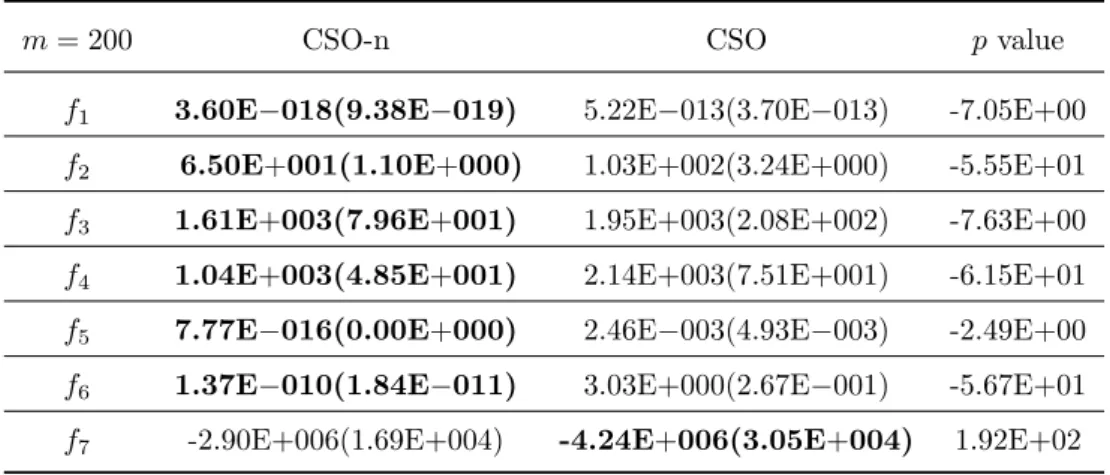
3.9 Statistical results of optimization errors obtained by CSO-n and CSO on 500-D
functions. . . 64
3.10 Statistical results of optimization errors obtained by CSO-n and CSO on 1000-D
functions. . . 64
3.11 Statistical results of optimization errors obtained by CSO-n and CSO on 500-D
functions. . . 66
3.12 Statistical results of optimization errors obtained by CSO-n and CSO on 1000-D
functions. . . 66
3.13 Parameter settings for the compared PSO variants . . . 78
3.14 Optimization errors on 12 basic test functions. . . 79
3.15 Optimization errors on CEC’13 functions. . . 82
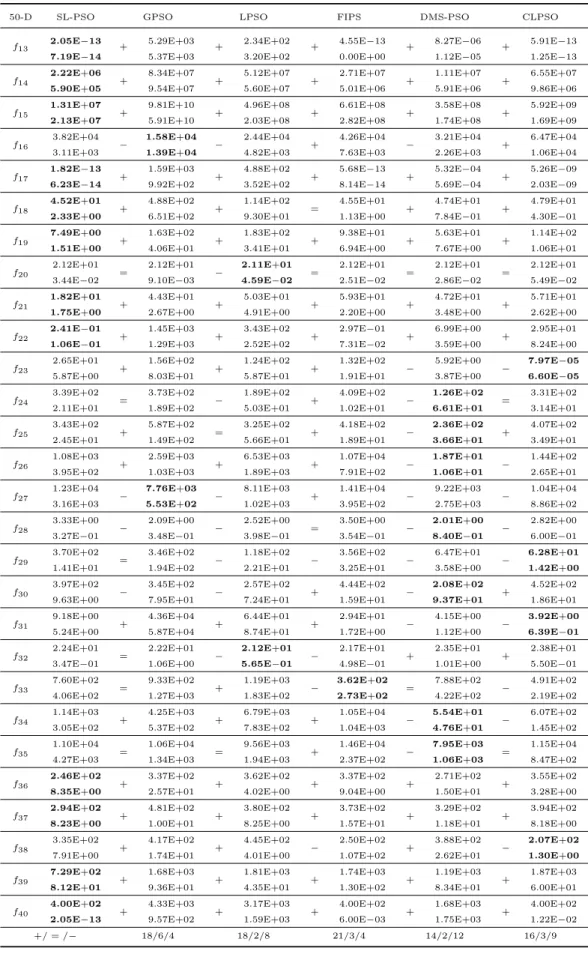
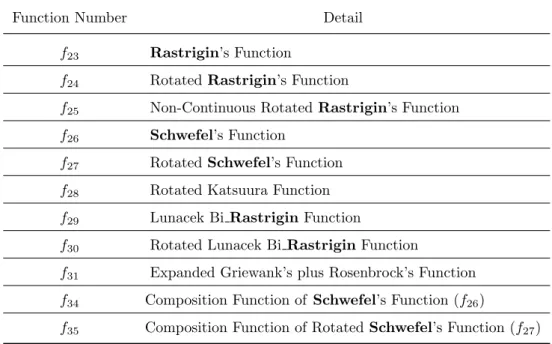
3.16 The details of functions on which DMS-PSO and CLPSO have yielded best
per-formance. . . 83
3.17 Optimization errors on CEC’08 functions (100-D). . . 84
3.18 Optimization errors on CEC’08 functions (500-D). . . 85
3.19 Optimization errors on CEC’08 functions (1000-D). . . 85
4.1 Parameter settings of the four algorithms in comparison. . . 107
4.2 Statistical results of IGD values obtained by IM-MOEA and each algorithm in
comparison on 30-D F1 to F10. . . 109
4.3 Statistical results of HV values obtained by IM-MOEA and each algorithm in
comparison on 34-D WFG functions. . . 114
4.4 Statistical results of HV values obtained by IM-MOEA and each algorithm in
comparison on 104-D WFG test problems. . . 115
5.1 Settings of population sizes in RVEA, MOEA/DD, NSGA-III and MOEA/D-PBI. 136
5.2 Parameter setting of div in GrEA on each test problem . . . 137
5.3 Parameter setting of T in KnEA on each test problem . . . 138
5.4 The statistical results (mean and standard deviation) of the HV values obtained
by RVEA, MOEA/DD, NSGA-III, MOEA/D-PBI, GrEA and KnEA on DTLZ1 to DTLZ4, SDTLZ1 and SDTLZ3. The best results are highlighted. . . 139
5.5 The statistical results (mean and standard deviation) of the HV values obtained
by RVEA, MOEA/DD, NSGA-III, MOEA/D-PBI, GrEA and KnEA on WFG1 to WFG6. The best results are highlighted. . . 145
5.6 The statistical results (mean and standard deviation) of the HV values obtained by RVEA and RVEA* on DTLZ5, DTLZ6 and DTLZ7. The best results are highlighted. . . 153
5.7 Objective values for three different controller configurations. The first column
lists the objective values of a baseline solution manually tuned by an engineer, where the objective values are normalized to 1. The second column lists the objective values of a solution obtained via single-objective optimization of the fuel consumption only. The last column lists the objective values of a solution obtained by RVEA via many-objective optimization. . . 157
6.1 The properties of the basic single-objective optimization problems. . . 169
6.2 The definitions of the proposed test problems. . . 172
6.3 Settings of population sizes in MOEA/D-DE, NSGA-III and MOEA/D-PBI. . . 176
6.4 The best, median and worst IGD values obtained by each compared algorithm on
bi-objective and three-objective instances. The best values are highlighted. . . . 178
6.5 The best, median and worst HV values obtained by the compared algorithms on
six-objective and ten-objective instances. The best values are highlighted. . . 179 A.1 Definitions of 12 Basic Single-objective Test Functions. . . 217 A.2 Definitions of 10 Modified ZDT and DTLZ test functions with linear and nonlinear
Introduction
Optimization is widely involved in real-world scenarios: engineers aim for the best performance of their designs; businessmen seek to maximize the profits of their deals; manufacturers expect the highest efficiency of their production processes; investors try to minimize risk of investment while maximizing rate of return, etc. Without exaggeration, optimization problems are everywhere.
In general, an optimization problem consists of three essential components [2]: objective(s),
decision variable(s) and constraint(s)1. An objective depicts the performance of the system under
study, while a decision variable is a certain characteristic in correlation with the objective(s), and the spaces where the objectives and decision variables are defined are known as objective space and decision space, respectively.
Optimization problems can be roughly categorized into two types according to the number of objectives: single-objective optimization problems (SOPs) and multi-objective optimization problem (MOPs). To be specific, if there is only one objective, the problem is known as a SOP, while if there is more than one conflicting objectives, the problem is known as an MOP. For a SOP, the optimal solution is often a single decision vector that minimizes (or maximizes) the objective; while for an MOP, since the multiple objectives are often in conflict with each other, there does not exist any solution that is able to optimize all objectives simultaneously, and instead, there is a set of solutions, known as the Pareto optimal solutions, that present the trade-offs between different objectives. Specially, MOPs with more than three objectives are
1This thesis only considers box constraints that specify the boundaries of the decision variables.
also known as MaOPs due their particular challenges [3].
To tackle various optimization problems, different optimization algorithms have been pro-posed. Roughly, optimization algorithms can be categorized into two classes: deterministic algorithms and stochastic algorithms. Most deterministic algorithms are gradient (or direction) based, e.g., the Newton’s method and the hill climbing method. Such deterministic algorithms perform efficiently on smooth uni-modal problems, while if there is no clear gradient information available, their performance will significantly deteriorate. Unfortunately, in most real-world op-timization problems, there is no explicit gradient information available due to some properties such as nonlinearity, non-differentiability or multi-modality.
While conventional deterministic methods are based on gradient information, stochastic algorithms are based on randomization mechanisms. Although there is no guarantee that the best solutions can always be found, stochastic algorithms are able to perform robustly on a
variety of complex real-world problems with littlea priori knowledge. Among various stochastic
algorithms, the nature inspired optimization algorithms, as an unique family, have witnessed
rapid development in recent years [4]. The motivation behind nature inspired optimization algorithms is quite straightforward: to take advantages of natural phenomena or mechanisms for solving optimization problems. Among various nature inspired optimization algorithms, the particle swarm optimization (PSO) algorithms and evolutionary algorithms (EAs) are two well known branches.
Despite the fact that nature inspired optimization algorithms such as PSO and EAs have been successfully applied to solving some small-sized optimization problems, most of them suffer
from a seriouscurse of dimensionality, i.e., as the scale of the optimization problems increases,
the performance of the algorithms substantially deteriorates [5, 6]. Unfortunately, many real-world optimization problems are of large scales, some of which may involve a large number of decision variables, e.g., the reconstruction of gene regularity networks [7] while others may involve many objectives, e.g., the optimization of hybrid electric vehicle controller models [8].
Without loss of generality, we denote optimization problems with a large number of
deci-sion variables and/or many objectives as large optimization problems hereafter. To be specific,
L-SOPs
L-MOPs
L-MaOPs
MaOPs
Large number of decision variables
Many objectives
Figure 1.1. This figure illustrates the classification of large optimization problems involved in
this thesis. Generally, the problems can have either a large number of decision variables or many objectives, which can be further categorized into four classes: single-objective problems with a large number of decision variables (L-SOPs), multi-objective optimization problems with a large number of decision variables (L-MOPs), many-objective optimization problems (MaOPs), and many-objective optimization problem with a large number of decision variables (L-MaOPs).
optimization problems with a large number of decision variables (L-SOPs), multi-objective op-timization problems with a large number of decision variables(L-MOPs), many-objective opti-mization problems (MaOPs), and many-objective optiopti-mization problems with a large number
of decision variables (L-MaOPs). It is worth noting that, since L-SOPs are also known as
large-scale optimization problems in the literature of single-objective optimization [9], for simplicity,
this thesis also refers to single-objective optimization with a large number of decision variables
aslarge-scale optimization for short.
The remainder of this chapter first presents the challenges of large optimization problems; afterwards, the main contributions of the work reported in this thesis are detailed; finally, the structure of this thesis is introduced.
1.1
Challenges
As is aforementioned, most nature inspired optimization algorithms tend to suffer the curse
of dimensionality. To be specific, since large optimization problems can involve either a large number of decision variables or many objectives, the challenges can be mainly attributed to the following two aspects.
Curse of dimensionality in the decision space: With a large number of decision vari-ables, firstly, since the volume of the decision space is exponentially increased, it is chal-lenging for nature inspired optimization algorithms to perform efficient search within ac-ceptable execution time. Secondly, the complexity of the search landscape could also be substantially increased. For example, some multi-modal optimization problems, e.g., the Rastrigin’s function, may have exponentially increased local optima as the number of de-cision variables grows [10]. In addition, the curse of dimensionality in the dede-cision space is
particularly serious when the decision variables are non-separable due to the interactions
between them [5].
Curse of dimensionality in the objective space: With many objectives, firstly, since the
candidate solutions are sparsely distributed in the high-dimensional objective space, ef-ficient population diversity management in nature inspired optimization algorithms
be-comes particularly important. Secondly, due to the phenomenon known as thedominance resistance [3], the majority of the candidate solutions in high-dimensional objective space become incomparable, thus leading to the failure of most dominance based algorithms which were originally designed for solving bi- or three-objective MOPs due to the loss of convergence pressure.
In general, the motivation of this thesis is to design and apply PSO and EA related nature inspired optimization techniques to addressing the above challenges in the optimization of large problems, where the main contributions are detailed in the next section.
1.2
Main Contributions
Two PSO variants for solving L-SOPs. Two PSO variants are proposed to address the curse of dimensionality in the decision space for solving L-SOPs. PSO is well known for its high search efficiency and fast convergence. However, traditional PSO suffers from
a major issue known as the premature convergence, i.e., the candidate solutions for an
optimization problem tend to converge too early, resulting in being local-optimal. In the optimization of large problems, the issue of premature convergence is particularly serious due to the curse of dimensionality in the decision space. Therefore, the two PSO variants are proposed to tackle premature convergence by enhancing the swarm diversity.
An MOEA for solving L-MOPs. An inverse model based MOEA is proposed to address the curse of dimensionality in the decision space for solving L-MOPs. Given an MOP, an MOEA evolves a population of candidate solutions to approximate the Pareto optimal solutions. However, it is time consuming to perform exhaustive search in high-dimensional decision space to obtain such an approximate solution set if the number of decision
vari-ables is large. Therefore, the MOEA is proposed to take advantage of the the regularity
property [11, 12] in multi-objective optimization to sample new candidate solutions via inverse models instead of performing exhaustive search.
An MOEA for solving MaOPs. A reference vector guided MOEA is proposed to address the curse of dimensionality in the objective space for solving MaOPs. In high-dimensional
objective space, diversity management and convergence pressure preservation are partic-ularly important due to the sparse distribution of the candidate solutions. Therefore, the MOEA is proposed to manage the diversity and preserve the convergence pressure with a set of reference vectors. The algorithm is not only able to approximate the Pareto optimal solutions if the reference vectors are uniformly distributed, but also capable of handling user references which can be articulated into the reference vectors.
A benchmark test suite of L-MOPs and L-MaOPs. A benchmark test suite is proposed to assess the performance of MOEAs on L-MOPs and L-MaOPs. Since it is believed that the development of MOEAs has undergone a co-evolution with the development of benchmark test problems, such a new test suite is proposed to call for the development of new MEOAs dedicated to solving L-MOPs and L-MaOPs.
1.3
Structure of Thesis
• Chapter 2 presents some background knowledge. First of all, the definitions of large
optimization problems are formulated. Afterwards, the literature reviews on PSO algo-rithms and MOEAs are given. Finally, some representative benchmark test problems for large-scale optimization, multi-objective optimization and many-objective optimization are introduced.
• Chapter 3 details the two PSO variants proposed for solving L-SOPs. The first PSO
vari-ant is inspired from competitive mechanisms, known as the competitive swarm optimizer (CSO); while the second PSO variant is inspired from social learning mechanisms, known as the social learning particle swarm optimization algorithm (SL-PSO). Some theoretical analyses of search dynamics and algorithmic convergence are presented, and the perfor-mance of the two PSO variants is empirically verified on a variety of benchmark L-SOPs.
• Chapter 4 details the inverse model based MOEA (IM-MOEA) for solving L-MOPs. To
begin with, the decomposition of multivariate inverse models is introduced to simplify the inverse modeling. Afterwards, the Gaussian process based inverse modeling is presented
in detail. Finally, the proposed IM-MOEA is verified on a variety of benchmark problems,
and the inverse modelling technique is applied to a posteriori sampling.
• Chapter 5 details the reference guided MOEA (RVEA) for solving MaOPs. In this
chap-ter, firstly, the details of the proposed RVEA are given; secondly, some empirical results obtained in comparison with other state-of-the-art MOEAs are given; thirdly, preference articulation using the proposed RVEA is exemplified; fourthly, an adaptive reference vec-tor regeneration strategy for handling irregular Pareto fronts is introduced; and finally, the proposed RVEA is applied to the optimization of a seven-objective hybrid electric vehicle controller model designed at the Honda Research Institute Europe.
• Chapter 6 details the benchmark test problems for assessing the performance of MEOAs
on L-MOPs and L-MaOPs. This chapter first presents the basic design principles and problem characteristics, and on the basis of these, nine test problems are designed to constitute a test suite. Finally, empirical results obtained by six MOEAs on the proposed test suite are presented and discussed.
• Chapter 7 summarizes this thesis and points out some new directions for future work.
1.4
List of Publications
Ran Cheng, Yaochu Jin, Markus Olhofer and Bernhard Sendhoff. Test Problems for
Large-Scale Multi- and Many-Objective Optimization. IEEE Transactions on Cybernetics, 2016.
(un-der review)
Ran Cheng, Yaochu Jin, Markus Olhofer and Bernhard Sendhoff. A Reference Vector Guided
Evolutionary Algorithm for Many-objective Optimization. IEEE Transactions on Evolutionary
Computation, 2016. (in press)
Ran Cheng, Yaochu Jin, Kaname Narukawa and Bernhard Sendhoff. A Multiobjective
Evo-lutionary Algorithm using Gaussian Process based Inverse Modeling. IEEE Transactions on
Ran Cheng and Yaochu Jin. A Competitive Swarm Optimizer for Large Scale
Optimiza-tion. IEEE Transactions on Cybernetics, 45(2): 191-204, 2015.
Ran Cheng and Yaochu Jin. A Social Learning Particle Swarm Optimization Algorithm for
Scalable Optimization. Information Sciences, 291: 43-60, 2015.
Ran Cheng, Markus Olhofer, and Yaochu Jin. Reference Vector Based a posteriori Preference
Articulation for Evolutionary Multiobjective Optimization. IEEE Congress on Evolutionary
Computation (CEC’2015), Sendai, Japan, 2015.
Ran Cheng, Yaochu Jin and Kaname Narukawa. Adaptive Reference Vector Generation for
In-verse Model based Evolutionary Multiobjective Optimization with Degenerate and Disconnected
Pareto Fronts. Evolutionary Multi-Criterion Optimization (EMO’2015), Guimar˜aes, Portugal,
2015.
Ran Cheng and Yaochu Jin. Demonstrator Selection in a Social Learning Particle Swarm
Optimizer. IEEE Congress on Evolutionary Computation (CEC’2014), Beijing, China, 2014.
Ran Cheng and Yaochu Jin, Simulating Swarm Behaviuors for Optimisation by Learning
from Neighbours. UK Workshop on Computational Intelligence (UKCI’2013), Guildford, UK,
2013.
Ran Cheng, Chaoli Sun, Yaochu Jin, A Multi-swarm Evolutionary Framework based on a
Feed-back Mechanism. IEEE Congress on Evolutionary Computation (CEC’2013), Cancun, Mexico,
Background
2.1
Problem Definition
Without loss of generality, optimization problems can involve one or multiple objectives to be
optimized, which can be formulated in a uniform manner as1:
min
x f(x) = (f1(x), f2(x), ..., fm(x)),
s.t. x∈X, f ∈Y,
(2.1)
whereX ⊂Rn is the decision space andx= (x1, x2, ..., xn)∈X is the decision vector; Y ⊂Rm
is the objective space and f ∈Y is the objective vector. The decision vector x is composed of
ndecision variables while the objective vectorf is composed ofm objective functions that map
x fromX toY.
If the number of objective functions is only one, i.e., m= 1, the problems are often known
assingle-objective optimization problem (SOPs); while if there is more than one objective
func-tion in conflict with each other, i.e., m > 1, the problems are often known as multi-objective
optimization problems (MOPs).
For SOPs, the optimization target is quite straightforward – searching for the global
opti-mum solution x∗ which minimizes the objective function f(x∗). While for MOPs, due to the
1
Thesis only considers minimization problems, while maximization problems can be equivalently transformed into minimization problems by negating the objective functions.
possible conflicts between different objectives, no single solution is able to minimize all objec-tives simultaneously. As a consequence, there exist a set of optimal solutions that trade off
between different objectives. To be specific, a solution x1 is said to dominate another solution
x2 (denoted asx1 ≻x2) iff ∀i∈1,2, ..., m:fi(x1)≤fi(x2) ∃j ∈1,2, ..., m:fj(x1)< fj(x2). (2.2)
If a solution x∗ cannot be dominated by any other feasible solutions, x∗ is said to be Pareto
optimal and the union of all x∗ is called Pareto set (PS), while the union of f(x∗) is termed Pareto front (PF). For most continuous MOPs, the PS (or PF) often consists of an infinite number of Pareto optimal solutions. Therefore, in practice, only a representative subset of the
PS (or PF) can be approximated with some non-dominated solutions, which are the solutions
that are not dominated by any other solution in the final solution set achieved by an algorithm. As is introduced in Chapter 1, large optimization problems involve either a large number
of decision variables (i.e., n is large) or many objective functions (i.e., m is large). However,
there is no well-established definition regarding what the threshold values of n or m should
be to recognize a large optimization problem. Empirically, the number of decision variables is
considered to be large if n≥ 100 is satisfied [13]; while the number of objectives is known as
many ifm >3 is satisfied, and such an MOP is also known as amany-objective problem(MaOP) nowadays [3]. Therefore, corresponding to the categorization in Figure 1.1, the four classes of large optimization problems involved in this thesis can be specified as follows.
L-SOPs: m= 1, n≥100;
L-MOPs: m= 2,3,n≥100;
MaOPs: m >3,n <100;
2.2
Particle Swarm Optimization
Particle Swarm Optimization (PSO) is one powerful and widely used swarm intelligence paradig-m introduced by Kennedy and Eberhart in 1995 [14]. PSO was originally intended for siparadig-mulating social behaviors such as bird flocking, and later simplified to be applicable for solving optimiza-tion problems. PSO iteratively maintains a swarm of particles, each of which has a posioptimiza-tion as well as a velocity. In PSO, it is assumed that each particle is able to memorize the best position found in history, i.e., the best position that has ever been found by the whole swarm, termed
global best, and the best position that has ever been found by each particle, known as personal
best. To find the global optimum of the optimization problem, the particles learn from the
per-sonal best and global best positions. To be specific, the learning mechanisms in the canonical PSO can be summarized as follows:
vi(t+ 1) =ωvi(t) +c1R1(t)◦(pbesti(t)−xi(t))
+c2R2(t)◦(gbest(t)−xi(t)),
(2.3)
xi(t+ 1) =xi(t) +vi(t+ 1), (2.4)
where t is the generation number, vi(t) and xi(t) represent the velocity and position of the
i-th particle, respectively; ω is termed inertia weight [15], c1 and c2 are the acceleration
coeffi-cients [16],R1(t) andR2(t) are two vectors randomly generated within [0,1]n, withnbeing the
dimension of the search space;pbesti(t) andgbest(t) denote the personal best of thei-th particle
and the global best of the swarm, respectively. The operator◦ is the Hadamard product which
element-wisely multiplies two vectors of the same size.
Although PSO has witnessed rapid developments over the past decades and has been success-fully applied to a number of applications, e.g., water distribution network design [17], resource allocation [18], task assignment [19], maximum power point tracker for photovoltaic system [20], optimal control [21], DNA sequence compression [22] and reconstruction of gene regulatory net-work [23], image processing [24], text clustering [25] and many others [26–28], its performance is still unsatisfying when the optimization problem has a large number of local optima or when the optimization problem is high-dimensional and non-separable [29]. The poor performance
of PSO can largely be attributed to its weak robustness to various problem structures [30]. In order to enhance the search performance of the canonical PSO, numerous PSO variants have been proposed, which can be roughly divided into the following five categories.
The first category adopts an adaptive control strategy of the parameters in PSO. As shown
in (2.3), ω, c1 and c2 are the three control parameters in PSO. ω, called the inertia weight,
was introduced as a constant in [31] and an adaptive parameter in [32]. Another important
modification of ω is the introduction of fuzzy inference [33]. Adaptation strategies for tuning
the acceleration coefficients, c1 and c2, have also been proposed [34, 35]. Apart from adapting
ω, c1 and c2, additional parameters to help regulate these three parameters have also been
introduced [36, 37].
Hybrid PSO variants, which can be categorized into the second category of PSO variants, combine PSO with other search strategies, such as genetic algorithms [38–40], differential evo-lution [39, 41], and ant colony optimization [42]. Other specific search operators have also been incorporated into PSO, including mutation operators [43–45], local search operators [46,47], and some nature-inspired operators as well, such as the niching PSO [48], culture-based PSO [49] and the aging theory inspired PSO (ALC-PSO) [50].
The third category of PSO variants introduces new topological structures in neighborhood control to enhance swarm diversity, thereby alleviating premature convergence [51, 52]. Several topological structures have been proposed [53], e.g., the ring topology and the von Neumann topology. In [54], a fully informed PSO (FIPS) was developed, where the update of each particle
is based on the historical best positions of several neighbors instead of gbest or pbest.
An-other representative example is the comprehensive learning PSO (CLPSO) introduced in [55], where particles update each decision variable by learning from different historical personal best positions. More recently, a distance-based locally informed particle swarm optimizer has been proposed to tackle multi-modal problems [56].
Multi-swarm PSO belongs to the fourth category. The main idea behind multi-swarm PSO variants is to enhance swarm diversity by exchanging information between different swarms. For example, the dynamic multi-swarm PSO (DMS-PSO) [57] was proposed with a dynamically changing neighborhood structure. In [58], a cooperative multi-swarm PSO (CPSO) is proposed
to solve large-scale optimization problems by dividing the decision variables into several sub-components. Similarly, the recently proposed cooperative coevolving PSO (CCPSO2) for large-scale optimization adopts the multi-swarm paradigm as well [59]. Additional multi-swarm PSO variants have been reported in [60–63].
The fifth category of PSO variants is designed to perform effective search using limited computational cost and memory usage. Unlike the first four categories, these PSO variants aim to simplify PSO to enhance its robustness by taking into account the constraints of the device on which the PSO is running, rather than introducing additional mechanisms to enhance the search performance for specific problems. Most PSO variants in this category are based on a probabilistic model. The earliest model-based PSO was proposed by Kennedy [64], called the bare bones PSO (BBPSO), which uses Gaussian distributions instead of the velocity equation to update the particle positions. In [65], a simplified intelligent single particle optimization (ISPO) was proposed to explore the search space using a single particle instead of a swarm, and some further discussions on the ISPO can also be found in a recently published literature [66]. In [67], a fitness estimation strategy has been introduced based on the relationship between the positions of the particles to reduce the required number of fitness evaluations.
PSO variants are often believed to be different from other nature inspired optimization algorithms in that PSO does not adopt an explicit selection mechanism. A slight difference lies in the fact that most PSO variants apply selection more implicitly, e.g. by updating the personal best solutions and the global best solution only. In addition, while other nature inspired optimization algorithms such as evolutionary algorithms (EAs) perform selection by comparing a list of solutions for multiple times, PSO compares solutions pairwise.
2.3
Multi-objective Evolutionary Algorithms (MOEAs)
An EA is a population based algorithm inspired from natural evolution mechanisms, which can date back to the genetic algorithm (GA) proposed by John Holland in 1975 [68]. Given an optimization problem, an EA iteratively maintains a population of candidate solutions. In each iteration, the population undergos some evolutionary operators such as crossover, mutation and selection. As a consequence, the population evolves towards better solutions to the optimization
problem.
EAs are well suited for solving MOPs as they can obtain set of solutions in one single run. Since Schaffer put forward the vector evaluated genetic algorithm [69] in 1984, a large number of multi-objective evolutionary algorithms (MOEAs) have been proposed. In the following two subsections, we briefly review MOEAs proposed for solving MOPs and MaOPs, respectively.
2.3.1 MOEAs for Solving MOPs
In general, MOEAs proposed for solving MOPs can be categorized into three groups,
includ-ing dominance based methods, decomposition2based methods and performance indicator based
approaches.
Dominance based MOEAs have been prevalent over the past two decades. Early dominance based non-elitism MOEAs include the non-dominated sorting genetic algorithm [70], the niched-Pareto genetic algorithm [71], and the multi-objective genetic algorithm [72]. It was found out later on that use of elitism strategies can substantially improve the convergence of MOEAs. As a result, several popular elitism MOEAs have been developed, including the elitist non-dominated sorting genetic algorithm (NSGA-II) [73], the strength Pareto evolutionary algorithm [74, 75] and the Pareto envelope-based selection algorithm [76, 77], among many others. Although dom-inance based MOEAs are very powerful for solving bi-objective or three-objective MOPs, their convergence performance dramatically degrades when the number of objectives is larger than three, mainly due to the loss selection pressure.
Decomposition based approaches divide a complex MOP into a number of sub-problems and solve them in a collaborative manner [78, 79]. There are mainly two types of decomposition based approaches. In the first type of decomposition based approaches, an MOP is decomposed into a group of single-objective problems (SOPs), including the weighted aggregation based approaches in early days [80, 81], and the more recent multi-objective evolutionary algorithm based on decomposition (MOEA/D), where more explicit collaboration strategies between the solutions of the sub-problems were introduced. Several variants of MOEA/D have been proposed
2
Decomposition in multi- or many-objective optimization specifically refers to the decomposition in the objec-tive space.
for enhancing the selection strategy for each sub-problem to strike a better balance between convergence and diversity [82–84]. In the second type of decomposition based approaches, an MOP is decomposed into a group of sub-MOPs. For instance, MOEA/D-M2M [79, 85] divides the whole PF into a group of segments, and each segment can be regarded as a sub-problem.
Since performance indicators are used to measure the solution qualities [86], it is quite intuitive to also use them as selection criteria to guide the search of the algorithms to obtain high-quality solutions. Among various performance indicators, the hypervolume indicator (or the S metric) is most widely applied in various MOEAs, due to the fact that it is the only metric known to be strictly monotonic to the Pareto dominance [87]. The first well known hypervolume
indicator based algorithm was proposed by Emmerich et al. in 2005, known as the s-metric
selection evolutionary multi-objective algorithm (SMS-EMOA) [88]. In SMS-EMOA, a (µ+ 1)
evolutionary strategy is adopted to generate one offspring candidate solution from a number ofµ
parents. To select a number ofµnew candidate solutions for the next generation, the hyervolume
contribution of each candidate solution on the last non-dominated front is calculated, and the one with the smallest hypervolume contribution is removed. Apart from the hyervolume indicator, some other performance indicators have been also adopted to guide the search of MOEAs. Zitzler
and K¨unzli have proposed a binary indicator (Iϵ+ ) based evolutionary algorithm (IBEA) [86],
where Iϵ+ is considered to be compliant with the Pareto dominance.
2.3.2 MOEAs for Solving MaOPs
MOEAs have been shown to perform well on a wide range of MOPs with two or three objectives; however, MOEAs have experienced substantial difficulties when they are adopted to tackle MOPs with more than three objectives, i.e., the MaOPs [89–92]. As a result, MaOPs have attracted increasing attention in evolutionary optimization.
One major reason behind the failure of most conventional MOEAs in solving MaOPs can be attributed to the loss of selection pressure, i.e., the pressure for the population to converge towards the PF, when dominance is adopted as a criterion for selecting individuals with a limited population size [93]. For example, the elitist non-dominated sorting genetic algorithm (NSGA-II) [73] and the strength Pareto evolutionary algorithm 2 (SPEA2) [75], both of which
use dominance-based selection, will fail to work properly when applied to the optimization of MaOPs, since most candidate solutions generated in a population of a limited size are non-dominated, making the dominance based selection criterion hardly possible to distinguish the candidate solutions, even in a very early stage of the search.
Another important reason for the degraded performance of MOEAs on MaOPs is the difficul-ty in maintaining a good population diversidifficul-ty in a high-dimensional objective space. Generally speaking, since the PFs of most continuous MOPs are piecewise continuous [11, 12], it is practi-cally unlikely to approximate all Pareto optimal solutions. Instead, most MOEAs aim to find a set of evenly distributed representative solutions to approximate the PF. When the number of objectives is two or three, where the PF is typically a one-dimensional curve or two-dimensional surface, maintaining a good diversity of the solutions is relatively straightforward. As the di-mension of the objective space increases, it becomes increasingly challenging to maintain a good population diversity, as the candidate solutions distribute very sparsely in the high-dimensional objective space. This consequently causes immense difficulties to the diversity management strategies widely used in MOEAs, e.g., the crowding distance base diversity method in NSGA-II [94–96].
To enhance the performance of most traditional MOEAs in solving MaOPs, a number of approaches have been proposed [6, 97, 98], which can be roughly divided into three classes.
The first class is the modified dominance based approaches. The basic idea is to enhance the convergence pressure by modifying the Pareto dominance to enlarge the dominating areas, such that some of the original non-dominated solutions become dominated by others. An early work
of this class is theϵ-dominance proposed by Laummanset al.[99], where the original dominance
relation can be relaxed to a certain extent by tuning the parameter ϵ ∈ (0,1). The bigger ϵ
is set, the more relaxed the dominance relation is, and vice versa. And based on ϵ-dominance,
Deb et al. have proposed a steady-state algorithm called ϵ-MOEA [100]. In addition, some
extended variants of the ϵ-dominance have also been proposed. In [101], Aguirre and Tanaka
have proposed anϵ-ranking multi-objective optimizer (ϵ R-EMO), where an adaptiveϵ-ranking
procedure is performed on top of a space partitioning strategy. Another representative modified
theα-domination allows a solution to be dominated by the other if it is slightly superior in one
objective but substantially inferior in others. Theα-domination has been successfully integrated
into some MOEAs for solving MOPs, such as the guided multi-objective evolutionary algorithm
(G-MOEA) [102]. As a combination of ϵ-dominance and α-dominance, Batista et al. have
proposed another modified dominance, namely the coneϵ-dominance [103]. It has been reported
that the cone ϵ-dominance is promising for solving many-objective optimization problems with
up to 50 objectives [92]. Recently, Yanget al. have proposed a grid based evolutionary algorithm
(GrEA) [104], where a grid-dominance is designed on top of some adaptively constructed grid coordinates in the objective space. The grid-dominance has an attractive feature that it allows one solution to dominate another if it is slightly inferior in some objectives but substantially superior in some others, which is useful in distinguishing the non-dominated solutions in many-objective optimization.
The second class is the diversity management enhancement based approaches. Since in
many-objective optimization, the distribution of the candidate solutions becomes very sparse in the high-dimensional objective space, diversity management becomes particularly meaningful to alleviate the negative impact of the excessive diversity on the population convergence. An early work of this class is from Adra and Fleming, who have proposed a diversity management strategy to quantitatively evaluate the degree of the population diversity according to the dis-tribution of the candidate solutions [95], and if the population is found excessively diverse, the diversity promotion mechanism in the selection procedure will be deactivated. A representative
recent work of this class is the shift-based density estimation (SDE) proposed by Liet al.[105],
where the basic idea is to penalize poorly converged solutions by assigning them a high density value, such that only candidate solutions with both good convergence and distribution can
sur-vive to the next generation. In [106], Wang et al. have proposed to coevolve preferences with
a population of candidate solutions for diversity management in many-objective optimization. Another representative algorithm belonging to this class is the NSGA-III [107], where the diver-sity is managed by a set of predefined reference points. In addition, the recently proposed knee point driven evolutionary algorithm (KnEA) also belongs to this category, where a knee point based diversity secondary selection strategy is adopted on top of traditional non-dominated
sorting [108].
While the first two classes aim to improve the performance of MOEAs on MaOPs, the third class, known as the objective reduction approaches, try to transform MaOPs to MOPs by re-ducing the number of redundant or irrelevant objectives, such that the problems can be directly solved with traditional MOEAs [109, 110]. In general, there are two types of objective reduction approaches: offline approaches and online approaches. Offline objective reduction approaches can be seen as pre-processing techniques, which work independently of specific MOEAs, but require a set of approximate Pareto optimal solutions as priori knowledge. In [111], Brockhoff and Zitzler have presented both deterministic and stochastic algorithms for objective reduction
based on the objective conflicts measured by ϵ-dominance. Sexaneet al. have proposed to use
principal component analysis (PCA) [112] and maximum variance unfolding (MVU) [113] for
linear and nonlinear objective reduction, respectively [110]. Singh et al. have proposed to use
corner solutions for objective reduction, which are obtained using a Pareto corner search evolu-tionary algorithm (PCSEA) [109]. Online objective reduction approaches are usually embedded in an existing MOEA and perform as part of the evolutionary procedure, where the idea is to update the reduced objectives iteratively using the solutions obtained by an MOEA during the
optimization procedure. In [111], Brockhoff et al. have proposed to embed the PCA approach
into NSGA-II to build an online objective reduction approach, known as the PCA-NSGA-II.
In [114], Jaimes et al. have proposed an online objective reduction algorithm to find a k-sized
objective subset based on correlations between the objectives. Recently, Guo et al. have
pro-posed to adopt the partitioning around medoids (PAM) [115] clustering algorithm to detect the correlations between objectives and divide them into different clusters [116].
Apart from the three classes of approaches, the decomposition based approaches and the performance indicator based approaches, which are originally proposed for solving MOPs, are also applicable to many-objective optimization. However, although neither of these two types of approaches are dominance based, they still suffer from some other issues.
For decomposition based approaches, it is always required to predefine a set of weight (or reference) vectors before running the algorithms. In high-dimensional objective space, it becomes particularly challenging to specify a proper vector set to well approximate the PF. To remedy
this issue, Li et al. have proposed an MOEA based on both dominance and decomposition, known as the MOEA/DD [117]. In addition, since most scalarization approaches in existing decomposition based approaches were originally proposed for solving MOPs, they may not be directly applicable on MaOPs.
For performance indicator based approaches, the major issue is the significant curse of
di-mensionality regarding the computational efficiency [118]. For example, the runtime of one
generation in SMS-EMOA is as high as O(NM/2+1), where N is the population size and M
is the number of objectives. To tackle this issue, Bader et al. have proposed a hypervolume
estimation algorithm (HypE) [87], where the Monte Carlo sampling method is adopted to obtain the approximate hypervolume values for many-objective cases. Similar to SMS-MOEA, the se-lection in HypE is still based on the hypervolume contribution of the candidate solutions, while a minor difference is that the contribution is calculated based on a randomly chosen subset of the non-dominated solution set, where the size of the subset equals the number of solutions to be removed. In addition, some faster hypervolume calculation methods have been proposed recently, e.g., the hypervolume by slicing objectives (HSO) [119] and the WFG hypervolume algorithm [120], etc.
2.4
Benchmark Test Problems
To assess the performance of various nature inspired optimization algorithms, a number of bench-mark test problems have been proposed. This section reviews some widely adopted benchbench-mark
test problems for large-scale optimization3 as well as multi- and many-objective optimization.
2.4.1 Benchmark Test Problems for Large-Scale Optimization
The first benchmark suite for large-scale optimization was proposed by Tang et al. in the
CEC’2008 special session and competition on large-scale global optimization [121], known as the CEC’2008 suite, which consists of seven test problems. This is the first attempt to explicitly
3
As is aforementioned in Chapter 1, in this thesis,large-scale optimizationspecifically refers tosingle-objective optimization with a large number of decision variablesfor short, and the corresponding optimization problems are L-SOPs.
include the characteristics of separability and non-separability into test problems for large-scale optimization. However, a major limit of this test suite is that the problems are roughly designed to be either separable or non-separable, which are only two extreme cases of most real-world problems.
In order to further improve the CEC’2008 test suite, Tang et al. later developed the
CEC’2010 test suite [122]. The major contribution of CEC’2010 test suite is the modularity based design principle, which divides the decision variables into different subcomponents, and the separability of each subcomponent is independent. In this way, with different combina-tions of separable and non-separable subcomponents, the test problems can be fully separable, partially separable or fully non-separable. The proposal of the CEC’2010 test suite has suc-cessfully motivated the development of techniques such as random grouping [123], cooperative co-evolution [59], and differential grouping [124], which are used to detect the interacted variable
subcomponents and solve them in a divide-and-conquer manner.
As a further improved version of the CEC’2010 test suite, the CEC’2013 test suite has been proposed to include some new characteristics [125]. Firstly, the subcomponents of the decision variables in the CEC’2010 test suite are completely independent, while in the CEC’2013 test suite, some subcomponents are overlapped; secondly, the size of all the subcomponents is fixed in the CEC’2010 test suite, while in the CEC’2013 test suite, the subcomponents are of different sizes, such that they have non-uniform contributions to the objective function.
2.4.2 Benchmark Test Problems for Multi- and Many-objective Optimization
To evaluate the performance of various MOEAs, several test suites have been designed for empirical studies. Among many others, the ZDT test suite [126], DTLZ test suite [127, 128] and the WFG test suite [129, 130] are the most widely used ones.
The ZDT test suite is one of the most popular test suites in the multi-objective optimization
literature [126]. Based on the generic design principles proposed by Deb in [131], the test
problems in the ZDT suite are constructed by introducing three basic functions, including a
distribution function f1, a distance function g and a shape function h, where function f1 is
meant for testing the ability of an MOEA to converge to the PF and function h for defining the shape of the PF. There are six test problems in the ZDT test suite, five of which (ZDT1 to ZDT4, ZDT6) are real-coded and one (ZDT5) is binary-coded. Different ZDT test problems have different characteristics. To be specific, ZDT3 has a disconnected PF, which is partly convex and partly concave; ZDT4 contains a large number of local PFs; ZDT6 has a non-uniform fitness landscape, which causes a biased distribution of the Pareto optimal solutions along the PF. However, despite its immense popularity, the ZDT test suite has a significant limitation, i.e., all test problems are bi-objective.
To address the limitation of the ZDT test suite (as well as many other bi-objective test
problems), Deb et al. proposed another test suite, i.e., the DTLZ test suite [127, 128], in which
the test problems are scalable to have any number of objectives. There are nine test problems in the DTLZ test suite, each of which is constructed with the same design principle, where
the first M −1 decision variables define the PF, while the rest decision variables specify the
convergence property. The DTLZ test suite has many unique characteristics. For instance, the fitness landscape of DTLZ1 and DTLZ3 contain a large number of local PFs; the distribution of the Pareto optimal solutions of DTLZ4 is highly non-uniform; the PFs of DTLZ5 and DTLZ6 are a degenerate curve; DTLZ7 has a disconnected PF; and DTLZ8 and DTLZ9 are constrained problems. One significant contribution of the DTLZ test suite is the proposal of a generic design principle for constructing tes