A dissertation submitted in accordance with the requirements
for the degree of Doctor of Philosophy.
Robust Online Subspace Learning
Stephan Liwicki
Imperial College of Science, Technology and Medicine
Department of Computing
c
2014 The copyright of this thesis rests with the author and is made available under a Creative Commons Attribution Non-Commercial No Derivatives licence. Researchers are free to copy, distribute or transmit the thesis on the condition that they attribute it, that they do not use it for commercial purposes and that they do not alter, transform or build upon it. For any reuse or redistribution, researchers must make clear to others the licence terms of this work.
Declaration
This dissertation is the result of my own work and includes nothing which is the outcome of work done in collaboration except where specifically indicated in the text. The research detailed in this work was conducted under the guidance of Professor Maja Pantic and Doctor Stefanos Zafeiriou.
The research presented resulted in several publications with joint authorship:
Liwicki, S., S. Zafeiriou, G. Tzimiropoulos, and M. Pantic. Fast and Robust Appearance-based Tracking. InIEEE Int. Conf. Automatic Face and Gesture Recognition, FG’11, pages 507 – 513, 2011.
Liwicki, S., G. Tzimiropoulos, S. Zafeiriou, and M. Pantic. Euler Principal Component Analysis. Int. J. Comput. Vis., 101(3):498–518, Feb 2013.
Liwicki, S., S. Zafeiriou, G. Tzimiropoulos, and M. Pantic. Efficient Online Subspace Learning with an Indefinite Kernel for Visual Tracking and Recognition. IEEE Trans. Neural Netw. Learn. Syst., 23(10):1624–1636, Oct 2012b.
Liwicki, S., S. Zafeiriou, and M. Pantic. Incremental Slow Feature Analysis with Indefinite Kernel for Online Temporal Video Segmentation. In Asian Conf. Computer Vision, ACCV’12, pages 162–176, 2012a.
Liwicki, S., M. Pham, S. Zafeiriou, M. Pantic, and B. Stenger. Full-Angle Quaternions for Robustly Matching Vectors of 3D Rotations. InIEEE Conf. Computer Vision and Pattern Recognition, CVPR’14, pages 105 – 112, 2014.
Liwicki, S., S. Zafeiriou, and M. Pantic. Online Kernel Slow Feature Analysis for Temporal Video Segmentation and Tracking. IEEE Trans. Image Process. subject to minor corrections.
This thesis contains only my contributions with guidance of my supervisors.
Abstract
In this thesis, I aim to advance the theories of online non-linear subspace learning through the development of strategies which are both efficient and robust. The use of sub-space learning methods is very popular in computer vision and they have been employed to numerous tasks. With the increasing need for real-time applications, the formulation of online (i.e. incremental and real-time) learning methods is a vibrant research field and has received much attention from the research community. A major advantage of incre-mental systems is that they update the hypothesis during execution, thus allowing for the incorporation of the real data seen in the testing phase. Tracking acts as an attractive and popular evaluation tool for incremental systems, and thus, the connection between online learning and adaptive tracking is seen commonly in the literature. The proposed system in this thesis facilitates learning from noisy input data, e.g. caused by occlusions, casted shadows and pose variations, that are challenging problems in general tracking frameworks.
First, a fast and robust alternative to standardℓ2-normprincipal component analysis
(PCA) is introduced, which I coin Euler PCA (e-PCA). The formulation of e-PCA is based on robust, non-linearkernel PCA (KPCA)with a cosine-based kernel function that is expressed via an explicit feature space. When applied to tracking, face reconstruction and background modeling, promising results are achieved.
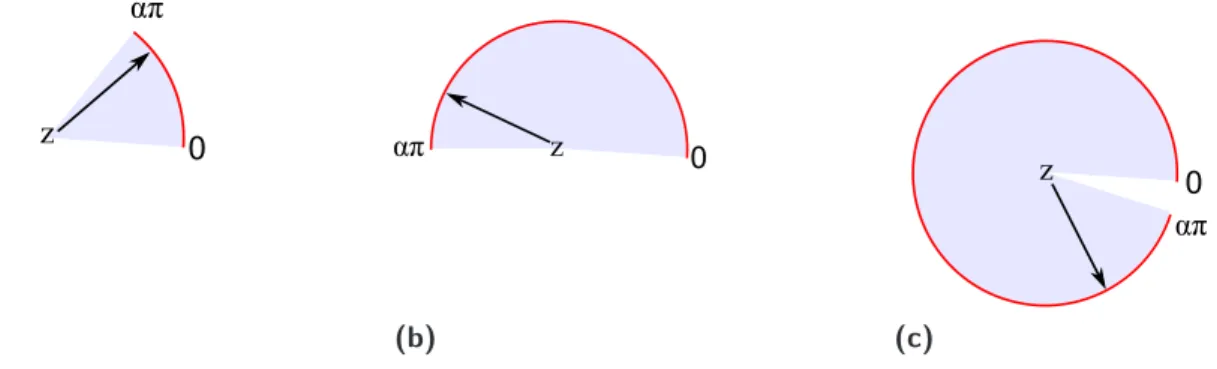
In the second part, the problem of matching vectors of 3D rotations is explicitly targeted. A novel distance which is robust for 3Drotations is introduced, and formulated as a kernel function. The kernel leads to a new representation of 3D rotations, the full-angle quaternion (FAQ)representation. Finally, I propose3Dobject recognition from point clouds, and object tracking with color values using FAQs.
A domain-specific kernel function designed for visual data is then presented. KPCA with Krein space kernels is introduced, as this kernel is indefinite, and an exact incre-mental learning framework for the new kernel is developed. In a tracker framework, the presented online learning outperforms the competitors in nine popular and challenging video sequences.
In the final part, the generalized eigenvalue problem is studied. Specifically, incre-mental slow feature analysis (SFA) with indefinite kernels is proposed, and applied to temporal video segmentation and tracking with change detection. As online SFA allows for drift detection, further improvements are achieved in the evaluation of the tracking task.
Acknowledgements
I thank my supervisor, Prof. Maja Pantic, for her trust, support and encouragement, and for enabling me to pursue my research interests. I am equally grateful to my second supervisor, Dr Stefanos Zafeiriou, for the many discussions, guidance and constructive criticism which helped shape my development as an independent scientist.
I thank the Engineering and Physical Science Research Council for providing me with financial security through their Doctoral Training Account studentship, without which this work would not have been possible. Similarly, I thank Intel for their generous gift through their Doctoral Student Honor Award, which provided the financial support in the later stages of my Ph. D. studies.
I thank the employees of Toshiba Research Europe Limited, and especially Dr Minh-Tri Pham and Dr Bj¨orn Stenger, for the fruitful and stimulating experience during my research internship. Our collaboration allowed me to approach my research from a different angle, which also inspired some of the findings reported in this thesis.
I thank the many members, past, visiting and present, of my research group, the intelligent behaviour understanding group, for their companionship. Also, I thank the administrative staff of Imperial College London for their help in the organizational aspect of the Ph. D. degree.
Finally, I thank my family – my parents, Michael Liwicki and Petra Liwicki, who supported me throughout my life and encouraged me to follow my dreams – and my loving wife, Dr Gemma Liwicki, who has always been there for me, in good times and in bad.
Contents
Abstract 5 Acknowledgements 7 List of Tables 13 List of Figures 15 List of Algorithms 17 1 Introduction 19 1.1 Challenges . . . 21 1.1.1 Robustness . . . 22 1.1.2 Efficiency . . . 24 1.2 Contributions . . . 24 1.3 Outline. . . 25 1.3.1 Chapter 2. Background. . . 251.3.2 Chapter 3. Euler Principal Component Analysis . . . 25
1.3.3 Chapter 4. Full-Angle Quaternion . . . 26
1.3.4 Chapter 5. Tracking with a Non-positive Kernel . . . 26
1.3.5 Chapter 6. Incremental Slow Feature Analysis . . . 26
1.3.6 Chapter 7. Conclusions and Outlook . . . 27
2 Background 29 2.1 Subspace Learning . . . 29
2.1.1 Principal Component Analysis . . . 30
2.1.2 Slow Feature Analysis . . . 36
2.1.3 Generalized Eigenvalue Problem . . . 39
2.2 Online Learning . . . 40
2.2.1 Incremental Eigenvalue Analysis . . . 41
2.2.2 Online Learning with Kernels . . . 42
2.3 Incremental Learning for Object Tracking . . . 44
2.3.1 Image Representation . . . 45
2.3.2 Appearance Model . . . 45
2.3.3 Motion Model . . . 46
3 Euler Principal Component Analysis 49
3.1 Cosine-based Dissimilarity . . . 50
3.2 Euler PCA (e-PCA) . . . 52
3.2.1 Defining Euler PCA . . . 52
3.2.2 Preimage Computation . . . 55
3.2.3 Incremental Learning . . . 58
3.3 Applications and Experiments . . . 60
3.3.1 Image Reconstruction under Noise . . . 60
3.3.2 Object Tracking . . . 68 3.3.3 Background Modeling . . . 82 3.4 Conclusions . . . 85 4 Full-Angle Quaternion 87 4.1 Representing 3D Rotations . . . 88 4.1.1 Euler Angles. . . 88 4.1.2 Rotation Matrix. . . 89 4.1.3 Rotation Vector . . . 90 4.1.4 Half-Angle Quaternion . . . 90
4.2 Existing Rotation Distances . . . 91
4.2.1 Robust Rotation Distance in 2D . . . 91
4.2.2 Rotation Distances in 3D. . . 93
4.3 Robust 3D Rotation Distance . . . 94
4.3.1 Proposed Distance . . . 94
4.3.2 Full-Angle Quaternion . . . 97
4.4 Applications of Full-Angle Quaternions . . . 98
4.4.1 Matching Ball Features for 3D Recognition . . . 99
4.4.2 Object Tracking in Color Video . . . 103
4.5 Experiments . . . 107
4.5.1 3D Object Recognition and Registration . . . 107
4.5.2 Object Tracking in Color Video . . . 110
4.6 Conclusions . . . 114
5 Tracking with a Non-positive Kernel 115 5.1 Kernel Functions in Krein Space . . . 117
5.2 Proposed Indefinite Kernel for Computer Vision . . . 119
5.2.1 Robust Gradient-based Kernel Function . . . 119
5.2.2 Special Kernel Properties. . . 121
5.3 Direct Incremental KPCA in Krein Space. . . 122
5.3.1 General KPCA with Arbitrary Krein Space Kernels . . . 123
5.3.2 Direct KPCA in Krein Spaces . . . 125
5.3.3 Direct Incremental KPCA . . . 126
5.4 Visual Object Tracking . . . 129
5.5 Results and Discussion . . . 130
5.5.1 Object Tracking . . . 130
5.5.2 Face Recognition . . . 148
5.6 Conclusions . . . 150
6 Incremental Slow Feature Analysis 151
6.1 Slow Feature Analysis with Indefinite Kernels . . . 154
6.1.1 SFA’s Optimization Problem . . . 155
6.1.2 Solving Kernel SFA in Krein Space . . . 156
6.2 A Framework for Online Kernel SFA . . . 160
6.2.1 General Online Kernel SFA . . . 160
6.2.2 Direct Online SFA with Special Kernels. . . 168
6.3 Applications of Online SFA . . . 170
6.3.1 Temporal Video Segmentation . . . 170
6.3.2 Multi Appearance Model Tracking . . . 171
6.4 Evaluation . . . 175
6.4.1 Proof of Concept . . . 176
6.4.2 Change Detection with Real Data . . . 177
6.4.3 Tracking with Change Detection . . . 183
6.5 Conclusions . . . 185
7 Conclusions and Outlook 187 7.1 Summary . . . 187
7.2 Conclusions . . . 188
7.2.1 Robustness with Efficiency . . . 188
7.2.2 Domain-Specific Properties. . . 189
7.2.3 Adapting and Learning Incrementally . . . 189
7.3 Future Work. . . 190
7.3.1 Machine Lifelong Learning . . . 190
7.3.2 Analysis of Further Applications . . . 190
7.4 Final Remarks. . . 191
Bibliography 193
Abbreviations 207
Symbols 209
A Properties of the Indefinite Kernel 211
List of Tables
2.1 A summary of generalized eigenvalue problems.. . . 40
3.1 Comparison of normalized dissimilarity measures.. . . 52
3.2 Mean RMS error for general tracking, and tracking rate.. . . 75
3.3 Maximum similarity on background modeling. . . 83
3.4 Execution time required to compute (or update) the appearance model. . . . 85
4.1 Weighting strategies for different methods.. . . 107
4.2 Object level registration rates of all methods.. . . 108
4.3 Summary of the results for object recognition. . . 109
4.4 The different tracking setups. . . 111
4.5 Mean RMS error for all videos and trackers. . . 111
5.1 Mean RMS error for tracking with video-specific parameters. . . 135
5.2 Mean RMS error for tracking with fixed parameters. . . 145
5.3 Average recognition rate with Yale B Database. . . 148
5.4 Average recognition rate with CMU PIE Database. . . 149
6.1 Mean RMS errors for DIKT and CD-DIKT with change detection. I write “lost” to indicate the sequences n which the tracker does not follow the target throughout, after visual inspection. . . 184
List of Figures
1.1 Overview of the proposed tracking system.. . . 19
1.2 Subspaces using linear, quadratic and arbitrary feature representations. . . . 20
1.3 Offline learning versus online learning.. . . 21
1.4 Examples of common challenges in visual tracking. . . 23
2.1 Simple illustration showing the concepts of subspace learning. . . 30
2.2 Illustration of the non-linear mapping, using φ.. . . 34
2.3 Reconstruction for kernel PCA using preimage approximation. . . 35
2.4 Illustration of hierarchical SFA. . . 37
2.5 SFA for temporal video segmentation.. . . 38
2.6 Tracking framework with incremental subspace learning.. . . 47
3.1 Cosine-based dissimilarity measure . . . 51
3.2 Motivating example for the use of the cosine-based dissimilarity measure. . . 52
3.3 Visualization of the explicit mapping with different α.. . . 53
3.4 Illustration of the preimage computation. . . 58
3.5 Cropped example images from the AR Database . . . 61
3.6 Reconstructed images after learning with random corruptions. . . 63
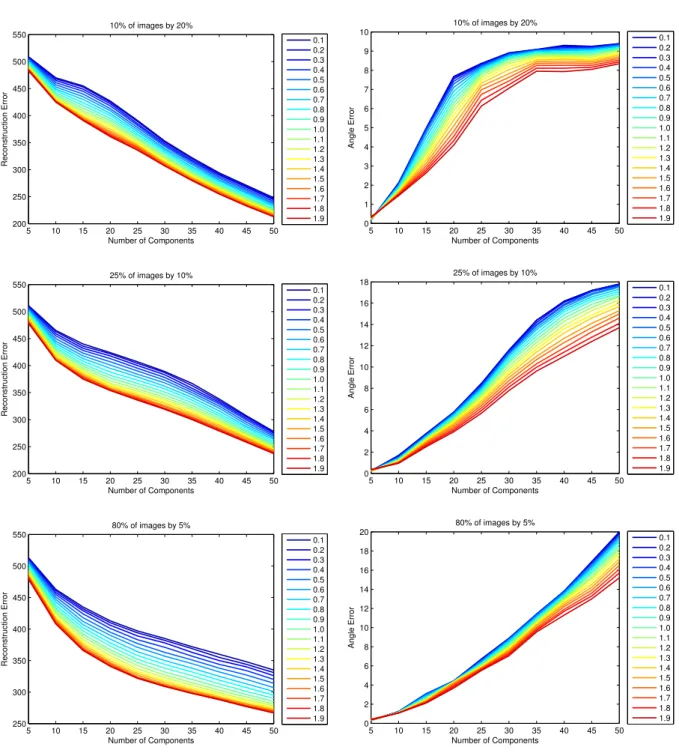
3.7 Reconstruction error and angular error for different values of α.. . . 64
3.8 Approximation error for e-PCA and e-PCA-GA. . . 65
3.9 Reconstruction error with different rates of occlusions.. . . 66
3.10 Angular error with different rates of occlusions.. . . 67
3.11 Examples of the corruptions in the training data. . . 68
3.12 Reconstruction error with different rates of hand occluded images.. . . 69
3.13 Angular error with different rates of hand occluded images.. . . 70
3.14 Reconstructed images after learning with skin-like corruptions. . . 71
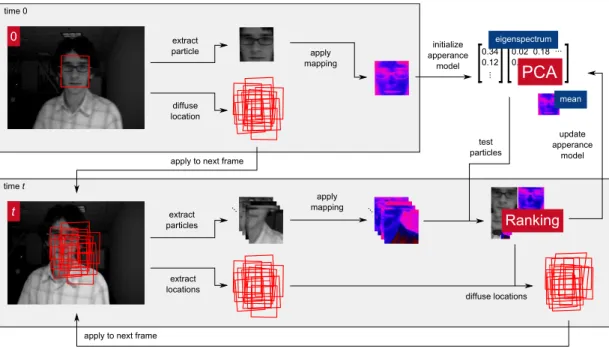
3.15 The Euler tracker framework with incremental e-PCA.. . . 72
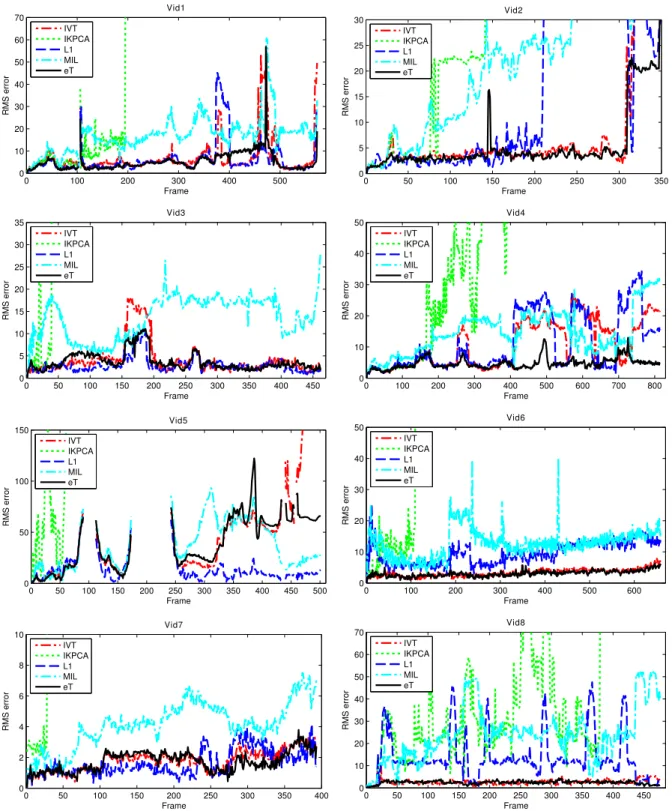
3.16 Mean RMS error of all tested trackers at each frame. . . 76
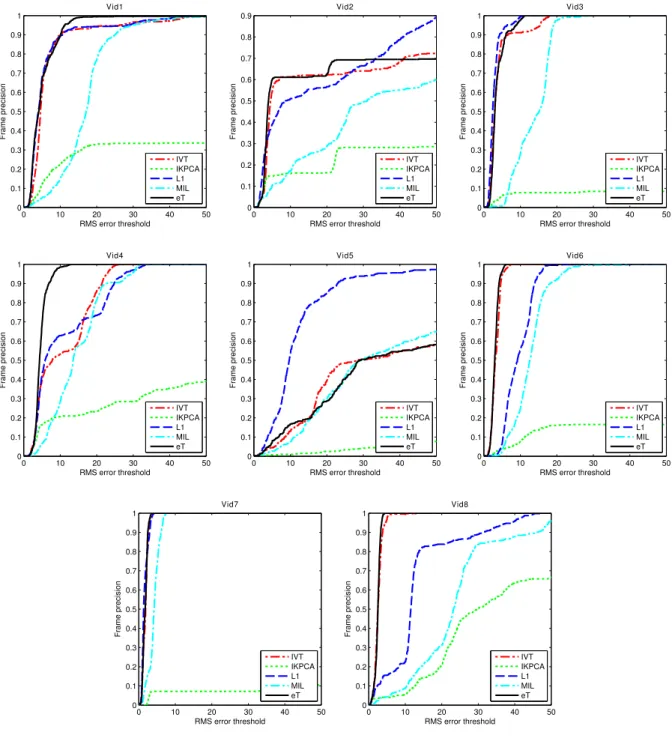
3.17 Tracking precision for each video sequence.. . . 77
3.18 Qualitative tracking results forVid1. . . 78
3.19 Qualitative tracking results forVid2. . . 78
3.20 Qualitative tracking results forVid3. . . 79
3.21 Qualitative tracking results forVid4. . . 79
3.22 Qualitative tracking results forVid5. . . 80
3.23 Qualitative tracking results forVid6. . . 80
3.25 Qualitative tracking results forVid8. . . 81
3.26 Similarity with changing number of components. . . 82
3.27 Examples of background modeling for each video and each method. . . 84
3.28 Per frame running time ofe-PCA and its batch version e-PCA-batch. . . 85
4.1 Visual comparison between rotation representations.. . . 89
4.2 Cosine-based distance function for different angle differences. . . 92
4.3 The proposed cosine-based distance for 3D rotations. . . 94
4.4 Histograms of the normalized squared distances. . . 96
4.5 Object recognition based on oriented ball features. . . 100
4.6 Tracking results of the proposed FAQ tracker. . . 110
4.7 RMS error of each frame for Vid2, Vid3, Vid5 and Vid7.. . . 112
4.8 Precision graphs of the object tracking results. . . 113
5.1 Visualization of the proposed kernel when corruption is present.. . . 120
5.2 The direct incremental KPCA tracker (DIKT) framework. . . 130
5.3 Mean RMS error for video-specific trackers at each frame. . . 133
5.4 Tracking precision of video-specific trackers for each video sequence.. . . 134
5.5 Example frames of the tracking with video-specific parameters forVid1. . . . 136
5.6 Example frames of the tracking with video-specific parameters forVid2. . . . 137
5.7 Example frames of the tracking with video-specific parameters forVid3. . . . 138
5.8 Example frames of the tracking with video-specific parameters forVid4. . . . 139
5.9 Example frames of the tracking with video-specific parameters forVid5. . . . 140
5.10 Example frames of the tracking with video-specific parameters forVid6. . . . 141
5.11 Example frames of the tracking with video-specific parameters forVid7. . . . 142
5.12 Example frames of the tracking with video-specific parameters forVid8. . . . 143
5.13 Example frames of the tracking with video-specific parameters forVid9. . . . 144
5.14 Mean RMS error for all trackers with fixed parameters at each frame. . . 146
5.15 Tracking precision of each video sequence with fixed tracking parameters. . . 147
5.16 The data, as projected by the subspaces of PCA, Gaussian and DKPCA.. . . 148
6.1 Illustration of incremental SFA at initialization (time 0) and time step t.. . . 161
6.2 Illustration of a preimage optimization setup. . . 166
6.3 Tracking with multiple appearance models, using change detection. . . 172
6.4 The distance between a data point and the mean of a subspace.. . . 175
6.5 A comparison of different SFA implementations. . . 176
6.6 Angular error between batch and online learned subspaces.. . . 178
6.7 Angular error with and without reduced set. . . 178
6.8 False positive over false negative rate of different kernel setups. . . 179
6.9 Change detection for D-Krein with direct mapping. . . 180
6.10 The three slowest features after 900 frames using the linear kernel. . . 181
6.11 Segmentation for yoga and ballet scenes.. . . 182
6.12 False positive over false negative rate comparison.. . . 183
6.13 Tracking results and models of appearances. . . 184
List of Algorithms
3.1 Estimating the Principal Subspace . . . 54
3.2 Embedding of new Samples . . . 54
3.3 Incremental Subspace Estimation . . . 59
3.4 Euler Tracker at Time t . . . 73
4.1 Offline Phase: Creating Hash Tables . . . 101
4.2 Online Phase: Vote Evaluation . . . 102
4.3 Quaternion Subspace Estimation . . . 106
4.4 Incremental Quaternion Subspace Estimation . . . 106
5.1 Direct KPCA in Krein Space . . . 127
5.2 Update Procedure of Direct Incremental KPCA . . . 129
5.3 DIKT at Time t. . . 131
6.1 Batch SFA in Krein Space . . . 159
Chapter
1
Introduction
T
he aim ofmy thesis, is to advance the theory of online non-linear subspace learning, and kernel methods in particular, through the development of fast and robust incre-mental methods, which are applicable to adaptive real-time object tracking in realistic environments. Figure 1.1 shows the general layout of the proposed system.feature extraction adaptive appearance model motion model video input image features candidate solutions tracking result
Figure 1.1: Overview of the proposed tracking system. The main aim of my research is the creation of an efficient and robust adaptive appearance model through non-linear online subspace learning.
(a)Linear (b) Quadratic (c) Arbitrary
Figure 1.2: Subspaces using linear, quadratic and arbitrary feature representations. Two-dimensional Data points and their corresponding one-Two-dimensional PCA subspaces are visual-ized.
Subspace learning has a long-standing history in machine learning and pattern recog-nition, and is employed in many common applications (Bishop 2006; Jolliffe 2002). Its primary aim is to map high-dimensional data into a (possibly) lower-dimensional space, in which the important properties of the original samples are retained or even exaggerated. For example, principal component analysis (PCA) extracts the directions with largest variance from a population of data points (figure 1.2(a)). PCA is often considered the most prominent subspace algorithm, as its solution can be computed efficiently via eigen-value decomposition, and its applications are numerous (Jolliffe 2002). Other subspace methods which are solvable by an eigenvalue problem include slow feature analysis (SFA) and linear discriminant analysis (LDA).
While the subspace of linear component analysis can be thought of as a transformation from original space onto a hyper-plane, non-linear subspace learning can be more complex (figure1.2(b) and figure1.2(c)). The advantage is that complex and robust feature spaces can be employed by the expressive non-linear setup. Disadvantageously, in PCAlearning for example, finding the solution commonly becomes more difficult and inefficient.
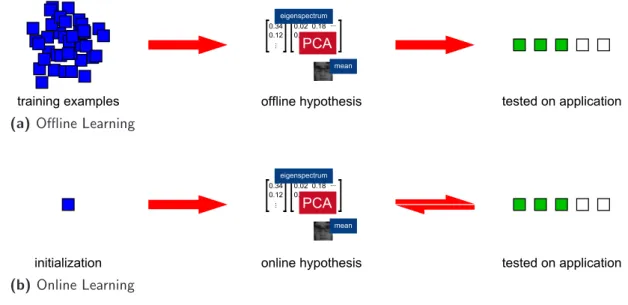
Another aspect of subspace learning is the model acquisition. Traditional methods extract informative properties from a set of training data offline. On the other hand, online (i.e. incremental and real-time) systems improve the hypothesis of the learning algorithm by considering the available test data as it arrives (figure 1.3). With an ever increasing importance of realizing adaptive applications with minimal a priori knowledge, online learning methods have become a popular research topic in recent years (Babenko et al. 2011; Ross et al. 2008).
The remainder of this chapter is organized as follows. In section 1.1, I will introduce the challenges of robust online subspace learning in the context of visual object tracking. 20
training examples 0.34 0.12 0.02 0.18 0.42 0.32 ... ... ... ... ... ... eigenspectrum mean PCA
offline hypothesis tested on application
(a) Offline Learning
0.34 0.12 0.02 0.18 0.42 0.32 ... ... ... ... ... ... eigenspectrum mean PCA
online hypothesis tested on application
(b) Online Learning
Figure 1.3: Offline learning versus online learning. Online systems require minimal training as the hypothesis is reinforced by incoming test data.
Section 1.2 lists the contributions of my work, and section1.3 outlines the contents of the chapters in this thesis.
1.1
Challenges
Closely related to online learning is the challenge of visual object tracking. In fact, track-ing is a very popular evaluation technique for many incremental systems (Babenko et al. 2011; Chin and Suter 2007; Ross et al. 2008). Tracking applications are ubiquitous and reach from automation and validation of common tasks (Collins et al. 2001; Haritaoglu et al. 2000; Hsieh et al. 2006; Kamijo et al. 2000) to human-computer interaction and behavior analysis (Cohn et al. 1999; Gunes and Pantic 2010; Wren et al. 1997). In the following, the demands of a real-time tracking system for realistic environments are com-pared to the task of incremental learning. Specifically, the tracking system should
1. run in real-time,
2. support occlusions and corruptions from noisy data, 3. handle varying illumination and casted shadows, 4. allow for pose variation, and
5. adapt to appearance changes.
In the subsequent sections, I will detail these challenges in the context of tracking with an online learning system, designed for robustness and efficiency.
1.1.1
Robustness
Plentiful tracking systems have been introduced to the computer vision community. How-ever, tracking for real environments remains unsolved. In their survey,Yilmaz et al.(2006) reveal that complex motion, changes in illumination, occlusions and non-rigid appearance variations are some examples which cause most trackers to fail. Figure1.4shows instances in which these challenges occur.
Occlusions
An occlusion refers to the tracking instances in which other objects are positioned between the recording device and the target. This means that parts of the object’s appearance will be hidden from view, causing corruptions or noisy data samples in the learning system.
Illumination Changes
Illumination changes are caused by alterations in the lighting conditions. Global as well as local changes may occur. Depending on the choice of feature space, illumination changes can cause drastic variation in the image as often a large proportion of pixels are affected.
Casted Shadows
Casted shadows occur especially in sunny outdoor scenes and in circumstances where the target traverses several different lighting conditions. From a computer vision perspective, casted shadows are akin to a combination of occlusions and illumination changes, as the shadowed pixels change their intensity values, while shadow boundaries may cause noise and corruption in feature space.
Complex Motion
While the trajectory of vehicles on roads is typically very expectable, object trackers for arbitrary target classes must be able to cope with less predictable motion. The target may move out of the frame or cause motion blur through fast movements. Furthermore, their path may suddenly be altered by other objects in the scene.
Pose Variation
Dependent on the motion model, pose variation can be challenging when out-of-plane rotations or other unsupported movements occur. Typically pixels of the background may corrupt the features used in the tracking framework, and thus noisy data is received.
105 DIKT 433 DIKT 464 DIKT (a)Occlusions 014 DIKT 043 DIKT 176 DIKT (b) Illumination Changes 157 DIKT 052 DIKT 186 DIKT (c) Casted Shadows 152 DIKT 492 DIKT 517 DIKT (d) Complex Motion 613 DIKT 342 DIKT 106 DIKT
(e) Pose Variation
267 DIKT 564 DIKT 183 DIKT
(f) Intrinsic Appearance Changes
Intrinsic Appearance Changes
Intrinsic appearance changes predominantly arise in non-rigid or compound object classes. In particular, objects may be added or removed from the original appearance, or the surface of the object is stretched, e.g. during emotion changes in face tracking.
1.1.2
Efficiency
In real-time applications, efficiency is vital. Thus it is essential to develop systems whose complexity remain unchanged over time. Clearly, if test data is to be utilized for learning, standard offline batch approaches, learned at each time-step, will not be feasible. Instead, an incremental acquisition of the model is required whose footprint does not grow during execution.
Ross et al. (2008) introduce a linear online subspace algorithm based on PCA. Their approach allows for fast computation and constant running speed. Outliers and noisy data are however not supported in their system. Other approaches, e.g. the non-linear kernel method byChin and Suter(2007), apply more robust learning frameworks. These methods support outliers but at a cost, as they inadvertently introduce expensive optimization problems or approximations, which reduce performance. Solutions that combine efficiency and robustness are still seldom found in the literature of online subspace learning.
1.2
Contributions
In this thesis, I present the following contributions to the computer vision community: 1. I introduce several robust kernel functions for measuring visual similarities. Instead
of using off-the-shelf kernels which are often not robust, I develop dissimilarity measures based on robust concepts and features in computer vision.
2. As one of the proposed kernel function is indefinite (i.e. non-positive definite), I extend the existing literature on non-linear kernel PCA (KPCA) from positive definite kernels in Hilbert space to general kernels in Krein space. Furthermore, the generalized eigenvalue problem, e.g. inSFA, is extended to handle indefinite Krein space kernels.
3. Online learning is instantiated forKPCA and kernel SFA (KSFA) via efficient and accurate incremental algorithms, which employ a special family of kernels. These frameworks are applicable to all kernels proposed in this thesis.
4. The introduced online subspace learning framework forKPCA, in combination with my robust kernels, is applied to visual tracking, for which state-of-the-art perfor-mance is achieved.
5. Additionally, I propose an online learning framework for the generalized eigenvalue problem in KSFA with arbitrary kernels in Krein space. Here, an optimization problem is employed to ensure constant memory and time complexity.
6. Finally, incremental KSFA is used to implement SFA’s first online temporal video segmentation, and tracking with change detection.
1.3
Outline
This thesis consists of 7 chapters in total. In this section I outline and summarize the content of the remaining parts.
1.3.1
Chapter
2
.
Background
Chapter 2 presents the related research in literature. The focus lies on subspace learning and incremental eigenvalue analysis. Moreover, kernel methods and online kernel learning is discussed. Finally, visual object tracking is introduced in the context of adaptive appearance models via online learning.
1.3.2
Chapter
3
.
Euler Principal Component Analysis
A robust and efficient kernel subspace method, called Euler PCA (e-PCA), is proposed in chapter 3. In particular, e-PCA employs a robust dissimilarity measure based on the Euler representation of complex numbers. In my work, I show that e-PCA suppresses outliers whilst retaining standard PCA’s desirable properties. An incremental version of
e-PCA is introduced for adaptive object tracking. Finally, two further computer vision applications are employed for evaluation, and the proposed method performs comparably to other state-of-the-art approaches – but faster.
Related Publications
Liwicki, S., S. Zafeiriou, G. Tzimiropoulos, and M. Pantic. Fast and Robust Appearance-based Tracking. InIEEE Int. Conf. Automatic Face and Gesture Recognition, FG’11, pages 507 – 513, 2011.
Liwicki, S., G. Tzimiropoulos, S. Zafeiriou, and M. Pantic. Euler Principal Component Analysis. Int. J. Comput. Vis., 101(3):498–518, Feb 2013.
1.3.3
Chapter
4
.
Full-Angle Quaternion
3Ddata is commonly present in computer vision. In chapter4, I introduce a new distance for robustly matching vectors of 3D rotations. A special representation of 3D rotations, which I coin full-angle quaternion (FAQ), then allows me to express this distance as Euclidean. The proposed distance is applied to 3D shape recognition and 2D object tracking from color video. For the former, I use the concurrent and efficient hashing for scale and translation proposed in collaboration with Toshiba Research Europe Limited (Toshiba) (Liwicki et al. 2014) to form vectors of rotations. For the latter, incremental PCAis performed with the proposedFAQrepresentation to highlight its benefit for online subspace learning.
Related Publication
Liwicki, S., M. Pham, S. Zafeiriou, M. Pantic, and B. Stenger. Full-Angle Quaternions for Robustly Matching Vectors of 3D Rotations. InIEEE Conf. Computer Vision and Pattern Recognition, CVPR’14, pages 105 – 112, 2014.
1.3.4
Chapter
5
.
Tracking with a Non-positive Kernel
In chapter 5, I propose an exact framework for online learning with a family of indefinite (not positive definite) kernels. As the case of indefinite kernels is studied, KPCA is first extended from areproducing kernel Hilbert space (RKHS)to Krein space. An incremental KPCA in Krein space is then presented. The approach of this chapter is motivated by the challenge of visual tracking. In particular, I develop a gradient-based kernel function with robust properties. The incremental framework is tested on several popular and difficult tracking scenarios. An evaluation on face recognition is additionally presented.
Related Publication
Liwicki, S., S. Zafeiriou, G. Tzimiropoulos, and M. Pantic. Efficient Online Subspace Learning with an Indefinite Kernel for Visual Tracking and Recognition. IEEE Trans. Neural Netw. Learn. Syst., 23(10):1624–1636, Oct 2012b.
1.3.5
Chapter
6
.
Incremental Slow Feature Analysis
Slow feature analysis (SFA) is a subspace learning technique which has been linked to how visual brain cells work. In recent years, SFA has been adopted for computer vision tasks. Chapter 6 proposes an exact KSFA framework for positive definite and indefinite
kernels in Krein space. Online KSFA which employs a reduced set expansion is then formulated. Finally, by exploiting a special kind of kernel family, I propose an efficient online KSFA algorithm for which no reduced set is required. The proposed incremental system is applied to develop SFA-based change detection for stream data, and a temporal video segmentation algorithm is presented. I test my setup on synthetic and real data streams. When combined with an online learning tracking system from previous chapters, the proposed change detection approach improves upon the original performance, which does not incorporate change detection.
Related Publications
Liwicki, S., S. Zafeiriou, and M. Pantic. Incremental Slow Feature Analysis with Indefinite Kernel for Online Temporal Video Segmentation. In Asian Conf. Computer Vision, ACCV’12, pages 162–176, 2012a.
Liwicki, S., S. Zafeiriou, and M. Pantic. Online Kernel Slow Feature Analysis for Temporal Video Segmentation and Tracking. IEEE Trans. Image Process. subject to minor corrections.
1.3.6
Chapter
7
.
Conclusions and Outlook
Chapter 7 concludes this thesis. I summarize the most important findings of previous chapters, and possible future research paths are introduced.
Chapter
2
Background
L
ike many machinelearning techniques, subspace learning aims to describe complex sets of data points through simpler representations. Consider a set of samples{xn}Nn=1where each samplexnresides in a high-dimensional space. In subspace learning, the aim is
to map the samples onto a low-dimensional sample set {yn}Nn=1, such that the underlying
meaning of the original space is retained. For example, in some subspace setups it is advantageous to retain the distinguishing parts to find the class labels of the points. Thus, a subspace is a mapping that reduces the original dimensionality, by extracting and combining only informative dimensions.
I will review the most relevant techniques for subspace learning in section2.1. Partic-ular focus lies on systems which may be expressed as a generalized eigenvalue problem. Incremental eigenvalue analysis, and general online learning is discussed in section 2.2. Finally in section 2.3, arguably the most prominent application of online systems, visual object tracking, is presented in the context of adaptive appearance models that learn during execution.
2.1
Subspace Learning
The need for subspace learning can be found in many applications of machine learning and pattern recognition (Bishop 2006). It is widely employed for de-noising (Broida and Chellappa 1986;Mika et al. 1999), reducing the cost of computing with high-dimensional data (Bishop 2006; Yeung and Ruzzo 2001), or compact feature extraction (Black and Jepson 1998; Nguyen and de la Torre 2009; Tzimiropoulos et al. 2012b). Figure 2.1 illustrates the workings of a subspace approach. Original samples {xn}Nn=1 in a
high-dimensional space xn ∈ X are transformed into a low-dimensional subspace, such that
the samples are mapped to {yn}Nn=1, y ∈ Y. The mapping function ψ : X → Y which
X
Y
ψ
Figure 2.1: Simple illustration showing the concepts of subspace learning. The elements of the high-dimensional space X are mapped onto a low-dimensional spaceY viaa projection ψ.
ψ which preserves the information of the original space. For this, many strategies exist. The most relevant methods for this thesis are discussed in the following.
2.1.1
Principal Component Analysis
In pattern recognition,PCAis perhaps the most classical tool for dimensionality reduction and feature extraction. It is widely employed in a great variety of disciplines, including agriculture, biology and economics (Jolliffe 2002). Researchers in computer vision employ PCA for face recognition (Turk and Pentland 1991), object tracking (Ross et al. 2008), background modeling (Li 2004) and many other applications (Jolliffe 2002). It is primarily used for efficient dimensionality reduction, which preserves the variance of the original high-dimensional data. Different formulations of PCA exist in the literature. I will now summarize these in the following.
Standard ℓ2-norm PCA
The most prominent version of PCA is based on theℓ2-norm. Consider the set {xn}Nn=1
where xn ∈ RP is a P-dimensional vector, in the high-dimensional original space. Let
us write the population of N samples in matrix format, by generating the sample matrix
X = h x1 · · · xN i
∈ RP×N (without loss of generality, a zero mean is assumed).
Then standard PCA is employed to find a set of R orthogonal basis functions {ur}Rr=1,
which project the original space onto subspace. The dimensionality of this subspace is guaranteed to be less than or equivalent to the dimensionality of the original space, i.e.
R ≤P – usuallyR≪P. The projection matrixU=h u1 · · · uR i
∈RP×Ris designed to minimize the ℓ2-norm between samples and their reconstruction, i.e.
U= min argUˇ kX−U ˇˇUTXk2F, (2.1)
wherek · kF denotes the Frobenius norm and(.) T
computes the transposition of a matrix.1
The above optimization problem is equivalent to the maximization problem
U = max argUˇ tr UˇTXXTUˇ
subject toUT
U =I, (2.2)
where tr(·) computes the trace of a matrix. Its solution is provided by the eigenvalue decomposition of the so-called scatter matrix S =XXT
=UΣ ˇˇ UT
, where Σis a diagonal matrix containing the eigenvalues, and Uˇ contains the eigenvectors. In particular, given the decomposition of the scatter matrix, eq. (2.2) can be expanded to
U = max argUˇ tr UˇTUΣ ˇˇ UTUˇ
= max argUˇ tr(Σ) = max argUˇ R X r λr subject to UTU =I, (2.3)
whereλris therthlargest eigenvalue inΣ. Thus, the solution of standardPCAis given by
the eigenvectors corresponding to the R largest eigenvalues obtained from the eigenvalue decomposition of scatter matrixS. Alternatively, thesingular value decomposition (SVD) of the sample matrixX =UΣˇ 12ΩTcan be employed. Notice, asΩandUˇ are orthonormal
matrices, we may write
XXT
=UΣˇ 12ΩTΩΣ12UˇT=UΣ ˇˇ UT. (2.4)
Finally the mapping of any sample x∈RP is given by ψ(x) =UT x.
Sometimes, the inverse mapping ψ−1 is utilized. For example, image de-noising
re-moves small varying pixel noise by means of projection and reconstruction of a sample x,
via ψ−1(ψ(x)) = UUT x.
Robust Principal Component Analysis
Often encountered in learning are corrupted data samples. Noisy data is a common problems in applications such as image registration (Tzimiropoulos et al. 2012b), image matching (Fitch et al. 2005), shape matching (Grauman and Darrell 2005), face recogni-tion (Marras et al. 2012), and feature learning (Nguyen and de la Torre 2009). Formally, Hawkins (1980) defines an outlier as an observation which deviates significantly from the
1
other observations, arousing suspicion that it was generated by a different mechanism. These phenomena are also referred to as abnormalities, discordances or deviants in liter-ature (Aggarwal 2013), and ought to be suppressed when modeling the data. The error function in eq. (2.1), however, is based on the ℓ2-norm which is optimal only for
inde-pendent and identically distributed Gaussian noise. It is therefore extremely sensitive to gross errors caused by non-Gaussian outliers (de la Torre and Black 2003). Recent methods attempt to mitigate this sensitivity by adopting different error functions.
The statistically more robustℓ1-norm as distance measure is introduced toPCA
learn-ing by Ke and Kanade (2003,2005). In their setups, the projectionU is optimizedvia
U= min argUˇ kX−U ˇˇUTXk1 = min argUˇ N X n=1 kxn−U ˇˇU T xnk1, (2.5)
where k · k1 computes the sum, composed out of the absolute values in a matrix or
vector. The proposed ℓ1-norm minimization is based on either the weighted median
algorithm (Ke and Kanade 2003) or convex quadratic programming (Ke and Kanade 2005). Consequently, while these approaches reduce the effect of outliers, the optimization of eq. (2.5) is computationally expensive. Moreover, both methods are not invariant to rotations, which is an important property of learning algorithms (Ding et al. 2006).
Approximations of ℓ1-norm PCA include the PCA-L1 by Kwak (2008) and the
R1-PCA by Ding et al. (2006). In particular, PCA-L1 estimates the optimum in eq. (2.5) with a componentwise greedy search for
U = arg max
ˇ
U k
ˇ
UTXk1. (2.6)
R1-PCA approximates eq. (2.5) by finding the optimum of
U = min argUˇ N X n=1 v u u t P X p=1 xn(p)− R X r=1 ˇ ur(p)ˇur(p)xn(p) !2 , (2.7)
where {ˇur}Rr=1 are the components in Uˇ, and a(b) extracts the bth value from vector a.
Both methods allow for faster convergence towards the solution. Furthermore, both are rotational invariant.
e la TorreDE LA TORRE and Black (2003) use theories of M-Estimation to refor-mulate PCA robustly. Note, M-Estimators are commonly linked to robust statistics, as they decrease the impact of “non-normal” data. He et al. (2011b) introduce HQ-PCA, which is rotational invariant and robust. Their approach is based on the maximum cor-rentropy criterion (MMC) (Liu et al. 2007), which is closely related to M-Estimators.
Here, the objective function is efficiently optimized by the half-quadratic optimization technique. Cand´es et al. (2009) representPCA as an optimization problem which finds a low dimensional linear subspace and a sparse matrix which relates to outliers.
With the introduction of robustness, commonly comes a decrease in efficiency. In particular, a disadvantage of the robust methods above is the lack of an elegant, closed-form solution for the optimization problems.
Non-linear Kernel Principal Component Analysis
Kernel PCA (KPCA)allows for linear formulations of non-linear subspaces, which can be expressed via a simple extension to standardℓ2-norm PCA. Notice, the flexibility of
non-linear subspaces might provide solutions to some of the problems often associated with robustness in linear PCA, while conserving efficiency. Before presenting further details, let me first review the general idea of kernel learning (Sch¨olkopf et al. 1997).
Recall, in ℓ2-normPCA, data points reside in an Euclidean space, where the squared
Euclidean distance between two points xi and xj is given by
kxi−xjk2 = x T i xi−x T ixj−x T jxi+x T jxj = hxi,xii − hxj,xii − hxi,xji+hxj,xji. (2.8)
Here h., .i denotes the inner product (or dot-product) between two vectors.
In KPCA, the samples lie in a non-linear feature space, which is hyper-dimensional. That is, considering the original sample z ∈ RP in Euclidean space, kernel methods
assume an implicit mapping into feature space – known as Hilbert space H. Essentially, the samplezis implicitly mapped as samplex=φ(z) using an unknown mapping function φ : RP → H (figure 2.3). Function φ is defined by means of a kernel k : RP ×RP → R
which expresses the comparison between two data points,i.e. the inner product in feature space. Formally, a Hilbert space H is a complete vector space which is provided by an inner product h., .i : H × H → R, which is realized by employing the kernel k, that compares two samples zi and zj via an implicit feature space, i.e.
hφ(zj), φ(zi)i=k(zi,zj). (2.9)
In many applications, the kernel k is employed and the implicit mapping φ is never explicitly required (B¨ohmer et al. 2011;Paulsen 2009;Sch¨olkopf et al. 1997;Shawe-Taylor
ϕ
H
R
PFigure 2.2: Illustration of the non-linear mapping φ. The original space is implicitly trans-formed into Hilbert space, where linear PCA can be pertrans-formed (red line) via the kernel trick.
and Cristianini 2004). For example, the squared distance between two samples in the non-linear Hilbert space is given via the kernel as
kφ(zi)−φ(zj)k2 = hφ(zi), φ(zi)i − hφ(zj), φ(zi)i − hφ(zi), φ(zj)i+hφ(zj), φ(zj)i
= k(zi,zi)−k(zi,zj)−k(zj,zi) +k(zj,zj). (2.10)
Thus, kernel methods allow us to transform non-linear feature spaces into (possibly “fic-titious”) linear spaces, in which standard linear methodologies apply.
Notice however, for the inner product to be valid, the kernel is traditionally required to be semi-positive definite (Sch¨olkopf et al. 1997). Hence, given any samples xi,xj,xk∈H
in Hilbert space, and any two scalar valuesa, b∈R, the following properties are important for the inner product in Hilbert space:
hxj,xii = hxi,xji (2.11)
haxj +bxk,xii = ahxj,xii+bhxk,xii (2.12)
kxi−xkk ≤ kxi−xjk+kxj−xkk. (2.13)
In the context of robustPCAlearning, it is easy to see thatKPCA is especially useful for extracting features from a non-linear space (Sch¨olkopf et al. 1997; Shawe-Taylor and Cristianini 2004). For example, consider the set of samples in input space {zn}Nn=1 and
their implicit sample matrix X = h φ(z1) · · · φ(zN) i
in feature space (zero mean is assumed without loss of generalization). The SVD of matrix X, needed for solving PCA, is found by expressing the searched-for subspace as linear combination, i.e. U=X ˜U. In particular, for KPCA, eq. (2.2) is rewritten as
˜
U = max argUˇ tr UXˇ TXXTX ˇU
subject to UTU=U˜TXTX ˜U=I. (2.14)
Z
H
Y
x=ϕ(z) z y=U ϕT (z) x=UU ϕT (z) z ϕ(z)Figure 2.3: Reconstruction for kernel PCA using preimage approximation. The original sample
z∈ Z is mapped implicitly into Hilbert spacex∈ Hand then onto the low-dimensional space
y∈ Y. The reconstruction findsˆzby reverse-engineering this setup. Although space His not explicitly known, comparisons between samples can be performed via the kernel.
Following Turk and Pentland (1991), given the eigenvalue decomposition of the squared kernel matrix K2 = (XT
X)2 =ΩΛ2ΩT
, the SVD of the sample matrix is provided by
X=hXΩΛ−12
i h
Λ12
i
[Ω]T, (2.15)
where the partial subspace is given by U˜ = ΩΛ−12. Finally, the mapping ψ of applying
the subspace to a new sample in input space z ∈ RP, is computed via a sum of kernel
functions which requires all training samples in {zn}Nn=1, as
ψ(z) =U˜TXTφ(z) = U˜T φ(z1)Tφ(z) ... φ(zN)Tφ(z) =U˜T k(z1,z) ... k(zN,z) . (2.16)
Similarly toPCA,KPCA is also suited to the problem of sample de-noisingvia recon-struction. For this, preimage computation is employed (Honeine and Richard 2011;Kwok and Tsang 2004; Mika et al. 1999). Specifically, given the positive definite kernel func-tion k and its related implicit mapping φ into Hilbert space, as discussed above, KPCA learns a linear subspace matrix U = h u1 · · · uR
i
, whose projections {ur}Rr=1 lie in
the hyper-dimensional, implicit Hilbert space. Mika et al. (1999) de-noise an unmapped sample z∈RP in its feature space φ(z) by solving the following optimization problem:
ˆz= arg min ˇ z φ(ˇz)−UU T φ(ˇz) 2 . (2.17)
Figure 2.3 visualizes the reconstruction. Notice, the above optimization problem aims to find a sample ˆz (i.e. the preimage) in input space such that its mapping in the feature spaceφ(ˆz) approximates the reconstruction in the feature spaceUUT
φ(ˆz) most accurately. The solution can be found through gradient descent.
While kernel methods, and KPCA in particular, provide a flexible framework for deriving functions that compare data samples, limited work in the literature actually employs robust kernels. Notice, popular kernels, such as Gaussian radial basis functions (GRBFs), do not possess robust properties by definition. One of the few methods that address robust subspace estimation in non-linear feature spaces is introduced by Nguyen and de la Torre (2009), who kernelize the linear robust PCA by de la Torre and Black (2003), discussed above.
2.1.2
Slow Feature Analysis
In contrast toPCAwhich is commonly employed in computer vision,SFAhas only recently found its way into the computer vision community, where it is used as an unsupervised subspace learning technique with sequential data.
SFAoriginates from theories related to neural networks (Wiskott and Sejnowski 2002). Over the years, extensive studies in neural science have found similarities betweenSFAand the properties of brain cells in the visual cortex (Berkes and Wiskott 2005; Wiskott and Sejnowski 2002). In particular, Berkes and Wiskott (2005) analyze the learning behavior of SFA when trained on image sequences. In their experiments a significant correlation between the learned SFA components and the brain cells in the primary visual cortex is revealed.
SFA forms an important aspect of this thesis, due to its ability to learn from unla-beled input, and its applicability to finding “surprising” changes in temporally arranged data. After formally providingSFA’s optimization problem, I review some recent work in computer vision that utilize slow features as subspace in the following.
SFA’s Optimization Problem
Let me formalize the optimization problem related to SFA. Given a set of temporally arranged input data {xn}Nn=1, the sequence can be expressed as sample matrix X =
h
x1 · · · xN i
∈ RP′×N
. SFA is defined as the subspace that produces mappings {yn}Nn=1, which change slowest over time (Wiskott and Sejnowski 2002). In
partic-ular, given the output space’s derivatives {y˙n}Nn=1, their sum of squared lengths, i.e.
PN
n=1ky˙nk2, is to be minimized. Furthermore, to avoid a trivial solution, Wiskott and
Sejnowski (2002) constrain the output samples{yn}Nn=1 to be of zero mean with
uncorre-lated dimensions of unit variance.
frame number slow feature value apply hierarchical SFA extract video frame
Figure 2.4: Illustration of hierarchical SFA. Hierarchical SFA learns from a subset of di-mensions and combines these layer by layer. This reduces computational cost, as only few dimensions are considered at each layer.
Berkes and Wiskott (2005) find the transformation into subspace by means of a gen-eralized eigenvalue problem, equivalent to the trace-problem
U = arg min ˇ U tr ˇ UTXXTUˇ−1 ˇ UTX ˙˙XTUˇ, (2.18) where S = XXT
is the scatter matrix of the samples, and ˙S = X ˙˙XT
represents the scatter of their derivatives, which is often approximated by simple substraction, i.e. x˙n ≈
xn−xn−1 (B¨ohmer et al. 2011; Nater et al. 2011). Note, in my notation both scatter
matrices assume a zero mean without loss of generalization. As before, the mapping onto subspace is provided by ψ(x) = UT
x.
SFA in Computer Vision
In computer vision, SFAis adopted to learn from temporally arranged data signals such as video (Franzius et al. 2008;Kompella et al. 2012;Nater et al. 2011;Zafeiriou et al. 2013). Like PCA, it extracts an orthogonal subspace from the input data. Differently to PCA however,SFAconsiders the temporal information to find the most descriptive components that vary slowest over time (Wiskott and Sejnowski 2002). That is, it minimizes the change in features while maximizing the variance of the samples. The intuition behind SFA is linked to the assumption that the information contained in a signal does not change suddenly, but slowly, in sequential data. Note, an input signal generally contains high variation, often caused by noise. Nonetheless, it is the seldom varying features of the sequence that mark the separation between informative changes. SFA extracts these features, as it selects the important attributes of the video which change least when time moves forward.
Inspired by the slowness principle of neural networks presented by F¨oldi´ak (1991), Franzius et al. (2008) employSFA for invariant object localization and recognition. This work extracts slow features hierarchically. In particular, multiple areas of the input images are analyzed for slow features individually. These features are then combined and reused
slow feature
value
slow feature
deriva
tive value
Figure 2.5: SFA for temporal video segmentation. The slow feature subspace is learned for the whole video (1st
row), and applied to the frames (2nd
row). Once the median is considered large, the frame with largest slow feature derivative value is used for splitting the video (3rd
row).
as the input signal for the next higher level of the hierarchy. In total, four SFA layers are introduced (figure 2.4). The final layer’s output features are then fed through linear regression or classification to find the system’s prediction of the target.
The recognition of human actions bySFA is proposed by Zhang and Tao(2012). Here temporal image patches are extracted from areas of motion in the videos. These patches describe the change of pixel intensities over a time window, thus resulting in a number of short video clips for SFA learning. The patches of each action in the training data are combined, and the common slow features extracted. In the recognition phase, the model most similar to the tested video provides the system’s classification.
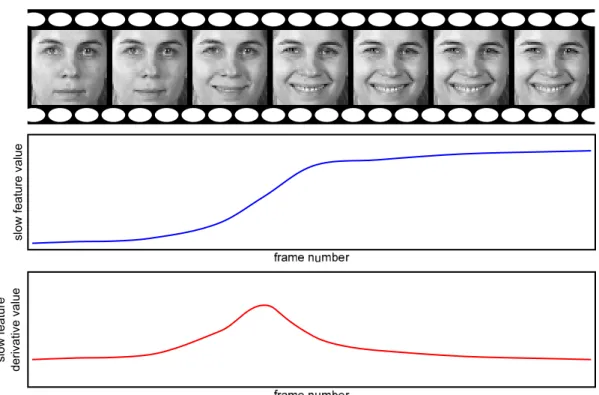
Nater et al. (2011) exploit SFA’s properties to segment video data temporally (fig-ure 2.5). The aim of their study is to extract unknown different actions in an image sequence. The individual segments are thought to be the activities in the examined video. After performing SFA on the complete video, the authors determine whether a split of the sequence is required. The decision is based on the median of change in the slow features. For the separation, the frame with the largest change is utilized as split position, as SFA tries to extract components that change least over time. SFA is once more performed on the resulting videos, and the process is repeated until no further split is necessary.
Another example of SFA applied to temporal segmentation is presented by Zafeiriou et al. (2013). After formulating SFA as probabilistic model and solving for expectation maximization, the authors are able to extract the temporal phases of facial expressions through SFA. Their offline algorithm successfully extracts onset (beginning), apex (dura-tion) and offset (ending) of facial action units.
Non-Linear Kernel Slow Feature Analysis
KSFA is originally proposed by B¨ohmer et al. (2011) in the speech processing domain. Like inKPCA, the samples are mapped into a Hilbert space which may be implicit, as the kernel trick can be applied. However, B¨ohmer et al. (2011) apply standard off-the-shelf kernels and thus their system remains non-robust.
2.1.3
Generalized Eigenvalue Problem
There are many dimensionality reduction techniques, and most of them are beyond the scope of this thesis. A large proportion, however, can formulated as generalized eigenvalue problems (de la Torre 2012;Kimura et al. 2013;Kokiopoulou et al. 2011;Sun et al. 2009; Zhang et al. 2009).
Optimization Problem
The generalized eigenvalue decomposition is often expressed as
Aur =λrBur, (2.19)
where{ur}Rr=1represents the set of eigenvectors and{λr}Rr=1denotes the set of eigenvalues.
If matrices A and B are square and regular, eq. (2.19) can be formulated as a trace problem, given by U = arg max ˇ U tr ˇ UTB ˇU−1 ˇ UTA ˇU = arg min ˇ U tr ˇ UTA ˇU−1 ˇ UTB ˇU, (2.20)
where U is the projection onto subspace. In real data, however, matrices A and B are seldom regular. Then the pseudo-inverse applied to eq. (2.20) provides an alternative approximation to eq. (2.19).
Table2.1lists some common setting of matricesAandBin literature. PCAmaximizes the variance of samples via the scatter matrix XXT
PCA SFA LDA PLS CCA MLR MatrixA XXT XXT S(b) 0 XYT YXT 0 0 XYT YXT 0 0 XYT YXT 0 Matrix B I S˙ S(w) I 0 0 I XXT 0 0 YYT XXT 0 0 I
Table 2.1: A summary of generalized eigenvalue problems. Matrix X contains the sample data, and matrix Y denote the relevant labels. The scatter matrix of the data derivative is given by S˙. S(b) and S(w) represent the between and within-class scatter matrix respectively.
relation toXXT
and the scatter matrix of the data derivative ˙S. LDAinflates the between-class variance while reducing the within-between-class differences – here, labeled training data is required. A complete set of labels {yn}Nn=1 and the matrix Y =
h
y1 · · · yN i
are also required for the remaining three algorithms, which are regression based. Partial least squares (PLS) finds a subspace that best explains the largest variance in the predictions in Y. Canonical correlation analysis (CCA) correlates the linear relationships between two sample sets. Multiple linear regression (MLR)minimizes the distance between Yand the projected samples in X. Detailed summaries of eigenvalue problems are presented by de la Torre (2012); Kimura et al. (2013); Kokiopoulou et al. (2011); Sun et al. (2009); Zhang et al. (2009).
Non-Linear Kernel Methods
Like for PCA and SFA, kernelized versions are presented for the algorithms above in the literature. For example, kernel LDA is employed by Mika et al. (1999) and Yang et al. (2005b), while Lai and Fyfe (2000) introduce kernel CCA.
2.2
Online Learning
With an ever increasing importance of realizing online and real-time applications, incre-mental learning methods have become a popular research topic. In such framework, the system requires only minimal training a priori (often only an initialization), as the hy-pothesis is updated when new data points arrive. Hence the system is adaptive to the samples in the test data, as it incorporates such points into its hypothesis. It is important to note here, that the term ‘online’ has different meanings in the literature. Throughout my thesis, I refer to incremental, real-time setups as online systems.
Many online learning methods have been recently proposed. For example, He et al. (2011a) introduce a general online algorithm to learn from stream data. A framework for learning with non-stationary environments, for which the classes and data distribution
change over time, is presented by Elwell and Polikar (2011). Motivated by the cere-bral cortex, Weng and Hwang (2007) propose an online methodology for classification and regression. Online blind source separation is introduced by Zhou et al. (2011), and several variations of incremental PCA have been recently introduced as well (Levy and Lindenbaum 2000;Ozawa et al. 2008; Ross et al. 2008; Weng et al. 2003).
In this thesis, I particularly focus on online learning with subspaces, and incremental kernel learning. Existing research related to these topics, is discussed in the following sections.
2.2.1
Incremental Eigenvalue Analysis
Any eigenvalue problem commonly requires the complete training data before learning can be done. This is often unfeasible, especially in adaptive real-time applications, where stream data is used as input. In the last two decades, incremental PCAhas been a devel-oping research area (Chandrasekaran et al. 1997;Hall et al. 1998;Levy and Lindenbaum 2000;Ozawa et al. 2008; Ross et al. 2008; Weng et al. 2003;Zhao et al. 2006).
The early methods by Chandrasekaran et al. (1997) and Hall et al. (1998) update the eigenvalue decomposition via an update of the covariance matrix. This, however, is unfeasible for high-dimensional image data. More recently, Weng et al. (2003) introduce candid covariance-free incremental PCA (CCIPCA)which is based on statistical efficiency, and incrementally estimates the data distribution by means of scale and mean. CCIPCA does not require the covariance matrix (or scatter matrix) of the samples and hence is suitable for image data. Nonetheless, the incremental convergence procedure requires a larger sample-to-dimension ratio for accurate results (Zhao et al. 2006).
A mathematically exact incremental update of PCA is introduced by Levy and Lin-denbaum (2000), and improved by Ross et al. (2008) to allow for mean-substraction. Here the sample set {xn}Nn=1 is approximated by a sufficient spanning set via eigenvalue
decomposition. Hence, if all eigenvalues are retained, the subspace is exactly equivalent to its offline version. Nonetheless, very small approximation errors are achieved by only considering the largest eigenvalues. In particular, given the SVD of the sample matrix at time t−1,i.e. Xt−1 = h x1 · · · xt−1 i ≈Ut−1Σt−1VTt−1, (2.21)
the new sample matrix at time t can be approximated by
Xt= h Xt Xδ i ≈h Ut−1Σt−1VtT−1 Xδ i , (2.22)
where Xδ =xt represents the novel data point. Notice, eq. (2.22) can be reformulated as Xt≈ h Ut−1 Uδ i " Σt−1 UTt−1Xδ 0 UT δXδ # " Vt−1 0 0 I #T , (2.23) whereUδ=orth Xδ−UUTXδ
contains the components not included in subspace Ut−1
(here, orth(.) finds the orthogonal components, and 0 implies zero padding). The SVD of the central term then yields the solution, i.e.
L= " Σt−1 UTt−1Xδ 0 UT δXδ # =U ´´Σ ´VT, (2.24) as Ut = h Ut−1 Uδ i ´
U and Σt = Σ´. The orthonormal matrix Vt is not required for
the computation.
Other researchers target the generalized eigenvalue problem. For example, Kim et al. (2007) introduce incremental LDA by approximating the within-class scatter matrix and the total scatter matrix through sufficient spanning sets. Incremental SFAis proposed by Kompella et al.(2012). Here,CCIPCAis combined with an incrementalminor component analysis (MCA) algorithm to solve SFA online.
However, I emphasize, the presented algorithms above all rely on theℓ2-norm and thus
fail to be robust. Furthermore, the robust reformulations of PCA, reviewed above, have no known incremental implementation and are therefore computationally expensive for large training sets, and unsuitable for online learning.
2.2.2
Online Learning with Kernels
In contrast to linear online subspace learning, incremental learning with non-linear setups is far from being solved. Nonetheless, many systems successfully apply online kernel learning to acquire non-linearity (Crammer et al. 2006; Engel et al. 2004; Freund and Schapire 1999; Liu et al. 2009; Orabona et al. 2009; Smale and Yao 2006; Yao 2010). Prominent methods range from classification (Bordes et al. 2005; Crammer and Singer 2003; Crammer et al. 2004; Slavakis et al. 2008; Ying and Zhou 2006) and regression (Kivinen et al. 2004;Richard et al. 2009) to novelty and change detection (Desobry et al. 2005; Kivinen et al. 2004), subspace learning (G¨unter et al. 2007; Kim et al. 2005), and feature extraction (Chin and Suter 2007;Laskov et al. 2006).
As seen in eq. (2.16), the online classification or regression function is typically written as a weighted sum of kernel combinations of samples from a set of stored instances, referred to as support or reduced set. One of the major challenges is that at each time step a new
instance is fed to the algorithm and added to this support set, which may grow to become arbitrarily large over time. To somewhat overcome the impact of growth, different update criterions are presented in literature.
Kivinen et al. (2004) propose online kernel algorithms for classification, regression and novelty detection using a stochastic gradient descent algorithm in the Hilbert space defined by the kernel. In order to avoid the arbitrary growth of the support set, the authors adopt simple truncation and shrinking strategies. Engel et al. (2004) present an online kernel regression algorithm that is based on constructing and solving minimum mean-squared-error optimization problems with Mercer kernels. In order to regularize solutions and keep the complexity of the algorithm bounded, a sequential sparsification process is adopted. This sparsification process has close connection to incremental PCA. Orabona et al.(2009) introduce the so-calledProjectron algorithm which neither truncates nor discards instances. In order to keep the support set bounded, the algorithm projects the samples onto the space spanned by the support set. If this is impossible without greater loss, the samples are added to the support set. It is proven that by following the Projectron algorithm, the support set and, therefore, the online hypothesis, is guaranteed to converge. The drawback is that the size of support cannot be predicted in advance. To cope with this, a parameter which provides a trade-off between accuracy and sparsity, is introduced. Richard et al. (2009) propose an online regression algorithm which uses an alternative model reduction criterion. Instead of using a sparsification procedure, the increase in the number of variables is controlled by a coherence parameter, a fundamental quantity that characterizes the behavior of dictionaries in sparse approximation problems. Although many methods have been proposed for online kernel learning for classifica-tion and regression, limited research has been conducted for online subspace learning with kernels. This research has mainly revolved around the development of incrementalKPCA (Chin and Suter 2007; G¨unter et al. 2007; Kim et al. 2005) and kernel SVD (Chin et al. 2006) algorithms. One of the first incremental KPCA algorithms is proposed by Kim et al. (2005). This algorithm is essentially the kernelization of the generalized Hebbian algorithm, which has similar operational characteristics to a single-layer feed-forward neu-ral network. Gain adaptation methods which improve convergence of the kernel Hebbian algorithm are introduced byG¨unter et al.(2007). An incrementalKPCAalgorithm which kernelizes the mathematically exact algorithm for incremental PCAby Levy and Linden-baum (2000); Ross et al. (2008) is presented by Chin and Suter (2007). In this method, in order to maintain constant update speed the authors construct reduced set expansions of the kernel principal components and the mean, by means of preimages. While such setup nicely bounds the support set, the main drawbacks of this approach are that (i) the reduced set representation provides only an approximation to the exact solution, and
(ii) the proposed optimization problem for finding the expansion inevitably increases the complexity of the algorithm.
In this section, I conclude that it still remains unclear how to combine robustness with efficiency, as most incremental kernel methods require expensive and inaccurate update strategies to prevent arbitrarily large growth in the support set.
2.3
Incremental Learning for Object Tracking
A very popular application is the evaluation of incremental learning using visual track-ing (Babenko et al. 2011; Chin and Suter 2007; Ross et al. 2008). The aim of a visual tracking system is to locate a predefined target object on every frame of a video sequence. Automatic tracking systems span a wide range of applications, such as traffic monitoring (Hsieh et al. 2006; Kamijo et al. 2000), surveillance (Collins et al. 2001; Haritaoglu et al. 2000), video retrieval and summarization (Luo et al. 2003), vehicle navigation (Fraundor-fer et al. 2007; Hashima et al. 1997), driver assistance (Avidan 2004; Handmann et al. 1998), human-computer interaction (Wren et al. 1997) and face analysis (Cohn et al. 1999; Gunes and Pantic 2010).
Although trackers have received plentiful attention, common problems persist. As outlined in chapter 1, complex motion, changes in illumination, occlusions and non-rigid appearance variations are some examples which make most trackers fail (Yilmaz et al. 2006). Consequently, assumptions about the data, such as static background or constant illumination, are often made to facilitate tracking. However, it is difficult to satisfy such assumptions in real data, as the aforementioned events often occur in real life settings. Few approaches address real-time tracking in realistic environments and unconstrained scenes. However, recent literature shows that adapting to the scene via online learning is advantageous in many tracking frameworks (Babenko et al. 2011; Mei and Ling 2009; Ross et al. 2008).
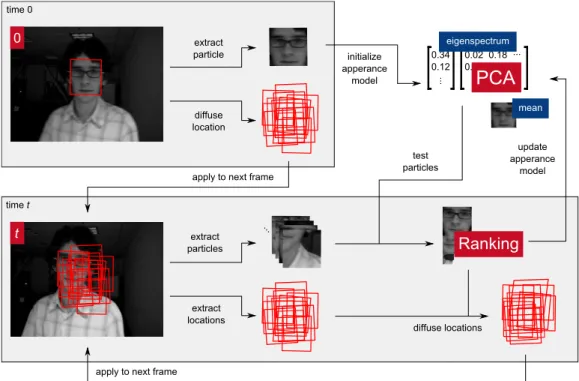
In tracking, some systems track the silhouette or the contour of the target (Isard and Blake 1998;Li et al. 2001;Paragios and Deriche 2005;Yilmaz et al. 2004). Other methods incorporate articulated shape information and structural features of the target (Cootes et al. 2001;Gall et al. 2009). I am particularly interested in systems which track an object as an image area (Babenko et al. 2011; Chin and Suter 2007; Mei and Ling 2009; Ross et al. 2008; Zhou et al. 2004). Usually, the search strategy of such tracking system is based on three main components
1. Image representation: The image representation defines the low-level features which are extracted from the frames of the video sequence.