Full Terms & Conditions of access and use can be found at
https://www.tandfonline.com/action/journalInformation?journalCode=taut20
Automatika
Journal for Control, Measurement, Electronics, Computing and
Communications
ISSN: 0005-1144 (Print) 1848-3380 (Online) Journal homepage: https://www.tandfonline.com/loi/taut20
Image retrieval based on colour and improved NMI
texture features
Anyu Du, Liejun Wang & Jiwei Qin
To cite this article: Anyu Du, Liejun Wang & Jiwei Qin (2019) Image retrieval based on colour and
improved NMI texture features, Automatika, 60:4, 491-499, DOI: 10.1080/00051144.2019.1645977
To link to this article: https://doi.org/10.1080/00051144.2019.1645977
© 2019 The Author(s). Published by Informa UK Limited, trading as Taylor & Francis Group
Published online: 05 Sep 2019.
Submit your article to this journal
Article views: 288
View related articles
2019, VOL. 60, NO. 4, 491–499
https://doi.org/10.1080/00051144.2019.1645977
REGULAR PAPER
Image retrieval based on colour and improved NMI texture features
Anyu Dua, Liejun Wangband Jiwei QincaSchool of Information Science and Engineering, Xinjiang University, Urumchi, People’s Republic of China;bSchool of Software Engineering, Xinjiang University, Urumchi, People’s Republic of China;cSchool of Education, Shaanxi Normal University, Xi’an, People’s Republic of China
ABSTRACT
This paper proposes an improved method for extracting NMI features. This method uses Par-ticle Swarm Optimization in advance to optimize the two-dimensional maximum class-to-class variance (2OTSU) in advance. Afterwards, the optimized 2OUSU is introduced into the Pulse Cou-pled Neural Network (PCNN) to automatically obtain the number of iterations of the loop. We use an improved PCNN method to extract the NMI features of the image. For the problem of low accuracy of single feature, this paper proposes a new method of multi-feature fusion based on image retrieval. It uses HSV colour features and texture features, where, the texture feature extraction methods include: Grey Level Co-occurrence Matrix (GLCM), Local Binary Pattern (LBP) and Improved PCNN. The experimental results show that: on the Corel-1k dataset, compared with similar algorithms, the retrieval accuracy of this method is improved by 13.6%; On the AT&T dataset, the retrieval accuracy is improved by 13.4% compared with the similar algorithm; on the FD-XJ dataset, the retrieval accuracy is improved by 17.7% compared with the similar algorithm. Therefore, the proposed algorithm has better retrieval performance and robustness compared with the existing image retrieval algorithms based on multi-feature fusion.
ARTICLE HISTORY Received 11 October 2018 Accepted 16 July 2019 KEYWORDS
CBIR; normalized moment of inertia; PCNN; multi-feature fusion; image datasets
1. Introduction
Image retrieval has received more and more attention in recent years. It refers to the process of searching for a query image in a database, and then search-ing for and representsearch-ing images related to user needs [1]. Image retrieval methods are mainly divided into two categories, text-based and content-based [2]. The early text-based image retrieval algorithm is a method for manually annotating image content and perform-ing keyword search. However, this method had many shortcomings. For example, text-based image retrieval mainly relies on the standard information of images for retrieval, but manual indexing is hard, and this process is costly and time consuming [1], after which the researchers began to focus on content-based image retrieval technology. In the context of content-based image retrieval, the study of colour, texture, and shape features is relatively mature. In the beginning, the main research was on image retrieval based on single fea-tures. Such as: Su CH et al. [3] proposed an efficient image retrieval based on HSV colour space; Sulochana et al. [4] proposed texture-based image retrieval using framelet transform – Grey Level Co-occurrence Matrix (GLCM); Mishra et al. proposed an improved content-based image retrieval approach using Local Binary Pattern (LBP) [5]. However, searching based on a sin-gle feature can only be used to retrieve images with
strong corresponding features. For images with com-plex features, the retrieval efficiency is low. Therefore, the research of multi-features fusion retrieval increas-ingly attracts people’s attention.
Later, Rahmaniansyah Dwi Putri et al. [6] proposed feature extraction of HSV colour and GLCM feature fusion; Swati Jain et al. proposed weighted fusion of LBP and CHH features [7]; Liu P et al. proposed fusion of colour histogram and LBP-based features for texture image retrieval and classification [8]. The accuracy of the above method is higher than that of a single feature, but it is bad for image processing such as smoothing, filtering, and compression. Then, Q Liu et al. [9] pro-posed an image NMI feature extraction based on pulse-coupled neural network. Although this method avoids poor image retrieval results caused by image smoothing and compression, the number of loop iterations needs to be determined artificially when extracting NMI fea-tures, resulting in the accuracy has declined. In recent years, researchers began to study how to obtain the number of iterations of the PCNN automatically, and then proposed to use the 2OTSU algorithm to automat-ically obtain the number of iterations of the loop. The time complexity of 2OTSU is relatively large. In order to solve this problem, the particle swarm optimization (PSO) algorithm is used to optimize the 2OTSU in this paper, and the optimized algorithm is introduced into
CONTACT Liejun Wang [email protected] School of Software Engineering, Xinjiang University, No. 499, Northwest Rd., Saybagh District, Urumchi 830046, People’s Republic of China
© 2019 The Author(s). Published by Informa UK Limited, trading as Taylor & Francis Group
This is an Open Access article distributed under the terms of the Creative Commons Attribution License (http://creativecommons.org/licenses/by/4.0/), which permits unrestricted use, distribution, and reproduction in any medium, provided the original work is properly cited.
492 A. DU ET AL.
the PCNN to automatically obtain the NMI features of the image. This paper fused the features extracted by HSV, GLCM and LBP and the NMI feature extracted by the improved PCNN to improve the retrieval accuracy. The rest of the paper is structured as follows: Section 2 reviews the related work of image retrieval; Section 3 describes proposed method; Section 4 explicates exper-imental results and analysis; Section 5 summarizes this paper.
2. Related work
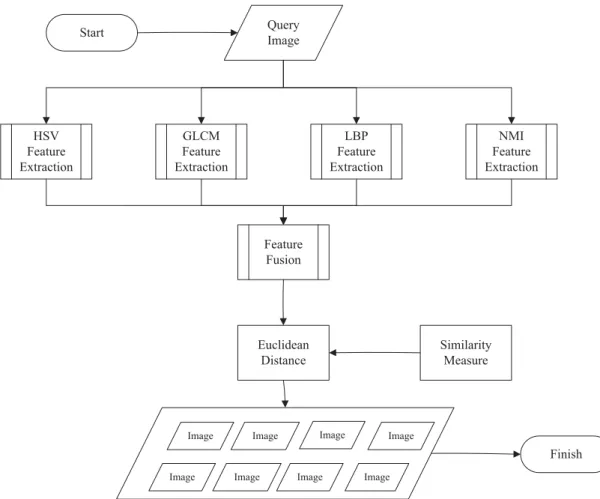
The concept of “content-based image retrieval” was proposed by T. Kato in 1992. Where, he used colour and shape to describe the automatic image retrieval exper-iments of the databases [3]. The concept of CBIR has been widely used and has achieved great development. This paper proposed a new image retrieval method based on this concept. Its system block diagram is shown in Figure1. The system begins to input the query image and enters the HSV feature extraction, GLCM feature extraction, LBP feature extraction and NMI fea-ture extraction stages respectively, and weighted fusion of four features; afterwards, the similarity measurement stage is entered. At this stage, the query image matches the image in the database; when the matching process is completed, an image with similar matching values is selected in the database and the image query.
2.1. Colour feature extraction
Colour features are one of the basic visual features that humans perceive and distinguish between differ-ent objects. Every object in the world has its own colour characteristic. The colour features are very sta-ble, and they are insensitive to rotation, translation, scale changes, and even various deformations. They showed strong robustness and is the most commonly used features of content-based image retrieval [10]. Colour histogram is the most commonly used colour features in image retrieval systems, while colour cor-relation diagram depicts the proportion of a certain number of colour pixels in an image, and also reflect the spatial correlation between different colours [11].
The choice of colour spaces and quantization lev-els are the two main aspects of colour feature extrac-tion. The colour spaces are the multidimensional space in which different dimensions have different colour components. This paper used the HSV colour model because it is closer to the human eye’s perception of colour. In the HSV model, H (hue) represents the chroma component in the model, S (saturation) rep-resents the advantage of a particular hue in the hue, andV(value) represents the hue intensity [12]. Since human eyes have different perceptions of hue, satura-tion, and numerical values, the three components of H,SandVare quantified non-uniformly in this paper. Hue is divided into saturation and numerical values
of 8 parts and quantized according to different colour ranges. After quantization, the three colour compo-nents are combined into the one-dimensional feature vectorZshown in equation (1):
Z=QSQVH+QVS+V (1)
whereQSandQV, respectively, represent the
quantiza-tion levels of S and V [1]. LetQS=2,QV=2, we can get
formula (2):
Z =4H+2S+V (2)
Therefore, after quantization, the colour histogram vec-tor can be expressed as a 1×32 one-dimensional vecvec-tor.
2.2. Texture feature extraction
2.2.1. GLCM feature extraction
In 1973, Haralick et al. proposed a grey-level co-occurrence matrix for image classification [13]. And using GLCM to extract features require to steps: the first step was to calculate GLCM, and the second step was to calculate texture features using the calculated GLCM [11].
The grey level co-occurrence matrix of the image can reflect the integrated information of the direction of the image grey, the adjacent interval, and the ampli-tude change. Letf(x,y)be a 2-bit digital image whose size is M×N, where Ng represents a grey level [12], then GLCM satisfies a certain spatial relationship, as shown in Equation (3):
P(x,y)=#{(x1,y1),(x2,y2)∈M×N} (3) where thexin #(x) represents the number of elements in the set. Obviously, P is a Ng×Ng matrix. if the dis-tance between (x1,y1) and (x2,y2) isd, and the angle between them and the horizontal axis coordinates isθ, thenP(i,j, d,θ) and various inclinations and angles can be obtained. In this paper, we select four param-eters of the co-occurrence matrix in four directions: contrast, correlation, energy, and uniformity to form a 1×4 vector.
2.2.2. LBP feature extraction
The local binary model was proposed by Ojala et al. It is an operator used to describe the local texture fea-tures of the image, and has significant advantages such as rotation invariance and grey scale invariance. It uses the local intensity of each pixel for feature vector extrac-tion [13]. The initial LBP operator is defined as a 3×3 window. Using the centre pixel of the window as the threshold, the grey values of the adjacent eight pixels are compared with it. If the surrounding pixel value is greater than the value of the centre point, the pixel position is marked as 1, otherwise 0. In this way, 8 points in the 3×3 field can generate an 8-bit unsigned number. Then assign different weights based on their
positions and add them together to get an integer, which is the LBP value at that point. In addition, uniform and uneven images are distinguished based on the appear-ance. This paper uses a uniform local binary pattern to extract texture features.
2.2.3. NMI feature extraction
PCNN is widely used in image segmentation, but its parameters are numerous, and the number of itera-tions needs to be manually determined. For these sit-uations, YD MA [14] proposed an automatic image segmentation method based on pulse coupled neural network and image entropy. However, this method is not ideal for low-contrast image segmentation. To solve this problem, this paper presents an automatic image segmentation method based on PCNN and 2OTSU, which is used to get the NMI features of the image and optimize the 2OTSU [15,16].
2.2.3.1. 2OTSU. The two-dimensional Otsu method is an efficient image segmentation method. It con-siders the grey information and spatial neighbouring information between pixels in the image at the same time. However, the computation of the optimal thresh-old vector for the two-dimensional Otsu method is very large. This paper uses Particle Swarm Optimiza-tion (PSO) to find the best two-dimensional thresh-old vector, where each particle represents a possible two-dimensional threshold vector and obtains the best two-dimensional threshold through the cooperation between the particles [17]. Experimental results show that the method not only can get the ideal segmentation result, but also can reasonably reduce the computa-tional cost, so it is suitable for the real-time application.
2.2.3.2. PCNN. Pulse coupled neural network is a simplified neural network model constructed by Eck-horn in the 1990s based on the visual principle of cats. Compared with BP neural network and Kohonen neural network, PCNN does not require learning or training, and can extract effective information from a complex background. It has characteristics such as syn-chronous pulse distribution and global coupling [18]. And its signal form and processing mechanism are more in line with the physiological basis of the human visual nervous system [19]. Since the setting of PCNN parameters will greatly affect the segmentation effect, in order to reduce the complexity of the PCNN and increase the operating speed at the same time, a sim-plified PCNN model is generally used, and its formula is as follows: Fij(n)=Iij (4) Lij(n)= k,l WklYkl(n−1) (5)
494 A. DU ET AL.
Figure 2.(a) Original (b) 2OTSU segment image (c) Optimized PCNN segment image. Uij(n)=Fij(n)(1+bLij(n)) (6) Tij(n)=e−aTij(n−1)+VYij(n) (7) Yij(n)= 1,Uij(n) >Tij(n−1) 0, others (8)
where the parameters W=
⎛ ⎝ √ 1/2 1 √1/2 1 1 1 √ 1/2 1 √1/2 ⎞ ⎠, a=0.1;b=0.2;V =0.2.
In equation (4),LijandFijrepresent the original grey
scale values of the image and the feedback domain input channels, respectively. In Equation (5),Lij andYklare
the link domain channels and the pulse output, respec-tively;Uij is expressed as the interior status signal of
the bit in Equation (6). b is the strength coefficient of the link;Tijin Equation (7) is expressed as a threshold
threshold. In the PCNN model,bis variable. The larger value ofb, the clearer the image is decomposed, and the more obvious the outline of the image. Conversely, the more detailed the image. The result as shown in Figure2.
2.2.3.3. NMI feature. The NMI of the image has an invariant property, which is the normalized rotational inertia of the image has a good invariance to the geo-metric distortion (such as translation, rotation, scaling) [20]. The representation of the normalized moment of inertia is as follows: ic= M i=1 N j=1iIij M i=1 N j=1Iij ,jc= M i=1 N j=1jIij M i=1 N j=1Iij (9) λ= Jicjc m = i,j∈ [(i−ic)2+(j−jc)2] i,j∈ Yij (10)
In Equation (9), (ic,jc) represents the point where the
total mass of the image plane image is concentrated; in Equation (10), λis the NMI eigenvalue, Yij is the
binary image, and is the region of Yij =1 in the
binary image. It can be seen that the eigenvalue λof the NMI is the ratio of the moment of inertia of the binary image quality around its centre of gravity to its mass. For different binary images, different NMI features can be extracted, and NMI has the advan-tages of convenient extraction and low computational
complexity compared to traditional image invariant features.
3. Proposed method
In this section, the study explains how to use the proposed method to establish a CBIR system. The pro-posed method has a third step: feature extraction, fea-ture fusion and similarity measure [3].
3.1. Features extraction
The image is first processed using feature extraction. This paper uses HSV colour extraction, GLCM, LBP texture extraction and improved PCNN for NMI tex-ture extraction.
In the HSV colour feature extraction stage, the image is converted to an HSV value, and the HSV image is converted into a histogram. This paper expresses the colour histogram vector as a 1×32 one-dimensional vector.
In the GLCM texture feature extraction phase, it is calculated respectively in four directions of 0°, 45°, 90° and 135° [3]. Subsequently, the four properties of the GLCM were used to calculate, including contrast, cor-relation, energy, and uniformity. The extraction process produces a 1×4 matrix.
In the LBP texture feature extraction phase, a 1×59 one-dimensional vector is generated during the extrac-tion process.
In the NMI feature extraction phase, features are extracted using PCNN. However, the number of loop iterations of PCNN is N determined manually, so we introduce the optimized 2OTSU after particle swarm optimization into PCNN, and automatically get the number of iterations of loop. The length of the NMI feature vector isN.
3.2. Features fusion
After the four features have been extracted, they are weighted and fused. Because the physical meanings of colours and textures are different and cannot be directly compared, these feature vectors need to be internally and externally normalized prior to fusion. The Gaus-sian normalization method is used in this paper. Inter-nal normalization means normalizing the components of the eigenvectors. External normalization is to nor-malize the feature distances to the same range of values to achieve the purpose of feature fusion [12]. In fusion, we assign weights based on the accuracy of the retrieved images, and then dynamically adjust the weights based on different types of images to obtain better fusion results. This paper assumes that HSV colour features, GLCM, LBP, and NMI weights respectively areω1,ω2,
ω3andω4. The weights of the features are shown as:
3.3. Similarity measure
The similarity measure is to measure the similarity between images. In this paper, when calculating simi-larity, the method used is Euclidean distance. The result of ED calculation is used as the parameter of image similarity. The smaller the ED value, the greater the similarity of the image. According to the result of sort-ing the ED value of the image, the ranksort-ing of the image is determined. X represents the feature vector of the image to be retrieved,y represents the feature vector of any image in the image database, and i=1, 2, 3, 4, respectively, represent the four features of the image [10]. The Euclidean distance formula is as follows:
di =
(xi−yi)2
(12) Similarity can be expressed as a formula:
si = 1
1+di
(13) The similarities of its four features are respectively s1,s2,s3,s4. The weight similarity formula is as follows:
s=ω1s1+ω2s2+ω3s3+ω4s4 (14)
When similar images are retrieved, the weight is pro-portional to the accuracy; otherwise, it is inversely proportional.
4. Experimental results and analysis
The proposed method is verified on Corel-1k dataset, AT&T dataset and FD-XJ dataset, respectively.
4.1. Datasets
4.1.1. Corel-1k dataset
Corel-1000 Image Database: This database is used for various scientific papers on content-based image retrieval systems. The database contains 10 image classes, each containing 100 images. Courses include: Africa, beaches, buildings, racing, sunsets, flowers, elephants, marine life, aircraft and mountains. Each image has a size of 192×128 and the image format is JPEG [12].
4.1.2. AT&T dataset
Face database is used for face image retrieval. AT&T’s face database contains 400 images of 40 topics. Each subject has 10 different facial expressions (open/closed eyes, smiling/not smiling) and facial details (eye-glasses/no glasses) images. These images were taken at different times and under different lighting conditions [13]. The size of each image in this database is 92×112.
4.1.3. FD-XJ dataset
The FD-XJ face image database is a Xinjiang ethnic minority face database created by the College of Infor-mation Science and Engineering of Xinjiang Univer-sity. The database contains 3289 images of shoulders of Uygur and Kazak people in 253 Xinjiang in China. There are 13 images in each category. All images are collected in specific environments and include expres-sions, poses, accessories and lighting four variables conditions.
4.2. Results and analysis
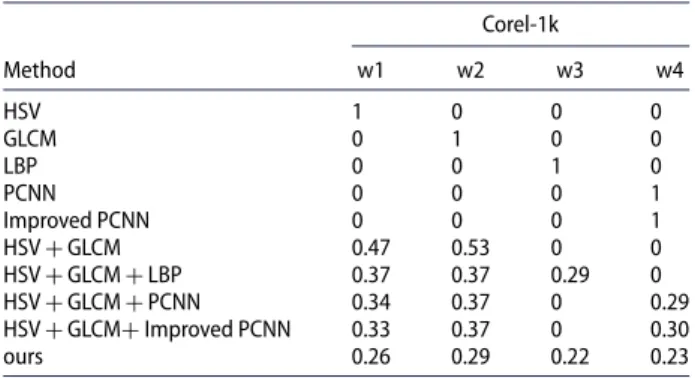
This paper firstly obtains the single-retrieval preci-sion of each feature for a class of images in each dataset, and compares the different capabilities of each feature of image retrieval. Then, when the fusion is performed, the weights of each feature are cal-culated using equations (11) to (14) according to the accuracy and fusion ratio of each single ture. And use the results of weights to fuse fea-tures. The weights in the three datasets of HSV, GLCM, LBP, PCNN, Improved PCNN, HSV+GLCM, HSV+GLCM+LBP, HSV+GLCM+PCNN, HSV+ GLCM+Improved NMI and our proposed method are shown in Tables1–3.
This paper randomly selects an image from a class of image in three datasets as a query image. Sub-sequently, we select the first 5 images retrieved and evaluate their average accuracy and average recall rate [14]. The formulas for accuracy and recall are as
Table 1.Weights of feature fusion in Corel-1k dataset.
Corel-1k Method w1 w2 w3 w4 HSV 1 0 0 0 GLCM 0 1 0 0 LBP 0 0 1 0 PCNN 0 0 0 1 Improved PCNN 0 0 0 1 HSV+GLCM 0.47 0.53 0 0 HSV+GLCM+LBP 0.37 0.37 0.29 0 HSV+GLCM+PCNN 0.34 0.37 0 0.29 HSV+GLCM+Improved PCNN 0.33 0.37 0 0.30 ours 0.26 0.29 0.22 0.23
Table 2.Weights of feature fusion in AT&T dataset.
AT&T Method w1 w2 w3 w4 HSV 1 0 0 0 GLCM 0 1 0 0 LBP 0 0 1 0 PCNN 0 0 0 1 Improved PCNN 0 0 0 1 HSV+GLCM 0.46 0.54 0 0 HSV+GLCM+LBP 0.28 0.33 0.39 0 HSV+GLCM+PCNN 0.30 0.35 0 0.35 HSV+GLCM+Improved PCNN 0.29 0.34 0 0.37 Ours 0.21 0.24 0.28 0.27
496 A. DU ET AL.
Table 3.Weights of feature fusion in FD-XJ dataset.
FD-XJ Method w1 w2 w3 w4 HSV 1 0 0 0 GLCM 0 1 0 0 LBP 0 0 1 0 PCNN 0 0 0 1 Improved PCNN 0 0 0 1 HSV+GLCM 0.50 0.50 0 0 HSV+GLCM+LBP 0.31 0.32 0.37 0 HSV+GLCM+PCNN 0.31 0.32 0 0.37 HSV+GLCM+Improved PCNN 0.31 0.31 0 0.38 ours 0.23 0.23 0.26 0.28 follows:
P= (Relenant images)∩(Retrieved images) Total number of images retrievevd (15)
R= (Relenant images)∩(Retrieved images) Total images of relevant in the database (16) The features of the fusion are compared in three datasets. Their performance is displayed in the
Figure 3.Precision-recall curve on Corel-1k.
Figure 4.Precision-recall curve on AT&T.
Figure 5.Precision-recall curve on FD-XJ.
precision-recall curve, and the curve can reflect the overall index. The results are as shown in Figures3–5.
The above three figures show the performance of each algorithm in the three datasets. From these, we can see that if the performance of a system is good, its curve should protrude as much as possible. In the experimen-tal results, the image retrieval performance of a single feature is obviously worse than that of a multi-feature fusion image. And the performance of our proposed method is obviously better than that of commonly used multi-feature fusion methods.
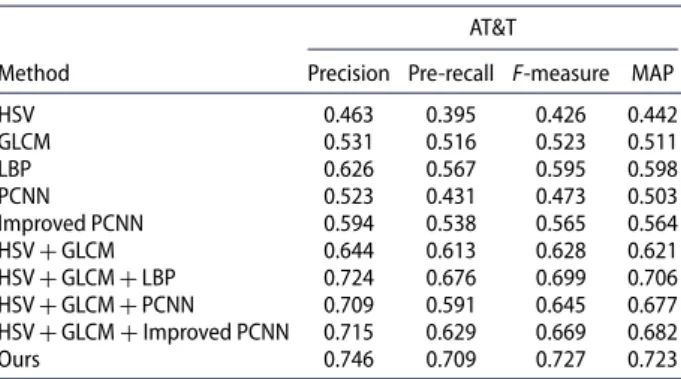
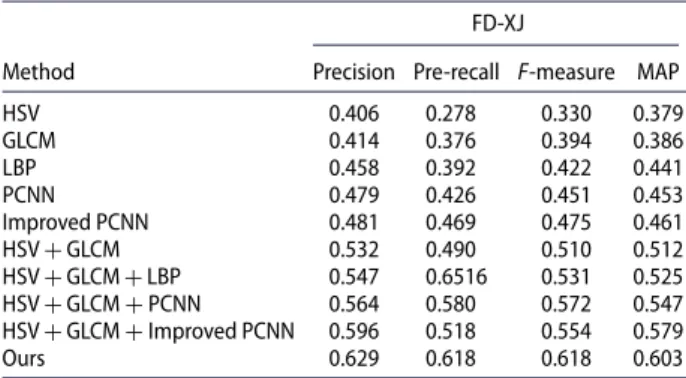
Subsequently, in order to more clearly see the pros and cons of their performance, we give objective eval-uation indicators for each system on three data sets. Table 4.Objective evaluation indicators of system in Corel-1k dataset.
Corel-1k
Method Precision Pre-recall F-measure MAP
HSV 0.525 0.434 0.475 0.485 GLCM 0.561 0.515 0.537 0.537 LBP 0.445 0.411 0.427 0.423 PCNN 0.436 0.353 0.390 0.414 Improved PCNN 0.451 0.449 0.450 0.438 HSV+GLCM 0.623 0.564 0.592 0.602 HSV+GLCM+LBP 0.634 0.633 0.633 0.614 HSV+GLCM+PCNN 0.662 0.547 0.599 0.651 HSV+GLCM+Improved PCNN 0.674 0.595 0.632 0.651 Ours 0.697 0.691 0.694 0.684
Table 5.Objective evaluation indicators of system in AT&T dataset.
AT&T
Method Precision Pre-recall F-measure MAP
HSV 0.463 0.395 0.426 0.442 GLCM 0.531 0.516 0.523 0.511 LBP 0.626 0.567 0.595 0.598 PCNN 0.523 0.431 0.473 0.503 Improved PCNN 0.594 0.538 0.565 0.564 HSV+GLCM 0.644 0.613 0.628 0.621 HSV+GLCM+LBP 0.724 0.676 0.699 0.706 HSV+GLCM+PCNN 0.709 0.591 0.645 0.677 HSV+GLCM+Improved PCNN 0.715 0.629 0.669 0.682 Ours 0.746 0.709 0.727 0.723
Table 6.Objective evaluation indicators of system in FD-XJ dataset.
FD-XJ
Method Precision Pre-recall F-measure MAP
HSV 0.406 0.278 0.330 0.379 GLCM 0.414 0.376 0.394 0.386 LBP 0.458 0.392 0.422 0.441 PCNN 0.479 0.426 0.451 0.453 Improved PCNN 0.481 0.469 0.475 0.461 HSV+GLCM 0.532 0.490 0.510 0.512 HSV+GLCM+LBP 0.547 0.6516 0.531 0.525 HSV+GLCM+PCNN 0.564 0.580 0.572 0.547 HSV+GLCM+Improved PCNN 0.596 0.518 0.554 0.579 Ours 0.629 0.618 0.618 0.603
Objective evaluation indicators include: accuracy (P), recall rate (R),F-measure, and MAP. The meaning of accuracy rate and recall rate has been given before. F-measure refers to the comprehensive evaluation index, which is a weighted harmonic average ofPandR. The higher the value of F, the better the performance is proved; Map is to solve the limitations of P, R, and F-measure single point values. The higher the value of Map, the better of the performance. The results are shown in Tables4–6.
Where, as can be seen from these tables, the value of each objective index of our proposed method is greater than that of other methods, which indicates that our proposed method performance is better than that of other systems.
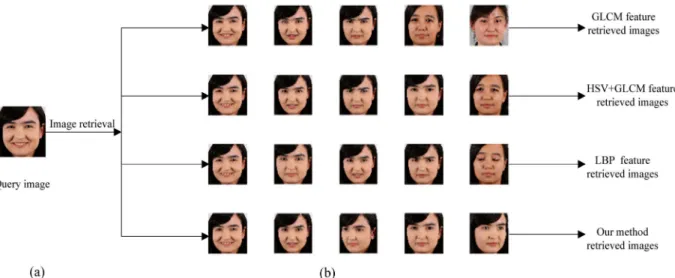
Following, we compare the subjective evaluation indicators of several algorithms in three datasets. This paper randomly selects an image (a) as a query image from a class of image in each dataset, then the GLCM feature, HSV+GLCM features, LBP feature and the feature proposed by us are respectively used to per-form image retrieval in the datasets, selecting the first 5 images retrieved the images are compared and the results are as follows.
In Figure 6, the other three methods each have an image does not belong to the same kind of image with the query image. The images retrieved by the method proposed in this paper belong to the same type of image with the query image; in Figure7, the images retrieved by the GLCM feature and the HSV+GLCM features do not belong to the same type of image as the query image. The image retrieved by the method proposed in this paper belongs to the same category as the query image;
Figure 6.(a) Query image (b) images retrieved in Corel-1k.
498 A. DU ET AL.
Figure 8.(a) Query image (b) images retrieved in FD-XJ. in Figure8, in the first method, having two retrieved images and query images do not belong to one type. In the second and third methods, have one retrieval image separately and query image do not belong to the same type of image, however, the images retrieved by the method proposed in this paper and query image belong to the same type of image.
5. Conclusion
This paper presents a novel multi-feature fusion image retrieval method. The purpose of this method is to complete the image retrieval through the fusion of four features. The method is based on three steps, namely multi-feature extraction, dynamic retrieval of weights and similarity fusion [21]. In the feature extraction process, the number of loop iterations of the traditional NMI feature is difficult to determine. Therefore, this paper proposed an improved PCNN to extract NMI feature. That is, 2OTSU uses parti-cle swarm optimization algorithm to optimize, and the optimized algorithm is introduced into PCNN to extract NMI feature. It is used to automatically obtain the number of loop iterations to extract the NMI features of the image. The advantages of NMI features are simple calculation, high accuracy, resis-tance to geometric distortion, and robustness to image operations such as filtering, smoothing, and compres-sion. The proposed method was compared with HSV, GLCM, LBP, PCNN, Improved PCNN, HSV+GLCM, HSV+GLCM+LBP, HSV+GLCM+PCNN and HSV+GLCM+Improved PCNN. All methods were tested on Corel-1k dataset, AT&T dataset and FD-XJ face image dataset. From the theoretical and experi-mental results it can be concluded that image retrieval based on this method provides excellent retrieval accu-racy. In future work, we would like to investigate more complex schemes to determine the weight of simi-larity fusion parts. It will also be our goal to reduce
the computational complexity through indexing tech-niques and to improve the framework that is more suitable for large datasets.
Disclosure statement
No potential conflict of interest was reported by the authors.
Funding
This work is supported by Chinese National Natural Science Foundation of China [Program No. 61771416]; 2017 CER-NET Innovation Project [Program No. NGII20170325, No. NGII20180201]; The Funds for Creative Research Groups of Higher Education of Xinjiang Uygur Autonomous Region [Program No. XJEDU2017T002].
References
[1] Mohamadzadeh S, Farsi H. Content-based image retrieval system via sparse representation. IET Comput Vision.2016;10(1):95–102.
[2] Qazanfari H, Hassanpour H, Qazanfari K. A short-term learning framework based on relevance feedback for content-based image retrieval. 2017 3rd Iranian Con-ference on Intelligent systems and signal processing (ICSPIS), Shahrood;2017. p. 136–140.
[3] Su C, Chiu H, Hsieh T. An efficient image retrieval based on HSV color space. 2011 International Conference on Electrical and Control Engineering, Yichang;2011. p. 5746–5749.
[4] Sulochana S, Vidhya R. Texture based image retrieval using framelet transform-gray level co-occurrence matrix (GLCM). Int J Adv Res Artifi Intel.2013;2(2): 68–73.
[5] Choobari BM, Mozaffari S. A robust content based image retrieval using local full-directional pattern (LFDP). 2017 5th Iranian Joint Congress on Fuzzy and Intelligent systems (CFIS), Qazvin;2017. p. 178–183. [6] Putri RD, Prabawa HW, Wihardi Y. Color and texture
features extraction on content-based image retrieval. 2017 3rd International Conference on Science in
information technology (ICSITech), Bandung; 2017.
p. 711–715.
[7] Jain S, Zaveri T, Patel S. Weighted fusion of LBP and CCH features for effective content based image
retrieval. 2016 International Conference on signal pro-cessing and Communications (SPCOM), Bangalore; 2016. p. 1–5.
[8] Liu P, Guo JM, Chamnongthai K, et al. Fusion of color histogram and LBP-based features for texture image retrieval and classification. Inf Sci.2017;390:95–111. [9] Liu Q, Xu L-P, Y-D MA, et al. Image NMI feature
extraction and retrieval method based on pulse
cou-pled neural networks. Acta Autom Sin. 2010;36(7):
931–938.
[10] Srivastava D, Goel S, Agarwal S. Pipelined technique for image retrieval using texture and color. 2017 4th Inter-national Conference on Power, Control & Embedded systems (ICPCES), Allahabad;2017. p. 1–6.
[11] Wang Y, Sui A, Fu W. Research on image retrieval technology based on image fingerprint and color fea-tures. 2016 International Conference on Audio, Lan-guage and image processing (ICALIP), Shanghai;2016. p. 447–451.
[12] Wenfei D, Shuchun Y, Songyu L, et al. Image retrieval based on multi-feature fusion. 2014 Fourth Interna-tional Conference on Instrumentation and Measure-ment, Computer, Communication and Control, Harbin; 2014. p. 240–243.
[13] Verma M, Raman B. Local tri-directional patterns: a new texture feature descriptor for image retrieval. Digit Signal Process.2016;51:62–72.
[14] Ma Y-D, Liu Q, Qian Z. Automated image segmentation using improved PCNN model based on cross-entropy. Proceedings of 2004 International Symposium on Intel-ligent Multimedia, Video and Speech Processing, Hong Kong;2004. p. 743–746.
[15] Cheng S, Wang L, Qin J, et al. Image segmenta-tion algorithm based on fusion of group intelligent algorithm optimized OTSU-entropy and pulse
cou-pled neural network. J Comput Appl. 2017;37(12):
3528–3535.
[16] Jieyu Z, Jindan H. An image segmentation algorithm research based on optimized PCNN. 2018 11th Inter-national Conference on Intelligent computation
tech-nology and Automation (ICICTA), Changsha; 2018.
p. 86–90.
[17] Tang Y-G, Dong L, Guan X-P. Fast image segmenta-tion based on particle swarm optimizasegmenta-tion and
two-dimension Otsu method. Control Decis. 2007;22(2):
202–205.
[18] Guo X, Zhang M, Dai Y. Image of Plant Disease segmen-tation model based on pulse coupled neural network with Shuffle Frog Leap algorithm. 2018 14th Interna-tional Conference on ComputaInterna-tional Intelligence and Security (CIS), Hangzhou;2018. p. 169–173.
[19] Zhou D, Zhou H, Gao C, et al. Simplified parameters model of PCNN and its application to image segmenta-tion. Pattern Anal Appl.2016;19(4):939–951.
[20] Liu C, Cui M, Yang Q, et al. Study on method for image retrieval based on feature fusion. 2011 4th IEEE Inter-national Symposium on Microwave, Antenna, Propaga-tion and EMC Technologies for Wireless Communica-tions, Beijing;2011. p. 637–640.
[21] Chen Q, Ding Y, Li H, et al. A novel multi-feature fusion and sparse coding-based framework for image retrieval. 2014 IEEE International Conference on Sys-tems, Man, and Cybernetics (SMC), San Diego, CA; 2014. p. 2391–2396.