M.Tech.- Thesis (June, 2007) Indian Institute of Information Technology, Allahabad 1
A Multifactor Security Protocol for Wireless
Payment-Secure Web Authentication using
Mobile Devices
A
Thesis
Submitted
In
Partial
Fulfillment
of
the
Requirements
For
the
Degree
of
Master
of
Technology
In
Information
Technology
(Wireless
Communication
and
Computing)
by
Ayu Tiwari
(MW200505)under
Dr.Sudip Sanyal
Indian
Institute
of
Information
Technology,
Allahabad
Indian Institute of Information Technology, Allahabad
M.Tech.- Thesis (July, 2007) Indian Institute of Information Technology, Allahabad 2
INDIAN
INSTITUTE
OF
INFORMATION
TECHNOLOGY
Allahabad
(Deemed
University)
(A Centre of Excellence in Information Technology Established by Govt. of India)
Date :____________________
I/We hereby recommend that this report prepared under
my/our supervision by Ayu Tiwari entitled “A Multifactor
Security Protocol for Wireless payment-Secure Web
Authentication using Mobile Devices “be presented in
the partial fulfillment of the requirements for the degree of
Master of Technology in Information Technology
Specialization “Wireless Communications & Computing” for
Examination.
COUNTERSIGNEDDr.Sudip Sanyal
(THESIS ADVISOR)
Dr. U.S.Tiwary
DEAN (ACADEMIC)M.Tech.- Thesis (July, 2007) Indian Institute of Information Technology, Allahabad 3
INDIAN
INSTITUTE
OF
INFORMATION
TECHNOLOGY
Allahabad
(Deemed
University)
(A Centre of Excellence in Information Technology Established by Govt. of India)
CERTIFICATE OF APPROVAL*
The foregoing thesis is hereby approved as a creditable study in the
area of Information Technology carried out and presented in a
manner satisfactory to warrant its acceptance as a pre-requisite to
the degree for which it has been submitted. It is understood that by
this approval the undersigned do not necessarily endorse or approve
any statement made, opinion expressed or conclusion drawn therein
but approve the thesis only for the purpose for which it is submitted.
COMMITTEE ON
FINAL EXAMINATION
FOR EVALUATION
OF THE THESIS
M.Tech.- Thesis (July, 2007) Indian Institute of Information Technology, Allahabad 4
DECLARATION
This is to certify that this thesis work entitled “
A Multifactor Security
Protocol for Wireless payment-Secure Web Authentication using Mobile
Devices
” which is submitted by me in partial fulfillment of the requirement
for the completion of M. Tech in Information Technology specialization in
Wireless Communications and computing to Indian Institute of Information
Technology, Allahabad comprises only my original work and due
acknowledgement has been made in the text to all other material used.
Ayu Tiwari
M.Tech. IT (Wireless Communications and Computing)
MW200505
M.Tech.- Thesis (July, 2007) Indian Institute of Information Technology, Allahabad 5
Abstract
The Cell phones have revolutionized the way we live. Cellular phones and PDA's have largely grown in popularity and as a result users have started online banking, purchasing of internet-based products and other online services. Previous web access authentication systems have used either the Internet or the wireless Mobile channel independently to authenticate the identity of remote user.
Accessing today's web-based services always requires a username and password to authenticate the user identity. This is a significant vulnerability since the password can be hacked by the man in the middle attack and later used for making illegal access to the user’s account.
Our goal is to create an authentication system that is both secure and highly usable based on multifactor authentication approach. It uses a novel approach to create an authentication system based on TICs (Transaction Identification code) and SMS (Short Message Service) to enforce an extra security level with the traditional Login/password system.
We have also used an encryption/decryption technique which is based on symmetric key and an iterated block cipher concept. This concept has been used to keep TICs as secret code on cell phones/PDAs and is also used to initiate secure web transaction using cell phones/PDAs. Finally we extend the system for two way authentication which authenticates both parties (user and e- service provider).
A detailed threat analysis demonstrates that the proposed system is secure against various types of internet attacks like phishing, man-in-the-middle, viruses etc.
M.Tech.- Thesis (July, 2007) Indian Institute of Information Technology, Allahabad 6
Objective
The main objective of the present work is to provide a highly secure wireless environment for financial web transactions that is simple to use and deploy, that does not require any change in existing wireless networks or protocol. This Protocol for Wireless Payment is used to achieve secure web transaction using cell phones / PDAs. The system is based on Multi-factor Authentication concept to provide secure wireless environment to the users to increase faith of the users in online financial web transactions using mobile devices.
M.Tech.- Thesis (July, 2007) Indian Institute of Information Technology, Allahabad 7
Acknowledgements
Before, I get into thick of things; I would like to add a few heartfelt words for the people who were part of my thesis in numerous ways, people who gave unending support right from the beginning. During this period, the faculty members and my batch mates took keen interest and participated actively. They are very efficient and qualified in their respective disciplines.
I express my sincere gratitude to Dr.Sudip Sanyal, Indian Institute of Information Technology-Allahabad for all his affectionate encouragement and guidance during the entire Thesis. His views and inputs are very helpful throughout the process.
I would like to thank Prof. Sugata Sanyal, Tata Institute of Fundamental Research, Mumbai, who suggested many related points and is always very constructive and helpful
I would like to thank Dr. M.D. Tiwari, Hon’ble Director, Indian Institute of Information Technology-Allahabad for the facilities and environment for research.
Not the least I would like to appreciate the support and guidance of all my Teachers specially Dr.U.S.Tiwary, Mr.Vijay Kumar Chourasiya and Dr. Ranta Sanyal and my all M.Tech. friends without whose help and support the thesis could not have been a success.
Lastly I would like to thank my family for their love, support and encouragement that they have given me through the past months, helping me to persevere in my studies. In addition, I wish to thank specially Maa & di, for giving me the educational opportunity that allowed me to do my post graduation.
M.Tech.- Thesis (July, 2007) Indian Institute of Information Technology, Allahabad 8
List of Figures
Figure 1 Transaction Flow in Secure Electronic Transaction
(SET)
Figure 2 Protocol for wireless payment: Multifactor secure
Web authentication protocol using mobile devices
Figure 3 Protocol for Wireless Payment : Two Way
Authentication
Figure 4 First Authentication of User to the Bank
Figure 5 Two way Authentication
Figure 6 Second Authentication of User to the Bank
Figure 7 Third Authentication of user to the bank
Figure 8 AES Key Expansion
Figure 9 Storing of Shared Logic on Client
M.Tech.- Thesis (July, 2007) Indian Institute of Information Technology, Allahabad 9
TABLE OF CONTENTS
CERTIFICATE OF APPROVAL DECLARATION ABSTRACT OBJECTIVE ACKNOWLEDGEMENTS LIST OF FIGURES Chapter 1 INTRODUCTION………... 11.1 Background & Introduction……….. 1
1.2 Requirement and Condition………. 3
1.3 Outline of Thesis……….. 4
1.4 Summary………... 6
Chapter 2 FACTORS OF AUTHENTICATION………... 7
2.1 Online Banking Fraud………. 7
2.1.1 The Rise in Online Banking Fraud………. 7
2.1.2 Key Types of Online Fraud……….. 8
2.1.3 The Spirit of the FFIEC Guidelines………... 8
2.2 Factors of Authentications………... 9
2.2.1 Authentication Methodologies………... 9
2.2.2 Selection of Authentication Key... 10
2.3 Summary……… 13
Chapter 3 INTRODUCTION TO EXISTING PAYMENT SYSTEM……….. 14
3.1 A SET Based Approach to Secure Wireless Payment………... 16
3.1.1 Secure Electronic Transaction (SET)………... 16
3.1.2 Disadvantages of SET………. 18
3.2 E-wallet or Digital cash……….. 19
3.2.1 Electronic Purse………... 20
3.2.2 Distributed Wallet………. 20
M.Tech.- Thesis (July, 2007) Indian Institute of Information Technology, Allahabad 10
3.3 Combined Web/Mobile Authentication for Secure Web Access
Control………... 22
3.3.1 Combined Web/MobileAuthentication………... 22
3.4 P2P (Point to Point Payment) System………... 23
3.4.1 Components of P2P Payment Protocol……….. 24
3.4.2 P2P-Paid system Client Functionality………. 24
3.4.3 P2P-Paid System Server Functionality………... 25
3.5 Summary……….... 26
Chapter 4 SYSTEM SPECIFICATIONS AND ARCHITECTURE………... 28
4.1 Mode of Payment……….... 28
4.1.1 Credit Card………... 28
4.1.2 Debit Card……… 29
4.1.3 Electronic Transfer………... 29
4.2 Multifactor Authentication………. 29
4.2.1 Web-Based Basic Authentication………... 31
4.2.2 TIC Authentication……… 31
4.2.3 SMS Confirmation………. 32
4.3 System Architecture………... 32
4.3.1 Secure Web Authentication protocol………. 32
4.3.2 Two Way Authentication………... 35
4.4 TIC Generation and Distribution……….. 39
4.5 Summary……….... 40
Chapter 5 TRANSACTION FLOW OF PROTOCOL……….... 42
5.1 First Authentication of user to the bank……….. 43
5.2 Two Way Authentication………... 45
5.3 Second Authentication of user to the bank………. 47
5.4 Third Authentication of user to the bank………. 49
5.5 Summary………... 51
Chapter 6 CRYPTOGRAPHY AND SESSION & KEY MANAGEMENT…………... 52
6.1 The Encryption Algorithm………... 53
6.2 Cipher Key Management………... 56
6.3 Session Management……… 59
M.Tech.- Thesis (July, 2007) Indian Institute of Information Technology, Allahabad 11
Chapter 7 SYSTEM ANALYSIS WITH VARIOUS INTERNET THREATS……... 61
7.1 Security Against Phishing ……….. 61
7.2 Viruses Attack Cell Phones and PDAs………. 64
7.3 User Session Hijacking……… 65
7.4 Cell Phone/PDA theft……… 66
7.5 Case I………. 67 7.6 Case II……… 68 7.7 Case III……….. 68 7.8 Case IV………... 69 7.9 Summary……….. 70 Chapter 8 TECHNOLOGIES……… 71 8.1 J2ME………... 71
8.1.1 Why J2ME is preferred……….…... 72
8.2 Sun Wireless Development tool kit 2.3……….…… 72
8.2.1 Toolkit Features………...………..……….. 73
8.3 JDK 1.2 Security Features……… 74
8.4 Java Servlets……… 74
8.5 Web Server (Apache-tomcat-5.5.17)……….. 75
8.6 JDBC……….. 76
8.7 ORACLE 9i with JServer………... 76
8.8 Summary………... 77
Chapter 9 SYSTEM IMPLEMENTATION & SIMULATION RESULTS……… 79
9.1 First Authentication of user to the bank ……… 80
9.2 Account Balance Enquiry……….. 81
9.3 Credit Card Transfer……… 82
9.4 Account Based Electronic Transfer……… 84
9.5 Second Authentication of user to the bank………... 86
9.6 Third Authentication of user to the bank………... 88
9.7 Merchant Payment……… 91
9.8 Change Account Password………... 100
9.9 Change TIC Password………. 101
9.10 TIC Generation………... 103
9.11 Some Alert Messages………. 105
M.Tech.- Thesis (July, 2007) Indian Institute of Information Technology, Allahabad 12
Appendix - A Database Design & Schema………. 112
Appendix - B Server Side Java Servlets………. 117
Appendix - C Commands and Settings……….. 119
Appendix - D Terms and Abbreviations………... 121
References……… 126
M.Tech.- Thesis (June, 2007) Indian Institute of Information Technology, Allahabad 1
Chapter 1
Introduction
1.1 Background & Introduction
This chapter describes the background for the work and explains the selection of subject with goals and scope of the work. It shows the basic requirements and conditions for this project. At then end it presents an outline of the complete work as categorized in the remainder of the chapters.
As computing becomes pervasive, people increasingly rely their business over the Internet by using commerce. Now, the Internet is a preferred source to access online e-services such as e-commerce, e-voting, e-banking, e-government, etc. Online applications require a strong security feature to protect user confidential data. Security is a major issue in internet based online payment system. There are various internet threats which affect the security system of internet and increase risk for electronic transaction. Most of the authentication system relies on passwords, personal identification numbers and keys to access their personal account information. This type of authentication system can not verify or authenticate the identity of the users who he or she claims to be.
Accessing today's web-based services always requires a username and password to authenticate the user identity. This is a significant vulnerability since the password can be hacked by the man in the middle attack and later used for making illegal access to the user’s account.
Financial organizations offer online services and Internet-based commerce should use secure and efficient methods to authentication their customers. The current authentication technique for online payment system is not very secure to protect users from identity theft,
M.Tech.- Thesis (July, 2007) Indian Institute of Information Technology, Allahabad 2 as a the result any attacker gain the access on confidential information of the user like credit card number or account password and make illegal transfer of funds which will be charged to the valid user’s account.
Single factor authentication increases risks posed by phishing, identify theft, online fraud and loss of confidential customer information [19, 20]. So, financial institutions should implement an effective authentication to reduce fraud and increase security for applications. Strong customer authentication is necessary to enforce security and assist financial institutions to detect and decrease user identity thefts.
The above observation underlines the need of Multifactor Authentication techniques for secure financial web transactions and to increase faith of users on wireless financial transactions. To do so in the present work we suggest an authentication system that is both secure and highly usable based on multifactor authentication approach. It uses a novel approach to create an authentication system based on TICs (Transaction Identification code) and SMS (Short Message Service) to enforce an extra security level along with the traditional Login/password system [18]. A detailed analysis of the proposed protocol has shown it to be resistant to various internet threats.
In the proposed protocol TICs are user specific unique transaction identification codes which are issued by bank authorities or financial institution to the user. This code is similar to OTP (One time password) and one code is used only once. They form the basis for authentication of the transaction.
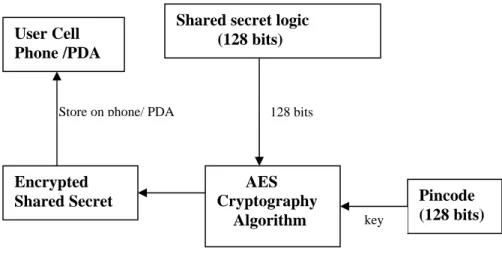
In the present work we have used suitable encryption/decryption techniques that would be used to keep TICs as secret codes on cell phones / PDAs. The user can easily pick up a TIC from the stored list of TICs to initiate secure web transaction, instead of typing complicated TIC code in each transaction. To keep the TICs secret we store our TICs list in an encrypted manner and decrypt it at the time of requirement. This code is used to initiate secure web transaction using cell phones / PDAs.
M.Tech.- Thesis (July, 2007) Indian Institute of Information Technology, Allahabad 3 Finally we extend our system for two-way authentication which authenticates both parties involved in transactions. Under this we would authenticate the company or service provider to the user. The proposed technique authenticates the company or service provider to the user along with the authentication of user to the financial institutions [18].
1.2
Requirements and Conditions
In the proposed work, we take the following facts intoconsideration:
The user has one cell phone with java enabled service.
On a mobile connection user has activated General Packet Radio System (GPRS) connection. In GPRS connection, the charging amount depends solely on the amount of exchanged data and not on the duration of the connection.
To make system less vulnerable authentication should not be dependent on the web server. Web server is generally vulnerable to several types of hacking attacks. Thus, authentication is done by the separate Authentication Server offered by the financial service provider i.e. banks etc. This makes a system more secure to maintain confidentiality and privacy of customer’s data.
M.Tech.- Thesis (July, 2007) Indian Institute of Information Technology, Allahabad 4
1.3
Outline of Thesis
Chapter 2 describes the Factors of Authentications with some key types of online frauds. It also focuses on the guidelines issued by Federal Financial Institutions Examination Council (FFIEC) related to stronger authentication for Internet banking services which shows that effective authentication system is necessary for financial institutions.
Chapter 3 highlights some existing M-Payment and electronic payment systems with their importance and application areas. It also presents a detailed study of the SET protocols and points out some of the disadvantages of the system.
Chapter 4 provides a brief introduction to the various modes of electronic payment with the details of the proposed system specifications. It also shows the Multifactor authentication techniques used in the present work with detailed explanation on the proposed protocols for Secure Web Authentication and Two-Way Authentication.
Chapter 5 discusses the details of transaction flow of the proposed protocols, with various components involved in the system.
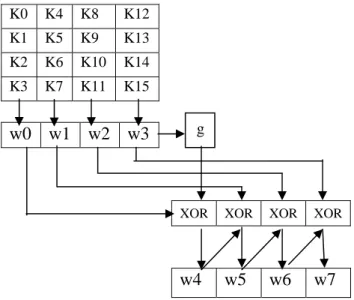
Chapter 6 talks about the Cryptography and Key Management of the system with the session tracking. It also briefly explains the concept of the key expansion cipher key management.
Chapter 7 provides a detailed analysis of the proposed system under various internet attacks. It talks about the system security features and demonstrates the system resistance to various internet threats.
Chapter 8 focuses on the various technologies that have been used to implement the system along with their advantages and features. This chapter also describes the tools used in implementation of the client and server of the system.
M.Tech.- Thesis (July, 2007) Indian Institute of Information Technology, Allahabad 5 Some simulation results are discussed in chapter 9. The section provides the screenshots of the functionality provided by the developed system to make secure wireless payment. The screenshots helps to provide a closer look at the developed system.
Conclusion is given in the last chapter 10 and scope of future integration is also incorporated.
Appendix- A shows the database schema design used in simulation of the system with corresponding integrity constraints applied in the schema.
Appendix- B shows the list of server side servlets of the system with their brief functionality and purpose.
Appendix- C gives details of various commands and setting used throughout the system development process.
Appendix- D gives details of various terms and abbreviations used throughout the dissertation.
M.Tech.- Thesis (July, 2007) Indian Institute of Information Technology, Allahabad 6
1.4 Summary
The Financial organizations offer Internet based commerce and services should use an effective method to authentication their customers or users and their transaction.
A single factor authentication such as user name and password is inadequate for user identity verification and vulnerable to various internet attacks.
Financial Institutions should use Multi-factor Authentication techniques to increase the faith of the users on wireless financial transactions.
The proposed system is based on multifactor authentication – TIC validation and SMS verification are the strong features of the system.
M.Tech.- Thesis (July, 2007) Indian Institute of Information Technology, Allahabad 7
Chapter 2
Factors of Authentication
In this chapter we examine the necessity of having a secure technique for performing online financial transactions. The following reports and statistics, culled from various sources, clearly demonstrate the rise in online frauds.
2.1 Online Banking Fraud
2.1.1 The Rise in Online Banking Fraud
The Internet is a medium which allows large number of people or organizations to communicate with each others in a few seconds, without much efforts and charges. Now online fraud is very popular all over the world, it has become a major source of revenue for criminals. The banks or financial institutions are very attentive in detecting and preventing online frauds. Reuters reports shows that according to US Treasury advisor Valerie McNiven the cyber-crime raised big amount of money globally. The report shows that increasing number of attacks and the evolution of their techniques. The report from Anti-Phishing Working Group in November 2005 shows raise in number of Phishing attacks and their techniques [19, 20, 44]:
More than 2000 companies, consisting of ISPs and banks, reported 16,882 unique phishing attacks.
The report also shows that increase in the number of fake URLs hosting to steal user passwords.
M.Tech.- Thesis (July, 2007) Indian Institute of Information Technology, Allahabad 8
2.1.2 Key Types of Online Fraud
The Online fraud has been categorized broadly into two categories as mentioned in [20]:
1. User Identity Theft: the user’s secret information required to access the online systems is stolen through means that include:
Phishing attacks which trick the user into providing access information.
Key-loggers and “spyware” which clearly capture access information.
2. User Session Hijacking – Attacker gets control over the active user session and monitors all user activities. In this attack all user’s online activities are monitored using malicious software (“malware”). Malware software for Session hijacking can run on a user’s local computer, or remotely as a attack on “man-in-the-middle”.
Local malware session hijacking attack performs host file redirection.
Remote malware session hijacking attacks performs DNS hijacking and Content Injection.
2.1.3 The Spirit of the FFIEC Guidelines
The FFIEC was established in March 1979 to recommend uniform principles, standards to promote consistency in the administration of financial agencies. The Council has five member agencies: the Board Governors of the Federal Reserve System, the Federal Deposit Insurance Corporation, the Office of Thrift Supervision, the National Credit Union Administration and the Office of the Comptroller of the Currency. In a press release the Federal Financial Institutions Examination Council (FFIEC) issued guidelines on October 12th, 2005 related to stronger and secure user authentication for Internet
M.Tech.- Thesis (July, 2007) Indian Institute of Information Technology, Allahabad 9 banking services it also recommend that financial institutions should use effective authentication system to reduce fraud [20].
Main highlights of the FFIEC Guidelines
Financial organizations offering online services and Internet-based commerce should use secure and efficient methods of customer’s authentication.
Authentication techniques based on single-factor authentication may not provide sufficient protection for Internet-based financial services.
The FFIEC agencies consider that financial institutions should implement multifactor authentication to reduce fraud and increase security for applications.
2.2 Factors of Authentication
2.2.1 Authentication Methodologies
Existing authentication methodologies have basic three “factors” [19, 45]:
Know: The user knows (password, PIN);
Has: The user has (ATM card, smart card); and
Is: The user is (biometric characteristic such as a fingerprint).
Authentication methods those are based on more than one factor are more difficult to break and secure than single-factor methods. Efficiently designed and implemented multifactor authentication methods are more reliable and secure to reduce online frauds.
M.Tech.- Thesis (July, 2007) Indian Institute of Information Technology, Allahabad 10
2.2.2 Selection of an Authentication key
Selection of an appropriate authentication key is one important characteristic of securing online services [44].
1. Passwords
A password is a type of secret authentication data which grants access to only authorized users. The password is known to the only authorized users and unauthorized persons are unaware of this, and user wish to gain access must be tasted to verify the authnticity of the user by checking the password. The passwords are universally used to keep authorization. However, password systems are vulnerable to many attacks and attackers can recover the user password by some attack. Additional protections have been implemented to protect the data communication channel to make password confidential, but this is not completely secure against attacks. Many security experts now realized that passwords are not secure mechanism to protect user confidential data; passwords can be hacked easily by hacking attacks [44].
2. Hardware tokens
A hardware token is physical device, it is a hardware implementation of the authentication device attached to an authorized user’s computer. Hardware token is a specialized physical device that protects secrets (cryptographic keys) and performs cryptographic operations. The cryptographic operations are used to secure the communication channel and authentication of parties [44].
Some of the major drawbacks of hardware tokens are:
It Increases the implementation cost, and complex functionality required in implementation and deployment.
M.Tech.- Thesis (July, 2007) Indian Institute of Information Technology, Allahabad 11
Reduced ease of use for customers.
3. Software tokens
Software tokens are similar to hardware tokes. It is software implementations of hardware tokens. Software tokens run on the PC or on a separate multi-purpose device but hardware tokens are stored on an external device away from the PC. Software tokens support authentication of both parties and protect the used communication channel to transmit data for authentication [44].
The major issues with software tokens are:
Software tokens can be copied easily
They may be copied without knowledge of user.
This could be happen if the system is less secure in protecting the secret. The main advantage of software token is low cost.
4. One-time passwords
The one-time password (OTP) based system is more secure then ordinary password based system, it is diffcult break and secured from unauthorized users. In this type of system passwords get updated constantly, for each access user has new password so it reduced the risk. Special algorithms are used to generate a series of passwords. Each password of the succession is called a one-time password as it is different from the other passwords and each password is used only once. Many types of one time password generation system are available to protection against attacks [44].
M.Tech.- Thesis (July, 2007) Indian Institute of Information Technology, Allahabad 12
They are very easy to use
This type of systems has lower cost and complexity as compared to the cost of software and hardware tokens.
One time password reduces the risk of attack against traditional passwords.
5. Biometrics
In Biometric authentication human physical and behavioural characteristics are used to verify the identity of the user. Biometrics is well suited to local access control rather than remotely access authentication. In case of remote access based on biometric authentication user’s personal data are used for authentication, significant privacy issues arise with thecollection, storage and use of such information. Special care must be taken in case of remote authentication because user’s personal data travels on communication network for authentication [44].
The financial agencies consider that single-factor authentication is not appropriate for financial transactions or access to customer information or online transfer of funds [19, 20]. The tools used in single-factor authentication are passwords and PINs, have been widely used for online banking and in e-commerce, including account balance inquiry or online payment. However, financial institutions should assess the security of such authentication techniques and protect their customer’s data from various online threats such as phishing,malware access and pharming. Where risk assessments signify that the use of single-factor authentication is not appropriate, financial institutions should implement multifactor authentication. Multifactor Authentication will increase the system security by providing an additional authentication “factor” further than the traditional login/password.
M.Tech.- Thesis (July, 2007) Indian Institute of Information Technology, Allahabad 13
2.3 Summary
Recent studies have shown that there is increase in online fraud or identity theft.
Online frauds are widely categorized in two categories – User Identity theft and User Session hijacking.
FFIEC has issued guidelines which show that single factor authentication is not secure and vulnerable to various online attacks, so financial institutions should implement multifactor authentication system.
Selection of an authentication key is an important issue in multifactor in authentication.
M.Tech.- Thesis (July, 2007) Indian Institute of Information Technology, Allahabad 14
Chapter 3
Introduction to existing Payment System
Mobile Payment (M-payment) is a wireless payment system that has raised the attention of researchers in the last few years. M-Commerce payment can be conducted in several ways and is based on “any–where, any-time” paradigm. M-payment is a critical component in M-commerce or E-commerce applications. According to the world wide forum, M-payment on a mobile device would be very popular and provide tremendous opportunities for M-commerce in the coming years.
Secure Wireless payment system has become an important research area in the last few years. There are various types of electronic payment solutions are available for internet based commerce. According to Gao et al. [2], mobile payment means wireless based electronic payment for M-commerce to support point-of-sale/point-of-service (POS) payment transactions using mobile devices such as cellular phones, smart phones and personal digital assistants (PDAs), or mobile terminals. In general, M-payment systems is widely used by merchant to make wireless based payment, content vendors, and information and service providers to process and support m-payment transactions based on wireless commerce applications. As discussed in [2], the existing m-payment systems can be classified into three major types.
The first type is known as account-based payment systems, in which each customer has a valid account maintained by a Trusted Third Party. The user can initiate pre-paid or post-paid financial transaction. There are three subdivisions of account-based M-payment systems:
M.Tech.- Thesis (July, 2007) Indian Institute of Information Technology, Allahabad 15 1. The payment system based on mobile phone, which facilitates the customer to do commerce and make payment over mobile phones,
2. The Smart Card Payment systems, and
3. Credit-Card M-payment systems, the users can make payment via of credit cards using their mobile devices.
More details about different account-based payment systems are discussed in [3, 4, 5, 6].
The second type of m-payment system refers to the mobile POS payment systems by which customers can purchase products using vending machines or online website with their mobile devices. There are two types of POS payment systems:
1. An automated POS payments, which are frequently used in immobile terminals such as vending machines, parking meters, etc.;
2. Attended POS payments, in which mobile users can make payments with the assistance from a service party such as a taxi driver, a counter clerk, etc.
A typical example of mobile POS payment system is Ultra’s M-Pay (http://www.ultra.si/).
The third type is E-wallets or E-cash. In this method customers stores digital cash in their E-wallet from a debit card, credit card or virtual check. Digital cash is like electronic cash in virtual savings account where the user can make payment for their purchases. E-wallets are frequently used in micro payments or small payments. Customers can obtain E-Wallets from their financial institution, specific merchants, or technology providers to make payments [2].
M.Tech.- Thesis (July, 2007) Indian Institute of Information Technology, Allahabad 16
3.1
A SET Based Approach to Secure Wireless Payment
The objective of the present work was to develop a wireless payment protocol which supports credit card payments as well as debit card payments in a secure manner. Two existing protocols were taken into consideration: the SET protocol, On-line payments [7]. This section provides a brief overview of the protocols.
3.1.1 Secure Electronic Transaction (SET)
The Secure Electronic Transaction is an open encryption and security specification designed to protect credit card transactions on the Internet. Companies involved in the development of the SET are IBM, Microsoft, Netscape, RSA, Terisa and Verisign. It is supported by major corporations such as VISA Inc. and MasterCard. Although SET had been designed to operate in a wired infrastructure [7, 5, 34], its transaction flow and implementation of security are of interest to us since it can also be employed in a wireless scenario.
The SET protocol is basically used in existing credit-card based payment system and provides enhanced security to web based financial transactions as well as authentication of transaction and involve identities by registration and certification. SET is also an international standard with published protocol specifications.
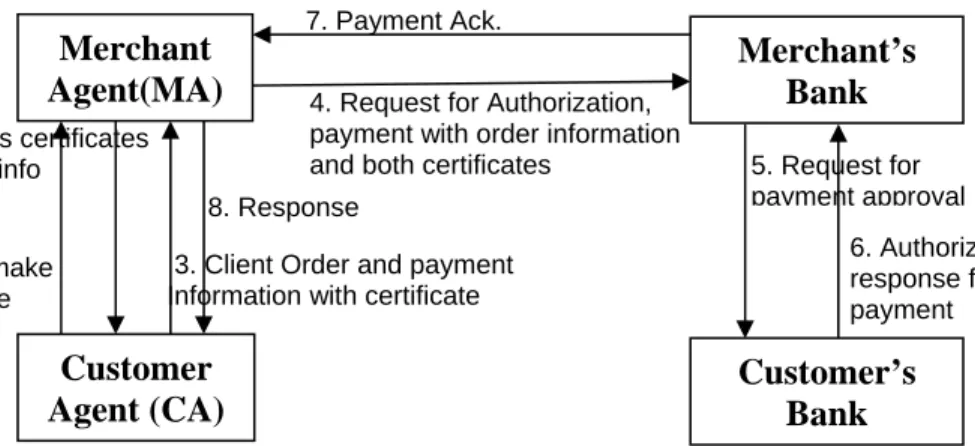
In Figure 1 on next page we show the flow of messages in the SET protocol. In a typical scenario, the merchant’s site will be accessed via the Internet by customers using their personal computers. While the SET protocol permits customers to make credit-card payments to any of the merchants offering a web-based service, customers also have the option of paying for other types of services using the on-line banking facilities (Internet) [7, 8, 34].
M.Tech.- Thesis (July, 2007) Indian Institute of Information Technology, Allahabad 17
Figure 1: Transaction flow in Secure Electronic Transaction (SET)
A brief description of the SET protocol, as depicted Figure 1, is described below:
1. The customers visit the merchant’s web site to select various goods for purchasing and get the total cost of all the selected goods, including taxes and shipping costs.
2. The system asks for payment method and the consumer chooses to pay through a credit card using SET.
3. Special software on the consumer's PC, called Digital Wallet, is invoked and it give choices to customer to select one credit card from the list of credit cards issued to customer.
4. The consumer selects the card to make payment, and the electronic transaction take place based on SET protocol.
5. After getting details of customer payment the merchant contacts the merchant’s Bank for customer authorization and payment.
1. user make Purchase request 6. Authorization response for payment 5. Request for payment approval 7. Payment Ack.
4. Request for Authorization, payment with order information and both certificates
8. Response
3. Client Order and payment Information with certificate 2. Merchant’s certificates
& Payment info
Merchant’s Bank Customer’s Bank Merchant Agent(MA) Customer Agent (CA)
M.Tech.- Thesis (July, 2007) Indian Institute of Information Technology, Allahabad 18 6. Merchant Bank will contact the customer’s Bank for the same and get approval of
payment.
7. Merchant will notify, if transaction is successful.
8. A few seconds later, there is a confirmation to the customer that this order has been processed.
On-line Payment services provided by most of banks, allow customers to make payments online to various persons or organizations that have previously registered themselves with the banks. Customers making online payment provide account number and type (i.e. savings, cheque etc.) and the amount to be transferred to the institution website. The bank generates transaction/reference number to confirm the successful completion of the transaction. At the end of the day, it also sends details of all the transactions carried out in the favor of merchant during the day for audit purpose [7, 34].
3.1.2 Disadvantages of SET
SET is a good example of a protocol that is not completely secure in user authentication. SSL-based methods are ignoring essential “security” necessities [10]. Some disadvantages of SET are:
1. SET is designed for wired networks and does not meet all the challenges of wireless network.
2. As the SET protocol was designed to maintain the traditional flow of payment data (CA – MA – Merchant’s Bank), There is a need of an end-to-end security mechanism.
3. The third element is the direction of the transaction flow. In SET, transactions are carried out between the Customer Agent and the Merchant. So it is vulnerable to various attacks like merchant can modify transactions data by altering the balance.
M.Tech.- Thesis (July, 2007) Indian Institute of Information Technology, Allahabad 19 4. Transaction flow is from Customer to Merchant so all the details of users credit cards/debit cards must flow via merchant’s side. It increases the user’s risk, since data can be copied and used later to access customer account without authorization.
5. There is no notification to the Customer from the customer’s Bank after the successful transfer. The user has to check his/her balance after logging on bank website again.
6. SET is only for card based (credit or debit) transactions. Account based transactions are not included in SET.
3.2
E-wallet or Digital cash
Jan Ondrus in [41] has given details on Digital cash or E-cash which is a method of money transfer, this method of the payment is electronic transfer of fund using computers via internet or on mobile phones via GPRS connection to use internet or Blutooth.This method of money transfer is easy and flexible to the users. Digital cash is also frequently used in day to day life to make small payments.
Digital cash system has many advatages which makes customers life easy, it also has some disadvantages which include fraud, device failure, tracking of perticular person and reduction in human social interactions. According to the facts given in [40], fraud over digital cash has been a pressing issue in recent years. It includes illeagle access of customers bank account and unauthorized acces of user private banking information which has increased the information hacking and identity theft. Some popular types E-wallet and Digital cash are briefly explain from [42] in next sub sections :
M.Tech.- Thesis (July, 2007) Indian Institute of Information Technology, Allahabad 20
3.2.1
Electronic Purse
Electronic purse is a system which facilitates customers not to carry cash with them for small payments. It is based on smart card technology which is similar to pre-paid financial card. Some advantages and disadvantages and example of existing system are given below for more detail on Electronic purse please refers [42].
Advantages
Very easy in use.
Capability to hold various currencies, simple payment based on P2P.
Consumers and retails are free from cash handling.
Disadvantages
Generally used in small payments.
There is no global standard for this type of payment system.
Electronic Purse is Bank dependent.
Existing Applications
Proton electronic purse developed by Banksys, Other smart card based electronic cash systems are- Mondex, Visa Cash, Manmont
3.2.2 Distributed Wallet
A distributed wallet is a payment system which initiates payment transaction via installed software on the consumer’s computer which interacts via Internet to the wallet servers to make payments. The client machine first makes a connection to the server machine using a connecting protocol for the user authentication and to make payment. Some advantages
M.Tech.- Thesis (July, 2007) Indian Institute of Information Technology, Allahabad 21 and disadvantages and example of existing system are given below for more detail on Distributed Wallet please refers [42].
Advantages
It works on smart card and secret PINs.
There is no need of Merchant subscription to make payment via distributed wallet service if the wallet client supports the payment system based on SET protocol.
Disadvantages
The complexity of Distributed wallets is higher than remote wallets and it also require large messaging sequence to run on dissimilar environment.
There is no any protocol which activates client side module of the distributed wallet to make interfacing with multiple wallet servers.
Existing Applications
Distributed wallet specification is available as a GlobalSET
3.2.3 Personal Wallet
A personal wallet is a software or hardware installed on user’s machine. There is no need of server, because payment transaction does not require any wallet server. The user’s credit information is stored locally on the user device. Some advantages and disadvantages and example of existing system are given below for more detail on Personal Wallet please refers [42].
Advantages
M.Tech.- Thesis (July, 2007) Indian Institute of Information Technology, Allahabad 22
Ability of offline payment.
Advanced and strong security feature.
It can also works on smart card and secret PINs.
All card information and user’s confidential and personal data are in control of user.
Disadvantages
Need large storage capability on user device.
Existing Applications
SET based system - IBM Consumer Wallet, Ilium Software launched eWallet
3.3 Combined Web/Mobile Authentication for Secure Web
transactions.
The hybrid approach of authentication is proposed by Adi W. & Al-Qayedi A in [1] which enables strong authentication by combining two factors to authenticate the user. First authentication approach is a traditional Web-based username/password and second one is a Mobile-based challenge/response authentication. Results in [1] show that the combined system has resistance to eavesdropping attacks and provides security by maintaining secure remote authentication server. This system functions well in existing infrastructure and 3G mobile networks or pervasive computing environments.
3.3.1 Combined Web/Mobile Authentication
The above cited work, [1], proposed one of the combined Web/Mobile user authentication approach before making payment transaction. It uses browser based
M.Tech.- Thesis (July, 2007) Indian Institute of Information Technology, Allahabad 23 system for online transactions with cellular network for user verification. Their approach mainly operates as follows:
1. The user can start transactions from computer using internet and complete it over cellular network based GSM network, in this approach Network Service Providers are also involve in completion of transaction.
2. The user can start transaction via making simple request on internet via their computer before making payment.
3. The customer will get invoice detail of purchased goods by which they can collect their purchased goods after making full payment.
The protocol relies on SMS messages, i.e., after validation of user password user will get SMS from the web server to authenticate their identity. Then the user will proof their identity to the authentication web server via sending an encrypted image from their mobile to the authentication server. The above described authentication must be done with in a pre-decided fixed time frame.
3.4 P2P (Point to Point) Payment System
P2P-Paid is a mobile based payment system, its development process is a part of research at San Jose State University in 2004. The main objective of this system is to develop wireless payment protocol which initiates wireless payment transactions over cell phones. As mentioned in [2], in the existing mobile payment system transactions are carried out on Internet. P2P protocol for wireless payment supports online financial transactions over internet as well as peer-to-peer mobile payment transactions on mobile phones to make small payment using a Bluetooth technology of cell phones over wireless network [17].
M.Tech.- Thesis (July, 2007) Indian Institute of Information Technology, Allahabad 24 The basic purpose of the P2P-Paid payment protocol is to make secure and convenient payment using a lightweight protocol over Bluetooth communication. The user can make secure P2P financial transactions by using various options available to mobile users in this protocol. These options include device/service discovery for Bluetooth connection, make request for money, transfer money, management of all financial transactions, etc.
3.4.1 Components of P2P Payment Protocol
As referred to [2] the Payment protocol can be divided into two parts: 1. Mobile client to Server Communication Protocol.
2. Mobile Client to Mobile Client Protocol.
3.4.2 P2P-Paid system Client Functionality
As referred in [2, 17] mobile client interface supports the following functionalities in P2P-Paid system:
P2P party discovery: It discovers the users Bluetooth devices over Bluetooth network to connect them each other before making payment.
P2P session management: After making discovery and connection between Bluetooth devices, it generates P2P payment session for secure exchange of money and drop session after completion of transactions.
P2P payment management: The users can makeP2P mobile payment transaction over the Bluetooth network under secure session. The payment transactions in P2P payment protocol are based on 2-D payment transaction protocols.
M.Tech.- Thesis (July, 2007) Indian Institute of Information Technology, Allahabad 25
Account management: This option supports various operations of account
management such as account balance enquiry and displaying an account summary.
Payment scheduling: The user canupdate, delete and view their payment schedules using mobile phones.
Payee management: By this function user can add new payee information or remove existing payee details or view existing payee information. Payee management is required before making payment.
3.4.3 P2P-Paid System Server Functionality
The server works with installed middleware by communicating with mobile client software to provide wireless payment. As referred in [2, 17] the functionality of Server in P2P-Paid protocol is as follows:
P2P communication: A mobile client makes a connection to the server using a peer-to-peer 2-D payment protocol to start all mobile payment transactions.
User management: It supports user registration system and maintains user information.
P2P- Paid account management: It manages the user account information to maintain user account.
Bank Account Management: It maintains account detail at server side with security, confidentiality and data consistency.
Schedule management:It stores the user schedules of all mobile payment, including addition, updation or deletion of a payment schedule for mobile user.
M.Tech.- Thesis (July, 2007) Indian Institute of Information Technology, Allahabad 26
Payment Management: It maintains the records of all the mobile payment transactions with there status.
Session Management: It generates a P2P payment session for secure exchange of money and control this session till completion of transactions.
Security management: It maintains the various security controls such as access control authentication, security key management, encryption/decryption, etc.
3.5 Summary
The Secure Wireless payment system has become an important research area in last few years. Mobile payment refers to wireless based electronic payment for M-commerce to support point-of-sale/point-of-service (POS) payment transactions using mobile devices such as cellular phones, smart phones, and personal digital assistants (PDAs). M-Payment is classified broadly in three categories :
- Account-based payment systems, - Mobile POS Payment system, - E-wallets or E-cash.
The Secure Electronic Transaction is a Card based payment protocol, SET is also an international standard with published protocol specifications. Many leading Companies like IBM, Microsoft, Netscape, RSA, Terisa and Verisign are involved in the development of SET. SET is designed for wired networks so do not meet the all the challenges of wireless networks.
E-wallet Digital cash or E-cash is a method of money transfer, this method of the payment is electronic transfer of funds using computers via internet or on mobile
M.Tech.- Thesis (July, 2007) Indian Institute of Information Technology, Allahabad 27 phones via GPRS connection to use internet or Blutooth. Many types of digital wallet systems are availables of which Electronic purse, Distributed Wallet and Personal Wallet are famous examples.
The P2P-Paid payment protocol is a wireless payment protocol which initiates wireless payment transactions over cell phones to provide a convenient, secure money transfer over Bluetooth communication protocol. P2P Payment systems are frequently used for micro payments and it works for the payment between the mobile client to mobile client or mobile client to P2P web server.
M.Tech.- Thesis (July, 2007) Indian Institute of Information Technology, Allahabad 28
Chapter 4
System Specification and Architecture
Various forms of existing electronic payments have been considered in the previous chapter where we also examined their advantages, disadvantages and domain of applicability. In the present chapter we develop the basic ideas of the present work. We first discuss the modes of payment and the role of multifactor authentication. This is followed by an overview of the protocol developed by us for client and transaction authentication. This is then extended to build a protocol for two way authentication.
4.1 Mode of Payment
Electronic payment systems are classified in three groups as mentioned in [43]:
1. Credit card based systems 2. Debit card based systems
3. Electronic checks and Account Transfers
4.1.1 Credit card based systems
Credit cards are a pre-agreement repayment system, credit card issuers and the acquirers are members of a card association, e.g. Visa or MasterCard. Issuers are bank authority. The merchants accept credit cards for payment they required necessary infrastructure, they have association with acquires who provide equipments for credit card payment. Credit card payments can be made both when being physically present or over telephone or Internet [43].
M.Tech.- Thesis (July, 2007) Indian Institute of Information Technology, Allahabad 29
4.1.2 Debit card based systems
Debit cards have payments set against an account with a pre-agreed deposited scheme. It is similar to an ATM card. Both the Debit card issuers and the acquirers are members of a card association, e.g. SBI ATM Card, City Bank ATM Card etc. Normally all of them are banks. The merchants have association with the acquirer, who provides the necessary infrastructure to the merchant for accepting Debit card payments. Debit card payments can be made both when being physically present or over telephone or Internet [43].
4.1.3 Electronic Transfer systems
Electronic payment rely on the Internet to make money transfer which is based on centralized account model, generally association is required between both the payer and the merchant’s financial institutions to make money transfer or both parties has account in the same financial institution. The transfer is simple from one account to another. In case of centralized account situation the major issues are ways for debiting the accounts and account holder authentication for funding [43].
4.2 Multifactor Authentication
As emphasized in the previous chapters, we need a strong authentication mechanism when using electronic transfer systems. Single factor authentication is considered to be inadequate for this purpose. Thus, we need multi factor authentication.
Multi Factor Authentication: Single-factor authentication is inadequate for high-risk transactions involving access to customer information or the movement of funds to other parties. To provide secure web transactions using cell phones multi factor authentication techniques have to be used. In our system we are using multi factor authentication using two different modes. The implementation is performed using TIC and SMS. While SMS
M.Tech.- Thesis (July, 2007) Indian Institute of Information Technology, Allahabad 30 has been used in previous approaches to the problem [1], we are introducing the new concept of TIC as a novel method of authenticating a transaction and the user.
1. TIC Authentication: TIC (Transaction Identification Code) Authentication is the technique which is used to identify both the user and the ongoing transaction. TIC code certifies that the current transaction has been initiated by the right person and it is a valid user who is trying to access his/her account
TIC codes are:
Issued by the Bank or Financial institution to its customer.
8 bit or 16 bit Pseudo randomly generated code which is assigned to the customers.
May be complicated digit sequence or combination of numeric or alpha numeric characters.
One TIC code is used only once, i.e. a unique TIC is used for each transaction.
Here we are assuming financial institutions are responsible to store TIC generation logic and algorithm confidentially and they have their specific parameters to decide the complexity of TICs format. Financial institutions are also responsible for upgrading from time to time the TIC generation logic and data and also to keep it absolutely secret. The user will get the list of TIC codes from the bank or financial institution according to its requirement.
The Bank or Financial institution will keep a record of issued TIC codes to its customers and match the same code during the online web transaction. A TIC code is cancelled after each successful transaction (i.e. each TIC code is used only once). We can also decide a validity time period of TICs according to issuing organization policies, which provides an extra security feature in the system.
2. SMS Authentication: Another method to validate user transaction is an SMS confirmation. The Bank or financial institution stores user cell phone number to provide
M.Tech.- Thesis (July, 2007) Indian Institute of Information Technology, Allahabad 31 multi factor authentication. We believe that users will carry their cell phone and can receive and send the short message. As a result, only valid users who have account will receive confirmation SMS from the authentication server.
After getting an SMS the user can acknowledge the choices. When authentication server receives “YES” it knows that the user is valid and the user has approved their initiated transaction. On the other hand, if the user sends a “NO” or the user does not send any response within a specified time period then the transaction will be rolled back and terminated.
We believe in above reasonable assumption given in [1] that when user lose their mobile phones, they make complain of lost phone and take necessary steps to deactivate their SIM. After deactivation of SIM, user would not be able to receive any SMS generated for them.
Our user authentication system attempts to resolve some of the issues associated with the previously mentioned systems.
So, multi factor authentication is used to verify user identity by using following steps:
4.2.1 Web-Based Basic Authentication
Firstly, the user has to prove their identity to the web authentication server using a web-based username/password basic authentication process.
4.2.2 TIC Authentication
After authenticating the user using username/password, the web authentication server demands a TIC code from the user. Now Cell phone/ PDA user will insert a one time TIC code to uniquely identify their transaction and prove his/her authentication to the web
M.Tech.- Thesis (July, 2007) Indian Institute of Information Technology, Allahabad 32 authentication server. TIC code would be selected from the stored list of TICs which were issued by authorized financial institution and uniquely assigned to its customers.
4.2.3 SMS Confirmation
After the TIC code identification and validation the remainder of the transaction will proceed. At the end of the transaction the user will get an SMS from the web authentication server to confirm his/her financial transaction. By this SMS user can confirm their transaction by “YES” or “NO”. If user chooses yes then transaction would be committed on the server and if the user denied then transaction would be cancelled. The security of the proposed system also depends on the security of encrypted messages sent by SMS and WAP, A5/3 Algorithm is used for message encryption as mentioned in [23].
4.3 System Architecture
In this section we present the basic flow of messages for implementing the proposed protocol. This also allows us to identify different components of the system and their functionalities.
4.3.1 Secure Web Authentication Protocol
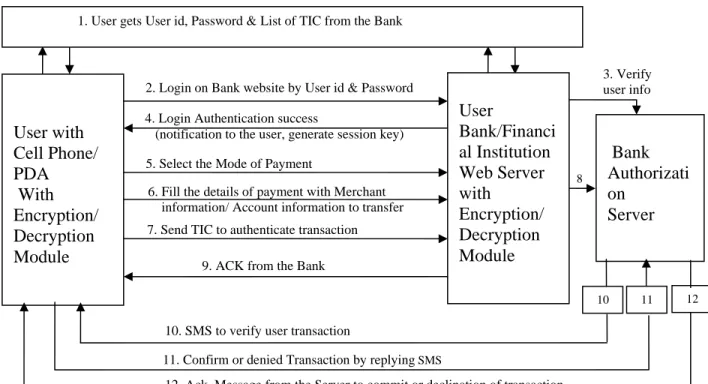
Figure 2 shows the Protocol for secure web authentication using Cell Phone/PDA. This protocol starts with the action of money transfer decided by user. Here we assume that the user information is available at server which includes user’s cell phone number. A separate authentication server is recommended to maintain strong security to authenticate users and their transactions with regular web and database servers of user information. As illustrated in Figure 2, following are the steps:
M.Tech.- Thesis (July, 2007) Indian Institute of Information Technology, Allahabad 33 Below we describe each step of the above protocol.
1. User gets username/password and Transaction Identification codes (TICs) from the Bank. Each user has only one username/password to their account, but TIC code is unique for each online transaction. So users will get list of TIC codes from the bank authority or authorized financial institution according to their requirement.
2. A Web-based username/password basic authentication is used to identify the user to the Web server.
3. The username and password will be verified by the Bank Authentication Server. After user recognition the user will get option screen to proceed further.
3. Verify user info
12. Ack. Message from the Server to commit or declination of transaction 9. ACK from the Bank
8. Verify TIC from assigned TIC 7. Send TIC to authenticate transaction
2. Login on Bank website by User id & Password
8
10
6. Fill the details of payment with Merchant information/ Account information to transfer
10. SMS to verify user transaction
11. Confirm or denied Transaction by replying SMS
4. Login Authentication success
(notification to the user, generate session key) User with Cell Phone/ PDA With Encryption/ Decryption Module Bank Authorizati on Server 5. Select the Mode of Payment
User Bank/Financi al Institution Web Server with Encryption/ Decryption Module
Figure 2: Protocol for wireless payment: Multifactor secure Web authentication protocol using mobile devices
1. User gets User id, Password & List of TIC from the Bank
12 11
M.Tech.- Thesis (July, 2007) Indian Institute of Information Technology, Allahabad 34 4. The user will get a notification of a successful logging with welcome message.
This step also generates a session key.
5. The user will select mode of payment. We have considered two modes of payment: Credit Card based system & Account based Electronic transfer. It is straightforward to add other modes to our system.
6. User will insert the details of payment by filling in a simple form with details such as merchant’s bank and branch code information, invoice number and account number to which an amount has to be transferred.
7. The user will insert a TIC code by simply choosing a TIC code from the stored list of TICs. Note that TICs are stored, with password protection, with a local encryption on the cell phone. The user will decrypt and insert the TIC in the financial transaction to give unique authentication to each web transaction. All details of the transaction, with attached TIC, will be further encrypted by AES encryption technique and submitted to the bank web server. The bank web server would pass it on to the authentication server where it would be decrypted and matched with the list of TICs that have been issued to the user. Discussions on the encryption/decryption technique used in the proposed system are given in chapter 6.
8. The bank authorization server decrypts the received message and extracts the TIC. It then verifies the TIC received from the user by comparing it with the stored list of TICs in the user account information at server database. If both TICs match then it cancels the used TIC from its database and goes to the next step. If no TIC matched with those in database then the authentication server will deny the user transaction and display appropriate error message to the user.
M.Tech.- Thesis (July, 2007) Indian Institute of Information Technology, Allahabad 35 9. Bank server generates an acknowledgement to the user, which makes user free
to logout from the web portal and wait for a confirmation SMS or to initiate another financial web transaction.
10.After completing the database updation with respect to the ongoing transaction, the authentication server will send an SMS to the user’s cell phone to verify the initiated web transaction. The cell phone number of the user is available on authentication server.
11.The user would confirm their initiated transaction by choosing “YES” or deny it by choosing “NO” by replying confirmation SMS.
12.The server will notify the user by a Message to acknowledge the successful completion of transaction or declination of the transaction.
In the above module all the transactions from client to server or vice versa are strictly in encrypted format. Encryption and decryption module is installed on the cell phone/PDA of the user and on server side environment. Cryptography module discussed in more detail in chapter 6. From the above description we can see that after authenticating the user using the basic login/password mechanism, the user and transaction are authenticated again using the TIC mechanism and the transaction is again verified using SMS. Thus we have multifactor authentication and verification steps, using different media.
4.3.2 System for Two Way Authentication which authenticates both the
parties
Mutual authentication is a process by which the web site (i.e. the service provider or merchant) is authenticated to the customer along with authenticating the customer identity. Currently most financial institutions do not authenticate their Web sites to the
M.Tech.- Thesis (July, 2007) Indian Institute of Information Technology, Allahabad 36 customer before collecting sensitive information. One reason for the success of phishing attacks is that unsuspecting customers cannot determine that they are being directed to spoof web sites during the gathering stage of an attack. Financial institutions can provide authentication of their web site to the customer which helps customers in selection of legal web sites over spoofed site. After having analyzed the Secure Electronic Transaction (SET), on-line payments [6, 10] and having taken into consideration the constraints of the wireless infrastructure, we developed the secure protocol for Wireless Payment, supportive of one-way authentication in the previous section. We extend the protocol to support two-way authentication in the present section i.e. we would like to authenticate the merchant / vendor / service provider to the user in addition to authenticating the user and the transaction. This is a necessary addition since, in E-commerce and M-E-commerce applications, the user may not be aware of the authenticity of the merchant or service provider. In fact this is the main reason why phishing attacks are so popular and successful.
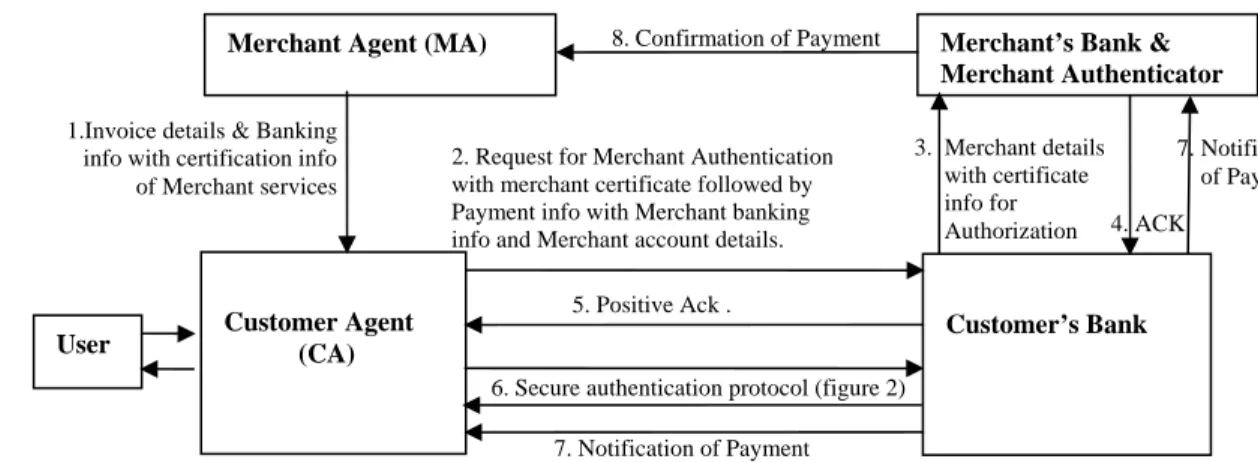
In order to develop a system providing two way authentication we have considered five major components with their certain roles as shown in Figure 3 below:
1. User: A user is a valid account holding customer of the bank,
2. Customer Agent (CA): CA is a software module which is installed on the user’s mobile device.
3. Merchant Agent (MA): An MA is an online service provider and merchant website by which the users perform online purchasing / transactions.
4. Customer’s Bank: This is the bank at which the user has a valid account, it also contains the authentication server necessary to authenticate the users and their transactions.
M.Tech.- Thesis (July, 2007) Indian Institute of Information Technology, Allahabad 37 5. Merchant Bank: This is the bank in which the merchant has a valid account,
the merchant Bank is also responsible for authenticating the merchant services.
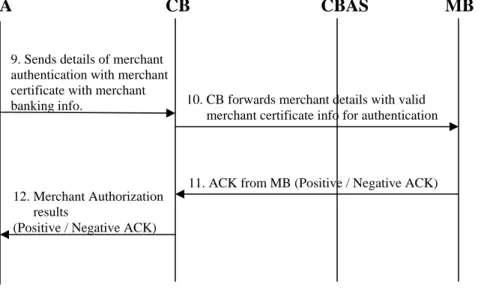
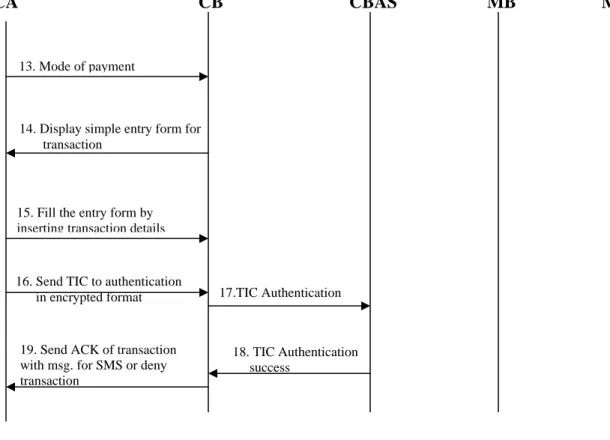
The two way Authentication protocol starts when the MA sends an invoice detail to CA related to purchase goods with payment information and terminates when the MA receives acknowledgement of received payment from Merchant’s bank [7] as shown in Figure 3, the flows for the payment transactions are as follows:
Figure 3 : Protocol for Wireless Payment : Two Way Authentication
1. The MA generates an invoice related to purchasing detail and sends the Merchant’s encrypted banking information and authentication certificate with the invoice and payment details to the CA.
2. The CA requests for authentication of Merchant