
Chemical
2
•
Atoms – same number of protons (+) and
electrons (-); electrically neutral
•
Ions – atoms w/ a (+) or (-) charge; have lost
or gained electrons (e-)
*
Cations: (+) charge; has lost e-; metals
* Anions: (-) charge; has gained e-;
3
• Types of Compounds
A. Molecular – atoms
bonded together by shared pairs of e- (covalent bonds); formed between nonmetals
ex: C6H12O6
B. Ionic – ions attracted to each other by opposite charges; formed between a metal and a nonmetal
4
Chemical Formulas – show the type and number of
atoms in smallest unit of substance
•
Molecular Formula
– type and number of atoms
joined to form a molecule
ex: C
2H
5OH
•
Formula Unit
– smallest ratio of ions in an ionic
compound
ex: CaF
25
Representing Chemical Compounds
•
Law of Definite Proportions – in any sample of
a compound, the elements are always
combined in the same proportions
ex: H
2O and H
2O
2H
2O – water – H:O ratio always 2:1
Chemical Formulas
•
A chemical formula indicates the elements
present in a compound and the relative number
of atoms of each.
–
For example, H
2O is the chemical formula for water; it
indicates that water consists of hydrogen and oxygen
atoms in a 2:1 ratio.
•
The formula contains the symbol for each
element, accompanied by a subscript indicating
the number of atoms of that element. By
Chemical Formulas
•
What are the element ratios for these
common chemical formulas:
–
NaCl
–
CO
2Chemical Formulas
•
The subscripts in a chemical formula are part
of the compound’s definition—if they change,
the formula no longer specifies the same
Chemical Formulas
•
Chemical formulas list the most metallic
elements first.
–
The formula for table salt is NaCl, not ClNa.
•
In compounds that do not include a metal, the
Chemical Formulas
•
Among nonmetals, those to the left in the
periodic table are more metal-like than those
to the right and are normally listed first.
–
We write NO
2and NO, not O
2N and ON.
•
Within a single column in the periodic table,
elements toward the bottom are more
metal-like than elements toward the top.
11
Identifying Ionic Charges
•
Group A elements
– use the periodic table to
determine ionic charge
* elements in same group have
same ionic charge
* Group 4A and Noble gases –
almost never form ions
•
Group B elements
– many have more than
one ionic charge
12
Identifying Ionic Charges
http://wps.prenhall.com/wps/media/objects/476/488316/ch04.html
Charge on cations corresponds to group #.
Charge on anions is found by subtracting 8 by group number
13
Binary Ionic Compounds
• Compounds composed of 2 different monatomic
elements
• To write binary formulas – write cation first, then anion
*criss-cross charges to determine how many of each ion you need
*use subscripts to denote number of ions
ex: Ca2+ + Cl1- CaCl 2
Na1+ + Cl1- NaCl
• To name binary compounds – write name of cation first,
then anion (-ide)
ex: CaCl2 = calcium chloride
14
Ternary Ionic Compounds
• Compounds containing at least one polyatomic ion; at least 3 different elements
• To write ternary formulas: write cation first, then anion
*criss-cross charges to determine how many of each ion you need
*use subscripts to denote number of ions
*must use parentheses around polyatomic if more than one is needed!!!
ex: Na1+ + SO
32- Na2SO3
Mg2+ + OH1- Mg(OH)
2 [not same as MgOH2]
• To name ternary compounds: write name of cation, then name of anion (not
all end in “-ide”)
**be careful with transition metals (more than one charge)** ex: CaCO3 = calcium carbonate
PbSO4 = lead (II) sulfate
Nomenclature Rules
Rules for naming three classes of compounds:ionic compounds, binary covalent compounds & acids.
What type of compound is it?
COVALENT COMPOUND: Nonionic – not composed of
cations & anions.
Generally, only nonmetals
are present. IONIC COMPOUND:
Composed of cations
(metals or polyatomic ions) and anions
(nonmetals or polyatomic ions).
ACID:
Produces H+ in water.
Typically the hydrogen cation is written first in the
chemical formula. TYPE I:
Only one type of cation is observed.
TYPE II:
More than one type of
cation is observed. TYPE III: Covalent, nonionic. ACIDS: Anion does not contain oxygen. OXYACIDS: Anion does contain oxygen.
Rules for Naming Ionic Compounds
1.) Determine whether or not the compound is ionic.
How do you know the compound is ionic in the first place?
a.) If the compound contains a metal, then it is
most likely an ionic compound. Metals readily lose electrons to form positive ions, called cations. Ionic compounds almost always contain a metal as a cation and a nonmetal as an anion.
b.) However, not all ionic compounds will contain a
metal cation. The cation could be a polyatomic ions, such as NH4+.
2.) Determine whether there is only one type of cation possible (Type I) or whether there are several
cations possible (Type II).
Rules for Naming Ionic Compounds
a.) If the cation is a polyatomic ion (e.g., ammonium,
NH4+), then there is only one possible charge and
so it is a type I compound.
b.) If the cation is a metal, determine if it forms only one type of cation.
Alkali metals (Group 1A) +1 cation
Alkaline earth metals (Group 2A) +2 cation
Transition metals (Group 1-8B)
1.) The cation is named first and the anion is named
second.
2.) The name of the cation is the same as the name
of the element. So both the element Mg and the cation
Mg2+ are called magnesium.
(Note: For polyatomic cations, you must memorize the names. )
3.) The anion is named by taking the root name of
the element and adding the suffix -ide. For example,
F is an atom of fluorine and F- is the anion fluoride.
(Note: For polyatomic anions, you must memorize the names. )
So MgF2 would be magnesium fluoride.
Polyatomic ions then resemble molecules in that they contain at least two atoms bound together in a definite arrangement.
The steps for naming compounds with polyatomic ions:
1.) The cation is listed first and the anion second.
2.) The polyatomic ion names must be memorized.
3.) No extra prefixes or suffixes are added.
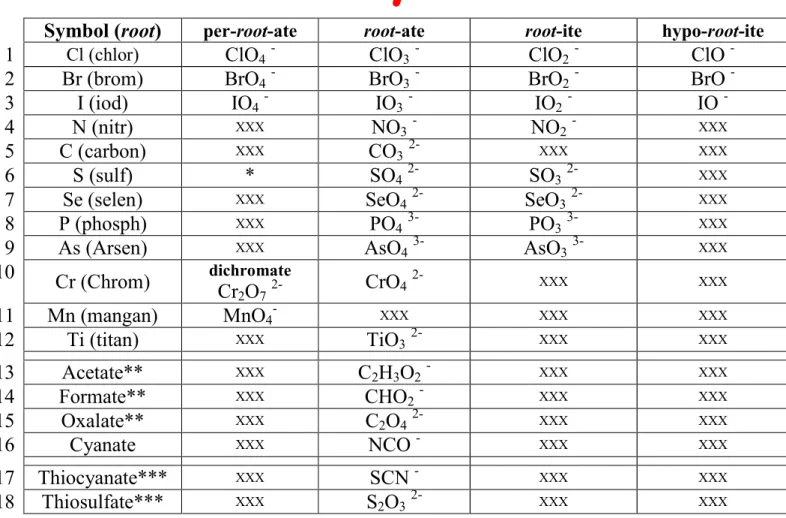
Rules for Naming Type I Compounds
with polyatomic ions
Symbol (root) per-root-ate root-ate root-ite hypo-root-ite
1 Cl (chlor) ClO4- ClO3- ClO2- ClO
-2 Br (brom) BrO4- BrO3- BrO2- BrO
-3 I (iod) IO4- IO3- IO2- IO
-4 N (nitr) XXX NO3- NO2- XXX
5 C (carbon) XXX CO32- XXX XXX
6 S (sulf) * SO42- SO32- XXX
7 Se (selen) XXX SeO42- SeO32- XXX
8 P (phosph) XXX PO43- PO33- XXX
9 As (Arsen) XXX AsO43- AsO33- XXX
10 Cr (Chrom) dichromate
Cr2O72- CrO4
2- XXX XXX
11 Mn (mangan) MnO4- XXX XXX XXX
12 Ti (titan) XXX TiO32- XXX XXX
13 Acetate** XXX C2H3O2- XXX XXX
14 Formate** XXX CHO2- XXX XXX
15 Oxalate** XXX C2O42- XXX XXX
16 Cyanate XXX NCO - XXX XXX
17 Thiocyanate*** XXX SCN - XXX XXX
18 Thiosulfate*** XXX S2O32- XXX XXX
* Sulfur has two anions that are often referred to as persulfate. They are peroxomonosulfate (or peroxymonosulfate) ion, SO52- and peroxodisulfate (or peroxydisulfate) ion, S
2O82-.
**The organic anions.
*** Thiocyanate and thiosulfate are formed by substituting a sulfur for an oxygen into the cyanate and sulfate ions.
Nomenclature Mnemonic for Remembering “ates”
Consonants
=
Vowels =
Polyatomic
Oxygen
Charge
Ion
Nomenclature Mnemonic for Remembering “ates”
Nick the Camel Ate a Clam Supper and Crepes (for dessert) in Phoenix
Nick = Nitrate 3 -1 NO3 –
Camel = Carbonate 3 -2 CO3 2-
Clam = Chlorate 3 -1 ClO3 -
(Note: Bromate and Iodate are the same as Chlorate.)
Supper = Sulfate 4 -2 SO4
2-Crepes = chromate 4 -2 CrO4
2-Phoenix = Phosphate 4 -3 PO4 3-
Rules for Naming Type II Compounds
Additionally for Type II Compounds:4.) Use a roman numeral after the cation to indicate the ionic charge of that cation.
So FeO would be called iron(II) oxide since the cation
is Fe2+ and Fe
2O3 would be iron(III) oxide since the cation
is Fe3+.
5.) Alternatively, when using traditional names atoms
whose valence numbers vary, you add the suffix –ous to the one with the lower valence state and –ic to the one with the higher valence state.
So FeO would be called ferrous oxide since the cation
is Fe2+ and Fe
2O3 would be ferric oxide since the cation is
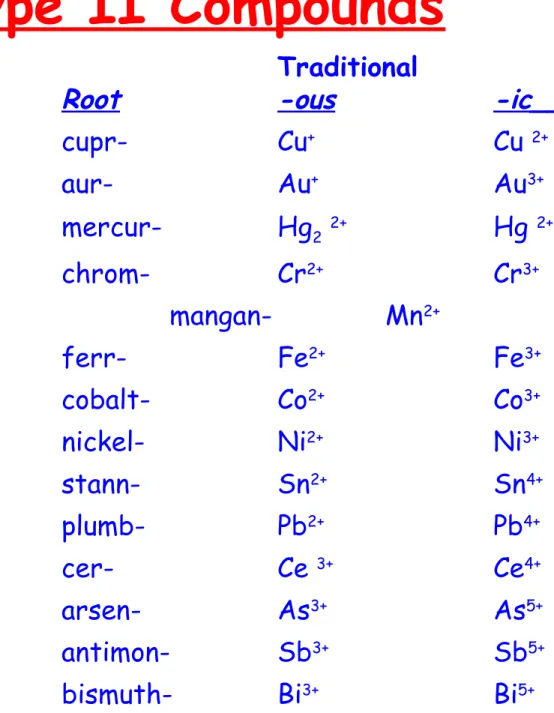
IUPAC Traditional
Root -ous -ic____ copper (I) & copper (II) cupr- Cu+ Cu 2+
gold (I) & gold (III) aur- Au+ Au3+
mercury (I) & mercury (II) mercur- Hg2 2+ Hg 2+
chromium (II) & chromium (III) chrom- Cr2+ Cr3+
manganese (II) & manganese (III) mangan- Mn2+ Mn3+
iron (II) & iron (III) ferr- Fe2+ Fe3+
cobalt (II) & cobalt (III) cobalt- Co2+ Co3+
nickel(II) & nickel (III) nickel- Ni2+ Ni3+
tin (II) & tin (IV) stann- Sn2+ Sn4+
lead (II) & lead (IV) plumb- Pb2+ Pb4+
cerium (III) & cerium (IV) cer- Ce 3+ Ce4+
arsenic (III) & arsenic (V) arsen- As3+ As5+
antimony (III) & antimony (V) antimon- Sb3+ Sb5+
bismuth (III) & bismuth (V) bismuth- Bi3+ Bi5+
Rules for Naming Binary Covalent Compounds
How do you recognize that something is a binary covalent compound (versus an ionic compound)?
1.) If a compound contains only nonmetals (no metals), then you can be reasonably sure that it is a covalent
compound.
Note: Some exceptions would be compounds that
contain polyatomic ions.
For example, ammonium bromide NH4Br and ammonium sulfate (NH4)2SO4 are ionic compounds even though
Type III Compounds: Binary Covalent Compounds
1.) The first element in the compound is named first using the name of the element.
2.) The second element is named as though it were an
anion (the root name + suffix -ide); even though, we
know there are no anions in a covalent compound.
3.) Prefixes are used to denote the numbers of each
atom present. Since there are no formal charges on the
atoms in covalent compounds, it is more difficult to predict the proportions that the atoms combine in. (Note: the prefix mono is never used with the first element).
Prefix meaning mono- one di- two tri- three tetra- four penta- five hexa- six hepta- seven octa- eight nona- nine deca- ten
Examples of binary covalent compounds include water (H2O), carbon monoxide (CO), and carbon dioxide CO2.
Type III Compounds: Binary Covalent Compounds
The naming convention for binary covalent compounds is as follows:
(prefix)-nonmetal + (prefix)-nonmetal root + "-ide. Try naming the compound P4O6.
![NERAM : Named Entity Recognition for AMazighe language (RENAM: Système de Reconnaissance des Entités Nommées Amazighes) [in French]](data:image/gif;base64,R0lGODlhAQABAIAAAP///wAAACH5BAEAAAAALAAAAAABAAEAAAICRAEAOw==)