Nursing faculties’ knowledge and attitude on
evidence‑based practice
Neda Mehrdad, Soodabeh Joolaee1, Azadeh Joulaee2, Naser Bahrani3
A
bstrActBackground: Evidence-based practice (EBP) is one of the main professional competencies for health care professionals and
a priority for medicine and nursing curriculum as well. EBP leads to improve effective and efficient care and patient outcomes. Nurse educators have responsibility to teach the future nurses, and an opportunity to promote patient outcomes. Therefore, the
aim of this study was to describe nurse educators’ knowledge and attitude on EBP.
Materials and Methods: This was a descriptive study conducted in nursing faculties of two major universities of medical sciences affiliated to Ministry of Health and Medical Sciences in Tehran, Iran. Data were gathered using a three‑section questionnaire.
Content and face validity was further enhanced by submitting it to nursing research and education experts. Statistical analysis was carried out using SPSS 11 software.
Results: According the results, nursing faculties’ knowledge of EBP was mainly moderate (47.1%). Significant statistical relationship
was found between the level of knowledge with education and teaching experience in different nursing programs. Nurses generally
held positive attitudes toward EBP (88.6%) and there was no statistical significant relationship with demographic variables.
Conclusion: Nursing educators are in a position to influence nursing research in clinical practice in the future. Therefore, it is
critical to achieve implementation of EBP and be a change agent for a paradigm shift toward EBP. Key words: Attitude, evidence-based practice, Iran, knowledge
Associate Professor, Center for Educational Research in Medical Sciences, Center for Nursing Care Research, Nursing and Midwifery School, Tehran University of Medical Sciences, Tehran, 1Associate Professor, Center for Nursing Care Research,
Nursing and Midwifery School, Tehran, 2Associate Professor,
Special Breast Unit, Mahdieh University Women’s Hospital,Shahid Beheshti University of Medical Sciences, Tehran, 3Instructor,
Statistics Department, Shahid Satari University, Tehran, Iran Correspondence to: Dr. Soodabeh Joolaee, Associate Professor, Center for Nursing Care Research, Nursing and Midwifery School, Tehran University of Medical Sciences., Tohid Sq., Tehran, Iran. E-mail: [email protected]
in research and EBP.[3] EBP results in professional
development of nurses’ capabilities and creates a new paradigm in nursing education. According to Melynk and Fineout‑Overholt (2005), EBP provides a solution for reducing uncertainty in the sophisticated health care system and improves the quality of healthcare.[4]
Estrabrooks et al. stated that this approach fills the gap between the evidences discovered by research and their application in clinics, thus enabling healthcare providers to offer quality services for patients and their families.[5]
Grol (2000) believes that evidence‑based nursing omits inefficient practices and implements effective approaches which eventually results in an appropriate and efficient care with an improved outcome for patients.[6]
Krugman (2003) states that establishing the culture of EBP is an essential plan for human resource development and believes that starting evidence‑based activities would serve as a pioneer for shifting the culture to that end. According to her, changing the attitude and enhancing the knowledge of nurses is the first step toward establishment of EBP.[7]
According to Melynk et al. acquiring knowledge about research methods, having the skill to evaluate research reports with a critic’s eye, and having a positive attitude toward evidence‑based nursing are among methods that may enable overcome the obstacles hindering the application of research findings and thus will lead to
Article
IntrodutIon
E
vidence‑based practice (EBP) constitutes one of the professional qualities of healthcare personnel and is among the priorities of medical education programs, including nursing education.[1] In order toexpedite the transfer of research findings to clinical practice, it is essential for nurses to acquire sufficient knowledge and skill and have strong faith in the crucial role of EBP in clinical settings. According to the results of a qualitative research in Iran, nurses have a positive attitude about the use of scientific evidence to guide practice.[2] However, nursing care system in Iran
improvement of healthcare quality.[8] McCleary and
Brown (2002) conducted a study on 528 graduate nurses working in educational pediatric hospitals of Ontario, Canada, concerning the relationship between training of nurses for research and the implementation of evidence‑based nursing, and they reported that the nurses’ knowledge of EBP and their positive attitude toward it will contribute to its implementation in healthcare system.[9] In Iran, the positive attitude toward EBP has
been reported in clinical nurses[2,3] as well. However, none
of them considered both the knowledge and attitude of EBP together.
Nursing faculties are in charge for training the future nurses, so their participation in integrating the EBP into clinical education will improve healthcare outcomes.[10]
Therefore, they must involve themselves in clinical issues and approximate clinical, educational, and research activities through teaching EBP to students and nurses. It is evident that this requires instructors to have sufficient knowledge and positive attitude before involvement in this sophisticated practice.
Considering the novelty of the idea of EBP in Iranian medical and particularly nursing education, and few studies conducted about this issue, and it is mentionable that educators need to be committed to the principles of EBP, provide resources, and create a supportive environment for its implementation,[11] this study was conducted to investigate
the Iranian nursing faculties’ knowledge and attitude on EBP.
M
AterIAlsAndM
ethodsDesign
This was a descriptive study conducted in two main nursing faculties in Tehran University of Medical Sciences, Tehran, Iran.
Participants
The study population were all nursing faculties providing clinical nursing education in two main nursing faculties in Tehran (N = 90). Finally, 70 questionnaires were completed, reflecting a response rate of 78%.
Data collection
A review of the literature recognized scales measuring knowledge and attitudes on EBP, developed for use in the health professions and staff nurses,[12] but not explicitly for
nursing faculties. The research team developed a self‑report questionnaire based on the researchers in the United States of America (USA).[13,14]
The questionnaire consisted of demographics and professional profile and two subscales. The demographics
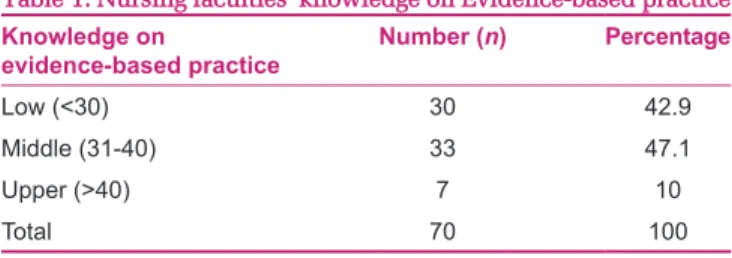
and professional profile included 10 questions. The knowledge of EBP subscale consists of 15 multiple choice and 10 matching questions. The attitudes toward EBP subscale comprised 17 items; however, there is some variation in the structure of the subscale responses. For measuring the knowledge of EBP subscale, each right and wrong answer was scored 2 and 0, respectively. The maximum score that could be obtained was 50. A total score of less than 30 was classified as low, 31‑40 as moderate, and more than 40 as high [Table 1].
For measuring the attitude of EBP subscale, each item was prepared in a Likert’s scale from agree, no opinion to disagree. So, the greatest score that could be acquired was 51. A total score of less than 40 was classified as negative and more than 40 as positive.
Face and content validity for the tool was obtained by gathering the view points of 10 experts in the field. Test and retest was done for reliability purpose and a correlation coefficient of 0.76 was achieved. Koronbakh Alpha showed an internal consistency of 0.89.
Ethical considerations
Ethics committee of Tehran University of Medical Sciences approved the research proposal. Participants were informed regarding the study aims, confidentiality of the data, and the freedom to withdrawal and oral consent was obtained.
Data analysis
For data analysis, each section of the questionnaire was graded separately. The range of grades for the second section of the questionnaire (knowledge) was defined as high (75% or higher of questionnaire grades), moderate (50%‑74% of questionnaire grades), and low (50% or less of questionnaire grades). Higher grades indicated higher knowledge. The grades obtained in the second section was categorized as less than 30 (low knowledge), 31‑40 (moderate knowledge), and more than 40 (high knowledge).
None of the participants had chosen “No idea” for any question of the third section, the range of grading for the third section (Attitude) was divided in two groups: Grades of Table 1: Nursing faculties’ knowledge on Evidence‑based practice Knowledge on
evidence‑based practice Number (n) Percentage
Low (<30) 30 42.9
Middle (31-40) 33 47.1
Upper (>40) 7 10
40 and higher were defined as positive attitude and grades lower than 40 were defined as negative attitude.
After merging the average and high levels due to their low frequency, the Fisher’s exact test was used to analyze the relationship between demographic features of the units under study and the level of knowledge of the faculties regarding EBP.
r
esultsNurse faculties were predominantly female (82.9%) with M.Sc. degree (91.4%). PhD degrees were held by 8.6% of the sample, and none had a B.Sc. degree. Their ages ranged between 30 and 55 years with a mean of 46.44 years [standard deviation (SD) 4.45]. Years of work experience as a faculty ranged from 11 to 20 (mean 15, SD 5.8). Nurse faculties that were teaching in B.Sc. level (20%), in both B.Sc. and M.Sc. levels (71.4%). Only 8.6% of the participants had teaching experiences in PhD level. According to the responses, approximately 87.1% indicated that they were not teaching EBP and more than one half of the respondents (51.6%) had never been trained in EBP workshops or through continuing education programs.
Knowledge and Evidence-based practice
The majority of respondents (60%) were partially aware of EBP and just a few numbers (N = 5) had not previously heard this term. More than half of the respondents (61.4%) were unaware of Cochrane collaboration as a source of information about EBP. The respondents felt that they were knowledgeable about the research strategies (71.4%). More than 80% of their knowledge about the terms such as “relative risks,” “odds ratio,” “confidence interval,” and “systematic bias” was in a low level. Participants scored themselves low on the ability to present a correct definition of EBP as well. In general, the majority of the nurse faculties were in a moderate level of knowledge toward EBP [Table 1]. Table 2 outlines the results of statistical tests for the relationship between nurse faculties’ demographic features and their knowledge to EBP.
The findings indicated a significant statistical relationship between the knowledge of nursing faculty members
and such variables as level of education (χ2 = 13.29,
P ≤ 0.001) and educational background in different levels of nursing (χ2 = 22.41, P ≤ 0.001). However,
no significant statistical relationship was observed for age, work experience, participation in research paper criticism sessions, and participation and teaching in EBP workshops [Table 2].
Attitude and Evidence-based practice
As for the attitude of faculty members toward EBP, the findings indicate that 80% of members believed EBP is helpful in making clinical decisions, and 81.4% were inclined to implement EBP in their clinical education. Nonetheless, 57.1% believed that EBP is not consistent with the present facts of Iranian nursing community and thus not feasible to implement. The general outline of the findings indicates a positive attitude of the majority of participants (88.6%) toward EBP [Table 2]. The mean grade of attitude towards EBP is 45.79 with a SD of 5.39, having 32 as minimum and 51 as maximum grade.
Our data analysis indicated no significant statistical relationship between the most of demographic features of the participants and their attitude toward EBP [Table 3].
d
IscussIonDespite having positive attitude the majority of nursing faculties had an average level of knowledge. Moreover, 60% stated that they are aware of the concept of EBP only “to some extent,” whereas nursing teachers (who have at least a Master’s degree in the field, have been trained about research methodology and are probably teachers of research
Table 2: Nursing faculties attitude toward Evidence‑based practice
Attitude toward
evidence‑based practice Number (n) Percentage
Negative (<40) 8 11.4
Positive(>40) 62 88.6
Total 70 100
Table 3: Relationship between demographic features and nursing faculties’ knowledge and attitude on Evidence‑based practice
Variable Knowledge of
EBP Attitude on EBP Demographic variables Test P value Test P value
Age r=0.19 ≤0.1 r=0.03 ≤0.9
F=2.7 F=0.06
Gender χ2=0.38 ≤0.86 χ2=2.54 ≤0.01 Educational level χ2=13.29 ≤0.001 χ2=0.16 ≤0.68 Clinical experience r=0.19 ≤0.1 ≤0.41
F=2.7
Educational work experience r=0.06 ≤0.57 r=0.1 ≤0.49 F=0.32 F=0.68 Faculty work experience r=0.1 ≤0.4 r=0.08 ≤0.63
F=0.7 F=0.47
General work experience r=0.17 ≤0.15 r=0.05 ≤0.56 Educational background F=2.06 F=0.22
methods) are expected to be sufficiently aware of this concept and to have acquired appropriate skills. This finding reflects the not‑so‑strong provision of EBP approach in faculty members. Considering the fact that more than 70% of participants were familiar with techniques of searching literature, it appears that they had no difficulty in accessing research methods and results, while the McColl et al. study (1998) reported only 16% of physicians in England to have received official education regarding literature search techniques.[15] Similarly, our findings indicate that
the nurse faculties are not familiar with technical terms used in evaluation of research articles, such as odds ratio, relative risk, and confidence interval. Other studies have corroborated this lack of knowledge regarding technical terms of research, as well.[16] Furthermore, only about half of
the respondents in this study had acquired their knowledge of EBP through participating in activities such as workshops, seminars, and conferences. Since Jette et al., depicted that educational sessions of EBP and teaching literature search techniques improve the knowledge of physiotherapists,[16]
it appears that supporting these sessions and educational programs would be essential in improving the methods of using resources and databases for acquiring up‑to‑date knowledge.
The findings of our study indicated that a great number of participants were familiar with the techniques of literature search; however, they did not use the Cochrane database and systematic review articles as sources of evidence. These findings are in line with those of Melynk et al. reporting 68% of nurses not to use the Cochrane database.[17] In contrast, Kamwendok (2002)
reported most Swedish rehabilitation specialists (70%) to use up‑to‑date sources and databases in their clinical practice.[18] Considering the availability of internet and
databases in most nursing universities, nursing teachers of any rank and professional status are expected to show greater attention to this issue, as Thomas (1998) believes nursing teachers to be responsible for educating nurses who are going to perform EBP.[19] These teachers should
serve as a role model for nursing students during both theoretical and practical education and must establish the base of EBP. Ciliska (2005) stated that unless instructors teach EBP, the students and consequently nurses will never manage to base their services on evidences.[20]
Our findings also indicated a significant relationship between the level of knowledge of nursing faculty members concerning the EBP and variables such as level of education and experience of teaching in different levels of nursing education, while it was not observed to be significantly related to other personal features. These are not consistent with those of Jette et al., who stated that participating in educational sessions, whether during
practical training or in ongoing educational programs, is related to the participants’ knowledge of technical terms and the concept of EBP.[16] However, they reported that
knowledge and skills of retrieving information critically are related to the level of education, which is similar to our findings. Comparing the findings of these two studies indicates that nursing educational programs highlighting EBP have not been conducted in Iran during the recent years.
Most respondents in our study had a positive attitude toward EBP, which is similar to the results of other studies conducted on the attitude of nurses and other healthcare personnel toward this issue.[21,22] Our participants believed that EBP
is essential for both nursing clinical practice and education, because EBP using the up‑to‑date scientific findings will improve the quality of care for patients. Similarly, Mc Ewen (2002) stated that nursing teachers and students believe that EBP fills the gap between research, theory, and practice.[23] Furthermore, this finding is consistent with
similar studies conducted on physicians, rehab specialists, and clinical nurses.[3,16,24,25] 94% of American pediatricians
strongly believed that using guidelines of clinical practice will motivate them for improving patient care[28] and 70% of
Iranian nurses in hospitals of Tehran University of Medical Sciences had a positive attitude toward using research evidences in clinical practice.[3]
Participants in our study were not sure whether the current research evidences will aid them in clinical decision making for patient care (37.1%). According to them, EBP may impose some limitations on education and practice and is not feasible in the present status of Iranian nursing community (57.1%). Similarly, statements of British physicians in a qualitative study[26] and clinical nurses
in Iran[3] indicated that they doubted the application
of current clinical guidelines and research evidences to clinical practice and believed research findings to be unrelated to some patients. The participants in our study probably believe that research studies are not compatible with clinical situations. In addition, our participants had a broad range of beliefs from approval to disapproval concerning the existence of research evidences to confirm the interventions they perform for patient care. These mixed responses combining agreement and disapproval for EBP reinforce this idea that implementing EBP requires researches to be better focused on clinical activities and answering clinical questions.
Most participants in our study believed that EBP can improve the quality of patient care and declared that they are inclined to learn and develop skills necessary for implementing EBP in their clinical education. This is in line with previous studies.[21,22] In another study by McColl
et al., most physicians had responded positively to EBP, and they used clinical guidelines and standard cares in their clinical activities.[19] In another qualitative study,[29] many
statements indicated that inclination toward EBP is related to implementing it in practice. In that study, expressions such as “stress,” “difficult and demanding,” “dangers and risks,” and “nuisance” were used by participants to describe EBP; the authors stated that despite using the above expressions, the participating physicians were inclined to use evidence‑based interventions.[25]
Lack of significant relationship between the demographic features of participants and their attitude toward EBP is not in line with the findings of Jette et al. (2003), who reported that the attitude of younger practitioners with less work experience is more positive compared to older participants with longer years of experience.[16] As for the
level of education, a study by Olade (2003) indicated Finnish nurses with higher levels of education to have a more positive attitude toward using research evidences in practice.[27] Ultimately, more focused interventions are
required to reinforce the attitude of nurses in order to enhance their motivation and desire to learn and commit to EBP. Thus, it appears that the positive mentality of Iranian nurses, particularly those in the nursing education systems, has provided a suitable opportunity for “evidence‑based practice” to be included in nursing practices.
Using convenience sampling with limited number of samples is the main limitation of our study, so more extensive studies are needed in order to generalize the findings.
c
onclusIonRespondents established that the use of evidence in practice was essential, and they had a positive attitude toward EBP. They believed that quality of patient care was improved when evidence was used in practice. Nursing faculties were interested in improving the skills necessary to implement EBP. Despite of their low‑level knowledge, they declared that they needed to increase the use of evidence in their daily practice. Considering their positive attitude on EBP, it seems that nursing faculties are emotionally prepared for capturing the required knowledge toward EBP. This leads nursing education policy makers to use this opportunity and move toward promoting EBP paradigm.
A
cknowledgeMentsThe authors would like to thank the Center for Nursing Care Research (CNCR), Tehran University of Medical Sciences, for funding this research project
r
eferences1. Greiner A, Knebel E. Health professions education: A bridge to quality. Washington, DC: National Academies Press; 2003. 2. Adib‑Hajbaghery M. Evidence‑based practice: Iranian nurses’
perceptions. Worldviews Evid Based Nurs 2009;6:93‑101. 3. Mehrdad N, Salsali M, Kazemnejad A. The spectrum of barriers
to and facilitators of research utilization in Iranian nursing. J Clin Nurs 2008;17:2194‑202.
4. Melynk B, Fineout –Overholt E. Evidence‑based practice in nursing and health care: A guide to best practice. Philadelphia, PA: Lippincott, Williams and Wilkins; 2005.
5. Estrabrooks CA, Wallin L, Milner M. Measuring Knowledge Utilization in Health Care. Int J Policy Evaluation Manag 2003;1:3‑36.
6. Grol R. Between evidence based practice and total quality management: The implement of cost‑effective care. Int J Qual health care 2000;12:297‑304.
7. Krugman M. Evidence–based practice: The role of Staff Development. J Nurses Staff Dev 2003;19:279‑85.
8. Melynk B, Fineout –Overholt E, Stone P, Ackerman M. Evidence‑ Based Practice: The past, the present and Recommendations for the Millennium. Pediatr Nurs 2000;26:77‑80.
9. McCleary L, Brown T. Research utilization among pediatric health professionals. Nurs Health Sci 2002;4:163‑71.
10. Penz KL, Bassendowski SL. Evidence‑Based Nursing in Clinical Practice: Implication for Nurse Educators. J Cont Educ Nurs 2006;37.
11. Adib‑Hajbaghery M. Factors facilitating and inhibiting evidence‑based nursing in Iran. J Adv Nurs 2007;58:566‑75. 12. Melnyk BM, Fineout‑Overholt E, Mays MZ. The evidence‑based
practice beliefs and implementation scales: Psychometric properties of two new instruments. Worldviews Evid Based Nurs 2008;4:208‑16.
13. Upton D, Upton P. Development of an evidence‑based practice questionnaire for nurses. J Adv Nurs 2006;54:454‑8.
14. Aarons GA. Mental health provider attitudes toward adoption of evidence based practice: The evidence‑based practice attitude scale (EBPAS). Ment Health Serv Res 2004;6:61‑74.
15. McColl A, Smith H, White P, Field J. General practitioners perception of the route to evidence‑based medicine: A questionnaire survey. Br Med J 1998; 316:361‑5.
16. Jette DU, Bacon K, Batty C, Carlson M, Ferland A, Hemingway RD, et al. Evidence‑based practice: Beliefs, attitudes, knowledge, and behaviors of physical therapists. J Am Phys Ther 2003;83:786‑805. 17. Melynk Bernadette M, Overholt Ellen F, Feinstein Nancy F,
Hong Li, Small L, Wilcox L, et al. Nurses’ Perceived Knowledge, Beliefs, Skills and Need Regarding Evidence‑Based Practice: Implications for Accelerating the Paradigm Shift. Worldviews Evid Based Nurs 2004;185‑193.
18. Kamwendo K. What does Swedish physiotherapist feel about research? A survey of perceptions, attitudes, intentions and engagement. Physiother Res Int 2002;7:23‑34.
19. Thomas E. The role of nurse lecturers in the utilization of research findings in practice. Development of professional practice research training fellowships: Occasional papers. Health Professional Wales, University of Wales College of Medicine; 1998.
20. Ciliska D. Education for Evidence‑Based Practice. J Prof Nurs 2005;21:345‑50.
21. Stevenson K, Lewis M, Hay E. Do physiotherapists’ attitudes toward evidence‑based practice change as a result of an
educational program? J Eval Clin Pract 2004;10:207‑17. 22. Metcalfe C. Barriers to implementing the evidence base in
four NHS therapies (Dietitian, Occupational therapist, and Physiotherapist, Speech and language therapist). Physiotherapy 2001;87:433‑41.
23. McEwen M. Application of theory in nursing practice. In: McEwen M, Wills EM, editors. Theoretical basis for nursing. Philadelphia: Lippincott, Williams and Wilkins; 2002. p. 347‑67. 24. Flores G, Lee M, Bauchner H, Kastner B. Pediatricians’ attitudes, beliefs and practices regarding clinical practice guidelines: A national survey. Pediatr 2000;105:496‑501.
25. Freeman AC, Sweeney K. Why general practitioners do not implement evidence: Qualitative study. Br Med J
2001;323:1100‑2.
26. Cranney M, Warren E, Barton S. Why do GPs not implement evidence‑based guidelines? A descriptive study. Fam Practitionaire 2001;18:359‑63.
27. Olade R. Attitudes and factors affecting research utilization. Nurs Forum 2003;5‑15.
How to cite this article: Mehrdad N, Joolaee S, Joulaee A, Bahrani
N. Nursing faculties’ knowledge and attitude on evidence-based practice. Iranian J Nursing Midwifery Res 2012;17:506-11.
Source of Support: Tehran University of medical Sciences, Center