Generation of High Order Harmonics from H
2+Molecule Ion by Using Homogenous and
Inhomogeneous Laser Fields
Fatemeh Aghili, Saeed Batebi, and Forouq HosseinzadehDepartment of Physics, University of Guilan, Rasht, Iran
Corresponding Author's Email: [email protected]
Received: Aug. 21, 2018, Revised: Oct. 31, 2018, Accepted: Dec. 2, 2018, Available Online: Dec. 27, 2019 DOI: 10.29252/ijop.13.2.135
ABSTRACT— We solved one dimensional Schrodinger equation in a H2+ molecular
environment by using 3 femtosecond homogeneous and nonhomogeneous laser fields. In homogeneous case, we found out that larger inter nuclear distances result in earlier ionization and also more instability in the wave packet. We deducted that the more the instability is, the more modulated the power spectrum will be. So, by choosing a fixed 1.96 atomic units inter nuclear distance, we investigated high harmonic generation in both linear and nonlinear nonhomogeneous laser pulses. We observed that in comparison with the linear case, in nonlinear one, the plateau possessed higher intensity harmonics. On the other hand, in this case, cutoff order occurred on higher frequency. By superposing several harmonics near cutoff region, we predicted the generation of a 73 attosecond pulse.
KEYWORDS: harmonic spectrum , homogeneous, inter nuclear distance, isolated attosecond pulse, nonhomogeneous, Schrӧdinger equation.
I.
I
NTRODUCTIONAttosecond science is a study to control the dynamics of electrons in atoms, molecules and solids. H2+ is the simplest known molecular
system. High harmonics generation (HHG) is the most effective and developed method to generate isolated attosecond pulses as has been popularly investigated in recent years [1]-[6]. The idea that HHG could give rise to attosecond (as) pulses was discussed already in
the early 1990s [7].we have two methods for explaining the HHG process. First the semi-classic or three step model [8], second the quantum model [9]. In our calculation we use the first one. In the three- step model first we assume that an atom is exposed to a laser field. As the intensity reaches the level of
14 2
10 Watt/cm , the field near the peak of each oscillation will be comparable to the atomic Coulomb field. The superposition of the laser field and the Coulomb field transforms the potential well that binds the electron into a potential barrier [19]. By laser field oscillations, the potential barrier tends right and left according to laser field direction. The electron ionizes by tunneling ionization then it accelerates by the laser field and gains kinetic energy. At the end of this journey, when the laser field approaches its maximum point again, electron changes direction and recombines with the parent ion or with neighboring ions [11],[12], and releases the kinetic energy as a photon [10]. In this step we will have the emissions of photons with a maximum cutoff energy equal to
3.17
c Ip Up
= + , where Ip is the ionization potential and Up is the ponderomotive energy of the free electron [14]. The ponderomotive energy is set to
2 2 0
2
4
p
e E U
m
= in which m and e
stand for mass and charge of electron and E0
and ω stand for amplitude and frequency of the laser field [15].c is the frequency of the
emitted photon. By considering cI2
one can deduce that higher wavelength and intensity lead to higher photon energy thus using a long wavelength high intensity laser field results in a high cutoff frequency. This means that, we can have a longer plateau. Much effort has been paid to enhance the plateau of HHG spectrum in order to obtain shorter attosecond pulses. Among them, as an example, [13] examined the effects of variation of carrier envelope phase (CEP) on molecular harmonic plateau. Researchers in [11] investigated enhancing the harmonic generation by two-color excitation in molecular system. Multi-color synthesized fields were used in [16], [17]. In [25]-[29], researchers used the amplification properties of a nanostructure on laser intensity and its effects on higher order harmonic generation. Our work has similarities and differences from other works that have been done recently or even many years ago. For example Wang et al. [32] have used a two color laser field in order to display the power spectrum of H2+. They
have optimized the laser field by varying intensity and time duration of the laser pulse. Unlike [32] in this manuscript we show that how an inhomogeneous three color laser field distributes the wave packet all over the calculation window and how an absorption function results in smoother plateau, distinct harmonic frequencies and shorter attosecond pulses. While neglecting absorption potential leads to more modulated power spectrum. Our simulations in ionization probability approves the results of [33]. The goal of this manuscript is what [34] have done. In both [34] and this paper, plasmonic fields are taken into account. Yavuz et al. enhanced the harmonic yield by increasing the internuclear distance but we enhance it by applying the forth order polynomial nonlinear inhomogeneity function to the laser field.
All calculations in this manuscript are based on atomic units unless is stated.
II.
THEORETICAL STUDIES A. CalculationsIn this work the one dimension (1-D) time-dependent Schrödinger equation for hydrogen molecular ion (H2+) in an intense linearly
polarized (along the molecular axis) laser field have been solved by using the Platonenko method [18]:
( , )
( , )
z t
i H z t
t
=
(1)
As we know, the so called Schrödinger equation Hamiltonian (H) has an operator term and a potential expression (H0in equation 2). The potential term consists of a coulomb potential and as a result of laser matter interactions an interaction potential is added to the Hamiltonian as is shown in equation 3. In which H is the Hamiltonian of the target atom in the condition that it is illuminated by an intense laser field.
2
0 2
1
( )
2 coulomb
d
H V z
dz
= − + (2)
0 int( , )
H =H +V z t (1)
The Coulomb potential in the z direction is:
2 1/ 2 2 1/ 2
1 1
(( / 2) ) (( / 2) )
coulomb
V
z R a z R a
= −
− + + + (4)
int ( ).
V =E t z (5)
where a is a parameter that allows avoiding singularities at the origins and is chosen to be
a=1.5 atomic unit (a.u.) in our calculations to produce energy eigenvalue of our interest in the absence of the laser field. Increasing the value of a, results in a smoother potential and a higher energy for the 1-D model of H2+ and
consequently, in a more spread out initial wave packet [20].
The electric field is:
3 0 1
( ) icos( i i) ( )
i
E t E t f t
=
=
+ (6)in which E0i is the amplitude of the laser field, i is angular frequency, i is the carrier envelope phase, f t( ) is the envelope of the laser pulse and is set to be:
2
( ) exp 2 ln 2
i
t f t
= −
(7)
where is the time duration of the envelope. In equation 6, i=1 represents the main field, with i=2 we have the first controlling field and with i=3 we have the second controlling field.
According to the Ehrenfest theorem we have the dipole acceleration as follows:
( ) ( , ) dVcoulomb ( ) ( , )
a t z t E t z t
dz
−
= + (8)
By calculating the Fourier transformation of the induced dipole acceleration (a t( )), the power spectrum of high harmonics (p( ) ) is achieved.
( ) ( ) i t
p =
a t e−dt (9)In spectral range, the spectrum of high harmonics is displayed. One of the most important features of this process is the creation of the power spectrum, which drops down on the first harmonics, creating a plateau region, consisting of harmonics with mostly the same intensity and finally, an abrupt cutoff at the end of the curve [30]. By filtering several harmonics, isolated attosecond pulses are exhibited. Eq.10 represents the time profile of attosecond pulses, in which q is the harmonic order and is chosen from harmonics near the cutoff region.
2
( ) q iq t
q
I t =
a e (10) where aq is given by:( ) iq t q
a =
a t e− dt (11)B. Results and Discussion
In this paper we simulate the generation of an isolated attosecond pulse by solving the time dependent one dimensional Schrӧdinger equation (1-D TDSE) for H2+ molecule ion
under the Born-Oppenheimer approximation (BO). The BO scheme is used in fixed nuclei approximation. As the time dependent wave function is used in all of our calculations, it is necessary to balance the laser parameters in a way that give a more stable wave function. First, for a monochromatic laser field, we tried
3 ,fs 5fs and 10fs
= = = time durations.
is the duration of time in which laser pulse is driven. Figs. 1-3 show the structure of their corresponding laser fields (in part a) and their wave packets (in part b). Other parameters of the laser pulse are given in the first row of Table 1. While an atom or molecule is exposed to a laser field, its wave packet alters with time. This is why we solve Schrodinger equation. When we plot the wave packet we can see that it distributes all over the window. E. g., look at the pink line in Fig. 1(b). In this picture one can see that at the first time steps of the laser oscillation (pink line), when the amplitude of laser is not strong enough to spread the wave packet, the population is greater (in the color bar we can see that red color shows the maximum). While time goes on and electric field gets more intensity, the wave packet starts spreading in space. In the temporal range from -150 a.u. to -50 a.u., wave packet spread left. In -50 a.u., when laser field changes direction, the wave packet changes direction to the right. Any time that laser changes direction, wave packet changes direction too. Imagine when wave packet reaches the wall (+100 a.u.), it would be reflected back to the middle of the window and destroy the wave packet structure. But, this reflection is a result of our numerical calculation and has no physical meaning. Because of this, it is better to omit such spurious reflections. There are several ways to eliminate this problem e.g. using wide spatial windows, using mask functions, or using absorption potentials. In this manuscript we chose the third solution. So, we add an absorption potential to the potential expression
(Vcoulomb+Vint) of the Hamiltonian [21]. The orange line in Fig. 1(b) shows the structure of the absorption potential. It is clear that when the wave packet reaches the absorption potential, as is seen in Fig. 1(b) in times around 100 a.u., it would be absorbed.
Fig. 1. (a). One color laser field (blue solid line) with a Gaussian envelope (red dashed line) and (b). Its corresponding wave packet for =3fs. The orange line determines the absorption potential. The pink line shows electric field.
The absorption potential is as follows:
1
0 1 2
2 1
0 otherwise
absorb
z z
iV z z z
V z z
−
−
= −
(12)
We can choose the optimized time duration from the time dependent wave function spectrum. It is clear from Figs. 1-3 that the probability density around the nuclei in the first figure (in which =3fs) is stronger and wave packet is more stable than others. From Fig. 1(b) we can see that in -100 to +100 a.u. (of space), wave packet is stronger and more
stable. But in Fig. 2(b), (τ=5) the wave packet expands to -200 a.u. to 200 a.u. Similar to Figs. 1(b) and 2(b), in Fig. 3(b) we observe more expansion of the wave packet. We prognosticate that we can have a better and more efficient harmonic spectrum from the first wave packet with =3fs because it is more stable than the others. Our assertion is approved in [31]. Therefore we use the 3fs
(∼124 a.u.) laser pulse for the rest of our work.
Fig. 2. (a). One color laser field (blue solid line) with a Gaussian envelope (red dashed line) and (b). Its corresponding wave packet for =5fs.
The emitted attosecond pulse energy is measured by c I2, we understand that higher laser intensity and longer laser wavelength gives higher cutoff energy. By adding the first controlling field to the main field, the harmonic cutoff is extended and the harmonic yield is enhanced by about 2-3 orders of magnitude compared to one color laser field [32]. So, in order to have a more optimized laser pulse, we add two controlling fields to previously introduced laser field. The parameters of this three color laser field is given by Table 1.
Fig. 3. (a). One color laser field (blue solid line) with a Gaussian envelope (red dashed line) and (b). Its corresponding wave packet for =10fs.
Table 1. Parameters of the laser field
(
2)
Watt cm
I (nm) (rad) (fs)
Main field 10 14 800 3
First controlling field
14
1.2 10 2000 0 5
Second controlling field
14
1.5 10 2200
2
− 10
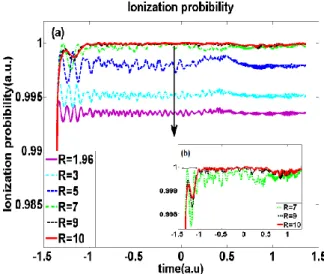
In the next step the ionization probability at several inter-nuclear distances (R) are calculated and demonstrated in Fig. (4). This figure shows that, by increasing the inter-nuclear distance the ionization probability will enhance. Similarly in [33] the variation of the ionization rate while changing R has been investigated. The results show that by enhancing the value of R the ionization will increase. In H2, both of electrons move around
the two cores. In H2+ case, the single electron
moves around the two nucleus. So, the electron binds to both of the cores. In better words, it sustains a high binding energy. Thus, in molecular case without the laser field
interaction the electron is trapped in one of the two potential wells with equal chances. By analyzing the structure of the wave packet, we see that when the strong laser field emits the molecule, the electronic wave packet near one nuclei is propagated in the temporal axis following the laser field, and spread in the spatial axis. When this wave packet reaches the second core’s wave packet, makes it propagate and distribute just like the other one (look at Fig. 1(b)). This means that the electron is accelerated from one core to the other directly by the laser field at an inter-nuclear distance (R) [13]. While the inter-nuclear distance increases, the binding energy decreases. In contrast we can say that when the time goes on, the population probability in the excited state will be increased. As a result, the electron will be ionized with a higher percent probability. Nuclear motion and charge resonance enhances ionization at distances larger than the equilibrium distance [22]-[24].
Fig. 4. (a). Variation of the ionization probability of the H2+ 1-D model electron with time at different inter-nuclear distances obtained under the influence of a three color laser pulse and (b). This figure is the zoom in case for R=7-10.
The HHG spectra of H2+ under homogenous
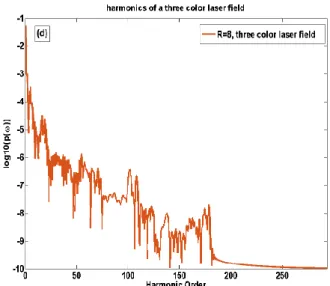
three color laser field at R=1.96, 2, 5, and 8 (a.u) are shown in Fig. (5). The related parameters of the laser field are the same as Table 1. The inter-nuclear distance directly influences high harmonic generation spectrum. It is obvious from Figs. 5(a-d) that the variation of R influences the plateau region and disturbs the plateau. We can also see the
shortening of the supercontinuum while widening R but cutoff harmonics are approximately the same for all of the distances [34]. We can see that at 5 a.u. inter-nuclear distance and even larger than that, modulation of plateau increases, while at shorter distances, especially at equilibrium separation, we have a softer plateau. As we said before, this is because of the instability in wave packet for large inter-nuclear distances. So, the wave packet has a direct influence on high harmonic spectrum.
Fig. 5. High-order-harmonic spectra produced by H2+ molecule under homogenous three color laser field at (a). R=1.96 (a.u.), (b). R=2 (a.u.), (c). R=5 (a.u.) and (d). R=8 (a.u.).
For large values of R, the wave packets are so unstable. While, for small values of R, wave packets are relatively more stable, [15] clearly shows this claim.
To achieve these harmonic spectra we need laser fields with intensities equal to
(
13 15)
210 −10 Watt cm . But we know that these kinds of fields are very scarce and expensive. So they are not available in all laboratories [19]. Therefore we need to amplify reachable laser fields (with intensities approximately equal to 11 2
10 Watt cm ) in order to produce attosecond pulses. To do so, using nanostructure properties might be helpful [29]. For this purpose we illuminate the bowtie nanostructure with a laser field. In this condition the field polarizes the atoms in the metal, and as a result, a cloud of negative charges is created on the surface of the metal. Concentration of these electron charges makes a plasma environment on the surface. Under the influence of incident field, free electrons start oscillation. Since conduction electrons can be thought of as harmonic oscillators, they are quantized in a similar fashion. Just as a photon is a quantum of oscillations of field, the plasmon is a quantum of electron accelerations in a metal [28]. In the result of illumination of an electric field, the plasmons on the surface start oscillation. When the
plasmon mode couples to the incident field, the field enhances up to 20–40 dB [29]. So, by the illumination of a 10 Watt cm11 2 laser field, one can achieve an intense
(
13 15)
210 −10 Watt cm field, which is the threshold to produce HHG.
Fig. 6. (a). Linear inhomogeneous three color laser field. (b). Its High-order-harmonic spectra produced by the H2+ .
The bowtie nanostructure consists of two triangular gold pads with a gap size between the two vertices. When the laser field is emitted to the gap size, a hot spot of intense field appears. But this field is not homogeneously distributed in the gap because in the vicinity of the nanostructure, the field’s strength is greater than in the middle of the gap. So, the inhomogeneous laser field is as following:
./ . ( , ) ( ) lin nonlin( )
E z t =E t H z (13)
( ) 1
linear
H z = + z (14)
18 5 2
.
22 3 10 4
( ) 2 2 10 3.1 10 3.1 10 5.3 10
nonlin
H z z z
z z
− −
− −
= − + +
− (15)
In which E t( ) is the time dependent laser field which gets space dependency with the inhomogeneity function Hlin nonlin./ .( )z .
( )
linear
H z is the linear inhomogeneity function which depends only on z. is the coefficient of inhomogeneous function and equals 1
g
=
[25],[26], where g is the gap size (in atomic units).
.
nonlin
H is the nonlinear inhomogeneous function which consist of higher powers of z. In this work, we have applied the forth order polynomial function with the 16nm gap size that authors of [27] have obtained by FDTD simulation.
Fig. 7. (a). Nonlinear inhomogeneous three color laser field. (b). Its High order harmonic spectrum produced by the H2+ .
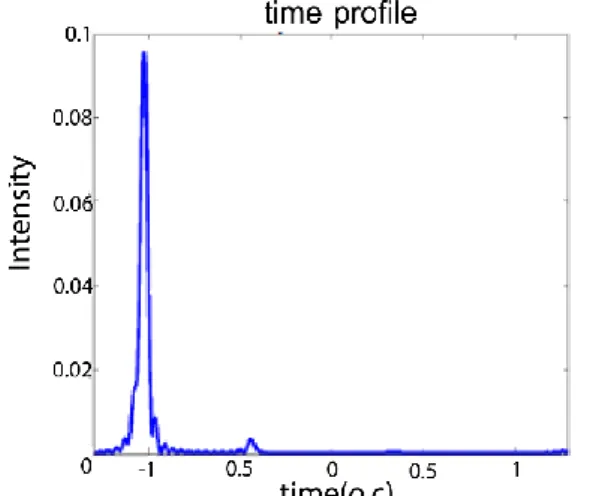
As a comparison, Fig. 7(a) shows that the electric field is more amplified while the nonlinear inhomogeneity function is applied [21]. Since the amplitude of the pulse is greater a higher cutoff frequency is expected (as a result of cI2 ). As it is observed in Figs. 6(b) and 7(b), the first cutoff in the nonlinear case is 69 orders greater than the linear case. The cutoff order in the second plateau of linear case is on 135th order and it is enhanced to 173th order in the nonlinear case. Despite of the enhancement in first and second cutoff orders, the efficiency of the power spectrum in the nonlinear case is enhanced more. In the linear inhomogeneous case the yield of the first plateau is -5, but in nonlinear case it is -0.5. Similarly, in the second plateau, the efficiency in linear case is -7.5, while in nonlinear case it is -4. By superposing 60 harmonics of the power spectrum’s plateau of nonlinear inhomogeneous case near the cutoff vicinity we obtain a 73 as laser pulse as is shown in Fig. (8).
Fig. 8. Time profile of an isolated 73 attosecond pulse. What does “O.C” mean?
III.
C
ONCLUSIONWe investigate high order harmonic and isolated attosecond pulse generation from a full one-dimensional model of H2+ molecule in
both homogeneous and nonhomogeneous three color, linearly polarized laser fields by using numerical solutions of the Born-Oppenheimer time-dependent Schrödinger equation. Since shorter time durations result in more stable
wave packets, the 3 femtosecond time duration is chosen in this work.
We study the ionization probability to investigate the effect of the nuclear distance on its spectrum and we find out that by increasing the nuclear separation the ionization probability enhances. When an electron is bounded to the two cores in their shortest inter-nuclear distance, electron confronts a higher bounding energy but when the cores start separation, the bounding energy decreases. So, electron can be ionized faster. Therefore, we can assert that the larger the inter-nuclear distance is, the greater the ionization probability will be.
By plotting the linear and nonlinear inhomogeneous fields we find out that in nonlinear inhomogeneous case, cutoff order shows a higher frequency because it provides a longer acceleration time for the oscillating electron. So, cutoff occurs on higher frequency.
By superposing several harmonics near cut off region, we obtain an isolated 73 attosecond pulse.
IV.
R
EFERENCES[1] M. Hentschel, R. Kienberger, C. Spielmann, G. Reider, N. Milosevic, T. Brabec, P.B. Corkum, U. Heinzmann, M. Drescher, and F. Krausz, “Attosecond metrology,” Nature , Vol. 414, pp. 509-513, 2001.
[2] P. Tzallas, D. Charalambidis, N.A. Papadogiannis, K. Witte, and GD. Tsakiris,
“Direct observation of attosecond light bunching,” Nature, Vol. 426, pp. 267-271, 2003.
[3] G. Sansone, “Isolated Single-Cycle Attosecond Pulses,” Science, Vol. 314, pp. 443-446, 2006.
[4] E. Goulielmakis, “Single-Cycle Nonlinear Optics,” Science, Vol. 320, pp. 1614 (1-20), 2008 .
[5] T. Brabec and F. Krausz, “Intense few-cycle laser fields Frontiers of nonlinear optics,” Rev. Mod. Phys. Vol. 72, pp. 545-591, 2000.
[6] C. Winterfeldt, C. Spielmann, and G. Gerber,
“Optimal control of high-harmonic generation,” Rev. Mod. Phys. Vol. 80, pp. 117-120, 2008.
[7] B. Mette, J. Gaarde, and K.J. Kenneth,
“Amplitude and Phase Control of Attosecond Light Pulses,” J. Phys. B, Vol. 41, pp. 31-36, 2008.
[8] P. Corkum, “Plasma perspective on strong field multiphoton ionization,” Phys. Rev. Lett. Vol. 71, pp.1994–1997, 1993.
[9] M. Lewenstein, P. Balcou, M.Y. Ivanov, A.L. Huillier, and P. B. Corkum, “Theory of high-harmonic generation by low-frequency laser fields,” Phys. Rev. A, Vol. 49, pp. 2117-2132, 1994.
[10]A.D. Bandrauk, S. Chelkowski, and S. Goudreau “Control of harmonic generation using two color femtosecond -attosecond laser fields,” J. Mod. Opt. Vol. 52, pp. 411–428, 2005.
[11]A.D. Bandrauk, S. Chelkowski, H. Yu,
“Constant, Enhanced harmonic generation in extended molecular systems by two-color excitation,” Phys. Rev. A, Vol. 56, pp. 2537– 2540, 1997.
[12]A.D. Bandrauk, S. Barmaki, and G.L. Kamta,
“Laser Phase Control of High-Order Harmonic Generation at Large Internuclear Distance The H+ − H2+ System,” Phys. Rev. Lett. Vol. 98, pp. 013001 (1-4), 2007.
[13]Y. Chao, E. Haixiang, W. Yunhui, Q. Sh, Z. Yadong, and L. Ruifeng, “Intense attosecond pulse generated from a molecular harmonic plateau of H2+ in mid-infrared laser fields,” Phys. Lett. Vol. 47, pp. 055601 (1-10), 2014. [14]P.C. Li, I.L. Liu, and S.I. Chu, “Optimization
of three-color laser field for the generation of single ultrashort attosecond pulse,” Opt. Express, Vol. 19, pp. 23857-23866, 2011. [15]H. Sabzyan and H. Ebadi, “Evolution of the
H2+ electron wavepacket under magnetic and electric fields of ultrashort intense laser pulse,” J. Iran. Chem. Soc., Vol. 6, pp. 489-503, 2009.
[16]M.F. Kling, “Control of Electron Localization in Molecular Dissociation,” Science, Vol. 312, pp. 246-250, 2006.
[17]A. Pic´on, A. Jaro´n-Becker, and A. Becker,
“Enhancement of Vibrational Excitation and
Dissociation of H2+ in Infrared Laser Pulses,” Phys. Rev. Lett. Vol. 109 pp. 163002 (1-5), 2012.
[18]V.T. Platonenko, A.F. Sterjantov and V.V. Strelkov, “Decrease of high harmonic generation yield in the barrier-suppression regime,” Laser Phys. Vol. 13, pp. 443-449, 2003.
[19]Z. Chang, Fundamental of attosecond optics
CRC Press Taylor and Francis, 2016.
[20]H. Sabzyan and H. Ebadi, “Ionization of 1-D model of H2+ from different states in intense laser field,” Iran. J. Sci. Technol. Vol. 33, pp. 87-102, 2009.
[21]F. Hosseinzadeh, M. Qadiri Soofi, and S. Batebi, “Time frequency analysis of high harmonic generation,” Int. J. Opt. Photon. Vol. 121, pp. 57-68, 2018.
[22]T. Zuo, A.D. Bandrauk, “ Charge-resonance-enhanced ionization of diatomic molecular ions by intense lasers,” Phys. Rev. A, Vol. 52, pp. 2511-2514, 1995.
[23]T. Seideman, M. Yu, P.B. Corkum, “Role of Electron Localization in Intense-Field Molecular Ionization,” Phys. Rev. Lett. Vol. 75, pp. 2819-2822, 1995.
[24]S. Chelkowski and A.D. Bandrauk, “Two-step Coulomb explosions of diatoms in intense laser fields,” J. Phys. B, Vol. 28, pp. L723-L731, 1995.
[25]A. Husakou, S.J. Im, and J. Herrmann,
“Theory of plasmon-enhanced high-order harmonic generation in the vicinity of metal nanostructures in noble gases,” Phys. Rev A. Vol. 83, pp. 043839 (1-5), 2011.
[26]H. Zhong, J. Guo, and W. Feng, “Analogy of electromagnetically induced transparency in plasmonic nanodisk with a square ring resonator,” Phys. Lett. A, Vol. 380, pp. 232-237, 2016.
[27]Sh. Xue, H. Du, and Y. Xi, “Photochemical Synthesis of Ultrafine Cubic Boron Nitride Nanoparticles under Ambient Conditions,” Chin. Phys. B, Vol. 24, pp. 7051-7054, 2015. [28]J.M. Reed, Temporal, spectral, and
polarization dependence of the nonlinear optical response of carbon disulfide, PhD Thesis, B.S. University of Central Florida, 2013.
[29]S. Kim, J. Jin, and Y.-J. Kim, “High-harmonic generation by resonant plasmon field enhancement,” Nature, Vol. 453, pp. 757–760, 2008.
[30]F. Hosseinzadeh, S. Batebi, and M.Q. Soofi,
“Dramatic dwindling of the power spectrum of high order harmonics by shrinking of the gap size in bowtie nanostructures,” J. Exp. Theoretical Phys. (JETP), Vol. 124, pp. 379– 387, 2017.
[31]J. Juan, X.M. Carrera, and T. Sh-I. Chu,
“Creation and control of a single coherent attosecond xuv pulse by few-cycle intense laser pulses,” Phys. Rev. A, Vol. 74, pp. 023404 (1-8), 2006.
[32]B. Wang, L. He, F. Wang, H. Yuan, X. Zhu Lan, and P. Lui, “Atomic layer graphene as a saturable absorber for ultrafast pulsed lasers,” Opt. Express, Vol. 25, pp. 1-25, 2017.
[33]B. Rotenberg, R. Taieb, V. Veniard, and A. Maquet, “H2+ in intense laser field pulses ionization versus dissociation within moving nucleus simulations,” J. Phys. B, Vol. 35, pp. L397-L402, 2002.
[34]I. Yavuz, Y. Tikman, and Z. Altun, “ High-order-harmonic generation from H2+ molecular ions near plasmon-enhanced laser fields,” Phys. Rev. A, Vol. 92, pp. 023413 (1-7), 2015.
Fatemeh Aghili has received her B.Sc. in Optics and Laser Engineering from Bonab University and now is a master of science student in Photonics in Guilan University.
Saeed Batebi has received his B.Sc., M.Sc. and PhD degrees in Applied Physics from Ferdowsi University, Physics from Sharif University of Technology, and Laser Physics from Moscow State University, Russia Federation in 1987, 1990, and 2003, respectively.
He is a scientific staff of Guilan University from 1992. His research interests are nonlinear optics, laser-plasmas interaction, higher harmonics generation and attosecond science. Dr. Batebi is the author and co-author of some papers of journals and conferences.
Forouq Hosseinzadeh has received her B.Sc. in Optics and Laser Engineering from Bonab University and she took her MSc degree in Photonics from Guilan University. Now she is PhD student in physics at Guilan University.