
Open Access
Research
Altered effector function of peripheral cytotoxic cells in COPD
Richard A Urbanowicz
1, Jonathan R Lamb
2, Ian Todd
1, Jonathan M Corne
3and Lucy C Fairclough*
1Address: 1COPD Research Group, Institute of Infection, Immunity and Inflammation, The University of Nottingham, NG7 2UH, UK, 2Immunology and Infection Section, Division of Cell and Molecular Biology, Faculty of Natural Sciences, Imperial College London, South
Kensington, London, SW7 9AZ, UK and 3Department of Respiratory Medicine, Nottingham University Hospitals, NG7 2UH, UK
Email: Richard A Urbanowicz - [email protected]; Jonathan R Lamb - [email protected]; Ian Todd - [email protected]; Jonathan M Corne - [email protected];
Lucy C Fairclough* - [email protected] * Corresponding author
Abstract
Background: There is mounting evidence that perforin and granzymes are important mediators in the lung destruction seen in COPD. We investigated the characteristics of the three main perforin and granzyme containing peripheral cells, namely CD8+ T lymphocytes, natural killer (NK;
CD56+CD3-) cells and NKT-like (CD56+CD3+) cells.
Methods: Peripheral blood mononuclear cells (PBMCs) were isolated and cell numbers and intracellular granzyme B and perforin were analysed by flow cytometry. Immunomagnetically selected CD8+ T lymphocytes, NK (CD56+CD3-) and NKT-like (CD56+CD3+) cells were used in
an LDH release assay to determine cytotoxicity and cytotoxic mechanisms were investigated by blocking perforin and granzyme B with relevant antibodies.
Results: The proportion of peripheral blood NKT-like (CD56+CD3+) cells in smokers with COPD
(COPD subjects) was significantly lower (0.6%) than in healthy smokers (smokers) (2.8%, p < 0.001) and non-smoking healthy participants (HNS) (3.3%, p < 0.001). NK (CD56+CD3-) cells from COPD
subjects were significantly less cytotoxic than in smokers (16.8% vs 51.9% specific lysis, p < 0.001) as were NKT-like (CD56+CD3+) cells (16.7% vs 52.4% specific lysis, p < 0.001). Both cell types had
lower proportions expressing both perforin and granzyme B. Blocking the action of perforin and granzyme B reduced the cytotoxic activity of NK (CD56+CD3-) and NKT-like (CD56+CD3+) cells
from smokers and HNS.
Conclusion: In this study, we show that the relative numbers of peripheral blood NK (CD56+CD3-) and NKT-like (CD56+CD3+) cells in COPD subjects are reduced and that their
cytotoxic effector function is defective.
Background
Chronic obstructive pulmonary disease (COPD) is a dis-ease state characterised by progressive airflow limitation that is not fully reversible [1]. It is associated with an
abnormal inflammatory response of the lungs to noxious particles or gases, primarily caused by cigarette smoking [2]. It is predicted to be the third most frequent cause of death worldwide by 2020 [3]. Although COPD is
prima-Published: 22 June 2009
Respiratory Research 2009, 10:53 doi:10.1186/1465-9921-10-53
Received: 10 December 2008 Accepted: 22 June 2009
This article is available from: http://respiratory-research.com/content/10/1/53
© 2009 Urbanowicz et al; licensee BioMed Central Ltd.
rily a disease of the lungs there is now an appreciation that many of the manifestations of disease are outside the lung, such as cachexia, skeletal muscle dysfunction, depression and osteoporosis [4], leading to the concept that COPD is a systemic disease [5-9].
Many previous studies have examined functions of lung derived CD8+ T cells in patients with COPD, for example studies have shown an increase in CD8+ cells within both
the peripheral airway [10] and lower respiratory tract of the lungs of COPD patients [11-14]. It is known that lym-phocytes can readily traffic between inflammatory sites (including lungs), regional lymph nodes, and importantly the systemic circulation, where they can be easily sampled [15] and hence may provide information using minimally invasive routes. This could be a benefit for subsequent biological and clinical investigations. To date research has been less conclusive in peripheral blood with some reporting an increase [12], a decrease in CD8+ cells [16] and others no change [17]. These conflicting findings may be due to the limits of some of the techniques employed and it is conceivable that other cell subpopulations expressing CD8 were included, i.e., CD8+ natural killer
(NK) cells (CD3-CD8+CD56+CD16+/-) and natural killer T
(NK-T) cells (CD3+CD8+CD56+). Furthermore, CD8+ T
cells can be divided into three subtypes, namely memory, naïve and the highly cytotoxic effector memory cells (TEMRA), the latter of which is determined by their high perforin content [18]. To date no analysis has looked at the proportions of these subtypes.
The numbers of peripheral blood NK (CD56+CD3-) cells
have been shown to be reduced in smokers with COPD compared to healthy volunteers and have reduced phago-cytic activity [19], with parallel changes in NK cells reported in asymptomatic smokers [20]. In contrast no difference in NK cell numbers or functional activity has been found in lung parenchyma of patients with COPD [21], although a decrease has been seen in the bronchoal-veolar lavage (BAL) of patients with chronic bronchitis, compared to healthy volunteers [13].
To date, no in-depth study of NKT cells in patients with COPD has been performed, although an increased number of a particular subset of NKT cells (Vα24-Vβ11 invariant-NKT cells) have been reported in asthma [22,23]. This, however, is still controversial, as others have not found the same increase [24]. Due to the extremely low number of invariant NKT cells in the peripheral blood [25] our analysis was expanded to include both invariant NKT cells and the TCR diverse non-invariant NKT cells by using CD3 and CD56 as markers [23]. NKT-like (CD56+CD3+) cells share both receptor structure and
function of NK cells and T cells [26]. They can express T cell markers like CD3, CD4 and CD8 and NK cell markers
like CD56, CD161 and inhibitory NK cell receptors (KIRs).
CD8+ T lymphocytes, NK (CD56+CD3-) cells and
NKT-like (CD56+CD3+) cells are all members of the
'profes-sional killer' family that use the perforin/granzyme gran-ule exocytosis pathway to cause targeted cell death. There is evidence that perforin and granzymes could play an important role in the lung tissue destruction witnessed in COPD [27-30] and contribute to the pathogenesis of the disease. This destruction may arise from either direct cell-cell interactions or exogenously present granzyme. Previ-ous studies have identified an increased number of granzyme B positive cells in the peripheral blood [31] and an increased number of perforin positive cells in induced sputum of COPD subjects [28]. However, no functional assays or staining for double positive perforin/granzyme cells has been conducted on peripheral blood-derived cells.
Perforin is a Ca2+-dependent pore-forming protein that
multimerizes in the plasma membrane of cells to form 5– 20 nm pores [32]. These pores formed by perforin result in the collapse of the membrane potential. Water, ions and proteases of the cathepsin superfamily, most notably granzyme B, then enter the target cell and initiate the apoptotic cascade.
In humans, five granzymes with differing substrate specif-icity have been identified [33]. Granzyme B has the strongest apoptotic activity of all the granzymes as a result of its caspase-like ability to cleave substrates at aspartic acid residues thereby activating pro-caspases directly and cleaving downstream caspase substrates [34].
In this study therefore we investigated, within peripheral blood, the number and cytotoxic function of the three main classes of human killer cells; namely CD8+ T
lym-phocytes, NK (CD56+CD3-) cells and NKT-like
(CD56+CD3+) cells.
Methods
Study population and procedures
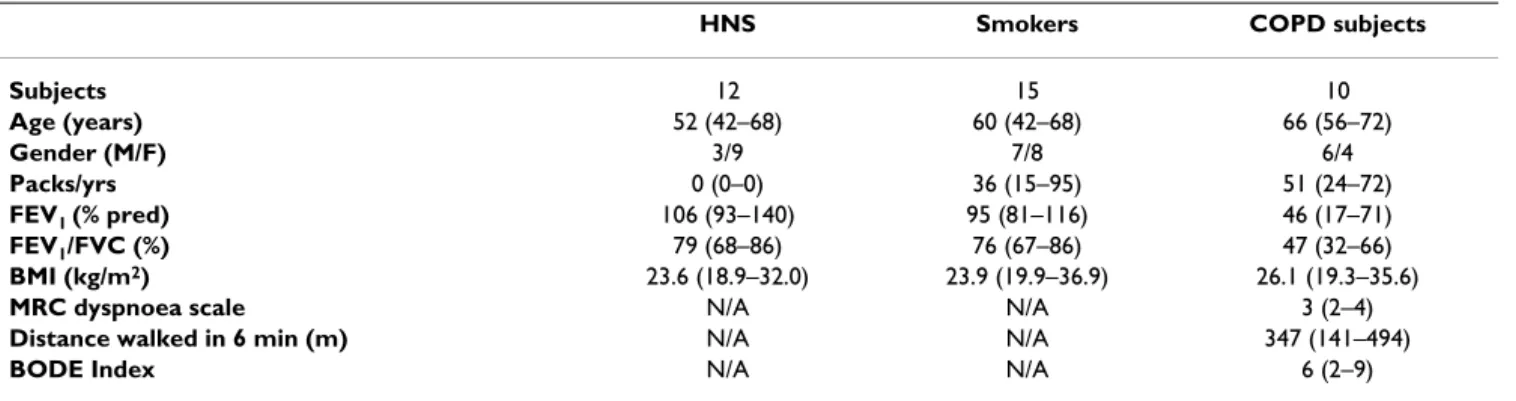
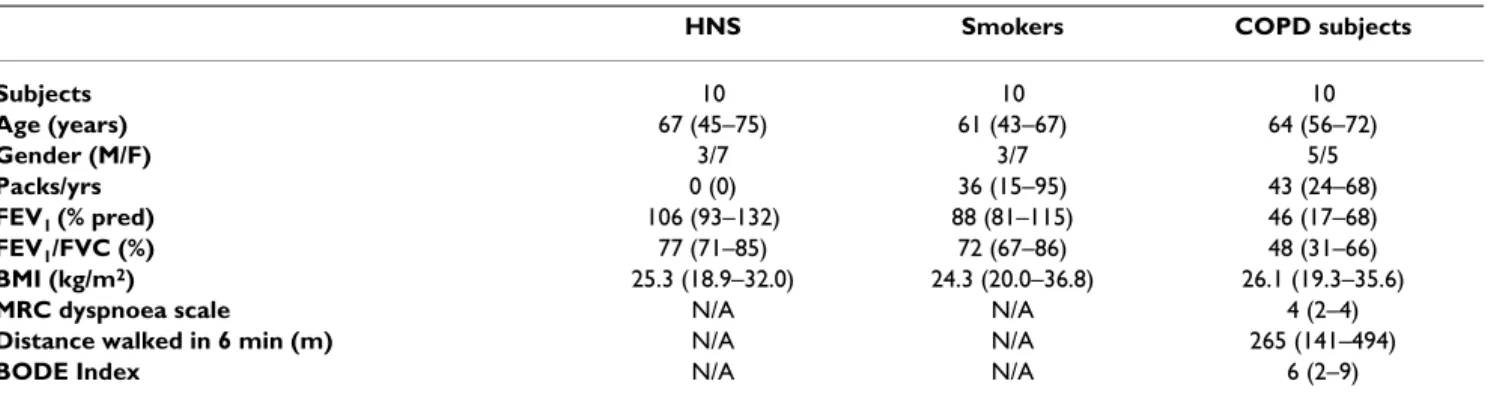
smok-ing history, as closely as possible. Table 1 details the demographic and spirometric data of the subjects used for the cell numbers and intracellular protein staining. Table 2 details the demographic and spirometric data of the sub-jects that were used for the cytotoxicity assay, which included 4 HNS, 8 smokers and 9 COPD subjects from the previous part of the study. Participants were excluded if they had a history of physician diagnosed asthma or a positive skin prick test response to any of the following allergens: grass pollen, house dust mite, cat dander and dog hair (ALK-Abelló). COPD subjects were also excluded if they had had an exacerbation within the previous 6 weeks, were α1-anti-trypsin deficient or had lung cancer. Six out of ten COPD subjects had received inhaled corti-costeroids within 6 weeks of entering the study.
PBMC isolation and fractionation
Peripheral blood mononuclear cells (PBMCs) were iso-lated from whole blood on a discontinuous Histopaque density gradient (Sigma). NK (CD56+CD3-) and NKT-like
(CD56+CD3+) cells were isolated from PBMCs using a
CD56 multi-sort kit in conjunction with α-CD3 microbeads (Miltenyi Biotech Ltd) according to manufac-turers' instructions. Briefly, PBMCs were incubated for 15 minutes at 4°c with α-CD56 MultiSort microbeads and separated on a refrigerated MS column using cold PBS containing 1% FCS and 0.4% EDTA. The resulting positive fraction was then incubated with MultiSort Release Rea-gent for 10 minutes at 4°C, washed and then incubated with MultiSort Stop Reagent and α-CD3 microbeads for 15 minutes at 4°C. Finally the labelled cells were sepa-rated on a refrigesepa-rated LS column. CD8+ T lymphocytes
(CD8+CD56-) were positively selected from the CD56
negative fraction with α-CD8 microbeads. Following iso-lation, all fractions were washed, counted and purity con-firmed at ≥ 94% by flow cytometric analysis.
Flow cytometric analysis
Cells were washed with PBA, fixed in 3% formaldehyde in isotonic azide free solution and given a final wash with PBA – 0.04% saponin with 10% FCS. Labelled antibodies (Table 3) were added at the recommended concentration and the cells were incubated for two hours at 4°C in the dark. Excess antibody was removed by washing and cells were stored in 0.5% formaldehyde in isotonic azide free solution at 4°C. Flow cytometric analysis of these anti-body labelled cells was performed using an EPICS Altra (Beckman Coulter). Fifty thousand live-gated events were collected for each sample and isotype matched antibodies were used to determine binding specificity. Data were analysed using WEASEL version 2.3 (WEHI). Dead cells were excluded from analysis according to their forward and side scatter characteristics.
Cytotoxicity assay
The cytotoxic activities of NK cells (CD56+CD3-),
NKT-like cells (CD56+CD3+) and CD8+ T lymphocytes
(CD8+CD56-) were determined by colorimetric
quantifi-cation of lactate dehydrogenase (LDH) released from lysed target cells. A commercially available kit (CytoTox 96 Non-Radioactive Cytotoxicity Assay, Promega) was used with erythroleukaemic K562 cells (ECACC) as the target cell line. Briefly, the effector and target cells were mixed at a ratio of 5:1, plated, in quadruplicate, on a 96-well U-bottomed plate and incubated for 4 h at 37°C in a humidified atmosphere containing 5% CO2. After incuba-tion, the samples were centrifuged, the supernatants col-lected and incubated for 30 min at room temperature with the Substrate Mix provided with the kit to detect LDH activity. A stop solution was added and the absorbance of the sample was measured at 490 nm on an Emax precision microplate reader (Molecular Devices) using SOFTmax software (Molecular Devices). The amount of cell-medi-ated cytotoxicity was calculcell-medi-ated by subtracting the sponta-neous LDH released from the target and effector cells from
Table 1: Demographic and spirometric values of the studied groups
HNS Smokers COPD subjects
Subjects 12 15 10
Age (years) 52 (42–68) 60 (42–68) 66 (56–72)
Gender (M/F) 3/9 7/8 6/4
Packs/yrs 0 (0–0) 36 (15–95) 51 (24–72)
FEV1 (% pred) 106 (93–140) 95 (81–116) 46 (17–71)
FEV1/FVC (%) 79 (68–86) 76 (67–86) 47 (32–66)
BMI (kg/m2) 23.6 (18.9–32.0) 23.9 (19.9–36.9) 26.1 (19.3–35.6)
MRC dyspnoea scale N/A N/A 3 (2–4)
Distance walked in 6 min (m) N/A N/A 347 (141–494)
BODE Index N/A N/A 6 (2–9)
Results are expressed as median with range in brackets.
the LDH released by lysed target cells, using the following equation:
For the blocking experiments, immunomagnetically selected CD56+ cells were incubated for 30 minutes with
different concentrations of antibodies (Table 3) and used at the effector:target ratio of 5:1 against K562 cells in the LDH release cytotoxicity assay, as previously detailed.
Statistical analysis
The statistical analysis was performed with Prism soft-ware, version 4.0c (GraphPad). Normality was detected
using the Kolmogorov-Smirnov test. As some data were non-normally distributed all are expressed as median (range), unless otherwise stated. Differences between the three groups of subjects were tested using the non-para-metric Kruskal-Wallis test with post hoc pairwise compari-sons made by the Dunn's Multiple Comparison test to determine which pair was statistically significantly differ-ent. P values of less than 0.05 were considered to indicate statistical significance.
Results
Cellular constituents of peripheral blood
All individuals had similar total mononuclear cell num-bers, which were within the normal lymphocyte range; therefore relative proportions of cell types were used for
Cytotoxicity(%)={(effector target cell mix/ −spontaneous effeector LDH release−spontaneous target LDH release) /(maximum target LDH release
spontaneous target LDH release
− )}×100.
Table 2: Demographic and spirometric values of the studied groups for the cytotoxicity assay
HNS Smokers COPD subjects
Subjects 10 10 10
Age (years) 67 (45–75) 61 (43–67) 64 (56–72)
Gender (M/F) 3/7 3/7 5/5
Packs/yrs 0 (0) 36 (15–95) 43 (24–68)
FEV1 (% pred) 106 (93–132) 88 (81–115) 46 (17–68)
FEV1/FVC (%) 77 (71–85) 72 (67–86) 48 (31–66)
BMI (kg/m2) 25.3 (18.9–32.0) 24.3 (20.0–36.8) 26.1 (19.3–35.6)
MRC dyspnoea scale N/A N/A 4 (2–4)
Distance walked in 6 min (m) N/A N/A 265 (141–494)
BODE Index N/A N/A 6 (2–9)
Results are expressed as median with range in brackets.
HNS, Healthy non-smokers; COPD, chronic obstructive pulmonary disease; FEV1, forced expiratory volume in 1 second; pred, predicted value; FVC, forced vital capacity.
Table 3: Antibodies used for flow cytometry and blocking experiments
Antigen Fluorochrome Isotype Clone Company
CD3 ECD
PC7
Mouse IgG1 UCHT1 Beckman Coulter, Luton, UK
CD4 FITC
PC5
Mouse IgG1 13B8.2 Beckman Coulter, Luton, UK
CD8 PC5
APC
Mouse IgG1 B9.11 Beckman Coulter, Luton, UK
CD8 ECD Mouse IgG1 SFCl21Thy2D3 Beckman Coulter, Luton, UK
CD14 FITC Mouse IgG2a RM052 Beckman Coulter, Luton, UK
CD16 PC7 Mouse IgG1 3G8 Beckman Coulter, Luton, UK
CD19 PC5 Mouse IgG1, k J4.119 Beckman Coulter, Luton, UK
CD45RA FITC
PE
Mouse IgG1 ALB11 Beckman Coulter, Luton, UK
CD45RO ECD Mouse IgG2a UCHL1 Beckman Coulter, Luton, UK
CD56 PE
PC5 PC7
Mouse IgG1 N901 Beckman Coulter, Luton, UK
CD62L PC5 Mouse IgG1 DREG56 Beckman Coulter, Luton, UK
Granzyme B FITC Mouse IgG1k GB11 Becton Dickinson, Oxford, UK
Perforin PE Mouse IgG2b δG9 Becton Dickinson, Oxford, UK
Granzyme B N/A Mouse IgG2a 2C5/F5 Becton Dickinson, Oxford, UK
Perforin N/A Mouse IgG2b δG9 Becton Dickinson, Oxford, UK
comparisons (Figure 1). The proportion of NKT-like (CD56+CD3+) cells in COPD subjects (0.6%) was
signifi-cantly lower than in both smokers (2.8%; p < 0.001) and HNS (3.3%; p < 0.001).
The proportion of NK (CD56+CD3-) cells was
signifi-cantly lower in COPD subjects (5.5%) compared to HNS (7.9%; p < 0.01) (Figure 1). As well as a reduction in the overall proportion of NK (CD56+CD3-) cells in the
peripheral blood of COPD subjects, the proportion of NK cells in the cytotoxic CD56dimCD16+ subset was decreased
(79.9%) compared to smokers (88.7%; p < 0.001) and HNS (88.6%; p < 0.01; Figure 2A), with a corresponding rise in the proportion of immunoregulatory CD56brightCD16- cells in COPD subjects. No significant
differences were observed in the proportion of CD8+
CD56dimCD16+ cells in COPD subjects or in the CD8+
CD56brightCD16- cells (data not shown).
Analysis of the NKT-like (CD56+CD3+) subsets revealed
differences between the three groups (Figure 2B). In COPD subjects, the proportion of CD8+ CD56+CD3+ cells
was significantly increased (29.2%) in relation to smokers (21.5%; p < 0.01) and HNS (19.7%; p < 0.01). There was a significant decrease in the number of CD4+ CD56+CD3+
cells in COPD subjects (15.7%) compared to smokers (27.4%; p < 0.001) and HNS (27.9%; p < 0.001) but no significant difference in the double negative (DN, CD3+CD4-CD8-CD56+) subset was detected.
Proportion and type of peripheral blood mononuclear cells in HNS (n = 12), smokers (n = 15) and COPD subjects (n = 10)
Figure 1
Proportion and type of peripheral blood mononuclear cells in HNS (n = 12), smokers (n = 15) and COPD sub-jects (n = 10). Results show a significant decrease in the proportion of NK (CD56+CD3-) cells (*; p < 0.05) and NKT-like
(CD56+CD3+) cells (***; p < 0.001) in COPD subjects compared to HNS. Smokers had a significantly lower proportion of
B-cells (***; p < 0.001) compared to the other two groups and a greater proportion of CD4+ T helper cells. Cell types were
As previously shown, there was no significant difference in the proportion of CD8+ T lymphocytes between the
three groups (Figure 1). However, further analysis of the CD8+ T lymphocytes by flow cytometry revealed that the
proportion of CD45RO+RA+ (T
EMRA cells) was significantly
lower in both smokers and COPD subjects, compared to HNS (p < 0.05). COPD subjects had a trend of more mem-ory cells (CD8+CD45RO+RA-) and a corresponding
reduc-tion in the proporreduc-tion of naïve cells (CD8+CD45RO-RA+)
compared to the other two groups (Figure 2C), although this did not reach significance.
Expression of cytotoxic effector molecules
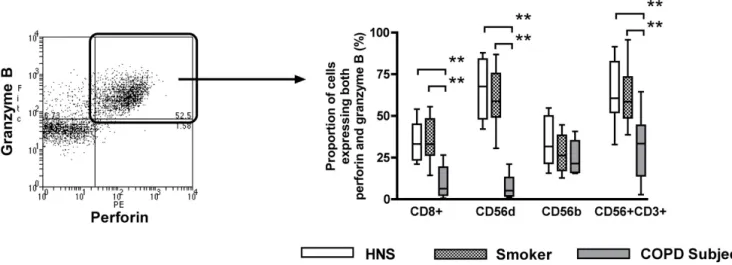
The expression of perforin and granzyme B were studied in CD8+ T lymphocytes, CD56dimCD16+ NK cells,
CD56brightCD16- NK cells and NKT-like (CD56+CD3+)
cells (Figure 3).
The proportions of CD8+ T lymphocytes, CD56dimCD16+
NK cells and NKT-like (CD56+CD3+) cells that expressed
both perforin and granzyme B were significantly lower in COPD subjects (6.4%, 5.2% and 33.4%, respectively) than in smokers (33.0%; p < 0.01, 58.9%; p < 0.01 and 58.6%; p < 0.01) and HNS (33.2%; p < 0.01, 67.7%; p < 0.01 and 60.7%; p < 0.01) (Figure 3B). There was no
dif-Proportion of NK (CD56+ CD3-) subsets (Panel A), NKT-like (CD56+ CD3+) subsets (Panel B) and CD8+ T lymphocyte
sub-sets (Panel C), from the peripheral blood of HNS (n = 12), smokers (n = 15) and COPD subjects (n = 10)
Figure 2
Proportion of NK (CD56+ CD3-) subsets (Panel A), NKT-like (CD56+ CD3+) subsets (Panel B) and CD8+ T lym-phocyte subsets (Panel C), from the peripheral blood of HNS (n = 12), smokers (n = 15) and COPD subjects (n = 10). Panel A shows the proportion of CD56brightCD16- NK cells was significantly increased in COPD subjects compared to
HNS (**; p < 0.01) and smokers (***; p < 0.001). Panel B shows significantly more CD8+CD56+CD3+ cells (**; p < 0.01) in the
peripheral blood of COPD subjects compared to the other two groups and a significant decrease in the proportion of CD4+CD56+CD3+ cells (***; p < 0.001). Panel C shows cells of the highly cytotoxic effector memory phenotype (T
EMRA;
ference in the proportion of CD56brightCD16- NK cells
expressing both granzyme B and perforin (Figure 3B).
The proportion of CD8+ T lymphocytes that expressed
only granzyme B and no perforin were significantly lower in COPD subjects (5.1%) compared to smokers (12.8%; p < 0.01) and HNS (12.7%; p < 0.01). No significant differ-ence was observed between the proportions of CD56dimCD16+ NK cells or CD56brightCD16- NK cells
expressing only granzyme B and no perforin between the three groups (data not shown). The proportion of NKT-like (CD56+CD3+) cells from COPD subjects that express
only granzyme B and no perforin were significantly higher (10.7%) than smokers (3.4%; p < 0.01) and HNS (4.7%; p < 0.01).
The proportion of CD8+ T lymphocytes that expressed
only perforin and no granzyme B were significantly lower in COPD subjects (1.8%) compared to smokers (10.9%; p < 0.01) and HNS (7.9%; p < 0.01). There were signifi-cantly more CD56dimCD16+ NK cells and NKT-like
(CD56+CD3+) cells expressing only perforin and no
granzyme B in COPD subjects (63.5% and 28.4%, respec-tively) compared to smokers (27.3%; p < 0.01 and 10.1%; p < 0.01) and HNS (32.2%; p < 0.01 and 7.0%; p < 0.01). No differences were observed in the proportion of CD56brightCD16- NK cells expressing only perforin and no
granzyme B between the three groups (data not shown).
Cytotoxic activity of NK (CD56+CD3-), NKT-like
(CD56+CD3+) cells and CD8+ T lymphocytes
To establish if the different levels of expression of perforin and granzyme B in these cell populations would reflect their cytotoxic activity, NK (CD56+CD3-) cells, NKT-like
(CD56+CD3+) cells and CD8+ T lymphocytes were
immu-nomagnetically purified from peripheral blood and screened in an LDH release assay. All samples were ≥ 94% pure with respect to B-lymphocytes, helper T lym-phocytes, monocytes, neutrophils and each other (Tables 4, 5 and 6).
Using the same number of effector cells (effector to target ratio of 5:1), both NK (CD56+CD3-) cells and NKT-like (CD56+CD3+) cells from COPD subjects were signifi-cantly less cytotoxic (16.8% and 16.7% specific lysis, respectively) than those from smokers (51.9%; p < 0.001 and 52.5%; p < 0.001) and HNS (66.0%; p < 0.001 and 69.6%; p < 0.001) (Figure 4A and 4B). NK (CD56+CD3-) cells and NKT-like (CD56+CD3+) cells from smokers were also significantly less cytotoxic than those from HNS (p < 0.001) (Figure 4A and 4B). As expected, due to K562 cells not expressing MHC class I, the CD8+ T lymphocytes did not show any killing activity in this assay (data not shown).
The cytotoxic activity of both NK (CD56+CD3-) cells and
NKT-like (CD56+CD3+) cells from COPD subjects
corre-lated with lung function as assessed by FEV1 measurement (r = 0.84; p = 0.0024 and r = 0.81; p = 0.0072, respectively; Figure 5A and 5B).
Representative flow cytometry plot (Panel A) showing the expression of both granzyme B and perforin (Panel B) in CD8+ T
lymphocytes, CD56dim CD16+ NK cells, CD56bright CD16- NK cells and NKT-like (CD56+CD3+) cells from non-smoking
healthy participants (n = 12), healthy smokers (n = 15) and smokers with COPD (n = 10)
Figure 3
Blocking of cytotoxic activity
In order to establish that the observed cytotoxicity of the NK (CD56+CD3-) and NKT-like (CD56+CD3+) cells was
perforin and granzyme B dependent, the effector and tar-get cells were incubated with differing concentrations of anti-perforin and anti-granzyme B antibodies alone and in combination. A dose-dependent inhibition of cytotoxic activity of CD56+ cells was observed in all three groups.
Total inhibition in COPD subjects occurred with a lower concentration of anti-perforin antibody (50 μg/ml) than in HNS and smokers (100 μg/ml; Figure 6A), although this was not statistically significant. The anti-granzyme B antibody had a limited inhibition effect on its own (Fig-ure 6B), but increased the level of inhibition when com-bined, at 50 μg/ml, with perforin (Figure 6C).
Regression analysis confirmed that all the key differences reported here, between the COPD subjects, the smokers and HNS, remained, even after adjusting for age, gender and inhaled corticosteroid use (data not shown).
Discussion
In this study, we have shown, for the first time, that the relative numbers of NK (CD56+CD3-) and NKT-like
(CD56+CD3+) cells in the peripheral blood of COPD
sub-jects are reduced compared to smokers. In addition, and corrected for cell numbers, cytotoxic activity of both NK (CD56+CD3-) and NKT-like (CD56+CD3+) cells is
signifi-cantly reduced and correlates positively with degree of air-way obstruction as measured by FEV1.
In studying the total number of cells in the peripheral blood, we confirmed the findings of others that there are
no significant differences in the overall proportion of CD8+ T lymphocytes between HNS, smokers and COPD
subjects [14,35]. However, the proportion of highly cyto-toxic TEMRA cells, as determined by their high perforin
con-tent [18], was lower. The decreased proportion of TEMRA cells in COPD subjects and smokers has not been previ-ously reported and appears to be related to smoking per se, rather than disease state, although this would need to be confirmed by looking at ex-smokers. One possible expla-nation for our finding is that these cells could be reduced in the periphery as a result of them trafficking to the lung. Since these changes occurred in both smokers with and without COPD they cannot in themselves be responsible for the disease, but could facilitate the development of disease in smokers in synergy with other inflammatory changes.
The proportion of NK (CD56+CD3-) cells was
signifi-cantly reduced in COPD subjects compared to HNS and was reduced, although not significantly, compared to smokers. This reduction in NK cells in COPD subjects has been previously reported [19]. Human NK cells can be sub-divided into two distinct subsets; CD56dimCD16+ and
CD56brightCD16-. In the periphery, the majority (~90%)
are CD56dimCD16+ whereas at sites of inflammation
CD56brightCD16-NK cells predominate. Further analysis of
the NK subsets showed a statistically significant propor-tional increase of CD56brightCD16- NK cells, which has not
been previously reported in COPD. The CD56brightCD16
-subset has a lower cytotoxic potential, but has the capacity to secrete cytokines and are therefore regarded as immu-noregulatory [36]. The relative increase in this cell subset could signify that NK cells play a role in the
pathophysiol-Table 4: Purity of immunomagnetically separated NK (CD56+CD3-) cells from the peripheral blood of the studied groups.
HNS Smokers COPD subjects
NK (CD56+CD3-) cells 96.2 (± 1.4) 96.6 (± 0.8) 96.8 (± 0.6)
NKT-like (CD56+CD3+) cells 1.2 (± 0.6) 1.0 (± 0.9) 0.8 (± 1.2)
Cytotoxic T cells (CD8+) 0.4 (± 1.3) 0.7 (± 0.5) 0.6 (± 0.7)
B cells (CD19+) 0.9 (± 0.9) 0.5 (± 0.8) 0.9 (± 0.9)
Helper T cells (CD4+) 1.1 (± 0.3) 0.9 (± 0.2) 0.4 (± 1.0)
Monocytes (CD14+) 0.2 (± 1.1) 0.3 (± 0.4) 0.5 (± 1.3)
Results are expressed as mean with standard deviation in brackets.
Table 5: Purity of immunomagnetically separated NKT-like (CD56+CD3+) cells from the peripheral blood of the studied groups.
HNS Smokers COPD subjects
NK (CD56+CD3-) cells 1.9 (± 1.2) 1.4 (± 0.3) 1.7 (± 1.3)
NKT-like (CD56+CD3+) cells 95.6 (± 0.8) 96.3 (± 0.5) 96.6 (± 1.0)
Cytotoxic T cells (CD8+) 0.5 (± 0.8) 0.2 (± 0.8) 0.6 (± 0.9)
B cells (CD19+) 0.7 (± 0.6) 1.1 (± 0.1) 0.4 (± 0.6)
Helper T cells (CD4+) 1.2 (± 1.3) 0.8 (± 0.3) 0.3 (± 1.2)
Monocytes (CD14+) 0.1 (± 1.1) 0.2 (± 0.9) 0.4 (± 1.0)
Table 6: Purity of immunomagnetically separated CD8+T lymphocytes from the peripheral blood of the studied groups.
HNS Smokers COPD subjects
NK (CD56+CD3-) cells 2.0 (± 0.5) 1.4 (± 1.4) 1.2 (± 1.0)
NKT-like (CD56+CD3+) cells 1.5 (± 1.1) 0.8 (± 1.2) 0.9 (± 1.2)
Cytotoxic T cells (CD8+) 94.7 (± 1.4) 95.0 (± 1.2) 96.0 (± 0.4)
B cells (CD19+) 0.2 (± 0.8) 0.9 (± 0.1) 0.8 (± 0.9)
Helper T cells (CD4+) 0.9 (± 0.9) 1.1 (± 1.0) 0.6 (± 0.6)
Monocytes (CD14+) 0.7 (± 0.8) 0.8 (± 0.7) 0.5 (± 1.0)
Results are expressed as mean with standard deviation in brackets.
Cytotoxic activity of NK (CD56+ CD3-) cells (Panel A) and
NKT-like (CD56+ CD3+) cells (Panel B)
Figure 4
Cytotoxic activity of NK (CD56+ CD3-) cells (Panel A) and NKT-like (CD56+ CD3+) cells (Panel B). Immu-nomagnetically separated cells (25,000) were cultured with K562 cells (5,000) giving an effector:target ratio of 5:1, in an LDH release cytotoxicity assay (***; p < 0.001).
Correlation of cytotoxic activity and lung function in NK (CD56+CD3-) cells (Panel A) and NKT-like (CD56+CD3+)
cells (Panel B) in COPD subjects
Figure 5
ogy of COPD not previously identified. However, without sampling the lung we can only hypothesis as to their role in the disease. No difference in NK cell numbers or func-tional activity has been found in lung parenchyma of COPD patients [21], although a decrease has been seen in the bronchoalveolar lavage (BAL) of chronic bronchitis patients [13] suggesting that there could be intra-compart-mental variability.
The overall proportion of NKT-like (CD56+CD3+) cells
was decreased in COPD subjects. The proportion of these cells that expressed CD8 was increased showing that, sim-ilar to NK cells, the subset bias is different in COPD patients, indicating potential selective enrichment or active recruitment to the lung. The immune regulatory role of CD56+CD3+ cells remains poorly defined; both for
the overall CD56+CD3+ cell population and for the
phe-notypically different CD56+CD3+ cell subtypes [37]. Due
to the extremely low number of invariant NKT cells in the
Cytotoxic activity of CD56+ cells in the presence of different concentrations of an anti-perforin antibody (A), an anti-granzyme
B antibody (B) and a combination of the two (C) from HNS (n = 3), smokers (n = 3) and COPD subjects (n = 3)
Figure 6
Cytotoxic activity of CD56+ cells in the presence of different concentrations of an anti-perforin antibody (A), an anti-granzyme B antibody (B) and a combination of the two (C) from HNS (n = 3), smokers (n = 3) and COPD subjects (n = 3). Immunomagnetically selected CD56+ cells were incubated with the stated concentration of antibody
peripheral blood [25] our analysis was expanded to include both invariant NKT cells and the TCR diverse non-invariant NKT cells by using CD3 and CD56 as markers. These markers, when used in conjunction with CD4 and CD8, enabled the analysis of CD4+, CD8+ and double
neg-ative (DN) NKT cells. This analysis revealed that in COPD subjects the overall proportion of NKT cells was decreased and the relative proportion of CD8+ NKT cells was
increased. Recent studies have highlighted the distinct Th1- and Th2-type cytokine profiles of NKT cell subpopu-lations [38-42]. The CD4+ NKT cells produce both
Th1-and Th2-type cytokines [38,40-42] Th1-and the CD8+ and DN
NKT cells produce predominantly Th1-type cytokines [39-42], which could influence the cytokine milieu at the site of inflammation, especially as they are prolific producers. No difference in cytotoxic ability of the three NKT-like subsets has been reported to date.
The differential expression of both perforin and granzyme B within the same cell in CD8+ T lymphocytes, CD56dimCD16+ NK cells and NKT-like (CD56+CD3+) cells
in COPD subjects has not been previously reported. By measuring the proteins at the same time and in the same cell it was possible to identify that the cells that express both perforin and granzyme B, were reduced in COPD subjects. These are of greatest interest as they would be the most cytotoxic. It is worth mentioning pre-stored perforin and granzyme B are normally only found in TEMRA and effector memory cells, but not in naïve or central memory cells [18]. A previous study by Morisette et al showed no difference in the levels of perforin or granzyme B in peripheral CD8+ T lymphocytes and CD56+ cells from emphysema patients compared to smokers and healthy controls [43]. Our study goes one stage further and looks at the proportion of cells that express both cytotoxic pro-teins and our conclusions complement theirs as we too propose that the cytotoxic cells are selectively recruited to the lung, or the cells are activated within the lung, by a hitherto unknown antigen. This hypothesis is also sup-ported by the findings of Hodge et al who reported an increase in the percentage of cells expressing either granzyme B or perforin in the airways and periphery of COPD patients [31]. Again, however, only one protein was measured in each cell so the difference that we report would not have been measurable. Hodge also reported an increase in exogenous granzyme B in the lung highlight-ing another potential role in the pathogenesis of disease. Furthermore, a previous study by Chrysofakis et al has shown that the CD8+ T cells contained within the induced
sputum of smokers with COPD were more cytotoxic and expressed more perforin than those in smokers and HNS [28]. The characteristic lung tissue destruction witnessed in COPD subjects [27] could, therefore, be partially medi-ated by the cytotoxic cells identified in this study, as they all express characteristic sets of chemokine receptors and
adhesion molecules that are required for homing to inflamed tissues, such as CXCR3, whose ligand IP-10 is known to be up-regulated in COPD lung epithium [44].
We have also demonstrated that there is a significant decrease in the cytotoxic activity of peripheral blood NK (CD56+CD3-) and NKT-like (CD56+CD3+) cells in COPD
subjects, compared to smokers and HNS. The measured reduction in cytotoxic activity is not related to absolute cell numbers, as this is accounted for in the assay, but appears to be related to the numbers of NK (CD56+CD3-)
and NKT-like (CD56+CD3+) cells that expressed both
per-forin and granzyme B. In the 4 hour LDH release assay performed, the majority of killing measured would be a result of these double positive cells. The perforin only cells, whilst theoretically capable of killing in vivo, due to their ability to form pores, need the synergistic activity of the apoptosis inducing granzyme B to kill within the 4-hour window of the assay. Granzyme B only cells could kill through the endocytotic uptake of granzyme B by the target cell, but this would be less effective than the per-forin and granzyme B combination.
The dose dependant reduction of cytotoxic activity of the NK (CD56+CD3-) and NKT-like (CD56+CD3+) cells when
incubated with either an anti-perforin antibody alone or in combination with an anti-granzyme B antibody con-firmed that the measured killing was a result of the gran-ule exocytosis pathway.
Conclusion
In summary, these experiments have shown that there are significant differences in the proportions, subsets, intrac-ellular proteins and cytotoxic abilities of CD56+CD3-
(nat-ural killer; NK) cells and CD56+CD3+ (NKT-like) cells in
the peripheral blood of COPD subjects.
Competing interests
The authors declare that they have no competing interests.
Authors' contributions
RAU carried out the experimental work and wrote the manuscript. JRL and IT participated in the study's design and edited the manuscript. LF and JC conceived the study, participated in its' design and co-ordination, and edited the manuscript. All authors read and approved the final manuscript.
Acknowledgements
We gratefully acknowledge our research nurse, Lizz Everitt for recruiting the patients. RAU was funded by a GlaxoSmithKline Ph.D Studentship grant.
References
1. Celli BR, MacNee W: Standards for the diagnosis and treat-ment of patients with COPD: a summary of the ATS/ERS position paper. Eur Respir J. 2004, 23(6):932-946.
2. Dennis RJ, Maldonado D, Norman S, Baena E, Castano H, Martinez G, Velez JR: Wood smoke exposure and risk for obstructive air-ways disease among women. Chest. 1996, 109(3 Suppl):55S-56S.
3. Barnes PJ: Small airways in COPD. N Engl J Med 2004,
350(26):2635-2637.
4. Agusti A: Systemic effects of chronic obstructive pulmonary disease: what we know and what we don't know (but should).
Proc Am Thorac Soc. 2007, 4(7):522-525.
5. Agusti A, Soriano JB: COPD as a Systemic Disease. COPD 2008,
5(2):133-138.
6. Fabbri LM, Rabe KF: From COPD to chronic systemic inflam-matory syndrome? Lancet 2007, 370(9589):797-799.
7. Bernard S, LeBlanc P, Whittom F, Carrier G, Jobin J, Belleau R, Maltais F: Peripheral muscle weakness in patients with chronic obstructive pulmonary disease. Am J Respir Crit Care Med 1998,
158(2):629-634.
8. Rahman I, Morrison D, Donaldson K, MacNee W: Systemic oxida-tive stress in asthma, COPD, and smokers. Am J Respir Crit Care Med. 1996, 154(4 Pt 1):1055-1060.
9. Kamischke A, Kemper DE, Castel MA, Luthke M, Rolf C, Behre HM, Magnussen H, Nieschlag E: Testosterone levels in men with chronic obstructive pulmonary disease with or without glu-cocorticoid therapy. Eur Respir J 1998, 11(1):41-45.
10. Saetta M, Di Stefano A, Turato G, Facchini FM, Corbino L, Mapp CE, Maestrelli P, Ciaccia A, Fabbri LM: CD8+ T-lymphocytes in peripheral airways of smokers with chronic obstructive pul-monary disease. Am J Respir Crit Care Med. 1998, 157(3 Pt 1):822-826.
11. Lofdahl MJ, Roos-Engstrand E, Pourazar J, Bucht A, Dahlen B, Elm-berger G, Blomberg A, Skold CM: Increased intraepithelial T-cells in stable COPD. Respir Med 2008, 102(12):1812-1818. 12. Brozyna S, Ahern J, Hodge G, Nairn J, Holmes M, Reynolds PN,
Hodge S: Chemotactic mediators of Th1 T-cell trafficking in smokers and COPD patients. COPD. 2009, 6(1):4-16. 13. Costabel U, Maier K, Teschler H, Wang YM: Local immune
com-ponents in chronic obstructive pulmonary disease. Respiration
1992, 59(Suppl 1):17-19.
14. Ekberg-Jansson A, Andersson B, Avra E, Nilsson O, Lofdahl CG: The expression of lymphocyte surface antigens in bronchial biop-sies, bronchoalveolar lavage cells and blood cells in healthy
smoking and never-smoking men, 60 years old. Respir Med
2000, 94(3):264-272.
15. Lehmann C, Wilkening A, Leiber D, Markus A, Krug N, Pabst R, Tschernig T: Lymphocytes in the bronchoalveolar space reenter the lung tissue by means of the alveolar epithelium, migrate to regional lymph nodes, and subsequently rejoin the systemic immune system. Anat Rec 2001, 264(3):229-236. 16. Kim WD, Kim WS, Koh Y, Lee SD, Lim CM, Kim DS, Cho YJ:
Abnor-mal peripheral blood T-lymphocyte subsets in a subgroup of patients with COPD. Chest 2002, 122(2):437-444.
17. Barceló B, Pons J, Fuster A, Sauleda J, Noguera A, Ferrer JM, Agustí AG: Intracellular cytokine profile of T lymphocytes in patients with chronic obstructive pulmonary disease. Clin Exp Immunol 2006, 145(3):474-479.
18. Sallusto F, Geginat J, Lanzavecchia A: Central memory and effec-tor memory T cell subsets: function, generation, and main-tenance. Annu Rev Immunol 2004, 22:745-763.
19. Prieto A, Reyes E, Bernstein ED, Martinez B, Monserrat J, Izquierdo JL, Callol L, de LUCAS P, Alvarez-Sala R, Alvarez-Sala JL, Villarrubia VG, Alvarez-Mon M: Defective natural killer and phagocytic activities in chronic obstructive pulmonary disease are restored by glycophosphopeptical (inmunoferon). Am J Respir Crit Care Med. 2001, 163(7):1578-1583.
20. Zeidel A, Beilin B, Yardeni I, Mayburd E, Smirnov G, Bessler H:
Immune response in asymptomatic smokers. Acta anaesthesi-ologica Scandinavica 2002, 46(8):959-964.
21. Majo J, Ghezzo H, Cosio MG: Lymphocyte population and apop-tosis in the lungs of smokers and their relation to emphy-sema. Eur Respir J 2001, 17(5):946-953.
22. Akbari O, Faul JL, Hoyte EG, Berry GJ, Wahlström J, Kronenberg M, DeKruyff RH, Umetsu DT: CD4+ invariant T-cell-receptor+ nat-ural killer T cells in bronchial asthma. N Engl J Med 2006,
354(11):1117-1129.
23. Fairclough L, Urbanowicz RA, Corne J, Lamb JR: Killer cells in chronic obstructive pulmonary disease. Clin Sci (Lond). 2008,
114(8):533-541.
24. Vijayanand P, Seumois G, Pickard C, Powell RM, Angco G, Sammut D, Gadola SD, Friedmann PS, Djukanovic R: Invariant natural killer T cells in asthma and chronic obstructive pulmonary disease.
N Engl J Med 2007, 356(14):1410-1422.
25. Kenna T, Golden-Mason L, Porcelli SA, Koezuka Y, Hegarty JE, O'Far-relly C, Doherty DG, Mason LG: NKT cells from normal and tumor-bearing human livers are phenotypically and func-tionally distinct from murine NKT cells. J Immunol. 2003,
171(4):1775-1779.
26. Emoto M, Kaufmann SH: Liver NKT cells: an account of hetero-geneity. Trends Immunol 2003, 24(7):364-369.
27. Vernooy JH, Moller GM, van Suylen RJ, van Spijk MP, Cloots RH, Hoet PH, Pennings HJ, Wouters EF: Increased granzyme A expression in type II pneumocytes of patients with severe chronic obstructive pulmonary disease. Am J Respir Crit Care Med 2007,
175(5):464-472.
28. Chrysofakis G, Tzanakis N, Kyriakoy D, Tsoumakidou M, Tsiligianni I, Klimathianaki M, Siafakas NM: Perforin expression and cytotoxic activity of sputum CD8+ lymphocytes in patients with COPD. Chest. 2004, 125(1):71-76.
29. Nikos S: "In the Beginning" of COPD: is evolution important?
Am J Respir Crit Care Med 2007, 175(5):423-424.
30. Willemse BW, ten Hacken NH, Rutgers B, Lesman-Leegte IG, Postma DS, Timens W: Effect of 1-year smoking cessation on airway inflammation in COPD and asymptomatic smokers. Eur Respir J 2005, 26(5):835-845.
31. Hodge S, Hodge G, Nairn J, Holmes M, Reynolds PN: Increased air-way granzyme b and perforin in current and ex-smoking COPD subjects. COPD. 2006, 3(4):179-187.
32. Sauer H, Pratsch L, Tschopp J, Bhakdi S, Peters R: Functional size of complement and perforin pores compared by confocal laser scanning microscopy and fluorescence microphotoly-sis. Biochim Biophys Acta 1991, 1063(1):137-146.
33. Trapani JA: Granzymes: a family of lymphocyte granule serine proteases. Genome Biol 2001, 2(12):REVIEWS3014.
34. Lord SJ, Rajotte RV, Korbutt GS, Bleackley RC: Granzyme B: a nat-ural born killer. Immunol Rev 2003, 193:31-38.
Publish with BioMed Central and every scientist can read your work free of charge
"BioMed Central will be the most significant development for disseminating the results of biomedical researc h in our lifetime."
Sir Paul Nurse, Cancer Research UK
Your research papers will be:
available free of charge to the entire biomedical community
peer reviewed and published immediately upon acceptance
cited in PubMed and archived on PubMed Central
yours — you keep the copyright
Submit your manuscript here:
http://www.biomedcentral.com/info/publishing_adv.asp
BioMedcentral
subjects have the phenotype of activated intraepithelial T cells (CD69+ CD103+). Thorax 2003, 58(1):23-29.
36. Dalbeth N, Gundle R, Davies RJ, Lee YC, McMichael AJ, Callan MF:
CD56bright NK cells are enriched at inflammatory sites and can engage with monocytes in a reciprocal program of acti-vation. J Immunol. 2004, 173(10):6418-6426.
37. Oren A, Husebo C, Iversen AC, Austgulen R: A comparative study of immunomagnetic methods used for separation of human natural killer cells from peripheral blood. J Immunol Methods
2005, 303(1–2):1-10.
38. Takahashi T, Nieda M, Koezuka Y, Nicol A, Porcelli SA, Ishikawa Y, Tadokoro K, Hirai H, Juji T: Analysis of human V alpha 24+ CD4+ NKT cells activated by alpha-glycosylceramide-pulsed monocyte-derived dendritic cells. J Immunol 2000,
164(9):4458-4464.
39. Takahashi T, Chiba S, Nieda M, Azuma T, Ishihara S, Shibata Y, Juji T, Hirai H: Cutting edge: analysis of human V alpha 24+CD8+ NK T cells activated by alpha-galactosylceramide-pulsed monocyte-derived dendritic cells. J Immunol. 2002,
168(7):3140-3144.
40. Gumperz JE, Miyake S, Yamamura T, Brenner MB: Functionally dis-tinct subsets of CD1d-restricted natural killer T cells revealed by CD1d tetramer staining. J Exp Med 2002,
195(5):625-636.
41. Kim CH, Butcher EC, Johnston B: Distinct subsets of human Valpha24-invariant NKT cells: cytokine responses and chem-okine receptor expression. Trends Immunol 2002,
23(11):516-519.
42. Lee PT, Benlagha K, Teyton L, Bendelac A: Distinct functional lin-eages of human V(alpha)24 natural killer T cells. J Exp Med
2002, 195(5):637-641.
43. Morissette MC, Parent J, Milot J: Perforin, granzyme B, and FasL expression by peripheral blood T lymphocytes in emphy-sema. Respir Res 2007, 8:62.


![Address [on annual developments] by Mr. Jean Monnet, President of the High Authority. Strasbroug, 12 May 1954](data:image/gif;base64,R0lGODlhAQABAIAAAP///wAAACH5BAEAAAAALAAAAAABAAEAAAICRAEAOw==)