ISSN: 2147-611X
www.ijemst.com
Using
an
Assessment
of
Early
Mathematical Knowledge and Skills to
Inform Policy and Practice: Examples
from the Early Grade Mathematics
Assessment
Linda M. Platas1, Leanne R. Ketterlin-Geller2, Yasmin Sitabkhan3
1San Francisco State University 2Southern Methodist University 3
RTI International
To cite this article:
Platas, L.M., Ketterlin-Geller, L.R., & Sitabkhan, Y. (2016). Using an assessment of early
mathematical knowledge and skills to inform policy and practice: Examples from the early
grade mathematics assessment.
International Journal of Education in Mathematics, Science
and Technology, 4
(3), 163-173. DOI:10.18404/ijemst.20881
This article may be used for research, teaching, and private study purposes.
Any substantial or systematic reproduction, redistribution, reselling, loan, sub-licensing,
systematic supply, or distribution in any form to anyone is expressly forbidden.
Authors alone are responsible for the contents of their articles. The journal owns the
copyright of the articles.
Volume 4, Number 3, 2016
DOI:10.18404/ijemst.20881
Using an Assessment of Early Mathematical Knowledge and Skills to
Inform Policy and Practice: Examples from the Early Grade Mathematics
Assessment
Linda M. Platas, Leanne R. Ketterlin-Geller, Yasmin Sitabkhan
Article Info
Abstract
Article History
Received: 15 July 2015
This paper describes the development and intended uses of the Early Grades Mathematics Assessment (EGMA), which measures essential early mathematical knowledge and skills that are foundational to more sophisticated mathematical abilities, predictive of later achievement, and teachable. Administering the EGMA can provide policy makers, practitioners, and researchers with information about whether existing educational policies, curricular reforms or programs, and instructional interventions are supporting students in reaching important goals in mathematics. We highlight the utility of the EGMA results in three abbreviated illustrations of implementation studies in low-income countries. Recommendations for policy makers, practitioners, and researchers are provided.
Accepted: 30 December 2015
Keywords
Mathematics Educational policy International education Assessment
Introduction
Research across the globe has provided evidence on the predictive relationship of early mathematical knowledge and skills on later academic achievement and economic status. Similarly, there has been a growing understanding of the importance of these foundational skills in building and sustaining a democratic society as well as technological capacity at national levels. However, until recently, there have been few efforts to provide valid and reliable population-level assessments of early mathematical knowledge and skills. This manuscript reports on the development and intended uses of the Early Grades Mathematics Assessment (EGMA), an instrument that measures number sense knowledge and skills in the early primary grades. Through snapshots of three implementation studies, we illustrate how policy makers and practitioners can use the EGMA results to evaluate the effectiveness of educational policies, curricular reforms or programs, and instructional practices and interventions.
This paper begins with overviews of research on the increasing importance of early mathematics proficiency and current mathematics assessment policies. We follow this with sections that cover the principles underlying the development of the EGMA including the content domains and assessment framework. We then illustrate the uses of the EGMA results through descriptions of three studies and conclude with recommendations for future research, development, and implementation of the EGMA.
The Importance of Mathematics Proficiency
Although reading is an essential skill, evidence suggests that an emphasis on reading alone may not produce the desired academic outcomes (Watts, Duncan, Siegler, & Davis-Kean, 2014). In addition to reading, students’ mathematical knowledge and skills may have wide reaching effects on their future academic and economic success. A causal relationship has been identified between early mathematical proficiency and later individual economic well-being and broader economic growth in countries including Kenya, Tanzania, Ghana, and Pakistan (Hanushek & Woessmann, 2008; Jolliffe, 1998). In the United Kingdom, Ritchie and Bates (2013) found a statistically significant association between early mathematical knowledge and adult socioeconomic status at age 42 years. In 2007, Duncan and colleagues conducted a meta-analysis of longitudinal studies from the United States, the United Kingdom, and Canada, and concluded that students’ early number sense skills were the greatest predictors of academic achievement at 3rd and 5th grades when compared to early reading, socio-emotional, and attention skills. Subsequent research showed that persistent poor performance in mathematics in the primary grades resulted in lower rates of high school completion and college attendance (Duncan & Magnuson, 2011). As this evidence suggests, proficiency in early mathematics concepts supports students’ future academic outcomes.
Many low-income countries are not faring well in mathematics (Mullis, Martin, Foy, & Arora, 2012). Recent reports from East Africa illustrate a profound lack of mathematical knowledge and skills in all grades (Uwezo at Twaweza, 2014). In Central and Eastern Europe and the Commonwealth of Independent States (CEECIS), mathematics performance is significantly poorer in countries with relatively lower incomes (UNICEF, 2007). Similarly, in Latin America, four of six countries participating in the Programme for International Student Assessment (PISA) rank in the bottom ten of all participating countries (Hanushek & Woessmann, 2012). Combined, these results indicate a far-reaching crisis in early grades mathematics achievement.
Assessing Early Grades Mathematics
Given the importance of early mathematics knowledge and skills, policy makers and practitioners alike need to be aware of students’ development of early mathematical proficiency. Data about students’ current understanding of key early mathematical concepts can help policy makers and practitioners evaluate the effectiveness of educational policies, curricular reforms or programs, and instructional practices or interventions on student learning. For example, data can be examined to determine the extent of student learning in relation to the curricular expectations, and students’ growth over time can be considered when evaluating whether the educational system is adequately supporting students’ development of proficiency. By gathering sufficient data, policy makers and practitioners may receive relevant and timely information to make adjustments to policies, curricular reforms or programs, and instructional practices so that they may better support student success. Several assessment systems are currently available that provide data about students’ mathematics achievement. Multi-country assessments, such as the Trends in International Mathematics and Science Study (TIMSS) and the PISA, provide data about students’ current level of mathematical understanding. Although policy makers can use these data to consider the effectiveness of within-country policies and practices, data obtained from these assessment systems are primarily intended for cross-country comparisons. In addition, Heckman (2006) noted that these assessments are often too difficult for many students in low-income countries, thereby limiting the utility of the data for evaluating current policies and practices. Moreover, because these assessments target students in upper primary school and beyond, no data are provided about students’ development of early
mathematical knowledge and skills. An important step in improving mathematics performance is to understand how students are progressing in attaining foundational skills.
Principles Underlying the Development of the EGMA
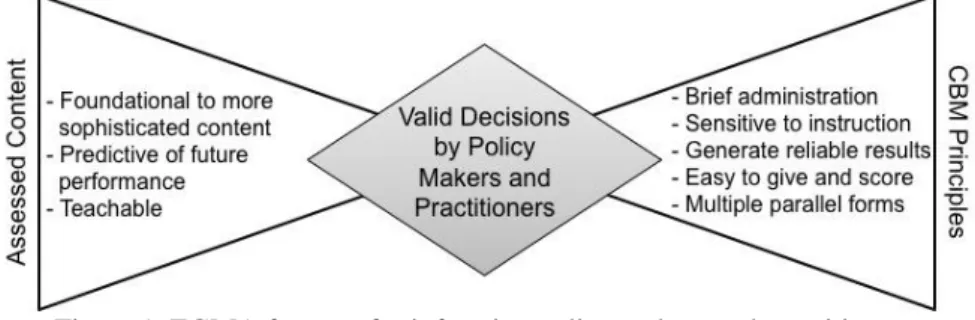
The EGMA is an open-source assessment of early mathematical knowledge and skills widely used in Sub-Saharan Africa, Latin America, the Caribbean, Asia, and the Middle East. What separates the EGMA from other early mathematics assessment systems are the content and test design features. Content assessed by the EGMA covers mathematical knowledge and skills that are predictive of future performance, including number identification, number discrimination, number patterns, and addition and subtraction. The EGMA is designed following principles of curriculum-based measurement (CBM) to provide reliable results that are sensitive to instructional changes over time. CBMs are brief measures that are easy to administer and score, and can include multiple parallel forms. Figure 1 illustrates the interaction between the assessed content and the CBM principles when using data to make informed decisions.
Figure 1. EGMA features for informing policy makers and practitioners.
In this paper, we describe the development and intended uses of the EGMA, focusing on the research underlying both the content selection and test design features aligned with the principles of CBM. We assert that these content and test design features provide policy makers and practitioners with precise data for making valid decisions to support students’ development of proficiency in key early mathematical knowledge and skills.
Content of the EGMA
Early mathematical concepts include counting, subitizing, one-to-one correspondence, magnitude comparison, quantity discrimination, detecting number patterns, quantity estimation, and performing simple number transformations (Geary, 2011; Jordan, Kaplan, Ramineni, & Locuniak, 2009). Students develop proficiency in these concepts through various informal and formal experiences with mathematics. Through play and interactions with their environment, children develop informal mathematical skills including number knowledge, relations between quantities, and early arithmetic operations (Purpura & Lonigan, 2012). In formal school settings, students learn to associate quantities with the abstract numerical representations, understand the concept of place value, and solve more complex operations. As students engage in increasingly more complex mathematical experiences, their ability to work nimbly and flexibly with numbers to solve and reason through problems increases.
As noted earlier, these predictive mathematical abilities make up number sense, the important collection of knowledge and skills that form the foundation of later mathematical skills and abilities, and are thus targets of the EGMA. A child’s ability to work with and make sense of numbers develops his or her number sense (Gersten & Chard, 1999). Specific skills that combine to support students’ number sense include basic counting, magnitude comparisons, and simple operations (National Mathematics Advisory Panel, 2008). These skills are the foundation for the five EGMA subtests. Although not discussed in this paper, other subtasks including shape recognition, spatial reasoning, and relational reasoning are under development for those countries that wish to assess these important, but relatively less predictive skills.
Students’ Development of Counting Skills
numeral within a number corresponds to given quantities thereby supporting students’ conceptual understanding of place value. Students’ understanding of these associations forms the basis of their ability to work with abstract symbol-based mathematics.
Students’ understanding of number patterns complements their counting ability, and bridges their early number sense to later mathematical skills including multiplication (Geary, 1994) and algebraic thinking (Sarama & Clements, 2009). Number patterns emerge as children recognize that counting concrete objects in any order results in the same sequence of number names. Children can also recognize repeating and growing patterns of objects or shapes. As Sarama and Clements succinctly state, “…patterning is the search for mathematical regularities and structures, to bring order, cohesion, and predictability to seemingly unorganized situations and facilitate generalizations beyond the information directly available” (p. 319).
Students’ Understanding of Magnitude
The ability to compare magnitudes develops as students become proficient in counting. This skill often begins in informal settings as students compare the quantity of two or more sets of objects (Purpura & Lonigan, 2012). As students become more proficient in number identification, students are able to compare symbolically expressed numbers by reasoning about their magnitude. Reasoning about numerical magnitudes supports students’ future arithmetic skills by narrowing the range of possible answers (Booth & Siegler, 2008) and facilitating efficient arithmetic strategies (Geary, Bow-Thomas, & Yao, 1992). In addition, students’ ability to compare magnitudes will likely predict their understanding of place value concepts (Gersten, Clarke, Jordan, Newman-Gonchar, & Wilkins, 2012).
Students’ Ability to Perform Operations
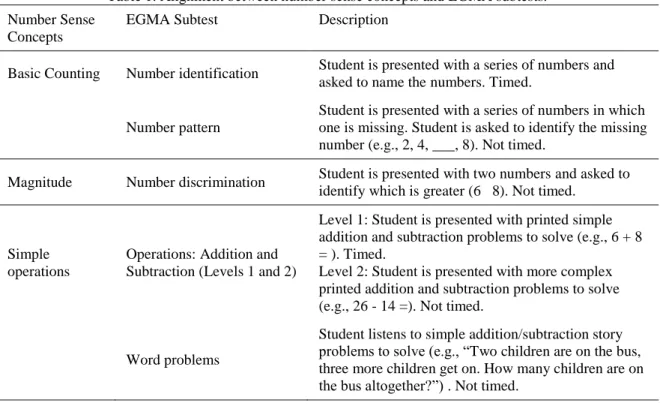
Proficiency with simple operations refers to children’s conceptual understanding of and procedural fluency with arithmetic operations. The early skills of counting and magnitude comparisons help students develop number sense, or an understanding of the relationship between numbers and how they apply to the real world. These skills work in tandem to support students’ conceptual understanding of, and procedural proficiency with, arithmetic operations. Initially, students understand the concepts of addition as joining and subtraction as separating sets or taking away, and the impact of these actions on the resulting quantity. These concepts support students’ ability to perform the simple operations with objects (Geary, 1994) and then visual representations. Ultimately, students develop procedural proficiency working with abstract representations. Notably, fluency in single-digit addition is a core skill for later mathematical development and predicts future mathematics performance (Baroody, 1987; Jordan, Hanich, & Kaplan, 2003; Reikeras, 2006). Relatedly, three subtests are timed in the EGMA, as timing is essential in determining fluency in these important skills. Five subtests were designed to assess these key concepts. Table 1 illustrates the alignment between the EGMA subtests and the concepts underlying students’ number sense.
In sum, although discussed independently, these skills are inseparable. They combine to represent students’ development of number sense. As an example, in a longitudinal study of elementary grade students in the United States, Geary (2011) found that early arithmetic skills that included the ability to quickly recognize quantities presented as sets or numerals (involving subitizing, number recognition, and number naming) and compose and decompose quantities predicted later achievement in mathematics beyond the contribution of general abilities and other mathematical competencies. Similarly, Claessens and Engel (2013) found that the combined proficiency level including competence in number recognition, counting, shapes and patterns is an important predictor of future mathematics success in elementary school.
Table 1. Alignment between number sense concepts and EGMA subtests. Number Sense
Concepts
EGMA Subtest Description
Basic Counting Number identification Student is presented with a series of numbers and asked to name the numbers. Timed.
Number pattern
Student is presented with a series of numbers in which one is missing. Student is asked to identify the missing number (e.g., 2, 4, ___, 8). Not timed.
Magnitude Number discrimination Student is presented with two numbers and asked to identify which is greater (6 8). Not timed.
Simple operations
Operations: Addition and Subtraction (Levels 1 and 2)
Level 1: Student is presented with printed simple addition and subtraction problems to solve (e.g., 6 + 8 = ). Timed.
Level 2: Student is presented with more complex printed addition and subtraction problems to solve (e.g., 26 - 14 =). Not timed.
Word problems
Student listens to simple addition/subtraction story problems to solve (e.g., “Two children are on the bus, three more children get on. How many children are on the bus altogether?”) . Not timed.
CBM Principles Guiding the Development of the EGMA
The development of the EGMA was informed by the tradition of assessments referred to as curriculum-based measurement (CBM; c.f., Deno, 1985). Initial research on CBMs was conducted in the 1970s but has continued to the present day as a way of gathering instructionally relevant student performance data for teachers’ immediate use (Fuchs, 2004). Student performance on CBMs in mathematics is used to determine students’ achievement level, identify students who are at risk for difficulties, and monitor the effectiveness of instruction at supporting learning (Lembke, Foegen, Whittaker, & Hampton, 2008). Consequently, these results can be used to assess whether existing educational policies, curricular reforms or programs, and instructional interventions are helping students reach proficiency in mathematics.
To support policy makers’ and practitioners’ decision-making efforts, the EGMA was designed as a robust indicator of future mathematics performance. By including multiple competencies associated with number sense, the EGMA can provide a comprehensive outlook about students’ current and future proficiency in mathematics. To assess students’ emerging number sense, the EGMA incorporates tasks that require students to identify numerals, compare quantities as expressed by two numbers, and identify missing numbers in a sequence (see Table 1 for a more thorough description). Tasks that include simple arithmetic formatted in word problems as well as computation-only problems assess more advanced number sense. In addition, a key feature of the EGMA is that it is an oral assessment, eliminating the confound of literacy skill level.
Technical adequacy information reported in the Core EGMA Toolkit (Research Triangle International, 2014a) provides evidence that the results obtained from the EGMA can support valid decision making. Technical evidence included tested content, internal structure, and relations to other variables. Test content was evaluated through an extensive external review process by early mathematics education experts. Internal structure was examined at the item- and test-levels. At the item level, all of the EGMA subtests had sufficient item-total correlations (greater than .20). With regard to the ordering of the assessment items (the EGMA was developed to present items in order of difficulty), evidence indicated that the theoretical rank ordering was significantly related to the empirically observed rank ordering for the EGMA subtests, excluding Word Problems. At the test-level, most subtests had acceptable reliability coefficients; however, some of the more difficult subtests (Word Problems, Addition and Subtraction Level 2, and Missing Number) had insufficient internal consistency reliability coefficients, likely due to the limited number of items per subtest (e.g., 5 items). Revisions are underway to improve the reliability of these subtests. Examining the relations between EGMA results and other variables indicated that student performance on the EGMA is weakly related to performance on the EGRA. These data provide evidence that the EGMA is measuring a unique construct of early learning. Additionally, student performance on most of the EGMA subtests were moderately to strongly correlated. Correlations were not as strong for the more difficult subtests (Word Problems and Addition and Subtraction Level 2).
Illustrations of the Uses of the EGMA Results
In this section, we use snapshots of implementation studies to illustrate the ways in which the EGMA results have been used to evaluate the effectiveness of educational policies, curricular reforms or programs, and instructional practices and interventions.
Informing Educational Policies: A Snapshot from Ghana
EGMA data can contribute to policy makers’ evaluation of educational policies in several ways. First, by examining performance on one administration of the EGMA, policy makers can gauge students’ current levels of proficiency on key early mathematical concepts. This information can be interpreted in reference to desired levels of proficiency to better understand students’ relative performance. Second, policy makers can examine changes in student performance over time to determine if the rate of improvement is consistent with expected rates. Third, to support policy analyses, data (point-in-time data or time series data) from the EGMA can be examined before and after a policy implementation to evaluate the impact on student performance.
To illustrate the use of the EGMA results to inform policy makers about students’ present level of performance, we highlight the recent implementation of the EGMA in Ghana. Ghana’s own education assessment for the primary grades, the National Education Assessment (NEA), has been administered every two years since 2005 to a nationally representative sample of pupils in grades 3 and 6, and has consistently shown that many students in Ghana perform well below expected achievement levels in mathematics, especially students attending public schools (Varly, Cumminskey, Kline, & Randolph, 2014).
With support from USAID, the EGMA was implemented in 2013 with 7,923 students across Ghana, a significant undertaking. This provided Ghana with its first national-level data set on children’s mathematical knowledge and skills in the early grades. EGMA results showed sharp differences in student performance with higher scores on basic procedural tasks versus lower scores on more conceptual tasks. For example, the mean percentage correct of the items attempted on the Number Identification subtest, which is procedural, was 71.7%. However, on Subtraction Level 2, the mean percentage correct was only 11.8% (Research Triangle International, 2014b). These results suggest that students’ experience of mathematics instruction in Ghana is more about memorization of facts and rules than development of strategies to find answers.
Policies around instruction were informed by these findings. Following the release of the EGMA results, a benchmarking workshop was convened in early 2014 with key Ghanaian education stakeholders (see Research Triangle International, 2014b for more details). Given students’ poor performance on the more conceptually-oriented subtasks, mathematics benchmarks were set for three of the conceptual EGMA tasks: Addition and Subtraction-Level 2, Missing Number, and Word Problems. In addition, recommendations from the study called for more sustained focus on identifying productive practices for improving conceptual teaching of mathematics, in-service and pre-service professional development, and development of materials that would support teachers in implementing new practices. In response, USAID released the Partnership for Education Project proposal, which is designed to provide technical support to improve pedagogical practices in reading and mathematics in the early grades in Ghana. As this snapshot illustrates, empirical data gained from the EGMA was instrumental in addressing educational policy needs. Benchmarks were created, and a new technical support program is in progress to improve the quality of instruction in conceptual mathematics.
Informing Curricular Reforms or Programs: A Snapshot from Suriname
Results from administration of the EGMA can also be used to evaluate the effect of curricular reforms or programs on students’ mathematics performance. Because both the content and test design features of the EGMA are intended to capture small changes in students’ understanding of early mathematics concepts, the EGMA can be used for program evaluation or empirical studies. Moreover, because the EGMA is easy to administer and score, it can be easily incorporated into the design of research studies seeking to investigate the effect of implementing specific educational practices or curricula on students’ understanding. Serving as a dependent measure, results from the EGMA can be compared for different groups of students receiving different programs or for the same group of students under different conditions. Analyzing results using inferential statistics can provide valuable evidence to inform the evaluation of reform initiatives or educational practices. An example use of the EGMA results to evaluate educational practices comes from Suriname. A small-scale study was conducted in Suriname in 2014 that examined 100 students’ performance in mathematics and reading based on the language of assessment. The RUTU Foundation-funded study investigated the effect of language of assessment (home language compared to the language of instruction) on students’ expression of their mathematical skills. Some research has been conducted on assessments when language of instruction, language of assessment, and home language are not identical (Abedi, 2007; Evans, 2006; Solano-Flores & Trumbull, 2003). However, research in this area in low-income countries is in its early stages. Evidence suggests that differences between language of instruction, language of assessment, and home language matter in student mathematics outcomes.
In Suriname, the language of instruction is Dutch, however, most Surinamese students begin school speaking only their home language (Kroon & Yagmur, 2014). As noted earlier, many students begin to develop an informal understanding of mathematical concepts prior to formal schooling. As such, students in Suriname may develop early mathematical concepts in their home language, but are required to generalize these concepts to Dutch once they enter formal school settings. To examine the impact of these policies on student performance in mathematics, this study examined EGMA results for a sample of Grade 3 and 4 students whose home language was Saamaka using a within-subjects quasi-experimental design. The students were administered parallel forms of the EGMA in both Saamaka and Dutch. Group means by language were analytically compared for each EGMA subtest.
statistically significant for students in Grade 4. A possible explanation for these results is that students are more familiar with practical applications of mathematical concepts in their home language than in Dutch.
The information gained from this implementation of the EGMA informs researchers and curriculum developers about the importance of considering home language and language of instruction on students’ assessment performance. As policy makers decide whether or how to support instruction in students’ home language, this knowledge can raise awareness of the consequences (e.g., inaccurate assessment results) of choosing one language over another.
As this snapshot illustrates, scores from the EGMA can be used to evaluate the impact of curricular reforms or programs on student performance in mathematics. Because the EGMA is easy to administer and score and is sensitive to small changes in students’ understanding, it provides a useful tool that researchers and policy makers can use to gather valuable information for improving educational practices for specific sub-populations (such as language minorities) or the primary school population as a whole.
Informing Interventions: A Snapshot from Kenya
EGMA results can be used to measure the impact of interventions on students’ mathematics performance for individual students or groups of students. Multiple parallel forms of the EGMA can be created and administered over time. Plotting the scores over time and examining the slope can provide an estimate of students’ rate of improvement in their performance. These time series data can be examined for individual students or groups of students during implementation of an intervention. Changes in students’ rate of improvement before and after implementation may provide evidence about the effectiveness of an intervention (Deno, 1985). Average rates of improvement can be examined for groups of students receiving different instructional practices or interventions. The content of the EGMA provides another advantage for using this tool to measure the impact of instructional interventions on students’ mathematics proficiency. Because the content is based on foundational number sense concepts, the EGMA is not determined by a particular country’s curriculum. As such, the EGMA may serve as an independent measure of students’ early mathematics proficiency. Because of these and other benefits, the EGMA was put into service in Kenya.
The Primary Math and Reading Initiative (PRIMR), an intervention program that provided teaching and learning materials in reading and mathematics to teachers in grades 1 and 2, in cooperation with USAID and the Kenyan Ministry of Education, used the EGMA to evaluate the effect of the instructional program on students’ mathematics performance. Notably, the EGMA was administered at baseline, midline, and endline of the PRIMR project. Results from the EGMA illustrated differences between treatment and control conditions in favor of the treatment group (Piper & Mugenda, 2014). Because the EGMA was sensitive to small changes in student performance, researchers were able to pinpoint areas of improvement as opposed to general statements of growth (Piper & Mugenda, 2014). For example, effect sizes from the endline assessment showed that students from the treatment group performed better than the control group on most subtests, these included Number Identification, (ES = 0.27), Missing Number (ES = 0.29), Addition Level 1 fluency (ES = 0.17), Addition Level 2 (ES = 0.23), Subtraction Level 1 fluency (ES = 0.21), Subtraction Level 2 (ES = 0.24), and Word Problems (ES = 0.13). Effect sizes in Grade 2 were larger than in Grade 1. These positive outcomes resulted in the adoption of the PRIMR math books in a national scale-up of the program. As this snapshot illustrates, the EGMA was a useful tool to measure the impact of an instructional intervention over time, and nuanced enough to detect changes in student’s abilities.
Conclusions
Because of these content and test design features, policy makers, practitioners, and researchers can use EGMA data in a variety of ways. In this manuscript, we illustrated three uses of the EGMA data. First, EGMA data can inform educational policies. An example from Ghana demonstrated how policy makers used EGMA data to identify students’ current level of mathematics performance in the early grades, and then establish national policies. Second, EGMA data can highlight the impact of curricular reforms or programs. Data from Suriname illustrated the outcome of educational practices targeting the language in which students receive instruction of instruction on students’ mathematics performance. Data generated from this study can be used to increase public awareness, design intervention programs, or provide other support. Third, EGMA data can help evaluate instructional practices or interventions. Implementation of the EGMA in Kenya elucidates the value of having sensitive data from multiple administrations of parallel forms of the EGMA when examining the outcomes of an intervention.
The EGMA is a tool that can be highly effective for policy makers in setting new education policy for high quality instruction. However, as yet, there is little systematic evidence as to how the EGMA has been used to influence policy in low-income contexts, and the results effects on the quality of education. Future longitudinal studies may shed light on precisely how the EGMA is being used by policy makers, and in turn, teacher uptake of new practices based on these policies.
References
Abedi, J. (2007). Part I: Language factors in the assessment of English language learners: The theory and principles underlying the linguistic modification approach. In J. Abedi & E. Sato (Eds.), Linguistic modification. Washington, DC: U.S. Department of Education: LEP Partnership.
Ball, J., Paris, S. G., & Govinda, R. (2014). Literacy and numeracy skills among children in developing countries. In D. A. Wagner (Ed.), Learning and education in developing countries: Research and policy for the Post-2015 UN Development Goals (pp. 26-41). New York: New York: Palgrave Macmillan.
Baroody, A. J. (1987). The development of counting strategies for single-digit addition. Journal for Research in Mathematics Education, 18(2), 141-157.
Booth, J. L., & Siegler, R. S. (2008). Developmental and individual differences in pure numerical estimation.
Developmental Psychology, 42, 189-201.
Claessens, A., & Engel, M. (2013). How important is where you start? Early mathematics knowledge and later school success. Teachers College Record, 115, 1-29.
Davis, J., & Sitabkhan, Y. (2012). Assessment of learning outcomes with respect to early grade numeracy in socio-economically less developed countries. Berlin, Germany: Die Deutsche Gesellschaft fur Internationale Zusammenarbeit.
Deno, S. L. (1985). Curriculum-based measurement: The emerging alternative. Exceptional Children, 52(3), 219-232.
Duncan, G. J., Claessens, A., Huston, A. C., Pagani, L. S., Engel, M., Sexton, H., . . . Japel, C. (2007). School readiness and later achievement. Developmental Psychology, 43(6), 1428-1446. doi: 10.1037/0012-1649.43.6.1428
Duncan, G. J., & Magnuson, K. (2011). The nature and impact of early achievement skills, attention skills, and behavior problems. In G. J. Duncan & R. J. Murnane (Eds.), Whither opportunity: Rising inequality, schools, and children's life chances (pp. 47-69). New York: NY: Russell Sage.
Eduation for All Global Monitoring Report Team. (2014). EFA Global Monitoring Report: Teaching and Learning: Achieving Quality for All. Paris, France: United Nations Educational, Scientific and Cultural Organization.
Evans, S. W. (2006). Differential performance of items in mathematics assessment materials for 7-year-old pupils in English-medium and Welsh-medium versions. Educational Studies in Mathematics, 64, 145-168.
Foegen, A., & Deno, S. L. (2001). Identifying growth indicators for low-achieving students in middle school mathematics. The Journal of Special Education, 35(1), 4-16. doi: 10.1177/002246690103500102 Foegen, A., Jiban, C., & Deno, S. L. (2007). Progress monitoring measures in mathematics. The Journal of
Special Education, 41(2), 121-139. doi: 10.1177/00224669070410020101
Fuchs, L. S. (2004). The past, present, and future of curriculum-based measurement research. School Psychology Review, 33, 188-192.
Geary, D. C. (2000). From infancy to adulthood: The development of numerical abilities. European Child & Adolescent Psychiatry, 9, II11-II16. doi: 10.1007/s007870070004
Geary, D. C. (2011). Cognitive predictors of achievement growth in mathematics: A 5-year longitudinal study.
Developmental Psychology, 47(6), 1539-1553. doi: 10.1037/a0025510
Geary, D. C., Bow-Thomas, C. C., & Yao, Y. (1992). Counting knowledge and skill in cognitive addition: A comparison of normal and mathematically disabled children. Journal of Experimental Child Psychology, 54, 372-391.
Gersten, R., & Chard, D. J. (1999). Number sense: Rethinking arithmetic instruction for students with mathematical disabilities. Journal of Special Education, 3, 18-29.
Gersten, R., Clarke, B., Jordan, N. C., Newman-Gonchar, R., & Wilkins, C. (2012). Universal screening in mathematics for the primary grades: Beginnings of a research base. Exceptional Children, 78(4), 423-445.
Ginsburg, H. P., & Baroody, A. (2003). Test of Early Mathematics Achievement-3. Austin, TX: Pro-Ed.
Ginsburg, H. P., Hyson, M., & Woods, T. A. (Eds.). (2014). Preparing early childhood educators to teach math: Professional development that works. Baltimore: MD: Paul H. Brookes.
Hanushek, E. A., & Woessmann, L. (2008). The role of cognitive skills in economic development. Journal of Economic Literature, 46(3), 607-668. doi: 10.1257/jel.46.3.607
Hanushek, E. A., & Woessmann, L. (2012). Schooling, educational achievement, and the Latin American growth puzzle. Journal of Development Economics, 99, 497-512. doi: 10.1016/j.jdeveco.2012.06.004 Heckman, J. J. (2006). Skill formation and the economics of investing in disadvantaged children. Science,
312(5782), 1900-1902. doi: 10.1126/science.1128898
Jolliffe, D. (1998). Skills, schooling, and household income in Ghana. The World Bank Economic Review, 12(1), 81-104.
Jordan, N. C., Hanich, L. B., & Kaplan, D. (2003). A longitudinal study of mathematical competencies in children with specific mathematics difficulties versus children with comorbid mathematics and reading difficulties. Child Development, 74, 834-850. doi: 10.1111/1467-8624.00571
Jordan, N. C., Kaplan, D., Ramineni, C., & Locuniak, M. N. (2009). Early math matters: Kindergarten number competence and later mathematics outcomes. Developmental Psychology, 45(3), 850-867. doi: 10.1037/a0014939
Kelley, B., Hosp, J. L., & Howell, K. W. (2008). Curriculum-based evaluation and math: An overview.
Assessment for Effective Intervention, 33(4), 250-256. doi: 10.1177/1534508407313490
Kroon, S., & Yagmur, K. (2014). Research for language policy in Surinamese education: A study on involvement and detachment. Current Issues in Language Planning, 15(4), 443-462.
Lembke, E. S., Foegen, A., Whittaker, T. A., & Hampton, D. (2008). Establishing technically adequate measures of progress in early numeracy. Assessment for Effective Intervention, 33(4), 206-214. doi: 10.1177/1534508407313479
Mullis, I., Martin, M., Foy, P., & Arora, A. (2012). TIMSS 2011 International results in mathematics. Amsterdam, Netherlands: International Association for the Evaluation of Education Achievement. National Mathematics Advisory Panel. (2008). Foundations for success: The final report of the National
Mathematics Advisory Panel. Washington, DC: U.S. Department of Education, Office of Planning, Evaluation and Policy Development.
Piper, B., & Mugenda, A. (2014). The Primary Math and Reading (PRIMR) Initiative: Endline Impact Evaluation. Research Triangle Park, NC: RTI International.
Purpura, D. J., & Lonigan, C. J. (2012). Informal numeracy skills: The structure and relations among numbering, relations, and arithmetic operations in preschool. American Educational Research Journal, 50(1), 178-209. doi: 10.3102/0002831212465332
Reikeras, E. K. L. (2006). Performance in solving arithmetic problems: A comparison of children with different levels of achievement in mathematics and reading. European Journal of Special Needs Education, 21(3), 233-250.
Research Triangle International. (2014a). EGMA Toolkit. Washington, DC: Research Triangle International. Research Triangle International. (2014b). Ghana benchmarking activity report. from
https://http://www.eddataglobal.org/countries/index.cfm?fuseaction=pubDetail&ID=577
Reubens, A. C. (2009). Early Grade Mathematics Assessment (EGMA): A conceptual framework based on
mathematics skills development in children. Retrieved from
https://www.eddataglobal.org/documents/index.cfm?fuseaction=pubDetail&id=193
Ritchie, S. J., & Bates, T. C. (2013). Enduring links from childhood mathematics and reading achievement to adult socioeconomic status. Psychological Science, 24(7), 1301-1308. doi: 10.1177/0956797612466268 Sarama, J., & Clements, D. H. (2009). Early childhood mathematics education research. New York, NY:
Snow, C. E. (2002). Reading for understanding: Toward an R & D program in reading comprehension. Santa Monica, CA: RAND.
Solano-Flores, G., & Trumbull, E. (2003). Examining language in context: The need for new research and practice paradigms in the testing of English-language learners. Educational Researcher, 32(2), 3-13. doi: 10.3102/0013189x032002003
Thorndike, R. L. (1973). Reading comprehension education in fifteen countries: An empirical study. New York, NY: Wiley.
UNESCO. (2014). EFA Global Monitoring Report: Teaching and Learning: Achieving Quality for All. Paris, France: United Nations Educational, Scientific and Cultural Organization.
UNICEF. (2007). Education for Some More than Others. Geneva, Switzerland: UNICEF Regional Office for Central and Eastern Europe and the Commonwealth of Independent States. Accessed at http://www.unicef.org/media/files/Regional_Education_Study_-.pdf.
Uwezo. (2014). Uwezo Annual Plan 2014. Nairobi, Kenya: Uwezo East Africa.
Uwezo at Twaweza. (2014). Are our children learning? Literacy and numeracy across East Africa. Nairobi, Kenya: Uwezo East Africa at Twaweza.
Varly, P., Cumminskey, C., Kline, T., & Randolph, E. (2014). Ghana 2013 National Education Assessment: Summary of results.
Watts, T. W., Duncan, G. J., Siegler, R. S., & Davis-Kean, P. E. (2014). What's past is prologue: Relations between early mathematics knowledge and high school achievement. Educational Researcher, 43, 352-360. doi: 10.3102/0013189X14553660
World Bank. (2013). World Bank Symposium: Assessment for Global Learning. from http://www.worldbank.org/content/dam/Worldbank/Event/education/Learning Assessment Symposium Booklet - Final (11.19.13).pdf
Author Information
Linda M. PlatasSan Francisco State University 1600 Holloway Avenue San Francisco, California, USA Contact e-mail: [email protected]
Leanne R. Ketterlin-Geller Southern Methodist University PO Box 750114
Dallas, TX 75275-0114, USA
Yasmin Sitabkhan RTI International