R E S E A R C H
Open Access
Dietary phytosterols and phytostanols decrease
cholesterol levels but increase blood pressure in
WKY
inbred
rats in the absence of salt-loading
Qixuan Chen
1, Heidi Gruber
1, Eleonora Swist
1, Kara Coville
1, Catherine Pakenham
1, Walisundera MN Ratnayake
1,
Kylie A Scoggan
1,2*Abstract
Background:There are safety concerns regarding widespread consumption of phytosterol and phytostanol supplemented food products. The aim of this study was to determine, in the absence of excess dietary salt, the individual effects of excess accumulation of dietary phytosterols and phytostanols on blood pressure in Wistar Kyoto (WKY)inbredrats that have a mutation in theAbcg5gene and thus over absorb phytosterols and phytostanols.
Methods:Thirty 35-day old male WKYinbredrats (10/group) were fed a control diet or a diet containing phytosterols or phytostanols (2.0 g/kg diet) for 5 weeks. The sterol composition of the diets, plasma and tissues were analysed by gas chromatography. Blood pressure was measured by the tail cuff method. mRNA levels of several renal blood pressure regulatory genes were measured by real-time quantitative PCR.
Results:Compared to the control diet, the phytosterol diet resulted in 3- to 4-fold increases in the levels of phytosterols in plasma, red blood cells, liver, aorta and kidney of WKYinbredrats (P< 0.05). The phytostanol diet dramatically increased (> 9-fold) the levels of phytostanols in plasma, red blood cells, liver, aorta and kidney of these rats (P< 0.05). The phytosterol diet decreased cholesterol levels by 40%, 31%, and 19% in liver, aorta and kidney, respectively (P< 0.05). The phytostanol diet decreased cholesterol levels by 15%, 16%, 20% and 14% in plasma, liver, aorta and kidney, respectively (P< 0.05). The phytostanol diet also decreased phytosterol levels by 29% to 54% in plasma and tissues (P< 0.05). Both the phytosterol and phytostanol diets produced significant decreases in the ratios of cholesterol to phytosterols and phytostanols in plasma, red blood cells, liver, aorta and kidney. Rats that consumed the phytosterol or phytostanol diets displayed significant increases in systolic and diastolic blood pressure compared to rats that consumed the control diet (P< 0.05). The phytosterol diet increased renalangiotensinogenmRNA levels of these rats.
Conclusion:These data suggest that excessive accumulation of dietary phytosterols and phytostanols in plasma and tissues may contribute to the increased blood pressure in WKYinbredrats in the absence of excess dietary salt. Therefore, even though phytosterols and phytostanols lower cholesterol levels, prospective clinical studies testing the net beneficial effects of dietary phytosterols and phytostanols on cardiovascular events for subgroups of individuals that have an increased incorporation of these substances are needed.
* Correspondence: [email protected]
1
Nutrition Research Division, Food Directorate, Health Products and Food Branch, Health Canada, Banting Research Centre, Ottawa, Ontario K1A 0K9, Canada
Background
Elevated blood levels of total cholesterol and low-density lipoprotein cholesterol (LDL-C) are established risk fac-tors for the development of cardiovascular disease in humans [1]. Phytosterols and phytostanols are lipid compounds structurally similar to cholesterol. Intake of phytosterols and/or phytostanols at the level of 1.5-3.0 g/day has been documented to reduce blood LDL-C by 10% [2,3], which would decrease coronary heart disease risk by 27%, if the LDL-C reduction was sustained for 5 years [4]. The efficacy and safety of phytosterol- and phytostanol-enriched food products has been reviewed by several regulatory agencies, and the sale of phytos-terol- and phytostanol-enriched food products have been allowed as a means to reduce blood cholesterol levels by many European countries [5], the United States [6], and Australia and New Zealand [7]. In Canada, health claims for phytosterol and phytostanol food sup-plementation are currently under review [8].
No unexpected side effects have been reported since phytosterol- and phytostanol-enriched food products have been introduced into the food supply [9]. However, studies indicating a pro-atherogenic effect of phytosterols and phytostanols have been published, as outlined below. First, phytosterolemic patients over-absorb and accumu-late phytosterols and phytostanols, and develop prema-ture coronary artery disease [10,11]. Second, the use of phytosterol or phytostanol-enriched food products was found to elevate phytosterol and phytostanol levels in serum in free-living populations [12,13] and in healthy subjects [14], and epidemiological studies have demon-strated that elevated serum levels of phytosterols and phytostanols are associated with increased atherosclerotic cardiovascular disease [15-18]. Third, phytosterols and phytostanols have been detected in atherosclerotic lesions from a phytosterolemic patient who died suddenly of a myocardial infarction [10], and also from patients with aortic stenosis [19]. Fourth, phytosterol and phytos-tanol supplementation increased plasma phytosterol and phytostanol levels, impaired endothelial function and increased cerebral lesion size in wild-type mice [19]. Fifth, elevated systolic blood pressure was observed in salt-loaded spontaneously hypertensive-stroke prone (SHRSP), spontaneously hypertensive (SHR) and Wistar Kyoto (WKY) rats fed a high phytosterol diet [20-24], as well as in a phytosterolemic patient [10].
Although phytosterolemia (also known as sitosterole-mia) is a rare autosomal recessive disorder, the preva-lence of this disorder is likely underestimated due to misdiagnosis as hyperlipidemia since the standard col-orimetric and enzymatic methods for the detection of cholesterol do not distinguish cholesterol from phytosterols and phytostanols. In addition, although
homozygosity for a mutation that causes phytosterole-mia is rare, heterozygosity is much more common (1/1100 individuals) [3]. These individuals usually have 2-fold higher levels of serum phytosterols compared to healthy people [25,26]. In a study of 595 hypercholester-olemic subjects in the United States, 3.5% of the subjects had elevated levels of serum phytosterols with acceler-ated atherosclerosis [15]. These results suggest that a substantial proportion of the population that would be recommended to consume phytosterol and phytostanol supplemented foods could be made worse by these pro-ducts. Therefore, although most healthy individuals do not absorb high levels of phytosterols and phytostanols, it is important to try to understand the mechanisms of action of phytosterols and phytostanols for subgroups of individuals that have an increased incorporation of these substances. Also, since phytosterol and phytostanol sup-plemented foods are being marketed for individuals with high serum cholesterol, a risk factor for heart disease, it is important to assess the mechanisms of action of these products for individuals predisposed to coronary heart disease, stroke and atherosclerosis.
Our previous data showed that dietary phytosterols and phytostanols increased the incorporation of phytos-terols and phytostanols in plasma and tissues in diabetic [27] and salt-loaded SHRSP rats [28-30] as well as ele-vated diastolic blood pressure, accelerated the onset of stroke and reduced the life span in salt-loaded SHRSP rats [28-31]. However, salt-loading is known to acceler-ate the development of hypertension and hypertensive-related conditions [32]. The presence of extra salt may contribute to or mask effects of dietary phytosterols and phytostanols. In the present study our objective was to isolate and identify the individual effects of increased intake of phytosterols and phytostanols on sterol accu-mulation, blood pressure and the expression of renal blood pressure regulatory genes from any potential con-founding effects of salt-loading. WKYinbred rats were used because this rat strain is usually used as a‘ normo-tensive’model compared to its ‘descendant’SHRSP rat strain [33]. Also, we have determined that, similar to phytosterolemic patients, WKYinbredrats have a muta-tion in theAbcg5 gene that results in increased tissue incorporation of phytosterols and phytostanols [34]. Therefore, we can use this model to investigate the health effects and mechanisms of action that result from increased absorption of dietary phytosterols and phytostanols.
Materials and methods
Phytosterols and phytostanols preparation
distillate is a by-product of the deodorization of vegeta-ble oils. It is a complex mixture of free fatty acids, phy-tosterols and their esters, tocopherol esters, and mono-, di- and triacylglycerols. In a typical preparation, 1 kg of canola oil deodorizer distillate (supplied by CanAmera Foods, Altona, Manitoba, Canada) containing 19.9% sterols was saponified, acidified and methylated. The non-saponifiable fraction containing free phytosterols was recovered and recrystalized using heptane. This pro-duced 124 g of 100% pure phytosterols. The purity of the phytosterol product was determined by gas liquid chromatography (GC) and thin-layer chromatography analysis (TLC) [29]. The phytosterol product contained 22.0% brassicasterol, 31.9% campesterol, 43.2% beta-sitosterol and 2.9% other phytosterols.
A portion of the recrystalized phytosterol product was converted to phytostanols via catalytic hydrogenation as described previously by us [31] at the pilot plant facility of the POS Plant Corporation (Saskatoon, SK, Canada). The final phytostanol product was 100% pure as deter-mined by GC and TLC, and contained 54.7% campesta-nol and 44.8% sitostacampesta-nol.
Diet preparation
Three diets were prepared according to our previous publication [31] based on the AIN-93G recommenda-tions for rodent diets [35]. The final total phytosterol and phytostanol content of the diets was 0.2, 2.1 and 1.9 g/kg in the control diet, phytosterol diet and phytostanol diet, respectively. These levels are the same as the levels we used in our previous study [31]. These dietary levels of phytosterols and phytostanols were used because our previous studies demonstrated that 2.0 g/kg diet of phy-tosterols and phytostanols significantly accelerated the onset of stroke and reduced the life span of SHRSP rats [28-30]. These dietary levels of phytosterols and phytos-tanols are similar to the amounts suggested for choles-terol lowering in humans on a dietary fat basis [3]. For example, consumption of 2.0 g per day of dietary phy-tosterols or phytostanols in an individual that consumes 100 g of fat per day (average fat intake) represents 2.0% of that person’s fat intake. Our rats were also fed 2.0 g of phytosterols or phytostanols in a diet that contained 100 g of fat (soybean oil) per kg of diet which represents 2.0% of the rat’s dietary fat intake.
Animals
WKY inbred rats were obtained from Charles River Laboratories (Kingston, NY, USA). 35-day old male WKY inbred rats were randomly assigned to one of three diet groups (n = 10/group, Table 1). They had free access to drinking water. After 5 weeks on the test diets, 12 h food-deprived rats were euthanised via exsanguina-tion from the abdominal aorta while under 3%
isoflurane anaesthesia. Blood was collected in hepari-nised polystyrene tubes. Plasma and red blood cells were isolated as described previously [28]. Liver, aorta and kidneys were removed, frozen immediately in liquid nitrogen and stored at -80°C. The animal protocol was approved by the Institutional Animal Care Committee at Health Canada.
Analyses of sterols
The sterol composition of the diets, plasma, red blood cells, liver, aorta, and kidney were analysed by gas chro-matography as described previously [29,30].
Measurement of blood pressure
Blood pressure was measured at the beginning, middle and end (week 1, 3 and 5) of the feeding phase of the study by the tail cuff method using a II TC Model 31 Blood Pressure Apparatus (II TC INC/Life Science Instruments, Woodland Hills, CA, USA) as described previously [31]. Briefly, the blood pressure apparatus was stored in a separate, warmer room (26-27°C). The pressure channels were calibrated every day and the chamber was kept at 29-30°C. Rats were trained on the apparatus every day for 1 week prior to the experiment. Rats were transferred to the blood pressure room 30 min before handling to allow them to gradually get used to the heat. Each rat was placed in the chamber for 5 min prior to starting the measurements, allowing rats to acclimatize. The same investigator monitored the com-puter screen and the animal in order to detect artifacts such as animal distress or movement. The systolic blood pressure and the mean blood pressure were measured by the same investigator every time. The diastolic blood pressure was calculated by the equation: diastolic = (3 × mean - systolic)/2 as per the manufacturer’s instruc-tions. The blood pressure of each rat at each measuring point was obtained as an average of three readings. The coefficient of variation (CV) is from 1.47% to 6.24%.
RNA isolation and real-time quantitative RT-PCR
Procedures described previously were followed [31]. Briefly, total RNA was extracted from each kidney sam-ple and purified. Total RNA (1 μg) was reverse-tran-scribed to synthesize cDNA with Retroscript Kit (Ambion, Austin, TX, USA). Real-time quantitative PCR was performed on a Mx4000 Multiplex Quantitative PCR System using the Brilliant SYBR Green QPCR Core Reagent Kit (Stratagene, La Jolla, CA, USA) or Taqman Gene Expression Assay (Applied Biosystems, Foster city, CA, USA) as described previously [31].
Statistical analysis
8.0 software (StatSoft, Tulsa, OK, USA). One-way analy-sis of variance (ANOVA) followed by post-hoc Duncan’s multiple range test was used to determine the diet effects and compare differences among group means. All data were evaluated for equality of variance prior to statistical analysis. Variables with skewed distribution were logarithm-transformed. A non-parametric Kruskal-Wallis test followed by Wilcoxon rank sum tests was employed if the data failed to satisfy equality of variance. Differences were considered significant whenP≤0.05.
Results
Body weight, food intake, water consumption and histopathologic findings
Body weight of the animals increased steadily during the 5 week feeding phase of the study. There were no effects of diet on body weight gain, food efficiency and total water consumption (Table 2). No significant lesions were found in liver and kidney in paraffin-embedded
hematoxylin and eosin stained slides. A cross-section of thoracic and abdominal aorta was examined and no sig-nificant lesions were seen (data not shown).
Sterol composition in plasma, red blood cells, liver, aorta, and kidney
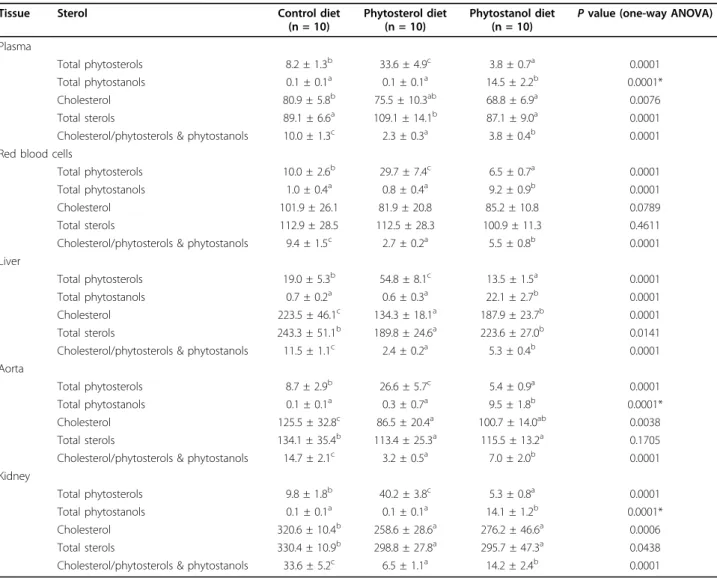
In comparison to the control diet, the phytosterol diet increased phytosterol incorporation in plasma (4.1-fold,
P < 0.05), red blood cells (3-fold, P< 0.05), liver (2.9-fold, P < 0.05), aorta (3.1-fold,P < 0.05) and kidney (4.1-fold, P < 0.05) in WKYinbred rats (Table 3). The phytostanol diet dramatically increased phytostanol incorporation in plasma (145-fold, P< 0.05), red blood cells (9.2-fold,P< 0.05), liver (31.6-fold,P< 0.05), aorta (95-fold, P < 0.05) and kidney (141-fold, P < 0.05) in these rats. The phytostanol diet decreased phytosterol incorporation in plasma (54%, P < 0.05), red blood cells (35%, P< 0.05), liver (29%, P < 0.05), aorta (38%,
P< 0.05) and kidney (46%,P< 0.05).
Table 1 Composition of test diets1
Control diet Phytosterol diet Phytostanol diet
Ingredient g/kg diet
Vitamin free casein 222.0 222.0 222.0
Soybean oil 100.0 100.0 100.0
Phytosterols2 — 2.0 —
Phytostanols3 — — 2.0
Cornstarch 477.5 475.5 475.5
Granulated sugar 100.0 100.0 100.0
Cellulose (alphacel) 50.0 50.0 50.0
Miscellaneous4 50.5 50.5 50.5
Sterol composition
Cholesterol 0.0 0.0 0.0
Total phytosterols5 0.2 2.1 0.2
Total phytostanols6 0.0 0.0 1.7
Total phytosterols and phytostanols 0.2 2.1 1.9
1
Based on the AIN-93G diet (American Institute of Nutrition, 1993). All ingredients, except phytosterols and phytostanols, were purchased from Harlan Teklad (Madison, WI).
2
Phytosterols isolated from canola oil deodorizer distillate (CanAmera Foods, Altona, MB, Canada).
3
Phytostanols were hydrogenated from phytosterols (POS Pilot Plant Corporation, Saskatoon, SK, Canada).
4
93G-MX Mineral mix (35.0 g/kg), 93-VX Vitamin mix (10.0 g/kg), L-cystine (3.0 g/kg), choline bitartrate (2.5 g/kg) and tert-butylhydroquinone (0.014 g/kg).
5
Total phytosterols include campesterol, beta-sitosterol, stigmasterol, brassicasterol, and delta 5,24- stigmastadienol.
6
Total phytostanols include campestanol and sitostanol.
Table 2 Growth, food and water intake of the rats in the absence of salt-loading
Control diet (n = 10) Phytosterol diet (n = 10) Phytostanol diet (n = 10) Pvalue (one-way ANOVA)
Initial body wt (g) 131.5 ± 15.2 133.9 ± 13.5 129.2 ± 12.7 0.7513
Body wt at week 5 (g) 265.9 ± 26.3 267.3 ± 16.0 258.5 ± 19.5 0.6084
Weight gain (g/5 weeks) 134.4 ± 13.0 133.5 ± 5.8 129.4 ± 8.8 0.4728
Total food intake (g) 539.6 ± 55.6 541.2 ± 46.6 519.0 ± 33.7 0.4959
Food efficiency (g gain/kg intake) 249.3 ± 8.6 247.9 ± 18.1 249.4 ± 10.3 0.9590 Total water consumption (g) 1010.9 ± 197.8 963.7 ± 82.5 1045.1 ± 147.9 0.4872*
In comparison to the control diet, the phytosterol diet decreased cholesterol levels in liver (40%, P < 0.05), aorta (31%, P < 0.05) and kidney (19%, P < 0.05) of these rats. The phytostanol diet also decreased choles-terol levels in plasma (15%, P < 0.05), liver (16%, P < 0.05), aorta (20%,P< 0.05) and kidney (14%,P < 0.05). The effects of phytosterols and phytostanols on choles-terol lowering in red blood cells did not reach statistical significance (overallP= 0.0789, Table 3).
Compared to the control diet, the phytosterol diet decreased total sterol levels in liver (P < 0.05), aorta (P < 0.05) and kidney (P < 0.05), but increased total sterols in plasma (P< 0.05) of these rats. The phytosta-nol diet also decreased total sterol levels in aorta (P < 0.05) and kidney (P < 0.05). However, the phytosterol
diet resulted in the lowest ratio of cholesterol to total phytosterols and total phytostanols in plasma, red blood cells, liver, aorta and kidney (P < 0.05, Table 3). The phytostanol diet also decreased this ratio in plasma and all tissues tested (P< 0.05).
Blood pressure
There were no differences in the initial systolic and diastolic blood pressure among groups (P= 0.5857 andP
= 0.5373, respectively, Table 4). After consuming the diets for 5 weeks, the WKYinbredrats fed the phytosterol and phytostanol diets had significantly higher systolic (P= 0.0067) and diastolic (P= 0.0001) blood pressure as well as greater increases in systolic (P= 0.0333) and diastolic (P= 0.0021) blood pressure, when compared to the rats
Table 3 Sterol levels in plasma (mg/100 ml) and tissues (mg/100 g) of rats in the absence of salt-loading
Tissue Sterol Control diet
(n = 10)
Phytosterol diet (n = 10)
Phytostanol diet
(n = 10) P
value (one-way ANOVA)
Plasma
Total phytosterols 8.2 ± 1.3b 33.6 ± 4.9c 3.8 ± 0.7a 0.0001
Total phytostanols 0.1 ± 0.1a 0.1 ± 0.1a 14.5 ± 2.2b 0.0001*
Cholesterol 80.9 ± 5.8b 75.5 ± 10.3ab 68.8 ± 6.9a 0.0076
Total sterols 89.1 ± 6.6a 109.1 ± 14.1b 87.1 ± 9.0a 0.0001
Cholesterol/phytosterols & phytostanols 10.0 ± 1.3c 2.3 ± 0.3a 3.8 ± 0.4b 0.0001
Red blood cells
Total phytosterols 10.0 ± 2.6b 29.7 ± 7.4c 6.5 ± 0.7a 0.0001
Total phytostanols 1.0 ± 0.4a 0.8 ± 0.4a 9.2 ± 0.9b 0.0001
Cholesterol 101.9 ± 26.1 81.9 ± 20.8 85.2 ± 10.8 0.0789
Total sterols 112.9 ± 28.5 112.5 ± 28.3 100.9 ± 11.3 0.4611
Cholesterol/phytosterols & phytostanols 9.4 ± 1.5c 2.7 ± 0.2a 5.5 ± 0.8b 0.0001
Liver
Total phytosterols 19.0 ± 5.3b 54.8 ± 8.1c 13.5 ± 1.5a 0.0001
Total phytostanols 0.7 ± 0.2a 0.6 ± 0.3a 22.1 ± 2.7b 0.0001
Cholesterol 223.5 ± 46.1c 134.3 ± 18.1a 187.9 ± 23.7b 0.0001
Total sterols 243.3 ± 51.1b 189.8 ± 24.6a 223.6 ± 27.0b 0.0141 Cholesterol/phytosterols & phytostanols 11.5 ± 1.1c 2.4 ± 0.2a 5.3 ± 0.4b 0.0001 Aorta
Total phytosterols 8.7 ± 2.9b 26.6 ± 5.7c 5.4 ± 0.9a 0.0001
Total phytostanols 0.1 ± 0.1a 0.3 ± 0.7a 9.5 ± 1.8b 0.0001*
Cholesterol 125.5 ± 32.8c 86.5 ± 20.4a 100.7 ± 14.0ab 0.0038
Total sterols 134.1 ± 35.4b 113.4 ± 25.3a 115.5 ± 13.2a 0.1705
Cholesterol/phytosterols & phytostanols 14.7 ± 2.1c 3.2 ± 0.5a 7.0 ± 2.0b 0.0001
Kidney
Total phytosterols 9.8 ± 1.8b 40.2 ± 3.8c 5.3 ± 0.8a 0.0001
Total phytostanols 0.1 ± 0.1a 0.1 ± 0.1a 14.1 ± 1.2b 0.0001*
Cholesterol 320.6 ± 10.4b 258.6 ± 28.6a 276.2 ± 46.6a 0.0006
Total sterols 330.4 ± 10.9b 298.8 ± 27.8a 295.7 ± 47.3a 0.0438 Cholesterol/phytosterols & phytostanols 33.6 ± 5.2c 6.5 ± 1.1a 14.2 ± 2.4b 0.0001
Values are presented as means ± SD. * Nonparametric (Kruskal-Wallis) test
a,b,c
means in a row not sharing a superscript letter are significantly different (P< 0.05, Duncan’s test or Wilcoxon rank sum tests). Total phytosterols include campesterol, beta-sitosterol, stigmasterol, brassicasterol, and delta 5,24-stigmastadienol.
Total phytostanols include campestanol and sitostanol.
fed the control diet. The phytostanol diet caused a greater increase in diastolic blood pressure (P< 0.05) compared to the phytosterol diet.
Renal mRNA expression of genes involved in blood pressure regulation
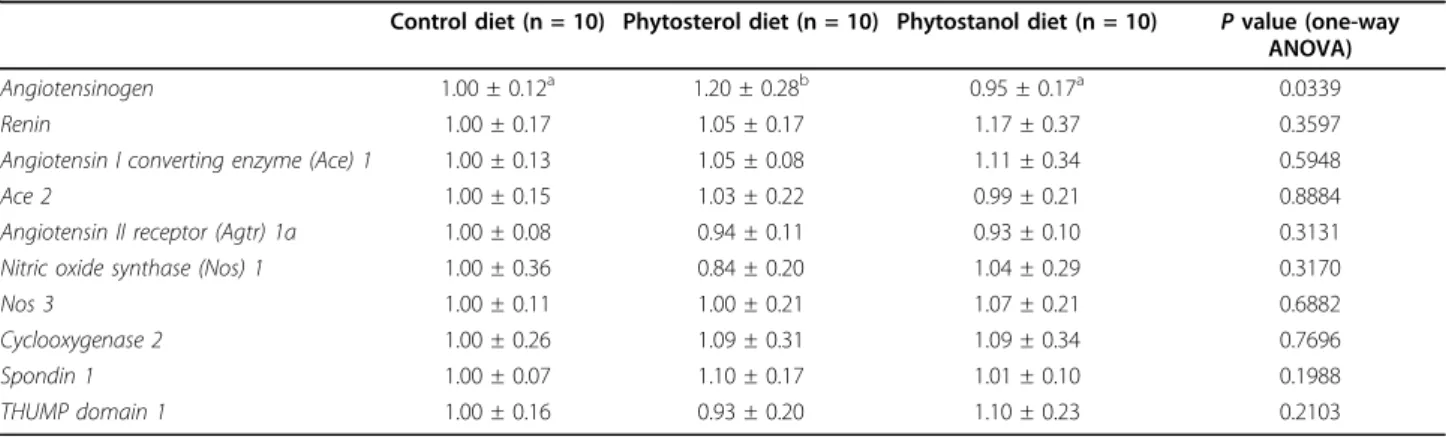
In comparison to the control diet, the phytosterol diet sig-nificantly increased mRNA levels of renalangiotensinogen
in WKYinbred rats (P= 0.0339, Table 5), but did not change renal mRNA levels ofrenin,angiotensin I convert-ing enzyme 1, 2 (Ace1, Ace2),angiotensin II receptor type 1a (Agtr1a), nitric oxide synthase 1, 3 (Nos1, Nos3),
cyclooxygenase 2,Spondin 1andTHUMP domain contain-ing 1(P> 0.05). There were no effects of phytostanols on mRNA expression of all genes measured (P> 0.05).
Discussion
High blood pressure is a serious condition that can lead to coronary heart disease, stroke, kidney failure, and other health problems [36]. Effects of phytosterols and phytosta-nols on blood pressure remain controversial. In human studies, consumption of a dietary portfolio (plant sterols, soybean protein, viscous fibres and almonds) for 1 year significantly reduced blood pressure in 66 hyperlipidemic
subjects [37]. Intake of a product containing sitostanol and campestanol for 4 weeks slightly decreased systolic blood pressure in 100 healthy men [38]. However, elevated systo-lic blood pressure was observed in a phytosterolemic patient [10]. In animal studies, in the presence of 1% salt-loading, our previous study demonstrated that, phytosterol or phytostanol supplemented diets (2.0 g/kg diet) induced a significant increase in diastolic blood pressure in SHRSP rats [31]. Similarly, Naitoet al. [22-24] showed that a diet containing 10% rapeseed oil (0.71 g total phytosterols/kg diet) induced higher systolic blood pressure than a diet containing soybean oil (0.29 g total phytosterols/kg diet) in SHRSP, SHR and WKY rats and thus thought that the higher content of phytosterols in rapeseed oil was related to the increased blood pressure. A diet containing soybean oil fortified with phytosterols (4.5 g/kg diet) for 24 days was also reported to elevate systolic blood pressure in SHRSP rats, but there were no significant differences on systolic blood pressure among diets containing 10% rape-seed oil, 10% soybean oil, and 10% soybean oil supplemen-ted with 0.6 g total phytosterols/kg diet [20]. A study by Chenet al. [39] demonstrated that consumption of a sitos-terol diet (0.3 g/kg diet) for 6 weeks did not increase blood pressure in wild-type, heterozygous and homozygous (a
Table 4 Systolic and diastolic blood pressure (BP) of the rats in the absence of salt-loading
Control diet (n = 10)
Phytosterol diet (n = 10)
Phytostanol diet
(n = 10) P
value (one-way ANOVA)
Initial systolic BP (mmHg) 113.7 ± 7.3 110.9 ± 10.7 115.3 ± 8.8 0.5857
Systolic BP at week 5 (mmHg) 127.0 ± 6.2a# 136.0 ± 8.2b# 138.6 ± 7.4b# 0.0067 Change in systolic BP (mmHg/5 weeks) 13.3 ± 8.5a 25.1 ± 12.0b 23.4 ± 9.1b 0.0333
Initial diastolic BP (mmHg) 78.0 ± 3.9 81.0 ± 7.8 79.9 ± 6.1 0.5373
Diastolic BP at week 5 (mmHg) 82.6 ± 4.0a# 89.7 ± 5.8b# 95.2 ± 5.8c# 0.0001
Change in diastolic BP (mmHg/5 weeks) 4.6 ± 3.6a 8.7 ± 5.8b 15.2 ± 7.1c 0.0021
Values are presented as means ± SD.
a,b,c
means in a row not sharing a superscript letter are significantly different (P< 0.05, Duncan’s test).
#
means significantly different from initial measurement of systolic or diastolic blood pressure, respectively (week 5 vs initial,P< 0.05, t-test).
Table 5 Kidney gene expression of the rats in the absence of salt-loading
Control diet (n = 10) Phytosterol diet (n = 10) Phytostanol diet (n = 10) Pvalue (one-way ANOVA)
Angiotensinogen 1.00 ± 0.12a 1.20 ± 0.28b 0.95 ± 0.17a 0.0339
Renin 1.00 ± 0.17 1.05 ± 0.17 1.17 ± 0.37 0.3597
Angiotensin I converting enzyme (Ace) 1 1.00 ± 0.13 1.05 ± 0.08 1.11 ± 0.34 0.5948
Ace 2 1.00 ± 0.15 1.03 ± 0.22 0.99 ± 0.21 0.8884
Angiotensin II receptor (Agtr) 1a 1.00 ± 0.08 0.94 ± 0.11 0.93 ± 0.10 0.3131 Nitric oxide synthase (Nos) 1 1.00 ± 0.36 0.84 ± 0.20 1.04 ± 0.29 0.3170
Nos 3 1.00 ± 0.11 1.00 ± 0.21 1.07 ± 0.21 0.6882
Cyclooxygenase 2 1.00 ± 0.26 1.09 ± 0.31 1.09 ± 0.34 0.7696
Spondin 1 1.00 ± 0.07 1.10 ± 0.17 1.01 ± 0.10 0.1988
THUMP domain 1 1.00 ± 0.16 0.93 ± 0.20 1.10 ± 0.23 0.2103
Values are presented as means ± SD.
a,b
mutation inAbcg5) female SHRinbredrats. In the absence of salt-loading, our present study found that dietary phy-tosterols or phytostanols (2.0 g/kg diet) significantly increased systolic and diastolic blood pressure in WKY
inbredrats (Table 4). To our knowledge, this was the first study to investigate, in the absence of salt-loading, the effects of dietary phytosterols and phytostanols on blood pressure in rodent models. Our results were consistent with those reported by Naitoet al. [21] who demonstrated that, in the absence of salt-loading, a diet containing 10% rapeseed oil for 4 weeks induced a higher systolic blood pressure in SHRSP rats compared to a diet containing 10% soybean oil. Taken together, our previous and present results suggest that increased intake of phytosterols or phytostanols may exacerbate hypertension in both hyper-tensive and normohyper-tensive rat models that over absorb phytosterols and phytostanols in the presence or absence of salt.
In order to elucidate the molecular mechanism(s) by which intake of phytosterols and phytostanols increased blood pressure in this rat model, the expression of sev-eral renal genes known to be involved in the renin-angiotensin-aldosterone system, nitric oxide, and cyclooxygenase-derived prostanoid pathways were inves-tigated (Table 5). Spondin 1 and THUMP domain con-taining 1 were also measured because they were recently identified as candidate hypertension genes [40,41]. Our present study demonstrated that, in the absence of salt-loading, the phytosterol diet slightly increased the mRNA expression of angiotensinogen(1.2-fold,P< 0.05, Table 5). There were no effects of phytosterols and phy-tostanols on the mRNA expression ofrenin,angiotensin I converting enzyme (Ace1) 1,Ace2, angiotensin II recep-tor 1a (Agtr1a), nitric oxide synthases (Nos) 1, Nos3,
Cyclooxygenase 2, Spondin 1andThump domain 1(P> 0.05). These results suggest thatNos,Cyclooxygenase 2,
Spondin 1andThump domain 1pathways do not play a critical role in the blood pressure regulation caused by the intake of phytosterols and phytostanols in WKY
inbredrats. Also, the phytostanol diet increased blood pressure but did not change the mRNA levels of renal
angiotensinogen. Therefore, the renin-angiotensin-aldos-terone system may not play a leading role in the hyper-tensive responses caused by phytosterol and phytostanol diets in the absence of salt-loading in WKYinbredrats.
Currently there are no data indicating that consump-tion of phytosterol and phytostanol-enriched foods alters cardiovascular events, but epidemiological studies indi-cated a controversial association of phytosterols and phytostanols with cardiovascular risk. For example, the results from a cohort study in 1242 subjects older than 65 years in the Netherlands showed that plasma levels of phytosterols were significantly lower in patients with coronary heart disease [42]. A prospective nested
case-control study consisting of 373 cases and 758 case-controls in the United Kingdom indicated that there was no adverse relationship between plasma physiological levels of phytosterols and coronary heart disease risk in appar-ently healthy individuals [43]. The study from 2542 sub-jects aged 30 to 67 years in the United States showed no significant difference in plasma sitosterol and cam-pesterol levels between the individuals having a positive and a negative family history of CHD [44]. However, studies in 595 subjects with hypercholesterolemia [15], in 48 postmenopausal women [16], in 53 patients under-going coronary artery bypass graft surgery [17] and in 159 men that suffered a myocardial infarction in the Prospective Cardiovascular Munster study [18] suggest an association of elevated levels of phytosterols and phy-tostanols with an increased cardiovascular disease risk. In the present study dietary phytosterols and phytosta-nols (2.0 g/kg diet) were found, in the absence of salt-loading, to significantly increase systolic and diastolic blood pressure (P< 0.05, Table 4), to increase phytos-terol and phytostanol accumulation in plasma, red blood cells, liver, aorta and kidney (P< 0.05), and to decrease cholesterol levels in liver, aorta, and kidney as well as plasma (only by phytostanols) (P < 0.05) (Table 3). These results suggest that, even though phytosterols and phytostanols lower cholesterol levels, their excessive accumulation in plasma and tissues may increase blood pressure thereby causing their net beneficial effects on cardiovascular events to remain questionable.
Our previous study indicated that a deficiency of membrane cholesterol due to phytosterol intake increases cell membrane rigidity, which might be a fac-tor contributing to the shortened life span of SHRSP rats [29]. Hamano et al. [45] also reported that a diet containing cholesterol (10 g/kg diet) delayed the onset of stroke and prolonged the life span of SHRSP rats, whereas diets with no added cholesterol greatly shor-tened post-stroke survival. In the present study supple-mentation of phytosterols and phytostanols produced significant decreases in the ratios of cholesterol to phy-tosterols and phytostanols in plasma, red blood cells, liver, aorta and kidney (Table 3) and increased blood pressure (Table 4) in WKY inbredrats. Therefore, the increased blood pressure caused by phytosterols and
phytostanols in WKY inbred rats may be due to
increased cell membrane rigidity. Other studies, in WKY rats in the presence of salt and in SHRSP rats in the absence of salt, have proposed that enhanced membrane activity of Na+, K+-ATPase by phytosterols in rapeseed oil may play a role in elevated blood pressure [21,22]. Other mechanisms, such as endothelin and natriuretic peptides [46], have not been excluded from playing a role in hypertension caused by phytosterols and
investigated in future studies. The molecular mechan-isms of action of dietary phytosterols and phytostanols responsible for the absorption and accumulation of cho-lesterol, phytosterols and phytostanols have been pre-viously discussed in our recently published paper [47].
Interestingly, it is generally speculated that phytosta-nol supplementation may be safer than phytosterol sup-plementation because the absorption of phytostanols (1-2%) is less than that of phytosterols (4-13%) [48] and the plasma levels of phytostanols are much less than that of phytosterols in humans after consumption of similar levels of either substance [49]. However, in our present study, the phytostanol diet resulted in a signifi-cant increase in diastolic blood pressure compared to the phytosterol diet (P < 0.05, Table 4). This result is consistent with our previous study in which SHRSP rats fed phytostanol supplemented margarine had a slightly lower survival rate than rats fed phytosterol supplemen-ted margarine [28].
Conclusion
Our study demonstrated for the first time that, in the absence of salt-loading, dietary phytosterols and phytos-tanols (2.0 g/kg diet) significantly increase systolic and diastolic blood pressure, and decrease the ratios of cho-lesterol to phytosterols and phytostanols in plasma, red blood cells, liver, aorta and kidney in WKYinbredrats. The renin-angiotensin-aldosterone system, prostanoids system, nitric oxide system, Spondin 1 and THUMP domain containing 1 do not appear to contribute signifi-cantly to the increased blood pressure. Increased cell membrane rigidity caused by a decreased ratio of choles-terol to phytoscholes-terols and phytostanols may contribute to the increased blood pressure. The net beneficial effect of phytosterols and phytostanols on cardiovascular events for individuals predisposed to over absorption of phytos-terols and phytostanols requires further investigation.
List of abbreviations
Ace1, Ace2: angiotensin I converting enzyme 1, 2;
Agtr1a: angiotensin II receptor type 1a; Nos1, Nos3: nitric oxide synthase 1, 3; SHR: spontaneously sive rats; SHRSP: stroke-prone spontaneously hyperten-sive rats; WKYinbred: Wistar Kyotoinbred.
Acknowledgements
The authors thank Dr. Don Caldwell and Pascale Bellon-Gagnon for their excellent technical support. The authors also express thanks to the members of the Animal Resources Division of Health Canada for their technical assistance with the animal feeding phase. Q.C was a recipient of a Health Canada Office of the Chief Scientist Postdoctoral Fellowship. This research was funded by Health Canada.
Author details
1Nutrition Research Division, Food Directorate, Health Products and Food
Branch, Health Canada, Banting Research Centre, Ottawa, Ontario K1A 0K9,
Canada.2Department of Biochemistry, Microbiology and Immunology,
University of Ottawa, Ottawa, Ontario K1H 8M5, Canada.
Authors’contributions
QC contributed to the animal feeding phase, blood pressure and gene expression measurements, data analysis as well as the drafting of the paper; HG contributed to the animal feeding phase and blood pressure
measurements; ES and KC contributed to gene expression measurements; CP contributed to sterol measurements; WMNR and KAS contributed to the design of the study, data interpretation and drafting the paper. All authors read and approved the final manuscript.
Competing interests
The authors declare that they have no competing interests.
Received: 4 December 2009 Accepted: 12 February 2010 Published: 12 February 2010
References
1. Muldoon MF, Manuck SB, Mendelsohn AB, Kaplan JR, Belle SH:Cholesterol reduction and non-illness mortality: meta-analysis of randomised clinical trials.BMJ2001,322:11-15.
2. Demonty I, Ras RT, Knaap van der HC, Duchateau GS, Meijer L, Zock PL, Geleijnse JM, Trautwein EA:Continuous dose-response relationship of the LDL-cholesterol-lowering effect of phytosterol intake.J Nutr2009, 139:271-284.
3. Katan MB, Grundy SM, Jones P, Law M, Miettinen T, Paoletti R, Stresa Workshop Participants:Efficacy and safety of plant stanols and sterols in the management of blood cholesterol levels.Mayo Clin Proc2003, 78:965-978.
4. Law MR, Wald NJ, Thompson SG:By how much and how quickly does reduction in serum cholesterol concentration lower risk of ischaemic heart disease?BMJ1994,308:367-372.
5. European Food Safety Authority:Consumption of food and beverages with added plant sterols in the European Union.The Efsa Journal2008, 133:1-21http://www.efsa.europa.eu/en/scdocs/doc/
datex_report_ej133_phytosterols_en.pdf.
6. U.S. Food and Drug Administration:Food Labeling: Plant Sterol/Stanol Esters and Coronary Heart Disease.Code of Federal Regulation (CFR). 21 CFR 101.832000http://edocket.access.gpo.gov/cfr_2001/aprqtr/pdf/ 21cfr101.83.pdf.
7. Commonwealth of Australia:Australia New Zealand Food Standards Code-Amendment No. 89 - 2006.Gazette No. FSC 312006http://www. foodstandards.gov.au/_srcfiles/Gazette%20Notice%20Amendment%20No% 2089%20WEB%20VERSION.pdf.
8. L’abbé MR, Dumais L, Chao E, Junkins B:Health claims on foods in Canada.J Nutr2008,138:1221S-1227S.
9. Lea LJ, Hepburn PA:Safety evaluation of phytosterol-esters. Part 9: Results of a European post-launch monitoring programme.Food Chem Toxicol2006,44:1213-1222.
10. Salen G, Horak I, Rothkopf M, Cohen JL, Speck J, Tint GS, Shore V, Dayal B, Chen T, Shefer S:Lethal atherosclerosis associated with abnormal plasma and tissue sterol composition in sitosterolemia with xanthomatosis.J Lipid Res1985,26:1126-1133.
11. Bhattacharyya AK, Connor WE:Beta-sitosterolemia and xanthomatosis: A newly described lipid storage disease in two sisters.J Clin Invest1974, 53:1033-1043.
12. Fransen HP, de Jong N, Wolfs M, Verhagen H, Verschuren WM, Lütjohann D, von Bergmann K, Plat J, Mensink RP:Customary use of plant sterol and plant stanol enriched margarine is associated with changes in serum plant sterol and stanol concentrations in humans.J Nutr2007, 137:1301-1306.
13. Davidson MH, Maki KC, Umporowicz DM, Ingram KA, Dicklin MR, Schaefer E, Lane RW, McNamara JR, Ribaya-Mercado JD, Perrone G, Robins SJ, Franke WC:Safety and tolerability of esterified phytosterols administered in reduced-fat spread and salad dressing to healthy adult men and women.J Am Coll Nutr2001,20:307-319.
15. Glueck CJ, Speirs J, Tracy T, Streicher P, Illig E, Vandegrift J:Relationships of serum plant sterols (phytosterols) and cholesterol in 595
hypercholesterolemic subjects, and familial aggregation of phytosterols, cholesterol, and premature coronary heart disease in
hyperphytosterolemic probands and their first-degree relatives. Metabolism1991,40:842-848.
16. Rajaratnam RA, Gylling H, Miettinen TA:Independent association of serum squalene and noncholesterol sterols with coronary artery disease in postmenopausal women.J Am Coll Cardiol2000,35:1185-1191. 17. Sudhop T, Gottwald BM, von Bergmann K:Serum plant sterols as a
potential risk factor for coronary heart disease.Metabolism2002, 51:1519-1521.
18. Assmann G, Cullen P, Erbey J, Ramey DR, Kannenberg F, Schulte H:Plasma sitosterol elevations are associated with an increased incidence of coronary events in men: results of a nested case-control analysis of the Prospective Cardiovascular Münster (PROCAM) study.Nutr Metab Cardiovasc Dis2006,16:13-21.
19. Weingärtner O, Lütjohann D, Ji S, Weisshoff N, List F, Sudhop T, von Bergmann K, Gertz K, König J, Schäfers HJ, Endres M, Böhm M, Laufs U: Vascular effects of diet supplementation with plant sterols.J Am Coll Cardiol2008,51:1553-1561.
20. Ogawa H, Yamamoto K, Kamisako T, Meguro T:Phytosterol additives increase blood pressure and promote stroke onset in salt-loaded stroke-prone spontaneously hypertensive rats.Clin Exp Pharmacol Physiol2003, 30:919-924.
21. Naito Y, Nagata T, Takano Y, Nagatsu T, Ohara N:Rapeseed oil ingestion and exacerbation of hypertension-related conditions in stroke prone spontaneously hypertensive rats.Toxicology2003,187:205-216. 22. Naito Y, Kasama K, Yoshida H, Ohara N:Thirteen-week dietary intake of
rapeseed oil or soybean oil as the only dietary fat in Wistar Kyoto rats-change in blood pressure.Food Chem Toxicol2000,38:811-816. 23. Naito Y, Konishi C, Katsumura H, Ohara N:Increase in blood pressure with
enhanced Na+, K+ -ATPase activity in stroke-prone spontaneously hypertensive rats after 4-weeks intake of rapeseed oil as the sole dietary fat.Pharmacol Toxicol2000,87:144-148.
24. Naito Y, Yoshida H, Nagata T, Tanaka A, Ono H, Ohara N:Dietary intake of rapeseed oil or soybean oil as the only fat nutrient in spontaneously hypertensive rats and Wistar Kyoto rats - blood pressure and pathophysiology.Toxicology2000,146:197-208.
25. Salen G, Shefer S, Nguyen L, Ness GC, Tint GS, Shore V:Sitosterolemia.J Lipid Res1992,33:945-955.
26. Hidaka H, Nakamura T, Aoki T, Kojima H, Nakajima Y, Kosugi K, Hatanaka I, Harada M, Kobayashi M, Tamura A:Fujii T, Shigeta Y: Increased plasma plant sterol levels in heterozygotes with sitosterolemia and xanthomatosis.J Lipid Res1990,31:881-888.
27. Scoggan KA, Gruber H, Chen Q, Plouffe LJ, Lefebvre JM, Wang B, Bertinato J, L’Abbé MR, Hayward S, Ratnayake WM:Increased incorporation of dietary plant sterols and cholesterol correlates with decreased expression of hepatic and intestinal Abcg5 and Abcg 8 in diabetic BB rats.J Nutr Biochem2009,20:177-186.
28. Ratnayake WM, Plouffe L, L’Abbé MR, Trick K, Mueller R, Hayward S: Comparative health effects of margarines fortified with plant sterols and stanols on a rat model for hemorrhagic stroke.Lipids2003,38:1237-1247. 29. Ratnayake WM, L’Abbé MR, Mueller R, Hayward S, Plouffe L, Hollywood R,
Trick K:Vegetable oils high in phytosterols make erythrocytes less deformable and shorten the life span of stroke-prone spontaneously hypertensive rats.J Nutr2000,130:1166-1178.
30. Ratnayake WM, Plouffe L, Hollywood R, L’Abbé MR, Hidiroglou N, Sarwar G, Mueller R:Influence of sources of dietary oils on the life span of stroke-prone spontaneously hypertensive rats.Lipids2000,35:409-420. 31. Chen Q, Gruber H, Swist E, Pakenham C, Ratnayake WMN, Scoggan KA:
Influence of dietary phytosterols and phytostanols on diastolic blood pressure and the expression of blood pressure regulatory genes in SHRSP and WKY inbred rats.Brit J Nutr2009,102:93-101.
32. Sapirstein LA, Brandt WL, Drury DR:Production of hypertension in the rat by substituting hypertonic sodium chloride solutions for drinking water. Proc Soc Exp Biol Med1950,73:82-85.
33. Carswell HV, McBride MW, Graham D, Dominiczak AF, Macrae IM:Mutant animal models of stroke and gene expression: the stroke-prone spontaneously hypertensive rat.Methods Mol Med2005,104:49-74.
34. Scoggan KA, Gruber H, Lariviere K:A missense mutation in the Abcg5 gene causes phytosterolemia in SHR, stroke-prone SHR, and WKY rats.J Lipid Res2003,44:911-916.
35. American Institute of Nutrition:AIN-93 Purified diets for laboratory rodents: Final report of the American Institute of Nutrition Ad Hoc Writing Committee on the reformulation of the AIN-76A rodent diet.J Nutr1993,123:1939-1951.
36. Rosendorff C:Hypertension and coronary artery disease: a summary of the American Heart Association scientific statement.J Clin Hypertens (Greenwich)2007,9:976.
37. Jenkins DJ, Kendall CW, Faulkner DA, Kemp T, Marchie A, Nguyen TH, Wong JM, de Souza R, Emam A, Vidgen E, Trautwein EA, Lapsley KG, Josse RG, Leiter LA, Singer W:Long-term effects of a plant-based dietary portfolio of cholesterol-lowering foods on blood pressure.Eur J Clin Nutr 2008,62:781-788.
38. Vissers MN, Trip MD, Pritchard PH, Tam P, Lukic T, de Sain-van der Velden MG, de Barse M, Kastelein JJ:Efficacy and safety of disodium ascorbyl phytostanol phosphates in men with moderate dyslipidemia. Eur J Clin Pharmacol2008,64:651-661.
39. Chen J, Batta A, Zheng S, Fitzgibbon WR, Ullian ME, Yu H, Tso P, Salen G, Patel SB:The missense mutation in Abcg5 gene in spontaneously hypertensive rats (SHR) segregates with phytosterolemia but not hypertension.BMC Genet2005,6:40.
40. Clemitson JR, Dixon RJ, Haines S, Bingham AJ, Patel BR, Hall L, Lo M, Sassard J, Charchar FJ, Samani NJ:Genetic dissection of a blood pressure quantitative trait locus on rat chromosome 1 and gene expression analysis identifies SPON1 as a novel candidate hypertension gene.Circ Res2007,100:992-999.
41. Hubner N, Wallace CA, Zimdahl H, Petretto E, Schulz H, Maciver F, Mueller M, Hummel O, Monti J, Zidek V, Musilova A, Kren V, Causton H, Game L, Born G, Schmidt S, Müller A, Cook SA, Kurtz TW, Whittaker J, Pravenec M, Aitman TJ:Integrated transcriptional profiling and linkage analysis for identification of genes underlying disease.Nat Genet2005, 37:243-253.
42. Fassbender K, Lütjohann D, Dik MG, Bremmer M, König J, Walter S, Liu Y, Letièmbre M, von Bergmann K, Jonker C:Moderately elevated plant sterol levels are associated with reduced cardiovascular risk–the LASA study. Atherosclerosis2008,196:283-288.
43. Pinedo S, Vissers MN, von Bergmann K, Elharchaoui K, Lütjohann D, Luben R, Wareham NJ, Kastelein JJ, Khaw KT, Boekholdt SM:Plasma levels of plant sterols and the risk of coronary artery disease: the prospective EPIC-Norfolk Population Study.J Lipid Res2007,48:139-144.
44. Wilund KR, Yu L, Xu F, Vega GL, Grundy SM, Cohen JC, Hobbs HH:No association between plasma levels of plant sterols and atherosclerosis in mice and men.Arterioscler Thromb Vasc Biol2004,24:2326-2332. 45. Hamano M, Mashiko S, Onda T, Tomita I, Tomita T:Effects of
cholesterol-diet on the incidence of stroke and life-span in malignant stroke prone spontaneously hypertensive rats.Jpn Heart J1995,36:511-512. 46. Ghofrani HA, Barst RJ, Benza RL, Champion HC, Fagan KA, Grimminger F,
Humbert M, Simonneau G, Stewart DJ, Ventura C, Rubin LJ:Future perspectives for the treatment of pulmonary arterial hypertension.J Am Coll Cardiol2009,54:S108-117.
47. Chen Q, Gruber H, Pakenham C, Ratnayake WMN, Scoggan KA:Dietary phytosterols and phytostanols alter the expression of sterol regulatory genes in SHRSP and WKYinbredrats.Annals of Nutr Metab2009, 55:341-350.
48. Sanders DJ, Minter HJ, Howes D, Hepburn PA:The safety evaluation of phytosterol esters. Part 6. The comparative absorption and tissue distribution of phytosterols in the rat.Food Chem Toxicol2000, 38:485-491.
49. Hallikainen MA, Sarkkinen ES, Gylling H, Erkkilä AT, Uusitupa MI:Comparison of the effects of plant sterol ester and plant stanol ester-enriched margarines in lowering serum cholesterol concentrations in hypercholesterolaemic subjects on a low-fat diet.Eur J Clin Nutr2000, 54:715-725.
doi:10.1186/1743-7075-7-11
Cite this article as:Chenet al.:Dietary phytosterols and phytostanols decrease cholesterol levels but increase blood pressure in WKYinbred