by Marcy Cohen
July 2012
Caring for BC’s
Aging Population
Improving Health Care for All
Download the summary
at policyalternatives.ca
/hcc-for-seniors
1400 – 207 West Hastings Street Vancouver BC V6B 1H7
604.801.5121
[email protected] www.policyalternatives.ca
CARING FOR BC’S AGING POPULATION:
IMPROVING HEALTH CARE FOR ALL By Marcy CohenJuly 2012
BC Health Coalition and CCPA–BC ACKNOWLEDGEMENTS
The author thanks Shannon Daub, Chris Kincaid, Kim McGrail, Margaret McGregor, Iglika Ivanova and Sarah Leavitt for their contributions to this report. Opinions and any errors are those of the author alone. This report is part of The Remaining Light Seniors Project, which brings community organizations, seniors and researchers together to develop policy solutions that support seniors’ dignity and well-being. CCPA–BC thanks the United Way of the Lower Mainland, Vancity, the Hospital Employees’ Union, and the BC Government and Service Employees’ Union for their support of the project. The opinions and recommendations in this report, and any errors, are those of the author, and do not necessarily reflect the views of the publishers or funders of this report.
Edit and graphic design: Nadene Rehnby Graphic illustrations: Terra Poirier Cover photos: clockwise from top left:
Anne de Haas, Kali Nine, Kyle Pearce and Ulrich Joho ISBN 978-1-77125-022-1
202 – 211 East Georgia Street Vancouver, BC V6A 1Z6 604.681.7945
[email protected] www.bchealthcoalition.ca Correction, November 15, 2012: The original version of this report, published July 11, 2012, contained an error in the calculation of hospital occupancy rates. Footnote 25 on page 18 indicated that the number of acute care beds in BC in 2009/10 was 7370; the correct number is 7994. The resulting corrected oc-cupancy rate is 96.8 per cent (not 97.0 per cent).
Contents
Summary ... 5
PART 1: Introduction ... 9
PART 2: Continued Decline in Access to Home and Community Care ... 11
PART 3: Implications of Restructuring Home and Community Care Services... 14
PART 4: Hospital Overcrowding ... 17
PART 5: Provincial Funding Context ... 19
PART 6: Priority Changes for BC’s Home and Community Care System ... 21
Service Integration ... 22
Patient Voice, Person-Centred Care ... 23
Social Support ... 24
Public Reporting and Accountability ... 25
PART 7: Conclusion ... 26
Appendix Tables ... 27
A B O U T T H E A U T H O R
MARCY COHEN is an adjunct faculty member at Simon Fraser University and co-chair of CCPA–BC’s Remaining Light Project. As a research associate with the CCPA–BC, she has co-authored a number of research and policy studies looking at public solutions to the current challenges in our health care system, including An Uncertain Future for Seniors:
BC’s Restructuring of Home and Community Health Care, 2001–2008 and Innovations in Community Health: from Pilot Project to System Change.
WITH THE GROWING SENIORS’ POPULATION, the question of how best to care for people as they age has never been more important. A recent landmark investigation by BC’s Ombudsperson highlights the serious problems seniors experience in accessing affordable high-quality home and community-based care services. At the same time, media coverage continues to focus public attention on the problems of hospital overcrowding and unacceptably long waitlists for emer-gency care and surgeries.
Taken together, these challenges can seem overwhelming, prompting dire warnings about the “financial sustainability” of Medicare, calls for private delivery of publicly-funded services, and fears that aging baby boomers are about to overwhelm the health care system, leaving few resources for younger British Columbians.
A more comprehensive and better-coordinated system of home and community care for seniors can help us move beyond this impasse. It can help seniors to live independent and healthy lives in their own homes and communities. It can reduce pressure on family members — many of whom are already balancing full-time employment and parenting — to act as caregivers. And it can reduce pressure on hospitals — the most expensive part of our health care system.
However, a decade of underfunding and restructuring has led to a home and community care system that is fragmented, confusing to navigate, and unable to meet seniors’ needs.
S U M M A R Y
Caring for BC’s Aging Population
Improving Health Care for All
An improved system of home and community care for seniors can help seniors live healthy, independent lives, and reduce pressure on hospitals — the most expensive part of our health care system.
CONTINUED DECLINES IN ACCESS TO MOST SERVICES
Previous CCPA studies published in 2005 and 2009 documented steep declines in access to home and community care services since 2001 — in particular residential care and home support. Updated figures obtained from the Ministry of Health show a continued downward trend. It is important to note that access to services is not simply a matter of asking how many residential care beds exist in BC, or how many hours of home support are provided. Such numbers tell us little unless we consider them in relation to population needs. It is no secret that BC’s population is aging: the number of seniors over age 75 increased by 28 per cent between 2001 and 2010. To assess the level of access, we look at the volume of services provided each year relative to the number of seniors over 75, and find that between 2001/02 and 2009/10:
• Access to residential care dropped by 21 per cent. • Access to home support dropped by 30 per cent.
• Reductions in access to home nursing of 3 per cent were more moderate, and in com-munity rehabilitation there has actually been an increase of 14 per cent.
• When all services are considered together, access to home and community care de-clined by 14 per cent.
• Access to services varies significantly across health authority regions, particularly for home health services (see page 13 for regional breakdowns).
BC NEEDS
MORE
NOT FEWER SERVICES FOR SENIORS
Declines in Access to Home and Community Health Care, 2001/02–2009/10
3%
21%
30%
14%
Home
Nursing
Care
Residential
Care
Support
Home
COMMUNITY CARE
ALL BC HOME &
SERVICES
Home and community care
helps seniors live healthy, independent lives in their
own homes and communities. It also helps keep them out of hospital. But there
have been serious declines in access to key services for seniors over 75 in BC.
Previous CCPA–BC studies documented steep declines in access to key home and community care services. Updated figures obtained from the BC Ministry of Health show a continuing downward trend.
Restructuring in home and community care — such as changes to policies that govern when seniors get access to what types of care — has also undermined the vital prevention role these services can play. In both residential care and home support, eligibility criteria have become increasingly restrictive, to the point that seniors often have to wait until they are in crisis and admitted to hospital in order to get the community services they require. Even then, services can be difficult to access.
REDUCED ACCESS TO SERVICES CONTRIBUTES
TO HOSPITAL OVERCROWDING AND WAITLISTS
One of the best ways to track the impact of reduced access to services is to look at the number of hospital patients who no longer require acute care but who continue to occupy a hospital bed because the appropriate residential or home health services are not available. These patients are called “Alternate Level of Care” or ALC patients.
In 2005/06, the provincial government discontinued its requirement that health authorities pub-licly report standardized data on ALC hospital use. However, data from the provincial government show that between 2005/06 and 2010/11, there was a 35.5 per cent increase in the number of hospital beds across BC occupied by people classified as ALC patients.
For elderly patients, being stuck in hospital because of the lack of sufficient and/or appropriate home and community care services can lead to a decline in their mobility and their ability to live independently. It also contributes to overcrowding in BC’s hospitals.
Research shows that hospital occupancy rates of 85 per cent or lower are optimal. When hospitals operate above optimal capacity, it is harder to isolate patients with antibiotic resistant viruses or respond to emergency admissions without having to delay elective surgeries or control wait times in emergency departments. While there is a lack of publicly reported data, it is possible to make a reasonable estimate of overall provincial occupancy levels by comparing the number of beds in operation with the average number of inpatient acute care days. Based on this calculation, in 2009/10, BC hospitals had occupancy rates of 97 per cent.
RECOMMENDATIONS
BC needs a more comprehensive and better-coordinated home and community care system, one that focuses on early intervention and supporting seniors to live well and die with dignity. This shift requires, at least initially, an infusion of new funding to build needed capacity in the system, which will reduce the need for expensive emergency room visits and hospital stays down the road. The cost of treating a senior in hospital ranges from $825 to $1,968 per day, whereas the cost of residential case is approximately $200 per day.
While health care has fared relatively well compared to other areas in provincial budgets over the last decade, BC has not kept up with other Canadian provinces. In 2001, BC had the second highest level of health spending per capita in Canada; by 2011 it had fallen to second lowest. This might not be cause for concern if BC’s lower rate of growth in health spending were the result of widespread efficiencies as opposed to restraint policies that reduced access to needed home and community care services and hospitals.
For elderly patients, being stuck in hospital because of the lack of community care services can lead to a decline in their mobility and their ability to live independently. It also contributes to overcrowding in BC’s hospitals.
Beyond issues of funding and access, changes are needed to how home and community care services are organized and integrated with the broader health care system. The provincial govern-ment needs to take a strong leadership role in the following priority areas:
• Integrate home, community and primary care (doctors) services for seniors with complex health needs:
Seniors with complex needs are frequently in and out of hospital and have multiple health providers (a family doctor, one or more specialists, a home nurse, etc), who often don’t even communicate with one another let alone work as a team. In other words, they face a home and community care system that is highly fragmented. Many of the basic home support services they need (particularly if they are low income), such as transportation and assistance shopping for groceries or preparing meals, are no longer publicly provided. These challenges can be resolved when services are reconfigured around a senior’s needs, provided by an interdisciplinary team of health professionals and front-line workers, and available 24/7.
• Increase patient involvement in decisions about their care:
Too often health care systems are organized around the needs of providers rather than patients. A growing body of evidence shows that by redesigning services around the needs of the patient, it is possible to improve both the quality and cost-effectiveness of care. There is also evidence to show that when individual patients with challenging chronic conditions are empowered to become more involved in managing their care and more confident in communicating with health care professionals, their health improves and they use fewer hospital and physician services. There are currently pro-grams in many BC communities that promote a greater role for patients in managing specific chronic conditions. However, these programs could be significantly expanded to cover a broader range of health challenges and be more accessible to low-income and immigrant seniors and those living in rural communities.
• Treat social supports as an integral aspect of care:
Social support is a determinant of health. It helps seniors to remain independent and healthy by building self-esteem and coping skills, improving knowledge about avail-able health and community resources, and encouraging healthy behaviours. Research shows that social connectedness slows cognitive decline, and the progression of both mental and physical disabilities. The provincial government should provide funding to ensure that social supports are available both within the home and community care system and in the broader community (through outreach programs at community or seniors’ centres, for example).
• Develop provincially standardized, publicly-reported information on key indicators Getting even very basic information about seniors care in BC can be daunting. The need for more transparent, accessible reporting on home and community care services, funding levels and health outcomes was highlighted by the province’s Ombudsperson in her recent investigation. Consistent, publicly available data on Alternate Level of Care patients, hospital occupancy rates, and hospital utilization by people with limited incomes and few social supports are also needed.
A growing body of evidence shows that by redesigning services around the needs of the patient, it is possible to improve both the quality and cost-effectiveness of care.
P A R T 1
Introduction
IN THE RESEARCH LITERATURE, among health providers and within governments, there is growing recognition that a comprehensive and well-coordinated home and community care system can significantly alleviate pressure in the most expensive part of the health system — hospi-tals — by reducing wait times for both emergency and surgical services. Recent national reports by the Wait Times Alliance on wait times for hospital services across Canada reinforce this point.The authors of these reports argue that despite the investment of billions of dollars to reduce surgery wait lists in five areas, progress has been slow. In their view the most effective way to improve timely access to elective and emergency surgery would be to invest in home and residential care to reduce the number of people — most of whom are elderly — who remain in hospital because they are unable to access the community health services they require.1
1 Wait Time Alliance, 2011; Wait Time Alliance, 2012
PRIMARY
ACUTE
HOME &
COMMUNITY
Canada’s health caresystem is made up of three intersecting parts:
• primary care (family doctors);
• acute care (e.g., hospitals and emergency services, the most expensive part of the system); and • home and community care
(e.g., residential care for seniors, home support services).
Health Care in Canada
There is growing recognition that a comprehensive and well-coordinated home and community care system can significantly alleviate pressure in the most expensive part of the health system — hospitals.
Previous CCPA studies have looked at the relationship between the underfunding and poor co-ordination of BC’s home and community care system (for seniors and people with disabilities) over the last 15 years, and the growing problem of hospital overcrowd-ing and wait times. This report builds on that work. It begins by providovercrowd-ing updated data (obtained from the Ministry of Health) on the decline in access to home and community care and hospital services and the implications of this reduced access for seniors and for the health system as a whole. It then identifies priority improvements needed in BC’s home and community care system that would support seniors to be as independent and healthy as possible, reduce stress on families, and improve access to acute care for the entire population.
Previous CCPA studies have looked at the relationship between the underfunding and poor co-ordination of BC’s home and community care system (for seniors and people with disabilities) over the last 15 years, and the growing problem of hospital overcrowding and wait times. This report builds on that work.
P A R T 2
Continued Decline in Access
to Home and Community Care
TWO CCPA STUDIES, one in 2005 and the other in 2009, documented the restructuring of home and community care services in BC, and in particular the reduction in access to residential care and home support services.2 These studies aimed to bring clarity to what had become a numbersgame, with the provincial government claiming it had increased the availability of services despite evidence of a growing crisis in access to care in communities around the province, particularly as a result of the closure of residential care beds.3 This raised concerns about the lack of transparency
and public accountability in BC’s home and community care system.
Beyond the problems of insufficient and inconsistent public reporting is the question of how to assess whether there is adequate capacity in the home and community care system. This is not simply a matter of how many residential care beds exist in BC, nor how many hours of home support hours are provided. Such numbers tell us little unless we consider them in relation to population needs. It is no secret that BC’s population is aging: the number of seniors over age 75 increased by 28% between 2001 and 2010.4 To assess the level of access, we look at the number
of beds and hours of care provided each year relative the number of seniors over 75.
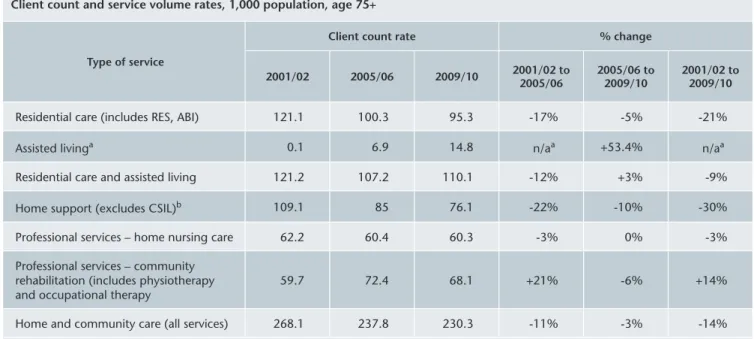
The latest data (Table 1 on the following page) shows continued decline in access to most home and community health care services for seniors 75 and over:
• Between 2001/02 and 2009/10, access to residential care dropped by 21 per cent, and access to home support dropped by 30 per cent;
• Reductions in access to home nursing of 3 per cent were much more moderate, and in community rehabilitation access has actually increased by 14 per cent; and
• When all home and community care is considered together, access to services for seniors 75+ declined by 14 per cent over the decade.
2 Cohen et al., 2005; Cohen et al., 2009a. 3 Cohen et al., 2009a.
4 BC Stats, Service, BC, Ministry of Citizen’s Services, P.E.O.P.L.E. 35 population estimates 2001–2010.
Previous studies aimed to bring clarity to what had become a numbers game, with the provincial government claiming it had increased services, despite evidence of a growing crisis in access to care.
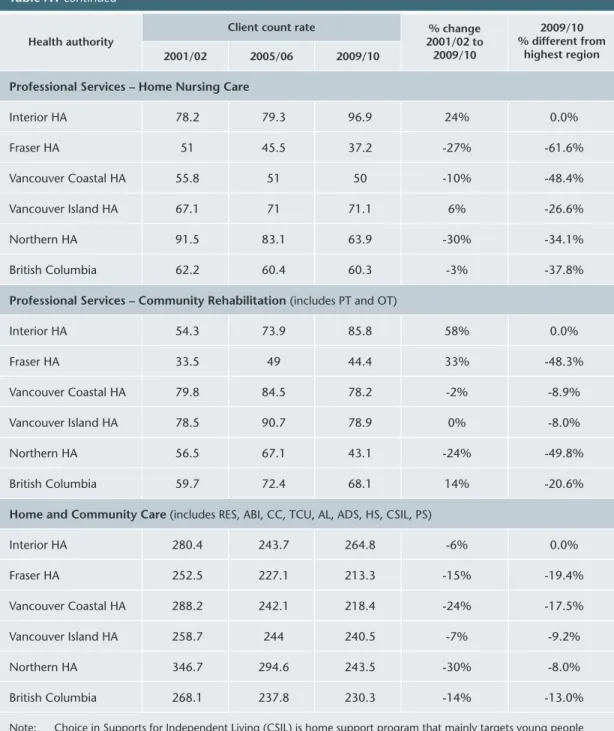
Most of the reduction in access to home and community care services occurred between 2001/02 and 2005/06. However, what is perhaps more startling than the decline in access is the extent to which access to services varies within and across regions (Table A1 in the Appendix), particularly for home health services. Some of the largest variations in access to home health services across health authorities in 2009/10 are illustrated by the following comparisons:
• A senior living in the Vancouver Coastal Health region was 38 per cent less likely to have access to home support than a senior on Vancouver Island.
• A senior living in Fraser Health region was 62 per cent less likely to have access to professional home nursing services than a senior in the Interior Health region.
• A senior living in the Northern Health region was 50 per cent less likely to have access to community rehabilitation services than a senior in the Interior Health region. BC Ombudsperson Kim Carter, in her recently released report on systemic problems in seniors care services, raised concerns about the lack of provincial standards or monitoring processes to ensure that seniors across BC have access to similar levels of service to meet their health needs.5 She
noted, for example, that while the province’s stated goal for home support is to “assist seniors to live in their own homes as long as it is practical and in their and their families’ best interests,” there are no provincial standards or monitoring processes in place to ensure that this goal becomes a reality.6 In fact, the central theme and most salient criticism to emerge from the Ombudsperson’s
report is the provincial government’s failure to fulfill its stewardship (i.e. leadership) role in relation
5 BC Ombudsperson, Overview, 2012. 6 Ibid, 2012:35.
When all home and community care is considered together, access to services for seniors 75+ declined by 14 per cent over the decade.
TABLE 1: Change in Access to Home and Community Health Care, 2001/02 to 2009/10
Client count and service volume rates, 1,000 population, age 75+
Type of service
Client count rate % change
2001/02 2005/06 2009/10 2001/02 to 2005/06 2005/06 to 2009/10 2001/02 to 2009/10
Residential care (includes RES, ABI) 121.1 100.3 95.3 -17% -5% -21% Assisted livinga 0.1 6.9 14.8 n/aa +53.4% n/aa
Residential care and assisted living 121.2 107.2 110.1 -12% +3% -9% Home support (excludes CSIL)b 109.1 85 76.1 -22% -10% -30%
Professional services – home nursing care 62.2 60.4 60.3 -3% 0% -3% Professional services – community
rehabilitation (includes physiotherapy
and occupational therapy 59.7 72.4 68.1 +21% -6% +14% Home and community care (all services) 268.1 237.8 230.3 -11% -3% -14%
Notes: aAssisted Living is a new level of care introduced after 2001/02. bChoice in Supports for Independent Living (CSIL), a home support
program that mainly targets young people with disabilities, managed by the clients themselves.
Source: Data prepared by Home and Community Care and Mental Health and Substance Use, Management Information Branch, Ministry of Health using data from BC Stats Service, BC, Ministry of Citizen’s Services and CCData Warehouse tables extracted from the Continuing Care Information Management System (CCIMS).
Fraser 2001/02: 101.5 2009/10: 76.3 Vancouver Island 2001/02: 98 2009/10: 94.7 Vancouver Coastal 2001/02: 122.2 2009/10: 59.1 Interior 2001/02: 113 2009/10: 79.4 Northern 2001/02: 157.2 2009/10: 63.7
British Columbia
2001/02: 109.1
2009/10: 76.1
Access to key services like
home support has declined
since 2001/02, and is very
uneven across BC.
Access to home support services varies across BC health authorities
Number of home support clients per 1000 seniors 75+
Access to Home Support Services Varies Across BC Health AuthoritiesNumber of home support clients per 1,000 seniors 75+
to the health authorities: that is, to ensure that the home and community care system has the requisite capacity and accountability mechanisms in place to meet the needs of BC seniors who require these services.7 A number of other reports and studies — including from the BC Auditor
General, and previous CCPA research reports — arrive at similar conclusions.8
7 Ibid, 2012:13-14. 8 BC Auditor General, 2008.
The central theme and most salient criticism to emerge from the BC Ombudsperson’s report is the provincial government’s failure to fulfill its stewardship role in relation to the health authorities.
P A R T 3
Implications of Restructuring Home
and Community Care Services
EARLIER CCPA STUDIES IDENTIFIED THE CONSEQUENCES of declining access to residential and home support services for seniors, their families, and for the health system as whole. These include:
• Reduced access to residential care and home support for people with limited needs, who are forced to rely on family and friends to provide this support, pay for it privately, or simply go without;
• Less emphasis on prevention and early intervention (once the hallmark of BC’s home and community care system);
• An increased emphasis on services for seniors with higher, more complex needs (i.e. seniors with one or more chronic health conditions, limited mobility, and/or some level of cognitive impairment); and
• Increased likelihood that services will be provided only in response to an emergency room visit or hospital admission.
The restructuring of residential care, beginning in 2002, is a case in point. Many facilities were closed9 and by 2008 there were over 800 fewer beds than in 2002, despite a 43 per cent increase
in the seniors’ population aged 85 and over.10 As a result, the eligibility criteria for admission to
residential care became more restrictive and changes were introduced in how wait lists were man-aged. Instead of giving priority to the people who have waited the longest, priority placement is now based on urgency of need. When a space does become available, seniors are required to take the “first available or first appropriate bed” or drop to the bottom of the wait list.11 Seniors
and their families are given only 48 hours to make this decision. In addition to causing stress and 9 The provincial government partially offset the closure of residential care beds with the addition of new and
converted assisted living units. Unlike in residential care, nursing supervision is not provided in assisted living facilities.
10 Cohen, 2009a:20-21.
11 Prior to the release of the Ombudsperson’s report in February 2012, seniors were expected to take the first available bed within 48 hours or drop to the bottom of the list. Since the release of the report, there is more consideration given to the appropriateness of the bed, in at least some health authorities. Appropriateness could include factors such as the distance from the person’s family and friends, the location of a spouse in another facility, etc.
Reduced access to residential care and home support for people with limited needs results in seniors being forced to rely on family and friends to provide this support, pay for it privately, or simply go without.
hardship for the senior and their family, these policies mean that seniors who are in hospital are, in most cases, deemed to have higher need than seniors living in the community. As a result, seniors often have to wait until they are in crisis and are admitted to hospital before they can access residential care services.
This is increasingly the case with home support as well. A very recent analysis of home health services in five health regions of the country — including BC’s Northern Health Authority — found that 36 to 52 per cent of seniors across the regions were referred to home health services from hospital, indicating that services were put in place only after significant health events.12 A report
from the Senate on the impact of the funding provided through the 2004 Health Accord confirms these findings. It found that provincial governments, in order to respond to the Accord’s focus on providing two weeks of post-acute home care, shifted resources away from using home support services to help elderly patients manage chronic illnesses over the longer term.13 Similar trends in
BC began even earlier. A 10 year review of BC’s home health services — covering the years from 1995/96 to 2004/05 — found that reduced access to home support disproportionately affected people who were low-income, long-term users of home support services.14
The greater focus on short-term, post-acute care increases both the intensity and cost of services. Being hospitalized can lead to decline in seniors’ mobility and their ability to manage daily activ-ities independently15 — it makes little sense from the perspective of either the individual patient
or the system. Yet hospitals are increasingly the route through which seniors gain access to both residential and home health services. While it is vital that seniors are able to move out of hospital when they no longer need acute care services, preventing the very health crises that land seniors in hospital is precisely what home and community care system ought to do. It is much better for seniors and their families, and reduces pressure on the acute care system.
One of the best ways to track the impact of reduction in access to home and community care on hospital overcrowding is to look at the number of patients who no longer requiring acute care, but who continue to occupy a hospital bed because they are unable to access home and community care services. These patients are termed “Alternate Level of Care” or ALC patients. In comparison to other patients in hospital, they tend to be older (median age 80 years), and are more likely to have longer stays, more than one health problem, including dementia, and to be admitted through emergency and then readmitted after 30 days.16 In other words, while ALC
patients no longer require acute care services, they are typically elderly people with complex needs who remain in hospital because of the lack of sufficient and/or appropriate residential care, community based rehabilitation, palliative care, and/or home health services in the community. In the CCPA’s 2005 study, Continuing Care Renewal or Retreat, we began to track changes in ALC utilization in BC. In the Capital Health District, in particular, detailed data made it possible to compare the costs of increasing numbers of ALC patients and days in hospital on the one hand, to cuts to residential care on the other.17 The data we assembled showed that cuts to residential
care not only resulted in longer waits in hospital emergency departments, but also in higher costs to the health system overall.
12 Health Council of Canada, 2012:17.
13 Standing Senate Committee on Social Affairs, Science and Technology, 2012:29. 14 McGrail, 2008:8.
15 Health Council of Canada, 2012:17. 16 CIHI, 2009:6.
17 Cohen et al., 2005:33. This calculation took into account the cost of the shift to assisted living beds.
One of the best ways to track the impact of reduction in access to home and community care on hospital overcrowding is to look at the number of patients who no longer requiring acute care, but who continue to occupy a hospital bed because they are unable to access home and community care services.
Since 2005, reliable information on ALC bed and day rates has been more difficult to obtain. From 2002/03 to 2004/05, the Ministry of Health’s performance agreements with health authorities included a requirement to publicly report on ALC patients and days, including any reductions/ increases from the previous year. The public reporting requirement was discontinued in 2005/06 and although information on ALC is still available, it is not regularly analyzed or reported publicly. And yet this information is very relevant to the question of hospital overcrowding and wait lists for emergency and elective surgery. As Table 2 shows, over six years from 2005/06 to 2010/11 there was a 35.5 per cent increase in the number of hospital beds occupied by people classified as ALC patients.
There is also the very real possibility that these numbers underestimate the extent of the problem. In 2009, the Canadian Institute for Health Information commented on its concerns about the data quality of ALC reporting across the country, noting that while “there is little concern about ALC being over-reported, there is greater concern that ALC may be underreported.”18 In 2005/06, the
way ALC beds were tracked was “tightened” in Fraser Health and Vancouver Coastal Health, but not in other regions of the province, creating inconsistencies in provincial reporting.19 Since that
time, ALC rates in Fraser and Coastal Health have been considerably lower than in the three other regions of BC (see Table A2 in the Appendix).
There is a clear need for more provincial oversight to ensure up to date, consistent public re-porting on the portion of hospital beds occupied by ALC patients in every region and to deter-mine the home and community services that should be put in place to address these needs. The Ombudsperson makes a similar point in her report, recommending that the Ministry of Health produce quarterly reports on lengths of stays of ALC patient and on the extra costs of keeping seniors in acute care hospital beds when they could instead be cared for in residential care (or in another community or home based health service).20
18 CIHI, 2009, page 3.
19 BC Ombudsperson, Volume 1:169. 20 BC Ombudsperson, Volume 1:169.
Table 2: Alternate Level of Care Days as a Proportion of Total Hospital Days 2005/06 and 2010/11 Total inpatient days Total ALC days ALC as a % of total days
2005/06 2,651,332 274,795 10.4% 2010/11 2,906,263 372,390 12.8% # increase from 2005/06 to 2010/11 254,931 97,595 % increase from 2005/06 to 2010/11 9.6% 35.5%
Sources: HealthIdeas, Total Acute Rehab and ALC days 2005/06 to 2010/11 from Hospital Workload by Governance Authority, Report Run ID 338462041.
There is a clear need for more provincial oversight to ensure up to date, consistent public reporting on the portion of hospital beds occupied by ALC patients.
P A R T 4
Hospital Overcrowding
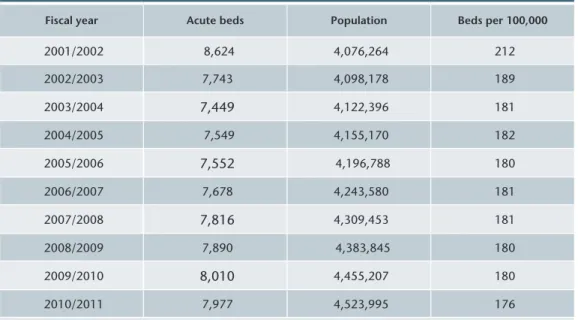
ACCESS TO HOSPITAL SERVICES (for the population as a whole) has also declined significantly over the last decade. In 2001/02 there were 212 hospital beds for every 100,000 British Columbians, compared to 176 in 2010/11 — a 17 per cent decline. The numbers are a reflection of bed reduc-tions and hospital closures made between 2002 and 2004, and the limited increases since that time. One of the best measures of hospital overcrowding is hospital occupancy rates. In the research literature it is widely acknowledged that occupancy rates below 85 per cent are optimal in man-aging wait times and patient safety.21 Occupancy rates of 85 per cent or lower provide hospitals,
for example, with the flexibility to isolate patients with antibiotic resistant viruses or to respond to emergency admissions without having to delay elective surgeries. When occupancy rates reach a threshold of 90 per cent, lengths of stay in emergency departments “increase extensively.”22
21 BMA, 2009: 22-23; Foster et al., 2003; Sprivalis, 2006. 22 Foster et al., 2003.
Table 3: Acute Care Beds Staffed and Operating, 2001/02 to 2010/2011
Fiscal year Acute beds Population Beds per 100,000
2001/2002 8,624 4,076,264 212 2002/2003 7,743 4,098,178 189 2003/2004 7,449 4,122,396 181 2004/2005 7,549 4,155,170 182 2005/2006 7,552 4,196,788 180 2006/2007 7,678 4,243,580 181 2007/2008 7,816 4,309,453 181 2008/2009 7,890 4,383,845 180 2009/2010 8,010 4,455,207 180 2010/2011 7,977 4,523,995 176
Note: Definition of beds – Bed count as of Period 1 (March) each fiscal year; excludes Riverview Hospital and Forensic Psychiatric Services.
Sources: Acute beds – Ministry of Health data extracted from OASIS/HAMIS and Quantum Analyser. Population – PEOPLE 35, BC STATS; population estimates as of July each year.
Access to hospital services in BC declined by 17 per cent between 2001/02 and 2010/11.
Although there is no current publicly reported information on hospital occupancy rates in BC, we do know that as early as 2004 occupancy rates in hospitals in the Okanagan were over 100 per cent with some operating at close to 120 per cent capacity.23 By 2006, hospitals across the
Lower Mainland were implementing “over capacity protocols” to manage the constant overflow in emergency departments.24
While there is no public reporting of occupancy rates, it is possible to provide a reasonable estimate of hospital occupancy by comparing the number of beds in operation with the average number of inpatient acute care days. Based on this calculation, in 2009/10, BC hospitals had occupancy rates of 105 per cent.25 According to an OECD study, overall occupancy rates in Canadian hospitals
were 93 per cent in 2008 — the second highest of 26 OECD countries. The average occupancy rate across OECD countries was 76 per cent.26
These numbers highlight the need — particularly in British Columbia, but also across the coun-try — to either dramatically expand the size of the hospital sector, or address the problems in home and community care that result in unnecessary emergency room visits and hospital stays.27
Interestingly, home and community care, which traditionally receives much less attention than other areas of the health care system from both policy makers and the media, is beginning to gar-ner more attention nationally because of concerns around hospital overcrowding. In discussions related to the 2014 Health Accord, organizations as diverse as the Canadian Medical Association, the Canadian Federation of Nurses Unions, and the Canadian Health Coalition are advocating for an expansion of home and community care (referred to in other provinces as continuing care).28
The federal NDP is also developing continuing care legislation with national standards and fund-ing for home, palliative and long-term care.
In cost terms alone, expanding home and community care services makes sense. Hospitals are the most expensive part of the system — the cost of treating a senior in an acute care bed ranges from $826 to $1,968 per day, compared, for example, to residential care where the cost is approxi-mately $200 per day.29 In addition, there is a growing body of international research evidence
showing that health systems that focus on providing a more comprehensive and integrated ap-proach to care in the community are able to provide higher quality, more cost-effective care, with better outcomes for patients.30 These systems achieve these goals by intervening early, focusing
on patients’ experiences, and integrating services and providers across primary, home, residential and acute care sectors.
23 Interior Health, 2005:3. 24 BCNU, 2007.
25 Data sources: The occupancy rates was calculated using two data sources: 1) the CIHI 2009/10 hospital beds staffed and in operation fiscal year 2009/10 of 7,994 beds and 2) HealthIdeas 09/10 data on the average daily number of inpatient acute care days 2826572/365= 7744. To calculate the occupancy rate the average daily number of impatient acute care days was divided by the number of hospital beds staffed and in operation (7744/7994 = 1.0507462).
26 OECD, 2011: 85; http://healthidea.hnet.bc.ca/portal/page/portal/HealthIdeas. 27 Cohen et al., 2012:12.
28 Canadian Medical Association, 2010; Canadian Health Coalition, 2012; Canadian Federation of Nurses Unions, Marcy 8, 2012, National Conference on Continuing Care.
29 29 BC Ombudsperson, 2012, Volume 2:239. 30 Cohen et al., 2012:15-19. These numbers highlight the need — particularly in British Columbia, but also across the country — to either dramatically expand the size of the hospital sector, or address the problems in home and community care that result in unnecessary emergency room visits and hospital stays.
P A R T 5
Provincial Funding Context
THE CALL FOR A MORE comprehensive and co-ordinated system of home and community care is gaining support because it is recognized as one of the keys to higher quality, more cost-effective health services. Yet, initially at least, this will require an infusion of new funding to build needed capacity in the system and reduce emergency room visits and hospital stays.
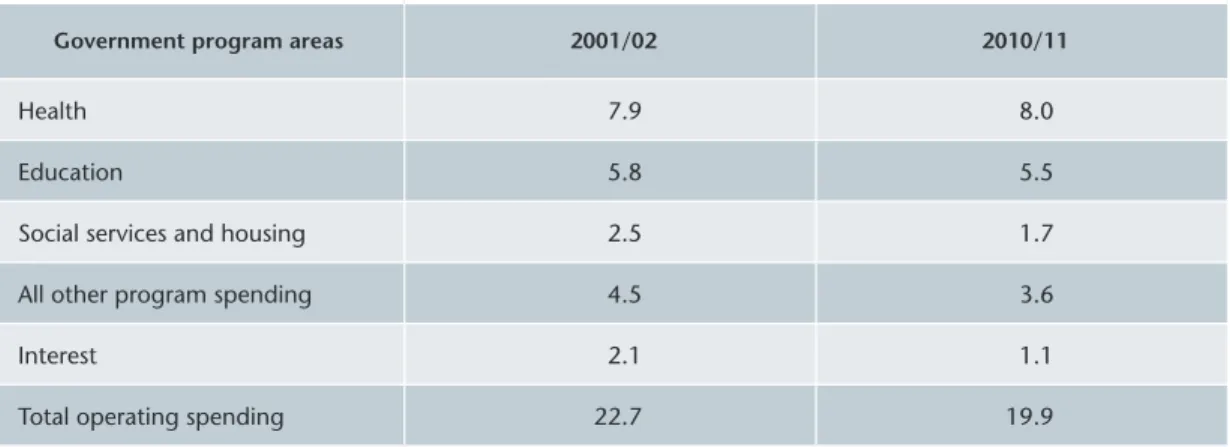
To understand how much fiscal room is available to make improvements in home and community care, it is important to understand how provincial program spending and revenues have changed over the last decade. Significant tax cuts reduced provincial revenues by $3.4 billion from 2001 to 2010.31 On the expenditure side, health care fared better than other programs, particularly social
services, which were substantially cut. In fact, health spending as a share of provincial GDP (i.e. total economic activity in the province) increased slightly, while in all other government program areas spending as a share of GDP declined (Appendix Table A3).
31 Lee, 2011:2.
Table 4: Provincial Government Sector Health Expenditure, by Province and Canada, 2001 to 2011— Current Dollars
2001 2011 Average annual
% change since 2001
Ranking (% change) $ per capita Ranking $ per capita Ranking
NL 2,555 1 5,077 1 7.1 1 Alberta 2,301 4 4,528 2 7.0 2 Saskatchewan 2,266 5 4,348 3 6.7 4 Manitoba 2,427 3 4,266 4 5.8 7 PEI 2,232 6 4,058 5 6.2 6 New Brunswick 2,128 7 4,033 6 6.6 5 Nova Scotia 2,022 10 3,972 7 7.0 3 Ontario 2,123 8 3,645 8 5.6 8 BC 2,481 2 3,604 9 3.8 10 Quebec 2,100 9 3,407 10 5.0 9 Canada average 2,209 3,778 5.5
Source: CIHI National Health Expenditure Trends, 1975–2010, Table B.4.2.
Investment in home and community care is the most cost-effective strategy for improving the health and wellbeing of seniors — and increasing access to acute care for the entire population.
However, when we compare BC to other provinces, the situation looks quite different. From 2001 to 2011 (see Table 4), health spending in BC increased less than in any other province — by 3.8 per cent in BC compared to 5.5 on average for all provinces. BC went from having the second highest spending per capita in 2001, to the second lowest in 2011.
These figures suggest BC has fallen behind the rest of Canada in support for health care. This might not be cause for concern if the lower rate of growth in health spending were the result of genuine efficiencies (i.e. improved service integration and reduction in the ineffective and in-appropriate use of emergency and hospital services) as opposed to restraint policies that reduced access to needed home and community services.32
As noted above, investment in home and community care is the most cost-effective strategy for improving the health and wellbeing of seniors (and others who depend on these services) — and increasing access to acute care for the entire population. The priority changes outlined below are designed to achieve these goals and to do so in ways that support BC seniors to be as independ-ent and healthy as possible.
32 Cohen et al., 2012:12.
BC went from having the second highest spending per capita in 2001, to the second lowest in 2011.
P A R T 6
Priority Changes for BC’s Home
and Community Care System
A 2008 REPORT FROM THE BC MEDICAL ASSOCIATION concluded that rebuilding BC’s home and community system requires two related initiatives: first, restoration of adequate levels of funding for specific home and community care services; and second, development of more in-tegrated and innovative approaches to delivery of these services.33 The second point is particularlyimportant: we can’t simply turn the clock back to the mid-1990s. Reductions in access to home support and residential care have meant that services are increasingly provided only to people with higher levels of need, often in response to a crisis such as an emergency room visit or hospital admission. As a consequence, many seniors receiving home and community care services today have higher levels of acuity and more complex care needs than they did 15 years ago.
Instead of an integrated continuum of services that can anticipate and respond to the changing needs of BC’s seniors, the system is fragmented, confusing to navigate, and access is limited and varies widely across and within the health regions.
In addition, in deciding how health funding should be allocated, the provincial government and health authorities have paid little attention to the unequal burden of ill health and disability on seniors with low socioeconomic status. Half the variation in risk of chronic conditions can be explained by economic factors such as education and income.34 As people age, the impact of
health inequality accumulates, so that people with low socioeconomic status are much more likely to have extended periods of ill health and disability in their seniors years compared to people from more privileged backgrounds.35
A 2008 cross-sectional study from the Canadian Institute for Health Information suggests this may be a significant issue.36 It found that people with low socioeconomic status were more than twice
as likely as people of high or average socioeconomic status to be hospitalized for chronic condi-tions (e.g. diabetes and mental illness) that could be treated in the community. Further research is needed to understand how and to what extent higher hospital admission rates for people with low social economic status reflect shortfalls in the home and community care system.
33 BCMA, 2008a. 34 Koen, 2009. 35 Prus, 2007.
36 Canadian Institute for Health Information, 2008.
As people age, the impact of health inequality accumulates, so that people with low socioeconomic status are much more likely to have extended periods of ill health and disability in their seniors years compared to people from more privileged backgrounds.
To date the provincial government has been slow to respond to the Ombudsperson’s report and acknowledge that the gaps in the home and community care system are creating significant challenges for frail seniors, particularly those who are low income with limited social supports. In summary, moving to a more comprehensive, better co-ordinated home and community care system requires a focus on early intervention, improved access to needed services for seniors on limited income, and increased capacity to address complex health challenges. Based on these considerations and considerable evidence from a wide range of sources, the following four priority areas are suggested as the focus for improvements:
1. Integrate home, community and primary care services for seniors and others with complex needs;
2. Implement delivery mechanisms that give more weight to patient experience and the role of patients in decision making;
3. Include social supports as integral aspect of service delivery, based on evidence showing that when seniors, no matter how frail, remain socially connected they have better health outcomes and a higher quality of life; and
4. Improve public reporting on key indicators to increase public accountability and aid effective planning and health system improvement.
Progress in these four areas would go a long way to achieving the goals of supporting seniors to remain as independent as possible in their own homes and communities, improving access and quality of care, and reducing hospital overcrowding and waitlists.
SERVICE INTEGRATION
It is a challenge for seniors with complex needs (i.e. seniors with one or more chronic conditions, limited mobility, or some level of cognitive impairment) to live well at home given the current fragmentation in service delivery and limited hours of care. Seniors in this situation are frequently in and out of hospital and have multiple health providers (a family doctor, one or more specialists, a home nurse, etc). All too often these providers don’t communicate with one another, and some-time they even work at cross purposes. Very often the basic supports seniors need to live at home (particularly if they are low income) — such as transportation, assistance with meal preparation and social support — are not available. This can change when services are reconfigured around a senior’s needs, provided by an interdisciplinary team of health professionals and front line work-ers, and available 24/7. There is a growing body of research evidence to show that seniors with complex needs can live well at home and use far fewer emergency and hospital services when services are structured in this manner.37
Similarly, in residential care there is evidence that more consistent and frequent visits from a physician (or nurse practitioner) and higher staffing levels (e.g. personal care, nursing, rehabilita-tion staff) can significantly reduce the likelihood that seniors will end up in hospital.38 The leading
work in this area is from the Netherlands, where specialist physicians (one for every 100 residents) work in residential care facilities with a multi-disciplinary team (e.g. rehabilitation therapists, diet-37 Alberta Health Services, 2009; Cohen et al., 2009b: 29-31; Beck et al., 2009; Muramatsum, 2004.
38 Grabowski, 2008; McGregor 2011.
It is a challenge for seniors with complex needs to live well at home given the current fragmentation in service delivery and limited hours of care.
icians, psychologists, and social and recreational workers) to treat diseases such as pneumonia, heart failure, dehydration, and mismanaged diabetes that would require hospitalization in other countries.39
PATIENT VOICE, PERSON-CENTRED CARE
Involving patients in care decisions has positive benefits for the both the health system and individual patients. At a systems level, processes for integrating services for people with complex conditions increasingly begin by mapping a patient’s experience, and then introducing chan-ges based on the problems they identify, and reconfirming these chanchan-ges with the patient as a redesign process unfolds.40 Health outcome measures are also being developed that take as
their starting point the patient’s perspective on effectiveness of a specific intervention, such as a surgical procedure or drug therapy.41 These more patient-centred strategies for system change
are seen as having the potential to be more effective in both improving quality and controlling costs.
At the individual level, significant health benefits result when patients are more actively involved in managing their chronic conditions. This includes the transition from hospital to home for older adults. In one study from the US, transition coaches (i.e. specially trained nurses or case managers) supported older patients after they left hospital, empowering them to become more involved in managing their chronic illness and more confident in communicating with health care professionals.42 The study showed that patients who received the coaching were approximately
half as likely to return to hospital as patients who did not receive this support and that this positive health outcome continued for over six months, well beyond the 24 days of contact with the transition coaches. Moreover, because the transition coaches supported the patient and their caregiver to obtain the care they needed, rather than providing the care themselves, the intensity of intervention was less. This made it possible for the coaches to manage more patients and still achieve the same high level of reduction in readmission rates.43
BC’s Chronic Disease Self-Management Program (CDSMP) takes a similar patient empowerment approach. CDSMP is a peer-led patient education program for adults experiencing chronic health conditions, their family members, friends and caregivers. The program, first developed at Stanford University, was designed to give patients the tools, confidence and motivation to manage the challenges of living with chronic health conditions.44 Participants in the program reported better
health, fewer limitations in social and work activities, and less disability and fatigue. They also vis-ited their physicians less frequently, had few hospitalizations, and experienced shorter stays when hospitalized.45 CDSMP programs are currently being offered in many communities throughout
BC and could be significantly expanded to cover a broader range of health challenges and made more accessible to low income and immigrant seniors and to those living in rural communities.
39 Hoek et al., 2003. 40 Baker, 2008:121-144.
41 Devlin, 2010; Conference Board of Canada, 2012. 42 Coleman et al., 2004.
43 Ibid., 1821-22.
44 University of Victoria Centre on Aging – Ladner, “Chronic Disease Self-Management Program in BC – History” webpage, www.coag.uvic.ca/cdsmp/information_cdsmp_history.htm
45 Lorig, 2001.
At the individual level, significant health benefits result when patients are more actively involved in managing their chronic conditions. This includes the transition from hospital to home for older adults.
SOCIAL SUPPORT
Social support is recognized by the Health Agency of Canada as a determinant of health. It can help people as they age to remain independent by building self-esteem and positive coping skills, improve knowledge and understanding of available health and community resources, and encourage healthy behaviours. The effects on health are tangible:
• A recent summary of research on social support as a determinant of seniors’ health concluded that social connectedness slows cognitive decline, the onset of dementia and the progression of disability (both mental and physical). It also has a positive impact on longevity. Social isolation, in turn, is associated with increased mortal-ity, greater probability of cognitive and physical decline, and poorer self-reported health.46
• A meta-analysis reviewing 148 separate studies with over 300,000 individuals found that social relationships are an important predictor of mortality (i.e., death rates) and that the magnitude of the effect is large — comparable to quitting smoking and ex-ceeding many well-known risk factors for mortality such as obesity, physical inactivity and high blood pressure. These findings are consistent across differences in age, sex, cause of death, or initial health status of the study subjects.47
In other words, social support is important for all seniors, whether they are relatively healthy, have complex needs, or are nearing the end of life.48 It is particularly important for low-income,
frail and isolated seniors, who are unable to maintain social connections on their own and are no longer able to access publicly subsidized home support for basic services such as meal prepara-tion. Providing funding to ensure that social supports are available both within health care (i.e., in home support and residential care) and in the broader community (i.e., in seniors outreach programs at community or seniors centres) is key to supporting seniors, no matter how frail, to remain as independent and healthy as possible.
46 Lansdowne, 2011:8-9. 47 Holt-Lundstad et al, 2010. 48 Ramage-Morin, 2005.
Providing funding to ensure that social supports are available both within health care and in the broader community is key to supporting seniors, no matter how frail, to remain as independent and healthy as possible.
The Remaining Light Project
The Remaining Light is a 30-minute documentary film that explores the issues raised in this study. It features the stories of seniors, their family members, and people who work as caregivers. You can watch the film online at
www.policyalternatives.ca/projects/ seniors-care, or email bcseniors@
policyalternatives.ca to request one or more free copies. Subtitles available in Chinese, Punjabi, Vietnamese and Spanish.
PUBLIC REPORTING AND ACCOUNTABILITY
In CCPA research on the restructuring of home and community care, getting even very basic information on the number of residential care beds and changes over time has been daunting.49
The first recommendation in the BC Ombudsperson’s report relates to the need for more transpar-ent, accessible reporting on home and community care services, funding levels and outcomes.50
The lack of reporting requirements limits public accountability and makes effective planning and system change more difficult. Understanding how many people are currently in hospital who could be cared for in other settings is limited in BC because of the lack of provincially standardized publicly reported information on alternate level of care patients, hospital occupancy rates, and hospital utilization rates for people on limited income and with few social supports.
Regional health systems in other countries that have succeeded in moving in the direction of more integrated and cost-effective care delivery have relied extensively on information related to health outcomes, patient experience and care co-ordination to determine what changes should be introduced and to assess the effectiveness of these changes over time.51 BC needs to move in
this direction as well, ensuring that provincially standardized information is available to support system change and public accountability.
49 Cohen et al., 2009a:25. 50 Ombudsperson, Vol. 1:34-39. 51 Baker, 2008. The first recommendation in the BC Ombudsperson’s report relates to the need for more transparent, accessible reporting on home and community care services, funding levels and outcomes.
P A R T 7
Conclusion
IMPROVING ACCESS TO, AND QUALITY OF, home and community care for seniors (and others who depend on these services) will be of benefit to all British Columbians. It will help seniors to live independently in their own homes and communities, avoiding social isolation and loneliness. It will reduce pressure on family members — many of whom are already balancing full-time employment and parenting their own children — to act as care providers. It is also the most cost-effective way to increase access to hospital services for people of all ages.
The priority changes outlined above include a number of examples of how this could be achieved. The values that underlie these changes — social connectedness, independence, prevention, person-centred care and public input — are widely shared among British Columbians, creating the potential to build broad-based support for these initiatives. However, developing a more compre-hensive and co-ordinated home and community care system also requires provincial leadership. In recent years there has been a recognition within the Ministry of Health of the benefits of inte-grating home and community care with primary physician care to support people with complex needs (both the frail elderly and people living with a mental illness) to live in their own homes or in community facilities instead of in acute care.52 However, no provincial infrastructure or dedicated
funding has been provided to support the improvements in home and community care needed to effectively implement these integration initiatives. Instead, BC health authorities have been left largely on their own to do what they can. Provincial leadership, resources, and infrastructure are required if real progress is to be made in moving toward a more comprehensive and better co-ordinated home and community care system with the capacity to take the pressure off hospital services and enhance the independence of seniors to both live well and die with dignity.
52 Cohen et al. 2012. 36-37. Provincial leadership is required to move toward a more comprehensive and better co-ordinated home and community care system with the capacity to take the pressure off hospital services and enhance the independence of seniors.
Table A1: Change in Access to Home and Community Care Services by Health Authority, 2001/02 to 2009/10 – Client and Service Volume per 1,000 population, Age 75+ Health authority
Client count rate % change 2001/02 to 2009/10 2009/10 % different from highest region 2001/02 2005/06 2009/10 Residential Care Interior HA 124.8 99.66 104.59 -16% -4.2% Fraser HA 123.06 103.79 94.43 -23% -13.5% Vancouver Coastal HA 125.38 105.34 90 -28% -17.6% Vancouver Island HA 111.02 91.31 93.45 -16% -14.4% Northern HA 148.37 118.37 109.17 -26% 0.0% British Columbia 121.14 100.32 95.29 -21% -12.7% Assisting Living Interior HA - 11 15.2 -44.7% Fraser HA - 6.3 15.9 -42.2% Vancouver Coastal HA 0.3 3.6 10.9 -60.4% Vancouver Island HA - 7.1 15.4 -44.0% Northern HA - 10.3 27.5 0.0% British Columbia 0.1 6.9 14.8 -46.2%
Residential Care and Assisted Living combined
Interior HA 124.8 110.66 119.77 -4% -12.4% Fraser HA 123.06 110.08 110.32 -10% -19.3% Vancouver Coastal HA 125.69 108.93 100.93 -20% -26.1% Vancouver Island HA 111.02 98.45 108.88 -2% -20.3% Northern HA 148.37 128.64 136.65 -8% 0.0% British Columbia 121.22 107.17 110.09 -9% -19.4%
Home Support(excludes CSIL*)
Interior HA 113 100.8 79.4 -30% -16.2% Fraser HA 101.5 76.6 76.3 -25% -19.4% Vancouver Coastal HA 122.2 76.6 59.1 -52% -37.6% Vancouver Island HA 98 92.8 94.7 -3% 0.0% Northern HA 157.2 92.2 63.7 -59% -32.7% British Columbia 109.1 85 76.1 -30% -19.6% A P P E N D I X T A B L E S
Table A1 continued
Health authority
Client count rate % change 2001/02 to 2009/10 2009/10 % different from highest region 2001/02 2005/06 2009/10
Professional Services – Home Nursing Care
Interior HA 78.2 79.3 96.9 24% 0.0% Fraser HA 51 45.5 37.2 -27% -61.6% Vancouver Coastal HA 55.8 51 50 -10% -48.4% Vancouver Island HA 67.1 71 71.1 6% -26.6% Northern HA 91.5 83.1 63.9 -30% -34.1% British Columbia 62.2 60.4 60.3 -3% -37.8%
Professional Services – Community Rehabilitation(includes PT and OT)
Interior HA 54.3 73.9 85.8 58% 0.0% Fraser HA 33.5 49 44.4 33% -48.3% Vancouver Coastal HA 79.8 84.5 78.2 -2% -8.9% Vancouver Island HA 78.5 90.7 78.9 0% -8.0% Northern HA 56.5 67.1 43.1 -24% -49.8% British Columbia 59.7 72.4 68.1 14% -20.6%
Home and Community Care (includes RES, ABI, CC, TCU, AL, ADS, HS, CSIL, PS)
Interior HA 280.4 243.7 264.8 -6% 0.0% Fraser HA 252.5 227.1 213.3 -15% -19.4% Vancouver Coastal HA 288.2 242.1 218.4 -24% -17.5% Vancouver Island HA 258.7 244 240.5 -7% -9.2% Northern HA 346.7 294.6 243.5 -30% -8.0% British Columbia 268.1 237.8 230.3 -14% -13.0%
Note: Choice in Supports for Independent Living (CSIL) is home support program that mainly targets young people with disabilities, managed by the clients themselves.
Source: Data prepared by Home and Community Care and Mental Health and Substance Use, Management Information Branch, Planning and Innovation Division, Ministry of Health using data from BC Stats Service, BC, Ministry of Citizen’s Services and CCData Warehouse tables extracted from the Continuing Care Information Management System (CCIMS).
Table A2: Alternate Level of Care Days as a Proportion of Total Hospital Days in BC Health Authorities, 2005/06 and 2010/11
Interior
Health HealthFraser
Vancouver Coastal
Health
Vancouver
Island Health Northern Health
2005/06: Inpatient days
ALC days 425,65758,580 754,74672,269 678,78246,946 514,70368,127 160,07928,028 2005/06:
ALC days as a % of all days 13.8% 9.6% 6.9% 13.5% 17.5% 2010/11:
Inpatient days
ALC days 453,34875,500 919,757101,178 722,97461,818 543,045108,303 164,68428,325 2010/11:
ALC days as a % of all days 16.7% 11% 8.6% 19.9% 17.2%
Source: Health Ideas, Total Acute Rehab and ALC days by HSDA 2005/06 to 2010/11,
extracted from the Hospital Workload by Governance Authority, Report Run ID 338462041
Table A3: BC Government Program Spending as a Percentage of GDP, 2001 to 2011 Government program areas 2001/02 2010/11
Health 7.9 8.0 Education 5.8 5.5 Social services and housing 2.5 1.7 All other program spending 4.5 3.6 Interest 2.1 1.1 Total operating spending 22.7 19.9
Source: BC Ministry of Finance, 2011 British Columbia Financial and Economic Review, 2011, Table A2.7.
R E F E R E N C E S
Alberta Health Services. 2009. Final Report Program Evaluation for the Comprehensive Home
Options of Integrated Care for the Elderly (CHOICES). Tri-global Solutions Group. March.
Baker, Ross G. et al. 2008. High Performing Healthcare Systems: Delivering Quality by Design. Toronto. Longwoods Publishing Corporation.
Beck, Robin et al. 2009. “House Calls for Seniors: Building and Sustaining a Model of Care for Homebound Seniors,” Journal of the American Geriatric Society. 57:1103-1109.
BC Auditor General. 2008. Home and Community Care Services: Meeting Needs and Preparing for
the Future. October.
British Columbia Medical Association (BCMA). 2008a. Bridging the Islands: Re-Building BC’s Home
and Community Care System, A Policy Paper by BC’s Physicians. May.
British Columbia Medical Association (BCMA). 2008b. Improving Access to Acute Care Services: A
Policy Paper by BC Physicians. August.
British Columbia Medical Association (BCMA). 2011. Policy Statement: Emergency Room
Overcrowding. July.
British Columbia Nurses’ Union (BCNU). 2007. Over Capacity Protocols Campaign, January https://new.bcnu.org/Campaigns/Campaigns.aspx?page=Overcapacity%20Protocol British Medical Association. 2009. Tackling Healthcare Associated Infections Through Effective Policy
Action. A publication of the BMA Science and Education Department and the Board of
Science.
Canadian Health Coalition. 2012. Building a Continuum of Care: Home Care, Long Term Care,
Palliative Care and Pharmacare. Ottawa: Canadian Health Coalition.
Canadian Institute for Health Information (CIHI). 2008. Reducing Gaps in Health: A Focus on
Socioeconomic Status in Urban Canada. November.
Canadian Institute for Health Information (CIHI). 2009. Alternative Level of Care in Canada. January.
Canadian Medical Association. 2010. Health Care Transition in Canada, Ottawa: Canadian Medical Association.
Cohen, Marcy et al. 2005. Continuing Care Renewal and Retreat? BC Residential and Home
and Community Care Restructuring 2001-2004, Vancouver: Canadian Centre for Policy
Cohen, Marcy et al. 2009a. An Uncertain Future for Seniors: BC’s Restructuring of Home
and Community Health Care, 2001-2008. Vancouver: Canadian Centre for Policy
Alternatives — BC Office. April.
Cohen, Marcy et al. 2009b. Innovations in Community Health: from Pilot Project to System Change. Vancouver: Canadian Centre for Policy Alternatives — BC Office. April.
Cohen, Marcy et al. 2012. Beyond the Hospital Walls Activity Based Funding Versus Integrated
Health Care Reform. Vancouver: Canadian Centre for Policy Alternatives — BC Office.
January.
Coleman, Smith, Frank et al. 2004. “Preparing Patients and Caregivers to Participate in Care Delivered Across Settings: The Care Transitions Intervention.” Journal of the American
Geriatrics Society. 52:1817-1825.
Devlin, Nancy. 2010. Getting the Most Out of Proms: Putting Health Outcomes at the Heart of NHS
Decision Making, London: The Kings Fund.
Foster, Alan et al. 2003. “Emergency Room Length of State and Patient Disposition.” Academy of
Emergency Medicine. Volume 10, Number 2. February.
Grabowski, D.C. et al. 2008. “Predictors of Nursing Home Hospitalization: a Review of the Literature.” Medical Care Residential Review. February; 65(1): 3-39.
Health Council of Canada. 2012. Seniors in Need, Caregivers in Distress: What are the Home Care
Priorities for Seniors in Canada? April.
Hoek, J.F. et al. 2003. “The Role of the Specialist Physician in Nursing Homes: The Netherlands’ Experience.” International Journal of Geriatric Psychiatry. 18: 244-249.
Holt-Lunstad, J. et al. 2010. “Social Relationships and Mortality Risk: A Meta-Analytic Review.”
PLoS Medicine. 7:7 e100316.
Interior Health. 2005. Financial Report – Executive Summary. YTD to January 27th (period 11).
Keon, Hon. Joseph. 2009. A Healthy Productive Canada: A Determinant of Health Approach. The Standing Committee on Social Affairs Science and Technology: Final Report of the Senate Committee on Population Health. June.
Lansdowne, Jolene. 2011. The Links Between Social Support and Improved Health Outcomes, The Smart Fund, Vancouver Coastal Health. January.
Lee, Marc et al. 2011. B.C.’s Regressive Tax Shift: A Decade of Diminishing Tax Fairness, 2000 to
2010. Vancouver: Canadian Centre for Policy Alternatives — BC Office. June.
Lorig, K.R. et al. 2001. “Chronic Disease Self-Management Program: 2-Year Health Status and Health Care Utilization Outcomes.” Medical Care. 39, 11:1217-1223.
McGregor, M.J. et al. 2011a. A Survey of Nursing Home Organizational Characteristics Associated with Potentially Avoidable Hospital Transfers and Care Quality in One Large British Columbia Health Region. Canadian Journal on Aging/Revue Canadienne du
McGregor, M.J. et al. 2011b, “The Association of Nursing Home Ownership and Organizational Characteristics and Resident Emergency Room Transfers.” Poster Presentation Family Forum. November.
McGrail, K. et al. 2008. Home Health Services in British Columbia: A Portrait of Users and Trends
Overtime. Vancouver: UBC, Centre for Health Policy Research. October.
Muramatsu, N. et al. 2004. “A Physician House Call Program for the Homebound.” Joint
Commission Journal on Quality and Safety. 30.5:266-276. May.
OECD, 2011. Health Care at a Glance, Health Indicators, OECD Publications.
Ombudsperson. 2012. The Best of Care: Getting it Right for Seniors in British Columbia. Part 2,
Overview and Volume I and Volume I. Victoria: BC Office of the Ombudsperson. February.
Prus, S.G. 2007. “Age, SES and Health: A Population Level Analysis of Health Inequalities, Over the Lifecourse.” Sociology of Health and illness. 29: 275-296.
Ramage-Morin, P.L. 2005. “Successful Aging in Healthcare Institutions.” Statistics Canada,
Supplement to Health Report. Catalogue no. 82-003. 16:47-56.
Standing Senate Committee on Social Affairs. 2012. Science and Technology, Time for
Transformative Change: A Review of the 2004 Health Accord. March.
Sprivalis, Peter. 2006. “The Association between Hospital Overcrowding and Mortality among Patients Admitted via Western Australian Emergency Departments.” Medical Journal of
Australia, Vol. 184, No. 5. March 6.
The Conference Board of Canada. 2012. Integrated Healthcare: The Importance of Measuring
Patient Experience and Outcomes. April.
Wait Time Alliance. 2011. Time Out! A Report on Wait Times in Canada. www.waittimesalliance. ca/publications.htm.
Wait Time Alliance. 2012. Report Care on Wait Times in Canada, www.waittimesalliance.ca/ publications.htm.
The Canadian Centre for Policy Alternatives is an independent,
non-partisan research institute concerned with issues of social and economic justice. The CCPA’s BC Office hosts The Remaining Light Project, which brings community organizations, seniors and researchers together to develop policy solutions that support seniors’ dignity and well-being. 1400 – 207 West Hastings Street
Vancouver, BC V6B 1H7 604.801.5121
The BC Health Coalition is a coalition of more than 50 groups that works to protect and expand public health care. For more information, please contact [email protected], call 604.681.7945 or visit our website at www.bchealthcoalition.ca