Performance Comparison and Analysis of Voice
Communication over Ad Hoc Network
HuiYao Zhang
1, John Homer
1, Garry Einicke
2, Kurt Kubik
11
School of Information Technology and Electrical Engineering, University of Queensland, QLD, Australia
[email protected] and [email protected]
2
CSIRO Exploration and Mining Technology Court, Pullenvale, QLD, Australia
Abstract — Currently, voice traffic (both local
and long-distance) is gradually moving from traditional circuit-switched networks to IP-based, packet-switched networks. Another dominant trend is the development of mobile ad hoc networks technology. In this work, a simulation-based performance analysis of ad hoc routing protocols is presented for establishing VoIP conversation sessions by mobile users in an ad hoc network scenario. The two primary performance metrics (the packet delivery rate and end-to-end delay) for measuring the voice communication are evaluated by varying the routing protocols, number of VoIP conversation sessions and user mobility.
I.INTRODUCTION
The world is becoming increasingly IP-centric, with a large number of devices getting networked every day. Voice over Internet Protocol (VoIP) is one of the fastest growing Internet applications today. The VoIP technology is used to transmit real-time voice conversations by using a data network instead of a phone line.
An Ad Hoc network is a collection of wireless nodes dynamically forming a temporary network without the use of any existing network infrastructure of centralized administration. Ad hoc networks are gaining increasing popularity in recent years because of their ease of deployment. The actual wireless technologies already provide users with enough coverage and the necessary network capabilities for supporting a high variety of peer to peer applications. We are considering the VoIP application on top of Ad Hoc networks, which we believe is a significant technology for voice communications without infrastructure support. Potential applications include military operations, underground mining environments or emergency services situations. For example, we aim to develop a capability so that mobile PDAs can be used as “walkie-talkies” and at the same time serve as an adaptive self-aware network. The key challenges will include estimating Quality of Service (QoS) and dynamically routing traffic over mobile nodes. In this paper, we present a simulation-based performance analysis of four popular ad hoc routing protocols in mobile ad hoc network scenario, which used to establish VoIP sessions by mobile users.
This paper is organized as follows. Section 2 presents a brief of VoIP and a classification of ad hoc routing protocols; Section 3 describes the adopted simulation model; Section 4 will analyse the two performance metrics of the simulated ad hoc routing protocols based on the requirements of real-time VoIP conversation scenario in a small-scale ad hoc network; Section 5 gives a conclusion.
II.BACKGROUND
2.1. VoIP
Voice over Internet Protocol is a technology for transmitting voice, such as ordinary telephone calls, over packet-switched data networks. VoIP is also called IP telephony. The VoIP technology allows you to make telephone calls using a computer network, VoIP converts the voice signal from telephone into a digital signal that travels over the internet then converts it back at the other end so you can speak to anyone with a regular phone number. VoIP may also allow you to make a call directly from a computer using a conventional telephone or a microphone. VoIP is being used more and more to keep corporate telephone costs down. VoIP runs right over your standard network infrastructure, but it also demands a very well-configured network to run smoothly.
2.1.1 Speech coding
VoIP combines the strengths of the Internet Protocol with the possibilities that come with telephony. By transforming the voice into a digital format the sound can be transported over a network. For VoIP, the analog or pulse-code modulation (PCM) voice signals are encoded and compressed into a low-rate packet stream by codecs. If you compress the audio a little bit better, for instance, the used bandwidth decreases and one can transport the data quicker over the Internet. In theory, the VoIP network service architect has an array of speech coder choices. Table 1 lists the attributes of several commonly used codecs.[1]
* For all codecs except G.729, Packets/sec=1/Framing interval). For G.729, two frames are combined into one packet so that Packets/sec=1/(2* Framing interval)
2.1.2 Transport
Typical Internet applications use TCP/IP, whereas VoIP uses RTP/UDP/IP. Although IP is a connectionless best effort network communications protocol, TCP is a reliable transport protocol that uses acknowledgments and retransmission to ensure packet receipt. Used together, TCP/IP is a reliable connection-oriented network communications protocol suite. TCP has a rate adjustment feature that increases the transmission rate when the network is uncongested, but quickly reduces the transmission rate when the originating host does not receive positive acknowledgments from the destination host. TCP/IP is not suitable for real-time communications, such as speech transmission, because the acknowledgment and retransmission feature would lead to excessive delays. UDP provides unreliable connectionless delivery service using IP to transport messages between end points in an internet. RTP, used in conjunction with UDP, provides end-to-end network transport functions for applications transmitting real-time data, such as audio and video, over unicast and multicast network services. RTP does not reserve resources and does not guarantee quality of service. A companion protocol RTCP does allow monitoring of a link, but most VoIP applications offer a continuous stream of RTP/UDP/IP packets without regard to packet loss or delay in reaching the receiver.[2]
2.1.3 Voice Quality and Performance Metrics
A key determinant in voice quality is
codec choice, but network performance will
have
a
substantial
impact
on
quality.
Degradation of speech quality caused by packet
delay and loss of voice traffic is still one of
critical technical barriers of the VoIP system.
According to [3, 4], the following two network characteristics must align with VoIP services because they determine the quality of VoIP service:
Delay
VoIP delay or latency is characterized as the amount of time it takes for speech to exit the speaker’s mouth and reach the listener’s ear. A delay of 100msec or less is considered desirable, whereas 250msec or greater depending on the degree of degradation deemed acceptable is noticeable and will cause people to switch to half-duplex conversation. Delay is made up of three elements, accumulation delay or algorithmic delay, processing (packetization) delay and network delay. Accumulation delay occurs because a “frame” comprising many voice samples must be collected before processing can be carried out on the frame. Processing delay is caused by the processing (compressing) of a frame and collection of encoded
samples into a packet for transmission. Often multiple small packets are collected in a single larger packet to reduce network overhead (the ratio of headers to useful data). Lastly, network delay is the time taken for the packet to be passed across the network to the recipient, including queuing time, packet transmission and propagation. The queuing time can be caused by network congestion on unavailability of valid routes.
The network delay is the major component of the total voice delay; the accumulation delay and processing delay often are fixed and take 10 to 50 milliseconds
.
The end-to-end delay, network delay, indicates how long it took for a packet successfully delivery from the CBR (constant bit rate) source to the application layer of the destination. It represents the average data delay in the network. E2E delay is measured in milliseconds (ms) and is calculated for the entire network.
−
=
)
Re
_
_
(
)
_
_
_
_
(
2
ceived
Packets
Data
time
sent
Packets
time
received
Packet
E
E
Packet loss
Since packets are sent using UDP, an unreliable protocol, codecs must be able to handle some packet loss, e.g. by interpolation, but a loss of
5% or more is usually noticeable. The amount of
packet loss a codec can handle before voice performance is degraded determines the robustness of the protocol. Speech is continuous, but packets may arrive out of order so protocols must be in place to prevent sequence errors. If a packet has not arrived at a receiving terminal before it is due to be played out to the listener, it is effectively a lost packet.
Packet delivery rate is the ratio of the number of data packet successfully delivered to the destinations to the number of data packets generated by the CBR sources. It specifies the packet loss rate, which limits the maximum throughput of the network. The better the delivery ratio, the more complete and correct is the routing protocol. This rate is calculated as a percentage.
×
=
)
_
_
_
(
100
)
_
_
(
sources
by
sent
Packets
received
Packets
Data
PDR
2.2 IEEE 802.11 DCF
The basic access method for 802.11 is the Distributed Coordination Function (DCF) which uses Carrier Sense Multiple Access / Collision Avoidance (CSMA / CA). This requires each station to listen for other users. If the channel is idle, the station may transmit. However if it is busy, each station waits until transmission stops, and then enters into a random back off procedure. This prevents multiple stations from seizing the medium immediately after completion of the preceding transmission. Packet reception is acknowledged by the receiving station. Initially 802.11 was designed for base station
managed networks, where the base stations are linked to an Access Point (AP) which forms a bridge (as the wireless LAN hub) between wireless and wired LANs. The Access point is not mobile and is connected to a wired backbone. However, with the DCF, Ad hoc networks with suitable routing protocols can be built on top of IEEE 802.11. Most of the protocols designed for ad hoc networks assume that IEEE 802.11 is used for lowest-layer communications.
Some work [4-11] has highlighted a certain number of performance metrics and efficient routing protocols for topologically changing networks.
2.3 Ad Hoc Routing Protocols [4-11]
Based on when routing activities are initiated, routing protocols for mobile ad hoc networks can be broadly classified into two basic categories: (1) proactive or table-driven protocols, for example, DSDV, WRP, etc; (2) reactive or on-demand routing protocols, for example AODV, DSR, TORA, etc. In proactive protocols, each node maintains consistent, up-to-data routing information about all destination nodes in the network. These protocols require each node to maintain one or more tables to store routing information and periodically propagates routing information.
Reactive protocols create and maintain routes only when desired by the source node. When a node requires a route to a destination, it initiates a route discovery process within the network.
Every routing protocol has its strengths and drawbacks, and aims at a specific application. Considering the real time voice communication application, this study focuses on evaluating the critical effect of user mobility in both proactive and reactive protocol ad hoc networks.
2.3.1 DSDV
In DSDV (Destination-Sequenced Distance Vector) Routing protocol, a routing table is maintained in every mobile node in the network. The routing table records all of the possible destinations within the network and the number of hops to each destination. Each entry is marked with a sequence number assigned by the destination node. The sequence numbers enable the mobile nodes to distinguish routes from new ones; therefore, they avoid the formation of routing loops. Routing table updates are periodically transmitted throughout the network in order to maintain table consistency.
2.3.2 AODV
AODV (Ad-hoc On-Demand Distance Vector Routing) is an improvement on DSDV because it typically minimizes the number of required broadcasts by creating routes on an on-demand basis, as opposed to maintaining a complete list of routes as in the DSDV algorithm. A source node desiring a route to some destination broadcasts a
Route Request (RREQ) packet across the network.
The destination or an intermediate node with a
current route to the destination answers with a
Route Reply (RREP) unicast packet. Once the
source node receives the RREP, it can begin using the route for data packet transmissions. AODV utilizes destination sequence numbers to ensure all routes are loop-free and contain the most recent route information. Each node maintains its own sequence number, as well as a broadcast ID. Once a link breaks in an active route, the node which detects a connectivity failure will send a
Route Error (RERR) message to the next node in
the reverse path. All nodes in the reverse path forward the RERR message until reaching the source node. When a source node receives a RERR message, it may re-initiate route discovery if necessary.
2.3.3. DSR
DSR (Dynamic Source Routing) protocol is based on the concept of source routing. Each node has a route cache, where complete routes to desired destinations are stored as gleaned from the reply packets. The protocol consists of two major phases: route discovery and route maintenance. When a node wants to send data and there is no route to the destination currently available in its route cache, it broadcasts a route request packet, which contains the destination address and a route record. The route record records the passed nodes address. When the request is received by the destination or an intermediate node that knows the route to the destination, a route reply is sent back to the source node via the recorded route. When a node learns the route is obsolete due to topology changes, it builds and sends a route error to the source. When a route error packet is received, the hop in error is removed from the node's route cache and all routes containing the hop are truncated at that point. The source then invokes a route discover
process to construct a new route.
2.3.4 TORA
TORA (Temporally-Ordered Routing Algorithm) is a highly adaptive, loop-free, distributed routing algorithm based on the concept of link reversal. The key design concept of TORA is the localization of control messages to a very small set of nodes near the occurrence of a topological change. The actions taken by TORA like water flowing downhill toward a destination node through a network of tubes that models the routing state of the real network, Shortest path is considered of secondary importance, and longer routes are often used if discovery of newer routes could be avoided. TORA is also characterized by a multipath routing capability.
The protocol performs three basic functions: 1) route creation where the nodes use the height metric[6] to maintain a directed acyclic graph (DAG) based on the neighbouring nodes; 2) route maintenance where in case a DAG route is broken, it is necessary to re-establish a DAG rooted at the
same destination; 3) route erasure, where TORA floods a broadcast clear packet (CLR) throughout the network to erase invalid routes.
III.SIMULATION SETTINGS
In this work, simulation sessions have been performed using the Network Simulator (ns-2.28) which is configured with Linux (Fedora Core 3) and equipped with one 1.5GHz processor and 512 MB of RAM.
The following wireless features are adopted for configuration of all simulations: radio propagation model using two ray ground propagation model; media access control protocol using IEEE802.11 distributed coordination function (DCF) and configured with an interface queue of 100 packets; nominal data rate of 11Mbps; transmission radius of 100m; and omni-directional antennas.
3.1 Traffic model
The traffic model of the VoIP session considered employed G. 729 codec for which the payload is 10 Bytes and packet rate is 50 packets per second. In summary, for each simulation, a VoIP session is characterized as a bi-directional, point-to-point connection between two users equipped with mobile phones. Voice packet transmission over wireless channels represents a real-time traffic pattern. The goal is to evaluate the more critical scenario, which occurs when mobile users are in permanent movement during the VoIP session. In one VoIP session, two nodes were chosen which were configured for respectively generating a constant bit rate data stream from the application layer to each other’s application layer at the same time thereby emulating 2 users talking to each other using mobile devices. The packet size is 10 bytes and packet rate is 50 packets per second using UDP protocol. Each session node generates 10000 packets, which means each simulated VoIP session takes 10000/50=200 seconds. Therefore, together, two mobile nodes in a VoIP session generate about 20000 packets.
The simulation time was configured for 300 seconds. Consequently, the time to generate the CBR data stream from application layer is set to between 0 and 100 seconds to ensure the conversation session will finish before the simulation stops. This also means several of the VoIP sessions will process together during part of simulation time.
3.2 Movement model
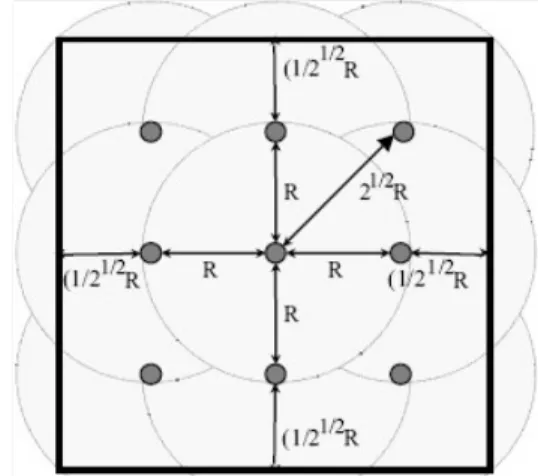
The simulated scenarios consider a small-scale ad hoc network in which 21 mobile users are randomly distributed within an area of 340x340m2. In such a scenario, to ensure all mobile nodes have existing routes with others within the coverage area, a matrix of 9 fixed nodes is defined as shown in figure 1[4]. The location of each fixed node is calculated based on the transmission radius of
100m and the network area of 340x340m2. So, in total there are 30 nodes located in the scenario area, 9 are fixed and 21 are randomly distributed and mobile. Each node supports ad hoc routing protocols, and can communicate with the fixed nodes or mobile nodes within its transmission radius. For each evaluated routing protocol, several simulations were performed, varying the maximal mobile speed and the number of VoIP sessions. The following maximal mobile speeds were considered 0, 1, 5, 10, 15, 20m/s. The adopted mobility model used pause times and random mobile speeds. In particular, all the mobile nodes randomly choose mobile speeds between 0 and the maximal speed. An additional pause time that nodes must wait after reaching their target locations, was configured as 10 seconds.
Figure 1. Fixed nodes setting in the scenario
IV.RESULTS AND ANALYSIS
This section presents and discusses the simulation results. A comparative analysis of the performance metrics for VoIP is generated from all simulations, and shows general and relevant aspects of the evaluated routing protocols in the diversity of mobility levels and VoIP sessions.
4.1 Packet Delivery Rate
Figures 2, 3, 4 illustrate the average packet delivery rate measured versus maximal mobile speed for different numbers of VoIP sessions. As can be observed from Figure 2 (one VoIP session), as the maximum speed increases, DSDV presents a lower packet delivery rate, dropping from about 90% to about 35%; whereas, the reactive protocols present high packet delivery rate, which remain near 100% as the speed increases. In particular, both AODV and DSR packet delivery rates are always near 100% and never less than 98%. TORA PDRs are between 100% and 95%.
The poor performance of DSDV under high mobility rate can be explained by its proactive approach. In DSDV, source nodes do not send route requests for creation and re-establishing route. It has to passively wait the periodic propagation of
routing messages to indicate valid routes to the required destination nodes. When there is a more frequent link failure as a result of increased mobility, DSDV can produce long periods of queuing time in which a given node does not have a valid route in the routing table. In such circumstances, receiving queues become full and subsequently arriving packets are just discarded causing the packet delivery rate to drop drastically.
Figure 2. PDR of one VoIP session
Figure 3. PDR of two VoIP sessions
Figure 4. PDR of three VoIP sessions
Comparing Figures 2, 3 and 4, it can be seen that with the increase in number of VoIP sessions, the PDR of all four protocols drops. Of the three reactive protocols, the TORA drops most. As previously mentioned, in TORA, route updating may not occur as quickly as in other protocols due to the potential for route oscillations. With an increase in the number of connections, it leads to potentially higher delays and lower packet delivery rates. In order to ensure the quality of a VoIP session, the average packet delivery rate should be more than 95% as we mentioned in section 2.1.3. Both AODV and DSR have a good behaviour for VoIP session in the ad hoc network scenarios, but for the scenario considered, they only can support one or two VoIP sessions at the same time. Increasing the
number of VoIP sessions causes the packet delivery rate to drop below the required 95% PDR standard. According to [1], this drop in PDR result is mainly due to the added packet-header overheads as the short VoIP packets traverse the various layers of the standard protocol stack, as well as the inefficiency inherent in the IEEE 802.11 medium-access control (MAC) protocol.
4.2 End-to-End delay
As can be observed in Figures 5, 6 and 7, the higher the user mobility level and more VoIP sessions, the higher the end-to-end delay.
Figure 5 shows the end-to-end delay of one VoIP session. DSDV E2E delay is the lowest when speed is 0 m/s, but as the maximum speed increases DSDV has a larger delay (increasing from about 0.005 to about 0.09s) than the reactive protocols. This is due to the proactive DSDV route maintenance generating an increase in transmission queues when the topology changes frequently[4]. In reactive protocols, the higher the user mobility level, the greater the number of route requests. Due to that, the average queuing time tends to become bigger, leading to an increase in E2E delay, as observed in Fig 5.
Figure 5. E2E delay of one VoIP session
Figure 6. E2E delay of two VoIP sessions
With the increase number of VoIP sessions, E2E delay increases for all of the four protocols. TORA and AODV vary significantly more than DSR and DSDV.
Since E2E delay is only measured on those successfully delivered packets, the shortest path protocols (DSDV) show the minimum delay characteristics. TORA has the worst delay characteristics. The reason is, in some situations, the reconstruction of routes in TORA can not happen as quickly as in other protocols, because the creation of routes in TORA is a time-consuming task.[4]. AODV and DSR present intermediate behaviour in multi-VoIP session scenarios as their routes are typically not the shortest. Even if the initial route discovery phase finds the shortest route (it typically will), the route may not remain the shortest over a period of time due to node mobility. DSR is better than AODV because it adopts the concept of multiple routes, during its route discovering process. DSR identifies multiple routes to the target node, and in addition, it discovers routes to intermediate nodes. As a consequence, almost always DSR has a valid route or can quickly update invalid ones.
As mentioned before, a real-time VoIP application requires end-to-end delays less than 200 ms, not including accumulation delay and processing delay. The results indicate that DSR and DSDV seem to be adequate for one or two VoIP session applications.
V.CONCLUSION
Many routing protocols for mobile ad hoc network have been proposed in recent years. This study numerically evaluates performance metrics of 4 ad hoc routing protocols (DSDV, AODV, DSR and TORA) in 6 different mobility levels (maximal speed from 0 to 20m/s) and 3 distinct VoIP conversation sessions (number of VoIP conversation session ranging from 1 to 3) in the special ad hoc scenario. Despite the existence of some comparative analyses of ad hoc routing protocols, none of them takes into account such an ad hoc network scenario and the VoIP application.
Considering the requirements of a VoIP application, DSR always presents an adequate behaviour both in packet delivery rate and end-to-end delay with a limited number of VoIP sessions. Based on this, we propose that DSR is the best option for such real-time VoIP conversation applications in an ad hoc network scenario.
In future work, first we intend to evaluate other routing protocols. Second, we plan to investigate and study on how to improve performance metrics in multi-VoIP sessions.
REFERENCES
[1] W. Wang, S. C. Liew, and V. O. K. Li, "Solutions to performance problems in VoIP over a 802.11 wireless LAN," Vehicular
Technology, IEEE Transactions on, vol. 54,
pp. 366-384, 2005.
[2] B. Goode, "Voice over Internet protocol (VoIP)," Proceedings of the IEEE, vol. 90, pp. 1495-1517, 2002.
[3] Ian Zahorujko, Alfred Reynolds and Bill Blair, "IP Convergence in Global Telecommunications - Voice over Internet Protocol (VoIP)," DSTO September 2000. [4] G. Campos and G. Elias, "Performance
Issues of Ad Hoc Routing Protocols in a Network Scenario used for Videophone Applications," 1530-1605, 2005.
[5] K. Shea, R. W. Ives, and M. Tummala, "Mobile ad hoc network routing protocol analysis and its application to a programmable modular communication system," presented at 34th Asilomar Conference, Oct 29-Nov 1 2000, Pacific Grove, CA, 2000.
[6] Q.-A. Z. Dharma Prakash Agrawal,
Introduction to wireless and mobile systems:
Thomson Learning, 2003.
[7] S. R. Das, R. Castaneda, and J. Yan, "Simulation-based performance evaluation of routing protocols for mobile ad hoc networks," Mobile Networks and Applications, vol. 5, pp. 179-189, 2000.
[8] J. Hsu, S. Bhatia, M. Takai, R. Bagrodia, and M. J. Acriche, "Performance of mobile AD HOC networking routing protocols in realistic scenarios," presented at MILCOM 2003 - 2003 IEEE Military Communications Conference, Oct 13-16 2003, Monterey, CA, United States, 2003.
[9] Z. Wan-Yu, Y. Meng, X. Li, and S. Zhong-Xiu, "A survey of on-demand routing protocols for ad hoc mobile networks,"
Chinese Journal of Computers, vol. 25, pp.
1009-17, 2002.
[10] H. Zhou, "A Survey on Routing Protocols in MANETs," Department of Computer Science and Engineering,Michigan State University Mar 28 Mar 28, 2003.
[11] D. A. M. Josh Broch, David B. Johnson, Yih-Chun Hu, and Jorjeta Jetcheva., "A Performance Comparison of Multi-Hop Wireless Ad Hoc Network Routing Protocols," presented at the Fourth Annual International Conference on Mobile Computing and Networking (MobiCom'98),ACM, Dallas, TX, October 1998.