Abstract—La0.25Sr0.75Cr0.5Mn0.5O3 (LSCM) and Ce/LSCM were synthesized and investigated for their potential use in an oxidative coupling of methane (OCM) reaction. The catalysts was characterized using XRD, SEM and Impedance. The catalytic activity of catalysts for OCM reaction was both studied in fixed bed and SOFC reactor. A YSZ was used as a solid electrolyte and La0.8Sr0.2FeO3 (LSF) was used as a cathode material. The cell obtained a maximum power density of 221 mW cm-2 in humidified methane. The cell was put under a bias voltage of 0.3 V, which C2 hydrocarbon was generated from the cell. At the highest methane conversion rate, the cell achieved a good C2 hydrocarbon selectivity of 78.4% and a C2 yield of 3.4% at 850 oC.
Index Terms—SOFC reactor, cogeneration, C2 hydrocarbon, LSCM.
I. INTRODUCTION
Research on the oxidative coupling of methane (OCM) has increased in intensity over the past decade due to the potential for converting natural gas directly to higher value chemicals, such as ethylene and ethane (C2 hydrocarbon) [1], [2]. The conversion of methane to C2 hydrocarbons remains a challenging problem in heterogeneous catalysis and chemical reaction engineering. The selectivity to C2 hydrocarbon decreases with increasing methane conversion. In addition, the yield of C2 hydrocarbons achieved in a fixed-bed reactor (FBR) was limited to about 20-25% due to to the presence of undesired complete oxidation in the gas phase and partially on the catalyst surface [3], [4]. In the last 25 years, numerous works have been reported and several innovative approaches have been proposed, including the use of solid electrolyte membrane reactors [5], [6]. However there are a few researches reveled SOFC reactor to produce C2 hydrocarbons. The SOFC reactor for co-generation of C2 hydrocarbons and electric power was first reported by Pujare and Sammells, they studied the OCM by using the cell Pt/Sm2O3 /La0.89Sr0.10MnO3 /YSZ/La 0.89 Sr0.10MnO3 /Pt. High
selectivity to C2 hydrocarbon (90 %) was achieved although the methane conversion was relatively low [7]. Hence, a
Manuscript received January 15, 2017; revised May 4, 2017.
The author was with Center of Excellence in Catalysis and Catalytic Reaction Engineering, Department of Chemical Engineering, Faculty of Engineering, Chulalongkorn University, Bangkok 10330, Thailand. She is now with the Department of Chemical Engineering, Rajamangala University of Technology Thanyaburi, Pathumtani, 12110 Thailand (e-mail: [email protected]).
development of anode catalysts for an oxidative coupling of methane in SOFC becomes an important goal to improve the conversion, selectivity, yield and stability of the reactor. Addition, the anode material must require good electronic conductivity, high electrochemical activity and structural stability properties [8].
Perovskite structure (ABO3) anode materials have
received much attention because of their mixed electronic and ionic conduction behaviors that make the triple-phaseboundary (TPB) extend to the entirely exposed anode surface. Among the variety of these oxides, LaSrMnO3
-based perovskite compounds are promising Ni-free anode candidates due to their high chemical stability at high temperatures under both oxidizing and reducing atmospheres, and strong resistance to carbon deposition [9], [10]. However, they suffer from the disadvantages of low electronic and ionic conductivities and poor catalytic activity. The sufficient electronic and ionic conductivities are indispensable to reduce the electrode polarization and thus promote the electrode reaction process. There are many efforts to enhance the electronic and ionic conductivities of LaSrMnO3 material.
For example donor doping on the Mn site of LaSrMnO3 with
perovskite structure could improve the electrical conductivity [11]-[15]. S.W. Tao and co-worker reported the increasing in electrical conductivity of doping on the Mn site of LaSrMnO3.
Moreover doped-chromium on Mn site is suitable for high temperature operation (750-900°C) because Cr doped LaSrMnO3 played a vital role in increasing resistance to
coking (as well as raising sulphur tolerance) [16]. Moreover, Ceria doped perovskite material, the electrochemical catalytic performance and carbon deposition resistance in oxidation of syngas were significantly improved [17].
In this work, Ce/La0.25Sr0.75Cr0.5Mn0.5O3 (Ce/LSCM) were
examined. The surface morphology, composition and surface area were characterised by several techniques. The catalytic activity of catalysts for oxidative coupling of methane reaction and the influence of some operating variables, i.e., the temperature were investigated in detail over a fixed bed reactor. For SOFC cell preparation, the cell components was improved by tape- casing preparation. The ohmic resistance decreased by the reduction of the electrolyte thickness. Finally, the electrochemical performance was investigated in solid oxide fuel cell reactor (SOFC).
II. EXPERIMENTAL
A. La0.25Sr0.75Cr0.5Mn0.5O3 Catalyst Preparation
The perovskite oxide, La0.25Sr0.75Cr0.5Mn0.5O3 (LSCM),
Development of Ce/ La
0.25
Sr
0.75
Cr
0.5
Mn
0.5
O
3
Anode
Catalyst for Further Application in Solid Oxide Fuel Cell
Typed Reactor
was prepared by sol-gel method. In this process, stoichiometric quantities of La(NO3)3·6H2O (Aldrich,
99.99%), Mn(NO3)2·6H2O (Aldrich, 98%), Cr(NO3)2·6H2O
(Aldrich, 99.99%), and Sr(NO3)2 (Aldrich, 99.99%)
precursors were dissolved into water. Hence, an aqueous solution of citric acid (Riedel de Haën, reagent grade) and ethylene glycol (Aldrich, 98%) was added to the metal solution (citric acid: metal nitrates [acetate]: ethylene glycol molar ratios=5:1:4.3). The mixture was stirred at 70 °C for 12 h. Water was slowly evaporated on a hot plate and the resulting brown gel was dried and then heated up in air at 400 °C for 2 h in an oven. LSCM perovskite samples were obtained by ball-milling the decomposed resin for a few hours before calcination at 1000 °C for 2 h in air with heating rate 6 °C/min).
B. Catalysts Characterization
XRD patterns of the La0.25Sr0.75Cr0.5Mn0.5O3 (LSCM)
catalyst were obtained by using X-ray diffractometers, D 5000 (Siemens AG) using Cu Kα radiation equipped with Ni filter with a range of detection of 2θ = 20-80 and a resolution of 0.02°. X-ray diffractometer connected with a personal computer using Diffract AT version 3.3 for a full control of the XRD analyzer. SEM (model JEM-6400 Jeol Ltd., Japan) techniques were used to study the catalyst morphology. The SEM was operated in the back scattering electron (BSE) mode at 15 kV.
C. Catalytic Activity Measurement
The catalytic of oxidative coupling of methane over LSCM catalysts was performed at atmospheric pressure and at temperatures of 700-900 oC in a quartz micro-reactor (i.d. 6 mm) placed in a ceramic tube furnace. A total of 0.3 g of fresh catalyst was loaded into a reactor that was located in a programmable furnace with a thermocouple placed in the center of the catalyst bed, and 4:1:5 CH4:O2:N2 molar ratios
of the feed were used. The gas products were sampled every 30 min for measuring their compositions using an on-line gas chromatography equipped with a TCD detector.
D. Preparation of LSF//YSZ//LSCM and LSF//YSZ// Ce-LSCM Single Cell
The single cell was prepare in YSZ 3-layer cells electrolyte and porous similar in somewhere [13]. LSCM was added to anode porous layers using aqueous nitrate solutions until the loading of LSCM was 40 wt.%. Then, the sample was transferred to the furnace where the nitrate decomposition was performed in a stagnant air. The heating treatment consisted of heating rate of 3 oC/min to 1200 oC and dwelling at this temperature for 2 hrs before cooling down to room temperature. After the heating treatment, the perovskite of the electrode material should deposit on the YSZ porous scaffold surface. For cathode side, La0.8Sr0.2FeO3 (LSF)
cathode was added after the final 1200 oC calcinations used to produce the LSCM, and was calcined at 850 oC. Additions of CeO2 at the anode were impregnated in separate stages. In
this case, the drying temperature was 400 oC, and they were calcined at 700 oC. Phase composition and metal oxide distribution inside the porous substrate were investigated by SEM-EDS.
E. Performance of SOFC Cell
In this study, H2 and CH4 were used as the anode gas.
Humidified H2 and CH4 were achieved by bubbling gas
through room-temperature water resulting in a gas mixture of 3 % H2O and fuel. The flow rate of gas was controlled by a
mass flow meter.
The open circuit voltage (OCV) of the cell under testing condition was recorded as a function of time until the system reached the steady state before performing the electrochemical measurements. The electrochemical measurements were carried out using a frequency response analyzer (Solartron 1255, UK) coupled with an electrochemical interface (Solartron 1287, UK). The voltage-current (V-I) measurement was performed by sweeping potentials across the cell using a scan rate of 2 mV/sec with the applied potentials from 0-0.5 V with respect to the OCV. The AC impedance measurement was obtained in a frequency range of 1 MHz to 0.1 Hz using potential amplitude of 50 mV under open-circuit conditions. In some cases, the polarisation under applied potential was also investigated.
For C2 hydrocarbon synthesis, humidified CH4 was fed
into the anode, during electrolysis, the gaseous products in the anode outlet stream were examined by a mass spectrometer (MS) (Prolab, Thermo Scientific) and GC-8A gas chromatograph (Shimadzu) equipped with a TCD, using a Poropak Q and Molecular Sieve 5A column at every 15 min.
III. RESULTS AND DISCUSSION
A. Catalytic Performance of Catalysts in Fixed Bed Reactor
The results of reactant conversions and product selectivities of LSCM and Ce/LSCM catalysts for OCM are shown in Fig. 1. This compares the catalytic performances of catalysts between 700-900oC. The WHSV and molar ratio of CH4:O2:N2 were kept at 10000 ml g-1h-1 and 4:1:5,
respectively. The results show LSCM catalyst was more selective to partial oxidation than the oxidative coupling of methane reaction, as the selectivity to CO was much higher than that to CO2. Approximately 54.5% CO selectivity and
43.2% CO2 selectivity at 43.2% CH4 conversion with LSCM
successfully obtained at 850 oC. For Ce/LSCM catalyst, it was more selective to oxidative coupling of methane reaction, as the selectivity to C2 was much higher than that to CO and CO2 . Approximately 54.5% CO selectivity and 43.2% CO2
selectivity at 43.2% CH4 conversion with LSCM successfully
obtained at 850 oC. In an analogous manner, Ce promoter addition increased methane conversion and C2 hydrocarbon selectivity. The C2+ selectivity increased when Ce was present in the catalyst. The highest C2+ (55.3%) selectivity were measured at 800 °C.
The effect of temperature on products is presented in Fig. 2. C2+ selectivity increased with temperature and passed through a maximum at 800 °C. For undesirable products, CO2 selectivity decreased with Ce addition. The 5 wt% Ce
catalyst demonstrated the lowest CO2 selectivity at 750 °C.
of temperature can be seen in Fig. 2. C2 hydrocarbon yield increased and passed through a maximum value at 800 °C. Consequently, the addition of Ce promoter could promote the performance of the catalysts for the OCM reaction, and inhibited the gas phase oxidation of methane.
Fig. 1. The catalytic performance of LSCM catalyst as related to operation temperatures at WHSV of 10000 mlg−1h−1 and CH4/O2 of 4.
Fig. 2. The catalytic performance of Ce/LSCM catalyst as related to operation temperatures at WHSV of 10000 mlg−1h−1 and CH4/O2 of 4.
B. Characterization of SOFC Single Cell
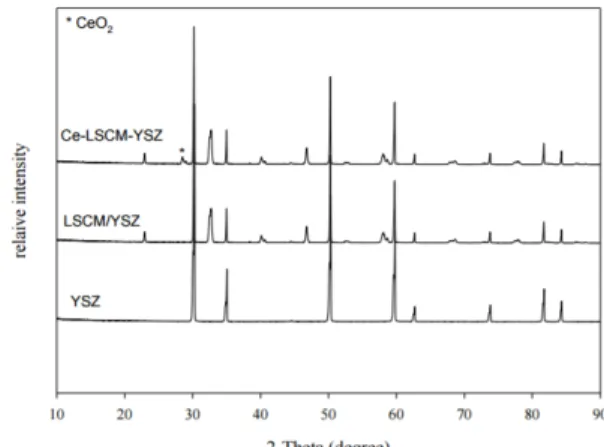
Phase identification of perovskite electrodes prepared from metal nitrates was determined by X-ray diffraction (XRD). Fig. 3 displays the XRD patterns from the surfaces of two electrode composites comprising of LSCM and Ce-LSCM addition into electrodes. For comparison, an XRD pattern of the YSZ porous layer is also included. After the sintered at 1200 °C, XRD peaks of LSCM were showed in Fig. 3. For CeO2 doping, the CeO2 peaks can be detected at
2θ as 28.6o . These data indicated that the addition of Ce promoter was not reacted with LSCM phase.
C. Microstructure of Impregnated Electrodes
Firstly, the firing conditions for the impregnation of the LSCM electrode were investigated. According to the literatures [18], [19], the thermal decomposition of nitrate solution in air begins at 300 o C. With an intention of prevent any thermal shock that may happen in this fairly strong ceramic membrane after repeated impregnation, the decomposition temperature of the impregnated nitrate was set at 350 °C with dwell time of 30 min. However after several impregnation cycles, the impregnated samples were completely disintegrated and delaminated. The SEM images in Fig. 4 show a significant change in the microstructure of
porous layers, the SEM images of the structures LSCM indicates that the LSCM forms a uniform coating over the surfaces of the YSZ (Fig. 4a). For CeO2 loading, the results
show the presence of nanocrystalline CeO2 (Fig. 4b). The
estimated particle diameters for CeO2 were 5-21 nm and
uniform coating over the surfaces of the LSCM/YSZ.
Fig. 3. The XRD pattern of (a) YSZ, (b) LSCM/YSZ and (c) Ce-LSCM/YSZ.
Fig. 4. SEM images of fracture-cross section of YSZ membrane with an impregnated porous layer. (a) porous membrane with LSCM impregnated
layer, (b) porous membrane with Ce/LSCM impregnated layer.
D. Electrochemical Performances
Fig. 5 shows voltage, current, and power density properties for tape-cast SOFC cells fabricated by impregnation of LSCM with CeO2 and without CeO2 with Ag
current collectors. The measurements of these cells at 800 o C are shown in Fig. 5. Their open circuit voltage (OCV) values were ∼1.02-1.08 V, which were very close to the theoretical value calculated from the Nernst equation. Such high OCV values indicate that a dense structure is well-formed in the YSZ electrolyte and leakage of the fuel gas is negligible for each sample. As seen in Fig. 6, the power density using a LSCM anode catalyst was 123 mW cm-2 at 800 oC. When 5 wt% of CeO2 was impregnated together with LSCM, the
power density was 298 mWcm-2. This is because the added ceria enhanced the conductivity, as well as extended effective active areas. As shown in Fig. 6, the cell had a series resistance, RS, of 0.65 Ω.cm2 and a total resistance, RT, of 1.05 Ω.cm2
at 750 °C. As the temperature increased to 850 °C, the series resistance of the cell decreased to 0.37 Ω.cm2
and the total resistances decreased to 0.65 Ω.cm2
temperature. The addition f ceria catalysts improve performance across the entire temperature range studied. The highest power density achieved in this study were for the cell containing 5wt% CeO2 with 356 mW.cm-2 at 850 oC in
humidified H2. These high powder densities are achieved
because ceria is the most active materials for effective catalysis of the different processes in fuel oxidation.
Fig. 5. Performance curves of the 8YSZ cell with 40 wt% LSCM(a) and 5%Ce/LSCM (b) in wet humidified H2 at 800 °C.
Fig. 6. Impedance spectra of the cell with 5%ceria-40wt% LSCM as anode and 40 wt% LSF as cathode in humidified H2 at different temperatures.
Fig. 7. IV and performance curves of the cell with 5%ceria-40wt% LSCM as anode and 40 wt% LSF as cathode in humidified H2 at different temperatures.
E. SOFC with 5%CeO2/LSCM Anode as Cogeneration of Chemical and Electricity
The 8YSZ cell with the 200 μm porous scaffolds were infiltrated with 40 wt% LSF and 5%CeO2-40 wt% LSCM
was used to investigate the performance of the 5%CeO2-40
wt% LSCM anode as a cogeneration device. The cell was tested in humidified CH4 following at the rate of 10ml/min at
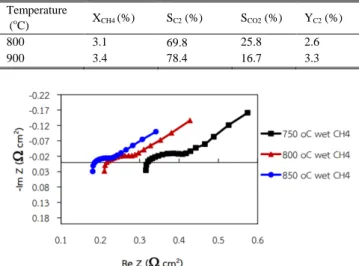
750-850 °C. Impedance spectra of the cell presented in Fig. 8 shows that the maximum power with increasing temperature. The cell had a low resistance and also the highest maximum power density of 221 mW cm2 at 850 °C, the best performance was also obtained at 850 °C in humidified CH4
(Fig. 9). As shown in Table I, the methane conversion was 3.1% after applying 0.3 V to the cell for 30 minutes. At the
highest methane conversion rate, the cell achieved a good C2 hydrocarbon selectivity of 78.4% and a C2 yield of 3.3% at 850 oC.
TABLEI:THE ARRANGEMENT OF CHANNELS
Temperature
(oC) XCH4 (%) SC2 (%) SCO2 (%) YC2 (%)
800 3.1 69.8 25.8 2.6
900 3.4 78.4 16.7 3.3
Fig. 8. Impedance spectra of the cell with 5%ceria-40wt% LSCM as anode and 40 wt% LSF as cathode in humidified CH4 at different temperatures.
Fig. 9. IV and performance curves of the cell with 5%ceria-40wt% LSCM as anode and 40 wt% LSF as cathode in humidified CH4 at different
temperatures.
IV. CONCLUSION
The catalytic activity for oxidative coupling of methane (OCM) was measured in a fixed bed reactor (FBR) and solid oxide fuel cell reactor (SOFC). Approximately 54.5% CO selectivity and 43.2% CO2 selectivity at 43.2% CH4
conversion with LSCM successfully obtained at 850 o C for Ce/LSCM catalyst. The addition of Ce promoter could promote the performance of the catalysts for the OCM reaction, and inhibited the gas phase oxidation of methane. The improvement of cell performance was carried out by decreasing the thickness of the electrolyte and using a high catalytic activity electrode. The tape casting method was employed in order to reduce the electrolyte thickness and prepare porous ceramic support for the electrode material. The electrode materials were introduced into porous YSZ support by ion impregnation technique and a composite electrode/electrolyte was achieved. The impregnated LSCM was synthesized at temperatures over 700 oC and did not react with 8YSZ at 1200 oC. Tape-cast SOFCs with impregnated LSCM exhibited excellent performance when CeO2 was used
wt% LSCM exhibited maximum power density 221 mW cm-2 at 850 o C in humidified methane. Under a load of 0.3V, 3.4% CH4 conversion and 78.4% C2 selectivity were obtained.
ACKNOWLEDGMENT
W. Appamana would like to thank the Rajamangala University of Technology Thanyaburi (RMUTT) research foundation scholarship in 2015. The author would like to thank Professor John T. S. Irvine, Professor Suttichai Assabamrungrat and Center of Excellence on Catalysis and Catalytic Reaction Engineering, Department of Chemical Engineering, Chulalongkron University.
REFERENCES
[1] T. W. Elkins, S. J. Roberts, and H. E. Hagelin-Weaver, “Effects of alkali and alkaline-earth metal dopants on magnesium oxide supported rare-earth oxide catalysts in the oxidative coupling of methane,”
Applied Catalysis A: General, vol. 538, pp. 175-190, Nov. 2016.
[2] N. Hiyoshi and K. Sato, “Oxidative coupling of methane over Mn–Na2WO4/SiO2 catalyst with continuous supply of alkali chloride vapor,” Fuel Processing Technology, vol. 51, pp. 148-154, Oct. 2016. [3] J. Wang et al., “Comparative study on oxidation of methane to ethane
and ethylene over Na2WO4–Mn/SiO2 catalysts prepared by different methods,” Journal of Molecular Catalysis A: Chemical, vol. 245, pp. 272-277, 2006.
[4] Z. Fakhroueian, F. Farzaneh, and N. Afrookhteh, “Oxidative coupling of methane catalyzed by Li, Na and Mg doped BaSrTiO3,” Fuel, vol. 87, pp. 2512-2516, 2008.
[5] T. Tagawa et al., “Design of electrode for solid oxide fuel cells reactor,” Solid State Ionics, vol. 106, pp. 227-235, 1998.
[6] L. Zhang, C. Yang, A. I. Frenkel, S. Wang, G. Xiao, K. Brinkman, and F. Chen, “Co-generation of electricity and chemicals from propane fuel in solid oxide fuel cells with anode containing nano-bimetallic catalyst,” Journal of Power Sources, vol. 262, pp. 421–428, 2014. [7] A. S. Carrillo, T. Tagawa, and S. Goto, “Application of mist pyrolysis
method to preparation of Ni/ZrO2 anode catalyst for SOFC type reactor,” Materials Research Bulletin, vol. 36, pp. 1017-1027, 2001. [8] K. Chen, N. Ai, and S. P. Jiang, “Performance and stability of
(La,Sr)MnO3– Y2O3–ZrO2 composite oxygen electrodes under solid oxide electrolysis cell operation conditions,” International Journal of
Hydrogen Energy, vol. 37, pp. 10517-10525, 2012.
[9] T. Wu, B. Yu, W. Zhang, J. Chen, and S. Zhao, “Fabrication of a high-performance nano-structured Ln1−xSrxMO3−δ (Ln = La, Sm; M =
Mn, Co, Fe) SOC electrode through infiltration,” RSC Advances, vol. 6, pp. 68379-68387, 2016.
[10] S. Barison et al., “Novel Au/La1−xSrxMnO3 and Au/La1−xSrxCrO3 composites: Catalytic activity for propane partial oxidation and reforming,” Solid State Ionics, vol. 177, pp. 3473-3484, 2007. [11] G. Corre et al., “Activation and ripening of impregnated manganese
containing perovskite SOFC electrodes under redox cycling,”
Chemistry of Materials, vol. 26, pp. 1077-1084, 2009.
[12] G. Kim et al., “Investigation of the structural and catalytic requirements for high-performance SOFC anodes formed by infiltration of LSCM,”
Electrochemical and Solid-State Letters, vol. 12, pp. B48-B52, 2009.
[13] S. Lee et al., “Solid oxide fuel cell cathodes prepared by infiltration of LaNi0.6Fe0.4O3 and La0.91Sr0.09Ni0.6Fe0.4O3 in porous yttria-stabilized zirconia,” Journal of Power Sources, vol. 193, pp. 747-753, 2009. [14] C. Yang et al., “Characterization of infiltrated (La0.75Sr0.25)0.95MnO3 as
oxygen electrode for solid oxide electrolysis cells,” International
Journal of Hydrogen Energy, vol. 35, pp. 5187-5193, 2010.
[15] H. He et al., “Low-temperature fabrication of oxide composites for solidoxide fuel cells,” Journal of the American Ceramic Society, vol. 87, pp. 331-336, 2004.
[16] S. Barison et al., “Novel Au/La1−xSrxMnO3 and Au/La1−xSrxCrO3 composites: Catalytic activity for propane partial oxidation and reforming,” Solid StateIonics, vol. 177, pp. 39-40, 2007.
[17] S. Tao and J. T. S. Irvine, “Synthesis and characterization of La0.75Sr0.25 Cr0.5Mn0.5 O3−δ, a redox-stable, efficient perovskite Anode for SOFCs,”
Catal. Sci. Technol., vol. 151, pp. A252-A259, 2004.
[18] B. L. Farrell and S. Linic, “Oxidative coupling of methane over mixed oxide catalysts designed for solid oxide membrane reactors,” Catalysis
Today, vol. 6, pp. 4370-4376, 2016.
[19] P. E. De. Miranda et al., “A method for the production of light hydrocarbons from gas with high methane content, a solid oxide fuel cell used for the production of light hydrocarbons from gas with high methane content, and a catalyst for the production of light hydrocarbons from gas with high methane content,” Google Patents, 2010.
Weerinda Appamana was born in 1984. Now, she is
a lecturerat the Department of Chemical Engineering, Rajamangala University of Technology Thanyaburi, Pathumtani, 12110 Thailand. She earned her Ph.D degree in chemical engineering from Chulalongkorn University, Thailand. Dr. Weerinda Appamana’s interests cover: waste to energy generation; intensification process; catalysis and catalytic reaction engineering.