R E V I E W A R T I C L E
Survival of short dental implants ≤7 mm: A review
Papi Piero, Condello Lorenzo, Rosella Daniele, Giardino Rita, Piccoli Luca, Pompa Giorgio
Department of Oral and Maxillofacial Sciences, “Sapienza” University of Rome, Rome, Italy
Abstract
The fi
rst long-term successful outcome of short dental implants was demonstrated by
Frieberg
et al
. in 1991, however, the defi
nition of “short” implants is still controversial
and without uniform consensus nowadays. The specifi
c aim of this review was to
evaluate and to compare cumulative survival rate (CSR) of short dental implants of the
two groups. The survival rate of short dental implants was the primary outcome variable
to be extracted and analyzed. An electronic search was conducted through the Medline
(PubMed) database of the National Library of Medicine, and EMBASE to fi
nd all
relevant articles published between January 1, 1990, and April 30, 2015. The electronic
search identifi
ed 347 publications, which were all carefully screened by title and abstract.
About 65 articles qualifi
ed for a thorough full-text analysis: 35 studies were excluded
because CSR% was not calculable. Finally, 30 studies with relevant data on CSR were
selected to be included in this review. Articles were divided into two groups: All relevant
articles published between 1991 and 2000 as Group 1 and between 2001 and 2015 as
Group 2. In Group 1 CSR was 83.53% ± 19.46%, a considerable statistically signifi
cant
di
ff
erence compared to 93.65% ± 7.94% of Group 2. This review further identifi
ed the
causes of failure: In Group 1 the majority of short implant failures occurred early, within
the fi
rst 4 months, for an insu
ffi
cient quantity of bone tissue. In Group 2, causes of early
failures considered were low bone quality while prosthetic reasons were responsible for
delayed failures.
Keywords: Short dental implants, short implants, survival rate
Correspondence
Papi Piero, Department of Oral and
Maxillofacial Sciences, “Sapienza” University of Rome, Via Caserta 6, 00161, Rome, Italy. Tel.: +00393934360087.
Email: [email protected]
Received 02 October 2015; Accepted 04 November 2015
doi: 10.15713/ins.ijcdmr.89
How to cite this article:
Papi Piero, Condello Lorenzo, Rosella Daniele, Giardino Rita, Piccoli Luca, Pompa Giorgio, “Survival of short dental implants ≤7 mm: A review,” Int J Contemp Dent Med Rev, vol.2015, Article ID: 011015, 2015. doi: 10.15713/ins.ijcdmr.89
Introduction
The fi
rst long-term successful outcome of short dental implants
was demonstrated by Frieberg
et al
. in 1991,
[1]however, the
defi
nition of “short” implants is still controversial and without
uniform consensus nowadays. In many studies, dental implants
<8 mm were defi
ned as “short” while several authors considered
also implants <10 mm.
[1-4]In this review, the authors considered
“short” dental implants with length <7 mm, because <7 mm
was the length examined by the articles that were available and
consequently selected. Articles were divided into two groups: All
relevant articles published between 1991 and 2000 as Group 1,
and between 2001 and 2015 as Group 2. The specifi
c aim of this
review was to evaluate and to compare cumulative survival rate
(CSR) of short dental implants of the two groups.
Materials and Methods
Search strategy
The systematic review was conducted by following previously
outlined recommendations and preferred reporting items for
systematic reviews and meta-analysis principles.
[5]The survival
rate of short dental implants was the primary outcome variable to
be extracted and analyzed. Implant survival was defi
ned as “the
presence of an implant with or without complications during the
follow-up period.”
[6,7]The electronic search was conducted through the Medline
(PubMed) database of the National Library of Medicine,
and EMBASE to fi
nd all relevant articles published between
January 1, 1990, and April 30, 2015.
Key words used in this meta-analysis were “dental implant,”
“short implant,” “ultra-short implant,” “survival rate,” “short
implant failure,” and “ultra-short implant failure.”
These terms were also combined with AND/OR to perform
the searches. Moreover, a manual search of the following journals
from 1990 to 2015 was conducted: Clinical Oral Implant Research,
International Journal of Oral and Maxillofacial Implants, Clinical
Implant Dentistry and Related Research, Journal of Periodontology,
Journal of Clinical Periodontology, International Journal of
Periodontics and Restorative Dentistry, Quintessence International.
To be included in this review, articles had to fulfi
ll the
following inclusion criteria:
1. Length of dental implants clearly defi
ned
2. Implant survival rate clearly indicated or calculable from data
reported in the text
3. Failure criteria clearly defi
ned
4. Dental implant treatment sites specifi
ed
5. Total number of short dental implants with diameter and
length
6. Publication in English.
All types of studies were included; they were divided for a
quality assessment according to the levels of Evidence Based
Medicine of the Oxford Centre. Two reviewers (Papi Piero,
Condello Lorenzo) independently identifi
ed the studies
obtained from the search based on an initial title.
Statistical analysis
Specifi
c statistical software (IBM SPSS V10 Statistics, IBM,
Armonk, USA) was used to analyze the data. Articles were div
ided into two groups: Group 1 from 1990 to 2000 and Group 2
from 2001 to 2015. Mean CSR% were extracted from each article
and computed for the two groups.
Results
The electronic search identifi
ed 347 publications, which were
all carefully screened by title and abstract. About 65 articles
qualifi
ed for a thorough full-text analysis: 35 studies were
excluded because CSR% was not calculable. Finally, 30 studies
with relevant data on CSR were selected to be included in
this review. The procedural fl
ow chart of the study selection
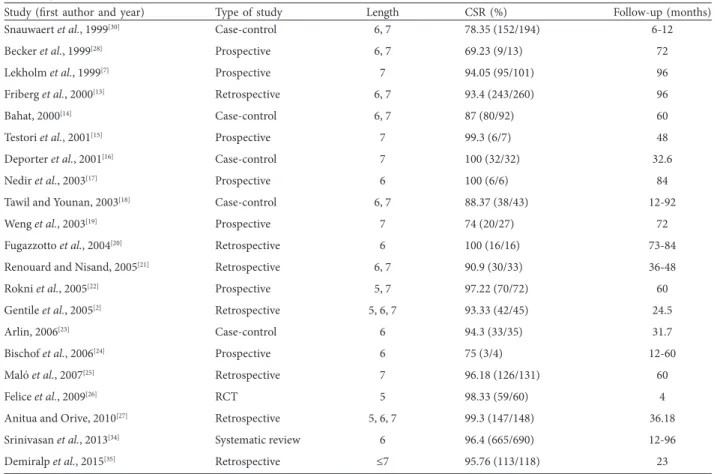
process is shown in Figure 1. Articles selection resulted in 1
randomized controlled trial, 1 systematic review, 11 cohort
prospective studies, 11 cohort retrospective studies, and
6 case-control studies [Table 1]. A descriptive overview of the
eligible studies and the data extracted from them is reported
in Table 2. A total of 3854 short dental implants were utilized
in these articles: 7 mm length dental implants were placed
in 20 studies, 6 mm length in 14 articles and 5 mm length in
just 3 papers [Table 2]. Mean follow-up period was 4.15 ±
3.85 months (range: 4-96 months) [Table 3]. Articles were
divided into two groups: Group 1 from 1990 to 2000 and
Group 2 from 2001 to 2015. Fourteen articles were included
in Group 1 while 16 articles composed Group 2. CSR was
83.53% ± 19.46% in the fi
rst group and 93.65% ± 7.94% in
Group 2 [Table 4].
Discussion
In clinical practice, short dental implants were considered
having lower survival rate compared to standard length
implants.
[1,2]However, their application was limited to atrophic
jaws and non-ideal/compromised alveolar situations, therefore
registering lower CSR values.
[8,9]The defi
nition of “short
dental implants” is still controversial nowadays: According to
the authors only dental implants with a length
≤
7 mm should
be considered, as in this review. In Group 1 CSR was 83.53%
± 19.46%, a considerable statistically signifi
cant di
ff
erence
compared to 93.65% ± 7.94% of Group 2 [Tables 3 and 4].
This review further identifi
ed the causes of failure: In Group 1
the majority of short implant failures occurred early, within the
fi
rst 4 months, for the insu
ffi
cient quantity of bone tissue.
[36]In Group 2, causes of early failures considered were low bone
quality, while prosthetic reasons were responsible for delayed
failures.
Conclusions
CSRs were lower for dental implants with a standard diameter
compared to larger diameters. According to the authors, short
dental implants can avoid bone augmentation procedures,
therefore representing an excellent clinical option for patients
with insu
ffi
cient bone quantity on a case-by-case basis.
Figure 1: Preferred reporting items for systematic reviews and meta-analysis fl ow diagram
Table 1: Levels of EBM, Oxford Centre Levels of
evidence
Characteristics Number
included
1a Systematic review 1
1b RCT 1
2a Systematic review of cohort studies
-2b Prospective cohort studies 11
2c Retrospective cohort studies 11
3a Systematic review of case-control studies
-3b Case-control studies 6
4 Clinical reports
-5 Expertise opinion
Study (fi rst author and year) Type of study Length CSR (%) Follow-up (months)
Friberg et al., 1991[1] Retrospective 7 94.45 (749/793) 36
Triplett et al., 1991[9] Retrospective 7 96 (44/46) 15-62
Jemt, 1993[29] Case-control 7 90.7 (49/54) 60
Nevins and Langer, 1993[3] Retrospective 7 92.43 (110/119) 72
Lekholm et al., 1994[4] Prospective 7 93.3 (112/120) 60
Jemt and Lekholm, 1995[10] Retrospective 7 73.82 (220/298) 60
ten Bruggenkate et al., 1998[11] Prospective 6 97 (246/253) 84
Grunder et al., 1999[12] Prospective 7 20 (1/5) 12-36
Renouard et al., 1999[8] Prospective 6 89.74 (35/39) 12
Table 3: Mean follow-up period and CSR%
(Cond...)
Table 2: Descriptive overview of the data extracted from the reviewed studiesStudy (fi rst author and year) Type of study Number of patients Number of short implants Diameter Length
Friberg et al., 1991[1] Retrospective 889 793 - 7
Triplett et al., 1991[9] Retrospective 28 46 3.75 7
Jemt, 1994[29] Case-control 67 54 - 7
Nevins and Langer, 1993[3] Retrospective 338 119 - 7
Lekholm et al., 1994[4] Prospective 159 120 3.75, 4 7
Jemt and Lekholm, 1995[10] Retrospective 150 298 4 7
ten Bruggenkate et al., 1998[11] Prospective 126 253 3.5 e 4.1 6
Grunder et al., 1999[12] Prospective 143 5 3.75 7
Renouard et al., 1999[8] Prospective 74 50 5 6
Snauwaert et al., 2000[30] Case-control 1315 194 3, 3.3, 4, 5 6 e 7
Becker et al. 1999[28] Prospective 212 13 3.75, 4, 5 6 e 7
Lekholm et al., 1999[7] Prospective 127 101 3.75 e 4 7
Friberg et al., 2000[13] Retrospective 49 260 3.75 e 5 6 e 7
Bahat, 2000[14] Case-control 202 92 3.75, 4, 5 6 e 7
Testori et al., 2001[15] Prospective 181 7 3.25, 3.75, 4, 5, 6 7
Deporter et al., 2001[16] Case-control 24 32 3.5, 4.1, 5 7
Nedir et al., 2004[17] Prospective 236 6 - 6
Tawil and Younan, 2003[18] Case-control 111 43 3.3, 3.75, 4, 5 6 e 7
Weng et al., 2003[19] Prospective 493 27 3.25, 3.75, 4, 5, 6 7
Fugazzotto et al., 2004[20] Retrospective 325 16 4.1, 4.8, 4.9 6+
Renouard and Nisand, 2005[21] Retrospective 85 33 3.75, 4, 5 6 e 7
Rokni et al., 2005[22] Prospective 74 72 - 5 e 7
Gentile et al., 2005[2] Retrospective 35 45 5 e 6 5.7 e 6
Arlin, 2006[23] Case-control 264 35 4.1 e 4.8 6
Bischof et al., 2006[24] Prospective 212 4 - 6
Maló et al., 2007[25] Retrospective 237 131 3.75 e 4 7
Felice et al., 2009[26] RCT 30 60 6 5
Anitua and Orive, 2010[27] Retrospective 661 148 2.5, 3, 3.3, 3.5, 3.75, 4, 4.5, 5, 5.5, 6 6.5 e 7
Srinivasan et al., 2014[34] Systematic review 983 690 - 6
References
1. van Steenberghe D, Lekholm U, Bolender C, Folmer T, Henry P, Herrmann I, et al. Applicability of osseointegrated oral implants in the rehabilitation of partial edentulism: A prospective multicenter study on 558 fi xtures. Int J Oral Maxillofac Implants 1990;5:272-81.
2. Friberg B, Jemt T, Lekholm U. Early failures in 4,641 consecutively placed Brånemark dental implants: A study from stage 1 surgery to the connection of completed prostheses. Int J Oral Maxillofac Implants 1991;6:142-6.
3. Triplett RG, Mason ME, Alfonso WF, McAnear JT. Endosseous cylinder implants in severely atrophic mandibles. Int J Oral
Maxillofac Implants 1991;6:264-9.
4. Nevins M, Langer B. Th e successful application of osseointegrated implants to the posterior jaw: A long-term retrospective study. Int J Oral Maxillofac Implants 1993;8:428-32.
5. Jemt T. Fixed implant-supported prostheses in the edentulous maxilla. A fi ve-year follow-up report. Clin Oral Implants Res 1994;5:142-7.
6. Lekholm U, Van Steenberghe D, Herrmann I. Osseointegrated implants in the treatment of partially edentulous jaws: A prospective 5 year multicenter study. Int J Oral Maxillofac Implants 1994;9:627-35.
7. Jemt T, Lekholm U. Implant treatment in edentulous maxillae: A 5-year follow-up report on patients with diff erent degrees of jaw resorption. Int J Oral Maxillofac Implants 1995;10:303-11. 8. ten Bruggenkate CM, Asikainen P, Foitzik C, Krekeler G,
Sutter F. Short (6-mm) nonsubmerged dental implants: Results of a Multicenter clinical trial of 1 to 7 years. Int J Oral Maxillofac Implants 1998;13:791-8.
9. Lekholm U, Gunne J, Henry P, Higuchi K, Lindén U, Bergström C, et al. Survival of the Brånemark implant in partially edentulous jaws: A 10-year prospective multicenter study. Int J Oral Maxillofac Implants 1999-Oct;14:639-45. 10. Renouard F, Arnoux JP, Sarment DP. Five mm diameter Implants
without a smooth surface collar: Report on 98 consecutive placements. Int J Oral Maxillofac Implants 1999;14:101-7. 11. Grunder U, Polizzi G. A 3 year prospective multicenter
follow-Study (fi rst author and year) Type of study Length CSR (%) Follow-up (months)
Snauwaert et al., 1999[30] Case-control 6, 7 78.35 (152/194) 6-12
Becker et al., 1999[28] Prospective 6, 7 69.23 (9/13) 72
Lekholm et al., 1999[7] Prospective 7 94.05 (95/101) 96
Friberg et al., 2000[13] Retrospective 6, 7 93.4 (243/260) 96
Bahat, 2000[14] Case-control 6, 7 87 (80/92) 60
Testori et al., 2001[15] Prospective 7 99.3 (6/7) 48
Deporter et al., 2001[16] Case-control 7 100 (32/32) 32.6
Nedir et al., 2003[17] Prospective 6 100 (6/6) 84
Tawil and Younan, 2003[18] Case-control 6, 7 88.37 (38/43) 12-92
Weng et al., 2003[19] Prospective 7 74 (20/27) 72
Fugazzotto et al., 2004[20] Retrospective 6 100 (16/16) 73-84
Renouard and Nisand, 2005[21] Retrospective 6, 7 90.9 (30/33) 36-48
Rokni et al., 2005[22] Prospective 5, 7 97.22 (70/72) 60
Gentile et al., 2005[2] Retrospective 5, 6, 7 93.33 (42/45) 24.5
Arlin, 2006[23] Case-control 6 94.3 (33/35) 31.7
Bischof et al., 2006[24] Prospective 6 75 (3/4) 12-60
Maló et al., 2007[25] Retrospective 7 96.18 (126/131) 60
Felice et al., 2009[26] RCT 5 98.33 (59/60) 4
Anitua and Orive, 2010[27] Retrospective 5, 6, 7 99.3 (147/148) 36.18
Srinivasan et al., 2013[34] Systematic review 6 96.4 (665/690) 12-96
Demiralp et al., 2015[35] Retrospective ≤7 95.76 (113/118) 23
RCT: Randomized controlled trials, CSR: Cumulative survival rate Table 3: (Continued...)
Table 4: Group 1 and Group 2 analysis
Variable 1991-2000 (14 articles) 2001-2015 (16 articles) Number of
short implants
2387 1467
Length (mm) 6, 7 5, 6, 7
Diameter (mm) 3, 3.3, 3.5, 3.75, 4, 4.1, 5 2.5, 3, 3.25, 3.3, 3.5, 3.75, 4, 4.1, 4.5, 4.8, 4.9, 5, 5.5, 6
Mean follow-up
4.25 years (range: 6-96 months)
4.15 years (range: 4-96 months)
CSR (%) 83.53±19.46 93.65±7.94
up report on the immediate and delayed immediate placement of implants. Int J Oral Maxillofac Implants 1999;14:210-6. 12. Becker W, Becker BE, Alsuwyed A, Al-Mubarak S. Long-term
evaluation of 282 implants in maxillary and mandibular molar positions: A prospective study. J Periodontol 1999;70:896-901. 13. Friberg B, Gröndahl K, Lekholm U, Brånemark PI.
Long-term follow-up of severely atrophic edentulous mandibles reconstructed with short Brånemark implants. Clin Implant Dent Relat Res 2000;2:184-9.
14. Bahat O. Brånemark system implants in the posterior maxilla: Clinical study of 660 implants followed for 5 to 12 years. Int J Oral Maxillofac Implants 2000;15:646-53.
15. Snauwaert K, Duyck J, van Steenberghe D, Quirynen M, Naert I. Time dependent failure rate and marginal bone loss of implant supported prostheses: A 15-year follow-up study. Clin Oral Investig 2000;4:13-20.
16. Testori T, Wiseman L, Woolfe S, Porter SS. A prospective multicenter clinical study of the Osseotite implant: Four-year interim report. Int J Oral Maxillofac Implants 2001;16:193-200. 17. Deporter D, Pilliar RM, Todescan R, Watson P, Pharoah M.
Managing the posterior mandible of partially edentulous patients with short, porous-surfaced dental implants: Early data from a clinical trial. Int J Oral Maxillofac Implants 2001;16:653-8. 18. Tawil G, Younan R. Clinical evaluation of short,
machined-surface implants followed for 12 to 92 months. Int J Oral Maxillofac Implants 2003;18:894-901.
19. Weng D, Jacobson Z, Tarnow D, Hürzeler MB, Faehn O, Sanavi F, et al. A prospective multicenter clinical trial of 3i machined-surface implants: Results aft er 6 years of follow-up. Int J Oral Maxillofac Implants 2003;18:417-23.
20. Nedir R, Bischof M, Briaux JM, Beyer S, Szmukler-Moncler S, Bernard JP. A 7-year life table analysis from a prospective study on ITI implants with special emphasis on the use of short implants. Results from a private practice. Clin Oral Implants Res 2004;15:150-7.
21. Fugazzotto PA, Beagle JR, Ganeles J, Jaffi n R, Vlassis J, Kumar A. Success and failure rates of 9 mm or shorter implants in the replacement of missing maxillary molars when restored with individual crowns: Preliminary results 0 to 84 months in function. A retrospective study. J Periodontol 2004;75:327-32. 22. Gentile MA, Chuang SK, Dodson TB. Survival estimates and
risk factors for failure with 6 × 5.7-mm implants. Int J Oral Maxillofac Implants 2005;20:930-7.
23. Renouard F, Nisand D. Short implants in the severely resorbed maxilla: A 2-year retrospective clinical study. Clin Implant Dent Relat Res 2005;7:S104-10.
24. Rokni S, Todescan R, Watson P, Pharoah M, Adegbembo AO, Deporter D. An assessment of crown-to-root ratios with short
sintered porous-surfaced implants supporting prostheses in partially edentulous patients. Int J Oral Maxillofac Implants 2005;20:69-76.
25. Goené R, Bianchesi C, Hüerzeler M, Del Lupo R, Testori T, Davarpanah M, et al. Performance of short implants in partial restorations: 3-year follow-up of Osseotite implants. Implant Dent 2005;14:274-80.
26. Arlin ML. Short dental implants as a treatment option: Results from an observational study in a single private practice. Int J Oral Maxillofac Implants 2006;21:769-76.
27. Bischof M, Nedir R, Abi Najm S, Szmukler-Moncler S, Samson J. A fi ve-year life-table analysis on wide neck ITI implants with prosthetic evaluation and radiographic analysis: Results from a private practice. Clin Oral Implants Res 2006;17:512-20. 28. Renouard F, Nisand D. Impact of implant length and diameter
on survival rates. Clin Oral Implants Res 2006;17:35-51. 29. Maló P, de Araújo Nobre M, Rangert B. Short implants placed
one-stage in maxillae and mandibles: A retrospective clinical study with 1 to 9 years of follow-up. Clin Implant Dent Relat Res 2007;9:15-21.
30. Liberati A, Altman DG, Tetzlaff J, Mulrow C, Gøtzsche PC, Ioannidis JP, et al. Th e PRISMA statement for reporting systematic reviews and meta-analyses of studies that evaluate healthcare interventions: Explanation and elaboration. BMJ 2009;339:b2700.
31. Felice P, Checchi V, Pistilli R, Scarano A, Pellegrino G, Esposito M. Bone augmentation versus 5-mm dental implants in posterior atrophic jaws. Four-month post-loading results from a randomised controlled clinical trial. Eur J Oral Implantol 2009;2:267-81.
32. Anitua E, Orive G. Short implants in maxillae and mandibles: A retrospective study with 1 to 8 years of follow-up. J Periodontol 2010;81:819-26.
33. Telleman G, Raghoebar GM, Vissink A, den Hartog L, Huddleston Slater JJ, Meijer HJ. A systematic review of the prognosis of short (<10 mm) dental implants placed in the partially edentulous patient. J Clin Periodontol 2011;38:667-76. 34. Srinivasan M, Vazquez L, Rieder P, Moraguez O, Bernard JP,
Belser UC. Survival rates of short (6 mm) micro-rough surface implants: A review of literature and meta-analysis. Clin Oral Implants Res 2014;25:539-45.
35. Demiralp KÖ, Akbulut N, Kursun S, Argun D, Bagis N, Orhan K. Survival rate of short, locking taper implants with a plateau design: A 5-year retrospective study. Biomed Res Int 2015;2015:197451.