Volume 1, Issue 7, September 2012
Abstract— WiMAX Technology is also one of the emerging wireless technology that provide us high speed mobile data and telecommunication services. WiMAX is the first wireless standard that allows the service provider or user to choose a codec based on the application Voice over Internet Protocol (VoIP) is an internet technology for the transmission of voice and multimedia over the Internet Protocol (IP) based network, especially the Internet. It has been widely in use as a communication protocol to replace traditional telephone technology, Public Switched Telephone Network (PSTN). As OPNET 14.5 provides simulated real-life environment, we have chosen as the platform OPNET simulation to study the performance of all of this work. The parameters used to evaluate the network throughput, jitter and packet and to and delay. Performance of VoIP codec is used to analyze traffic on the network wimax.
Index Terms—WiMAX, VoIP Codecs, OPNET.
I. INTRODUCTION
Worldwide Interoperability for Microwave Access (WiMAX) is a telecommunications protocol which provides wireless Internet access for fixed and mobile nodes. The WiMAX is based on IEEE 802.16 wireless Metropolitan Area Network standard and has been deployed extensively in recent years to solve the problems associated with point-to-multipoint broadband outdoor wireless networks [1]. The 802.16-2004 standard [2], usually referred to as 802.16d, supports only fixed broadband wireless access systems. The more recent 802.16-2005 (or 802.16e) standard supports both fixed and mobile broadband access at thenexpense of lower transmission range [3]. The two types of Wimax are used for different applications and the implementation of each has been optimized to suit particular application.
Voice over IP over Wimax, is redarded to become killer application in IEEE 802.16e which aims at providing multimedia Application services [4], [5],. As WiMAX networks are all-IP networks, voice service over WiMAX are implemented as Voice over IP (VoIP). The data rate generated by VoIP codecs differs from one codec to another,
Gysberth Maurits Wattimena, Gysberth Maurits Wattimena is a Ph.D student, Saint Petersburg National Research University of Information Technologies Mechanics and Optics, Saint Petersburg Rusia.
as there is a tradeoff between the voice quality, generated date rate and complexity of codec[6]
Goal of this study was to investigate the performance of VoIP QoS in WiMAX networks, by using some VoIP codec according to standard of International Telecommunication Union (ITU). The rest of this paper is organized as follows. Section 2 explains the QoS in IEEE 806, VoIP and focus on VoIP codecs. Section 3 provides the model design and configuration networks. Result are presented in Section 4. Finaly, section 5 concludes the paper
.
II. LITERATURSURVEY
A. Quality of Service (QoS) in WiMAX Networks
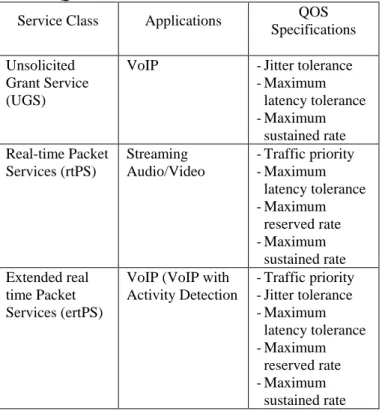
Quality of Service (QoS) is what determines if a wireless technology can successfully deliver high value services such as voice and video. To support the different types of traffic with their various requirements IEEE 802.16-2005 defines five QoS service classes: Unsolicited Grant Scheme (UGS), Extended Real Time Polling Service (ertPS), Real Time Polling Service (rtPS), Non Real Time Polling Service (nrtPS) and Best Effort Service (BE). Fixed WiMAX offers 4 categories for the prioritization of traffic and mobile WiMAX has 5 categories :
Table 1: QoS Service Classes
Service Class Applications QOS Specifications
Unsolicited Grant Service (UGS)
VoIP -Jitter tolerance -Maximum
latency tolerance -Maximum
sustained rate Real-time Packet
Services (rtPS)
Streaming Audio/Video
-Traffic priority -Maximum
latency tolerance -Maximum
reserved rate -Maximum
sustained rate Extended real
time Packet Services (ertPS)
VoIP (VoIP with Activity Detection
-Traffic priority -Jitter tolerance -Maximum
latency tolerance -Maximum
reserved rate -Maximum
sustained rate
Analysis Performance VoIP Codecs over
WiMAX Access Network
Non-real time Packet Services (nrtPS)
FTP -Traffic priority -Maximum
reserved rate -Maximum
sustained rate Best Effort (BE) Data transfer, web
browsing
-Traffic priority -Maximum
sustained rate
B. Voice Over IP
Voice is analog and is converted into the digital format before transmitting over Internet. This process is called encoding and the reverse is called decoding. Both the tasks are performed by voice codecs [7]. With bandwidth utilization becoming a great concern, voice compression techniques are used in practice [7] to reduce the bandwidth consumption. VoIP, or Voice over Internet Protocol, is a method for taking analog audio signals (like the kind you hear when you talk on the phone), and turning them into digital data that can be transmitted over the Internet
VoIP uses a combination of protocols for delivering phone data over networks. Various signaling protocols are used, SIP and H.323 can be regarded as the enabler protocols for voice over IP (VoIP) services [8]. VoIP communications require these signaling systems to setup, control, initiate a session and facilitate real-time data transfer in order to provide clear communications[9].
C. VoIP Codecs
The CODEC (COder/DECoder) is the component in an IP phone that digitises the voice and converts it back into an analog stream of speech. The CODEC is the analog-to-digital-to-analog converter. The CODEC may also perform the voice compression and decompression. There are several voice digitisation standards and some proprietary techniques in use for VoIP transmission. Most vendors support one or more of the following ITU standards and avoid proprietary solutions:
G.711 is a codec that was introduced by ITU in 1972 for use in digital telephony, i.e. in ISDN, T.1 and E.1 links. The codec has two variants: A-Law is being used in Europe and in international telephone links, u-Law is used in the U.S.A. and Japan. G.711 uses a logarithmic compression. It squeezes each 16-bit sample to 8 bits, thus it achieves a compression ratio of 1:2. The resulting bitrate is 64 kbit/s for one direction, so a call consumes 128 kbit/s (plus some overhead for packet headers). This is quite a lot when compared with other codecs. This codec can be used freely in VoIP applications as there are no licensing fees. G.729 is a codec that has low bandwidth requirements but
provides good audio quality (MOS = 4.0). The codec encodes audio in frames, each frame is 10 milliseconds long. Given the sampling frequency of 8 kHz, the 10 ms frame contains 80 audio samples. The codec algorithm encodes each frame to 10 bytes, so the resulting bitrate is 8 kbit/s for one direction
G.723 is a result of a competition that ITU announced with the aim to design a codec that would allow calls over 28.8 and 33 kbit/s modem links. There were two very good
solutions and ITU decided to use them both. Because of that, we have two variants of G.723. They both operate on audio frames of 30 milliseconds (i.e. 240 samples), but the algorithms differ. The bitrate of the first variant is 6.4 kbit/s and the second variant is 5.3 kbit/s. The encoded frames for the two variants are 24 and 20 bytes long, respectively. G.723 is a licensed codec, the last patent that covers it is expected to expire in 2014.
Table 2 shows some features of the most common codecs: G.711, G.723 and G.729
Table 2. VoIP codecs characteristics IUT-T
Codec
Algorithm Codec Delay (ms)
Bit Rate (kbps)
Packets Per Second
IP Packet
Size (bytes)
G.711 PCM 0 .375 64 100 120
G .729 ACELP 35 8 100 50
G.723 CS-ACEL P
97.5 5.3 33 60
III. SIMULATIONCONFIGURATION
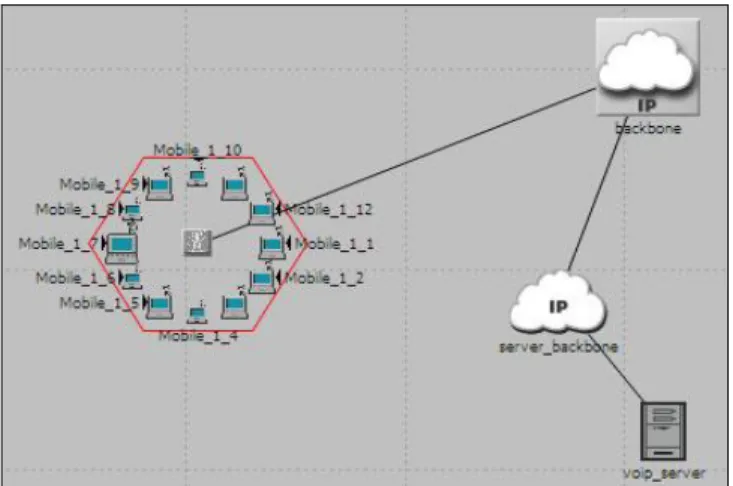
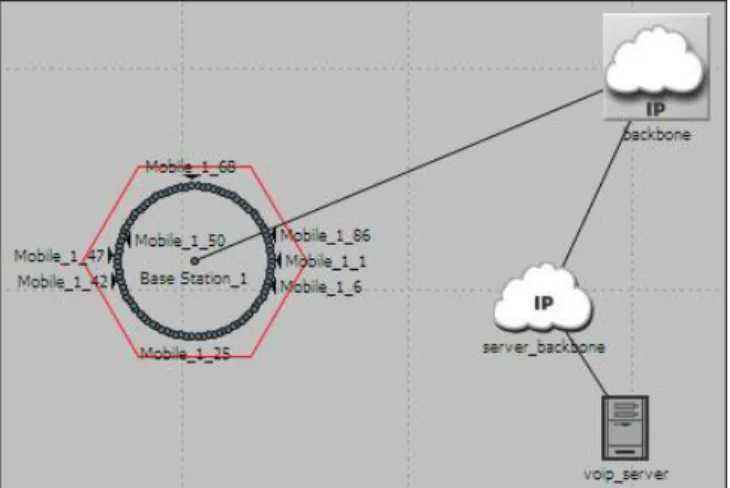
In this experiment, using OPNET version 14.5 with WiMAX Module Capability. 3 the scenario in design. To 3 those scenarios can be seen in figure 1,2,3
.
Figure 1 – Scenario 1 with 12 Subscriber Station
Volume 1, Issue 7, September 2012
Figure 3 – Scenario 3 with 90 Subscriber Station
Every scenario consists of one cell and IP backbone, and cell radius is set to 1 km. Subsriber node transmission power is set to 0,5 W. base station transmission power is set to be 5 W. The pathloss and multipath model are set to Free space. For the Scenario 1 Base station has 12 Nodes (Figure 1). Scenario 2 Base station with 50 nodes (Figure 2) and Scenario 3 Base station has 90 nodes (Figure 3).The parameter of base station and subscriber station can be seen in table 2 and table 3.
Table 3 - BS Parameters
Antenna Gain (dBi) 15 dBi Maximum Number of SS Nodes 100 Channel Quality averaging
parameter
4/16
Number of Transmitters SISO Maximum Transmission Power
(W)
0,2
Phy Profile Wireless OFDM 20
MHz
PHY profile Type OFDM
Table 4 - SS Parameters
Antenna Gain (dBi) -1 dBi Maximum Transmission Power
(W)
0,2
Phy Profile Wireless OFDM 20
MHz
PHY profile Type OFDM
Multipath Channel Model ITU Vehicular A
Pathloss Model Free Space
Terrain Type (Suburban Fixed) Terrain Type A Ranging Power Step (mW) 0,25
Contention Ranging Retries 16 Pigyback BW Request Enable
CQICH Period 3
Contention Based Reservation Timeout
16
Request Retries 16
MAC Service Class is used for all three those scenarios, namely ertPS. With a maximum latency in 10 miliseconds. For each scenario using 3 Type the G.711, G.723 (5.3 kbps) and G.729 (8 kbps)
IV. SIMULATIONRESULT Scenario 1 :
Figure 4 show comperative results of scenario 1 with 12 subscriber station in 1 base station. Fig 4a show comperative result of jitter for codecs that are used in this experiment. It can be seen that the G.723 codec scheme has large value of jitter variation of -4,70E-06. The negative value of jitter means that the time difference between the packets at destination is less than that source. Figure 4b show comperative packet End to End delay. The result G.723 codec have highest voice packet delay averaging around 115,9 ms, and the lowest voice packet is G.711 codec averaging around 74,9 ms. In figure 4c show comperative result throughput all codecs. G.711 codec has the highest throughput as a result of highest packet size with expected value 864,2 packet/sec. The G.723 codec has the lowest throughput. Result Scenario 1 as shown in table 5.
a) Jitter b) End to End Delay c) Throughput Figure 4 – 12 Subscriber Station
Table 5 – Result 12 Subscriber Station
QoS G.729 G.723 G.711
Jitter -2,09E-06 -4,70E-06 -1,46E-06 Packet End to
End Delay 0,0758 0,1159 0,0749
Throughput 863,1722 287,8667 864,2
Scenario 2 :
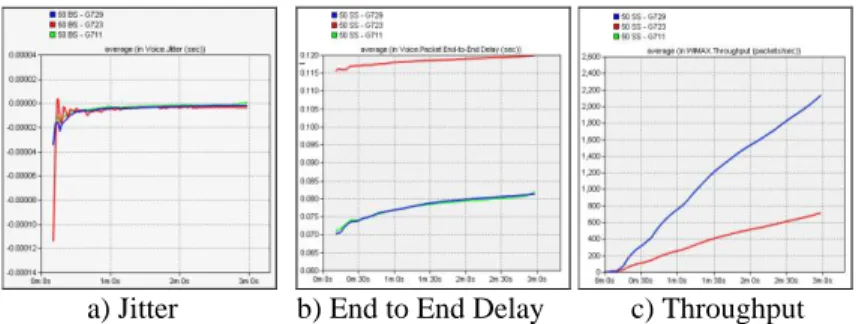
a) Jitter b) End to End Delay c) Throughput Figure 5 – 50 Subscriber Station
Table 6 – Result 50 Subscriber Station
QoS G.729 G.723 G.711
Jitter -4,99E-06 -6,14E-06 -3,79E-06 Packet End
to End Delay 0,0780 0,1183 0,0778 Throughput 2128,3278 709,8778 2127
Scenario 3 :
Figure 6 show comperative result scenario 3 in this experiment with 90 subscriber station. Result average jitter for G. 711 codec for this scenario lower than other codecs with expected value -1,04E-05 sec (fig. 5a). For End to End Delay in this scenario G.729 Codec lowest with expected value 0,082271 sec then another codec (fig 5b). And comperative result throughput G.729 codec highest with expected value 4549,1833. package/sec (fig 5c)
a) Jitter b) End to End Delay c) Throughput Figure 6 – 90 Subscriber Station
Table 7 – Result 90 Subscriber Station
QoS G.729 G.723 G.711
Jitter -1,66E-05 -6,39E-06 1,36E-04 Packet End
to End Delay 0,0823 0,1205 0,3527 Throughput 4549,1833 1677,1722 4068,5167
V. CONCLUSION
WiMAX allows for more efficient bandwidth use, interference avoidance, and is intended to allow higher data rates over longer distances. Voice over Internet Protocol (VoIP) technology facilitates packet based IP networks to carry digitized voice, it uses internet protocol for transmission of voice as packets over IP networks
In this paper Simulations were conducted to evaluate performance of voip over wimax networks. For this puppose OPNET 14.5 have been used as the simulation platform. The parameters in this simulation are views jitter,packet end to end delay and throughput. Three voice codecs G.711, G.723 and G.729 is the parameters of this experiment. Comparative results between the three scenarios in this experiment give a performace voip over wimax network. Simulation Result shows that the performance of the G.711 codec is better than other codecs if seen from throughput value of which is derived. The greater the number of subscriber station, the greater the value of throughput for the G.711 codec.
REFERENCES
[1] IEEE Std 802.16-2004, IEEE Standard for Local and Metropolitan Area Networks, Part 16: Air interface for Fixed Broadband Access Systems, October, 2004. [2] IEEE Standard “802.16-2004. Part 16: Air interface for
fixed broadband wireless access systems”, June 2004. [3] IEEE Standard “802.16-2005. Part 16: Air interface for
fixed and mobile broadband wireless access systems”, December 2005.
[4] IEEE Standard for Local and Metropolitan Area Networks - Part 16: Air Interface for Fixed and Mobile Broadband Wireless Access Systems Amendment 2,” Feb. 28.
[5] Jeffrey G.Andrews, Arunabha Ghosh, Rias Muhammed “Fundamentals of WiMAX Understanding Broadband Wireless Networks” Prentice Hall Inc, 2007.
[6] Ashraf A.Ali, Spyridon Vassilaras, Konstantinos Ntagkounakis, A Comparative Study of Bandwidth Requirements of VoIP Codecs Over WiMAX Access Networks, Third International Conference on Next Generation Mobile Applications, Services and Technologies, 2009
[7] Anindita Kundu, Iti Saha Misra, Salil K. Sanyal, Suman Bhunia, VOIP PERFORMANCE OVER BROADBAND WIRELESS NETWORKS UNDER STATIC AND MOBILE ENVIRONMENTS, International Journal of Wireless & Mobile Networks (IJWMN), 2010
[8] S. Karapantazis and F.-N. Pavlidou, “VoIP: A comprehensive survey on a promising technology”, Computer Networks, 2009.
[9] Tarik ANOUARI, Abdelkrim HAQIQ, Performance Analysis of VoIP Traffic in WiMAX using various Service Classes, International Journal of Computer Applications, 2012
[10] Iwan Adhicandra, Improving VoIP Traffic Performance in WiMAX Networks, Second International Conference Evolving Internet, 2010
[11] Pranita D. Joshi, Prof. Smita Jangale , Analysis of VoIP traffic in WiMAX using NS2 simulator, International Journal of Advanced Research in Computer Science and Electronics Engineering, 2012
Volume 1, Issue 7, September 2012
Conference on Recent Advances and Future Trends in Information Technology, 2012
[13] Hin Heng Chan , Voice over Internet Protocol (VoIP) over Worldwide Interoperability for Microwave Access (WiMAX), 2011
[14] Rakes Kumar Jha, Idris Z Bholebawa, Upena D Dalal, Location Based Performance of WiMAX Network for QoS with Optimal Base Station (BS), Wireless Engineering and Technology, 2011
[15] Wimax Tutorial-Quality of Service, http://www.wimax.com/wimax-tutorial/quality-of-serv ice
[16] Vladimír Toncar, VoIP Basics: Overview of Audio Codecs,http://toncar.cz/Tutorials/VoIP/VoIP_Basics_ Overview_of_Audio_Codecs.html
[17] Gary Audin, VoIP bandwidth fundamentals, http://www.computerweekly.com/feature/VoIP-bandwi dth-fundamentals
[18] OPNET Technologies, http://www.opnet.com [19] Wimax Technology, http://freewimaxinfo.com/ [20] Motorola Viewpoint and Solution, WiMAX VoIP: How
Motorola Can Help You Offer a Successful Service, http://www.motorola.com.