International Research Journal of Pharmaceutical and Biosciences (IRJPBS) 2015; 2 (2) : 01- 09 1
ORIGINAL ARTICLE
International Research Journal of Pharmaceutical and Biosciences
Pri -ISSN: 2394 - 5826
http://www.irjpbs.com e-ISSN: 2394 - 5834
ANTIOXIDANT
AND
PHYTOCHEMICAL
PROPERTIES
OF
COMBINATION OF LEAVES OF
AEGLE MARMELOS AND MENTHA
PIPERITA
Nadhiya. H and K. M.K.Vadivazhagi *
Department of Biochemistry, Sri Akilandeswari Womens college, Wandiwash – 604408, TN, India
Article info Abstract
Article history:
Received 20 February 2015 Accepted 15 March 2015
*Corresponding author:
Copyright 2015 irjpbs.
Therapeutic applications of various Indian medicinal plants of Tamilnadu regions are well documented from its traditional origin in different aspects.In this present investigation we
shows the Extraction of Mentha piperita and Aegle Marmelos
leaves using ethanol by soxhlet apparatus, Identification of
phytoconstituents from Mentha piperita and Aegle Marmelos
extract by Gas Chromatography and Mass spectroscopy and interpretation of the reslts with Dr.Dukes Phytochemical and
Etanobotanical data bases. Evaluation of antioxidant activity
and Comparision of various antioxidant parameters between
standard and Mentha piperita and Aegle Marmelos ethanolic
extract. This study suggested that the combination of Mentha
piperita. L and Aegle marmelos leaves extract possess strong free radical scavenging action due to the presence of various phytocompounds.
International Research Journal of Pharmaceutical and Biosciences (IRJPBS) 2015; 2 (2) : 01- 09 2
INTRODUCTION
Aqueous extract of Aegle marmelos leaves, was evaluated for hypoglycemic and antioxidant effect [1], by using alloxon induced diabetes in male albino rats and proposed AM L may be useful in the long-term management of diabetes. Similarly, The anti hyperlipidaemi c activity of aqueous extract of Aegle marmelos fruits was demonstrated using the streptozotocin- induced diabetic wistar rats. Aegle Marmelos leaf extract on alcohol induced liver injury in albino rats and presented data of excellent hepatoprotective
effects [2]. The ethanolic extract of dried fruit pulp of Aegle Marmelos against various
intestinal pathogens i.e. Shigella boydii, S. sonnei & S. Flexneri and proposed that certain phytochemicals including Phenols, Tannins and Flavonoids were effective against all. Anti-inflammatory, antipyretic & analgesic propertie s of serial extract of leaves of Aegle Marmelos, and presented that most of the extract caused a significant inhibition of the carrageenan-induced paw oedema and cotton-pellet granuloma in rats [3]. The antifungal activity of ethanolic extract of the Aegle marmelos leaves including antidiarrhoeal, and antimicrobial, activities. The anticancer potential of folk medicine used in Banglad eshi and used extracts of Aegle marmelos for cytotoxic action using brine shrimp lethality assay; sea urchin eggs assay, and MTT assay using tumor cell lines.
Common names for thePeppermint are lamb mint, brandy mint, balm mint, curled mint,
amenta, lammint. The Potentially Active Chemical Constituents present in the peppermint are menthol, menthone, menthyl acetate, neomenthol, isomenthone, menthofuran, limonene, pulegone, alpha and beta pinene, and trans-sabinene hydrate Monoterpenes , Caffeic acids. Flavonoids and tannins. Peppermint leaf and oil are used for folk medicine, as flavouring agents, and in cosmetic and pharmaceutical products throughout the world [4]. Herbalists consider peppermint an astringent, antiseptic, antipruritic, antispasmodic, antiemetic, carminative, diaphoretic, mild bitter, analgesic, anticatarrhal, antimicrobial,
rubefacient, stimulant, and emmenagogue [5]. Peppermint is currently used to treat
irritable bowel syndrome, Crohn‟s disease, ulcerative colitis, gallbladder and biliary tract disorders, and liver complaints. Peppermint oil is used to relieve menstrual cramps [6].
In this present study Gas Cromatography and Mas spectroscopy is used to identify
phytochemicals present in the Aegle marmelos with Mentha piperita leaves extract.
Phytocheical identified from A. marmelos and M. piperita combined extract is used to
investigate the various antioxidant activities.
MATERIALS AND METHODS Plant material
Leaves of Mentha piperita and Aegle marmelos was collected locally in and around
International Research Journal of Pharmaceutical and Biosciences (IRJPBS) 2015; 2 (2) : 01- 09 3 Extract preparation
Materials were cleaned with water and dried in the shade until a constant weight was obtained. It was extracted with 95% ethanol in a Soxhlet extractor. Extracts were concentrated; the percentage yield for ethanol extract was 7.9% and for antioxidant studies, since the ethanol extract was not soluble in water, it is suspended in 5% gum acacia.
GC–MS Analysis of ethanol extract of Mentha piperita and Aegle marmelos linn for the identification of chemical composition
The identification of chemical composition of ethanol extract of Mentha piperita and Aegle marmelos was performed using a GC–MS spectrograph (Agilent 6890/Hewlett–Packard
5975) fitted with electron impact (EI) mode. The ethanol extract (2.0 mL) of Mentha
piperita was injected with a Hamilton syringe to the GC–MS manually for total ion chromatographic analysis in split mode. In quantitative analysis, selected ion monitoring (SIM) mode was employed during the GC MS analysis. SIM plot of the ion current resulting from very small mass range with only compounds of the selected mass were detected and plotted.(Naknean et al,2010).
NON ENZYMATIC ANTIOXIDANT ASSAY Free radical scavenging assay (DPPH)
The scavenging activity of DPPH free radicals by different plant extracts was determined according to the method reported by Gyamfi [7]. Ascorbic acid was estimated by the method of Roe and Kuether.
Nitric Oxide Radical Inhibition Assay
Nitric oxide radical inhibition can be estimated by the use of Griess Illosvoy reaction [8]. In this investigation Griess Illosvoy reagent was modified by using naphthyl ethylene diamine dihydrochloride (0.1% w/v) instead of 1- napthylamine (5%).
Estimation of lipid hydroperoxide
Tissue lipid hydroperoxide was estimated by the method of Jiang. In this method, oxidation of ferrous ions (Fe2+) under acidic conditions in the presence of xylenol orange leads to the formation of a chromophore with an absorbance maximum at 560nm.
Superoxide anion scavenging activity
Measurement of superoxide anion scavenging activity of mentaha was done based on the
Nishimiki method [9].
Reducing power
International Research Journal of Pharmaceutical and Biosciences (IRJPBS) 2015; 2 (2) : 01- 09 4 Determination of total phenolic compounds
Total soluble phenolic in the aqueous extract of Mentha were determined with
Folin-Ciocalteu reagent according to the standard method [11] using pyrocatechol as a standard.
Hydroxyl radical scavenging assay
The assay was performed as described by Halliwell method [12] with minor changes.
Statistical analysis
All the invitro experimental results were mean ± S.D of five parallel measurements.
RESULTS AND DISCUSSION
Phytochemical Analysis by Gaschromatography and Mass Spectrospcoy (Gc- Ms)
The ethanol extract of Mentha piperita and Aegle marmelos Linn leaves was a complex
mixture of many constituents and 12 compounds were identified in this plant by GC–MS. Phytoconstituents such as Decanal, 1-Octanol, 2-butyl-,Eugenol, Benzene, 1-(1,5-dimethyl-4-hexenyl)-4-methyl- (Synonyms: à-Curcumene, 1,3-Cyclohexadiene, 5-(1,5-dimethyl-4-hexenyl)-2-methyl-, [S-(R*,S*)]- (Synonyms: Zingiberene, Cyclohexene, 1-methyl-4-(5-methyl-1- methylene-4-hexenyl)-, (S)- (Synonyms: á-Bisabolene, Cyclohexene, 3-(1,5- dimethyl-4-hexenyl)-6-methylene-, [S-(R*,S*)]- (Synonyms: á- Sesquiphellandrene), 1,6,10-
Dodecatrien-3-ol, 3,7,11-trimethyl- (Synonyms: Nerolidol), Tetradecanoic acid,
Spiro[4.5]dec-6-en-8-one, 1,7-dimethyl-4-(1- methylethyl)-, n- Hexadecanoic acid and ,Were identified in the ethanol extract of Mentha piperita and Aegle marmelos Linn leaves by relating to the orresponding peak area through coupled GC–MS.
Figure 1. The chromatogram showing different compounds as peaks detected by Gas
chromatography–Mass spectrophotometry in ethanolic extract of Mentha Piperita (MP)
International Research Journal of Pharmaceutical and Biosciences (IRJPBS) 2015; 2 (2) : 01- 09 5 Free radical scavengigng activity
Free radicals have aroused significant interest among scientists in the past decade. Their broad range of effects in biological systems has drawn the attention of many experimental experimental works. It has been proved that these mechanisms may be important in the pathogenesis of certain diseases and ageing. There are many reports that support the use of antioxidant supplementation in reducing the level of oxidative stress and in slowing or preventing the development of complications associated with diseases [13]. Many synthetic antioxidant components have shown toxic and/or mutagenic effects, which have shifted the attention towards the naturally occurring antioxidants. Numerous plant constituents have proven to show free radical scavenging or antioxidants activity [14]. Flavonoids and other phenolic compounds (hydroxyl cinnamic derivatives, catechines etc) of plant origin have been reported as scavengers and inhibitors of lipid peroxidation [15].
DPPH radical scavenging activity
The hydro alcoholic extract of Mentha piperita and Aegle marmelos exhibited a significant dose dependent inhibition of DPPH activity, with a 50% inhibition (IC50) at a concentration of 1.5 μg/ml. The result was mentioned in figure 2. The IC50 value of the extract was found to be lesser than the standard, vitamin C (IC50 3.0 μg/ml).
Figure 2. Scavenging effect of Mentha Piperita & Aegle marmelos Extract and standard vitamin Con 1, 1 '-Dipheny l-2 -picrylhydrazyl (D P P H ) radical. Results are mean ± S.D of five parallel measurements.
Nitric oxide radical inhibition assay
International Research Journal of Pharmaceutical and Biosciences (IRJPBS) 2015; 2 (2) : 01- 09 6 Figure 3. Scavenging effect of Mentha Piperita & Aegle marmelos Extract and standard rut in on Nitric oxide radical. Results are mean ± S.D of five parallel measurements.
Superoxide anion scavenging activity
The superoxide anion derived from dissolved oxygen by Phenazine methosulphate/NADH coupling reaction reduces nitro blue tetrazolium. The decrease the absorbance at 560 nm with the plant extract thus indicates the consumption of superoxide anion in the reaction mixture. As mentioned in figure 4, the plant extract as well as curcumin showed the scavenging activity; IC50 values, 4.7 μg/ ml and 5.84 μg/ml, respectively.
International Research Journal of Pharmaceutical and Biosciences (IRJPBS) 2015; 2 (2) : 01- 09 7 Lipid peroxidation assay
Activity of plant extract against non-enzymatic lipid peroxidation in rat liver microsomes has been shown in figure 5. Addition of Fe 2+/ascorbate to the liver microsomes cause increase in lipid peroxidation. The extract showed inhibition of peroxidation effect in all concentrations which showed 50% inhibition effect at 104.0 μg/ml. The extract inhibition value was found to be lesser than the standard, vitamin E (IC50 120.5 μg/ml).
Figure 5 : Scavenging effect of Mentha Piperita & Aegle marmelos Extract and vitamin E on lipid peroxidation of liver microsome induced by Fe2+/ascorbate.
Hydroxyl radical scavenging assay
To attack the substrate deoxyribose hydroxyl radicals were generated by reaction of Ferric-EDTA together with H2O2 and ascorbic acid. When the plant extract were incubated with the above reaction mixture, it could prevent the damage against sugar. The results are shown in figure 6, the concentrations of 50% inhibition were found to be 27.0 μg/ml and 32.5 μg/ml for the extract and standard of vitamin E, respectively. The extract inhibition value was found to be lesser than the standard.
Figure 6. Hydroxyl radical scavenging assay, effect of Mentha Piperita & Aegle marmelos
International Research Journal of Pharmaceutical and Biosciences (IRJPBS) 2015; 2 (2) : 01- 09 8 Reducing power
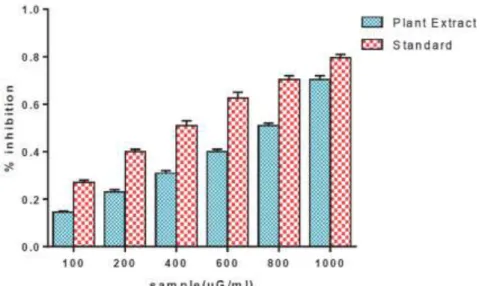
Figure 7 shows the reductive capabilities of the plant extract compared to butylated
hydroxy toluene. The reducing power of extract of Mentha piperita and Aegle marmelos
was very potent and the power of the extract was increased with quantity of sample. The plant extract could reduce the most Fe3+ ions, which had a lesser reductive activity than the standard of butylated hydroxy toluene.
Determination of total phenolic compounds
The total phenolic contents of hydro alcoholic extract of Mentha piperita and Aegle
marmelos was 0.0589 μg pyrocatechol equivalent / mg.
Fig.7: The reductive ability of Mentha Piperita & Aegle marmelos Extract butylated hydroxy toluene. Results are mean ± S .D o f five parallel measurements.
CONCLUSION
This study suggested that the combination of Mentha piperita. L and Aeglemarmelos leaves extract possess strong antioxidant activity due to the presence of phytocompounds like n-Hexadecanoic acid, tetradecampoic acid , Benzene, 1-(1,5- dimethyl-4-hexenyl)-4-methyl- à-Curcumene which might be helpful in preventing or slowing the progress of various oxidative stress- related diseases. Further investigation on the isolation and identification of antioxidant component(s) in the plant may lead to chemical entities with potential for clinical use.
REFERENCES
1. Upadhya, S., Shanbhag, K K, Suneetha, G, Naidu, B M, and Upadhya, S. (2004) “A
International Research Journal of Pharmaceutical and Biosciences (IRJPBS) 2015; 2 (2) : 01- 09 9
2. Singanan, V., Singanan, M and Begum H (2007); “The hepatoprotective effect of
bael leaves (Aegle marmelos) in alcohol induced liver injury in albino rats”; International Journal of Science & Technology; 2(2), Page No. 83-92.
3. Biswas K, Chatopadhyay I, Banerjee R.K., and Bandhopadhyay U. (2002), “Biological
Activities and Medicinal Properties of neem( Azadirachta indica ), Curr Sci, 82 Page No.1336.
4. Foster S. Peppermint: Mentha piperita. American Botanical Council - Botantical
Series 1996; 306:3 - 8.
5. Hoffman D. The complete illustrated holistic herbal. Rockport, MA: Element Books
Inc., 1996.
6. Bove M. An encyclopedia of natural healing for children & infants. New Canaan, CT:
Keats Publishing, Inc.,1996.
7. Gyamfi MA, Yonamine M, Aniya Y. Free radical scavenging action of medicinal herbs
from Ghana Thonningia sanguinea on experimentally induced liver injuries. Gen Pharmacol 32: 661- 667, 1999.
8. Garrat DC: The Quantitative analysis of Drugs. Chapman and Hall ltd, Japan 1964,
3:456-458.
9. Nishimiki M, Appaji N, Yagi K: The occurrence of superoxide anion in the reaction of
reduced phenazine mehosulphate and molecular oxygen. Biochem Biophys Res Commun 1972,46:849-854.
10.Oyaizu M: Studies on product of browning reaction prepared from glucose amine.
Jap J Nutr 1986, 44:307-315.
11.Slinkard K, Singleton VL: Total Phenol analyses: automation and comparison with
manual methods. Am J Enol Viticult 1977, 28:49-55.
12.Halliwell B, Gutteridge JM, Aruoma OI: The deoxyribose method:a simple 'test tube'
assay for determination of rate constants for reaction of hydroxyl radicals. Anal Biochem 1987,165:215-219.
13.Rose WM, Creighton MO, Stewart DHPJ, Sanwal M, Trevithick GR:In vivo effects of
vitamin E on cataractogenesis in diabetic rats. Can J Ophtalmol 1982, 17:61-66.
14.Aruoma OI, Cuppett SL: Antioxidant methodology In vivo and In vitro concepts.
AOCS press, Champaign, Illinois; 1997:41-172.
15.Formica JV, Regelson W: Review of the biology of quercetin and related