Original Research Article
Pattern of alcohol use and drinking antecedents in alcohol dependent
patients with and without co-morbid depression: a comparative study
Anu Mary Mani
1*, K. Srinivasan
2, Priya Sreedaran
2INTRODUCTION
Co-morbidities are always a significant concern for a clinician when it comes to alcohol dependence syndrome. It adds further more when the co-morbidity is depression as it is well known that both disorders are highly prevalent when taken independent and co-morbid. The presence of either disorder doubled the risks of the second disorder.1 Severity in one disorder is associated
with severity in the other.2-5 Moreover, alcohol
dependence prolongs the course of depression and
persistence of depressive symptoms in the abstinence period is a risk factor for relapse of alcohol use.6-10 Thus
it adds to considerable morbidity, disability and treatment difficulties, if left undiagnosed and untreated. Alcohol dependence syndrome (ADS) and depression are highly prevalent co-morbid conditions.
The term drinking patterns refers to various styles of drinking based on indices of quantity and frequency or on assessments of the volume of alcohol consumed by a person in a given period of time. There is growing
1Department ofPsychiatry, Amala Institute of Medical Sciences, Amala Nagar, Thrissur, Kerala, India 2Department of Psychiatry, St. Johns Medical College, Bengaluru, Karnataka, India
Received: 09 July 2020
Accepted: 15 July 2020
*Correspondence:
Dr. Anu Mary Mani,
E-mail: [email protected]
Copyright: © the author(s), publisher and licensee Medip Academy. This is an open-access article distributed under the terms of the Creative Commons Attribution Non-Commercial License, which permits unrestricted non-commercial use, distribution, and reproduction in any medium, provided the original work is properly cited.
ABSTRACT
Background: Few studies have compared the pattern of alcohol use in Alcohol dependence syndrome (ADS) patients with and without co-morbid depression. Assessing the pattern may throw light into prevention of relapses more effectively in alcohol dependent patients with co-morbid depression. This study was undertaken to assess the difference in pattern of drinking of alcohol in patients with alcohol dependence with and without co-morbid depression.
Methods: A descriptive comparative study was designed to compare the difference in pattern of alcohol use in alcohol dependent patients with co-morbid depression and without co-morbid depression. Severity of dependence on alcohol was assessed using Alcohol Use Disorders Identification Test (AUDIT). Drinking pattern was assessed using Timeline Follow back Calender and Drinking Pattern Questionnaire. The data were statistically analysed.
Results: Total 96 alcohol dependent patients (24 had co-morbid depression and 72 without co-morbid depression) were included in the study. There were no significant differences in alcohol use in both the groups in terms of AUDIT scores, amount of drinking, abstinence days or binge drinking. More frequent drinking was observed in circumstances related to emotional, physiological, financial and children related situations in patients with co-morbid depression (p<0.05).
Conclusions: Drinking circumstances like emotional, physiological, financial and children related situations require more attention while assessing, treating and aiming at relapse of prevention in ADS patients with co-morbid depression.
Keywords: Alcohol dependence syndrome, Co-morbidity, Depression, Relapse
evidence that apart from the total quantum, the pattern of
consumption (frequency of use, drinking to intoxication, binge drinking, chronic use) plays an important role in many of the public health problems (Injuries, violence, etc) consequent to alcohol use.11 Globally, key patterns of
alcohol consumption include chronic use, daily or near daily use, bouts of heavy drinking over very short periods of time (binge drinking), solitary drinking, drinking in public places, etc. Circumstances or antecedents of drinking are also important when considering patterns of drinking as it helps to identify high risk situations in which people use alcohol. Understanding and identifying situational antecedents to alcohol consumption are critical to plan effective interventions.12 It helps to identify one's
motivations for drinking as well as help to focus situations that may trigger high-risk drinking behaviours and/or negative consequences.13 Very few studies have
looked into pattern of drinking in alcohol dependent patients with co-morbid depression. Studies have shown that young age, single marital status, and low family income may be potential risk factors for co-morbid major depression and alcohol dependence.14 A positive
association of depression was found with a higher number of withdrawal symptoms, using alcohol as eye-openers, having alcohol-related police arrest and unintended higher-frequency drinking.15 While studies
have suggested that certain pattern of drinking are more common among patients with ADS and co-morbid depression, few studies have compared the difference in pattern of alcohol use in ADS with and without co-morbid depression. This may be critical in prevention of relapses in patients who have co-occurrence of alcohol dependence and depression. Therefore, this study was aimed to assess the difference in pattern of drinking of alcohol in patients with alcohol dependence with and without co-morbid depression.
METHODS
Study design and sampling
A descriptive comparative study was done among consecutive alcohol dependent patients admitted in the Psychiatry ward of St. Johns Medical College, Bangalore during one year study period of September 2013 to September 2014. Male patients (age 18-65 years), fulfilling the diagnostic criteria of ADS alone or ADS with current or lifetime diagnosis of depression according to MINI PLUS were included in the study. Patients with severe medical illness, mental retardation and c/o-morbid psychiatric illness like dementia, bipolar affective disorder, obsessive compulsive disorder, psychosis or substance use disorders other than alcohol and nicotine were excluded from the study. Ethical clearance was obtained from the institutional ethics review board before starting the study.
Study procedure
Diagnosis of alcohol dependence and major depressive episode was made according to MINI PLUS, The
Mini-International Neuropsychiatric Interview (M.I.N.I.) a structured diagnostic interview was used to assess Axis I psychiatric illness. HMSE, Hindi mental state examination, an Indian version of the MMSE developed by Indo-US cross National dementia epidemiology study was used to screen subjects for cognitive impairment. Severity of dependence on alcohol was assessed using Alcohol Use Disorders Identification Test and severity of depressive symptoms was rated on Hamilton Rating Scale for Depression (HDRS).
Patient’s having an HMSE score of >19 and CIWA score of <15 were included in the study. If patient had HMSE<19 or CIWA score of >15 or if he coded >1 for orientation and sensorium item, he was reassessed after 72-96 hours for the same. Later patients were interviewed with MINI PLUS. After applying diagnostic criteria, patients were grouped into Group A-Alcohol dependence only, Group B-Alcohol dependence with life time diagnosis of major depression and Group C-Alcohol dependence with current depression. They were provided with a timeline follow back calendar to assess the amount of alcohol use in the previous 1 month (30 days). All patients were administered with drinking pattern questionnaire (DPQ). Group B and C patients were, in addition, administered the Hamilton rating scale for depression (HAM D). Group C patients were reassessed on day 14 with HAM D and those who continued to have depression (i.e., HAM D score on day 14 of at least half of day 3 score) were grouped under group B. While those who no longer reported depression (i.e., HAM D score of less than half of day 3 score) were recategorized under group A. The groups were renamed as group 1 having ADS with depression (Group B and Group C who continued to have depression on Day 14) and group 2 with ADS only. (Group A and Group C who did not have depression on Day 14). Drinking pattern was assessed using Timeline Follow back Calender (TLFB) and Drinking Pattern Questionnaire (DPQ).
Statistical analysis
Data were analyzed using Statistical Package for Social Sciences (SPSS, v20). Data distributions were examined for normality. The non normal data were reported using median and inter-quartile range. To test the difference between each group Mann-Whitney U Test were used. Statistical significance was assumed for p ≤0.05.
RESULTS
with co-morbid depression had median drink of 6.255
standard drink/day compared to 5.731 standard drink /day in ADS only group. Both the groups had median value of only 2 days of abstinence in a month. Total week end
drinking in a month which came up to a median value of 66.81 standard drink /month in ADS with co-morbid depression group and 54.88 standard drink /month in ADS only group.
Table 1: Comparison of drinking pattern of the study groups.
Group
1=ADS+DEP, 2=ADS
Median
(inter quartile range)
p-value (mann-whitney u test)
Average drinks /day (standard drinks)
ADS+DEP 6.255 (4.54-9.24)
0.472
ADS 5.731 (3.48-8.99)
Abstinence days/ month ADS+DEP 2 (0-8.50) 0.889
ADS 2 (0-8.00)
Week end drinking (standard drinks)
ADS+DEP 66.81 (45.51-93.06)
0.259
ADS 54.88 (29.99-81.82)
Binge drinking ADS+DEP 4 (2.00-4.00) 0.436
ADS 3 (1.00-4.00)
Audit total Scores ADS+DEP 32 (27.25- 34.75) 0.124
ADS 30 (25.00 -33.00)
ADS: Alcohol dependence syndrome, DEP: Depression
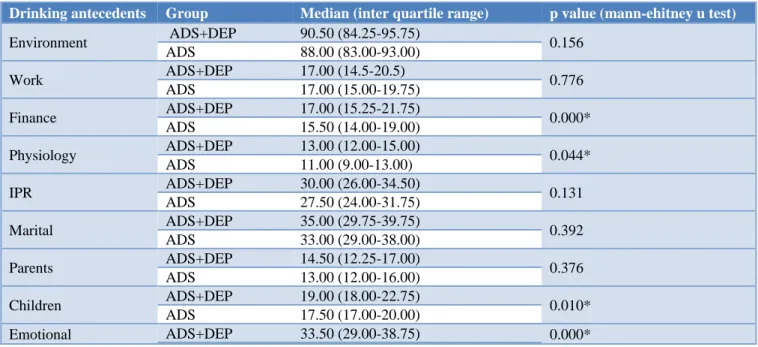
Table 2: Comparison of drinking antecedents of the study groups.
Drinking antecedents Group Median (inter quartile range) p value (mann-ehitney u test)
Environment ADS+DEP 90.50 (84.25-95.75) 0.156
ADS 88.00 (83.00-93.00)
Work ADS+DEP 17.00 (14.5-20.5) 0.776
ADS 17.00 (15.00-19.75)
Finance ADS+DEP 17.00 (15.25-21.75) 0.000*
ADS 15.50 (14.00-19.00)
Physiology ADS+DEP 13.00 (12.00-15.00) 0.044*
ADS 11.00 (9.00-13.00)
IPR ADS+DEP 30.00 (26.00-34.50) 0.131
ADS 27.50 (24.00-31.75)
Marital ADS+DEP 35.00 (29.75-39.75) 0.392
ADS 33.00 (29.00-38.00)
Parents ADS+DEP 14.50 (12.25-17.00) 0.376
ADS 13.00 (12.00-16.00)
Children ADS+DEP 19.00 (18.00-22.75) 0.010*
ADS 17.50 (17.00-20.00)
Emotional ADS+DEP 33.50 (29.00-38.75) 0.000*
ADS: Alcohol dependence syndrome, DEP: Depression
When comparing the circumstances and antecedents of drinking a significant difference was observed between the two groups for finance, physiology, children and emotion related factors. Group 1 (ADS+DEP) had a higher median scores of 17 for finance, 13 for physiology, 19 for children and 33.5 for emotion related factors as against a low median score in Group 2 (ADS) of 15.5 for finance, 11 for physiology, 17.5 for children and 26 for emotion related factors. This implies that ADS patients with co-morbid depression tend to drink more often in emotional, physiological, financial and children related circumstances (Table 2).
DISCUSSION
difference in terms of frequency of drinking as more
percentage of subjects in depressed group drank >4 days per week than the non-depressed group. They have not looked into the abstinence days in a month but as frequency of usage is more there is a high chance that depressed patient’s had less days of abstinence in a month.16 The ADS group with co-morbid depression had
median drink of 6.255 standard drink/day compared to 5.731 standard drink /day in ADS only group. Both the groups had median value of only 2 days of abstinence in a month. Total week end drinking in a month which came up to a median value of 66.81 standard drink /month in ADS with co-morbid depression group and 54.88 standard drink /month in ADS only group. The study site being a tertiary care hospital there is a high likelihood that more severe cases of alcohol dependence gets admitted thus accounting for high scores on AUDIT. The recall of exact amount of alcohol use on each day in the prior month would have been more difficult for the depressed group as a result of poor concentration and other depressive symptoms interfering with recall of information.
When comparing the circumstances of consuming alcohol between the 2 groups so as to know the antecedents of alcohol use there was a significant difference between the groups. The results showed a significant difference in finance, children, physiology and emotion related factors where in ADS subjects with co-morbid depression consumed alcohol more often in these situations compared to the non-depressed group. When considering emotional factors some influential theoretical models of alcohol addiction hypothesize that emotional disorders and AUDs share direct or indirect causal relationships. Examples of such models, include self-medication model, that propose emotional disorders are antecedents to problematic alcohol use, where in alcohol is sought and used primarily as a means of providing temporary relief from persistent negative mood.17 Significant difference in
alcohol use in emotional circumstances in ADS patient with co-morbid depression is thus supportive of self-medication hypothesis of alcohol use to cope in negative affect situations.
Co-morbid depression may add to the burden of alcohol use in terms of management of financial difficulties and difficulties related to children. A study done by Benjamin et al had shown a direct association between changes in levels of financial strain and the odds of heavy alcohol use, particularly among elderly men (odds ratio (OR) = 1.31) and those with low levels of education (OR = 1.27).18 In Indian cultural setup, males are looked upon as
the primary earning member of the family which is a major responsibility for them. This can add to a vicious cycle of depression leading to less productivity, more financial burden leading to greater use of alcohol in such occasions to relieve stress.
The finding of this study is a novel and authors had not been able to identify studies that have specifically
examined the differences, if any in antecedents of drinking in patients of ADS co-morbid with depression compared to patients with ADS.
This finding is of public health importance in the aftermath of a pandemic which may lead to additional financial burden and increased prevalence of depressive disorders which adds to current situation and has to be looked into. The findings from this study that ADS patients with co-morbid depression tends to drink more in emotional, physiological, financial and children related circumstances are crucial in planning relapse prevention strategies. Formulating treatment plans to avoid or modify the above cues as part of primary prevention may help to prevent relapses in the above group more effectively. It will be useful to look into the difference in pattern of alcohol use in depressed and non- depressed alcohol dependent patients in community samples.
Limitations of the study is done on a clinical sample, hence need not necessarily reflect findings in community. Thus results cannot be generalized to the community sample. A bigger sample size would have helped to compare the pattern of drinking in the depressed group between life time depression and current depression.
CONCLUSION
Patients with ADS have high co-morbidity of depressive disorders. The drinking circumstances like emotional, physiological, financial and children related situations require more attention while assessing, treating and aiming at relapse prevention in ADS patients with co-morbid depression. The above findings are of pubic health. importance and should be kept in mind while making public health policies in the aftermath of recent pandemic.
ACKNOWLEDGEMENTS
The authors acknowledge the valuable help of Dr. Ajith TA, Professor, Department of Biochemistry, Amala Institute of Medical Sciences, Thrissur, Kerala, India during the preparation of this manuscript.
Funding: No funding sources Conflict of interest: None declared
Ethical approval: The study was approved by the Institutional Ethics Committee
REFERENCES
1. Boden JM, Fergusson DM. Alcohol and depression. Addiction. 2011;106(5):906-14.
3. Regier DA, Farmer ME, Rae DS. Comorbidity of
mental disorders with alcohol and other drug abuse. Results from the Epidemiologic Catchment Area (ECA) Study. JAMA. 1990;264:2511-8.
4. Gilman SE, Abraham HD. A longitudinal study of the order of onset of alcohol dependence and major depression. Drug Alcohol Depend. 2001;63:277-86. 5. Grant BF, Harford TC. Comorbidity between DSM-IV alcohol use disorders and major depression: results of a national survey. Drug Alcohol Depend. 1995;39:197-206.
6. Hasin DS, Tsai WY, Endicott J, Mueller TI, Coryell W, Keller M. Five-year course of major depression: effects of comorbid alcoholism. J Affect Disord. 1996;41:63-70.
7. Mueller TI, Lavori PW, Keller MB, Swartz A, Warshaw M, Hasin D, et al. Prognostic effect of the variable course of alcoholism on the 10-year course of depression. Am J Psychiatry. 1994;151:701-6. 8. Greenfield SF, Weiss RD, Muenz LR, Vagge LM,
Kelly JF, Bello LR, et al. The effect of depression on return to drinking: a prospective study. Arch Gen Psychiatry. 1998;55:259-65.
9. Hasin DS, Grant BF. Major depression in 6050 former drinkers: association with past alcohol dependence. Arch Gen Psychiatry. 2002;59(9):794-800.
10. Kranzler HR, Del Boca FK, Rounsaville BJ. Comorbid psychiatric diagnosis predicts three-year outcomes in alcoholics: a posttreatment natural history study. J Stud Alcohol. 1996;57:619-26. 11. Ezzati M. Comparative quantification of health
risks: Global and regional burden of disease attributable to selected major risk factors. World Health Organization. 2004.
12. Marlatt GA, Gordon JR. Determinants of relapse: Implications for the maintenance of behavior
change. In: Davidson, PO., Davidson, SM., editors. Behavioral Medicine: Changing Health Lifestyles. Brunner/Mazel; New York. 1980: 410-452.
13. Turner NE, Annis HM, Sklar SM. Measurement of antecedents to drug and alcohol use: Psychometric properties of the Inventory of Drug-Taking Situations (IDTS). Behavior Res Theory. 1997;35:465-83.
14. Lejoyeux M, Lehert P. Alcohol-use disorders and depression: results from individual patient data meta-analysis of the acamprosate-controlled studies. Alcohol. 2011;46:61-7.
15. Wang J, El-Guebaly N. Sociodemographic factors associated with comorbid major depressive episodes and alcohol dependence in the general population. Can J Psychiatry. 2004;49:37-44.
16. Neupane S, Bramnes JG. Prevalence and correlates of major depression among Nepalese patients in treatment for alcohol use disorders. Drug Alcohol Rev 2013;32:170-7.
17. Khantzian EJ. The self-medication hypothesis of addictive disorders: focus on heroin and cocaine dependence. Am J Psychiatry. 1985;142:1259-64. 18. Shaw BA, Agahi N, Krause N. Are changes in
financial strain associated with changes in alcohol use and smoking among older adults?. J Stud Alcohol Drugs. 2011;72:917-25.