Research Article
July
2017
Computer Science and Software Engineering
ISSN: 2277-128X (Volume-7, Issue-7)
Real Time Person Recognition and Attendance Marking
Using Holistic Based Approach
Reshma P, Muneer VK, Muhammed Ilyas P
Department of Computer Science, University of Calicut, Kerala, India
DOI: 10.23956/ijarcsse/V7I7/0220
Abstract— Face recognition is a challenging task for the researches. It is very useful for personal verification and recognition and also it is very difficult to implement due to all different situation that a human face can be found. This system makes use of the face recognition approach for the computerized attendance marking of students or employees in the room environment without lectures intervention or the employee. This system is very efficient and requires very less maintenance compared to the traditional methods. Among existing methods PCA is the most efficient technique. In this project Holistic based approach is adapted. The system is implemented using MATLAB and provides high accuracy.
Keywords— Eigenfaces, Eigenvalue, Euclidean Distance, Principal Component Analysis (PCA), Viola-Jones Algorithm.
I. INTRODUCTION
Face is our primary and first focus of attention in social life. Face plays an important role in identity of an individual. Even after years we can identify and recognize a number of faces learned throughout our lifespan. Due to aging and distractions like beard, glasses or change of hairstyles there may be variations in faces. Face recognition plays a vital role in biometrics were basic traits of human are matched to the existing data and identification of a human being is traced depending on result of matching. Face detection and identifications could be applied in wide varieties of applications including criminal identification, security systems, identity verification etc. It also includes in the areas, in websites hosting images and social networking sites. Various technologies related to computer science can be used to achieve face recognition and detection. The method starts with feature extraction from a face, its processing and comparison with similarly processed faces present in the database. If a face is recognized it is known or the system may show a similar face existing in database else it is unknown.
Fig. 1. Basic block diagram of face recognition
In general, face recognition techniques can be divided into three: Feature-based approach, Holistic or global approach and Hybrid methods. Feature-based approaches rely on the detection and characterization of individual facial features and their geometrical relationships which include the features like eyes, nose, and mouth. The detection of faces and their features prior to performing verification or recognition makes these approaches robust to positional variations of the faces in the input image. Holistic or global approaches involve encoding the entire facial image and treating the resulting facial “code” as a point in a high dimensional space. Here, it is assumed that all faces are constrained to particular positions, orientations, and scales. Hybrid method is the combination of both holistic and feature extraction methods. Generally hybrid methods include 3D Images.
Employee or student attendance monitoring is simplified by face recognition technology by using Matlab. There are many methods for face recognition like LDA, PCA, Neural networks, ICA. Among all these methods PCA is the most efficient technique. In this project PCA algorithm for face recognition is implemented. Preserving the attendance is very crucial in all the institutes for checking the overall performance of students. Each institute has its very own method in this regard. A few are taking attendance manually using the old paper or document based approach and some have adopted techniques of automated attendance the use of few biometric techniques. There are many computerized methods to be had for this reason i.e. biometric attendance. All these methods additionally waste time due to the fact that college students or employees have to make a queue to contact their thumb on the scanning device. This gadget makes use of the face recognition approach for the computerized attendance of students in the study room environment without lectures intervention or the employee .This attendance is recorded with the aid of usage of a digital camera connected in the study room or the working environment i.e. constantly shooting photos of students or employees, discover the faces in pix and examine the detected faces with the database and mark the attendance.
Face recognition serves distinct advantages because of its non-contact process when comparing with other
Reshma et al., International Journal of Advanced Research in Computer Science and Software Engineering7(7) ISSN(E): 2277-128X, ISSN(P): 2277-6451, DOI: 10.23956/ijarcsse/V7I7/0220, pp. 302-307
a distance being identified, and the identification does not require any interaction with the person. Face recognition is also used for crime deterrent purpose because the recorded and archived face images can later used to identify a person.
II. HISTORYOFFACERECOGNITION
The most famous early example of a face recognition system is due to Kohonen, who illustrated that a simple neural net could perform face recognition for aligned and normalized face images. The type of network he employed computed a face description by approximating the eigenvectors of the face image's autocorrelation matrix; these eigenvectors are now known as `Eigen faces.' Kohonen's system was not a practical success, however, because of the need for precise alignment and normalization. In following years many researchers tried face recognition schemes based on edges, inter-feature distances, and other neural net approaches. While several were successful on small databases of aligned images, none successfully addressed the more realistic problem of large databases where the location and scale of the face is unknown.
Kirby and Sirovich (1989) later introduced an algebraic manipulation which made it easy to directly calculate the eigenfaces, and showed that fewer than 100 were required to accurately code carefully aligned and normalized face images. The KLT for face recognition proposed by Turk and Pentland (1991) considered only a few KLT coefficients to represent faces in what they termed facespace and performed well for frontal mugshot images. Each set of KLT coefficients representing a face formed a point in this high-dimensional space. They proved that the KLT does not provide adequate robustness against variations in facial orientation, position, and illumination. Therefore, Akamatsuetal (1991) added operations to the KLT method to standardize faces with respect to position and size. The KLT on particular features of a face used by Pentland and colleagues (1994) used a distance-to-feature space (DFFS) metric to locate them in an image. A similar idea of using „local‟ information was presented by Lades et al. (1993). Next, for relatively large databases, an artificial neural network employed so-called dynamic link architecture (DLA) to achieve distortion-invariant recognition. Gabor-based wavelets are used to obtain local descriptors of the input images in terms of frequency, position, and orientation information. Another holistic approach to facial recognition was based on linear discriminant analysis (LDA) (Swets and Weng, 1996; Belhumeur et al, 1997). Fisher‟s linear discriminant (Duda and Hart, 1973) is used to obtain the most discriminating features of faces rather than the most expressive ones given by KLT alone (Swets and Weng, 1996). LDA resulted in better classification than in the case of the KLT applied alone, especially under varying pose and illumination conditions. Though there are merits to both feature-based and holistic approaches to face recognition, they may both be necessary to meet the two main objectives of a face recognition system: accuracy and robustness. Holistic approaches proved to be accurate for simple frontal mug shots, but they must be accompanied by certain feature-based techniques to make them more robust. Both holistic information and feature information are essential for human recognition of faces. In order to incorporate both accuracy and robustness, an alternative holistic method for facial recognition has been proposed (Ziad, 2001; Lu et al., 2003), where the basic idea is to use the discrete cosine transform (DCT) as a means of feature extraction for later face classification. Another method of face recognition, based on the information theory approach that breaks down facial images into a small set of characteristic feature images called “eigenfaces” was proposed by Sudhanshuetal.
III. RELATEDWORKS
K. Sai Prasad Reddy and Dr. K. Nagabhushan Raju [1] proposed a system that is completely based on MATLAB for face recognition. They used Eigen face approach for the face recognition and also they proved that the recognition rate increases with the number of training images per person.
Priyanka Dhoke and M.P. Parsai they used a face recognition system using PCA with BPNN (Back Propagation Neural Network) [2]. The characteristic features of PCA called”eigenfaces” are extracted from the stored images, which is combining with Back Propagation Neural Network for subsequent recognition of new images. They attained an acceptance ratio of not more than 90% and few seconds execution time.
Ashvini E. Shivdas [3] proposed a system noble face recognition system algorithm which integrates PCA, BPNN (Back Propagation Neural Network) and Discrete Cosine Transform using artificial neural network to improve the performance of face recognition. The learning process of neurons is used to train the input face images from training database with number of iterations to minimize the error for face recognition.
Ashwini D.Gadekar and Sheeja S.Suresh [4] introduced a global thresholding technique SIFT (Scale Invariant Feature Transform), PCA (Principal Component Analysis) and SVM (Support Vector Machine) classifier. Their system increases the face identification rate and they combine the global thresholding technique with SIFT key point feature and PCA and outperformance of the result is classified using SVM classifier for various face identification.
Mrunmayee Shirodkar et.al [5] proposed a system which provides features such as detection of faces, extraction of the
features, detection of extracted features, analysis of students' attendance and monthly attendance report generation. Faces are recognized using advanced LBP (local binary pattern) The proposed system integrates techniques such as image contrasts, integral images, Ada-Boost, Haar-like features and cascading classifier for feature detection.
Deise Maia and Roque Trindade [6] implemented algorithm for face detection and recognition in color images and they used feed forward Neural network to perform the action. Faces have been detected through skin segmentation in RGB performed by a neural network. They achieved 70.74% correctness rate of face recognition algorithm.
IV. PROPOSEDSYSTEM
ISSN(E): 2277-128X, ISSN(P): 2277-6451, DOI: 10.23956/ijarcsse/V7I7/0220, pp. 302-307
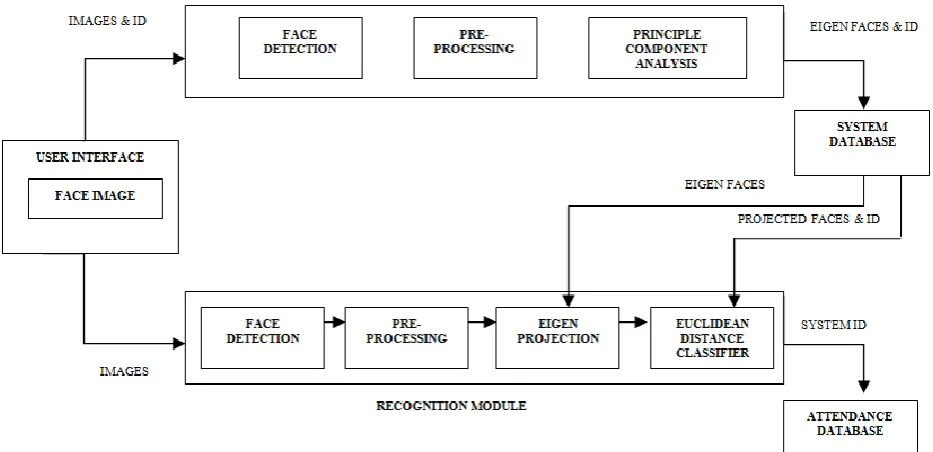
Fig. 2: System block diagram
The system methodology consists of mainly two modules:
Enrollment Module
A database for training the system is created and an ID is automatically generated for each individual. The face detection from the image is performed using Viola Jones algorithm, then the face is cropped from the image using bounding box. The cropped image is then converted to grayscale image by eliminating the hue and saturation information while retaining the luminance. Then the image is resized into 100x100 pixels for equalizing number of features in the feature and the intensity matrix is converted to a vector for further processing.
Recognition Module
Face recognition is performed and the attendance is marked for the recognized person. An image of the person is the input. One-to-many matching procedure is done. Single image of an individual at a time is captured and follow the same steps as in the enrollment module up-to the pre-processing stage. Then the image is projected to Eigen space using already saved Eigen faces from the database. Euclidean distances from the projected test image to the retrieved projected train images are determined. The ID that corresponds to train image with minimum distance to the test is selected. Attendance of a particular day is marked for the recognized ID to an excel sheet.
A. Holistic Based Search
A holistic or global approach involves encoding the entire facial image and treating the resulting facial “code” as a point in a high dimensional space. Here, it is assumed that all faces are constrained to particular positions, orientations, and scales. The first stage is to insert a set of images into a database, these images are names as the training set and this is because they will be used when we compare images and when we create the eigenfaces. The second stage is to create the eigenfaces. Eigenfaces are made by extracting characteristic features from the faces. The input images are normalized to line up the eyes and mouths. They are then resized so that they have the same size. Eigenfaces can now be extracted from the image data by using a mathematical tool called Principal Component Analysis (PCA), which is the method adopted in this work.
B. Principle Component Analysis
Principal component analysis (PCA) is a statistical procedure that uses an orthogonal transformation to convert a set of observations of possibly correlated variables into a set of values of linearly uncorrelated variables called principal components (or sometimes, principal modes of variation). Principal Component Analysis does not attempt to categories faces using familiar geometrical differences, such as nose length or eyebrow width. Instead, a set of human faces is analysed using PCA to determine which 'variables' account for the variance of faces. In face recognition, these variables are called eigenfaces. The number of principal components is less than or equal to the smaller of the number of original variables or the number of observations. This transformation is defined in such a way that the first principal component has the largest possible variance (that is, accounts for as much of the variability in the data as possible), and each succeeding component in turn has the highest variance possible under the constraint that it is orthogonal to the preceding components. The resulting vectors are an uncorrelated orthogonal basis set. PCA is sensitive to the relative scaling of the original variables.
Steps for PCA
1) Prepare the training image set.
Reshma et al., International Journal of Advanced Research in Computer Science and Software Engineering7(7) ISSN(E): 2277-128X, ISSN(P): 2277-6451, DOI: 10.23956/ijarcsse/V7I7/0220, pp. 302-307
Where T is the image vector and P is the number of face images
3) Subtract the Mean from Original Image
4) Calculate the Covariance Matrix
5) Calculate the Eigenvectors and Eigenvalues of the Covariance Matrix and Select the Principal Components
The images are then projected to Eigen space for using it for matching. The Eigen faces is saved to a system database for later use in projecting test images to Eigen space. Also, the projected Images along with its ID is also saved. The eigenvalues associated with each eigenface represent how much the images in the training set vary from the mean image in that direction. We lose information by projecting the image on a subset of the eigenvectors, but we minimize this loss by keeping those eigenfaces with the largest eigenvalues.
V. EXPERIMENTAL RESULTS AND ANALYSIS
The database used for training and testing purpose was faces96. Images of 40 persons with 10 sample each and training set of 8 was given. With the same data an accuracy of 97.5% is obtained. The precision and recall was observed to be 97.5% and 98.33% respectively (mathematically analyzed). As the system performs well with good accuracy the same can be used for attendance marking.
A. Attendance Monitoring Section
A GUI was created for student or employee enrolment and recognition. During the enrollment process student/employee databases were created with 6 different samples for each person.
Fig 3: Enrollment process
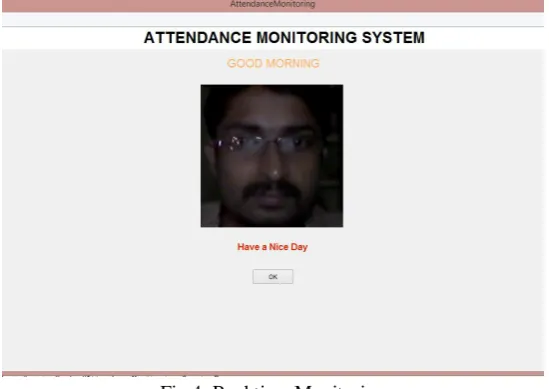
The next stage is attendance marking in which high clarity camera captures images of student/employee in real time (Fig 4). If the captured image matches with any of the images in the database during enrollment, then the attendance will be marked automatically for that image in an excel sheet otherwise no entry will be there in the sheet (Fig 5).
ISSN(E): 2277-128X, ISSN(P): 2277-6451, DOI: 10.23956/ijarcsse/V7I7/0220, pp. 302-307
Fig 5: Excel sheet entry for monitored image and attendance marked as 1 in the corresponding column
VI. CONCLUSION
A Holistic-based face recognition approach is implemented in MATLAB. This method which is implemented using PCA represents a face by projecting original images onto a low-dimensional linear subspace defined by eigenfaces. A new face is compared to known face classes by computing the distance between their projections onto face space. This approach is tested on a number of face images. The system shows better performance when the training image-set number is increased. Application of this system is that it is capable of marking the presence of personnel at any place of work and this attendance will be useful for calculating their month to month payment. For better results the system can be implemented using Kernel PCA or weighted PCA.
REFERENCES
[1] K. Sai Prasad Reddy and Dr. K. Nagabhushan Raju., Design and Implementation of an Algorithm for Face
Recognition by using Principal Component Analysis (PCA) in MATLAB, International Journal of Advanced
Research in Computer Science and Software Engineering, Volume 6, Issue 10, October 2016 ISSN: 2277 128X .
[2] Priyanka Dhoke and M.P. Parsai., A MATLAB based Face Recognition using PCA with Back Propagation
Neural network, International Journal of Innovative Research in Computer and Communication Engineering,
Vol. 2, Issue 8, August 2014.
[3] Ashvini E. Shivdas., Face Recognition Using Artificial Neural Network, International Journal of Research in
Management, Science & Technology (E-ISSN: 2321-3264) Vol.2, No.1, April 2014.
[4] Ashwini D.Gadekar and Sheeja S.Suresh., Face Recognition Using SIFT- PCA Feature Extraction and SVM
Classifier, IOSR Journal of VLSI and Signal Processing (IOSR-JVSP) Volume 5, Issue 2, Ver. II (Mar. - Apr.
2015).
[5] Mrunmayee Shirodkar ,Varun Sinha ,Urvi Jain ,Bhushan Nemade “ AUTOMATED ATTENDANCE
MANAGEMENT SYSTEM USING FACE RECOGNITION” International Journal of Computer Applications
(0975 – 8887) International Conference and Workshop on Emerging Trends in Technology (ICWET 2015)
[6] Deise Maia and Roque Trindade “FACE DETECTION AND RECOGNITION IN COLOR IMAGES UNDER
MATLAB ” International Journal of Signal Processing, Image Processing and Pattern Recognition Vol.9, No.2
(2016).
[7] Shreya Nallawar, Neha Giri, Neeraj Deshbhratar, Shamal Sane, Trupti Gautre, Avinash Bansod “MODERN
TECHNIQUE OF LECTURE ATTENDANCE USING FACE RECOGNITION” International Journal of
Advance Foundation And Research In Science & Engineering (IJAFRSE) Volume 1, Issue 8, January 2015.
[8] Ajinkya Patil1, Mrudang Shukla2 “IMPLEMENTATION OF CLASSROOM ATTENDANCE SYSTEM
BASED ON FACE RECOGNITION IN CLASS ,International Journal of Advances in Engineering &
Technology July 2014.
[9] Abhishek Jha “CLASS ROOM ATTENDANCE SYSTEM USING FACIAL RECOGNITION SYSTEM ”The
International Journal of Mathematics, Science, Technology and Management.
[10] Jomon Joseph, K. P. Zacharia “AUTOMATIC ATTENDANCE MANAGEMENT SYSTEM USING FACE
RECOGNITION” International Journal of Science and Research (IJSR).
[11] Parteek Kumar ,Praveen Sehgal “ FACE DETECTION USING PRINCIPAL COMPONENT
ANALYSIS ”International Journal of Computer Engineering & Technology (IJCET) Volume 7, Issue 3,
Reshma et al., International Journal of Advanced Research in Computer Science and Software Engineering7(7) ISSN(E): 2277-128X, ISSN(P): 2277-6451, DOI: 10.23956/ijarcsse/V7I7/0220, pp. 302-307
[12] M. Turk and A. Pentland ,―Eigenfaces for recognition‖, Journal of Cognitive Neuroscience, vol.3, No.1, 1991.
[13] M. Turk and A. Pentland, ―Face recognition using eigenfaces‖, Proc. IEEE Conf. on Computer Vision and
Pattern Recognition, pages 586-591, 1991.
[14] A. Pentland and T. Choudhury, ―Face recognition for smart environments‖, Computer, Vol.33 Iss.2, Feb. 2000.
[15] R. Brunelli and T. Poggio, ―Face recognition: Features versus Templates‖, IEEE Trans. Pattern Analysis and
Machine Intelligence, 15(10): 1042-1052, 1993.
AUTHOR‘S PROFILE
Reshma P received Bsc in Computer Science from College of Applied Sciences(IHRD), Thiruvampadi in the year 2014. She is pursuing her PG in Computer Science in Sullamussalam Science College, Areacode, Kerala, India. Her interests are in the field of Image Processing based Biometrics.
Muneer VK received MCA from Bharathiyar University Coimbatore in the year 2008 . He is currently working as an Assistant Professor in the Department of Computer Science, Sullamussalam Science College, Areacode, Kerala, India. His area of interest is Image Processing.