ISSN-L: 2501 - 1235 Available on-line at: www.oapub.org/edu
Copyright © The Author(s). All Rights Reserved.
doi: 10.5281/zenodo.1286410 Volume 4 │ Issue 8 │ 2018
COMMITMENT, FEAR TO BE EVALUATED AND DROP OUT IN
YOUNG FOOTBALLERS ACCORDING TO THE SPORT CATEGORY
Joel Manuel Prieto Andreu1, Juan González Hernández2
1Universidad Internacional de la Rioja,
Dpto. de Ciencias de la Educación, C/Almansa, 101, Madrid, 28040,
Castellón, España
2Universidad de Granada,
Facultad de Psicología, Granada, España
Abstract:
The sport can enhance psychological variables in young people, such as commitment or fun, and maybe differently in each sport category. The purpose of this study was to determine whether there are significant differences between competitiveness, social anxiety, engagement, fun and motivational orientation (to the ego and to the task) to the sports category U11(under-11 years old), U14(under-14 years old) and U16(under-16 years old). Total sample of this study, with a quantitative methodology, and a design descriptive and correlational, was N = 205 subjects (90 U11, 34 U14 and 81 U16). Instruments about Competitiveness Scale-10 (C-10), Social Anxiety Scale for Adolescents (SASC-R), Perception of Success Questionnaire (POSQ), SCQ-e (The Sport Commitment Model Questionnaire) and Fun Questionnaire Subjects Sports Practice (CDPD) were applicated. The main results highlight that fear of negative evaluation scale is higher in U11, U14 and U16 in first year compared in later years; and opportunities for involvement and enjoyment increase from the first year to the subsequent years in each category, reflecting the importance of learning about experience and continuity in sport practice.
Keywords: social anxiety, youth, football players, sports category, commitment
1. Introduction
Competitiveness is a conduct of achievement in a competitive context, where social assessment is the key component, being the characteristic of the personality that best predicts the way in which people assess the competitive objective situation (Martens, 1976, p. 3). Following Escartí & Cervelló (1994) and Weinberg & Gould (1995), the achievement motivation depends on the personality factors (success or avoiding failure) and situational factors (probability of success or failure and incentive value associated with the success or failure), they interact and they explain the motivation, that is to say the factors or personal reasons are the motive to succeed and the motive of avoiding failure.
On the other hand, the anxiety is another psychological aspect that accompanies every human being, considered as a multifaceted response to a threatening situation (Leary, 1991). Social phobias are those that produce anxiety face to the exposure to certain types of social situations (O'Connor, Raglin & Martinsen, 2000). Social anxiety can take two forms: specific form and generalized form, the first refers to a serie of specific stimuli that produces anxiety (write, bathe in public, talk, etc.) while the second is related to a variety of social situations (interpersonal interactions) (Mattick & Peters, 1988). Competencies considered as favourite as taking part in sports activities have been found to be significantly associated with social anxiety. Therefore, the fact of not reaching certain levels in these competitions could pose a risk in the face of manifest social anxiety in adolescence.
On the other hand, sports can enhance psychological variables in young people, such as commitment or enjoyment (Boixadós, Cruz, Torregrosa & Valiente, 2004; Scanlan, Simons, Carpenter, Schmidt & Keeler, 1993; Scanlan, Babkes & Scanlan, 2005) and in addition, to encourage social aspects, such as the relationship with the peers and the adults (Bois, Sarrazin, Brustad, Trouilloud, & Curry, 2005; Cruz, Boixadós, Torregrosa & Mimbrero, 1997; Duncan, Duncan, Strycker, & Chaumeton, 2002). Sport commitment model (see Figure 1) (Scanlan, Simons, Carpenter, Schmidt and Keeler (1993) demonstrates its effectiveness to predict involvement in various investigations (Rusbult, Martz & Agnew, 1998; Le & Agnew, 2003).
Figure 1: Model of commitment to sports with the determinants of commitment and its effects, Scanlan, Simons, Carpenter, Schmidt and Keeler (1993) (Own elaboration)
subscales comprising the POSQ. The question is if both types of goals would be also present in adolescents in each sport category when they are immersed in sport contexts of football base.
Ultimately, the main objective of this study is based on determining the competitiveness (oriented motivation to success, oriented motivation to avoid the failure and competitiveness), the profiles of higher risk of social anxiety (fear of negative evaluation, anxiety and social avoidance faced to strange people and anxiety and social avoidance faced to everyone in general) the motivational orientation (orientation to the task and ego orientation), the commitment (degree of enjoyment, alternatives of involvement, personal investments, opportunities for involvement, social constraint and sports commitment) and the enjoyment in soccer players, according to the sports category (U11, U14 and U16) with purpose of comparison sports category in first, second and third year (U11) and first and second year (U14 and U16).
2. Method
2.1 Design
With a cross-sectional, quantitative and non-experimental study, describe the circumstances of an event at the start of the season without any direct manipulation of the variables of study. The design conforms to the characteristics of the so called basic or observational correlation because a deliberate manipulation of the considered variables has not been carried out. The study is based on a design of surveys, since the psychological variables have been investigated, usually through questionnaires (Verma & Mallick, 1999).
2.2 Participants
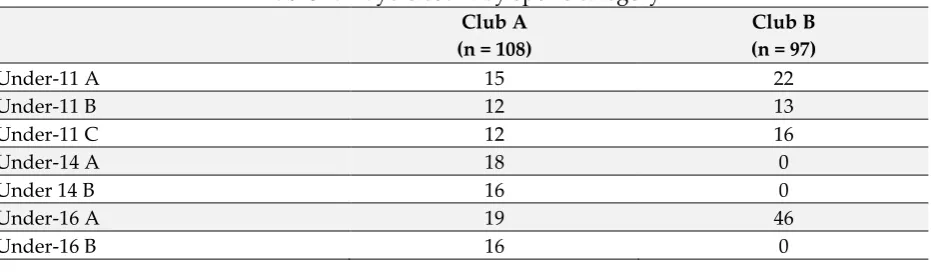
Only numbers were used to characterize the population, which gives it its descriptive character (McMillan and Schumacher, 2005). The selection of the sample was not randomly; therefore, it is no probabilistic research (McMillan and Schumacher, 2005). The participants were selected by convenience, in this case, for agreeing to participate in the study. We worked with young football players from two Spanish Clubs, who agreed to participate voluntarily in the study, prior informed consent of their parents. Got a representative sample of 205 subjects (90 U11, 34 U14 and 81 U16), in table 1 can see the distribution of players according to sports category.
Table 1: Players count by sports category Club A
(n = 108)
Club B (n = 97)
Under-11 A 15 22
Under-11 B 12 13
Under-11 C 12 16
Under-14 A 18 0
Under 14 B 16 0
Under-16 A 19 46
2.3 Instruments
The list of the used questionnaires was described below:
1. The competitiveness Scale-10 (C-10) by Remor (2007) was used for the evaluation
of competitiveness. It is a self-report questionnaire with 10 questions about associated motivation with sports competitiveness; it was designed for the evaluation of oriented motivation to success, motivation to avoid failure and competitiveness.
2. Scale of social anxiety for adolescents (SASC-R), La Greca & López (1998), adapted in its Spanish version by Olivares, Ruiz, Hidalgo, Garcia-Lopez, Rosa & Piqueras (2005), it is a created tool specifically for the evaluation between
teenagers of social anxiety, understanding this as a structure which is divided into
three factors: fear of negative evaluation (FNE), social anxiety about new situations (SAD-N), and social anxiety experienced in general (SAD-G).
3. A success perception questionnaire (POSQ), prepared by Roberts & Balague
(1991) was used to measure the orientation to the task and Ego orientation. The POSQ is a 12 item scale: 6 of involvement in the task (items 3, 4, 7, 8, 10 and 11) and 6 of involvement in the ego (items 1, 2, 5, 6, 9 and 12), assessing the personal attitude of goal in personal achievement.
4. The level of commitment to sports was evaluated through the SCQ-e (The Sport
Commitment Model Questionnaire) of Scalan, Simons, Carpenter, Schmidt & Keeler (1993). This instrument is based on the model of sports commitment proposed by Scalan (Sport Commitment Model, Spanish version), which measures 6 influencing factors at the level of sport commitment on 28 items: degree of enjoyment, alternatives of involvement, personal investments, opportunities for involvement, social constraints and sports commitment.
5. The questionnaire of enjoyment related with sport practice (CDPD) designed by
Duda & Nichols (1992) was used to determine the degree of enjoyment that the athletes have with sport practice. The original questionnaire consists of 8 items
which are grouped into two factors called boredom and amusement, respectively.
In this study and in the adapted version by Escartí & Cervelló (1994), the two factors were transformed into one, called enjoyment, since thus it increased the internal consistency of the questionnaire.
2.4 Procedure
During the third working day of the new season of League (beginning of October 2016), soccer players of two Spanish football club (Castellon CF and Elche CF) were invited (U11, U14 and U16) to participate since they were training inside their sports clubs, it was explained that the purpose of this study was to provide information that described their anxiety and motivational orientation in their role as athletes.
1. In several meetings before the distribution of questionnaires, the parents were told the subject matter of the research, its objectives, its development, as well as the list of questionnaires which their children had to fill out. It was marked the voluntary and anonymous nature of participation in the study.
2. Explanation of the instructions to players in order to complete each
questionnaire. The investigator read each statement and an example item of each questionnaire while participants were reading them and then they made questions.
2.5 Statistical analysis
The statistical treatment of the data was performed using the program SPSS 23.0. With this program descriptive analysis of frequencies, averages and correlations were performed through the technique of analysis of variance ANOVA and Tukey multiple comparison of averages method. A coefficient alpha of Cronbach of ,584 for all study variables was obtained. All statistical analyses were performed with a p ≤05 significance level.
3. Results
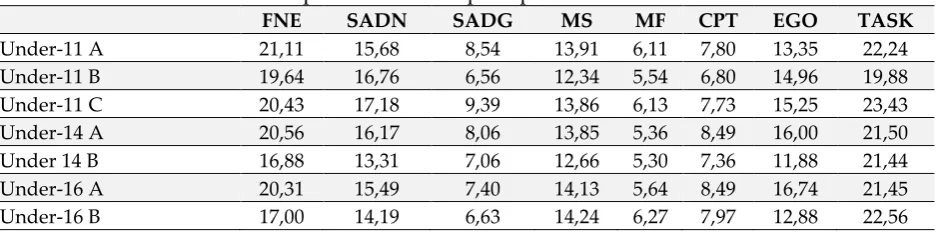
Averages obtained by football base players are presented in table 2, for social anxiety scales, competitiveness and perception of success, according to the sports category. On the other hand, in table 3 show the averages for the grade scales of entertainment and sports commitment according to the sports category
Table 2: Comparison of averages for the scales of social anxiety, competitiveness and perception of success
FNE SADN SADG MS MF CPT EGO TASK
Under-11 A 21,11 15,68 8,54 13,91 6,11 7,80 13,35 22,24 Under-11 B 19,64 16,76 6,56 12,34 5,54 6,80 14,96 19,88 Under-11 C 20,43 17,18 9,39 13,86 6,13 7,73 15,25 23,43 Under-14 A 20,56 16,17 8,06 13,85 5,36 8,49 16,00 21,50 Under 14 B 16,88 13,31 7,06 12,66 5,30 7,36 11,88 21,44 Under-16 A 20,31 15,49 7,40 14,13 5,64 8,49 16,74 21,45 Under-16 B 17,00 14,19 6,63 14,24 6,27 7,97 12,88 22,56
Table 3: Comparison of averages for grade scales about entertainment and sports commitment
CDPD_EN COM SCQ_EN ALTIN CONS INVES OPOR
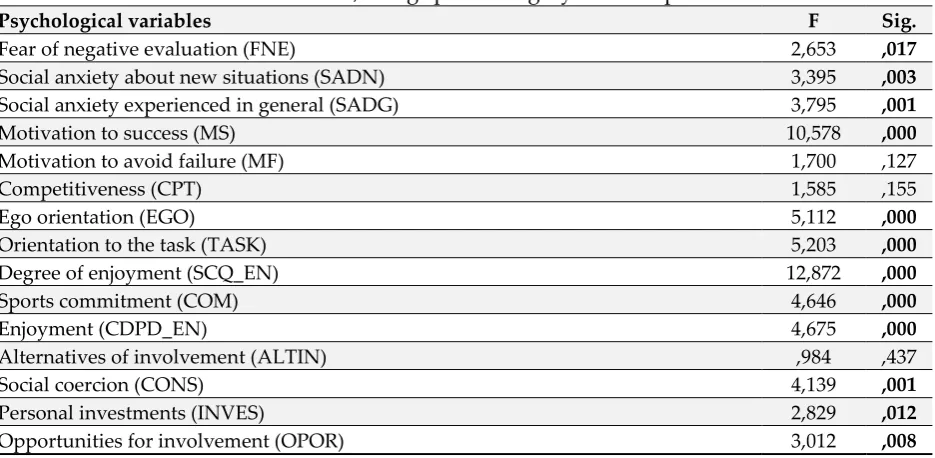
The technique of analysis of variance (ANOVA) in table 4 was used to determine the relationship between the sports category with different psychological scales and determine what are the variables that obtain significant relationships with sports category.
With regard to the procedure to determine these relationships, the sports category was taken as a dependent variable and the obtained scores in each one of the psychological scales as an independent variable.
Table 4: Anova of a factor, using sports category as the dependent variable
Psychological variables F Sig.
Fear of negative evaluation (FNE) 2,653 ,017
Social anxiety about new situations (SADN) 3,395 ,003
Social anxiety experienced in general (SADG) 3,795 ,001
Motivation to success (MS) 10,578 ,000
Motivation to avoid failure (MF) 1,700 ,127
Competitiveness (CPT) 1,585 ,155
Ego orientation (EGO) 5,112 ,000
Orientation to the task (TASK) 5,203 ,000
Degree of enjoyment (SCQ_EN) 12,872 ,000
Sports commitment (COM) 4,646 ,000
Enjoyment (CDPD_EN) 4,675 ,000
Alternatives of involvement (ALTIN) ,984 ,437
Social coercion (CONS) 4,139 ,001
Personal investments (INVES) 2,829 ,012
Opportunities for involvement (OPOR) 3,012 ,008
When the sports category is taken as the dependent variable we found in table 4 significant differences in the following psychological scales: fear of negative evaluation (p = ,017), social anxiety about new situations (p = ,003), social anxiety experienced in general (p = ,001), social coercion (p = ,001), personal investments (p = ,012) and opportunities for involvement (p = ,008). Furthermore, we found potential significant differences (p = ,000) in the following psychological scales: motivation to success, ego orientation, orientation to the task, degree of enjoyment, sports commitment and enjoyment
The averages of the players with respect to psychological scales in the categories alevin, infantile and cadet can be seen in tables 2 and 3. After applying the Tukey method of multiple comparison of averages, and comparing U11 of first, second and third year with first and second year in U14 and U16, the following results stand out:
categories. On the other hand, we found lower orientation to the task in U11 of second year (19,88) compared to first year (22,24) and third year (23,43)
The scale of enjoyment is higher in U11 of third-year (25,64) than the U11 of first and second year (24,84 / 24,08), is also higher in U14 of second-year (25,13) than U14 of the first year (25,11), and higher in U16 of the second year (25,00) compared to the U16 of first year (24,11). In the same line, social coercion is higher in third-year U11 (22,50) than U11 in the first and second year (16,92 / 18,40), and higher in second-year U14 (17,00) compared to first year U14 (15,00), but higher in cadets of first year (17,38) compared to the second year U16 (14,25).
Finally, opportunities for involvement increase from the first year to the subsequent years in each category. Opportunities for involvement are higher in U11 (16,78 / 17,56 / 18,96), U14 (17,22 / 17,69) and U16 (16,15 / 17,00) of last year.
4. Discussion
The anxiety in the sporting context may also be related to different psychological constructs, such as motivational orientation, achievement motivation, attribution of success and satisfaction or enjoyment in sport. The main objective of this research was to determine competitiveness, social anxiety, motivational orientation, commitment and enjoyment in soccer base players, depending on the category of the sports players (U11, U14 and U16). In this study, the cadets had a greater motivation oriented to achieve success, as opposed to the study of Olmedilla, Andreu & Blas (2005) in which the cadets players obtained a greater anxiety and self-confidence and a less motivation.
In this study, fear of negative evaluation scale was higher in U11, U14 and U16 in first year compared in later years. The decrease of anxiety in the cadets may be related to their greater orientation towards results and their biggest oriented motivation to achieve success. In sporting contexts both types of goals are usually present, the person who is oriented to the task believes that success in sport consists in striving and improving the execution of the task using the criteria of self-referential comparison to assess their competence, while a person aimed at the ego believes that success in sport consists in showing how superior to others can be a person using normative criteria and social comparison to judge their competence. Perhaps because the cadets are immersed in training, and because of their greater experience, are more involved than the players of lower categories, and could obtain higher scores in both types of motivational orientations. It means that the higher scores in the motivational orientation towards the ego or the result and toward the task will reinforce adherence to the group, and therefore adherence towards sports practice, being more involved than the U11 and U14.
2007), relate the commitment with the theory of orientation of goals (Sousa, Torregrosa, Viladrich, Villamarin, Borrás, Palou & Cruz, 2007) or investigate the reasons that some coaches continue their career and others leave it (Raedeke, Warren & Granzyk, 2002).
So, on the one hand, we can see that enjoyment, involvement opportunities, and personal investment are strong factors that predict the commitment, although alternatives to involvement and social constraints arise as factors with difficulties to determine their role in the prediction of sport commitment. In this study were obtained significant differences with respect to the sport commitment in relation to the sports category, in fact, in this study sports commitment scale was higher in U11 and U14 in first year, but not in first year cadets compared to second year.
Finally, Olivares, García-López, Hidalgo & Caballo (2002) propose that future researches focusing specifically on the adolescent population should be made making use of longitudinal studies in order to observe the course of social anxiety. In this line, the early detection of a social anxiety disorder in the categories alevin, infantile and cadet, could make that the professional could achieve a certain efficiency through the exposition and training in social skills.
5. Conclusions
The purpose of this study was to determinate whether there are significant differences between competitiveness, social anxiety, engagement, fun and motivational orientation (to the ego and to the task) according to the comparison of sports category in first, second and third year (U11) and first and second year (U14 and U16).
The most important conclusions of this study are:
1. Fear of negative evaluation scale is higher in U11, U14 and U16 in first year compared in later years.
2. Sports commitment scale is higher in U11 and U14 in first year, but not in first
year cadets compared to second year
3. Ego orientation is superior in U14 and cadets of first year than second year.
4. Motivation to success is higher in cadets compared to the other categories.
5. Orientation to the task is lower in U11 of second year than first and third year.
6. Social coercion is higher in third-year U11 and second year U14 than previous years, but higher in cadets of first year than second year.
7. Opportunities for involvement and enjoyment increase from the first year to the
subsequent years in each category.
Bibliography
1. Balaguer, I., Castillo, I. & Tomás, I. (1996). Análisis de las propiedades psicométricas del Cuestionario de Orientación al Ego y a la Tarea en el Deporte
(TEOSQ) en su traducción al castellano. Psicológica, 17, 71-81
2. Boixadós, M., Cruz. J., Torregrosa, M., & Valiente, L. (2004). Relationships among
motivational climate, satisfaction, perceived ability, and fair play attitudes in young soccer players. Journal of Applied Sport Psychology, 16 (4), 301-317.
3. Bois, J. E., Sarrazin, P. G., Brustad, R. J., Trouilloud, D. O., & Curry, F. (2005). Elementary schoolchildren perceived competence and physical activity involvement: the influence of parents’ role modelling behaviours and perceptions of their child’s competence. Psychology of Sport and Exercise, 6, 381-397.
4. Carpenter, P. J., & Coleman, R. (1998). A longitudinal study of elite youth
cricketers’commitment. Journal of Sport Psychology, 29, 195-210.
5. Cruz, J., Boixadós, M., Torregrosa, M. & Mimbrero, J. (1997). ¿Existe un deporte
educativo?: Papel de las competiciones deportivas en el proceso de socialización del niño. Revista de Psicología del Deporte, 9(10), 103-109.
6. Duda, J. L., & Nicholls, J. G. (1992). Dimensions of achievement motivation in
schoolwork and sport. Journal of Educational Psychology, 84, 1-10.
7. Duncan, S. C., Duncan, T. E., Strycker, L. A., & Chaumeton, N. R. (2002). Relations between youth antisocial and prosocial activities. Journal of Behavioral Medicine, 25(5), 425-438.
8. Escartí, A. & Cervelló, E. (1994). La motivación en el deporte. En I. Balaguer (Ed.), Entrenamiento psicológico en deporte: Principios y aplicaciones (pp. 61-90). Valencia: Albatros Educación.
9. La Greca A.M. & López N. (1998). Social anxiety among adolescents: Linkages
with peer relations and friendships. J Abnorm Child Psychol 26, 83-94.
10. Leary, M. & Kowalsky, R. (1991). Social Anxiety. New York: Guilford
publications, Inc.
11. Le, B., & Agnew, C. R. (2003). Commitment and its theorized determinants: A
metaanalysis of the investment model. Personal Relationships, 10, 37-57.
12. Mattick, R.P. & Peters, L. (1988). Treatment of severe social phobia. Effects of
guided exposure with and without cognitive restructuring. Journal of Consulting
and Clinical Psychology, 56, 251-260.
13. Martens, R. (1976). Competitiveness in sport. Documento presentado en el
Congreso Internacional de Ciencias de la Actividad Física, Quebec.
14. McMillan, J. & Schumacher, S. (2005). Investigación Educativa. Madrid: Pearson. 15. O`Connor, P., Raglin, J. & Martinsen, E. (2000). Physical Activity, Anxiety and
16. Olmedila, A., Andreu, M.D. & Blas, A. (2005). Variables psicológicas, categorías
deportivas y lesiones en futbolistas jóvenes: Un estudio correlacional. Análise
Psicológica, 23(4), 449-459.
17. Olivares, J., García-López, L. J., Hidalgo, M. D. & Caballo, V. (2004). Relationships among social anxiety measures and their invariance: a
confirmatory factor analysis. European Journal of Psychological Assessment, 20,
172-179.
18. Olivares J., Ruiz, J., Hidalgo M.D., García-López, L.J., Rosa, A.I. & Piqueras, J.A. (2005). Social Anxiety Scale for Adolescents (SAS-A): Psychometric properties in
a Spanish- speaking population. International Journal of Clinical Health and
Psychology, 5, 85-97.
19. Raedeke, T. D., Warren, A. H., & Granzyk, T. L. (2002). Coaching commitment
and turnover: A comparison of current and former coaches. Research Quarterly for
Exercise and Sport, 73, 73-86.
20. Remor, E. (2007). Propuesta de un cuestionario breve para la evaluación de la
competitividad en el ámbito deportivo: Competitividad-10. Revista de Psicología
del Deporte, 16(2), 167-183.
21. Roberts, G. C. & Balagué, G. (1991) The development and validation of the perception
of Success Questionaire. Congreso FEPSAC. Colonia. Alemania.
22. Rusbult, C. E., Martz, J. M. & Agnew, C. R. (1998). The investment model scale: Measuring commitment level, satisfaction level, quality of alternatives, and investment size. Personal Relationships, 5, 357-391.
23.Scanlan, T. K., Carpenter, P. J., Schmidt, G. W., Simons, J. P. & Keeler, B. (1993).
An introduction to the sport commitment model. Journal of Sport and Exercise
Psychology, 15, 1-15.
24. Scanlan, T.K., Simons, J. P., Carpenter, P. J., Schmidt, G. W. & Keeler, B. (1993). The sport commitment model: Measurement development for the youth-sport domain. Journal of Sport and Exercise Psychology,15, 16-38.
25. Scanlan, T. K., Babkes, M. L., & Scanlan, L. A. (2005). Participation in sport: A development glimpse at emotion. En J. L. Mahoney, R. W. Larson y J. S. Eccles (Eds.), Organized Activities as contexts of development. Extracurricular Activities,
after-school and community programs (pp. 275-309). New Jersey: Lawrence
Erlbaum.
26. Sousa, C., Torregrosa, M., Viladrich, C., Villamarín, F., Borrás, P. A., Palou, P., & Cruz, J. (2007). Goal orientation and its influence in sport commitment. En Y. Theodorakis, M. Goudas y A. Papaioannou (Eds.), Book of Abstracts of the 12th European Congress of Sport Psychology (pp. 375). Halkidiki: Grecia.
27. Verma, G. & Mallick, K. (1999). Researching Education. Perspectives and Techniques. London: Falmer Press.
29. Weiner, B. (1992). Human motivation: Metaphors, theories and research. Newbury Park, Ca.: Sage.
30. Weiss, M. W., & Weiss, M. R. (2003). Attraction- and entrapment-based
commitment among competitive female gymnasts. Journal of Sport and Exercise
Psychology, 25, 229-247.
31.Weiss, M. W., & Weiss, M. R. (2007). Sport commitment among competitive
female gymnasts: A development perspective. Research Quarterly for Exercise and
Sport, 78 (1), 90-102.
Creative Commons licensing terms