Available online throug
ISSN 2229 – 5046
A STUDY ON THE DEPENDENCY IN THE ALPHA BRAIN WAVE RECORDED
THROUGH EEG WITH ACADEMIC PERFORMANCE AND STRESS MIND STATE
OF ENGINEERING STUDENTS
P. G. JANSI RANI*
Department of Mathematics,
Sethu Institute of Technology, Kariapatti-626115, Tamil Nadu, India.
(Received On: 09-02-17; Revised & Accepted On: 07-03-17)
ABSTRACT
T
his paper deals with the acquisition and analysis of Electroencephalogram (EEG) signals on engineering college students of age group 18-20 in Tamil Nadu, India, recorded through 23 electrodes of EEG using Fast Fourier transform (FFT) frequency analysis to determine the distribution of Delta, Theta, Alpha and Beta frequencies during various tasks. The development in any field is highly correlated with the development of theoretical research and its successful applications. Therefore the significance of this theoretical research lies in the insight gained into the real life applications.Keywords: Electroencephalogram (EEG), Electrodes, Four principal brain waves, Delta, Theta, Alpha and Beta frequencies, Fast Fourier Transform (FFT), Experimental Analysis.
1. INTRODUCTION
The fast paced life style most of us have adopted has resulted in a loss of the skill to produce Theta and Alpha waves. People who have more Alpha brain waves have less anxiety and tension. Creativity is another activity for which Alpha waves are helpful. Scientists have shown that highly creative people have different brain waves from normal and non-creative people. In order to have a non-creative inspiration, our brain needs to be able to produce a big burst of Alpha waves, predominately on the left side, effectively shutting the left-brain down. This allows the creative right-brain to expose new idea is given in Table 1
Table-1: Left and right brain activities [1, 2]
LEFT (Analytic) RIGHT (Global) 1. Verbal 1. Visual
2. Responds to word meaning 2. Responds to tone of voice 3. Sequential 3. Random
4. Processes information linearly 4. Processes information in varied order 5. Responds to logic 5. Responds to emotion
6. Plans ahead 6. Impulsive
7. Recalls people's names 7. Recalls people's faces 8. Speaks with a few gestures 8. Gestures when speaking 9. Punctual 9. Less punctual
10. Prefers formal study design 10.Prefers sound/music background while studying
11.Prefers bright lights while studying 11. Prefers frequent mobility while studying
We can tap our psychic abilities by understanding and altering our four principal mind state delta, theta alpha and beta since different behaviors lead specific areas to synchronize at different frequencies. For example relaxation or meditation with eyes closed leads to increased alpha waves in the rear of the head.
© 2017, IJMA. All Rights Reserved 53
Figure-1: Four principal brain waves [1] [64]
FOUR PRINCIPAL BRAIN WAVES AND THEIR BEHAVIOURS [1]
Delta waves-1-4Hz. (1-4 cycles per second)
This brain state is related to the unconscious or super-conscious mind. Only under the most developed circumstances can a person dip into the delta state of awareness and bring back any intelligible information. Associated with deep sleep patterns.
Theta waves-4-7Hz. (4-7 cycles per second)
Theta state is related to our subconscious mind. We generally experience the theta level in deep meditations and in our sleep state. Here we can transcend time and space, obtain remote perceptions, and obtain information from the highest source. Associated with REM (Rapid eye movement) sleep or lucid dreaming
Alpha waves-7-13Hz (7-13 cycles per second)
Gate between the outer and the inner world. Associated with relaxed and alert state of mind. Improves our mental processes concentration, clarity of thinking, decision making, memory. Calms your body and mind while it maintains alertness. Stimulates imagination, intuition and higher awareness, increases learning ability and improves memory. This is a more internally focused, self-reflective mind-set
Beta waves-14-40 Hz. (14-40 cycles per second)
Beta is seen in highly stressful situations, and in a difficult mental concentration and focus. Associated with an conscious and excited state or our normal waking state Therefore psychic faculties are mostly muted because exterior stimuli dominate our thoughts and actions and suppress subtle realm information
2. PROMPTING FOR THE RESEARCH
The pre-frontal cortex, also called the brain’s executive control system, responsible for planning, organizing and sequencing behavior for self-control, moral judgment and attention are developed throughout childhood and adolescence. The nature of the stimulus may predispose some children to attention problems. The fast-paced, attention-grabbing techniques like ‘rapid-zoom’ pans, flashes of colors, quick movements, sudden loud noises etc, engage the brain’s attention involuntarily may idle the executive control system of the brain, impoverish its development and deprive the children of the practice in using their own brain independently. But, the executive control system that goes idle may be reactivated by altering the four principal mind-states, which are responsible for different behavior. Many parents of children diagnosed with attention deficit disorder found the difficulty markedly improved after they took away television viewing privileges. Sports scientists have shown that increases of Alpha waves, primarily in the left-brain, precede optimal performance. There is a distinct difference in the brain wave pattern of an expert and a novice athlete. Just before an expert sportsmen makes his or her "move" there is a burst of Alpha in the left brain. Novice and intermediate athletes do not show this Alpha pattern. (1997 Biocybernaut Institute, www.biocybernaut.com/ tutorial/ alpha.html)
On the analysis based on quantitative measurements of EEG amplitudes on academically successful and unsuccessful university students during a 5 min, eyes closed, relaxed state, unsuccessful students displayed a brain wave pattern in the right hemisphere, which resemble patterns often found in depression, suggests a relative disorganization of right hemispheric activity in the unsuccessful students [3].
This prompted to do an experiment on EEG signal to analyze the alpha level during different tasks on students differing in their academic achievements, and other behaviorslisted in the following experiments.
3. EXPERIMENTS
3.1. EEG ANALYSIS WITH 2 TASKS
Objective of experiment 1
To determine the alpha level among various categories of students who differ in academic achievements, stress level, behavior in the class, behavior at home, and their general attitude by examining the alpha band of their EEG, in the initial 7 minutes during initial rest with eyes closed and during task and it is given in the table 2.
Task1(7minutes) Task2 (3minutes) Normal relaxed state Multiplication Task
3.2. EEG ANALYSIS WITH 5 TASKS
Objective of experiment 2
To determine the dependency on the alpha mind state among various tasks given in Table.2 with academic performance and stress mind state by examining the alpha band of their EEG, in the initial 5 minutes during rest and during different tasks and means to improve the brain power by increasing their alpha state involving physical exercise, balanced nutrition and complex mental exercises. The time taken for this experiment is given in the supplementary material of the manuscript. Also Brainwave Recorded for the student id: 635 time duration 01 – 10 seconds is given in the below fig. Brainwave Recorded for the other students is given in the supplementary material of the manuscript.
Task1 (5minutes)
Task 2 (3 minutes)
Task 3 (3 minutes)
Task 4 (1 minute)
Task 5 (1 minute)
Initial state rest and relaxed state
Listening to Rock music
Listening to Melodious instrumental Music
Multiplication Task
Thinking over Logical questions related with blood relation with eyes closed and answering after EEG recording is stopped
© 2017, IJMA. All Rights Reserved 55
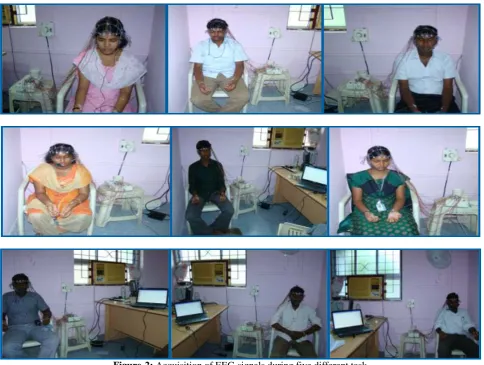
Figure-2: Acquisition of EEG signals during five different task
Table 3.2.1 Logical (Blood Relation) Questions (task1) and multiplication questions (task4) asked at students during acquisition of EEG signals:
1. A is my mother in law’s only child’s child. What is the relationship between me and A? 2. B is your father’s only son in law’s only daughter. What is relationship between you and B?
3. If your mother’s only elder brother’s only sister has only daughter, what is the relationship between you and that daughter?
4. Lavan and Kushan are father and son respectively. Mishan is Kushan’s uncle. Thrisha is Lavan’s sister. What is the relationship between Misha and Thrisha?
5. If A’s mother in law and B’s mother in law are mother and daughter, then what is the relationship A and B? 6. A’s father B’s father are father and son. Then what is the relationship between A and B?
7. B is A’s mother’s only child’s son. What is the relationship of B to A? 8. B is A’s mother’s daughter’s son. What is the relationship of B to A? 9. B is A’s mother’s brother’s father. What is B to A?
10. B knows A’s birthday falls between 20th October and 7th November. C knows that A’s birthday is after 30th October. Find A is birthday?
11. When did Alber Einstein discover Newton’s 3rd law of motions?
Multiplication Task
25 x 17 29x13 16x13 18x14 17x16 15x13 13x11 15x12 18x14
3.3. PERFORMANCE ANALYSIS IN VARIOUS ENVIRONMENTS
Objective of experiment 3
To determine the variation in the performance of activities in different environments given below.
Score without Music Score with rock Music
4. METHODOLOGY: EEG ANALYSIS
The brain consists of about 20 billion neurons which generate electrical impulses. When these neurons work together in synchrony, tiny rhythmic, electrical potentials occur in the synapses which are specialised junctions between the neurons. The more neurons that work in synchrony, the larger the potential (amplitude) of the electrical oscillations measured in micro volts. The faster the neurons work together, the higher the frequency of the oscillations measured in Hertz. These two parameters: amplitude and frequency are the primary characteristics of brain waves.
These weak electrical signals are measured with electrodes placed on the scalp using some conductive paste. After amplification by an EEG-amplifier, the signals are fed to a computer and analysed for amplitude and frequency.From this EEG signal it is possible to differentiate between alpha (α), beta (β), delta (δ), and theta (Θ) waves. The alpha waves have the frequency spectrum of 8-13 Hz and can be measured from the occipital region [4 ]in an awake person when the eyes are closed. The frequency band of the beta waves is 13-30 Hz; these are detectable over the parietal and frontal lobes. The delta waves have the frequency range of 0.5-4 Hz and are detectable in infants and sleeping adults. The theta waves have the frequency range of 4-8 Hz and are obtained from children and sleeping adults.
Acquisition of EEG signals analysis on eight II semester students recorded through 23 electrodes of Electroencephalogram (EEG) equipment initially recorded during rest with closed eyes after that the EEG is recorded during different tasks. FFT frequency analysis gives the distribution of Delta, Theta, Alpha, Beta1, and Beta2 frequencies.
Figure-2 Acquisition of EEG signals during rest, Figure-3 Acquisition of EEG signals during Rock (fast beat) and Melodious instrumental music
© 2017, IJMA. All Rights Reserved 57
Figure-3(b): Power spectrum and frequency values for the brain wave using FFT.
Figure-5(a), (b): EEG 2, FFT 2
© 2017, IJMA. All Rights Reserved 59 Figure-7(a), (b): EEG 3, FFT 3
5. EXPERIMENT 1: EEG ANALYSIS WITH 2 TASKS
Sample of 8 students who were selected for sample study of EEG analysis differing in various categories like academic performance and stress level, from the class where I taught and know the students behavior and attribute well is given in table 2.
Table-2: EEG 1a: Brainwave Recorded for the second time for the student id: 635 time duration 01 – 10 seconds.
S. No
Name of the student (Abbreviated) EEG ID Students attitude and Behaviour observed by
the staff 10 t
h m ar k H SC I S em es ter A ca de mi c B eha v io ur i n t he cl a ss f eed b a ck fr o m cl a ss t ea ch er P 4 -02 8 to 12 P 3 -O 1 8 to 12 T ot al A lp h a i n 2 E lect ro d es T a sk 1 T ot al A lp h a i n 2 E lect ro d es T a sk 4 A ve rage A lp h a of Ta sk 1 A ve rage A lp h a of Ta sk 4 Be tw ee n I n it ia l re st a nd D ur ing
1 ATH 636
Very dynamic calm responsible School first in HSC. won't get tensed
2 APN 638 Very much relaxed won't get tensed easily will take everything easily
A A A G VCD 145 207 352 594 176 297 17
3 DK 639
Very curious does not get tensed but is anxious but don't show much outside have the capacity to control emotions. Very good in studies especially in mathematics
A A B E T 85 54 139 124 69 62 23
4 AK 640
Wants to be free. Does not like parents’
strict activities
B B D M T 71 58 129 182 65 91 19
5 KAN 634
Easily gets tensed even and takessmall matter(small comparison) seriously
B C B M T 53 41 94 124 47 62 20
6 BR 635
Is always thinking of something (Family problem)
D B A G ATS 36 27 63 125 32 63 18
7 KMN 633
Is always thinking of something( Intensive Family problem)
B B B M ATS 34 21 55 79 28 40 21
8 LAW 637
Won't talk much with staff and not so jovial with friends
A S A E T 23 28 51 48 26 24 22
© 2017, IJMA. All Rights Reserved 61
7 KMN 16
Always thinking of something( Intensive Family problem)
B B B M ATS 53 32 86 166 43 83 -40
It is observed that in figure EEG 1, FFT 1, EEG 1a, FFT 1a, EEG 2, FFT 2, EEG 2a, FFT 2a, EEG 3, FFT 3, table3, with details of the second EEG analysis, their Alpha measure was less compared to EEG of others who participated in the first EEG analysis experiment. It is also observed that these two students show an increase in alpha level while doing multiplication task both during test-1 and test-2.This pilot study is the basis for further study in students’ brain wave analysis.
Figure-8: Average alpha measure in 5 different tasks
Pie Chart 8 Measuring average alpha measure during five different tasks
S. No EEG ID
Average Alpha
Rest Loud Music Melody Multiplication Logical
Average Alpha of Task 1
Average Alpha of Task 2
Average Alpha of Task 3
Average Alpha of Task 4
Average of Alpha Task 5
1 004 151 188 264 197 319
2 680 144 232 241 209 324
3 017 86 120 94 78 183
4 014 128 178 105 149 242
5 681 86 252 207 174 230
6 002 33 83 81 85 141
7 016 43 87 97 83 105
8 003 65 144 170 136 157
Logical 123 25%
Music 1 106 21% Music 2
106 21% Multiplication
102 20%
Initial Rest 64 13%
9 670 62 181 191 134 154
10 013 58 122 93 69 88
11 010 60 84 79 48 63
12 672 60 69 78 58 66
13 682 62 128 148 136 140
14 009 28 37 100 92 69
15 637 26 0 0 24 0
16 005 103 223 169 219 188
17 633 28 0 0 40 0
18 634 47 0 0 62 0
19 639 69 0 0 62 0
20 635 32 0 0 63 0
21 640 65 0 0 91 0
22 638 176 0 0 297 0
23 636 180 0 0 346 0
Total 1790 2129 2117 2850 2468
Average 64 106 106 102 123
Position 4 2 2 3 1
Table-4: Average Alpha Measure
Measuring increase in alpha measure between two different tasks
© 2017, IJMA. All Rights Reserved 63
Figure-10: gives the comparative alpha measure during two different tasks:
6. RESULT
From the EEG analysis of the students, it is inferred that music and logical (in blood relation) questions play a significant role in increasing alpha frequency in students’ minds state.
7. EXTRACTION OF DECISION RULES USING ROUGH SET THEORY
Extraction of decision rules using rough set theory through the data mining software ROSETTA data mining software.
Inst ance s
Condition al Attribute
Condition al Attribute
Condition al Attribute
Conditional Attribute Conditional Attribute Decision Variable
10th(SSLC
Mark)
12 th (HSC Mark)
I year Mark in
college
Class Teacher’s opinion about students academic
level
Behaviour in the class(Given by the class
Teachers )
Alpha Level based on students EEG
recording
1 D D D VP ATS 33
2 S A A E LT 65
3 S S S E LT 151
4 B B B G T 103
5 D B A G ATS 28
6 C C F M VT 60
7 A A B E NT 160
8 D D F P T 58
9 C C F VP VT 128
10 C C F M VT 64
11 B B B M ATS 43
12 B B A G T 86
13 B B B M ATS 28
14 B C B M T 47
16 A S A E VCD 180
17 A S A E T 26
18 A A A G VCD 176
19 A A B E T 69
20 B B D M T 65
21 A A E E VCD 62
22 A B B G T 60
23 A A E E T 144
24 A A B E T 86
25 A A B VG T 62
Table-5: Information Table
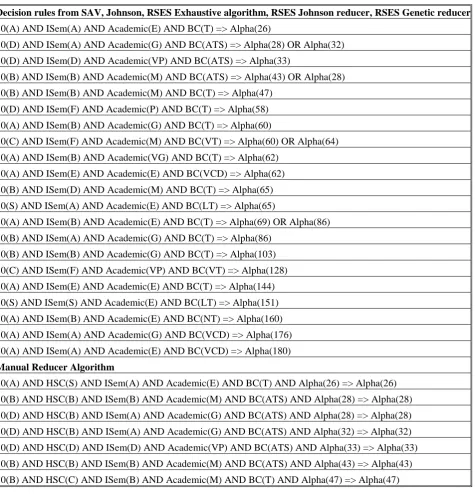
Rules extracted from Johnson’s and SAV Genetic Reducer algorithm using Rosetta data mining software are given in table 6.11 and rules extracted from Manual Reducer Algorithm are given in table 6.12
Table-6: Rules extracted from Johnson’s and SAV Genetic Reducer algorithm
Decision rules from SAV, Johnson, RSES Exhaustive algorithm, RSES Johnson reducer, RSES Genetic reducer
10(A) AND ISem(A) AND Academic(E) AND BC(T) => Alpha(26)
10(D) AND ISem(A) AND Academic(G) AND BC(ATS) => Alpha(28) OR Alpha(32) 10(D) AND ISem(D) AND Academic(VP) AND BC(ATS) => Alpha(33)
10(B) AND ISem(B) AND Academic(M) AND BC(ATS) => Alpha(43) OR Alpha(28) 10(B) AND ISem(B) AND Academic(M) AND BC(T) => Alpha(47)
10(D) AND ISem(F) AND Academic(P) AND BC(T) => Alpha(58) 10(A) AND ISem(B) AND Academic(G) AND BC(T) => Alpha(60)
10(C) AND ISem(F) AND Academic(M) AND BC(VT) => Alpha(60) OR Alpha(64) 10(A) AND ISem(B) AND Academic(VG) AND BC(T) => Alpha(62)
10(A) AND ISem(E) AND Academic(E) AND BC(VCD) => Alpha(62) 10(B) AND ISem(D) AND Academic(M) AND BC(T) => Alpha(65) 10(S) AND ISem(A) AND Academic(E) AND BC(LT) => Alpha(65)
10(A) AND ISem(B) AND Academic(E) AND BC(T) => Alpha(69) OR Alpha(86) 10(B) AND ISem(A) AND Academic(G) AND BC(T) => Alpha(86)
10(B) AND ISem(B) AND Academic(G) AND BC(T) => Alpha(103) 10(C) AND ISem(F) AND Academic(VP) AND BC(VT) => Alpha(128) 10(A) AND ISem(E) AND Academic(E) AND BC(T) => Alpha(144) 10(S) AND ISem(S) AND Academic(E) AND BC(LT) => Alpha(151) 10(A) AND ISem(B) AND Academic(E) AND BC(NT) => Alpha(160) 10(A) AND ISem(A) AND Academic(G) AND BC(VCD) => Alpha(176) 10(A) AND ISem(A) AND Academic(E) AND BC(VCD) => Alpha(180)
Manual Reducer Algorithm
© 2017, IJMA. All Rights Reserved 65
10(C) AND HSC(C) AND ISem(F) AND Academic(VP) AND BC(VT) AND Alpha(128) => Alpha(128) 10(A) AND HSC(A) AND ISem(E) AND Academic(E) AND BC(T) AND Alpha(144) => Alpha(144) 10(S) AND HSC(S) AND ISem(S) AND Academic(E) AND BC(LT) AND Alpha(151) => Alpha(151) 10(A) AND HSC(A) AND ISem(B) AND Academic(E) AND BC(NT) AND Alpha(160) => Alpha(160) 10(A) AND HSC(A) AND ISem(A) AND Academic(G) AND BC(VCD) AND Alpha(176) => Alpha(176) 10(A) AND HSC(S) AND ISem(A) AND Academic(E) AND BC(VCD) AND Alpha(180) => Alpha(180)
Table-6: Manual Reducer Algorithm
8. RESULT
From the decision rules extracted from the above algorithms it is inferred that if we particularly notice the rules, the conditional variable ATS (the students always thinking about something in the class) is assigned with the decision variable with minimum alpha value 13 rules out of 14 rules.
9. SUMMARY
Since the intelligence of brain cells is dependent upon mental exercise, students are suggested to enhance their relaxed, focused and receptive alpha mind state by defocusing one’s attention through external and/or internal sources. Such students will be able to absorb new information easily and become more successful persons. Also it is observed from this study that performance of any task with the accompaniment of loud music and television reduces the score. Today, television and music plays an increasingly prominent role in student’s lives. Most of the students have the practice of studying with background music or television. Youngsters who have this practice can to increase their working efficiency by avoiding these distractions.
ACKNOWLEDGMENT
The author thanks to Mr. S. Mohamed Jaleel, the Chairman and Dr. A. Senthil Kumar, the Principal, Sethu Institute of Technology, Kariapatti, India for their constant encouragement.
REFERENCES
1.
2.
3. You-Shyang Chen, Cing-Hsue Cheng. “Evaluating industry performance using extracted RGR rules based on feature selection and rough sets classifier”, Journal of Expert systems with
4.
Source of support: Nil, Conflict of interest: None Declared.