Proceedings of the
XII Spanish Conference on Programming and Computer
Languages
(PROLE 2012)
Test-Case Generation for SQL Nested Queries with Existential
Conditions
Rafael Caballero Jos´e Luz´on-Mart´ın Antonio Tenorio
15 pages
Guest Editors: Mar´ıa-del-Mar Gallardo
Managing Editors: Tiziana Margaria, Julia Padberg, Gabriele Taentzer
Test-Case Generation for SQL Nested Queries with Existential
Conditions
Rafael Caballero1∗Jos´e Luz´on-Mart´ın2Antonio Tenorio3
1[email protected]2[email protected]3[email protected] Departamento de Sistemas Inform´aticos y Computaci´on
Universidad Complutense de Madrid, Spain
Abstract: This paper presents a test-case generator for SQL queries. Starting with a set of related SQL views that can include existential subqueries in the conditions, the technique finds a database instance that can be used as a test-case for the target view. The proposal reduces the problem of generating the test-cases to a Constraint Satisfaction Problem using finite domain constraints. In particular, we present a new approach for existential conditions that makes possible to find test-cases for a wider set of queries. The soundness and correctness of the technique with respect to a simple operational semantics for SQL queries without aggregates is proven. The theoretical ideas have been implemented in an available prototype.
Keywords:SQL, Test-cases, constraints, finite domains
1
Introduction
defining SQL views. In [CGS10] the treatment of these subqueries was very limited (only if the exists occurred as part of a conjunction at the outer level). Moreover, the operational semantics used in that work (the Extended Relation Algebra, ERA in short) does not allow subqueries, a very important feature that could not be included in the theoretical results. We overcome this limitation in the current paper by:
1. Defining a new SQL Operational Semantics (called SOS), presented in Section 2 that allows existential subqueries as part of the conditions in thewhereclause. We prove the equivalence of SOS and ERA over the set of basic queries without aggregates.
2. Defining a CSP that includes representation of existential subqueries (Section3), and prov-ing its correctness and completeness.
3. Implementing a new prototype (Section4) that generates the test-cases using a constraint solver.
The work is concluded in Section5, which summarizes the results and discusses future work.
2
SQL operational semantics
Atable schemais of the formT(A1, . . . ,An), with T the table name andAi attribute names for
i=1. . .n. We will refer to a particular attributeAby using the notationT.A. Each attributeAhas an associated type (integer,string, . . . ) represented bytype(T.A). In this paper we only consider integertypes, although the inclusion of other data types will be considered in future work.
Aninstanceof a table schemaT(A1, . . . ,An)will be represented as a finite multiset of functions
(called rows){|µ1,µ2, ...,µm|}such thatdom(µi) ={T.A1, . . . ,T.An}, andµi(T.Aj)∈type(T.Aj)
for everyi=1, . . . ,m, j=1, . . . ,n. Observe that we qualify the attribute names in the domain by table names. This is done because in general we will be interested in rows that combine attributes from different tables, usually as result of cartesian products. In the following, it is useful to consider each attributeT.Aiindom(µ)as a logic variable, andµ as a logic substitution.
The concatenation of two rows µ1, µ2 with disjoint domain is defined as the union of both functions represented asµ1µ2. Given a rowµ and an expressionewe use the notationeµ to represent the value obtained applying the substitutionµ toe.
If dom(µ) ={T.A1, . . . ,T.An} andν ={U.A17→T.A1, . . . ,U.An7→T.An} (i.e., ν is a table
renaming) we will use the notation µU to represent the substitution composition ν◦µ. The
previous concepts for concatenations and substitutions can be extended to multisets of rows in a natural way. For instance, given the multiset of rows S and the row µ, Sµ represents the
application of µ to each member of the multiset. Analogously, given two multisetsS1,S2, we define
S1S2={ν◦µ|ν∈S1,µ∈S2}
which constitutes the natural representation ofcartesian productsin relational databases. Ob-serve that although our representation for rows is different from the representation used usually in relational databases (tuples), it is possible to define an isomorphisml·mbetween the two
thenlµm= (a1, . . . ,an)where the order in the tuple is the lexicographic order of the attribute
names. In order to define the inverse transformation we assume that every relation has a well-defined schema with attribute names(T1.A1, . . . ,Tn.An)with the attribute name positions in
lexi-cographic order. Obviously, ifRis either a table or a view,Ti=Rfori=1. . .n, but in the case
of queries we can assume different relation names as prefixes. Then ift= (a1, . . . ,an)is a tuple
inRwe definelµm−1=T1.A17→a1, . . .Tn.An7→an. It can be checked that the transformation
is distributive with respect to∏and, this means thatlt1×t2m−1=lt1m−1lt2m−1 and
lµ1µ2m=lµ1m×lµ2m.
Definition 1 SQL view and query syntax.
The general form of a view is: create view V(A1, . . . ,An) as Q, withQa query andV.A1, . . .V.An
the name of the view attributes. Queries can be:
1. Basic queries Q = selecte1, . . . ,enfromR1B1, . . . ,RmBmwhereC;
withRj tables or views for j=1. . .m,ei,i=1. . .nexpressions involving constants,
pre-defined functions and attributes of the formBj.A, 1≤ j≤m, andAan attribute ofRj. The
conditionCmust have one of the following forms:
C::=false|true|e1e2|C1andC2|C1orC2|notC1|exists(Q)
with e1,e2 arithmetic expressions, ∈ {=, <>, >, <, >=, <=}, C1,C2 SQL conditions andQan SQL query.
In the rest of the paper the logic valuestrue andfalseare represented respectively by >
and⊥in order to be distinguished from the SQL reserved wordstrueandfalse. 2. Unions of the formQ1unionQ2, withQ1andQ2queries.
3. Intersections of the formQ1intersectsQ2, withQ1andQ2queries.
A database schema Dis a tuple (T,C,V), where T is a finite set of tables, C a finite set of database constraints and V a finite set of views. A database instance d of a database schema is a set of table instances, one for each table inT verifyingC (thus we only consider valid instances). To represent the instance of a tableT in a database instancedwe will use the notationd(T). In this paperprimary keyandforeign keyconstraints are considered. They can be formally defined as follows:
Definition 2 LetDbe a database schema andda database instance. LetT be a table inDsuch thatd(T) ={|µ1, . . . ,µn|}, then:
1. IfT has a primary key constraint defined over the columnsC1, . . . ,Cp, then we say thatd
is a valid instance with respect to this constraint if for everyi=1. . .nthe logic formula
n
^
j=1,j6=i
(
p
_
k=1
µi(T.Ck)6=µj(T.Ck))
2. IfT has a foreign key constraint for the columnsC1, . . . ,Cf referring the columnsC01, ...C0f
from tableT2. Then suppose thatd(T2) ={|ν1, . . . ,νn0|}. Thend is a valid instance with respect to this foreign key if for everyµi,i=1. . .nthe following logic formula holds:
n0
_
j=1,j6=i
(
f
^
k=1
µi(T.Ck) =νj(T2.C0k))
That is, in the case of the primary key we require that every pair of rows must differ in at least one attribute of the primary key. In the case of the foreign key, every rowµi inT requires the
existence of another tupleνjinT2such that they have the same values over the attributes defining the primary case in each case.
Asymbolic database instance dsis a database instance whose rows can contain logic variables.
We say thatdsis satisfied by a substitutionµwhen(dsµ)is a database instance.µmust substitute
all the logic variables indsby domain values.
Next we present a small example that is used in the rest of the paper.
Example1 A board game for multiple players. Players are included into the following table
create table player { id int primary key };
The board can contain pieces from different players, but only one piece at each position. The board state is represented by the following table:
create table board { int x,
int y, int id,
primary key x,y;
foreign key(id) references player(id); };
wherex, yare the position in the board andidthe player identifier.
We are interested in detecting theids of the players that are still playing (that is, they have at
least one piece on the board), and all their pieces are threatened: for every piece of the player
there is a piece of a different player which is either in the samexor in the samey. The views
defining such pieces are the following:
create view nowPlaying(id) as select p.id
from player p
where exists (select b.id from board b where b.id=p.id);
create view checked(id) as select p.id
from player p
where b1.id = p.id and not exists
(select b2.id from board b2
where (b2.x - b1.x) * (b2.y-b1.y)=0 and (b1.id <> b2.id)));
The syntactic dependency treefor a view, table or queryR, withRin the root of this tree, is defined as:
• IfRis a table it has no children.
• IfRis a view the only child is the syntactic dependency tree of its associated query.
• IfRis a query the children are the syntactic dependency trees of the relations occurring in thefromsection, plus one child for each subquery occurring in thewheresection.
Now we are ready to define our SQL operational semantics (SOS for short).
Definition 3 LetD a relational database schema andd be an instance of D. Then the SQL operational semantics,SOS(d)is defined as follows:
1. For any tableT defined inD,hT,di=d(T). 2. For any simple queryQ
selecte1, . . . ,enfromR1B1, . . . ,RmBmwhereC; define:
hQ,di={sQ(µ)|ν1∈ hR1,di, . . . ,νm∈ hRm,di,µ=ν1B1 · · · νmBm,hCµ,di}
wheresQ(µ)={Q.A17→(e1µ), . . . ,Q.An7→(enµ)}, andhC,diis defined as follows
• IfC≡falsethenhC,di=⊥
• IfC≡truethenhC,di=>
• IfC≡e, withean arithmetic expression involving constants thenhC,di=e
• IfC≡e1e2, witha relational operator, thenhC,di= (he1,di he2,di).
• IfC≡C1andC2thenhC,di=hC1,di ∧ hC2,di
• IfC≡C1orC2thenhC,di=hC1,di ∨ hC2,di
• IfC≡notC1thenhC,di=¬hC,di
• IfC≡existsQthenhC,di=hQ,di 6=/0
3. IfQis a view with attributesA1, . . . ,Andefined by a query of the formQ1unionQ2, then
hQ,di=hQ1,di ∪ hQ2,diwith∪the union multiset operator.
4. Analogously, ifQis of the formQ1intersectionQ2then,hR,di=hQ1,di ∩ hQ2,di), with
∩the intersection multiset operator.
The following observations can be useful for understanding SOS. Queries are treated as anony-mous views, and the nameQis always given as table name to the rows in the result. Analogously Aiis always the name given to the i-th expression in theselectclause. This is useful for instance
for ensuring that unions and intersections provide homogeneous rows, and also for the renaming applied by views in the last item. The expression(e1e2)µ in the second case represents the
logic value>or⊥obtained after replacing each attribute by its value inµ and evaluating the relational expression in usual logic. In well-defined SQL queries all the attributes in the expres-sions correspond exactly to one attribute of a relation defined in the query. Well-defined exis-tential subqueries must verify that after replacing the external attributes by values they become well-defined queries. This property is exploited in the definition used in the existential condition C(µ) = (hQµ,di 6= /0), which must be read as: first replace inQall the external attributes by
their values, then obtain their semantics, and finally check whether the result is different from the empty multiset.
Using this definition we can define a positive test-case(PTC) for a viewV as a non-empty database instancedsuch thathVi 6=/0. In previous papers we have used the Extended Relational Algebra (ERA from now on) [GUW08] as suitable operational semantics for SQL. However ERA does not allow existential subqueries, a key point of this work that is solved in SOS. Defining ERA and the transformation of SQL into ERA is beyond the scope of this paper, and we only mention some of the basic operations:
• Unions and intersections. The union ofR andS, is a multisetR∪S in which the row µ
occursn+mtimes. The intersection of RandS, R∩S, is a multiset in which the row µ
occursmin(n,m)times.
• Projection. The expressionπe17→A1,...,en7→An(R)produces a new relation producing for each
rowµ∈Ra new row{A17→e1lµm, . . . ,An7→enlµm}. That is, we substitute in each
eithe attribute names by their values inµ and then evaluateei. The resulting multiset has
the same number of rows asR.
• Selection. Denoted byσC(R), whereCis the condition that must be satisfied for all rows
in the result. The selection operator on multisets applies the selection condition to each row occurring in the multiset independently.
• Cartesian products. Denoted asR×S, each row in the first relation is paired with each row in the second relation.
• Renaming. The expressionρS(R)changes the name of the relationRtoS.
A sound requirement is that both ERA and SOS must define the same semantics over the com-mon SQL fragment. This is important because ERA is assumed as the standard SQL semantics.
Proof. Using induction on the depth of the syntactic dependency tree forR, and distinguishing cases depending on the form ofR:
-R is a query of the formselect e1, . . . ,en from R1 B1 , . . . ,Rm BmwhereC;, andC does not
contain subqueries. Then according to Definition3
hQ,di={sQ(µ)|ν1∈ hR1,di, . . . ,νm∈ hRm,di,µ=ν1B1 · · · νmBm,hCµ,di} (1)
And it is easy to check that in the case of conditions without subquerieshCµ,di=C0µ where C0 is obtained fromC by replacing trueby >, falseby ⊥, andby ∧, or by ∨ and not by ¬. Analogously in ERA the query can expressed as:
ERA(Q,d) =
∏
e17→Q.A1,...,en7→Q.A1 σC0(ρB
1(ERA(R1,d))× · · · ×ρBm(ERA(Rm,d))) (2)
withC0defined as above. Now assume thatη∈ hQ,diwith cardinalityk. This means that there
existsµ1, . . . ,µk such thatη=sQ(µi)fori=1. . .k. According to1this implies that
µi=ν1iB1 · · · νmi Bm
,withνij∈ hRj,difor j=1. . .m (3)
Then applying the induction hypothesis to3we have thatlνijm∈ERA(Rj,d)with the same
car-dinality fori=1. . .n,j=1. . .m, which means thatρ νij Bj ∈
ρBj(ERA(Rj,d))fori=1. . .n,j=
1. . .m, and thereforeρ µi∈(ρB1(ERA(R1,d))× · · · ×ρBm(ERA(Rm,d))). From 1we have that
hCµ,di=C0µi holds, which means thatρ µi∈σC0(ρB
1(ERA(R1,d))× · · · ×ρBm(ERA(Rm,d))).
Finally, taking into account thatη=sQ(µi)fori=1. . .k, and considering thatlηm=lsQ(µi)m
={Q.A17→(e1lµim), . . . ,Q.An7→(enlµim)}= ∏e17→Q.A1,...,en7→Q.A1(lµim) we have from2 thatlηm∈ERA(Q,d).
3
Generating Constraints
In our tool, initially the user chooses a viewV and the number of rows of the initialsymbolic databaseinstance (that is the number of rows of the tables involved in the computation ofV). Each attribute value in each row corresponds to a fresh logic variable with its associated domain integrity constraints. The tool tries to obtain a positive test-case by binding the logic variables in the symbolic database. Notice that the number of rows directly affects the result since for some queries does not exists positive test-cases with an specific size. In the future we plan to decide automatically the more convenient size by inspecting the relations definition. Observe also that currently only integer domains are supported. Extending the proposal to other domains such as strings does not seem difficult to achieve, but is beyond the scope of this work.
For instance, in Example1, suppose that the user decides to look for a positive test-case with two rows in each table. Then, initially the prototype builds the following symbolic instance:
player id player.id.0 player.id.1
board
id x y
Notice thatplayer.id.0, player.id.1,board.id.0, board.id.1,board.x.0, board.x.1,board.y.0, board.y.1 represent logic variables. The next definition is employed by the tool to establish the constraints on these variables.
Definition 4 Let Dbe a database schema and d a database instance. We defineθ(R,d) for
every relationRinDas a multiset of pairs(ψ,u)withψa first order formula, andua row. This multiset is defined as follows:
1. For every tableTinDsuch thatd(T) ={|µ1, . . . ,µn|}: whereµi=(T.C17→Xi1, . . . ,T.Cm7→
Xim)then:
• If the definition ofT has neither primary key nor foreign key constraints: θ(T,d) = {|(true,µ1), . . . ,(true,µn)|}.
• If the definition ofT contains primary or foreign key constraints:
– ifT has a primary key constraint for the columnsC1, . . . ,Cp: LetT0be the table
T without that primary key constraint. Assume that θ(T0,d) ={|(ψ1,µ1), . . . ,
(ψn,µn)|}, then:
θ(T,d) ={|((ψi∧( n
^
j=1,j6=i
(
p
_
k=1
µi(T.Ck)6=µj(T.Ck)))),µi)|i∈1, . . . ,n|}
– if T has a foreign key constraint for the columnsT.C1, . . . ,T.Cf referring the
columnsT2.C10, ...T2.C0f from tableT2: LetT0be theT without that foreign key constraint. Assume thatθ(T0,d) ={|(ψ1,µ1), . . . ,(ψn,µn)|}, and thatd(T2) =
{|ν1, . . . ,νn0|}. Then:
θ(T,d) ={|((ψi∧( n0
_
j=1,j6=i
(
f
^
k=1
µi(T.Ck) =νj(T2.Ck0)))),µi)|i∈1, . . . ,n|}
2. For every viewV =create viewV(E1, . . . ,En)asQ,
θ(V,d) =θ(Q,d){V.E17→Q.A1, . . . ,V.En7→An}
3. IfQis a basic query of the form:
selecte1, . . . ,enfromR1B1, . . . ,RmBmwhereCw;
Then:
θ(Q,d) = {|(ψ1∧ · · · ∧ψm∧ϕ(Cwµ,d),sQ(µ)) |
(ψ1,ν1)∈θ(R1,d), . . . ,(ψm,νm)∈θ(Rm,d),µ =ν1B1 · · · νmBm|}
where
• sQ(µ)={Q.A17→(e1µ), . . . ,Q.An7→(enµ)},
– IfC≡falsethenϕ(C,d) =⊥ – IfC≡truethenϕ(C,d) =>
– IfC≡e, withean arithmetic expression involving constants thenϕ(C,d) =e – IfC≡e1e2, witha relational operator, thenϕ(C,d) = (ϕ(e1,d)ϕ(e2,d)). – IfC≡C1andC2thenϕ(C,d) =ϕ(C1,d)∧ϕ(C2,d)
– IfC≡C1orC2thenϕ(C,d) =ϕ(C1,d)∨ϕ(C2,d) – IfC≡notC1thenϕ(C,d) =¬ϕ(C,d)
– If C ≡exists Q then suppose that θ(Q,d) ={|(ψ1,µ1), . . .(ψp,µp)|}. Then
ϕ(C,d) = (∨pj=1ψj).
4. For set queries:
• θ(V1union V2,d) =θ(V1,d) ∪ θ(V2,d)with∪the multiset union.
• (ψ,µ)∈θ(V1intersection V2,d)with cardinalitykiff(ψ1,µ)∈θ(V1,d)with
cardi-nalityk1,(ψ2,µ)∈θ(V2,d)with cardinalityk2,k=min(k1,k2)andψ=ψ1∧ψ2.
Observe that the notation sQ(x) with Q a query is a shorthand for the row µ with domain {E1, . . . ,En} such that(Ei)x= (ei)x, with i=1. . .n, with select e1 E1, . . . , en En the select
clause ofQ. IfEi’s are omitted in the query, it is assumed thatEi=ei.
The following result and its corollary represent the main result of this paper, stating the sound-ness and completesound-ness of our proposal:
Theorem 2 Let D be a database schema and d a valid database instance. Let R be either a relation in D or a query defined using relations in D. Thenη ∈ hR,diwith cardinality k iff
(true,η)∈θ(R,d)with cardinality k.
Proof. The result is proven by using complete induction on the depth of the syntactic dependence tree definingR.
- If R is a table. Suppose thatd(R) ={|µ1, . . . ,µn|}. We distinguish cases depending on the
database constraints in the definition ofR.
we prove the result using induction on the number of constraintsmin the definition of tableR. - Ifm=0, that is,Ris defined with neither primary key nor foreign key constraints. In SOS by Definition3,hT,di=d(T) ={|µ1, . . . ,µn|}. From Definition4,θ(T,d) ={|(true,µ1), . . . ,(true,µn)|}.
Then every elementη occurs inhR,diwith the same cardinality a(true,η)inθ(R,d).
- Ifm>0Ris defined using at least one primary or foreign key constraints. Select any constraint. Suppose that the selected constraint is a primary key defined by columnsC1, . . . ,Cp. Then if
µi∈ hR,di, it appears only once due to the primary key constraints. Let us see thatµi∈ hR,diiff
(true,µi)∈θ(R,d)(with cardinality 1). From Definition2.1,µi∈ hR,di, withda valid instance
implies that
n
^
j=1,j6=i
(
p
_
k=1
µi(R.Ck)=6 µj(R.Ck)) (4)
{|(ψ1,µ1), . . . ,(ψn,µn)|}, and from Definition4.1
θ(T,d) ={|(ψi∧( n
^
j=1,j6=i
(
p
_
k=1
µi(R.Ck)6=µj(R.Ck)))),µi)|i∈1, . . . ,n|} (5)
µi ∈ hR,di iff (from hT0,di=h(R,d)i) µi∈ hT0,di iff (true,µi)∈θ(T0,d) ( by induction
hypothesis) iff ψi =true. Moreover, µi ∈ hR,di iff 4 is > (because d is valid) iff (true,µi) ∈θ(R,d)(replacingψi and4by>in5). The result is analogous if the selected constraint is a
foreign key.
- If R is a view then θ(V,d) =θ(Q,d){V.E17→Q.A1, . . . ,V.En7→Q.An} with E1, . . . ,En the
attribute names defined by the view (Def. 4), andhV,di=hQ,di{V.E17→Q.A1, . . . ,V.En7→
Q.An}(Def.3) and the result is straightforward from the induction hypothesis applied toQ.
- IfRis a simple query of the form:
selecte1, . . . ,enfromR1B1, . . . ,RmBmwhereC;
According to Definition3
hQ,di={sQ(µ)|ν1∈ hR1,di, . . . ,νm∈ hRm,di,µ=ν1B1 · · · νmBm,hCµ,di} (6)
and by Definition4
θ(Q,d) = {|(ψ1∧ · · · ∧ψm∧ϕ(Cµ,d),sQ(µ)) |
(ψ1,ν1)∈θ(R1,d), . . . ,(ψm,νm)∈θ(Rm,d),µ=ν1B1 · · · νmBm|} (7)
The first step is to check that
ϕ(Cµ,d)iffhCµ,di (8)
The result is straightforward from the respective definitions (3 and 4) except in the case of existential subqueries. In this case Definition 3 indicates that an existential subquery Q0 is transformed intohQ0,di 6= /0, which is true iff there is someη∈ hQ0,di. By the inductive hy-pothesis this means that(true,η)∈θ(Q0,d). Thus, in the definition4the multisetθ(Q0,d) =
{|(ψ1,µ1), . . .(ψp,µp)|}contains at least one tuple(ψi,µi)with ψi=truefor some 1≤i≤p,
which implies thatϕ(Cµ,d) = (∨pj=1ψj)is true, proving8.
Then(true,η)∈θ(Q,d)with cardinalitykiff there are exactlykvalues such that fori=1. . .k
µi=ν1iB1 · · · νmi Bm
,for some(ψ1i,ν1i)∈θ(R1,d), . . . ,(ψmi,ν i
m)∈θ(Rm,d) (9)
η=sQ(µi) (10)
ψ1i =true, . . . ,ψmi =true (11)
ϕ(Cµ,d) =trueand thus by Def.3hCµ,di=true (12)
From11and considering9, applying the induction hypothesis:
and thussQ(µi)∈ hQ,diin6fori=1. . .m. That is (considering10),η∈ hQ,diwith multiplicity k.
- IfRis a query of the form:Q1unionQ2thenhQ,di=hQ1,di∪hQ2,di(Def.3),θ(V1union V2,d) = θ(V1,d) ∪ θ(V2,d)(Def.4), and the result is an easy consequence of the induction hypothesis.
- IfRis a query of the form:Q1intersectionQ2the result is similar to the previous case and it is omitted for the sake of space.
Observe that in [CGS10] the proof was restricted to queries without subqueries due to the limitations of the Extended Relational Algebra [GUW08] used as operational semantics.
The following corollary contains the idea for generating constraints that will yield the PTCs: Corollary 1 Let D be a database schema and ds a symbolic database instance. Let R be a
relation in D such thatθ(R) ={|(ψ1,µ1), . . .(ψn,µn)|}, andη a substitution satisfying ds. Then
dsη is a PTC for R iff(
Wn
i=1ψi)η=true.
Proof. Straightforward from Theorem2:(Wn
i=1ψi)η=trueiff there is someψi with 1≤i≤n
such thatψiη=trueiff(µiη)∈ hRiiffhRi 6=/0.
4
Prototype
In this section, we comment on some aspects of our implementation and show a system ses-sion for our running example. The SQL Test Case Generator (STCG) is implemented in the programming language C++.
The input of STCG consists of a table or view nameR, and a SQL file containing the definition ofRand of all the relations in its syntactic dependence tree. The goal is to obtain a positive test-case forR.
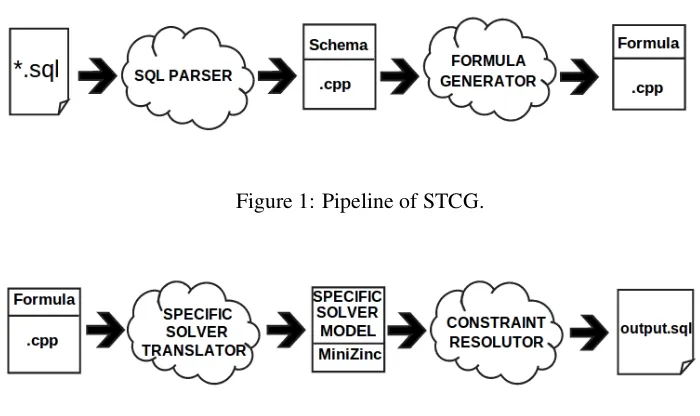
STCG can be seen as a pipeline, which helps to maintain and extend the implementation. In a first phase the prototype generates a representation in C++ of the CSP. This phase consists of two steps:
1. SQL parser: STCG includes a SQL parser to pre-process the input file. The result is a C++ representation of the database schema. This parser has been produced usingGNU Bison[GNU], a general-purpose parser generator, andFlex[CF04], a tool for generating scanners.
2. Formula Generator: The core of STCG. Takes as input the output of the previous step, and following Definition4described in section3, generates the first order logic formula representing the constraints associated to the table or view specified.
Figure1shows a diagram of this first phase. Next, we want to satisfy this formula by binding the logic variables, thus obtaining a positive test case if possible.
Figure 1: Pipeline of STCG.
Figure 2: Pipeline of STCG extended with an input builder for a solver.
logic formula into aMiniZinc model, so it can be solved, returning, if possible, the positive test-cases. Other constraint programing languages can be added by implementing new translators.
Below we present a system session for the example at hand. Consider that the input SQL file corresponds to Example1.
Following the pipeline, the SQL parser takes this file as input and generates an internal C++ representation of the database schema (it can be obtained at the command line using the ”-v” option of STCG). Suppose that the user intends to generate a test case for view checked indicating that tablesplayerandboardmust have two rows at most. Thus, theFormula Generator module takes the database schema as input and generates the following formula (where symbolic variables are of the formtable name.column name.row):
#(checked)=
{(((((board.id.0 == player.id.0) OR (board.id.1 == player.id.0)) AND ...
(not (((((board.x.0 - board.x.1) * (board.y.0 - board.y.1)) == 0) AND (board.id.1 != board.id.0)) OR ...))))),
{checked.id -> player.id.0}), ...}
This corresponds to θ(checked,board) without considering primary and foreign keys
(dis-played below). For the sake of space we display only part of the first formula and the first row
Primary key constraint of tableplayeris shown below. For simplicity, only logic formula for the first row{player.id→player.id.0}is displayed. That formula indicates that this table cannot have two players with the sameidattribute, that isplayer.id.0 != player.id.1.
#(player)={(player.id.0 != player.id.1), {player.id -> player.id.0}), ...}
Next, we display primary key and foreign key constraints ofboardfor the first row{board.x→
board.x.0, board.y→board.y.0, board.id→board.id.0}. That formula indicates thatidattribute of each row of this table must reference one ofid attributes of the table player (foreign key), that isboard.id.0 == player.id.0∧board.id.1 == player.id.0, and two pieces cannot be in the same game board position, that is(board.x.0 != board.x.1)∨(board.y.0 != board.y.1)(primary key). #(board)=
{(((board.id.0 == player.id.0) AND (board.id.1 == player.id.0)) AND ((board.x.0 != board.x.1) OR (board.y.0 != board.y.1)),
{board.x-> board.x.0,board.y-> board.y.0,board.id-> board.id.0}),...}
Actually, STCG generates only one formula, with primary key and foreign key constraints included, but we show them separated for simplicity.
The next step of the pipeline is to solve this constraints if possible. As mentioned above, we use the MiniZinc constraint modeling language for this purpose. We introduce a new step to the pipeline, that will translate ourFormulato aMiniZinc model. This model consists of four sections: variable declarations, constraint specification, solver invocation and output formatting. The model is saved in a file that can be later executed by MiniZinc, returning the positive test-case if possible. To obtain meaningful results we restrict the domain of symbolic variables to 1..5 in this session. In the future, our tool will support domain constraints of symbolic variables. The result returned by MiniZinc is:
INSERT INTO board(id,x,y) VALUES (1,1,1); INSERT INTO board(id,x,y) VALUES (2,1,5); INSERT INTO player(id) VALUES(1);
INSERT INTO player(id) VALUES(2);
This result is a positive test-case, written as a set of SQL insert statements that populates the tables of the database with the following data:
player id
1 2
board id x y
1 1 1 2 1 5
Thus, the board has player 1 in position (1,1) and player 2 in position (1,5) and both players arecheckedas defined in the example1. We can check that this instance is a positive test-case by executing the SQL queryselect * from checked, which returns the following non empty result:
5
Conclusions and Future Work
We have presented a technique for generating positive test-cases for sets of correlated SQL views. Our setting considers that a database instance constitutes a test-case for a view if the view com-putes at least one tuple with respect to the instance. Our proposal is to reduce the problem of obtaining a test-case to a Constraint Satisfaction Problem over finite domains. The generated constraints take into account primary and foreign key database constraints if they are defined in an SQL table definition statement. The work improves the proposal of [CGS10] by introducing a complete treatment of existential subqueries. In order to prove the correctness of the technique, a new operational semantics for SQL views without aggregates is introduced. The theoretical ideas have been implemented in a working prototype called STCG, available at:
https://gpd.sip.ucm.es/trac/gpd/wiki/GpdSystems/STCG
The prototype takes a set of views and the name of a particular viewV, and generates a positive test-case forV. It uses MiniZinc [NSB+07] as constraint modeling language. The output is given in the form of a list of SQLinsertcommands that create the database instance.
Although the framework presented is useful for many types of queries, including those defined by set operations and those queries including existential subqueries, it is only a first step since there are many useful SQL features still not supported by our tool. As immediate future work, we plan the integration of aggregate subqueries. The theoretical problem was already addressed in [CGS10], and the implementation seems straightforward. It would also be interesting to extend the SQL operational semantics to aggregates in order to prove the soundness of the proposal. Another limitation that must be solved is the inclusion of null values, which is currently not supported. However, the main limitation of the tool, and thus the main goal for our future work, is to extend the data types allowed for SQL columns. Currently the type of table attributes is limited to integer, and at leastvarchar (that is, string types) are required in order to obtain a really applicable tool.
Bibliography
[AO08] P. Ammann, J. Offutt.Introduction to Software Testing. Cambridge University Press, 2008.
[CF04] J. Coelho, M. Florido. CLP(Flex): Constraint Logic Programming Applied to XML Processing. InProceedings of the CoopIS/DOA/ODBASE. Pp. 1098–1112. Springer LNCS 3291, Heidelberg, Germany, 2004.
[CGS10] R. Caballero, Y. Garc´ıa-Ruiz, F. S´aenz-P´erez. Applying Constraint Logic Program-ming to SQL Test Case Generation. In Blume et al. (eds.),Functional and Logic Pro-gramming. Lecture Notes in Computer Science 6009, pp. 191–206. Springer Berlin / Heidelberg, 2010.
[CT04] M. J. S. Cabal, J. Tuya. Using an SQL coverage measurement for testing database applications. In Taylor and Dwyer (eds.),SIGSOFT FSE. Pp. 253–262. ACM, 2004. [GNU] GNU. Bison - GNU parser generator.
[GUW08] H. Garcia-Molina, J. D. Ullman, J. Widom.Database Systems: The Complete Book. Prentice Hall PTR, Upper Saddle River, NJ, USA, 2008.
[NSB+07] N. Nethercote, P. J. Stuckey, R. Becket, S. Brand, G. J. Duck, G. Tack. MiniZinc: Towards a Standard CP Modelling Language. In Bessiere (ed.). Lecture Notes in Computer Science 4741, pp. 529–543. Springer, 2007.
[SQL92] SQL, ISO/IEC 9075:1992, third edition. 1992.
[ST09] M. Surez-Cabal, J. Tuya. Structural Coverage Criteria for Testing SQL Queries. Jour-nal of Universal Computer Science15(3):584–619, 2009.