Available online throug
ISSN 2229 – 5046
EFFECTS OF VARIABLE THERMAL CONDUCTIVITY
ON HEAT AND MASS TRANSFER WITH JEFFERY FLUID
I. J. Uwanta* and E. Omokhuale
Department of Mathematics, Usmanu Danfodiyo University, P. M. B. 2346, Sokoto, Nigeria.
E-mail:
(Received on: 05-06-13; Revised & Accepted on: 20-03-14)
ABSTRACT
T
he effects of variable thermal conductivity on heat and mass transfer with Jeffery fluid has been investigated in this paper. The equations have been solved numerically by implicit finite difference schemes of Crank – Nicolson type. Results are shown graphically for the velocity profile, the temperature profile, and the concentration profile with different values of physical parameters like Jeffery parameter, thermal Grashof number, mass Grashof number, Schmidt number, Prandtl number, magnetic parameter, chemical reaction parameter, permeability parameter, suction parameter, heat generation parameter, and Eckert number. It is observed that the velocity becomes higher as Gr, Gc, Ec, S, K,γ
, and t increased but decreases for Pr, Sc, M, R, andλ
1. The temperature profile increases due to the presence of heat generation, and time but reduces for increased values of Prandtl number and suction. Similarly, concentration rises with time, and decreases with increasing values of Schmidt number Sc, radiation and suction. Key words and Phrases: Heat and mass transfer, Jeffery fluid and variable thermal conductivity.1. INTRODUCTION
Heat and mass transfer in porous medium are known to have applications in industrial, chemical engineering, nuclear reactors, geophysical and in petroleum industries. Recent developments in binary flow of mixtures and the determination of molecular weights, separation of isotopes, food processing, filtration process lead to increased investigations on understanding such flow Alam et al. [3].
There are industrial applications of flows of electrically conducting fluids in the fields of geothermal systems, nuclear reactors, filtration, etc. where the conducting fluid flows through a porous medium which also rotates about an axis. There is one subclass of non – Newtonian fluids called Jeffery fluid, the fluid model is capable of describing the characteristics of relaxation and retardation times Hayat et al. [13].
Nadeem et al. [17] analyzed the boundary layer flow of a Jeffery fluid over exponentially stretching surface. The effect of thermal radiation was carried out for two cases. The reduced similarity equations were then solved by homotopy analysis method (HAM). The effects of physical parameters were examined. Afsar Khan et al. [2] investigated the peristaltic flow of Jeffery fluid with variable viscosity through porous medium in an asymmetric channel. They obtained analytic solutions for stream function velocity, pressure gradient, and pressure rise by regular perturbation. Malga and Kishan [16] examined the unsteady free convection mass transfer boundary layer flow past an accelerated infinite vertical porous plate with suction by taking into account viscous dissipation. The effect of linear thermal stratification in stable stationary ambient fluid on steady MHD convective flow of a viscous incompressible electrically conducting fluid along a moving, non- isothermal vertical plate in the presence of mass transfer, Soret and Dufour effects and heat generation or absorption is investigated by Subhakar et al. [29]. Shateyi and Motsa [22] studied unsteady magnetohydrodynamics convective heat and mass transfer past an infinite vertical plate in a porous medium with thermal radiation, Heat generation /absorption and chemical reaction. Rawat et al. [20] examined two dimensional, laminar boundary layer flow and mass transfer of micropolar chemically reacting fluid past a linearly stretching surface embedded in a porous medium. The effects of variable viscosity and thermal conductivity on the flow and heat transfer in a laminar liquid on a horizontal shrinking / stretching sheet is analyzed by Khan et al. [15]. Shrama and Singh [26] investigated the effect of temperature dependent electrically conductivity on steady natural convection flow of a viscous incompressible low prandtl electrically conducting fluid along an isothermal vertical and exponentially decaying heat generation. Aruna Kumari et al. [5] studied the effects of magnetic field on free convective flow of
Corresponding author: I. J. Uwanta*
Department of Mathematics, Usmanu Danfodiyo University, P. M. B. 2346, Sokoto, Nigeria.
© 2014, IJMA. All Rights Reserved 136
Jeffery fluid past an infinite vertical porous plate with constant heat flux. Sreedharamalle et al. [21] examined unsteady flow of a Jeffery fluid in an elastic tube with stenosis numerically. Kavita et al. [14] analyzed influence of heat transfer on MHD oscillatory flow of a Jeffery fluid in a channel. Sharma and Singh [23] investigated the flow of a viscous incompressible electrically conducting fluid along a porous vertical isothermal non- conducting plate with variable suction and exponentially decaying heat generation in the presence of transverse magnetic field numerically. Oscillatory flow of a Jeffery fluid in an elastic tube of variable cross- section was examined numerically by Bandari Narayana et al. [6]. The effects of mass diffusion on chemical species with first – order reaction on peristaltic motion of an incompressible Jeffery fluid is studied by El – Sayed et al. [11]. The effects of variable thermal conductivity on the coupling of conduction and joule heating with MHD free convection flow along vertical plate is examined by Nasrin and Alim [18]. Sharma and Singh [24] discussed effects of variable thermal conductivity and heat source/ sink on flow of a viscous incompressible electrically conducting fluid in the presence of uniform transverse magnetic field and variable free stream near stagnation point on a non – conducting stretching sheet numerically using shooting method. Chain [8] analyzed heat transfer in a fluid with variable thermal conductivity over stretching sheet. Sher Akbar et al.
[25] investigated the influence of heat and mass transfer on blood flow through tapered artery with a stenosis. The study of convective heat and mass transfer characteristics of an incompressible MHD visco-elastic fluid flow immersed in a porous medium over a stretching sheet with chemical reaction and thermal stratification effects has been carried out by Alharbi et al. [4]. Uwanta [30] studied numerically the steady two dimensional flow of an incompressible viscous fluid with heat and mass transfer and MHD radiation past an infinite vertical plate in a porous medium using fourth order Runge – Kutta method and shooting technique. Bisht et al. [7] examined the steady incompressible mixed convection boundary layer flow with variable fluid properties and mass transfer inside a cone due to a point sink at the vertex of the cone numerically. Geethy and Moorthy [12] carried out an analysis for a two – dimensional steady flow of an electrically conducting viscous incompressible fluid past a continuously moving surface in the presence of uniform transverse magnetic field surface with chemical reaction numerically. Uwanta and Omokhuale [31] analyzed viscoelastic fluid flow in a fixed plane with heat and mass transfer. Heat and mass transfer in MHD viscoelastic fluid over a stretching sheet with variable thermal conductivity, non – uniform heat source and radiation was studied by Abel and Mahesha [1].
Prasad et al. [19] used Crank-Nicolson scheme to analyse the transient convective heat and mass transfer with thermal radiation effects along a vertically impulsively started plane. Dada and Adefolaju [10] studied dissipative, MHD and radiation effects on an unsteady convective heat and mass transfer in a Darcy-Forcheimer porous medium. Among other authors that used this method is Sangapatnam et al. [27] who investigated the thermal radiation and mass transfer effects on MHD free convection dissipative fluid flow past impulsively- stated vertical plate.
In this paper, the effects of variable thermal conductivity on heat and mass transfer with Jeffery fluid is studied. This work is an extension of Soundalgekar et al. [28]. The resulting equations have been solved numerically by implicit finite difference schemes of Crank – Nicolson type. It is clear from results that, the velocity becomes higher as thermal Grashof number, mass Grashof number, Eckert number, heat generation, permeability parameter, suction, and time increased but decreases for Prandtl number, Schmidt number, magnetic parameter, chemical reaction parameter, and Jeffery parameter. The temperature profile increases due to the presence of heat generation, and time but reduces for increased values of Prandtl number and suction.
2. FORMULATION OF THE PROBLEM
Consider an unsteady two–dimensional heat and mass transfer flow of an electrically conducting incompressible viscous fluid past an infinite vertical plate moving with Jeffery fluid. As the plate is infinite in extent, the physical variables are functions of
y
′
andt
′
wherey
′
is taken normal to the plate and thex
′
-direction is taken along the plate in the vertical upward direction, where fluid suction or injection and magnetic field are imposed at the plate surface. The temperature and concentration of the fluid are raised toT
w′
andC
w′
respectively and are higher than the ambient temperature and that of fluid. In addition, the effects of variable thermal conductivity is taken into account. It is assumed that induced magnetic field is negligible, viscous dissipation and the heat generated are not neglected.The governing equations of the flow under the usual Boussinesq and boundary-layer approximation can be written as (See Soundalgekar et al. [28], Dada and Adefolaju [10]):
0
v
y
′
∂
=
′
∂
(1)(
)
(
)
2 2 * 0 2 * 11
B
u
u
u
v
u
u
g
T
T
g
C
C
t
y
y
K
σ
ν
ν
β
β
λ
ρ
∞ ∞′
′
′
∂
′
∂
∂
′
′
′
′
′
′
+
=
−
−
+
−
+
−
′
′
′
© 2014, IJMA. All Rights Reserved 137
(
)
(
)
20
1
k
T
T
T
Q
u
v
m T
T
T
T
t
y
Cp y
y
Cp
Cp
y
µ
ρ
∞ρ
∞′
′
′
′
∂
′
∂
∂
′
′
∂
′
′
∂
+
=
+
−
+
−
+
′
′
′
′
′
∂
∂
∂
∂
∂
(3)(
)
2
* 2
C
C
C
v
D
R C
C
t
y
y
∞′
′
′
∂
+
′
∂
=
∂
−
′
−
′
′
′
′
∂
∂
∂
(4)with the following initial and boundary conditions:
0,
0,
,
0,
,
,
0
0,
,
p w w
t
u
T
T C
C for all y
t
u
u T
T C
C at y
u
T
T C
C as y
∞ ∞
∞ ∞
′
≤
′
=
′
→
′ ′
→
′
′
′
>
′
=
′
=
′ ′
=
′
′
=
′
→
′
→
′ ′
→
′
′
→ ∞
(5)
where u and v are velocity components in
x
′
andy
′
directions respectively, T is the temperature, t is the time, g is the acceleration due to gravity, β is the thermal expansion coefficient,β
∗ is the concentration expansion coefficient,υ
is the kinematic viscosity,D
is the chemical molecular diffusivity,C
pis heat capacity at constant pressure,B
0is a constant magnetic field intensity,σ
is the electrical conductivity of the fluid,k
0 is the variable thermal conductivity,ρ
is the density,λ
1 is the Jeffery fluid, Tw is the wall temperature, T∞ is the free stream temperature,C
wis the speciesconcentration at the plate surface,
C
∞is the free stream concentration,Q
is the heat generation coefficient.v
0>
0
is the suction parameter andv
0<
0
is the injection parameter. On introducing the following non-dimensionless quantities(
)
(
)
(
)
(
)
0 0 0
2
0 0
2 * 2 3
0 0 0
* *
3 2 2
0 0 0
2
0 0
,
,
,
,
,
Pr
,
,
,
,
,
,
,
,
p p
o
u
T
T
C
C
u
y
t
u
u
y
t
C
u
u
h
t
T
T
C
C
g
T
T
k
B
M
K
Gr
Cp
u
K u
u
g
C
C
R
Q
Gc
Sc
R
S
u
D
u
Cpu
u
v
Ec
m T
T
Cp T
T
u
ω ω ω ω ω ω
θ
βν
σ ν
ν
µ
ρ
β ν
ν
ν
ν
ρ
γ
η
∞ ∞ ∞ ∞ ∞ ∞ ∞ ∞′
′
′
′
′
′
′
′
−
−
=
=
=
=
=
=
′
−
′
′
−
′
′
−
′
=
=
=
=
′
−
′
=
=
=
=
′
′
=
=
=
−
′
−
′
(6)where,
u
0,h
, andt
0are reference velocity, length and time respectively.Using (1) and (6), equations (2) - (5) are transformed to the following:
2 2 1
1
1
u
u
u
Mu
Ku
Gr
GcC
t
γ
y
λ
y
θ
∂
∂
∂
−
=
−
−
+
+
∂
∂
+
∂
(7)(
)
22 21
1
Pr
Pr
u
S
Ec
t
y
y
y
y
θ
γ
θ
ηθ
θ η θ
θ
∂
−
∂
=
+
∂
+
∂
+
+
∂
∂
∂
∂
∂
∂
(8)2 2
1
C
C
C
RC
t
γ
y
Sc y
∂
−
∂
=
∂
−
∂
∂
∂
(9)The corresponding boundary conditions are:
0,
,
0
,
,
0
0,
,
p w w
u
T
T C
C for all y t
u
u T
T C
C at y
u
T
T C
C as y
∞ ∞ ∞ ∞
=
→
→
≤
=
=
=
=
→
→
→
→ ∞
(10)© 2014, IJMA. All Rights Reserved 138
the suction parameter,
S
is the heat generation parameter,Ec
is the Eckert number.η
is a constant. Also,u
0, H and0
t
These equations (7) to (10) are now solved by implicit finite difference schemes of Crank – Nicolson type. The finite difference approximations of these equations are as follows:(
)
( )
( )
, 1 , 1, , 1, 1 , 1 1, 1 1, , 1,
2 2
2
2
1
2 1
i j i j i j i j i j i j i j i j i j i j
i
u
u
u
u
u
u
u
u
u
u
t
γ
y
λ
y
y
+
−
+−
− +−
++
+ + −−
+
+
−
=
+
∆
∆
+
∆
∆
(
, 1 ,) (
, 1 ,)
(
, 1 ,)
(
, 1 ,)
2
i j i j2
i j i j2
i j i j2
i j i jM
K
Gr
Gc
u
+u
u
+u
θ
+θ
C
+C
−
+
−
+
+
+
+
+
(11)(
)
( )
( )
, 1 , 1, , 1, 1 , 1 1, 1 1, , 1,
, 1 , 2 2
2
2
1
1
2 Pr
2
i j i j i j i j i j i j i j i j i j i j
i j i j
t
y
y
y
θ
θ
θ
θ
η
θ
θ
θ
θ
θ
θ
γ
θ
θ
+ + − + + + + − + +
−
−
−
+
−
+
−
=
⋅ +
+
+
∆
∆
∆
∆
(
)
2 21, , 1, ,
, 1 ,
Pr
2
i j i j i j i j
i j i j
u
u
S
Ec
y
y
θ
θ
η
+θ
θ
++
−
−
+
+
+
+
∆
∆
(12)( )
( )
, 1 , 1, , 1, 1 , 1 1, 1 1, , 1,
2 2
2
2
1
2
i j i j i j i j i j i j i j i j i j i j
C
C
C
C
C
C
C
C
C
C
Sc
t
γ
y
y
y
+
−
+−
− +−
++
+ + −−
+
+
−
=
+
∆
∆
∆
∆
(
, 1 ,)
2
i j i jRSc
C
+C
−
+
(13)The initial and boundary conditions becomes
,0 ,0 ,0
,0 ,0 ,0
,0 ,0 ,0
0,
0,
0 for all i except
0
,
1,
1
0,
1,
1
i i i
i p i i
L L L
u
C
i
u
u
C
u
C
θ
θ
θ
=
=
=
=
=
=
=
=
=
=
(14)where L corresponds to
∞
. The suffix i corresponds to y and j is equals to t. consequently,∆ =
t
t
j+1−
t
jand1
i i
y
y
+y
∆ =
−
.3. NUMERICAL METHODS
In order to access the effects of parameters on the flow variables namely; Jeffery parameter, thermal Grashof number, mass Grashof number, Schmidt number, Prandtl number, magnetic parameter, chemical reaction parameter, permeability parameter, suction parameter, heat generation parameter, and Eckert number on the velocity, temperature and concentration, and have grips of the physical problem, the unsteady coupled non-linear partial differential equations (7) – (9) with boundary conditions (10)have been solved by implicit finite difference schemes of Crank – Nicolson type. This method has been extensively developed in recent years and remains one of the best reliable methods for solving partial differential equation because it converges fast and is unconditionally stable. The finite difference approximations of these equations were solved by using the values for Gr = Gc = M =
η
= 1,λ =
10.5
,Pr = 0.71, Sc = 0.6, S= 0.2, Ec = 0.2, R = 0.5, K= 0.5, except where they are varied. A step size of
∆
Y
= 0.01 is used for the intervalY
min= 0 toY
max= 5 for a desired accuracy and a convergence criterion of 10-6 is satisfied for various parameters.4. RESULT AND DISCUSSION
Knowing the values of C,
θ
, u at time t, the values at a timet
+ ∆
t
can obtained as follows. Substituting1, 2,...,
1
i
=
L
−
in (13) which results in a tri-diagonal system of equations in unknown values of C. Using initial and boundary conditions, the system can be solved by Gauss elimination method Carnahan et al. [9]. Thus C is known at all values of y at timet
+ ∆
t
. Then the known values of C and applying the same procedure and using boundary onditions, similarly calculateθ
and u from (12) and (11). This procedure is continued to obtain the solution till desired time t. If1
M
m
K
Gc
S
0
© 2014, IJMA. All Rights Reserved 139
Velocity profiles
Figures 1 to 14 represent the velocity profiles with varying parameters respectively.
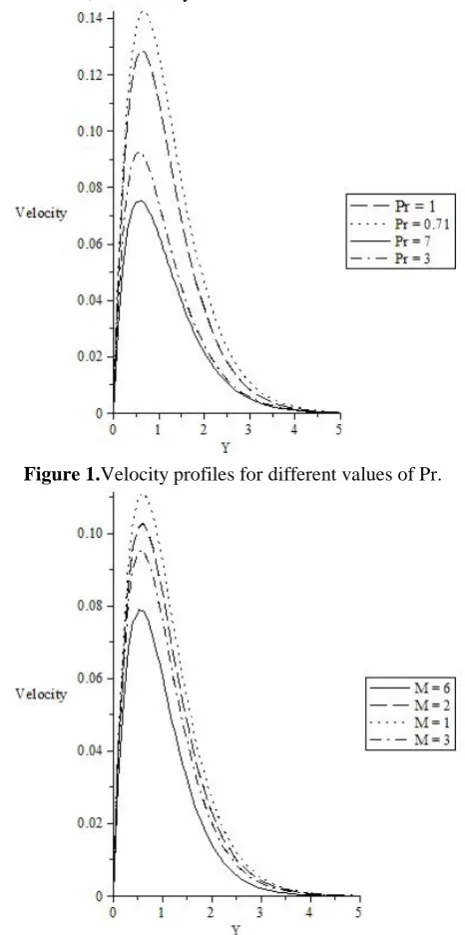
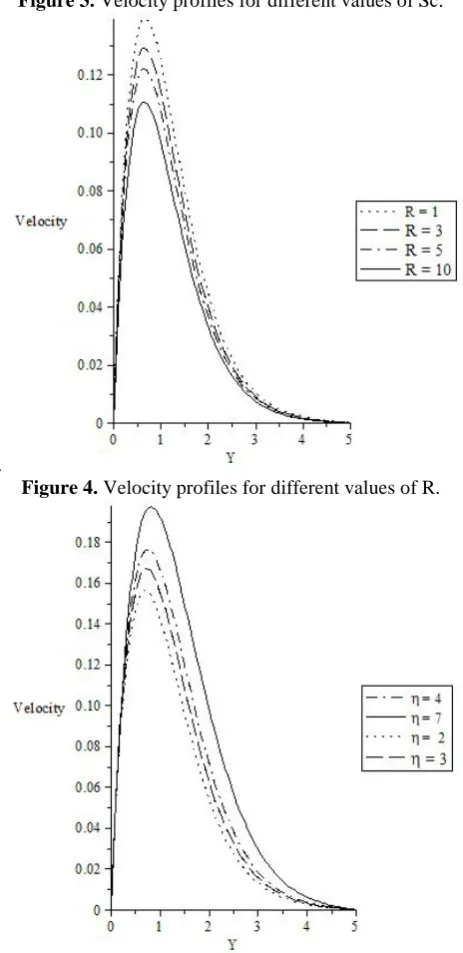
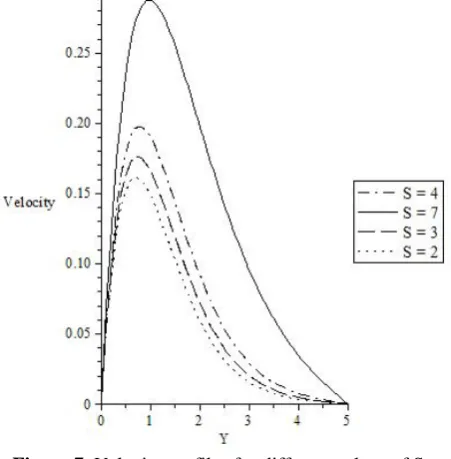
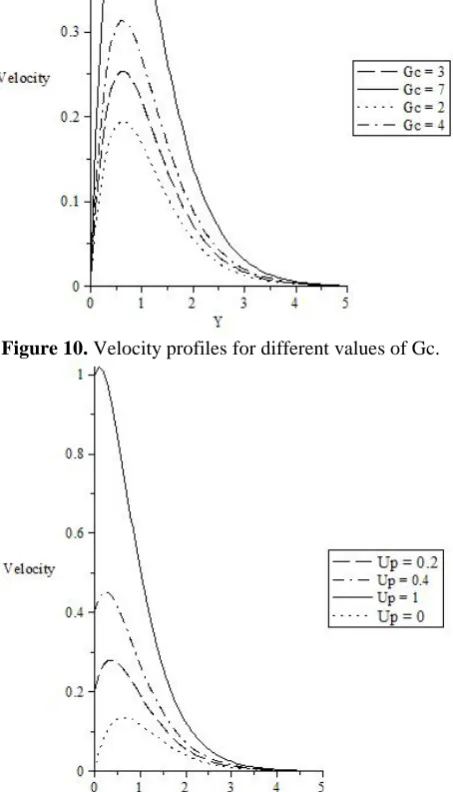
Figure 1 shows the effect of Prandtl number on the velocity. It is observed that, the velocity decreases with increasing Prandtl number. Influence of Hartmann number M on the velocity is shown in figure 2. It is found that, the velocity decreases with the increase in magnetic parameter. Figure 3 depicts variation of Schmidt number on the velocity profile. It is noted that, the velocity decreases with decrease in Schmidt number. Chemical reaction parameter on the velocity profile is depicted in figure 4. It is observed that, the velocity decreases with increasing chemical reaction parameter. Figure 5 illustrates different values of constant
η
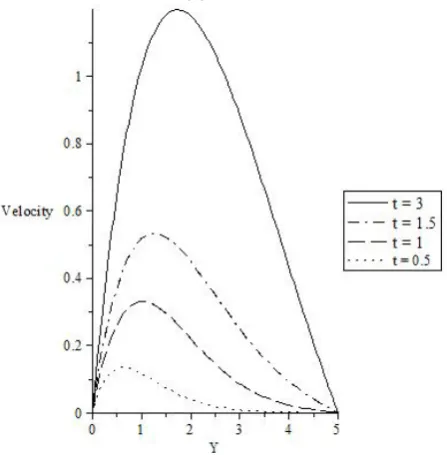
on the velocity. It is found that, the velocity increases with the increase of the constant. Effect of Jeffery parameter on the velocity is illustrated in figure 6. It is clear that, the velocity decreases with increase in Jeffery parameter. Figure 7 shows that with the increase in heat generation, the velocity of the fluid increases. Influence of suction parameter on the velocity is demonstrated in figure 8. It is seen that, the velocity is higher with due to an increase in suction parameter. Figure 9 represents different values of thermal Grashof number on the velocity, it is noted that, the velocity rises with increasing thermal Grashof number. In figure 10, the effect of mass Grashof number on the velocity is presented. It is observed that, the velocity increases with increase in mass Grashof number. The influence of Up on the velocity is given in figure 11. It is noticed that, the velocity rises with an increase in Up. Figure 12 shows that for an increase in time, the velocity rises.13 illustrates the variation of permeability parameter on the velocity. It is shown that, the velocity falls with increase of permeability parameter. In figure 14, it is observed that, the velocity increases with for different values of Eckert number.Figure 1.Velocity profiles for different values of Pr.
© 2014, IJMA. All Rights Reserved 140
Figure 3. Velocity profiles for different values of Sc.
.
Figure 4. Velocity profiles for different values of R.
© 2014, IJMA. All Rights Reserved 141
Figure 6. Velocity profiles for different values of
λ
1.Figure 7. Velocity profiles for different values of S.
© 2014, IJMA. All Rights Reserved 142
Figure 9. Velocity profiles for different values of Gr.
Figure 10. Velocity profiles for different values of Gc.
© 2014, IJMA. All Rights Reserved 143
Figure12. Velocity profiles for different values of t.
Figure 13.Velocity profiles for different values of K.
© 2014, IJMA. All Rights Reserved 144
4.2 Temperature profiles
Figures 15 to 19 demonstrate the temperature profiles.
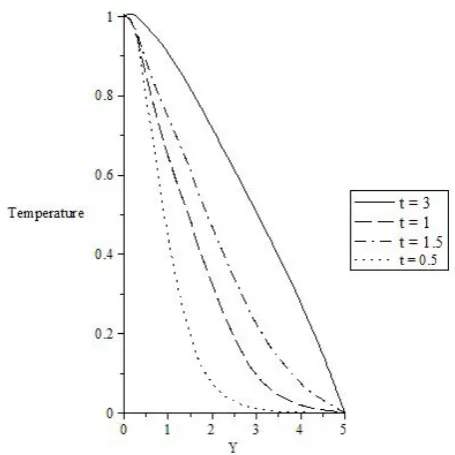
In figure 15, the influence of Prandtl number on the velocity is shown. It is seen that, the temperature decreases when the Prandtl number is reduced. Figure 16 represents effect of heat sink on the temperature. It is depicted that, the temperature increases with increase in heat generation. Variation of suction parameter on the temperature is illustrated in figure 17. It is observed that, the temperature decreases with decrease in the suction parameter. Figure 18 depicts the effect of constant
η
on the temperature. It is noted that, the temperature rises when the constant is higher. In figure 19, it is presented that, the temperature increases with increasing time.Figure 15. Temperature profiles for different values of Pr.
© 2014, IJMA. All Rights Reserved 145
Figure 17. Temperature profiles for different values of
γ
.Figure 18.Temperature profiles for different values of
η
.
.
© 2014, IJMA. All Rights Reserved 146
4.3Concentration profiles
Figures 20 to 23 are the concentration profiles.
Effect of Schmidt number on the concentration is presented in figure 20. It is noted that, the concentration is lower due to increasing Schmidt number. In figure 21, the influence of chemical reaction parameter on the concentration is shown. It is demonstrated that. The concentration is lower as the chemical reaction parameter is increased. Figure 22 displays the variation of suction parameter on the concentration. It is seen that, the concentration deceases with decreasing suction parameter. In figure 23, It is observed that the concentration rises with an increase in the time.
Figure 20. Concentration profiles for different values of Sc.
© 2014, IJMA. All Rights Reserved 147
Figure 22. Concentration profiles for different values of
γ
.Figure 23. Concentration profiles for different values of t.
5. CONCLUSIONS
Effects of variable thermal conductivity on heat and mass transfer with Jeffery fluid is studied. A set of non-linear coupled differential equations governing the fluid velocity, temperature and chemical species concentration is solved numerically for various material parameters. The velocity becomes higher when Gr, Gc, Ec, S, K,
η
,γ
, and t is increased. Also, decreases of Pr, Sc, M, R, andλ
1lead to sharp fall in the velocity of the boundary layer. The temperature profile increases in the presence of heat generation, and time but reduces for increased values of Prandtl number and suction. Similarly, concentration rises with time, and decreases with increasing values of Schmidt number Sc, radiation and suction.COMPETING INTEREST
The authors declare that they have no competing interest.
AUTHORS’ CONTRIBUTIONS
© 2014, IJMA. All Rights Reserved 148
ACKNOWLEDGMENTS
The authors are very grateful to the anonymous referees for their valuable suggestions.
REFERENCES
[1] M. S. Abel, and N. Mahesha, Heat transfer in MHD viscoelastic fluid over a stretching sheet with variable thermal conductivity, non – uniform heat source and radiation, Appl. Math. Model 32 (10) (2008), 1165 – 1983.
[2] A. Afsar Khan, R. Ellahi, and K. Vafai, Peristaltic transport on a Jeffery fluid with variable viscosity through a porous medium in asymmetric channel,Advances in Math. Phy. 10 (1155) (2012), 1-15.
[3] M. S. Alam, M. Ferdows, M. Ota and M. A. Maleque, Dufour and Soret effects on steady free convection and mass transfer flow past a semi infinite vertical porous plate in a porous medium, International Journal Applied Mechanics and Engineering, 11(3) (2006), 535- 545.
[4] S. M. Alharbi, M. A. A. Bazid, and M. S. El Gendy, The study of convective heat and mass transfer characteristics of an incompressible MHD visco-elastic fluid flow immersed in a porous medium over a stretching sheet with chemical reaction and thermal stratification effects, Appl. Mathematics (2010), 446 – 455.
[5] B. Aruna Kumari, K. Ramakrisna Prasad, and K. Kavitha, Effects of a magnetic field on the free convective flow of Jeffery fluid past an infinite vertical porous plate with constant heat flux, Int. J. of Math. Ach. 3(6) (2012), 2240 – 2248.
[6] C. H. Badari Narayana, S. Sreenadh, and P. Devaki, Oscillatory flow of a Jeffery fluid in an elastic tube of variable cross – section, Advances in Applied Science Research 3 (2) (2012), 671 – 677.
[7] V. Bisht, M. Kumar, and Z. Uddin, Effects of variable thermal conductivity and chemical reaction on steady mixed convection boundary layer flow with heat and mass transfer inside a cone due to a point sink,J. of Appl. Fluid Mech.
4(4) (2011), 59 – 63.
[8] T. C. Chain, Heat transfer in a fluid with variable thermal conductivity over stretching sheet, Acta Mech. 129 (1998), 63 – 72.
[9] B. Carnahan, H. A. Luther, and J. O. Willkes , Applied numerical method, John Wiley and Sons New York, USA, 1969.
[10] M. S. Dada and F. H. Adefolaju, Dissipative, MHD and radiation effects on an unsteady convective heat and mass transfer in a Darcy-Forcheimer porous mediu, J. of Math. Research 4(2) (2012), 110-127.
[11] M. F. El – Sayed, N. T. M. Eldabe, and A. Y. Ghaly, Effects of chemical reaction, heat and mass transfer on Non – Newtonian fluid flow in a porous medium in vertical perisitic tube,Transport Porous Medium 89 (2011), 185 – 212.
[12] P. Geetha, and M. B. Moorthy, MHD boundary layer flow of heat and mass transfer on a continuously moving surface with chemical reaction, European J. of Scientific Research, 56 (3) ( 2011), 354 – 363.
[13] T. Hayat, Z. Iqbal, M. Mustafa, and A. Alsaedi, Unsteady flow and heat transfer of Jeffery fluid over a stretching sheet, Acta Mechanica 105 (2008), 49 – 56.
[14] K. Kavita, K. Ramakrishna Prasad, and B. Aruna Kumari, Influence of heat transfer on MHD oscillatory flow of a Jeffery fluid in a channel, Advances in Science Research 3(4) (2012), 2312 – 2325.
[15] Y. Khan, Q. Wu, N. Faraz, and A. Yildirim , The effects of variable thermal conductivity on a thin film flow over a shrinking/stretching sheet, Computer and Mathematics with Applications 61(11) (2011), 3389 – 3399.
[16] B. S. Malga and N. Kishan, Viscous dissipation effects unsteady free convection and mass transfer flow past an accelerated vertical porous plate with suction, Advances in Appl. Sciences Research 2 (6) (2011), 460 – 469.
[17] S. Nadeem, S. Zaheer, and T. Fang, Effects of thermal radiation on the boundary layer flow of a Jeffery fluid over an exponentially stretching surface, numerical algorithms 57 (2) (2011), 187 – 205.
© 2014, IJMA. All Rights Reserved 149
[19] R. V. Prasad, B. N. Reddy, and R. Muthukumaraswamy, Radiation and mass transfer effects on two-dimensional flow past an impulsively stated infinite vertical plate, Int. J. of Thermal Science, 46(12) (2007), 1251-1258.
[20] S. Rawat, S. Kapoor, R. Bhagrava and O. Anwar Beg, Heat and mass transfer of a chemically reacting micropolar fluid over a stretching Sheet in Darcy Forcheimer porous medium, Int. J. of Computer Applications, 44(6) (2012), 40 – 51.
[21] S. Sreedharamelle, D. Palluru, and D. Krishnaiah, Unsteady flow of a Jeffery fluid in an elastic tube with a stenosis, Int. Conference on fluid Dynamics and Themodynamics Technologies 33(2012) (2012),136 – 142.
[22] S. Shateyi, and S. Motsa, Unsteady magnetohydrodynamics convection heat and mass transfer past an infinite vertical plate in a porous medium with thermal radiation, heat generation / absorption and chemical reaction, Advance Topics in Mass Transfer 5(3) (2011), 146 – 162.
[23] P. R. Sharma, and G. Singh, Unsteady MHD free convective flow and heat transfer along a vertical porous plate with variable suction and internal heat generation, Int. J. of Math. and Mech. 4 (5) (2008), 1- 8.
[24] P. R. Sharma, and G. Singh, Thermal conductivity and heat source/sink on MHD flow near a stagnation point on a linearly stretching sheet, J. of Appl. Fluid Mech. 2 (1) (2009), 13 – 21.
[25] N. Sher Akbar, S. Nadeem and C. Lee. Influence of heat and mass transfer on phan –thien – tanner fluid model for blood flow through tapered artery with a stenosis, Scientific Research and Essays 7 (43) (2012), 3737 – 3750.
[26] P. R. Shrama, and G. Singh, Steady MHD natural convection flow with variable electrical conductivity and heat generation along isothermal vertical plate, Tamkang J. of Science and Engineering 13(3) (2010), 235 – 242,.
[27] S. Sangapatnam, R. Nandanoor, and R. P. Vallampati , Radiation and mass transfer effects on MHD free convection flow past impulsively-stated isothermal vertical plate with dissipation, Thermal Science 13(2) (2009), 171-181.
[28] V. M. Soundalgekar, A. G. Uplekar, and B. S. Jaiswal, Transient free convection flow of dissipative fluid past an infinite vertical porous plate, Achieve of Mech. 56(1) (2004), 7 – 17.
[29] M. J. Subhakar, K. Gangadhar, and Bhaskar, N. Reddy, Soret and Dufour effects on MHD convective flow of heat and mass transfer over vertical moving non – isothermal vertical plate with heat generation/absorption, Advances in Appl. Science and Research 3(5) (2012), 3165 – 3187.
[30] I. J. Uwanta, Effects of chemical reaction and radiation on heat and mass transfer past a semi vertical porous plate with constant mass flux and dissipation, European J. of Scientific Research 87 (2) (2012), 190 – 200.
[31] I. J. Uwanta, and E. Omokhuale, Viscoelastic fluid flow in a fixed plane with heat and mass transfer, Research J. of Math. and Stat. 4 (3) (2012), 63 – 69.