International Journal Advances in Social Science and Humanities
Available online at: www.ijassh.com
RESEARCH ARTICLE
Influence of Electronic Media on Behaviour Problems among Selected
Kenyan Secondary School Students
Rosempta N John, Peter JO Aloka*, Sr Sabina Mutisya
Department of Psychology, Faculty of Education, Catholic University of Eastern Africa, Nairobi, Kenya. *Correponding Author: Email:[email protected]
Abstract
The study investigated the influence of electronic media on behaviour problems among Secondary School Students in Mukaa District, Makueni County of Kenya. The study adopted the Bandura’s Social Learning theory. The study employed descriptive cross-sectional survey design and the targeted population included all students and teachers in charge of discipline and guidance and counselling departments. The study sample size comprised 300 students and 20 teachers. Questionnaires were used to gather data. The findings reported that, different contents were accessed by the students from the electronic media and that it affected students’ behaviour both positively and negatively. The study recommended that, school administration and teachers need to sensitize students on the harmful effects of electronic media for which they seem to be attracted to and even sometimes demanding to access them.
Keywords:Behaviour problems, Electronic media, Students, Influence, Kenya, Secondary schools.
Introduction
In the current society, technology and adolescents seem to be destined for each other in that, both are young, fast paced, and ever changing. According to [1], previous generation of teens readily embraced new technologies and especially electronic media, such as record players, TVs, cassette players, computers, and VCRs. However, the past two decades have witnessed a virtual explosion in new technology, including cell phones, iPods, MP-3s, DVDs, and PDAs (Personal Digital Assistants). Moreover, this new technology has been eagerly embraced by adolescents and has led to an expanded vocabulary, including instant messaging, blogging, and text messaging. Consequently, youth are spending increasing amounts of time using electronic media, with the average American youngster now spending one-third of each day with some form of electronic media [2]. As a result, this has led to a phenomena of electronic aggression perpetrated through technology such as harassment or bullying (teasing, telling lies, making fun of someone, making rude or mean comments, spreading rumours, or making threatening or aggressive comments) that occurs through email, a chat room, instant messaging, a website (including blogs), or text messaging. Brown et.al [3] noted that electronic media had many social and educational benefits and risks, that caregivers and educators had expressed concern
about the dangers young people can be exposed to through these technologies. Moreover, [4] notes that radio, television (TV), movies, video games, cell phones, and computer networks have assumed central roles in our children's daily lives. Actually, the media has demonstrated potentially profound effects, both positive and negative, on children's cognitive, social, and behavioural development. This is in agreement with a study that had reviewed a decade of research concerning television and youth in the United States and concluded that, children will have viewed 200,000 acts of violence and 16,000 murders by the time they are 18 years of age [5].
for access whenever possible, most often in Internet cafes. This has been the case in African countries whereby radios, televisions and mobile phones stand out in Africa’s media of communication. Samora M [6] reported that 72% of all Ghanaians in Ghana had mobile phones in their homes and 86% own radio nationally, While Kenyans had 71% mobile phones at home and 87% homes had radio. In connection to this, mobile phones are rivaling radio and televisions as the most accessible communication media and entertainment platforms in both Kenya and Ghana.
Considering Kenya, social networking has become the trend among the young people. Having computers and advanced cell-phones has enabled easy access to emails, chartrooms, Facebook and twitter services which are facilitated by the internet. Furthermore, according to an East Africa Survey uptake of Facebook among urban youth, it was reported that among youth between the ages 7 and 24 years in Kenya, Uganda and Tanzania, there are interesting aspects concerning the accessibility and use of internet towards communication and entertainment [7]. Additionally, the research revealed that, 35% of the targeted group in the entire region had access to the internet with Kenya leading the pack at 49% with internet access, Tanzania at 30% and Uganda at 26%. Moreover, the study also indicated that, of these 74% in Kenya are on an online social network and Uganda had 59% networks across the entire region. This information seems to have implications because the youth between 7 and 24 years forms the age group of Kenya’s Secondary School Students. This is because electronic media seems to be providing the youth with the music they want, computer games, videos and information hence spending most of their time watching television, listening music and goggling Internet from the ever available mobile phones to satisfy their curiosity. As result, activities that require focused attention, such as reading, are declining among the youth, while activities that depend on multitasking, such as instant messaging are increasing.
Kariuki J et. al. [8] reported that learners in Kenya secondary schools were spreading strike messages through text messages using mobile phones which have been sneaked into the schools. On the same vein, Strassberg et. Al. [9] reported that, more than hundred students in Tetu district of Kenya went on strike after one of the students was suspended for having a mobile phone in school. Messages on strikes being passed through mobile phones can make schools to be rocked
by violent strikes at a particular time of the year when no one is aware of the cause. This further explains why the current study is focused on finding out how electronic media could be influencing secondary school students’ discipline as increased use of televisions, radios, computers and cell-phones has not only benefited the society but also disadvantaged some of its members especially the youth. Moreover, it is widely accepted that media has profound influence on child health, including violence, obesity, tobacco and alcohol use, and risky sexual behaviors. This may imply that students’ discipline is an issue that has been and continues to remain in school settings. According to [10], school violence that rocked schools in Kenya and Uganda during the first half of the year 2008 was blamed on peer influence, bad parenting, laxity in teaching service, sloppiness in ministry of education, media, the mobile phones, pocket money and drugs. Wanjiru [11] added that the most common types of discipline cases included drug abuse, school strikes, stealing, fighting, bullying, sneaking from school, sexual assault and homosexuality. To date these and other discipline cases have continued to be reported in schools amongst students. School administrations, teachers and other stakeholders seem to wonder what has continued to influence students discipline negatively. This calls for the researcher to investigate into what is causing this discipline issues despite there being school rules and regulations which students are expected to follow or face punishment.
by so many boys, how they enjoyed so many bottles of soda and to them this boosts their self-perception and esteem unlike those girls who have not been recognized by any boy. Boy girl relationships and sexual conduct in schools is a disciplinary issue which is punishable by the schools’ authority. Despite this awareness, students still go ahead forming boy girl relationships and practicing sex. It has been noted that most of these schools are located near market centres which have cyber cafes and video shops. Since these schools are both day and boarding, most of the day scholar students spend good time in these places after school and over the weekends. Sometimes, some students sneak out of school to watch videos and play computer games in the market. This worsens when schools close over the holidays as boarding students and day scholar students flock into these market centres to play computer games, watch videos, and download their favorite music and access internet services. In the homes there are televisions, cell phones and computers through which children have access to channels of their choices.
Many studies on influence of electronic media on students’ discipline has been conducted. Among the most recent studies are [12-14] [5]. For instance, in a study on the effects of internet and social capital on teenagers’ academic performance, [15] reported that, internet expands its reach to teenagers’ school life. This makes students more reliant on the internet to access information about assignments and school life as well as entertainment; this encourages passiveness and lack of creativity in learning. Again, teenagers manage their social capital through the internet. Ogolla N [16] established that, reports of violence broadcasted over electronic media could easily influence others to commit crimes. These crimes include physical violence, raping and assaulting of females. These studies are very significant because they describe situations that influence discipline among high school students. However, it is equally important to find out whether teachers and parents are aware of these situations hence the researcher’s desire to find out how electronic media could be influencing secondary school student’ discipline.
The study adopted the Social Learning theory of Bandura to explain how media influenced people’s thinking, actions and behaviors. According to Bandura (1977), social learning theory explains how people learn from direct experience or from observation and modeling. The key elements in this theory are attention, retention, motor reproduction, and motivations. According to Bandura, attention to an event is influenced by
characteristics of the event and by characteristics of the observer.
For example, repeated observation of an event by a student who has been paying close attention should increase learning of either a negative or a positive behaviour. Retention refers to how well an individual remembers behaviours that have been observed, while motor reproduction is the actual behavioural enactment of the observed event. For example, some students can accurately imitate behaviour after merely observing it, but others need to experiment. Social learning theory predicts that people can learn antisocial or pro-social acts by watching films or television. The theory suggests that viewing repeated antisocial acts makes people more likely to perform these acts in real life and causes desensitization accounts for people who are heavily exposed to violence and antisocial behaviours as they become less anxious about the consequences. Other factors that facilitate the performance of antisocial acts include the degree to which the media behaviour is perceived to be real, the emotional arousal of the subjects, and the presence of cues in the post-observation environment that elicit antisocial behaviour. This theory informs this study in that the students are socialized as they observe television and computer movies; listen to radios not forgetting use of cell-phones for social networking, downloading movies and music of choice. Through this they interact in a very special way with the media hence they may end up imitating actions or language performed or broadcasted over the media, both good and bad to an extend of interfering with their emotions, behaviours, attitudes and language. This may be facilitated by the effects of attention, retention, motor reproduction and motivation aspects of this theory.
considered participants who were early adolescent, unlike this study which intends to consider secondary school students in Kenya who are both early adolescents and mid adolescents. Wanjiru GM [11] study reported that most indiscipline cases experienced by most secondary schools included drug abuse, school strikes, stealing, fighting, bullying, and sneaking from school, sexual assault and homosexuality. Kariungi AW [19] study revealed that, parents had contributed to some forms of indiscipline as a result of laxity such as use of abusive language, rudeness to teachers, and absenteeism from school and drug abuse. Major causes of this indiscipline were: peer pressure, substance abuse, lack of parental guidance, parental negligence, poor teacher parent relationship and lack of role models. In another different study, [20], carried out on Dutch adolescents and adults to investigate about their video gaming behaviour so as to assess the prevalence of problematic gaming, the results showed that gaming in general is a wide-spread and popular activity among the participants. Browser games (small games played via the internet) and offline casual games (e.g., offline card games) were reported as most popular type of game. Online games (e.g., massively multiplayer online role-playing games) are played by a relatively small part of the respondents, yet considerably more time is spent on these online games than on browser games, offline casual games, and offline games (e.g., offline racing games). The prevalence of problematic gaming in the total sample is 1.3 percent. Among adolescents and young adults problematic gaming occurs in 3.3 percent of cases. Particularly male adolescents seem to be more vulnerable to developing problematic gaming habits. Wang L et. al [14] study on the prevalence of Internet addiction among Chinese adolescents found evidence demonstrating the link between Internet addiction and well-being. Increased symptoms of problematic use were associated with decreased self-esteem satisfaction with life and increased depression. Strassberg DS et. al. [9] study reported that, nearly 20 % of all participants reported they had ever sent a sexually explicit image of themselves via cell phone while almost twice as many reported that they had ever received a sexually explicit picture via cell phone and, of these, over 25 % indicated that they had forwarded such a picture to others. The current study would help parents, teachers, and school administration gain knowledge on what kind of information students were being exposed to as they interacted with electronic media. The study also offers an insight on how particular indiscipline cases related to exposure on electronic media could be solved. Findings would make
students aware of the harm they were exposing themselves to as a result of uncontrolled exposure to electronic media. This would awaken in them a desire to control unnecessary exposure to electronic media.
The study investigated the extent to which discipline issues observed among secondary school students as a result of exposure to electronic media in Mukaa district, Makueni County of Kenya. The study also investigated the solutions could be offered to curb unnecessary students’ exposure to electronic media in Mukaa district, Makueni County of Kenya.
Research Design
The study adopted a cross-sectional survey research design which involves collection of standardized, quantifiable information from all members of a population or a selected sample [21]. This design generated initial insights into the nature of an issue and develops questions to be investigated by more extensive study [22].
Population and Sample
The target population comprised 195 teachers and 1500 secondary school students especially form three and four students and teachers. Teachers in discipline and counselling department were sampled because they were custodians of discipline and often met students who had discipline problems or issues, and they also kept records on which students they had given punishment and why. Its worthy noting that currently many schools have not differentiated the role of counsellors and discipline masters. Form three and four students were the key target population among the students because it was assumed that they interact with electronic media with passionate and are easily influenced by technological advancements due to their exposure, nature of adventuring and discovering, which allow themselves to be influenced by what they discover in their immediate environment as they have acquired skills on how to manipulate their behaviour.
schools six (6) were day secondary schools out of a total of (20) day secondary schools in the district and four (4) were boarding secondary schools out of the 14 boarding secondary schools in the district. These were intended to be a representative sample of the whole population. Purposive sampling technique was used to pick only teachers in charge of guidance and counselling and those in-charge of discipline in the selected schools. This gave a total of 20 teachers as the sampled schools were ten and each school produced two teachers.
Instruments
Questionnaires were used to collect data. The questionnaires sought information on respondents demographic information such as age, gender, class, professional qualification and number of years in service or teaching experience. It also sought information on the types of electronic media that secondary school students were mostly exposed to. Further, the items also considered the major discipline issues observed among the students as a result of exposure to electronic media. This collected information on whether teachers and students were aware that electronic media could be causing a continued negative influence on students’ behaviour. Reliability of the questionnaire was ensured by internal consistency technique was used to compute the reliability of the instruments. Generally, scores of 0.60 and higher are considered strong indicators of reliability in a particular test. High consistency means that items correlate highly among themselves; that is, there is consistency among the items in measuring the concept of interest [21]. The validity of questionnaires was ensured as the researcher consulted educational experts in research department from the Catholic University of Eastern Africa who gave a feedback useful in validating the instruments. Therefore, the researcher tested the questionnaires through testing their content by piloting in three different schools that were not part of the sampled schools and used two groups of teachers for piloting.
Data Collection Procedure
The researcher sought permission from the Kenyan Ministry of Education to conduct the study in public secondary schools. On reaching the selected schools, the researcher introduced himself to the principal from where he got consent to approach heads of departments, teachers and learners. Thereafter, selected teachers and students were approached and they consented, after which, self-administered questions were given to them. The researcher took time to explain to each group before asking them to fill in
the questionnaire and waited within the school compound in case of any problems so as to explain. The researcher administered the instruments to all schools with permission from principals. The researcher distributed the questionnaires to students and oversaw the process of filling them. The questionnaires were administered during lunch hour break and games time which were deemed to be appropriate time because schools were on session.
Data Analysis
The data from the questionnaires was analyzed as per the research questions. The outcomes of the quantitative data from the coded closed ended items were analyzed, tabulated, tallied and summarized, so as to obtain descriptive statistics such as frequencies, and percentages.Finally, the researcher drew conclusions and recommendations from the information obtained from the findings of the study in an attempt to answer the research questions.
Results
Demographic Information of Participants
The demographic information of participants was with regards to: gender, age, class and students’ status, educational qualifications for teachers, their departments and years of service. 200 male students (72%) and 100 female students (28%) participated in the study. There were 12(60%) male teachers and 8(40%) female teachers who participated in the study. Most of the student participants were between the ages 15-17 (49%), followed by 18-20 years (45.7%) while (0.30%) were of between 12-14 years. Most of the student participants were boarders 158(53%) while 142(47%) were day scholar students. Most teachers had a bachelor of education degree (75%) and few (10%) held Post Graduate Diploma in Education and Maters of education. Regarding teachers experiences, 6 (30%) of them had worked as counsellors for period between 6-10 years while in the disciplinary department, 5 (25%) of the participants had served for the period between 6-10 years. The disciplinarian had 4(20%) who had worked for the period between 6-10 years while only 1(5%) had worked for the period 10 and above years.
electronic media. The Table 1 presents the findings.
Table 1: Results on whether electronic media exposure may affect students’ behaviour
Response Frequency Percentage
High extremely 153 51.0
Moderately 109 36.3
Less extremely 38 12.7
Total 300 100.0
The results on Table 1 indicates that, majority 153 (51%) of the students felt that students’ exposure to electronic media may affect their behaviour extremely. 109 (36.3%) felt that students’ behaviour was moderately affected by exposure to electronic media while 38(12.7%)
indicated that electronic media affected students’ discipline less extremely. This finding generally implies that students’ behaviour is affected by exposure to electronic media. The findings also reported teachers’ response on discipline issues observed among students.
Table 2: Teachers’ response on discipline issues observed among students
Response Extremely f (%) Very moderately f
(%)
Slightly f (%) Not at all F (%)
Bullying 6 30% 14 70%
Cheating in exams 16 80% 5 10% 5 10%
Bad sexual behavior 19 95% 1 5%
School strikes 15 75% 3 15% 2 10%
Drug and substance abuse 18 90% 2 10%
Violence 16 80% 4 20%
The results presented in Table 2 indicates that, majority 19 (95%) of the respondents stated that bad sexual behaviours are discipline issues observed among the students. Cheating in exams, school strikes, and substance and drug abuse had equal percentage of respondents 18 (90%) who stated them as discipline issues observed among students. 16 (80%) of the teacher respondents indicated that violence was moderately observed as a discipline issue influenced by exposure to electronic media while bullying was slightly
associated with electronic media exposure at 14(70%).
Results on whether Teachers had Witnessed Students Punished as a Result of Discipline Issues
The study also sought to establish presence of indiscipline in schools which teachers had continued to witness. The findings are presented in Table 3.
Table 3: Teachers’ response on students punished due to behaviour problems
Response Agree f % Undecided f (%) Disagree f (%)
Participating school in strikes 19 95% 3 15%
Aggressive behaviours 20 100%
Cheating in exams 20 100%
Stealing 17 85% 3 15%
Sneaking into school cell phones 20 100%
Immoral sexual behavior 20 100%
Drug abuse 20 100%
Rioting 16 80% 3 15% 1 5%
The results on Table 3 indicate that (100%) of the participants indicated that they had seen students being punished because of aggressive behaviours, cheating in exams, sneaking cell-phones into the school, immoral sexual behaviours and drug abuse. 95% of the participants showed that they had witnessed a student being punished due to participating in strikes. Stealing was indicated by 85% of the participants while rioting was indicated by (80%) of the respondents.
Results on Information on Students’
Behaviours Highly Influenced by Electronic Media
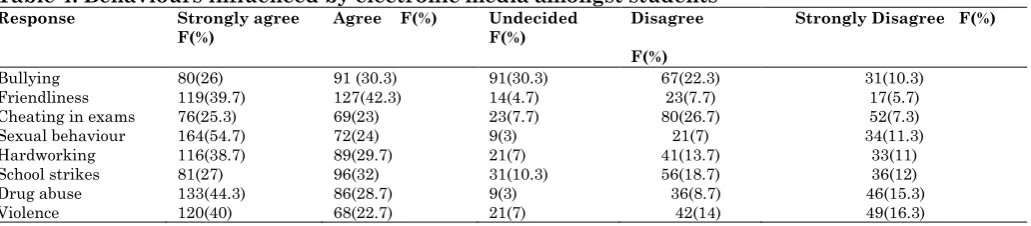
This study sought to establish whether there are behaviours observed in students that are associated with electronic media. Results are presented in Table 4.
Table 4: Behaviours influenced by electronic media amongst students
Response Strongly agree
F(%)
Agree F(%) Undecided F(%)
Disagree
F(%)
Strongly Disagree F(%)
Bullying 80(26) 91 (30.3) 91(30.3) 67(22.3) 31(10.3)
Friendliness 119(39.7) 127(42.3) 14(4.7) 23(7.7) 17(5.7)
1. Cheating in exams 76(25.3) 69(23) 23(7.7) 80(26.7) 52(7.3)
2. Sexual behaviour 164(54.7) 72(24) 9(3) 21(7) 34(11.3)
Hardworking 116(38.7) 89(29.7) 21(7) 41(13.7) 33(11)
3. School strikes 81(27) 96(32) 31(10.3) 56(18.7) 36(12)
4. Drug abuse 133(44.3) 86(28.7) 9(3) 36(8.7) 46(15.3)
Violence 120(40) 68(22.7) 21(7) 42(14) 49(16.3)
236(78.7%) of the students agreed that bad sexual behaviours were influenced by exposure to electronic media while 219(73%) of the students agreed that drug and substance abuse among students is highly influenced by exposure to electronic media. (68.4%) of the students agreed that being hard working is also influenced by exposure to electronic media. A relatively high percentage 188(62.7%) of the students agreed that violence is influenced by exposure to electronic media. 177(59%) of the students agreed that school strikes are influenced by exposure to electronic media. In another finding 171(57%) of the students agreed that bullying as a behaviour
can be influenced by exposure to electronic media. These behaviours included harassing or embarrassing another person, chatting with strangers and seeking phonographic sites. Small number 145(48%) of the students indicated that cheating in exams was influenced by students’ exposure to electronic media.
Results on Students’ view about their Behaviours
The aim was to establish whether the students themselves were aware of which information may affect them from the electronic media. The results are presented in Table 5.
Table 5: Students’ response on how their behavior is influenced by electronic media
Response Extremely
f(%) Moderately f(%) Not at all f(%)
Playing violent video games makes students violent 89(29.7) 160(53.3) 51(I7)
Watching sex movies making students sex crazy 196(65.3) 61(20.3) 43(14.3)
Exposure to pornography affects students’ attitude on sex 211(70.3) 62(20.7) 27(9)
Violent music encourages violent practice. 145(48.3) 108(36) 47(15.7)
Beer commercial content/celebrities encourages drug abuse 158(52.7) 78(26) 64(21.3)
Results from Table 5 indicated that majority 211(70.3%) of the students indicated that exposure to pornography affects students attitude towards sex while another 196(65.3%) of the students stated that watching sex movies makes students sex crazy. This implies that students may have bad sexual behaviours such as lesbianism, premarital sex, and unwanted relationships in schools whereby these impacts on the discipline negatively. Another finding showed 158(52.7%) of the students stated that beer commercial content and celebrities extremely encourages drug abuse among students.
145(48.3%) of the students stated that violent music encouraged violent practice while 89(29.7%) indicated that playing violent video games made students violent. From this data it can be deduced that to some extent students behaviours were influenced by the presence of electronic media and students need to be informed about this so that they can learn to select useful content from electronic media.
The findings with regards to teachers’ response on effects of unnecessary exposure to electronic media are presented in Table 6.
Table 6:Teachers’ response on effects of unnecessary exposure to electronic media
Response Extremely
f (%)
Moderately
f (%)
Not at all f (%)
Sometimes some students perform poorly because they spent too much time using a given form of electronic media
3 15% 11 55% 6 30%
Playing violent video games makes students violent 2 10% 16 80% 2 10%
Watching sexy movies makes students sex crazy 19 95% 1 5%
Viewing beer commercials, contest and celebrities encourages students
towards using drug and substance abuse. 19 95% 1 5%
Listening to violent and romantic music encourages violence and early
sexual practices among students 18 90%
Results from Table 6 indicate that 20(100%) of the participants agreed that electronic media affects students in that watching sexy movies makes students sex crazy, viewing beer commercials, contest and celebrities encourages students towards using drug and substance abuse, listening to violent and romantic music encourages violence and early sexual practices among students, 18(90%) of the participants indicated that playing violent video games makes students violent While only 14 (70%) indicated that sometimes some students perform poorly because they spent too much time using a given form of electronic media. This finding implies that according to the teachers some aspects of students’ discipline were highly influenced by the presence of electronic media within the students’ environment. Therefore, school principal need to empower discipline and counselling departments so as to promote proper guidance to students
Results on Solutions to Curb Students’ Exposure to Electronic Media
The researcher collected data so as to establish participants view on what should be done to prevent students’ exposure to electronic media. The findings indicated that all the teacher respondents 20(100%) agreed that there was unnecessary exposure of electronic media within
the students’ environment. This implies that school principals, and teachers should come up with strict measure to monitor and regulate students’ interaction with electronic media.
Moreover, majority 175 (59.3%) of the students agreed that there was unnecessary media exposure within the students environment, 107 (35.6%) of the students disagreed that there was media exposure within students’ environment while 5(5.0%) of the students were undecided on whether to agree or disagree about the presence of electronic media within the students environment. This data implies that there is unnecessary media exposure within students’ environment and therefore, policy makers and the ministry of education should facilitate strategies to curb it.
Results on Solutions to Curb Unnecessary Media Exposure to Students
This data was collected from students and teachers so as to establish what solutions could be offered so as to control saturation of harmful content from the media. Results from student and teacher participants are presented in Table 7.
Table 7: Students’ Solutions to curb unnecessary exposure to electronic media
Response Fair f (%) Unfair f (%)
Students found with any form of electronic media should be punished 175 (58.3) 125 (41.7) The government should pass a policy on censoring information before it is
broadcasted over any form of media 203 (67.7) 97 (32.3)
Schools should stop buying television, radio & computer 23 (7.7) 277 (92.3) The time students are exposed to electronic media should be limited 185 (61.7) 115 (38.3)
The findings in Table 7 indicate that majority 203(67.7%) of the students felt that the government should pass a policy on censoring information before it is broadcasted over any form of media, 185 (61.7%) of the students felt that the time students were exposed to electronic media should be limited, 175(58.3%) of the students stated that Students found with any form of electronic media should be punished while 23(7.7%) stated that schools should stop buying
television, radio and computer. This data implies that the government should pass a policy on censoring harmful information before it is broadcasted over the media. The schools on their part should be alert on how students are spending the electronic media and regulate the time students spent over the media. Further, students who sneak into the schools electronic media especially mobile phones should be reasonably punished.
Table 8: Teachers’ solution to curb unnecessary media exposure to students
Response Fair
f (%)
Unfair f (%)
Students found with any form of electronic media should be punished 12 60% 8 40% The government should pass a policy on censoring information before it is
broadcasted over the media. 20 100%
The findings presented in Table 8 indicates that all 20(100%) of the respondents felt that the government should pass a policy on censoring information before it is broadcasted over the media, 17(85%) of the respondents felt that the time students were exposed to electronic media should be limited 12(60%) of the participants stated that students found with any form of electronic media should be punished While only 3(15%) of the respondents felt that schools should stop buying Televisions, Radios & Computers. This data implies that there can be measures against broadcasting harmful information before it is passed over the media. The school principal and teachers on their part should be alert on how students are spending the electronic media and regulate the time students spent over the media. In addition, schools should come up with a more strict monitoring, regulations and rules that can enable students’ limited and useful interaction with the electronic media.
The findings also indicated that the respondents suggested that, to reduce students’ harmful exposure to electronic media, there should be awareness on useful and harmful effects of media should be made to the students, censoring information passed over the electronic media should be done so as to ensure the contents passed over is for the rightful age, schools should devise reasonable ways of advising and punishing students who misuse any electronic media, parents not to buy cell phones for their children until they reach a particular age and that school management monitor and regulate the use of media within the schools’ premises
Discussion
The findings indicated that, majority of the respondents stated that bad sexual behaviours are discipline issues observed among the students. Cheating in exams, school strikes, and substance and drug abuse had equal percentage of respondents who stated them as discipline issues observed among students. Most of the respondents indicated that violence was moderately observed as a discipline issue influenced by exposure to electronic media while bullying was slightly associated with electronic media exposure. This findings are consistent with those of [23] who found out that media exposure had incremental effects on sexual behavior on the adolescents especially participants of television viewing. Similarly, in another study [17] reported that the way in which children learn makes portrayal of violence, sex, drugs and alcohol within the media an important contributor to behaviour change in children. Further, [18] in their investigation on internet risk behaviours
among middle school students reported that students engaged in high risk behaviours such as giving out personal information, using the internet to harass or embarrass another person, chatting and starting relationships with strangers, making rude commends to others and seeking out phonographic sites. Therefore, the above study can be used to deduce that students’ discipline can be highly influenced by exposure to electronic media and teachers need to know so as to facilitate electronic media control amongst and within students.
The findings also indicated that all participants reported that they had seen students being punished because of aggressive behaviours, cheating in exams, sneaking cell-phones into the school, immoral sexual behaviours and drug abuse. 95% of the participants showed that they had witnessed a student being punished due to participating in strikes. Stealing and rioting was reported by majority of the respondents. In support of this study [11] reported that factor that the most indiscipline cases experienced in secondary schools included: drug abuse, school strikes, stealing, fighting, bullying and sneaking from school, sexual assault and homosexuality. According to her study the influencing factors towards these issues were use of drugs, peer pressure, academic or exam pressure, apathy, poor social background, mass media, kind of books and magazines read. In a similar study, [8] revealed that indiscipline amongst students included, abuse of language, rudeness to teachers, absenteeism from schools and drug abuse and the major causes of this were peer pressure, substance abuse, lack of parental guidance, poor teacher student relationship and lack of role models. Therefore the above study implies there have been disciplines issues which were being observed in most of the secondary schools and may be they have continued to occur due to exposure to electronic media.
electronic media. A relatively high percentage 188(62.7%) of the students agreed that violence is influenced by exposure to electronic media. 177(59%) of the students agreed that school strikes are influenced by exposure to electronic media. This is supported by [14] reported that mass media was a factor influencing secondary school strikes. In another finding most students agreed that bullying as behaviour can be influenced by exposure to electronic media. In support of this [18] in his investigation found that high risk behaviour among students were influenced by internet. These behaviours included harassing or embarrassing another person, chatting with strangers and seeking phonographic sites. Small number 145(48%) of the students indicated that cheating in exams was influenced by students’ exposure to electronic media, In support of this, [24-25] reported that, mobile phones were being used in exam cheating. The above findings imply that to some extent electronic media influences both positively and negatively the way students’ behave hence affecting their discipline while in schools.
Limitations of Study
This study was limited to the influence of electronic media in students discipline on the secondary schools of Mukaa District, Makueni County of Kenya. Secondary school categories involved were day secondary schools and boarding secondary schools. This was because administration and teachers efforts to fight indiscipline cases in secondary schools did not seem to be effective. Therefore, this study limited into what is still influencing students discipline negatively. The sample of the study was limited to students, teachers in charge of guidance and counselling departments in schools and their counterpart discipline masters in the schools. This was because the students were the ones interacting with electronic media and also faced disciplinary actions. The teachers helped the students to correct their indiscipline cases.
Implications of the Study
Based on the findings of the study, the following are implications. First, school administration and teachers in charge of guidance and counselling departments need to inform students about the harmful effects of electronic media for which the current generation of young people seem to be attracted to and even sometimes demanding to access them. This is because most of the students who participated in this study lie between 14 and 20 years they share the same characteristics as the adolescents. This group of people like adventuring and discovering so as to fulfil their curiosity. Therefore, School administrators,
discipline and counselling masters need to be aware of the various types of media that influence secondary school students’ discipline and establish good guidelines on how these electronic media should be used by the students within the school compound. Particularly, the use of computers and cell-phones need to be highly monitored and regulated. The Ministry of Education should encourage media literacy programs on all types of media accessed by the students as part of school curricula, youth and community organizations and family life. This will enable the society to have knowledge and skills to critically analyze media messages. Further, students will be able to analyze content on unwanted behaviours such as sexual content, drug and substance abuse, violence and other aggressive behaviours which they like imitating. The government should encourage the media to promote presentations of health information through educational programs, essential life skills and environmental programs. This will reduce dangers of drug abuse, premarital sex and aggressive behaviours and promote students’ health and well-being. Generally, media producers and executives need to recognize how powerful their messages are and work with experts in order to produce more positive images to the students. School principals, discipline and counselling departments in schools and teachers in general should be aware of discipline issues that are highly influenced by electronic media such as bullying, cheating in exams, bad Sexual behaviour; school strikes drug abuse and violence. This will enable them advice students in very understanding manner hence promoting their understanding on the harmfulness and usefulness of whatever electronic media they are handling. There should a policy censoring information before it is broadcasted over any form of media. This should touch content on music, movies, advertisements, social networks and internet. This will allow broadcasting of useful and not harmful information especially to the students.
Conclusion
school students’ behaviour both positively and negatively. The behaviours which were highly influenced by electronic media are; bad sexual behaviours, drug and substance abuse, cheating in exams, school strikes and violence. Moreover, apart from these negative behaviours there some good behaviours which are also influenced by electronic media such as friendliness and hard working. As a result of this influence, the study established that students in school are ever punished due to indiscipline cases such as bad sexual behaviours, sneaking phones into schools, aggressive behaviours, drugs and substance abuse, cheating in exams and participating in school strikes and riots. In addition, as per this study Watching sexy movies makes students sex crazy, viewing beer commercials, contest and celebrities encourages students towards using drug and substance abuse, listening to violent and romantic music encourages violence and early sexual practices among students and that sometimes some students perform poorly because they spent too much time using a given form of electronic media.
Further this study established that there is unnecessary media exposure within the students’ environment and that there are solutions which can be used to address students’ unnecessary
exposure to electronic media. The solution established through this study were that the government should pass a policy on censoring information before it is broadcasted over the media, time students are exposed to electronic media should be limited and students found with any form of electronic media should be punished. Further, suggestions made on what could be done to reduce harmful media saturation were found to be; awareness on useful and harmful effects of media should be made to the students, censoring information passed over the electronic media should be done so as to ensure the contents passed over is for the rightful age, schools should devise reasonable ways of advising and punishing students who misuse any electronic media, parents should be advised to monitor their children’s interaction with any form of electronic media and not to buy cell phones for their children until they have reached a particular age. The study recommends the following for further investigations. For example, the influence of electronic media on students’ academic achievement; students’ perceptions towards electronic media; gender differences in using different types of electronic media and the psychosocial effects of electronic media to students.
References
1. Hertz MF, David-Ferdon C (2008) Electronic Media and Youth Violence: A CDC Issue brief for Educators and Caregivers. Atlanta (GA): Center for Disease Control.
2. Escobar-Chaves, S. L., & Anderson, C. A. (2008). Media and risky behaviors: Future of Children, Journal of psychology 18, 147-180.
3. Brown B, Marin P (2009) Adolescents and electronic media: Growing up plugged. Connecticut Avenue, Washington DC.
4. Ray M, Jat KR (2010) Effect of Electronic Media on Children. J. Indian Pediatrics, 47(7):561-568. 5. Donnerstein (2010) The Media and Aggression:
From TV to the Internet. University of Arizona. 6. Samora M (2012, September, 19). The Evolution of
Phones: The Demise of Mankind. The press pp.2-3. 7. Mutua W (2011) East Africa uptake of facebook
among urban youth [online]. Retrieved February, 15th 2012-blogsy.net/Kenya/technology/east-af … 8. Kariuki J, Karanja S, Munene G (2012) November,
6). Schools Rocked by Violent Strikes. The press pp. 13.
9. Strassberg DS, McKinnon RK, Sustaíta AM, Rullo J (2013) Sexting by high school students: An exploratory and descriptive study archives of sexual behavior. J. Cyber Psychology, 42(1):15-21.
10. Mwangi J, Birgen P (2008) School fires in Uganda and Kenya; Students way of saying no to undemocratic practices in schools. J. Education Insight, 17:4-5.
11. Wanjiru GM (2009) Factors that lead to Secondary School Strikes. In selected Schools in Muranga. Unpublished thesis (M.ed). Catholic University of Eastern Africa.
12. Roberts DF, Foehr UG, Rideout VJ (2005) Generation M: Media in the Lives of 8-18 year-olds. Menlo Park, CA: Kaiser Family Foundation.
13. Adebayo DO, Udegbe IB, Sunmola AM (2006) Gender, internet use, and sexual behavior orientation among young nigerians. J. Cyber Psychology and Behavior, 9(6):742-752.
14. Wang L, Luo, J, Bai Y, Kong J, Gao W, Sun X (2013) Internet addiction of adolescents in China: Prevalence, predictors, and association with well-being. J. health care, 21(1):62-69.
15. Bae Young (2006) A study on the effect of internet use and social capital on the academic performance, Soongsil University. J. Development and Society, 35(1):100-123.
17. Earles KA, Alexander R, Johnson M, Liverpool J, McGhee A (2002) Media influences on children and adolescents: Violence and sex. J. the national medical association 9 (94):797-801. Atlanta, Georgia.
18. Dowell B, Burgess AW, Cavanaugh DJ (2009) Clustering of internet risk behaviors in a middle school student population. J. School Health, 79(11):547-553.
19. Kariungi AW (2011) Parental Role in secondary school Students Discpline. Nairobi. Unpublished thesis, Catholic university of Eastern Africa.
20. Haagsma CM, Pieterse ME, Peters O, (2012) Video
gaming behavior among the adolescents and adults: The prevalence of
problematic gaming. J. cyber psychology, behavior, and social networking 15(3):162-168.
21. Gay L, Mills, Airsian (2009) Educational Research Competencies for Analysis and Applications 9th Ed.
London: Pearson Education Limited.
22. Marlow CR (2001) Research methods for generalist social work (3rd ed.). Belmont. CA:
Wardsworth/Thompson Learning.
23. Schooler D, Sorsoli L, Kim JL, Tolman DL ( 2009) Adolescents' use of sexual media. J. Research on Adolescence, 19(3):484-508.
24. Muindi B (2012) Students denied results over cheating-Kenya, Retrieved from [email protected]. Posted Wednesday, February 29, 2012 at 22:30-Kenya.