Owusu-Sarpong et al Maternal Death Audit Review
African Journal of Reproductive Health June 2017; 21 (2):49
ORIGINAL RESEARCH ARTICLE
Associated Factors and Quality of Care Received among Maternal
Deaths at a Regional Hospital in Ghana: Maternal Death Audit Review
Akosua Owusu-Sarpong
1*, Kwame A. Boamah
2and Frank Baiden
3Lower Manya Krobo Municipal Health Directorate1; Eastern Regional Hospital2; Ensign College of Public Health3
*For Correspondence: Email: [email protected]
Abstract
Maternal death audits are crucial to the reduction of maternal deaths.The aim of this study was to identity factors contributing to maternal deaths at Eastern Regional Hospital of Ghana. Quantitative and qualitative methods were used. Quantitative data on all the maternal deaths from January to December 2012 was extracted from completed audit forms and patients records using a standardized questionnaire. The data were analyzed in Epi-info. Qualitative data was collected through in-depth interviews and focus group discussions with health staff to assess care received and factors leading to death. A total of 43 maternal deaths occurred out of which 37 (86%) were audited. Major causes of deaths were pregnancy induced hypertension (27%) and abortion (21%). Late referrals, poor supervision of junior staff, inadequate numbers of senior clinicians, lack of intensive care facility as well as unavailability and insufficient blood and blood products were the main contributory factors to the deaths. Tertiary health institutions should be adequately equipped, staffed, and funded to address these causes of maternal death. (Afr J Reprod Health 2017; 21[2]:49-54).
Keywords: Maternal, Death, Audit, Ghana, Africa
Résumé
Les vérifications des décès maternels sont essentielles à la réduction des décès maternels. L'objectif de cette étude était d'identifier les facteurs contribuant aux décès maternels au Eastern Regional Hospital au Ghana. Des méthodes quantitatives et qualitatives ont été utilisées. Les données quantitatives sur tous les décès maternels de janvier à décembre 2012 ont été tirées des formulaires de vérification et des dossiers des patientes remplis en utilisant un questionnaire normalisé. Les données ont été analysées dans Epi-info. Les données qualitatives ont été recueillies grâce à des entretiens approfondis et des discussions de groupes avec le personnel de santé pour évaluer les soins reçus et les facteurs qui ont mené à la mort. Au total, 43 décès maternels sont survenus, dont 37 (86%) ont été vérifiés. Les principales causes de décès étaient l'hypertension induite par la grossesse (27%) et l'avortement (21%). Les renvois tardifs, la supervision insuffisante du personnel subalterne, le nombre insuffisant de cliniciens seniors, le manque d'installations de soins intensifs ainsi que l'indisponibilité et l'insuffisance de sang et de produits sanguins ont été les principaux facteurs contributifs aux décès. Les établissements de santé tertiaire devraient être suffisamment équipés, dotés de personnel et financés pour s'adresser à ces causes de mortalité maternelle.
(Afr J Reprod Health 2017; 21[2]: 49-54).
Mots clés: maternel, mort, audit, Ghana, Afrique
Introduction
The United Nations‘ Millennium Development Goal 5 (MDG5), sought to reduce by three quarters the 1990 Maternal Mortality ratio by 2015. As at 2008, Ghana‘s maternal mortality ratio was estimated to be 451 per 100,000 live births1. This had reduced to 325/100,000 live births2 by 2010. On the basis of this trend Ghana was reported to be making steady progress but was considered unlikely to reach the MDG 5 target of 185 per 100,000 by 20152.
The leading causes of maternal mortality in Ghana are haemorrhage, hypertensive diseases in pregnancy, unsafe abortion and septicaemia3. Underlying these specific causes is a high rate of unskilled attendance at delivery4. One of the
strategies to reduce the high maternal mortality rate in Ghana is the promotion of institutional delivery by skilled attendance5-6. The justification for this strategy lies in the fact that skilled attendance at delivery has been shown to reduce maternal mortality5-6. As a measure to ensure the quality of institutional maternal health services in the country, all health facilities are required to conduct audits of maternal deaths. The findings of such audits are to be used as basis for improving services.
Owusu-Sarpong et al Maternal Death Audit Review
African Journal of Reproductive Health June 2017; 21 (2):50
facilities in the Region. Maternal death audits are routinely conducted in the hospital by an audit team made up of representatives from Obstetrics and Gynaecology Department, Public Health Department and other departments of the hospital. The findings of the audit are used to identify gaps in service provision, causes of deaths and make appropriate recommendations to staff and other stakeholders. This paper reports on the findings of maternal deaths at the hospital from January to December 2012.
Methods
Study site
The Eastern Regional hospital has a total bed capacity of 3627 and an Obstetrics and Gynaecology department with bed capacity of 105, one Obstetrician/Gynecologist, one senior medical officer, two medical officers and forty seven midwives. The Eastern Region has a population of 2,681,281 out of which 107, 2517 are women of childbearing age. Quantitative data on all the maternal deaths during the period were extracted from completed audit forms and patients records using a standardized questionnaire.
Each death audit report form for the period was examined. This involved detailed examination of the demographic information, clinical presentations, cause of deaths, contributory factors to death and the recommendations made. Clinical records were examined to obtain some missing information on the audit report form. A quality of care evaluation form was also designed to assess the care received at the facility. This form assessed the following areas, documentation, diagnosis and treatment in accordance with protocols, promptness in receiving care and involvement of senior clinicians and specialist in patient care.
Data on each report form was entered into Epi info version 3.5.4, 2012. Data analysis was conducted using frequency distribution tables and presented in tables. Findings from the preliminary analysis of the data from audit reports and patients records were used to develop an interview guide.
In-depth interviews were conducted in the facility with the Obstetrician Gynecologist and the Nurse Manager of the maternity unit. One focus group discussion was held with the midwives of the unit. These interviews were tape recorded, transcribed, imported and analyzed using excel. Qualitative data on the contributory factors to the
death and recommendations for action on each case were analyzed thematically. The emerging common themes were merged.
The Hospital and the Regional Health Administration gave their approval for this study to be conducted. No patient identifications were used and only authorized persons had access to individual patient records.
Results
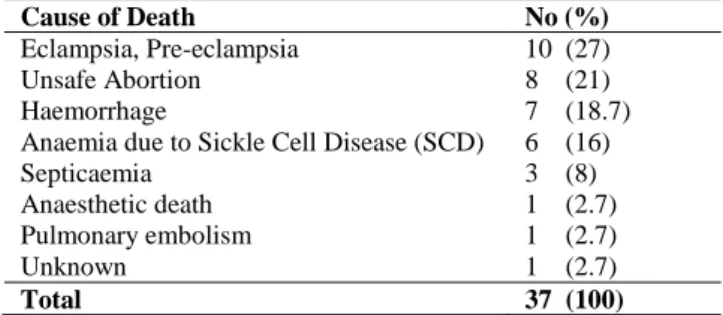
A total of 43 maternal deaths were recorded between January to December 2012, out of which 37 (86.0%) were audited. The majority of women (45.9%) were aged between 26-35years and 29.9% had no formal education (Table 1). Most (31%) of the women were in their first pregnancies. Attendance to antenatal clinic was 65%, with 42% attending antenatal clinics at least four times and more. Twenty seven percent (27%), 3% and 51% of deaths occurred in the first, second and third (including labor and delivery) trimesters respectively while 19% occurred in the postpartum period. Out of the total deaths, 62% were referred from other facilities. Forty three percent (43%) of the referred cases died within 24 hours of reaching the facility. Twenty five percent (25%), 33% and 42% of the referred cases arrived at the Regional hospital within 1 hour, within 3 hours and between 3 to 9 hours respectively. Most of the delays (62%) in reaching the facility were as a result of poor road network and lack of transportation to the Regional hospital, 30% were delays on the part of patients and 8% were delayed at the referring facility. Half of the referred cases arrived at the facility during the hours of 8am to 5pm. Seventy six percent (76%) of the referred cases were attended by medical doctors within an hour of arrival while 24% received care after an hour of arrival by medical doctors. Of the 35 deaths (94.5%) for which times of deaths were recorded 57.5% of death occurred between the hours of 5pm and 8am while the rest 37% occurred between 8am and 5pm. Out of the total referred cases, 19% were brought in critical conditions and needed to be managed in an intensive care unit, yet they received normal medical care on the wards. Seventy two percent (72%) of those who needed blood had at least one unit of blood, however only 16% received the full quantities of prescribed blood. The leading causes of deaths were eclampsia (27.0%), unsafe abortions (21.0%) and hemorrhage (18.7%) (Table 2).
Owusu-Sarpong et al Maternal Death Audit Review
African Journal of Reproductive Health June 2017; 21 (2):51 Table 1: Socio-demographic Characteristics of Maternal
Mortality Cases at Regional Hospital in Ghana, 2012
Table 2: Causes of Maternal Deaths at Regional Hospital in Ghana, 2012
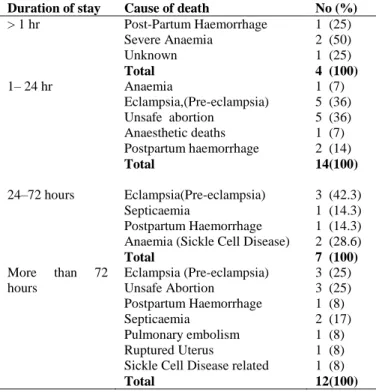
Of the four deaths that occurred within an hour of admission, two and one respectively were due to severe anemia and postpartum hemorrhage (Table 3).
Qualitative assessment results
Delays in reaching the regional hospital
Most of the participants in the focus group discussion (FGD) and in-depth interviews (IDI) were of the opinion that cases that were referred reached the facility when their conditions had deteriorated to an extent that the chances of survival were very low. They further mentioned that these delays were either due to patients‘ reluctance to report early or the delays on the part of referring facilities. Inadequate management of patients prior to referral and insufficient information on the referral letter from referring facility were mentioned as factors contributing to the deaths:
“Some patients referred as a result of haemorrhage from a health facility reached here without intravenous line in-situ. Trying to set a line became very difficult because of collapsed veins.”
Quote from a midwife.
It was also revealed that delays also occurred within the Regional hospital. This is because all referred cases passed through the common casualty ward before specialist attention could be drawn to treat at the Obstetric Department.
Non-involvement of senior clinicians in the
management of cases
Some of the recommendations made on the audit report were that senior clinicians should be involved in the management of complicated cases. In-depth interview revealed that inadequate staff was a contributory factor to maternal deaths. In the period of the study, there was only one obstetrician gynaecologist who had additional roles as medical director of the hospital. This obstetrician-gynaecologist also served as consultant on maternal health services to the Regional Health Directorate. By the procedures of the hospital, the first on call is any one of the four house officers; the second on call was any one of the three medical officers. The specialist obstetrician was only called in thereafter thus any break in communication especially when these medical officers were overwhelmed led to the non-involvement of senior clinicians in the management of cases.
„I leave the hospital after 7pm every day and there is hardly any two consecutive days that I am not called in the night to attend to emergencies and yet I have to be back in the hospital by 8am. Moreover if I am not informed about a case, how can I intervene,‟
Quote from the obstetrician/gynaecologist.
Inadequate equipment
It was agreed among most of the participants that some of the deaths occurred due to substandard care resulting from a combination of inadequate equipment and staff.
There were situations where
few staff had to use manual monitoring devices
in a ward full of patients. This led to late
detection of conditions like hemorrhage, which
eventually resulted in deaths.
Focus group discussion revealed that the unit had few electronic monitoring devices and patients were monitored manually.Characteristics Categories No (%)
Age group 15-25 years 11 (29.7) 26-35 years 17 (46) 36-45 years 9 (24.3)
Total 37 (100)
Educational Level None 12 (32.4) Primary 5 (13.5) Middle/JSS 17 (46) Secondary 2 (5.4) Tertiary 1 (2.7)
Total 37 (100)
Cause of Death No (%)
Eclampsia, Pre-eclampsia 10 (27) Unsafe Abortion 8 (21) Haemorrhage 7 (18.7) Anaemia due to Sickle Cell Disease (SCD) 6 (16) Septicaemia 3 (8) Anaesthetic death 1 (2.7) Pulmonary embolism 1 (2.7) Unknown 1 (2.7)
Owusu-Sarpong et al Maternal Death Audit Review
African Journal of Reproductive Health June 2017; 21 (2):52 Table 3: Duration of Stay versus cause of Death in
Regional Hospital in Ghana, 2012
Duration of stay Cause of death No (%)
> 1 hr Post-Partum Haemorrhage Severe Anaemia
Unknown
Total
1 (25) 2 (50) 1 (25)
4 (100)
1– 24 hr Anaemia
Eclampsia,(Pre-eclampsia) Unsafe abortion
Anaesthetic deaths Postpartum haemorrhage
Total
1 (7) 5 (36) 5 (36) 1 (7) 2 (14)
14(100)
24–72 hours Eclampsia(Pre-eclampsia) Septicaemia
Postpartum Haemorrhage Anaemia (Sickle Cell Disease)
Total
3 (42.3) 1 (14.3) 1 (14.3) 2 (28.6)
7 (100)
More than 72 hours
Eclampsia (Pre-eclampsia) Unsafe Abortion
Postpartum Haemorrhage Septicaemia
Pulmonary embolism Ruptured Uterus
Sickle Cell Disease related
Total
3 (25) 3 (25) 1 (8) 2 (17) 1 (8) 1 (8) 1 (8)
12(100)
Operational challenges related to laboratory
and blood bank services
Participants indicated that the non-availability of laboratory services during certain periods particularly weekends aggravated maternal health conditions which sometimes caused death:
„Laboratory services should operate fully during weekends.‟
Quote from a midwife
The unavailability of blood and its products were also mentioned as contributory factors to maternal deaths. Patients who needed blood often received them late and in fewer quantities than requested for by the attending clinicians.
Lack of intensive care facility
The Regional Hospital lacked an intensive care facility. Participants indicated that this contributed to some of the deaths:
„How can I manage a critically ill patient without an intensive care facility, I am not a magician.‟
Quote from a medical officer
Non-performance of post-mortem
Participants indicated that the Regional Hospital lacked post-mortem services. As a result clinicians did not have the benefit of autopsies to establish the causes of death in situations such as pulmonary embolism.
Discussion
In this paper we have reviewed the immediate and remote causes of maternal deaths at a regional hospital in Ghana. Although the focus was in one facility, we believe on the basis of available literature that the findings depicts the situation in similar institutions in other parts of Ghana and sub-Saharan Africa9,10. In Ghana regional hospitals are considered level-C facilities. This means they act as ultimate referral facilities for populations ranging from 700,000 to 5,000,00011. The standard of care in a Regional Hospitals is expected to be the most optimal within the region. Unfortunately this study has shown that a combination of factors had compromised the capacity of this Regional Hospital to live up to its mandate.
The Ghana Health Service requires that all maternal deaths be audited. In this study, 14% of the deaths were not audited. Among the cases that were audited, the times of death were not recorded in two cases. This raises concern about the quality of record keeping at the facility. The situation as established in this facility appears therefore not to be different from that described in a study conducted in a rural health facility in Northern Ghana in 199212. This suggests that beyond the requirements of audit, interventions are needed to ensure optimal documentation and accountability in all cases of maternal deaths.
In this study we found haemorrhage, eclampsia and unsafe abortion to be the leading causes of maternal deaths. This finding is consistent with reports in similar studies in other parts of sub-Saharan Africa3,13. These causes of death are well-established in both literature and practice, and are amenable to well-documented interventions. It appears that these deaths are avoidable and result from a lack of implementation of well-known interventions, across the entire health system.
Owusu-Sarpong et al Maternal Death Audit Review
African Journal of Reproductive Health June 2017; 21 (2):53
referral facility is most unacceptable. The acute shortage of specialist Obstetrician-Gynaecologists at regional and district health facilities in Ghana have been a long standing problem. In order to equip regional and district hospitals to provide specialist services in any country, there is the need to evaluate the process of training and deployment of specialists. Locally based specialist training programs with attachment and deployment to district and regional health institutions help retain the specialist hence addressing the shortage of specialist medical personnel in regional and district health institutions14.
A Regional Hospital, being an ultimate referral facility is expected to have adequate infrastructure. This includes electronic monitoring devices, an intensive care unit and 24-hour blood bank services. It is these facilities and services that will enable the facility to be a fall-back option for other facilities in the Region. From the findings of this study, it can be reasonably inferred that maternal health services in other facilities in the region are similarly challenged, with profound implications for the risk of institutional maternal deaths.
While a number of the challenges identified in this facility are holistic and possibly beyond the immediate control of the authorities of the facility, there are some others that are amenable to local interventions. Operational challenges like the non-availability of laboratory services during certain periods of the day could perhaps be addressed at the facility level. Improving the system of record-keeping, establishing and ensuring adherence to standard operating procedures as well as effective supervision can only be best guaranteed at the institutional level15.
In order for a Regional Hospital to function as an ultimate referral facility for maternal health services, systemic factors such as adequate staff, infrastructure and equipment are key to quality service provision.
Conclusion
Maternal mortality can be reduced drastically if health facilities are equipped with adequate human resource, equipment, infrastructure and logistics as well as adherence to protocols and standard operating procedures.
Acknowledgements
The authors acknowledge the management of
the Regional hospital, Regional Health
Administration and Dr. Phyllis Antwi of Ghana College of Physicians and Surgeons for their support in conducting this study.
This study was sponsored by the health facility in which the study took place.
Contribution of Authors
The first author Dr. Akosua Owusu-Sarpong conceived and designed the study, was involved in data collection, analysis and preparation of the manuscript. Dr. Kwame A. Boamah was involved in data collection and preparation of manuscript and Dr. Frank Baiden was involved in data analysis and preparation of the manuscript. All authors mentioned in the article approved the manuscript.
References
1. Ghana Statistical Service (GSS), Ghana Health Service (GHS), and Macro International, 2009. Ghana Maternal Health Survey 2007. Calverton, Maryland, USA: GSS, GHS and Macro International
2. Trends in maternal mortality: 1990-2015: estimates from WHO, UNICEF, UNFPA, World Bank Group and the United Nations Population Division
3. Gunonya, SK, Kolbila, DK, Gandau, BBN, Malechi H and K. Kyei-Aboagye, Trends in Maternal Mortality in Tamale Teaching hospital, Ghana . GMJ. Sep 2011; 45(3); 105-110
4. Zakariah AY, Alexander S, Roosmalen Jv, Buekens P,
Kwawukume EY and Frimpong P: Reproductive age mortality survey (RAMOS) in Accra, Ghana.
Reproductive Health 2009, 6 (1) : 7.
5. Paxton A, Maine D, Freedman L, Fry D and Lobis S. The evidence for emergency obstetric care. International journal of gynaecology and obstetrics: the official organ of the International Federation of Gynaecology and Obstetrics. 2005;88(2):181–93. Epub 2005/02/08. doi: 10.1016/j.ijgo.2004.11.026 .
6. WHO. Making pregnancy safer: the critical role of the skilled attendant. A joint statement by WHO, ICM and FIGO Geneva, Switzerland: WHO, 2004.
7. District Health Information Management Systems (DHIMS) / auth. Ghana Health Service. - Eastern Region : Ghana Health Service, 2012.
8. Eastern Regional Health Directorate, Ghana Health Service, Ministry of Health, 2012 annual report, 2013. Eastern Region Health Directorate, Ghana Health Service, Koforidua, Ghana.
9. Terefe W, Getachew Y, Hiruve A Derbew M, Mariam DH, Mammo D and Muhiye A. Patterns of hypertensive disorders of pregnancy and associated factors at Debre Berhan referral hospital, Ethiop Med J. 2015 Jul, Suppl 2:57-65
Owusu-Sarpong et al Maternal Death Audit Review
African Journal of Reproductive Health June 2017; 21 (2):54
11. Ghana Statistical Service. (2012, May 1). Ghana Statistical Service. Retrieved Febuary 20, 2016, from Ghana Statistical Service: http://www.statsghana.gov.gh 12. Allotey PA and Reidpath D. Information quality in a remote
rural maternity unit in Ghana. Health Policy and Planning; 15(2): 170-176
13. Ray S; Madzimbamuto FD; Ramagola-Masire D Phillips R,
Mogobe KD and Haverkamp M. Review of causes of maternal deaths in Botswana in 2010. SAM J, S. Afr. Med. J. vol. 103 n.8 Cape Town Jan.
2013.
14.Anderson FWJ, Obed SA, Brookman EL and Opare- Ado H. The Public Health Impact of Training Physicians to become Obstetrician and Gynaecologist in Ghana. Am J Public Health. 2014 February; 104(Suppl 1): S159-S165