Lucrări ştiinţifice Zootehnie şi Biotehnologii, vol. 42 (2) (2009), Timişoara
ANALYSIS OF POLYMORPHISM OF CAST GENE AND
CLPG GENE IN SHEEP BY PCR-RFLP METHOD
ANALIYA POLIMORFISMULUI GENELOR CAST ŞI CLPG
LA OI PRIN METODA PCR-RFLP
M. GÁBOR, ANNA TRAKOVICKÁ, MARTINA MILUCHOVÁ
Slovak University Of Agriculture In Nitra [email protected]
The work was oriented to identification of calpastatin gene polymorphism and callipyge gene polymorphism and analysis of genotype structure in population of sheep kept in Slovakia.
The material involved 96 sheep of breeds tsigai, improved valachian, east friesian, lacaune and crossbreds lacaune and tsigai . Genomic DNA was isolated by salting out method and used in order to estimate calpastatin and callipyge genotypes by means of PCR-RFLP method. The PCR products were digested with MspI restriction enzyme for calpastatin gene and FaqI restriction enzyme for callipyge gene. In the total population of sheep was
detected homozygous genotype MM – 0.87, heterozygous genotype MN – 0.13 for calpastatin gene.
Homozygous genotype NN has not been observed. For the callipyge gene was detected homozygous genotype AA – 1.00 only. The heterozygous genotype AG and homozygous genotype GG was not detected.
Keywords: sheep, PCR-RFLP, calpastatin gene, callipyge gene
Introduction
In present the demands of consumers of lamb are not focus on quantity traits only but quality traits of meat too. The one from resourses than breeders can to improve your rearings is using some genes , which has been considered as candidate genes for selection of quantity and quality traits as double muscle and meat tenderness.
quality in sheep, Palmer et al. (1999) have chosen the ovine CAST gene as a candidate gene for meat quality. For a region of the ovine CAST have described two polymorphic variants ( allele M and allele N), which have detected by PCR-RFLP method (Palmer et al., 1998).
The Callipyge (CLPG) gene is most documented gene for double muscle in
sheep. The mutation cognizant of unique muscling phenotype in sheep was first discovered in 1983 in Oklahoma in Dorset breed. The CLPG gene has unique inheritance pattern, which has been termed as polar overdominance (Cockett et al., 1996, Freeking et al., 1998). The term polar overdominancewas used to describe the genetic model in which only heterozygous individuals that were receiving the newly identified allele from their sire expressed the unique phenotype (Freeking et al., 1998). Callipyge phenotypic effects were previously estimated in heterozygous
lamb but the mutant CLPG allele have to be inherited from sire and normal allele have to be inherited from dam. The others combination of allele can be classified as noncarier lambs with normal phenotype.The locus of CLPG gene was mapped to the telomeric region of ovine chromosome 18 (Cockett et al., 1994).
Materials and Methods
In this study were collected blood samples from 96 sheep (rams and ewes) kept in Slovakia. This population involved 60 sheep of breed tsigai, 19 sheep of breed improved valachian, 2 sheep of breed east friesian, 11 sheep of breed lacaune and 5 sheep of crossbreed tsigai and lacaune. Ovine genomic DNA was DNA was extracted from 500 μl of blood as described by Miller et al., (1987) and used in order to estimate CAST and CLPG genotypes by PCR-RFLP method.
Calpastatin
DNA primers described by Palmer (1998) were used to PCR amplification: forward primer 5´- TGGGGCCCAATGACGCCATCGATG - 3´ and reverse primer 5´ - GGTGGAGCAGCACTTCTGATCACC- 3´. The PCR reaction elaborated by Palmer (1998) was modificated.The reaction mixture in the total volume 25 μl containing 50 ng DNA, 1 U Taq polymerase (Fermentas), 1 x PCR buffer (NH4)2SO2 ,2.5 mM MgCl2, 5 % glycerol, 200 μM dNTP, 10 pM of each primer. The PCR reaction was optimized in the gradient thermocycler C1000TM (Biorad). The following amplification parameters were applied: 95 oC for 3 minutes followed by 30 cycles: 95 °C for 30 seconds, 63 °C for 50 seconds, 72 °C for 60 seconds. The reaction was completed by the final synthesis: 72 °C for 10minutes.
The PCR products of 622 bp were digested with 10 units of the MspI
Callipyge
DNA primers described by Freking (2002) were used to PCR amplification: forward primer 5´- TGA AAA CGT GAA CCC AGA AGC - 3´and reverse primer 5´ - GTC CTA AAT AGG TCC TCT CG - 3´. The PCR reaction elaborated by Kloc (2005) was modificated. The reaction mixture in the total volume 25 μl containing 50 ng DNA, 1 U Taq polymerase (Fermentas), 1 x PCR buffer (NH4)2SO2 ,1.5 mM MgCl2, 200 μM dNTP, 10 pM of each primer. The PCR reaction was optimized in the thermocycler MJ Mini (Biorad) .The following amplification parameters were applied: 94 oC for 3 minutes followed by 35 cycles: 94 °C for 20 seconds, 58 °C for 30 seconds, 72 °C for 40 seconds. The reaction was completed by the final synthesis: 72 °C for 10minutes.
The PCR products of 426 bp were digested with 10 units of the FaqI (BsmFI) restriction enzyme (Fermentas). Restriction digestion fragments were
loaded on 3 % agarose gel (Invitrogen) containing ethidium bromide and the gel were analyzed in the UV rays.
Results and Discussion
Calpastatin
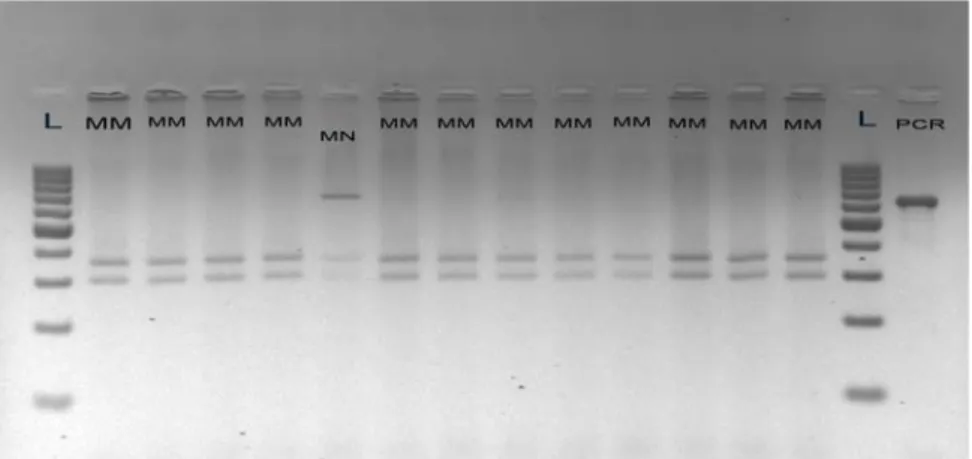
Figure 1: Representatively results of analysis PCR-RFLP for CAST gene by restriction enzyme MspI on 2 % agarose gel.
L – ladder 100 bp (Fermentas), MM -genotype (336 bp, 287 bp), MN –genotype (622 bp, 336 bp, 287 bp), PCR – product of PCR (622 bp).
Our results show that locus of calpastatin gene had two alleles for purebred Tsigai , Improved Valachian and crossbred Tsigai and Lacaune and one allele for purebred Lacaune and East Friesian. Similar results for frequency of genotype MM MN and NN desribed Efteknari Shakroudi et al., (2005), Nassiry et al., (2007). A high degree of calpastatin gene polymorphism was detected in crossbred Dorset Down x Coopworth, Corriedale rams (Palmer et al., 1997).
Table 1. Freqeuncy of genotypes and alleles of CAST gene in the population of sheep kept
in Slovak republic.
1 – The breed with small number of animals. 2 – Ovis aries cross (Tsigai x Lacaune)
Allele Genotype (Observed/Expected)
Breed n M N M/M M/N N/N Tsigai 58 0.91 0.09 0.83 0.84 0.17 0.16 0.00 0.00 Improved Valachian1 19 0.97 0.03 0.95
0.95 0.05 0.05 0.00 0.00 Lacaune1 11 1.00 0.00 1.00
1.00 0.00 0.00 0.00 0.00 East Friesian1 2 1.00 0.00 1.00
1.00 0.00 0.00 0.00 0.00 Crossbred1,2 5 0.90 0.10 0.80
0.81 0.20 0.18 0.00 0.01
Callipyge
The polymorphism of CLPG gene was detected in 426 bp PCR product by restriction endonuclease FaqI. The FaqI digestion of the PCR products produced
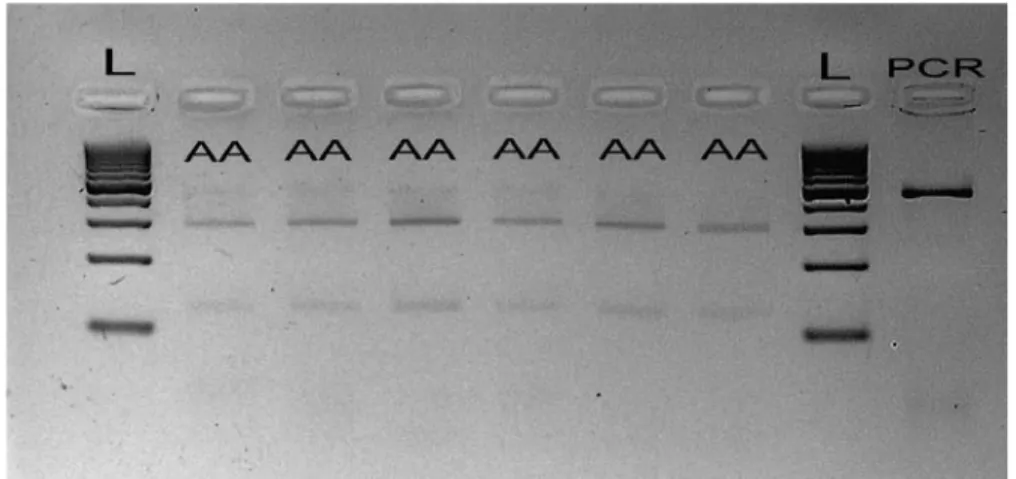
digestion fragments of 395 bp and 31 bp for mutant allele G and 278 bp, 117 bp and 31 bp for wild allele A (Figure 2). The total population of sheep was monomorphic for CLPG gene, because we detected wild allele A only (Figure 3). The mutant allele G was not detected in all breeds and crosbreds involved in this study.
In the frequency of genotype AA was 1.00 therefore the genetic equilibrium of analysed population was not evaluated on the base χ2-test.
Figure 3: Representatively results of analysis PCR-RFLP for CLPG gene by restriction enzyme FaqI on 3 % agarose gel.
L – ladder 100 bp (Fermentas), AA -genotype (278 bp, 117 bp, 31 bp ), PCR – product of PCR (426 bp).
Figure 2:Schematic image of PCR-RFLP product CLPG gene by restriction enzyme
FaqI.
1 – DNA ladder 100 bp,
2 – genotype GG (395 bp, 31 bp),
3 – genotype AG (395 bp, 278 bp, 117 bp, 31 bp), 4 – genotype AA (278 bp, 117 bp, 31 bp ), 5 – PCR product (426 bp)
Slovakia. Quanbari et al., (2007) did not detected CLPG mutation in experimental flock of Afshari breed too. The occurence the mutant allele G was deteminated for breeds of sheep than Dorset, Rambouillet and Hampshire, respectively (Jackson et al., 1997,
Conclusion
It may be concluded that CLPG locus is a monomorphic for population sheep kept in Slovakia . It was detected the genotype AA with frequency 1.00. The locus of CAST gene is polymorphic for population of sheep involved purebreds Tsigai, Improved Valachian and crossbred Lacaune and Tsigai.
In total population of sheep was detected a predominance of genotype MM - 0.87 and a predominance of allele M – 0.96 before the heterozygous genotype MN - 0.13 and allele N – 0.06. The homozygous genotype NN was not detected in this population of sheep.
Sources of research financing: project VEGA no 1/4440/07
References
1. Casas, E., White, S. N., Wheeler, T. L., Shackelford, S. D., Koohmaraie, M., Riley, D. G., et al., 2006, Effects of calpastatin and micro-calpain markers in beef cattle on tenderness traits, J Anim Sci, 84, 520–525
2. Cockett, N.E., Jackson, S.P., Shay, T.L., Nielsen, D.M., Moore, S.S., Steele, M.R., Barendse, W., Green, R.D., Georges, M., 1994, Chromosomal localization of the callipyge gene in sheep (Ovisaries) using
bovine DNA markers, Proc. Natl. Acad. Sci., 91, 3019–3023
3. Cockett, N. E., Jackson, S. P., Shay, T. L., Farnir, F., Berghmans, S., Snowder, G. D., Nielsen, D. M., Georges, M., 1996, Polar overdominance at the ovine callipyge locus, Science, 273, 236
4. Freking, B.A., Keele, J.W., Beattie, C.W., Kappes, S.M., Smith, T.P.L., Sonstegard, T.S., Nielsen, M.K., Leymaster, K.A., 1998, Evaluation of the ovine callipyge locus: I. Relative chromosomal position and gene action, J. Anim. Sci., 76, 2062–2071
5. Jackson, S.P., Green, R.D., 1993, Muscle trait inheritance, growth performance and feed efficiency of sheep exhibiting a muscle hypertrophy phenotype, J. Anim. Sci., 71, 241 (Abstr)
6. Jackson, S. P., Miller, M. F., Green, R. D.,1997, Phenotypic characterization of Rambouillet sheep expressing the callipyge gene: I. Inheritance of the condition and production characteristics, J. Anim. Sci.,
75, 14
8. Palmer, B. R., Robert, N., Kent, M. P., 1999,. A candidate gene approach to animal quality traits, Proc NZ Society Anim Prod, 57, 294-296
9. Palmer, B. R., Su, H. Y., Roberts, N., Hickford, J. G., Bickerstaffe, R., 2000, Single nucleotide polymorphisms in an intron of the ovine calpastatin gene, Animal Biotechnology, 11, 63–67
10. Shahroudi, E. F., Nassiry, M.R., Valizadeh, R., 2005, The genetic polymorphism of calpastatain gene in karakul sheep, J Agric Sci Natural Resou Khazar., 2, 1-10
11. Schenkel, F. S., Miller, S. P., Jiang, Z., Mandell, I. B., Ye, X., Li, H., et al., 2006, Association of a single nucleotide polymorphism in the calpastatin gene with carcass and meat quality traits of beef cattle, J Anim Sci, 84,
291–299