SCHOOL OF COMPUTING
PROGRAMMES OFFERED BY DEPARTMENT OF COMPUTER SCIENCE
SYSTEMS
(Note: This document is for polytechnic students admitted in AY2004-5)
Bachelor of Computing in Communications and Media
OverviewThe 4-year Bachelor of Computing in Communications and Media aims to train students in the technological underpinnings of internet technologies as well as the required skills of media design and content creation tempered with a proper understanding of the social sciences. Therefore, the programme has been designed to achieve an integrated foundation in all these aspects. Since this programme involves aspects of computing and the arts and social sciences, it can be viewed from two perspectives:
TECHNOLOGY PERSPECTIVE:
• Foundation of IT: This refers to the basics of computing required to understand, design, and extend the internet-based systems.
• Information encoding, information customisation, content-repurposing: Information encoding, such as XML, is required for information to be mass communicated on the Internet and WWW. Customisation refers to the personalisation of information to individuals and groups which the technology allows, and repurposing refers to the customisation of information to the heterogeneous networks (wired and wireless) as well as the plethora of end-devices (static and mobile, with varying display plus communication capabilities).
• Text, multimedia information analysis and processing: These refer to the technological basis of the various digital media (text, image, graphics, audio and video) and the various types of processing, such as data-rate transformation and summarisation.
• Entertainment technology: This refers to technologies required to develop interactive games and virtual reality systems.
• Internet architecture: This refers to the technical aspects of the Internet including networking, client-server architecture, and issues related to scalability, reliability and availability.
CONTENT AND USER PERSPECTIVE:
• Foundation (sociology): This refers to the social science foundation required to contextualise the use of media for communication by individuals and groups in human society.
• Human-computer interaction: This refers to the human-centred design of intuitive and flexible interfaces for people to communicate via the end-devices of the internet fringes.
• Writing and media design for mass communication: This refers to the required arts background, which enables the creative use of digital media for the purpose of expression and communication. The media considered include hypertext, audio, image/graphics, and video.
• Mass communication on the Internet: This refers to the theoretical and empirical principles of mass communications on the WWW.
Degree Requirements
The Communications and Media programme degree requirement is at least 160 modular credits. Modules are classified as follows (note that every module can only be counted towards satisfying exactly one requirement):
(i) PROGRAMME REQUIREMENTS Common Essentials (Total: 26 MCs)
CS1101 or CS1101S Programming Methodology (5 MCs) CS1102 or CS1102S Data Structures and Algorithms (5 MCs)
CS1104 Computer Organization (4 MCs)
CS2102 Database Systems (4 MCs)
CS2103 Software Engineering (4 MCs)
CS2105 Computer Networks I (4 MCs)
Programme Essentials (Total: 53 MCs)
Computer Science Related
CS1231 Discrete Structures (4 MCs) CS3224 Architecture of Internet (4 MCs) CS3240 Human-Computer Interaction (4 MCs) CS3241 Computer Graphics (4 MCs) CS3242S Hypermedia Technologies (5 MCs) CS4101 Honours Project (12 MCs)
CS4102 Technical & Management Training (0 MCs) Communications and Media (CM) Related +
IF1101E Information Revolution & Society (4 MCs) IF2101 Media Communication (4 MCs) Choose either
IF2208 Principles of Visual Communication (4 MCs) or
IF2210 Aesthetics of New Media (4 MCs)
IF3209/EL3271 Hypertext and the Electronic Author (4 MCs) Choose either
CS3248 Design of Interactive Media (4 MCs) or
IF3208 Designing Content for New Media(4 MCs)
+ With approval from the department, students may take a module of equivalent level or higher
from Programme Elective Group B in place of a module in Program Essentials. CM Programme Electives (Total: 24 MCs)
Complete 24 MCs with the following conditions:
i. At least 8 MCs from the Media & Internet Technology module group;
ii. At least 8 MCs from the Content Creation & Mass Communications module group; iii. At least 16 MCs are at level 4000 or above.
Programmes Elective Groups:
A. Media & Internet Technology module group * CS3243 Foundation of Artificial Intelligence CS3248 Design of Interactive Media CS4213 Games Development
CS4241 Multimedia Information Systems
CS4243 Computer Vision and Pattern Recognition CS4245 Multimedia E-Learning Environments CS4247 Image Synthesis and Computer Animation CS4248 Natural Language Processing
CS4249 Design of Advanced User Interfaces CS5240 Theory and Practice of Multimedia CS5246 Text Processing on the Web
Other relevant courses approved by the Department of Computer Science
* Students may choose a module in this group if they have not already taken it as part of Program Essential.
B. Content Creation & Mass Communications module group * IF2201 Culture & Communications
IF2202 Governance and IT
IF2204 Economics of Information & Communication IF2207 Internet Studies: Cyber Communications IF2214 Mass Media & Culture
IF3201 Media, Globalization & IT IF3206 Knowledge Economies IF3208 Designing Content for New Media IF3213/SC3213 Visual Ethnography IF4201 Culture Industries IF4202 Transnational Info Producers IF4204 Ethics in the Information Age IF4205 Digital Media Project Management IF4206 Media & Communications Regulation IF5202 New Media in Emerging Asian Economies
Other relevant courses approved by the Department of Computer Science
* Students may choose a module in this group if they have not already taken it as part of Program Essential.
Science Related (Total: 16 MCs)
MA1505C Mathematics I (4 MCs) or MA1505 Mathematics I (4 MCs) MA1101R Linear Algebra (4 MCs)
ST2131 Probability (4 MCs) Science module 1 (4 MCs)
(ii) University Level Requirements (Total: 28 MCs) As specified in Section 2.1.2.
(iii) Unrestricted Electives (Total: 13 MCs) As specified in Section 2.1.2.
1 A Science module can be LSM1302 (Genes and Society), LSM1304 (Microbes, Environment and Man), PC1143 (Physics III), PC1144 (Physics IV), PC1221 (Fundamentals of Physics I), PC1222 (Fundamentals of Physics II), or courses approved by the Department of Computer Science
Bachelor of Computing in Computer Science
OverviewThe 4-year Computer Science programme aims to equip graduates with a strong and broad technical knowledge in computer science and technology. It also provides the flexibility for students to specialise in various fields of computer science. The programme emphasises the four pillars in computer science, viz. programming languages, computer systems, modelling and algorithms, and human-computer interaction.
The programme is structured around the U.S. Association of Computing Machinery and the IEEE Computer Society’s Computing Curriculum 2001 recommendations. Students pursuing a degree in B.Comp. (Computer Science) will also pick up knowledge in science, including life science, mathematics, and physics. It inculcates among them an awareness of information technology application across multiple disciplines. It also provides the opportunity for students to receive inter-disciplinary education.
Graduates in B.Comp. in CS degree can position themselves in a large number of exciting fields of works, including digital animation, knowledge engineering, software architecture, web design, digital media, and security consultancy.
Degree Requirements
The Computer Science programme degree requirement is at least 160 modular credits. Modules are classified as follows (note that every module can only be counted towards satisfying exactly one requirement):
(i) PROGRAMME REQUIREMENTS a. Common Essentials
CS1101 or CS1101S Programming Methodology CS1102 or CS1102S Data Structures and Algorithms
CS1104 Computer Organisation CS2102S Database Systems CS2103 Software Engineering CS2105 Computer Networks I b. Major Requirements Computing Related CS1231 Discrete Structures CS2106 Operating Systems CS3212 Programming Languages CS3215 Software Engineering Project CS3230 Design and Analysis of Algorithms CS4101 Honours Project
CS4102 Technical and Management Training Minimum of 8 modular credits from the following list of 5 modules: CS3211 Parallel and Concurrent Programming CS3220 Computer Architectures
CS3231 Theory of Computation CS3234 Logic and Formal Systems
CS3243 Foundations of Artificial Intelligence
Complete 16 modular credits from 4000/5000-level modules in elective areas A1 to A4.
Science Related
MA1505C Mathematics I or MA1505 Mathematics I MA1101R Linear Algebra
A Life-Sciences Module2
A Physics Module3
Others
CS2301 Business and Technical Communication (ii) UNIVERSITY LEVEL REQUIREMENTS
As specified in Section 2.1.2. (iii) UNRESTRICTED ELECTIVES
As specified in Section 2.1.2.
University Scholars Programme (Computer Science)
Students in the University Scholars Programme who choose the Bachelor of Computing (Computer Science) major will take the four-year Computer Science programme, but with the following variations: 1. They will not be required to take the following:
(a) The University Level Requirements (28 MCs) (b) One Physics Module (4 MCs)
(c) One Life-Sciences Module (4 MCs)
(These are replaced by appropriate First-Tier Scholars Modules.)
2. They will take UROP modules (CS3208 and CS3209) in place of CS3215 (Software Engineering Project). CS3208 and CS3209 are independent study modules (ISMs) and they will also be counted as two of the four Advanced Scholars Modules [8 equivalent MCs]. 3. Four MCs (out of 48 MCs for USP) will count towards “Unrestricted Electives”.
2
A Life-Science module can be LSM1302 (Genes and Society), LSM1304 (Microbes, Environment and Man), or courses approved by the Department of Computer Science.
3 A Physics module can be PC1143 (Physics III), PC1144 (Physics IV), PC1221 (Fundamentals of
Physics I), PC1222 (Fundamentals of Physics II), or courses approved by the Department of Computer Science.
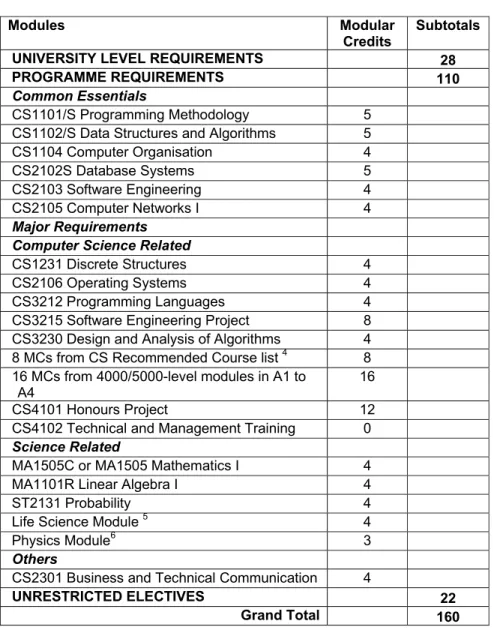
Table 1: Summary of degree requirement for B.Comp. (Computer Science)
Modules Modular Credits Subtotals
UNIVERSITY LEVEL REQUIREMENTS 28
PROGRAMME REQUIREMENTS 110
Common Essentials
CS1101/S Programming Methodology 5
CS1102/S Data Structures and Algorithms 5
CS1104 Computer Organisation 4
CS2102S Database Systems 5
CS2103 Software Engineering 4
CS2105 Computer Networks I 4
Major Requirements
Computer Science Related
CS1231 Discrete Structures 4
CS2106 Operating Systems 4
CS3212 Programming Languages 4
CS3215 Software Engineering Project 8 CS3230 Design and Analysis of Algorithms 4 8 MCs from CS Recommended Course list 4 8
16 MCs from 4000/5000-level modules in A1 to
A4 16
CS4101 Honours Project 12
CS4102 Technical and Management Training 0
Science Related
MA1505C or MA1505 Mathematics I 4
MA1101R Linear Algebra I 4
ST2131 Probability 4
Life Science Module 5 4
Physics Module6 3
Others
CS2301 Business and Technical Communication 4
UNRESTRICTED ELECTIVES 22
Grand Total 160
4
The CS Recommended Course list includes: CS3211 (Parallel and Concurrent Programming), CS3220 (Computer Architectures), CS3231 (Theory of Computation), CS3234 (Logic and Formal Systems), CS3243 (Foundations of Artificial Intelligence), and other relevant courses approved by the Department of Computer Science.
5
A Life-Science module can be LSM1302 (Genes and Society), LSM1304 (Microbes, Environment and Man), or courses approved by the Department of Computer Science.
6 A Physics module can be PC1143 (Physics III), PC1144 (Physics IV), PC1221 (Fundamentals of
Physics I), PC1222 (Fundamentals of Physics II), or courses approved by the Department of Computer Science.
Bachelor of Computing
OverviewThe 3-year Bachelor of Computing programme is designed to provide a sound scientific education, targeted at the needs of local and regional IT users and vendors. The programme combines
theoretical training with practical technology experience. Students will develop professional
competence in programming, abstraction, and conceptual skills of computing.
Graduates will meet national IT manpower needs in major job segments such as programmer analyst, systems analyst, systems programmer, system integrators and end user support analyst. They will be able to contribute immediately to the development needs of the local and regional economies.
Students in this programme are required to choose a focus of study. In order to meet diverging demand in IT practice, the 3-year Bachelor of Computing Programme consists of two foci of studies: The Technology focus aims to equip students with strong technology know-how so that they can stride forward alongside the advancement of computing technology.
The Business focus aims to equip students with sound business knowledge in relation to information technology, including the operation of E-Commerce.
Degree Requirements
The 3-year Bachelor of Computing programme degree requirement is at least 120 modular credits. Modules are classified as follows (note that every module can only be counted towards satisfying exactly one requirement):
(i) PROGRAMME REQUIREMENTS a. Common Essentials
CS1101 or CS1101S Programming Methodology CS1102 or CS1102S Data Structures and Algorithms
CS1104 Computer Organisation CS2102 Database Systems CS2103 Software Engineering CS2105 Computer Networks I b. Major Requirements Technology Focus Computing Related CS1231 Discrete Structures
CS2104 Programming Language Concepts CS2106 Operating Systems
CS3214 Information Systems Development Project
Complete at least 12 modular credits from Technology Requirement by taking elective areas A1 to A8, with at least two modules chosen from the following modules offered by School of Computing:
Modules in elective area A8 Modules on Computer Security
Modules on Human-Computer Interaction Modules on E-Commerce
Modules on Computer Networks Science Related
MA1505C Mathematics I or MA1505 Mathematics I
MA1101R Linear Algebra
A Life-Sciences Module7
Others
CS2301 Business and Technical Communication Business Focus
Computing Related
CS1105 Computing and Society
CS1231 Discrete Structures
CS2250 Fundamentals of Information Systems CS3214 Information Systems Development Project
CS3265 Economics of E-Business
CS3266 E-Commerce Technologies
CS2301 Business and Technical Communication
Complete at least 12 modular credits from Business Requirement by taking elective areas A1 to A8, with at least two modules chosen from the following modules offered by School of Computing:
Modules in elective area A6
CS3251 Technology Strategy and Management CS3253 Management of Information Systems Economics Related
EC1301 Principles of Economics
Science Related
ST2334 Probabilities and Statistics
(ii) UNIVERSITY LEVEL REQUIREMENTS As specified in Section 2.1.2.
(iii) UNRESTRICTED ELECTIVES As specified in Section 2.1.2.
7 A Life-Science module can be LSM1302 (Genes and Society), LSM1304 (Microbes, Environment
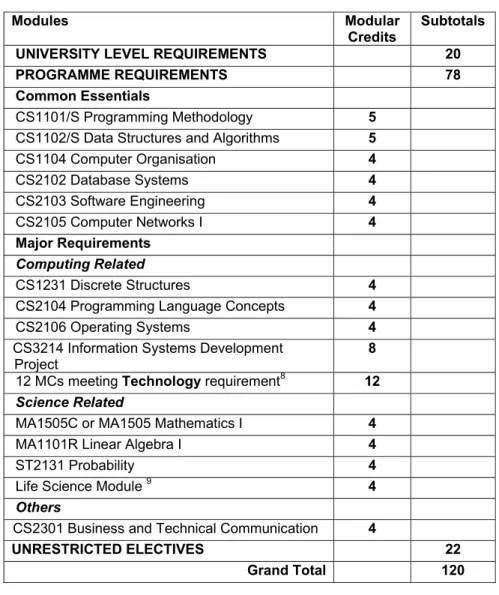
Table 2: Summary of degree requirement for B.Comp. with Technology Focus
Modules Modular Credits Subtotals
UNIVERSITY LEVEL REQUIREMENTS 20
PROGRAMME REQUIREMENTS 78
Common Essentials
CS1101/S Programming Methodology 5
CS1102/S Data Structures and Algorithms 5
CS1104 Computer Organisation 4 CS2102 Database Systems 4 CS2103 Software Engineering 4 CS2105 Computer Networks I 4 Major Requirements Computing Related CS1231 Discrete Structures 4
CS2104 Programming Language Concepts 4
CS2106 Operating Systems 4
CS3214 Information Systems Development Project
8 12 MCs meeting Technology requirement8 12
Science Related
MA1505C or MA1505 Mathematics I 4
MA1101R Linear Algebra I 4
ST2131 Probability 4
Life Science Module 9 4
Others
CS2301 Business and Technical Communication 4
UNRESTRICTED ELECTIVES 22
Grand Total 120
8
To satisfy the Technology requirement, students must make up 12 MCs by taking courses from elective areas A1 to A8, with at least two modules chosen from the following categories of modules offered by School of Computing: Modules from elective area A8, computer security, human-computer interaction, e-commerce, computer networks.
9
A Life-Science module can be LSM1302 (Genes and Society), LSM1304 (Microbes, Environment and Man), or courses approved by the Department of Computer Science
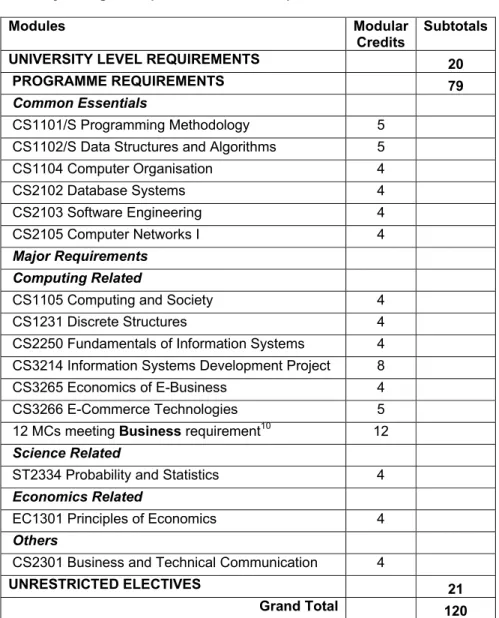
Table 3: Summary of degree requirement for B.Comp. with Business Focus
Modules Modular Credits Subtotals
UNIVERSITY LEVEL REQUIREMENTS 20
PROGRAMME REQUIREMENTS 79
Common Essentials
CS1101/S Programming Methodology 5
CS1102/S Data Structures and Algorithms 5
CS1104 Computer Organisation 4 CS2102 Database Systems 4 CS2103 Software Engineering 4 CS2105 Computer Networks I 4 Major Requirements Computing Related
CS1105 Computing and Society 4
CS1231 Discrete Structures 4
CS2250 Fundamentals of Information Systems 4 CS3214 Information Systems Development Project 8
CS3265 Economics of E-Business 4
CS3266 E-Commerce Technologies 5
12 MCs meeting Business requirement10 12
Science Related
ST2334 Probability and Statistics 4
Economics Related
EC1301 Principles of Economics 4
Others
CS2301 Business and Technical Communication 4
UNRESTRICTED ELECTIVES 21
Grand Total 120
10 To satisfy the Business requirement, students must make up 12 modular credits by taking
courses from elective areas A1 to A8, with at least two modules chosen from the following modules offered by School of Computing: Modules from elective area A6, CS3251 (Technology Strategy and Management) and CS3253 (Management of Information Systems).