Overview
Cisco Hosted IP
Telephony
Executive Summary
The use of alternative technologies such as wireless, e-mail, instant messaging, and IP telephony, including IP private branch exchange (PBX) systems, is affecting the revenue of service providers who rely on time-division multiplexing (TDM) voice-access technology. Attracted by the IP PBX’s productivity-enhancing features and superior manageability, businesses have begun migrating away from
traditional PBX systems and central office exchange (Centrex) service toward IP telephony over the LAN.
Service providers can take advantage of the IP telephony movement, while protecting their TDM voice-access revenue, by offering new, IP-based managed voice services. The most profitable voice services share two attributes. One is a “success-based” capital expenditure model, which accelerates return on investment (ROI) because the service provider can expand the network as additional customers are acquired. The other attribute is an underlying IP infrastructure that service providers can use to deliver incremental services, so that revenue per customer increases with time.
To address this new business imperative, Cisco Systems has released a portfolio of Managed Voice Services solutions that service providers can profitably deploy and offer to enterprises and small and medium businesses. These solutions include Cisco Hosted IP Telephony, Cisco Managed IP PBX, and Cisco Multiservice Virtual Private Network
(VPN). All Cisco solutions for Managed Voice Services share the following characteristics: • Managed Voice Services are enabled by important Cisco Ecosystem Program partners via
a tested and validated combination of market-leading Cisco AVVID (Architecture for Voice, Video and Integrated Data) IP Telephony solutions and service provider carrier-class packet voice products and solutions.
• These services provide a greater return on capital expenditure than traditional TDM voice services because several revenue-generating, enhanced services can be deployed on a common network infrastructure.
• The services take advantage of and complement Cisco expertise and market success in enterprise IP telephony by offering business customers the option to outsource their deployment of integrated voice and data solutions to a managed service provider. Hosted IP telephony is an attractive alternative to customer premises-based PBX systems. The service provider hosts the feature set for IP PBX, unified communications, and integrated management in its central office or data center, where it can be shared by multiple business users. The service provider’s business customers gain access to commonly used subscriber
and group-level calling features, as well as value-added capabilities such as self-provisioning of services; direct management of moves, adds, and changes; integration of instant messaging; video; click to conference; directory services; unified communications; virtual assistants; and more.
The hosted IP telephony service is compelling to business customers because they can take advantage of feature-rich voice services while reducing capital and operating costs. This advantage particularly applies to enterprise branch offices, teleworkers, and small and medium-sized businesses that want to access a full range of IP telephony services, but prefer to outsource.
Cisco offers clear advantages as a provider of solutions for hosted IP telephony. Foremost among them is that Cisco supplies the voice and data IP infrastructure for the greatest number of enterprise companies, giving service providers the largest available market for managed voice services. This, combined with long-term commitment from Cisco to introducing and supporting managed voice services, makes the Cisco Hosted IP Telephony solution the lowest-risk choice with the highest revenue potential.
This solution overview explains the market forces that contribute to the hosted IP telephony service opportunity, the Cisco Hosted IP Telephony solution and its components, and the benefits of the solution to service providers and their business customers.
Market Forces for Hosted IP Telephony
Recent changes in the market have opened a window of opportunity for service providers to offer hosted IP telephony services.
Outsourcing on the Rise
Small and medium-sized businesses (SMBs) with 40 to 200 employees want control over their phone systems and are willing to pay for additional features, as demonstrated by their purchases of PBX and key systems. This makes them prime prospects for outsourced services. In a recent survey of this customer segment by Research First, more than 60 percent of respondents stated that they would outsource communications if the service supported subscriber self-management and the advanced features available through hosted IP telephony.
Another important segment interested in outsourcing is distributed enterprises. They are seeking hosted services to support branch offices with fewer than 100 people and teleworkers who need to access the full range of corporate communications services.
Although outsourcing has long been popular for payroll and human resources and has recently become so for Web hosting, it is just becoming an attractive option for telecommunications. The barrier until now has been the time delays and high costs associated with Centrex administration. Moves, adds, and changes typically took a week to implement and cost US$75 to US$150 each. In addition, there was a significant feature disparity between premises-based and central office-based PBX systems.
The Cisco Hosted IP Telephony solution helps service providers deliver the advantages of outsourcing without its drawbacks. With Web-based self-provisioning, the business customer—either the network administrator or actual business user—can make the changes instantly instead of waiting for the service provider to process moves, adds, and changes. To make changes, the subscriber logs onto a Web site by entering a password and personal identification number (PIN), and then simply turns features on or off. And because packet-based services are not dependent on location of the IP phone on the LAN, businesses that opt for the hosted approach do not sacrifice features.
Because of these dynamics, the market for hosted IP telephony services is projected to be significant. Market researcher IDC forecasts that by 2004, 12.2 percent of worldwide IP PBX services will be hosted in the central office or data center. In the United States alone, Frost & Sullivan projects that IP PBX services will amount to US$1.7 billion in service provider revenue in 2004, growing to US$5.1 billion and US$7.7 billion in 2005 and 2006.
More Enterprise LANs Are Ready for IP Telephony
According to Gartner Group, nearly 50 percent of all PBX sales will be IP-based in 2005.
The increasing sales of IP telephony-enabled switches and routers implies that business customers are preparing to adopt IP telephony, but have not yet decided whether to deploy an in-house IP PBX system or to outsource. Therefore, service providers that quickly introduce hosted IP telephony services position themselves to capitalize on a significant, long-term service revenue opportunity. Fast time to market is crucial: According to Gartner Group, if the enterprise makes a decision to install a premises-based PBX, it will not reevaluate that decision for at least five to seven years.
Business Customers Are Discovering the Advantages of IP PBX Technology
Market researcher RHK reports that since the introduction of IP PBX technology, incumbents have lost 1.8 million lines and more than US$1 billion in traditional Centrex services revenue. Probe Research found that when a major university implemented an IP PBX solution, its incumbent carrier saw monthly Centrex revenue decrease from US$40,000 to US$6000. Offering hosted IP telephony services is a way to target a new set of business customers that have been interested in outsourced approaches, but unwilling to accept the limitations to this approach that have existed to date. And because a hosted IP telephony service offers a rich feature set and high customer flexibility, the long-term monthly revenue potential is compelling.
Service Description
An alternative to PBX or key systems based on TDM switches, the Cisco Hosted IP Telephony solution delivers the most commonly used subscriber and group calling services, as well as other valuable features enabled by IP. These include presence management, preferential call treatment, call logs, unified communications, instant messaging, and basic interactive voice response (IVR) and automatic call distribution (ACD) capabilities. The service represents a “hosted” alternative for enterprises and SMB customers that want to reduce up-front capital expenditures and outsource solution design and support.
To turn traditional features on and off, business customers use a simple, Web-based interface instead of
difficult-to-remember “star” codes. A Web-based interface is also used for moves, adds, and changes, dramatically reducing call center requirements for the service provider while cutting costs and saving time for its business customers. Service providers can customize the Cisco Hosted IP Telephony solution by using Extensible Markup Language (XML) to change the behavior of the phones. This speeds new service introduction, helping service providers retain high-margin business customers and attract new ones. customer turnover is further reduced because the service provider can strengthen the customer relationship by offering value-added services such as directory-based calling and personalization of communications services.
Because hosted IP telephony is network-based, the service provider can take advantage of the network to deliver new services. For example, if a service provider wants to deploy a service that integrates Microsoft Outlook with voice applications, it can simply e-mail the upgrade to the end customers, who install the upgrade themselves. Similarly,
the service provider can “push” additional value-added applications directly to the customers' IP phones. This new service deployment model allows for more rapid service deployment, more innovation, and competitive
differentiation.
Service Provider and Enterprise Benefits
The Cisco Hosted IP Telephony solution offers economic benefits to both the service provider and its enterprise customers.
Service Provider Benefits
• Generates new, high-margin revenue streams with a success-based capital expenditure model—Deployment of a hosted IP telephony service requires very little up-front investment. Carriers invest in additional software licenses and expand their underlying voice and data infrastructure as the customer base grows. Additional gateway ports, points of presence, and data VPN infrastructure can be added as the service succeeds and the carrier enters new markets. Compare this to TDM-based hosted services, which typically require an up-front investment of US$3 to US$5 million just to provide service to the first customer.
• Can be used to deliver other managed voice services—A limitation of traditional hosted approaches is that the underlying infrastructure is incapable of delivering a variety of additional services. In contrast, the Cisco Hosted IP Telephony solution offers the potential for very rapid ROI because the same underlying network components can be used to deliver other managed voice services, such as:
– Managed IP PBX—The service provider sells and provides ongoing management of a premises-based IP PBX solution.
– Multiservice VPN—The service provider delivers voice and data connectivity and closed user group dialing across multiple enterprise locations.
• Takes advantage of existing investments—The Cisco Hosted IP Telephony solution coexists with the carrier voice-over-IP (VoIP) infrastructure and the carrier’s customer’s LAN infrastructures.
• Differentiates service provider from competition—By offering hosted IP telephony services, carriers can differentiate themselves from other service providers, attracting new customers and retaining existing ones. • Helps retain customers with bundled services—By bundling hosted IP telephony services with other services, such
as IP VPNs, unified messaging, and conferencing services, carriers can elevate their value to the customer and earn higher average revenue per user.
• Responds to competitive pressure from IP PBX—Hosted IP telephony competes more effectively with
premises-based solutions because it reduces a business’s management and capital expenditure costs, and delivers a much richer feature set than traditional hosted approaches. And because hosted IP telephony solutions rely on a multiservice architecture, when that architecture is in place for the service provider and its customer, the service provider can more readily offer other scalable business phone services.
Enterprise Benefits
Service providers that deploy the Cisco Hosted IP Telephony solution can offer their customers the following advantages:
• Differentiated services—Business subscribers to hosted IP telephony services gain access to
productivity-enhancing services such as integration of instant messaging, video, click to conference, directory services, and unified communications.
• Greater ease of use—The Cisco Hosted IP Telephony solution eliminates the need for arbitrary,
difficult-to-remember star codes, such as *72 to activate call forwarding. Instead, business users can take advantage of an intuitive graphical user interface (GUI). Productivity improves because users no longer have to look up codes, nor do they have to hang up and redial if they enter an incorrect code.
• Faster moves, adds, and changes—The customer’s administrator can perform adds, deletes, and changes immediately when requested, rather than waiting in a queue for the service provider.
• “Single-wire” connectivity to the desktop—Subscribers to the service provider’s hosted IP telephony service can take advantage of their data networks for voice. They do not need to incur the expense of maintaining separate voice and data networks.
• Consistent voice functions across multiple locations—With centralized, hosted services based on the Cisco Hosted IP Telephony solution, all enhanced voice services work the same way across all locations. This simplifies training, administration, and support, and increases employee productivity. Companies can also implement abbreviated dial plans because the Cisco Hosted IP Telephony solution is capable of forwarding voice mail between switches.
• Lower capital costs—Business customers need to purchase only the number of lines needed, adding or removing lines as business needs change. In contrast, with a premises-based PBX system, line cards, equipment cages, and software licenses are typically sold in fixed increments, so enterprises might need to purchase more hardware or software than they actually need.
• Lower maintenance costs—Costs drop when business customers can outsource installation, configuration, and operation. It costs less and takes far less time for the customer to self-provision than to submit a request to the service provider. And businesses can take advantage of software upgrades immediately when the service provider hosts a shared solution.
• Overall savings—According to a study by InfoTech, companies that implement a hosted IP telephony service reduce the cost of moves, adds, and changes by 37 percent, toll charges by 23 percent, maintenance costs by 10 percent, and voice communications staff by 30 percent on average.
Cisco Hosted IP Telephony Solution Components
The only prerequisite for the Cisco Hosted IP Telephony solution is a telephony-ready data infrastructure with support for quality of service (QoS). Cisco AVVID, based on Cisco Catalyst® switches and Cisco routers, meets these requirements. Figure 1 shows the solution components at the central office and customer premises.
Figure 1
Cisco Hosted IP Telephony Solution Architecture
Service Provider Components
Hosted IP Telephony Application Servers
The Cisco solution features hosted IP telephony application servers from Cisco Ecosystem Partners Broadsoft or Sylantro Systems. The application servers enable service providers to offer a rich set of telephony services that users can control themselves, using an intuitive Web interface. They communicate via Session Initiation Protocol (SIP) or Media Gateway Control Protocol (MGCP) with the customer premises equipment (CPE), such as Cisco IP phones or Cisco IAD 2400 Series integrated access devices (IADs). The application servers deliver enterprise call control, subscriber and group calling services, translations and routing, regulatory features such as lawful intercept, and operations, administration, maintenance, and provisioning (OAM&P).
Internet Carrier Core BTS 10200 or PGW 2200 Public Access IP Network (Open) Public Access IP Network (Protected) TDM Trunks to PSTN Management IP Network Application Server AS5000 PRI 911 PRI SS7 IMT Data Center Trunking Infrastructure PIX® Firewall IAD 2421 and 2423 MGX® 8000 UC Conference Server 10000/12000 Customer Premises
Public Switched Telephone Network (PSTN)
Partner-Hosted IP Telephony Application Server Partner Unified Messaging and Conference Server M DACS + MUX PBX/ HKTS LAN KTS IAD 2600, 3600, 7200 Routers 7960, 7940, 7905 Cisco Catalyst Switch—LAN Switching, Inline Power, 802.1p/q Customer Premises ATA 186/188 LAN V
Service Provider Networking
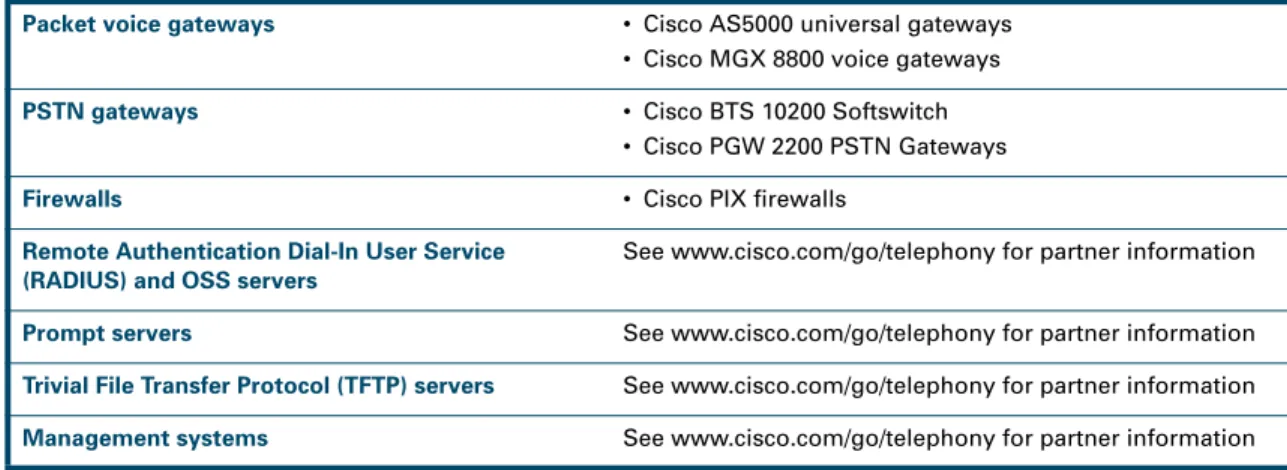
Table 1 provides an overview of the gateway, signaling, media server, billing, and operations support system (OSS) components of the solution.
Alternative Deployment Model
For very rapid time to market, service providers can work with an applications service provider (ASP) that provides IP communications services instead of building their own infrastructures. By reselling wholesale hosted IP telephony services from a ASP, a service provider can bypass the process of integrating the hosted IP telephony system with its back office, rolling out its service and earning revenue in only about 90 days.
Customer Premises Components Line Connections: Cisco IP Phones
Cisco IP phones are fully programmable, next-generation intelligent communication devices. The service provider or business customer can customize the phone feature set easily as business needs change. The two-port 10/100BASE-T switch interface can be used to connect the phone to a PC, satisfying most desktop users’ needs with a single Ethernet port. In-line power is accepted from an integrated Cisco Catalyst switch card or the Cisco Catalyst In-Line Power Patch Panel.
Service providers can offer their customers a choice of Cisco IP phones depending on their price and feature requirements. For example, the Cisco IP Phone 7940 is a full-featured phone for light to medium traffic volume and the Cisco IP Phone 7960 is designed for the needs of executives and managers. For cost-effective IP telephony, the Cisco IP Phone 7905 is a full-featured IP telephone primarily designed as an entry-level device.
Cisco Analog Telephone Adaptors
Business customers that want to use their existing analog phones with hosted IP telephony can take advantage of the Cisco ATA 186 or ATA 188 Analog Telephone Adaptor. Installed at the customer premises, the adaptors interface regular analog telephones with IP-based telephony networks. Both the Cisco ATA 186 and 188 support two voice Table 1 Solution Components Overview
Packet voice gateways • Cisco AS5000 universal gateways
• Cisco MGX 8800 voice gateways
PSTN gateways • Cisco BTS 10200 Softswitch
• Cisco PGW 2200 PSTN Gateways
Firewalls • Cisco PIX firewalls
Remote Authentication Dial-In User Service (RADIUS) and OSS servers
See www.cisco.com/go/telephony for partner information
Prompt servers See www.cisco.com/go/telephony for partner information
Trivial File Transfer Protocol (TFTP) servers See www.cisco.com/go/telephony for partner information
ports, each with its own telephone number, and the Cisco ATA 188 adds an internal Ethernet switch that allows for a direct connection to a 10/100BASE-T Ethernet network via an RJ-45 interface.
Cisco IAD 2400 Series Integrated Access Devices
Cisco IAD 2400 Series integrated access devices reside at the customer premises, integrating data and digital or analog voice services. By using Cisco Configuration Express, service providers can order, configure in advance, and ship the Cisco IAD 2400 Series products directly to end customers, reducing the costs of warehousing, shipping, and manual intervention. The Cisco IAD 2420 supports VoIP, voice over ATM, proven QoS tools, multiple call-control protocols, Simple Gateway Control Protocol (SGCP), diverse coders-decoders (codecs), IP routing, and network security features.
Why Cisco?
Service providers that choose the Cisco Hosted IP Telephony solution reduce risk, gain access to the largest available market of enterprise customers, and can take advantage of Cisco channels for marketing and support.
Specific advantages to working with Cisco to deliver hosted IP telephony services include:
• Long-term commitment to IP telephony—The market leader in VoIP, Cisco has the financial strength, depth of technology, and market presence to endure market cycles and support service providers for the long term. Synergy Research reports that Cisco is number one in worldwide LAN telephony and IP phone sales, with nearly one million IP phones shipped. Cisco is the predominant vendor for enterprise VoIP deployments and enterprise gateways. In addition, Cisco has the broadest worldwide carrier customer base and largest VoIP networks in operation.
• Largest potential customer base—Cisco is the only company with a stated commitment to tie enterprise and service provider networks together. More enterprise customers have built their infrastructures with products from Cisco than from any other vendor. These existing Cisco customers can easily upgrade their LAN infrastructures to support IP telephony, usually by simply adding a voice gateway or voice-enabling their existing Cisco switch or router. Therefore, service providers that deploy the Cisco Hosted IP Telephony solution gain the largest available market—not only for hosted IP telephony services, but also for other high-margin managed voice services that can be deployed on the same infrastructure, such as managed IP PBX and multiservice VPN services. • Marketing and technical support from direct and indirect partners of Cisco—Cisco has accumulated an in-depth knowledge base of what it takes to succeed with IP telephony, incorporated that knowledge into Cisco AVVID technology, and trained its sales channels to implement that knowledge. Service providers that deploy the Cisco Hosted IP Telephony solution are paired with channels that will help sell the service to business customers. • Comprehensive product portfolio—Service providers can obtain all necessary components for the hosted IP
telephony solution and other managed voice services—for the central office as well as the customer premises—from a single source.
• Multiprotocol, multi-environment support—The infrastructure for the Cisco Hosted IP Telephony solution supports multiple protocols—SIP, H.323, and multiple call control protocols—making the service marketable to business customers using IP phones with any of these protocols.
To learn more about the Cisco Hosted IP Telephony solution and other Cisco solutions for Managed Voice Services, visit:
Corporate Headquarters Cisco Systems, Inc. 170 West Tasman Drive San Jose, CA 95134-1706 USA www.cisco.com Tel: 408 526-4000 800 553-NETS (6387) Fax: 408 526-4100 European Headquarters Cisco Systems International BV Haarlerbergpark Haarlerbergweg 13-19 1101 CH Amsterdam The Netherlands www-europe.cisco.com Tel: 31 0 20 357 1000 Fax: 31 0 20 357 1100 Americas Headquarters Cisco Systems, Inc. 170 West Tasman Drive San Jose, CA 95134-1706 USA
www.cisco.com Tel: 408 526-7660 Fax: 408 527-0883
Asia Pacific Headquarters Cisco Systems, Inc. Capital Tower 168 Robinson Road #22-01 to #29-01 Singapore 068912 www.cisco.com Tel: +65 317 7777 Fax: +65 317 7799 Cisco Systems has more than 200 offices in the following countries and regions. Addresses, phone numbers, and fax numbers are listed on the
C i s c o W e b s i t e a t w w w . c i s c o . c o m / g o / o f f i c e s
Argentina • Australia • Austria • Belgium • Brazil • Bulgaria • Canada • Chile • China PRC • Colombia • Costa Rica • Croatia Czech Republic • Denmark • Dubai, UAE • Finland • France • Germany • Greece • Hong Kong SAR • Hungary • India • Indonesia • Ireland Israel • Italy • Japan • Korea • Luxembourg • Malaysia • Mexico • The Netherlands • New Zealand • Norway • Peru • Philippines • Poland Portugal • Puerto Rico • Romania • Russia • Saudi Arabia • Scotland • Singapore • Slovakia • Slovenia • South Africa • Spain • Sweden S w i t z e r l a n d • Ta i w a n • T h a i l a n d • Tu r k e y • U k r a i n e • U n i t e d K i n g d o m • U n i t e d S t a t e s • Ve n e z u e l a • Vi e t n a m • Z i m b a b w e