CHARACTERIZATION AND CONTROL OF BAND BROADENING IN ULTRA-HIGH PRESSURE LIQUID CHROMATOGRAPHY COLUMNS
James P. Grinias
A dissertation submitted to the faculty of the University of North Carolina at Chapel Hill in partial fulfillment of the requirements for the degree of Doctor of Philosophy in the
Department of Chemistry.
Chapel Hill 2014
ABSTRACT
James P. Grinias: Characterization and Control of Band Broadening in Ultra-High Pressure Liquid Chromatography Columns
(Under the direction of James W. Jorgenson)
Improving column performance remains paramount to advancing liquid chromatography (LC) technology. To that end, a series of experiments was designed to both measure and reduce band broadening in LC columns. The main broadening mechanisms (multiple flow path
dispersion, longitudinal molecular diffusion, and resistance to mass transfer) were investigated. Dispersion due to multiple flow paths within a packed bed were studied with a series of columns prepared using different packing conditions. Packed column microstructure was analyzed by confocal laser scanning microscopy (CLSM) to determine bed morphology. Column efficiency was correlated to the bed morphology and the radial particle size distribution. Research on longitudinal molecular diffusion focused on the validity of different stationary phase diffusion models. Evidence was found supporting the recently proposed surface-restricted model of surface diffusion. This result has implications affecting both gradient separations and the
ACKNOWLEDGEMENTS
First, I must thank my research advisor Professor Jim Jorgenson for his guidance and advice over the past five years. His enthusiasm for chromatography was contagious and helped motivate me to grow as a scholar and a scientist. Many of my colleagues from the Jorgenson lab also deserve my deepest gratitude. Ed Franklin and Laura Blue took me under their wing when I first started and have been great mentors ever since; the capillary columns presented in Chapter 2 were a combined, group effort. Justin Godinho has been a dependable co-worker and friend throughout my final two years of graduate school; his contributions to column preparation in Chapter 4 were vital. Other colleagues who have helped me are James Treadway, Dan Lunn, Stephanie Moore, Jordan Stobaugh, and Brian Matthew by providing advice, assistance, know-how, and camaraderie over the past few years. My two undergraduate mentees (Dayley Wilson and Alison Ivey) were very helpful in the data collection for Chapter 5. Finally, I cannot begin to express how important Kaitlin Fague was to my time at Carolina both personally and
professionally. Thank you Kaitie for all you have done… our journey is just beginning!
grateful for the particles, data, and know-how that they have provided over the past year. We would have never been able to connect with the Skrabalak lab if not for Professor Milos Novotny (and his former student Dr. Benjamin Mann); his vast knowledge of chromatography and upbeat attitude have made this a rather enjoyable collaboration. The importance of Waters Corporation to the completion of this dissertation (especially Chapters 3, 5, and 6) cannot be overstated. Dr. Geoff Gerhardt, Dr. Kevin Wyndham, Dr. Keith Fadgen, Bob Collamati, Dr. Greg Roman, and many others have all provided expertise, columns, equipment, and materials whenever needed and I have enjoyed getting to know all of them over the past five years. Special thanks must go to Waters scientists Dr. Martin Gilar and Dr. Bernard Bunner for their hard work and dedication while collaborating on Chapter 3 as well as providing me with a unique perspective on
chromatography from the industry point-of-view.
I would be remiss to not mention the many people who have helped me get to this point. Countless friends and family members must be thanked, especially my parents and sister whose unwavering support has allowed me to reach this point. My “adopted” family of St. Barbara’s Greek Orthodox Church helped me feel at home at North Carolina; they have ensured that I don’t
TABLE OF CONTENTS
LIST OF TABLES ... xii
LIST OF FIGURES ... xiii
LIST OF ABBREVIATIONS ... xxiv
LIST OF SYMBOLS ... xxvii
CHAPTER 1. Introduction to Band Broadening Theory ... 1
1.1 Overview ... 1
1.2 Band Broadening Theory ... 1
1.2.1 The Basics of Separations and Separation Terminology ... 1
1.2.2 van Deemter Theory ... 3
1.2.3 Coefficient Estimates, Reduced Parameters and Alternate Equations ... 7
1.3 Ultra-High Pressure Liquid Chromatography (UHPLC) ... 11
1.3.1 Comparison of HPLC and UHPLC... 11
1.3.2 Pressure, Flow, and Frictional Heating ... 12
1.3.3 Extra-Column Band Broadening... 14
1.4 Dissertation Scope ... 14
1.5 FIGURES ... 16
1.6 REFERENCES ... 19
CHAPTER 2. Correlation of Separation Efficiency and Bed Morphology in Packed Capillary UHPLC Columns... 21
2.1.2 Column Imaging and Reconstruction by Confocal Laser Scanning
Microscopy ... 24
2.2 Materials and Methods ... 26
2.2.1 Chemicals and Materials ... 26
2.2.2 Preparation and Analysis of 10-75 μm i.d. Capillary UHPLC Columns ... 27
2.2.3 Microscopic Imaging and Bed Reconstruction of Capillary UHPLC Columns ... 29
2.3 Results and Discussion ... 30
2.3.1 Efficiency of Capillary UHPLC Columns with Varying Aspect Ratio ... 30
2.3.2 Morphology of Capillary UHPLC Columns with Varying Aspect Ratio ... 31
2.3.3 Particle Size Segregation in Capillary UHPLC Columns ... 34
2.3.4 Slurry Concentration Effects on Efficiency and Particle Size Segregation ... 35
2.4 Conclusions ... 37
2.5 TABLES ... 40
2.6 FIGURES ... 43
2.7 REFERENCES ... 65
CHAPTER 3. Investigation of Surface Diffusion Models and Implications for Chromatographic Band Broadening ... 68
3.1 Introduction ... 68
3.1.1 Surface Diffusion Effects in Gradient LC ... 68
3.1.2 Longitudinal Molecular Diffusion ... 69
3.1.3 Surface-Restricted Molecular Diffusion Model ... 71
3.1.4 Particle-Restricted Molecular Diffusion Model ... 74
3.2.1 Chemicals ... 75
3.2.2 Chromatographic Columns and Instrumentation ... 76
3.2.3 Variance Measurements Using Stop-Flow Techniques ... 76
3.3 Results and Discussion ... 78
3.3.1 Comparison of Surface Diffusion Models ... 78
3.3.2 Investigation of the Surface-Restricted Molecular Diffusion Model ... 79
3.3.3 Correlation Between Longitudinal Molecular Diffusion and Retention ... 80
3.4 Conclusions ... 82
3.5 FIGURES ... 83
3.6 REFERENCES ... 92
CHAPTER 4. Sub-2 μm Perfusion Chromatography Particle Performance and Size Refinement by Hydrodynamic Chromatography ... 94
4.1 Introduction ... 94
4.1.1 Perfusion Chromatography ... 94
4.1.2 Macroporous Silica Particle Synthesis by Ultrasonic Spray Pyrolysis ... 97
4.1.3 Sub-2 μm Macroporous Particles for Capillary UHPLC ... 98
4.2 Theory of Hydrodynamic Chromatography ... 101
4.3 Materials and Methods ... 103
4.3.1 HDC Column Preparation and Use ... 103
4.3.2 HDC Analysis and Refinement of Silica Particles ... 104
4.4 Results and Discussion ... 105
4.4.1 Separation of Nonporous Silica Size Standards by HDC ... 105
4.5 Conclusions ... 111
4.6 FIGURES ... 113
4.7 REFERENCES ... 132
CHAPTER 5. Thermal Broadening Effects in Sub-2 μm Fully Porous and Superficially Porous Particle UHPLC Columns ... 135
5.1 Introduction ... 135
5.1.1 Viscous Heating in UHPLC ... 135
5.1.2 Superficially Porous Particles as a Solution to Viscous Heating ... 137
5.2 Materials and Methods ... 138
5.2.1 Chemicals ... 138
5.2.2 Chromatographic Columns and Instrumentation ... 139
5.2.3 Temperature Measurement and Control Methods ... 140
5.2.4 Chromatographic Efficiency Experiments ... 141
5.3 Results and Discussion ... 142
5.3.1 Column Temperature Measurements ... 142
5.3.2 Effect of Particle Structure on Performance and Temperature ... 143
5.3.3 Effect of Column Dimensions on Performance and Temperature ... 145
5.3.4 Effect of Temperature Environment on Performance and Temperature ... 148
5.3.5 Thermal Effects on Peak Capacity of Peptides in Gradient LC ... 152
5.4 Conclusions ... 155
5.5 TABLES ... 157
5.6 FIGURES ... 159
5.7 REFERENCES ... 186
6.1 Introduction ... 188
6.2 Theory of Extra-Column Band Broadening ... 190
6.2.1 System Contributions to Band Broadening... 190
6.2.2 Injector Contributions ... 191
6.2.3 Exponential Decay Flow Paths ... 191
6.2.4 Connecting Tubing... 192
6.2.5 Detector Contributions ... 193
6.2.6 Calculating Peak Variance ... 194
6.3 Materials and Methods ... 195
6.3.1 Reagents and Materials ... 195
6.3.2 Subtraction Method Instrumentation and Techniques ... 195
6.3.3 Direct Measurement Instrumentation and Techniques ... 196
6.3.4 Flow Modeling Simulations ... 198
6.3.5 Extra-Column Broadening Effects on Microfluidic LC Performance ... 198
6.4 Results and Discussion ... 199
6.4.1 Broadening in Small Inner Diameter Connecting Capillaries ... 199
6.4.2 Simulations of Broadening in Injectors and Connecting Tubing... 204
6.4.3 Peak Injection Profiles ... 206
6.4.4 Efficiency Loss from ECBB in Microfluidic LC ... 207
6.5 Conclusions ... 208
6.6 FIGURES ... 210
LIST OF TABLES
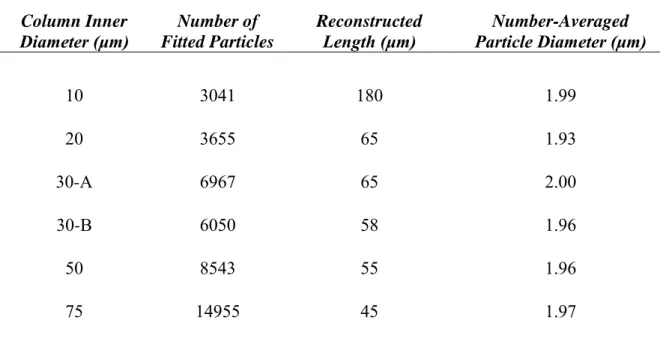
Table 2-1. Bed reconstruction parameters for six capillary LC columns packed
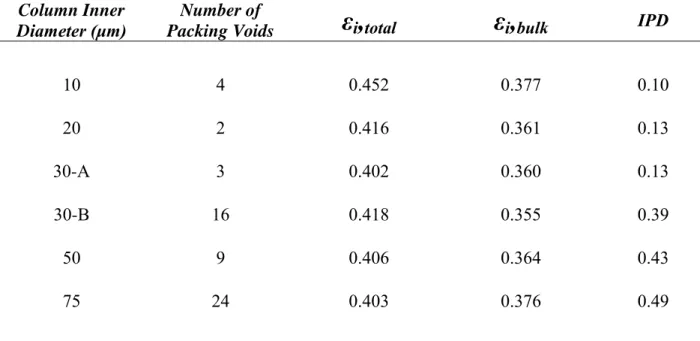
with 1.9 μm BEH particles. ... 40 Table 2-2. Morphological data for six capillary LC columns packed with 1.9 μm
BEH particles. Packing voids describe open spaces in the packed bed that
are larger than the first quartile of the overall particle size distribution. ... 41 Table 2-3. Morphological data for four capillary LC columns packed with 1.7 μm
LIST OF FIGURES
Figure 1-1. Multiple flow path broadening terms present in packed
chromatographic beds (according to the Giddings model4): transchannel (1), short-range interchannel (2), transcolumn (3), long-range interchannel
(4), transparticle (5). ... 16 Figure 1-2. Theoretical h-v plot based on Equation 1-21 with individual
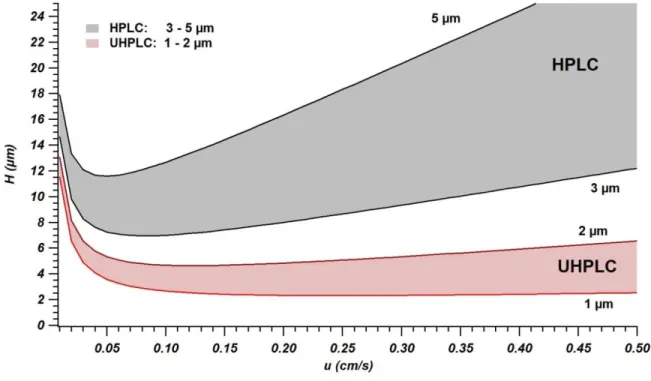
contributions from ha, hb, and hc also shown. ... 17 Figure 1-3. Comparison of relative H values for particle sizes typical of HPLC
(3-5 μm) and UHPLC (1-2 μm) based on Equation 1-17 (with Dm = 1 x 10⁻⁶
cm2/s). ... 18 Figure 2-1. Multiple flow path broadening terms present in packed
chromatographic beds (according to the Giddings model2): transchannel (1), short-range interchannel (2), transcolumn (3), long-range interchannel
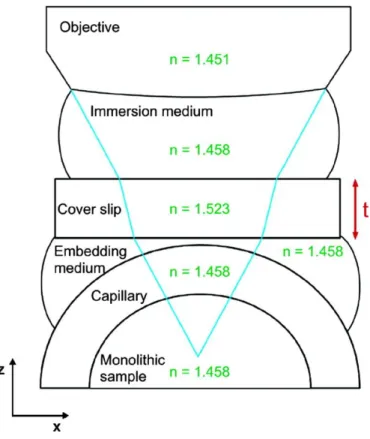
(4), transparticle (5). ... 43 Figure 2-2. Microscope scheme used to image monolithic chromatographic bed
inside a polyimide-coated fused silica capillary. A glycerol/water mixture is used as both the immersion and embedding medium, with a
DMSO/water mixture flowed through the column for refractive index matching purposes. Used with permission from Bruns, S., Müllner, T., Kollmann, M., Schachtner, J., Höltzel, A., Tallarek, U. Analytical Chemistry,2010, 82, 6569-6575. Copyright 2010 American Chemical
Society... 44 Figure 2-3. The first demonstration of a reconstructed packed particle bed imaged
by CLSM (using 2.6 μm Kinetex superficially porous particles) is shown in (A). Morphological analysis of packed bed void spaces (small in green, medium in yellow, and large in red) is shown in (B). Adapted with
permission from Bruns, S., Tallarek, U. Journal of Chromatography A,
2011, 1218, 1849-1860. Copyright 2011 Elsevier. ... 45 Figure 2-4. Initial trial of imaging C18-bonded particle packed bed (Kinetex 2.6
μm superficially porous particles) using a Bodipy 493/503 fluorescence
dye (molecular structure shown on the right). ... 46 Figure 2-5. Restored CLSM images of a capillary bed packed with 1.9 μm BEH
fully porous particles in a 30 μm i.d. capillary along the capillary (xy) axis
and optical (xz) axis. ... 47 Figure 2-6. Calculated particle centers (in red) determined for a 10 μm i.d. column
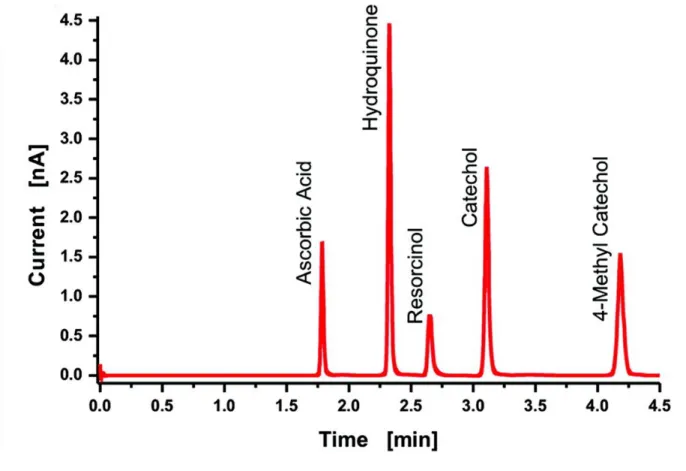
electrochemical test mixture on the capillary LC evaluation system with carbon microfiber electrochemical detection. This run was conducted at 460 bar (1.9 mm/s, v = 4) with a mobile phase of 50:50 (v/v)
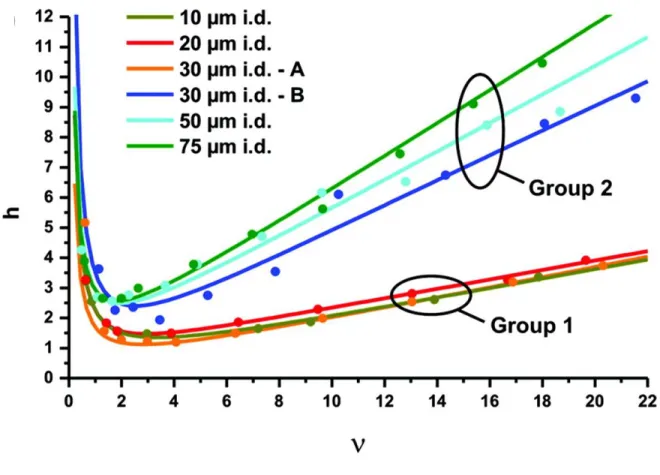
water:acetonitrile with 0.1% TFA. ... 49 Figure 2-8. Set of h-v curves for six capillary LC columns (~20 cm, of inner
diameters shown) packed with 1.9 μm BEH particles. Solid lines of the same color indicate a best fit to Equation 2-8 for each column. Group 1 indicates columns of good (expected) performance while Group 2
indicates columns of poorer performance. ... 50 Figure 2-9. Full reconstruction model of a 30 μm i.d. capillary column packed
with 1.9 μm BEH particles. The reconstruction is made up of 6,967 fitted
particles over a length of 65 μm... 51 Figure 2-10. Color-coded 2-D porosity (interparticle void volume fraction) profile
of a 30 μm i.d. column packed with 1.9 μm BEH particles. Warmer colors
indicate higher porosity and cooler colors indicate lower porosity. ... 52 Figure 2-11. Radial porosity (interparticle void volume fraction) profiles for six
capillary LC columns (of inner diameters shown) packed with 1.9 μm BEH particles. Group 1 indicates columns of good (expected)
performance while Group 2 indicates columns of poorer performance. ... 53 Figure 2-12. Porosity deviation plot used to calculate the IPD value for a 20 μm
i.d. column packed with 1.9 μm BEH particles, representative of the
Group 1 (good performing) columns. ... 54 Figure 2-13. Porosity deviation plot used to calculate the IPD value for a 75 μm
i.d. column packed with 1.9 μm BEH particles, representative of the
Group 2 (poorer performing) columns. ... 55 Figure 2-14. Measure of the mean particle size plotted as a function of the
distance from the capillary wall for six capillary LC columns (of inner
diameters shown) packed with 1.9 μm BEH particles. ... 56
Figure 2-15. Visual depiction of particle size positions in a 30 μm i.d. column packed with 1.9 μm BEH particles. Particles in the lowest 25% of of the PSD of the 3-D reconstruction are highlighted in yellow. Particles in the
highest 25% of the PSD of the 3-D reconstruction are highlighted in blue. ... 57 Figure 2-16. Visual depiction of particle size positions in a 75 μm i.d. column
packed with 1.9 μm BEH particles. Particles in the lowest 25% of the PSD of the 3D reconstruction are highlighted in yellow. Particles in the
highest 25% of the PSD of the 3-D reconstruction are highlighted in blue. ... 58 Figure 2-17. Comparison of local particle size distribution and global particle
wall and 13 particle diameters from the column wall) for a 75 μm i.d.
column packed with 1.9 μm BEH particles. ... 59 Figure 2-18. h-v curves of hydroquinone for 75 μm i.d. columns (~20 cm) packed
with 1.9 μm BEH particles at slurry concentrations of 3 mg/mL and 100
mg/mL. Mobile phase was 50:50 (v/v) water:acetonitrile with 0.1% TFA. ... 60 Figure 2-19. h-v curves of hydroquinone for 50 μm i.d. columns (~20 cm) packed
with 1.7 μm BEH particles at slurry concentrations of 3 mg/mL and 30
mg/mL. Mobile phase was 50:50 (v/v) water:acetonitrile with 0.1% TFA. ... 61 Figure 2-20. Restored CLSM images of 1.9 μm BEH particles packed into a 75
μm i.d. column (100 mg/mL slurry concentration) and 1.7 μm BEH particles packed into a 50 μm i.d. column (30 mg/mL slurry
concentration). ... 62 Figure 2-21. Radial porosity (interparticle void volume fraction) profiles for 75
μm i.d. columns packed with 1.9 μm BEH particles at 3 and 100 mg/mL slurry concentrations and 50 μm i.d. columns packed with 1.7 μm BEH
particles at 3 and 30 mg/mL slurry concentrations. ... 63 Figure 2-22. Measure of the mean particle size plotted as a function of the
distance from the capillary wall for six capillary LC columns (of inner
diameters shown) packed with 1.9 μm BEH particles. ... 64 Figure 3-1. Representation of the surface-restricted molecular diffusion model,
where Qstis the isosteric heat of adsorption and Es is the activation energy of surface diffusion. Adapted with permission from Miyabe, K. Journal of
Chromatography A, 2007, 1167, 161-170. Copyright 2007 Elsevier. ... 83 Figure 3-2. Representations of the proposed particle-restricted molecular diffusion
model for particle-packed beds (A) and monolithic columns (B). ... 84 Figure 3-3. Variance vs. stop time plots for 2.1 x 50 mm BEH and Chromolith
columns run in gradient mode. Peak variance is measured for the renin substrate (DRVYIHPFHLLVYS) peak detected (at 214 nm) from the Waters MassPREP Peptide Mixture. For the BEH column, the sample was loaded at 1%B, run from 1-5%B over one minute and held for a selected stop time (0 min, 2 min, 2 hr, 8 hr, and ~30 hr), then run from 5-50%B over 9 minutes. For the Chromolith column, the sample was loaded at 5%B, run for 1 minute and held for a selected stop time (0 min, 10 min, and 24 hr), then run from 5-50%B over 10 minutes. (100 μL/min for all separations, A: optima-grade water with 0.1% trifluoroacetic acid, B: optima-grade acetonitrile with 0.1% trifluroacetic acid). Dotted lines to
valerophenone. For the BEH column the mobile phase was 78/22 (v/v) water/acetonitrile (k’ ≈ 98) and for the Chromolith column the mobile
phase was 82/18 (v/v) water/acetonitrile (k’ ≈ 93). ... 86
Figure 3-5.Mobile phase and stationary phase diffusion coefficients calculated for valerophenone on a 2.1 x 50 mm BEH column tested at a series of
retention factors for a four-hour stop time. Mobile phase diffusion coefficients were calculated by the Wilke-Change Equation (Equation 3-24e) and Ds was calculated with Equation 3-24f. Increased k’ values were obtained by decreasing the acetonitrile fraction in the water/acetonitrile
mobile phase (50%, 35%, 27%, and 22%, respectively). ... 87 Figure 3-6. Ds/Dm vs. retention factor plot for valerophenone on a 2.1 x 50 mm
BEH column tested at a series of retention factors for a four-hour stop
time based on values from Figure 3-5... 88 Figure 3-7. Diffusion coefficient ratio vs. retention factor plot tested at a series of
retention factors. UNC data is adapted from Figure 3-6 while monolith and 5 μm C18 particle data is adapted with permission from Miyabe, K.
Journal of Chromatographic Science, 2009, 47, 452-458. Copyright 2009
Oxford University Press. ... 89 Figure 3-8. Plot of the logarithm of Ds/Dm vs. the logarithm of the inverse of the
retention factor for valerophenone on a 2.1 x 50 mm BEH column tested at a series of retention factors for a four-hour stop time based on values from
Figure 3-5. ... 90 Figure 3-9. Reduced b-term vs. k’ on a 18.9 cm x 30 μm i.d. column packed with
0.9 μm BEH particles. k' was reported for four compounds
(hydroquinone, resorcinol, catechol, and 4-methyl catechol) at five
different mobile phase compositions (20, 30, 50, 70, and 80%B). The red dashed line displays Equation 3-25f when χ ≈ 2. Adapted with permission from Lieberman, R. A. UNC Doctoral Dissertation, 2009. Copyright 2009
Rachel A. Lieberman. ... 91 Figure 4-1. Representation of a perfusion chromatography particle. Adapted with
permission from Afeyan, N. B., Gordon, N. F., Mazsaroff, I., Varady, L., Fulton, S. P., Yang, Y. B., Regnier, F. E. Journal of Chromatography,
1990, 519, 1-29. Copyright 1990 Elsevier. ... 113 Figure 4-2. SEM image of a macroporous USP particle. ... 114 Figure 4-3. SEM image of USP raw material highlighting three particle
morphologies: macroporous (green), hybrid (or Janus, yellow), and
mesoporous (red). ... 115 Figure 4-4. Chromatogram of a mixture of four electrochemically active analytes
catechol (4MC)) run on a 19 cm x 75 μm i.d. capillary column packed with 1.2 μm (nominally) USP particles bonded with C18. The mobile phase was 80/20 (v/v) water/acetonitrile with 0.1% trifluoroacetic acid and the inlet pressure was 22 kpsi. Measured plate counts (N) are shown for
each peak. ... 116 Figure 4-5. H-u curve of hydroquinone measured on a 19 cm x 75 μm i.d.
capillary column packed with 1.2 μm (nominally) USP particles bonded with C18. The mobile phase was 80/20 (v/v) water/acetonitrile with 0.1%
trifluoroacetic acid. Inlet pressures ranged from 7.9 to 38 kpsi... 117 Figure 4-6. Flow resistance comparison of a 19 cm x 75 μm i.d. capillary column
packed with 1.2 μm (nominally) USP particles bonded with C18 to theoretical curves for columns of the same dimensions packed with 0.5, 1.0, and 1.5 μm porous (assumed εi = 0.4 and εt = 0.7) particles calculated
by the Kozeny-Carman equation (Equation 1-32). ... 118 Figure 4-7. Depiction of hydrodynamic chromatography of two particles in a
capillary tube where rc represents the capillary radius and rp represents the particle radius (rp,1 > rp,2). Adapted with permission from Striegel, A. M., Brewer, A. K., Annual Review of Analytical Chemistry, 2012, 5, 15-34.
Copyright 2012 Annual Reviews. ... 119 Figure 4-8. Three overlaid HDC chromatograms of 0.5, 1.0, and 1.5 μm silica size
standards (urea dead time marker in each run) with 0.2, 1.2, and 5.0 mg/mL sample concentrations, respectively. The glass HDC column was 86 cm x 10 mm diameter packed with 34 μm glass beads, run at 4 mL/min
in 1 mM ammonium hydroxide mobile phase. ... 120 Figure 4-9. SEM images of the HDC polyethylene frit (A), a zoomed-in image of
the polyethylene frit showing trapped silica particles (B), and the
replacement stainless steel mesh frit (C). ... 121 Figure 4-10. Separation of 0.5 and 1.5 μm NPS spheres (with urea dead time
marker) on two 10 mm diameter HDC columns of different lengths packed with 34 μm glass beads. The red trace is for a 47 cm long column and the blue trace is for a 86 cm (39 cm packed on top of the 47 cm column) long column. Both runs were conducted at 4 μL/min (1 mM ammonium hydroxide mobile phase), so the 47 cm column data has been scaled
(based on the ratio of column dead times). ... 122 Figure 4-11. HDC chromatogram for the separation of 0.5 and 1.5 μm silica size
standards (with an added urea dead time marker). The glass HDC column was 86 cm x 10 mm diameter packed with 34 μm glass beads, run at 4
column was 86 cm x 10 mm diameter packed with 34 μm glass beads, run
at 4 mL/min in 1 mM ammonium hydroxide mobile phase. ... 124 Figure 4-13. HDC chromatogram for the refinement of 1.0 μm BEH particles. 1
mg was injected (100 μL of a 10 mg/mL slurry) and four fractions (12 s each) were collected across the peak. The glass HDC column was 86 cm x 10 mm diameter packed with 34 μm glass beads, run at 4 mL/min in 1
mM ammonium hydroxide mobile phase. ... 125 Figure 4-14. A series of ten consecutive injections (at each dotted line, 4 minutes
apart) of the separation shown in Figure 4-13. ... 126 Figure 4-15. Histograms representing ~100 particles sized by SEM for each HDC
fraction collected in Figure 4-13. Average size values (reported with one standard deviation) are: 1.0 μm BEH starting material (A): 1.02 ± 0.24 μm; Fraction 1 (B): 1.24 ± 0.18 μm; Fraction 2 (C): 1.13 ± 0.18 μm;
Fraction 3 (D): 0.98 ± 0.16 μm; and Fraction 4 (E): 0.88 ± 0.15 μm. ... 127
Figure 4-16. HDC chromatogram for the refinement of 1.2 μm USP particles. 1 mg was injected (100 μL of a 10 mg/mL slurry) and two fractions (30 s each) were collected across the peak. The glass HDC column was 86 cm x 10 mm diameter packed with 34 μm glass beads, run at 4 mL/min in 1
mM ammonium hydroxide mobile phase. ... 128 Figure 4-17. Comparison of the particle size distributions of Fractions 1 and 2
collected in Figure 4-16 to the raw (pre-refined) 1.2 μm USP material. The percentage of macroporous, hybrid, and mesoporous particles are shown for each fraction and the average size (± 1 standard deviation) for each particle type. The average particle sizes (for the total fraction) are: 1.23 ± 0.23 μm (Fraction 1), 1.25 ± 0.37 μm (Raw), and 0.97 ± 0.21 μm
(Fraction 2)... 129 Figure 4-18. Comparison of the particle size distributions of the raw 1.2 μm USP
material to material collected following two separate steps of HDC refinement. The percentage of macroporous, hybrid, and mesoporous particles are shown for each fraction and the average size (± 1 standard deviation) for each particle type. The average particle sizes (for the total fraction) are: 1.25 ± 0.37 μm (30% RSD, Raw), 1.23 ± 0.23 μm (19%
RSD, Refinement 1), and 1.25 ± 0.17 μm (14% RSD, Refinement 2). ... 130 Figure 4-19. SEM images of the unrefined, raw 1.2 μm USP particles and the
same particles following two refinement steps by HDC. ... 131 Figure 5-1. Electron micrographs of 1.8 μm HSS particles (A) and 1.5 μm SPP
particles (B). ... 159 Figure 5-2. Mini hypodermic thermocouple probe HYP-0 (A) attached to an
(C). Diagram of the thermocouple probe inserted into PEEK tubing at the
outlet of a standard-bore LC column is shown in (D). ... 160 Figure 5-3. Diagram of a standard-bore LC column held within an external sleeve
designed to contain particulate insulation (aerogel). ... 161 Figure 5-4. Diagram of a standard-bore LC column held within a water
flow-through cell. ... 161 Figure 5-5. Temperature change values measured using a hypodermic
thermocouple probe at the outlet of 2.1 x 50 mm BEH and SPP columns in acetonitrile at 10, 250, 500, 750, 1,000, 1,250, and 1,500 μL/min for 20
minutes each (with a final 20 minute period back at 10 μL/min). ... 162
Figure 5-6. Comparison of measured and extra-column band broadening corrected efficiency values of hexadecanophenone on a 2.1 x 50 mm SPP column
(acetonitrile mobile phase). ... 163 Figure 5-7. h-v curves for hexadecanophenone in acetonitrile mobile phase on 2.1
x 50 mm HSS and SPP columns (corrected for extra-column band
broadening). ... 164 Figure 5-8. Temperature change values (measured using a hypodermic
thermocouple probe at the column outlet) compared to generated power
for 2.1 x 50 mm diameter HSS and SPP columns. ... 165 Figure 5-9. k’ measured for hexadecanophenone in acetonitrile on 2.1 x 50 mm
BEH, HSS, and SPP columns at flow rates ranging from 25 μL/min to
1,600 μL/min (maximum flow rate based on pressure limitations). ... 166 Figure 5-10. Comparison of measured and extra-column band broadening
corrected efficiency values of hexadecanophenone on a 2.1 x 150 mm
HSS column (acetonitrile mobile phase). ... 167 Figure 5-11. h-v curves for hexadecanophenone in acetonitrile mobile phase on
2.1 mm diameter HSS columns of 5 and 15 cm length (corrected for
extra-column band broadening). ... 168 Figure 5-12. Temperature change values (measured using a hypodermic
thermocouple probe at the column outlet) compared to generated power
for 2.1 x 50 mm diameter HSS columns of 5 and 15 cm length. ... 169 Figure 5-13. k’ measured for hexadecanophenone in acetonitrile on on 2.1 mm
Figure 5-14. Comparison of measured and extra-column band broadening corrected efficiency values of hexadecanophenone on a 1.0 x 150 mm
HSS column (acetonitrile mobile phase). ... 171 Figure 5-15. h-v curves for hexadecanophenone in acetonitrile mobile phase on 15
cm HSS columns of 1.0 and 2.1 mm diameter (corrected for extra-column
band broadening). ... 172 Figure 5-16. Temperature change values (measured using a hypodermic
thermocouple probe at the column outlet) compared to generated power
for 15 cm HSS columns of 1.0 and 2.1 mm diameter. ... 173 Figure 5-17. k’ measured for hexadecanophenone in acetonitrile on 15 cm HSS
columns of 1.0 and 2.1 mm diameter at flow rates ranging from 25 μL/min
to 900 μL/min (maximum flow rate based on pressure limitations). ... 174 Figure 5-18. h-v curves for hexadecanophenone in acetonitrile mobile phase on
2.1 x 150 mm HSS columns in the standard Acquity instrument column oven, inside an insulation jacket filled with aerogel (adiabatic), and inside a jacket that allows for heat transfer by water flow (corrected for
extra-column band broadening). ... 175 Figure 5-19. Temperature change values (measured using a hypodermic
thermocouple probe at the column outlet) compared to generated power for 2.1 x 150 mm HSS columns in still air (representative of the Acquity instrument column oven), inside an insulation jacket filled with aerogel,
and inside a jacket that allows for heat transfer by water flow. ... 176 Figure 5-20. k’ measured for hexadecanophenone in acetonitrile on 2.1 x 150 mm
HSS columns in the standard Acquity instrument column oven, inside an insulation jacket filled with aerogel, and inside a jacket that allows for heat transfer by water flow length at flow rates ranging from 50 μL/min to
900 μL/min. ... 177
Figure 5-21. h-v curves for hexadecanophenone in acetonitrile mobile phase on 2.1 x 150 mm HSS and SPP columns in the standard Acquity instrument column oven and inside a jacket that allows for heat transfer by water flow
(corrected for extra-column band broadening). ... 178 Figure 5-22. Temperature change values (measured using a hypodermic
thermocouple probe at the column outlet) compared to generated power for 2.1 x 150 mm HSS and SPP columns in still air (representative of the Acquity instrument column oven) and inside a jacket that allows for heat
transfer by water flow. ... 179 Figure 5-23. k’ measured for hexadecanophenone in acetonitrile on 2.1 x 150 mm
and inside a jacket that allows for heat transfer by water flow at flow rates
ranging from 50 μL/min to 900 μL/min. ... 180 Figure 5-24. Gradient separation of the Waters MassPREP Peptide Mixture (6 μL
injected) on a 2.1 x 150 mm HSS column. The black trace is the raw, measured data, the dotted green trace indicates the UV signal acquired when the gradient is run with no sample injection, and the red trace is the baseline corrected chromatogram. Gradient conditions were 1-50%B (A: optima-grade water with 0.1% trifluoroacetic acid, B: optima-grade
acetonitrile with 0.1% trifluoroacetic acid) over 30 minutes (100 μL /min). ... 181 Figure 5-25. Range for peak capacity measurements where the gradient time is
calculated from Peak 1 to Peak 6 and the peak widths are averaged from
all 6 peaks. Peak identifications can be found in Table 5-2... 182 Figure 5-26. Gradient separation (1-50%B, A: optima-grade water with 0.1%
trifluoroacetic acid, B: optima-grade acetonitrile with 0.1% trifluoroacetic acid) of the Waters MassPREP Peptide Mixture (6 μL injected) on a 2.1 x 150 mm HSS column at three different flow rates: 100 μL/min (30
minutes, red trace), 200 μL/min (15 minutes, black trace), and 300 μL/min
(10 minutes, blue trace)... 183 Figure 5-27. Peak capacities (calculated by Equation 5-5) for 2.1 mm diameter
HSS and SPP columns of 5 and 15 cm length. ... 184 Figure 5-28. Temperature change values (measured using a hypodermic
thermocouple probe at the column outlet) compared to generated power
for 2.1 mm diameter HSS and SPP columns of 5 and 15 cm length. ... 185 Figure 6-1. Graphical plot of Equation 6-11 with a sigma value of 0.2 s, Apeak set
to 1, tr equal to 10 s, and tau values of 0.1, 0.3, 0.5, and 1.0 s. ... 210 Figure 6-2. Diagram (not-to-scale) of instrument set-up used to test open-tube
broadening using the subtraction method (including inset showing internal
capillary butt connection inside the zero-dead volume union). ... 211 Figure 6-3. Valve diagram for the four-port internal sample loop Valco injector.
Red sections indicate fluid that contains analyte while blue indicates
mobile phase. ... 212 Figure 6-4. Diagram (not-to-scale) of instrument set-up used to test open-tube
broadening using the direct measurement method. ... 213 Figure 6-5. 3-D axisymmetric model of the injector (rotor and stator) connected to
Figure 6-6. Photographs of a prototype titanium substrate LC tiles manufactured by Waters Corporation and prototype tile-to-capillary fittings used with the tile. A tile with three straight channels is shown in A (channel position overlaid in blue). Different fittings used for making capillary connections
to and from the tile are shown separately in B and installed in C. ... 215 Figure 6-7. Diagram (not-to-scale) of instrument set-up used to test packed LC
tile column performance with UV detection. ... 216 Figure 6-8. Variance values measured using the subtraction method for nominally
25, 30, 40, and 50 μm i.d. capillaries (1 m long) at flow rates ranging from
0.5 – 14 μL/min. ... 217 Figure 6-9. Measurement of 4-methyl catechol through a 6 cm, 13 μm i.d.
capillary using a carbon fiber electrode detector with a full loop injection. Data acquisition rate was set at 80 Hz and preamplifier filter rates were set
to 3, 10, and 30 Hz. ... 218 Figure 6-10. Variance values measured using the direct measurement method with
a full loop injection for 21, 29, 42, and 51 μm i.d. capillaries (1 m long) at
flow rates ranging from 0.5 – 15 μL/min. ... 219 Figure 6-11. Representation of fluid containing analyte (red) moving from the
internal loop into the connecting capillary when switched into inject mode (mobile phase in blue). The dotted line separates the part of the sample that does not enter the capillary during a timed pinch injection. Adapted with permission from Foster, M. D., Arnold, M. A., Nichols, J. A., Bakalyar, S. R. Journal of Chromatography A, 2000, 869, 231-241.
Copyright 2000 Elsevier. ... 220 Figure 6-12. Variance values measured using the direct measurement method with
a timed pinch injection for 21, 29, 42, and 51 μm i.d. capillaries (1 m long)
at flow rates ranging from 0.5 – 15 μL/min. ... 221 Figure 6-13. Variance values calculated using an EMG peak fit and an ISM
algorithm (interval of -3σ, +5σ) for a 1 m, 20 μm i.d. capillary with a
timed pinch injection... 222 Figure 6-14. Sigma-squared values measured using the direct measurement
method with both full loop and timed pinch injections for 21, 29, 42, and 51 μm i.d. capillaries (1 m long) at flow rates ranging from 0.5 – 15 μL/min. Straight lines indicate values calculated using Taylor-Aris theory
(Equation 6-6). ... 223 Figure 6-15. Tau-squared values measured using the direct measurement method
with a full loop injection for 21, 29, 42, and 51 μm i.d. capillaries (1 m
Figure 6-16. Tau-squared values measured using the direct measurement method with a timed pinch injection for 21, 29, 42, and 51 μm i.d. capillaries (1 m
long) at flow rates ranging from 0.5 – 15 μL/min. ... 225 Figure 6-17. COMSOL modeling of analyte moving from a 20 nL internal loop
through the instrument stator (100 μm i.d.) and into 2.5 mm of a 29 μm i.d. capillary. Red regions represent the initial analyte concentration (conc. = 1) and blue regions represent the mobile phase (conc. = 0) with a colored gradient in between. Flow rate is 15 μL/min and time points are 0,
0.025, 0.05, 0.075, and 0.1 s. ... 226 Figure 6-18. Comparison of τ2 values (29 μm i.d.) from the 3-D axisymmetric
COMSOL model (Model 1, just the injector), combined 2-D and 3-D axisymmetric COMSOL model (Model 2, injector and tube), and
experimental data from Figure 6-15 (injector and tube). ... 227 Figure 6-19. Peak injection profiles of a full loop injection measured out of the
injector through a small (6 cm, 13 µm inner diameter) connecting capillary
for eight flow rates between 0.5 and 15 μL/min. ... 228 Figure 6-20. Peak injection profiles of a timed pinch injection measured out of the
injector through a small (6 cm, 13 µm inner diameter) connecting capillary
for eight flow rates between 0.5 and 15 μL/min. ... 229 Figure 6-21. Expanded peak injection profiles of a timed pinch injection measured
out of the injector through a small (6 cm, 13 µm inner diameter)
connecting capillary for six flow rates between 4 and 15 μL/min. ... 230 Figure 6-22. Comparison of full loop and timed pinch peak injection profiles
measured out of the injector through a small (6 cm, 13 µm inner diameter)
connecting capillary at 10 μL/min. ... 231 Figure 6-23. Standard chromatogram from a 300 μm i.d. titanium tile packed with
1.8 μm HSS particles using a 5-compound test mixture (uracil,
acetophenone, propiophenone, butyrophenone, and valerophenone) with UV detection. Mobile phase was 50:50 (v/v) water:acetonitrile with 0.1%
TFA. ... 232 Figure 6-24. van Deemter curves measured for acetophenone (red, k’ = 1.4) and
butyrophenone (blue, k’ = 4.3) on a 10 cm, 300 μm i.d. titanium tile column packed with 1.8 μm HSS particles. Raw data is shown is shown with the filled circles (fit to Equation 1-20 with solid lines) and ECBB corrected values are shown with the open circles (fit to Equation 1-20 with
LIST OF ABBREVIATIONS
2-D Two-dimensional
3-D Three-dimensional
4MC 4-methyl catechol
AA Ascorbic acid
BEH Bridged-ethyl hybrid BJH Barrett-Joyner-Halenda
C18 n-Octadecyl
CAT Catechol
CFD Computational fluid dynamics CLSM Confocal laser scanning microscopy DMSO Dimethyl sulfoxide
ECBB Extra-column band broadening EMG Exponentially-modified Gaussian EMT Effective medium theory
FPP Fully porous particle
HDC Hydrodynamic chromatography HETP Height equivalent to a theoretical plate HPLC High pressure liquid chromatography HSS High strength silica
HQ Hydroquinone
IPD Integral porosity deviation
i.d. Inner diameter
LC Liquid chromatography
LC-MS Liquid chromatography-Mass spectrometry
MeCN Acetonitrile
MoM Method of (statistical) moments
NPS Nonporous silica
o.d. Outer diameter
PE Polyethylene
PEEK Polyether ether ketone PSD Particle size distribution PS-DVB Poly(styrene-divinyl benzene) PTFE Polytetrafluoroethylene
RES Resorcinol
RSD Relative standard deviation SEM Scanning electron microscopy SPP Superficially porous particle
SS Stainless steel
TEM Transmission electron microscopy TFA Trifluoroacetic acid
TTL Through-the-Lens
UV Ultraviolet
LIST OF SYMBOLS
A Multiple flow path van Deemter coefficient
Apeak Peak amplitude
a Reduced multiple flow path van Deemter coefficient
aKnox Reduced multiple flow path van Deemter coefficient in the Knox model
B Longitudinal diffusion van Deemter coefficient
Bm Longitudinal diffusion in the mobile phase van Deemter coefficient
Bs Longitudinal diffusion in the stationary phase van Deemter coefficient %B Percentage of organic modifier in the mobile phase (for either isocratic or
gradient separations)
b Reduced longitudinal diffusion van Deemter coefficient
bKnox Reduced longitudinal diffusion van Deemter coefficient in the Knox model
C Reduced resistance to mass transfer van Deemter coefficient
CHDC Hydrodynamic chromatography quadratic correction term
Cm Resistance to mass transfer in the mobile phase van Deemter coefficient
Cs Resistance to mass transfer in the mobile phase van Deemter coefficient
Csm Resistance to mass transfer in the stagnant mobile phase van Deemter coefficient
c Resistance to mass transfer van Deemter coefficient
cKnox Reduced resistance to mass transfer van Deemter coefficient in the Knox model
cs Particle slurry concentration
Deff,s Effective diffusion coefficient in the stationary phase
Dm Diffusion coefficient in the mobile phase
Dm,0 Frequency factor of molecular diffusion in the mobile phase
Dmz Diffusion coefficient in the mobile zone
Dpore Diffusion coefficient in the particle pores
Ds Diffusion coefficient in the stationary phase
Ds,0 Frequency factor of molecular diffusion in the stationary phase
Dsz Diffusion coefficient in the stationary zone
dm Theoretical microparticle diameter
dp Particle diameter
dp,HDC Hydrodynamic chromatography packing material particle diameter
dp,n Number-averaged particle diameter
dp,vol Volume-averaged particle diameter
dpore Pore diameter
ds Stationary phase film thickness
Em Activation energy of molecular diffusion in the mobile phase
Es Activation energy of molecular diffusion in the stationary phase
Evap Energy of evaporation
F Flow rate
ffilt Detector filter cutoff frequency
f(t) Measured peak signal in the time domain
G Gradient compression factor
H Height equivalent to a theoretical plate
HA Height equivalent to a theoretical plate due to multiple flow path broadening
HA,Giddings Height equivalent to a theoretical plate due to multiple flow path
broadening in the Giddings model
HB Height equivalent to a theoretical plate due to longitudinal diffusion
HB,m Height equivalent to a theoretical plate due to longitudinal diffusion in the mobile phase
HB,s Height equivalent to a theoretical plate due to longitudinal diffusion in the stationary phase
HC Height equivalent to a theoretical plate due to resistance to mass transfer
HC,m Height equivalent to a theoretical plate due to resistance to mass transfer in the mobile phase
HC,s Height equivalent to a theoretical plate due to resistance to mass transfer in the stationary phase
HC,sm Height equivalent to a theoretical plate due to resistance to mass transfer in the stagnant mobile phase
Hmin Minimum height equivalent to a theoretical plate
h Reduced height equivalent to a theoretical plate
ha Reduced height equivalent to a theoretical plate due to multiple flow path broadening
ha,Giddings,i Reduced height equivalent to a theoretical plate due a multiple flow path
broadening mechanism i in the Giddings model
hads Reduced height equivalent to a theoretical plate due to slow adsorption-desorption kinetics in the Gritti-Guiochon model
hb Reduced height equivalent to a theoretical plate due to longitudinal diffusion
hGiddings Reduced height equivalent to a theoretical plate in the Giddings model
hKnox Reduced height equivalent to a theoretical plate in the Knox model
hlong Reduced height equivalent to a theoretical plate due to longitudinal diffusion in the Gritti-Guiochon model
hmin Minimum reduced height equivalent to a theoretical plate
hmt,m Reduced height equivalent to a theoretical plate due to resistance to mass transfer in the mobile phase in the Gritti-Guiochon model
hmt,s Reduced height equivalent to a theoretical plate due to resistance to mass transfer in the stationary phase in the Gritti-Guiochon model
htc Transcolumn reduced height equivalent to a theoretical plate in the Gritti-Guiochon model
htotal Total reduced height equivalent to a theoretical plate in the
Gritti-Guiochon model
Ka Adsorption equilibrium constant
Ka,0 Frequency factor of adsorption equilibrium
Kbed Specific permeability constant of a packed bed
Kpart Specific permeability constant of a particle
kads Adsorption rate constant
kB Boltzmann constant
k' Retention factor
k’0 Retention factor at initial gradient condition
k’g Gradient retention factor
k’part Particle retention factor
L Column length
MA Solute molecular weight
N Number of theoretical plates
nc Peak capacity
ΔP Pressure drop across the column
Qst Isosteric heat of adsorption
R Universal gas constant
Rs Resolution
rc Column (or capillary) radius
rc,HDC Interstitial capillary radius in a particle-packed hydrodynamic
chromatography column
rp Particle radius
rsolid-core Solid-core radius (in a superficially porous particle)
S Retention and organic solvent concentration relationship constant
T Temperature
ΔTL Axial temperature change ΔTR Radial temperature change
t Time
t0 Column void (dead) time
tfilt Detector filter time constant
tG Gradient time length
tin Time into the stationary phase
tm Time analyte spends in mobile phase
tmix Mean time an analyte spends in a mixing chamber
tr Analyte retention time
ts Time analyte spends in stationary phase
tsamp Detector sampling time (inverse data acquisition rate)
u Mobile phase velocity
ui Interstitial mobile phase velocity
up Particle velocity in hydrodynamic chromatography
ur Local velocity at radial position r
us Sedimentation velocity
umeas Measured mobile phase velocity
upore Mobile phase velocity through particle pores
VA Solute molar volume
Vdet Detector volume
Vf Solvent free volume
Vinj Injection volume
Vsp Specific pore volume
w Peak basewidth
wavg Mean peak basewidth
α Relative retention
αT Thermal expansion coefficient of the solvent
β Surface diffusion fractional isosteric heat of adsorption
βlong Effective medium theory diffusion coefficient ratio term
γ Tortuosity (obstruction) factor
γs Tortuosity (obstruction) factor in the stationary phase
γsm Tortuosity (obstruction) factor in the stagnant mobile phase
δi Thermal conductivity of component i
δMeCN Thermal conductivity of acetonitrile
δm Thermal conductivity of a medium
δp Thermal conductivity of the packed bed (including solvent)
δwater Thermal conductivity of water
ε(r) Local interstitial porosity at radial position r from the column center
εbulk Interstitial porosity in the bulk packing region
εi Interstitial porosity
εpp Intraparticle porosity
εsk Particle skeleton fraction
εt Total column porosity
ζ Cm-term packed bed structure coefficient
η Mobile phase viscosity
κ Ratio of pore velocity to total mobile phase velocity
λA A-term packed bed structure coefficient
λdiff Distance between two neighboring equilibrium positions in diffusion
λHDC Ratio of particle radius to capillary radius in hydrodynamic chromatography
λi Advection structural parameter in the Giddings model
λtch Transchannel advection structural parameter in the Giddings model
v Reduced mobile phase velocity
v1/2,i Reduced transition velocity of a given broadening contribution i in the
Giddings model
v1/2,sr Reduced transition velocity of the short-range interchannel contribution in
the Giddings model
v1/2,tc Reduced transition velocity of the transcolumn contribution in the
Giddings model
v1/2,tch Reduced transition velocity of the transchannel contribution in the
Giddings model
vopt Optimum reduced mobile phase velocity
ξlong Torquato model parameter
ρ Ratio of solid core radius to total particle radius in a superficially porous particle
ρliq Solvent density
ρsk Particle skeletal density
σfit Sigma parameter from the Exponentially-modified Gaussian peak fit
σ2
det Sigma-type variance contribution from the detector
σ2
diff Variance due to longitudinal molecular diffusion
σ2
diff,l Spatial variance due to longitudinal molecular diffusion
σ2
diff,time Temporal variance due to longitudinal molecular diffusion
σ2
inj Sigma-type variance contribution from the injector
σ2
l Spatial variance
σ2
time Temporal variance
σ2
tot,sys Total system (extra-column) variance
σ2
σ2
var,EMG Peak variance calculated using the Exponentially-modified Gaussian
peak-fitting technique
σ2
var,MOM Peak variance calculated using the statistical moments method
σ2
vol Volumetric variance
σ2
vol,det Sigma-type volumetric variance contribution from the detector
σ2
vol,inj Sigma-type volumetric variance contribution from the injector
σ2
vol,tube Sigma-type volumetric variance contribution from connecting tubing
τdiff Diffusion rate constant
τfit Tau parameter from the Exponentially-modified Gaussian peak fit
τHDC Hydrodynamic chromatography particle elution factor
τ2
data Tau-type variance contribution from the data acquisition rate
τ2
filt Tau-type variance contribution from the detector filter rate
τ2
flow Tau-type variance contribution from mixing volumes
τ2
time,chmbr Tau-type temporal variance contribution from a diffusion chamber
τ2
time,data Tau-type temporal variance contribution from the data acquisition rate
τ2
time,filt Tau-type temporal variance contribution from the detector filter rate
τ2
time,mix Tau-type temporal variance contribution from a mixing chamber
Δϕ Change in fraction of organic modifier in the mobile phase
ϕm,i Volume fraction of component i in a medium
φ Stagnant mobile phase fraction
χ Surface-restricted molecular diffusion model constant
ΨB Solvent association factor
ωsr Short-range interchannel diffusion structural parameter in the Giddings model
ωtc Transcolumn diffusion structural parameter in the Giddings model
ωtch Transchannel diffusion structural parameter in the Giddings model
ωα,i Distance an analyte molecule must travel by advection to encounter all possible velocity paths for a given broadening contribution i in the Giddings model
ωα,tc Distance an analyte molecule must travel by advection to encounter all possible velocity paths for the transcolumn contribution in the Giddings model
ωβ,i Ratio of the velocity extremes across the range of a given broadening contribution i to the mean velocity across this range in the Giddings model
ωβ,tc Ratio of the velocity extremes across the range of the transcolumn broadening contribution to the mean velocity across this range in the Giddings model
CHAPTER 1. Introduction to Band Broadening Theory
1.1 Overview
High pressure liquid chromatography (HPLC) is one of the most ubiquitous and important analytical techniques in use today.1,2 According to a recent strategic business report on HPLC systems and accessories prepared by Global Industry Analysts, Inc., the global liquid chromatography (LC) market will expand to nearly $5 billion by the year 2020.3 As the field continues to grow and the worldwide user base expands, improving the performance and speed of this technique is paramount for continued growth. The most vital factor in a separation by LC (and the focus of this thesis) is the column1,2, where further development is one of the keys to achieving these improvements. In this introduction, the general theory of band broadening in LC columns will be described in order to present readers with the necessary background to
understand the research presented here. More recent developments in the field focused on ultra-high pressure liquid chromatography (UHPLC) that have impacted LC column (and instrument) research will also be detailed. The specific sections relevant to each chapter in the thesis will be detailed throughout the rest of this introduction.
1.2 Band Broadening Theory
1.2.1 The Basics of Separations and Separation Terminology
terminology relates this spatial variance to a factor referred to as the height equivalent to a theoretical plate (HETP, or H) through the column length (L)4:
L
H l
2
(1-1)
The number of theoretical plates in a column (N) is a measure of separation efficiency and is a ratio of the total column length to one HETP1:
2 2 l L H L N
(1-2)
In nearly all cases, chromatograms are measured in the time domain, so N can also be described in terms of temporal variance (σtime2)1:
2 2 time r t N (1-3)
where tr is the analyte retention time, or the amount of time spent on the column. The retention time is the sum of time an analyte spends in the stationary (ts) and mobile (tm) phases:
m s r t t
t (1-4)
tm is the time it takes for the entire mobile phase fraction to elute from the column and is also referred to as the column dead time (t0) which is interchangeable with tm and can be measured by the elution time of a non-retained analyte.2 The most popular form of LC (reversed phase LC) consists of a particulate material (usually spherical silica) coated with a thin hydrophobic stationary phase layer (this material is then packed into a column) and mobile phases that are mixtures of water and an organic solvent (typically acetonitrile or methanol). It is the
0 0 ' t t t t t k r m
s
(1-5)
Resolution (Rs) is the term used to describe the separation between two analytes and is related to both N and k’1:
1 ' ' 1 4 2 2 k k N Rs (1-6)
where α is the relative retention (the ratio of the two retention factors, k’2/k’1). To quickly determine resolution from a measured chromatogram, the following formula based on the peak basewidths (w, which is equal to 4σt) can be used1:
1 2
1 , 2 , 2 w w t t
Rs r r
(1-7)
1.2.2 van Deemter Theory
Every process that broadens a band has its own variance contribution. If these processes are independent from each other, then the total HETP can be described as4:
... ... ... 3 2 1 2 3 , 2 2 , 2 1 , 2 3 , 2 2 , 2 1 ,
H H H
L L L L
H l l l l l l (1-8)
The most well-known description of chromatographic band broadening based on Equation 1-8 is the van Deemter equation, where three contributions to H are described based on their
dependence to the mobile phase velocity (u)5:
Cu u B A H H H
H A B C (1-9)
including the Giddings4 and Knox10 equations. No matter the model, the three main broadening mechanisms that occur in columns are (labeled with terms from the van Deemter equation): multiple flow paths (A), longitudinal molecular diffusion (B), and resistance to mass transfer (C).
1.2.2.1 A-Term Broadening
The multiple flow path (or eddy) dispersion term (A-term) describes broadening that occurs due to the variable flow paths an analyte molecule can take while traveling through a column.1 Each of these paths can have a different length and linear velocity, which leads to spreading of the analyte band. The simplest interpretation of this term is1:
p A
A d
H (1-10)
In Equation 1-10, dp is the diameter of the particles that make up the stationary phase packing material and λA is a parameter describing the quality of the packed bed (usually 1.5-2 for a well-packed column1). This basic description assumes analyte migration by advection (flow
exchange, or convection) throughout the column and neglects migration by diffusion. In the Giddings model (a more complex description of multiple flow path broadening), exchange by both flow and diffusion is considered and HA is4:
5 1 2 , 2 1 1 i p i m p i Giddings A ud D d H (1-11)transchannel and transcolumn broadening modes actually simplify to velocity-dependent (C) terms.11,12 This means that when the van Deemter model is used to describe band broadening in LC columns, contributions that should be attributed to the multiple flow path term are being absorbed into the C-term.6,7 Gritti and Guiochon have found that after separating out the velocity-dependent contributions to A-term broadening from the C-term, the multiple flow path term contributes ~75% of the total value of H and thus its reduction is paramount to improving column efficiency.8 A study on how column packing techniques can affect the bed structure (morphology) and the resulting impact of this structure on the chromatographic performance (and the A-term) is detailed in Chapter 2.
1.2.2.2 B-Term Broadening
B-term broadening occurs due to longitudinal molecular diffusion of the analyte molecules within the column1:
u D HB 2 (1-12)
where γ is a tortuosity factor that describes how the packed bed prevents free diffusion of the molecules. Both Giddings4 and Knox13 separate contributions to the B-term based on the mobile (m) and stationary (s) phases:
u D k u D H H
H m m s s
s B m B B
2 '
2 ,
,
(1-13)
1.2.2.3 C-Term Broadening
The C-term is made up of three components of mass transfer resistance: within the mobile phase (Cm), the stationary phase (Cs), and the stagnant mobile phase (in the pores of porous particles, Csm).1 First, resistance to mass transfer in the mobile phase arises due to movement of analyte from the interstitial (in between the particles) mobile phase to the particle surface1:
mp m C D k u d k k H 2 2 2 , ' 1 ' 11 ' 6 1 (1-14)
with ζ a parameter related to the packed bed structure. The parabolic profile of mobile phase flow in the interparticle pores means that analytes are moving faster the further they are from a particle surface (to which they must travel to in order to enter the stationary phase).14 Because the magnitude of both of these effects increases as the interparticle space grows larger (which occurs as dp increases), HC,m is proportional to dp2. In Section 1.2.2.1 it was described how when diffusion and migration are coupled in the Giddings model4 that the transchannel contribution becomes proportional to u.11,12 The HC,m factor derived from theories on mass transfer in capillaries1 and the A-term transchannel broadening described by Giddings are related ways of determining mass transfer resistance in the channels between adjacent particles.
As mentioned earlier, the stationary phase is a thin film (with thickness ds) coated onto a support particle. The resistance to mass transfer in the stationary phase relates to the time it takes for the analyte to diffuse out of the stationary phase4:
k
uFinally, in porous stationary phase particles there is a fraction (φ) of the mobile phase that is within the pores and is stagnant (sm), giving rise to a third C-term (HC,sm) related to this mass transfer resistance in region1:
sm mp sm C D k u d k H 2 2 2 , ' 1 1 30 ' 1 (1-16)
To reduce HC,sm, pores can either be eliminated1,15 (which greatly reduces the loading capacity of the particles) or significantly increased in size to increase mass transfer through the particle.8 In perfusion chromatography, the pore diameter (dpore) is much larger than in standard stationary phase supports, allowing convective transport through the pores (and thus, the particle) which can greatly reduce HC,sm.15,16 In Chapter 4, a new perfusion particle17,18 is introduced for
reversed phase LC and results on its initial performance and further development are described.
1.2.3 Coefficient Estimates, Reduced Parameters and Alternate Equations
Neue has reported an empirical van Deemter equation that can be used to approximate H
for most LC columns slurry packed with porous particles1:
m p m p C B A D u d u D d H H H H 6 5 . 1 2
(1-17)
However, when trying to compare columns that are packed with different particles or are
characterized with different mobile phases or analytes (both of which will change Dm), it is easier to normalize the A, B, and C terms. To achieve this, reduced plate height (h) and reduced
velocity (v) parameters are used1:
d H
m p
D ud
v (1-19)
With these parameters, the reduced van Deemter equation can be described1:
cv v b a h h h
h a b c (1-20)
By substituting Equations 1-18 and 1-19 into Equation 1-17, an estimated value for the reduced plate height (from Equation 1-20) is calculated1:
6 1 5 . 1 v v
h (1-21)
A plot of Equation 1-21 is shown in Figure 1-2 demonstrating the relative contributions from ha,
hb, and hc. From this equation, the minimum reduced plate height (hmin) is ~2.3 and the reduced velocity at this minimum (vopt) is ~2.5. As mentioned in Section 1.1.2, the Knox equation10 is a popular alternative to the van Deemter equation that accounts for some of the
velocity-dependence of the A term (discussed in the Giddings model4) based on empirical observations1,2,9:
10 5 . 1 3 / 1 3 / 1 v v v v c v b v a
hKnox Knox Knox Knox (1-22)
While the reduced van Deemter and Knox equations (Equations 1-20 and 1-22) are both well-known curve fits to h-v data, the factors that make them up (specifically Equations 10, 1-13, 1-14, 1-15, and 1-16) are not exact, physical representations of broadening processes.6-8 Presently, the most complete model of band broadening (htotal) based on rigorous empirical measurements and computational modeling was reported by Gritti and Guiochon7:
s mt m mt ads long
total h h h h
h , , (1-23)
and stationary (s) phases. While the overall broadening mechanism concepts are the same, their relationships, physical descriptions, and magnitudes change. For hlong, complexities arising from diffusion in a heterogeneous binary medium (such as a packed bed with mobile phase) not accounted for in Equation 1-13 are solved by utilizing effective medium theory (EMT) models19,20 which result in the following expansion7:
2 2 2 1 1 2 1 2 1 2 long long i long i long long i long i i long v h (1-24)
In this equation, εi describes the interparticle porosity (usually ~0.4 for a random-packed bed1),
ξlong is a parameter derived from the Torquato model21 of the EMT (when εi ≈ 0.4, ξlong ≈ 0.13),
and βlong is a diffusion coefficient ratio7:
2 ' 1 ' m S m S long D D k D D k
(1-25)
For mass transfer resistance in the mobile phase, it was determined that hmt,m is only related to retention (like Equation 1-14) when slow adsorption-desorption kinetics contributions (hads) are included in its determination.7 In this model, these kinetics are removed from the resistance to mass transfer calculation and given their own parameter:
2 2 2 ' 1 ' ' 1 ' 1 2 p ads m part part i i ads d k D k k k k
h
(1-26)
where kads is the adsorption rate constant and k’part is a particle retention factor related to the intraparticle porosity (εpp, the fraction inside a particle that is stagnant mobile phase)7:
pp
ikBy removing any relationship between retention and mass transfer resistance in the mobile phase, hmt,m is instead represented by the Giddings model of the multiple flow path term (Equation 1-11)4, specifically the transchannel (tch), short-range interchannel (sr), and transcolumn (tc) contributions7:
) ( 1 2 1 1 1 2 1 1
, h v
v v h tc sr sr tch tch m mt (1-28)
The transcolumn term is due to non-uniform packing across the cross-sectional area of the column and non-ideal analyte distribution into (and analyte collection out of) the column.7 When the analyte is fully equilibrated across the diameter of the column and maldistribution effects are negligible (like in a capillary column where the length-to-diameter ratio is large), htc simplifies to a term directly proportional to v.11,12 However, when these criteria are not met, the actual factor htc has no exact mathematical expression and can only be found by subtracting out the other components of Equation 1-23 from an experimental htotal.7 As mentioned for Equation 1-11, this term is discussed in further detail in Chapter 2. The last remaining term in this
expanded band broadening equation describes resistance to mass transfer in the stationary phase7:
sm i i s mt D k v D k k h ' ' 1 ' 1 30 2 , (1-29)
The various models that are described above are of increasing complexity in their description of the broadening mechanisms that occur in LC (especially Equations 1-23 through 1-29) and are mainly detailed here as a reference to the reader.