Analysis and Optimization for Pipelined Asynchronous
Systems
Gennette D Gill
A dissertation submitted to the faculty of the University of North Carolina at Chapel Hill in partial fulfillment of the requirements for the degree of Doctor of Philosophy in the Depart-ment of Computer Science.
Chapel Hill 2010
Approved by:
Montek Singh, Advisor
Jo Ebergen, Co-principal Reader
Krishnendu Chakrabarty, Reader
Anselmo Lastra, Reader
Leandra Vicci, Reader
c
2010
Abstract
Gennette D Gill: Analysis and Optimization for Pipelined Asynchronous Systems . (Under the direction of Montek Singh.)
Most microelectronic chips used today—in systems ranging from cell phones to desktop computers
to supercomputers—operate in basically the same way: they synchronize the operation of their millions
of internal components using a clock that is distributed globally. This global clocking is becoming a
critical design challenge in the quest for building chips that offer increasingly greater functionality,
higher speed, and better energy efficiency.
As an alternative, asynchronous or “clockless” design obviates the need for global
synchroniza-tion; instead, components operate concurrently and synchronize locally only when necessary. This
dissertation focuses on one class of asynchronous circuits: application specific dataflow systems (i.e.
those that take in a stream of data items and produce a stream of processed results.) High-speed stream
processors are a natural match for many high-end applications, including 3D graphics rendering, image
and video processing, digital filters and DSPs, cryptography, and networking processors.
This dissertation aims to make the design, analysis, optimization, and testing of circuits in the
chosen domain both fast and efficient. Although much of the groundwork has already been laid by
years of past work, my work identifies and addresses four critical missing pieces: i) fast performance
analysis for estimating the throughput of a fine-grained pipelined system; ii) automated and versatile
design space exploration; iii) a full suite of circuit level modules that connect together to implement a
wide variety of system behaviors; and iv) testing and design for testability techniques that identify and
target the types of errors found only in high-speed pipelined asynchronous systems.
I demonstrate these techniques on a number of examples, ranging from simple applications that
allow for easy comparison to hand-designed alternatives to more complex systems, such as a JPEG
encoder. I also demonstrate these techniques through the design and test of a fully asynchronous GCD
Acknowledgments
This dissertation would not have been possible without the help of a great many people.
I credit Montek Singh—who has been my advisor through this entire process—with helping
me become interested in asynchronous design. He has always been there to point me in the
right direction when I get off track and help me see the big picture when I was stuck on the
details.
I also highly value the help and support of the other students that I have worked with.
John Hansen and I learned together how tedious the hand design of circuits can be, and this
experience has inspired both of our research. Ankur Agiwal and Vishal Gupta both provided
invaluable support through setting up and running simulations.
I would like to thank my committee for the time that they have spent helping prepare
me to complete this dissertation. Jo Ebergen, Leandra Vicci, Anselmo Lastra, Krishnendu
Chakrabarty, and Kevin Jeffay have all helped test my knowledge and given feedback to
pre-pare me for this research undertaking. Jo Ebergen, who I did an internship with soon after I
began my journey into asynchronous design, helped shape my ideas about both the benefits
and the challenges of asynchronous design. Leandra Vicci, in addition to being on my
com-mittee, also played a vital role in the completion of the testing and demonstration setup for the
Euclid test chip.
I would like to mention the administrative and IT support staff in the computer science
department, who have always been so helpful and patient with me. I would especially like to
thank Janet Jones for doing a spectacular job of making sure that I was never kicked out of
school for missing paperwork.
I would be remiss if I failed to mention the funding sources that have helped me focus
Department of Defense and also a National Science Foundation fellowship. During my last
semester, which I spent preparing this dissertation and writing one more paper, I was supported
by the Alumni Fellowship from Computer Science department at the University of North
Carolina at Chapel Hill.
Though I cannot give names, I would love to be able to thank the countless anonymous
reviewers who have spent the time to critique my papers over the years. It has helped me
to greatly improve my scientific writing. Some of the writing from those papers has also
found its way into this dissertation, so this work was indirectly edited by many people who
undoubtedly do no realize their role. One person who has helped in editing this document
that I can name, though, is my friend Sharif Razzaque, who has always had a knack for being
helpful.
Finally, I must admit that there is no possible way I could have completed this work
with-out the support of my husband, Pepe Bastardes, who has always been an unending source of
optimism about my research. I find that, in research, motivation and tenacity are an even more
Table of Contents
List of Tables . . . xiii
List of Figures . . . xiv
1 Introduction . . . 1
1.1 Goals and Solution Strategies . . . 1
1.1.1 Challenges to Designing Application Specific Dataflow Systems . . 1
1.1.2 Solution Strategy . . . 2
1.1.3 Thesis Statement . . . 2
1.2 Introduction to Asynchronous Design . . . 3
1.2.1 Definition . . . 3
1.2.2 Current Uses . . . 4
1.2.3 Future Applications . . . 4
1.3 Past Work and Current Challenges . . . 4
1.3.1 High-level Code to Low-level Designs . . . 5
1.3.2 Design-space Exploration . . . 6
1.3.3 Performance Analysis . . . 7
1.3.4 Circuit Components . . . 7
1.3.5 Testability . . . 8
1.4 Contributions . . . 8
1.4.1 Modeling and Abstractions . . . 8
1.4.3 System-Level Optimization . . . 9
1.4.4 Testing and Design for Testability . . . 9
1.4.5 Circuit-Level Design . . . 10
1.4.6 Case Studies . . . 10
1.5 Dissertation Organization . . . 10
2 Background on Asynchronous Design . . . 12
2.1 Asynchronous Pipelines . . . 12
2.1.1 Data Encodings within Asynchronous Pipelines . . . 12
2.1.2 Asynchronous Handshaking Protocols . . . 14
2.1.3 Asynchronous Pipeline Styles . . . 14
2.2 Performance Analysis for Asynchronous Pipelines . . . 17
2.2.1 Performance Metrics for Pipeline Stages . . . 17
2.2.2 Canopy Graph Analysis. . . 19
3 Models and Abstractions . . . 24
3.1 Background . . . 24
3.1.1 Performance Metrics for Pipeline Stages . . . 24
3.1.2 Abstractions for Asynchronous Pipelined Systems . . . 26
3.1.3 System-level Performance Models . . . 26
3.2 Modeling Asynchronous Pipeline Stages . . . 27
3.2.1 Delay Models . . . 27
3.2.2 Performance Metrics for System-Level Analysis . . . 28
3.2.3 Determining Performance Metrics . . . 29
3.2.4 System-level Use of Performance Metrics . . . 38
3.3 A Hierarchical Model for Asynchronous Systems . . . 39
3.3.2 Supported Hierarchical Constructs . . . 40
3.3.3 Example Usage . . . 44
3.4 Modeling System Performance : Canopy Graphs. . . 46
3.4.1 Definition and Notation for Canopy Graphs . . . 47
3.4.2 Properties of Canopy Graphs . . . 49
3.4.3 Advantages of Canopy Graph Analysis . . . 53
3.4.4 Canopy Graph for a Single Stage . . . 54
3.4.5 Assumptions . . . 55
4 Performance Analysis . . . 57
4.1 Introduction . . . 57
4.2 Previous Work . . . 59
4.3 Analysis Method . . . 60
4.3.1 Parallel Composition . . . 61
4.3.2 Sequential Composition . . . 64
4.3.3 Conditional Constructs . . . 67
4.3.4 Iterative Constructs . . . 74
4.4 Algorithm Description . . . 76
4.5 Results. . . 79
4.6 Conclusion . . . 81
5 Optimization and Trade-off Exploration . . . 83
5.1 Introduction . . . 83
5.2 Background on Optimizing Asynchronous Systems . . . 84
5.2.1 Previous Work on Optimizing Transformations . . . 84
5.2.2 Previous Work on Optimization and Bottleneck Removal . . . 86
5.3.1 Bag of TRICS . . . 87
5.3.2 Buffer Insertion Details . . . 90
5.3.3 Loop pipelining: a novel transformation for bottleneck alleviation . . 98
5.4 Bottleneck Identification . . . 103
5.4.1 Classification of Bottlenecks . . . 104
5.4.2 Step 1: Compute Overall Canopy Graph . . . 105
5.4.3 Step 2: Find Limiting Segments . . . 105
5.4.4 Step 3: Compute And-Or Bottleneck Formula . . . 107
5.5 Bottleneck Removal . . . 109
5.5.1 User-Guided Method for Bottleneck Alleviation . . . 109
5.5.2 Automated Bottleneck Removal . . . 110
5.5.3 Advanced Tree Pruning Approaches . . . 118
5.6 Results. . . 122
5.6.1 Benchmarks . . . 123
5.6.2 Results for Loop Pipelining and Unrolling . . . 124
5.6.3 Results for Slack Matching . . . 127
5.6.4 Results for Bottleneck Identification . . . 128
5.6.5 Results for Bottleneck Alleviation . . . 129
5.6.6 Results for Automated Constrained Optimization . . . 130
5.7 Conclusion . . . 136
6 Testing and Design for Testability . . . 138
6.1 Introduction to Testing Asynchronous Pipelines . . . 138
6.2 Previous Work and Background on Asynchronous Testing . . . 140
6.2.1 Previous Work . . . 140
6.3 General Approach for Testing Asynchronous Pipelines . . . 143
6.3.1 Classification of Timing Constraint Violations . . . 143
6.3.2 Test Strategy for Linear Pipelines . . . 145
6.4 Test Strategy for Non-Linear Pipelines: Handling Forks and Joins . . . 151
6.4.1 Forward Timing Violations . . . 151
6.4.2 Reverse Timing Violations . . . 153
6.5 Test Example I: LinearMOUSETRAP . . . 156
6.5.1 Forward Timing Violations . . . 156
6.5.2 Reverse Timing Violations . . . 159
6.6 Test Example II: Non-LinearMOUSETRAP . . . 162
6.6.1 Setup Time Fault . . . 163
6.6.2 Control Overrun. . . 163
6.6.3 Data Overrun . . . 164
6.7 Conclusions and Possible Extensions . . . 164
7 Circuit Designs . . . 166
7.1 Introduction . . . 166
7.2 Background . . . 167
7.2.1 LinearMOUSETRAPPipeline Stage . . . 167
7.2.2 MOUSETRAPFork . . . 167
7.2.3 MOUSETRAPJoin . . . 168
7.3 Circuit Usage . . . 169
7.3.1 Stage Description . . . 169
7.3.2 Implementing Hierarchical Constructs . . . 171
7.4 Conditional Split . . . 174
7.4.2 Non-optimized Implementation . . . 174
7.4.3 Options and Optimizations . . . 177
7.5 Conditional Select . . . 178
7.5.1 Behavior . . . 178
7.5.2 Non-optimized Implementation. . . 179
7.5.3 Options and optimizations . . . 180
7.5.4 Data path . . . 182
7.6 Conditional Join . . . 183
7.6.1 Behavior . . . 183
7.6.2 Gate level implementation . . . 183
7.6.3 Options and Optimizations . . . 184
7.7 Merge without Arbitration . . . 185
7.7.1 Behavior . . . 185
7.7.2 Gate level implementation . . . 185
7.7.3 Datapath . . . 186
7.8 Arbitration Stage . . . 188
7.8.1 Behavior . . . 188
7.8.2 Gate level implementation . . . 188
7.8.3 Datapath . . . 190
7.9 Conclusion . . . 191
8 Case Study . . . 192
8.1 GCD Circuit Design. . . 192
8.1.1 Introduction . . . 192
8.1.2 Overview of Design. . . 193
8.1.4 Interface . . . 202
8.1.5 Testing Setup . . . 207
8.1.6 Results and Discussion . . . 210
8.2 JPEG Example . . . 214
8.2.1 JPEG Benchmark Structure . . . 214
8.2.2 Performance Results . . . 217
8.2.3 Optimization Results . . . 217
8.3 Conclusion . . . 220
9 Conclusion . . . 221
9.1 Contributions of This Work . . . 221
9.1.1 Performance Analysis. . . 221
9.1.2 System-level Optimization . . . 222
9.1.3 Testing . . . 222
9.1.4 Case Studies . . . 223
9.2 Future Research Directions . . . 223
List of Tables
2.1 Dual rail data encoding. . . 14
4.1 Predicted throughput compared to simulation . . . 82
5.1 TRICs applicability to the bottleneck types . . . 109
5.2 Synthesis Results: Performance Benefit . . . 125
5.3 Area and Latency (Relative Overheads) . . . 127
5.4 Slack matching results . . . 127
5.5 TRIC applicability . . . 128
5.6 Bottleneck identification: finding limiting segments . . . 129
5.7 Iterative bottleneck alleviation . . . 129
5.8 Information about five circuit examples. . . 131
5.9 Comparison between search methods . . . 133
5.10 Speed improvement with additional tree pruning . . . 134
5.11 Results using different cost functions and goal throughputs . . . 135
6.1 Forward Constraint examples . . . 144
6.2 Examples of reverse timing constraints: Analytical expressions.. . . 148
6.3 Test patterns for checking setup time fault for lineo1in Figure 6.8. . . 160
6.4 Test pattern for control overrun . . . 161
List of Figures
1.1 Comparison between synchronous and asynchronous design paradigms . . . 3
1.2 The ideal design flow to reduce designer effort. . . 5
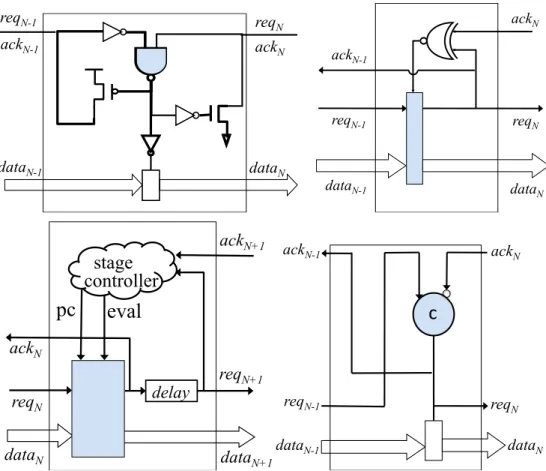
2.1 A simple self-timed pipeline . . . 13
2.2 Sutherland’s Micropipeline with Muller C-element. . . 15
2.3 TheMOUSETRAPpipeline style. . . . . 16
2.4 The GasP pipeline style.. . . 17
2.5 The high capacity pipeline style. . . 18
2.6 The upper bounds on the maximum ring frequency: shaded area represents operating region . . . 20
2.7 Parallel composition: a) structure, b) canopy graphs . . . 22
2.8 Sequential composition: a) structure, b) canopy graphs . . . 22
3.1 Forward delay for a pipeline stage . . . 25
3.2 Reverse delay for a pipeline stage . . . 25
3.3 Cycle time for a pipeline stage . . . 26
3.4 General model for a pipelined system. . . 28
3.5 Model for a pipelined system used throughout this thesis. . . 29
3.6 Cycles cross stage boundaries. . . 30
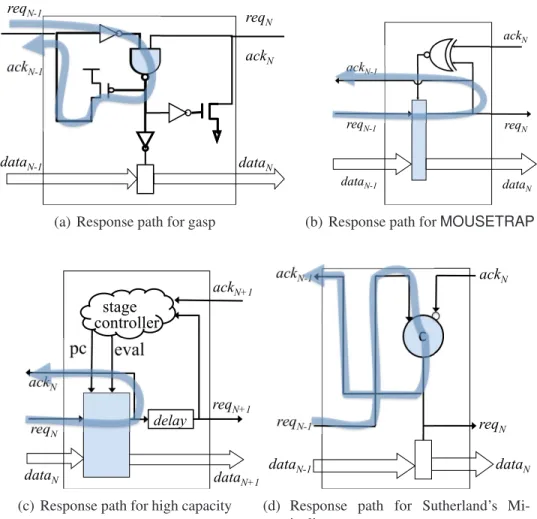
3.7 Synchronization points in various pipeline styles; a) Synchronization point for GasP is anand gate b) Synchronization point for MOUSETRAP is a latch; c) Synchronization point for high capacity is the domino logic; d) Synchroniza-tion point for Sutherland’s Micropipelines is the C element . . . 31
3.8 Abstract model for pipeline stageN with shaded synchronization point . . . 32
3.10 Revival paths for various pipeline styles . . . 35
3.11 A cycle time composed on one revival and one response time. . . 36
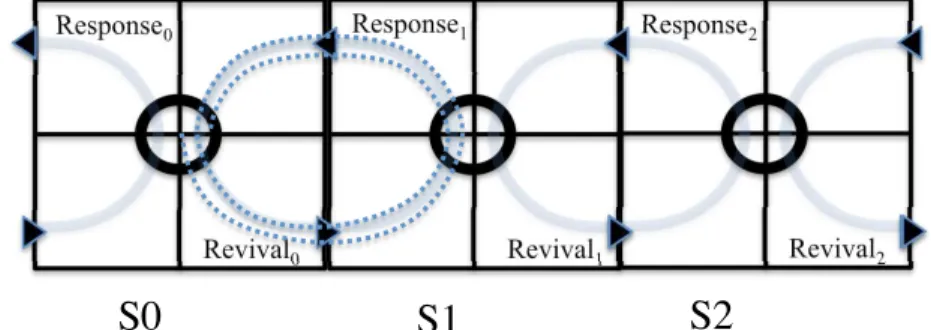
3.12 Indicating revival and response times. . . 36
3.13 A cycle time that crosses two stage boundaries. . . 37
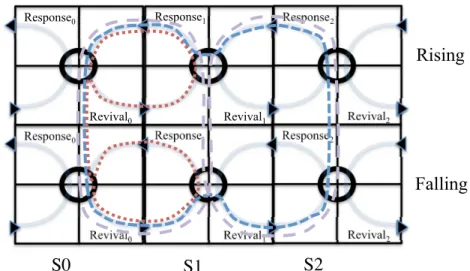
3.14 A cycle that operates simultaneously with the one of Figure 3.13 . . . 37
3.15 Stages with asymmetric rising and falling delays require further information for analysis . . . 38
3.16 The process of assigning performance metrics to stages . . . 39
3.17 A hierarchically composable single pipeline stage . . . 41
3.18 A hierarchically composable sequential component . . . 41
3.19 A hierarchically composable parallel component . . . 42
3.20 A hierarchically composable parallel component with speculative conditional 43 3.21 A hierarchically composable non-speculative conditional component . . . 43
3.22 A hierarchically composable data-dependent loop component . . . 44
3.23 Our transformation algorithm . . . 45
3.24 Sample code written in a hierarchical high-level language . . . 45
3.25 Parse tree for code in figure 3.24 . . . 46
3.26 The result of hierarchical composition for the code of Figure 3.24 . . . 47
3.27 Snapshots of the operation of a pipeline with steady state behavior. . . 49
3.28 Canopy graphCwith four limiting segments . . . 50
3.29 Parallel composition: a) structure, b) canopy graphs . . . 54
3.30 Canopy graph for a single pipeline stage . . . 54
4.1 A pipelined parallel construct . . . 61
4.2 A parallel construct from CORDIC . . . 62
4.4 Slack mismatch example . . . 63
4.5 Sequential composition of a parallel construct . . . 65
4.6 Composing in sequence . . . 66
4.7 Canopy graph for sequential composition . . . 66
4.8 A pipelined choice construct . . . 67
4.9 A conditional from CRC . . . 68
4.10 Canopy graph for CRC at p1 = 0.3 . . . 69
4.11 Throughput depends on probability . . . 69
4.12 Canopy graph for CRC at p1 = 0.3 with slack mismatch . . . 70
4.13 Slack mismatch leads to throughput degradation . . . 71
4.14 Clustering decreases throughput . . . 73
4.15 Clustering decreases max throughput . . . 73
4.16 Pipelined GCD loop . . . 75
4.17 Canopy graph analysis for GCD . . . 75
4.18 Our analysis algorithm . . . 76
4.19 Differential equation solver . . . 77
4.20 Abstract syntax tree . . . 78
4.21 Pipelined implementation of Diffeq. . . 78
4.22 Parallel composition ofbranch0 andbranch1 . . . 79
4.23 Canopy graph for loop body . . . 79
4.24 Canopy graph for pipelined loop . . . 80
5.1 Coalescing. . . 87
5.2 Parallelization . . . 88
5.4 Duplication with Wagging . . . 89
5.5 Buffer Insertion . . . 90
5.6 Slack mismatch in a fork/join construct. . . 92
5.7 Canopy graphs showing slack mismatch . . . 92
5.8 Canopy graphs with slack matching . . . 92
5.9 Key canopy graph intersections . . . 96
5.10 Slack matching algorithm . . . 98
5.11 Sample code for aforloop . . . 99
5.12 A simple implementation of thecomputefunction . . . 99
5.13 A loop pipelined implementation of thecomputefunction . . . 99
5.14 My method of loop flow control. . . 100
5.15 Congestion prevention for pipelined loops. . . 100
5.16 Sample code with feedback . . . 101
5.17 Preventing data hazards in pipelined loops. . . 101
5.18 Pseudocode for generating limiting segment expression . . . 108
5.19 AND-OR tree for the system of Figure 5.22 . . . 108
5.20 Iterative algorithm for bottleneck alleviation . . . 110
5.21 Block level representation of a hierarchical system . . . 111
5.22 A tree representing system of Figure 5.21 . . . 111
5.23 A sample search tree . . . 113
5.24 Exhaustive search with prime solutions as the terminating condition . . . 115
5.25 Code description of exhaustive search . . . 116
5.26 Greedy search evaluates a small number of nodes . . . 116
5.27 Code description of greedy search . . . 117
5.29 Code description of lookahead search . . . 118
5.30 Recognizing commutative operations to prune the search space . . . 120
5.31 Exploiting commutativity to prune the tree . . . 121
5.32 Pruning search space to avoid identity transforms . . . 122
6.1 Examples of forward timing constraints. . . 145
6.2 a) Beginning state b) Correct end behavior c) Behavior with forward timing violation . . . 147
6.3 Examples of reverse timing constraints . . . 149
6.4 a) Beginning stage b) bubble propagates backwards c) Correct end behavior d) Behavior with reverse timing violation. . . 150
6.5 a) Extra circuitry for forward delay. b) Generic implementation . . . 152
6.6 a) Extra circuitry for reverse delay. b) Generic implementation . . . 155
6.7 ATPG for testing setup time violations. . . 157
6.8 A two-stage pipeline with one level of combinational logic. . . 159
6.9 Timing diagram showing control overrun . . . 159
6.10 A non-linearMOUSETRAPpipeline . . . 164
7.1 A basicMOUSETRAPstage from [55]. . . 168
7.2 AMOUSETRAPfork stage from [55] . . . 168
7.3 AMOUSETRAPjoin stage from [55] . . . 169
7.4 A hierarchically composable single pipeline stage . . . 171
7.5 A hierarchically composable sequential component . . . 171
7.6 A hierarchically composable parallel component . . . 172
7.7 A hierarchically composable parallel component with speculative conditional 172 7.8 A hierarchically composable non-speculative conditional component . . . 172
7.10 Conditional split circuit diagram . . . 175
7.11 Conditional split abstract analysis model . . . 176
7.12 The reverse path for all conditional split circuits . . . 177
7.13 Basic logic minimized expression for conditional split . . . 178
7.14 Generalized C-element implementation of a conditional split . . . 178
7.15 Conditional select circuit diagram . . . 179
7.16 Synchronization point model for the data path of the conditional select . . . . 180
7.17 Synchronization point model for the Boolean path of the conditional select . . 180
7.18 Conditional select optimized for constant Boolean value. . . 181
7.19 Conditional select optimized for forward latency with the assumption that the Boolean value arrives before the data. . . 181
7.20 Data-path setup for a conditional select . . . 182
7.21 Conditional join circuit diagram . . . 183
7.22 Conditional join abstract analysis model . . . 184
7.23 Circuit diagram for merge without arbitration . . . 185
7.24 Merge without arbitration abstract analysis model . . . 186
7.25 Implementation of the data path for a merge . . . 187
7.26 Implementation of the data path for a merge using C-elements . . . 187
7.27 Arbitration stage built around a mutex . . . 189
7.28 Arbiter abstract analysis model . . . 190
7.29 Datapath for arbitration stage . . . 190
8.1 Overall architecture of GCD chip . . . 194
8.2 Basic GCD algorithm before and after simplification of the ring interface. . . 195
8.4 Area-optimized GCD algorithm, and the dataflow implementation of one
iter-ation . . . 199
8.5 Layout of one iteration . . . 200
8.6 Implementation of a stage: delay matching and control buffering . . . 201
8.7 Detail of the chip interface . . . 203
8.8 Fabricated chip layout and photomicrograph . . . 207
8.9 Testing and evaluation setup . . . 208
8.10 Throughput vs. occupancy for the fastest and slowest chips tested . . . 210
8.11 Estimating the ideal peak internal throughput . . . 211
8.12 Speed increases with increased voltage . . . 212
8.13 Impact of voltage variation on power consumption . . . 213
8.14 Power consumption varies with voltage . . . 214
8.15 Eτ2 vs. voltage at maximum throughput . . . 215
8.16 Impact of temperature on performance . . . 216
8.17 The hierarchical structure of the JPEG example. . . 216
8.18 Performance of the JPEG benchmark before optimizing.. . . 217
8.19 The performance of the JPEG benchmark after loop unrolling . . . 218
8.20 Nodes with detected bottlenecks . . . 219
Chapter 1
Introduction
1.1
Goals and Solution Strategies
The goal of my work is to support the design of high-performance application specific dataflow
systems (i.e. those that take in a stream of data items and produce a stream of processed
re-sults.) The ability to design such processors quickly and efficiently will likely be important
to sustaining the current level explosive growth of consumer electronics, multimedia
applica-tions, and high-speed networking. My work identifies and addresses several key challenges in
designing these systems.
1.1.1
Challenges to Designing Application Specific Dataflow Systems
One particular challenge is that application specific processors have short design cycles,
be-cause bringing new application specific hardware to market quickly is vital when improved
algorithms and new standards are constantly being created.My work handles this challenge
in several ways. First, it employs the benefits of asynchronous or “clockless” design. The
removal of the clock improves the circuit’s efficiency by eliminating the power requirements
of propagating a global clock signal. Further, the modular nature of asynchronous design can
increase designer productivity and therefore reduce production time and the associated
system-level optimization for asynchronous dataflow systems. These methods aim to decrease
design times both by improving the speed of the algorithms themselves and by automatically
and systematically completing tasks that designers often spend long hours performing in ad
hoc ways.
Another specific challenge is providing low-level support for the design of high-performance
dataflow systems. Designers want to have some assurance that the systems they create will
operate correctly and be practical to implement at the circuit level. This dissertation presents
new testing approaches that are specific to asynchronous pipelined systems, which can expose
errors caused by manufacturing defects. My work also includes a suite of new circuit-level
designs, which can be connected together modularly to implement a wide variety of system
functionality.
1.1.2
Solution Strategy
In order to make the problem of analyzing and optimizing pipelined asynchronous circuits
more tractable, I focus on a special class of asynchronous systems: those withhierarchically
composed pipelined architectures. Such structures are quite common when the system is
de-signed using high-level translation methods (e.g., Tangram/Haste [45], Balsa [14]) because
high-level specification languages tend to be hierarchically block-structured. Moreover, even
when the design approach is ad-hoc, designers often tend to implement systems with
hier-archical structures. In particular, I target architectures that are hierhier-archical compositions of
sequential, parallel, conditional, and iterative operators. By focusing on this special but
prac-tically useful class of systems, this work is able to leverage information about their hierarchy
to provide fast runtimes while still maintaining accuracy.
1.1.3
Thesis Statement
The problem of analyzing and optimizing pipelined asynchronous systems can be made tractable
The key insight is that restricting to the hierarchical nature of these systems can be
ex-ploited to make analysis and optimization faster. This dissertation will show that the set of
hierarchical systems is expressive enough to implement a variety of practical systems. The
results will also show that the resulting analysis method is fast and accurate enough to be used
repeatedly in an optimization loop. Finally, the resulting, optimized systems can be practically
realized in hardware.
1.2
Introduction to Asynchronous Design
1.2.1
Definition
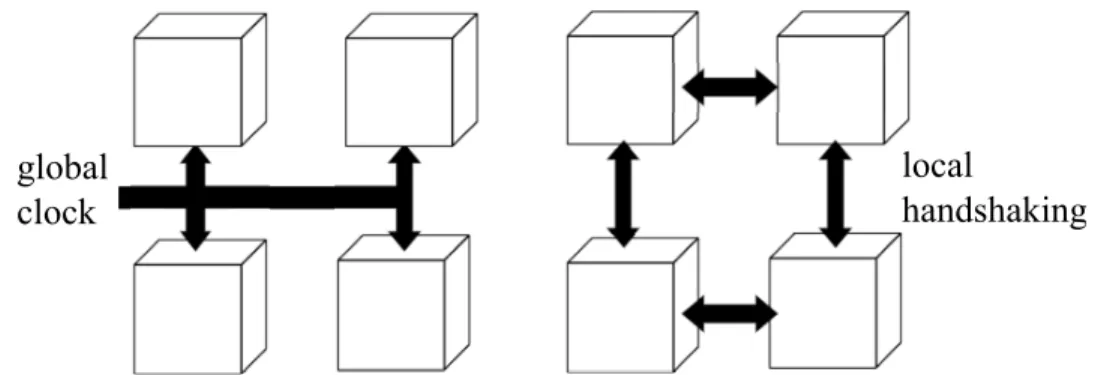
Figure1.1illustrates the fundamental difference between asynchronous design and synchronous
design. While the synchronous system has one global clock that must propagate to the entire
chip, the asynchronous design uses handshakes to synchronize local communications. The
switch from global clocking to local, as-needed synchronization can potentially offer ease
of design due to increased modularity, faster speed because of more concurrency, and lower
energy consumption because switching activity occurs only when and where needed.
global clock
local
handshaking
1.2.2
Current Uses
As an indicator of asynchronous design’s current commercial success, Handshake Solutions,
a Philips subsidiary, has sold more than 750 million asynchronous microprocessor chips for
use in low-power applications such as cell phones, pagers, smart cards, and cryptochips used
in E.U. passports. In addition, Intel and Sun Microsystems have used asynchronous circuits
in small targeted speed-critical circuits inside their commercial processors.
1.2.3
Future Applications
Asynchronous design will have a significant role in the design of future systems. In future
multi-core systems, on-chip networks that connect hundreds or thousands of heterogeneous
cores will likely be asynchronous in nature, leading to a globally asynchronous locally
syn-chronous (GALS) architecture. Recently, a new style of clocked design has received much
attention from researchers: synchronous elastic design or latency-insensitive synchronous
de-sign. These styles borrow the notion of elasticity (achieved via asynchronous handshaking)
and apply it to clocked design to obtain synchronous elastic systems. Finally, asynchronous
design will likely play a key role in the emerging technologies of nanoelectronic, quantum
and biologically-inspired (e.g., DNA self-assembled) computing, in all of which timing issues
are fundamentally too complex to be addressed by global clocking.
1.3
Past Work and Current Challenges
The overall goal of my line of research is to create a fully automated toolflow for the design
of high-throughput asynchronous circuits that begins at a designer specification and ends with
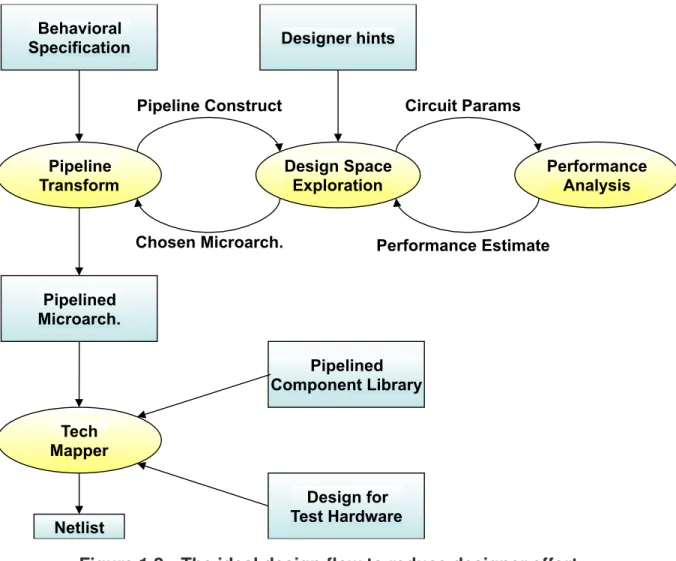
a gate-level hardware specification. Figure 1.2 shows an example design flow, which gives
context for the work presented in this dissertation. If fully automated, this design flow will
achieve the goals of creating efficient, high-performance circuits with low designer-time cost.
the overall goals, describe the current work that has been done in each area, and outline the
remaining work that this dissertation will add to the design flow.
Pipeline Transform Behavioral Specification
Performance Analysis Design Space
Exploration Designer hints
Pipelined Microarch.
Pipelined Component Library
Netlist
Design for Test Hardware Pipeline Construct
Chosen Microarch. Performance Estimate Circuit Params
Tech Mapper
Figure 1.2: The ideal design flow to reduce designer effort.
1.3.1
High-level Code to Low-level Designs
In the design flow of Figure1.2, the designer first gives a high-level behavioral specification
for the circuit. Next, that control-driven specification is turned into a data-driven pipelined
architecture. My work does not focus on this transformation step, because much current and
ongoing work done by others has effectively targeted this area. Specifically, Hansen [19] has
specification. Work done by Budiu [8] used C as the input language to create a hardware
specification in which data flows directly from producer to consumer. Kapasi takes a different
approach to specifying data flow hardware by introducing new language constructs that are
tailored to data flow design [24]. Though Chapter3of this dissertation does give one possible
algorithm for converting a specification written in a high-level language to a pipelined system,
this is offered only for completeness and does not limit the work of this dissertation to using
only that one approach for the first pipeline transform step of the design flow.
1.3.2
Design-space Exploration
Automated design-space exploration is key to reducing designer effort. In the design flow of
Figure1.2, design space exploration takes a non-optimized pipelined circuit as an input and
re-turns an optimized version of the circuit. Since my work targets high-throughput systems, the
final circuit should be optimized to meet some throughput goal, possibly with additional
con-straints on other cost functions such as delay or energy. The design space exploration should
ideally take place with little to no direct intervention on the part of the designer. Currently,
many circuit designers use time consuming ad hoc techniques based on designer knowledge
and experience. More systematic approaches presented by Beerelet al.[3], Prakashet al.[47],
and Smirnovet al.[1] remove bottlenecks by strategically adding buffer stages to the circuit.
Other approaches target latency rather than throughput. One such approach is the CASH
com-piler by Budiu and Goldstein [8], which translates an ANSI C program into data-flow
hard-ware. A different approach by Theobald and Nowick [63] targets generation of distributed
asynchronous control from control-dataflow graphs, with the objective of optimizing
commu-nication between the controllers, and between a controller and its associated datapath object.
To my knowledge, a system-level design space exploration system that focuses on throughput
does not currently exist. My work on constrained optimization for pipelined systems aims to
1.3.3
Performance Analysis
Performance analysis is an integral part of design space exploration, because optimization
often requires repeated analysis to monitor the effects of changes to the circuit. As seen in
Figure1.2, the design space exploration method uses performance analysis repeatedly, which
indicates that fast and accurate performance analysis is important to making the design
ex-ploration work. Several innovations in the area of performance analysis of pipelined circuits
serve as the basis of the work of this thesis. The idea that the throughput depends on the
occu-pancy of a pipeline, which is the foundation of much of the analysis-level work of this thesis,
was first introduced in a doctoral thesis by Williams [67] and later expanded upon by
Green-street [18] and Lines [31], though none of these works provided a system-level approach.
In addition, more general analysis methods [29][71] [36] can estimate the performance of
entire systems, proving that accurate system-level throughput estimates can be obtained for
pipelined asynchronous systems. Brining these ideas together, my analysis work provides a
fast analytic solution like that of Williams [67] while maintaining some of the versatility found
in past system-level analysis methods.
1.3.4
Circuit Components
The design space exploration step produces an optimized pipelined microarchitecture. To be
realized in practice, every component within the microarchitecture must be implemented by a
corresponding circuit component. Many pipeline circuit styles have already been developed,
which serve as the basis for implementing any high-throughput pipelined system.[61, 15,
42, 59, 55, 72] Micropipeline styles that achieve high-speed while maintaining low control
overheads enable the construction of fast and efficient asynchronous pipelines. My work in
this area adds on toMOUSETRAP, a high-speed, low-overhead pipeline implementation [55]. Existing MOUSETRAPcircuits can be used to implement a variety of structures, but are not expressive enough to implement all the possible behavior in the set of circuits that the design
can, together with existing circuits, implement common hierarchical structures. These circuits
can be composed together modularly to form a wide variety of structures and behaviors.
1.3.5
Testability
Finally, the design flow incorporates the design for testability. Incorporating testing into a
design flow is vital to the success of any design flow, because designers are hesitant to use
a technology that cannot be tested. Luckily, much work has already been done in the area
of testing for asynchronous pipelines. Pagey et al. [43] proposed methods for generating
test patterns to test stuck-at faults in traditional micropipelines. Another approach that was
adapted for use with micropipelines is by [27], which focuses on test sequence generation for
testing both stuck-at and delay faults insideC-elements—circuits that are often used as local
synchronizing elements in asynchronous systems. My work on testing is based most closely
on the work of Shiet al.[53], which is specifically targeted to testing high-speed asynchronous
pipelines. My testing work focuses on achieving high fault coverage while trying to keep the
design-for-test overheads low.
1.4
Contributions
The work of this thesis focuses on one type of asynchronous circuits—high-throughput
steam-ing systems that are hierarchical in nature—in order to provide a great depth of resources for
designing these types of circuits. Contributions range from high-level abstractions for circuit
modeling to low-level circuits that are used as the basis for circuit design.
1.4.1
Modeling and Abstractions
Chapter3 presents the models and abstractions that are used throughout the rest of the
system, defines the structure of a hierarchical system, and formalizes use of canopy graphs for
performance analysis.
1.4.2
Performance analysis
Chapter 4 addresses the problem of system-level performance estimation. Although
deter-mining the performance of an arbitrary asynchronous system is NP-hard, my solution focuses
instead on analyzing a special subclass: systems that are hierarchically composed of basic
pipeline stages using sequential, parallel, iterative, and conditional operators. This restricted
class is actually still quite rich, and includes most commonly used system topologies. By
ex-ploiting hierarchy, my algorithm achieves an expected linear running time. Results show that
non-trivial examples with over 100 stages can be analyzed in less than 10 milliseconds.
1.4.3
System-Level Optimization
Chapter5presents optimization methods that leverage the fast analysis method presented in
Chapter4. Identification and elimination of bottlenecks is an important part of any design flow
that aims to produce high-throughput systems. This thesis includes (i) a bottleneck detection
algorithm that leverages performance analysis to pinpoint the parts of an asynchronous
sys-tem that limit throughput, and (ii) a bottleneck alleviation algorithm that reports all potential
bottlenecks to the designer and suggests modifications. A specific challenge is to overcome
the performance bottleneck due to algorithmic loops. I have introduced a systematic approach
for improving the throughput of algorithmic loops by allowing multiple problem instances to
be computed concurrently within a single loop hardware (i.e., multi-token loops).
1.4.4
Testing and Design for Testability
Chapter6presents a testing approach to uncover timing violations within asynchronous pipelines.
approach targets a subclass of much interest to asynchronous designers: relative timing
con-straint violations. In particular, certain asynchronous circuits achieve high performance by
making local timing assumptions. I have introduced the first practical method for testing
for violations of these relative timing assumptions in pipelined systems. The approach is
minimally-intrusive and includes both test application and test vector generation.
1.4.5
Circuit-Level Design
Chapter7presents the low-level pipeline stages that form the basis for implementing pipelined
asynchronous systems. My component library includes circuit-level designs of all commonly
used building blocks (i.e., design primitives), including pipeline stages, forks/joins,
condition-als and loops, arbitration stages, etc. These designs were carefully constructed so as to obtain
high throughput and low latency.
1.4.6
Case Studies
To demonstrate and evaluate these circuits, Chapter8presents asynchronous case study chip
that implements Euclids iterative GCD algorithm; it was fabricated at IBM foundry in a 130nm
CMOS process. The chip is one of only a few high-speed asynchronous chips that have been
demonstrated so far, achieving the equivalent of 1 GHz operation, and robustness to wide
variations in supply voltage (0.5-4V) and temperature (-45-150C), and has helped validate my
design and test approaches. In addition, the chapter uses the analysis and optimization of a
JPEG encoder as a detailed example of the steps taken to produce a final, optimized circuit.
The results show a 40x improvement for this example.2
1.5
Dissertation Organization
The remainder of this document is organized as follows. First, Chapter2 gives background
Next, Chapter 3describes the abstractions and models that will be used throughout this
dis-sertation. It also introduces new notations and definitions relevant to asynchronous design that
are extensions upon previous work.
Chapter 4 introduces my analysis method. It first presents the analysis of the four
hi-erarchical components considered in this dissertation—sequential, parallel, conditional, and
iteration—and then describes how to bring them together to form a system-level,
hierarchi-cal analysis method. Chapter5 goes on to present an optimization method that builds off of
the analysis. It first describes a set of transformations that can potentially improve
perfor-mance, then gives a method for detecting the location of bottlenecks within a system, and
finally defines a framework for iteratively applying optimizing transformations to remove all
the bottlenecks of a system.
Chapter 6 describes a testing method that applies to pipelined asynchronous systems.
Chapter7 provides low-level support for design by specifying a suite of five circuits that—
together with circuits from past work—can be used to implement a wide variety of
asyn-chronous systems. This chapter can serve as a reference for those who wish to implement any
of the hierarchical structures described in this dissertation. Finally, Chapter8gives two case
studies in asynchronous design. The first one, a system that calculates the greatest common
di-visor of two numbers, was fabricated in silicon and tested extensively. It serves as an example
Chapter 2
Background on Asynchronous Design
2.1
Asynchronous Pipelines
In a pipelined asynchronous system, parts of the circuit synchronize locally using a
request-acknowledge handshake protocol. These handshakes control the flow of data into and out
of registers, which are usually implemented as latches. A pipeline operates correctly if the
handshaking protocol prevents data from being lost or overwritten while still allowing for the
flow of data between stages.
Figure2.1shows the basic structure of a self-timed pipeline. Each pipeline stage consists
of a controller, a storage element (“data latch”), and processing logic. Typically, a stage
generates a requestto initiate a handshake with its successor stage, indicating that new data
is ready. If the successor stage is empty it accepts the data and performs two further actions:
(i) it acknowledges its predecessor for the data received and, (ii) initiates a similar handshake
with its own successor stage. Many variations on this basic protocol have been developed, and
a variety of asynchronous pipeline controller implementations exist.
2.1.1
Data Encodings within Asynchronous Pipelines
Pipeline styles can also be categorized based on the data encoding employed. Using data
Figure 2.1: A simple self-timed pipeline
[38,34], so this section will not provide a full description of possible data encodings. Instead,
it will give some idea of the main types of data encodings used.
Bundled Data
A simple yet effective approach is the bundled data encoding, which is also known as
single-rail. Each data bit is represented by exactly one wire, with one additional wire for the request
bit. While the data bits are processed by a block of logic within the stage, the request bit
must go through some matched delay—a set of gates that slows the outgoing request so it
stays coherent in time with the data. This style is simple and practical, but it does not take
advantage of function blocks that have variable delays.
Dual-Rail Encoding
Dual-rail data encoding uses two wires per data bit, so that the request signal is essentially
built in to the encoding. Table 2.1 shows one possible dual-rail representation that encodes
both the value of the data and the presence of new data.
This encoding scheme allows the stage to indicate completion as soon as it is finished,
Table 2.1: Dual rail data encoding. Dual-rail code
0 0 data not ready
0 1 0 request
1 0 1 request
1 1 unused
2.1.2
Asynchronous Handshaking Protocols
two-phase Protocols
Two phase protocols have handshaking cycles that are made up of two events. Specifically,
the value of the request changes once and then the value of the acknowledge changes once
to complete the handshake. As a result, 2-phase protocols use transition based encodings: a
transition on a line rather than the value of the line indicates an event.
four-phase Protocols
Four phase protocols have handshaking cycles that are made up for four events. Typically,
the request goes high and the acknowledge goes high as a response. Then the request goes
low to a reset value, and the acknowledge also resets to a low value. This protocol has more
events than a two-phase protocol, but the logic implementations are often simpler, because
level-based logic is a simpler design style than transition-based logic.
2.1.3
Asynchronous Pipeline Styles
Many different implementations for asynchronous pipelines have been developed, which use
different combinations of data encodings and handshaking protocols. [61, 15, 42, 59, 55,
72, 67] In this dissertation, I use the following four circuit styles as examples whenever the
!"
req
Nack
Nack
N-1req
N-1data
N-1data
NFigure 2.2: Sutherland’s Micropipeline with Muller C-element.
Sutherland’s Micropipelines
Suterland’s Micropipeline style [61] is a two-phase controller that uses bundled data. As
shown in Figure2.2, it uses the Muller C-element [40] as the control circuit. Since the output
of the C-element to the latch uses transition signaling, the latch is a special transition sensitive
latch. When the pipeline line is in operation, every transition on the request wire—either high
to low or low to high—indicates that a new data is available. The next stage will send back a
corresponding acknowledge signal when it has finished processing the previous data.
MOUSETRAP Pipelines
MOUSETRAP [55], shown in Figure2.3, is a two-phase pipeline style that uses static logic. Since MOUSETRAPuses transition signaling for the requests and acknowledges, every tran-sition on a request wire indicates new data is ready and every trantran-sition on an acknowledge
wire indicates that old data can be overwritten. Thus, when the request and acknowledge
go-ing into a stage are the same, the stage becomes “empty” and when they are different the stage
becomes “full”. The latches that hold data begin transparent and become opaque just after
req
Nack
Nack
N-1req
N-1data
N-1data
N
Figure 2.3: TheMOUSETRAPpipeline style.
as a transition to level converter.
GasP Pipelines
GasP [59] is a four-phase pipeline style that uses static logic. The data latches in a GasP
pipeline begin closed, and must open and then close again upon receiving each new data item.
The most distinctive feature ofGasPis that a single wire, called the state conductor, is used
to transmitboththe request and acknowledge signals between a pair of adjacent stages. A low
signal on the state conductor wire indicates that the previous stage is“full” and a high signal
indicates that it is “empty”.
The controller for GasPis a self resettingNAND, as shown in Figure 2.4. When both of
the inputs to theNANDgo high, it goes low. After some delay, this low transition triggers the
NANDto reset back to high. Specifically, two possible reset paths, r1 andr2, can cause the NANDto go high again. Pathr1consists of one pull up transistor and one inverter (inva). Path
reqN-1
reqN
ackN ackN-1
dataN-1 dataN
Figure 2.4: The GasP pipeline style.
High-Capacity Pipelines
The high-capacity (HC) pipeline [54] is a four-phase pipeline style that uses dynamic logic.
It islatchless. Instead, the dynamic logic of each stage has an “isolate phase”, in which its
output is protected from further input changes. Specifically, during the isolate phase, the logic
is neither precharging nor evaluating.
AnHCpipeline stage simply cycles through three phases. After it completes its evaluate
phase, it enters its isolate phase and subsequently its precharge phase. As soon as precharge
is complete, it re-enters the evaluate phase again, completing the cycle.
2.2
Performance Analysis for Asynchronous Pipelines
2.2.1
Performance Metrics for Pipeline Stages
There are three metrics typically used to characterize the performance of a self-timed pipeline:
forward latency, reverse latency, and cycle time. The forward latency is simply the time it
delay
pc
eval
ack
Nreq
Nreq
N+1ack
N+1data
Ndata
N+1stage
controller
Figure 2.5: The high capacity pipeline style.
isFi, then the latency of the entire pipeline is:
LPipeline = X
i
Fi (2.1)
Similarly, the reverse latency characterizes the speed at which empty stages or “holes” flow
backward through an initially full pipeline. The reverse latency of the entire pipeline is simply
the sum of the stage reverse latencies:
RPipeline = X
i
Ri (2.2)
The cycle time of a stage, denoted byTi, is the minimum time that must elapse after a data item
is produced by that stage before the next data item will be generated. Since a complete cycle
of a stage typically consists of transmitting a data item forward followed by propagating a
hole in the reverse direction, the following relationship holds for most handshaking protocols:
The maximum throughput a stage can support is simply the reciprocal of its cycle time. The
cycle time of a linear pipeline is limited by the cycle time of its slowest stage:
tptPipeline = 1.max
i (Ti) (2.4)
2.2.2
Canopy Graph Analysis
The classic work on performance analysis of asynchronous pipelines by Williams and Horowitz
[67] introduces the “canopy graph” to characterize the performance of a pipelined ring. Our
approach builds upon this to handle more general systems.
Ring Performance Analysis
One useful metric of ring performance is the number of times any data item crosses a
par-ticular stage in the ring per second; we will refer to this measure as thering frequency. The
performance of the ring is highly dependent on itsoccupancy, i.e.,the number of data items
revolving inside it. When the number of data items is small, the ring frequency is low, and
the pipeline is said to be “data limited.” On the other hand, when nearly every stage of the
pipeline is filled with data items, the performance is once again limited, because holes are
needed to allow data items to flow through the pipeline. In this scenario, the pipeline is said
to be congested, or “hole limited.”
Data Limited Operation. If there arek data items in the ring, then in the time a
particu-lar data item completes one revolution around the ring (i.e., P
iFi), all k items would have
crossed each ring stage. Therefore, the maximum ring frequency attainable is proportional to
the ring occupancy:
Ring Frequency ≤ k.X
i
Fi (2.5)
1 2 N-2 N-1 0 Data limited region Hole limited region
Max ideal throughput
= 1/(L+R)
Limited by a slow stage
Slope =1/
Σ
L Slope = 1/
Σ
R
Ring Occupancy, k
Ri ng T hr ou gh pu t N
Figure 2.6: The upper bounds on the maximum ring frequency: shaded area represents operating region
ring frequency is limited by the number of holes in the ring. If there areh holes in the ring,
then in the time a particular hole completes one revolution around the ring (i.e., P
iRi), all
h holes would have crossed the each stage, 0 in a direction opposite to data. Thus, if N is
the number of stages in the ring, then h = N −k, and we have the following bound on the performance:
Ring Frequency ≤ (N −k).X
i
Ri (2.6)
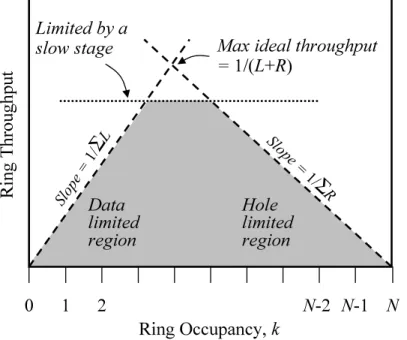
Figure 2.6 shows a plot of the ring frequency versus its occupancy. The rising portion
of the graph represents the data limited region, where performance rises linearly with the
number of data items. The falling portion, similarly, represents the hole limited region, where
performance drops linearly with a decrease in the number of holes.
Limitations Due to a Slow Stage. If all the stages in the ring have similar forward and
reverse latencies, then the maximum attainable performance will be the frequency at which
is the inverse of the cycle time of each ring stage: 1/T = 1/(L+R). However, if some
stages are slower than others, then the ring frequency will be limited by the cycle time of the
slowest stage. In the figure, the horizontal line represents the maximum operating rate that
can be sustained by the slowest stage in the ring [67]:
Ring Frequency ≤ 1.max
i (Ti) (2.7)
The overall ring performance will always be constrained to lie under the canopy formed by
the three lines in Figure2.6.
Linear Pipelines
The behavior of a linear pipeline,under steady-state operation,can be modeled as that of a
self-timed ring. In particular, in steady state, as one item leaves the right end of the pipeline,
another item enters on the left. As shown by Lines [31] and Singh et al. [57], the linear
pipeline’s throughput is correctly modeled as a canopy graph, with the same three constraints
on its operation (data limited, hole limited, and constrained by local cycle times).
However, there are two key differences that must be noted. First, the occupancy in a linear
pipeline can be fractional. That is, unlike a ring which always contains an integral number of
items, a linear pipeline can have anaverage occupancy that is non-integral (e.g., 4.5 items)
because of phase differences between entering and exiting items.
Second, a linear pipeline can actually operate in the entire region under the canopy. In
contrast, the operating point of a ring in steady state is typically on the boundary of the canopy.
The reason for this difference is that the ring analysis assumed that the ring is isolated and
operates autonomously without any interaction with the environment; therefore, it operates at
the maximum throughput possible for a given occupancy. On the other hand, a linear pipeline’s
operation is constrained by both the left and right environments, which can force it to operate
!" #" $%&'()*+" ,--./0)-1" #" a) b)! !" 2 3 4% . 5 3 / . 6"
Figure 2.7: Parallel composition: a) structure, b) canopy graphs
!" #" $%&'()*+"
!" #"
a)!
b)! ,--./0)-1"
2 3 4% . 5 3 / . 6"
Figure 2.8: Sequential composition: a) structure, b) canopy graphs
Parallel and Sequential Composition
As shown by Lines [31], canopy graph analysis can also be applied to parallel and sequential
compositions of linear pipelines.
For the fork-join parallel structure of Fig.2.7a, the throughput of the composition is
con-strained by the intersection of the canopy graphs of the branches. The reason is that the
operation of the fork-join pair is constrained so that (i) the throughput of each branch is the
same, and (ii) the number of tokens in each branch is the same (assuming they were initialized
empty). The result of the intersection of the constituent canopy graphs is also a canopy graph
as shown in Fig.2.7b.
Similarly, when two pipelines are composed sequentially, as in Fig. 2.8a, the throughput
of the composition is constrained by the horizontal sum of the canopy graphs of the two
but the total occupancy is now the sum of the occupancies of the two pipelines. That is, the
composition can attain any throughput that both of the pipelines can sustain, and for each such
throughput, the net occupancy is simply the sum of the two occupancies. The result is also a
Chapter 3
Models and Abstractions
Throughout the thesis, most of the discussions and proofs will deal not with the complex,
underlying circuits but with the more abstract models. This chapter defines the models that
will be used throughout this thesis and defines how they relate to real systems. First Section
3.2 gives the models for the performance of an individual stage and presents a method for
mapping from a pipelined circuit to the abstract representation used in later chapters. Section
3.3fully defines the set of hierarchical circuits that this thesis analyzes, and gives an example
of the steps from high-level code to a pipelined representation. Finally3.4defines and further
described the use of the canopy graph for modeling system-level performance information.
3.1
Background
3.1.1
Performance Metrics for Pipeline Stages
Three performance metrics are typically used to describe the performance of pipeline stages:
forward latency, reverse latency, and cycle time. Following are the classical descriptions of
Forward Latency
The forward delay, also denoted as LF, is the difference between the time that a request is
received by an empty stage and the time that a request is received by the following stage.
Figure3.1illustrates the forward delay of one stage.
!"#$%&
!"#'()
*+,'()&
*+,$%&
Figure 3.1: Forward delay for a pipeline stage
Reverse Latency
The reverse delay, also denoted asLR, is the difference between the time that an acknowledge
is received by a full stage and the time that an acknowledge is received by the previous stage.
It is also often useful to think of the reverse delay as the time for one “hole” to travel in the
reverse direction of the flow of data. Figure3.2illustrates the forward delay of one stage.
!"#$%&
!"#'()
*+,'()&
*+,$%&
Figure 3.2: Reverse delay for a pipeline stage
Cycle Time
Cycle time, orT, is the time for a stage to progress from some state in relation to a data item
until the time it arrives at the same state with the subsequent data item. Figure3.3 shows a
representation of the cycle time. Note that cycle time can cross stage boundaries, and that it
does not necessarily include the entirety of either the forward or reverse cycle time for the
!"#$%&
'()*+,&
!"#*+,
'()$%&
Figure 3.3: Cycle time for a pipeline stage
3.1.2
Abstractions for Asynchronous Pipelined Systems
One common representation for an asynchronous circuit is the Petri net, which has been used
in much past work [30][36][71]. Petri nets are capable of capturing the high concurrency
inherent to asynchronous systems. Moreover, timed petri nets, which assign a delay to every
event within the system, allow for thorough analysis of the timing of the asynchronous system.
[36].
The power of using a petri net model lies in its ability to represent all possible
connec-tions and configuraconnec-tions of a general asynchronous system. This kind of low-level modeling
of connections is necessary when analyzing systems with complex connections and
irregu-lar topologies. The work in this thesis, however, focuses on systems that are composed of
repeated instances of pipeline stages that are further organized hierarchically. For these
pur-poses, a timed petri net representation is not necessary; the essence of the system can be
captured by a more abstract, high-level representation.
3.1.3
System-level Performance Models
The most straightforward method for describing the performance of a pipelined system is to
give one number: the throughput. Variations on the single-number performance
characteriza-tion include reporting the cycle time, bounding the time separacharacteriza-tion of events, or finding the
global critical cycle time for the system [36][30][70][65]. Each of these metrics provides a
one-dimensional view of the performance of a circuit, in that a single performance number for
Williams and Horowitz [67] first introduced the use of a second dimension, occupancy,
to characterize the performance of a system. Here, occupancy is defined to mean the total
number of distinct data items that are contained in the entire pipelined system. This thesis
relies heavily on the throughput vs. occupancy graph, also known as the canopy graph, first
introduced for analyzing the performance of a pipeline ring. Later, Lines [31] and Singhet
al.[57] applied this model to sequential pipelines, and Lines [31] further used it for systems
consisting of a parallel operator. More details on the derivation and methods of this work can
be found in the background section2.2.2of this thesis.
3.2
Modeling Asynchronous Pipeline Stages
As described in Section 2.1.3, many different types of asynchronous pipelines exist. My
method for analyzing pipelines, however, is independent of the particular pipeline style used.
This section describes how to map an actual asynchronous pipelined stage onto a
representa-tion that is independent of implementarepresenta-tion by abstracting away the unnecessary details while
retaining the necessary performance information.
3.2.1
Delay Models
The analysis method described in this thesis uses a fixed delay model. The commonly used
bundled data encoding, which was described in Section 2.1.3, is very accurately modeled
using fixed delays. Other data encodings, such as dual-rail, can have data-dependent execution
times for individual stages. Though this work does not directly address probabilistic delays,
it can still be used to perform worst case analysis by setting the fixed delays to be equal to the
worst case delay for each stage. Worst case analysis is a useful lower bound on performance.
3.2.2
Performance Metrics for System-Level Analysis
Figure 3.4 shows the abstract model for an asynchronous pipeline stage that will be used
throughout the rest of this thesis. Each stage is represented by a box. This is a further
abstrac-tion of the pipeline stage shown in Figure2.1, which removes the unnecessary details of the
stage’s controller, latch, and logic.
The connections between stages are represented by arrows. The direction of the arrows
indicates the direction of the flow of data while the flow of “holes” is implied to be in the
op-posite direction. The internal workings and even the handshaking signals have been removed
for simplicity and are indeed not necessary to perform analysis on this system.
!"#$!%#&!
!'#(!)#&!
!"#$!%#&!
!'#(!)#&!
!"#$!%#&!
!'#(!)#&!
!"#$!%#&!
!'#(!)#&!
!"#$!%#&!
!'#(!)#&!
!"#$!%#&!
!'#(!)#&!
!"#$!%#&!
!'#(!)#&! !"#$!%#&!
!'#(!)#&!
!"#$!%#&!
!'#(!)#&! "#$!%#&!
'#(!)#&!
Figure 3.4: General model for a pipelined system.
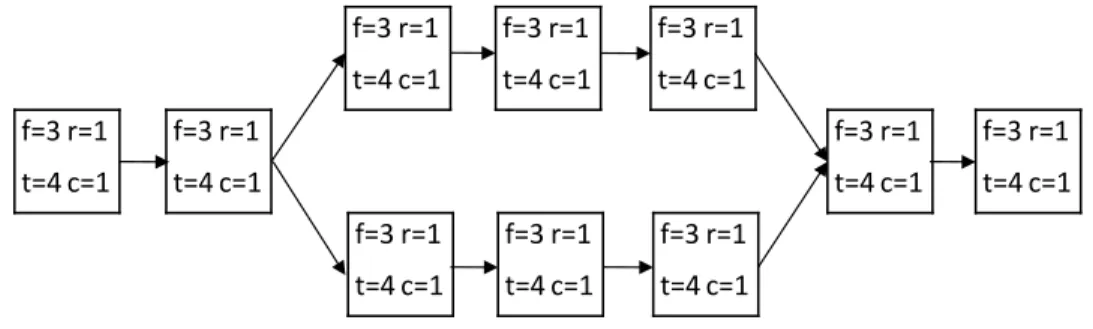
Each stage is also annotated with the local performance metrics that are necessary for
performing analysis: forward latency, reverse latency, cycle time, and capacity. These four
metrics fully characterize the performance of each individual stage for the purposes of
per-forming system-level analysis. This notation for graphically describing a pipelined system
will be used throughout this thesis. For conciseness, the graphical representations often omit
the cycle time and capacity, as has been done in Figure 3.5. If not specified, cycle time is
assumed to be the sum of the forward and reverse latencies and the capacity is one.
This thesis uses the same definition of cycle time as give in background section 3.1.1.
However, the definitions of forward and reverse latency are slightly changed, capacity is a
!"#$
#"#$
!"%$
#&"#$
#&"#$
!"#$
#"#$
!"#$
#&"#$
#&"#$
Figure 3.5: Model for a pipelined system used throughout this thesis.
Capacity
The capacity of a single stage to hold data is a feature of the chosen pipeline style. All
commonly used pipeline styles have a capacity of either one or one half data items per stage,
although other capacities are possible in theory. A capacity of one indicates that two stages
in a row can both contain distinct data items while a capacity of one half indicates that every
other stage can contain a distinct data item.
3.2.3
Determining Performance Metrics
Although the models used for analysis do not depend on the type of pipeline stage being used,
determining the values of the four parameters for each stage–which must take place before
analysis–does depend on the type of pipeline stage being used. In particular, one cannot
always assume that cycle time for a stage be calculated using the forward and reverse delays
only.
This section describes my technique for determining the necessary metrics. The remainder
of the thesis assumes that these metrics have already been determined, and the accuracy of the
performance analysis will, of course, depend on the accuracy of performance metric values
Challenges to Determining the Performance of a Single Stage
A common method for finding the cycle time is simply summing the forward and reverse
cycle times [67, 58]. Though this method is it simple and elegant, it does not always give an
accurate local cycle time. The local cycle time often includes the delays of gates across two or
more pipeline stages, so summing the forward and reverse latencies is inaccurate when gates
in adjacent stages have differing delays.
As an example, see cycle time for the pipeline stageS0shown in Figure3.6. Compare the
sum of the forward and reverse latencies of the stage to the cycle time.
LF0+LR0 =dL0+dxnor0+dL0
T0 =dL0+dL1+dxnor0
Note that the expressions are identical only if the delays of latchesL0andL1are the same.
Therefore, ifdL1is greater thandL0, then the sum of the forward and reverse delays will be an underestimate of the actual cycle time forS0.
L0 L1
xnor0 xnor1
Figure 3.6: Cycles cross stage boundaries.
Synchronization Point Method for Determining Performance Metrics
Despite this subtle difficulty in assigning performance metrics to individual stages, it is still
possible to assign local cycle times to individual stages. In particular, if the properties of
neighboring stages are known at the time of analysis, the difference in gate delays can be
taken into account when assigning performance metrics to every stage. If the connections